LESSON XXII
Reading edition
HOW ROUGH PRECIOUS STONES ARE CUT
Rough Precious Stones. John Ruskin, who had the means to acquire some very fine natural specimens of gem material was of the opinion that man ought not to tamper with the wonderful crystals of nature, but that rather they should be admired in the rough. While one can understand Ruskin's viewpoint, nevertheless the art of man can make use of the optical properties of transparent minerals, properties no less wonderful than those exhibited in crystallization, and indeed intimately associated with the latter, and, by shaping the rough material in accordance with these optical properties, greatly enhance the beauty of the gem.
No material illustrates the wonderful improvement that may be brought about by cutting and polishing better than diamond. In the rough the diamond is less attractive in appearance than rock crystal. G. F. Herbert-Smith likens its appearance to that of soda crystals. Another author likens it to gum arabic. The surface of the rough diamond is usually ridged by the overlapping of minute layers or strata of the material so that one cannot look into the clear interior any more than one can look into a bank, through the prism-glass windows that are so much used to diffuse the light that enters by means of them. Being thus of a rough exterior the uncut diamond shows none of the snap and fire which are developed by proper cutting.
As the diamond perhaps shows more improvement on being cut than any other stone, and as the art of cutting the diamond is distinct from that of cutting other precious stones, both in the method of cutting and in the fact that the workers who cut diamonds cut no other precious stones, it will be well to consider diamond cutting separately.
Before discussing the methods by which the shaping and polishing are accomplished let us consider briefly the object that is in view in thus altering the shape and smoothing the surface of the rough material.
How Cutting Increases Brilliancy. Primarily the object of cutting a diamond is to make it more brilliant. So true is this that the usual form to which diamonds are cut has come to be called the brilliant. The adjective has become a noun. The increased brilliancy is due mainly to two effects: First, greatly increased reflection of light, and second, dispersion of light. The reflection is partly external but principally internal.
Taking up first the internal reflection which is responsible for most of the white brilliancy of the cut stone we must note that it is a fact that light that is passing through any transparent material will, upon arriving at any polished surface, either penetrate and emerge or else it will be reflected within the material, depending upon the angle at which the light strikes the surface. For each material there is a definite angle outside of which light that is passing as above described, is totally reflected within the material.
Fig. 9.
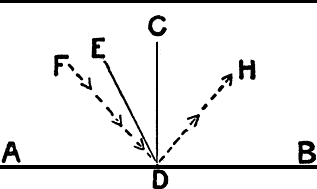
AB represents the back surface of a piece of diamond.
CD is a line perpendicular to AB.
Angle CDE is about 24 degrees.
Dotted line, FDH represents the course taken by a ray of light which is totally reflected at D in such fashion that angle FDA equals angle HDB.
Any light proceeding towards AB but between E and C, would fail to be totally reflected. Most of it would penetrate AB.
Total Reflection. For diamond this critical angle, as it is called, is very nearly 24° from a perpendicular to the surface. If now, we shape a diamond so that most of the light that enters it from the front falls upon the first back surface that it meets, at an angle greater than 24° to a perpendicular to that surface, the light will be totally reflected within the stone. The angle at which it is reflected will be the same as that at which it meets the surface. In other words the angles of incidence and of reflection are equal. See Fig. 9 for an illustration of this point.
Theory of the "Brilliant." In the usual "brilliant" much of the light that enters through the front surface is thus totally reflected from the first rear facet that it meets and then proceeds across the stone to be again totally reflected from the opposite side of the brilliant. This time the light proceeds toward the top of the stone. See Fig. 10—(From G. F. Herbert-Smith's Gem-Stones).
The angles of the top of a brilliant are purposely made so flat that the up coming light fails to be totally reflected again and is allowed to emerge to dazzle the beholder. In the better made brilliants the angle that the back slope makes with the plane of the girdle is very nearly 41° and the top angle, or angle of the front slope to the plane of the girdle is about 35°. Such well made brilliants when held up to a bright light appear almost black—that is, they fail to pass any of the light through them (except through the tiny culet, which, being parallel to the table above, passes light that comes straight down to it).
Fig. 10.—Course of the Rays of Light Passing Through a Brilliant.
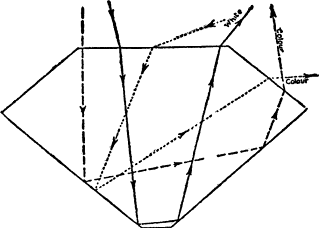
In other words, instead of allowing the light to penetrate them, well-made brilliants almost totally reflect it back toward its source, that is, toward the front of the stone. The well-cut diamond is a very brilliant object, viewed from the front.
We must now consider how the "fire" or prismatic color play is produced, for it is even more upon the display of fire than upon its pure white brilliancy that the beauty of a diamond depends.
Cause of "Fire." As we saw in Lesson X. (which it would be well to re-read at this time), white light that changes its course from one transparent medium to another at any but a right angle to the surface involved, is not only refracted (as we saw in Lesson II.) but is dispersed, that is, light of different colors is bent by differing amounts and thus we have a separation of the various colors. If this takes place as the ray of light leaves the upper surface of a brilliant the observer upon whose eye the light falls will see either the red, or the yellow, or the blue, as the case may be, rather than the white light which entered the stone. If instead, the dispersion takes place as the light enters the brilliant the various colored rays thus produced will be totally reflected back to the observer (slightly weakened by spreading, as compared to the direct or unreflected spectra). Thus dispersion produces the "fire" in a brilliant.
Other materials than diamond behave similarly, but usually to a much smaller extent, for few gem materials have so high a refractive power or so great a dispersive power as diamond.
Having considered the theory of the brilliant we may now take up a study of the methods by which the exceedingly hard rough diamond is shaped and polished.
Cleaving Diamonds. If the rough material is of poor shape, or if it has conspicuous defects in it which prevent its being made into a single stone, it is cleaved (i. e., split along its grain). Hard as it is, diamond splits readily in certain definite directions (parallel to any of the triangular faces of the octahedral crystal). The cleaver has to know the grain of rough diamonds from the external appearance, even when the crystals, as found, are complicated modifications of the simple crystal form. He can thus take advantage of the cleavage to speedily reduce the rough material in size and shape to suit the necessity of the case. The cleaving is accomplished by making a nick or groove in the surface of the rough material at the proper point (the stone being held by a tenacious wax, in the end of a holder, placed upright in a firm support). A thin steel knife blade is then inserted in the nick and a sharp light blow struck upon the back of the knife blade. The diamond then readily splits.
"Cutting Diamonds." The next step is to give the rough material a shape closely similar to that of the finished brilliant but rough and without facets. This shaping or "cutting" as it is technically called, is done by placing the rough stone in the end of a holder by means of a tough cement and then rotating holder and stone in a lathe-like machine. Another rough diamond (sometimes a piece of bort, unfit for cutting, and sometimes a piece of material of good quality which it is necessary to reduce in size or alter in shape) is cemented into another holder and held against the surface of the rotating diamond. The holder is steadied against a firm support. It now becomes a case of "diamond cut diamond," each stone wearing away the other and being worn away itself.
The cutting process is fairly rapid and it leaves the stone (which is reversed to make the opposite side) round in form and with a rounding top and cone-shaped back. Stones of fancy shape, such as square, or cushion shape, have to be formed in part by hand rubbing or "bruting" as it is called.
The facets must now be polished onto the stone. Usually the workers who cut do not cleave or polish.
"Polishing" Diamonds. The polisher fixes the cut stone firmly in a metallic holder called a dop, which is cleverly designed to hold the stone with much of one side of it exposed. The holder is then inverted so that the stone is beneath and a stout copper wire attached to the holder is then clamped firmly in a sort of movable vise. The latter is then placed on the bench in such a position that the diamond rests upon the surface of a rapidly revolving horizontal iron wheel or "lap" as it is called. The surface of the latter is "charged" with diamond dust, that is, diamond dust has been pushed into the metal surface which thus acts as a support to the dust. The latter wears away the diamond, producing a flat facet. The lap is kept moistened with oil and from time to time fresh oil and diamond dust are applied. A speed of about 2,000 rotations per minute is used.
Facetting. The making of the facets is rather slow work, especially when, as is usually the case in making the "table" the work has to be done against one of the "hard points" of the crystal. Great care has to be taken to place the stone so that the grain lies in a correct position, for diamond cannot be polished against the grain, nor even exactly with it, but only obliquely across it. This requirement, as much as anything, has prevented the use of machines in polishing diamonds. The table is usually first polished on, then the four top slopes, dividing the top surface into quarters, then each of the four ridges thus left, is flattened, making eight facets and finally 32 facets, exclusive of the table, are made upon the top of the brilliant. The stone is then reversed and 24 facets, and the culet, polished on the back. As each facet nears its proper shape the stone is placed upon a particularly smooth part of the lap and a slight vibratory motion given to the holder by the hand. This smooths out any lines or grooves that may have formed because of inequalities of surface of the lap. When completely facetted the brilliant is finished and requires only to be cleaned, when it is ready for sale.