LESSON III
Reading edition
DOUBLE REFRACTION
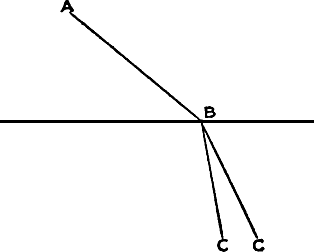
Explanation of Double Refraction. In Lesson II. we learned what is meant by refraction of light. While glass and a small number of precious stones (diamond, garnet, and spinel) bend light as was illustrated in Fig. 1, practically all the other stones cause a beam of light on entering them to separate, and the path of the light in the stone becomes double, as shown in Fig. 2.
This behavior is called double refraction. It may be used to distinguish those stones which are doubly refracting from those which are not. For example, in the case of a stone which is doubly refracting to a strong degree, such as a peridot (the lighter yellowish-green chrysolite is the same material and behaves similarly toward light), the separation of the light is so marked that the edges of the rear facets, as seen through the table, appear double when viewed through a lens. A zircon will also similarly separate light and its rear facets also appear double-lined as seen with a lens from the table of the stone. The rarer stones, sphene and epidote, likewise exhibit this property markedly. Some colorless zircons, when well cut, so closely resemble diamonds that even an expert might be deceived, if caught off his guard, but this simple test of looking for the doubled lines at the back of the stone would alone serve to distinguish the two stones.
Fig. 2.
A Simple but very Valuable Test for the Kind of Refraction of a Cut Stone. In the case of most of the other doubly refracting stones the degree of separation is much less than in peridot and zircon, and it takes a well-trained and careful eye to detect the doubling of the lines. Here a very simple device will serve to assist the eye in determining whether a cut stone is singly or doubly refracting. Expose the stone to direct sunlight and hold an opaque white card a few inches from the stone, in the direction of the sun, so as to get the bright reflections from within the stone reflected onto the card.
If the material is singly refractive (as in the case of diamond, garnet, spinel, and glass), single images of each of the reflecting facets will appear on the card, but if doubly refracting—even if slightly so—double images will appear. When the stone is slightly moved, these pairs of reflections will travel together as pairs and not tend to separate. The space between the two members of each pair of reflections serves to give a rough idea of the degree of the double refraction of the material if compared with the space between members in the case of some other kind of stone held at the same distance from the card. Thus zircon separates the reflections widely. Aquamarine, which is feebly doubly refracting, separates them but slightly.
It will be seen at once that we have here a very easily applied test and one that requires no costly apparatus. It is, furthermore, a sure test, after a little practice. For example, if one has something that looks like a fine emerald, but that may be glass, all one need to do is to expose it in the sun, as above indicated. If real emerald, double images will be had (very close together, because emerald is but feebly doubly refracting). If glass, the images on the card will be single.
Similarly, ruby can at once be distinguished from even the finest garnet or ruby spinel, as the last two are singly refracting. So, too, are glass imitations of ruby and ruby doublets (which consist of glass and garnet). This test cannot injure the stone, it may be applied to mounted stones, and it is reliable. For stones of very deep color this test may fail for lack of sufficiently brilliant reflections. In such a case hold the card beyond the stone and let the sunlight shine through the stone onto the card, observing whether the spots of light are single or double.
The table below gives the necessary information as to which stones show double and which single refraction.
Table Giving Character of Refraction in the Principal Gems
Refraction Single:
Diamond
Garnet (all types)
Spinel
Opal
Glass
Difference between highest and lowest refractive indices
Refraction Double:
Sphene.084
Zircon.053
Benitoite.047
Peridot or chrysolite.038
Epidote.031
Tourmaline.020
Kunzite.015
Ruby and sapphire.009
Topaz (precious).009
Amethyst and quartz topaz.009
Emerald and aquamarine.007
Chrysoberyl.007
The student should now put into practice the methods suggested in this lesson. Look first for the visible doubling of the lines of the back facets in peridot (or chrysolite); then in zircon; then in some of the less strongly doubly refracting stones; then try the sunlight-card method with genuine stones and with doublets and imitations until you can tell every time whether you are dealing with singly or doubly refracting material. When a stone of unknown identity comes along, try the method on it and thus assign it as a first step to one or the other class. Other tests will then be necessary to definitely place it.
Differences in Refraction Due to Crystal Form. The difference in behavior toward light of the singly and doubly refracting minerals depends upon the crystal structure of the mineral. All gems whose crystals belong in the cubic system are singly refracting in all directions: In the case of some other systems of crystals the material may be singly refracting in one or in two directions, but doubly refracting in other directions. No attention need be paid to these complications, however, when using the sunlight-card method with a cut stone, for in such a case the light in its course within the stone will have crossed the material in two or more directions, and the separation and consequent doubling of image will be sure to result. For those who wish to study double refraction more in detail, Chapter VI., pages 40-52, of G. F. Herbert-Smith's Gem-Stones will serve admirably as a text. As an alternative any text-book on physics will answer.