Part 6 — CHAPTER XXXV THE NEW MODEL ARMY. 1644-1649
Reading edition
LEADING DATES Reign of Charles I., 1625-1649
Battle of Naseby June 14, 1645
Glamorgan's Treaty Aug. 25, 1645
Charles in the hands of the Scots May 5, 1646
Charles surrendered by the Scots Jan. 30, 1647
Charles carried off from Holmby June 5, 1647
The Army in Military Possession of London Aug. 7, 1647
Charles's Flight from Hampton Court Nov. 11, 1647
The Second Civil War April to Aug., 1648
Pride's Purge Dec. 6, 1648
Execution of Charles Jan. 30, 1649
2. Milton's 'Areopagitica.' 1644.—By Cromwell, who in consequence of his tolerance was the idol of the Sectarians in the army, religious liberty had first been valued because it gave him the service of men of all kinds of opinions. On November 24, 1644, Milton, some of whose books had been condemned by the licensers of the press appointed by Parliament, issued Areopagitica, in which he advocated the liberty of the press on the ground that excellence can only be reached by those who have free choice between good and evil. "He that can apprehend," he wrote, "and consider vice with all her baits and seeming pleasures, and yet abstain—he is the true warfaring Christian. I cannot praise a fugitive and cloistered virtue, unexercised and unbreathed, that never sallies out and seeks her adversary, but slinks out of the race, when that immortal garland is to be run for, not without dust and heat." Liberty was good for religion as much as it was for literature. "These are the men," he continued, "cried out against for schismatics and sectaries, as if, while the temple of the Lord was building, there should be a sort of irrational men who could not consider there must be many schisms and many dissections made in the quarry and in the timber ere the house of God can be built." The perfection of the building consisted "in this—that out of many moderate varieties and brotherly dissimilitudes that are not vastly disproportional, arises the goodly and the graceful symmetry that commends the whole pile and structure."
3. The Execution of Laud. 1645.—In Parliament, at least, there was one direction in which neither Presbyterian nor Independent was inclined to be tolerant. They had all suffered under Laud, and Laud's impeachment was allowed to go on. The House of Lords pronounced sentence against him, and on January 10, 1645, he was beheaded. The Presbyterians had the majority in the House of Commons, and they were busy in enforcing their system, as far as Parliamentary resolutions would go. The Independents had to wait for better times.
4. Montrose and Argyle. 1644.—For the present, however, the two parties could not afford to quarrel, as a powerful diversion in the king's favour was now threatening them from Scotland. The Marquis of Montrose, who, in the Bishops' Wars, had taken part with the Covenanters, had grown weary of the interference of the Scottish Presbyterian clergy with politics, and still more weary of the supremacy in Scotland of the Marquis of Argyle, who had all the organisation of the Presbyterian Church at his disposal. Montrose saw that, though Argyle was too strong for him in the Lowlands, it was possible to assail him with effect in the Highlands, where he had made many enemies. In the Lowlands Argyle was regarded as a Scottish nobleman. In the Highlands he was the chief of the clan of the Campbells, which had often unscrupulously extended its borders at the expense of its neighbours, especially at the expense of the various clans of the Macdonalds. Montrose therefore hoped that if he threw himself into the Highlands, he might make use of the enmity of these clans against the Campbells to crush Argyle and to exalt the king.
5. Montrose in the Highlands. 1644-1645.—In 1644, shortly after the battle of Marston Moor, Montrose made his way to the Highlands with only two followers. He was the first to discover the capacity of the Highlanders for war. With their help, and with the help of a trained Irish contingent, mostly composed of the descendants of Highlanders who had emigrated to Ireland, he beat the Scottish forces at Tippermuir and Aberdeen, and then, crossing the mountains, amidst the snows of winter, harried the lands of the Campbells. On February 2, 1645, he defeated Argyle's clansmen at Inverlochy, whilst Argyle himself—who was no warrior—watched their destruction from a boat. Wherever Montrose went the heavy Lowland troops toiled after him in vain. On May 9 he overthrew another army under Baillie at Auldearn. Leven's Scottish army in Yorkshire had enough to do to bar the way against Montrose in case of his issuing from the mountains and attempting to join forces with Charles in England. With any other troops Montrose would probably have made the attempt already; but his Highlanders were accustomed to return home to deposit their booty in their own glens as soon as a battle had been won, and, therefore, victorious as he had been, he was unable to leave the Highlands.
6. The New Model Army in the Field. 1645.—The New Model army started on its career in April. Cromwell, with his highly-trained horse, swept round Oxford, cutting off Charles's supplies; whilst Fairfax was sent by the Committee of Both Kingdoms (see p. 542) to the relief of Taunton, which had been gallantly holding out under Robert Blake. A detachment of Fairfax's force sufficed to set Taunton free. His main force was stupidly sent by the Committee to besiege Oxford, though the king was marching northwards, and might fall upon Leven's Scots as soon as he reached them. On May 31, however, Charles turned sharply round, and stormed Leicester. The popular outcry in London compelled the Committee to allow their commander-in-chief to act on his own discretion; and Fairfax, abandoning the siege of Oxford, marched straight in pursuit of the Royal army.
7. The Battle of Naseby. 1645.—On June 14 Fairfax overtook the king at Naseby. In the battle which followed, the Parliamentary army was much superior in numbers, but it was largely composed of raw recruits (see p. 545), and its left wing of cavalry—under Ireton, who, in the following year, became Cromwell's son-in-law—was routed by the king's right, under Rupert. As at Edgehill, Rupert galloped hard in pursuit, without looking back. The Parliamentary infantry in the centre was by this time pressed hard, but Cromwell, on the right, at the head of a large body of cavalry, scattered the enemy's horse before him. Then, as at Marston Moor, he halted to see how the battle went elsewhere. Sending a detachment to pursue the defeated Royalists, he hurled the rest of his horse on the king's foot, who were slowly gaining ground in the centre. In those days, when half of every body of infantry fought with pikes, and the other half with inefficient muskets, it was seldom that foot-soldiers could withstand a cavalry charge in the open, and the whole of Charles's infantry, after a short resistance, surrendered on the spot. Rupert returned only in time to see that defeat was certain. The king, with what horse he could gather round him, made off as fast as he could. The stake played for at Naseby was the crown of England, and Charles had lost it.
8. The Results of Naseby. 1645.—Disastrous as Charles's defeat had been, he contrived to struggle on for some months. The worst thing that befel him after the battle was the seizure of his cabinet containing his correspondence, which revealed his constant intrigues to bring alien armies—French, Lorrainers, and Irish—into England. It was, therefore, in a more determined spirit than ever that Parliament carried on the war. After retaking Leicester, on June 18, Fairfax marched on to the West, where the king's eldest son, Charles, Prince of Wales, had been since the summer of 1644, and where debauched and reckless Goring was at the head of a Royalist army. On July 10 Fairfax routed him at Langport, and on July 23 took Bridgwater. Then, leaving forces to coop up Goring's remaining troops, Fairfax turned eastward, took Sherborne on August 2, whilst the Scots, who after Naseby had marched southwards, were besieging Hereford. On September 1, however, the king relieved Hereford, and fancied he might still retrieve his fortunes. On September 10, he received a severe blow. Fairfax stormed the outer defences of Bristol, and Rupert, who commanded the garrison, at once capitulated. There can be little doubt that he had no other choice; but Charles would hear no excuse, and dismissed him from his service.
9. Charles's Wanderings. 1645.—Charles's hopes were always springing up anew, and now that Rupert had failed him, he looked to Montrose for deliverance. Montrose, on July 2, had won another victory at Alford, and, on August 15, a still more crushing victory at Kilsyth, after which he had entered Glasgow, and received the submission of the Lowlands. Charles marched northward to meet him, but on the way was met and defeated by the Parliamentary general, Poyntz, on Rowton Heath. Almost immediately afterwards he heard the disastrous news that David Leslie, an able officer who had won renown in the German wars, and had fought well at Marston Moor, had been despatched from the Scottish army in England, had fallen upon Montrose at Philiphaugh, at a time when he had but a scanty following with him, and had utterly defeated him. After this Cromwell reduced the South, capturing Winchester and Basing House, whilst Fairfax betook himself to the siege of Exeter. In October, Charles, misled by a rumour that Montrose had recovered himself, made one more attempt to join him; but he was headed by the enemy, and compelled to retreat to Oxford, where, with all his followers ardently pleading for peace, he still maintained that his conscience would not allow him to accept any terms from rebels, or to surrender the Church of England into their hands.
10. Glamorgan in Ireland. 1645-1646.—Not one of Charles's intrigues with foreign powers did him so much harm as his continued efforts to bring over an Irish army to fight his battles in England. In 1645 he despatched the Roman Catholic Earl of Glamorgan to Ireland, giving him almost unlimited powers to raise money and men, and to make treaties with this object, but instructing him to follow the advice of Ormond. When Glamorgan arrived in Ireland, in August, he found that the Confederate Catholics were resolved to demand that all the churches in Ireland, except the few still in the hands of the English, should be given permanently to the Catholics, and that permission should be granted to their clergy to exercise jurisdiction in matters spiritual and ecclesiastical. Though Glamorgan knew that Charles had never approved of these concessions, he signed a treaty, on August 25, 1645, in which he granted all that was asked, in consideration of an engagement by the Confederates to place him at the head of 10,000 Irishmen destined for England. Before anything had been done, a Papal Nuncio, Rinuccini, landed in Ireland and required fresh concessions, to which Glamorgan readily assented. On January 16, 1646, however, before Glamorgan's army was ready to start, the treaty which he had made in August became known at Westminster; and, though Charles promptly disavowed having authorised its signature, there remained a grave suspicion that he was not as innocent as he pretended to be.
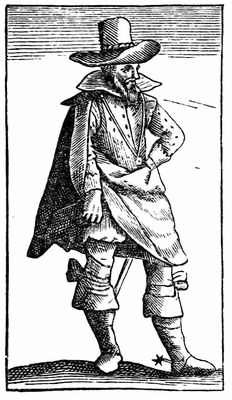
A gentleman.
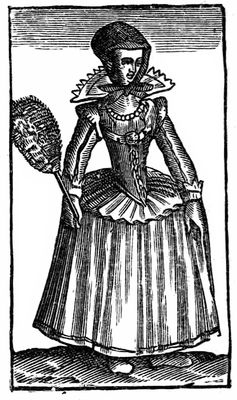
A gentlewoman.
Ordinary civil costume temp. Charles I.: from Speed's map of 'The Kingdom of England,' 1646.
11. The King's Flight to the Scots. 1646.—In the beginning of 1646 the Civil War virtually came to an end. On March 14, Charles's army in the West surrendered to Fairfax in Cornwall, and in the same month the last force which held the field for him was overthrown at Stow-on-the-Wold. Many fortresses still held out, but, as there was no chance of relief, their capture was only a question of time; and though the last of them—Harlech Castle—did not surrender till 1647, there was absolutely no doubt what the result would be. Charles, now again at Oxford, had but to choose to whom he would surrender. He chose to give himself up to the Scots, whose army was at the time besieging Newark. He seems to have calculated that they would replace him on the throne without insisting on very rigorous conditions, thinking that they would rather restore him to power than allow the English army, formidable as it was, to have undisputed authority in England, and possibly to crush the independence of Scotland. The Scots, on the other hand, seem to have thought that, when Charles was once in their power, he must, for his safety's sake, agree to establish Presbyterianism in England, by which means the party which would of necessity lean for support on themselves would have the mastery in England. On May 5, 1646, Charles rode in to the quarters of the Scottish army at Southwell, a few miles from Newark.
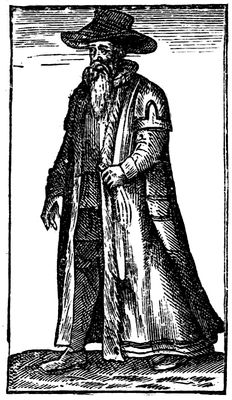
A citizen.
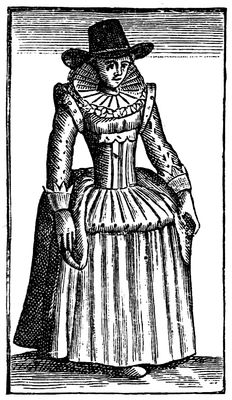
A citizen's wife.
Ordinary civil costume temp. Charles I.: from Speed's map of 'The Kingdom of England', 1646.
12. Charles at Newcastle. 1646.—Newark at once surrendered, and Charles was conveyed to Newcastle, where, as he refused to consent to the establishment of Presbyterianism in England, he was practically treated as a prisoner. At the end of 1645 and the beginning of 1646 there had been fresh elections to fill up seats in the House of Commons left vacant by Royalists expelled for taking the king's part; but, though many Independent officers were chosen, there was still a decidedly Presbyterian majority. On July 14 propositions for peace were delivered to Charles on behalf of Parliament and the Scots. He was to surrender his power over the militia for twenty years, to take the Covenant, and to support Presbyterianism in the Church. Charles, in his correspondence with his wife, showed himself more ready to abandon the militia than to abandon episcopacy; whilst she, being a Roman Catholic, and not caring for bishops whom she counted as heretics, advised him at all hazards to cling to the command of the militia. Charles hoped everything from mere procrastination. "All my endeavours," he wrote to the queen, "must be the delaying of my answer till there be considerable parties visibly formed"—in other words, till Presbyterians and Independents were ready to come to blows, and, therefore, to take him at his own price. In order to hasten that day, he made in October a proposal of his own, in which he promised, in case of his being restored to power, to establish Presbyterianism for three years, during which time the future settlement of the Church might be publicly discussed. He, however, took care to make no provision for the very probable event of the discussion leaving parties as opposed to one another as they had been before the discussion was opened, and it was obvious that, as he had never given the royal assent to any Act for the abolition of episcopacy, the whole episcopal system would legally occupy the field when the three years came to an end. The Presbyterians would thus find themselves checkmated by an unworthy trick.
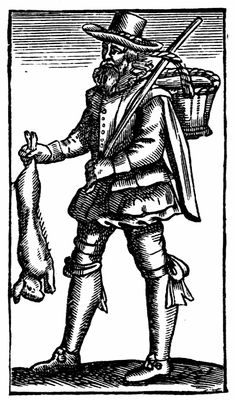
A countryman.
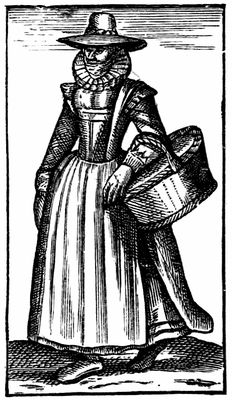
A countrywoman.
Ordinary civil costume temp. Charles I.: from Speed's map of 'The Kingdom of England,' 1646.
13. The Removal of the King to Holmby. 1647.—The Scots, discontented with the king's refusal to accept their terms, began to open their ears to an offer by the English Parliament to pay them the money owing to them for their assistance, on the open understanding that they would leave England, and the tacit understanding that they would leave the king behind them. Once more they implored Charles to support Presbyterianism, assuring him that, if he would, they would fight for him to a man. On his refusal, they accepted the English offer, took their money, and on January 30, 1647, marched away to their own country, leaving Charles in the hands of Commissioners of the English Parliament, who conveyed him to Holmby House, in Northamptonshire.
16. The Abduction of the King. 1647.—The fact was that the Presbyterian leaders fancied themselves masters of the situation. Receiving a favourable answer from the king to the proposals made by them in January (see p. 553), they entered into a negotiation with the French ambassador and the Scottish commissioners to bring about a Scottish invasion of England on the king's behalf, and this invasion was to be supported by a Presbyterian and Royalist rising in England. In the meanwhile Charles was to be conveyed away from Holmby to preserve him from the army. This design was betrayed to Cromwell, and, in consequence, he secretly gave instructions to a certain Cornet Joyce to take a body of cavalry to hinder the Scots and Presbyterians from carrying off the king, but only, as it seems, to remove him from Holmby if force was likely to be used on the other side. On June 3, Joyce, with a picked body of horse, appeared at Holmby, where he received news which led him to think that a Presbyterian body of troops was approaching with the intention of taking possession of the king's person. Late in the evening, therefore, imagining that the danger foreseen as possible in Cromwell's instructions had really arrived, he invited the king to leave Holmby the next morning. When the morning came Charles, stepping out on the lawn, asked Joyce for a sight of the commission which authorised him to give such unexpected orders. "There is my commission," answered Joyce, pointing to his soldiers. There was no resisting such an argument, and Charles was safely conducted to Newmarket.
17. The Exclusion of the Eleven Members. 1647.—Parliament, dissatisfied with this daring act, began to levy troops in London, and reorganised the London trained bands, excluding all Independents from their ranks. The army declared that eleven members of the House of Commons—the leaders of the Presbyterian party—were making arrangements for a new war, and sent in charges against them. The eleven members, finding themselves helpless, asked leave of absence. The City of London was as Presbyterian as Parliament. A mob burst into the House, and, under stress of violence, the Independent members, together with the Speakers of the two Houses, left Westminster and sought protection with the army. The Presbyterians kept their seats, and voted to resist the army by force. The army took advantage of the tumult to appear on the scene as the vindicators of the liberties of Parliament and, marching upon London, passed through the City on August 7, leaving sufficient forces behind to occupy Westminster and the Tower. The eleven Presbyterian members sought refuge on the Continent.
18. The Heads of the Proposals. 1647.—In the meanwhile Cromwell was doing his best to come to an understanding with Charles. A constitutional scheme, to which was given the name of The Heads of the Proposals, was drawn up by Ireton and presented in the name of the army to the king. It provided for a constant succession of biennial Parliaments with special powers over the appointment of officials, and it proposed to settle the religious difficulty by giving complete religious liberty to all except Roman Catholics. Those who chose to do so might submit to the jurisdiction of bishops, and those who chose to do so might submit to the jurisdiction of a presbytery; but no civil penalties were to be inflicted on those who objected either to Episcopacy or to Presbyterianism or to both.
19. The King's Flight to the Isle of Wight. 1647.—No proposals so wise and comprehensive had yet been made, but neither Charles nor the Parliament was inclined to accept them. Many of the Agitators, finding that there was still a Presbyterian majority in Parliament, talked of using force once more and of purging the Houses of all the members who had sat in them whilst the legitimate Speakers were absent. In the meanwhile the king grew more hostile to Cromwell every day, and entered secretly into a fresh negotiation with the Scottish commissioners who formed part of the Committee of both Kingdoms, asking them for the help of a Scottish army. The more advanced Agitators proposed a still more democratic constitution than The Heads of the Proposals, under the name of The Agreement of the People, and attempted to force it upon their officers by threats of a mutiny. At the same time, they and some of the officers talked of bringing the king to justice for the bloodshed which he had caused. Charles, becoming aware of his danger, fled on November 11 to the Isle of Wight, thinking that it would be easy to escape whenever he wished. He was, however, detained in Carisbrooke Castle, where he was treated very much as a prisoner.
20. The Scottish Engagement, and the Vote of No Addresses. 1647-1648.—Cromwell put down the mutiny in the army, but he learnt that the king was intriguing with the Scots, and at last abandoned all hope of settling the kingdom with Charles's help. On December 26, 1647, Charles entered into an Engagement with the Scottish commissioners. On the condition of having toleration for his own worship, according to the Prayer Book, he agreed to establish Presbyterianism in England for three years, and to suppress all heresy. The Scottish army was then to advance into England to secure the king's restoration to power in accordance with the wishes of a free Parliament, to be chosen after the existing one had been dissolved. The English Parliament, indeed, had no knowledge of this engagement, but finding that Charles refused to accept their terms, they replied, on January 17, 1648, by a Vote of No Addresses, declaring that they would make no more proposals to the king.
21. The Second Civil War. 1648.—The majority of Englishmen were, on the contrary, ready to take Charles at his word. Men were weary of being controlled by the army, and still more of paying the taxes needed for the support of the army. There were risings in Wales and Kent, and a Scottish army prepared to cross the borders under the Duke of Hamilton. The English army had, however, made up its mind that Charles should not be restored. Fairfax put down the rising in Kent after a sharp fight at Maidstone, and drove some of the fugitives across the Thames into Essex, where being outnumbered they took refuge in Colchester. Fairfax, following them up, laid siege to Colchester, though the Londoners threatened to rise in his rear, and a great part of the fleet deserted to the Prince of Wales, who came from France to take the command. In the meanwhile Cromwell suppressed the insurrection in Wales, and then marched northwards. On August 17, with less than 9,000 men, he fell upon the 24,000 who followed Hamilton, and, after three days' fighting, routed them utterly. On August 28 Colchester surrendered to Fairfax.
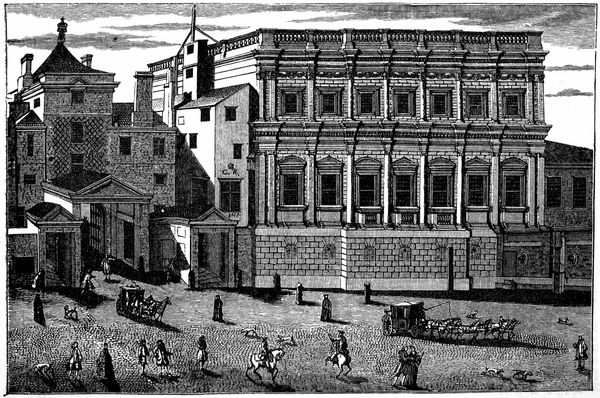
View of the west side of the Banqueting House, Whitehall: from an engraving by Terasson, dated 1713. It is believed that Charles came out through the window above which a crown is marked.
23. The High Court of Justice. 1649.—On January 1, 1649, the purged House proposed to appoint a High Court of Justice to try Charles, but the Lords refused to take part in the act. On the 4th the Commons declared that the people were, under God, the source of all just power, and that the House of Commons, being chosen by the people, formed the supreme power in England, having no need of either king or House of Lords. Never was constitutional pedantry carried further than when this declaration was issued by a mere fragment of a House which, even if all its members had been present, could only claim to have represented the people some years before. On January 6 a special High Court of Justice was constituted by the mutilated House of Commons alone, for the trial of the king. On January 19 Charles was brought up to Westminster. Only the sternest opponents of Charles would consent to sit on the Court which tried him. Of 135 members named, only 67 were present when the trial began. Fairfax was amongst those appointed, but he absented himself, and when his name was called, his wife cried out, "He is not here, and will never be; you do wrong to name him."
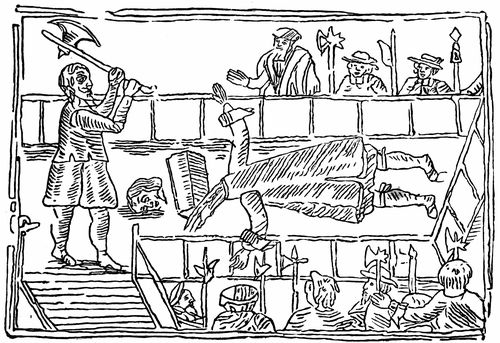
Execution of King Charles I., January 30, 1649: from a contemporary broadside.
24. The King's Trial and Execution. 1649.—Charles's accusers had on their side the discredit which always comes to those who, using force, try to give it the appearance of legality. Charles had all the credit of standing up for the law, which, in his earlier life, he had employed to establish absolutism. He refused to plead before the Court, on the ground that it had no jurisdiction over a king. His assailants fell back on the merest technicalities. Instead of charging him with the intrigues to bring foreign armies into England, of which he had been really guilty, they accused him of high treason against the nation, because, forsooth, he had appeared in arms against his subjects in the first Civil War. The Court, as might have been expected, passed sentence against him, and, on January 30, he was beheaded on a scaffold in front of his own palace at Whitehall.
25. Results of Charles's Execution. 1649.—With the king's execution all that could be permanently effected by his opponents had been accomplished. When the Long Parliament met, in November 1640, all Englishmen had combined to bring Charles to submit to Parliamentary control. After the summer of 1641 a considerable part of the nation, coming to the conclusion that Charles was ready to use force rather than to submit, took arms against him to compel him to give way. Towards the end of 1647 a minority of Englishmen, including the army, came to the conclusion that it was necessary to deprive Charles of all real power, if the country was not to be exposed to constantly recurring danger whenever he saw fit to re-assert his claims to the authority which he had lost. In 1648 a yet smaller minority came to the conclusion that security could only be obtained if he were deprived of life. In depriving the king of life all had been done which force could do. The army could guard a scaffold, but it could not reconstruct society. The vast majority of that part of the nation which cared about politics at all disliked being ruled by an army even more than it had formerly disliked being ruled by Charles, and refused its support to the new institutions which, under the patronage of the army, were being erected in the name of the people.