Part 5 — CHAPTER XXVIII THE ELIZABETHAN SETTLEMENT IN CHURCH AND STATE 1558-1570
Reading edition
LEADING DATES Reign of Elizabeth, 1558-1603
Accession of Elizabeth 1558
The Acts of Supremacy and Uniformity 1559
The Treaty of Edinburgh 1560
Mary Stuart lands in Scotland 1561
End of the Council of Trent 1563
Marriage of Mary and Darnley 1565
Murder of Darnley 1567
Escape of Mary into England 1568
The rising in the North 1569
Papal excommunication of Elizabeth 1570
1. Elizabeth's Difficulties. 1558.—Elizabeth, when she received the news of her sister's death, was sitting under an oak in Hatfield Park (see p. 423). "This," she exclaimed, "is the Lord's doing, and it is marvellous in our eyes." Her life's work was to throw down all that Mary had attempted to build up, and to build up all that Mary had thrown down. It was no easy task that she had undertaken. The great majority of her subjects would have been well pleased with a return to the system of Henry VIII.—that is to say, with the retention of the mass, together with its accompanying system of doctrine, under the protection of the royal supremacy, in complete disregard of the threats or warnings of the Pope. Elizabeth was shrewd enough to see that this could not be. On the one hand, the Protestants, few as they were, were too active and intelligent to be suppressed, and, if Mary's burnings had been unavailing, it was not likely that milder measures would succeed. On the other hand, the experience of the reign of Edward VI. had shown that immutability in doctrine and practice could only be secured by dependence upon the immutable Papacy, and Elizabeth had made up her mind that she would depend on no one but herself. She would no more place herself under the Pope than she would place herself under a husband. She cared nothing for theology, though her inclinations drew her to a more elaborate ritual than that which the Protestants had to offer. She was, however, intensely national, and was resolved to govern so that England might be great and flourishing, especially as her own greatness would depend upon her success. For this end she must establish national unity in the Church, a unity which, as she was well aware, could only be attained if large advances were made in the direction of Protestantism. There must be as little persecution as possible, but extreme opinions must be silenced, because there was a danger lest those who came under their influence would stir up civil war in order to make their own beliefs predominant. The first object of Elizabeth's government was internal peace.
3. The new Bishops and the Ceremonies. 1559-1564.—All the bishops except one refusing to accept the new order of things, new ones were substituted for them, the old system of election by the chapters on a royal congé d'élire being restored (see pp. 391, 415). Matthew Parker, a moderate man after Elizabeth's own heart, became Archbishop of Canterbury. Very few of the old clergy who had said mass in Mary's reign refused to use the new Prayer Book, and as Elizabeth prudently winked at cases in which persons of importance had mass said before them in private, she was able to hope that, by leaving things to take their course, a new generation would grow up which would be too strong for the lovers of the old ways. The main difficulty of the bishops was with the Protestants. Many of those who had been in exile had returned with a strengthened belief that it was absolutely unchristian to adopt any vestments or other ceremonies which had been used in the Papal Church, and which they, therefore, contumeliously described as rags of Antichrist. A large number even of the bishops sympathised with them, and opposed them only on the ground that, though it would have been better if surplices and square caps had been prohibited, still, as such matters were indifferent, the queen ought to be obeyed in all things indifferent. To Elizabeth refusal to wear the surplice was not only an act of insubordination, but likely to give offence to lukewarm supporters of the Church system which she had established, and had, therefore, a tendency to set the nation by the ears. In Parker she found a tower of strength. He was in every sense the successor of Cranmer, with all Cranmer's strength but with none of Cranmer's weakness. He fully grasped the principle that the Church of England was to test its doctrines and practices by those of the Church of the first six hundred years of Christianity, and he, therefore, claimed for it catholicity, which he denied to the Church of Rome; whilst he had all Cranmer's feeling for the maintenance of external rites which did not directly imply the existence of beliefs repudiated by the Church of England.
4. Calvinism.—The returning exiles had brought home ideas even more distasteful to Elizabeth than the rejection of ceremonies. The weak point of the Lutherans in Germany, and of the reformers in England, had been their dependence upon the State. This dependence made them share the blame which fell upon rulers who, like Henry VIII., were bent on satisfying their passions, or, like Northumberland, on appropriating the goods of others. Even Elizabeth thought first of what was convenient for her government, and secondly, if she thought at all, of the quest after truth and purity. In Geneva the exiles had found a system in full working order which appeared to satisfy the cravings of their minds. It had been founded by a Frenchman, John Calvin, who in 1536 had published The Institution of the Christian Religion, in which he treated his subject with a logical coherence which impressed itself on all Protestants who were in need of a definite creed. He had soon afterwards been summoned to Geneva, to take charge of the congregation there, and had made it what was extensively believed to be, a model Church. With Calvin everything was rigid and defined, and he organised as severely as he taught. He established a discipline which was even more efficacious than his doctrine. His Church proclaimed itself, as the Popes had proclaimed themselves, to be independent of the State, and proposed to uphold truth and right irrespective of the fancies and prejudices of kings. Bishops there were to be none, and the ministers were to be elected by the congregation. The congregation was also to elect lay-elders, whose duty it was to enforce morality of the strictest kind; card-playing, singing profane songs, and following after amusements on the Sunday—or Sabbath as it was called in Geneva—being visited with excommunication. The magistrates were expected to inflict temporal penalties upon the offender. This Presbyterian system, as it was called, spread to other countries, especially to countries like France, where the Protestant congregations were persecuted by the Government. In France a final step was taken in the Presbyterian organisation. The scattered congregations elected representatives to meet in synods or assemblies, and the French Government, in this way, found itself confronted by an ecclesiastical representative republic.
5. Peace with France. 1559.—It was this Calvinistic system which was admired by many of the exiles returning to England, but which Elizabeth detested as challenging her own authority. Her only chance of resisting with success lay in her power of appealing to the national instinct, and of drawing men to think more of unity and peace at home than of that search after truth which inevitably divides, because all human conceptions of truth are necessarily imperfect, and are differently held by different minds. To do this she must be able to show that she could maintain her independence of foreign powers. Though her heart was set on the recovery of Calais, she was obliged in 1559 to make peace with France, obtaining only a vague promise that it might be restored at a future time. Shortly afterwards peace was made between France and Spain at Câteau Cambresis. Elizabeth was aware that, though neither Philip II. of Spain nor Henry II. loved her, neither of them would allow the other to interfere to her detriment. She was therefore able to play them off one against the other. Her diplomacy was the diplomacy of her time. Elizabeth like her contemporaries, lied whenever it suited her to lie, and made promises which she never intended to perform. In this spirit she treated the subject of her marriage. She at once rejected Philip, who, though he was her brother-in-law, proposed to marry her immediately after her accession, but when he suggested other candidates for her hand, she listened without giving a decided answer. It was convenient not to quarrel with Philip, but it would be ruinous to accept a husband at his choice.
6. The Reformation in Scotland. 1559.—Philip was formidable to Elizabeth because he might place himself at the head of the English Catholics. Henry was formidable because the old alliance between France and Scotland, confirmed by the recent marriage of the Dauphin with Mary Stuart, made it easy for him to send French troops by way of Scotland into England. Early in Elizabeth's reign, however, events occurred in Scotland which threatened to sever the links between that country and France. The Regent, Mary of Guise—mother of the absent queen and sister of the Duke of Guise, the French conqueror of Calais, and leader of the French Catholics—was hostile to the Protestants not only by conviction, but because there had long been a close alliance between the bishops and the Scottish kings in their struggle with the turbulent nobles. The wealth of the bishops, however, great according to the standard of so poor a country, tempted the avarice of the nobles, and their profligacy, openly displayed, offended all who cared for morality. In 1559 a combination was formed amongst a large number of the nobles, known as the Lords of the Congregation, to assail the bishops. John Knox, the bravest and sternest of Calvinists, urged them on. The Regent was powerless before them. The mass was suppressed, images destroyed, and monasteries pulled down. Before long, however, the flood seemed about to subside as rapidly as it rose. The forces of the lords consisted of untrained peasants, who could not keep the field when the labours of agriculture called them home, and rapidly melted away. Then the Lords of the Congregation, fearing disaster, called on Elizabeth for help.
9. Scottish Presbyterianism. 1561.—The Scots had not failed to profit by the cessation of authority following on the death of Mary of Guise. They disclaimed the authority of the Pope and made it punishable to attend mass, the penalty for the third offence being death. The English Reformation had been the work of the king and of the clergy of the Renascence, and had, therefore, been carried on under the form of law. The Scottish Reformation had been the revolutionary work of the nobility and of the Calvinistic clergy. In England the power of the State had been strengthened. In Scotland it was weakened. Almost from the beginning the nobles who had taken part in the revolution showed signs of disagreement. A few of them were earnest Protestants, but there were more who cared only for political or personal ends. "I have lived many years," said the aged Lord Lindsay; "now that it hath pleased God to let me see this day ... I will say with Simeon, 'Now lettest Thou thy servant depart in peace.' "Hey then!" said Maitland of Lethington sarcastically, when he heard that the clergy claimed to govern the Church and own its property in the place of the bishops, "we may all bear the barrow now to build the house of the Lord." Knox organised the Church on a democratic and Presbyterian basis with Church Courts composed of the minister and lay elders in every parish, with representative Presbyteries in every group of parishes, and with a representative General Assembly for all Scotland. Like a prophet of old, Knox bitterly denounced those who laid a finger on the Church's discipline. The nobles let him do as he would as far as religion was concerned, but they insisted on retaining nominal bishops, not to rule the Church, but to hold the Church lands and pass the rents over to themselves.
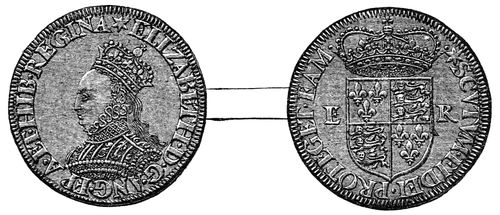
A 'milled' half-sovereign of Elizabeth, 1562-1568.
10. Mary and Elizabeth. 1561.—In August 1561 Mary landed in Scotland, having come by sea because Elizabeth refused to allow her to pass through England unless she would renounce her claim to the English crown. Mary would perhaps have yielded if Elizabeth would have named her as her successor. Elizabeth would do nothing of the kind. She had a special dislike to fixing on any one as her successor. About this time she threw into prison Lady Catherine Grey for committing the offence of marrying without her leave. Lady Catherine was the next sister of Lady Jane Grey, and therefore Elizabeth's heir if the will of Henry VIII. in favour of the Suffolk line (see p. 410) was to be held binding. Elizabeth no doubt had a political object in showing no favour to either of her expectant heirs. By encouraging Catherine's hopes she would drive her Catholic subjects to desperation. By encouraging Mary's she would drive her Protestant subjects to desperation. Yet there was also strong personal feeling to account for her conduct. She was resolved never to marry, however much her resolution might cost her. Yet she too was a very woman, hungry for manly companionship and care, and, though a politician to the core, was saddened and soured by the suppression of her womanly nature. To give herself a husband was to give herself a master, yet she dallied with the offers made to her, surely not from political craft alone. The thought of marriage, abhorrent to her brain, was pleasant to her heart, and she could not lightly speak the positive word of rejection. Even now, in the vain thought that she might rule a subject, even if she became his wife, she was toying with Lord Robert Dudley, the handsome and worthless son of the base Northumberland. So far did she carry her flirtations that tales against her fair fame were spread abroad, but marry him she never did. Her treatment of the Lady Catherine was doubtless caused far less by her fear of the claims of the Suffolk line than by her reluctance to think of one so near to her as a happy wife, and as years grew upon her she bore hardly on those around her who refused to live in that state of maidenhood which she had inflicted on herself.
12. End of the Council of Trent. 1563.—If Rome was to be victorious she must use other than carnal weapons. The main cause of the growth of Protestantism had been the revolt of honest minds against the profligacy of the Popes and the clergy. The Popes had after a long time learnt the lesson, and were now as austerely moral as Calvin himself. They had of late busied themselves with bringing the doctrines of the Church into a coherent whole, in order that they might be referred to with as much certainty as the Institution of Calvin was referred to by the Calvinist. This work was accomplished by an ecclesiastical council sitting at Trent, and composed mainly of Spanish and Italian prelates. The Council, having completed its task, broke up in 1563.
13. The Jesuits.—The main instruments of the Popes to win back those who had broken loose from their authority were the members of the Society of Jesus, usually known as Jesuits. The society was founded in 1540 by Ignatius Loyola, a Spanish knight who, having been incapacitated by a wound for a military career, had devoted himself to the chivalry of religion. The members of the society which he instituted were not, like the monks, to devote themselves to setting an example of ascetic self-denial, nor, like the friars, to combine asceticism with preaching or well-doing. Each Jesuit was to give himself up to winning souls to the Church, whether from heathenism or from heresy. With this end, the old soldier who established the society placed it under more than military discipline. The first virtue of the Jesuit was obedience. He was to be in the hands of his superior as a stick in the hand of a man. He was to do as he was bidden, unless he was convinced that he was bidden to commit sin. What was hardest, perhaps, of all was that he was not allowed to judge his own character in choosing his work. He might think that he was admirably qualified to be a missionary in China, but if his superior ordered him to teach boys in a school, a schoolmaster he must become. He might believe himself to be a great scholar and fitted by nature to impart his knowledge to the young, but if his superior ordered him to go as a missionary to China, to China he must go. Discipline voluntarily accepted is a great power in the world, and this power the Jesuits possessed.
14. The Danger from Scotland. 1561-1565.—Whilst the opposing forces of Calvinism and the reformed Papacy were laying the foundations of a struggle which would split western Europe in twain, Elizabeth was hampered in her efforts to avert a disruption of her own realm by the necessity of watching the proceedings of the Queen of Scots. If in Elizabeth the politician predominated over the woman, in Mary the woman predominated over the politician. She was keen of sight, strong in feeling, and capable of forming far-reaching schemes, till the gust of passion swept over her and ruined her plans and herself together. After her arrival in Scotland she not only acknowledged the new Calvinistic establishment, but put down with a strong hand the Earl of Huntly, who attempted to resist it, whilst on the other hand she insisted, in defiance of Knox, on the retention of the mass in her own chapel. It is possible that there was in all this a settled design to await some favourable opportunity, as she knew that there were many in Scotland who cherished the old faith. It is possible, on the other hand, that she thought for a time of making the best of her uneasy position, and preferred to be met with smiles rather than with frowns. Knox, however, took care that there should be frowns enough. There was no tolerant thought in that stern heart of his, and he knew well that Mary would in the end be found to be fighting for her creed and her party. Her dancing and light gaiety he held to be profane. The mass, he said, was idolatry, and according to Scripture the idolater must die. There was in Scotland as yet no broad middle class on which Mary could rely, and, feeling herself insulted both as a queen and as a woman, she took up Knox's challenge. She had but the weapons of craft with which to fight, but she used them admirably, and before long, with her winning grace, she had the greater number of the nobility at her feet.
16. The Murder of Rizzio. 1566.—Mary had taken a coarse-minded fool for her husband, and had to suffer from him all the tyranny which a heartless man has it in his power to inflict on a woman. Her heart craved for affection, and Darnley, who plunged without scruple into the most degrading vice, believed, or affected to believe, that his wife had sacrificed her honour to David Rizzio, a cultivated Italian who acted as her secretary, and carried on her correspondence with the Continental powers. A league for the murder of Rizzio—such things were common in Scotland—was formed between Darnley and the Protestant lords. On March 9, 1566, they burst into Mary's supper-room at Holyrood. Rizzio clung to his patroness's robe, but was dragged off and slain. Murray with his fellow-conspirators came back to Scotland. Mary, however, with loving looks and words, won over the husband whom she despised, broke up the confederacy, and drove most of the confederates out of the country.
17. The Murder of Darnley. 1567.—On June 19, 1566, Mary gave birth to a son, afterwards James VI. of Scotland, and James I. of England. His birth gave strength to the party in England which was anxious to have Mary named heiress of the crown. Whatever little chance there was of Elizabeth's consent being won was wrecked through a catastrophe in which Mary became involved. Mary despised her miserable husband as thoroughly as he deserved. He at least, weak as water, could give her no help in her struggle with the nobles. Her passionate heart found in the Earl of Bothwell one who seemed likely to give her all that she needed—a strong will in a strong body, and a brutal directness which might form a complement to her own intellectual keenness. Mary and Bothwell were both married, but Bothwell at least was not to be deterred by such an obstacle as this. The evidence on Mary's conduct is conflicting, and modern enquirers have not succeeded in coming to an agreement about it. It is possible that she did not actually give her assent to the evil deed which set her free; but it can hardly be doubted that she at least willingly closed her eyes to the preparations made for her husband's murder. Whatever the truth as to her own complicity may be, it is certain that on February 10, 1567, Darnley was blown up by gunpowder at Kirk o' Field, a lonely house near Edinburgh, and slain by Bothwell, or by Bothwell's orders, as he was attempting to escape. Bothwell then obtained a divorce from his own wife, carried Mary off—not, as was firmly believed at the time, against her will—and married her.
18. The Deposition and Flight of Mary. 1567-1568.—Mary, in gaining a husband, had lost Scotland. Her subjects rose against her as an adulteress and a murderess. At Carberry Hill, on June 15, 1567, her own followers refused to defend her, and she was forced to surrender, whilst Bothwell fled to Denmark, remaining in exile for the rest of his life. Mary was imprisoned in a castle on an island in Loch Leven, and on July 24 she was forced to abdicate in favour of her son. Murray acted as regent in the infant's name. On May 2, 1568, Mary effected her escape, and rallied to her side the family of the Hamiltons, which was all-powerful in Clydesdale. On May 13 she was defeated by Murray at Langside, near Glasgow. Riding hard for the Solway Firth, she threw herself into a boat, and found herself safe in Cumberland. She at once appealed to Elizabeth, asking not for protection only, but for an English army to replace her on the throne of Scotland.
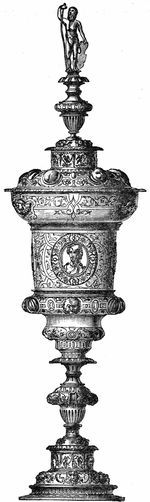
Silver-gilt standing cup made in London in 1569-70, and given to Corpus Christi College, Cambridge, by Archbishop Parker.
19. Mary's Case before English Commissioners. 1568-1569. Elizabeth could hardly replace her rival in power, and was still less inclined to set her at liberty, lest she should go to France, and bring with her to Scotland another French army. After innumerable changes of mind Elizabeth appointed a body of commissioners to consider the case against Mary. Before them Murray produced certain letters contained in a casket, and taken after Bothwell's flight. The casket letters, as they are called, were alleged to be in Mary's handwriting, and, if genuine, place out of doubt her guilty passion for Bothwell, and her connivance in her husband's murder. They were acknowledged by the commissioners, with the concurrence of certain English lords who were politically partisans of Mary, to be in her hand. Mary—either, as her adversaries allege, because she knew that she was guilty, or as her supporters allege, because she was afraid that she could not obtain justice—withdrew her advocates, and pleaded with Elizabeth for a personal interview. This Elizabeth refused to grant, but on the other hand she denied the right of the Scots to depose their queen. Mary remained virtually a prisoner in England. She was an interesting prisoner, and in spite of all her faults there were many who saw in her claim to the English crown the easiest means of re-establishing the old Church and the old nobility.
20. The Rising in the North. 1569.—The old Church and the old nobility were strongest in the North, where the Pilgrimage of Grace had broken out in 1536 (see p. 397). The northern lords, the Earls of Northumberland and Westmorland, longed to free Mary, to proclaim her queen of England, and to depose Elizabeth. They were, however, prepared to content themselves with driving Cecil from power, with forcing Elizabeth to acknowledge Mary as her heir, and to withdraw her support from Protestantism. Mary, according to this latter plan, was to marry the Duke of Norfolk, the son of that Earl of Surrey who had been executed in the last days of Henry VIII. (see p. 411). On October 18 Elizabeth, suspecting that Norfolk was entangling himself with the Queen of Scots, sent him to the Tower. Northumberland and Westmorland hesitated what course to pursue, but a message from the Queen requiring their presence at Court decided them, and they rose in insurrection. On November 14, with the northern gentry and yeomanry at their heels, they entered Durham Cathedral, tore in pieces the English Bible and Prayer Book, and knelt in fervour of devotion whilst mass was said for the last time in any one of the old cathedrals of England. Elizabeth sent an army against the earls. Both of them were timorous and unwarlike, and they fled to Scotland before the year was ended, leaving their followers to the vengeance of Elizabeth. Little mercy was shown to the insurgents, and cruel executions followed this unwise attempt to check the progress of the Reformation.
21. The Papal Excommunication. 1570.—Elizabeth, it seemed for all her triumph over the earls, had a hard struggle still before her. In January 1570 the regent Murray was assassinated by Hamilton of Bothwellhaugh, and Mary's friends began again to raise their heads in Scotland. In April Pope Pius V. excommunicated Elizabeth and absolved her subjects from their allegiance. In May, a fanatic named Felton affixed the Pope's bull of excommunication to the door of the Bishop of London's house. Felton was eventually seized and executed, but his deed was a challenge which Elizabeth would be compelled to take up. Hitherto she had trusted to time to bring her subjects into one way of thinking, knowing that the younger generation was likely to be on her side. She had taken care to deal as lightly as possible with those who shrank from abandoning the religion of their childhood, and she had recently announced that they were free to believe what they would if only they would accept her supremacy. The Pope had now made it clear that he would not sanction this compromise. Englishmen must choose between him and their queen. On the side of the Pope it might be argued with truth that with Elizabeth on the throne it would be impossible to maintain the Roman Catholic faith and organisation. On the side of the queen it might be argued that if the Papal claims were admitted it would be impossible to maintain the authority of the national government. A deadly conflict was imminent, in which the liberty of individuals would suffer whichever side gained the upper hand. Nations, like persons, cannot attend to more than one important matter at a time, and the great question at issue in Elizabeth's reign was whether the nation was to be independent of all foreign powers in ecclesiastical as well as in civil affairs.