Part 3 — CHAPTER XIV. EDWARD I. AND EDWARD II. EDWARD I., 1272—1307. EDWARD II., 1307—1327.
Reading edition
LEADING DATES
Accession of Edward I. 1272
Death of Alexander III. 1285
The Award of Norham 1292
The Model Parliament 1295
The First Conquest of Scotland 1296
Confirmatio Cartarum 1297
Completion of the Second Conquest of Scotland 1304
The Incorporation of Scotland with England 1305
The Third Conquest of Scotland 1306
Accession of Edward II. 1307
Execution of Gaveston 1312
Battle of Bannockburn 1314
Execution of Lancaster 1322
Deposition of Edward II. 1327
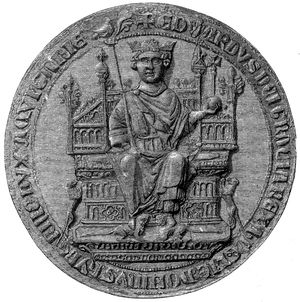
Great Seal of Edward I.
1. The First Years of Edward I. 1272—1279.—Edward I., though he inherited the crown in 1272, did not return to England till 1274, being able to move in a leisurely fashion across Europe without fear of disturbances at home. He fully accepted those articles of John's Great Charter which had been set aside at the beginning of the reign of Henry III., and which required that the king should only take scutages and aids with the consent of the Great Council or Parliament. The further requirement of the barons that they should name the ministers of the crown, was allowed to fall asleep. Edward was a capable ruler, and knew how to appoint better ministers than the barons were likely to choose for him. It was Edward's peculiar merit that he stood forward not only as a ruler but as a legislator. He succeeded in passing one law after another, because he thoroughly understood that useful legislation is only possible when the legislator on the one hand has an intelligent perception of the remedies needed to meet existing evils, and on the other hand is willing to content himself with such remedies as those who are to be benefited by them are ready to accept. The first condition was fulfilled by Edward's own skill as a lawyer, and by the skill of the great lawyers whom he employed. The second condition was fulfilled by his determination to authorise no new legislation without the counsel and consent of those who were most affected by it. He did not, indeed, till late in his reign call a whole Parliament together, as Earl Simon had done. But he called the barons together in any matter which affected the barons, and he called the representatives of the townsmen together in any matter which affected the townsmen, and so on with the other classes.
2. Edward I. and Wales. 1276—1284.—Outside England Edward's first difficulty was with the Welsh, who, though their Princes had long been regarded by the English Kings as vassals, had practically maintained their independence in the mountainous region of North Wales of which Snowdon is the centre. Between them and the English Lords Marchers, who had been established to keep order in the marches, or border-land, there was nothing but hostility. The Welshmen made forays and plundered the English lands, and the English retorted by slaughtering Welshmen whenever they could come up with them amongst the hills. Naturally the Welsh took the side of any enemy of the English kings with whom it was possible to ally themselves. Llewelyn, Prince of Wales, had joined Earl Simon against Henry III., and had only done homage to Henry after Simon had been defeated. After Henry's death he refused homage to Edward till 1276. In 1282 he and his brother David renewed the war, and Edward, determined to put an end to the independence of such troublesome neighbours, marched against them. Before the end of the year Llewelyn was slain, and David was captured and executed in 1283. Wales then came fully under the dominion of the English kings. Edward's second son, afterwards King Edward II., was born at Carnarvon in 1284, and soon afterwards, having become heir to the throne upon the death of his elder brother, was presented to the Welsh as Prince of Wales, a title from that day usually bestowed upon the king's eldest son. At the same time, though Edward built strong castles at Conway and Carnarvon to hold the Welsh in awe, he made submission easier by enacting suitable laws for them, under the name of the Statute of Wales, and by establishing a separate body of local officials to govern them, as well as by confirming them in the possession of their lands and goods.
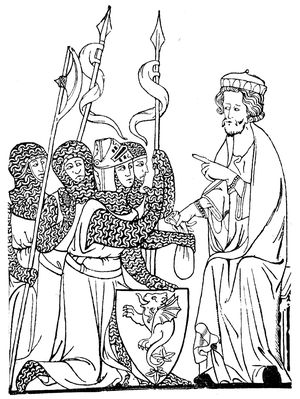
Group of armed knights, and a king in ordinary dress. Date, temp. Edward I.
3. Customs Duties. 1275.—Though Edward I. was by no means extravagant, he found it impossible to meet the expenses of government without an increase of taxation. In 1275 he obtained the consent of Parliament to the increase of the duties on exports and imports which had hitherto been levied without Parliamentary sanction. He was now to receive by a Parliamentary grant a fixed export duty of 6s. 8d. on every sack of wool sent out of the country, and of a corresponding duty on wool-fells and leather. Under ordinary circumstances it is useless for any government to attempt to gain a revenue by export duty, because such a duty only raises the price abroad of the products of its own country, and foreigners will therefore prefer to buy the articles which they need from some country which does not levy export duties, and where, therefore, the articles are to be had more cheaply. England, however, was, in Edward's time, and for many years afterwards, an exception to the rule. On the Continent men could not produce much wool or leather for sale, because private wars were constantly occurring, and the fighting men were in the habit of driving off the sheep and the cattle. In England there were no private wars, and under the king's protection sheep and cattle could be bred in safety. There were now growing up manufactures of cloth in the fortified towns of Flanders, and the manufacturers there were obliged to come to England for the greater part of the wool which they used. They could not help paying not only the price of the wool, but the king's export duty as well, because if they refused they could not get sufficient wool in any other country.
4. Edward's Judicial Reforms. 1274—1290.—Every king of England since the Norman Conquest had exercised authority in a twofold capacity. On one hand he was the head of the nation, on the other hand he was the feudal lord of his vassals. Edward laid more stress than any former king upon his national headship. Early in his reign he organised the courts of law, completing the division of the Curia Regis into the three courts which existed till recent times: the Court of King's Bench, to deal with criminal offences reserved for the king's judgment, and with suits in which he was himself concerned; the Court of Exchequer, to deal with all matters touching the king's revenue; and the Court of Common Pleas, to deal with suits between subject and subject. Edward took care that the justice administered in these courts should as far as possible be real justice, and in 1289 he dismissed two Chief Justices and many other officials for corruption. In 1285 he improved the Assize of Arms of Henry II. (see p. 154), so as to be more sure of securing a national support for his government in time of danger.
5. Edward's Legislation. 1279—1290.—It was in accordance with the national feeling that Edward, in 1290, banished from England the Jews, whose presence was most profitable to himself, but who were regarded as cruel tyrants by their debtors. On the other hand, Edward took care to assert his rights as a feudal lord. In 1279, by the statute De religiosis, commonly known as the Statute of Mortmain, he forbade the gift of land to the clergy, because in their hands land was no longer liable to the feudal dues. In 1290, by another statute, Quia emptores, he forbade all new sub-infeudation. If from henceforth a vassal wished to part with his land, the new tenant was to hold it, not under the vassal who gave it up, but under that vassal's lord, whether the lord was the king or anyone else. The object of this law was to increase the number of tenants-in-chief, and thus to bring a larger number of landowners into direct relations with the king.
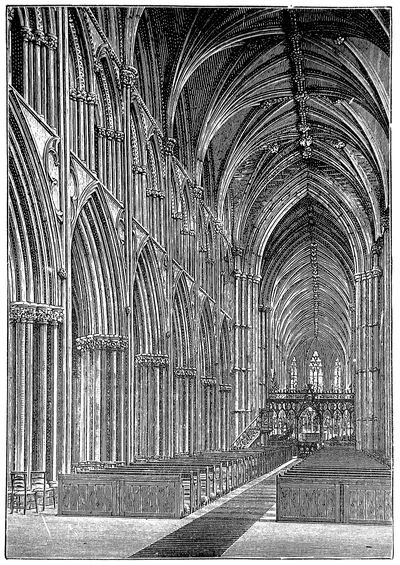
Nave of Lichfield Cathedral, looking east. Built about 1280.
6. Edward as a National and as a Feudal Ruler.—In his government of England Edward had sought chiefly to strengthen his position as the national king of the whole people, and to depress legally and without violence the power of the feudal nobility. He was, however, ambitious, with the ambition of a man conscious of great and beneficent aims, and he was quite ready to enforce even unduly his personal claims to feudal obedience whenever it served his purpose to do so. His favourite motto, 'Keep troth' (Pactum serva), revealed his sense of the inviolability of a personal engagement given or received, but his legal mind often led him into construing in his own favour engagements in which only the letter of the law was on his side, whilst its spirit was against him. It was chiefly in his relations with foreign peoples that he fell into this error, as it was here that he was most strongly tempted to lay stress upon the feudal tie which made for him, and to ignore the importance of a national resistance which made against him. In dealing with Wales, for instance, he sent David to a cruel death, because he had broken the feudal tie which bound him to the king of England, feeling no sympathy with him as standing up for the independence of his own people.
7. The Scottish Succession. 1285-1290.—In the earlier part of Edward's reign Alexander III. was king of Scotland. Alexander's ancestors, indeed, had done homage to Edward's ancestors, but in 1189 William the Lion had purchased from Richard I. the abandonment of all the claim to homage for the crown of Scotland which Henry II. had acquired by the treaty of Falaise (see pp. 154, 159). William's successors, however, held lands in England, and had done homage for them to the English kings. Edward would gladly have restored the old practice of homage for Scotland itself, but to this Alexander had never given way. To Edward there was something alluring in the prospect of being lord of the whole island, as it would not only strengthen his own personal position, but would bring two nations into peaceful union. Between the southern part of Scotland, indeed, and the northern part of England there was no great dissimilarity. On both sides of the border the bulk of the population was of the same Anglian stock, whilst, in consequence of the welcome offered by the Scottish kings to persons of Norman descent, the nobility was as completely Norman in Scotland as it was in England, many of the nobles indeed possessing lands on both sides of the border. A prospect of effecting a union by peaceful means offered itself to Edward in 1285, when Alexander III. was killed by a fall from his horse near Kinghorn. Alexander's only descendant was Margaret, a child of his daughter and of King Eric of Norway. In 1290 it was agreed that she should marry the Prince of Wales, but that the two kingdoms should remain absolutely independent of one another. Unfortunately, the Maid of Norway, as the child was called, died on her way to Scotland, and this plan for establishing friendly relations between the two countries came to naught. If it had succeeded three centuries of war and misery might possibly have been avoided.
8. Death of Eleanor of Castile. 1290.—Another death, which happened in the same year, brought sorrow into Edward's domestic life. His wife Eleanor died in November. The corpse was brought for burial from Lincoln to Westminster, and the bereaved husband ordered the erection of a memorial cross at each place where the body rested.
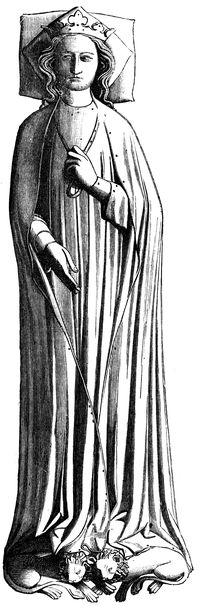
Effigy of Eleanor of Castile, queen of Edward I., in Westminster Abbey.
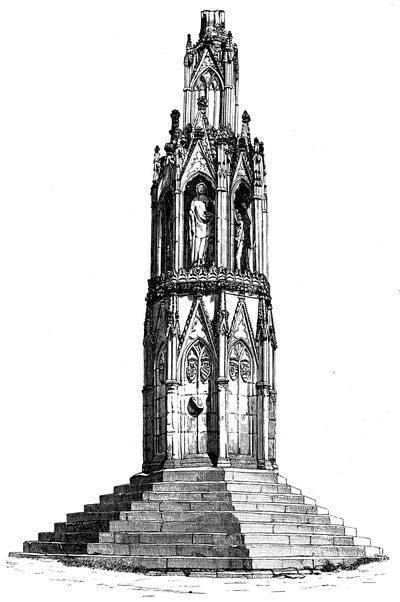
Cross erected near Northampton by Edward I. in memory of Queen Eleanor built between 1291 and 1294.
11. The Model Parliament. 1295.—Edward, attacked on two sides, threw himself for support on the English nation. Towards the end of 1295 he summoned a Parliament which was in most respects the model for all succeeding Parliaments. It was attended not only by bishops, abbots, earls, and barons, by two knights from every shire, and two burgesses from every borough, but also by representatives of the chapters of cathedrals and of the parochial clergy. It cannot be said with any approach to certainty, whether the Parliament thus collected met in one House or not. As, however, the barons and knights offered an eleventh of the value of their movable goods, the clergy a tenth, and the burgesses a seventh, it is not unlikely that there was a separation into what in modern times would be called three Houses, at least for purposes of taxation. At all events, the representatives of the clergy subsequently refused to sit in Parliament, preferring to vote money to the Crown in their own convocations.
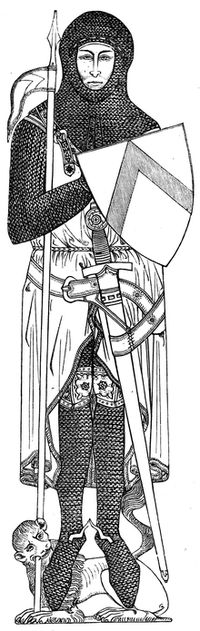
Sir John d'Abernoun, died 1277: from his brass at Stoke Dabernon: showing armour worn from about 1250 to 1300.
12. The first Conquest of Scotland. 1296.—In 1296 Edward turned first upon Scotland. After he crossed the border Balliol sent to him renouncing his homage. "Has the felon fool done such folly?" said Edward. "If he will not come to us, we will go to him." He won a decisive victory over the Scots at Dunbar. Balliol surrendered his crown, and was carried off, never to reappear in Scotland. Edward set up no more vassal kings. He declared himself to be the immediate king of Scotland, Balliol having forfeited the crown by treason. The Scottish nobles did homage to him. On his return to England he left behind him the Earl of Surrey and Sir Hugh Cressingham as guardians of the kingdom, and he carried off from Scone the stone of destiny on which the Scottish kings had been crowned, and concerning which there had been an old prophecy to the effect that wherever that stone was Scottish kings should rule. The stone was placed, where it still remains, under the coronation-chair of the English kings in Westminster Abbey, and there were those long afterwards who deemed the prophecy fulfilled when the Scottish King James VI. came to take his seat on that chair as James I. of England.
13. The Resistance of Archbishop Winchelsey. 1296—1297.—The dispute with France and the conquest of Scotland cost much money, and Edward, finding his ordinary revenue insufficient, had been driven to increase it by unusual means. He gathered assemblies of the merchants, and persuaded them without the leave of Parliament to increase the export duties, and he also induced the clergy in the same way to grant him large sums. The clergy were the first to resist. In 1296 Boniface VIII., a Pope who pushed to the extreme the Papal claims to the independence of the Church, issued the Bull, Clericis laicos, in which he declared that the clergy were not to pay taxes without the Pope's consent; and when at the end of the year Edward called on his Parliament to grant him fresh sums, Winchelsey, the Archbishop of Canterbury, refused, on the ground of this Bull, to allow a penny to be levied from the clergy. Edward, instead of arguing with him, directed the chief justice of the King's Bench to announce that, as the clergy would pay no taxes, they would no longer be protected by the king. The clergy now found themselves in evil case. Anyone who pleased could rob them or beat them, and no redress was to be had. They soon therefore evaded their obligation to obey the Bull, and paid their taxes, under the pretence that they were making presents to the king, on which Edward again opened his courts to them. In the days of Henry I. or Henry II. it would not have been possible to treat the clergy in this fashion. The fact was, that the mass of the people now looked to the king instead of to the Church for protection, and therefore respected the clergy less than they had done in earlier days.
14. The 'Confirmatio Cartarum.' 1297.—In 1297 Edward, having subdued the Scots in the preceding year, resolved to conduct one army to Flanders, and to send another to Gascony to maintain his rights against Philip IV. He therefore called on his barons to take part in these enterprises. Amongst those ordered to go to Gascony were Roger Bigod, Earl of Norfolk, and Humfrey Bohun, Earl of Hereford. They declared that they were only bound to follow the king himself, and that as Edward was not going in person to Gascony they would not go. "By God, Sir Earl," said the king to one of them, "you shall either go or hang." "By God," was the reply, "I will neither go nor hang." The two earls soon found support. The barons were sore because Edward's reforms had diminished their authority. The clergy were sore because of their recent treatment. The merchants were sore because of the exactions to which they had been subjected. Archbishop Winchelsey bound the malcontents together by asking Edward to confirm Magna Carta and other charters granted by his predecessors, and by adding other articles now proposed for the first time, so as to preclude him from demanding taxes not granted by Parliament. Edward found that the new articles restricted his action more than it had been restricted by the older charters. He was deeply vexed, as he thought that he deserved to be trusted, and that, though he had exacted illegal payments, he had only done so out of necessity. He saw, however, that he must yield, but he could not bring himself to yield in person, and he therefore crossed the sea to Flanders, leaving the Prince of Wales to make the required concession. On October 10, 1297, the Confirmatio Cartarum, as it was called, was issued in the king's name. It differed from Magna Carta in this, that whereas John had only engaged not to exact feudal revenue from his vassals without consent of Parliament, Edward I. also engaged not to exact customs duties without a Parliamentary grant. From that time no general revenue could be taken from the whole realm without a breach of the law, though the king still continued for some time to raise tallages, or special payments, from the tenants of his own demesne lands.
15. Wallace's Rising. 1297—1304.—Whilst Edward was contending with his own people his officers had been oppressing the Scots. They had treated Scotland as a conquered land, not as a country joined to England by equal union. Resistance began in 1297, and a rising was headed by Wallace, a gentleman of moderate fortune in the western lowlands. Wallace's bold and vigorous attacks gained him the confidence of the lesser gentry and the people, though the nobles, mostly of Norman descent, supported the English government, and only joined Wallace when it was dangerous to stand aloof. In the autumn, an English army advancing into Scotland reached the south bank of the Forth near Stirling. Wallace, who showed on that day that he was skilful as well as brave, drew up his army on the north bank at some little distance from the narrow bridge over which the English must come if they were to attack him. When half of them had crossed, he fell upon that half before the troops in the rear could advance to its succour. Wallace's victory was complete, and he then invaded England, ravaging and slaughtering as far as Hexham.
16. The Second Conquest of Scotland. 1298—1304.—In 1298 Edward, who had been unsuccessful on the Continent, made a truce with Philip. Returning to England, he marched against Wallace, and came up with him at Falkirk. The battle which ensued, like William's victory at Senlac (see p. 96), was a triumph of inventive military skill over valour content to rest upon ancient methods. The Scots were hardy footmen, drawn up in three rings, and provided with long spears. Against such a force so armed the cavalry of the feudal array would dash itself in vain. Edward, however, had marked in his Welsh wars the superiority of the long-bow drawn to the ear—not, as in the case of the shorter bows of older times, to the breast of the archer—and sending its cloth-yard shaft with a strength and swiftness hitherto unknown. He now brought with him a large force of bowmen equipped in this fashion. At Falkirk the long-bow was tried for the first time in any considerable battle. The effect was overwhelming: a shower of arrows poured upon a single point in the ring of the spearmen soon cleared a gap. Edward's cavalry dashed in before the enemy had time to close, and the victory was won. Wallace had had scarcely one of the Scottish nobles with him either at Stirling or at Falkirk, and unless all Scotland combined he could hardly be expected to succeed against such a warrior as Edward. Wallace's merit was that he did not despair of his country, and that by his patriotic vigour he prepared the minds of Scotsmen for a happier day. He himself fled to France, but Scotland struggled on without him. Some of the nobles, now that Wallace was no longer present to give them cause of jealousy, took part in the resistance, and only in 1304 did Edward after repeated campaigns complete his second conquest of the country.
17. The Incorporation of Scotland with England. 1305.—In 1305 Wallace, who had returned from France, but had taken no great part in the late resistance, was betrayed to the English. His barbarity in his raid on Northumberland in 1297 (see p. 221) had marked him out for vengeance, and he was executed at Tyburn as a traitor to the English king of Scotland, whose right he had never acknowledged. Edward then proceeded to incorporate Scotland with England. Scotland was to be treated very much as Wales had been treated before. There was to be as little harshness as possible. Nobles who had resisted Edward were to keep their estates on payment of fines, the Scottish law was to be observed, and Scots were to be chosen to represent the wishes of their fellow-countrymen in the Parliament at Westminster. On the other hand, the Scottish nobles were to surrender their castles, and the country was to be governed by an English Lieutenant, who, together with his council, had power to amend the laws.
18. Character of Edward's Dealings with Scotland.—Edward's dealings with Scotland, mistaken as they were, were not those of a self-willed tyrant. If it be once admitted that he was really the lord paramount of Scotland, everything that he did may be justified upon feudal principles. First, Balliol forfeited his vassal crown by breaking his obligations as a vassal. Secondly, Edward, through the default of his vassal, took possession of the fief which Balliol had forfeited, and thus became the immediate lord of Balliol's vassals. Thirdly, those vassals rebelled—so at least Edward would have said—against their new lord. Fourthly, they thereby forfeited their estates to him, and he was therefore, according to his own view, in the right in restoring their estates to them—if he restored them at all—under new conditions. Satisfactory as this argument must have seemed to Edward, it was weak in two places. The Scots might attack it at its basis by retorting that Edward had never truly been lord paramount of Scotland at all; or they might assert that it did not matter whether he was so or not, because the Scottish right to national independence was superior to all feudal claims. It is this latter argument which has the most weight at the present day, and it seems to us strange that Edward, who had done so much to encourage the national growth of England, should have entirely ignored the national growth of Scotland. All that can be said to palliate Edward's mistake is that it was, at first, difficult to perceive that there was a Scottish nationality at all. Changes in the political aspect of affairs grow up unobserved, and it was not till after his death that all classes in Scotland were completely welded together in resistance to an English king. At all events, if he treated the claim of the Scots to national independence with contempt, he at least strove, according to his own notions, to benefit Scots and English alike. He hoped that one nation, justly ruled under one government, would grow up in the place of two divided peoples.
19. Robert Bruce. 1306.—It was better even for England that Edward's hopes should fail. Scotland would have been of little worth to its more powerful neighbour if it had been cowed into subjection; whereas when, after struggling and suffering for her independence, she offered herself freely as the companion and ally of England to share in common duties and common efforts, the gift was priceless. That Scotland was able to shake off the English yoke was mainly the work of Robert Bruce, the grandson of the Robert Bruce who had been one of the claimants of the Scottish crown at Norham. The Bruces, like Balliol, were of Norman descent, and as Balliol's rivals they had attached themselves to Edward. The time was now come when all chances of Balliol's restoration were at an end, and thoughts of gaining the crown stirred in the mind of the younger Bruce. After Edward's last settlement of Scotland it was plain that there was no longer room for a Scottish vassal king, and Bruce was therefore driven to connect his own aspirations with those of the Scottish nation. He had, however, one powerful rival amongst the nobles. John Comyn—the Red Comyn, as he was called—had been one of the many claimants of the throne who appeared before Edward at Norham, and he still looked with a jealous eye upon all who disputed his title. He was, however, persuaded in 1306 to meet Bruce in the Grey Friars Church at Dumfries. As Bruce pleaded his own right to the crown, Comyn denounced him as a traitor to Edward. Bruce answered by driving his dagger into him. "I doubt," cried Bruce, as he rushed from the church, "that I have slain the Red Comyn." "I will mak sicker" (make sure), said Kirkpatrick, who was in attendance upon him, and, going in, completed the murder. Bruce made for Scone and was crowned king of Scotland in the presence of many of the chief nobility.
20. Edward's Last March on Scotland and Death. 1306—1307. Edward, to whom Bruce was but a rebel and a murderer, despatched against him the Earl of Pembroke who routed his forces at Methven. The revolt was suppressed and Bruce's supporters were carried off to English prisons, and their lands divided amongst English noblemen. The Countess of Buchan, who had taken a prominent part in Bruce's coronation, was subjected to an imprisonment of great severity in the castle of Berwick. Bruce almost alone escaped. He knew now that he had the greater part of the nobility as well as the people at his side, and even in his lonely wanderings and hairbreadth escapes he was, what neither Balliol nor Wallace had been, the true head of the Scottish nation. Before the end of 1306 he reappeared in Carrick, where his own possessions lay, and where the whole population was on his side, and inflicted heavy losses on the English garrisons. Early in July 1307 Edward, who himself had tarried in Cumberland, once more set out to take the field in person; but he was now old and worn out, and he died at Burgh on Sands, a few miles on the English side of the border.
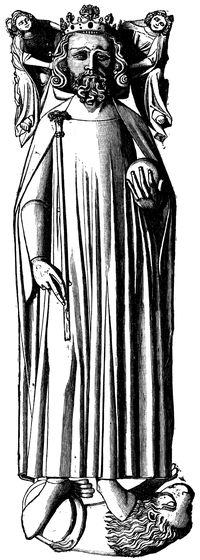
Edward II.; from his monument in Gloucester Cathedral.
21. Edward II. and Piers Gaveston. 1307—1312.—The new king, Edward II., was as different as possible from his father. He was not wicked, like William II. and John, but he detested the trouble of public business, and thought that the only advantage of being a king was that he would have leisure to amuse himself. During his father's life he devoted himself to Piers Gaveston, a Gascon, who encouraged him in his pleasures and taught him to mistrust his father. Edward I. banished Gaveston; Edward II., immediately on his accession, not only recalled him, but made him regent when he himself crossed to France to be married to Isabella, the daughter of Philip IV. The barons, who were already inclined to win back some of the authority of which Edward I. had deprived them, were very angry at the place taken over their heads by an upstart favourite, especially as Gaveston was ill-bred enough to make jests at their expense. The barons found a leader in Thomas, Earl of Lancaster, the son of that Edmund, the brother of Edward I., who had received the title of king of Sicily from the Pope (see p. 197). Thomas of Lancaster had very large estates. He was an ambitious man, who tried to play the part which had been played by Earl Simon without any of Simon's qualifications for the position. In 1308 the king yielded to the barons so far as to send Gaveston out of the country to Ireland as his Lieutenant. In 1309 he recalled him. The barons were exasperated, and in the Parliament of 1310 they brought forward a plan for taking the king's government out of his hands, very much after the fashion of the Provisions of Oxford. Twenty-one barons were appointed Lords Ordainers, to draw up ordinances for the government of the country. In 1311 they produced the ordinances. Gaveston was to be banished for life. The king was to appoint officers only with the consent of the barons, without which he was not to go to war nor leave the kingdom. The ordinances may have been justified in so far as they restrained the authority of a king so incapable as Edward II. Constitutionally their acceptance was a retrograde step, as, like the Provisions of Oxford, they placed power in the hands of the barons, passing over Parliament as a whole. Edward agreed to the ordinances, but refused to surrender Gaveston. The barons took arms to enforce their will, and in 1312, having captured Gaveston, they beheaded him near Warwick without the semblance of a trial.
22. Success of Robert Bruce. 1307—1314.—Whilst Edward and the barons were disputing Bruce gained ground rapidly. In 1313 Stirling was the only fortress of importance in Scotland still garrisoned by the English, and the English garrison bound itself to surrender on June 24, 1314, if it had not been previously relieved. Even Edward II. was stirred by this doleful news, and in 1314 he put himself at the head of an army to relieve Stirling. Lancaster, however, and all whom he could influence refused to follow him, on the ground that the king had not, in accordance with the ordinances, received permission from the barons to go to war. On June 24 Edward reached Bannockburn, within sight of Stirling. Like his father, he brought with him English archers as well as English horsemen, but he foolishly sent his archers far in advance of his horsemen, where they would be entirely unprotected. Bruce, on the other hand, not only had a small body of horse, which rode down the archers, but he strengthened the defensive position of his spearmen by digging pits in front of his line and covering them with turf. Into these pits the foremost horses of the English cavalry plunged. Edward's whole array was soon one mass of confusion, and before it could recover itself a body of gillies, or camp-followers, appearing over a hill was taken for a fresh Scottish army. The vast English host turned and fled. Stirling at once surrendered, and all Scotland was lost to Edward. Materially, both England and Scotland suffered grievously from the result of the battle of Bannockburn. English invasions of southern Scotland and Scottish invasions of northern England spread desolation far and wide, stifling the germs of nascent civilisation. Morally, both nations were in the end the gainers. The hardihood and self-reliance of the Scottish character is distinctly to be traced to those years of struggle against a powerful neighbour. England, too, was the better for being balked of its prey. No nation can suppress the liberty of another without endangering its own.
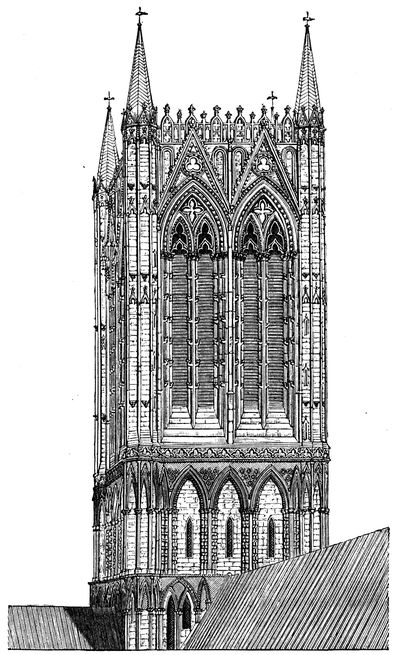
Lincoln Cathedral—the central tower; built about 1310.
23. Lancaster's Government. 1314—1322.—Edward was thrown by his defeat entirely under the power of Lancaster, who took the whole authority into his hands and placed and displaced ministers at his pleasure. Lancaster, however, was a selfish and incompetent ruler. He allowed the Scots to ravage the north of England without venturing to oppose them, and as he could not even keep order at home, private wars broke out amongst the barons. In 1318 Bruce took Berwick, the great border fortress against Scotland. It was rather by good luck than by good management that Edward was at last able to resist Lancaster. Edward could not exist without a personal favourite, and he found one in Hugh le Despenser. Despenser was at least an Englishman, which Gaveston had not been, and his father, Hugh le Despenser the elder, did his best to raise up a party to support the king. In 1321, however, Parliament, under Lancaster's influence, declared against them and sentenced them to exile. Edward took arms for his favourites, and in 1322 defeated Lancaster at Boroughbridge, and then had him tried and beheaded at Pontefract.
24. A Constitutional Settlement. 1322.—Favourites as they were, the Despensers had at least the merit of seeing that the king could not overpower the barons by the mere assertion of his personal authority. At a Parliament held at York in 1322, the king obtained the revocation of the ordinances, and a declaration that 'matters to be established for the estate of our lord the king and of his heirs, and for the estate of the realm and of the people, shall be treated, accorded, and established in Parliaments by our lord the king, and by the consent of the prelates, earls and barons, and commonalty of the realm, according as hath been hitherto accustomed.' Edward I. had in 1295 gathered a full Parliament, including the commons. But there was no law to prevent him or his successors excluding the commons on some future occasion. Edward II. by this declaration, issued with consent of Parliament, confirmed his father's practice by a legislative act. Unless the law were broken or repealed, no future statute could come into existence without the consent of the commons.
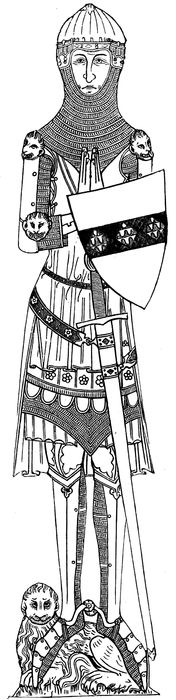
Sir John de Creke; from his brass at Westley Waterless, Cambridgeshire: showing armour worn between 1300 and 1335 or 1340. Date, about 1325.
25. The Rule of the Despensers. 1322—1326.—For some years after the execution of Lancaster, Edward, or rather the Despensers, retained power, but it was power which did not work for good. In 1323 Edward made a truce with Scotland, but the cessation of foreign war did not bring with it a cessation of troubles at home. Edward was entirely unable to control his favourites. The elder Despenser was covetous and the younger Despenser haughty, and they both made enemies for themselves and the king. Queen Isabella was alienated from her husband, partly by his exclusive devotion to the Despensers and partly by the contempt which an active woman is apt to feel for a husband without a will of his own. In 1325 she went to France, and was soon followed by her eldest son, named Edward after his father. From that moment she conspired against her husband. In 1326 she landed, accompanied by her paramour, Robert Mortimer, and bringing with her foreign troops. The barons rose in her favour. London joined them, and all resistance was speedily beaten down. The elder Despenser was hanged by the queen at Bristol. The younger was hanged, after a form of trial, at Hereford.
26. The Deposition and Murder of Edward II. 1327.—Early in 1327 a Parliament met at Westminster. It was filled with the king's enemies, and under pressure from the queen and Mortimer Edward II. was compelled to sign a declaration of his own wrong-doing and incompetency, after which he formally resigned the crown. He was allowed to live for eight months, at the end of which he was brutally murdered in Berkeley Castle. The deposition of Edward II.—for his enforced resignation was practically nothing less than that—was the work of a faithless wife and of unscrupulous partisans, but at least they clothed their vengeance in the forms of Parliamentary action. It was by the action of Parliament in loosing the feudal ties by which vassals were bound to an unworthy king, that it rose to the full position of being the representative of the nation, and at the same time virtually proclaimed that the wants of the nation must be satisfied at the expense of the feudal claims of the king. The national headship of the king would from henceforward be the distinguishing feature of his office, whilst his feudal right to personal service would grow less and less important every year.[Back to Contents]
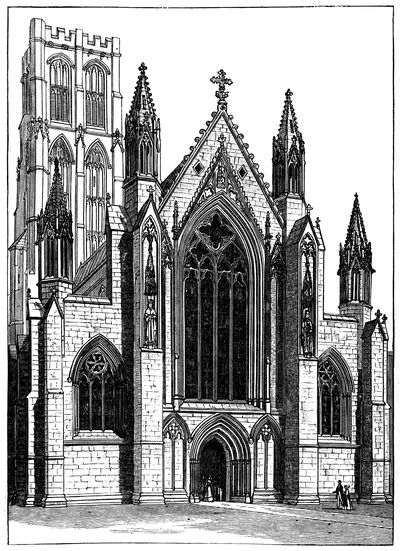
Howden Church, Yorkshire—the west front; built about 1310-1320. The tower was built between 1390 and 1407.