Part 1 — CHAPTER VI. ENGLAND AND NORMANDY.
Reading edition
LEADING DATES
Death of Eadgar 975
Accession of Æthelred 979
Accession of Cnut 1016
Accession of Eadward the Confessor 1035
Banishment of Godwine 1051
Accession of Harold and Battle of Senlac 1066
2. Æthelred's Early Years. 979—988.—Æthelred, now a boy of ten, became king in 979. The epithet the Unready, which is usually assigned to him, is a mistranslation of a word which properly means the Rede-less, or the man without counsel. He was entirely without the qualities which befit a king. Eadmund had kept the great chieftains in subordination to himself because he was a successful leader. Eadgar had kept them in subordination because he treated them with respect. Æthelred could neither lead nor show respect. He was always picking quarrels when he ought to have been making peace, and always making peace when he ought to have been fighting. What he tried to do was to lessen the power of the great ealdormen, and bring the whole country more directly under his own authority. In 985 he drove out Ælfric, the Ealdorman of the Mercians. In 988 Dunstan died, and Æthelred had no longer a wise adviser by his side.
3. The Return of the Danes. 984.—It would have been difficult for Æthelred to overpower the ealdormen even if he had had no other enemies to deal with. Unluckily for him, new swarms of Danes and Norwegians had already appeared in England. They began by plundering the country, without attempting to settle in it. In 991 Brihtnoth, Ealdorman of the East Saxons, was defeated and slain by them at Maldon. Æthelred could think of no better counsel than to pay them 10,000l., a sum of money which was then of much greater value than it is now, to abstain from plundering. It was not necessarily a bad thing to do. One of the greatest of the kings of the Germans, Henry the Fowler, had paid money for a truce to barbarians whom he was not strong enough to fight. But when the truce had been bought Henry took care to make himself strong enough to destroy them when they came again. Æthelred was never ready to fight the Danes and Norwegians at any time. In 994 Olaf Trygvasson, who had been driven from the kingship of Norway, and Svend, who had been driven from the kingship of Denmark, joined forces to attack London. The London citizens fought better than the English king, and the two chieftains failed to take the town. 'They went thence, and wrought the greatest evil that ever any army could do, in burning, and harrying, and in man-slaying, as in Essex, and in Kent, and in Sussex, and in Hampshire. And at last they took their horses and rode as far as they could, and did unspeakable evil.' The plunderers were now known as 'the army,' moving about where they would. Æthelred this time gave them 16,000l. He got rid of Olaf, who sailed away and was slain by his enemies, but he could not permanently get rid of Svend. Svend, about the year 1000, recovered his kingship in Denmark, and was more formidable than he had been before. Plunderings went on as usual, and Æthelred had no resource but to pay money to the plunderers to buy a short respite. He then looked across the sea for an ally, and hoped to find one by connecting himself with the Duke of the Normans.
4. The Norman Dukes. 912—1002.—The country which lies on both sides of the lower course of the Seine formed, at the beginning of the tenth century, part of the dominions of Charles the Simple, king of the West Franks, who had inherited so much of the dominions of Charles the Great as lay west of a line roughly drawn from the Scheldt to the Mediterranean through the lower course of the Rhone. Danes and Norwegians, known on the Continent as Normans, plundered Charles's dominions as they had plundered England, and at last settled in them as they had settled in parts of England. In 912 Charles the Simple ceded to their leader, Hrolf, a territory of which the capital was Rouen, and which became known as Normandy—the land of the Normans. Hrolf became the first Duke of the Normans, but his men were fierce and rugged, and for some time their southern neighbours scornfully called him and his descendants Dukes of the Pirates. In process of time a change took place which affected both Normandy and other countries as well. The West Frankish kings were descended from Charles the Great; but they had failed to defend their subjects from the Normans, and they thereby lost hold upon their people. One of their dependent nobles, the Duke of the French, whose chief city, Paris, formed a bulwark against the Normans advancing up the Seine, grew more powerful than themselves. At the same time the Normans were becoming more and more French in their speech and customs. At last an alliance was made between Hugh Capet, the son of Hugh the Great, Duke of the French (see p. 63), and Richard the Fearless, Duke of the Normans. The race of Charles the Great was dethroned, and Hugh became king of the French. In name he was king over all the territory which had been governed by Charles the Simple. In reality that happened in France which Æthelred had been trying to prevent in England. Hugh ruled directly over his own duchy of France, a patch of land of which Paris was the capital. The great vassals of the crown, who answered to the English ealdormen, only obeyed him when it was their interest to do so. The most powerful of these vassals was the Duke of the Normans. In 1002 the duke was Richard II.—the Good—the son of Richard the Fearless. In that year Æthelred, who was a widower, married Richard's sister, Emma. It was the beginning of a connection with Normandy which never ceased till a Norman duke made himself by conquest king of the English.
5. Political Contrast between Normandy and England.—The causes which were making the English thegnhood a military aristocracy acted with still greater force in Normandy. The tillers of the soil, sprung from the old inhabitants of the land, were kept by their Norman lords in even harsher bondage than the English serfs. The Norman warriors held their land by military service, each one being bound to fight for his lord, and the lord in turn being bound, together with his dependents, to fight for a higher lord, and all at last for the Duke himself. In England, though, in theory, the relations between the king and his ealdormen were not very different from those existing between the Norman duke and his immediate vassals, the connection between them was far looser. The kingdom as a whole had no general unity. The king could not control the ealdormen, and the ealdormen could not control the king. Even when ealdormen, bishops, and thegns met in the Witenagemot they could not speak in the name of the nation. A nation in any true sense hardly existed at all, and they were not chosen as representatives of any part of it. Each one stood for himself, and it was only natural that men who during the greater part of the year were ruling in their own districts like little kings should think more of keeping up their own almost independent power at home than of the common interests of all England, which they had to consider when they met—and that for a few days only at a time—in the Witenagemot. Æthelred at least was not the man to keep them united.
6. Svend's Conquest. 1002—1013.—Æthelred, having failed to buy off the Danes, tried to murder them. In 1002, on St. Brice's Day, there was a general massacre of all the Danes—not of the old inhabitants of Danish blood who had settled in Ælfred's time—but of the new-comers. Svend returned to avenge his countrymen. Æthelred had in an earlier part of his reign levied a land-tax known as the Danegeld to pay off the Danes—the first instance of a general tax in England. He now called on all the shires to furnish ships for a fleet; but he could not trust his ealdormen. Some of the stories told of these times may be exaggerated, and some may be merely idle tales, but we know enough to be sure that England was a kingdom divided against itself. Svend, ravaging as he went, beat down resistance everywhere. In 1012 the Danes seized Ælfheah, Archbishop of Canterbury, and offered to set him free if he would pay a ransom for his life. He refused to do so, lest he should have to wring money from the poor in order to pay it. The drunken Danes pelted him with bones till one of the number clave his skull with an axe. He was soon counted as a martyr. Long afterwards one of the most famous of his successors, the Norman Lanfranc, doubted whether he was really a martyr, as he had not died for the faith. 'He that dies for righteousness,' answered the gentle Anselm, 'dies for the faith,' and to this day the name of Ælfheah is retained as St. Alphege in the list of English saints. In 1013 Svend appeared no longer as a plunderer but as a conqueror. First the old Danish districts of the north and east, and then the Anglo-Saxon realm of Ælfred—Mercia and Wessex—submitted to him to avoid destruction. In 1013 Æthelred fled to Normandy.
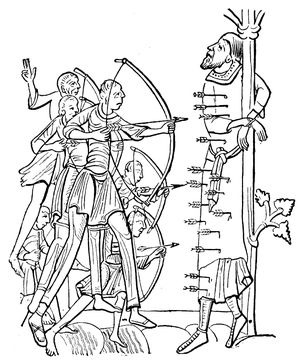
Martyrdom of St. Edmund by the Danes. (From a drawing belonging to the Society of Antiquaries.)
8. Eadmund Ironside. 1016.—Æthelred's eldest son—not the son of Emma—Eadmund Ironside, succeeded him. He did all that could be done to restore the English kingship by his vigour. In a single year he fought six battles; but the treachery of the ealdormen was not at an end, and at Assandun (? Ashington), in Essex, he was completely overthrown. He and Cnut agreed to divide the kingdom, but before the end of the year the heroic Eadmund died, and Cnut the Dane became king of England without a rival.
9. Cnut and the Earldoms. 1016—1035.—Cnut was one of those rulers who, like the Emperor Augustus, shrink from no barbarity in gaining power, but when once they have acquired it exercise their authority with moderation and gentleness. He began by outlawing or putting to death men whom he considered dangerous, but when this had once been done he ruled as a thoroughly English king of the best type. The Danes who had hitherto fought for him had come not as settlers, but as an army, and soon after Eadmund's death he sent most of them home, retaining a force, variously stated as 3,000 or 6,000, warriors known as his House-carls (House-men), who formed a small standing army depending entirely on himself. They were not enough to keep down a general rising of the whole of England, but they were quite enough to prevent any single great man from rebelling against him. Cnut therefore was, what Æthelred had wished to be, really master of his kingdom. Under him ruled the ealdormen, who from this time were known as Earls, from the Danish title of Jarl (see p. 64), and of these Earls the principal were the three who governed Mercia, North-humberland, and Wessex, the last named now including the old kingdoms of Kent and Sussex. There was a fourth in East Anglia, but the limits of this earldom varied from time to time, and there were sometimes other earldoms set up in the neighbouring shires, whereas the first-named three remained as they were for some time after Cnut's death. It is characteristic of Cnut that the one of the Earls to whom he gave his greatest confidence was Godwine, an Englishman, who was Earl of the West Saxons. Another Englishman, Leofwine, became Earl of the Mercians. A Dane obtained the earldom of the North-humbrians, but the land was barbarous, and its Earls were frequently murdered. Sometimes there was one Earl of the whole territory, sometimes two. It was not till after the end of Cnut's reign that Siward became Earl of Deira, and at a later time of all North-humberland as far as the Tweed. The descendants of two of these Earls, Godwine and Leofwine, leave their mark on the history for some time to come.
11. Cnut's Government.—Cnut had thus made himself master of a great empire, and yet, Dane as he was, though he treated Englishmen and Danes as equals, he gave his special favour to Englishmen. He restored, as men said, the laws of Eadgar—that is to say, he kept peace and restored order as in the days of Eadgar. He reverenced monks, and once as he was rowing on the waters of the fens, he heard the monks of Ely singing. He bade the boatmen row him to the shore that he might listen to the song of praise and prayer. He even went on a pilgrimage to Rome, to humble himself in that city which contained the burial places of the Apostles Peter and Paul. From Rome he sent a letter to his subjects. 'I have vowed to God,' he wrote, 'to live a right life in all things; to rule justly and piously my realms and subjects, and to administer just judgment to all. If heretofore I have done aught beyond what is just, through headiness or negligence of youth, I am ready, with God's help, to amend it utterly.' With Cnut these were not mere words. It is not likely that there is any truth in the story how his flattering courtiers told him to sit by the sea-shore and bade the inflowing tide refrain from wetting his feet, and how when the waves rose over the spot on which his chair was placed he refused to wear his crown again, because that honour belonged to God alone, the true Ruler of the world. Yet the story would not have been invented except of one who was believed to have been clothed with real humility.
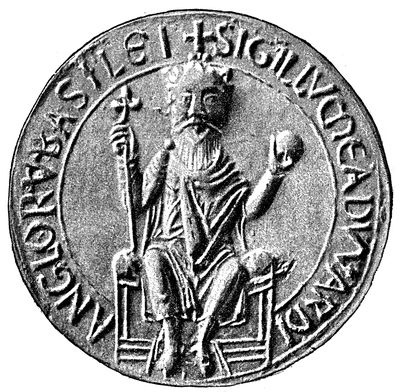
First Great Seal of Eadward the Confessor (obverse).
13. Eadward the Confessor and Earl Godwine. 1042—1051.—The English were tired of foreign rulers. 'All folk chose Eadward king.' Eadward, the son of Æthelred and the brother of the murdered Ælfred, though an Englishman on his father's side, was also the son of the Norman Emma, and had been brought up in Normandy from his childhood. The Normans were now men of French speech, and they were more polite and cultivated than Englishmen. Eadward filled his court with Normans. He disliked the roughness of the English, but instead of attempting to improve them as the great Ælfred had formerly done, he stood entirely aloof from them. The name of the Confessor by which he was afterwards known was given him on account of his piety, but his piety was not of that sort which is associated with active usefulness. He was fond of hunting, but was not active in any other way, and he left others to govern rather than himself. For some years the real governor of England was Earl Godwine, who kept his own earldom of Wessex, and managed to procure other smaller earldoms for his sons. As the Mercia over which Leofric ruled was only the north-western part of the old kingdom, and as Siward (see p. 84) had enough to do to keep the fierce men of North-humberland in order, Godwine had as yet no competitor to fear. In 1045 he became the king's father-in-law by the marriage of Eadward with his daughter, Eadgyth. Eadward, however, did his best for his Norman favourites, and appointed one of them, Robert of Jumièges, to the bishopric of London, and afterwards raised him to the Archbishopric of Canterbury. Between Godwine and the Normans there was no goodwill, and though Godwine was himself of fair repute, his eldest son, Swegen, a young man of brutal nature, alienated the goodwill of his countrymen by seducing the Abbess of Leominster, and by murdering his cousin Beorn. Godwine, in his blind family affection, clung to his wicked son and insisted on his being allowed to retain his earldom.

Hunting. (From the Bayeux Tapestry.)
14. The Banishment of Godwine. 1051.—At last, in 1051, the strife between the king and the Earl broke out openly. Eadward's brother-in-law, Eustace, Count of Boulogne, visited England. On his return his men made a disturbance at Dover, and in the riot which ensued some of the townsmen as well as some of his own men were slain. Eadward called on Godwine, in whose earldom Dover was, to punish the townsmen. Godwine refused, and Eadward summoned him to Gloucester to account for his refusal. He came attended by an armed host, but Leofric and Siward, who were jealous of Godwine's power, came with their armed followers to support the king. Leofric mediated, and it was arranged that the question should be settled at a Witenagemot to be held in London. In the end Godwine was outlawed and banished with all his family. Swegen went on a pilgrimage to Jerusalem and died on the way back.
15. Visit of Duke William. 1051.—In Godwine's absence Eadward received a visit from the Duke of the Normans, William, the bastard son of Duke Robert and the daughter of a tanner of Falaise. Robert was a son of Richard II., and William was thus the grandson of the brother of Eadward's mother, Emma. Such a relationship gave him no title whatever to the English throne, as Emma was not descended from the English kings, and as, even if she had been, no one could be lawfully king in England who was not chosen by the Witenagemot. Eadward, however, had no children or brothers, and though he had no right to give away the crown, he now promised William that he should succeed him. William, indeed, was just the man to attract one whose character was as weak as Eadward's. Since he received the dukedom he had beaten down the opposition of a fierce and discontented nobility at Val-ès-dunes (1047). From that day peace and order prevailed in Normandy. Law in Normandy did not come as in England from the traditions of the shire-moot or the Witenagemot, where men met to consult together. It was the Duke's law, and if the Duke was a strong man he kept peace in the land. If he was a weak man, the lords fought against one another and plundered and oppressed the poor. William was strong and wily, and it was this combination of strength and wiliness which enabled him to bear down all opposition.
16. William and the Norman Church.—An Englishman, who saw much of William in after-life, declared that, severe as he was, he was mild to good men who loved God. The Church was in his days assuming a new place in Europe. The monastic revival which had originated at Cluny (see p. 67) had led to a revival of the Papacy. In 1049, for the first time, a Pope, Leo IX., travelled through Western Europe, holding councils and inflicting punishments upon the married clergy and upon priests who took arms and shed blood. With this improvement in discipline came a voluntary turning of the better clergy to an ascetic life, and increased devotion was accompanied, as it always was in the middle ages, with an increase of learning. William, who by the strength of his will brought peace into the state, also brought men of devotion and learning into the high places of the Church. His chief confidant was Lanfranc, an Italian who had taken refuge in the abbey of Bec, and, having become its prior, had made it the central school of Normandy and the parts around. With the improvement of learning came the improvement of art, and churches arose in Normandy, as in other parts of Western Europe, which still preserved the old round arch derived from the Romans, though both the arches themselves and the columns on which they were borne were lighter and more graceful than the heavy work which had hitherto been employed. Of all this Englishmen as yet knew nothing. They went on in their old ways, cut off from the European influences of the time. It was no wonder that Eadward yearned after the splendour and the culture of the land in which he had been brought up, or even that, in defiance of English law, he now promised to Duke William the succession to the English crown.
18. Harold's Greatness. 1053—1066.—Harold was a brave and energetic man, but Eadward preferred his brother Tostig, and on the death of Siward appointed him Earl of North-humberland. A little later Gyrth, another brother of Harold, became Earl of East Anglia, together with Bedfordshire and Oxfordshire, and a fourth brother, Leofwine, Earl of a district formed of the eastern shires on either side of the Thames. All the richest and most thickly populated part of England was governed by Harold and his brothers. Mercia was the only large earldom not under their rule. It was now under Ælfgar, the son of Leofric, who had lately died.
19. Harold and Eadward. 1057—1065.—It became necessary to arrange for the succession to the throne, as Eadward was childless, and as Englishmen were not likely to acquiesce in his bequest to William. In 1057 the Ætheling Eadward, a son of Eadmund Ironside, was fetched back from Hungary, where he had long lived in exile, and was accepted as the heir. Eadward, however, died almost immediately after his arrival. He left but one son, Eadgar the Ætheling (see genealogy at p. 78), who was far too young to be accepted as a king for many years to come. Naturally the thought arose of looking on Harold as Eadward's successor. It was contrary to all custom to give the throne to any one not of the royal line, but the custom had been necessarily broken in favour of Cnut, the Danish conqueror, and it might be better to break it in favour of an English earl rather than to place a child on the throne, when danger threatened from Normandy. During the remainder of Eadward's reign Harold showed himself a warrior worthy of the crown. In 1063 he invaded Wales and reduced it to submission. About the same time Ælfgar died, and was succeeded by his son, Eadwine, in the earldom of the Mercians. In 1065 the men of North-humberland revolted against Tostig, who had governed them harshly, and who was probably unpopular as a West Saxon amongst a population of Danes and Angles. The North-humbrians chose Eadwine's brother, Morkere, as his successor, and Harold advised Eadward to acquiesce in what they had done. Northamptonshire and Huntingdonshire were committed to Waltheof, a son of Siward (see p. 84), and the modern Northumberland was committed to a native ruler, Oswulf.
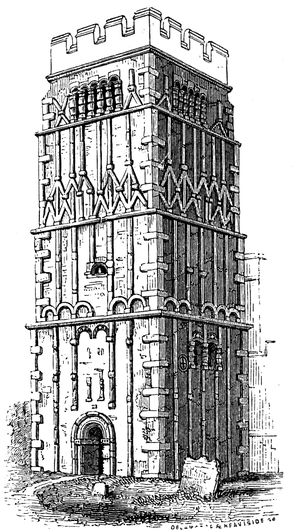
Tower in the earlier style. Church at Earl's Barton. (The battlements are much later.)
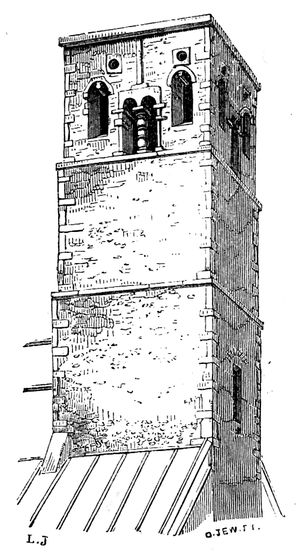
Tower in the earlier style. St Benet's Church, Cambridge.
20. Death of Eadward. 1066.—England was therefore ruled by two great families. Eadwine and Morkere, the grandsons of Leofric, governed the Midlands and almost the whole of North-humberland. Harold and his brothers, the sons of Godwine, governed the south and the east. The two houses had long been rivals, and after Eadward's death there would be no one in the country to whom they could even nominally submit. Eadward, whose life was almost at an end, was filled with gloomy forebodings. His thoughts, however, turned aside from the contemplation of earthly things, and he was only anxious that the great abbey church of Westminster, which he had been building hard by his own new palace on what was then a lonely place outside London, should be consecrated before his death. The church, afterwards superseded by the structure which now stands there, was built in the new and lighter form of round-arched architecture which Eadward had learned to admire from his Norman friends. It was consecrated on December 28, 1065, but the king was too ill to be present, and on January 5, 1066, he died, and was buried in the church which he had founded. Harold was at once chosen king, and crowned at Westminster.
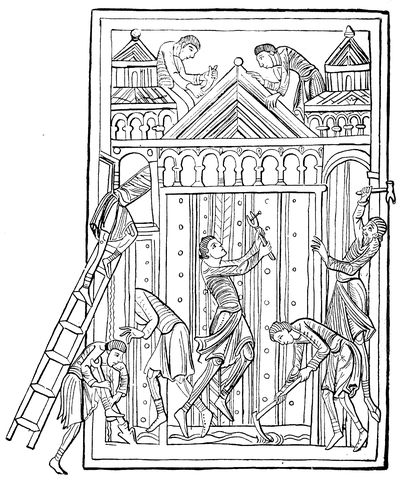
Building a church in the later style. (From a drawing belonging to the Society of Antiquaries.)
21. Harold and William. 1066.—William, as soon as he heard of his rival's coronation, claimed the crown. He was now even mightier than he had been when he visited Eadward. In 1063 he had conquered Maine, and, secure on his southern frontier, he was able to turn his undivided attention to England. According to the principles accepted in England, he had no right to it whatever; but he contrived to put together a good many reasons which seemed, in the eyes of those who were not Englishmen, to give him a good case. In the first place he had been selected by Eadward as his heir. In the second place the deprivation of Robert of Jumièges was an offence against the Church law of the Continent, and William was therefore able to obtain from the Pope a consecrated banner, and to speak of an attack upon England as an attempt to uphold the righteous laws of the Church. In the third place, Harold had at some former time been wrecked upon the French coast, and had been delivered up to William, who had refused to let him go till he had sworn solemnly, placing his hand on a chest which contained the relics of the most holy Norman saints, to do some act, the nature of which is diversely related, but which Harold never did. Consequently William could speak of himself as going to take vengeance on a perjurer. With some difficulty William persuaded the Norman barons to follow him, and he attracted a mixed multitude of adventurers from all the neighbouring nations by promising them the plunder of England, an argument which every one could understand. During the whole of the spring and the summer ships for the invasion of England were being built in the Norman harbours.
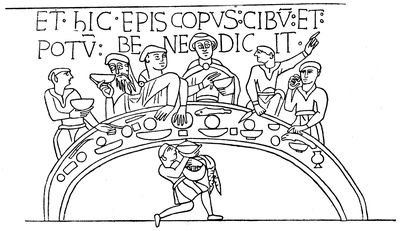
Normans feasting; with Odo, Bishop of Bayeux, saying grace. (From the Bayeux Tapestry.)
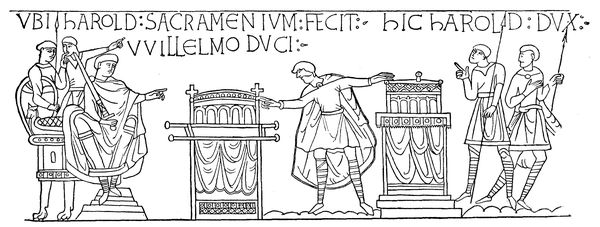
Harold swearing upon the Relics. (From the Bayeux Tapestry.)
22. Stamford Bridge. 1066.—All through the summer Harold was watching for his rival's coming. The military organisation of England, however, was inferior to that of Normandy. The Norman barons and their vassals were always ready for war, and they could support on their estates the foreign adventurers who were placed under their orders till the time of battle came. Harold had his house-carls, the constant guard of picked troops which had been instituted by Cnut, and his thegns, who, like the Norman barons, were bound to serve their lord in war. The greater part of his force, however, was composed of the peasants of the fyrd, and when September came they must needs be sent home to attend to their harvest, which seems to have been late this year. Scarcely were they gone when Harold received news that his brother Tostig, angry with him for having consented to his deposition from the North-humbrian earldom, had allied himself to Harold Hardrada, the fierce sea-rover, who was king of Norway, and that the two, with a mighty host, after wasting the Yorkshire coast, had sailed up the Humber. The two Northern Earls, Eadwine and Morkere, were hard pressed. Harold had not long before married their sister, and, whatever might be the risk, he was bound as the king of all England to aid them. Marching swiftly northwards with his house-carls and the thegns who joined him on the way, he hastened to their succour. On the way worse tidings reached him. The Earls had been defeated, and York had agreed to submit to the Norsemen. Harold hurried on the faster, and came upon the invaders unawares as they lay heedlessly on both sides of the Derwent at Stamford Bridge. Those on the western side, unprepared as they were, were soon overpowered. One brave Norseman, like Horatius and his comrades in the Roman legend, kept the narrow bridge against the army, till an Englishman crept under it and stabbed him from below through a gap in the woodwork. The battle rolled across the Derwent, and when evening came Harold Hardrada, and Tostig himself, with the bulk of the invaders, had been slain. For the last time an English king overthrew a foreign host in battle on English soil.
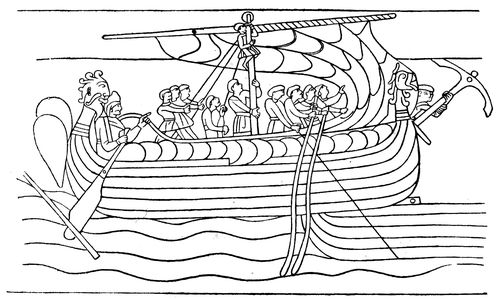
A Norman ship. (From the Bayeux Tapestry.)
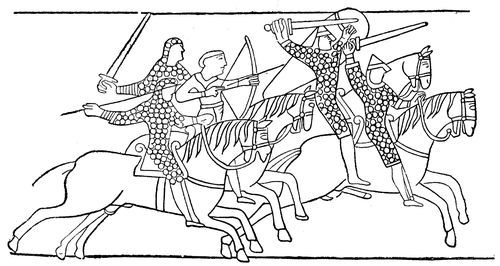
Norman soldiers mounted. (From the Bayeux Tapestry.)
23. The Landing of William. 1066.—Harold had shown what an English king could do, who fought not for this or that part of the country, but for all England. It was the lack of this national spirit in Englishmen which caused his ruin. As Harold was feasting at York in celebration of his victory, a messenger told him of the landing of the Norman host at Pevensey. He had saved Eadwine and Morkere from destruction, but Eadwine and Morkere gave him no help in return. He had to hurry back to defend Sussex without a single man from the north or the Midlands, except those whom he collected on his line of march. The House of Leofric bore no goodwill to the House of Godwine. England was a kingdom divided against itself.
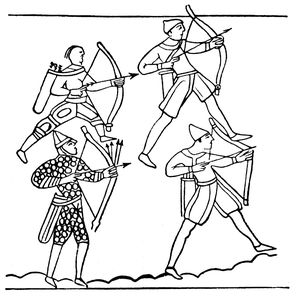
Group of archers on foot. (From the Bayeux Tapestry.)
24. The Battle of Senlac. 1066.—Harold, as soon as he reached the point of danger, drew up his army on the long hill of Senlac on which Battle Abbey now stands. On October 14 William marched forth to attack him. The military equipment of the Normans was better than that of the English. Where the weapons on either side are unlike, battles are decided by the momentum—that is to say, by the combined weight and speed of the weapons employed. The English fought on foot mostly with two-handed axes; the Normans fought not only on horseback with lances, but also with infantry, some of them being archers. A horse, the principal weapon of a horseman, has more momentum than an armed footman, whilst an arrow can reach the object at which it is aimed long before a horse. Harold, however, had in his favour the slope of the hill up which the Normans would have to ride, and he took advantage of the lie of the ground by posting his men with their shields before them on the edge of the hill. The position was a strong one for purposes of defence, but it was not one that made it easy for Harold to change his arrangements as the fortunes of the day might need. William, on the other hand, had not only a better armed force, but a more flexible one. He had to attack, and, versed as he was in all the operations of war, he could move his men from place to place and make use of each opportunity as it arrived. The English were brave enough, but William was a more intelligent leader than Harold, and his men were better under control. Twice after the battle had begun the Norman horsemen charged up the hill only to be driven back. The wily William, finding that the hill was not to be stormed by a direct attack, met the difficulty by galling the English with a shower of arrows and ordering his left wing to turn and fly. The stratagem was successful. Some of the English rushed down the hill in pursuit. The fugitives faced round and charged the pursuers, following them up the slope. The English on the height were thus thrown into confusion; but they held out stoutly, and as the Norman horsemen now in occupation of one end of the hill charged fiercely along its crest, they locked their shields together and fought desperately for life, if no longer for victory. Slowly and steadily the Normans pressed on, till they reached the spot where Harold, surrounded by his house-carls, fought beneath his standard. There all their attacks were in vain, till William, calling for his bowmen, bade them shoot their arrows into the air. Down came the arrows in showers upon the heads of the English warriors, and one of them pierced Harold's eye, stretching him lifeless on the ground. In a series of representations in worsted work, known as the Bayeux Tapestry, which was wrought by the needle of some unknown woman and is now exhibited in the museum of that city, the scenes of the battle and the events preceding it are pictorially recorded.
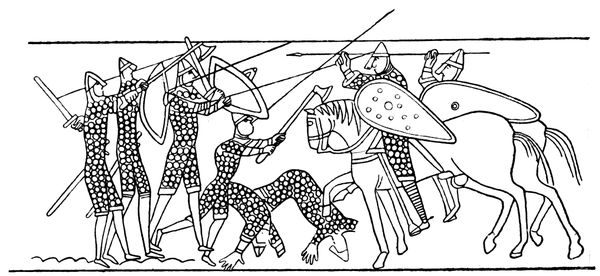
Men fighting with axes. (From the Bayeux Tapestry.)
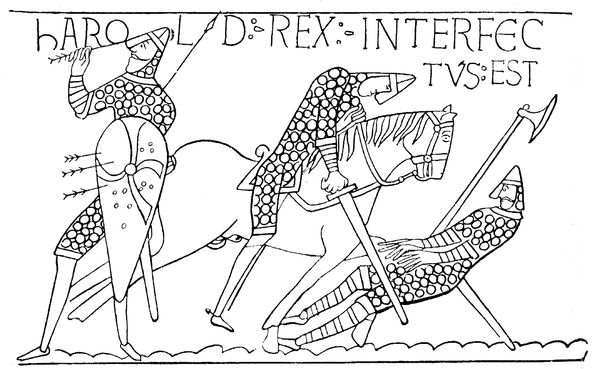
Death of Harold, who is attempting to pull the arrow from his eye. (From the Bayeux Tapestry.)
25. William's Coronation. 1066.—William had destroyed both the English king and the English army. It is possible that England, if united, might still have resisted. The great men at London chose for their king Eadgar the Ætheling, the grandson of Eadmund Ironside. Eadwine and Morkere were present at the election, but left London as soon as it was over. They would look after their own earldoms; they would not join others, as Harold had done, in defending England as a whole. Divided England would sooner or later be a prey to William. He wanted, however, not merely to reign as a conqueror, but to be lawfully elected as king, that he might have on his side law as well as force. He first struck terror into Kent and Sussex by ravaging the lands of all who held out against him. Then he marched to the Thames and burnt Southwark. He did not, however, try to force his way into London, as he wanted to induce the citizens to submit voluntarily to him, or at least in a way which might seem voluntary. He therefore marched westwards, crossed the Thames at Wallingford, and wheeled round to Berkhampstead. His presence there made the Londoners feel utterly isolated. Even if Eadwine and Morkere wished to do anything for them, they could not come from the north or north-west without meeting William's victorious army. The great men and citizens alike gave up all thought of resistance, abandoned Eadgar, and promised to take William for their king. On Christmas Day, 1066, William was chosen with acclamation in Eadward's abbey at Westminster, where Harold had been chosen less than a year before. The Normans outside mistook the shouts of applause for a tumult against their Duke, and set fire to the houses around. The English rushed out to save their property, and William, frightened for the only time in his life, was left alone with the priests. Not knowing what was next to follow, he was crowned king of the English by Ealdred, Archbishop of York, in an empty church, amidst the crackling of flames and the shouts of men striving for the mastery.
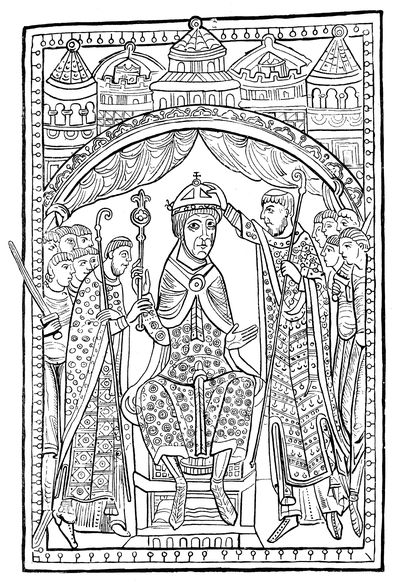
Coronation of a king, temp. William the Conqueror. (From a drawing in the possession of the Society of Antiquaries.)
Books recommended for further study of Part I.
Dawkins, W. Boyd. Early Man in Britain.
Rhys, J. Early Britain.
Elton, C. J. Origins of English History.
Guest, E. Origines Celticæ. Vol. ii. pp. 121-408.
Freeman. History of the Norman Conquest. Vols. i.-iii.
Green, J. R. The Making of England.
—— The Conquest of England.
—— History of the English People. Vol. i. pp. 1-114.
Bright, W. Chapters of English Church History.
Stubbs, W. The Constitutional History of England. Chaps. I.-IX.
Cunningham, W. The Growth of English Industry and Commerce during the Early and Middle Ages. pp. 1-128.
Hodgkin, T. The Political History of England. Vol i. From the Earliest Times to 1066.[Back to Contents]