Part 2 — XLVIII. THE GREAT EARL OF KILDARE AND THE EARL OF ORMOND.
Reading edition
The great lords who settled in Ireland in the time of Henry II. became so powerful that they ruled in the land like so many kings. It was so hard to reach Ireland in those times, or even to get from one part of Ireland to another, that their master, the king of England, had generally very little control over them: and he often found it hard enough even to find out what was going on among them. So those mighty barons did very much as they liked. They imposed taxes, raised armies, and made war on each other, just as if they were independent sovereigns.
The Fitzgeralds, or Geraldines, were among the most illustrious of those families. They intermarried with the families of the native Irish kings and princes, such as the O'Neills and O'Conors; and altogether they fell in so well with the ways of the country, that the Irish people came to love them almost better than they loved their own old native kings and chiefs. And for hundreds of years those Geraldines took a leading part in the government of Ireland for the kings of England.
In the time of Henry VII., who became king in the year 1485, Garrett Fitzgerald, earl of Kildare—the "Great Earl" as he was called—was Lord Deputy, or chief ruler of Ireland, for the king: and he was the leading man of his day in Ireland.[68] We are told in the old accounts of him that he was tall of stature, of goodly presence, very liberal and merciful; of strict piety; mild in his government; very easily put into a passion, but just as easily appeased; a knight in valour, and princely in his words and judgments.
Once he got into a great rage with one of his servants for some blunder. It happened that two of the gentlemen of his household were looking on: and one of them whispered to the other, whose name was Boice, that he would give him a good Irish hobby if he went and plucked a hair out of the earl's beard. Boice took him at his offer, and knowing well the earl's good nature, he went up to him, while he still fumed with anger, and said:—
"If so it please your good lordship, one of your horsemen promised me a choice horse if I snip one hair from your beard." "Well," quoth the earl, "I agree thereto; but if you pluck more than one, I promise you to bring my fist away from your ear!"
And Boice plucked the hair, and won the hobby: but he took good care to pluck only one, so that his ear escaped the earl's big fist.
At this time the chief man of the Butlers was James, earl of Ormond: and he and the Deputy were at enmity, each working with might and main to put down the other. The earl of Ormond, who was a deep and far reaching man, not being strong enough to oppose his adversary openly, devised a plan to entrap him by means of submission and courtesy. Certain charges had, it seems, been made against Ormond, and he now wrote to the deputy, who was, of course, in authority over him, asking permission to come to Dublin to disprove them; which the deputy granted. Accordingly, in the year 1492, he marched to Dublin with a numerous army, and encamped near the city.
Now Kildare's councillors, and the citizens in general, disliked the presence of so great an army, suspecting some evil design: and besides, the soldiers used the people ill, often beating and robbing them; so that instead of peace, this visit of Ormond made all the greater discord. Yet still, with an air of great respect and humility, he persisted in asking to be heard, saying he would show that the evil stories about him were all false. At length, Lord Deputy Kildare agreed, and the meeting was held in St. Patrick's Church.
But this meeting was not a quiet or peaceful one; for the two earls, instead of speaking gentle words of forgiveness, began to accuse each other of all the damages inflicted on both sides. The citizens too, who were in great crowds around the church, complained with loud voices of all the ill usage they had suffered from the soldiers; whereupon they and the soldiers fell to jars and quarrels, and the whole city was soon in an uproar. At last, a body of Dublin archers, enraged that such a disturbance should be raised by "this lawless rabble," rushed into the church, shouting out that they would kill Ormond, as the leader of them, and they shot at random hither and thither, leaving their arrows sticking in the timbers and ornaments of the church, but doing no harm otherwise. It is probable, indeed, that out of respect to the place, notwithstanding their rage, they took care to shoot over the heads of the crowd, so as to kill no one.
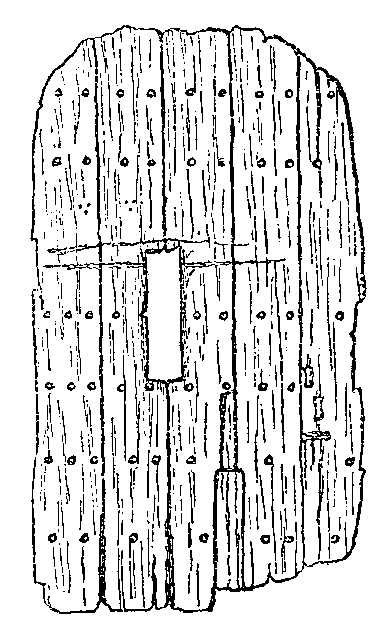
On this, the Earl of Ormond, fearing with good reason for his safety, fled with a few of his followers to the chapter-house, and slamming the door, bolted and barred it strongly. Kildare followed and called to him to come out, promising upon his honour that he should receive no harm. Ormond replied that he would come forth if the deputy gave him his hand that his life should be safe; so "a cleft was pierced in a trice through the chapter-house door," to the end that the earls might shake hands and be reconciled. But Ormond, still suspecting treachery, refused to put forth his hand, fearing it might be chopped off, till at last Kildare stretched in his arm to him through the hole, and they shook hands. Then the door was opened and the two earls embraced, and the storm was appeased.
Old Chapter-house Door, now in St. Patrick's Cathedral, Dublin.
But though this quarrel was patched up, it was only for the time. Kildare suspected that Ormond had brought his army with evil intent "to outface him and his power in his own countrie"; while "Ormond mistrusted that this treacherous practice of the Dublinians was by Kildare devised." So that, as the old writer goes on to say, "their quarrels were not ended, but only for the present discontinued: like unto a green wound, rather bungerlie botcht, than soundlie cured. And these and the like surmises, with many stories carried to and fro, and in their ears whispered, bred and fostered a malice betwixt them and their posterity, many years incurable, which caused much stir and unquietnesse in the realm."
The old chapter-house door, which is pictured on last page, still remains in St. Patrick's Cathedral, where it may be seen leaning against one of the walls, with the very "cleft" in it through which the two earls shook hands more than four hundred years ago.