IV. CUSTOMS AND MODES OF LIFE.
Reading edition
Our old books contain very full information regarding the Irish people, and how they lived, more than a thousand years ago.
In early times Ireland was almost everywhere covered with forests; and there were great and dangerous bogs and marshes, overgrown with reeds, moss, and coarse grass. Many of these bogs still remain, but they are not nearly so large or dangerous as they were then. Great tracts of country were uninhabited, so that the whole population was much less than it is now.
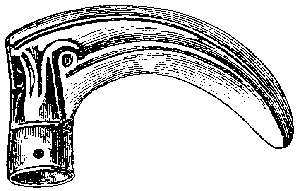
Ancient Irish bronze reaping-hook: 6 inches long. It was fitted with a handle which was fastened in the socket with a rivet. Now in the National Museum, Dublin.
The people hunted and fished a great deal, partly for food, partly to rid the country of noxious creatures, and partly for sport; for the forests were alive with wild animals of all kinds, and the rivers and lakes teemed with fish. But no one then thought it worth while to hunt foxes and hares for sport, as people do now. They had much grander game:—wild boars with long and dangerous tusks; gigantic deer; and fierce wolves that lurked in caves and thick woods. In the cleared parts of the country there was much pasture and tillage various kinds of corn and vegetables were grown, and the land was very fertile and well watered with springs and rivulets.
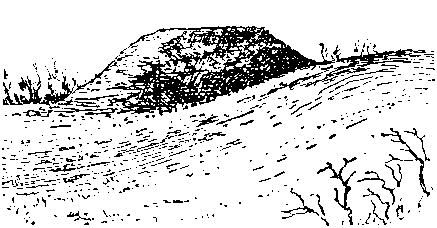
A moat: at Patrickstown, near Oldcastle, Co. Meath. Some moats were burial mounds. See pages 16 and 59.
There was more pasture than tillage; and the pasture land was not fenced in, but was grazed in common. The law was very particular in laying down rules about the fences of tillage lands—that they should be properly made, and that when two farms lay next each other, each man should do half the fencing work. Oxen were generally used for ploughing: horses seldom. Generally two oxen were put to one plough, but sometimes four, and sometimes even six. While one man held the plough, another walked in front to lead the animals.
On account of the great forests and bogs, there were many large districts where it was hard to go long distances across country from place to place: and often impossible. But in all the inhabited parts there were roads or cleared paths. The roads of those times were however very rough, and not nearly so good as our present roads. Rivers were crossed by bridges made of rough planks or wickerwork—for there were no stone bridges—or by wading at shallow fords, or by little ferry boats.
The people lived in houses almost always made of timber, generally round-shaped or oval, but sometimes four-cornered and oblong like our present houses. In order to keep off wild beasts and robbers, there was a high embankment of earth, with a deep trench, round every house. Many of these earthworks still remain all over Ireland, and are well known by the names lis, rath, fort, &c.; and some have high mounds commonly called moats.
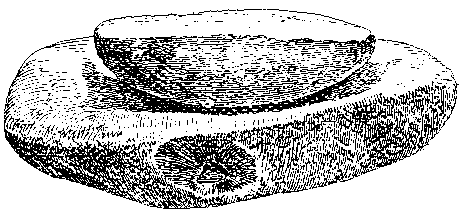
Grain-rubber: 16 inches long. People ground their corn with this before the invention of querns and milk. The grain was put between the two stones, and the upper stone was worked backwards and forwards with the hands. It was very hard and tedious work. See p. 17.
The food of the people was not very different from what it is at present, except that they had no potatoes, which were brought to Ireland for the first time about 300 years ago: and there was no tea or coffee. They used oats, wheat, rye, and barley, ground and made into bread; fish; and for those who could afford it, the flesh of various animals, either boiled or roast. Oatmeal porridge or stirabout was in very general use, especially for children. They ground their corn with small watermills, or with handmills called querns, one of which was kept in almost every house. Querns were in use before the earliest time that our history reaches; and water-mills were introduced before the arrival of St. Patrick. In those early ages there was no sugar, and honey was greatly valued, so that beehives were kept everywhere.
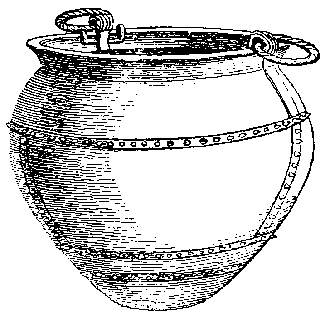
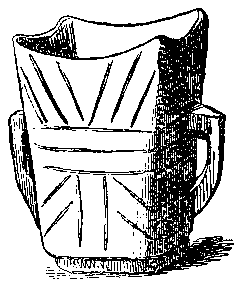
Ancient Irish bronze caldron for boiling meat, 12½ inches deep, formed of plates beautifully rivetted together. It shows marks and signs of long use over a fire. Now in the National Museum, Dublin. Irish drinking vessel, called a Mether. They drank from the corners. At meals, the same mether was used by several persons, who drank from it in turn.
For drink, they had, besides plain water and milk, ale, and a sweet sort of liquor called mead both of which were made at home, and often wine, which was brought from the continent. There was then no whiskey.
In those days there were no hotels or inns as there are now, where a person could have board and lodging for payment; but they were not much needed then, as travellers were otherwise well provided for. Besides the monasteries, which, as we shall see further on, were always open and free to wayfarers, there were, all through the country, what were called "Houses of public hospitality." The keeper of one of those houses was called a Brugaid and sometimes a Beetagh; and his office was considered very high and honourable. A brugaid or beetagh had to keep an open house for travellers who were always welcome, and received bed and food free of charge. He was obliged by law to keep constantly in hands a large stock of provisions; and he should have a certain number of beds and all other necessary household furniture. To enable a brugaid to keep up such an expensive establishment, he had the house itself and a large tract of land, free of rent and taxes, besides other liberal allowances.
The law required that there should be several open roads leading to the residence of every brugaid; and that a light should always be kept burning in the lawn at night to guide travellers to the house.
The people dressed well according to their means. Both men and women were fond of bright coloured garments, which were not hard to procure, as the art of dyeing in all the various hues was well understood. It was usual for the same person to wear clothes of several brilliant colours: and sometimes the long outside mantle worn by men and women was striped and spotted with purple, yellow, green, or other dyes like Joseph's coat of many colours. Those who were able to afford it wore rings, bracelets, necklaces, gorgets, brooches, and other ornaments, made of gold, silver, and a sort of white bronze.
Ancient Irish Gorget for the neck: of gold, reddish in colour, and very pure: weighs 16⅓ oz. Now in the National Museum, Dublin.
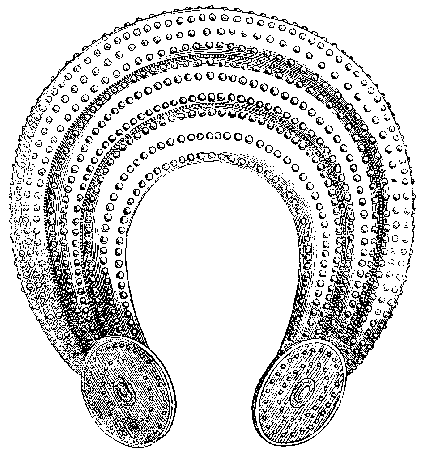
The Irish metal workers were very skilful. They made brooches, rings, bracelets, croziers, crosses, and other such articles, in gold, silver, whitish bronze, gems, and enamel, of which many have been found in the earth from time to time, and are now kept in museums: and some of them are so skilfully and beautifully wrought that no artificer of the present day can imitate them.
There were men of the several professions, such as medical doctors, lawyers, judges, builders, poets, historians: and all through the country were to be found tradesmen of the various crafts—carpenters, smiths, workers in gold, silver, and brass, ship and boat builders, masons, shoemakers, dyers, tailors, brewers, and so-forth: all working industriously and earning their bread under the old irish laws, which were everywhere acknowledged and obeyed. Then there was a good deal of commerce with Britain and with Continental countries, especially France; and the home commodities, such as hides, salt, wool, etc., were exchanged for wine, silk, satin, and other goods not produced in Ireland.
From what has been said here, we may see that the ancient Irish were orderly and regular in their way of life—quite on a level in this respect with the people of those other European countries of the same period that had a proper settled government; and, it will be shown further on in this book, that they were famed throughout all Europe for Religion and Learning.
The greatest evil of the country was war; for the kings and chiefs were very often fighting with each other, which brought great misery on the poor people where the disturbances took place. But in those early times war was common in all countries; and in this respect there was no more trouble in Ireland than in England, Scotland, and the countries of the Continent.
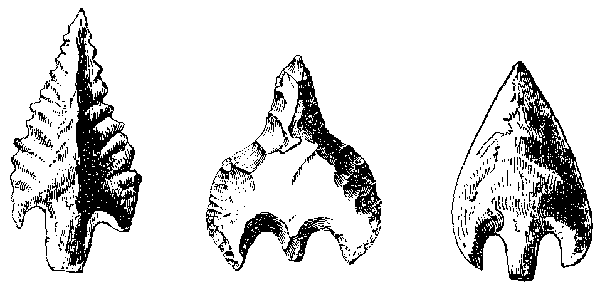
Flint arrow-heads. The head was fixed on the top of the shaft with cord of some kind, or with dried gut or tendon. Flint was used at a very early period when metals were either not known at all or were still very scarce. The makers of flint implements shaped them by chipping with stone hammers, in which they were very skilful and expert.
One form of Irish Ornament.