Part 2 — XLIII. "CAHAL-MORE OF THE WINE-RED HAND."
Reading edition
XLIII. "CAHAL-MORE OF THE WINE-RED HAND."
The ancient Irish people—like those of several other countries—believed that when a just and good king reigned, the country was blessed with fine weather and abundant crops, the trees bended with fruit, the rivers teemed with fish, and the whole kingdom prospered. This was the state of Connaught while Cahal of the Red Hand reigned in peace. And it is recorded that when he died, fearful portents appeared, and there was gloom and terror everywhere. James Clarence Mangan, a Dublin poet, who died in 1849, pictures all this in the following fine poem. He supposes himself to be living on the river Maine, in Germany, and he is brought to Connaught in a vision, where he witnesses the prosperity that attended Cahal's reign. This he sets forth in the first part of the poem: but a sudden mysterious change for the worse comes, which he describes in the last two verses. The whole poem forms a wild, misty sort of picture, such as one might see in a dream.[64]
A Vision of Connaught in the Thirteenth Century.
I walked entranced Through a land of Morn; The sun, with wondrous excess of light, Shone down and glanced Over seas of corn And lustrous gardens aleft and right. Even in the clime Of resplendent Spain, Beams no such sun upon such a land; But it was the time, 'Twas in the reign, Of Cahal More of the Wine-red Hand. Anon stood nigh By my side a man Of princely aspect and port sublime. Him queried I, "O, my Lord and Khan,[65] What clime is this, and what golden time?" When he—"The clime Is a clime to praise, The clime is Erin's, the green and bland; And it is the time, These be the days, Of Cahal More of the Wine-red Hand!" Then saw I thrones, And circling fires, And a dome rose near me, as by a spell, Whence flowed the tones Of silver lyres, And many voices in wreathèd swell; And their thrilling chime Fell on mine ears As the heavenly hymn of an angel-band— "It is now the time, These be the years, Of Cahal More of the Wine-red Hand!" I sought the hall, And, behold!... a change From light to darkness, from joy to woe! King, nobles, all, Looked aghast and strange; The minstrel-group sate in dumbest show! Had some great crime Wrought this dread amaze, This terror? None seemed to understand! 'Twas then the time, We were in the days, Of Cahal More of the Wine-red Hand. I again walked forth; But lo! the sky Showed fleckt with blood, and an alien sun Glared from the north, And there stood on high, Amid his shorn beams, a skeleton It was by the stream Of the castled Maine, One Autumn eve, in the teuton's land, That I dreamed this dream Of the time and reign Of Cahal More of the Wine-red Hand!
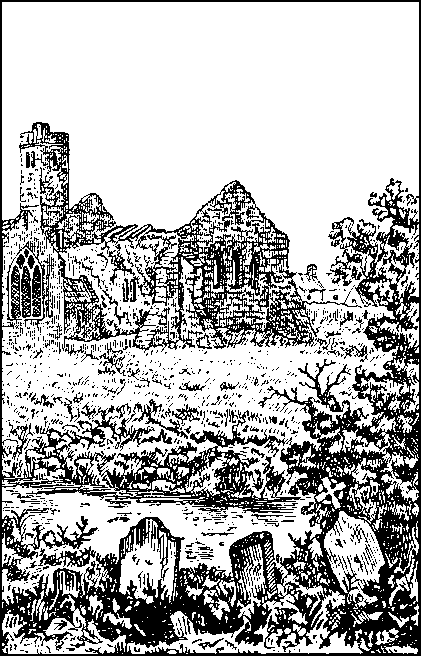
St. Finghin's Church, Quin, Co. Clare: originally built by the Irish: re-built by Thomas de Clare, the Anglo-Norman lord who erected Bunratty Castle (see p. 177). The Irish began to build large churches and castles a little before the arrival of the Anglo-Normans. The Irish churches of a previous time were generally small. After the Invasion, the Anglo-Norman barons and the Irish kings and chiefs vied with each other in erecting churches, abbeys, and castles.