Volume 3 — CHAPTER XXVII.——THE WARS IN ITALY. —LOUIS XII. 1498-1515.
Robert Black translation
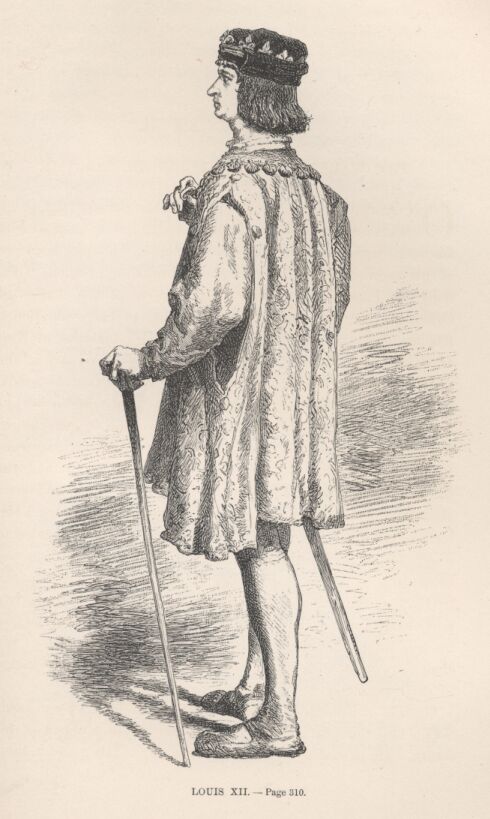
On ascending the throne Louis XII. reduced the public taxes and confirmed in their posts his predecessor’s chief advisers, using to Louis de la Tremoille, who had been one of his most energetic foes, that celebrated expression, “The King of France avenges not the wrongs of the Duke of Orleans.” At the same time, on the day of his coronation at Rheims [May 27, 1492], he assumed, besides his title of King of France, the titles of King of Naples and of Jerusalem and Duke of Milan. This was as much as to say that he would pursue a pacific and conservative policy at home and a warlike and adventurous policy abroad. And, indeed, his government did present these two phases, so different and inharmonious. By his policy at home Louis XII. deserved and obtained the name of Father of the People; by his enterprises and wars abroad he involved France still more deeply than Charles VIII. had in that mad course of distant, reckless, and incoherent conquests for which his successor, Francis I., was destined to pay by capture at Pavia and by the lamentable treaty of Madrid, in 1526, as the price of his release. Let us follow these two portions of Louis XII.‘s reign, each separately, without mixing up one with the other by reason of identity of dates. We shall thus get at a better understanding and better appreciation of their character and their results.
Outside of France, Milaness [the Milanese district] was Louis XII.‘s first thought, at his accession, and the first object of his desire. He looked upon it as his patrimony. His grandmother, Valentine Visconti, widow of that Duke of Orleans who had been assassinated at Paris in 1407 by order of John the Fearless, Duke of Burgundy, had been the last to inherit the duchy of Milan, which the Sforzas, in 1450, had seized. When Charles VIII. invaded Italy in 1494, “Now is the time,” said Louis, “to enforce the rights of Valentine Visconti, my grandmother, to Milaness.” And he, in fact, asserted them openly, and proclaimed his intention of vindicating them so soon as he found the moment propitious. When he became king, his chance of success was great. The Duke of Milan, Ludovic, the Moor, had by his sagacity and fertile mind, by his taste for arts and sciences and the intelligent patronage he bestowed upon them, by his ability in speaking, and by his facile character, obtained in Italy a position far beyond his real power. Leonardo da Vinci, one of the most eminent amongst the noble geniuses of the age, lived on intimate terms with him; but Ludovic was, nevertheless, a turbulent rascal and a greedy tyrant, of whom those who did not profit by his vices or the enjoyments of his court were desirous of being relieved. He had, moreover, embroiled himself with his neighbors the Venetians, who were watching for an opportunity of aggrandizing themselves at his expense. As early as the 20th of April, 1498, a fortnight after his accession, Louis XII. addressed to the Venetians a letter “most gracious,” says the contemporary chronicler Marino Sanuto, “and testifying great good-will;” and the special courier who brought it declared that the king had written to nobody in Italy except the pope, the Venetians, and the Florentines. The Venetians did not care to neglect such an opening; and they at once sent three ambassadors to Louis XII. Louis heard the news thereof with marked satisfaction. “I have never seen Zorzi,” said he, “but I know him well; as for Loredano, I like him much; he has been at this court before, some time ago.” He gave them a reception on the 12th of August, at Etampes, “not in a palace,” says one of the senate’s private correspondents, “but at the Fountain inn. You will tell me that so great a king ought not to put up at an inn; but I shall answer you that in this district of Etampes the best houses are as yet the inns. There is certainly a royal castle, in the which lives the queen, the wife of the deceased king; nevertheless his Majesty was pleased to give audience in this hostelry, all covered expressly with cloth of Alexandrine velvet, with lilies of gold at the spot where the king was placed. As soon as the speech was ended, his Majesty rose up and gave quite a brotherly welcome to the brilliant ambassadors. The king has a very good countenance, a smiling countenance; he is forty years of age, and appears very active in make. To-day, Monday, August 13, the ambassadors were received at a private audience.”
A treaty concluded on the 9th of February, 1499, and published as signed at Blois no earlier than the 15th of April following, was the result of this negotiation. It provided for an alliance between the King of France and the Venetian government, for the purpose of making war in common upon the Duke of Milan, Ludovic Sforza, on and against every one, save the lord pope of Rome, and for the purpose of insuring to the Most Christian king restoration to the possession of the said duchy of Milan as his rightful and olden patrimony. And on account of the charges and expenses which would be incurred by the Venetian government whilst rendering assistance to the Most Christian king in the aforesaid war, the Most Christian king bound himself to approve and consent that the city of Cremona and certain forts or territories adjacent, specially indicated, should belong in freehold and perpetuity to the Venetian government. The treaty, at the same time, regulated the number of troops and the military details of the war on behalf of the two contracting powers, and it provided for divers political incidents which might be entailed, and to which the alliance thus concluded should or should not be applicable according to the special stipulations which were drawn up with a view to those very incidents.
In the month of August, 1499, the French army, with a strength of from twenty to five and twenty thousand men, of whom five thousand were Swiss, invaded Milaness. Duke Ludovic Sforza opposed to it a force pretty nearly equal in number, but far less full of confidence and of far less valor. In less than three weeks the duchy was conquered; in only two cases was any assault necessary; all the other places were given up by traitors or surrendered without a show of resistance. The Venetians had the same success on the eastern frontier of the duchy. Milan and Cremona alone remained to be occupied. Ludovic Sforza “appeared before his troops and his people like the very spirit of lethargy,” says a contemporary unpublished chronicle, “with his head bent down to the earth, and for a long while he remained thus pensive and without a single word to say. Howbeit he was not so discomfited but that on that very same day he could get his luggage packed, his transport-train under orders, his horses shod, his ducats, with which he had more than thirty mules laden, put by, and, in short, everything in readiness to decamp next morning as early as possible.” Just as he left Milan, he said to the Venetian ambassadors, “You have brought the King of France to dinner with me; I warn you that he will come to supper with you.”
“Unless necessity constrain him thereto,” says Machiavelli [treatise Du Prince, ch. xxi.], “a prince ought never to form alliance with one stronger than himself in order to attack others, for, the most powerful being victor, thou remainest, thyself, at his discretion, and princes ought to avoid, as much as ever they can, being at another’s discretion. The Venetians allied themselves with France against the Duke of Milan; and yet they might have avoided this alliance, which entailed their ruin.” For all his great and profound intellect, Machiavelli was wrong about this event and the actors in it. The Venetians did not deserve his censure. By allying themselves, in 1499, with Louis XII. against the Duke of Milan, they did not fall into Louis’s hands, for, between 1499 and 1515, and many times over, they sided alternately with and against him, always preserving their independence and displaying it as suited them at the moment. And these vicissitudes in their policy did not bring about their ruin, for at the death of Louis XII. their power and importance in Southern Europe had not declined. It was Louis XII. who deserved Machiavelli’s strictures for having engaged, by means of diplomatic alliances of the most contradictory kind, at one time with the Venetians’ support, and at another against them, in a policy of distant and incoherent conquests, without any connection with the national interests of France, and, in the long run, without any success.
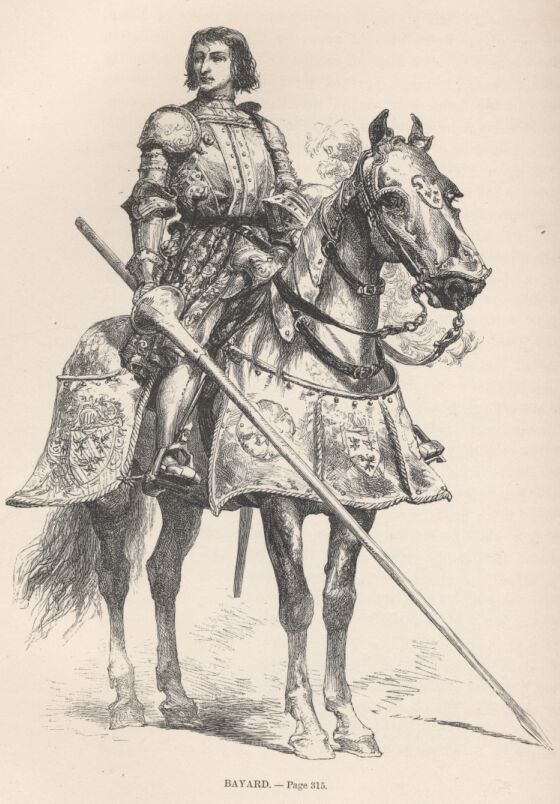
Louis was at Lyons when he heard of his army’s victory in Milaness and of Ludovic Sforza’s flight. He was eager to go and take possession of his conquest, and, on the 6th of October, 1499, he made his triumphal entry into Milan amidst cries of “Hurrah! for France.” He reduced the heavy imposts established by the Sforzas, revoked the vexatious game-laws, instituted at Milan a court of justice analogous to the French parliaments, loaded with favors the scholars and artists who were the honor of Lombardy, and recrossed the Alps at the end of some weeks, leaving as governor of Milaness John James Trivulzio, the valiant Condottiere, who, four years before, had quitted the service of Ferdinand II., King of Naples, for that of Charles VIII. Unfortunately Trivulzio was himself a Milanese and of the faction of the Guelphs. He had the passions of a partisan and the habits of a man of war; and he soon became as tyrannical and as much detested in Milaness as Ludovic the Moor had but lately been. A plot was formed in favor of the fallen tyrant, who was in Germany expecting it, and was recruiting, during expectancy, amongst the Germans and Swiss in order to take advantage of it. On the 25th of January, 1500, the insurrection broke out; and two months later Ludovic Sforza had once more become master of Milaness, where the French possessed nothing but the castle of Milan. In one of the fights brought about by this sudden revolution the young Chevalier Bayard, carried away by the impetuosity of his age and courage, pursued right into Milan the foes he was driving before him, without noticing that his French comrades had left him; and he was taken prisoner in front of the very palace in which were the quarters of Ludovic Sforza. The incident created some noise around the palace; Ludovic asked what it meant, and was informed that a brave and bold gentleman, younger than any of the others, had entered Milan pell-mell with the combatants he was pursuing, and had been taken prisoner by John Bernardino Casaccio, one of the leaders of the insurrection. Ludovic ordered him to be brought up, which was done, though not without some disquietude on the part of Bayard’s captor, “a courteous gentleman, who feared that Lord Ludovico might do him some displeasure.” He resolved himself to be his conductor, after having dressed him in one of his own robes and made him look like a gentleman. “Marvelling to see Bayard so young, ‘Come hither, my gentleman,’ said Ludovico: ‘who brought you into the city?’ ‘By my faith, my lord,’ answered Bayard, who was not a whit abashed, ‘I never imagined I was entering all alone, and thought surely I was being followed of my comrades, who knew more about war than I, for if they had done as I did they would, like me, be prisoners. Howbeit, after my mishap, I laud the fortune which caused me to fall into the hands of so valiant and discreet a knight as he who has me in holding.’ ‘By your faith,’ asked Ludovico, ‘of how many is the army of the King of France?’ ‘On my soul, my lord,’ answered Bayard, ‘so far as I can hear, there are fourteen or fifteen hundred men-at-arms and sixteen or eighteen thousand foot; but they are all picked men, who are resolved to busy themselves so well this bout that they will assure the state of Milan to the king our master; and meseems, my lord, that you would surely be in as great safety in Germany as you are here, for your folks are not the sort to fight us.’ With such assurance spoke the good knight that Lord Ludovico took pleasure there-in, though his say was enough to astound him. ‘On my faith, my gentleman,’ said he, as it were in raillery, ‘I have a good mind that the King of France’s army and mine should come together, in order that by battle it may be known to whom of right belongs this heritage, for I see no other way to it.’ ‘By my sacred oath, my lord,’ said the good knight, ‘I would that it might be to-morrow, provided that I were out of captivity.’ ‘Verily, that shall not stand in your way,’ said Ludovico, ‘for I will let you go forth, and that presently. Moreover, ask of me what you will, and I will give it you.’ The good knight, who, on bended knee, thanked Lord Ludovico for the offers he made him, as there was good reason he should, then said to him, ‘My lord, I ask of you nothing save only that you may be pleased to extend your courtesy so far as to get me back my horse and my arms that I brought into this city, and so send me away to my garrison, which is twenty miles hence; you would do me a very great kindness, for which I shall all my life feel bounden to you; and, barring my duty to the king my master and saving my honor, I would show my gratitude for it in whatsoever it might please you to command me.’ ‘In good faith,’ said Lord Ludovico, ‘you shall have presently that which you do ask for.’ And then he said to the Lord John Bernardino, ‘At once, Sir Captain, let his horse be found, his arms and all that is his.’ ‘My lord,’ answered the captain, ‘it is right easy to find, it is all at my quarters.’ He sent forthwith two or three servants, who brought the arms and led up the horse of the good young knight; and Lord Ludovico had him armed before his eyes. When he was accoutred, the young knight leaped upon his horse without putting foot to stirrup; then he asked for a lance, which was handed to him, and, raising his eyes, he said to Lord Ludovico, ‘My lord, I thank you for the courtesy you have done me; please God to pay it back to you.’ He was in a fine large court-yard; then he began to set spurs to his horse, the which gave four or five jumps, so gayly that it could not be better done; then the young knight gave him a little run, in the which he broke the lance against the ground into five or six pieces; whereat Lord Ludovico was not over pleased, and said out loud, ‘If all the men-at-arms of France were like him yonder, I should have a bad chance.’ Nevertheless he had a trumpeter told off to conduct him to his garrison.” [Histoire du bon Chevalier sans Peur et sans Reproche, t. i. pp. 212-216.]
For Ludovic the Moor’s chance to be bad it was not necessary that the men-at-arms of France should all be like Chevalier Bayard. Louis XII., so soon as he heard of the Milanese insurrection, sent into Italy Louis de la Tremoille, the best of his captains, and the Cardinal d’Amboise, his privy councillor and his friend, the former to command the royal troops, French and Swiss, and the latter “for to treat about the reconciliation of the rebel towns, and to deal with everything as if it were the king in his own person.” The campaign did not last long. The Swiss who had been recruited by Ludovic and those who were in Louis XII.‘s service had no mind to fight one another; and the former capitulated, surrendered the strong place of Novara, and promised to evacuate the country on condition of a safe-conduct for themselves and their booty. Ludovic, in extreme anxiety for his own safety, was on the point of giving himself up to the French; but, whether by his own free will or by the advice of the Swiss who were but lately in his pay, and who were now withdrawing; he concealed himself amongst them, putting on a disguise, “with his hair turned up under a coif, a collaret round his neck, a doublet of crimson satin, scarlet hose, and a halberd in his fist;” but, whether it were that he was betrayed or that he was recognized, he, on the 10th of April, 1500, fell into the hands of the French, and was conducted to the quarters of La Tremoille, who said no more than, “Welcome, lord.” Next day, April 11, Louis XII. received near Lyons the news of this capture, “whereat he was right joyous, and had bonfires lighted, together with devotional processions, giving thanks to the Prince of princes for the happy victory he had, by the divine aid, obtained over his enemies.” Ludovic was taken to Lyons. “At the entrance into the city a great number of gentlemen from the king’s household were present to meet him; and the provost of the household conducted him all along the high street to the castle of Pierre-Encise, where he was lodged and placed in security.” There he passed a fortnight. Louis refused to see him, but had him “questioned as to several matters by the lords of his grand council; and, granted that he had committed nought but follies, still he spoke right wisely.” He was conducted from Pierre-Encise to the castle of Loches in Touraine, where he was at first kept in very strict captivity, “without books, paper, or ink,” but it was afterwards less severe. “He plays at tennis and at cards,” says a despatch of the Venetian ambassador, Dominic of Treviso, “and he is fatter than ever.” [La Diplomatic Venitienne, by M. Armand Baschet (1862), p. 363.] He died in his prison at the end of eight years, having to the very last great confidence in the future of his name, for he wrote, they say, on the wall of his prison these words: “Services rendered me will count for an heritage.” And “thus was the duchy of Milan, within seven months and a half, twice conquered by the French,” says John d’Auton in his Claronique, “and for the nonce was ended the war in Lombardy, and the authors thereof were captives and exiles.”
Whilst matters were thus going on in the north of Italy, Louis XII. was preparing for his second great Italian venture, the conquest of the kingdom of Naples, in which his predecessor Charles VIII. had failed. He thought to render the enterprise easier by not bearing the whole burden by himself alone. On the 11th of November, 1500, he concluded at Grenada “with Ferdinand and Isabella, King and Queen of Castile and Arragon,” a treaty, by which the Kings of France and Spain divided, by anticipation, between them the kingdom of Naples, which they were making an engagement to conquer together. Terra di Lavoro and the province of the Abruzzi, with the cities of Naples and Gaeta, were to be the share of Louis XII., who would assume the title of King of Naples and of Jerusalem; Calabria and Puglia (Apulia), with the title of duchies, would belong to the King of Spain, to whom Louis XII., in order to obtain this chance of an accessary and precarious kingship, gave up entirely Roussillon and Cerdagne, that French frontier of the Pyrenees which Louis XI. had purchased, a golden bargain, from John II., King of Arragon. In this arrangement there was a blemish and a danger of which the superficial and reckless policy of Louis XII. made no account: he did not here, as he had done for the conquest of Milaness, join himself to an ally of far inferior power to his own, and of ambition confined within far narrower boundaries, as was the case when the Venetians supported him against Ludovie Sforza: he was choosing for his comrade, in a far greater enterprise, his nearest and most powerful rival, and the most dexterous rascal amongst the kings of his day. “The King of France,” said Ferdinand one day, “complains that I have deceived him twice; he lies, the drunkard; I have deceived him more than ten times.” Whether this barefaced language were or were not really used, it expressed nothing but the truth: mediocre men, who desire to remain pretty nearly honest, have always the worst of it, and are always dupes when they ally themselves with men who are corrupt and at the same time able, indifferent to good and evil, to justice and iniquity. Louis XII., even with the Cardinal d’Amboise to advise him, was neither sufficiently judicious to abstain from madly conceived enterprises, nor sufficiently scrupulous and clear-sighted to unmask and play off every act of perfidy and wickedness: by uniting himself, for the conquest and partition of the kingdom of Naples, with Ferdinand the Catholic, he was bringing upon himself first of all hidden opposition in the very midst of joint action, and afterwards open treason and defection. He forgot, moreover, that Ferdinand had at the head of his armies a tried chieftain, Gonzalvo of Cordova, already known throughout Europe as the great captain, who had won that name in campaigns against the Moors, the Turks, and the Portuguese, and who had the character of being as free from scruple as from fear. Lastly the supporters who, at the very commencement of his enterprises in Italy, had been sought and gained by Louis XII., Pope Alexander VI. and his son Caesar Borgia, were as little to be depended upon in the future as they were compromising at the present by reason of their reputation for unbridled ambition, perfidy, and crime. The King of France, whatever sacrifices he might already have made and might still make in order to insure their co-operation, could no more count upon it than upon the loyalty of the King of Spain in the conquest they were entering upon together.
The outset of the campaign was attended with easy success. The French army, under the command of Stuart d’Aubigny, a valiant Scot, arrived on the 25th of June, 1501, before Rome, and there received a communication in the form of a bull of the pope which removed the crown of Naples from the head of Frederick III., and partitioned that fief of the Holy See between the Kings of France and Spain. Fortified with this authority, the army continued its march, and arrived before Capua on the 6th of July. Gonzalvo of Cordova was already upon Neapolitan territory with a Spanish army, which Ferdinand the Catholic had hastily sent thither at the request of Frederick III. himself, who had counted upon the assistance of his cousin the King of Arragon against the French invasion. Great was his consternation when he heard that the ambassadors of France and Spain had proclaimed at Rome the alliance between their masters. At the first rumor of this news, Gonzalvo of Cordova, whether sincerely or not, treated it as a calumny; but, so soon as its certainty was made public, he accepted it without hesitation, and took, equally with the French, the offensive against the king, already dethroned by the pope, and very near being so by the two sovereigns who had made alliance for the purpose of sharing between them the spoil they should get from him. Capua capitulated, and was nevertheless plundered and laid waste. A French fleet, commanded by Philip de Ravenstein, arrived off Naples when D’Aubigny was already master of it. The unhappy King Frederick took refuge in the island of Ischia; and, unable to bear the idea of seeking an asylum in Spain with his cousin who had betrayed him so shamefully, he begged the French admiral himself to advise him in his adversity. “As enemies that have the advantage should show humanity to the afflicted,” Ravenstein sent word to him, “he would willingly advise him as to his affairs; according to his advice, the best thing would be to surrender and place himself in the hands of the King of France, and submit to his good pleasure; he would find him so wise, and so debonnair, and so accommodating, that he would be bound to be content. Better or safer counsel for him he had not to give.” After taking some precautions on the score of his eldest son, Prince Ferdinand, whom he left at Tarento, in the kingdom he was about to quit, Frederick III. followed Ravenstein’s counsel, sent to ask for “a young gentleman to be his guide to France,” put to sea with five hundred men remaining to him, and arrived at Marseilles, whither Louis XII. sent some lords of his court to receive him. Two months afterwards, and not before, he was conducted to the king himself, who was then at Blois. Louis welcomed him with his natural kindness, and secured to him fifty thousand livres a year on the duchy of Anjou, on condition that he never left France. It does not appear that Frederick ever had an idea of doing so, for his name is completely lost to history up to the day of his death, which took place at Tours on the 9th of November, 1504, after three years’ oblivion and exile.
On hearing of so prompt a success, Louis XII.‘s satisfaction was great. He believed, and many others, no doubt, believed with him, that his conquest of Naples, of that portion at least which was assigned to him by his treaty with the King of Spain, was accomplished. The senate of Venice sent to him, in December, 1501, a solemn embassy to congratulate him. In giving the senate an account of his mission, one of the ambassadors, Dominic of Treviso, drew the following portrait of Louis XII.: “The king is in stature tall and thin, and temperate in eating, taking scarcely anything but boiled beef; he is by nature miserly and retentive; his great pleasure is hawking; from September to April he hawks. The Cardinal of Rouen [George d’Amboise] does everything; nothing, however, with-out the cognizance of the king, who has a far from stable mind, saying yes and no. . . . I am of opinion that their lordships should remove every suspicion from his Majesty’s mind, and aim at keeping themselves closely united with him.” [Armand Baschet, La Diplomatic, L’enitienne, p. 362.] It was not without ground that the Venetian envoy gave his government this advice. So soon as the treaty of alliance between Louis XII. and the Venetians for the conquest of Milaness had attained its end, the king had more than once felt and testified some displeasure at the demeanor assumed towards him by his former allies. They had shown vexation and disquietude at the extension of French influence in Italy; and they had addressed to Louis certain representations touching the favor enjoyed at his hands by the pope’s nephew, Caesar Borgia, to whom he had given the title of Duke of Valentinois on investing him with the countships of Valence and of Die in Dauphiny. Louis, on his side, showed anxiety as to the conduct which would be exhibited towards him by the Venetians if he encountered any embarrassment in his expedition to Naples. Nothing of the kind happened to him during the first month after King Frederick III.‘s abandonment of the kingdom of Naples. The French and the Spaniards, D’Aubigny and Gonzalvo of Cordova, at first gave their attention to nothing but establishing themselves firmly, each in the interests of the king his master, in those portions of the kingdom which were to belong to them.
But, before long, disputes arose between the two generals as to the meaning of certain clauses in the treaty of November 11, 1500, and as to the demarcation of the French and the Spanish territories. D’Aubigny fell ill; and Louis XII. sent to Naples, with the title of viceroy, Louis d’Armagnac, Duke of Nemours, a brave warrior, but a negotiator inclined to take umbrage and to give offence. The disputes soon took the form of hostilities. The French essayed to drive the Spaniards from the points they had occupied in the disputed territories; and at first they had the advantage. Gonzalvo of Cordova, from necessity or in prudence, concentrated his forces within Barletta, a little fortress with a little port on the Adriatic; but he there endured, from July, 1502, to April, 1503, a siege which did great honor to the patient firmness of the Spanish troops and the persistent vigor of their captain. Gonzalvo was getting ready to sally from Barletta and take the offensive against the French when he heard that a treaty signed at Lyons on the 5th of April, 1503, between the Kings of Spain and France, made a change in the position, reciprocally, of the two sovereigns, and must suspend the military operations of their generals within the kingdom of Naples. “The French general declared his readiness to obey his king,” says Guicciardini; “but the Spanish, whether it were that he felt sure of victory or that he had received private instructions on that point, said that he could not stop the war without express orders from his king.” And sallying forthwith from Barletta, he gained, on the 28th of April, 1503, at Cerignola, a small town of Puglia, a signal victory over the French commanded by the Duke of Nemours, who, together with three thousand men of his army, was killed in action. The very day after his success Gonzalvo heard that a Spanish corps, lately disembarked in Calabria, had also beaten, on the 21st of April, at Seminara, a French corps commanded by D’Aubigny. The great captain was as eager to profit by victory as he had been patient in waiting for a chance of it. He marched rapidly on Naples, and entered it on the 14th of May, almost without resistance; and the two forts defending the city, the Castel Nuovo and the Castel dell’ Uovo surrendered, one on the 11th of June and the other on the 1st of July. The capital of the kingdom having thus fallen into the hands of the Spaniards, Capua and Aversa followed its example. Gaeta was the only important place which still held out for the French, and contained a garrison capable of defending it; and thither the remnant of the troops beaten at Seminara and at Cerignola had retired. Louis XII. hastened to levy and send to Italy, under the command of Louis de la Tremoille, a fresh army for the purpose of relieving Gaeta and recovering Naples; but at Parma La Tremoille fell ill, “so crushed by his malady and so despairing of life,” says his chronicler, John Bouchet, “that the physicians sent word to the king that it was impossible in the way of nature to recover him, and that without the divine assistance he could not get well.” The command devolved upon the Marquis of Mantua, who marched on Gaeta. He found Gonzalvo of Cordova posted with his army on the left bank of the Garigliano, either to invest the place or to repulse re-enforcements that might arrive for it. The two armies passed fifty days face to face almost, with the river and its marshes between them, and vainly attempting over and over again to join battle. Some of Gonzalvo’s officers advised him to fall back on Capua, so as to withdraw his troops from an unhealthy and difficult position; but “I would rather,” said he, “have here, for my grave, six feet of earth by pushing forward, than prolong my life a hundred years by falling back, though it were but a few arms’ lengths.” The French army was dispersing about in search of shelter and provisions; and the Marquis of Mantua, disgusted with the command, resigned it to the Marquis of Saluzzo, and returned home to his marquisate. Gonzalvo, who was kept well informed of his enemies’ condition, threw, on the 27th of December, a bridge over the Garigliano, attacked the French suddenly, and forced them to fall back upon Gaeta, which they did not succeed in entering until they had lost artillery, baggage, and a number of prisoners. “The Spaniards,” says John d’Auton, “halted before the place, made as if they would lay siege to it, and so remained for two or three days. The French, who were there in great numbers, had scarcely any provisions, and could not hold out for long; however, they put a good face upon it. The captain, Gonzalvo, sent word to them that if they would surrender their town he would, on his part, restore to them without ransom all prisoners and others of their party; and he had many of them, James de la Palisse, Stuart d’Aubigny, Gaspard de Coligny, Anthony de la Fayette, &c., all captains. The French captains, seeing that fortune was not kind to them, and that they had provisions for a week only, were all for taking this offer. All the prisoners, captains, men-at-arms, and common soldiers were accordingly given up, put to sea, and sailed for Genoa, where they were well received and kindly treated by the Genoese, which did them great good, for they were much in need of it. Nearly all the captains died on their return, some of mourning over their losses, others of melancholy at their misfortune, others for fear of the king’s displeasure, and others of sickness and weariness.” [Chroniques of John d’Auton, t. iii. pp. 68-70.]
Gaeta fell into the hands of the Spaniards on the 1st of January, 1504. The war was not ended, but the kingdom of Naples was lost to the King of France.
At the news of these reverses the grief and irritation of Louis XII. were extreme. Not only was he losing his Neapolitan conquests, but even his Milaness was also threatened. The ill-will of the Venetians became manifest. They had re-victualled by sea the fortress of Barletta, in which Gonzalvo of Cordova had shut himself up with his troops; “and when the king presented complaints of this succor afforded to his enemies, the senate replied that the matter had taken place without their cognizance, that Venice was a republic of traders, and that private persons might very likely have sold provisions to the Spaniards, with whom Venice was at peace, without there being any ground for concluding from it that she had failed in her engagements towards France. Some time afterwards, four French galleys, chased by a Spanish squadron of superior force, presented themselves before the port of Otranto, which was in the occupation of the Venetians, who pleaded their neutrality as a reason for refusing asylum to the French squadron, which the commander was obliged to set on fire that it might not fall into he enemy’s hands.” [Histoire de la Republique de L’enise, by Count Daru, t. iii. p. 245.] The determined prosecution of hostilities in the kingdom of Naples by Gonzalvo of Cordova, in spite of the treaty concluded at Lyons on the 5th of April, 1503, between the Kings of France and Spain, was so much the more offensive to Louis XII. in that this treaty was the consequence and the confirmation of an enormous concession which he had, two years previously, made to the King of Spain on consenting to affiance his daughter, Princess Claude of France, two years old, to Ferdinand’s grandson, Charles of Austria, who was then only one year old, and who became Charles the Fifth (emperor)! Lastly, about the same time, Pope Alexander VI., who, willy hilly, had rendered Louis XII. so many services, died at Rome on the 12th of August, 1503. Louis had hoped that his favorite minister, Cardinal George d’Amboise, would succeed him, and that hope had a great deal to do with the shocking favor he showed Caesar Borgia, that infamous son of a demoralized father. But the candidature of Cardinal d’Amboise failed; a four weeks’ pope, Pius III., succeeded Alexander VI.; and, when the Holy See suddenly became once more vacant, Cardinal d’Amboise failed again; and the new choice was Cardinal Julian della Rovera, Pope Julius II., who soon became the most determined and most dangerous foe of Louis XII., already assailed by so many enemies.
The Venetian, Dominic of Treviso, was quite right; Louis XII. was “of unstable mind, saying yes and no.” On such characters discouragement tells rapidly. In order to put off the struggle which had succeeded so ill for him in the kingdom of Naples, Louis concluded, on the 31st of March, 1504, a truce for three years with the King of Spain; and on the 22d of September, in the same year, in order to satisfy his grudge on account of the Venetians’ demeanor towards him, he made an alliance against them with Emperor Maximilian I. and Pope Julius II., with the design, all three of them, of wresting certain provinces from them. With those political miscalculations was connected a more personal and more disinterested feeling. Louis repented of having in 1501 affianced his daughter Claude to Prince Charles of Austria, and of the enormous concessions he had made by two treaties, one of April 5, 1503, and the other of September 22, 1504, for the sake of this marriage. He had assigned as dowry to his daughter, first the duchy of Milan, then the kingdom of Naples, then Brittany, and then the duchy of Burgundy and the countship of Blois. The latter of these treaties contained even the following strange clause: “If, by default of the Most Christian king or of the queen his wife, or of the Princess Claude, the aforesaid marriage should not take place, the Most Christian king doth will and consent, from now, that the said duchies of Burgundy and Milan and the countship of Asti, do remain settled upon the said Prince Charles, Duke of Luxembourg, with all the rights therein possessed, or possibly to be possessed, by the Most Christian king.” [Corps Diplomatique du Droit des Gens, by J. Dumont, t. iv. part i. p. 57.] It was dismembering France, and at the same time settling on all her frontiers, to east, west, and south-west, as well as to north and south, a power which the approaching union of two crowns, the imperial and the Spanish, on the head of Prince Charles of Austria, rendered so preponderating and so formidable.
It was not only from considerations of external policy, and in order to conciliate to himself Emperor Maximilian and King Ferdinand, that Louis XII. had allowed himself to proceed to concessions so plainly contrary to the greatest interests of France: he had yielded also to domestic influences. The queen his wife, Anne of Brittany, detested Louise of Savoy, widow of Charles d’Orleans, Count of Angouleme, and mother of Francis d’Angouleme, heir presumptive to the throne, since Louis XII. had no son. Anne could not bear the idea that her daughter, Princess Claude, should marry the son of her personal enemy; and, being more Breton than French, say her contemporaries, she, in order to avoid this disagreeableness, had used with the king all her influence, which was great, in favor of the Austrian marriage, caring little, and, perhaps, even desiring, that Brittany should be again severed from France. Louis, in the midst of the reverses of his diplomacy, had thus to suffer from the hatreds of his wife, the observations of his advisers, and the reproaches of his conscience as a king. He fell so ill that he was supposed to be past recovery. “It were to do what would be incredible,” says his contemporary, John de St. Gelais, “to write or tell of the lamentations made throughout the whole realm of France, by reason of the sorrow felt by all for the illness of their good king. There were to be seen night and day, at Blois, at Amboise, at Tours, and everywhere else, men and women going all bare throughout the churches and to the holy places, in order to obtain from divine mercy grace of health and convalescence for one whom there was as great fear of losing as if he had been the father of each.” Louis was touched by this popular sympathy; and his wisest councillors, Cardinal d’Amboise the first of all, took advantage thereof to appeal to his conscience in respect of the engagements which “through weakness he had undertaken contrary to the interests of the realm and the coronation-promises.” Queen Anne herself, not without a struggle, however, at last gave up her opposition to this patriotic recoil; and on the 10th of May, 1505, Louis XII. put in his will a clause to the effect that his daughter, Princess Claude, should be married, so soon as she was old enough, to the heir to the throne, Francis, Count of Angouleme. Only it was agreed, in order to avoid diplomatic embarrassments, that this arrangement should be kept secret till further notice. [The will itself of Louis XII. has been inserted in the Recueil des Ordonnances des Bois des France, t. xxi. p. 323, dated 30th of May, 1505.]
When Louis had recovered, discreet measures were taken for arousing the feeling of the country as well as the king’s conscience as to this great question. In the course of the year 1505 there took place throughout the whole kingdom, amongst the nobility and in the principal towns, assemblies at which means were proposed for preventing this evil. Unpleasant consequences might have been apprehended from these meetings, in the case of a prince less beloved by his subjects than the king was; but nothing further was decided thereby than that a representation should with submission be made to him of the dangers likely to result from this treaty, that he should be entreated to prevent them by breaking it, and that a proposal should be made to him to assemble the estates to deliberate upon a subject so important. [Histoire de France, by Le Pere Daniel, t. viii. p. 427, edit. of 1755.] The states-general were accordingly convoked and met at Tours on the 10th of May, 1506; and on the 14th of May Louis XII. opened them in person at Plessis-les-Tours, seated in a great hall, in the royal seat, between Cardinal d’Amboise and Duke Francis of Valois, and surrounded by many archbishops and all the princes of the blood and other lords and barons of the said realm in great number, and he gave the order for admitting the deputies of the estates of the realm.
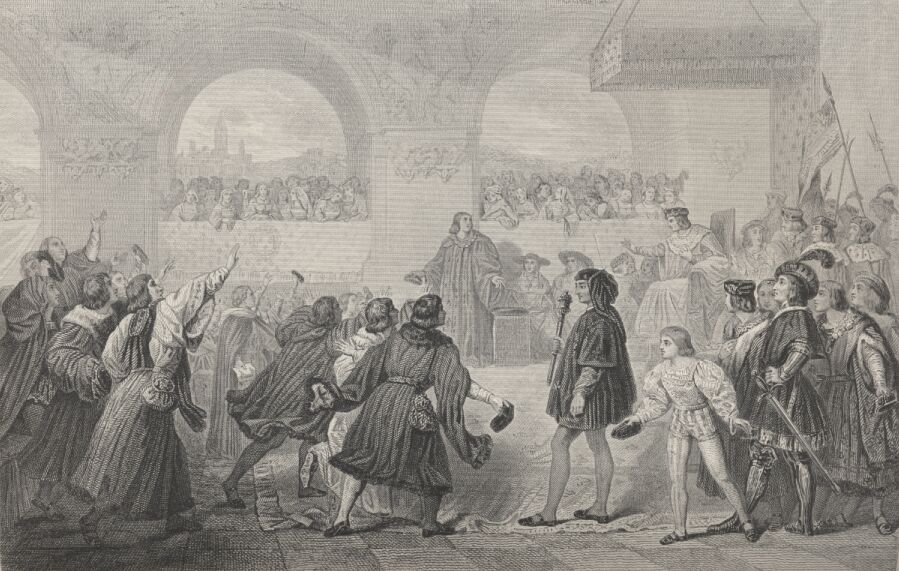
“Far from setting forth the grievances of the nation, as the spokesman of the estates had always done, Thomas Bricot, canon of Notre-Dame de Paris, delivered an address enumerating, in simple and touching terms, the benefits conferred by Louis XII., and describing to him the nation’s gratitude. To him they owed peace and the tranquillity of the realm, complete respect for private property, release from a quarter of the talliages, reform in the administration of justice, and the appointment of enlightened and incorruptible judges. For these causes, the speaker added, and for others which it would take too long to recount, he was destined to be known as Louis XII., father of the people.
“At these last words loud cheers rang out; emotion was general, and reached the king himself, who shed tears at hearing the title which posterity and history were forever to attach to his name.
“Then, the deputies having dropped on their knees, the speaker resumed his speech, saying that they were come to prefer a request for the general good of the realm, the king’s subjects entreating him to be pleased to give his only daughter in marriage to my lord Francis, here present, who is every whit French.
“When this declaration was ended, the king called Cardinal d’Amboise and the chancellor, with whom he conferred for some time; and then the chancellor, turning to the deputies, made answer that the king had given due ear and heed to their request and representation, . . . that if he had done well, he desired to do still better; and that, as to the request touching the marriage, he had never heard talk of it; but that as to that matter, he would communicate with the princes of the blood, so as to have their opinion.
“The day after this session the king received an embassy which could not but crown his joy: the estates of the duchy of Burgundy, more interested than any other province in the rupture of the (Austrian) marriage, had sent deputies to join their most urgent prayers to the entreaties of the estates of France.
“On Monday, May 18, the king assembled about him his chief councillors, to learn if the demand of the estates was profitable and reasonable for him and his kingdom. ‘Thereon,’ continues the report, ‘the first to deliver an opinion was my lord the Bishop of Paris; after him the premier president of the parliament of Paris and of that of Bordeaux.’ Their speeches produced such effect that, ‘quite with one voice and one mind, those present agreed that the request of the estates was sound, just, and reasonable, and with one consent entreated the king to agree to the said marriage.’
“The most enlightened councillors and the princes of the blood found themselves in agreement with the commons. There was no ambiguity about the reply. On the Tuesday, May 19, the king held a session in state for the purpose of announcing to the estates that their wishes should be fully gratified, and that the betrothal of his daughter to the heir to the throne should take place next day but one, May 21, in order that the deputies might report the news of it to their constituents.
“After that the estates had returned thanks, the chancellor gave notice that, as municipal affairs imperatively demanded the return of the deputies, the king gave them leave to go, retaining only one burgess from each town, to inform him of their wants and ‘their business, if such there be in any case, wherein the king will give them good and short despatch.’
“The session was brought to a close by the festivities of the betrothal, and by the oath taken by the deputies, who, before their departure, swore to bring about with all their might, even to the risk of body and goods, the marriage which had just been decided upon by the common advice of all those who represented France.’” [Histoire des Etats Generaux from 1355 to 1614, by George Picot, t. i. pp. 352-354].
Francis d’Angouleme was at that time eleven years old, and Claude of France was nearly seven.
Whatever displeasure must have been caused to the Emperor of Germany and to the King of Spain by this resolution on the part of France and her king, it did not show itself, either in acts of hostility or even in complaints of a more or less threatening kind. Italy remained for some years longer the sole theatre of rivalry and strife between these three great powers; and, during this strife, the utter diversity of the combinations, whether in the way of alliance or of rupture, bore witness to the extreme changeability of the interests, passions, and designs of the actors. From 1506 to 1515, between Louis XII.‘s will and his death, we find in the history of his career in Italy five coalitions, and as many great battles, of a profoundly contradictory character. In 1508, Pope Julius II., Louis XII., Emperor Maximilian, and Ferdinand the Catholic, King of Spain, form together against the Venetians the League of Cambrai. In 1510, Julius II., Ferdinand, the Venetians, and the Swiss make a coalition against Louis XII. In 1512, this coalition, decomposed for a while, re-unites, under the name of the League of the Holy Union, between the pope, the Venetians, the Swiss, and the Kings of Arragon and Naples against Louis XII., minus the Emperor Maximilian, and plus Henry VIII., King of England. On the 14th of May, 1509, Louis XII., in the name of the League of Cambrai, gains the battle of Agnadello against the Venetians. On the 11th of April, 1512, it is against Pope Julius II., Ferdinand the Catholic, and the Venetians that he gains the battle of Ravenna. On the 14th of March, 1513, he is in alliance with the Venetians, and it is against the Swiss that he loses the battle of Novara. In 1510, 1511, and 1512, in the course of all these incessant changes of political allies and adversaries, three councils met at Tours, at Pisa, and at St. John Lateran with views still more discordant and irreconcilable than those of all these laic coalitions. We merely point out here the principal traits of the nascent sixteenth century; we have no intention of tracing with a certain amount of detail any incidents but those that refer to Louis XII. and to France, to their procedure and their fortunes.
Jealousy, ambition, secret resentment, and the prospect of despoiling them caused the formation of the League of Cambrai against the Venetians. Their far-reaching greatness on the seas, their steady progress on land, their riches, their cool assumption of independence towards the papacy, their renown for ability, and their profoundly selfish, but singularly prosperous policy, had excited in Italy, and even beyond the Alps, that feeling of envy and ill-will which is caused amongst men, whether kings or people, by the spectacle of strange, brilliant, and unexpected good fortune, though it be the fruits of rare merit. As the Venetians were as much dreaded as they were little beloved, great care was taken to conceal from them the projects that were being formed against them. According to their historian, Cardinal Bembo, they owed to chance the first notice they had. It happened one day that a Piedmontese at Milan, in presence of the Resident of Venice, allowed to escape from his lips the words, “I should have the pleasure, then, of seeing the crime punished of those who put to death the most illustrious man of my country.” He alluded to Carmagnola, a celebrated Piedmontese condottiere, who had been accused of treason and beheaded at Venice on the 3d of May, 1432. The Venetian ambassador at Louis XII.‘s court, suspecting what had taken place at Cambrai, tried to dissuade the king. “Sir,” said he, “it were folly to attack them of Venice; their wisdom renders them invincible.” “I believe they are prudent and wise,” answered Louis, “but all the wrong way of the hair (inopportunely); if it must come to war, I will bring upon them so many fools, that your wiseacres will not have leisure to teach them reason, for my fools hit all round without looking where.” When the league was decisively formed, Louis sent to Venice a herald to officially proclaim war. After having replied to the grievances alleged in support of that proclamation, “We should never have believed,” said the Doge Loredano, “that so great a prince would have given ear to the envenomed words of a pope whom he ought to know better, and to the insinuations of another priest whom we forbear to mention (Cardinal d’Amboise). In order to please them, he declares himself the foe of a republic which has rendered him great services. We will try to defend ourselves, and to prove to him that he has not kept faith with us. God shall judge betwixt us. Father herald, and you, trumpeter, ye have heard what we had to say to you; report it to your master. Away!” Independently of their natural haughtiness, the Venetians were puffed up with the advantages they had obtained in a separate campaign against the Emperor Maximilian, and flattered themselves that they would manage to conquer, one after the other, or to split up, or to tire out, their enemies; and they prepared energetically for war. Louis XII., on his side, got together an army with a strength of twenty-three hundred lances (about thirteen thousand mounted troops), ten to twelve thousand French foot, and six or eight thousand Swiss. He sent for Chevalier Bayard, already famous, though still quite a youth. “Bayard,” said he, “you know that I am about to cross the mountains, for to bring to reason the Venetians, who by great wrong withhold from me the countship of Cremona and other districts. I give to you from this present time the company of Captain Chatelard, who they tell me is dead, whereat I am distressed; but I desire that in this enterprise you have under your charge men afoot; your lieutenant- captain, Pierrepont [Pierre de Pont d’Albi, a Savoyard gentle-man, and Bayard’s nephew], who is a very good man, shall lead your men-at-arms.” “Sir,” answered Bayard, “I will do what pleaseth you; but how many men afoot will you be pleased to hand over to me to lead?” “A thousand,” said the king: “there is no man that hath more.” “Sir,” replied Bayard, “it is a many for my poor wits; I do entreat you to be content that I have five hundred; and I pledge you my faith, sir, that I will take pains to choose such as shall do you service; meseems that for one man it is a very heavy charge, if he would fain do his duty therewith.” “Good!” said the king: “go, then, quickly into Dauphiny, and take heed that you be in my duchy of Milan by the end of March.” Bayard forthwith set out to raise and choose his foot; a proof of the growing importance of infantry, and of the care taken by Louis XII. to have it commanded by men of war of experience and popularity.
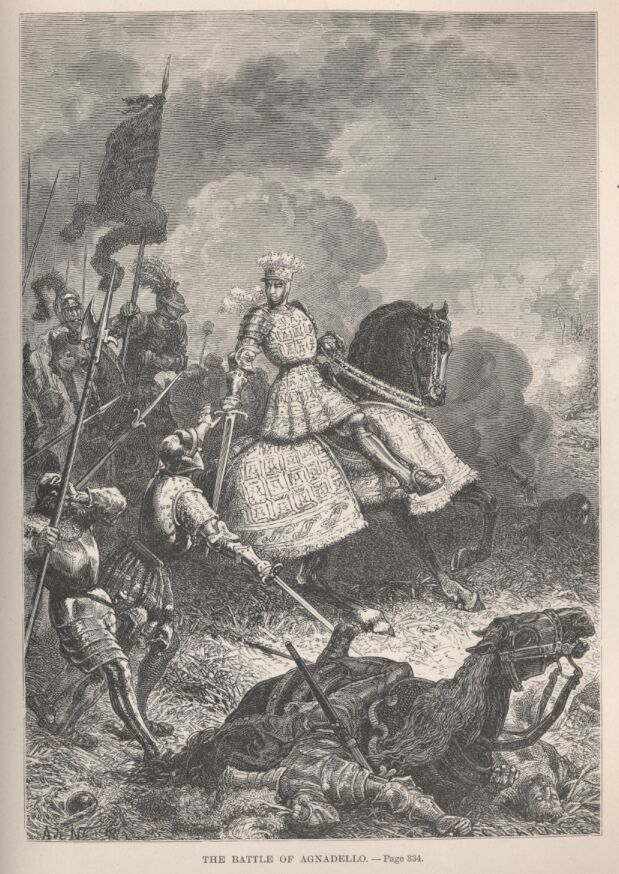
On the 14th of May, 1509, the French army and the Venetian army, of nearly equal strength, encountered near the village of Agnadello, in the province of Lodi, on the banks of the Adda. Louis XII. commanded his in person, with Louis de la Tremoille and James Trivulzio for his principal lieutenants; the Venetians were under the orders of two generals, the Count of Petigliano and Barthelemy d’Alviano, both members of the Roman family of the Orsini, but not on good terms with one another. The French had to cross the Adda to reach the enemy, who kept in his camp. Trivulzio, seeing that the Venetians did not dispute their passage, cried out to the king, “To-day, sir, the victory is ours!” The French advance- guard engaged with the troops of Alviano. When apprised of this fight, Louis, to whom word was at this same time brought that the enemy was already occupying the point towards which he was moving with the main body of the army, said briskly, “Forward, all the same; we will halt upon their bellies.” The action became general and hot. The king, sword in hand, hurried from one corps to another, under fire from the Venetian artillery, which struck several men near him. He was urged to place himself under cover a little, so as to give his orders thence; but, “It is no odds,” said he; “they who are afraid have only to put themselves behind me.” A body of Gascons showed signs of wavering: “Lads,” shouted La Tremoille, “the king sees you.” They dashed forward; and the Venetians were broken, in spite of the brave resistance of Alviano, who was taken and brought, all covered with blood, and with one eye out, into the presence of the king. Louis said to him, courteously, “You shall have fair treatment and fair captivity; have fair patience.” “So I will,” answered the condottiere; “if I had won the battle, I had been the most victorious man in the world; and, though I have lost it, still have I the great honor of having had against me a King of France in person.” Louis, who had often heard talk of the warrior’s intrepid presence of mind, had a fancy for putting it to further proof, and, all the time chatting with him, gave secret orders to have the alarm sounded not far from them. “What is this, pray, Sir Barthelemy?” asked the king: “your folks are very difficult to please; is it that they want to begin again?” “Sir,” said Alviano, “if there is fighting still, it must be that the French are fighting one another; as for my folks, I assure you, on my life, they will not pay you a visit this fortnight.” The Venetian army, in fact, withdrew with a precipitation which resembled a rout: for, to rally it, its general, the Count of Petigliano, appointed for its gathering-point the ground beneath the walls of Brescia, forty miles from the field of battle. “Few men-at-arms,” says Guicciardini, “were slain in this affair; the great loss fell upon the Venetians’ infantry, which lost, according to some, eight thousand men; others say that the number of dead on both sides did not amount to more than six thousand.” The territorial results of the victory were greater than the numerical losses of the armies. Within a fortnight, the towns of Caravaggio, Bergamo, Brescia, Crema, Cremona, and Pizzighitone surrendered to the French. Peschiera alone, a strong fortress at the southern extremity of the Lake of Garda, resisted, and was carried by assault. “It was a bad thing for those within,” says the Loyal Serviteur of Bayard; “for all, or nearly all, perished there; amongst the which was the governor of the Signory and his son, who were willing to pay good and heavy ransom; but that served them not at all, for on one tree were both of them hanged, which to me did seem great cruelty; a very lusty gentleman, called the Lorrainer, had their parole, and he had big words about it with the grand master, lieutenant-general of the king; but he got no good thereby.” The Memoires of Robert de la Marck, lord of Fleuranges, and a warrior of the day, confirm, as to this sad incident, the story of the Loyal Serviteur of Bayard: “When the French volunteers,” says he, “entered by the breach into the castle of Peschiera, they cut to pieces all those who were therein, and there were left only the captain, the proveditore, and the podesta, the which stowed themselves away in a tower, surrendered to the good pleasure of the king, and, being brought before him, offered him for ransom a hundred thousand ducats; but the king swore, ‘If ever I eat or drink till they be hanged and strangled! ‘Nor even for all the prayer they could make could the grand master Chaumont, and even his uncle, Cardinal d’Amboise, find any help for it, but the king would have them hanged that very hour.” Some chroniclers attribute this violence on Louis XII.‘s part to a “low and coarse” reply returned by those in command at Peschiera to the summons to surrender. Guicciardini, whilst also recording the fact, explains it otherwise than by a fit of anger on Louis’s part: “The king,” he says, “was led to such cruelty in order that, dismayed at such punishment, those who were still holding out in the fortress of Cremona might not defend themselves to the last extremity.” [Guicciardini, Istoria d’Italia, liv. viii. t. i. p. 521.] So that the Italian historian is less severe on this act of cruelty than the French knight is.
Louis XII.‘s victory at Agnadello had for him consequences very different from what he had no doubt expected. “The king,” says Guicciardini, “departed from Italy, carrying away with him to France great glory by reason of so complete and so rapidly won a victory over the Venetians; nevertheless, as in the case of things obtained after hope long deferred men scarcely ever feel such joy and happiness as they had at first imagined they would, the king took not back with him either greater peace of mind or greater security in respect of his affairs.” The beaten Venetians accepted their defeat with such a mixture of humility and dignity as soon changed their position in Italy. They began by providing all that was necessary for the defence of Venice herself; foreigners, but only idle foreigners, were expelled; those who had any business which secured them means of existence received orders to continue their labors. Mills were built, cisterns were dug, corn was gathered in, the condition of the canals was examined, bars were removed, the citizens were armed; the law which did not allow vessels laden with provisions to touch at Venice was repealed, and rewards were decreed to officers who had done their duty. Having taken all this care for their own homes and their fatherland on the sea, the Venetian senate passed a decree by which the republic, releasing from their oath of fidelity the subjects it could not defend, authorized its continental provinces to treat with the enemy with a view to their own interests, and ordered its commandants to evacuate such places as they still held. Nearly all such submitted without a struggle to the victor of Agnadello and his allies of Cambrai; but at Treviso, when Emperor Maximilian’s commissioner presented himself in order to take possession of it, a shoemaker named Caligaro went running through the streets, shouting, “Hurrah! for St. Mark.”
The people rose, pillaged the houses of those who had summoned the foreigner, and declared that it would not separate its lot from that of the republic. So Treviso remained Venetian. Two other small towns, Marano and Osopo, followed her example; and for several months this was all that the Venetians preserved of their continental possessions. But at the commencement of July, 1509, they heard that the important town of Padua, which had fallen to the share of Emperor Maximilian, was uttering passionate murmurs against its new master, and wished for nothing better than to come back beneath the old sway; and, in spite of the opposition shown by the doge, Loredano, the Venetians resolved to attempt the venture. During the night between the 16th and 17th of July, a small detachment, well armed and well led, arrived beneath the walls of Padua, which was rather carelessly guarded. In the morning, as soon as the gate was opened, a string of large wagons presented themselves for admittance. Behind one of these, and partially concealed by its bulk, advanced six Venetian men-at-arms, each carrying on his crupper a foot-soldier armed with an arquebuse; they fired on the guard; each killed his man; the Austrian garrison hurried up and fought bravely; but other Venetian troops arrived, and the garrison was beaten and surrendered. Padua became Venetian again. “This surprisal,” says M. Darn, “caused inexpressible joy in Venice; after so many disasters there was seen a gleans of hope.” The Venetians hastened to provision Padua well and to put it in a state of defence; and they at the same time published a decree promising such subjects of the republic as should come back to its sway complete indemnity for the losses they might have suffered during the war. It blazed forth again immediately, but at first between the Venetians and the Emperor Maximilian almost alone by himself. Louis XII., in a hurry to get back to France, contented himself with leaving in Lombardy a body of troops under the orders of James de Chabannes, Sire de la Palisse, with orders “to take five hundred of the lustiest men-at-arms and go into the service of the emperor, who was to make a descent upon the district of Padua.” Maximilian did not make his descent until two months after that the Venetians had retaken Padua and provisioned it well; and it was only on the 15th of September that he sat down before the place. All the allies of the League of Cambrai held themselves bound to furnish him with their contingent. On sallying from Milan for this campaign, La Palisse “fell in with the good knight Bayard, to whom he said, ‘My comrade, my friend, would you not like us to be comrades together?’ Bayard, who asked nothing better, answered him graciously that he was at his service to be disposed of at his pleasure;” and from the 15th to the 20th of September, Maximilian got together before Padua an army with a strength, it is said, of about fifty thousand men, men-at-arms or infantry, Germans, Spaniards, French, and Italians, sent by the pope and by the Duke of Ferrara, or recruited from all parts of Italy.
At the first rumor of such a force there was great emotion in Venice, but an emotion tempered by bravery and intelligence. The doge, Leonardo Loredano, the same who had but lately opposed the surprisal of Padua, rose up and delivered in the senate a long speech, of which only the essential and characteristic points can be quoted here:—
“Everybody knows, excellent gentlemen of the senate,” said he, “that on the preservation of Padua depends all hope, not only of recovering our empire, but of maintaining our own liberty. It must be confessed that, great and wonderful as they have been, the preparations made and the supplies provided hitherto are not sufficient either for the security of that town or for the dignity of our republic. Our ancient renown forbids us to leave the public safety, the lives and honor of our wives and our children, entirely to the tillers of our fields and to mercenary soldiers, without rushing ourselves to shelter them behind our own breasts and defend them with our own arms. For so great and so glorious a fatherland, which has for so many years been the bulwark of the faith and the glory of the Christian republic, will the personal service of its citizens and its sons be ever to seek? To save it who would refuse to risk his own life and that of his children? If the defence of Padua is the pledge for the salvation of Venice, who would hesitate to go and defend it? And, though the forces already there were sufficient, is not our honor also concerned therein? The fortune of our city so willed it that in the space of a few days our empire slipped from our hands; the opportunity has come back to us of recovering what we have lost; by spontaneously facing the changes and chances of fate, we shall prove that our disasters have not been our fault or our shame, but one of those fatal storms which no wisdom and no firmness of man can resist. If it were permitted us all in one mass to set out for Padua, if we might, without neglecting the defence of our own homes and our urgent public affairs, leave our city for some days deserted, I would not await your deliberation; I would be the first on the road to Padua; for how could I better expend the last days of my old age than in going to be present at and take part in such a victory? But Venice may not be deserted by her public bodies, which protect and defend Padua by their forethought and their orders just as others do by their arms; and a useless mob of graybeards would be a burden much more than a reenforcement there. Nor do I ask that Venice be drained of all her youth; but I advise, I exhort, that we choose two hundred young gentlemen, from the chiefest of our families, and that they all, with such friends and following as their means will permit them to get together, go forth to Padua to do all that shall be necessary for her defence. My two sons, with many a comrade. will be the first to carry out what I, their father and your chief, am the first to propose. Thus Padua will be placed in security; and when the mercenary soldiers who are there see how prompt are our youth to guard the gates and everywhere face the battle, they will be moved thereby to zeal and alacrity incalculable; and not only will Padua thus be defended and saved, but all nations will see that we, we too, as our fathers were, are men enough to defend at the peril of our lives the freedom and th safety of the noblest country in the world.”
This generous advice was accepted by the fathers and carried out by the sons with that earnest, prompt, and effective ardor which accompanies the resolution of great souls. When the Paduans, before their city was as yet invested, saw the arrival within their walls of these chosen youths of the Venetian patriciate, with their numerous troop of friends and followers, they considered Padua as good as saved; and when the imperial army, posted before the place, commenced their attacks upon it, they soon perceived that they had formidable defenders to deal with. “Five hundred years it was since in prince’s camp had ever been seen such wealth as there was there; and never was a day but there filed off some three or four hundred lanzknechts who took away to Germany oxen and kine, beds, corn, silk for sewing, and other articles; in such sort that to the said country of Padua was damage done to the amount of two millions of crowns in movables and in houses and palaces burnt and destroyed.” For three days the imperial artillery fired upon the town and made in its walls three breaches “knocked into one;” and still the defenders kept up their resistance with the same vigor. “One morning,” says the Loyal Serviteur of Bayard, “the Emperor Maximilian, accompanied by his princes and lords from Germany, went thither to look; and he marvelled and thought it great shame to him, with the number of men he had, that he had not sooner delivered the assault. On returning to his quarters he sent for a French secretary of his, whom he bade write to the lord of La Palisse a letter, whereof this was the substance: ‘Dear cousin, I have this morning been to look at the breach, which I find more than practicable for whoever would do his duty. I have made up my mind to deliver the assault to-day. I pray you, so soon as my big drum sounds, which will be about midday, that you do incontinently hold ready all the French gentlemen who are under your orders at my service, by command of my brother the King of France, to go to the said assault along with my foot; and I hope that, with God’s help we shall carry it.’
“The lord of La Palisse,” continues the chronicler, “thought this a somewhat strange manner of proceeding; howbeit he hid his thought, and said to the secretary, ‘I am astounded that the emperor did not send for my comrades and me for to deliberate more fully of this matter; howbeit you will tell him that I will send to fetch them, and when they are come I will show them the letter. I do not think there will be many who will not be obedient to that which the emperor shall be pleased to command.’
“When the French captains had arrived at the quarters of the lord of La Palisse, he said to them, ‘Gentlemen, we must now dine, for I have somewhat to say to you, and if I were to say it first, peradventure you would not make good cheer.’ During dinner they did nothing but make sport one of another. After dinner, everybody was sent out of the room, save the captains, to whom the lord of La Palisse made known the emperor’s letter, which was read twice, for the better understanding of it. They all looked at one another, laughing, for to see who would speak first. Then said the lord of Ymbercourt to the lord of La Palisse, ‘It needs not so much thought, my lord; send word to the emperor that we are all ready; I am even now a-weary of the fields, for the nights are cold; and then the good wines are beginning to fail us;’ whereat every one burst out a-laughing. All agreed to what was said by the lord of Ymbercourt. The lord of La Palisse looked at the good knight (Bayard), and saw that he seemed to be picking his teeth, as if he had not heard what his comrades had proposed. ‘Well, and you,’ said he, ‘what say you about it? It is no time for picking one’s teeth; we must at once send speedy reply to the emperor.’ Gayly the good knight answered, ‘If we would all take my lord of Ymbercourt’s word, we have only to go straight to the breach. But it is a somewhat sorry pastime for men-at-arms to go afoot, and I would gladly be excused. Howbeit, since I must give my opinion, I will. The emperor bids you, in his letter, set all the French gentlemen afoot for to deliver the assault along with his lanzknechts. My opinion is, that you, my lord, ought to send back to the emperor a reply of this sort: that you have had a meeting of your captains, who are quite determined to do his bidding, according to the charge they have from the king their master; but that to mix them up with the foot, who are of small estate, would be to make them of little account; the emperor has loads of counts, lords, and gentlemen of Germany; let him set them afoot along with the men-at-arms of France, who will gladly show them the road; and then his lanzknechts will follow, if they know that it will pay.’ When the good knight had thus spoken, his advice was found virtuous and reasonable. To the emperor was sent back this answer, which he thought right honorable. He incontinently had his trumpets sounded and his drums beaten for to assemble all the princes, and lords, and captains as well of Germany and Burgundy as of Hainault. Then the emperor declared to them that he was determined to go, within an hour, and deliver the assault on the town, whereof he had notified the lords of France, who were all most desirous of doing their duty therein right well, and prayed him that along with them might go the gentlemen of Germany, to whom they would gladly show the road: ‘Wherefore, my lords,’ said the emperor, I pray you, as much as ever I can, to be pleased to accompany them and set yourselves afoot with them; and I hope, with God’s help, that at the first assault we shall be masters of our enemies.’ When the emperor had done speaking, on a sudden there arose among his Germans a very wondrous and strange uproar, which lasted half an hour before it was appeased; and then one amongst them, bidden to answer for all, said that they were not folks to be set afoot or so to go up to a breach, and that their condition was to fight like gentlemen, a-horseback. Other answer the emperor could not get; but though it was not according to his desire, and pleased him not at all, he uttered no word beyond that he said, ‘Good my lords, we must advise, then, how we shall do for the best.’ Then, forthwith he sent for a gentleman of his who from time to time went backwards and forwards as ambassador to the French, and said to him, ‘Go to the quarters of my cousin, the lord of La Palisse; commend me to him and to all my lords the French captains you find with him, and tell them that for to-day the assault will not be delivered.’ I know not,” says the chronicler, “how it was nor who gave the advice; but the night after this speech was spoken the emperor went off, all in one stretch, more than forty miles from the camp, and from his new quarters sent word to his people to have the siege raised; which was done.”
So Padua was saved, and Venice once more became a power. Louis XII., having returned victorious to France, did not trouble himself much about the check received in Italy by Emperor Maximilian, for whom he had no love and but little esteem. Maximilian was personally brave and free from depravity or premeditated perfidy, but he was coarse, volatile, inconsistent, and not very able. Louis XII. had amongst his allies of Cambrai and in Italy a more serious and more skilful foe, who was preparing for him much greater embarrassments.
Julian Bella Rovera had, before his elevation to the pontifical throne, but one object, which was, to mount it. When he became pope, he had three objects: to recover and extend the temporal possessions of the papacy, to exercise to the full his spiritual power, and to drive the foreigner from Italy. He was not incapable of doubling and artifice. In order to rise he had flattered Louis XII. and Cardinal d’Amboise with the hope that the king’s minister would become the head of Christendom. When once he was himself in possession of this puissant title he showed himself as he really was; ambitious, audacious, imperious, energetic, stubborn, and combining the egotism of the absolute sovereign with the patriotism of an Italian pope. When the League of Cambrai had attained success through the victory of Louis XII. over the Venetians, Cardinal d’Amboise, in course of conversation with the two envoys from Florence at the king’s court, let them have an inkling “that he was not without suspicion of some new design;” and when Louis XII. announced his approaching departure for France, the two Florentines wrote to their government that “this departure might have very evil results, for the power of Emperor Maximilian in Italy, the position of Ferdinand the Catholic, the despair of the Venetians, and the character and dissatisfaction of the pope, seemed to foreshadow some fresh understanding against the Most Christian king.” Louis XII. and his minister were very confident. “Take Spain, the king of the Romans, or whom you please,” said Cardinal d’Amboise to the two Florentines; “there is none who has observed and kept the alliance more faithfully than the king has; he has done everything at the moment he promised; he has borne upon his shoulders the whole weight of this affair; and I tell you,” he added, with a fixed look at those whom he was addressing, “that his army is a large one, which he will keep up and augment every day.” Louis, for his part, treated the Florentines with great good-will, as friends on whom he counted and who were concerned in his success. “You have become the first power in Italy,” he said to then one day before a crowd of people: “how are you addressed just now? Are you Most Serene or Most Illustrious?” And when he was notified that distinguished Venetians were going to meet Emperor Maximilian on his arrival in Italy, “No matter,” said Louis; “let them go whither they will.” The Florentines did not the less nourish their mistrustful presentiments; and one of Louis XII.‘s most intelligent advisers, his finance-minister Florimond Robertet, was not slow to share them. “The pope,” said he to them one day [July 1, 1509], “is behaving very ill towards us; he seeks on every occasion to sow enmity between the princes, especially between the emperor and the Most Christian king;” and, some weeks later, whilst speaking of the money-aids which the new King of England was sending, it was said, to Emperor Maximilian, he said to the Florentine, Nasi, “It would be a very serious business, if from all this were to result against us a universal league, in which the pope, England, and Spain should join.” [Negotiations Diplomatiques de la France avec la Toscane, published by M. Abel Desjardins, in the Documents relatifs d l’Histoire de France, t. ii. pp. 331, 355, 367, 384, 389, 416.]
Next year (1510) the mistrust of the Florentine envoys was justified. The Venetians sent a humble address to the pope, ceded to him the places they but lately possessed in the Romagna, and conjured him to relieve them from the excommunication he had pronounced against them. Julius II., after some little waiting, accorded the favor demanded of him. Louis XII. committed the mistake of embroiling himself with the Swiss by refusing to add twenty thousand livres to the pay of sixty thousand he was giving them already, and by styling them “wretched mountain- shepherds, who presumed to impose upon him a tax he was not disposed to submit to.” The pope conferred the investiture of the kingdom of Naples upon Ferdinand the Catholic, who at first promised only his neutrality, but could not fail to be drawn in still farther when war was rekindled in Italy. In all these negotiations with the Venetians, the Swiss, the Kings of Spain and England, and the Emperor Maximilian, Julius II. took a bold initiative. Maximilian alone remained for some time at peace with the King of France.
In October, 1511, a league was formally concluded between the pope, the Venetians, the Swiss, and King Ferdinand against Louis XII. A place was reserved in it for the King of England, Henry VIII., who, on ascending the throne, had sent word to the King of France that “he desired to abide in the same friendship that the king his father had kept up,” but who, at the bottom of his heart, burned to resume on the Continent an active and a prominent part. The coalition thus formed was called the League of Holy Union. “I,” said Louis XII., “am the Saracen against whom this league is directed.”
He had just lost, a few months previously, the intimate and faithful adviser and friend of his whole life: Cardinal George d’Amboise, seized at Milan with a fit of the gout, during which Louis tended him with the assiduity and care of an affectionate brother, died at Lyons on the 25th of May, 1510, at fifty years of age. He was one not of the greatest, but of the most honest ministers who ever enjoyed a powerful monarch’s constant favor, and employed it we will not say with complete disinterestedness, but with a predominant anxiety for the public weal. In the matter of external policy the influence of Cardinal d’Amboise, was neither skilfully nor salutarily exercised: he, like his master, indulged in those views of distant, incoherent, and improvident conquests which caused the reign of Louis XII. to be wasted in ceaseless wars, with which the cardinal’s desire of becoming pope was not altogether unconnected, and which, after having resulted in nothing but reverses, were a heavy heritage for the succeeding reign. But at home, in his relations with his king and in his civil and religious administration, Cardinal d’Amboise was an earnest and effective friend of justice, of sound social order, and of regard for morality in the practice of power. It is said that, in his latter days, he, virtuously weary of the dignities of this world, said to the infirmary-brother who was attending him, “Ah! Brother John, why did I not always remain Brother John!” A pious regret the sincerity and modesty whereof are rare amongst men of high estate.
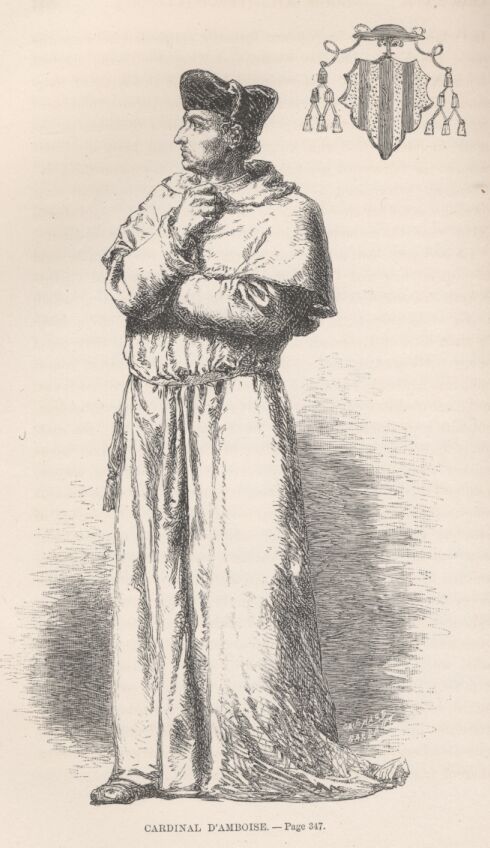
“At last, then, I am the only pope!” cried Julius II., when he heard that Cardinal d’Amboise was dead. But his joy was misplaced: the cardinal’s death was a great loss to him; between the king and the pope the cardinal had been an intelligent mediator, who understood the two positions and the two characters, and who, though most faithful and devoted to the king, had nevertheless a place in his heart for the papacy also, and labored earnestly on every occasion to bring about between the two rivals a policy of moderation and peace. “One thing you may be certain of,” said Louis’s finance-minister Robertet to the ambassador from Florence, “that the king’s character is not an easy one to deal with; he is not readily brought round to what is not his own opinion, which is not always a correct one; he is irritated against the pope; and the cardinal, to whom that causes great displeasure, does not always succeed, in spite of all influence, in getting him to do as he would like. If our Lord God were to remove the cardinal, either by death or in any other manner, from public life, there would arise in this court and in the fashion of conducting affairs such confusion that nothing equal to it would ever have been seen in our day.” [Negociations Diplomatiques de la France avec la Toscane, t. ii. pp. 428 and 460.] And the confusion did, in fact, arise; and war was rekindled, or, to speak more correctly, resumed its course after the cardinal’s death. Julius II. plunged into it in person, moving to every point where it was going on, living in the midst of camps, himself in military costume, besieging towns, having his guns pointed and assaults delivered under his own eyes. Men expressed astonishment, not unmixed with admiration, at the indomitable energy of this soldier-pope at seventy years of age. It was said that he had cast into the Tiber the keys of St. Peter to gird on the sword of St. Paul. His answer to everything was, “The barbarians must be driven from Italy.” Louis XII. became more and more irritated and undecided. “To reassure his people,” says Bossuet (to which we may add, ‘and to reassure himself’), “he assembled at Tours (in September, 1510), the prelates of his kingdom, to consult them as to what he could do at so disagreeable a crisis without wounding his conscience. Thereupon it was said that the pope, being unjustly the aggressor, and having even violated an agreement made with the king, ought to be treated as an enemy, and that the king might not only defend himself, but might even attack him without fear of excommunication. Not considering this quite strong enough yet, Louis resolved to assemble a council against the pope. The general council was the desire of the whole church since the election of Martin V. at the council of Constance (November 11, 1417); for, though that council had done great good by putting an end to the schism which had lasted for forty years, it had not accomplished what it had projected, which was a reformation of the Church in its head and in its members; but, for the doing of so holy a work, it had ordained, on separating, that there should be held a fresh council. . . . This one was opened at Pisa (November 1, 1511) with but little solemnity by the proxies of the cardinals who had caused its convocation. The pope had deposed them, and had placed under interdict the town of Pisa, where the council was to be held, and even Florence, because the Florentines had granted Pisa for the assemblage. Thereupon the religious brotherhoods were unwilling to put in an appearance at the opening of the council, and the priests of the Church refused the necessary paraphernalia. The people rose, and the cardinals, having arrived, did not consider their position safe; insomuch that after the first session they removed the council to Milan, where they met with no better reception. Gaston de Foix, nephew of Louis XII., who had just appointed him governor of Milaness, could certainly force the clergy to proceed and the people to be quiet, but he could not force them to have for the council the respect due to so great a name; there were not seen at it, according to usage, the legates of the Holy See; there were scarcely fifteen or sixteen French prelates there; the Emperor Maximilian had either not influence enough or no inclination to send to it a single one from Germany; and, in a word, there was not to be seen in this assembly anything that savored of the majesty of a general council, and it was understood to be held for political purposes.” [Bossuet, Abrege de l’Histoire de France pour l’Education du dauphin; OEuvres completes (1828), t. xvii. pp. 541, 545.] Bossuet had good grounds for speaking so. Louis XII. himself said, in 1511, to the ambassador of Spain, that “this pretended council was only a scarecrow which he had no idea of employing save for the purpose of bringing the pope to reason.” Amidst these vain attempts at ecclesiastical influence the war was continued with passionateness on the part of Julius II., with hesitation on the part of Louis XII., and with some disquietude on the part of the French commanders, although with their wonted bravery and loyalty. Chaumont d’Amboise, the cardinal’s nephew, held the command-in-chief in the king’s army. He fell ill: the pope had excommunicated him; and Chaumont sent to beg him, with instance, to give him absolution, which did not arrive until he was on his death-bed. “This is the worst,” says Bossuet, “of wars against the Church; they cause scruples not only in weak minds, but even, at certain moments, in the very strongest.” Alphonso d’ Este, Duke of Ferrara, was almost the only great Italian lord who remained faithful to France. Julius II., who was besieging Ferrara, tried to win over the duke, who rejected all his offers, and, instead, won over the negotiator, who offered his services to poison the pope. Bayard, when informed of this proposal, indignantly declared that he would go and have the traitor hanged, and warning sent to the pope. “Why,” said the duke, “he would have been very glad to do as much for you and me.” “That is no odds to me,” said the knight; “he is God’s lieutenant on earth, and, as for having him put to death in such sort, I will never consent to it.” The duke shrugged his shoulders, and spitting on the ground, said, ‘Od’s body, Sir Bayard, I would like to get rid of all my enemies in that way; but, since you do not think it well, the matter shall stand over; whereof, unless God apply a remedy, both you and I will repent us.” Assuredly Bayard did not repent of his honest indignation; but, finding about the same time (January, 1511) an opportunity of surprising and carrying off the pope, he did not care to miss it; he placed himself in ambush before day-break, with a hundred picked men-at-arms, close to a village from which the pope was to issue. “The pope, who was pretty early, mounted his litter, so soon as he saw the dawn, and the clerics and officers of all kinds went before without a thought of anything. When the good knight heard them he sallied forth from his ambush, and went charging down upon the rustics, who, sore dismayed, turned back again, pricking along with loosened rein and shouting, Alarm! alarm! But all that would have been of no use but for an accident very lucky for the holy father, and very unfortunate for the good knight. When the pope had mounted his litter, he was not a stone’s throw gone when there fell from heaven the most sharp and violent shower that had been seen for a hundred years. ‘Holy father,’ said the Cardinal of Pavia to the pope, ‘it is not possible to go along this country so long as this lasts; meseems you must turn back again; ‘to which the pope agreed; but, just as he was arriving at St. Felix, and was barely entering within the castle, he heard the shouts of the fugitives whom the good knight was pursuing as hard as he could spur; whereupon he had such a fright, that, suddenly and without help, he leaped out of his litter, and himself did aid in hauling up the bridge; which was doing like a man of wits, for had he waited until one could say a Pater noster, he had been snapped up. Who was right down grieved, that was the good knight; never man turned back so melancholic as he was to have missed so fair a take; and the pope, from the good fright he had gotten, shook like a palsy the live-long day.” [Histoire du ben Chevalier Ballard, t. i. pp. 346-349.]
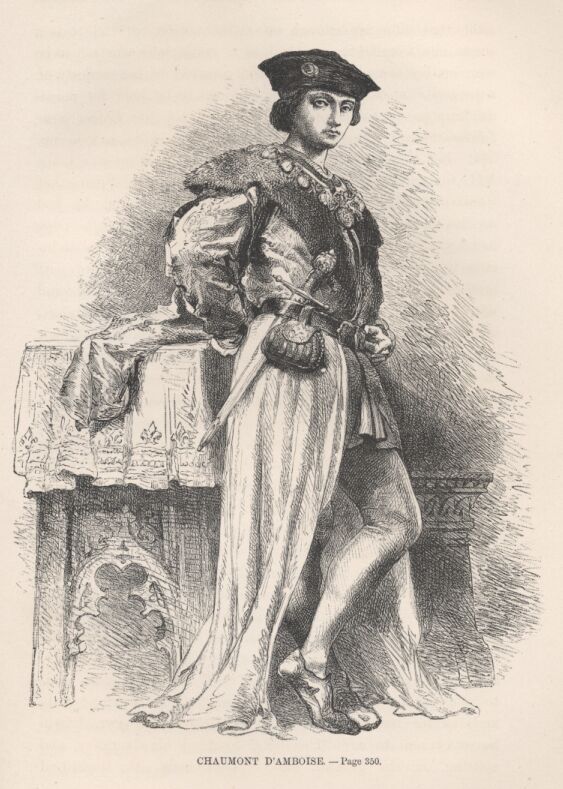
From 1510 to 1512 the war in Italy was thus proceeding, but with no great results, when Gaston de Foix, Duke of Nemours, came to take the command of the French army. He was scarcely twenty-three, and had hitherto only served under Trivulzio and La Palisse; but he had already a character for bravery and intelligence in war. Louis XII. loved this son of his sister, Mary of Orleans, and gladly elevated him to the highest rank. Gaston, from the very first, justified this favor. Instead of seeking for glory in the field only, he began by shutting himself up in Milan, which the Swiss were besieging. They made him an offer to take the road back to Switzerland, if he would give them a month’s pay; the sum was discussed; Gaston considered that they asked too much for their withdrawal; the Swiss broke off the negotiation; but “to the great astonishment of everybody,” says Guicciardini, “they raised the siege and returned to their own country.” The pope was besieging Bologna; Gaston arrived there suddenly with a body of troops whom he had marched out at night through a tempest of wind and snow; and he was safe inside the place whilst the besiegers were still ignorant of his movement. The siege of Bologna was raised. Gaston left it immediately to march on Brescia, which the Venetians had taken possession of for the Holy League. He retook the town by a vigorous assault, gave it up to pillage, punished with death Count Louis Avogaro and his two sons, who had excited the inhabitants against France, and gave a beating to the Venetian army before its walls. All these successes had been gained in a fortnight. “According to universal opinion,” says Guicciardini, “Italy for several centuries had seen nothing like these military operations.”
We are not proof against the pleasure of giving a place in this history to a deed of virtue and chivalrous kindness on Bayard’s part, the story of which has been told and retold many times in various works. It is honorable to human kind, and especially to the middle ages, that such men and such deeds are met with here and there, amidst the violence of war and the general barbarity of manners.
Bayard had been grievously wounded at the assault of Brescia; so grievously that he said to his neighbor, the lord of Molart, “‘Comrade, march your men forward; the town is ours; as for me, I cannot pull on farther, for I am a dead man.’ When the town was taken, two of his archers bare him to a house, the most conspicuous they saw thereabouts. It was the abode of a very rich gentleman; but he had fled away to a monastery, and his wife had remained at the abode under the care of Our Lord, together with two fair daughters she had, the which were hidden in a granary beneath some hay. When there came a knocking at her door, she saw the good knight who was being brought in thus wounded, the which had the door shut incontinently, and set at the entrance the two archers, to the which he said, ‘Take heed for your lives, that none enter herein unless it be any of my own folk; I am certified that, when it is known to be my quarters, none will try to force a way in; and if, by your aiding me, I be the cause that ye lose a chance of gaining somewhat, never ye mind; ye shall lose nought thereby.’