Volume 3 — CHAPTER XXIV.——THE HUNDRED YEARS’ WAR. —CHARLES VII. AND JOAN OF ARC. 1422-1461. (continued 2)
Robert Black translation
The trial lasted from the 21st of February to the 30th of May, 1431. The court held forty sittings, mostly in the chapel of the castle, some in Joan’s very prison. On her arrival there, she had been put in an iron cage; afterwards she was kept no longer in the cage, but in a dark room in a tower of the castle, wearing irons upon her feet, fastened by a chain to a large piece of wood, and guarded night and day by four or five “soldiers of low grade.” She complained of being thus chained; but the bishop told her that her former attempts at escape demanded this precaution. “It is true,” said Joan, as truthful as heroic, “I did wish and I still wish to escape from prison, as is the right of every prisoner.” At her examination, the bishop required her to take an oath to tell the truth about everything as to which she should be questioned.” “I know not what you mean to question me about; perchance you may ask me things I would not tell you; touching my revelations, for instance, you might ask me to tell something I have sworn not to tell; thus I should be perjured, which you ought not to desire.” The bishop insisted upon an oath absolute and with-out condition. “You are too hard on me,” said Joan; I do not like to take an oath to tell the truth save as to matters which concern the faith.” The bishop called upon her to swear on pain of being held guilty of the things imputed to her.
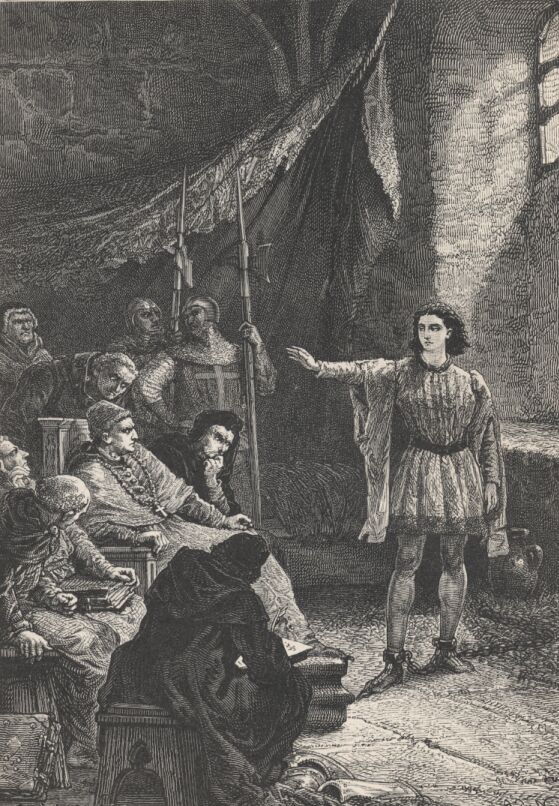
“Go on to something else,” said she. And this was the answer she made to all questions which seemed to her to be a violation of her right to be silent. Wearied and hurt at these imperious demands, she one day said, “I come on God’s business, and I have nought to do here; send me back to God, from whom I come.” “Are you sure you are in God’s grace?” asked the bishop. “If I be not,” answered Joan, “please God to bring me to it; and if I be, please God to keep me in it!” The bishop himself remained dumbfounded.
There is no object in following through all its sittings and all its twistings this odious and shameful trial, in which the judges’ prejudiced servility and scientific subtlety were employed for three months to wear out the courage or overreach the understanding of a young girl of nineteen, who refused at one time to lie, and at another to enter into discussion with them, and made no defence beyond holding her tongue or appealing to God who had spoken to her and dictated to her that which she had done. In order to force her from her silence or bring her to submit to the Church instead of appealing from it to God, it was proposed to employ the last means of all, torture. On the 9th of May the bishop had Joan brought into the great tower of Rouen Castle; the instruments of torture were displayed before her eyes; and the executioners were ready to fulfil their office, “for to bring her back,” said the bishop, “into the ways of truth, in order to insure the salvation of her soul and body, so gravely endangered by erroneous inventions.” “Verily,” answered Joan, “if you should have to tear me limb from limb, and separate soul from body, I should not tell you aught else; and if I were to tell you aught else, I should afterwards still tell you that you had made me tell it by force.” The idea of torture was given up. It was resolved to display all the armory of science in order to subdue the mind of this young girl, whose conscience was not to be subjugated. The chapter of Rouen declared that in consequence of her public refusal to submit herself to the decision of the Church as to her deeds and her statements, Joan deserved to be declared a heretic. The University of Paris, to which had been handed in the twelve heads of accusation resulting from Joan’s statements and examinations, replied that “if, having been charitably admonished, she would not make reparation and return to union with the Catholic faith, she must be left to the secular judges to undergo punishment for her crime.” Armed with these documents the Bishop of Beauvais had Joan brought up, on the 23d of May, in a hall adjoining her prison, and, after having addressed to her a long exhortation, “Joan,” said he, “if in the dominions of your king, when you were at large in them, a knight or any other, born under his rule and allegiance to him, had risen up, saying, ‘I will not obey the king or submit to his officers,’ would you not have said that he ought to be condemned? What then will you say of yourself, you who were born in the faith of Christ and became by baptism a daughter of the Church and spouse of Jesus Christ, if you obey not the officers of Christ, that is, the prelates of the Church?” Joan listened modestly to this admonition, and confined herself to answering, “As to my deeds and sayings, what I said of them at the trial I do hold to and mean to abide by.” “Think you that you are not bound to submit your sayings and deeds to the Church militant or to any other than God?” “The course that I always mentioned and pursued at the trial I mean to maintain as to that. If I were at the stake, and saw the torch lighted, and the executioner ready to set fire to the fagots, even if I were in the midst of the flames, I should not say aught else, and I should uphold that which I said at the trial even unto death.”
According to the laws, ideas, and practices of the time the legal question was decided. Joan, declared heretic and rebellious by the Church, was liable to have sentence pronounced against her; but she had persisted in her statements, she had shown no submission. Although she appeared to be quite forgotten, and was quite neglected by the king whose coronation she had effected, by his councillors, and even by the brave warriors at whose side she had fought, the public exhibited a lively interest in her; accounts of the scenes which took place at her trial were inquired after with curiosity. Amongst the very judges who prosecuted her, many were troubled in spirit, and wished that Joan, by an abjuration of her statements, would herself put them at ease and relieve them from pronouncing against her the most severe penalty. What means were employed to arrive at this end? Did she really, and with full knowledge of what she was about, come round to the adjuration which there was so much anxiety to obtain from her? It is difficult to solve this historical problem with exactness and certainty. More than once, during the examinations and the conversations which took place at that time between Joan and her judges, she maintained her firm posture and her first statements. One of those who were exhorting her to yield said to her one day, “Thy king is a heretic and a schismatic.” Joan could not brook this insult to her king. “By my faith,” said she, “full well dare I both say and swear that he is the noblest Christian of all Christians, and the truest lover of the faith and the Church.” “Make her hold her tongue,” said the usher to the preacher, who was disconcerted at having provoked such language. Another day, when Joan was being urged to submit to the Church, brother Isambard de la Pierre, a Dominican, who was interested in her, spoke to her about the council, at the same time explaining to her its province in the church. It was the very time when that of Bale had been convoked. “Ah!” said Joan, “I would fain surrender and submit myself to the council of Bale.” The Bishop of Beauvais trembled at the idea of this appeal. “Hold your tongue in the devil’s name!” said he to the monk. Another of the judges, William Erard, asked Joan menacingly, “Will you abjure those reprobate words and deeds of yours?” “I leave it to the universal Church whether I ought to abjure or not.” “That is not enough: you shall abjure at once or you shall burn.” Joan shuddered. “I would rather sign than burn,” she said. There was put before her a form of abjuration, whereby, disavowing her revelations and visions from heaven, she confessed her errors in matters of faith, and renounced them humbly. At the bottom of the document she made the mark of a cross. Doubts have arisen as to the genuineness of this long and diffuse deed in the form in which it has been published in the trial-papers. Twenty-four years later, in 1455, during the trial undertaken for the rehabilitation of Joan, several of those who had been present at the trial at which she was condemned, amongst others the usher Massieu and the registrar Taquel, declared that the form of abjuration read out at that time to Joan and signed by her contained only seven or eight lines of big writing; and according to another witness of the scene it was an Englishman, John Calot, secretary of Henry VI., King of England, who, as soon as Joan had yielded, drew from his sleeve a little paper which he gave to her to sign, and, dissatisfied with the mark she had made, held her hand and guided it so that she might put down her name, every letter. However that may be, as soon as Joan’s abjuration had thus been obtained, the court issued on the 24th of May, 1431, a definitive decree, whereby, after some long and severe strictures in the preamble, it condemned Joan to perpetual imprisonment, “with the bread of affliction and the water of affliction, in order that she might deplore the errors and faults she had committed, and relapse into them no more henceforth.”
The Church might be satisfied; but the King of England, his councillors and his officers, were not. It was Joan living, even though a prisoner, that they feared. They were animated towards her by the two ruthless passions of vengeance and fear. When it was known that she would escape with her life, murmurs broke out amongst the crowd of enemies present at the trial. Stones were thrown at the judges. One of the Cardinal of Winchester’s chaplains, who happened to be close to the Bishop of Beauvais, called him traitor. “You lie,” said the bishop. And the bishop was right; the chaplain did lie; the bishop had no intention of betraying his masters. The Earl of Warwick complained to him of the inadequacy of the sentence. “Never you mind, my lord,” said one of Peter Cauchon’s confidants; “we will have her up again.” After the passing of her sentence Joan had said to those about her, “Come, now, you churchmen amongst you, lead me off to your own prisons, and let me be no more in the hands of the English.” “Lead her to where you took her,” said the bishop; and she was conducted to the castle prison. She had been told by some of the judges who went to see her after her sentence, that she would have to give up her man’s dress and resume her woman’s clothing, as the Church ordained. She was rejoiced thereat; forthwith, accordingly, resumed her woman’s clothes, and had her hair properly cut, which up to that time she used to wear clipped round like a man’s. When she was taken back to prison, the man’s dress which she had worn was put in a sack in the same room in which she was confined, and she remained in custody at the said place in the hands of five Englishmen, of whom three staid by night in the room and two outside at the door. “And he who speaks [John Massieu, a priest, the same who in 1431 had been present as usher of the court at the trial in which Joan was condemned] knows for certain that at night she had her legs ironed in such sort that she could not stir from the spot. When the next Sunday morning, which was Trinity Sunday, had come, and she should have got up, according to what she herself told to him who speaks, she said to her English guards, ‘Uniron me; I will get up.’ Then one of then took away her woman’s clothes; they emptied the sack in which was her man’s dress, and pitched the said dress to her, saying, ‘Get up, then,’ and they put her woman’s clothes in the same sack. And according to what she told me she only clad herself in her man’s dress after saying, ‘You know it is forbidden me; I certainly will not take it.’ Nevertheless they would not allow her any other; insomuch that the dispute lasted to the hour of noon. Finally, from corporeal necessity, Joan was constrained to get up and take the dress.”
The official documents drawn up during the condemnation-trial contain quite a different account. “On the 28th of May,” it is there said, “eight of the judges who had taken part in the sentence [their names are given in the document, t. i. p. 454] betook themselves to Joan’s prison, and seeing her clad in man’s dress, ‘which she had but just given up according to our order that she should resume woman’s clothes, we asked her when and for what cause she had resumed this dress, and who had prevailed on her to do so. Joan answered that it was of her own will, without any constraint from any one, and because she preferred that dress to woman’s clothes. To our question as to why she had made this change, she answered, that, being surrounded by men, man’s dress was more suitable for her than woman’s. She also said that she had resumed it because there had been made to her, but not kept, a promise that she should go to mass, receive the body of Christ, and be set free from her fetters. She added that if this promise were kept, she would be good, and would do what was the will of the Church. As we had heard some persons say that she persisted in her errors as to the pretended revelations which she had but lately renounced, we asked whether she had since Thursday last heard the voices of St. Catherine and St. Margaret; and she answered, Yes. To our question as to what the saints had said she answered, that God had testified to her by their voices great pity for the great treason she had committed in abjuring for the sake of saving her life, and that by so doing she had damned herself. She said that all she had thus done last Thursday in abjuring her visions and revelations she had done through fear of the stake, and that all her abjuration was contrary to the truth. She added that she did not herself comprehend what was contained in the form of abjuration she had been made to sign, and that she would rather do penance once for all by dying to maintain the truth than remain any longer a prisoner, being all the while a traitress to it.”
We will not stop to examine whether these two accounts, though very different, are not fundamentally reconcilable, and whether Joan resumed man’s dress of her own desire or was constrained to do so by the soldiers on guard over her, and perhaps to escape from their insults. The important points in the incident are the burst of remorse which Joan felt for her weakness and her striking retractation of the abjuration which had been wrung from her. So soon as the news was noised abroad, her enemies cried, “She has relapsed!” This was exactly what they had hoped for when, on learning that she had been sentenced only to perpetual imprisonment, they had said, “Never you mind; we will have her up again.” “Farewell, farewell, my lord,” said the Bishop of Beauvais to the Earl of Warwick, whom he met shortly after Joan’s retractation; and in his words there was plainly an expression of satisfaction, and not a mere phrase of politeness. On the 29th of May the tribunal met again. Forty judges took part in the deliberation; Joan was unanimously declared a case of relapse, was found guilty, and cited to appear next day, the 30th, on the Vieux-Marche to hear sentence pronounced, and then undergo the punishment of the stake.
When, on the 30th of May, in the morning, the Dominican brother Martin Ladvenu was charged to announce her sentence to Joan, she gave way at first to grief and terror. “Alas!” she cried, “am I to be so horribly and cruelly treated that this my body, full pure and perfect and never defiled, must to-day be consumed and reduced to ashes! Ah! I would seven times rather be beheaded than burned!” The Bishop of Beauvais at this moment came up. “Bishop,” said Joan, “you are the cause of my death; if you had put me in the prisons of the Church and in the hands of fit and proper ecclesiastical warders, this had never happened; I appeal from you to the presence of God.” One of the doctors who had sat in judgment upon her, Peter Maurice, went to see her, and spoke to her with sympathy. “Master Peter,” said she to him, “where shall I be to-night?” “Have you not good hope in God?” asked the doctor. “O! yes,” she answered; “by the grace of God I shall be in paradise.” Being left alone with the Dominican, Martin Ladvenu, she confessed and asked to communicate. The monk applied to the Bishop of Beauvais to know what he was to do. “Tell brother Martin,” was the answer, “to give her the eucharist and all she asks for.” At nine o’clock, having resumed her woman’s dress, Joan was dragged from prison and driven to the Vieux- Marche. From seven to eight hundred soldiers escorted the car and prohibited all approach to it on the part of the crowd, which encumbered the road and the vicinities; but a man forced a passage and flung himself towards Joan. It was a canon of Rouen, Nicholas Loiseleur, whom the Bishop of Beauvais had placed near her, and who had abused the confidence she had shown him. Beside himself with despair, he wished to ask pardon of her; but the English soldiers drove him back with violence and with the epithet of traitor, and but for the intervention of the Earl of Warwick his life would have been in danger. Joan wept and prayed; and the crowd, afar off, wept and prayed with her. On arriving at the place, she listened in silence to a sermon by one of the doctors of the court, who ended by saying, “Joan, go in peace; the Church can no longer defend thee; she gives thee over to the secular arm.” The laic judges, Raoul Bouteillier, baillie of Rouen, and his lieutenant, Peter Daron, were alone qualified to pronounce sentence of death; but no time was given them. The priest Massieu was still continuing his exhortations to Joan, but “How now! priest,” was the cry from amidst the soldiery, “are you going to make us dine here?” “Away with her! Away with her!” said the baillie to the guards; and to the executioner, “Do thy duty.” When she came to the stake, Joan knelt down completely absorbed in prayer. She had begged Massieu to get her a cross; and an Englishman present made one out of a little stick, and handed it to the French heroine, who took it, kissed it, and laid it on her breast. She begged brother Isambard de la Pierre to go and fetch the cross from the church of St. Sauveur, the chief door of which opened on the Vieux-Marche, and to hold it “upright before her eyes till the coming of death, in order,” she said, “that the cross whereon God hung might, as long as she lived, be continually in her sight;” and her wishes were fulfilled. She wept over her country and the spectators as well as over herself. “Rouen, Rouen,” she cried, “is it here that I must die? Shalt thou be my last resting-place? I fear greatly thou wilt have to suffer for my death.” It is said that the aged Cardinal of Winchester and the Bishop of Beauvais himself could not stifle their emotion—and, peradventure, their tears. The executioner set fire to the fagots. When Joan perceived the flames rising, she urged her confessor, the Dominican brother, Martin Ladvenu, to go down, at the same time asking him to keep holding the cross up high in front of her, that she might never cease to see it. The same monk, when questioned four and twenty years later, at the rehabilitation trial, as to the last sentiments and the last words of Joan, said that to the very latest moment she had affirmed that her voices were heavenly, that they had not deluded her, and that the revelations she had received came from God. When she had ceased to live, two of her judges, John Alespie, canon of Rouen, and Peter Maurice, doctor of theology, cried out, “Would that my soul were where I believe the soul of that woman is!” And Tressart, secretary to King Henry VI., said sorrowfully, on returning from the place of execution, “We are all lost; we have burned a saint.”
A saint indeed in faith and in destiny. Never was human creature more heroically confident in, and devoted to, inspiration coming from God, a commission received from God. Joan of Arc sought nothing of all that happened to her and of all she did, nor exploit, nor power, nor glory. “It was not her condition,” as she used to say, to be a warrior, to get her king crowned, and to deliver her country from the foreigner. Everything came to her from on high, and she accepted everything without hesitation, without discussion, without calculation, as we should say in our times. She believed in God, and obeyed Him. God was not to her an idea, a hope, a flash of human imagination, or a problem of human science; He was the Creator of the world, the Saviour of mankind through Jesus Christ, the Being of beings, ever present, ever in action, sole legitimate sovereign of man whom He has made intelligent and free, the real and true God whom we are painfully searching for in our own day, and whom we shall never find again until we cease pretending to do without Him and putting ourselves in His place. Meanwhile one fact may be mentioned which does honor to our epoch and gives us hope for our future. Four centuries have rolled by since Joan of Arc, that modest and heroic servant of God, made a sacrifice of herself for France. For four and twenty years after her death, France and the king appeared to think no more of her. However, in 1455, remorse came upon Charles VII. and upon France. Nearly all the provinces, all the towns, were freed from the foreigner, and shame was felt that nothing was said, nothing done, for the young girl who had saved everything. At Rouen, especially, where the sacrifice was completed, a cry for reparation arose. It was timidly demanded from the spiritual power which had sentenced and delivered over Joan as a heretic to the stake. Pope Calixtus III. entertained the request preferred, not by the King of France, but in the name of Isabel Romee, Joan’s mother, and her whole family. Regular proceedings were commenced and followed up for the rehabilitation of the martyr; and, on the 7th of July, 1456, a decree of the court assembled at Rouen quashed the sentence of 1431, together with all its consequences, and ordered “a general procession and solemn sermon at St. Ouen Place and the Vieux- Marche,” where the said maid had been cruelly and horribly burned; besides the planting of a cross of honor (crucis honestee) on the Vieux-Marche, the judges reserving the official notice to be given of their decision “throughout the cities and notable places of the realm.” The city of Orleans responded to this appeal by raising on the bridge over the Loire a group in bronze representing Joan of Arc on her knees before Our Lady between two angels. This monument, which was broken during the religious wars of the sixteenth century and repaired shortly afterwards, was removed in the eighteenth century, and, Joan of Arc then received a fresh insult; the poetry of a cynic was devoted to the task of diverting a licentious public at the expense of the saint whom, three centuries before, fanatical hatred had brought to the stake. In 1792 the council of the commune of Orleans, “considering that the monument in bronze did not represent the heroine’s services, and did not by any sign call to mind the struggle against the English,” ordered it to be melted down and cast into cannons, of which “one should bear the name of Joan of Arc.” It is in our time that the city of Orleans and its distinguished bishop, Mgr. Dupanloup, have at last paid Joan homage worthy of her, not only by erecting to her a new statue, but by recalling her again to the memory of France with her true features, and in her grand character. Neither French nor any other history offers a like example of a modest little soul, with a faith so pure and efficacious, resting on divine inspiration and patriotic hope.
During the trial of Joan of Arc the war between France and England, without being discontinued, had been somewhat slack: the curiosity and the passions of men were concentrated upon the scenes at Rouen. After the execution of Joan the war resumed its course, though without any great events. By way of a step towards solution, the Duke of Bedford, in November, 1431, escorted to Paris King Henry VI., scarcely ten years old, and had him crowned at Notre-Dame. The ceremony was distinguished for pomp, but not for warmth. The Duke of Burgundy was not present; it was an Englishman, the Cardinal-bishop of Winchester, who anointed the young Englander King of France; the Bishop of Paris complained of it as a violation of his rights; the parliament, the university, and the municipal body had not even seats reserved at the royal banquet; Paris was melancholy, and day by day more deserted by the native inhabitants; grass was growing in the court-yards of the great mansions; the students were leaving the great school of Paris, to which the Duke of Bedford at Caen, and Charles VII. himself at Poitiers, were attempting to raise up rivals; and silence reigned in the Latin quarter. The child-king was considered unintelligent, and ungraceful, and ungracious. When, on the day after Christmas, he started on his way back to Rouen, and from Rouen to England, he did not confer on Paris “any of the boons expected, either by releasing prisoners or by putting an end to black-mails, gabels, and wicked imposts.” The burgesses were astonished, and grumbled; and the old queen, Isabel of Bavaria, who was still living at the hostel of St. Paul, wept, it is said, for vexation, at seeing from one of her windows her grandson’s royal procession go by.
Though war was going on all the while, attempts were made to negotiate; and in March, 1433, a conference was opened at Seineport, near Corbeil. Everybody in France desired peace. Philip the Good himself began to feel the necessity of it. Burgundy was almost as discontented and troubled as Ile-de-France. There was grumbling at Dijon as there was conspiracy at Paris. The English gave fresh cause for national irritation. They showed an inclination to canton themselves in Normandy, and abandon the other French provinces to the hazards and sufferings of a desultory war. Anne of Burgundy, the Duke of Bedford’s wife and Philip the Good’s sister, died. The English duke speedily married again without even giving any notice to the French prince. Every family tie between the two persons was broken; and the negotiations as well as the war remained without result.
An incident at court caused a change in the situation, and gave the government of Charles a different character. His favorite, George de la Tremoille, had become almost as unpopular amongst the royal family as in the country in general. He could not manage a war, and he frustrated attempts at peace. The Queen of Sicily, Yolande d’Aragon, her daughter, Mary d’Anjou, Queen of France, and her son, Louis, Count of Maine, who all three desired peace, set themselves to work to overthrow the favorite. In June, 1433, four young lords, one of whom, Sire de Beuil, was La Tremoille’s own nephew, introduced themselves unexpectedly into his room at the castle of Coudray, near Chinon, where Charles VII. was. La Tremoille showed an intention of resisting, and received a sword-thrust. He was made to resign all his offices, and was sent under strict guard to the castle of Alontresor, the property of his nephew, Sire de Beuil. The conspirators had concerted measures with La Tremoille’s rival, the constable De Richemont, Arthur of Brittany, a man distinguished in war, who had lately gone to help Joan of Arc, and who was known to be a friend of peace at the same time that he was firmly devoted to the national cause. He was called away from his castle of Parthenay, and set at the head of the government as well as of the army. Charles VII. at first showed anger at his favorite’s downfall. He asked if Richemont was present, and was told no: where-upon he seemed to grow calmer. Before long he did more; he became resigned, and, continuing all the while to give La Tremoille occasional proofs of his former favor, he fully accepted De Richemont’s influence and the new direction which the constable imposed upon his government.
War was continued nearly everywhere, with alternations of success and reverse which deprived none of the parties of hope without giving victory to any. Peace, however, was more and more the general desire. Scarcely had one attempt at pacification failed when another was begun. The constable De Richemont’s return to power led to fresh overtures. He was a states-man as well as a warrior; and his inclinations were known at Dijon and London, as well as at Chinon. The advisers of King Henry VI. proposed to open a conference, on the 15th of October, 1433, at Calais. They had, they said, a prisoner in England, confined there ever since the battle of Agincourt, Duke Charles of Orleans, who was sincerely desirous of peace, in spite of his family enmity towards the Duke of Burgundy. He was considered a very proper person to promote the negotiations, although he sought in poetry, which was destined to bring lustre to his name, a refuge from politics which made his life a burden. He, one day meeting the Duke of Burgundy’s two ambassadors at the Earl of Suffolk’s, Henry VI.‘s prime minister, went up to them, affectionately took their hands, and, when they inquired after his health, said, “My body is well, my soul is sick; I am dying with vexation at passing my best days a prisoner, without any one to think of me.” The ambassadors said that people would be indebted to him for the benefit of peace, for he was known to be laboring for it. “My Lord of Suffolk,” said he, “can tell you that I never cease to urge it upon the king and his council; but I am as useless here as the sword never drawn from the scabbard. I must see my relatives and friends in France; they will not treat, surely, without having consulted with me. If peace depended upon me, though I were doomed to die seven days after swearing it, that would cause me no regret. however, what matters it what I say? I am not master in anything at all; next to the two kings, it is the Duke of Burgundy and the Duke of Brittany who have most power. Will you not come and call upon me?” he added, pressing the hand of one of the ambassadors. “They will see you before they go,” said the Earl of Suffolk, in a tone which made it plain that no private conversation would be permitted between them. And, indeed, the Earl of Suffolk’s barber went alone to wait upon the ambassadors in order to tell them that, if the Duke of Burgundy desired it, the Duke of Orleans would write to him. “I will undertake,” he added, “to bring you his letter.” There was evident mistrust; and it was explained to the Burgundian ambassadors by the Earl of Warwick’s remark, “Your duke never once came to see our king during his stay in France. The Duke of Bedford used similar language to them. Why,” said he, “does my brother the Duke of Burgundy give way to evil imaginings against me? There is not a prince in the world, after my king, whom I esteem so much. The ill-will which seems to exist between us spoils the king’s affairs and his own too. But tell him that I am not the less disposed to serve him.”
In March, 1435, the Duke of Burgundy went to Paris, taking with him his third wife, Isabel of Portugal, and a magnificent following. There were seen, moreover, in his train, a hundred wagons laden with artillery, armor, salted provisions, cheeses, and wines of Burgundy. There was once more joy in Paris, and the duke received the most affectionate welcome. The university was represented before him, and made him a great speech on the necessity of peace. Two days afterwards a deputation from the city dames of Paris waited upon the Duchess of Burgundy, and implored her to use her influence for the re-establishment of peace. She answered, “My good friends, it is the thing I desire most of all in the world; I pray for it night and day to the Lord our God, for I believe that we all have great need of it, and I know for certain that my lord and husband has the greatest willingness to give up to that purpose his person and his substance.” At the bottom of his soul Duke Philip’s decision was already taken. He had but lately discussed the condition of France with the constable, De Richemont, and Duke Charles of Bourbon, his brother-in-law, whom he had summoned to Nevers with that design. Being convinced of the necessity for peace, he spoke of it to the King of England’s advisers whom he found in Paris, and who dared not show absolute opposition to it. It was agreed that in the month of July a general, and, more properly speaking, a European conference should meet at Arras, that the legates of Pope Eugenius IV. should be invited to it, and that consultation should be held thereat as to the means of putting an end to the sufferings of the two kingdoms.
Towards the end of July, accordingly, whilst the war was being prosecuted with redoubled ardor on both sides at the very gates of Paris, there arrived at Arras the pope’s legates and the ambassadors of the Emperor Sigismund, of the Kings of Castile, Aragon, Portugal, Naples, Sicily, Cyprus, Poland, and Denmark, and of the Dukes of Brittany and Milan. The university of Paris and many of the good towns of France, Flanders, and even Holland, had sent their deputies thither. Many bishops were there in person. The Bishop of Liege came thither with a magnificent train, mounted, says the chroniclers, on two hundred white horses. The Duke of Burgundy made his entrance on the 30th of July, escorted by three hundred archers wearing his livery. All the lords who happened to be in the city went to meet him at a league’s distance, except the cardinal-legates of the pope, who confined themselves to sending their people. Two days afterwards arrived the ambassadors of the King of France, having at their head the Duke of Bourbon and the constable De Richemont, together with several of the greatest French lords, and a retinue of four or five hundred persons. Duke Philip, forewarned of their coming, issued from the city with all the princes and lords who happened to be there. The English alone refused to accompany him, wondering at his showing such great honor to the ambassadors of their common enemy. Philip went forward a mile to meet his two brothers-in-law, the Duke of Bourbon and the Count de Richemont, embraced them affectionately, and turned back with them into Arras, amidst the joy and acclamations of the populace. Last of all arrived the Duchess of Burgundy, magnificently dressed, and bringing with her her young son, the Count of Charolais, who was hereafter to be Charles the Rash. The Duke of Bourbon, the constable De Richemont, and all the lords were on horseback around her litter; but the English, who had gone, like the others, to meet her, were unwilling, on turning back to Arras, to form a part of her retinue with the French.
Grand as was the sight, it was not superior in grandeur to the event on the eve of accomplishment. The question was whether France should remain a great nation, in full possession of itself and of its independence under a French king, or whether the King of England should, in London and with the title of King of France, have France in his possession and under his government. Philip the Good, Duke of Burgundy, was called upon to solve this problem of the future, that is to say, to decide upon the fate of his lineage and his country.
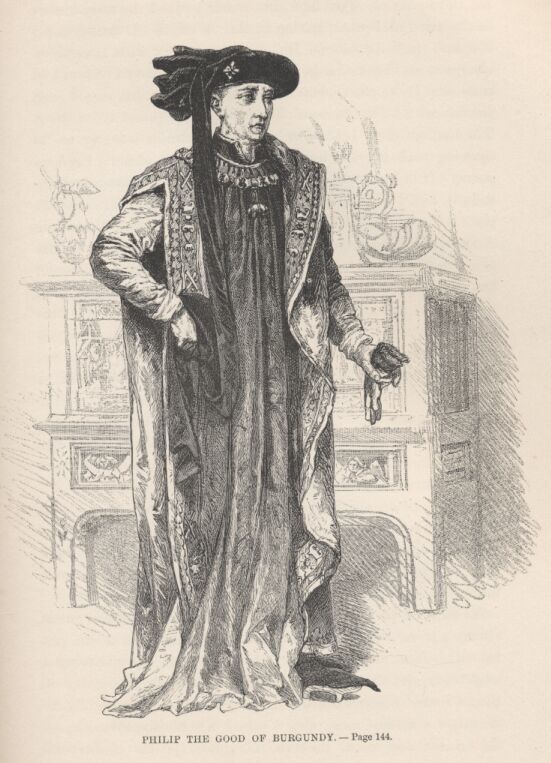
As soon as the conference was opened, and no matter what attempts were made to veil or adjourn the question, it was put nakedly. The English, instead of peace, began by proposing a long truce, and the marriage of Henry VI. with a daughter of King Charles. The French ambassadors refused, absolutely, to negotiate on this basis; they desired a definitive peace; and their conditions were, that the King and people of England making an end of this situation, so full of clanger for the whole royal house, and of suffering for the people. Nevertheless, the duke showed strong scruples. The treaties he had sworn to, the promises he had made, threw him into a constant fever of anxiety; he would not have any one able to say that he had in any respect forfeited his honor. He asked for three consultations, one with the Italian doctors connected with the pope’s legates, another with English doctors, and another with French doctors. He was granted all three, though they were more calculated to furnish him with arguments, each on their own side, than to dissipate his doubts, if he had any real ones. The legates ended by solemnly saying to him, “We do conjure you, by the bowels of our Lord Jesus Christ, and by the authority of our holy father, the pope, of the holy council assembled at Bale, and of the universal Church, to renounce that spirit of vengeance whereby you are moved against King Charles in memory of the late Duke John, your father; nothing can render you more pleasing in the eyes of God, or further augment your fame in this world.” For three days Duke Philip remained still undecided; but he heard that the Duke of Bedford, regent of France on behalf of the English, who was his brother-in-law, had just died at Rouen, on the 14th of September. He was, besides the late King of England, Henry V., the only English-man who had received promises from the duke, and who lived in intimacy with him. Ten days afterwards, on the 21th of September, the queen, Isabel of Bavaria, also died at Paris; and thus another of the principal causes of shame to the French kingship, and misfortune to France, disappeared from the stage of the world. Duke Philip felt himself more free and more at rest in his mind, if not rightfully, at any rate so far as political and worldly expedience was concerned. He declared his readiness to accept the proposals which had been communicated to him by the ambassadors of Charles VII.; and on the 21st of September, 1435, peace was signed at Arras between France and Burgundy, without any care for what England might say or do.
There was great and general joy in France. It was peace, and national reconciliation as well; Dauphinizers and Burgundians embraced in the streets; the Burgundians were delighted at being able to call themselves Frenchmen. Charles VII. convoked the states-general at Tours, to consecrate this alliance. On his knees, upon the bare stone, before the Archbishop of Crete, who had just celebrated mass, the king laid his hands upon the Gospels, and swore the peace, saying that “It was his duty to imitate the King of kings, our divine Saviour, who had brought peace amongst men.” At the chancellor’s order, the princes and great lords, one after the other, took the oath; the nobles and the people of the third estate swore the peace all together, with cries of “Long live the king! Long live the Duke of Burgundy!” “With this hand,” said Sire de Lannoy, “I have thrice sworn peace during this war; but I call God to witness that, for my part, this time it shall be kept, and that never will I break it (the peace).” Charles VII., in his emotion, seized the hands of Duke Philip’s ambassadors, saying, “For a long while I have languished for this happy day; we must thank God for it.” And the Te Deum was intoned with enthusiasm.
Peace was really made amongst Frenchmen; and, in spite of many internal difficulties and quarrels, it was not broken as long as Charles VII. and Duke Philip the Good were living. But the war with the English went on incessantly. They still possessed several of the finest provinces of France; and the treaty of Arras, which had weakened them very much on the Continent, had likewise made them very angry. For twenty-six years, from 1435 to 1461, hostilities continued between the two kingdoms, at one time actively and at another slackly, with occasional suspension by truce, but without any formal termination. There is no use in recounting the details of their monotonous and barren history. Governments and people often persist in maintaining their quarrels and inflicting mutual injuries by the instrumentality of events, acts, and actors that deserve nothing but oblivion. There is no intention here of dwelling upon any events or persons save such as have, for good or for evil, to its glory or its sorrow, exercised a considerable influence upon the condition and fortune of France.
The peace of Arras brought back to the service of France and her king the constable De Richemont, Arthur of Brittany, whom the jealousy of George de la Tremoille and the distrustful indolence of Charles VII. had so long kept out of it. By a somewhat rare privilege, he was in reality, there is reason to suppose, superior to the name he has left behind him in history; and it is only justice to reproduce here the portrait given of him by one of his contemporaries who observed him closely and knew him well. “Never a man of his time,” says William Gruet, “loved justice more than he, or took more pains to do it according to his ability. Never was prince more humble, more charitable, more compassionate, more liberal, less avaricious, or more open-handed in a good fashion and without prodigality. He was a proper man, chaste and brave as prince can be; and there was none of his time of better conduct than lie in conducting a great battle, or a great siege, and all sorts of approaches in all sorts of ways. Every day, once at least in the four and twenty hours, his conversation was of war, and he took more pleasure in it than in aught else. Above all things he loved men of valor and good renown, and he more than any other loved and supported the people, and freely did good to poor mendicants and others of God’s poor.”
Nearly all the deeds of Richemont, from the time that he became powerful again, confirm the truth of this portrait. His first thought and his first labor were to restore Paris to France and to the king. The unhappy city in subjection to the English was the very image of devastation and ruin. “The wolves prowled about it by night, and there were in it,” says an eye-witness, “twenty-four thousand houses empty.” The Duke of Bedford, in order to get rid of these public tokens of misery, attempted to supply the Parisians with bread and amusements (panem et circenses); but their very diversions were ghastly and melancholy. In 1425, there was painted in the sepulchre of the Innocents a picture called the Dance of Death: Death, grinning with fleshless jaws, was represented taking by the hand all estates of the population in their turn, and making them dance. In the Hotel Armagnac, confiscated, as so many others were, from its owner, a show was exhibited to amuse the people. “Four blind men, armed with staves, were shut up with a pig in a little paddock. They had to see whether they could kill the said pig, and when they thought they were belaboring it most they were belaboring one another.” The constable resolved to put a stop to this deplorable state of things in the capital of France. In April, 1433, when he had just ordered for himself apartments at St. Denis, he heard that the English had just got in there and plundered the church. He at once gave orders to march. The Burgundians, who made up nearly all his troop, demanded their pay, and would not mount. Richemont gave them his bond; and the march was begun to St. Denis. “You know the country?” said the constable to Marshal Isle-Adam. “Yes, my lord,” answered the other; “and by my faith, in the position held by the English, you would do nothing to harm or annoy them, though you had ten thousand fighting men.” “Ah! but we will,” replied Richemont; “God will help us. Keep pressing forward to support the skirmishers.” And he occupied St. Denis, and drove out the English. The population of Paris, being informed of this success, were greatly moved and encouraged. One brave burgess of Paris, Michel Laillier, master of the exchequer, notified to the constable, it is said, that they were ready and quite able to open one of the gates to him, provided that an engagement were entered into in the king’s name for a general amnesty and the prevention of all disorder. The constable, on the king’s behalf, entered into the required engagement, and presented himself the next day, the 13th of April, with a picked force before the St. Michel gate. The enterprise was discovered. A man posted on the wall made signs to them with his hat, crying out, “Go to the other gate; there’s no opening this; work is going on for you in the Market-quarter.” The picked force followed the course of the ramparts up to the St. Jacques gate. “Who goes there?” demanded some burghers who had the guard of it. “Some of the constable’s people.” He himself came up on his big charger, with satisfaction and courtesy in his mien. Some little time was required for opening the gate; a long ladder was let down; and Marshal Isle-Adam was the first to mount, and planted on the wall the standard of France. The fastenings of the drawbridge were burst, and when it was let down, the constable made his entry on horseback, riding calmly down St. Jacques Street, in the midst of a joyous and comforted crowd. “My good friends,” he said to them, “the good King Charles, and I on his behalf, do thank you a hundred thousand times for yielding up to him so quietly the chief city of his kingdom. If there be amongst you any, of whatsoever condition he may be, who hath offended against my lord ‘the king, all is forgiven, in the case both of the absent and the present.”
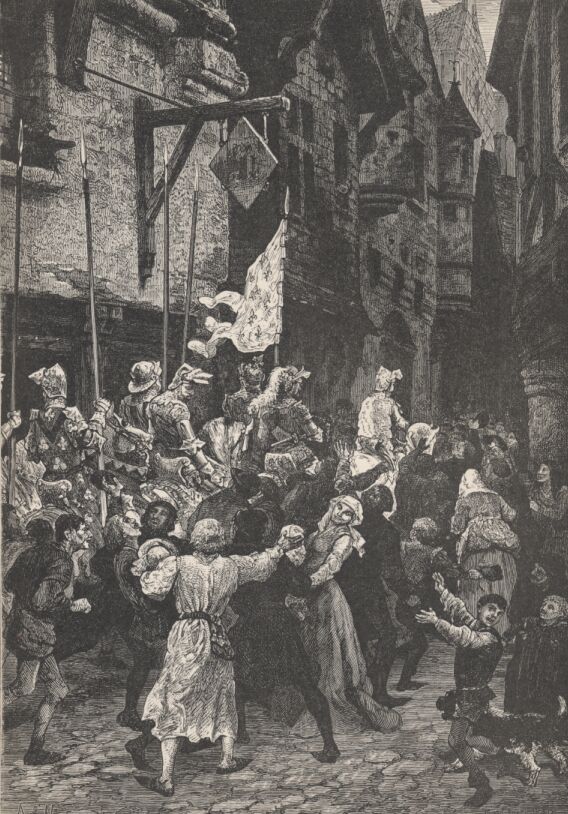
Then he caused it to be proclaimed by sound of trumpet throughout the streets that none of his people should be so bold, on pain of hanging, as to take up quarters in the house of any burgher against his will, or to use any reproach whatever, or do the least displeasure to any. At sight of the public joy, the English had retired to the Bastille, where the constable was disposed to besiege them. “My lord,” said the burghers to him, “they will surrender; do not reject their offer; it is so far a fine thing enough to have thus recovered Paris; often, on the contrary, many constables and many marshals have been driven out of it. Take contentedly what God hath granted you.” The burghers’ prediction was not unverified. The English sallied out of the Bastille by the gate which opened on the fields, and went and took boat in the rear of the Louvre. Next day abundance of provisions arrived in Paris; and the gates were opened to the country folks. The populace freely manifested their joy at being rid of the English. “It was plain to see,” was the saving, “that they were not in France to remain; not one of them had been seen to sow a field with corn or build a house; they destroyed their quarters without a thought of repairing them; they had not restored, peradventure, a single fireplace. There was only their regent, the Duke of Bedford, who was fond of building and making the poor people work; he would have liked peace; but the nature of those English is to be always at war with their neighbors, and accordingly they all made a bad end; thank God there have already died in France more than seventy thousand of them.”
Up to the taking of Paris by the constable the Duke of Burgundy had kept himself in reserve, and had maintained a tacit neutrality towards England; he had merely been making, without noisy demonstration, preparations for an enterprise in which he, as Count of Flanders, was very much interested. The success of Richemont inspired him with a hope, and perhaps with a jealous desire, of showing his power and his patriotism as a Frenchman by making war, in his turn, upon the English, from whom he had by the treaty of Arras effected only a pacific separation. In June, 1436, he went and besieged Calais. This was attacking England at one of the points she was bent upon defending most obstinately. Philip had reckoned on the energetic cooperation of the cities of Flanders, and at the first blush the Flemings did display a strong inclination to support him in his enterprise. “When the English,” they said, “know that my lords of Ghent are on the way to attack them with all their might they will not await us; they will leave the city and flee away to England.” Neither the Flemings nor Philip had correctly estimated the importance which was attached in London to the possession of Calais. When the Duke of Gloucester, lord-protector of England, found this possession threatened, he sent a herald to defy the Duke of Burgundy and declare to him that, if he did not wait for battle beneath the walls of Calais, Humphrey of Gloucester would go after him even into his own dominions. “Tell your lord that he will not need to take so much trouble, and that he will find me here,” answered Philip proudly. His pride was over-confident. Whether it were only a people’s fickleness or intelligent appreciation of their own commercial interests in their relations with England, the Flemings grew speedily disgusted with the siege of Calais, complained of the tardiness in arrival of the fleet which Philip had despatched thither to close the port against English vessels, and, after having suffered several reverses by sorties of the English garrison, they ended by retiring with such precipitation that they abandoned part of their supplies and artillery. Philip, according to the expression of M. Henri Martin, was reduced to covering their retreat with his cavalry; and then he went away sorrowfully to Lille, to advise about the means of defending his Flemish lordships exposed to the reprisals of the English.
Thus the fortune of Burgundy was tottering whilst that of France was recovering itself. The constable’s easy occupation of Paris led the majority of the small places in the neighborhood, St. Denis, Chevreuse, Marcoussis, and Montlhery to decide either upon spontaneous surrender or allowing themselves to be taken after no great resistance. Charles VII., on his way through France to Lyon, in Dauphiny, Languedoc, Auvergne, and along the Loire, recovered several other towns, for instance, Chateau- Landon, Nemours, and Charny. He laid siege in person to Montereau, an important military post with which a recent and sinister reminiscence was connected. A great change now made itself apparent in the king’s behavior and disposition. He showed activity and vigilance, and was ready to expose himself without any care for fatigue or danger. On the day of the assault (10th of October, 1437) he went down into the trenches, remained there in water up to his waist, mounted the scaling- ladder sword in hand, and was one of the first assailants who penetrated over the top of the walls right into the place. After the surrender of the castle as well as the town of Montereau, he marched on Paris, and made his solemn re-entry there on the 12th of November, 1437, for the first time since in 1418 Tanneguy-Duchatel had carried him away, whilst still a child, wrapped in his bed-clothes. Charles was received and entertained as became a recovered and a victorious king; but he passed only three weeks there, and went away once more, on the 3d of December, to go and resume at Orleans first, and then at Bourges, the serious cares of government. It is said to have been at this royal entry into Paris that Agnes Sorel or Soreau, who was soon to have the name of Queen of Beauty, and to assume in French history an almost glorious though illegitimate position, appeared with brilliancy in the train of the queen, Mary of Anjou, to whom the king had appointed her a maid of honor. It is a question whether she did not even then exercise over Charles VII. that influence, serviceable alike to the honor of the king and of France, which was to inspire Francis I., a century later, with this gallant quatrain:
“If to win back poor captive France be aught, More honor, gentle Agnes, is thy weed, Than ere was due to deeds of virtue wrought By cloistered nun or pious hermit-breed.”
It is worth while perhaps to remark that in 1437 Agnes Sorel was already twenty-seven.
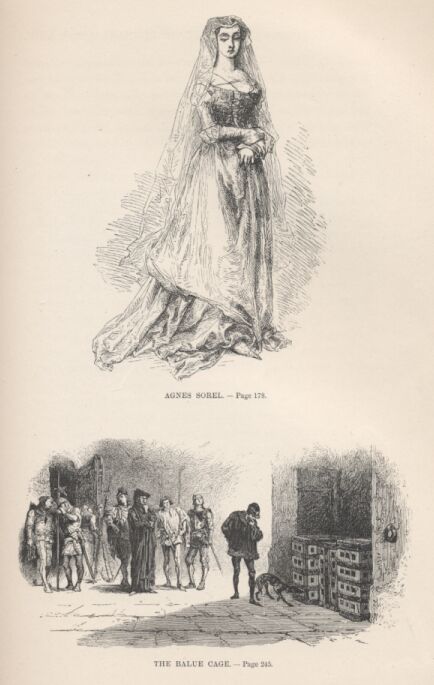
One of the best informed, most impartial, and most sensible historians of that epoch, James Duclercq, merely says on this subject, King Charles, before he had peace with Duke Philip of Burgundy, led a right holy life and said his canonical hours. But after peace was made with the duke, though the king continued to serve God, he joined himself unto a young woman who was afterwards called Fair Agnes.
Nothing is gained by ignoring good even when it is found in company with evil, and there is no intention here of disputing the share of influence exercised by Agnes Sorel upon Charles VII.‘s regeneration in politics and war after the treaty of Arras. Nevertheless, in spite of the king’s successes at Montereau and during his passage through Central and Northern France, the condition of the country was still so bad in 1440, the disorder was so great, and the king so powerless to apply a remedy, that Richemont, disconsolate, was tempted to rid and disburden himself from the government of France and between the rivers [Seine and Loire, no doubt] and to go or send to the king for that purpose. But one day the prior of the Carthusians at Paris called on the constable and found him in his private chapel. “What need you, fair father?” asked Richemont. The prior answered that he wished to speak with my lord the constable. Richemont replied that it was he himself. “Pardon me, my lord,” said the prior, “I did not know you; I wish to speak to you, if you please.” “Gladly,” said Richemont. “Well, my lord, you yesterday held counsel and considered about disburdening yourself from the government and office you hold hereabouts.” “How know you that? Who told you?” “My lord, I do not know it through any person of your council, and do not put yourself out to learn who told me, for it was one of my brethren. My lord, do not do this thing; and be not troubled, for God will help you.” “Ah! fair father, how can that be? The king has no mind to aid me or grant me men or money; and the men-at-arms hate me because I have justice done on them, and they have no mind to obey me.” “My lord, they will do what you desire; and the king will give you orders to go and lay siege to Meaux, and will send you men and money.” “Ah! fair father, Meaux is so strong! How can it be done? The King of England was there for nine months before it.” “My lord, be not you troubled; you will not be there so long; keep having good hope in God and He will help you. Be ever humble and grow not proud; you will take Meaux ere long; your men will grow proud; they will then have somewhat to suffer; but you will come out of it to your honor.”
The good prior was right. Meaux was taken; and when the constable went to tell the news at Paris the king made him “great cheer.” There was a continuance of war to the north of the Loire; and amidst many alternations of successes and reverses the national cause made great way there. Charles resolved, in 1442, to undertake an expedition to the south of the Loire, in Aquitaine, where the English were still dominant; and he was successful. He took from the English Tartas, Saint-Sever, Marmande, La Reole, Blaye, and Bourg-sur-Mer. Their ally, Count John d’Armagnac, submitted to the King of France. These successes cost Charles VII. the brave La Hire, who died at Montauban of his wounds. On returning to Normandy, where he had left Dunois, Charles, in 1443, conducted a prosperous campaign there. The English leaders were getting weary of a war without any definite issue; and they had proposals made to Charles for a truce, accompanied with a demand on the part of their young king, Henry VI., for the hand of a French princess, Margaret of Anjou, daughter of King Rena, who wore the three crowns of Naples, Sicily, and Jerusalem, without possessing any one of the kingdoms. The truce and the marriage were concluded at Tours, in 1444. Neither of the arrangements was popular in England; the English people, who had only a far-off touch of suffering from the war, considered that their government made too many concessions to France. In France, too, there was some murmuring; the king, it was said, did not press his advantages with sufficient vigor; everybody was in a hurry to see all Aquitaine reconquered. “But a joy that was boundless and impossible to describe,” says Thomas Bazin, the most intelligent of the contemporary historians, “spread abroad through the whole population of the Gauls. Having been a prey for so long to incessant terrors, and shut up within the walls of their towns like convicts in a prison, they rejoiced like people restored to freedom after a long and bitter slavery. Companies of both sexes were seen going forth into the country and visiting temples or oratories dedicated to the saints, to pay the vows which they had made in their distress. One fact especially was admirable and the work of God Himself: before the truce so violent had been the hatred between the two sides, both men-at-arms and people, that none, whether soldier or burgher, could without risk to life go out and pass from one place to another unless under the protection of a safe-conduct. But, so soon as the truce was proclaimed, every one went and came at pleasure, in full liberty and security, whether in the same district or in districts under divided rule; and even those who, before the proclamation of the truce, seemed to take no pleasure in anything but a savage outpouring of human blood, now took delight in the sweets of peace, and passed the days in holiday-making and dancing with enemies who but lately had been as bloodthirsty as themselves.”
But for all their rejoicing at the peace, the French, king, lords, and commons, had war still in their hearts; national feelings were waking up afresh; the successes of late years had revived their hopes; and the civil dissensions which were at that time disturbing England let favorable chances peep out. Charles VII. and his advisers employed the leisure afforded by the truce in preparing for a renewal of the struggle. They were the first to begin it again; and from 1449 to 1451 it was pursued by the French king and nation with ever-increasing ardor, and with obstinate courage by the veteran English warriors astounded at no longer being victorious. Normandy and Aquitaine, which was beginning to be called Guyenne only, were throughout this period the constant and the chief theatre of war. Amongst the greatest number of fights and incidents which distinguished the three campaigns in those two provinces, the recapture of Rouen by Dunois in October, 1449, the battle of Formigny, won near Bayeux on the 15th of April, 1450, by the constable De Richemont, and the twofold capitulation of Bordeaux, first on the 28th of June, 1451, and next on the 9th of October, 1453, in order to submit to Charles VII., are the only events to which a place in history is due, for those were the days on which the question was solved touching the independence of the nation and the kingship in France. The Duke of Somerset and Lord Talbot were commanding in Rouen when Dunois presented himself beneath its walls, in hopes that the inhabitants would open the gates to him. Some burgesses, indeed, had him apprised of a certain point in the walls at which they might be able to favor the entry of the French. Dunois, at the same time making a feint of attacking in another quarter, arrived at the spot indicated with four thousand men. The archers drew up before the wall; the men-at-arms dismounted; the burgesses gave the signal, and the planting of scaling-ladders began; but when hardly as many as fifty or sixty men had reached the top of the wall the banner and troops of Talbot were seen advancing. He had been warned in time and had taken his measures. The assailants were repulsed; and Charles VII., who was just arriving at the camp, seeing the abortiveness of the attempt, went back to Pont-de-l’Arehe. But the English had no long joy of their success. They were too weak to make any effectual resistance, and they had no hope of any aid from England. Their leaders authorized the burgesses to demand of the king a safe-conduct in order to treat. The conditions offered by Charles were agreeable to the burgesses, but not to the English; and when the archbishop read them out in the hall of the mansion-house, Somerset and Talbot witnessed an outburst of joy which revealed to them all their peril. Fagots and benches at once began to rain down from the windows; the English shut themselves up precipitately in the castle, in the gate-towers, and in the great tower of the bridge; and the burgesses armed themselves and took possession during the night of the streets and the walls. Dunois, having received notice, arrived in force at the Martainville gate. The inhabitants begged him to march into the city as many men as he pleased. “It shall be as you will,” said Dunois. Three hundred men-at-arms and archers seemed sufficient. Charles VII returned before Rouen; the English asked leave to withdraw without loss of life or kit; and “on condition,” said the king “that they take nothing on the march without paying.” “We have not the wherewithal,” they answered; and the king gave them a hundred francs. Negotiations were recommenced. The king required that Harfleur and all the places in the district of Caux should be given up to him. “Ah! as for Harfleur, that cannot be,” said the Duke of Somerset; “it is the first town which surrendered to our glorious king, Henry V., thirty-five years ago.” There was further parley. The French consented to give up the demand for Harfleur; but they required that Talbot should remain as a hostage until the conditions were fulfilled. The English protested. At last, however, they yielded, and undertook to pay fifty thousand golden crowns to settle all accounts which they owed to the tradesmen in the city, and to give up all places in the district of Caen except Harfleur. The Duchess of Somerset and Lord Talbot remained as hostages; and on the 10th of November, 1449, Charles entered Rouen in state, with the character of a victor who knew how to use victory with moderation.
The battle of Formigny was at first very doubtful. In order to get from Valognes to Bayeux and Caen the English had to cross at the mouth of the Vire great sands which were passable only at low tide. A weak body of French under command of the Count de Clermont had orders to cut them off from this passage. The English, however, succeeded in forcing it; but just as they were taking position, with the village of Formigny to cover their rear, the constable De Richemont was seen coming up with three thousand men in fine order. The English were already strongly intrenched, when the battle began. “Let us go and look close in their faces, admiral,” said the constable to Sire de Coetivi. “I doubt whether they will leave their intrenchments,” replied the admiral. “I vow to God that with His grace they will not abide in them,” rejoined the constable; and he gave orders for the most vigorous assault. It lasted nearly three hours; the English were forced to fly at three points, and lost thirty-seven hundred men; several of their leaders were made prisoners; those who were left retired in good order; Bayeux, Avranches, Caen, Falaise, and Cherbourg fell one after the other into the hands of Charles VII.; and by the end of August, 1450, the whole of Normandy had been completely won back by France.
The conquest of Guyenne, which was undertaken immediately after that of Normandy, was at the outset more easy and more speedy. Amongst the lords of Southern France several hearty patriots, such as John of Blois, Count of Perigord, and Arnold Amanieu, Sire d’Albret, of their own accord began the strife, and on the 1st of November, 1450, inflicted a somewhat severe reverse upon the English, near Blanquefort. In the spring of the following year Charles VII. authorized the Count of Armagnac to take the field, and sent Dunois to assume the command-in-chief. An army of twenty thousand men mustered under his orders; and, in the course of May, 1451, some of the principal places of Guyenne, such as St. Emillon, Blaye, Fronsac, Bourg-en-Mer, Libourne, and Dax were taken by assault or capitulated. Bordeaux and Bayonne held out for some weeks; but, on the 12th of June, a treaty concluded between the Bordelese and Dunois secured to the three estates of the district the liberties and privileges which they had enjoyed under English supremacy; and it was further stipulated that, if by the 24th of June the city had not been succored by English forces, the estates of Guyenne should recognize the sovereignty of King Charles. When the 24th of June came, a herald went up to one of the towers of the castle and shouted, “Succor from the King of England for them of Bordeaux!!” None replied to this appeal; so Bordeaux surrendered, and on the 29th of June Dunois took possession of it in the name of the King of France. The siege of Bayonne, which was begun on the 6th of August, came to an end on the 20th by means of a similar treaty. Guyenne was thus completely won. But the English still had a considerable following there. They had held it for three centuries; and they had always treated it well in respect of local liberties, agriculture, and commerce. Charles VII., on recovering it, was less wise. He determined to establish there forthwith the taxes, the laws, and the whole regimen of Northern France; and the Bordelese were as prompt in protesting against these measures as the king was in employing them. In August, 1452, a deputation from the three estates of the province waited upon Charles at Bourges, but did not obtain their demands. On their return to Bordeaux an insurrection was organized; and Peter de Montferrand, Sire de Lesparre, repaired to London and proposed to the English government to resume possession of Guyenne. On the 22d of October, 1452, Talbot appeared before Bordeaux with a body of five thousand men; the inhabitants opened their gates to him; and he installed himself there as lieutenant of the King of England, Henry VI. Nearly all the places in the neighborhood, with the exception of Bourg and Blaye, returned beneath the sway of the English; considerable reenforcements were sent to Talbot from England; and at the same time an English fleet threatened the coast of Normandy. But Charles VII. was no longer the blind and indolent king he had been in his youth. Nor can the prompt and effectual energy he displayed in 1453 be any longer attributed to the influence of Agnes Sorel, for she died on the 9th of February, 1450. Charles left Richemont and Dunois to hold Normandy; and, in the early days of spring, moved in person to the south of France with a strong army and the principal Gascon lords who two years previously had brought Guyenne back under his power. On the 2d of June, 1453, he opened the campaign at St. Jean-d’Angely. Several places surrendered to him as soon as he appeared before their walls; and on the 13th of July he laid siege to Castillon, on the Dordogne, which had shortly before fallen into the hands of the English. The Bordelese grew alarmed and urged Talbot to oppose the advance of the French. “We may very well let them come nearer yet,” said the old warrior, then eighty years of age; “rest assured that, if it please God, I will fulfil my promise when I see that the time and the hour have come.”
On the night between the 16th and 17th of July, however, Talbot set out with his troops to raise the siege of Castillon. He marched all night and came suddenly in the early morning upon the French archers, quartered in an abbey, who formed the advanced guard of their army, which was strongly intrenched before the place. A panic set in amongst this small body, and some of them took to flight. “Ha! you would desert me then?” said Sire de Rouault, who was in command of them; “have I not promised you to live and die with you?” They thereupon rallied and managed to join the camp. Talbot, content for the time with this petty success, sent for a chaplain to come and say mass; and, whilst waiting for an opportunity to resume the fight, he permitted the tapping of some casks of wine which had been found in the abbey, and his men set themselves to drinking. A countryman of those parts came hurrying up, and said to Talbot, “My lord, the French are deserting their park and taking to flight; now or never is the hour for fulfilling your promise.” Talbot arose and left the mass, shouting, “Never may I hear mass again if I put not to rout the French who are in yonder park.” When he arrived in front of the Frenchmen’s intrenchment, “My lord,” said Sir Thomas Cunningham, an aged gentleman who had for a long time past been his standard-bearer, “they have made a false report to you; observe the depth of the ditch and the faces of yonder men; they don’t look like retreating; my opinion is, that for the present we should turn back; the country is for us, we have no lack of provisions, and with a little patience we shall starve out the French.” Talbot flew into a passion, gave Sir Thomas a sword-cut across the face, had his banner planted on the edge of the ditch, and began the attack. The banner was torn down and Sir Thomas Cunningham killed. “Dismount!” shouted Talbot to his men-at-arms, English and Gascon. The French camp was defended by a more than usually strong artillery; a body of Bretons, held in reserve, advanced to sustain the shock of the English; and a shot from a culverin struck Talbot, who was already wounded in the face, shattered his thigh, and brought him to the ground. Lord Lisle, his son, flew to him to raise him. “Let me be,” said Talbot; “the day is the enemies’; it will be no shame for thee to fly, for this is thy first battle.” But the son remained with his father, and was slain at his side. The defeat of the English was complete. Talbot’s body, pierced with wounds, was left on the field of battle. He was so disfigured that, when the dead were removed, he was not recognized. Notice, however, was taken of an old man wearing a cuirass covered with red velvet; this, it was presumed, was he; and he was placed upon a shield and carried into the camp. An English herald came with a request that he might look for Lord’ Talbot’s body. “Would you know him?” he was asked. “Take me to see him,” joyfully answered the poor servant, thinking that his master was a prisoner and alive. When he saw him, he hesitated to identify him; he knelt down, put his finger in the mouth of the corpse, and recognized Talbot by the loss of a molar tooth. Throwing off immediately his coat-of-arms with the colors and bearings of Talbot, “Ah! my lord and master,” he cried, “can this be verily you? May God forgive your sins! For forty years and more I have been your officer-at-arms and worn your livery, and thus I give it back to you!” And he covered with his coat-of-arms the stark-stripped body of the old hero.
The English being beaten and Talbot dead, Castillon surrendered; and at unequal intervals Libourne, St. Emillon, Chateau-Neuf de Medoc, Blanquefort, St. Macaire, Cadillac, &c., followed the example. At the commencement of October, 1453, Bordeaux alone was still holding out. The promoters of the insurrection which had been concerted with the English, amongst others Sires de Duras and de Lesparre, protracted the resistance rather in their own self-defence than in response to the wishes of the population; the king’s artillery threatened the place by land, and by sea a king’s fleet from Rochelle and the ports of Brittany blockaded the Gironde. “The majority of the king’s officers,” says the contemporary historian, Thomas Basin, “advised him to punish by at least the destruction of their walls the Bordelese who had recalled the English to their city; but Charles, more merciful and more soft-hearted, refused.” He confined himself to withdrawing from Bordeaux her municipal privileges, which, however, she soon partially recovered, and to imposing upon her a fine of a hundred thousand gold crowns, afterwards reduced to thirty thousand; he caused to be built at the expense of the city two fortresses, the Fort of the Ila and the Castle of Trompette, to keep in check so bold and fickle a population; and an amnesty was proclaimed for all but twenty specified persons, who were banished. On these conditions the capitulation was concluded and signed on the 17th of October; the English re-embarked; and Charles, without entering Bordeaux, returned to Touraine. The English had no longer any possession in France but Calais and Guines; the Hundred Years’ War was over.
And to whom was the glory?
Charles VII. himself decided the question. When in 1455, twenty-four years after the death of Joan of Are, he at Rome and at Rouen prosecuted her claims for restoration of character and did for her fame and her memory all that was still possible, he was but relieving his conscience from a load of ingratitude and remorse which in general weighs but lightly upon men, and especially upon kings; and he was discharging towards the Maid of Domremy the debt due by France and the French kingship when he thus proclaimed that to Joan above all they owed their deliverance and their independence. Before men and before God Charles was justified in so thinking; the moral are not the sole, but they are the most powerful forces which decide the fates of people; and Joan had roused the feelings of the soul, and given to the struggles between France and England its religious and national character. At Rheims, when she repaired thither for the king’s coronation, she said of her own banner, “It has a right to the honor, for it has been at the pains.” She, first amongst all, had a right to the glory, for she had been the first to contribute to the success.
Next to Joan of Arc, the constable De Richemont was the most effective and the most glorious amongst the liberators of France and of the king. He was a strict and stern warrior, unscrupulous and pitiless towards his enemies, especially towards such as he despised, severe in regard to himself, dignified in his manners, never guilty of swearing himself and punishing swearing as a breach of discipline amongst the troops placed under his orders. Like a true patriot and royalist, he had more at heart his duty towards France and the king than he had his own personal interests. He was fond of war, and conducted it bravely and skilfully, without rashness, but without timidity: “Wherever the constable is,” said Charles VII., “there I am free from anxiety; he will do all that is possible!” He set his title and office of constable of France above his rank as a great lord; and when, after the death of his brother, Duke Peter II., he himself became Duke of Brittany, he always had the constable’s sword carried before him, saying, “I wish to honor in my old age a function which did me honor in my youth.” His good services were not confined to the wars of his time; he was one of the principal reformers of the military system in France by the substitution of regular troops for feudal service. He has not obtained, it is to be feared, in the history of the fifteenth century, the place which properly belongs to him.
Dunois, La Hire, Xaintrailles, and Marshals De Boussac and De La Fayette were, under Charles VII., brilliant warriors and useful servants of the king and of Fiance; but, in spite of their knightly renown, it is questionable if they can be reckoned, like the constable De Richemont, amongst the liberators of national independence. There are degrees of glory, and it is the duty of history not to distribute it too readily and as it were by handfuls.
Besides all these warriors, we meet, under the sway of Charles VII., at first in a humble capacity and afterwards at his court, in his diplomatic service and sometimes in his closest confidence, a man of quite a different origin and quite another profession, but one who nevertheless acquired by peaceful toil great riches and great influence, both brought to a melancholy termination by a conviction and a consequent ruin from which at the approach of old age he was still striving to recover by means of fresh ventures. Jacques Coeur was born at Bourges at the close of the fourteenth century. His father was a furrier, already sufficiently well established and sufficiently rich to allow of his son’s marrying, in 1418, the provost’s daughter of his own city. Some years afterwards Jacques Coeur underwent a troublesome trial for infraction of the rules touching the coinage of money; but thanks to a commutation of the penalty, graciously accorded by Charles VII., he got off with a fine, and from that time forward directed all his energies towards commerce. In 1432 a squire in the service of the Duke of Burgundy was travelling in the Holy Land, and met him at Damascus in company with several Venetians, Genoese, Florentine, and Catalan traders with whom he was doing business. “He was,” says his contemporary, Thomas Basin, “a man unlettered and of plebeian family, but of great and ingenious mind, well versed in the practical affairs of that age. He was the first in all France to build and man ships which transported to Africa and the East woollen stuffs and other produce of the kingdom, penetrated as far as Egypt, and brought back with them silken stuffs and all manner of spices, which they distributed not only in France, but in Catalonia and the neighboring countries, whereas heretofore it was by means of the Venetians, the Genoese, or the Barcelonese that such supplies found their way into France.”
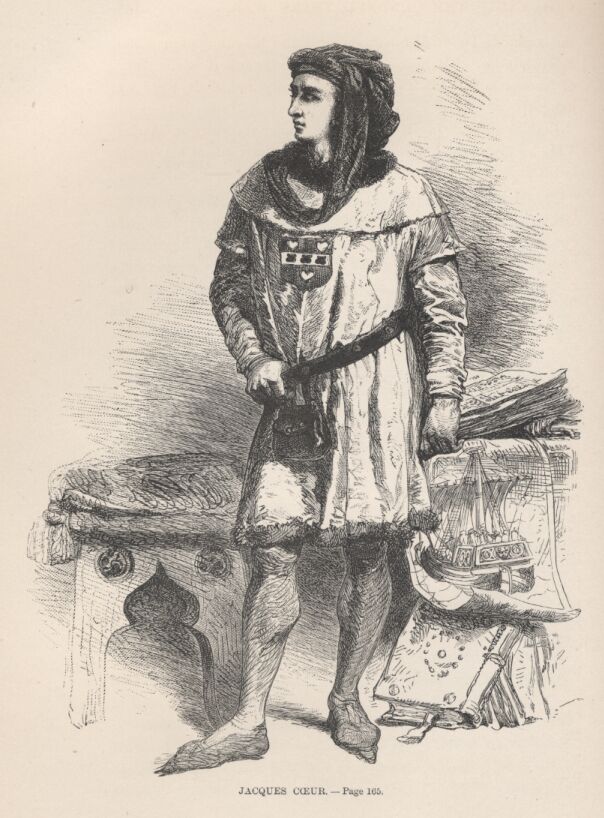
Jacques Coeur, temporarily established at Montpellier, became a great and a celebrated merchant. In 1433 Charles VII. put into his hands the direction of the mint at Paris, and began to take his advice as to the administration of the crown’s finances. In 1440 he was appointed moneyman to the king, ennobled together with his wife and children, commissioned soon afterwards to draw up new regulations for the manufacture of cloth at Bourges, and invested on his own private account with numerous commercial privileges. He had already at this period, it was said, three hundred manufacturing hands in his employment, and he was working at the same time silver, lead, and copper mines situated in the environs of Tarare and Lyons. Between 1442 and 1446 he had one of his nephews sent as ambassador to Egypt, and obtained for the French consuls in the Levant the same advantages as were enjoyed by those of the most favored nations. Not only his favor in the eyes of the king, but his administrative and even his political appointments, went on constantly increasing. Between 1444 and 1446 the king several times named him one of his commissioners to the estates of Languedoc and for the installation of the new parliament of Toulouse. In 1446 he formed one of an embassy sent to Italy to try and acquire for France the possession of Genoa, which was harassed by civil dissensions. In 1447 he received from Charles VII. a still more important commission, to bring about an arrangement between the two popes elected, one under the name of Felix V., and the other under that of Nicholas V.; and he was successful. His immense wealth greatly contributed to his influence. M. Pierre Clement [Jacques Coeur et Charles WE, ou la France au quinzieme siecle; t. ii., pp. 1-46] has given a list of thirty-two estates and lordships which Jacques Coeur had bought either in Berry or in the neighboring provinces. He possessed, besides, four mansions and two hostels at Lyons; mansions at Beaucaire, at Beziers, at St. Pourcain, at Marseilles, and at Montpellier; and he had built, for his own residence, at Bourges, the celebrated hostel which still exists as an admirable model of Gothic and national art in the fifteenth century, attempting combination with the art of Italian renaissance.
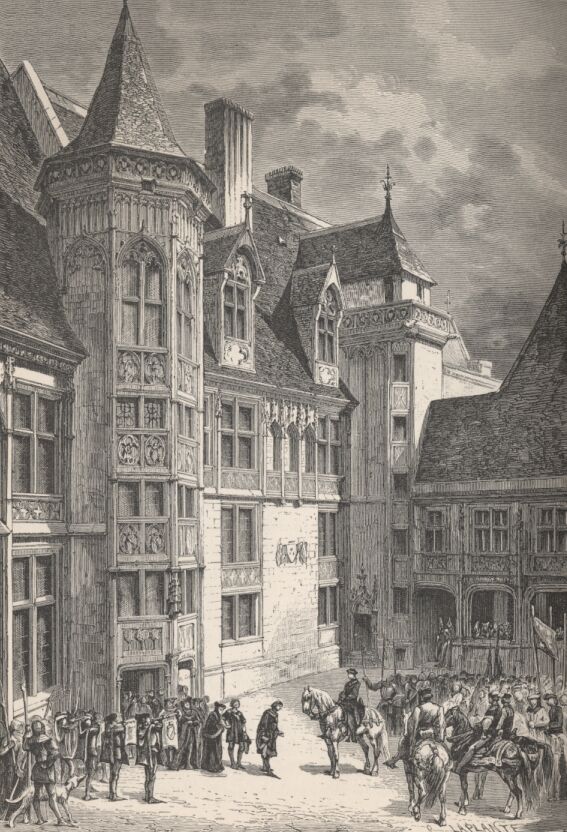
M. Clement, in his table of Jacques Coeur’s wealth does not count either the mines which he worked at various spots in France, nor the vast capital, unknown, which he turned to profit in his commercial enterprises; but, on the other hand, he names, with certain et ceteras, forty-two court-personages, or king’s officers, indebted to Jacques Coeur for large or small sums he had lent them. We will quote but two instances of Jacques Coeur’s financial connection, not with courtiers, however, but with the royal family and the king himself. Margaret of Scotland, wife of the dauphin, who became Louis XI., wrote with her own hand, on the 20th of July, 1445, “We, Margaret, dauphiness of Viennois, do acknowledge to have received from Master Stephen Petit, secretary of my lord the king, and receiver-general of his finances for Languedoc and Guienne, two thousand livres of Tours, to us given by my said lord, and to us advanced by the hands of Jacques Coeur, his moneyman, we being but lately in Lorraine, for to get silken stuff and sables to make robes for our person.” In 1449, when Charles VII. determined to drive the English from Normandy, his treasury was exhausted, and he had recourse to Jacques Coeur. “Sir,” said the trader to the king, “what I have is yours,” and lent him two hundred thousand crowns; “the effect of which was,” says Jacques Duclercq, “that during, this conquest, all the men-at-arms of the King of France, and all those who were in his service, were paid their wages month by month.”
An original document, dated 1450, which exists in the “cabinet des titres” of the National Library, bears upon it a receipt for sixty thousand livres from Jacques Coeur to the king’s receiver-general in Normandy, “in restitution of the like sum lent by me in ready money to the said lord in the month of August last past, on occasion of the surrendering to his authority of the towns and castle of Cherbourg, at that time held by the English, the ancient enemies of this realm.” It was probably a partial repayment of the two hundred thousand crowns lent by Jacques Coeur to the king at this juncture, according to all the contemporary chroniclers.
Enormous and unexpected wealth excites envy and suspicion at the same time that it confers influence; and the envious before long become enemies. Sullen murmurs against Jacques Coeur were raised in the king’s own circle; and the way in which he had begun to make his fortune—the coinage of questionable money—furnished some specious ground for them. There is too general an inclination amongst potentates of the earth to give an easy ear to reasons, good or bad, for dispensing with the gratitude and respect otherwise due to those who serve them. Charles VII., after having long been the patron and debtor of Jacques Coeur, all at once, in 1451, shared the suspicions aroused against him. To accusations of grave abuses and malversations in money matters was added one of even more importance. Agnes Sorel had died eighteen months previously (February 9, 1450); and on her death-bed she had appointed Jacques Coeur one of the three executors of her will. In July, 1451, Jacques was at Taillebourg, in Guyenne, whence he wrote to his wife that “he was in as good case and was as well with the king as ever he had been, whatever anybody might say.” Indeed, on the 22d of July Charles VII. granted him a “sum of seven hundred and seventy-two livres of Tours to help him to keep up his condition and to be more honorably equipped for his service;” and, nevertheless, on the 31st of July, on the information of two persons of the court, who accused Jacques Coeur of having poisoned Agnes Sorel, Charles ordered his arrest and the seizure of his goods, on which he immediately levied a hundred thousand crowns for the purposes of the war. Commissioners extraordinary, taken from amongst the king’s grand council, were charged to try him; and Charles VII. declared, it is said, that “if the said moneyman were not found liable to the charge of having poisoned or caused to be poisoned Agnes Sorel, he threw up and forgave all the other cases against him.” The accusation of poisoning was soon acknowledged to be false, and the two informers were condemned as calumniators; but the trial was, nevertheless, proceeded with. Jacques Coeur was accused “of having sold arms to the infidels, of having coined light crowns, of having pressed on board of his vessels, at Montpellier, several individuals, of whom one had thrown himself into the sea from desperation, and lastly of having appropriated to himself presents made to the king, in several towns of Languedoc, and of having practised in that country frequent exaction, to the prejudice of the king as well as of his subjects.” After twenty-two months of imprisonment, Jacques Coeur, on the 29th of May, 1453, was convicted, in the king’s name, on divers charges, of which several entailed a capital penalty; but “whereas Pope Nicholas V. had issued a rescript and made request in favor of Jacques Coeur, and regard also being had to services received from him,” Charles VII. spared his life, “on condition that he should pay to the king a hundred thousand crowns by way of restitution, three hundred thousand by way of fine, and should be kept in prison until the whole claim was satisfied;” and the decree ended as follows: “We have declared and do declare all the goods of the said Jacques Coeur confiscated to us, and we have banished and do banish this Jacques Coeur forever from this realm, reserving thereanent our own good pleasure.”
After having spent nearly three years more in prison, transported from dungeon to dungeon, Jacques Coeur, thanks to the faithful and zealous affection of a few friends, managed to escape from Beaucaire, to embark at Nice and to reach Rome, where Pope Nicholas V. welcomed him with tokens of lively interest. Nicholas died shortly afterwards, just when he was preparing an expedition against the Turks. His successor, Calixtus III., carried out his design, and equipped a fleet of sixteen galleys. This fleet required a commander of energy, resolution, and celebrity. Jacques Coeur had lived and fought with Dunois, Xaintrailles, La Hire, and the most valiant French captains; he was known and popular in Italy and the Levant; and the pope appointed him captain-general of the expedition. Charles VII.‘s moneyman, ruined, convicted, and banished from France, sailed away at the head of the pope’s squadron and of some Catalan pirates to carry help against the Turks to Rhodes, Chios, Lesbos, Lemnos, and the whole Grecian archipelago. On arriving at Chios, in November, 1456, he fell ill there, and perceiving his end approaching, he wrote to his king “to commend to him his children, and to beg that, considering the great wealth and honors he had in his time enjoyed in the king’s service, it might be the king’s good pleasure to give something to his children, in order that they, even those of them who were secular, might be able to live honestly, without coming to want.” He died at Chits on the 25th of November, 1456, and, according to the historian John d’Auton, who had probably lived in the society of Jacques Coeur’s children, “he remained interred in the church of the Cordeliers in that island, at the centre of the choir.”
We have felt bound to represent with some detail the active and energetic life, prosperous for a long while and afterwards so grievous and hazardous up to its very last day, of this great French merchant at the close of the middle ages, who was the first to extend afar in Europe, Africa, and Asia the commercial relations of France, and, after the example of the great Italian merchants, to make an attempt to combine politics with commerce, and to promote at one and the same time the material interests of his country and the influence of his government. There can be no doubt but that Jacques Coeur was unscrupulous and frequently visionary as a man of business; but, at the same time, he was inventive, able, and bold, and, whilst pushing his own fortunes to the utmost, he contributed a great deal to develop, in the ways of peace, the commercial, industrial, diplomatic, and artistic enterprise of France. In his relations towards his king, Jacques Coeur was to Charles VII. a servant often over-adventurous, slippery, and compromising, but often also useful, full of resource, efficient, and devoted in the hour of difficulty. Charles VII. was to Jacques Coeur a selfish and ungrateful patron, who contemptuously deserted the man whose brains he had sucked, and ruined him pitilessly after having himself contributed to enrich him unscrupulously.
We have now reached the end of events under this long reign; all that remains is to run over the substantial results of Charles VII.‘s government, and the melancholy imbroglios of his latter years with his son, the turbulent, tricky, and wickedly able born-conspirator, who was to succeed him under the name of Louis XI.
One fact is at the outset to be remarked upon; it at the first blush appears singular, but it admits of easy explanation. In the first nineteen years of his reign, from 1423 to 1442, Charles VII. very frequently convoked the states-general, at one time of Northern France, or Langue d’oil, at another of Southern France, or Langue d’oc. Twenty-four such assemblies took place during this period at Bourges, at Selles in Berry, at Le Puy in Velay, at Mean-sur-Yevre, at Chinon, at Sully-sur-Loire, at Tours, at Orleans, at Nevers, at Carcassonne, and at different spots in Languedoc. It was the time of the great war between France on the one side and England and Burgundy allied on the other, the time of intrigues incessantly recurring at court, and the time likewise of carelessness and indolence on the part of Charles VII., more devoted to his pleasures than regardful of his government. He had incessant need of states-general to supply him with money and men, and support him through the difficulties of his position. But when, dating from the peace of Arras (September 21, 1435), Charles VII., having become reconciled with the Duke of Burgundy, was deliverer from civil war, and was at grips with none but England alone already half beaten by the divine inspiration, the triumph, and the martyrdom of Joan of Arc, his posture and his behavior underwent a rare transformation. Without ceasing to be coldly selfish and scandalously licentious king he became practical, hard-working, statesman-like king, jealous and disposed to govern by himself, but at the same time watchful and skilful in availing himself of the able advisers who, whether it were by a happy accident or by his own choice, were grouped around him. “He had his days and hours for dealing with all sorts of men, one hour with the clergy, another with the nobles, another with foreigners, another with mechanical folks, armorers, and gunners; and in respect of all these persons he had a full remembrance of their cases and their appointed day. On Monday, Tuesday, and Thursday he worked with the chancellor, and got through all claims connected with justice. On Wednesday he first of all gave audience to the marshals, captains, and men of war. On the same day he held a council of finance, independently of another council which was also held on the same subject every Friday.” It was by such assiduous toil that Charles VII., in concert with his advisers, was able to take in hand and accomplish, in the military, financial, and judicial system of the realm, those bold and at the same time prudent reforms which wrested the country from the state of disorder, pillage, and general insecurity to which it had been a prey, and commenced the era of that great monarchical administration, which, in spite of many troubles and vicissitudes, was destined to be, during more than three centuries, the government of France. The constable De Richemont and marshal De la Fayette were, in respect of military matters, Charles VII.‘s principal advisers; and it was by their counsel and with their co-operation that he substituted for feudal service and for the bands of wandering mercenaries (routiers), mustered and maintained by hap-hazard, a permanent army, regularly levied, provided for, paid, and commanded, and charged with the duty of keeping order at home, and at the same time subserving abroad the interests and policy of the state. In connection with, and as a natural consequence of this military system, Charles VII., on his own sole authority, established certain permanent imposts with the object of making up any deficiency in the royal treasury, whilst waiting for a vote of such taxes extraordinary as might be demanded of the states-general. Jacques Coeur, the two brothers Bureau, Martin Gouge, Michel Lailler, William Cousinot, and many other councillors, of burgher origin, labored zealously to establish this administrative system, so prompt and freed from all independent discussion. Weary of wars, irregularities, and sufferings, France, in the fifteenth century, asked for nothing but peace and security; and so soon as the kingship showed that it had an intention and was in a condition to provide her with them, the nation took little or no trouble about political guarantees which as yet it knew neither how to establish nor how to exercise; its right to them was not disputed in principle, they were merely permitted to fall into desuetude; and Charles VII., who during the first half of his reign had twenty-four times assembled the states-general to ask them for taxes and soldiers, was able in the second to raise personally both soldiers and taxes without drawing forth any complaint hardly, save from his contemporary historian, the Bishop of Lisieux, Thomas Basin, who said, “Into such misery and servitude is fallen the realm of France, heretofore so noble and free, that all the inhabitants are openly declared by the generals of finance and their clerks taxable at the will of the king, without anybody’s daring to murmur or even ask for mercy.” There is at every juncture, and in all ages of the world, a certain amount, though varying very much, of good order, justice, and security, without which men cannot get on; and when they lack it, either through the fault of those who govern them or through their own fault, they seek after it with the blind eyes of passion, and are ready to accept it, no matter what power may procure it for them, or what price it may cost them. Charles VII. was a prince neither to be respected nor to be loved, and during many years his reign had not been a prosperous one; but “he re-quickened justice, which had been a long while dead,” says a chronicler devoted to the Duke of Burgundy; “he put an end to the tyrannies and exactions of the men-at-arms, and out of an infinity of murderers and robbers he formed men of resolution and honest life; he made regular paths in murderous woods and forests, all roads safe, all towns peaceful, all nationalities of his kingdom tranquil; he chastised the evil and honored the good, and he was sparing of human blood.”