Volume 3 — CHAPTER XXIV.——THE HUNDRED YEARS’ WAR. —CHARLES VII. AND JOAN OF ARC. 1422-1461.
Robert Black translation
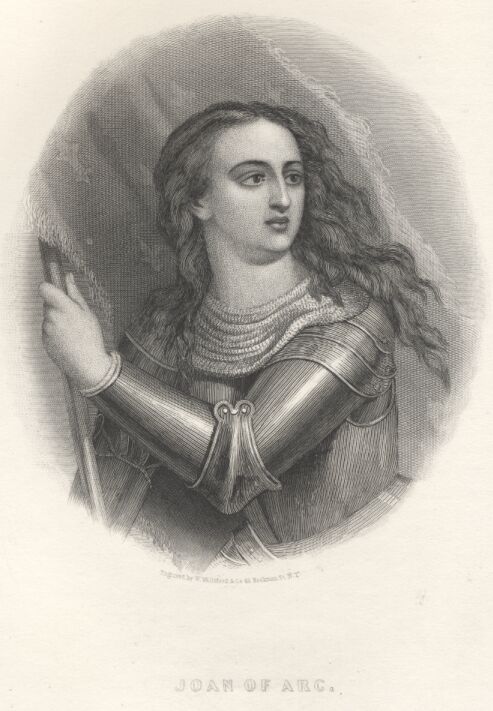
Whilst Charles VI. was dying at Paris, his son Charles, the dauphin, was on his way back from Saintonge to Berry, where he usually resided. On the 24th of October, 1422, at Mehun-sur-Yevre, he heard of his father’s death. For six days longer, from the 24th to the 29th of October, he took no style but that of regent, as if he were waiting to see what was going to happen elsewhere in respect of the succession to the throne. It was only when he knew that, on the 27th of October, the parliament of Paris had, not without some little hesitation and ambiguity, recognized “as King of England and of France, Henry VI., son of Henry V. lately deceased,” that the dauphin Charles assumed on the 30th of October, in his castle of Mehun-sur-Yevre, the title of king, and repaired to Bourges to inaugurate in the cathedral of that city his reign as Charles VII.
He was twenty years old, and had as yet done nothing to gain for himself, not to say anything of glory, the confidence and hopes of the people. He passed for an indolent and frivolous prince, abandoned to his pleasures only; one whose capacity there was nothing to foreshadow, and of whom France, outside of his own court, scarcely ever thought at all. Some days before his accession he had all but lost his life at Rochelle by the sudden breaking down of the room in the episcopal palace where he was staying; and so little did the country know of what happened to him that, a short time after the accident, messengers sent by some of his partisans had arrived at Bourges to inquire if the prince were still living. At a time when not only the crown of the kingdom, but the existence and independence of the nation, were at stake, Charles had not given any signs of being strongly moved by patriotic feelings. “He was, in person, a handsome prince, and handsome in speech with all persons, and compassionate towards poor folks,” says his contemporary Monstrelet; “but he did not readily put on his harness, and he had no heart for war if he could do without it.” On ascending the throne, this young prince, so little of the politician and so little of the knight, encountered at the head of his enemies the most able amongst the politicians and warriors of the day in the Duke of Bedford, whom his brother Henry V. had appointed regent of France, and had charged to defend on behalf of his nephew, Henry VI., a child in the cradle, the crown of France, already more than half won. Never did struggle appear more unequal or native king more inferior to foreign pretender.
Sagacious observers, however, would have easily discerned in the cause which appeared the stronger and the better supported many seeds of weakness and danger. When Philip the Good, Duke of Burgundy, heard at Arras, that Charles VI. was dead, it occurred to him immediately that if he attended the obsequies of the English King of France he would be obliged, French prince as he was, and cousin-german of Charles VI., to yield precedence to John, Duke of Bedford, regent of France, and uncle of the new king, Henry VI. He resolved to hold aloof, and contented himself with sending to Paris chamberlains to make his excuses and supply his place with the regent. On the 11th of November, 1422, the Duke of Bedford followed alone at the funeral of the late king of France, and alone made offering at the mass. Alone he went, but with the sword of state borne before him as regent. The people of Paris cast down their eyes with restrained wrath. “They wept,” says a contemporary, “and not without cause, for they knew not whether for a long, long while they would have any king in France.” But they did not for long confine themselves to tears. Two poets, partly in Latin and partly in French, Robert Blondel, and Alan Chartier, whilst deploring the public woes, excited the popular feeling. Conspiracies soon followed the songs. One was set on foot at Paris to deliver the city to king Charles VII., but it was stifled ruthlessly; several burgesses were beheaded, and one woman was burned. In several great provincial cities, at Troyes and at Rheims, the same ferment showed itself, and drew down the same severity. William Prieuse, superior of the Carmelites, was accused of propagating sentiments favorable to the dauphin, as the English called Charles VII. Being brought, in spite of the privileges of his gown, before John Cauchon, lieutenant of the captain of Rheims [related probably to Peter Cauchon, Bishop of Beauvais, who nine years afterwards was to sentence Joan of Arc to be burned], he stoutly replied, “Never was English king of France, and never shall be.” The country had no mind to believe in the conquest it was undergoing; and the Duke of Burgundy, the most puissant ally of the English, sulkily went on eluding the consequences of the anti-national alliance he had accepted.
Such being the disposition of conquerors and conquered, the war, though still carried on with great spirit, could not, and in fact did not, bring about any decisive result from 1422 to 1429. Towns were alternately taken, lost, and retaken, at one time by the French, at another by the English or Burgundians; petty encounters and even important engagements took place with vicissitudes of success and reverses on both sides. At Crevant-sur-Yonne, on the 31st of July, 1423, and at Verneuil, in Normandy, on the 17th of August, 1424, the French were beaten, and their faithful allies, the Scots, suffered considerable loss. In the latter affair, however, several Norman lords deserted the English flag, refusing to fight against the King of France. On the 26th of September, 1423, at La Gravelle, in Maine, the French were victorious, and Du Guesclin was commemorated in their victory. Anne de Laval, granddaughter of the great Breton warrior, and mistress of a castle hard by the scene of action, sent thither her son, Andrew de Laval, a child twelve years of age, and, as she buckled with her own hands the sword which his ancestor had worn, she said to him, “God make thee as valiant as he whose sword this was!” The boy received the order of knighthood on the field of battle, and became afterwards a marshal of France. Little bands, made up of volunteers, attempted enterprises which the chiefs of the regular armies considered impossible. Stephen de Vignolles, celebrated under the name of La Hire, resolved to succor the town of Montargis, besieged by the English; and young Dunois, the bastard of Orleans, joined him. On arriving, September 5, 1427, beneath the walls of the place, a priest was encountered in their road. La Hire asked him for absolution. The priest told him to confess. “I have no time for that,” said La Hire; “I am in a hurry; I have done in the way of sins all that men of war are in the habit of doing.” Whereupon, says the chronicler, the chaplain gave him absolution for what it was worth; and La Hire, putting his hands together, said, “God, I pray Thee to do for La Hire this day as much as Thou wouldst have La Hire do for Thee if he were God and Thou wert La Hire.” And Montargis was rid of its besiegers. The English determined to become masters of Mont St. Michel au peril de la mer, that abbey built on a rock facing the western coast of Normandy and surrounded every day by the waves of ocean. The thirty-second abbot, Robert Jolivet, promised to give the place up to them, and went to Rouen with that design; but one of his monks, John Enault, being elected vicar-general by the chapter, and supported by some valiant Norman warriors, offered an obstinate resistance for eight years, baffled all the attacks of the English, and retained the abbey in the possession of the King of France. The inhabitants of La Rochelle rendered the same service to the king and to France in a more important case. On the 15th of August, 1427, an English fleet of a hundred and twenty sail, it is said, appeared off their city with invading troops aboard. The Rochellese immediately levied upon themselves an extraordinary tax, and put themselves in a state of defence; troops raised in the neighborhood went and occupied the heights bordering on the coast; and a bold Breton sailor, Bernard de Kercabin, put to sea to meet the enemy, with ships armed as privateers. The attempt of the English seemed to them to offer more danger than chance of success; and they withdrew. Thus Charles VII. kept possession of the only seaport remaining to the crown. Almost everywhere in the midst of a war as indecisive as it was obstinate local patriotism and the spirit of chivalry successfully disputed against foreign supremacy the scattered fragments of the fatherland and the throne.
In order to put an end to this doubtful condition of events and of minds, the Duke of Bedford determined to aim a grand blow at the national party in France and at her king. After Paris and Rouen, Orleans was the most important city in the kingdom; it was as supreme on the banks of the Loire as Paris and Rouen were on those of the Seine. After having obtained from England considerable re-enforcements commanded by leaders of experience, the English commenced, in October, 1428, the siege of Orleans. The approaches to the place were occupied in force, and bastilles closely connected one with another were constructed around the walls. As a set-off, the most valiant warriors of France, La Hire, Dunois, Xaintrailles, and the Marshal La Fayette threw themselves into Orleans, the garrison of which amounted to scarcely twelve hundred men. Several towns, Bourges, Poitiers, and La Rochelle, sent thither money, munitions, and militia; the states-general, assembled at Chinon, voted an extraordinary aid; and Charles VII. called out the regulars and the reserves. Assaults on the one side and sorties on the other were begun with ardor. Besiegers and besieged quite felt that they were engaged in a decisive struggle. The first encounter was unfortunate for the Orleannese. In a fight called the Herring affair, they were unsuccessful in an attempt to carry off a supply of victuals and salt fish which Sir John Falstolf was bringing to the besiegers. Being a little discouraged, they offered the Duke of Burgundy to place their city in his hands, that it might not fall into those of the English; and Philip the Good accepted the offer, but the Duke of Bedford made a formal objection: “He didn’t care,” he said, “to beat the bushes for another to get the birds.” Philip in displeasure withdrew from the siege the small force of Burgundians he had sent. The English remained alone before the place, which was every day harder pressed and more strictly blockaded. The besieged were far from foreseeing what succor was preparing for them.
This very year, on the 6th of January, 1428, at Domremy, a little village in the valley of the Meuse, between Neufchateau and Vaucouleurs, on the edge of the frontier from Champagne to Lorraine, the young daughter of simple tillers of the soil, “of good life and repute, herself a good, simple, gentle girl, no idler, occupied hitherto in sewing or spinning with her mother, or driving afield her parent’s sheep, and sometimes, even, when her father’s turn came round, keeping for him the whole flock of the commune,” was fulfilling her sixteenth year. It was Joan of Arc, whom all her neighbors called Joannette. She was no recluse; she often went with her companions to sing and eat cakes beside the fountain by the gooseberry-bush, under an old beech, which was called the fairy-tree: but dancing she did not like. She was constant at church, she delighted in the sound of the bells, she went often to confession and communion, and she blushed when her fair friends taxed her with being too religious. In 1421, when Joan was hardly nine, a band of Anglo-Burgundians penetrated into her country, and transferred thither the ravages of war. The village of Domremy and the little town of Vaucouleurs were French, and faithful to the French king-ship; and Joan wept to see the lads of her parish returning bruised and bleeding from encounters with the enemy. Her relations and neighbors were one day obliged to take to flight, and at their return they found their houses burned or devastated. Joan wondered whether it could possibly be that God permitted such excesses and disasters. In 1425, on a summer’s day, at noon, she was in her father’s little garden. She heard a voice calling her, at her right side, in the direction of the church, and a great brightness shone upon her at the same time in the same spot. At first she was frightened, but she recovered herself on finding that “it was a worthy voice;” and, at the second call, she perceived that it was the voice of angels. “I saw them with my bodily eyes,” she said, six years later, to her judges at Rouen, “as plainly as I see you; when they departed from me I wept, and would fain have had them take me with them.” The apparitions came again and again, and exhorted her “to go to France for to deliver the kingdom.” She became dreamy, rapt in constant meditation. “I could endure no longer,” said she, at a later period, “and the time went heavily with me as with a woman in travail.” She ended by telling everything to her father, who listened to her words anxiously at first, and afterwards wrathfully. He himself one night dreamed that his daughter had followed the king’s men-at-arms to France, and from that moment he kept her under strict superintendence. “If I knew of your sister’s going,” he said to his sons, “I would bid you drown her; and, if you did not do it, I would drown her myself.” Joan submitted: there was no leaven of pride in her sublimation, and she did not suppose that her intercourse with celestial voices relieved her from the duty of obeying her parents. Attempts were made to distract her mind. A young man who had courted her was induced to say that he had a promise of marriage from her, and to claim the fulfilment of it. Joan went before the ecclesiastical judge, made affirmation that she had given no promise, and without difficulty gained her cause. Everybody believed and respected her.
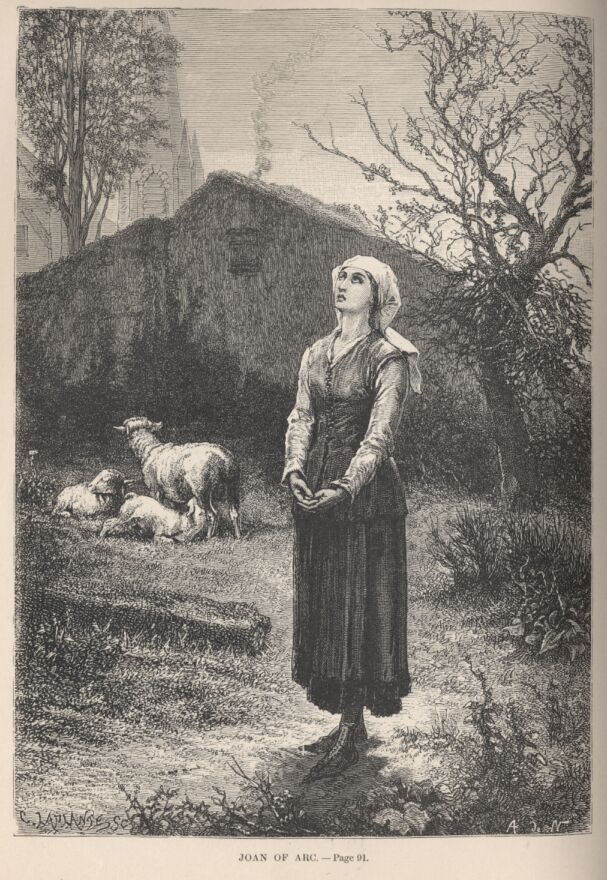
In a village hard by Domremy she had an uncle whose wife was near her confinement; she got herself invited to go and nurse her aunt, and thereupon she opened her heart to her uncle, repeating to him a popular saying, which had spread indeed throughout the country: “Is it not said that a woman shall ruin France, and a young maid restore it?” She pressed him to take her to Vaucouleurs to Sire Robert de Baudricourt, captain of the bailiwick, for she wished to go to the dauphin and carry assistance to him. Her uncle gave way, and on the 13th of May, 1428, he did take her to Vaucouleurs. “I come on behalf of my Lord,” said she to Sire de Baudricourt, “to bid you send word to the dauphin to keep himself well in hand, and not give battle to his foes, for my Lord will presently give him succor.” “Who is thy lord?” asked Baudricourt. “The King of Heaven,” answered Joan. Baudricourt set her down for mad, and urged her uncle to take her back to her parents “with a good slap o’ the face.”
In July, 1428, a fresh invasion of Burgundians occurred at Domremy, and redoubled the popular excitement there. Shortly afterwards, the report touching the siege of Orleans arrived there. Joan, more and more passionately possessed with her idea, returned to Vaucouleurs. “I must go,” said she to Sire de Baudricourt, “for to raise the siege of Orleans. I will go, should I have to wear off my legs to the knee.” She had returned to Vaucouleurs without taking leave of her parents. “Had I possessed,” said she, in 1431, to her judges at Rouen, “a hundred fathers and a hundred mothers, and had I been a king’s daughter, I should have gone.” Baudricourt, impressed without being convinced, did not oppose her remaining at Vaucouleurs, and sent an account of this singular young girl to Duke Charles of Lorraine, at Nancy, and perhaps even, according to some chronicles, to the king’s court. Joan lodged at Vaucouleurs in a wheelwright’s house, and passed three weeks there, spinning with her hostess, and dividing her time between work and church. There was much talk in Vaucouleurs of her, and her visions, and her purpose. John of Metz [also called John of Novelompont], a knight serving with Sire de Baudricourt, desired to see her, and went to the wheelwright’s. “What do you here, my dear?” said he; “must the king be driven from his kingdom, and we become English?” “I am come hither,” answered Joan, “to speak to Robert de Baudricourt, that he may be pleased to take me or have me taken to the king; but he pays no heed to me or my words. However, I must be with the king before the middle of Lent, for none in the world, nor kings, nor dukes, nor daughter of the Scottish king can recover the kingdom of France; there is no help but in me. Assuredly I would far rather be spinning beside my poor mother, for this other is not my condition; but I must go and do the work because my Lord wills that I should do it.” “Who is your lord?” “The Lord God.” “By my faith,” said the knight, seizing Joan’s hands, “I will take you to the king, God helping. When will you set out?” “Rather now than to-morrow; rather to-morrow than later.” Vaucouleurs was full of the fame and the sayings of Joan. Another knight, Bertrand de Poulengy, offered, as John of Metz had, to be her escort, Duke Charles of Lorraine wished to see her, and sent for her to Nancy. Old and ill as he was, he had deserted the duchess his wife, a virtuous lady, and was leading anything but a regular life. He asked Joan’s advice about his health. “I have no power to cure you,” said Joan, “but go back to your wife and help me in that for which God ordains me.” The duke ordered her four golden crowns, and she returned to Vaucouleurs, thinking of nothing but her departure. There was no want of confidence and good will on the part of the inhabitants of Vaucouleurs in forwarding her preparations. John of Metz, the knight charged to accompany her, asked her if she intended to make the journey in her poor red rustic petticoats. “I would like to don man’s clothes,” answered Joan. Subscriptions were made to give her a suitable costume. She was supplied with a horse, a coat of mail, a lance, a sword, the complete equipment, indeed, of a man-at-arms; and a king’s messenger and an archer formed her train. Baudricourt made them swear to escort her safely, and on the 25th of February, 1429, he bade her farewell, and all he said was, “Away then, Joan, and come what may.”
Charles VII. was at that time residing at Chinon, in Touraine. In order to get there Joan had nearly a hundred and fifty leagues to go, in a country occupied here and there by English and Burgundians, and everywhere a theatre of war. She took eleven days to do this journey, often marching by night, never giving up man’s dress, disquieted by no difficulty and no danger, and testifying no desire for a halt save to worship God. “Could we hear mass daily,” said she to her comrades, “we should do well.” They only consented twice, first in the abbey of St. Urban, and again in the principal church of Auxerre. As they were full of respect, though at the same time also of doubt, towards Joan, she never had to defend herself against their familiarities, but she had constantly to dissipate their disquietude touching the reality or the character of her mission. “Fear nothing,” she said to them; “God shows me the way I should go; for thereto was I born.” On arriving at the village of St. Catherine-de-Fierbois, near Chinon, she heard three masses on the same day, and had a letter written thence to the king, to announce her coming and to ask to see him; she had gone, she said, a hundred and fifty leagues to come and tell him things which would be most useful to him. Charles VII. and his councillors hesitated. The men of war did not like to believe that a little peasant-girl of Lorraine was coming to bring the king a more effectual support than their own. Nevertheless some, and the most heroic amongst them,—Dunois, La Hire, and Xaintrailles,—were moved by what was told of this young girl. The letters of Sire de Baudricourt, though full of doubt, suffered a gleam of something like a serious impression to peep out; and why should not the king receive this young girl whom the captain of Vaucouleurs had thought it a duty to send? It would soon be seen what she was and what she would do. The politicians and courtiers, especially the most trusted of them, George de la Tremoille, the king’s favorite, shrugged their shoulders. What could be expected from the dreams of a young peasant-girl of nineteen? Influences of a more private character and more disposed towards sympathy—Yolande of Arragon, for instance, Queen of Sicily and mother-in-law of Charles VII., and perhaps, also, her daughter, the young queen, Mary of Anjou, were urgent for the king to reply to Joan that she might go to Chinon. She was authorized to do so, and, on the 6th of March, 1429, she with her comrades arrived at the royal residence.
At the very first moment two incidents occurred to still further increase the curiosity of which she was the object. Quite close to Chinon some vagabonds, it is said, had prepared an ambuscade for the purpose of despoiling her, her and her train. She passed close by them without the least obstacle. The rumor went that at her approach they were struck motionless, and had been unable to attempt their wicked purpose. Joan was rather tall, well shaped, dark, with a look of composure, animation, and gentleness. A man-at-arms, who met her on her way, thought her pretty, and with an impious oath expressed a coarse sentiment. “Alas!” said Joan, “thou blasphemest thy God, and yet thou art so near thy death!” He drowned himself, it is said, soon after. Already popular feeling was surrounding her marvellous mission with a halo of instantaneous miracles.
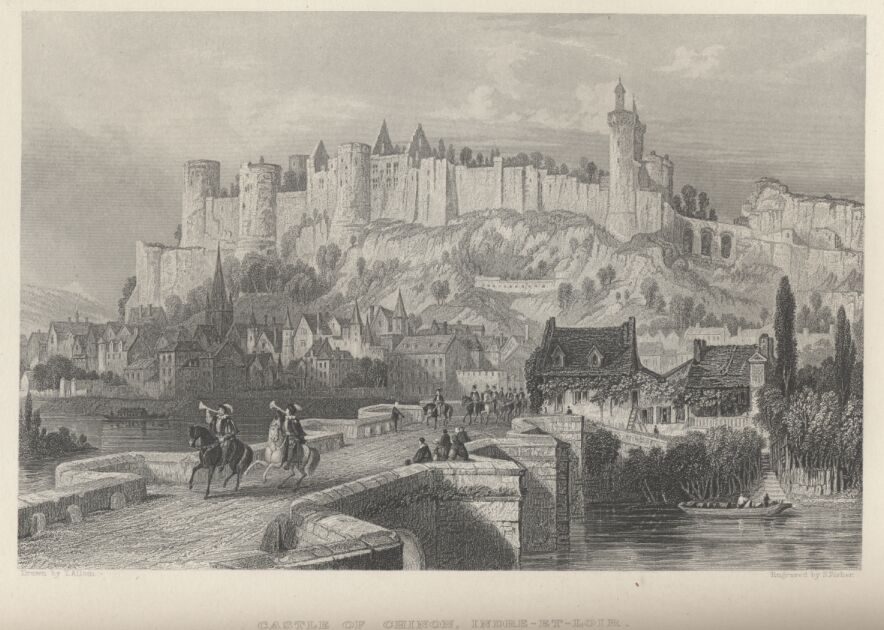
On her arrival at Chinon she at first lodged with an honest family near the castle. For three days longer there was a deliberation in the council as to whether the king ought to receive her. But there was bad news from Orleans. There were no more troops to send thither, and there was no money forthcoming: the king’s treasurer, it was said, had but four crowns in the chest. If Orleans were taken, the king would perhaps be reduced to seeking a refuge in Spain or in Scotland. Joan promised to set Orleans free. The Orleannese themselves were clamorous for her; Dunois kept up their spirits with the expectation of this marvellous assistance. It was decided that the king should receive her. She had assigned to her for residence an apartment in the tower of the Coudray, a block of quarters adjoining the royal mansion, and she was committed to the charge of William Bellier, an officer of the king’s household, whose wife was a woman of great piety and excellent fame. On the 9th of March, 1429, Joan was at last introduced into the king’s presence by the Count of Vendome, high steward, in the great hall on the first story, a portion of the wall and the fireplace being still visible in the present day. It was evening, candle-light; and nearly three hundred knights were present. Charles kept himself a little aloof, amidst a group of warriors and courtiers more richly dressed than he. According to some chroniclers, Joan had demanded that “she should not be deceived, and should have pointed out to her him to whom she was to speak;” others affirm that she went straight to the king, whom she had never seen, “accosting him humbly and simply, like a poor little shepherdess,” says an eye-witness, and, according to another account, “making the usual bends and reverences as if she had been brought up at court.” Whatever may have been her outward behavior, “Gentle dauphin,” she said to the king (for she did not think it right to call him king so long as he was not crowned), “my name is Joan the maid; the King of Heaven sendeth you word by me that you shall be anointed and crowned in the city of Rheims, and shall be lieutenant of the King of Heaven, who is King of France. It is God’s pleasure that our enemies the English should depart to their own country; if they depart no evil will come to them, and the kingdom is sure to continue yours.” Charles was impressed without being convinced, as so many others had been before, or were, as he was, on that very day. He saw Joan again several times. She did not delude herself as to the doubts he still entertained. “Gentle dauphin,” she said to him one day, “why do you not believe me? I say unto you that God hath compassion on you, your kingdom, and your people; St. Louis and Charlemagne are kneeling before Him, making prayer for you, and I will say unto you, so please you, a thing which will give you to understand that you ought to believe me.” Charles gave her audience on this occasion in the presence, according to some accounts, of four witnesses, the most trusted of his intimates, who swore to reveal nothing, and, according to others, completely alone. “What she said to him there is none who knows,” wrote Alan Chartier, a short time after [in July, 1429], “but it is quite certain that he was all radiant with joy thereat as at a revelation from the Holy Spirit.” M. Wallop, after a scrupulous sifting of evidence, has given the following exposition of this mysterious interview. “Sire de Boisy,” he says, “who was in his youth one of the gentlemen of the bed-chamber on the most familiar terms with Charles VII., told Peter Sala, giving the king himself as his authority for the story, that one day, at the period of his greatest adversity, the prince, vainly looking for a remedy against so many troubles, entered in the morning, alone, into his oratory, and there, without uttering a word aloud, made prayer to God from the depths of his heart that if he were the true heir, issue of the house of France (and a doubt was possible with such a queen as Isabel of Bavaria), and the kingdom ought justly to be his, God would be pleased to keep and defend it for him; if not, to give him grace to escape without death or imprisonment, and find safety in Spain or in Scotland, where he intended in the last resort to seek a refuge. This prayer, known to God alone, the Maid recalled to the mind of Charles VII.; and thus is explained the joy which, as the witnesses say, he testified, whilst none at that time knew the cause. Joan by this revelation not only caused the king to believe in her; she caused him to believe in himself and his right and title: though she never spoke in that way as of her own motion to the king, it was always a superior power speaking by her voice, ‘I tell thee on behalf of my Lord that thou art true heir of France, and son of the king.’” (Jeanne d’Arc, by M. Wallon, t. i. p. 32.)
Whether Charles VII. were or were not convinced by this interview of Joan’s divine mission, he clearly saw that many of those about him had little or no faith in it, and that other proofs were required to upset their doubts. He resolved to go to Poitiers, where his council, the parliament, and several learned members of the University of Paris were in session, and have Joan put to the strictest examination. When she learned her destination, she said, “In the name of God, I know that I shall have tough work there, but my Lord will help me. Let us go, then, for God’s sake.” On her arrival at Poitiers, on the 11th of March, 1429, she was placed in one of the most respectable families in the town, that of John Rabuteau, advocate-general in parliament. The Archbishop of Rheims, Reginald de Chartres, Chancellor of France, five bishops, the king’s councillors, several learned doctors, and amongst others Father Seguin, an austere and harsh Dominican, repaired thither to question her. When she saw them come in, she went and sat down at the end of the bench, and asked them what they wanted with her. For two hours they set themselves to the task of showing her, “by fair and gentle arguments,” that she was not entitled to belief. “Joan,” said William Aimery, professor of theology, “you ask for men-at-arms, and you say that it is God’s pleasure that the English should leave the kingdom of France, and depart to their own land; if so, there is no need of men-at-arms, for God’s pleasure alone can discomfit them, and force them to return to their homes.” “In the name of God,” answered Joan, “the men-at-arms will do battle, and God will give them victory.” Master William did not urge his point. The Dominican, Seguin, “a very sour man,” says the chronicle, asked Joan what language the voices spoke to her. “Better than yours,” answered Joan. The doctor spoke the Limousine dialect. “Do you believe in God?” he asked, ill-humoredly. “More than you do,” retorted Joan, offended. “Well,” rejoined the monk, “God forbids belief in you without some sign tending thereto: I shall not give the king advice to trust men-at-arms to you, and put them in peril on your simple word.” “In the name of God,” said Joan, “I am not come to Poitiers to show signs; take me to Orleans, and I will give you signs of what I am sent for. Let me have ever so few men-at-arms given me, and I will go to Orleans;” then, addressing another of the examiners, Master Peter of Versailles, who was afterwards Bishop of Meaux, she said, “I know nor A nor B; but in our Lord’s book there is more than in your books; I come on behalf of the King of Heaven to cause the siege of Orleans to be raised, and to take the king to Rheims, that he may be crowned and anointed there.” The examination was prolonged for a fortnight, not without symptoms of impatience on the part of Joan. At the end of it, she said to one of the doctors, John Erault, “Have you paper and ink? Write what I shall say to you.” And she dictated a form of letter which became, some weeks later, the manifesto addressed in a more developed shape by her from Orleans to the English, calling upon them to raise the siege and put a stop to the war. The chief of those piously and patriotically heroic phrases were as follows:—
“Jesu Maria, “King of England, account to the King of Heaven for His blood royal. Give up to the Maid the keys of all the good towns you have taken by force. She is come from God to avenge the blood royal, and quite ready to make peace, if you will render proper account. If you do not so I am a war-chief; in whatsoever place I shall fall in with your folks in France, if they be not willing to obey, I shall make them get thence, whether they will or not; and if they be willing to obey, I will receive them to mercy. . . . The Maid cometh from the King of Heaven as His representative, to thrust you out of France; she doth promise and certify you that she will make therein such mighty haha [great tumult], that for a thousand years hitherto in France was never the like. . . . Duke of Bedford, who call yourself regent of France, the Maid doth pray you and request you not to bring destruction on yourself; if you do not justice towards her, she will do the finest deed ever done in Christendom. “Writ on Tuesday in the great week.” [Easter week, March, 1429]. Subscribed: “Hearken to the news from God and the Maid.”
At the end of their examination, the doctors decided in Joan’s favor. Two of them, the Bishop of Castres, Gerard Machet, the king’s confessor, and Master John Erault, recognized the divine nature of her mission. She was, they said, the virgin foretold in the ancient prophecies, notably in those of Merlin; and the most exacting amongst them approved of the king’s having neither accepted nor rejected, with levity, the promises made by Joan; “after a grave inquiry there had been discovered in her,” they said, “nought but goodness, humility, devotion, honesty, simplicity. Before Orleans she professes to be going to show her sign; so she must be taken to Orleans, for to give her up without any appearance on her part of evil would be to fight against the Holy Spirit, and to become unworthy of aid from God.” After the doctors’ examination came that of the women. Three of the greatest ladies in France, Yolande of Arragon, Queen of Sicily; the Countess of Gaucourt, wife of the Governor of Orleans; and Joan de Mortemer, wife of Robert le Macon, Baron of Troves, were charged to examine Joan as to her life as a woman. They found therein nothing but truth, virtue, and modesty; “she spoke to them with such sweetness and grace,” says the chronicle, “that she drew tears from their eyes;” and she excused herself to them for the dress she wore, and for which the sternest doctors had not dreamed of reproaching her. “It is more decent,” said the Archbishop of Embrun, “to do such things in man’s dress, since they must be done along with men.” The men of intelligence at court bowed down before this village-saint, who was coming to bring to the king in his peril assistance from God; the most valiant men of war were moved by the confident outbursts of her patriotic courage; and the people everywhere welcomed her with faith and enthusiasm. Joan had as yet only just appeared, and already she was the heaven-sent interpretress of the nation’s feeling, the hope of the people of France.
Charles no longer hesitated. Joan was treated, according to her own expression in her letter to the English, “as a war-chief;” there were assigned to her a squire, a page, two heralds, a chaplain, Brother Pasquerel, of the order of the hermit-brotherhood of St. Augustin, varlets, and serving-folks. A complete suit of armor was made to fit her. Her two guides, John of Metz and Bertrand of Poulengy, had not quitted her; and the king continued them in her train. Her sword he wished to be supplied by himself; she asked for one marked with five crosses; it would be found, she said, behind the altar in the chapel of St. Catherine-de-Fierbois, where she had halted on her arrival at Chinon; and there, indeed, it was found. She had a white banner made, studded with lilies, bearing the representation of God seated upon the clouds, and holding in His hand the globe of the world. Above were the words “Jesu Maria,” and below were two angels, on their knees in adoration. Joan was fond of her sword, as she said two years afterwards at her trial, but she was forty times more fond of her banner, which was, in her eyes, the sign of her commission and the pledge of victory. On the completion of the preparations she demanded the immediate departure of the expedition. Orleans was crying for succor; Dunois was sending messenger after messenger; and Joan was in a greater hurry than anybody else.
More than a month elapsed before her anxieties were satisfied. During this interval we find Charles VII. and Joan of Arc at Chatelherault, at Poitiers, at Tours, at Florent-les-Saumur, at Chinon, and at Blois, going to and fro through all that country to push forward the expedition resolved upon, and to remove the obstacles it encountered. Through a haze of vague indications a glimpse is caught of the struggle which was commencing between the partisans and the adversaries of Joan, and in favor of or in opposition to the impulse she was communicating to the war of nationality. Charles VII.‘s mother-in-law, Yolande of Arragon, Queen of Sicily, and the young Duke of Alencon, whose father had been killed at the battle of Agincourt, were at the head of Joan’s partisans. Yolande gave money and took a great deal of trouble in order to promote the expedition which was to go and succor Orleans. The Duke of Alencon, hardly twenty years of age, was the only one amongst the princes of the house of Valois who had given Joan a kind reception on her arrival, and who, together with the brave La Hire, said that he would follow her whithersoever she pleased to lead him. Joan, in her gratitude, called him the handsome duke, and exhibited towards him amity and confidence.
But, side by side with these friends, she had an adversary in the king’s favorite, George de la Tremoille, an ambitious courtier, jealous of any one who seemed within the range of the king’s favor, and opposed to a vigorous prosecution of the war, since it hampered him in the policy he wished to keep up towards the Duke of Burgundy. To the ill will of La Tremoille was added that of the majority of courtiers enlisted in the following of the powerful favorite, and that of warriors irritated at the importance acquired at their expense by a rustic and fantastic little adventuress. Here was the source of the enmities and intrigues which stood in the way of all Joan’s demands, rendered her successes more tardy, difficult, and incomplete, and were one day to cost her more dearly still.
At the end of about five weeks the expedition was in readiness. It was a heavy convoy of revictualment, protected by a body of ten or twelve thousand men, commanded by Marshal de Boussac, and numbering amongst them Xaintrailles and La Hire. The march began on the 27th of April, 1429. Joan had caused the removal of all women of bad character, and had recommended her comrades to confess. She took the communion in the open air, before their eyes; and a company of priests, headed by her chaplain, Pasquerel, led the way whilst chanting sacred hymns. Great was the surprise amongst the men-at-arms, many had words of mockery on their lips. It was the time when La Hire used to say, “If God were a soldier, He would turn robber.” Nevertheless, respect got the better of habit; the most honorable were really touched; the coarsest considered themselves bound to show restraint. On the 29th of April they arrived before Orleans. But, in consequence of the road they had followed, the Loire was between the army and the town; the expeditionary corps had to be split in two; the troops were obliged to go and feel for the bridge of Blois in order to ‘cross the river; and Joan was vexed and surprised. Dunois, arrived from Orleans in a little boat, urged her to enter the town that same evening. “Are you the bastard of Orleans?” asked she, when he accosted her. “Yes; and I am rejoiced at your coming.” “Was it you who gave counsel for making me come hither by this side of the river, and not the direct way, over yonder where Talbot and the English were?” “Yes; such was the opinion of the wisest captains.” “In the name of God, the counsel of my Lord is wiser than yours; you thought to deceive me, and you have deceived yourselves, for I am bringing you the best succor that ever had knight, or town, or city, and that is the good will of God, and succor from the King of Heaven; not assuredly for love of me, it is from God only that it proceeds.” It was a great trial for Joan to separate from her comrades, “so well prepared, penitent, and well disposed; in their company,” said she, “I should not fear the whole power of the English.” She was afraid that disorder might set in amongst the troops, and that they might break up, instead of fulfilling her mission. Dunois was urgent for her to go herself at once into Orleans, with such portion of the convoy as boats might be able to transport thither without delay. “Orleans,” said he, “would count it for nought, if they received the victuals without the Maid.” Joan decided to go: the captains of her division promised to rejoin her at Orleans; she left them her chaplain, Pasquerel, the priests who accompanied him, and the banner around which she was accustomed to muster them; and she herself, with Dunois, La Hire, and two hundred men-at-arms, crossed the river at the same time with a part of the supplies.
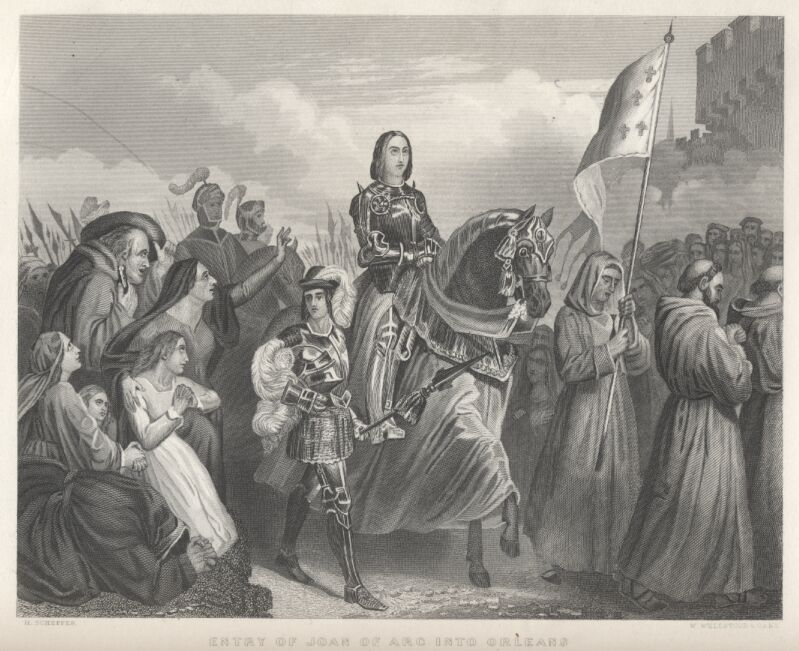
The same day, at eight P. M., she entered the city, on horseback, completely armed, preceded by her own banner, and having beside her Dunois, and behind her the captains of the garrison and several of the most distinguished burgesses of Orleans who had gone out to meet her. The population, one and all, rushed thronging round her, carrying torches, and greeting her arrival “with joy as great as if they had seen God come down amongst them. They felt,” says the Journal of the Siege, “all of them recomforted and as it were disbesieged by the divine virtue which they had been told existed in this simple maid.” In their anxiety to approach her, to touch her, one of their lighted torches set fire to her banner. Joan disengaged herself with her horse as cleverly as it could have been done by the most skilful horseman, and herself extinguished the flame. The crowd attended her to the church whither she desired to go first of all to render thanks to God, and then to the house of John Boucher, the Duke of Orleans’s treasurer, where she was received together with her two brothers and the two gentlemen who had been her guides from Vaucouleurs. The treasurer’s wife was one of the most virtuous city dames in Orleans, and from this night forth her daughter Charlotte had Joan for her bedfellow. A splendid supper had been prepared for her; but she would merely dip some slices of bread in wine and water. Neither her enthusiasm nor her success, the two greatest tempters to pride in mankind, made any change in her modesty and simplicity.
The very day after her arrival she would have liked to go and attack the English in their bastilles, within which they kept themselves shut up. La Hire was pretty much of her opinion; but Dunois and the captains of the garrison thought they ought to await the coming of the troops which had gone to cross the Loire at Blois, and the supports which several French garrisons in the neighborhood had received orders to forward to Orleans. Joan insisted. Sire de Gamaches, one of the officers present, could not contain himself. “Since ear is given,” said he, “to the advice of a wench of low degree rather than to that of a knight like me, I will not bandy more words; when the time comes, it shall be my sword that will speak; I shall fall, perhaps, but the king and my own honor demand it; henceforth I give up my banner and am nothing more than a poor esquire. I prefer to have for master a noble man rather than a girl who has heretofore been, perhaps, I know not what.” He furled his banner and handed it to Dunois. Dunois, as sensible as he was brave, would not give heed either to the choler of Gamaches or to the insistence of Joan; and, thanks to his intervention, they were reconciled on being induced to think better, respectively, of giving up the banner and ordering an immediate attack. Dunois went to Blois to hurry the movements of the division which had repaired thither; and his presence there was highly necessary, since Joan’s enemies, especially the chancellor Regnault, were nearly carrying a decision that no such re-enforcement should be sent to Orleans. Dunois frustrated this purpose, and led back to Orleans, by way of Beauce, the troops concentrated at Blois. On the 4th of May, as soon as it was known that he was coming, Joan, La Hire, and the principal leaders of the city as well as of the garrison, went to meet him, and re-entered Orleans with him and his troops, passing between the bastilles of the English, who made not even an attempt to oppose them. “That is the sorceress yonder,” said some of the besiegers; others asked if it were quite so clear that her power, did not come to her from on high; and their commander, the Earl of Suffolk, being himself, perhaps, uncertain, did not like to risk it: doubt produced terror, and terror inactivity. The convoy from Blois entered Orleans, preceded by Brother Pasquerel and the priests.
Joan, whilst she was awaiting it, sent the English captains a fresh summons to withdraw conformably with the letter which she had already addressed to them from Blois, and the principal clauses of which were just now quoted here. They replied with coarse insults, calling her strumpet and cow-girl, and threatening to burn her when they caught her. She was very much moved by their insults, insomuch as to weep; but calling God to witness her innocence, she found herself comforted, and expressed it by saying, “I have had news from my Lord.” The English had detained the first herald she had sent them; and when she would have sent them a second to demand his comrade back, he was afraid. “In the name of God,” said Joan, “they will do no harm nor to thee nor to him; thou shalt tell Talbot to arm, and I too will arm; let him show himself in front of the city; if he can take me, let him burn me; if I discomfit him, let him raise the siege, and let the English get them gone to their own country.” The second herald appeared to be far from reassured; but Dunois charged him to say that the English prisoners should answer for what was done to the heralds from the Maid. The two heralds were sent back. Joan made up her mind to iterate in person to the English the warnings she had given them in her letter. She mounted upon one of the bastions of Orleans, opposite the English bastille called Tournelles, and there, at the top of her voice, she repeated her counsel to them to be gone; else, woe and shame would come upon them. The commandant of the bastille, Sir William Gladesdale [called by Joan and the French chroniclers Glacidas], answered with the usual insults, telling her to go back and mind her cows, and alluding to the French as miscreants. “You lie,” cried Joan, “and in spite of you soon shall ye depart hence; many of your people shall be slain; but as for you, you shall not see it.”
Dunois, the very day of his return to Orleans, after dinner, went to call upon Joan, and told her that he had heard on his way that Sir John Falstolf, the same who on the 12th of the previous February had beaten the French in the Herring affair, was about to arrive with re-enforcements and supplies for the besiegers. “Bastard, bastard,” said Joan, “in the name of God I command thee, as soon as thou shalt know of this Pascot’s coming, to have me warned of it, for, should he pass without my knowing of it, I promise thee that I will have thy head cut off.” Dunois assured her that she should be warned. Joan was tired with the day’s excitement; she threw herself upon her bed to sleep, but unsuccessfully; all at once she said to Sire Daulon, her esquire, “My counsel doth tell me to go against the English; but I know not whether against their bastilles or against this Fascot. I must arm.” Her esquire was beginning to arm her when she heard it shouted in the street that the enemy were at that moment doing great damage to the French. “My God,” said she, “the blood of our people is running on the ground; why was I not awakened sooner? Ah! it was ill done! . . . My arms! My arms! my horse!” Leaving behind her esquire, who was not yet armed, she went down. Her page was playing at the door: “Ah! naughty boy,” said she, “not to come and tell me that the blood of France was being shed! Come! quick! my horse!” It was brought to her; she bade them hand down to her by the window her banner, which she had left behind, and, without any further waiting, she departed and went to the Burgundy gate, whence the noise seemed to come. Seeing on her way one of the townsmen passing who was being carried off wounded, she said, “Alas! I never see a Frenchman’s blood but my hair stands up on my head!” It was some of the Orleannese themselves who, without consulting their chiefs, had made a sortie and attacked the Bastille St. Loup, the strongest held by the English on this side. The French had been repulsed, and were falling back in flight when Joan came up, and soon after her Dunois and a throng of men-at-arms who had been warned of the danger. The fugitives returned to the assault; the battle was renewed with ardor; the bastille of St. Loup, notwithstanding energetic resistance on the part of the English who manned it, was taken; and all its defenders were put to the sword before Talbot and the main body of the besiegers could come up to their assistance. Joan showed sorrow that so many people should have died unconfessed; and she herself was the means of saving some who had disguised themselves as priests in gowns which they had taken from the church of St. Loup. Great was the joy in Orleans, and the enthusiasm for Joan was more lively than ever. “Her voices had warned her,” they said, “and apprised her that there was a battle; and then she had found by herself alone and without any guide the way to the Burgundy gate.” Men-at-arms and burgesses all demanded that the attack upon the English hastilles should be resumed; but the next day, the 5th of May, was Ascension-day. Joan advocated lions repose on this holy festival, and the general feeling was in accord with her own. She recommended her comrades to fulfil their religious duties, and she herself received the communion. The chiefs of the besieged resolved to begin on the morrow a combined attack upon the English bastilles which surrounded the palace; but Joan was not in their counsels. “Tell me what you have resolved,” she said to them; “I can keep this and greater secrets.” Dunois made her acquainted with the plan adopted, of which she fully approved; and on the morrow, the 6th of May, a fierce struggle began again all round Orleans. For two days the bastilles erected by the besiegers against the place were repeatedly attacked by the besieged. On the first day Joan was slightly wounded in the foot. Some disagreement arose between her and Sire de Gaucourt, governor of Orleans, as to continuing the struggle; and John Boucher, her host, tried to keep her back the second day. “Stay and dine with us,” said he, “to eat that shad which has just been brought.” “Keep it for supper,” said Joan; “I will come back this evening and bring you some goddamns (Englishman) or other to eat his share;” and she sallied forth, eager to return to the assault. On arriving at the Burgundy gate she found it closed; the governor would not allow any sortie thereby to attack on that side. “Ah! naughty man,” said Joan, “you are wrong; whether you will or no, our men-at-arms shall go and win on this day as they have already won.” The gate was forced; and men-at-arms and burgesses rushed out from all quarters to attack the bastille of Tournelles, the strongest of the English works. It was ten o’clock in the morning; the passive and active powers of both parties were concentrated on this point; and for a moment the French appeared weary and downcast. Joan took a scaling-ladder, set it against the rampart, and was the first to mount. There came an arrow and struck her between neck and shoulder, and she fell. Sire de Gamaches, who had but lately displayed so much temper towards her, found her where she lay. “Take my horse,” said he, “and bear no malice: I was wrong; I had formed a false idea of you.” “Yes,” said Joan, “and bear no malice: I never saw a more accomplished knight.” She was taken away and had her armor removed. The arrow, it is said, stood out almost half-a-foot behind. There was an instant of faintness and tears; but she prayed and felt her strength renewed, and pulled out the arrow with her own hand.
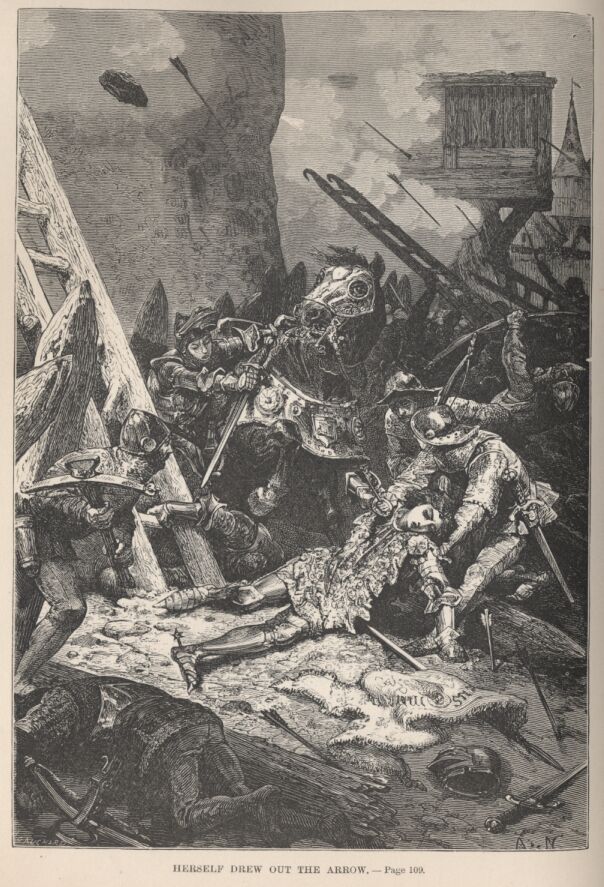
Some one proposed to her to charm the wound by means of cabalistic words; but “I would rather die,” she said, “than so sin against the will of God. I know full well that I must die some day; but I know nor where nor when nor how. If, without sin, my wound may be healed, I am right willing.” A dressing of oil and lard was applied to the wound; and she retired apart into a vineyard, and was continually in prayer. Fatigue and discouragement were overcoming the French; and the captains ordered the retreat to be sounded. Joan begged Dunois to wait a while. “My God,” said she, “we shall soon be inside. Give your people a little rest; eat and drink.” She resumed her arms and remounted her horse; her banner floated in the air; the French took fresh courage; the English, who thought Joan half dead, were seized with surprise and fear; and one of their principal leaders, Sir William Gladesdale, made up his mind to abandon the outwork which he had hitherto so well kept, and retire within the bastille itself. Joan perceived his movement. “Yield thee,” she shouted to him from afar; “yield thee to the King of Heaven! Ah! Glacidas, thou hast basely insulted me; but I have great pity on the souls of thee and thine.” The Englishman continued his retreat. Whilst he was passing over the drawbridge which reached from the out-work to the bastille, a shot from the side of Orleans broke down the bridge; Gladesdale fell into the water and was drowned, together with many of his comrades; the French got into the bastille without any fresh fighting; and Joan re-entered Orleans amidst the joy and acclamations of the people. The bells rang all through the night, and the Te Deum was chanted. The day of combat was about to be succeeded by the day of deliverance.
On the morrow, the 8th of May, 1429, at daybreak, the English leaders drew up their troops close to the very moats of the city, and seemed to offer battle to the French. Many of the Orleannese leaders would have liked to accept this challenge; but Joan got up from her bed, where she was resting because of her wound, put on a light suit of armor, and ran to the city gates. “For the love and honor of holy Sunday,” said she to the assembled warriors, “do not be the first to attack, and make to them no demand; it is God’s good will and pleasure that they be allowed to get them gone if they be minded to go away; if they attack you, defend yourselves boldly; you will be the masters.” She caused an altar to be raised; thanksgivings were sung, and mass was celebrated. “See!” said Joan; “are the English turning to you their faces, or verily their backs?” They had commenced their retreat in good order, with standards flying. “Let them go: my Lord willeth not that there be any fighting to-day; you shall have them another time.” The good words spoken by Joan were not so preventive but that many men set off to pursue the English, and cut off stragglers and baggage. Their bastilles were found to be full of victual and munitions; and they had abandoned their sick and many of their prisoners. The siege of Orleans was raised.
The day but one after this deliverance, Joan set out to go and rejoin the king, and prosecute her work at his side. She fell in with him on the 13th of May, at Tours, moved forward to meet him, with her banner in her hand and her head uncovered, and bending down over her charger’s neck, made him a deep obeisance. Charles took off his cap, held out his hand to her, and, “as it seemed to many,” says a contemporary chronicler, “he would fain have kissed her, for the joy that he felt.” But the king’s joy was not enough for Joan. She urged him to march with her against enemies who were flying, so to speak, from themselves, and to start without delay for Rheims, where he would be crowned. “I shall hardly last more than a year,” said she; “we must think about working right well this year, for there is much to do.” Hesitation was natural to Charles, even in the hour of victory. His favorite, La Tremoille, and his chancellor, the Archbishop of Rheims, opposed Joan’s entreaties with all the objections that could be devised under the inspiration of their ill will: there were neither troops nor money in hand for so great a journey; and council after council was held for the purpose of doing nothing. Joan, in her impatience, went one day to Loches, without previous notice, and tapped softly at the door of the king’s privy chamber (chambre de re- trait). He bade her enter. She fell upon her knees, saying, “Gentle dauphin, hold not so many and such long councils, but rather come to Rheims, and there assume your crown; I am much pricked to take you thither.” “Joan,” said the Bishop of Castres, Christopher d’Harcourt, the king’s confessor, “cannot you tell the king what pricketh you?” “Ah! I see,” replied Joan, with some embarrassment: “well, I will tell you. I had set me to prayer, according to my wont, and I was making complaint for that you would not believe what I said; then the voice came and said unto me, ‘Go, go, my daughter; I will be a help to thee; go.’ When this voice comes to me, I feel marvellously rejoiced; I would that it might endure forever.” She was eager and overcome.
Joan and her voices were not alone in urging the king to shake off his doubts and his indolence. In church, and court, and army, allies were not wanting to the pious and valiant maid. In a written document dated the 14th of May, six days after the siege of Orleans was raised, the most Christian doctor of the age, as Gerson was called, sifted the question whether it were possible, whether it were a duty, to believe in the Maid. “Even if (which God forbid),” said he, “she should be mistaken in her hope and ours, it would not necessarily follow that what she does comes of the evil spirit, and not of God, but that rather our ingratitude was to blame. Let the party which hath a just cause take care how, by incredulity or injustice, it rendereth useless the divine succor so miraculously manifested, for God, without any change of counsel, changeth the upshot according to deserts.” Great lords and simple gentlemen, old and young warriors, were eager to go and join Joan for the salvation of the king and of France. The constable, De Richemont, banished from the court through the jealous hatred of George la Tremoille, made a pressing application there, followed by a body of men-at-arms; and, when the king refused to see him, he resolved, though continuing in disgrace, to take an active part in the war. The young Duke of Alencon, who had been a prisoner with the English since the battle of Agincourt, hurried on the payment of his ransom in order to accompany Joan as lieutenant-general of the king in the little army which was forming. His wife, the duchess, was in grief about it. “We have just spent great sums,” said she, “in buying him back from the English; if he would take my advice, he would stay at home.” “Madame,” said Joan, “I will bring him back to you safe and sound, nay, even in better contentment than at present; be not afraid.” And on this promise the duchess took heart. Du Guesciin’s widow, Joan de Laval, was still living; and she had two grandsons, Guy and Andrew de Laval, who were amongst the most zealous of those taking service in the army destined to march on Rheims. The king, to all appearance, desired to keep them near his person. “God forbid that I should do so,” wrote Guy de Laval, on the 8th of June, 1429, to those most dread dames, his grandmother and his mother; “my brother says, as also my lord the Duke d’Alencon, that a good riddance of bad rubbish would he be who should stay at home.” And he describes his first interview with the Maid as follows: “The king had sent for her to come and meet him at Selles-en-Berry. Some say that it was for my sake, in order that I might see her. She gave right good cheer (a kind reception) to my brother and myself; and after we had dismounted at Selles I went to see her in her quarters. She ordered wine, and told me that she would soon have me drinking some at Paris. It seems a thing divine to look on her and listen to her. I saw her mount on horseback, armed all in white armor, save her head, and with a little axe in her hand, on a great black charger, which, at the door of her quarters, was very restive, and would not let her mount. Then said she, ‘Lead him to the cross,’ which was in front of the neighboring church, on the road. There she mounted him without his moving, and as if he were tied up; and turning towards the door of the church, which was very nigh at hand, she said, in quite a womanly voice, ‘You, priests and church-men, make procession and prayers to God.’ Then she resumed her road, saying, ‘Push forward, push forward.’ She told me that three days before my arrival she had sent you, dear grand-mother, a little golden ring, but that it was a very small matter, and she would have liked to send you something better, having regard to your estimation.”
It was amidst this burst of patriotism, and with all these valiant comrades, that Joan recommenced the campaign on the 10th of June, 1429, quite resolved to bring the king to Rheims. To complete the deliverance of Orleans, an attack was begun upon the neighboring places, Jargeau, Meung, and Beaugency. Before Jargeau, on the 12th of June, although it was Sunday, Joan had the trumpets sounded for the assault. The Duke d’Alencon thought it was too soon. “Ah!” said Joan, “be not doubtful; it is the hour pleasing to God; work ye, and God will work.” And she added, familiarly, “Art thou afeard, gentle duke? Knowest thou not that I have promised thy wife to take thee back safe and sound?” The assault began; and Joan soon had occasion to keep her promise. The Duke d’Alencon was watching the assault from an exposed spot, and Joan remarked a piece pointed at this spot. “Get you hence,” said she to the duke; “yonder is a piece which will slay you.” The Duke moved, and a moment afterwards Sire de Lude was killed at the self-same place by a shot from the said piece. Jargeau was taken. Before Beaugency a serious incident took place. The constable, De Richemont, came up with a force of twelve hundred men. When he was crossing to Loudun, Charles VII., swayed as ever by the jealous La Tremoille, had word sent to him to withdraw, and that if he advanced he would be attacked. “What I am doing in the matter,” said the constable, “is for the good of the king and the realm; if anybody comes to attack me, we shall see.” When he had joined the army before Beaugency, the Duke d’Alencon was much troubled. The king’s orders were precise, and Joan herself hesitated. But news came that Talbot and the English were approaching. “Now,” said Joan, “we must think no more of anything but helping one another.” She rode forward to meet the constable, and saluted him courteously. “Joan,” said he, “I was told that you meant to attack me; I know not whether you come from God or not; if you are from God, I fear you not at all, for God knows my good will; if you are from the devil, I fear you still less.” He remained, and Beaugency was taken. The English army came up. Sir John Falstolf had joined Talbot. Some disquietude showed itself amongst the French, so roughly handled for some time past in pitched battles. “Ah! fair constable,” said Joan to Richemont, “you are not come by my orders, but you are right welcome.” The Duke d’Alencon consulted Joan as to what was to be done. “It will be well to have horses,” was suggested by those about her. She asked her neighbors, “Have you good spurs?” “Ha!” cried they, “must we fly, then?”
“No, surely,” replied Joan: “but there will be need to ride boldly; we shall give a good account of the English, and our spurs will serve us famously in pursuing them.” The battle began on the 18th of June, at Patay, between Orleans and Chateaudun. By Joan’s advice, the French attacked. “In the name of God,” said she, “we must fight. Though the English were suspended from the clouds, we should have them, for God hath sent us to punish them. The gentle king shall have to-day the greatest victory he has ever had; my counsel hath told me they are ours.” The English lost heart, in their turn; the battle was short, and the victory brilliant; Lord Talbot and the most part of the English captains remained prisoners. “Lord Talbot,” said the Duke d’Alencon to him, “this is not what you expected this morning.” “It is the fortune of war,” answered Talbot, with the cool dignity of an old warrior. Joan’s immediate return to Orleans was a triumph; but even triumph has its embarrassments and perils. She demanded the speedy march of the army upon Rheims, that the king might be crowned there without delay; but objections were raised on all sides, the objections of the timid and those of the jealous. “By reason of Joan the Maid,” says a contemporary chronicler, “so many folks came from all parts unto the king for to serve him at their own expense, that La Tremoille and others of the council were much wroth thereat, through anxiety for their own persons.” Joan, impatient and irritated at so much hesitation and intrigue, took upon herself to act as if the decision belonged to her. On the 25th of June she wrote to the inhabitants of Tournai, “Loyal Frenchmen, I do pray and require you to be all ready to come to the coronation of the gentle King Charles, at Rheims, where we shall shortly be, and to come and meet us when ye shall learn that we are approaching.” Two days afterwards, on the 27th of June, she left Gien, where the court was, and went to take up her quarters in the open country with the troops. There was nothing for it but to follow her. On the 29th of June, the king, the court (including La Tremoille), and the army, about twelve thousand strong, set out on the march for Rheims. Other obstacles were encountered on the road. In most of the towns the inhabitants, even the royalists, feared to compromise themselves by openly pronouncing against the English and the Duke of Burgundy. Those of Auxerre demanded a truce, offering provisions, and promising to do as those of Troyes, Chalons, and Rheims should do. At Troyes the difficulty was greater still. There was in it a garrison of five or six hundred English and Burgundians, who had the burgesses under their thumbs. All attempts at accommodation failed. There was great perplexity in the royal camp; there were neither provisions enough for a long stay before Troyes, nor batteries and siege trains to carry it by force. There was talk of turning back. One of the king’s councillors, Robert le Macon, proposed that Joan should be summoned to the council. It was at her instance that the expedition had been undertaken; she had great influence amongst the army and the populace; the idea ought not to be given up without consulting her. Whilst he was speaking, Joan came knocking at the door; she was told to come in; and the chancellor, the Archbishop of Rheims, put the question to her. Joan, turning to the king, asked him if he would believe her. “Speak,” said the king; “if you say what is reasonable and tends to profit, readily will you be believed.” “Gentle king of France,” said Joan, “if you be willing to abide here before your town of Troyes, it shall be at your disposal within two days, by love or by force; make no doubt of it.” “Joan,” replied the chancellor, “whoever could be certain of having it within six days might well wait for it; but say you true?” Joan repeated her assertion; and it was decided to wait. Joan mounted her horse, and, with her banner in her hand, she went through the camp, giving orders everywhere to prepare for the assault. She had her own tent pitched close to the ditch, “doing more,” says a contemporary, “than two of the ablest captains would have done.” On the next day, July 10, all was ready. Joan had the fascines thrown into the ditches, and was shouting out, “Assault!” when the inhabitants of Troyes, burgesses and men-at-arms, came demanding permission to capitulate. The conditions were easy. The inhabitants obtained for themselves and their property such guarantees as they desired; and the strangers were allowed to go out with what belonged to them. On the morrow, July 11, the king entered Troyes with all his captains, and at his side the Maid carrying her banner. All the difficulties of the journey were surmounted. On the 15th of July the Bishop of Chalons brought the keys of his town to the king, who took up his quarters there. Joan found there four or five of her own villagers, who had hastened up to see the young girl of Domremy in all her glory. She received them with a satisfaction in which familiarity was blended with gravity. To one of them, her godfather, she gave a red cap which she had worn; to another, who had been a Burgundian, she said, “I fear but one thing—treachery.” In the Duke d’Alencon’s presence she repeated to the king, “Make good use of my time, for I shall hardly last longer than a year.” On the 16th of July King Charles entered Rheims, and the ceremony of his coronation was fixed for the morrow.
It was solemn and emotional, as are all old national traditions which recur after a forced suspension. Joan rode between Dunois and the Archbishop of Rheims, chancellor of France. The air resounded with the Te Deum sung with all their hearts by clergy and crowd. “In God’s name,” said Joan to Dunois, “here is a good people and a devout when I die, I should much like it to be in these parts.” “Joan,” inquired Dunois, “know you when you will die, and in what place?” “I know not,” said she, “for I am at the will of God.” Then she added, “I have accomplished that which my Lord commanded me, to raise the siege of Orleans and have the gentle king crowned. I would like it well if it should please him to send me back to my father and mother, to keep their sheep and their cattle, and do that which was my wont.” “When the said lords,” says the chronicler, an eye-witness, “heard these words of Joan, who, with eyes towards heaven, gave thanks to God, they the more believed that it was somewhat sent from God, and not otherwise.”
Historians, and even contemporaries, have given much discussion to the question whether Joan of Arc, according to her first ideas, had really limited her design to the raising of the siege of Orleans and the coronation of Charles VII. at Rheims. She had said so herself several times, just as she had to Dunois at Rheims on the 17th of July, 1429; but she sometimes also spoke of more vast and varied projects, as, for instance, driving the English completely out of France, and withdrawing from his long captivity Charles, Duke of Orleans. He had been a prisoner in London ever since the battle of Agincourt, and was popular in his day, as he has continued to be in French history, on the double ground of having been the father of Louis XII. and one of the most charming poets in the ancient literature of France. The Duke d’Alencon, who was so high in the regard of Joan, attributed to her more expressly this quadruple design: “She said,” according to him, “that she had four duties; to get rid of the English, to have the king anointed and crowned, to deliver Duke Charles of Orleans, and to raise the siege laid by the English to Orleans.” One is inclined to believe that Joan’s language to Dunois at Rheims in the hour of Charles VII.‘s coronation more accurately expressed her first idea; the two other notions occurred to her naturally in proportion as her hopes as well as her power kept growing greater with success. But however lofty and daring her soul may have been, she had a simple and not at all a fantastic mind. She may have foreseen the complete expulsion of the English, and may have desired the deliverance of the Duke of Orleans, without having in the first instance premeditated anything more than she said to Dunois during the king’s coronation at Rheims, which was looked upon by her as the triumph of the national cause.
However that may be, when Orleans was relieved, and Charles VII. crowned, the situation, posture, and part of Joan underwent a change. She no longer manifested the same confidence in herself and her designs. She no longer exercised over those in whose midst she lived the same authority. She continued to carry on war, but at hap-hazard, sometimes with and sometimes without success, just like La Hire and Dunois; never discouraged, never satisfied, and never looking upon her-self as triumphant. After the coronation, her advice was to march at once upon Paris, in order to take up a fixed position in it, as being the political centre of the realm of which Rheims was the religious. Nothing of the sort was done. Charles and La Tremoille once more began their course of hesitation, tergiversation, and changes of tactics and residence without doing anything of a public and decisive character. They negotiated with the Duke of Burgundy, in the hope of detaching him from the English cause; and they even concluded with him a secret, local, and temporary truce. From the 20th of July to the 23d of August Joan followed the king whithersoever he went, to Chateau-Thierry, to Senlis, to Blois, to Provins, and to Compigne, as devoted as ever, but without having her former power. She was still active, but not from inspiration and to obey her voices, simply to promote the royal policy. She wrote the Duke of Burgundy a letter full of dignity and patriotism, which had no more effect than the negotiations of La Tremoille. During this fruitless labor amongst the French the Duke of Bedford sent for five thousand men from England, who came and settled themselves at Paris. One division of this army had a white standard, in the middle of which was depicted a distaff full of cotton; a half-filled spindle was hanging to the distaff; and the field, studded with empty spindles, bore this inscription: “Now, fair one, come!” Insult to Joan was accompanied by redoubled war against France. Joan, saddened and wearied by the position of things, attempted to escape from it by a bold stroke. On the 23d of August, 1429, she set out from Compiegne with the Duke d’Alencon and “a fair company of men-at-arms;” and suddenly went and occupied St. Denis, with the view of attacking Paris. Charles VII. felt himself obliged to quit Compiegne likewise, “and went, greatly against the grain,” says a contemporary chronicler, “as far as into the town of Senlis.” The attack on Paris began vigorously. Joan, with the Duke d’Alencon, pitched her camp at La Chapelle. Charles took up his abode in the abbey of St. Denis. The municipal corporation of Paris received letters with the arms of the Duke d’Alencon, which called upon them to recognize the king’s authority, and promised a general amnesty. The assault was delivered on the 8th of September. Joan was severely wounded, but she insisted upon remaining where she was. Night came, and the troops had not entered the breach which had been opened in the morning. Joan was still calling out to persevere. The Duke d’Alencon himself begged her, but in vain, to retire. La Tremoille gave orders to retreat; and some knights came up, set Joan on horse-back, and led her back, against her will, to La Chapelle. “By my martin” (staff of command), said she, “the place would have been taken.” One hope still remained. In concert with the Duke d’Alencon she had caused a flying bridge to be thrown across the Seine opposite St. Denis. The next day but one she sent her vanguard in this direction; she intended to return thereby to the siege; but, by the king’s order, the bridge had been cut adrift. St. Denis fell once more into the hands of the English. Before leaving, Joan left there, on the tomb of St. Denis, her complete suit of armor and a sword she had lately obtained possession of at the St. Honore gate of Paris, as trophy of war.
From the 13th of September, 1429, to the 24th of May, 1430, she continued to lead the same life of efforts ever equally valiant and equally ineffectual. She failed in an attempt upon Laemir. Charite-sur-Loire, undertaken, for all that appears, with the sole design of recovering an important town in the possession of the enemy. The English evacuated Paris, and left the keeping of it to the Duke of Burgundy, no doubt to test his fidelity. On the 13th of Aprils 1430, at the expiration of the truce he had concluded, Philip the Good resumed hostilities against Charles VII. Joan of Arc once more plunged into them with her wonted zeal. Ile-de-France and Picardy became the theatre of war. Compiegne was regarded as the gate of the road between these two provinces; and the Duke of Burgundy attached much importance to holding the key of it. The authority of Charles VII. was recognized there; and a young knight of Compiegne, William de Flavy, held the command there as lieutenant of La Tremoille, who had got himself appointed captain of the town. La Tremoille attempted to treat with the Duke of Burgundy for the cession of Compiegne; but the inhabitants were strenuously opposed to it. “They were,” they said, “the king’s most humble subjects, and they desired to serve him with body and substance; but as for trusting themselves to the lord Duke of Burgundy, they could not do it; they were resolved to suffer destruction, themselves and their wives and children, rather than be exposed to the tender mercies of the said duke.” Meanwhile Joan of Arc, after several warlike expeditions in the neighborhood, re-entered Compiegne, and was received there with a popular expression of satisfaction. “She was presented,” says a local chronicler, with three hogsheads of wine, a present which was large and exceeding costly, and which showed the estimate formed of this maiden’s worth.” Joan manifested the profound distrust with which she was inspired of the Duke of Burgundy. There is no peace possible with him,” she said, “save at the point of the lance.” She had quarters at the house of the king’s attorney, Le Boucher, and shared the bed of his wife, Mary. “She often made the said Mary rise from her bed to go and warn the said attorney to be on his guard against several acts of Burgundian treachery.” At this period, again, she said she was often warned by her voices of what must happen to her; she expected to be taken prisoner before St. John’s or Midsummer-day (June 24); on what day and hour she did not know; she had received no instructions as to sorties from the place; but she had constantly been told that she would be taken, and she was distrustful of the captains who were in command there. She was, nevertheless, not the less bold and enterprising. On the 20th of May, 1430, the Duke of Burgundy came and laid siege to Compiegne. Joan was away on an expedition to Crepy in Valois, with a small band of three or four hundred brave comrades. On the 24th of May, the eve of Ascension-day, she learned that Compiegne was being besieged, and she resolved to re-enter it. She was reminded that her force was a very weak one to cut its way through the besiegers’ camp. “By my martin,” said she, “we are enough; I will go see my friends in Compiegne.” She arrived about daybreak without hinderance, and penetrated into the town; and repaired immediately to the parish church of St. Jacques to perform her devotions on the eve of so great a festival. Many persons, attracted by her presence, and amongst others “from a hundred to six-score children,” thronged to the church. After hearing mass, and herself taking the communion, Joan said to those who surrounded her, “My children and dear friends, I notify you that I am sold and betrayed, and that I shall shortly be delivered over to death; I beseech you, pray God for me.” When evening came, she was not the less eager to take part in a sortie with her usual comrades and a troop of about five hundred men. William de Flavy, commandant of the place, got ready some boats on the Oise to assist the return of the troops. All the town-gates were closed, save the bridge-gate. The sortie was unsuccessful. Being severely repulsed and all but hemmed in, the majority of the soldiers shouted to Joan, “Try to quickly regain the town, or we are lost.” “Silence,” said Joan; “it only rests with you to throw the enemy into confusion; think only of striking at them.” Her words and her bravery were in vain; the infantry flung themselves into the boats, and regained the town, and Joan and her brave comrades covered their retreat. The Burgundians were coming up in mass upon Compiegne, and Flavy gave orders to pull up the draw-bridge and let down the portcullis. Joan and some of her following lingered outside, still fighting. She wore a rich surcoat and a red sash, and all the efforts of the Burgundians were directed against her. Twenty men thronged round her horse; and a Picard archer, “a tough fellow and mighty sour,” seized her by her dress, and flung her on the ground. All, at once, called on her to surrender. “Yield you to me,” said one of them; “pledge your faith to me; I am a gentleman.” It was an archer of the bastard of Wandonne, one of the lieutenants of John of Luxembourg, Count of Ligny. “I have pledged my faith to one other than you,” said Joan, “and to Him I will keep my oath.” The archer took her and conducted her to Count John, whose prisoner she became.
Was she betrayed and delivered up, as she had predicted? Did William de Flavy purposely have the drawbridge raised and the portcullis lowered before she could get back into Compiegne? He was suspected of it at the time, and many historians have indorsed the suspicion. But there is nothing to prove it. That La Tremoille, prime minister of Charles VII., and Reginald de Chartres, Archbishop of Rheims, had an antipathy to Joan of Arc, and did all they could on every occasion to compromise her and destroy her influence, and that they were glad to see her a prisoner, is as certain as anything can be. On announcing her capture to the inhabitants of Rheims, the arch-bishop said, “She would not listen to counsel, and did everything according to her pleasure.” But there is a long distance between such expressions and a premeditated plot to deliver to the enemy the young heroine who had just raised the siege of Orleans and brought the king to be crowned at Rheims. History must not, without proof, impute crimes so odious and so shameful to even the most depraved of men.
However that may be, Joan remained for six months the prisoner of John of Luxembourg, who, to make his possession of her secure, sent her, under good escort, successively to his two castles of Beaulieu and Beaurevoir, one in the Vermandois and the other in the Cambresis. Twice, in July and in October, 1430, Joan attempted, unsuccessfully, to escape. The second time she carried despair and hardihood so far as to throw herself down from the platform of her prison. She was picked up cruelly bruised, but without any fracture or wound of importance. Her fame, her youth, her virtue, her courage, made her, even in her prison and in the very family of her custodian, two warm and powerful friends. John of Luxembourg had with him his wife, Joan of Bethune, and his aunt, Joan of Luxembourg, godmother of Charles VII. They both of them took a tender interest in the prisoner; and they often went to see her, and left nothing undone to mitigate the annoyances of a prison. One thing only shocked them about her—her man’s clothes. “They offered her,” as Joan herself said, when questioned upon this subject at a later period during her trial, “a woman’s dress, or stuff to make it to her liking, and requested her to wear it; but she answered that she had not leave from our Lord, and that it was not yet time for it.” John of Luxembourg’s aunt was full of years and reverenced as a saint. Hearing that the English were tempting her nephew by the offer of a sum of money to give up his prisoner to them, she conjured him in her will, dated September 10, 1430, not to sully by such an act the honor of his name. But Count John was neither rich nor scrupulous; and pretexts were not wanting to aid his cupidity and his weakness. Joan had been taken at Compiegne on the 23d of May, in the evening; and the news arrived in Paris on the 25th of May, in the morning. On the morrow, the 26th, the registrar of the University, in the name and under the seal of the inquisition of France, wrote a citation to the Duke of Burgundy “to the end that the Maid should be delivered up to appear before the said inquisitor, and to respond to the good counsel, favor, and aid of the good doctors and masters of the University of Paris.” Peter Cauchon, Bishop of Beauvais, had been the prime mover in this step. Some weeks later, on the 14th of July, seeing that no reply arrived from the Duke of Burgundy, he caused a renewal of the same demands to be made on the part of the University in more urgent terms, and he added, in his own name, that Joan, having been taken at Compiegne, in his own diocese, belonged to him as judge spiritual. He further asserted that “according to the law, usage, and custom of France, every prisoner of war, even were it king, dauphin, or other prince, might be redeemed in the name of the King of England in consideration of an indemnity of ten thousand livres granted to the capturer.” Nothing was more opposed to the common law of nations and to the feudal spirit, often grasping, but noble at bottom. For four months still, John of Luxembourg hesitated; but his aunt, Joan, died at Boulogne, on the 13th of November, and Joan of Arc had no longer near him this powerful intercessor. The King of England transmitted to the keeping of his coffers at Rouen, in golden coin, English money, the sum of ten thousand livres. John of Luxembourg yielded to the temptation. On the 21st of November, 1430, Joan of Arc was handed over to the King of England, and the same day the University of Paris, through its rector, Hebert, besought that sovereign, as King of France, “to order that this woman be brought to their city for to be shortly placed in the hands of the justice of the Church, that is, of our honored lord, the Bishop and Count of Beauvais, and also of the ordained inquisitor in France, in order that her trial may be conducted officially and securely.”
It was not to Paris, but to Rouen, the real capital of the English in France, that Joan was taken. She arrived there on the 23d of December, 1430. On the 3d of January, 1431, an order from Henry VI., King of England, placed her in the hands of the Bishop of Beauvais, Peter Cauchon. Some days afterwards, Count John of Luxembourg, accompanied by his brother, the English chancellor, by his esquire, and by two English lords, Richard Beauchamp, Earl of Warwick, and Humphrey, Earl of Stafford, the King of England’s constable in France, entered the prison. Had John of Luxembourg come out of sheer curiosity, or to relieve himself of certain scruples by offering Joan a chance for her life? “Joan,” said he, “I am come hither to put you to ransom, and to treat for the price of your deliverance; only give us your promise here to no more bear arms against us.” “In God’s name,” answered Joan, “are you making a mock of me, captain? Ransom me! You have neither the will nor the power; no, you have neither.” The count persisted. “I know well,” said Joan, “that these English will put me to death; but were they a hundred thousand more Goddams than have already been in France, they shall never have the kingdom.”
At this patriotic burst on the heroine’s part, the Earl of Stafford half drew his dagger from the sheath as if to strike Joan, but the Earl of Warwick held him back. The visitors went out from the prison and handed over Joan to the judges.
The court of Rouen was promptly formed, but not without opposition and difficulty. Though Joan had lost somewhat of her greatness and importance by going beyond her main object, and by showing recklessness, unattended by success, on small occasions, she still remained the true, heroic representative of the feelings and wishes of the nation. When she was removed from Beaurevoir to Rouen, all the places at which she stopped were like so many luminous points for the illustration of her popularity. At Arras, a Scot showed her a portrait of her which he wore, an outward sign of the devoted worship of her lieges. At Amiens, the chancellor of the cathedral gave her audience at confession and administered to her the eucharist. At Abbeville, ladies of distinction went five leagues to pay her a visit; they were glad to have had the happiness of seeing her so firm and resigned to the will of Our Lord; they wished her all the favors of heaven, and then wept affectionately on taking leave of her. Joan, touched by their sympathy and open heartedness, said, “Ah! what a good people is this! Would to God I might be so happy, when my days are ended, as to be buried in these parts!”
When the Bishop of Beauvais, installed at Rouen, set about forming his court of justice, the majority of the members he appointed amongst the clergy or the University of Paris obeyed the summons without hesitation. Some few would have refused; but their wishes were overruled. The Abbot of Jumieges, Nicholas de Houppeville, maintained that the trial was not legal. The Bishop of Beauvais, he said, belonged to the party which declared itself hostile to the Maid; and, besides, he made himself judge in a case already decided by his metropolitan, the Archbishop of Rheims, of whom Beauvais was holden, and who had approved of Joan’s conduct. The bishop summoned before him the recalcitrant, who refused to appear, saying that he was under no official jurisdiction but that of Rouen. He was arrested and thrown into prison, by order of the bishop, whose authority he denied. There was some talk of banishing him, and even of throwing him into the river; but the influence of his brethren saved him. The sub-inquisitor himself allowed the trial in which he was to be one of the judges to begin without him; and he only put in an appearance at the express order of the inquisitor-general, and on a confidential hint that he would be in danger of his life if he persisted in his refusal. The court being thus constituted, Joan, after it had been put in possession of the evidence already collected, was cited, on the 20th of February, 1431, to appear on the morrow, the 21st, before her judges assembled in the chapel of Rouen Castle.