Volume 3 — CHAPTER XXVI.——THE WARS OF ITALY. — CHARLES VIII.— 1483-1498. (continued 2)
Robert Black translation
Both armies might and did claim the victory, for they had, each of them, partly succeeded in their design. The Italians wished to unmistakably drive out of Italy Charles VIII., who was withdrawing voluntarily; but to make it an unmistakable retreat, he ought to have been defeated, his army beaten, and himself perhaps a prisoner. With that view they attempted to bar his passage and beat him on Italian ground: in that they failed; Charles, remaining master of the battle-field, went on his way in freedom, and covered with glory, he and his army. He certainly left Italy, but he left it with the feeling of superiority in arms, and with the intention of returning thither better informed and better supplied. The Italian allies were triumphant, but without any ground of security or any lustre; the expedition of Charles VIII. was plainly only the beginning of the foreigner’s ambitious projects, invasions and wars against their own beautiful land. The King of France and his men of war had not succeeded in conquering it, but they had been charmed with such an abode; they had displayed in their campaign knightly qualities more brilliant and more masterful than the studied duplicity and elegant effeminacy of the Italians of the fifteenth century, and, after the battle of Fornovo, they returned to France justly proud and foolishly confident, notwithstanding the incompleteness of their success.
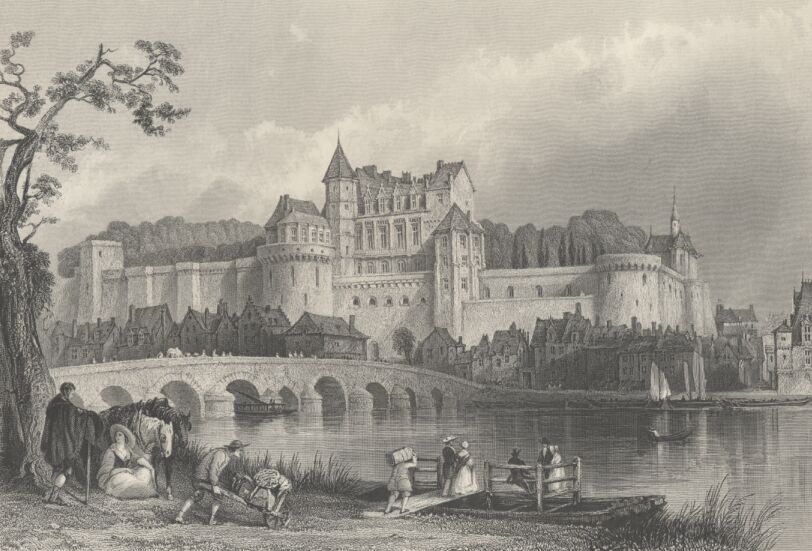
Charles VIII. reigned for nearly three years longer after his return to his kingdom; and for the first two of them he passed his time in indolently dreaming of his plans for a fresh invasion of Italy, and in frivolous abandonment to his pleasures and the entertainments at his court, which he moved about from Lyons to Moulins, to Paris, to Tours, and to Amboise. The news which came to him from Italy was worse and worse every day. The Count de Montpensier, whom he had left at Naples, could not hold his own there, and died a prisoner there on the 11th of November, 1496, after having found himself driven from place to place by Ferdinand II., who by degrees recovered possession of nearly all his kingdom, merely, himself also, to die there on the 6th of October, leaving for his uncle and successor, Frederick III., the honor of recovering the last four places held by the French. Charles ordered a fresh army of invasion to be formed, and the Duke of Orleans was singled out to command it; but he evaded this commission. The young dauphin, Charles Orlando, three years old, had just died, “a fine child and bold of speech,” says Commynes, “and one that feared not the things that other children are wont to fear.” Duke Louis of Orleans, having thus become heir to the throne, did not care to go and run risks at a distance. He, nevertheless, declared his readiness to obey an express command from the king if the title of lieutenant-general were given him; but “I will never send him to war on compulsion,” said Charles, and nothing more was said about it. Whilst still constantly talking of the war he had in view, Charles attended more often and more earnestly than he hitherto had to the internal affairs of his kingdom. “He had gotten it into his head,” says Commynes, “that he would fain live according to God’s commandments, and set justice and the Church in good order. He would also revise his finances, in such sort as to levy on the people but twelve hundred thousand francs, and that in form of talliage, besides his own property on which he would live, as did the kings of old.” His two immediate predecessors, Charles VII. and Louis IX., had decreed the collation and revision of local customs, so often the rule of civil jurisdiction; but the work made no progress: Charles VIII., by a decree dated March 15, 1497, abridged the formalities, and urged on the execution of it, though it was not completed until the reign of Charles IX. By another decree, dated August 2, 1497, he organized and regulated, as to its powers as well as its composition, the king’s grand council, the supreme administrative body, which was a fixture at Paris. He began even to contemplate a reformation of his own life; he had inquiries made as to how St. Louis used to proceed in giving audience to the lower orders; his intention, he said, was to henceforth follow the footsteps of the most justice-loving of French kings. “He set up,” says Commynes, “a public audience, whereat he gave ear to everybody, and especially to the poor; I saw him thereat, a week before his death, for two good hours, and I never saw him again. He did not much business at this audience; but at least it was enough to keep folks in awe, and especially his own officers, of whom he had suspended some for extortion.” It is but too often a man’s fate to have his life slip from him just as he was beginning to make a better use of it. On the 7th of April, 1498, Charles VIII. was pleased, after dinner, to go down with the queen into the fosses of the castle of Amboise, to see a game of tennis. Their way lay through a gallery the opening of which was very low; and the king, short as he was, hit his forehead. Though he was a little dizzy with the blow, he did not stop, watched the players for some time, and even conversed with several persons; but about two in the afternoon, whilst he was a second time traversing this passage on his way back to the castle, he fell backwards and lost consciousness. He was laid upon a paltry paillasse in that gallery where everybody went in and out at pleasure; and in that wretched place, after a lapse of nine hours, expired “he,” says Commynes, “who had so many fine houses, and who was making so fine an one at Amboise; so small a matter is our miserable life, which giveth us so much trouble for the things of the world, and kings cannot help themselves any more than peasants. I arrived at Amboise two days after his decease; I went to say mine orison at the spot where was the corpse; and there I was for five or six hours. And, of a verity, there was never seen the like mourning, nor that lasted so long; he was so good that better creature cannot be seen; the most humane and gentle address that ever was was his; I trow that to never a man spake he aught that could displease; and at a better hour could he never have died for to remain of great renown in histories and regretted by those that served him. I trow I was the man to whom he showed most roughness; but knowing that it was in his youth, and that it did not proceed from him, I never bore him ill-will for it.”
Probably no king was ever thus praised for his goodness, and his goodness alone, by a man whom he had so maltreated, and who, as judicious and independent as he was just, said of this same king, “He was not better off for sense than for money, and he thought of nothing but pastime and his pleasures.”