A NAVAL VENTURE (continued 8)
Reading edition
"All—right; I'll—send—the—troops—along. Go—along—and—fetch—'em," he told the Orphan; "those—blokes—sitting—along—the—thundering—beach. Tell—'em—to—thundering—well—get—a —move—on—if—they—don't—want—to—be—left—behind. Con-found—this—pipe!" As the Orphan darted away he heard the rending sound of timber cracking and ropes "parting". He found some officers; they passed the "word" along; gave orders, and No. 1 Company of that battalion rose to their feet, picked up their rifles, and commenced to straggle down to the pier. As the Orphan and the first of them reached it, there came a loud crashing of smashing woodwork, loud shouts of "She's carried away, sir!" people came running back from where the pontoon had been; and Mr. Armstrong, walking slowly up to him, said: "The—thundering—thing's—carried —away—al-to-gether. It's—the—very—devil. Go—and—tell—the—N.-T.-O. See—if—you—can—find— me—a—bit—of—wire—my—pipe's—choked."
Back went the Orphan to No. 4 Pier, but Captain Macfarlane was not there, nor at No. 3 Pier. Someone took him to the new office "dug-out" at the top of the beach; and there he found him, sitting at a table with an oil-lamp hanging above it, smoking a cigarette, tugging at his beard, and looking quaintly amused at a number of officers who were all asking him questions at the same time.
The Orphan wriggled his way through them, and burst out with: "The 'barrel pier' has gone, sir—washed away!"
"How very annoying, Mr. Orpen; very annoying indeed!" he said, smiling grimly. "We shall have to send the soldiers off from No. 3 Pier. Go down and tell the pier-master to embark them on the two 'stand-by' motor-lighters, and tell Mr. Armstrong to go down and help him."
The Orphan, noticing that the lamp was hanging by a piece of wire, thought that there might be some more somewhere about, looked round, and saw a piece lying under the table—just what Mr. Armstrong would like. He picked it up, and was just wriggling his way out again when the Captain wanted to know what he was doing.
"Mr. Armstrong's pipe is choked, sir, and I saw this bit of wire."
"Dear me! dear me!" smiled the Captain. "Misfortunes never come singly; do they, Mr. Open?"
"No, sir," said the Orphan, not knowing what else to say, and dashed off; found the Pier-master—another Naval Lieutenant—and gave his message. Then he went off with his piece of wire to clear Mr. Armstrong's pipe, and tell him to go down to No. 3 Pier.
"All—right—hold—this—thundering—megaphone— whilst—I—clean—my—pipe."
At No. 3 Pier these latest arrived troops were already marching down into the "stand-by" motor-lighters, with a scuffling of tired feet, a clatter of rifle-butts, and the continual, monotonous, weary sound of "Form two deep! Form two deep!" as more infantry neared the shore end of the pier.
They were tired and dirty and trench-stained, and they cursed as they stumbled against each other in the dark, but they were very cheerful. As soon as one lighter had taken as many as she could hold, she shoved off, and grunted and snorted across to the "Outer Hulk".
"Nip over there; jump into that steamboat," the Pier-master called out. "Find out how many more men that destroyer can take."
The Orphan jumped down into a picket-boat lying alongside, and found Bubbles there.
As he took him across to the destroyer, the Orphan asked him what he had been doing all night.
"Generals, and their Staffs," Bubbles shouted happily. "You've no idea what a lot of trouble I've had with them. Some of them have actually started giving me orders. I've 'told 'em off' properly. They get quite tame then. I've taken some off from 'V' beach as well; everything's going on well down there. This sea running in is pretty beastly, isn't it?"
The Orphan climbed up the destroyer's side, and found her deck crammed with soldiers. He pushed his way up to the fore bridge, and heard her Captain yelling down to the men on the "Outer Hulk": "Get some more fenders along. Slack off that hawser." He was told that "If you don't 'get out of it' in a 'brace of shakes' you'll get a sea-passage, for nothing. I'm just going to shove off out of it. I can't take another soldier, and I'll stove my side in if I stay here much longer."
The Orphan went back to the steamboat, across to the pier, and reported that the destroyer was just shoving off.
"I can see that for myself," grumbled the Pier-master, as a flash from the monitor's gun suddenly showed the destroyer backing out.
This same flash also showed a heavily-laden lighter being warped off from No. 4 Pier, so the Orphan knew that the Sub had managed to start his journey with those last guns.
Then two teams of horses came jangling down to the pier unexpectedly, and the irritated Pier-master sent Bubbles to try and find a horse-boat or lighter alongside the "Inner Hulk". He came back with one; was nearly run down by another destroyer; got it alongside. Those twelve horses walked down into it as if they knew all about the business, and the very last horse to be taken off from "W" beach was towed away into the darkness.
Captain Macfarlane came down and told them that he had received a telephone message from Headquarters Office that the trenches had been finally evacuated, and the covering brigades withdrawn. "Everything IS absolutely quiet up there," he said.
The Orphan and Bubbles were greatly excited at that news. They tried to picture these last troops stealthily creeping out of their long line of trenches—extending from Ghurka Bluff and the Nullah, across the plain in front of Krithia, along the lower slopes of Achi Baba, and across and along the ravines past Sedd-el-Bahr—coming down the communication trenches, treading softly, and not making a sound, expecting all the time that Turkish patrols would give the alarm, and that the Turks would only be waiting for that moment to light the plain with star shells and rush down on them.
"We should hear the mines blow up, anyway," the Orphan said, as both snotties stood and listened, hearing nothing but the howling of the wind and the lapping of the waves, and the bumping of the picket-boat against the pier.
"It must be exciting for them," Bubbles said, bubbling with excitement.
After having secured several empty motor-lighters alongside, in readiness to embark the last troops, there was nothing to do.
"Have—a—sand-wich?" said Mr. Armstrong, producing a bulky package which Richards had prepared for him. They ate them sitting on the top of the picket-boat's cabin, as she bobbed and bumped against the side of the pier. Mr. Armstrong told them that one of the Generals coming down was a cousin of his named Bailey, and that if he did come down to this pier he wasn't to go off without seeing him. General Bailey had a brother who had been a Sub in charge of a gun-room when Mr. Armstrong was a midshipman in it. "A—thundering—good—chap," Mr. Armstrong said. "He—used—to—beat—me— thundering—hard—have—an-other—sandwich."
Before the sandwiches were finished, the Orphan had to go up to the Captain's beach office. The Senior Military Landing Officer, rather upset about something, was talking nervously.
"Oh, Mr. Orpen, there are some men who can't be taken off from Gully Beach, round by the left flank, on account of the heavy sea," the Captain said calmly. "They are starting to march this way. Go down and tell the Pier-master and Mr. Armstrong to collect as many empty motor-lighters as possible. Come back here when you have given this message."
When he returned, the Captain gave him a signal to take up to the temporary "wireless" station, a little way along the top of the cliff.
"You had better hurry," he said, good-humouredly, looking at his watch, "if you really don't mind, or they'll be packed up before you get there."
The Orphan dashed off up the main road, and then along the branch path to where he knew the "wireless" station had been "put up".
"You're just in time," the Naval Lieutenant in charge of it said; "I was just going to give the order to 'pack up'."
"Here!" he shouted to the operator. "Call up those two destroyers; they'll be wanted to come alongside the 'Outer Hulk'."
"The N.T.O. says you can pack up when you get those signals through, sir," the Orphan said.
"All right; those destroyers will have the deuce of a time getting alongside if the wind goes on increasing as it's been doing for the last half-hour," the Lieu-tenant said. "What d'they want 'em for? anything gone wrong?"
The Orphan told him, and as he turned back he ran into some soldiers carrying heavy square tins.
"What are you doing?" he asked one of them.
"Going off to soak the stores with petrol," he said, and hurried on up to the Ordnance Depot.
Down the main road were now coming the first of the "covering parties"—some of the men who had actually stayed in the trenches till the last moment, many of them limping heavily, most of them talking cheerily. Some had maxim guns on their shoulders, others carried the tripod-stands, others maxim belt-boxes.
"Which way for the Margate steamer?" a Cockney voice called out.
"Turn to your right when you get on the beach," the Orphan shouted as he passed them; and the same voice called back: "Hi, Guv'nor! I've lost me return ticket. I ain't got no money, and I don't want to be left behind—I ain't 'ankering after a trip to Constantinople."
The tired men began to laugh.
The midshipman found Captain Macfarlane in his office, and told him that these men were coming down. He went out and stood at the top of the beach as they went past, their feet scrunching on the stones and shuffling through the sand as they marched down to No. 3 Pier, straight aboard the motor-lighters waiting for them.
A little officer came past, walking with a very tall one.
"Is that General Bailey?" called Captain Macfarlane.
"Hullo, Macfarlane! I knew your voice," he replied, stopping.
"Everything all right?" asked the Captain; and the Orphan remembered that this was Mr. Armstrong's cousin, and listened eagerly for what the General, who had just gone through this terribly anxious time, had to say.
"A pipeful of ship's tobacco, and I should be a happy man," was what he actually did say.
"I know where I can get some, sir," the Orphan interrupted. "Mr. Armstrong has plenty down at No. 3 Pier."
"There's a picket-boat waiting for you there, General. Mr. Orpen will show you the way. Everything all quiet when you left?"
"Everything. The Turks haven't stirred from their trenches; have hardly fired a shot all night. We've brought everyone back."
The Orphan piloted the General and his Staff Officer through the crowd of men round No. 3 Pier, and found Mr. Armstrong.
"General Bailey, sir; he wants a pipeful of ship's tobacco," he said, and left them there; hearing Mr. Armstrong's funny drawl: "You're—a—sort—of —cousin—of—mine—sir—your—brother—in—the— Navy—used—to—beat—me—thundering—hard—a— thundering—good—chap—take—the—whole— blessed—pouchful."
"Bubbles!" the Orphan called, as he found the picket-boat, "I've brought you another General."
"Put him down below in the cabin with 'Kaiser Bill'," Bubbles sang out laughingly. "What 'Kaiser Bill' doesn't know about looking after Generals isn't worth knowing."
The wind by now had increased to almost the force of a gale, and a most unpleasant sea was swirling in through the gap in No. 1 Pier—where the pontoon had been—and round and between the ends of the sunken "hulks". In spite of this, those "covering parties" were safely taken off; the clumsy motor-lighters pushed and shoved out past the "Outer Hulk" by tugs and picket-boats, and then there was nothing much to do until those men marching back from the left flank and Gully Beach arrived. The Orphan was sent with some of the beach party to bring down the "gear" from the "wireless" station, and when he came back he found a white-painted hospital motor-lighter alongside No. 3 Pier. The Army doctor in charge had asked to be given an opportunity of trying to save the most valuable of the surgical stores still left in the Casualty Clearing-stations, and now was up there with nearly a hundred R.A.M.C. orderlies, bringing down cases of surgical instruments and expensive apparatus as fast as they could. They had already filled two big ambulance wagons, and man-handled them down on to the beach, and everyone was helping to unload them.
As a matter of fact, the last night of the evacuation had gone off so smoothly, in spite of the unfortunate change of weather, that people hardly realized that the original scheme had been drafted under the impression that the "covering parties" would probably have to fight their way back. The maxims in the picket-boats had been placed in them so that the picket-boats should try and cover the embarkation of those last few people who would rush down to the beach; the white-painted hospital lighter was there to, if possible, take off any wounded who could crawl or hobble to it.
In the complete absence of any interference by the Turks this fact had been almost forgotten.
The Sapper working-parties, who had been sprinkling petrol over the Ordnance and Commissariat stores, now began to return, and set to work with pick-axes to smash the engines of some motor-lorries which had to be left behind, and rip their tyres to shreds.
The Orphan having nothing whatever to do, and feeling very tired, wandered down to No. 3 Pier and found Bubbles and his picket-boat.
"I say, Bubbles, got anything to eat?"
Bubbles had. He produced a packet of sandwiches out of a haversack, and the crew brought the two of them a bowl of hot cocoa. They sat on the top of the picket-boat's cabin, and whilst they were munching away happily, they heard someone singing out: "'Ave you seen Mr. Orpen about?"
It was Plunky Bill's voice.
"Hello! What d'you want?" the Orphan called; "I'm here."
Plunky Bill came aboard. "Beg pardon, sir; I thought as 'ow you and t'other young gen'l'man could do with a couple of army macintoshes. I've just 'appened to come across two;" and he added confidentially: "If you'd like any more, I knows where I might be able to lay me 'ands on 'em."
"Where did you get them?" they asked; but Plunky Bill only told them that "he'd been looking round a bit". "I'll just stick 'em alongside 'Kaiser Bill', and then they'll be safe. You'll find a couple of them there 'lectric torches in the pockets."
"Whatever else have you got?" Bubbles laughed, seeing that he was bulged out with things.
"Nothin' much, sir; nothin' but a few pairs of them injy-rubber trench boots, sir. It do seem such a shame to leave 'em for the Turks, and they'll come in 'andy on board."
He put these boots down below under the forepeak, and went away again, towards the beach.
"That makes up for the macintosh spoilt by that shell the other day," Bubbles said. "They're jolly good things; you can wear them in plain clothes."
They did think of calling him back and asking, him to bring down some more for the rest of the gun-room, but a picket-boat came lurching alongside with the Sub in it, and in their eagerness to know whether he had managed to get off the last of those guns they forgot about macintoshes.
"They're half-way to Mudros by this time," the Sub shouted happily. "I'm off to tell the Skipper. What's the delay? What are we waiting for?"
They told him of the men from the left flank, and away he went.
At about three o'clock the first destroyer came alongside the "Outer Hulk" and made fast. This would have been a difficult job in daylight, on account of the heavy sea which was running, the strong wind, a very strong current swirling down from the Dardanelles, the very limited space for manoeuvring, and the dangerous proximity of the lee shore. In the pitchy darkness of the night it was ten times as difficult.
Thank goodness, just about this time, the first of those men began to tramp down the road from the ridge, footsore and weary after their long and anxious march—long march, that is, for men who had spent so many weeks continually in trenches. The Orphan helped to guide them down to No. 3 Pier, and they limped into the waiting motor-lighters, and were taken across to the destroyer.
By a quarter to four, not a single soldier remained on the Gallipoli Peninsula except a Sapper "demolition" party busy setting fire to the petrol-soaked stores, and waiting to ignite the fuses which should blow up the magazines containing all the ammunition and explosives which had to be abandoned.
By four o'clock these Sappers had come back to the beach and embarked aboard a motor-lighter. The whole circle of the ridge above "W" beach and the slopes of the gully now began to flicker with little flames, and in an incredibly short time the strong wind fanned them until the whole place was a mass of roaring, crackling fire.
Captain Macfarlane, the few of his officers who had not yet gone off, and a few of his men, now collected at the end of No. 3 Pier, alongside which lay two steamboats and that white-painted motor-lighter laden with medical and surgical stores, a few injured men (including two soldiers with sprained ankles—actually the two last men to come down to "W" beach), and some R.A.M.C. orderlies. Bubbles, with his last load of military officers, with "Kaiser Bill" and the two macintoshes, had already gone out to sea, and was steaming across to Kephalo.
Those flames lighted up the whole of "W" beach in the most extraordinary manner, and everything all round was visible—the little group on the pier, the stones on the beach, a white-tilted ambulance wagon with its Red Cross, half-way down the beach, the broad road running up between the huge masses of flame, the white hospital tents, an abandoned motor-lorry with its engines destroyed and its tyres hacked to pieces, the white stones which marked the boundary of the Naval Camp, and even the two "cuttings" which led to the Naval Mess "dug-out". Out by the "hulks" some of those last soldiers could be seen still scrambling aboard the destroyer.
Captain Macfarlane gave the order for the hospital-lighter to shove off, and for everyone to embark, so the Sub, the Orphan, Mr. Armstrong, and many more crowded into one of those steamboats and started away. The time was now about ten minutes past four, and before they had gone a hundred yards the magazine on shore blew up. It contained all the explosives which it had not been possible to take off, and made the most earth-rending, stupendous noise, sending up a huge mass of flame like a volcano, and flaming masses flew gyrating and twisting like huge gigantic Chinese crackers high up into the sky and spreading far and wide in every direction.
"My—blooming—oath—what—price—that—for—fireworks!" drawled Mr. Armstrong.
"Keep down! Keep down!" people shouted, as masses of rock came splashing into the water all round the steamboat, but none hit her; and as she turned round the end of the "Outer Hulk", on the inner side of which the destroyer and several motor-lighters still lay, crowded with troops, and faced the sea, the Orphan saw the other steamboat following, with Captain Macfarlane and the rest of his officers and men, and the white hospital lighter struggling out, with the water splashing up all round her, just as though she were under a heavy fire. A tremendous crackle of musketry broke out from the beach, and for a moment the Orphan thought that the Turks had come down to the ridge at last; but a Sapper officer in the boat told him that this was only the abandoned small-arm ammunition exploding.
Captain Macfarlane, passing them in his steamboat, sent them back to assist the hospital lighter if necessary; but she managed to make her way out safely, so in a few minutes they followed him.
Another destroyer waited for them outside; they saw her, steamed alongside, and climbed aboard with some difficulty owing to the heavy sea. The huge blaze on shore lighted up every face, and the first person the Orphan recognized was Dr. Gordon, the Volunteer Surgeon of the Achates.
"We've just had some pieces of rock fall on board," he said, "but no one is hurt. How about you? They were falling all round your boat."
"What are you doing here, sir?" the Orphan asked.
"They've sent a doctor to every destroyer to-night. Thank God, everyone has got off safely! You go and lie down; you look absolutely 'played out'."
"We got off all the men and the last guns—the very last they intended to take off," the Orphan said. "Isn't that grand?" But he would not go and lie down. He stood watching the flames and the destroyer silhouetted against them, as she backed out to let another take her place and empty the remaining motor-lighters. The motor-lighters came out and headed into the heavy sea; the destroyer backed out and went ahead into safety, and the last that the Orphan saw was a solitary little picket-boat pushing her way in towards No. 3 Pier and the flames, to make a final search for anyone left there, and then coming out again.
It was now about a quarter to five in the morning, and the marvellous evacuation had been successfully completed.
Then the Orphan staggered aft, crawled below, almost fell on to one of the leather cushions down in the ward-room, and went fast asleep.
Dr. Gordon, coming down a few minutes later, found him there, and felt his clothes. They were wet through, so he pulled a couple of blankets off a bunk and covered him up.
By this time there were very few of the beach party or its officers who had not found somewhere to stretch themselves and go to sleep. The strain of those last ten days and nights had been very great—fourteen hours of hard work day and night for most of them; for some a great deal more—and even the Sub, strong as he was, could not have "stood" many more such days and nights without a rest.
But the destroyer they were aboard had not finished her job. She and a cruiser now had to shepherd every tug, motor-lighter, trawler, and steamboat safely on its way across to Kephalo—especially those troublesome motor-lighters, which behaved so badly in a heavy sea. She went up the Straits, past "V" beach, where the fires blazing there showed up the castle walls of Sedd-el-Bahr and the poor old River Clyde; steamed up as far as Morto Bay to see that no craft of any kind had been left behind; and it was not until nearly seven o'clock, and after the Turks had been shelling the beaches for nearly two hours, both from Achi Baba and the Asiatic shore, that she started away for Kephalo. By eight o'clock she ran into that crowded harbour.
The Achates had left for Mudros several days previously, and thither Dr. Gordon, the Sub, Bubbles, the Orphan, and "Kaiser Bill" followed her late that afternoon in the troop-carrier Ermine. As this plucky little steamer passed Cape Tekke and Cape Helles the fires still raged, and a cruiser, a monitor, and two destroyers were bombarding the shore.
When the Orphan looked his last at Gallipoli Peninsula, as the Ermine steamed away to the west, the cliffs of Cape Tekke glowed in the rays of the setting sun, with a great pall of black smoke above them, the masts of the sunken hulks at their feet, our own shells were bursting on the beaches, and a huge splash leapt up under the stern of the cruiser as a shell from "Asiatic Annie" fell into the sea close to her.
By nine o'clock, after a wet and "bumpy" passage through the head sea left by last night's gale, the Sub, Bubbles, and the Orphan found themselves once more in the Honourable Mess, where everybody asked hundreds of questions at the same time, and where Barnes soon had a glorious "feed" waiting for them. Fletcher, the stoker, had come aft directly they reached the ship, to find out whether they had brought the tortoise back safely.
"It was all due to him," the Orphan told Fletcher joyfully. "You said he would bring good luck, and he has."
"Kaiser Bill", however, did not show the slightest interest in getting back to the ship or his owner, and refused even to put out his head.
"His nerves are a bit out of order, I expect," Uncle Podger suggested.
"You should have seen him 'duck' when he heard the shells burst!" the Orphan laughed. "You're a bigger funk than I am; aren't you, old 'Kaiser Bill'?"
CHAPTER XXV
The "Achates" Returns to Malta
At nine o'clock on Sunday morning, the 9th January, a general "wireless" signal was made by the Naval Commander-in-Chief—"Helles evacuated successfully"; and every battleship, scout, sloop, and destroyer scattered widely over the Eastern Mediterranean received the welcome news at the same moment.
The greatest enthusiasm prevailed among the whole fleet, for everyone realized that though the evacuation was actually a retreat, yet it had been a wonderful achievement in the face of difficulties which had at one time seemed insuperable; moreover, it set free a large and seasoned army for employment elsewhere.
When, later on in the day, the officers and men who had taken part in the evacuation returned to their own ships at Mudros with yarns of last night's adventures, everyone marvelled how it had been possible to hoodwink the wily Turk a second time so completely, and to do so in the teeth of that south-west gale.
In the gun-room of the Achates that night, the Sub, Bubbles, and the Orphan tried to answer questions and eat at the same time.
"It was that south-west wind that sprang up," the Lamp-post said. "Directly it started blowing, the Turks thought to themselves, 'Well, they won't try to slip away to-night, at any rate', got out their hubble-bubble pipes, and began playing 'patience'."
"You must have been there, old Lampy," Uncle Podger laughed. "Was it pretty to watch? What kind of patience did they play?"
"You know what I mean," the Lamp-post said. "Don't try to be funny."
"I believe he's right," the Sub said, with his mouth full. "My jumping Jimmies, didn't we have luck?"
The China Doll sat listening, with his eyes opening and shutting, and his mouth wide open, fearfully excited, especially when the Orphan, in the interval of "Another helping, please, Barnes!" told them all about the shells coming into the "dug-outs", and the third one which just missed Bubbles outside the kitchen door.
In the middle of all this, the Pimple rushed in, shouting: "We're off to Malta! Off to Malta to refit! The signal has just come through! As soon as ever we get back all our men, off we go! You can't say I don't bring you news, can you?"
In a moment the evacuation, and the bursting shells, and all the thrilling adventures—even the two macintoshes and electric torches looted by Plunky Bill—had been entirely forgotten. They all yelled with joy, and wondered how long the Achates would remain at Malta, where she would go afterwards, and what ships would be there for them to challenge at cricket or hockey.
"You'll have to give me that dinner there, Rawlins, old chap," grinned the Lamp-post, referring to the "race" in their "water-beetles".
"Ra-ther!" said Rawlins. "We'll have a regular slap-up 'eat-till-you-burst' show at the Club, won't we?"
Dr. Gordon put his head into the gun-room to see whether Bubbles and the Orphan had finished "feeding" and were ready to come for'ard to the sick-bay and have their slight wounds properly dressed. But no one could worry about little things like that—now.
"Come in, sir! Come in!" they shouted. "Isn't it grand about Malta? Where do you think we'll go afterwards?"
"I don't know; I haven't the faintest idea," Dr. Gordon answered in his nervous way.
"Hadn't we better have a bath first, sir?" the two wounded warriors asked him. "We want one frightfully badly."
"All right," Dr. Gordon smiled. "I'll get the bandages and things into my cabin. Come along there, afterwards."
They had their baths, they had their scratches dressed; and then it was simply no use to try—they could not keep awake any longer, and they turned into their hammocks—on the half-deck—and slept like logs; though not before the Pimple, shaking Bubbles, told him that he must keep the forenoon watch next day. "I've been keeping double watches ever since you went skylarking over at Helles," he complained.
"Oh, bother you!" Bubbles groaned, and went to sleep.
Next morning, as Bubbles kept his "forenoon", the Orphan came to talk to him. He had a great idea of doing something for "Kaiser Bill", "so that he should always remember how he'd brought luck wherever he went, and all the righting and things he'd been through". They had a very long and secret conversation, and then the Orphan, saying: "I'm certain I can get it made on board—there's a stoker petty officer who says he can do it—I'll go and see him now," went away again.
Three days later, just before sunset, the Achates steamed out through the "gate" in the double row of submarine nets, left Mudros for the last time, and commenced to zigzag her way to Malta.
In the ward-room that night the Sub dined with Mr. Meredith, and the Orphan dined with the War Baby, sitting next to Dr. O'Neill, the Fleet-Surgeon, who was so delighted at getting away from the Dardanelles that he actually made himself quite agreeable.
"Not so much of the 'rats-in-a-trap' now, Doc," the cheery Fleet-Paymaster called across the table. "More of the 'bird-in-a-gilded-cage', eh? Don't cheer up too soon; we shall be right in the thick of the submarines to-night and to-morrow. You'd better blow up your safety waistcoat."
"That's all right, Pay. It's hanging up in my cabin, blown up tight."
"Good! I'll know where to steal it," grinned the Fleet-Paymaster.
After dinner the other gun-room officers were invited to come along and start a "sing-song". They came in, and the Lamp-post, itching to get at the piano, was stuck down in front of it and told to play.
As his fingers drew music from the battered, uncared-for old instrument, he lost himself in another world altogether. He didn't hear the Navigator asking why the China Doll had not come; or the Pimple and Rawlins say: "Oh, we forgot him; we left him in the gun-room"; nor notice them rush away with the Orphan, Bubbles, and the War Baby, and bring back the Assistant Clerk lashed in a bamboo stretcher, with a big cardboard label—pointing the wrong way—"This side up. Fragile—with care."
They rushed him through the ward-room door, his squeals drowned by their shouts and the Lamp-posts music, and stood him upside down on his head, against the table.
"He's frightfully fragile! Listen how he cracks if you touch him!" And the Pimple nipped his ankle, the poor China Doll giving a squeak of pain.
"That's hardly comfortable, is it?" Dr. Gordon suggested.
"Well, look at the label, sir. 'This side up', so it must be right," they laughed. But Dr. Gordon made them unbuckle the stretcher and take it away, whilst the China Doll was "stood up" the right way, blinking his eyes, and opening and shutting his mouth. "Look at his lovely pink socks!" they cried, pulling up his trouser legs. "Aren't they pretty?" But the Assistant Clerk, with a frightened look at the Sub, who had forbidden him to wear them in uniform, tried to hide them.
The Lamp-post stopped playing and "came to earth" again.
"It's simply marvellous how you do it, old Lampy," said Uncle Podger, who had listened to every note. "That right hand of yours gave those black notes the time of their life; your left hand simply wasn't in it—never had a look in. You ought to give it a good start next time."
"Don't be an ass!" the Lamp-post smiled.
Then Mr. Meredith had to sing, and everyone joined in the chorus. After that the China Doll, pretending to be very shy, was pulled forward, and bleated some song like "Put me among the Girls", and received such an ovation for his silly performance, and became so highly delighted with himself and his popularity, that he thought he'd brave the Sub's displeasure, and not creep away and change those pink socks as he had intended to do.
The Commander went off to bed very soon; but just as the last chorus of "The Midshipmite" came to a tremendous end, the door opened, and in came Captain Macfarlane, smoking a cigar.
Everyone stood up.
"Have a whisky and soda, sir?" the Fleet-Paymaster and Navigator asked him. "We're having a sing-song."
"I thought I heard a slight noise," smiled the Captain tugging at his pointed, yellow beard. "May I ask what you are doing, Mr. Chaplain?" The little Padre happened to be taking lessons from the Sub as to how best to crawl through the back of one of the ward-room chairs, and had just got himself firmly wedged in, unable to move the chair up or down.
"I can nearly do it, sir," he said, standing up with the back of the chair round his chest, and his usually pale face almost purple.
"Nearly do it, Mr. Chaplain! nearly do it! How long have you been in the Service? I'll show you how to do it properly;" and throwing off his mess-jacket, and placing his cigar in safety, Captain Macfarlane wriggled his head and shoulders through the back of another chair, and slipped it down to his feet in half a minute.
"It's very easily done, Mr. Chaplain," he said, just a little out of breath, as he resumed his cigar.
"It's all very well for you, sir. You are thin all the way down—the Padre's only thin 'up topsides'." the Navigator laughed.
The Captain sang a song, and joined in the choruses of others till the time came for his usual visit to the bridge. Then he put on his mess-jacket and wished them all "good night".
"Good night, sir!" everyone said, standing up as he went away.
After this the sing-song became a little more boisterous, until finally the climax came when the Fleet-Paymaster, bursting in with a cushion he had borrowed from the Padre's cabin, endeavoured to score a "try" between the legs of the piano. He was forced into touch, banged against the ship's side, the cushion seized, and a most delightful game of Rugby football followed.
Dr. Gordon had a little work to do—mending people—afterwards, whilst the sing-song gradually broke up, the clamour subsided, and one after the other all went away to turn in, and peace and quietness reigned once more.
On the way back to the gun-room the Sub asked Uncle Podger to come into his cabin.
"Look here, Uncle, that youngster of yours took advantage of my dining in the ward-room to-night to wear those pink socks. I don't care a tinker's curse if he wears all the colours of the rainbow out of uniform, but I had told him not to do so in uniform. It's just this: the snotties—all of us—are spoiling him, treating him like a plaything or a little girl. He can't even talk sensibly now, or make an ordinary remark without saying something silly to try and make us laugh at him. He wore those socks to-night to make the snotties laugh at him and "rag" him; and that silly song he sang, and that silly blinking of his eyes when the ward-room officers clapped him—well, it's got to be stopped. What a horrible time he will have, when he goes to another ship and tries his baby tricks there! and what will he be like when he grows up? He's a good little chap, really, and as plucky as paint at sports. We must do something."
"I don't know," Uncle Podger reflected. "I feel just as you do. He's being absolutely spoiled. He's absolutely useless in the office; I do believe he spends his time thinking of what he can do next to make them laugh at him. They were talking at dinner to-night of getting up a gun-room court martial and trying him one night before we get to Malta. The snotties knew you had ordered him not to wear those socks, and thought of trying him for that. The China Doll thinks he's going to have the time of his life."
"Right," said the Sub, "and I'll take 'President'; he shall have the time of his life."
"You won't be too hard on him?" Uncle Podger asked, a little anxiously.
"Right-o, old chap! Good night! I won't break him."
By the next morning the Achates had passed through the narrow Doro channel, where so many ships had been attacked by submarines, and zigzagged her way along the coast of Greece. In the gun-room, great preparations were made for the China Doll's court martial, which would be really done "top-hole" fashion now that the Sub had offered to be "President". All details were settled that afternoon. The Orphan must be "Prisoner's Friend", and Uncle Podger "Judge-Advocate". The War Baby had been asked to dine as the guest of the Honourable Mess, and afterwards to act as "Provost-Marshal", "Master-at-Arms", "Second Executioner", and "Prisoner's Escort". The Pimple appointed himself "First Executioner", and Rawlins and the Hun appointed themselves "Comic Jailers". But the Hun, who had not been well for some days, had again to be put on the sick-list and be slung in a cot on the half-deck, so that Bubbles took his place as "Second Jailer". The Lamp-post, of course, would be the "Prosecutor", and make up a really funny speech.
Before dinner they shifted the Hun in his cot, and slung him just outside the gun-room door so that he could look in and see the fun. "You'll have to be the 'crowd'," they told him, "and groan and hoot when the 'Prisoner' is dragged in or out—that is, if you feel well enough, old Hun."
They had a grand, cheery dinner, the most cheery and noisy since the ship had left Ieros; they entirely forgot Cape Helles or Suvla, the shells or the submarines. The China Doll simply giggled with excitement all the time. He longed for the trial to begin, and for himself to be the central figure and be able to "answer back" so cheekily.
When the meal was at last finished and everything cleared away, he helped to carry in the Master-at-Arms' table, and stood it across the top of the Mess, in front of the sideboard, for the Sub to sit behind as "Judge" and "President"; he helped bring in the Padre's reading-desk to make the witness-box, and he cleared all the litter of coats and boots from the brass "beading", or fender, which surrounded the place where the stove had stood in the old days. This was to be the Bar, and he would have to stand in the middle of it, facing the witness-box, with a "Jailer" on each side of him, and the War Baby, with his very long sword, behind him.
He himself had no sword, and would not be entitled to one until he reached the exalted rank of Clerk, so he was ordered to provide himself with a pen from the ship's office to take its place.
Directly after "Commander's rounds" at nine o'clock, the "Court" was "cleared", and the China Doll, trembling with excitement, was sent to stand by his sea-chest until the "Jailers" and the "Master-at-Arms" came for him.
Punctually at ten past nine the War Baby, in helmet, tunic, and those beautiful scarlet-striped trousers of his, his long sword at the "carry", did the "goose step" solemnly along the half-deck, followed by Bubbles and Rawlins, their helmets on, the wrong way round, their monkey-jackets stuffed out with swimming-belts to make them look more "funny", and their drawn dirks in their hands. They dragged behind them the chain from one of the hatchway ladders, and having snapped a pair of handcuffs round the China Doll's wrists, lashed his arms to his side with the chain.
Then they escorted him solemnly back to the gun-room, amidst derisive shouts of "Go it, pickpocket! Wearer of Pink Socks! Booh! Pooh! Booh!" from the "crowd"—the Hun in his cot outside the gun-room door.
Behind the little table sat the Sub, smoking his pipe—that office pen, which represented the "Prisoner's" sword, and the gun-room cane in front of him. On his left, at the end of the little table, sat Uncle Podger with his "cocked" hat on, his sword between his knees, and a roll of papers in his hands. In front and on the right of the "Judge" was the stove fender for the "Prisoner at the Bar", and in front and on the left, the Padre's reading-desk, laden with a pile of volumes of Chambers's Encyclopædia, borrowed from the ward-room. The Lamp-post, as "Prosecutor", leant "gracefully" against it.
Behind the "Judge" stood the Pimple—a black mask hiding most of his face—brandishing a huge meat-chopper, kindly lent by the marine butcher.
The Orphan had vanished.
The China Doll was now marched to the Bar.
"Attention! Silence in Court!" shouted the War Baby in a shrill falsetto; and the two "Jailers", standing on each side of the China Doll, repeated it after him, trying to make funny faces, and jerking the ends of the chain coiled round the "Prisoner's" chest, whilst that luckless youth opened and shut his eyes, and kept saying: "Shut up! you're hurting!"
Silence, or comparative silence, having been obtained, Uncle Podger gravely read, from a long roll of paper, the horrible charge: "Whereas, Mr. Charles Stokes, commonly known as the China Doll, did, after being duly warned and cautioned not to wear pink socks"—(loud "booing" from the "crowd", and a request from the "crowd" for his cot to be shifted a little farther for'ard, so that he could see better).
After this interruption, and the Court had settled down again, the "Judge-Advocate" resumed: "pink socks, not in accordance with the Uniform Regulations of His Majesty's Navy, and also infringing the customs of the Honourable Mess, and being distasteful to the Honourable Members thereof, and did indulge this noxious habit on sundry and divers occasions, to wit, notably at dinner on the thirteenth day of the first month of the year nineteen hundred and sixteen; therefore, the aforesaid Mr. Charles Stokes be now brought before a Court Martial, duly assembled, and his crime diligently, and with all due formality, examined into, and death or other such punishment as be deemed necessary, awarded."
"Prisoner at the Bar," the "Judge-Advocate" began sternly—("Tremble, China Doll," Rawlins implored in a whisper. "Shake the chain and the handcuffs.")—"having heard the grave charge, do you plead guilty or not guilty?"
"Guilty, my Lord," squeaked the "Prisoner", knowing that this was just what no one would want him to say.
"The 'Prisoner at the Bar' pleads 'Not guilty'—not guilty, my Lord!'" shrieked the "Provost-Marshal", "Master-at-Arms", "Second Executioner", and "Prisoner's Escort", all rolled in one, waving his long sword; the two comic "Jailers" joined in to drown the "Prisoner's" voice.
There was now heard, from the deck outside, shouts of "Justice! Justice!" and a rather mild "booing" from the "crowd"; in rushed the Orphan and struck an attitude. "Am I too late to save my young friend's life?" he cried tragically, holding one hand against the front of his monkey-jacket, beneath which something bulged out. "The prisoner pleads 'Not guilty, my Lord!' and I am here to prove his innocence. Fleeing from the Dardanelles, flying from the post of danger, I—I—I—— Oh, hang it all; I can't remember any more!"
So down the Orphan sat, amidst groans from the "Jailers", the "First and Second Executioners", and the "crowd" outside.
"The 'Prisoner at the Bar' having pleaded 'Not guilty, my Lord!'" continued the "Judge-Advocate", "I will now request my honourable friend, 'Mr. Prosecutor', to proceed."
So the Lamp-post, having cleared his throat several times, and fixed the "Prisoner" with an "eagle glance", before which the China Doll's knees shook in the most realistic manner, proceeded: "My Lord, in my researches among my legal books" (here he rested his hand on the Encyclopædia) "I find but little mention of socks, and none of pink socks, which is sufficient proof that the crime, of which the 'Prisoner at the Bar' is charged, is one of a unique and most dangerous character. But" (and he banged the reading-desk) "in the article on 'Dyes' I find this: 'Pink dye is produced from coal-tar'"—(great sensation in Court; Bubbles pretended to faint against the bulkhead; the Pimple waved the meat-chopper so close to the "Judge's" head that he was told to put it down in the corner; and there was prolonged hissing from the "crowd").
Then the "Prosecutor", lightly touching on coal-tar soap, tarred roads—their advantage to motors and disadvantage to the fish in the streams which ran alongside them, briefly mentioned the good old custom of "tar and feathering", which he trusted the Court would inflict on the wretched "Prisoner at the Bar". "These," he said, suddenly holding aloft the two incriminating socks, "are the abominated vestments or 'what-nots' owned and worn by that trembling, terrified tadpole, that cringing criminal in the dock. I will now, my Lord, proceed to call my witnesses."
"You're doing it spiffingly!" whispered Rawlins to the China Doll. "If you could only wink up a tear, and shake the chains a bit more!"
One by one, Uncle Podger, the "Jailers", and Barnes (in his shirt-sleeves) were called to the reading-desk, sworn on the office copy of the King's Regulations and Admiralty Instructions, and each identified those socks as having been worn by the "Prisoner" on the occasion in question. The War Baby further gave evidence that he had found them that night concealed in the "Prisoner's" chest.
The Orphan, with some hazy idea of judicial procedure, tried unsuccessfully to obtain a hearing. At last he was heard to say: "That the 'Prisoner at the Bar' denied ever having seen them before; that having been brought up from the tenderest age on 'Pink Pills for Pale Piccaninnies', he so abominated that colour that he invariably fainted on seeing it". Here, with his free hand (for the other hand still clasped the bulge beneath his monkey-jacket), he seized the pink socks from the "Prosecutor" and held them in front of the "Prisoner's" face.
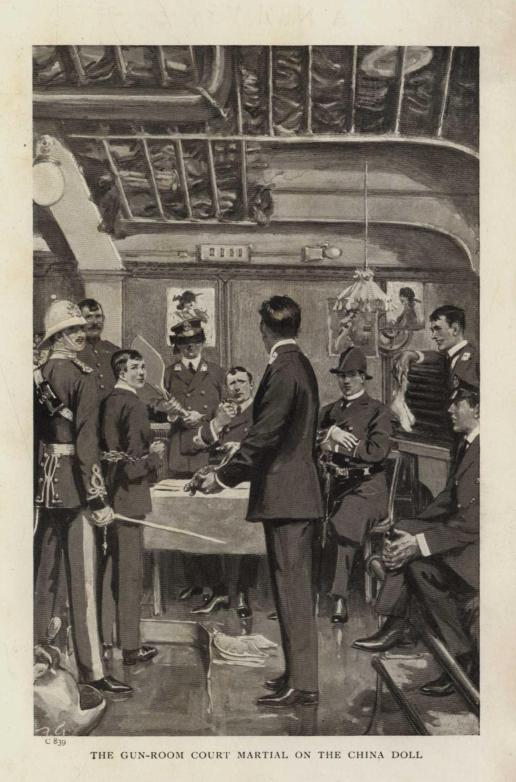
THE GUN-ROOM COURT MARTIAL ON THE CHINA DOLL.
The China Doll promptly fell back into the arms of the "Jailers" and "Provost-Marshal".
"See, my Lord!" and the Orphan pointed triumphantly (as Rawlins whispered, "Keep on fainting—I'll tell you when to stop"); "can the Court require further proof of his innocence?"
("Yes! Yes! Booh! Booh! Yah!" from the "crowd" and the Pimple.)
"Then I will produce the real criminal, the owner of those hateful socks;" and putting his hand inside his monkey-jacket, the Orphan drew out "Kaiser Bill", with his head out and legs dangling from his shell.
"There he is! Come to save the innocent life of that young officer—at the risk of his own shell!" (Tremendous sensation in Court; the "Jailers" flung their arms round each other and wept loudly—even the "Judge" smiled as he refilled his pipe.)
"I will now confront him with those socks, and the Court will see him recognize them," went on the Orphan, and dangled a sock in front of "Kaiser Bill". Unfortunately, just at that moment the Pimple dropped the meat-chopper, and "Kaiser Bill", thinking, probably, that "Asiatic Annie" was getting busy again, promptly "ducked" inside his shell, and nothing would induce him to come out again.
The Lamp-post banged the reading-desk. "My Lord, you have seen for yourself that the Witness for the Defence refuses to perjure himself: the case is clear; I submit that the charge is proved."
In the general clamour and booing which followed, the China Doll endeavoured to make himself heard; but every time he opened his mouth, Rawlins or Bubbles slapped a wet sponge (thoughtfully provided by the Pimple) over his mouth, and the War Baby sawed gently at his neck with his sword.
Amid the general uproar, the Orphan was understood to be pleading for the clemency of the Court. "The 'Prisoner at the Bar'," he was heard to say, "resolved, at a tender age, to devote his life to his King and Country, and, leaving several disconsolate, doting wives and children to mourn his loss, had come to sea to make toast for the Honourable Mess."
"But he doesn't make it now; he never did! He always ate it himself!" yelled the "Jailers", the "First Executioner", and the "crowd".
"I look to the justice of the Court to acquit the miserable little worm—I mean, this gallant and impetuous officer—of the foul charge which—which—which—— Oh, hang it all! I've forgotten what comes next," the Orphan said, and, amidst "loud and prolonged cheering" from the Hun in his cot outside, sat down on the gun-room table with "Kaiser Bill" on his knees.
The Sub banged the table. "Has the 'Prisoner at the Bar' anything to say in his defence?"
The China Doll, thinking that at last the time had come for him to make the funny remarks he expected everyone to laugh at, began, in his most squeaky voice, his eyes opening and shutting: "My Lord, old Lampy is——"
"The Prosecutor! the Prosecutor!" they all shouted, whilst the "Jailers" clapped the sponge over his mouth.
"Is an ass!" shrieked the China Doll, struggling free.
"Muzzle the 'Prisoner'! Shove the sponge in his mouth! Cut his head off!" shouted the "Jailers", the "Provost-Marshal", the "First Executioner", and the "crowd".
The Sub banged the table for silence, and roared: "'Provost-Marshal', remove the 'Prisoner', and send back the 'Jailers'!" Whereupon the China Doll was lifted up, kicking and squeaking, and taken out into the half-deck, the War Baby keeping guard whilst the two "Comic Jailers" came back.
"Now look here," began the Sub, "we've had too much of this fooling of the Assistant Clerk. He's not a bad little chap, and we're simply spoiling him. He thinks of nothing but how he can make us laugh at him. When he goes to another ship he'll have a rotten time, and grow up to be a 'rotter'. He wore those pink socks after I had told him not to do so, and to make you laugh at him all the more. Now all this 'rot' has to stop—from this very moment. He is not to be called China Doll any longer—the name will stick to him, and sooner or later spoil him. Stokes is his name, and Stokes—and nothing else—nothing else, do you understand?—you will call him in future. You can 'scrap' with him as much as you like, but you are to talk sensibly to him—and you are never again to call him China Doll. Go and fetch the 'Prisoner'."
The snotties never expected any ending like this, and, rather bewildered, brought back the excited Mr. Stokes.
"Take off those handcuffs and foolhardy chains," the Sub called out, "and bring Mr. Stokes over here."
The Assistant Clerk stood opposite the Sub, wondering why the others didn't giggle at the abject look of silly fright he tried to show.
"Stand up when I speak to you!" growled the Sub, and the Assistant Clerk straightened himself and looked frightened—naturally; he didn't know what was the matter.
"I have taken 'President of the Court' to-night, Mr. Stokes," the Sub began sternly, "and let you have your fun out of it, but I am going to say a few things to you which you are to remember. If you intend to become a credit to yourself and the Navy you must learn to obey orders—that is the first thing. Then you must learn to be manly, which you are not trying to do here. If you hadn't been just a silly, little puppy I should have beaten you; but from now on, you are to be called by your proper name—Stokes—and by nothing else—and—and—dash it all—come with me to my cabin and talk it over."
Ten minutes later they both came back, the Assistant Clerk looking as if he had shed tears.
The Sub put his hand on his shoulder. "Have a drink, Stokes?" and Mr. Stokes looking up, with a suspicion of a tremble on his lips, said: "Thank you, sir, I should like a ginger beer."
"Barnes!" called the Sub; "bring me a whisky and soda, and a ginger beer for Mr. Stokes."
The others kept very quiet.
The evening after that court martial had taken place, and just before dinner, Bubbles and the Orphan, vastly excited, knocked at the door of the Sub's cabin.
"We've had this made for 'Kaiser Bill'," they both began saying, bursting in. "Could we get Fletcher and the tortoise down to the gun-room after dinner, and present it to him—properly?" and they pulled out a brass cross, shaped like a German "Iron Cross", suspended on a piece of coloured ribbon with a proper brooch and four "clasps".
The Sub examined it, smiling as he read on one side of the cross "Kaiser Bill—the Tortoise", on the other "Good Luck"; and on the clasps: "Achates, 1915-16"—"Smyrna"—"'W' beach"—and on the fourth—a very broad one: "Evacuation, Suvla—Helles".
"We got it made on board," they said. "Haven't they done it well?"
"Where did you get the ribbon?" he asked.
"Off the War Baby's straw hat. He'll never want it. Can we tell Fletcher to come down after dinner, and will you give 'Kaiser Bill' the medal? It would be best to come from you."
"All right; tell him to come to the gun-room after 'rounds'."
So off they rushed.
Just after nine o'clock old Fletcher came aft with the tortoise. They all met him outside, escorted him into the gun-room, and made him sit down in the one easy-chair, with the tortoise on his knees.
Then the Sub said: "We've had a medal made for 'Kaiser Bill', Fletcher; we thought you'd like to have it, just to remember what he had been through, and remind you about it later on."
The old stoker took the medal and its clasps, pulled his gold spectacles out of their case from inside his "jumper", fixed them on his nose, and beamed when he read the inscriptions. "Thank you very much, gentlemen! Thank you all, very much! I'll take it home with me, and I hope I'll take 'Kaiser Bill' home too. He did bring luck, didn't he? If we'd only had him with us, that last time in the picket-boat, we shouldn't have lost her. Should we, sir?"
Then Stokes, very nervous because this was his first public appearance under his real name, stuttered: "And, Fletcher, the Sub wants me to give you this box of cigars; he thinks 'Kaiser Bill' likes the smell of cigar smoke!"
"It's very kind of you all; thank you very much, gentlemen;" and the old stoker, beaming at them through his gold spectacles, added, artlessly: "If 'Kaiser Bill' doesn't enjoy the smell of them, I know someone who does. Thank you all, very much indeed!"
Next morning, just after daybreak, every one of the midshipmen (except the Hun in his cot) came on deck to see the old walls of Malta standing up out of the glittering sea, ahead of the ship.
As they watched, and chaffed Rawlins about the dinner he had to "stand" the Lamp-post at the Club, the messenger-boy from the "wireless" room brought aft the usual morning "Wireless Press News".
"Beg pardon, sir, but there's something about you this morning," he said, coming up to the Orphan.
"About me! What d'you mean?"
"There, sir," and the messenger-boy pointed to the end of the last page.
They all crowded round the Orphan, who read: "The following additional Naval honours appeared in last night's Gazette", and at the end of the list came—and the Orphan's head buzzed—"Distinguished Service Cross—Midshipman Vincent Orpen".
For a minute he wondered whether it was possible that there could be another midshipman of the same name; but whilst the others thumped him on the back and congratulated him, another messenger came flying down from the bridge: "The Captain wants you, sir, at once."
Not knowing whether he was on his head or his heels, the Orphan flew up to the fore bridge.
Captain Macfarlane smiled at him and tugged his beard.
"Is it really true, sir?"
"I imagine so; I sent your name in."
"What's it for, sir?"
"I think, Mr. Orpen, for working that maxim in your picket-boat, at Ajano."
"Thank you awfully, sir! but Plunky Bill was wounded twice, sir."
"Was he the seaman who fired it before you 'took on'?" asked the Captain.
"Yes, sir; he was hit twice before he gave up."
"I think, Mr. Orpen, you'll find that he has not been forgotten."
"Thank you, sir, awfully! I—I—must go and tell the Hun and the Sub—won't they be pleased?"
The Orphan thereupon dashed down the bridge ladder.
PRINTED IN GREAT BRITAIN At the Villafield Press, Glasgow, Scotland
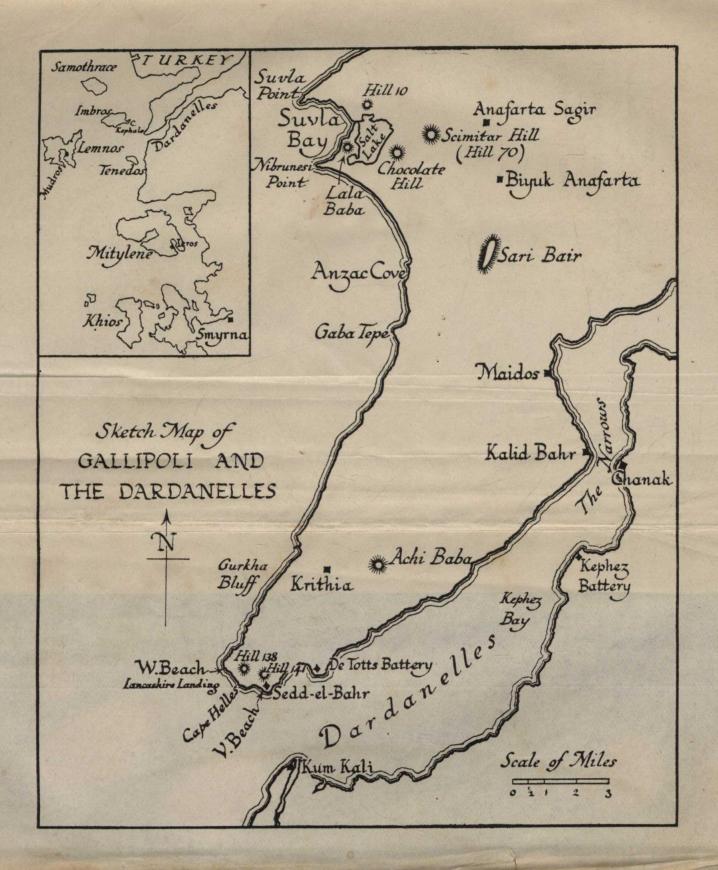
Sketch map of Gallipoli and The Dardanelles
* * * * * * * *
BY FLEET SURGEON T. T. JEANS, R.N.
"The manifold excellences of Fleet Surgeon Jeans' work—its freshness, its originality, and above all its abiding humour."—Outlook.
Large crown 8vo, cloth extra. Illustrated
Gunboat and Gun-runner: A Tale of the Persian Gulf.
"That boy must be a dullard whose pulse does not quicken, or his imagination begin to glow, when he reads this exciting tale."—Bookman.
John Graham, Sub-Lieutenant, R.N.: A Tale of the Atlantic Fleet.
"A real workaday narrative of midshipmen's life as seen through the eyes of a young gunroom officer. We cannot imagine a better book for the mature boy."—Evening Standard.
On Foreign Service: or, The Santa Cruz Revolution.
"His book is among the very first we would recommend."— Glasgow Herald.
Ford of H.M.S. Vigilant: A Tale of the Chusan Archipelago.
"A distinctly good story."—Naval and Military Record.
Mr. Midshipman Glover, R.N.: A Tale of the Royal Navy of To-day.
"A really first-class book of naval adventure."—Literary World.
LONDON: BLACKIE & SON, LTD., 50 OLD BAILEY, E.C.