A NAVAL VENTURE (continued 3)
Reading edition
"It's blocked up with boards, and you can see the light between them," someone sitting next him said; "and those blighted Turks can see a light inside here, through them, too."
This burst of firing died away very rapidly; and as he sat there, jammed among a lot of soldiers, his eyes gradually became accustomed to the darkness, and he made out that he was close to a big hatch leading down into absolute blackness—the hold probably—and that above him was another hatchway, with a coaming round it, the edges of which stood out quite clearly against the clouds. A broad wooden ladder—the foot of it quite close to him—led up to this and, as he knew it must, to the upper deck, where the remaining wounded lay. The gangway port through which he had come, showed as a lighter patch than the ship's side, and anybody moving across it could be just distinguished; but people did not move across it more than they could help, because a lot of bullets had already come through it from the sea wall. Under this, his launch lay—at the foot of the ladder he had just climbed up. Dr. Gordon kept on talking, evidently trying to pacify Dr. O'Neill, and a man near him kept rattling something—a ship's lantern it sounded like—so he guessed that the chief sick-berth steward sat quite near. People conversed all round him, in a drowsy sort of way, as if to prevent themselves being nervous or of going to sleep; farther away, hundreds of people seemed to be snoring. A soldier leant against his back; he knew it was a soldier because a bayonet kept pressing against his thigh; someone slid down across his legs, snoring loudly; he pulled up his knees, and the man went on snoring peacefully; out from a distant corner came the sound of a man in pain, in his sleep.
Some men were sitting at the foot of the ladder, and, because he heard Dr. O'Neill talking to them, he guessed that they were officers. He was evidently suggesting the possibility of getting down the wounded now that the firing had died away, but they kept on saying: "They'll start off again in a minute! It can't be done." Every now and then came the noise of heavy boots trampling hurriedly across the deck above; a figure would appear over the coaming, silhouetted against the clouds for a moment, and then someone would come hastily clattering down the ladder as if he were glad to get away from there. The whistle of an occasional bullet over that hatch explained this.
Another burst of firing broke out, swelled to a perfect fury of noise, and then subsided just as the others had done.
During a comparatively quiet interval which followed, several men scrambled down the ladders. They called out: "Worcesters to go ashore at once!" and then went back again, screwing themselves over the coaming and disappearing along the deck. The group of officers stirred themselves and stood up wearily—a tired, lackadaisical voice kept repeating "Sergeant-Major! Sergeant-Major!" then seemed to wake properly, and yelled it out.
Men began to stir. '"Ere, wake up, Major! You're wanted," came out of the dark; the sound of a man waking irritably from his sleep, scrambling to his feet, a long yawn, and then a sharp, decisive "Yes, sir! Sergeant-Major, sir!"
"Fall in, the Worcesters! Worcesters! The Worcesters have to go ashore," the officer shouted.
"Fall in, Worcesters! Fall in, Worcesters! Fall in! Fall in round the ladder!" Men all round took up the cry, waking those asleep. Men cursed and yawned, and yawned and cursed again.
"Who are you a-shaking of? I ain't a ruddy Worcester," growled someone. The darkness was full of bustle and noise as the Worcesters dragged themselves to their feet and groped round for their packs and rifles. Rifles clattered to the deck; men jostled, cursing, against each other, and the Sergeant-Major's voice kept calling out: "Come along, lads! We've got to go ashore! Hurry up, Worcesters! This way, Worcesters! Fall in near the ladder!"
Men began humping on their packs. The Orphan—by this time on his feet, to keep out of the way—had a rifle shoved into his hands. "'Old on to it, mate, while I shoves my blooming pack on." He helped the man whilst he secured the webbing-straps. Then a plaintive voice came out of the dark: "I cawn't find me pack! Where's me pack?"
There was a titter of amusement as the Sergeant-Major yelled for the men to help him find it.
"'Ere it is, you blighted idiot!" someone shouted. "You was a-sittin' on it."
"'Elp me on! 'Elp me on!" the idiot pleaded.
"You'll 'ave to 'ave a lady's maid, that's what you'll 'ave to 'ave. We cawn't go waiting for you, Bill 'Awkins," bawled the Sergeant-Major; and to judge by the silly cries of Bill Hawkins, they were strapping him up too tightly.
"Where's me rifle? I 'ad it in me 'ands, and now I cawn't find 'e," the company idiot stammered helplessly; and the man whom the Orphan was helping chuckled: "'E's a fair treat, that 'ere 'Awkins; 'e can never find nothink."
The rifle had to be found. The Captain with the lackadaisical voice was getting impatient. Matches were struck to look for it.
"Come along, Worcesters! Get up on deck!" shouted the Captain; and they began clattering up the wooden ladder, actually bandying jokes as they disappeared over the coaming, and went pattering along the deck. The company idiot, who was in a pitiable state of terror lest he should be left behind, found his rifle at last, and, clutching it, he rushed up the ladder after them.
"Now 'old on to it, and don't let it out o' yer 'ands. You'll 'ave to look arter yerself now," said the Sergeant-Major kindly, as he followed him.
Whilst these men had been getting ready, another outburst of firing had commenced, and the fusillade on shore sputtered furiously.
"I shouldn't care to have to go ashore, out into that," Dr. Gordon said; and Dr. O'Neill answered: "I wouldn't go as cheerfully as they seemed to. Grand chaps those!"
"That's the first time I've heard him praise anyone," thought the Orphan.
Firing died away again, until only an occasional shot broke the silence; and with that company of Worcesters gone, there was much more room.
The two doctors talked in a low voice. The Orphan heard Dr. O'Neill say cynically: "You can't get a night like this in Harley Street;" and the volunteer reserve doctor laughed, in his funny, nervous manner: "No, I can't. I expect my old butler wouldn't sleep much if he knew how I was spending my night. He looks after me as though I were a baby."
Someone came down the ladder—the Orphan thought he had on a naval cap—sat with his back against a stanchion, and went to sleep. A man coming down presently, knocked against him and woke him—a perfect torrent of oaths, in a very childish voice, following.
"Why, that's old Piggy Carter from the Queen Elizabeth," thought the Orphan. "I'd know his voice anywhere." He went across and shook him, for he had fallen fast asleep again. "Carter! You are Piggy Carter, ar'n't you? I'm Orpen; you remember me?"
He did; and listened sleepily to the Orphan telling him all about the shell and splinter holes in the Achates deck and funnel, until Dr. O'Neill called out irritably: "Stop chattering!"
"Look here, Piggy, I want to go up on deck and have a look round," the Orphan whispered; but Piggy said he'd spent all day there, and in the water, with the lighters, and if the Orphan wanted to go along, more fool he, and he could go by himself. He—Carter—wanted to sleep, and didn't want to hear any more of "W" beach, or "X", or "Y", or "A", "B", or "C", or the whole tomfool alphabet of beaches.
And he went to sleep, with his back against the stanchion; and the Orphan, left to himself, sat on some sacks, watched the clouds moving across the open hatchway, and listened to the firing ashore, the pattering of bullets against the ship's side, and the snoring of tired men.
He went to sleep, and woke in the midst of a tremendous din. There was a perfect scream of rifle- and maxim-firing. He longed to go on deck, and wondered whether Dr. O'Neill would see him. Perhaps he was asleep too.
There was a new noise now—a much louder boom following a glare which lighted up the clouds, and then a smaller glare and a lesser sound; nearer they were, much nearer. "Those are field-guns," he said to himself; and after listening to them for some minutes, judging the distances of the different sounds, realized that they were our own guns. They began firing two shots, one after the other. "Two guns," he thought; and then felt certain that these were the very same guns which he had towed ashore that afternoon at "W" beach. He must see what was going on.
He wriggled cautiously to the foot of the ladder—Dr. O'Neill's voice didn't call out to him—he went up it on hands and feet. As he reached the top a bullet whistled by; he ducked, and threw himself over the coaming, clung there, found himself on deck—the noise seemed louder there—and doubled himself up as he ran across to the shelter of the bulwark. He waited for half a minute to pull himself together, and then drew himself up and peered over.
Right in front of him was the dark mass of the cliffs—they seemed to be not 200 yards away—and twinkles of flame sparkled out all along the tops of them. As he looked, there was the glare of a field-gun flash which outlined the whole cliffs—the crash—and then a glare farther inland, and a fainter report of a shrapnel bursting. For an instant he saw before him a narrow strip of beach with a dark shadow above it. Then it was dark again; but all along it, all the time, spurts of rifle-flame, ten times as distinct and large as those twinkles of the Turks' rifles on the cliff, marked an irregular, uneven line, where he knew our own troops must be—those Worcesters, who had just landed, probably among them.
A little to the right, down in the centre of that spluttering line of flashes, there was a regular spout of flame—a maxim was rattling; farther away inland, twinkles darted out everywhere—the whole air seemed full of noises. Then he jumped nervously, for suddenly two or three maxims at the other end—from the bows of the River Clyde—opened fire at something or other, just as they had done before. He could see nothing moving; it was all very uncanny, and fearfully exciting. He forgot that bullets occasionally pinged overhead or splattered against the side of the ship, and waited there until that attack had been beaten off—or perhaps, after all, it had been a false alarm—and gradually first the maxims, then the volleys, then the individual firing died down, and left only a few snipers trying to find each other.
Then he had time to look round the deck. Close to him he saw something—some queer shape—moving in the shadow of the bulwark, and he put out his hand and felt the rough hair and the long, smooth ears which could only have belonged to a donkey. There were two of them, both tied up behind a little deck-house. They were glad for anyone to touch them; they nosed at him, as if he gave them comfort, and stamped their little feet on the deck to show their pleasure, and to make him understand how they wanted to be taken on shore.
He gave them each a friendly pat and scratched their ears, wondering what they were doing there.
But what he wanted to see were those maxims, away at the other end of the ship; to be actually behind them when they next opened fire, and to find out what was happening, and what they were firing at. So he crept along the deck, along a row of stretchers, with shapeless forms on them, lying close under the bulwark. One or two groaned, but they all seemed to be asleep, and then he gained the entrance to the dark passage or alley-way under the superstructure. In it a man was smoking—he saw the glowing end of his cigarette.
"Can I get along here?" the Orphan asked. "I want to get to the maxims."
A rough Yorkshire voice told him the passage was full of people asleep. "You'd be doing better to go up along; keep away t'other side, it's safer so."
So the Orphan retreated, crossed the open deck in front of the mast and cargo winch, found the ladder leading to the superstructure, and was just going up it, to the shelter of the starboard side of the deck-house, when he saw a stooping figure bending over a stretcher, and Dr. O'Neill's harsh voice growled out: "Here, you! come and lend a hand. Lift that corner of the stretcher."
A wounded man lay on it, very heavily asleep; and as the Orphan lifted, the Doctor pulled free a blanket which had caught under the stretcher, and spread it over him.
He had not recognized the Orphan, who promptly darted up the ladder lest he should do so, and stop him going to find those maxims. He groped his way to the ladder, which he knew must lead down to the for'ard "well" deck; found it, climbed down, and then the fo'c'sle itself was in front of him, and an iron ladder to climb up. He was up it like a redshank, and at last found himself right in the bows of the River Clyde.
Two almost simultaneous glares from the field-guns lighted the clouds and showed up, for a moment, the high battlemented curtain-walls and the bastions of Sedd-el-Bahr castle, and showed the fo'c'sle he stood on, the cables, the capstan winch, some sand-bags piled up in the bows, some men standing behind them, and three box-shaped structures—two on the port side and one on the starboard.
He did not know what these were.
CHAPTER X
A Night Attack
The Orphan, holding his breath, crept forward to look over the sand-bags in the bows, treading on hundreds of empty cartridge-cases which rolled about the deck.
Another glare from the field-guns, and he saw that one of the men standing there, peering through his glasses into the gloom below, was an officer of the Royal Naval Division—the "R.N.D."—a Sub-lieutenant, wearing a naval cap with the silver anchor badge. (He actually belonged to the Armoured Car Section.)
"Hello! Who are you? Where've you sprung from?" this officer called out.
The Orphan told him, and, thirsting for information, asked what was happening. "What's going on, sir?"
"I'm hanged if I know."
"But what were you firing at? Those maxims were firing a minute ago, weren't they?" he asked, disappointed.
"Were they?" the Sub-lieutenant repeated to the figure next to him, who replied dryly: "I fancy I heard them."
"I feel sure I heard some little noise too, now I come to think of it," said the Sub-lieutenant jocularly.
"What are those things?" the Orphan asked, pointing to the two dark, square, box-like structures along the port side of the fo'c'sle.
"Come along and see," said his new friend; took him to one, slid back an iron plate, and pushed him into a little space where three men crouched, in the darkness, round the breech of a maxim whose barrel stuck out through a loophole in the front.
"Quiet little cosy place, that," he heard the Sub-lieutenant say from the outside. "Come along and we'll shut them in again, or they'll catch cold."
He slid the rear plate into place, and led the Orphan back to the maxim in the bows. "They're comfortable enough in their little boxes, aren't they? Steel plates all round them, and a steel plate on top—all home comforts!"
"But what's going on? Do tell me," the Orphan begged, looking down over the bows.
"Would you like to start a battle? I bet you would;" and before the excited Orphan had time to think what he meant, he sang out: "Get hold of that gun," and pushed him down astride the tripod.
Mechanically the bewildered and flustered midshipman gripped the two handles, and stood by to press his thumbs on the firing-button.
"Now don't be in a hurry; point the thing over there. No, not there; that's where our chaps are; they wouldn't like it—beastly 'touchy' they are; point the other way; that's better."
The Orphan found himself training the gun towards where he could just distinguish the biggest and nearest of all the bastions, straight ahead of the ship.
"There's the front door of the castle, down there," continued his friend. "Turks are always coming in or out—lazy beggars they are—they want 'gingering up'. Wait till those field-guns, up beyond Cape Helles, fire; then you'll see it; the front door-steps show up white. Ah! there they go! That's about right! Keep her there! Let her rip!"
The Orphan, not really realizing what he was doing, pointed the gun towards a white patch, and jerked both his thumbs against the button. His eyes were blinded as "tut! tut! tut! tut!" flashed the gun, and the jar on his unaccustomed thumbs and wrists took off the pressure.
"Keep her going!" he heard his new friend shout; and setting his teeth and pressing with all his might, he tried to keep the maxim gun pointing in the right direction as it shook and rattled, and the empty cartridge-cases tumbled on to others upon the deck.
Immediately there were answering twinkles and sparks of rifles—a maxim somewhere above the castle doorway flamed out—the firing rang along the length of the beach, was taken on up above the cliffs; hundreds, thousands of shots were fired, and bullets whizzed over the fo'c'sle of the River Clyde, one or two thudding against the sand-bags.
"All right; let 'em go to sleep again," the Sub-lieutenant laughed, as the Orphan's tired thumbs and wrists refused to press the button any longer and the maxim stopped. In two minutes there was absolute silence.
"Well! Enjoy your battle?"
"Thank you very much!" the Orphan answered, tremendously pleased, and picking up a couple of the cartridge-cases he had fired, to keep as curios.
"What did happen?" he asked as he stood up again.
"A strong attack on the River Clyde was beaten off with heavy loss, thanks to the brilliant handling of the maxims under the charge of—what did you say your name is?"
"Orpen of the Achates."
"——under the charge of Midshipman Orpen of H.M.S. Achates."
"But there wasn't any attack, was there, sir?"
"Not as I know of; but it sounds better, and we'll leave it at that," laughed the Sub-lieutenant.
He kept on peering into the darkness; he seemed a little anxious, taking advantage of the frequent glares from the field-guns to look very closely through his glasses.
"There's something going on down there—I'm blest if I know what! You have a look," and he handed the glasses to the midshipman. The Orphan peered through them, waited for the sudden coming of a glare, thought he saw figures moving, and said so.
"So do I; but I can't make out whether they are our fellows or not."
"Where are our men?" the Orphan asked.
"More to the left, along the beach—there's no cover just in front of the bows down there. You see those dark shadows under the bows; they're the lighters your chaps fixed up. The Turks have some maxims in one of the bastions of that old castle; they're the guns which did all the mischief this morning. We've been trying to knock 'em out all day, but can't seem to get hold of 'em."
"Was it very bad this morning?"
"Bad! My God! it was awful. You see those pontoons or lighters—wait for a flash from the field-guns. Ah! now you see them! By half-past eight this morning they were actually heaped with our men—dead and wounded. If a wounded man moved a finger, they filled him with bullets. Not one man out of three got ashore. They're still lying on them; thank God, the night hides them! Keep your eyes skinned; I'm certain there's something going on down there," he added sharply.
A messenger came from the bridge, climbing the fo'c'sle ladder, and calling out: "The officer! Where's the machine-guns officer?"
"Here I am."
"The Colonel thinks the Turks are going to try and rush the pontoons. He wants you to 'stand by' with your maxims."
"All right; let 'em try," and he calmly filled his pipe, struck a match, the flare of which seemed to the excited Orphan to illuminate the whole fo'c'sle, and proceeded very slowly to light it; whilst the Orphan hardly knew whether he was standing on his head or his heels for excitement.
"Tell those two guns in the 'boxes' to train on the shore, near the pontoons, and 'stand by' to fire," the Sub-lieutenant said, casually giving the order, and sucking at his pipe as though he was thoroughly enjoying it.
"I'm certain there are some chaps down there, but we've landed nearly twelve hundred more since dark, and those may be some of them. I'm hanged if I know!"
"Ah, look!" he said quietly, as a glare from the field-guns showed, unmistakably, a figure approaching the end of the pontoons. "What kind of a cap has he? The Turks wear a shapeless thing, almost like one of our Balaclava helmets."
The Orphan, hugely excited, had caught a glimpse of him, but could not see the shape of his cap. He was scrambling from one pontoon to the next, moving about and then disappearing in a particularly dark shadow. It struck him that the man seemed to be putting his feet down very cautiously, almost as if he were looking for something and was afraid of treading on it.
"He has to move carefully, there are so many dead lying there," his friend explained.
"He's going back now," the Orphan whispered.
"That's rummy; so he is! and there are a lot more other chaps—a whole mass of them—coming towards him."
As he spoke a tremendous fusillade broke out on shore, above where the dark line of pontoons ended and these dark figures were moving, and the air over their heads seemed to be filled with whistling bullets. Bullets rattled up against the bows of the ship and smacked into the sand-bags, one or two pinged against the plates in front of the other two maxims; rifles began firing from the other side of the ship, from the lower sea walls. An answering crackle of musketry broke out along the shore to the left; and as the Orphan ducked his head below the sand-bags, his friend the officer, not waiting for any further orders, opened fire with all three maxims, and two more, down on the port side of the fo'c'sle well deck, joined in as well.
It was the most furious firing the Orphan had heard since he came aboard the River Clyde. He pushed his hand and arm between the sand-bags, and tried to look through the gap. Rifles began firing below him, close to him, and towards him; the men firing them must be on the pontoons themselves. The Sub-lieutenant saw them; jumped to the gun, yelling, "Depress! depress! fire on the last two pontoons." A sand-bag was pulled away to allow the maxim to depress, and it spurted fire and bullets; left off to correct the depression, and started again. The Orphan thought he heard shrieks (afterwards he swore he did); those rifles on the pontoons dropped from twenty or more to three—then to one—then to none; but the firing behind, up above the bank, went on more furiously than ever, and the bigger flashes of the English rifles, along the beach to the left, seemed to be blazing all the time. Two maxims among them made spouts of flame quite three feet long.
The din was so terrific that the Orphan could only just hear what his friend yelled in his ears: "Pretty to watch, sonny; but you'd better scoot back aft—they may come on again, and that doctor of yours may want you. Keep your head down, well down, as you go."
The Orphan, who had entirely forgotten Dr. O'Neill, and would have given his soul to stay and see the end of this, found himself stumbling down the ladder from. the fo'c'sle, up again and along the superstructure, down and along the line of stretchers; bumped into the donkeys at the top of the hatch, crawled over the coaming, and very gently went down the ladder, hoping that Dr. O'Neill had not missed him and would not see him coming back.
He need not have bothered himself about that. There was a great deal of confusion down there; orders were being yelled out, men were gathering at each side of the gangway port, rifle-butts were banging on the deck, and bayonets snapping on the muzzles. He was pushed out of the way, and found himself next to Dr. O'Neill and the chief sick-berth steward. He expected to get a "wigging", but Dr. O'Neill only snarled: "They've started a silly yarn that the Turks are trying to board along the platforms—all this silly, stupid fuss—it's confounded nonsense. You've slept through the last two hours, you lucky little devil!"
The Orphan was just going to say that it wasn't nonsense, that he had seen the Turks trying to get across the pontoons to the platform, but he thought it wiser to keep quiet. He asked the chief sick-berth steward where Dr. Gordon was.
"Gone back, sir, an hour ago; a steamboat came along, and the Fleet-Surgeon sent him back to the ship. I wish he'd sent me. I'd be just as happy there, sir."
That snotty—Piggy Carter—was still sitting with his back to the stanchion, at the foot of the ladder, his chin on his chest, and snoring. The Orphan thinking that he would love to know that the Turks were trying to board through the gangway port (about twenty feet away from him), shook him till he woke, asking: "What's the matter?"
The Orphan told him excitedly.
"Oh, bother the Turks! I don't care a tuppenny curse for them; what d'you want to wake me for?" and promptly went to sleep again.
For a few minutes everyone was in a state of nerves, expecting at any moment to see the heads of Turks appearing at that big opening in the ship's side; the noise of firing, on the other side of the ship, rose to a perfect frenzy.
Although the Orphan had seen the first attempt crumpled up, he could not know what would happen to a second, and felt very jumpy, too; but presently the firing gradually subsided, and word was passed down that all the soldiers there were to go ashore. These men unfixed bayonets, strapped on their packs, and went on deck, knocking against the sleeping midshipman, who cursed them in his juvenile voice. That was about three o'clock, and for some time afterwards things were very quiet. The Fleet-Surgeon, the Orphan, the chief sick-berth steward, and Piggy Carter snoring against his stanchion, were alone, as far as they could see although from the dark recesses of the space round them they heard a great multitude of snores of every variety. The Orphan's launch's crew had not been seen since they had come inboard, and no doubt four of those snores belonged to them.
The Orphan himself dozed off once or twice, but kept on being awakened by bursts of firing. He did not want to go to sleep, for fear of missing any of the excitement, so went and leant up against the edge of the gangway port, only putting his nose out, because bullets were still coming along from those snipers on the low sea walls which jutted into the sea on this side. A cool breeze blew in through the port and made a pleasant "popple" against his launch, which was bumping gently against the side of the River Clyde. It was raining a little, and the cool drops on his forehead were jolly refreshing.
Even standing there he could not keep awake; his brain began to lull itself with the burbling noise of the sea and the boat, until suddenly the most appalling, panic-stricken shrieks came from overhead, and the noise of heavy boots trampling along the deck.
The Orphan, with his heart in his mouth, dashed to the foot of the ladder, just in time to see a half-naked figure, his chest and neck swathed in blood-stained bandages, throw himself over the coaming of the hatchway above him; dragging a blanket after him he came scrambling down the ladder, yelling that the Turks had boarded the ship and were bayoneting everyone on deck. There happened to be the sound of many feet running about overhead at the time, and for a moment the Orphan was entirely terror-struck—his heart really seemed to stop beating; but the Fleet-Surgeon, jumping to his feet, seized the man, who was still yelling, "Save me! save me! the Turks will get me; they're bayoneting everyone!" cursed him, and told him to lie down in a corner and cover himself with his blanket.
With another yell the man tore himself away, shrieked out that "it wasn't safe anywhere in the ship"; and before the Orphan could stop him, he dashed to the big gangway port and half-fell, half-slid down the ladder into the launch. There, in the stern-sheets, he coiled himself up, covered himself with his blanket, and appeared to go to sleep.
"Nightmare, that's what's the matter with him," the Fleet-Surgeon said, a little shakily. "If he prefers to lie there in the rain and the sniping, he can. Phew! it gave me a bit of a fright."
Piggy Carter snored peacefully—even through this incident.
After it, nothing exciting happened for a long time. Occasionally a few solitary rifle-shots rang out, and sometimes there were rapid bursts of heavy musketry and volleys. Those two field-guns kept on, at intervals, all through the night, but by now they were accustomed to them. Dr. O'Neill, who was trying to sleep, would curse whenever he heard three or four sniping shots, and then perhaps a volley in reply. "Curse those snipers!" he would growl; "they'll start the whole lot of them off again, and I can't sleep."
Eventually the Orphan must have fallen asleep, for the next time he remembered anything it was growing dimly light. He looked out of that big opening in the side, away over the grey water—absolutely still now—and made out the obscure shape of a battleship, the Albion, he knew. To the left he saw, gradually becoming distinct, the lower walls and fantastically crumbled ruins of the Sedd-el-Bahr castle stretching out into the Straits. Putting his head out and looking for'ard, along the side of the River Clyde—rather nervously, because he did not know that the snipers behind those projecting ruins had been withdrawn—he saw two great round bastions and a huge curtain-wall with its battlemented parapet—the main "keep" of the old castle. Down at his feet the "nightmare" man lay in the launch's stern-sheets fast asleep.
Inside the River Clyde there was now sufficient light to see that they had spent the night in a big cargo space, littered with boxes of stores and ammunition, and quite a hundred men lay there soundly sleeping. By the Red Cross badges and by the Red Cross marks on the panniers and store boxes among them, he knew that they were R.A.M.C. orderlies. Two men with blood-stained bandages lay on stretchers—also asleep—and near them his launch's crew. On the opposite side of the ship he saw the planks which filled in the opposite gangway, and close to it a heap of "something" covered with a tarpaulin.
Piggy Carter had gone, and so had Dr. O'Neill and the chief sick-berth steward.
Everything seemed quiet and peaceful, except for some solitary rifle-shots which came, every now and again, from the direction of the cliffs.
A man walked down the ladder smoking a pipe, and winding a woollen scarf round his head in turban fashion. The Orphan recognized him as his R.N.D. friend of the maxims.
"Hullo, youngster! want a smoke? Try one of my 'gaspers'."
The Orphan, who was dying for a cigarette, took one and lighted it. "Did the Turks try again?" he asked.
The Sub-lieutenant shook his head. "Come over here," he said, and showed him the holes made by three 8-inch shells in the deck above, and in the side of the ship where they had gone out.
"That was when we were coming along here. Lucky they didn't burst, for our chaps were packed as thick as thieves. One had his head taken clean off—nothing left of it; two others were killed—we stuck 'em down there in the hold."
The Orphan, looking down through the hatch, was glad he couldn't see them.
"There are a lot more 'deaders' under that tarpaulin. Come on deck—your Doctor is 'nosing round' there."
When they went up the ladder, the Orphan concealed his cigarette in his hand. But Dr. O'Neill was not worrying about a midshipman, under eighteen years of age, smoking; he was examining the wounded on the stretchers lying under the bulwarks, and looked very old and haggard in the dim light of the dawn.
The two donkeys seemed horribly miserable, nosing wearily at some dirty straw and cabbage-leaves on the deck. "Poor little blighters!" said the Sub-lieutenant. "They've not been really happy since one of those shells went through the deck between them—look at the hole it made. We've brought them along with us, from Port Said, to carry ammunition—poor little chaps!" and he fondled them as they put up their noses to be petted.
He was a very restless individual, and seemed not in the least affected by the strain of the last twenty-four hours. He pointed out the grey cliffs of Cape Helles. They seemed uncomfortably close, and looked right down upon the deck.
"That's where those snipers are—they're there still—I thought so—d'you hear that?" (a bullet pinged past); "you needn't worry—they can't shoot for toffee. If we move about and show ourselves, some more of them will start potting at us. Let's try!"
The Orphan found himself crouching behind one of the donkeys, but stood up again as his extremely cool friend laughed at him.
Dr. O'Neill now sent him to collect a dozen of those sleeping orderlies and start handing the wounded men, in their stretchers, down the ladder from the upper deck, and then down into the launch. They were very sleepy, and not too inclined to stir themselves; but he found a weather-beaten R.A.M.C. sergeant—a regular "terror"—who soon began "rousting them up". For the next hour this job kept him busy, his maxim-gun friend sitting all the time on top of the hatchway, smoking his pipe contentedly and warning him whenever the snipers from the cliff became too busy. "Better keep under cover for a bit, sonny," he would sing out; "your chaps are getting on their nerves." He never shifted his own position, although he was entirely in view; and after a few minutes, would call down: "All right; you can carry on!", and the Orphan and the orderlies would rush up, and start moving more men down. It was quite safe moving them along, under the bulwarks; but what the Orphan did not like was taking them across the deck, and lifting them over the coaming, with the delay there, whilst men standing on the steps of the ladder took charge of the stretcher. Those cliffs seemed so horribly near.
At last they had all been struck down below, and the Orphan was listening to a very humorous dissertation from his loquacious friend, on the merits of different kinds of rifles (they were both standing at the foot of the ladder, and it was broad daylight), when suddenly there was a roaring noise, followed immediately afterwards by a most terrific explosion, which made them both quail, and made the River Clyde tremble as though a mine had exploded under her bows. The youthful orderlies handing the stretchers down into the launch dashed for cover, their nerves much "rattled"; but the Orphan and his friend, recovering themselves, jumped across to the gangway port to see what had happened. As they did so, the Albion—perhaps a thousand yards away—fired one of the 12-inch guns in her fore turret, and another terrific thunder-clap crashed out as a lyddite shell burst against one of the big bastions of the castle. When the smoke cleared away, they saw that the top half of it had been almost destroyed.
The R.N.D. Sub-lieutenant grinned. "'Finished' that battery of maxims they had up there all day yesterday; we couldn't turn them out." The Albion continued to fire her big shells, and the bursting of the high explosive against the solid masonry of the castle, not more than 250 yards from the River Clyde, made the most overwhelming and overpowering noise inside the poor old ship. Some of those youthful orderlies were very nerve-shaken indeed.
A steamboat came alongside soon afterwards, and Dr. O'Neill, singing out that he would borrow her to tow away the wounded, went up on deck.
The Orphan, very anxious to have another look round, followed him to the superstructure deck, and there he left him talking to a white-haired naval Captain in khaki—the Beach-master of "V" beach—and a big, burly, red-faced man, in very much stained khaki, with Commander's shoulder-straps. This was Commander Unwin, who had won the Victoria Cross the day before.
The midshipman went for'ard to where some army officers and signalmen were standing watching the shore. From there he saw the foc's'le, the maxims, and the sand-bags behind which he had crouched. He could not see the lighters and pontoons because they were hidden by the fo'c'sle, but right in front of him was the great mediæval castle of Sedd-el-Bahr, with its bastion towers—one of which he had just seen demolished—its curtain-walls, and arched gateway at which he had fired that maxim. Farther to the right, the height of the walls decreased as they jutted out into the Straits; they were much battered about, and, in several places, huge breaches had been blown in them by the ships' guns. Fallen masonry sloped down from these breaches into the sea itself. Scrambling along the rocks below the walls, and wading through the shallow water round the masses of fallen masonry, he saw many of our soldiers. Officers were evidently forming them up below the breaches; men were crawling up these slopes and kneeling down in front of barbed-wire entanglements, which he could plainly see across the top of one breach; somewhere close by a maxim spluttered, and a few single shots—whether English or Turkish he did not know—rang out. The Albion's shells were now bursting some way in rear of these breaches.
Close to the water's edge, sheltered by some rocks, a dark-blue army signal-flag began waving to and fro. The Orphan could "take in" Morse, and spelt out "R-E-A-D-Y T-O A-D-V-A-N-C-E". He heard one of the signallers standing behind him repeat this, and a tired, weary voice called out: "Signal to the Albion to cease fire." He heard the rustle of the Morse flag signalling to the ship; a minute later the signaller called out: "They've taken it in, sir."
The weary voice sang out again, in the most matter-of-fact way: "Tell Colonel Doughty-Wylie to carry on the advance—as arranged;" and, fearfully excited, he heard the blue flag behind him whipping backwards and forwards, and saw the blue flag on shore answering.
Then men seemed to appear in hundreds; they swarmed at the feet of those breaches, and began dodging and climbing up them. Rifle-fire burst out, maxims rattled, and the Orphan held his breath to watch what was happening; but then he was pulled away, and Dr. O'Neill, savage with rage, ordered him back to the boat. "I've been looking for you everywhere; now's our chance to get away to the hospital ship." So, very reluctantly, he went back to the launch.
As he and Dr. O'Neill were going down the ladder, at the foot of which they had spent most of such an exciting night, a big man, his face wrapped in bandages, rushed down after them, and wanted to know if it was necessary for him to go off to a hospital ship. His tunic was soaked in blood.
"I feel all right; I don't want to go," he said.
"Take off those bandages," Dr. O'Neill snapped, and he rapidly unwound them.
Dr. O'Neill sniffed.
"It's my nose, I think, sir."
"Hang it, man! you've not got a wound anywhere. Who was the fool who wrapped you up like that and sent you back?"
"One of the ambulance men. Can I go back?"
"Of course you can. Get out of it!" and, intensely relieved, the man, a magnificently built sapper of the West Riding Field Company, darted up the ladder on his way ashore.
"That comes of having half-trained idiots," Dr. O'Neill snapped, as he went down into the launch. "A stone thrown up by a bullet must have hit his nose and made it bleed. He looked confoundedly pleased to get another chance of being killed—the fool. Shove off? Of course you can! D'you think I want to stay here all day? Tell the steamboat to take us to the hospital ship."
So off they went with their wounded, and as the boats cleared the stern of the River Clyde, and the high cliffs came into view, a sniper up there sent a last bullet pinging over them. He did not fire again, and in a couple of minutes or so they were out of range, and being towed towards the crowds of ships of all sorts which were lying off the end of the Peninsula; the noise of the rifle-firing gradually fading away as they left it behind.
It was a perfectly glorious morning—about six o'clock—and the Orphan was fearfully hungry—too excited still to feel sleepy. As they were towed across the bows of the Cornwallis, she saw the wounded lying in the launch, and waited for them to pass before firing her fore turret again—she was shelling Achi Baba. In twenty minutes the steamboat towed the launch alongside the hospital ship Sicilia, and left her there.
Dr. O'Neill scrambled up the ladder, and told the Orphan he could come too. "We may get a cup of coffee," he said, less harshly than usual.
After the scenes they had just left, the Sicilia was so quiet and peaceful that when they were taken into her saloon, trod on the thick carpet, and sank on soft, plush-covered settees, the Orphan fell asleep, even before his cup of coffee was brought.
It was after half-past eight when the launch, now emptied, reached the Achates. The Sub was on watch. "You won't be wanted until the afternoon; go and have a bath, something to eat, and turn into my bunk," he said.
Down in the gun-room Uncle Podger, the Pimple, Rawlinson, and the China Doll were just finishing breakfast. They all shouted questions at him, and he was also talking and answering them when the Sub came down and cleared them all out.
"Leave him alone!" he roared angrily. "Let him have his food in peace and turn in; he hasn't had any sleep for forty-eight hours."
"I had a bit last night," the Orphan expostulated; he rather wanted to tell them about firing the maxim.
"Do as I tell you."
"Are things going on all right?" he ventured to ask.
"I don't know," growled the Sub. "Go on with your breakfast."
CHAPTER XI
The Beach Party
We must now follow the adventures of the Pink Rat, Bubbles, the Lamp-post, and the fifty men of their beach party whom we had left being towed across to the Newmarket on Saturday night.
On board her had embarked details of Royal Engineers, Army Service Corps, and a weak company of the "Anson" Battalion, Royal Naval Division; also a Commander (from another ship) who took charge of the beach party, and a naval Captain to take charge of "W" beach—to act as Beach-master there—as soon as the landing commenced.
This little steamer slowly steamed across from Tenedos Island during Saturday night, and on Sunday, at daybreak, anchored about twelve hundred yards from "W" beach, just as the first of the Lancashires jumped out of their boats on to the shore. Almost immediately afterwards, stray bullets began to whistle over her or splash in the water round her.
The three midshipmen, almost too excited to notice these, stood with their hands shading the sun from their eyes, trying to pierce the cloud of smoke and haze over "W" beach and see what was happening beneath it.
The Swiftsure, quite close to them, fired her 7.5-inch guns very rapidly, and they were spectators of a most beautiful bit of gunnery work. This ship had already cleared the Turks away from the trenches running along the edges of the lower cliffs, on the left of "W" beach, and had driven them over the ridge above; now she began bursting shells on the higher cliffs, to the right of the beach, and as the smoke cloud melted and gave her a clear view of them and the little groups of Lancashires forming up beneath them, her shells, which had been searching those cliffs in a blind, indeterminate way, began bursting with the most marvellous accuracy, first in the galleries the Turks had cut in the cliff face, and when these were cleared, in the trenches above. Shells from the Achates helped her; but the Swiftsure was within shorter range and could enfilade them, so that most of the credit of stopping the murderous fire of rifles, maxims, and nordenfeldts from this position, and of driving the Turks away, is due to her. This made it possible for the Lancashires, who had already gained possession of the top of the low cliffs to the left, to press on across the head of the gully, and for those still on the beach to advance up it.
As they advanced, the three tongue-tied midshipmen could see them plainly, and as they gained ground, so did those shells drop farther along, always some fifty or seventy yards in front of them. It was grand and most efficient gunnery, a remarkably fine example of the co-operation of supporting guns and advancing troops. To realize this thoroughly, you must put yourself in the place of the men who were actually firing her guns, and who, looking through their telescopic sights, could actually see the Lancashires in the lower half of the field of vision. The slightest unsteadiness, the lowering of a sight by a hair's-breadth, at the moment when they pressed their triggers, would have sent a 200-lb. lyddite shell to burst right among them. If there had been the slightest roll on the ship this feat would have been impossible, but, as you know, the sea was absolutely calm.
All the three midshipmen could do was to gaze, open-mouthed, and burst out with excited "Oh's!" and "Look at that one!" "Look at them there—up there; those are our fellows!" "There's another shell, just in front of them! Isn't that grand!"
Then the emptied transports' boats were towed alongside by the Orphan, and down into them they and their beach party had to scramble. The boat in which they found themselves had a pool of blood in her stern-sheets, and the thwarts and gunwales were smeared with it. They were too excited to pay any attention to this, because bullets were flying round the Newmarket pretty thickly at that time, and they had to shove off as quickly as possible, being towed inshore with the Swiftsure's shells passing over their heads.
This beach party was actually the second unit to land, and Bubbles said afterwards that it was exactly ten minutes past six when he scrambled out on to a large boulder, and found himself at last in the enemy's country. As a matter of fact, his watch must have been nearly twenty minutes slow.
They landed, without casualties, among the rocks and under the low cliffs to the left of the sandy stretch of "W" beach, the calmness of the sea enabling the boats to run alongside, and shove themselves between the boulders scattered there, without damage. This place was hardly exposed to fire, and the whole of the beach party scrambled ashore and reached the foot of the low cliffs without loss.
Here they were met by a Staff officer, who ordered the Commander in charge of them to scale the cliff and occupy the trenches along the top.
The men had brought their rifles; were extremely pleased at the prospect of getting a shot at the Turks, and climbed up eagerly, throwing themselves into a broad, shallow trench running along the top. They waited for a few stragglers and for the men of the "Anson" Battalion, and then the little party of perhaps a hundred and fifty men trotted up the slope and towards the right, passing across one or two communication trenches, many craters made by the ships' shells, and one or two dead Lancashires. No one was hit in this little "jaunt", although many bullets were flying past. At last they were told to lie down in a trench—a deeper one—and remain there.
It was interesting to see the different behaviour of the three midshipmen. Bubbles, big and burly, bustled along with his elbows bent, his head thrown back, a laugh on his face, and his mouth wide open as usual, his red face perspiring and the collar of his tunic unbuttoned, charging through the little scrub bushes and running straight, never looking behind. The Pink Rat, with his eyes bulging out of his head, dodged and stooped, and set his teeth, very obviously conscious of the bullets; whilst the Lamp-post trotted along, swinging his long legs, and looking as little discomposed as if he was at some silly manoeuvres—possibly he was setting the noise of the bullets and the ships' shells to music. He was the only one of the three who looked back, at all, to see how the men were coming along, and to keep his section in something like order, preventing them from bunching together—as sailors always will—and steadying those who wanted to run too fast.
Once in this trench, the Pink Rat was sent along to make the men spread out and take cover properly, for again they were "bunching". The "Ansons", though they were mostly sailors, had had six months' military training, and so did not want telling what to do.
Next to where Bubbles sprawled, panting and blowing, was a bluejacket who, even at this time, had begun collecting "curios", and now showed with pride a Turkish bayonet and a trenching tool which he had picked up on his way. "If I'd left 'em there," he told Bubbles, "I'd 'ave never seed them again."
From the moment he had commenced to scramble up the low cliffs and then to trot along the slope above them, Bubbles had been entirely oblivious of anything except pushing on and saving his breath, but now he was able to look about him and see what was happening.
The trench in which he knelt ran almost at right angles to the sea and the cliff they had just climbed, and whilst the lower portion dipped into the gully which led down to the sandy portion of "W" beach, the upper part reached the sky-line formed by the ridge which extended from the end of the Peninsula, parallel to the sea, above the cliffs.
He, Bubbles, was almost in the middle of the trench, with most of the beach party lower down, and the "Ansons" above him. Looking along it and up the slope, he saw that the sky-line was, here and there, dotted by soldiers lying prone, and apparently firing inland. Straight in front of him the ground sloped a little downwards to the gully, to the ruins of a little house—a farm-building, perhaps—and then gradually rose again, rising with the higher cliffs beyond "W" beach, till it reached the spot where the white lighthouse buildings of Cape Helles stood very conspicuously. There it made another sky-line, perhaps eight hundred yards away from Bubbles, joining up with the sky-line of the ridge on his left. Behind, where these two sky-lines met, was a small eminence, and through his glasses he could see the barbed-wire which surrounded it. This was Hill 138, still strongly held by the Turks, and had to be taken before "W" beach could be used in comfort. Looking downwards to the right—where the gully sloped to the sea—a strip of "W" beach showed at the foot of the steep cliffs facing him there, with the galleries and the trenches along the upper edge, from which the Swiftsure's lyddite and the shells from the Achates had driven the Turks only three-quarters of an hour ago.
The green slopes were brown with a maze and network of trenches, rifle-pits, and shell craters; and beyond these the Lancashire Fusiliers still advanced towards the lighthouse—pressing forward by rushes of little groups; men running a few yards, throwing themselves down among the bushes, and firing; springing up and advancing again. When Bubbles saw a man fall, he could not know whether he was hit—so naturally did he fall—unless the line of scattered khaki figures went on and left him lying there. The Swiftsure's shells screeching over the trench in which Bubbles knelt, burst continually just in front of them. Firing was very brisk at this time, both on the ridge to his left and also from the sky-line near the lighthouse, and the crackling of musketry and the angry swish of bullets over the trench were almost continuous—minor noises among the deep, thundering bellow of the ships' guns and the rush of their shells. The Pink Rat came along the trench, stooping well down.
"What's going on? What are we supposed to be doing?" Bubbles asked as he stopped for a moment.
"Doing support to the firing-line," he squeaked, and hurried along with a message for the "Ansons".
Left to himself again, Bubbles looked out across the blue waters of the Straits to the Asiatic shore and its high mountains fading away in the distance. The reddish ridge showing on the Asiatic shore was Kum Kali fort, and under it the French fleet was hammering away at the shore, the most conspicuous ships being the Jeanne d'Arc, with her six funnels, and the curiously shaped Henri IV. Not far from them was the lighter grey of the Russian Askold and her five tall, thin funnels, lighted by continuous flashes from her guns—the "Packet of Woodbines" the sailors called her. Farther away lay the big Messageries Maritimes transports, the huge La Provence, and rows of boats being towed inshore. Destroyers and French torpedo-boats dashed about; the whole surface of the sea was a mass of ships—one solitary white-painted hospital ship among them; and away beyond the lighthouse on Cape Helles—far up the Straits—Bubbles could hear the heavy guns of the Lord Nelson and Agamemnon, and the 6-inch salvoes of the Queen Elizabeth. He could not see these ships because the cliffs hid them from sight.
Firing died down, and the Lamp-post came sauntering along, looking bored, and sat down beside him, with his long, thin legs drawn up, resting his chin on his knees. "Those are the Plains of Troy," he said, pointing across the Straits to the belt of green pastures lying behind Kum Kali fort. "We should be able to see the ruins of Troy itself," and he got out his glasses, and looked disappointed when he failed to find them.
Bubbles watched him with amusement. "Go it, old Lampy, keep your head in the clouds, and get a bullet in it! Who wants to see your silly old Troy! let's have some grub. I'm terribly hungry."
They pulled some stale sandwiches from their haversacks, and commenced munching them contentedly.
"I'm jolly glad I'm not the Orphan—out there," said Bubbles, talking with his mouth full, and waving a half-eaten sandwich across beyond "W" beach—"pegging away in his old steam bus. I wouldn't be him for anything."
"Jolly hard luck on Rawlins to be left in the ship," added the Lamp-post.
"Hello! there's a chap badly knocked about—look—dragging himself towards us through the grass!" The Lamp-post had "spotted" him about a hundred yards away from the trench.
"Let's go and give him a hand," suggested Bubbles.
"Right oh!" said the Lamp-post, pushing his field-glasses back into their case, and together these two midshipmen stepped out of the trench and walked towards the man. Only a few stray bullets were coming along just then. "Hullo! What's up?" they asked the soldier when they reached him.
"Got me in the knee," he said—his face ghastly white—as he turned over on his back, with one leg helpless and that trouser-leg soaked in blood.
The Lamp-post knew all about "First Aid"—there were not many things he did not know something about—and the two midshipmen, kneeling down beside him, lashed his two legs together with his puttees, and began to carry him back.
On the way the Lamp-post stumbled once, and the wounded man let out a groan: "For God's sake be careful!"—but they got him into the trench and laid him down. Then the Lamp-post crumpled up. "Something gave me an awful whack when I stumbled," he said; "I believe I'm hit," and put his hand to his side.
Bubbles, frightened, made him lie down, and examined him. "There's no blood outside—I can't find any—oh! but look here!" and he lifted up the field-glass case. It had a slanting hole right across it, and when he wrenched out the glasses themselves, the "joining" piece had a ragged notch in it, and a small piece of torn white metal had been caught in it.
"My aunt! Old chap, that's a bit of nickel casing—a bullet hit it—you are a lucky chap! If you hadn't put those glasses away you'd have been a 'deader'."
The two snotties examined the field-glasses eagerly, and passed them to the men close by. They all looked at the Lamp-post as if they envied him very much, and Bubbles kept on gurgling: "You are a lucky chap, Lampy!"
They hunted to see if there was a bruise under the Lamp-post's shirt, and were disappointed when they found none.
"It feels jolly sore," the Lamp-post said as he felt the place.
"There'll sure to be a bruise to-morrow," Bubbles gurgled excitedly; "you are a lucky beggar."
By this time the stretcher-parties were already out, and they handed over their wounded "knee" man to some of them. The others went up past the trench towards the firing-line, searching the grass and bushes. The two snotties watched them moving about. They would go across to a bush, stoop down, and Bubbles and the Lamp-post would know that a man was lying hidden there. If someone sat up between them, or they put down and opened out their stretcher, they knew they had found a wounded man. If nothing happened, and they went on with their stretcher, still folded, they knew that it was a dead man who was lying there.
More soldiers now began coming up the gully, extending in long lines as they debouched at the top of it. They turned to the left, coming over the trench, and marching up to the slope behind and to the left. A bluejacket shouted out: "Who are you, matey?" "Essex!" they called back as they scrambled past, panting beneath their heavy packs. A youthful subaltern, struggling under the weight of his, stopped a moment to get Bubbles and the Lamp-post to hold it up, whilst he pulled the webbing-straps more tightly.
"Thanks! that's better," and off he went.
"Good luck!" they sang out after him.
Almost directly after this, the order came for the "Ansons" and the beach party to fall back to the beach. "That finishes soldiering; now we've got to be labourers," the men grumbled as they straggled down the gully, helping any wounded they met on the way.
And now they saw that horrible line of dead, lying at the water's edge, with the sea lapping round their legs and bodies, and the men hanging over the rows of barbed wire.
"It's rotten. It spoils all the fun," said the Lamp-post, as he stepped across the body of a very finely-made man lying face downwards in the sand, one hand still gripping his rifle, and the fingers of the other still dug into the sand. "Look at those bits of firewood in the straps of his pack. Poor chap! He'll never want them to cook his food with. It's rather rotten, isn't it?"
"Don't be an ass," Bubbles said comfortingly. He wasn't much of a philosopher, and these sights did not affect him.
It was now about half-past nine, and by this time a large number of boats, full of stores, had wedged themselves among the rocks—farther along, where the beach party had landed—and the crews were throwing them out, shoving off, and going back for more. Army Service Corps men were already taking charge of them and taking them higher up the beach; the Sappers were already busy building a pier with casks and pontoons; and among all this hustle and bustle, the wounded sat or lay huddled up against the foot of the cliffs, waiting whilst the army doctors went from one to the other. The first thing that the Lamp-post and Bubbles had to do was to drive six stakes into the beach whilst six buoys were being moored, some sixty yards out, in the sea, and then stretch hawsers from each stake to its opposite buoy—as you have read before. That took a good hour, and when the big lighters came hauling themselves into these rope "gangways" they and their men had to unload them.
Whenever there was not a boat to unload, there were wounded men to carry down to the empty boats. They were not idle for a moment, and all the time stray bullets were falling on the beach and occasionally wounding some of the men there. One of the Lamp-post's "section" got a bullet in his side and had to be sent off to the Achates, but no other of the beach party was hit that day. However, they were all much too busy to worry about, or even notice, these bullets, and never had a "stand easy" until about two o'clock, when they watched the shells from the Albion and Cornwallis bursting round Hill 138, beyond the lighthouse ridge, and listened to the Swiftsure's shells screaming overhead again to burst in front of the advancing Worcesters. They hastily munched a bit of biscuit and tore off a bit of bully beef, had a pull at their nearly empty water-bottles; but more lighters coming in, crammed with stores, they went on with their work. Much heavy firing went on, stray bullets flipped about in all directions, and by half-past three they heard that the Worcesters had captured the hill; and, half an hour later still, had to help the wounded who streamed back down the gully from that gallant little assault.
The Orphan brought them in a barricoe of water about this time, but that the wounded drank. Fortunately, a water lighter was brought ashore and beached shortly afterwards, and the Sappers pumped the water into a canvas tank they set up at the water's edge, so they didn't really want for long. It was rather unpleasant to go and get it, because you had to pass along and step across those dead men lying there. There was no time to move these, and they lay where they had fallen, when scrambling out of the boats, all that day and all the night, until next morning.
After the Worcesters captured Hill 138, there was very little firing for some time. Later on, before sunset, the beach party had the joy of helping to run two field-guns out of horse-boats, and helped to haul them up the gully with hook-ropes—hauling them almost as high as the trench they had occupied in the early morning, then hurrying back for their limbers.
"What a thing to remember!" the Lamp-post said, patting the tarpaulin-covered gun, and panting with the exertion of hauling it up the steep gully. "Fancy helping with the very first gun to land!"
Dusk came, and night fell grey and calm. Flares—oil flares, the same as those one sees over a green-grocer's barrow, in a market, at home—were lighted and placed along the beach. No one had a "stand easy".
"What have you got?" would be shouted as a loaded boat crept in through the dark. "Come over this way—haul on that rope under your bows—that's better—there's room here."
Perhaps they were Ordnance stores or Army Service stores—each had to be kept apart—the coloured stripes on the boxes would be scanned by the light of a lantern or of the flares. The bluejackets hoisted them on to the shore, and placed them in separate heaps for the soldier working-parties to take away to their proper "depots", already formed, one on one side of the gully, the other on the other side. Hour after hour this work went on; the men commenced to realize that they were almost "played out", and, without thinking, would throw themselves down and rest whenever there was the chance. Rifle-fire grew as the night went on, and wounded came back with stories of strong Turkish counter-attacks on the ridge beyond the cliffs. If they had had time to notice it they would have heard one continuous splutter of musketry, but they were too tired to do anything except go on working mechanically.
At about midnight things became serious. Several men on the beach had been hit by stray bullets, and word was passed round to put out all the flares; news came that the troops up above were exhausted and running short of ammunition, and eventually the order ran along the beach: "Everyone with a rifle to fall in!"
The bluejacket beach party dropped their boxes and groped for their rifles, fell in, and were marched by the Lamp-post and Bubbles up the gully again. The Pink Rat dashed about carrying orders from the Commander and the Beach-master.
Those who had no rifles were told to get hold of ammunition-boxes and find their way up to the firing-line. The position was really serious at this time, though Bubbles and the Lamp-post were much too stupefied with fatigue to realize this.
Once up at the top of the gully, someone gave the order to turn to the left, and led the beach party up the slope. Things were evidently pretty lively; the air seemed alive with bullets, and the ridge was outlined by spurts of flame. They came to a trench running parallel with, and below, this ridge, and were told to lie down in it. "Line out, men! You may be wanted to reinforce the firing-trench in front. Don't fire unless you get the order," and the officer, whoever he was, disappeared in the dark, leaving Bubbles and the Lamp-post—now thoroughly awake—to spread their men along the trench. Some of their friends—the Ansons—joined them, and presently the Beach-master, the Commander, and the Pink Rat found them too.
For an hour they lay there doing nothing, Bubbles and the Lamp-post lying flat on their stomachs, next to a Staff officer at a telephone, who told them from time to time how things were "going". They both hoped that the front trench would require reinforcing.
Then they were taken out of that trench, and brought back to one still farther in the rear—almost on the edge of the cliffs. The men, losing interest, coiled up and went to sleep.
Some time afterwards there were calls for "volunteers to carry up ammunition"—the firing-line was "shrieking" for more cartridges.
"Let's go!" the Lamp-post suggested. "We're not doing any good here; we can carry boxes all right."
They found the Commander, who gave them leave. "Be careful," he said; "and you're not to stop up there."
They scrambled to their right, to the foot of the gully, and found the stacked ammunition-boxes by marking the line of men who came from them carrying boxes on their shoulders.
They seized a box between them. A small man—it was the Beach-master's servant—was trying to lift one on his shoulder. The three of them took the two between them—Bubbles gripping a loop of each box—and together they "lugged" them up the gully.
At the top stood someone shouting out: "You go straight on along the edge of the cliff.—Keep along the Turks' trench there, as far as you can go; that'll take you right.—You go straight up the slope, away from the sea.—You get along to the left, as far as you can go—keep going uphill."
As the Lamp-post, Bubbles, and the little servant came panting up, he sent them along the edge of the cliff, in the lighthouse direction. "Hurry along!" he called after them. "Keep along the trench."
Off they went as fast as they could; an ill-assorted trio, for the Lamp-post's long legs and the servant's short ones did not keep step. The little man panted in the rear, but kept on bravely; Bubbles's two hands soon began to be cramped.
They found the trench and followed it. The night was almost pitch-dark; but the rifle-firing ahead, to the left of them, gave an unsteady light, just sufficient for them to see the dark line of the trench. On their right, the cool wind blew gently up from the sea and the edge of the cliffs; it seemed to be humming with bullets. People kept meeting them—appearing out of the darkness, bumping into them, and disappearing; all had the same cry—"Hurry up!" as they dashed down for more ammunition.
"How much farther?" Bubbles, whose hands were so cramped that he could not now feel his fingers, called to a passing soldier.
"A hundred yards," the man shouted as he ran past.
The Lamp-post caught his foot in something and fell; the box of ammunition fell out of Bubbles's cramped fingers—fell on something soft—a dead man. The Lamp-post jumped up, seized the box, hoisted it on his shoulder, and disappeared ahead; Bubbles and the servant followed with the other.
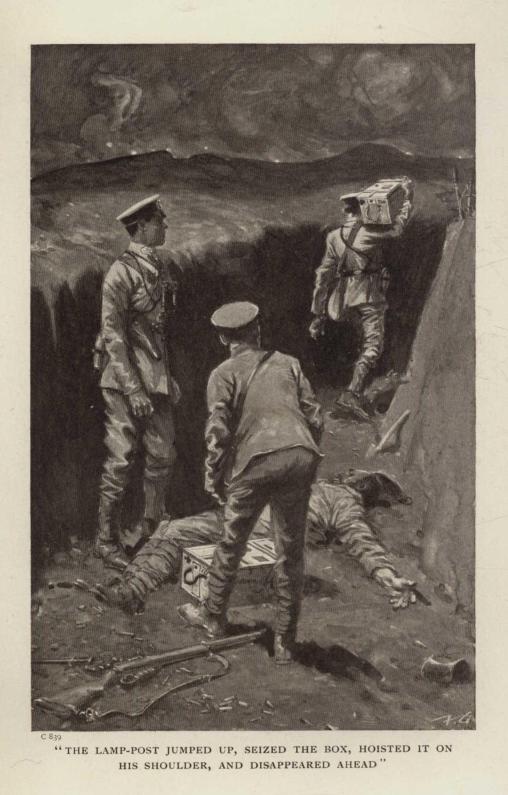
"THE LAMP-POST JUMPED UP, SEIZED THE BOX, HOISTED IT ON HIS SHOULDER, AND DISAPPEARED AHEAD"
They were very near the front trench now; the whole ridge near the lighthouse and to the left of them was almost continuously outlined by the flashes of incessant musketry.
Bubbles panted—his ear-drums were splitting—the little servant was catching his breath with half-frightened gulps. Then they cannoned against a bend in the trench, and were going on, when a gruff voice sang out: "Put it down here! Keep your heads down, damn you! Cut away back for more!"
The Lamp-post joined them, breathing hard, and together, empty-handed, they ran back as fast as the narrowness of the trench and the darkness would allow them; the noise of the bullets coming along from behind, and pinging round their ears, making them go faster.
Those two field-guns began firing just about then, lighting up the whole place with the glare of their flash, so that they could see, every time they fired, the trench in front of them, and the "drawn" faces of the men coming along it with more ammunition-boxes.
The noise of these guns and their bursting shrapnel was most comforting. They realized then why it is that soldiers so love the sound of supporting guns.
They regained the gully, dashed down it, and got hold of more ammunition. Each of the midshipmen put a box on his shoulder this time, and left the little servant to bring up a case by himself as best he could. On their way along the trench, at a place where it was deep and narrow, they had to push past two men crouching together.
"What's the matter? What are you doing?" they asked, taking a breather.
"We're wounded," they answered in a dull, stupid way.
"Can you walk?"
"Yes."
"Well, don't block up the place. Get away back to the beach."
When they returned, these two were still there.
The Lamp-post had tripped over their feet and their rifles, and they blocked the trench.
"Where are you wounded?" he asked savagely.
"In the arm," one said, holding his right arm; the other growled sullenly that he'd been hit in the shoulder.
Like lightning the Lamp-post pulled up the man's sleeve and his shirt-sleeve, and ran his fingers up the arm. He tore open the other man's tunic, and passed his hand under his shirt and over his shoulder—felt nothing—felt no blood on his hands—looked at them as a field-gun flashed, and found none.
"Get out of it!" he yelled at them. "You're neither of you touched."
"We ain't 'ad nothink to eat since last night," one of them whined.
"Get out of it!" the Lamp-post kept yelling. "Go back to your regiment," and losing his temper completely, as the two men never attempted to move, struck one in the face—hard; but he was so absolutely cowed and exhausted that he only uttered a pitiful moan, and sunk a little farther down in the trench.
"If you are here when I come back," the Lamp-post hissed, "I'll shoot the two of you!" and the two snotties doubled back for more ammunition, passing the little servant staggering along under his load. "I'm all right, sir!" he gasped as they passed along the trench. When they did come back for the third time, those two men had disappeared, they never knew where. They were the only panic-stricken men they saw that day or night.
On their third return journey the volume of fire was appreciably lessening, and they brought back word that no more ammunition was wanted in that direction. They were sent back to the beach party, and wandered about for a long time on the exposed slope above the gully until they stumbled across them, and reported themselves to the Commander. "We took up six cases between us, and the Captain's servant—that little chap—took up two at least." Then they flung themselves down beside their friend with the telephone, who told them that "all was gay".
Most of the men in that trench were sound asleep, and the two tired snotties would have fallen asleep too, had not the Pink Rat glided along the trench to ask them where they'd been and what they'd done.
"I should have loved it," he kept on saying, "only the Commander wouldn't let me go."
They did not altogether believe him.
Rifle-firing had now dwindled to an occasional shot from some nervous rifle. The Turks by this time had given up any idea of pushing our people back into the sea, and only the two field-guns kept up a monotonous barking all night through.
Just before dawn the beach party was withdrawn, and staggered down to "W" beach to commence another day's work; and, later on, Bubbles overheard one horny A.B. explain to a fat A.S.C. sergeant: "If those soldier chaps 'ad given way a bit, us chaps would 'ave 'ad a chawnce; but they 'eld on—the silly blighters!"
That beach party, ever afterwards, had a grievance.
Before the men "set to" again, they were given a little time to get food. Then they started to unload more stores. Stores simply poured ashore: clumsy bulky things like water-carts—more guns—two 60-pounder "heavy" guns and their limbers (these were placed in position behind the ridge, almost at the end of the Peninsula)—reels of telephone cable—tents for stores—hundreds and hundreds of boxes of ammunition—balks of timber for piers.
Horses began to arrive—big fellows for the heavy guns—Clydesdales perhaps—great lovable fellows with a roguish eye for the beach, which made the sailors love them all the more. These last they handled as no one else in the world can handle them. Give a bluejacket anything on four feet, from an elephant to a pig, and he'll get it ashore all right. They've got "a way with them", and can coax a nervous horse or an obstinate mule better than anyone else—or think they can, which is more than half the battle. Perhaps the whole secret lies in the fact that they are so accustomed to shifting heavy weights that, if a beast resists all their blandishments, they know that hauling on to a rope passed round their "sterns" will work the oracle.
Luckily, by the time they reached the shore in horse-boats, these poor, patient creatures had gone through so many extraordinary experiences that they did not worry much what happened to them. It was grand to see their pleasure when they felt firm ground once more under their feet and, when they were taken up the gully, saw grass growing once again. Mules came—mules in hundreds; but nobody can be really fond of a mule—not in a passing acquaintance, anyway.
The Sappers made great headway with their pier of trestles, casks, and planks—No. 3 Pier—some way to the east of the pontoons they had placed in position, the day before, and called No. 2 Pier. They also discovered a freshwater spring at the foot of the cliffs, about two hundred yards beyond "W" beach. The discovery of this seems now a little matter, hardly worth recording; but quite possibly it was the most important event of the twenty-four hours.
That day, also, the few Turkish prisoners who had been captured, unwounded, set to work with a will to build a small breakwater, which eventually became the base of No. 1 Pier.
The "Howe" Battalion, R.N.D., also began making roadways.
Work for the beach party became slacker towards night, not because there was less to do, but because the men were absolutely "played out". Officers and men had a regular "stand off", after dark, and a proper meal. They also had time to peg off the site for the naval camp with ropes, just below the Ordnance Store Depots, and to lay down some strips of canvas on the sandy ground. They were also put in two "watches", half of them working for four hours, and the other half working for the next four, and so on.
Bubbles, who had the first watch "off", crept under his bit of canvas and fell asleep in a "brace of shakes", whilst the Lamp-post stalked back to the beach with his own section of men, and went on working. If it had been light enough to see that young officer's face, you would have noticed that his eyes seemed to have sunk back into his head, and that he kept on biting his lips to keep himself awake.
CHAPTER XII
Off Cape Helles
The movements of the transports, store ships, and auxiliaries of all kinds were controlled from the Achates, and to cope with this work additional officers had been attached to her. An Admiral hoisted his flag in her, and brought his Staff, including two Assistant Clerks; three Captains joined as Naval Transport Officers—"N.T.O.'s"—and round her gangways hovered, night and day, a restless crowd of steamboats, picket-boats, and pinnaces—lent for various purposes from other ships. Each of these steamboats had its midshipman—some of them two, working watch and watch, twenty-four hours "on", and twenty-four hours "off" duty—with the result that the Honourable Mess was completely overrun with strangers.
With the Pink Rat, the Lamp-post, and Bubbles away all the time, the Orphan, the Hun, and Rawlins—who relieved these, two in turn—away most of the time, and the Pimple spending most of his days and a good many of his nights visiting transports with the Navigator, when that officer went away to anchor them in their proper places, there was practically no one left except Uncle Podger, the China Doll, and the Sub. Now the Sub was in charge of all steamboats; it was his duty to hoist them out of the water when they required repairs, to get the repairs carried out as quickly as possible, and then hoist them into the water again. He also was in charge of all the coaling and watering of these boats. These duties kept him so constantly employed that he very seldom spent much time in the gun-room. In fact, Barnes generally left something in his cabin for him to eat, whenever the opportunity permitted.
Of all the Honourable Mess, practically only Uncle Podger and the China Doll remained and came to meals as before. The result was that, twenty-four hours after the Achates had anchored off "W" beach, the mess groaned under the weight of the Barbarians, and the Midianites, in the guise of tired, hungry snotties from other ships, and the Admiral's two Assistant Clerks had descended, pretty completely, on the fruitful land of her gun-room. They crowded down into it in their Condy's-fluid-stained "ducks"; they lay on the cushions and slept; lay in the one easy-chair and slept; came in at all hours of the day and night, demanding food, and drove the patient Barnes and the little messman nearly off their heads.
The miserable little rat of a messman, thoughtless of the morrow, and eager to turn an honest penny just as quickly as he could, produced all the stores he had laid in at Portsmouth and again at Malta—stores which had been intended to delight the stomachs of the Honourable Mess for many "moons": tins of dainty biscuits, cakes, boxes of chocolate and preserved fruit, bottles of anchovies, jars of bloater and anchovy paste, jars of Oxford marmalade, and tins of Oxford sausages and of tongue—and many other rare delicacies, impossible now to replace; and this insatiable crowd of sojourners realized, like one man, that though their work was hard and the hours long, their feet were indeed cast in fruitful and pleasing places. Now the Pimple and the China Doll worshipped their stomachs with an unswerving devotion, unalloyed by the pangs of indigestion, so watched these intruders working havoc among the gun-room stores with feelings of keen agony. They realized, only too well, the barrenness which would soon fall to their lot, and they implored the Sub to stop these devastating demands on luxuries and "extras" before it was too late. Worst blow of all: that one last barrel of beer wouldn't drip another drop, however hard you blew down the vent.
But the Sub was so seldom in the gun-room that he did not, for the first few days, realize the impending danger. It was on the third day, just as he had received an imploring, urgent order from the Commander, "to hoist in the General's picket-boat and hack away a coil of rope which had wrapped itself round the screw and shaft, and get her into the water again as quickly as ever he could", that he was waylaid by these two young gentlemen, who rushed to him with anxious faces. "Can't something be done? It's simply awful! One of the Lord Nelson's snotties has just had his second box—his second box to-day—of those "chocs" with walnuts on the top!"
They ran back much faster than they came; but that very day the Sub had the whole tragedy brought vividly before him, when, later on, going down to his cabin for a cup of tea, and feeling he wanted something "tasty", he ordered a pot of anchovy paste.
Barnes came back with a long face. "That 'ere rat of a messman, 'e's been and gone and let all of 'em strange young gen'l'men 'ave all the han-chovy, sir. 'E ain't got none left, sir, but 'e 'as just one pot of chicken-and-'am what's gone an' got a bit mouldy. There won't be 'ardly nothink left of nothink, what with them strange young gen'l'men, and the young gen'l'men what's gone with the beach parties a-sending off chits for this and chits for that, as if this 'ere ship was a Lipton's store-shop."
"It's just as bad along in the canteen, for'ard, sir," he added dolefully; "beach parties and all of these stranger boats' crews, they've just been and gone and raided it, that they 'ave; nothink there now, scarcely, but penny bottles of Worcester sauce and tins of blackin'. It ain't 'ardly fair; no, nor it isn't."
Even Uncle Podger thought things were going too far when one day a midshipman from one of these ships ordered four tins of Oxford sausages to be sent down to his boat's crew.
"It may be very pretty to watch," he said, finding the Sub in his cabin, "but it's rotten bad luck on us."
The Sub was worried. "You see, it's like this," he answered; "they're rather like guests, and we can't be rude to them. But I'll write out a notice which won't hurt their feelings, and may be some good; we'll stick it on the notice board."
He wrote out several; he didn't like any of them, and tore them up, saying: "We can't be rude, can we?" And then, getting impatient, tore up the last, and burst out with: "Well, let the blessed things go, and don't let's worry, Uncle, old chap! You and I aren't particular."
So things took their course unchecked, till the messman, at the end of ten days or so, announced to the rapacious throng, and the miserable Pimple and China Doll, that he had nothing left in his private store except one bottle of pickles and a bottle of Eno's fruit salt. Even that pot of mouldy "chicken-and-ham" had been "taken up".
It is certain that if the Pimple or the China Doll were asked, now, what went on during the days following the landing of "The Great Adventure", and what struck them most forcibly, both of them would tell of the snotty who had eaten two boxes of "walnut chocolates" in one day—the two last boxes in the messman's store.
The China Doll would also recount days of unaccustomed toil, when he was attached to one of the Naval Transport Officers as Clerk, and had to copy out sailing orders and check lists of arrivals and sailings of ships; work which frequently interfered with his great delight of climbing to the main-top, and looking through the range-finder there (against all orders, it may be said) at the shells bursting on the slopes of Achi Baba and among the windmills and houses of the village of Krithia. For the first few days he had felt very proud of his new job, carried a big correspondence book about with him, and felt himself as important as those very important young officers, the Admiral's Assistant Clerks; but as the days wore on, it became monotonous and irksome. The Captain whom he thus "assisted" was none too gentle with his mistakes—which were many—and he wished that the old days would return, when he had nothing to do but sit on the office stool in front of a ship's ledger, and kick his feet against the bulkhead until Uncle Podger told him to clear out of it. If only he kicked that bulkhead hard enough and often enough, Uncle Podger would never keep him long. It had been such a pleasant kind of a life, and in those days he had only to run into the gun-room and make some cheeky remark, to be rolled on the deck and be ragged; but even that was finished; the gun-room was no longer like home nowadays, for the snotties were mostly strangers, who took no notice of him if they were awake; and even if the Orphan, Rawlins, or the Hun happened to be there, they were much too tired to skylark. With the Pimple, who was more often available, he did not like skylarking, for the Pimple generally hurt him—intentionally.
So, what with one thing and another, the China Doll was not entirely happy whilst he copied out these "silly" orders, and guns thudded from the ships all round him—guns whose shells he could not always run up on deck to see burst.
There was so much to see, and it was so irritating to come out all this way to the Dardanelles, and then to find that he had to stick in a stupid office just when some of the most exciting things were going on. However, he could always make sure of watching a duel between the howitzers on the Asiatic shore—somewhere behind Kum Kali fort—and the ship told off to keep them quiet—the Prince George or the Albion, sometimes the Agamemnon. At almost any hour of the day he went on deck, he could make certain of soon seeing a splash leap up, close to whichever ship was on duty, and then see her fire her 12-inch guns, and watch till the brownish-red or black clouds flew up behind Kum Kali ridge as the shells burst, hoping intensely that bits of "Asiatic Annie" were flying up in it, and wondering what the spotting aeroplane, circling high above in the blue sky like a hawk, had seen and signalled.
Then there were the shrapnel bursting behind "W" beach, and the little shells which sometimes burst there, but, more often than not, only buried themselves with a little spurt of dust. He would wonder whether Bubbles or the Lamp-post had been hit, and hoped they had not, because they had promised to send him off a shell, or anything interesting, as a curio. And, later on, there were the high-explosive shells, which sometimes burst in the air over that beach, and at other times burst on the ground with a horrid noise which frightened him, even where he was, in the ship, and made him rather alter his mind about going ashore to see the fun.
The Turkish aeroplanes, or German most probably—the "Taubes" he had heard so much of—they came often; and at the first news of "hostile aeroplane approaching from the north-east" he would dash on deck, and try to spot them as they appeared over the top of Achi Baba—little moving spots which he lost sight of, if he was not very careful, until they came nearer and nearer, and the sun made their wings glisten like silver. He knew that each carried bombs, and often he could actually see these little things at the moment they were released from the body of the aeroplane, to burst somewhere near "W" beach, raising a cloud of dust and smoke, or drop in the sea among the ships, sending up a rather silly splash—such a waste of energy. And it was so "ripping" to hear guns firing at the aeroplane and see the shrapnel bursting. He did so long to see one crumple up and come tumbling down, but he was always being disappointed; and when that particular aeroplane had seen what it wanted, dropped all its bombs—seldom where it wanted—and turned back up the Straits, the China Doll felt rather miserable.
Sometimes British and French aeroplanes went up after the Taube, and chased him to his home up above the Narrows, whilst the Turkish shrapnel burst round them just as they had done at Smyrna, only making better shooting as the days went on and their practice improved.
At first the British and French aeroplanes had their home at Tenedos; and if they rested, slid down on the open ground close to Helles lighthouse, flighting back to their island before dark to spend the night. That, too, was always "pretty to watch", as Uncle Podger would have said.
Then the bombardments of Achi Baba and Krithia, on the days that the troops attacked, gave him intense enjoyment; and sometimes, though not often, the China Doll, from his post up aloft in the main-top, could see, through the forbidden range-finder, little groups of khaki figures darting about among the scrub and the ravines which intersected that plain, though he could never be sure whether they were British or Turks. But what excited him most, and kept him in some quiet corner for hours, holding on to the rigging or a stanchion, stretching his head out in the dark, and hardly daring to breathe, were the night attacks by the Turks. The noise of them would wake him, and up on to the after shelter deck he would slip, in his ragged pyjamas, and watch the glare of the field-guns, the bursts of shrapnel-flame, the bright star-shells as they sunk in graceful curves of dazzling white light, and would listen to the rattle of the musketry and the Maxims, and the fierce barking of the guns—especially of the French "75's".
On one of these nights Mr. Meredith found his funny little figure squeezed up against the rails, close to the life-buoy.
"Hullo, youngster!" he said cheerfully. "Would you like to be right in among it all—there on shore?"
"No, sir! I mean yes, sir! No, sir!"
"Which do you mean?" he asked.
"I don't know, sir. It sounds so awful."
"Well, you'd better turn in. They're packing up for the night now."
And so the China Doll would patter down the ladder in his bare feet, listen for a moment at the top of the hatchway to make sure that they had stopped fighting, and then go back to the dark half-deck and his hammock, and lie listening until he could not keep awake any longer.
In the picket-boat and steam pinnace the Orphan, the Hun, and Rawlins (who first relieved one and then the other) had never, all that first week or ten days, six hours' consecutive sleep.
Steamboats! Why! fifty more would have found plenty to do; and of those which were actually available, so many were constantly in the Sub's hands being repaired, or back on board their own ships being repaired, that those remaining were running practically day and night continuously. The Hun's pinnace smashed in her stem and stove in her bows against a trawler on the Thursday, and that laid her up for two whole days whilst she was being patched. On one of these two days he took charge of a boat whose midshipman had been killed by a stray bullet at another beach—"X" beach—round the corner, and on the second he and the Orphan kept "watch and watch" in the picket-boat. For all practical purposes their only chance of a rest was when their boats ran short of coal and water and had to go back to the Achates. The job of filling up with water and coal often took half an hour—time enough to get some food, sometimes even a bath; more often, all they wanted was sleep. Occasionally they had a stroke of luck after getting back to the ship, and might be told that they would not be wanted for an hour, perhaps longer. Then the Orphan, Rawlins, or the Hun—whoever it was who had such luck—would coil up on a cushion in the gun-room and sleep, or lie down on the Sub's bunk—if he was not there—which was more peaceful. More often than not, something would happen: an urgent signal would come from somewhere or other, to take a Staff officer "off" from "W" beach to the Arcadia—the General Head-quarters Staff ship—-or to tow inshore a lighter full of stores, urgently needed—bombs, barbed wire, empty sandbags, whatever it might be; his boat might be the only one available, and away he would have to go.