A NAVAL VENTURE (continued 5)
Reading edition
Securing their prizes they shouted, "Thanks, awfully! Merci beaucoup!" hoping that they might understand French; and the War Baby, who knew a few words of Spanish, called out, "Gratia! Señoritas!" hoping they could understand that. But language did not matter; they knew what was meant to be expressed, and shrieked with laughter.
The Fleet-Paymaster, puffing along by the side of Dr. Gordon, who looked exactly like a walrus in the water, grunted out: "We're too old, I suppose, for 'em to chuck oranges at us? Let's try!"
And they did; and each got his orange, and his shriek of laughter when he tried to eat it without spoiling the taste with sea water.
All this time the China Doll, who could only swim a few strokes, did not venture far from the foot of the ladder, very miserable that everybody seemed to have forgotten him, and knowing that if he did venture out among the others he would certainly be ducked—which he hated—and very probably drowned.
Up on deck, Captain Macfarlane, grimly looking on, met the Gunnery-Lieutenant coming up from performing his trick of tossing a hoop off the top of the ladder, and then diving through it as it lay on the surface of the water—he had done this about ten times already, as if he were carrying out some drill or religious exercise.
"Mr. Gunnery-Lieutenant," Captain Macfarlane said, tugging thoughtfully at his beard; "the Great War is still on, is it not?" and the startled Gunnery-Lieutenant, the hoop in one hand, the other raised to his dripping hair in wild salute, replied: "Oh! Yes, sir! As far as I know, sir!" and, later on, gave it as his opinion that "the Skipper must be going off his head".
Presently the bugle sounded the "retire", and everyone splashed back to the ship, the members of the Honourable Mess going down to the half-deck, chattering like magpies round the Pink Rat's cot whilst they rubbed themselves down and dressed.
"I never got an orange. I do think you chaps might have brought me one," the China Doll squeaked, a little upset because no one had taken any notice of him; so they chased him round the half-deck with their wet towels, till he shrieked for mercy and was happy again.
Then they rushed up on deck, because the Hun and Bubbles meant to ask those girls on board to show them the holes made by the Smyrna shells, as some little "return" for the oranges.
The others had "dared" them to do this; and they would have asked them, but were too late—their boat had paddled back to the village.
What a dinner they had that night!
The miserable little messman, for once, had risen to the occasion, and bought potatoes, cabbages, lettuce, and onions, and fruit—oranges and bananas—which of course were "extras".
"I'm jolly sorry that the other three aren't here," Uncle Podger remarked, as he skinned his fourth orange. "Wouldn't old Bubbles have loved them? Wouldn't he have been pretty to watch?"
On these occasions, when "extras" had been provided, a comic scene always followed in the pantry. In order that the messman could know who devoured his precious "extras", and could put the names down in his book, he had to keep a very smart "look-out" through the sliding doors in the pantry bulkhead; and Barnes, who hated him like poison, would block one and then the other with his huge head and shoulders, so that he should not see which of the "young gen'l'men" had taken an orange or banana. As Uncle Podger always said on such occasions: "It was pretty to watch him and Barnes dodging each other backwards and forwards, from side to side."
Barnes would slide across one of the trap-doors, then block up the other; across would dart the little messman, slide back the one which had just been closed, and peep through it. Bang would go the other, and Barnes would be seen pushing the messman aside, muttering "'Ere you; you're getting in the way, you are", reaching through, and making pretence of drawing back any dirty plates or dishes which stood on the sideboard. And so this game went on; whilst the Pimple and the China Doll, keeping their eyes about them, would seize fruit at the most favourable moment, drop the skins on someone else's plate if possible, and if not, throw them far under the table.
Barnes, afterwards, when he cleared the table and swept up the deck, would do it to a muttered accompaniment of: "That nawsty little beggar, a-countin' up and a-puttin' down everythink of 'is beastly hextras. 'Umph!" (bang would go the broom against a leg of the table). "And who eats 'em? 'Umph! the nawsty, slimy toad. I'll learn 'im, me as what 'as a pub of 'is own at 'ome—or 'ad, afore this 'ere war a-started."
The days which followed were days of real delight, never to be forgotten by the Honourable Mess, who revelled in them and in the noiseless, peaceful nights when they slept on the quarter-deck, and woke to slip off their pyjamas and plunge over the side into the transparent water.
In a week's time, very early one morning, up the harbour came the grey picket-boat with the Orphan; behind her followed Trawler No. 370 with Bubbles, the Lamp-post, and all that was left of their beach party.
"Come along, you chaps!" called Uncle Podger, waving his towel, when at last they came aboard. "My! but you do look scarecrows! Off with your grubby clothes and flop in. It's simply splendid!" They did flop in; and that morning's bathe, when the Honourable Mess was once more united, was a memorable one, especially to the "War Baby"—the officer of the watch—who could not make them come out of the water until long after the regulation time, and until the Commander had twice sent for him to know why he didn't stop that confounded noise round the foot of the ladder.
They arranged a grand picnic next day, and hired two of the little Greek sailing-boats which ferried people across from one side of the harbour to the other. They bought a basketful of oranges from the Greek boats alongside—it was cheaper to do this than to get them through the messman—they took a kettle of water, tins of jam, milk, and butter, loaves of bread; and away they went, with a merry breeze, the whole crowd of them, the Sub, Uncle Podger, the Orphan, Rawlins, and Bubbles in one, the Lamp-post and the remainder in the other. They raced the two boats to a tiny island at the mouth of the entrance of the harbour, beached them without rubbing off much paint, stripped, and larked in the water and out of it, on the grass under some trees.
Then the China Doll and the Pimple were appointed "cooks of the mess", and wandered off to collect driftwood to make a fire on the beach, whilst the others stretched themselves on the grass to dry themselves until they were too hot, then plunged in again till they were cool. By the time the fire had begun to crackle famously the Sub, Uncle Podger, and two of the snotties—the Lamp-post and Bubbles, who were over eighteen years old—had found their pipes, lighted them, and were puffing away luxuriously. The Sub, whose heart warmed benevolently within him, called out: "Carry on smoking, my bouncing beauties—every mother's son of you—so long as you aren't sick!" So off dashed the others to their clothes, and produced the well-worn pipes which they had brought with them, hoping that the Sub would be in a good temper. Even the China Doll produced a cigarette case, and made a great fuss of lighting a "Virginian", puffing at it like a girl, then holding it in his fingers because the smoke made his eyes water. "No 'stinkers'! No 'gaspers' here! Phew. What a horrible smell!" the others shouted. The Orphan pretended to faint, Bubbles threw himself down in the grass and groaned.
"I haven't any 'Gyppies'," pleaded the Assistant Clerk. "You smoke 'stinkers' yourselves sometimes.
"Only on board, China Doll, to drown the smell of the gun-room, when you're in it," Bubbles gurgled. "Get to leeward, you little stink-pot!" The Pimple and Rawlins made a rush for him; he dodged them, and waded into the water.
"Come back!" they shouted as they followed him. "We're getting wet; we can't swim a stroke," and drove him out until only his head and neck were above the water. They made him smoke it there, throwing clods of earth at him whenever he attempted to take it out of his mouth to prevent his eyes watering.
"Nice, quiet, gentlemanly lads," said Uncle Podger from the grass. "Very pretty to watch, aren't they?"
But the Pimple—earnestly occupied in keeping the China Doll and the "overpowering" smell of his tiny cigarette from destroying the aroma from nine fairly foul pipes loaded with "ship's" tobacco—and the China Doll thus engaged, with only his head above water, were neglecting their duty as cooks to the Honourable Mess. The kettle was trying to lift off its lid, and threatened to fall over.
It was saved just in time, and the Pimple, violently seized by the Hun and Rawlins, escorted back to his duties, whilst the China Doll waded out with his cigarette damped and "dead".
The Sub, Uncle Podger, and the Lamp-post lay and smoked, and watched the others carrying all the paraphernalia of tea from the two boats to a little place under a shady tree, cutting slices of bread, and opening the tins of milk, butter, and jam.
"Isn't this an extraordinary change from ten days ago?" said Uncle Podger presently, with a great sigh of enjoyment. "The whole place looks as if it had never even heard of such a thing as war."
"It may look like it, Uncle, but you'd be nearer the mark if you said that it had never really known peace," the Lamp-post said. "Why, Mytilene, and the other islands round about here, have seen fighting all through history—history was made in these parts—right away from the year one—five hundred years before it, too, and they haven't known peace—not for any length of time—ever since. The Phoenicians, Athenians, Carthaginians, Romans, Persians, Syrians, Turks, and Greeks—they've all had a "go" at it—landed and killed the men, garrisoned the place for a few years, till they were "booted" out or killed by the next little lot to come along.
"I was only asking the Interpreter[#] this morning, and he told me that there are villages up there" (and the Lamp-post pointed across the harbour to the slopes of the hills) "which are full of Turks, and they daren't come down to the Greek villages except in numbers and in the daylight—nor dare the Greeks go up to them—for fear of being killed. He told me that the Greeks and Turks are always fighting on these islands, and on the mainland right along the coast to Smyrna. The Greek chaps get on their nerves; they work hard, are smarter business men, lend money, which makes them very unpopular; and there are so many of them in the coast towns that the Turks are really frightened of them, so they kill them whenever they get a comfortable opportunity and can raise the energy. Hereditary enemies they are, and vendettas go on just as they have done for centuries; but the Turk has generally got an old rifle, of sorts, so it's the Greek who gets killed in the long run.
[#] The Achates had a Syrian interpreter on board.
"You see," went on the Lamp-post, "all the Turkish soldiers who used to keep the peace—sometimes—in the villages and small towns have been withdrawn to Smyrna or the Dardanelles, and now they are away the Turks and Greeks are at each other's throats hammer and tongs. The Interpreter told me that there are more than thirty thousand refugees from the coast in Mytilene alone, and thousands more are trying to escape before they are killed."
"That's why the Greeks here are giving the Turks in the hills such a rotten time, I suppose?" the Sub asked.
"It rather spoils the picture," Uncle Podger said; "I wish you hadn't told us."
"Let us go, some day, and see the castle at Mytilene," the Lamp-post suggested. "The Interpreter says that it was started five hundred years B.C.—by the Phoenicians or someone like them, and has been added on to by everybody else ever since. He says you can see some parts which are Roman and some which the Persians built. I'm frightfully keen on things like that," he added apologetically:
"Come along, you chaps! Everything's ready!" the others shouted, carrying up the kettle of boiling water.
A grand tea they had, although the Orphan upset a good deal of the only tin of milk over himself. That did not matter much, for they managed to save most of it with spoons.
"Pass the Orphan, please," one or other would say, "I want some more milk;" and whoever was sitting next to him, Bubbles or Rawlins, would sing "He's too heavy," and pretend to scrape more milk off his bathing-suit.
The China Doll and the Pimple, however, felt that there were two things lacking to make the picnic a complete success—sardines and some tinned sausages to cook over the fire; but, of course—and they sighed heavily—the gun-room store was empty.
The China Doll, presently, blinked and blushed, and suggested that they should ask the War Baby to the next picnic. There was a shout of "He's all right, but he doesn't belong to the gun-room—this is a gun-room picnic."
"But, if he came, he might bring some sardines and 'bangers'. I know they have some in the ward-room—I asked their messman."
"You're a perfect marvel, China Doll; fancy thinking all that out in your noddle!" the Pimple said admiringly. "I votes we do ask him."
Then the Orphan, catching sight of the wet remains of that "Virginian" cigarette lying in the grass, pretended to faint; and when he'd been revived by a convenient twig twirled round inside his nose, groaned: "I'm awfully sorry, you chaps, but didn't you notice that awful smell again," and pointed to that unhappy cigarette end.
"Don't be silly," the China Doll kept on saying, blushing and trying to hide it; but they sent him twenty yards along the beach, made him scrape with his hands a hole, a foot deep, in the muddy sand, and bury it there. "You've eaten all the oranges," he almost "blubbed" when he returned. "My back's all sunburnt, and my feet are tingling. I've been treading on something which hurts."
They threw some oranges at him and made him happy, but he kept on looking at the soles of his feet.
"Well, if you will tread on sea-urchins' eggs you can't expect anything else," the Lamp-post said, having a look at them himself.
"Lend us a knife, somebody; he's got thirty or forty of the spikes in his feet." But the pain of having them extracted with a pocket-knife was too much for the Assistant Clerk; he said he'd get Dr. Gordon to take them out when they went back to the ship. He ate his oranges, and looked rather miserable whilst he dressed, slowly.
The others played the newly invented "submarine game", standing in a ring with the water up to their chins, their legs wide apart, and stones in their hands; whilst the Orphan, who took the part of a submarine, started in the middle, dived, and had not to come to the surface before he had torpedoed somebody by swimming between his legs. If any part of him showed up above the surface, or he came up to breathe, the others threw stones at him; and if he was hit he had lost, and started again. The torpedoed one had to change places with the "submarine"; and when the fat Bubbles was at last torpedoed and had to take this leading part, you can imagine that parts of him showed very often, and he laughed so much that he couldn't keep his head under for ten seconds at a time.
"Very pretty to watch," remarked Uncle Podger. Then they all scrambled out, dried themselves in the sun, dressed; stowed away all the tea "gear" in the boats—the kettle, teacups, knives, spoons, and plates; carried the China Doll down to the boat to the tune of "John Brown's body lies a-mouldering in the grave"; had a search for a missing spoon; found it; shoved off, and raced back to the ship, the losing boat's crew to pay for the oranges.
"Off you go to Dr. Gordon," the Sub told the China Doll, "and just pretend those feet of yours don't hurt you. If you go limping about looking like a dying duck in a thunderstorm, you won't get the kind of sympathy you want—not from me!"
"That youth behaves like a little girl. He always wants people to take notice of him and pet him. Whatever will he be like when he grows up?" the Sub said afterwards to Uncle Podger.
"A good beating twice a week would make a man of him," advised the Clerk. "He is a good enough little chap, but he does want beating."
"I'll see what can be done," answered the Sub thoughtfully.
At that time the Greek population was extremely polite, and glad to see British Naval uniforms. Everyone who passed took off his hat, the girls were all smiles, and the children flocked round, holding out flowers, though their homage was slightly diminished by insistent demands for "one pen-ny". In fact, they became a beastly nuisance after a while.
Now you must understand that the Achates had not been sent to Ieros for the purpose of providing entertainment for the gun-room officers, but to superintend the blockade of Smyrna. To make this blockade effective, she had under her orders two mine-layers, some destroyers, and some submarines. These were always going out or coming in through the picturesque entrance, and the submarine off duty used to make fast alongside the Achates. Naturally she proved a great attraction to the gun-room officers, who used to bother the lives out of the sub-lieutenants—seconds in command—to show them round.
One of these, a cheery sportsman, burst out with: "Oh, hang it all! Come along, every one of you; four at a time, and I'll work through the whole blooming Mess and get it over and done with."
He did get it 'over', though the last four, the China Doll among them, were rather a trial.
"But if," bleated the Assistant Clerk, standing on the plates below the open conning-tower, "if you did happen to dive when the lid was open, wouldn't the water come in?"
There was a roar of laughter from the others (which he wanted); but the second in command, whose patience had not yet quite vanished, said: "Oh, that's nothing! that often happens. We just stand down here, puff out our cheeks, and blow up through the conning-tower—blow very hard until someone climbs up and puts the lid on again."
"Is that really true?" gasped the China Doll, not quite certain whether he was being made a fool.
Much as the officers appreciated the change of scene at Ieros, the men appreciated it still more. All except the beach party and the boats' crews (a very small proportion) had been cooped up in the noisy, crowded mess-decks ever since leaving Port Said. They to could now go ashore occasionally; twice a day they could jump overboard and swim in the glorious, buoyant water alongside, and once a week route marches took place early in the morning, before the sun became too hot. These route marches, however, were not very popular.
You may be certain that the first time Fletcher the stoker went ashore, he took "Kaiser Bill" with him.
"You should have seen him nipping off the bits of grass," he told the Orphan later on; "he did enjoy himself, sir!"
Whilst here, the wireless press news came each morning, and was not reassuring, for the Germans had commenced their advance through Galicia and into Poland, and nothing seemed able to stop them. News, too, from the Peninsula was bad—nearly a thousand men had been lost when the transport Royal Edward was sunk by a submarine, and another desperate attempt to capture Krithia had failed with heavy losses.
As a set-off against all these dismal tales there were rumours of mysterious monitors on their way out with heavy guns, of reinforcements pouring eastwards, and of the brilliant exploits of our own submarines above the Dardanelles, in the Sea of Marmora.
CHAPTER XVI
A Glorious Picnic
Among the many queer characters they met at Ieros, none was more quaint than a Mr. M'Andrew, who appeared on the scene in a very smart, rakish little motor yacht with two masts and a gay awning, very reminiscent of the River Thames. Sometimes he appeared flying the Greek flag, and bringing the rubicund military governor of Mytilene to "protest" against the British having done "this" or "that"; with a cheery "Au revoir, Messieurs; à Constantinople!" when he left the ship. At other times he flew the red ensign, and took Captain Macfarlane and the Commander for—as far as the gun-room knew—pleasant little sea trips. Generally he flew no flag at all, and had a most motley crew of picturesque brigands with him.
Occasionally the yacht used to lie alongside the Achates, and once or twice the Sub tempted Mr. M'Andrew down into the gun-room to take a glass of iced soda-water, of which he seemed excessively fond. He never touched alcohol.
He looked like a retired bank-manager who possibly devoted his leisure to teaching in a Sunday or "ragged" school; he was broad and plump, and perhaps fifty years of age—a most placid-looking individual who always wore an old, but not shabby, blue suit, across the ample waistcoat of which stretched a very thick gold watch and chain. He talked very simply—as if talking was mere waste of breath—and his conversation was chiefly about soda-water and the places he remembered where you could buy it cheapest. He always carried a bunch of raisins in one of his side-pockets, and ate them deliberately, one at a time, whenever he was not smoking a very old briar pipe. The Sub used to ask him to dinner or lunch, but he would refuse. "No, thank you; I never have meals; I just go on munching raisins, and have some bread occasionally."
Rumour had told the Honourable Mess that he was really a daring pirate, and led forays against the Turks in the little bays on the mainland—over against Mytilene—though never a word could they get from him about his adventures—about anything, in fact, except soda-water, the merits of dried raisins, and the unfortunate family troubles of his crew.
There was one old man who used to sit on the top of the deck-house all day long without saying a word to a soul—a shrunken old Greek with very sharp features and black eyes which seemed to blaze from their deep sockets in the most startling way. When you first saw him he looked a poor, withered, feeble old "dodderer", in spite of the Winchester rifle he always gripped across his knees, and the two filled bandoliers of cartridges round his waist and shoulders; but when he turned to look at you the fierceness of his eyes gave him a most extraordinary appearance. Mr. M'Andrew used to take him down a loaf of bread—provided by the gun-room—pat him on the shoulder, and say a few words to him. "Poor old man!" Mr. M'Andrew told them, "poor old man; he's rather miserable. You see, he and his three sons kept a flock of sheep on some little island near the coast, and the Turks came along, killed his sons and the sheep, and tried to kill him, but he managed to escape. He knew of a crack in a rock, where he hid by day—for three days—crawling out at night to suck the grass and eat berries and leaves, until the Turks gave up looking for him and went away—thought he must be dead. I just happened to be going past there yesterday, saw him wave, and brought him along. He won't be really happy again until he's killed a Turk for each of his sons; he thinks I'll give him the chance soon, so won't leave me."
"But shall you?" the Honourable Mess cried with one accord.
"This really is not at all bad soda-water," Mr. M'Andrew went on in his slow, deliberate way. "I remember when I was in Mexico—no, it reminds me of some I got at Haiti during the revolution, the one of 1901. As I was saying, most of my crew have had a good deal of family trouble one way or the other. There's that little lad who cleans the brasswork. He's the only one left of a family of twelve—father, mother, brothers, and sisters. He hid in the roof when the Turks cut the throats of the others one night. He came along here—no, I don't know how—and wants me to let him have a rifle. Oh, those other chaps; nice, gentle-looking fellows, aren't they? They can't bear the Turks—more or less for the same reason! Some of their relatives have been killed by them, or they've been driven away from the mainland and have nothing left of farms, or shops, or flocks, wives or children. They just come along to me, and I lend them some old rifles I just happen to have."
"Have they had a chance of using them?" the snotties asked. "Most of them say they have killed a Turk or two; tell me so when they come first. And I expect they have," went on Mr. M'Andrew in his placid voice, feeling in his pocket for another raisin, and fumbling with the fob of his gold watch-chain.
The China Doll, in fact all the gun-room officers, spent a good deal of time watching him moving about among the fierce, black-eyed ruffians, who sat about the deck of the smart little motor-yacht with their bandoliers across their shoulders, their rifles (which Mr. M'Andrew just happened to have lent them) gripped firmly in their hands. They cleaned these interminably, and Mr. M'Andrew walked about and spoke a few words to each, just as you could picture him walking about the boys in his Ragged School in Glasgow, distributing raisins and bread to them just as he might have done to his boys.
One day the motor-yacht towed in a clumsy, old, local trading schooner, and anchored her abreast the Achates. She turned out to be a Turkish trading ship which had been becalmed off some Greek village. The Greeks captured her, and had killed at least one of her crew, for his body still lay on the deck, just at the break of the poop.
"Oh, no!" said Mr. M'Andrew, in genuine surprise, "I had nothing to do with it. I simply found her a derelict and towed her in here. The rest of the crew were probably killed as well, but thrown overboard. Oh, no! that's nothing unusual."
The dead Turk was handed over to the authorities, and this lumbering old derelict—she looked at least fifty years old, and was probably a hundred—swung at anchor, close to the Achates, for some days.
The Sub had a brilliant "brain wave", and suggested that the gun-room should commission her, one day, for a picnic. Captain Macfarlane gave permission, and then came the question of asking the War Baby. Finally it was unanimously decided to do so; and—"Well", as Bubbles said when he gave the invitation, "if you can bring some sardines and sausages along with you, so much the better." They asked Mr. Meredith, the R.N.R. Lieutenant, and Dr. Gordon, the R.N.V.R. Surgeon, and they asked the Padre too; and, wonderful to relate, that pale-faced little man jumped at the offer—"so long as he could smoke his pipe all the time". The other two of course accepted.
After dinner, and after considerable deliberation and more noise, the following notice appeared on the board in the gun-room, under the alarum-clock and the five broken-down wrist-watches:—
NOTICE To-morrow, Thursday, 17th June, H.M. Schooner *What's Her Name* will be commissioned, at 1.30 p.m. The following appointments have been made to her:— Captain ... ... ... ... ... ... ... ... The Sub. First-class Passenger ... ... ... ... Mr. Meredith. First Lieutenant and Boatswain ... ... The Pink Rat. Officer of Marines and Master-at-Arms The War Baby. Surgeon and Captain of the Main-top ... Dr. Gordon. Chaplain and Official Photographer ... The Rev. Horace Gibbons. Paymaster and Man-of-all-Work ... ... Uncle Podger. Captain of the Fore-top ... ... ... ... The Lamp-post. Foretopmen ... ... ... ... ... ... ... The Hun, The Orphan, Rawlins Maintopmen ... ... ... ... ... ... ... Bubbles, The Pimple. Cabin Boy ... ... ... ... ... ... ... The China Doll. Second Cabin Boy ... ... ... ... ... Barnes. The Ancient Mariner ... ... ... ... ... Fletcher the Stoker. The Albatross ... ... ... ... ... ... "Kaiser Bill". *Uniform of the day—Pirate Rig.* Coloured shirt, vest, or jersey. Trousers or shorts. Head-dress—any old thing, as long as it's hideous.
Fletcher they asked because they thought the old man would enjoy "a bit of an outing", and "Kaiser Bill" was asked because Fletcher wouldn't enjoy it without him.
Barnes, on reading the notice and seeing his own appointment, growled to the messman: "What did them young gen'l'men a-think they was a-doin' of; no, 'e wasn't a-goin' a-sailorisin' in that 'ere craft what murder 'ad been done in, an' the blood-stain on 'er deck an' all—not 'e;" but he changed his mind and went aboard with the Pirate Crew, grinning like a huge schoolboy, with his big basket of food (including the War Baby's sardines and sausages), a bucket of coal and wood to make a fire, a kettle, frying-pan, and a barricoe of water. They climbed aboard, handed up all the "gear" and their towels, and the Sub ran a boat's ensign, which he had borrowed, up to the main masthead.
"Hello, Doc! brought your Harley Street bag with you, I see." Dr. Gordon laughed. "Yes," he twinkled, "it might be useful." The little Padre, beaming, passed aboard his camera, and climbed up after it.
To give you an idea of what this piratical crew looked like, the Orphan wore a red tam-o'-shanter, a yellow-and-black sweater, running "shorts", and gymnasium shoes; and Bubbles had an old kicked-in bowler hat on the back of his head, a green football shirt stuffed into striped bathing drawers, and a pair of sea-boots. He made a picturesque villain, especially when he gripped a captured Turkish bayonet between his teeth and gurgled at the China Doll. Most of them started with naked Turkish bayonets tucked into their belts; but, on Uncle Podger's advice, the Sub sent these back in the boat which had taken them all to the What's Her Name. What a funny old-fashioned tub she was, and what stories she could have told of all the years she had been toiling round the coast, among the islands! Her high poop had rails round it, some of the wooden posts beautifully carved, but most of them of rough wood, which showed that she had "come down in the world" in her old age. Between the poop and the still higher fo'c'sle was a "well" deck, with its dark blood-stain, the foremast right amidships, and two big open hatchways, one for'ard and one abaft the mast. Round her fo'c'sle were more rails, some handsomely carved, and on it was an antediluvian windlass for hoisting the anchor. The cable was so rusted and worn that it seemed hardly possible that she could trust to it to ride out even the lightest of gales.
Her masts—the lower masts at any rate—and the wide-spreading foreyard were good, sound bits of timber, but the top-masts and fore-tops'l yards looked anything but sound, and her "standing" rigging was so chafed and so badly "set up" that her murdered crew must have been "past masters" in the art of sailing her gently to prevent her masts carrying away.
"Well, what about it?" the Sub asked Mr. Meredith, with a note of anxiety in his voice. "The breeze is blowing straight out of the harbour; if we run to lee'ard, 'twill be too narrow there to beat back, won't it? We'd best start beating to wind'ard, hadn't we? Look here," he said, "this is rather out of my line; you'd best run the show. You'd better start a mutiny right away."
As Mr. Meredith had been in sailing-ships for years, and had been Captain of a full-rigged ship before he was thirty, what he didn't know about sailing wasn't worth knowing. "All right," he smiled, "I'm game;" and seizing the unresisting Sub by the neck of his coloured jersey, hurled him to the deck with fierce yells, and planting one foot on his chest, roared: "Clear lower deck! I'm now the Captain of the What's Her Name. Now, you dog," he hissed, as the pirate crew "fell in", "get up and 'fall in' among those rascals; another word and you'll walk the plank, and your bones shall bleach on the coral islands of the Spanish Main. Ha! ha!"
The crew, overawed by his daring, and the ferocity of his appearance in a Turkish fez, a red shirt, Sam Browne belt, and khaki riding-breeches, gave three cheers for the new Captain; old Fletcher, who had put "Kaiser Bill" in a safe place where he could not fall down the hatchways, smiled indulgently; and Barnes, trying to enter into the spirit of the game, grumbled in an undertone: "This 'ere 'clear lower deck' and 'fall in' sounds too much like the real thing," and "'e didn't see quite where the fun came in."
Then the Lamp-post and his foretopmen, the Hun, the Orphan, and Rawlins, were sent off to clear the jibs and slack away the tops'l gaskets up aloft, and to learn where their proper halyards "ran"; Dr. Gordon, the Pimple, and Bubbles went aft to get the big spanker ready for setting; Barnes and the China Doll were ordered to explore the little cook-house, just under the fo'c'sle; Fletcher had strict orders to keep alight the cigar which the Sub had brought him, and enjoy himself at all costs, and all the others followed Mr. Meredith up on the fo'c'sle to heave up the cable.
In five minutes after getting on board, the Orphan and Rawlins were climbing out along the bowsprit and jib-boom, and the Lamp-post and the Hun were up aloft, out along the tops'l-yard, unlashing the gaskets and having a grand time; whilst the crowd on the fo'c'sle began levering round the old horizontal windlass ("wild cat", Mr. Meredith told them, was its proper name) with two long levers, like crowbars, stuck in the holes at each end of it.
"Let's have a 'chanty'," they called, and the Sub started "We'll rant and we'll roar"; but that did not "fit in", so Mr. Meredith gave them a very old one:
"For the times are hard, and the wages low;
Leave her, Johnny, leave her.
Last night I heard the Old Man say,
'Tis time for us to leave her."
Whilst he sung the first line to a mournful dirge, they shifted the crowbars into fresh holes, and then, hauling aft on them, joined in the chorus: "Leave her, Johnny, leave her"; shifted them again whilst he chanted the third line, and pulled to "'Tis time for us to leave her"; and each time they pulled the "wild cat" round, the links of the old rusty cable came creaking in through the hawse-pipe, and the metal pawls of the "wild cat" fell, "clink-clank", into the ratchet notches.
In a minute everybody had joined in the chanty, the Orphan and Rawlins out beyond the fo'c'sle on the bowsprit, the Lamp-post and the Hun busy aloft, Dr. Gordon and his "hands" aft. The China Doll, dashing up to have one pull at the levers, chipped in too; whilst Barnes bellowed "Leave her, Johnny, leave her" (thinking it was something about a girl) from inside the cook-house; and old Fletcher, busy with his cigar, beamed at everyone through his gold spectacles.
Presently Mr. Meredith, leaning over the bows, sang out: "She's 'up and down'. Heave away, my hearties! 'Leave her, Johnny, leave her'," and ran aft to take the wheel; the Orphan and Rawlins, scrambling back on the fo'c'sle, hoisted the jib, and in a few more turns of the "wild cat" the clumsy old "tub" began to pay off before the breeze.
Dr. Gordon, the Pink Rat, and the Pimple set the spanker, hauled taut the clumsy "sheet", and the poor old What's Her Name slowly pushed her way through the water.
"Stand by aloft!" Mr. Meredith hailed the fore-top. "Let go gaskets! Overhaul buntlines! Come down from aloft! You on deck, there! Sheet home! Sheet home! Haul taut lee braces! Right you are!" as, somewhat confused and muddled, the foretopmen managed at last to set that tops'l. "Belay all!"
Mr. Meredith made a wry face. "She won't reach to wind'ard much, Doc, with that old fore-tops'l drawing.
"Haul taut your lee braces, lads! Hoist your fore stays'l! Ease off jib sheets!"
The foretopmen were having all the sport, so the maintopmen dashed for'ard to help them; and by the time the anchor had been catted and secured, the What's Her Name was, as Mr. Meredith said, "moving as fast as a snail and as sideways as a crab". "We shan't get far to-day, Doc."
Nor did they; though what mattered that? They were as happy as kings; the "going about" was such fun; everybody had something to do, especially when the Padre, the China Doll, or the War Baby slacked off a wrong rope at the right time or a right rope at the wrong time. It was grand fun, and old Fletcher, sitting on the poop yarning with Uncle Podger, thoroughly enjoyed himself; whilst from for'ard a little column of grey smoke, and an occasional bellow of "Leave her, Johnny, leave her", showed that Barnes, getting tea ready, was also quite happy.
The China Doll stole aft and called up to the Pimple, standing on the main "cross-trees", above the spanker "jaws": "Pimple, I say, Pimple, there are five tins of sausages. Isn't that grand?"
Suddenly, from for'ard, there came shrieks and agonized yells for Fletcher.
"Fletcher! Hurry! Come quickly! Help! Help!"
The Orphan and the Hun flew up the rigging, yelling "that 'Kaiser Bill' had broken loose, and was attacking them"; Bubbles, bursting with laughter, climbed the dangerously weak ratlines after them; the Lamp-post and Rawlins swarmed up the rigging on the other side, and even the little Padre, catching the infection, sprang up as well.
"We won't come down till he's chained up. Look at him! Careering round and snapping at everything. Save us, Fletcher! Save us!"
Old Fletcher, smiling kindly, came along from the poop, asking: "Where is he?"
"There; there—near the water-butt! Do be careful! Get at him from behind. Wave a lettuce leaf in front of him. We've brought a lettuce in case he attacked us. Barnes! Barnes! Bring the lettuce! 'Kaiser Bill' has broken out!"
The old stoker, peering about for the tortoise, found him just where he had left him—his legs and head well tucked "inside"—-picked him up, placed him inside his "jumper"; got a lettuce from Barnes, who grunted "they young gen'l'men will be a-breaking their blooming necks afore long, I reckon"; and went aft again, to try and tempt the tortoise to put his head out, and show some interest in the picnic.
Then the Padre and some of the snotties ventured on deck, again, though most of them preferred to lie out on the tops'l-yard, which was so frail, and its "lifts" so badly "set up", that it bent ominously, as did the fore-topmast itself.
"Come down off that yard!" Mr. Meredith shouted. "Only two of you are to be there at a time."
They begged him to let them set the upper tops'l, but that yard was more like a broom-handle than anything else.
"The Hun can do it; no one else. The mast is rotten, and the yard too," Mr. Meredith shouted. (The Hun was the lightest of all the midshipmen.) So the others gathered in the "top" and watched the Hun swarm up the topmast, and so out on that tiny yard, casting off the gaskets of the tiny sail.
Then they dashed down on deck, before Mr. Meredith's voice bellowed out: "Let fall upper tops'l gaskets; overhaul your buntlines; sheet home, sheet home. Belay all!"
Then came the "pipe": "Clear lower deck! All hands 'bout ship'!"
When once the ship had tacked away from the shore, most of them made some excuse or other to find their way aloft again or out on the bowsprit; and though it may have looked curious to see the What's Her Name slowly beating to wind'ard, backwards and forwards, across the harbour, with most of her crew up aloft or clinging to the bowsprit all the time, what did anything matter? They all enjoyed themselves hugely; those up aloft sniffing as the fragrant odour of cooking sausages floated up to them from the cook-house.
Tea-time came before they knew it.
"Seven bells, Bos'n," Mr. Meredith called out. The Pink Rat found an old tin and beat it. Everybody sang out for Barnes, came down from the mast, the bowsprit, or the poop, and rushed to help bring aft all the luxuries.
Old Fletcher fidgeted and looked at the Sub.
"Right you are, Fletcher!" he said, knowing that the old stoker would enjoy his tea more with Barnes than with them; so whilst they all sat round the poop and had a gorgeous tea—what a tea!—Barnes and Fletcher and "Kaiser Bill" had tea by themselves at the break of the fo'c'sle, and Bubbles, good-natured Bubbles, steered. However, there was so little breeze that it did not much matter whether anybody steered or not; and Dr. Gordon, finishing his meal quickly, relieved him.
"Where are we going to have our bathe?" Bubbles asked.
"Nowhere, my jumping Jimmy! I'm not going to weigh that anchor again, it is too much like work; we'll just sail about," the Sub said.
When nothing but empty plates, empty tins, and an empty teapot remained, and they were just going to fill their pipes, Dr. Gordon at the wheel called out: "Fetch my surgical bag, someone. I knew it would be wanted."
The Hun fetched it, opened it, and inside were three tins of pine-apple.
"You are splendid, sir," they shouted, as they opened the tins and cut the pine-apples into fat slices. "Won't these fill up odd corners?"
What a grand feast that was!
Then it was time to go back. The breeze had fallen still more, so the helm was put up, sheets were eased, the foretops'l and its little upper tops'l squared away, and the What's Her Name wafted slowly back to her anchorage, whilst everybody lay back, contentedly smoking and thoroughly happy.
They came abreast the Achates; sail was taken off her; the anchor let go; the "wild cat" whirled round (they knew then why it was called a "wild cat"); and there was nothing to do except pack up and stow away everything "shipshape", and wait until the Officer of the Watch sent the cutter across for them.
She came. They were taken back to the Achates, and the poor old What's Her Name left desolate. Never could she have made a more happy voyage or borne a merrier crew than she did that afternoon—not in all her long life.
They had noticed that the motor-yacht had come in and run alongside the Achates soon after they had started on their picnic; and when they went on board, the Officer of the Watch told the Sub that Captain Macfarlane wanted to see him directly he had shifted into uniform. In ten minutes he was ready, went aft, and found the Captain in conversation with Mr. M'Andrew.
"Oh! Come in!" the Captain said. "Had a good picnic? No lives lost? Your crew seemed to spend most of their time aloft. I was afraid that you'd kill someone before you'd finished."
"Everyone all right, sir. We had a grand time."
"Well, we have a job for you. Mr. M'Andrew has brought in two refugees, escaped from a place called Ajano, a little village, up a creek, not far from Smyrna. They say that there is a Turkish patrol-boat hiding up there. I want you to take the picket-boat and "cut her out" to-morrow morning at dawn."
The Sub grinned with delight, and forgetting where he was, burst out with: "My jumping Jimmy! what a show!—I beg pardon, sir. I meant 'what a splendid job.' Thank you, sir, I'd love to go;" whilst the Captain crossed his thin knees, tugged at his beard, and smiled at his eagerness. In ten minutes he had given him all instructions; and the Sub, going out, found the Orphan waiting for him outside his cabin in a great state of excitement.
"What is it? What's going to happen? They're sticking the maxim in the picket-boat, and bolting on those shields in front of the wheel. Jarvis tells me that they are going to fix steel plates all round the stern-sheets as well."
"My perishing Orphan! What a show it's going to be!" And the Sub pulled the Orphan inside his cabin, shoved him down on top of the wash-stand, and spread out the rough chart which Captain Macfarlane had just given him.
"It beats the band, Sonny. We've to go out at midnight. The motor-yacht is coming along with us, and we have to rendezvous with the Kennet at about three o'clock. She will take us to the mouth of the creek—here," and the Sub pointed to the creek marked on the chart. "Two refugees from the village are coming with us to show the way in—up we sprint—cut out a Turkish patrol-boat hiding up there in front of the village—tow her out to the destroyer, and bring her back—a prize. What d'you say to that, my guzzling Orphan? What d'you say to that for a job? Fancy catching them asleep, waking them up, and banging them on the head if they don't hand over their old junk quietly."
"Or toppling them overboard," gasped the Orphan, wild with delight. In his wildest dreams he had never imagined such a grand adventure.
"Well, off you go. See that the boat is all right. Oh," the Sub called, as the midshipman began to run off, "we're to take four more 'hands'. I'll choose 'em. I've got 'em in my mind. Everybody has to take rifle and cutlass. You'd better take a pistol, but don't shoot me with it. That's all. I'll arrange about the grub. Off you go."
The Orphan dashed away to supervise the fitting out of the picket-boat.
CHAPTER XVII
A "Cutting-out" Expedition
Down in the picket-boat the Orphan found armourers and blacksmiths busily fitting the additional plates all round the stern-sheets.
"That'll make a snug place aft, sir," Jarvis said sarcastically, as the midshipman climbed down into the boat. "What's in the wind now?"
"That's 'summat' like a job," he grinned, when he had been told; "summat like a cutting-out job in the old days—that."
The motor-yacht lay alongside the picket-boat, her crew looking very fierce with their rifles and bandoliers and long knives, and as though they were wildly keen to go and slay Turks, especially so when Mr. M'Andrew spoke a few words to each of them, and set on fire their passionate hatred of the enemy.
He brought the two refugees across to the steamboat, and explained to them that they would have to lie one on each side of the maxim gun-mounting in the bows, and guide the boat in through the creek of Ajano by pointing their hands in the direction of the channel. One of these two the Orphan called "the Bandit"—an oldish man in a fez, dirty white shirt, black voluminous trousers, a black cloth wound round his waist, blue cloth wrapped round his legs puttee-fashion, and clumsy leather boots. He had an honest face, which the other man had not. In fact, the Orphan immediately dubbed this one "the Hired Assassin". His swarthy face, glittering black eyes, and bushy eyebrows gave him an exceedingly treacherous appearance. He was, at any rate, a picturesque scoundrel, with his knives sticking out of the folds of a dirty red sash, and the sunburnt skin of his neck and chest showing through the open, dirty shirt he wore.
"You are going in first," Mr. M'Andrew said, "and, if necessary, I shall come along afterwards. I expect that it will be difficult to keep back my chaps. Watch that old 'grandfather man'."
The old Greek with the burning eyes sat under the motor-yacht's awning, with his rifle across his knees, and his wizened old head turning from side to side, looking exactly like a vulture that has sighted some likely carrion.
The Sub, coming down, sent the Orphan and Plunky Bill aboard with the cutlasses, to have them sharpened on the grindstone.
That was a grand job—with half the crew looking on.
"I pity the poor Turk who gets that on 'is 'napper'," Plunky Bill grinned, as he felt, with his great horny thumb, the new edge on one of them.
By eight o'clock everything had been done, so the Orphan went down to the gun-room to get a "watch" dinner, and ate it amidst a babel of gramophone tunes and noisy horse-play as the Honourable Mess wound up the day, after their joyous picnic in the What's Her Name.
"You've got a job in front of you. Come along with me," said the Sub when he had finished. He took him to his cabin, gave him a rug and a pillow to lay on the deck, climbed on his bunk, and turned out the light. "Now coil down and go to sleep," he growled.
The Orphan did sleep after a while—slept until the sentry banged on the door and sang out: "Seven bells just gone, sir!"
"Come along, my jumping Orphan! Come along! Wake up! Show a leg!" the Sub cried, turning up the light. "Now we're off for our picnic."
They pulled on their boots, buckled their revolver-belts round them—the Orphan feeling a funny sensation of emptiness under his belt, just at first—and went on deck, creeping under the hammocks in the half-deck, and hearing Bubbles snoring luxuriously.
They climbed down into the picket-boat and found Jarvis.
"Everything ready, sir! Old Fletcher 'as just gone up to bring down that there hanimile of 'is—the old 'umbug. 'E'll be along in a minute. I've got some 'ot cocoa for you two officers—down in the cabin."
Alongside, in the motor-yacht, the Greeks were coiled up asleep, and Mr. M'Andrew could be seen, walking round in his usual ponderous way, waking them. A little oil-lamp in her engine-room showed the Greek engineer overhauling the motors.
The Bandit and the Hired Assassin, with rifles and bandoliers, were brought across and taken down into the forepeak.
From the dark gangway above them the Captain's voice called down: "Everything ready to start?"
"Yes, sir," the Sub called back.
"Well, good luck to you! I hope you'll bring back a prize by breakfast-time."
"We'll have a jolly good try, sir," the Sub answered.
"It's time for you to shove off, Mr. M'Andrew," the Captain sang out. "Good luck to you!"
The motor-yacht let go her ropes; there was a smell of petrol, and a tut-tut-tut from her stern, and off she went in the dark.
"That there old 'umbug ain't come back yet," Jarvis told the Sub. But just as he was about to send a "hand" to look for him, Fletcher came climbing down.
"Very sorry, sir, but I can't find 'Kaiser Bill' anywhere. The picnic must have made him so giddy that he's started climbing over the boat deck."
"Bad luck, Fletcher!" the Sub said sympathetically.
"Well, he did seem a bit of a mascot—as the saying goes."
"The old 'umbug!" snorted Jarvis. "'E ain't no blooming mascot."
"Well, off you go! Good luck!" called the Captain.
"Shove off for'ard!" cried the Sub.
The Orphan rang "ahead" to the engine-room, and the picket-boat followed the motor-yacht out through the narrow, very dark channel into the open sea. The two boats then changed places, the picket-boat leading and the motor-yacht following, because Mr. M'Andrew's compass could not be trusted. This was the first time that the Orphan had ever had a twenty-mile "run" in a picket-boat before him, and, with no lights showing (except the tiny little glow in the compass-box), on such a dark night it was rather eerie work.
By half-past twelve they were clear of the harbour. In a couple of hours they expected to pick up the destroyer Kennet. By twenty past three there ought to be enough light to see a mile and a half ahead, and by that time they hoped to be close in to the mouth of the creek. By half-past four the job might be over—should be finished—and they ought to be on the way home, with the Turkish patrol-boat in tow.
"My jumping Orphan! It's a grand show, isn't it?" said the Sub, swallowing some of the cocoa. "Nothing like ship's cocoa to stand by one's stomach."
The Orphan, awed by the solemnity of the night and the blackness and emptiness of everything, and too excited to talk, gripped the steering-wheel and peered into the compass-box.
A little before half-past two the black outline of a destroyer loomed up. The signalman in the picket-boat, Bostock—a thick-set, criminal-looking man whom the Sub had chosen—flashed across with a shaded lamp. The Kennet flashed back, stopped, and took both boats in tow, then very slowly steamed ahead. By a quarter-past three the coast-line became faintly visible, with a break in it—the creek of Ajano. The destroyer stopped, the towing hawser was cast off, and then the Orphan knew that their time had come. How his heart beat!
"Shove along in!" called the Captain of the Kennet, coming aft. "I'll keep an eye on you. Get back as soon as you can. Good luck to you!"
The Orphan had a glimpse of Mr. M'Andrew fumbling with his watch-chain, and of the Greeks springing about and fingering their rifles as though they wanted to let them off then and there; and then the destroyer was left behind, and he was steering for the mouth of the little creek, with the picket-boat throbbing and panting under him.
"You've got your revolver? Yes, that's right. For goodness' sake don't fire it unless you are obliged," the Sub said in a low voice.
Jarvis had already buckled on his cutlass. He, too, had a revolver. The Bandit and the Hired Assassin crept out of the forepeak and lay down on each side of the maxim—they looked very keen on their job. Plunky Bill went for'ard to the maxim, opened a belt-box, and slipped the end of the belt through the breech. The other "hands", including Bostock the signalman and the three extra men—great horny chaps—stirred themselves, and buckled their cutlass-belts round them—they would probably find these more useful than rifles, though rifles also lay handy.
"I'd better have one of these cutlasses," the Sub said. "Got a spare one down there?"
They passed up one and its belt, and he fastened it round him, drawing the cutlass half out of the scabbard to make certain that it would not stick. "Clumsy things," he said, "but mighty good in a scrap; can knock a chap's teeth down his throat with the hilt—fine."
"You men all ready?" he asked. "Two of you go for'ard, abaft the maxim. The others keep down below the plates; and when we run alongside the patrol-boat, and you hear me "sing out", out you jump and give 'em 'beans'." It was almost daylight now, and the picket-boat had entered the mouth of the creek—some four hundred yards wide. The Bandit and the Hired Assassin, lying with their hands pointing straight ahead, were very excited.
"Keep your eye on them," the Sub snapped. "Hello! there's the village; you can see it over the land—masts there too, lots of them."
Everything was absolutely quiet, except for the noise of the engines and the rush of water under the bows. The creek began to narrow rapidly; they were approaching a bend in it, and the two Greeks pointed their hands over one bow, and made a hissing noise to draw attention. "All right; we see you; don't lose your 'wool'. Follow the 'pointer', Orphan."
He touched the wheel, the picket-boat swerved into the channel, and the Sub rang for half speed. Five hundred yards ahead they saw a small building standing some fifty yards back from the bank. It looked like a ferryman's house, or perhaps a small toll-house. The Bandit cried out "Turko! Turko!" but no one could be seen moving about there. He kept pointing away to the left—away from the toll-house—and so did the Hired Assassin.
The Orphan followed the direction they indicated.
"They're taking us mighty close to the other bank," the Sub said anxiously, and sent Jarvis for'ard to look out for the water shoaling. The boat was now not fifty yards from the left bank when, just as Jarvis threw his hand up and waved for the helm to be "ported", she suddenly slowed, the bows gave a heave, she pushed on for some ten feet, and then came to a standstill.
"We're stuck," the Sub muttered tragically, seized a boat-hook, and sounded.
"Deep water ahead," Jarvis, coming aft, reported.
"Turko! Turko!" the Greeks whispered hoarsely.
The Sub ordered the engines full speed astern, then full speed ahead, then astern again, but the boat did not shift an inch.
"Turko! Turko!" the Greeks hissed.
The engines were stopped. "Everyone overboard," the Sub sang out softly, and slid over the side into the water, up to his waist. "It's only soft mud, we'll push her through."
The Orphan let himself down into some sticky mud, and all the men, except the two Greeks, Fletcher in the stokehold, and the stoker petty officer in the engine-room, followed.
"Now get hold of her and shove her ahead."
Nobody required to be told what to do; they shoved hard, but with no result. Then the Sub made them keep time together. "One! two! three! shove!" he called in a low voice. "Ah! she moved then; now another. There she goes!"
She glided off; the black mud swirled up under her stern, and the crew, clinging to the life-lines, dragged themselves on board.
"Phew! I didn't like that," the Sub said, as the black mud dripped off his clothes. He put the engines "easy ahead", and the two Greeks pointed towards the toll-house, whining "Turko, Turko," and looking frightened. The picket-boat now headed almost straight for the toll-house, some three hundred yards away; and just as the Orphan caught sight of someone moving close to it, crack went a rifle, and "ping" came a bullet overhead.
"Phew! we're discovered; we must chance it now; full speed ahead! We must hurry if there's to be a chance of surprising that patrol-boat. Confound those Greeks; they're pointing to the other bank, again," the Sub said.
The picket-boat increased speed; one or two more bullets came whizzing past—one hit the new plates round the stern-sheets. Plunky Bill swung his maxim towards the toll-house, but could see nothing to fire at. The two Greeks squirmed on the deck, their faces pressed against it, and their hands pointing away from the toll-house. The head of the creek opened out; the little white village of Ajano came into view, with some sailing craft anchored close inshore, but never a sign of any patrol-boat. Another minute, and they saw that the mud-bank on which they had run ashore was part of an island, and that, some eighty yards farther on, a narrow channel ran between the mainland and the end of it.
"Port your helm!" the Sub cried, "we're getting too close; these Greeks are terrified; we'll be ashore again in a minute;" and hardly had he said this, before the picket-boat pushed into something soft, her bows came up out of the water, her stern swung round, in towards the bank, not forty yards away, and she came to a dead stop.
"Full speed astern!" the Sub yelled; and full speed astern went the engines, her stern shook, and the black mud, churned up from the bottom, swirled for'ard. But not a movement did she make.
"She's right in it, sir," Jarvis, rushing aft, told the Sub; "there's not a foot of water for'ard."
The Sub jumped overboard abreast the wheel.
There was not two feet of water there, and he walked round her bows, pulling his feet out of the sticky mud. He could walk all round her except at the stern. That last swerve she had made had turned the stern right in to the shore, and the dark back of another mud-bank showed not six yards away, just under the surface of the water. He knew, perfectly well, that she would never get off without assistance.
Bullets kept flicking past—Zip! Zip! Ping! Ping! Some struck the water quite close to the boat; another smacked against those new plates round the stern-sheets. Someone was certain to be hit in a moment or two; and the first was the Hired Assassin, who got a bullet through his left arm, and scrambled aft, behind the plates, bleeding like a pig and whimpering with fright.
The engines were still going astern, but quite uselessly. Everybody had to scramble out; most of them did so on the protected side, the side away from the toll-house. "Some of you come this side," the Sub shouted angrily; and the Orphan, Jarvis, and Plunky Bill followed him round. "Now shove her astern! One! two! three! Altogether—one! two! three! Heave!"
They tried a dozen times, but not an inch did she move. It was terrible. Some bullets now began coming from the side opposite to the toll-house, from beyond that gap of water which separated the island on which they were aground from the mainland. They could see some men creeping among some low, scrubby bushes there, and some puffs of rifle smoke. Plunky Bill was ordered to turn the maxim on to them, so climbed on board, swung the gun round, and let "rip" some fifty rounds. Those kept them quiet for a few minutes.
"If Mr. M'Andrew came in, he could tow us on," the Orphan suggested; but the Sub, although he felt sure that it was helpless to think of getting off without assistance, would not signal to ask for it, not yet. He tried making the engines go full speed ahead and then full speed astern, the men all pushing and shoving at the same time. Then they all climbed on board, crowded as far aft as they could, and tried jumping, up and down, in time, whilst the engines went full speed astern. But you might as well have expected to move a house. The picket-boat showed not the slightest sign of coming off.
All this time some ten or twelve rifles were being constantly fired at them from different points in the direction of the toll-house, only about two hundred and fifty or three hundred yards away. Some of these rifles were evidently mausers—they recognized their sharp crack; but several were old-fashioned ones which gave a duller noise when they fired, and their bullets, coming almost simultaneously with the report, made a bigger splash when they hit the water. Also, every now and then, little white wisps of powder smoke drifted up from behind some of those bushes. Those wisps were practically the only "targets" Plunky Bill had to fire at, but occasionally he caught sight of something creeping about among the bushes.
The shooting of these Turks was, of course, execrable; otherwise everyone in the picket-boat must have been killed.
Soon some of those rifle "cracks" began to sound appreciably nearer.
"The Turks have come down to the bank, near the toll-house," the Orphan gasped out. "I think they're trying to creep along the bank towards us."
The Sub, wading round the bows, climbed on board and told Bostock to signal to the Kennet, "Have run aground, send motor-boat"; and whilst Bostock, jumping on the top of the cabin, where he was entirely exposed, wagged his semaphore flags, Plunky Bill searched the opposite bank with his maxim.
"Scramble aboard, all of you!" the Sub shouted to those still over the side. "Get down behind the shields. Four of you, fire your rifles at the bank near that white house, and two at those Turks beyond the island."
They scrambled behind the cover of the plates, picked up their rifles, and tried to find something to aim at.
Bostock now took in the reply to that signal: "Am sending in motor-boat". The Sub, looking out to sea, saw that the destroyer was about twelve hundred yards away, and that the motor-yacht was at that time alongside her.
"Mr. M'Andrew will be here in a few minutes; we'll get off all right then," he said confidently.
There was a yell from Plunky Bill, crouched behind the maxim-gun shield looking for a target. He put his hand to his face, and found it covered with blood. He cursed horribly, swung round the maxim towards the scrub bushes beyond the island, and let off a dozen rounds "into the brown". Splashes kept jumping up out of the water on both sides; the cracks of the rifles and the "ping" "flop" as the bullets struck the side of the boat or the water, or whipped overhead, being almost simultaneous. Within the protecting shields round the stern, people were practically safe. Everyone was there now except Plunky Bill, Fletcher in the stokehold, and the man in the engine-room. Theoretically, these last two were not safe at such short range, though, actually, no bullets did penetrate the sides of the picket-boat—none that were noticed.
"That motor-yacht has not shoved off yet," the Sub cried, looking over the edge of the plates. "I wonder what has happened. Motors have broken down, I expect. Phew! that's rotten; we'll never get off without her."
Jarvis, much excited, shouted: "A lot more men have come along to that white house, sir; they are coming this way, but I can't see them now."
"Ask the Kennet to open fire on the white house, and to search the banks near it," the Sub told Bostock, who jumped on top of the cabin again, and, though bullets were "zipping" past every few moments, made the signal quite unconcernedly, then slowly climbed down into safety under cover of the steel plates, grinning as he spread out one of the flags and showed a bullet-hole in it.
A minute later the destroyer's for'ard 12-pounder fired, and a shell burst just in front of the toll-house. Others came in quick succession, searching the banks between it and the picket-boat.
Rifle-fire died down at once; one or two men could be seen crawling away. A seaman down aft fired his rifle, and swore that he had hit one of them; the others fired whenever they saw a chance, and so did Plunky Bill with his maxim.
The motor-boat had not yet cast off from the destroyer.
There was a shout from Plunky Bill, and they saw a ferry-boat crowded with men start across the creek from the toll-house side. Two of the bluejackets fired at this boat, and the maxim was turned on it; but before there was time to steady it the men in the ferry had scrambled out, and were hidden among those thick bushes there.
"They'll be trying to wade across that gap to the island presently," Jarvis growled. "If they do get across, they'll be able to crawl up to within fifty yards of the boat without us being able to touch them. Bad show this, sir!"
"Curse that motor-boat!" the Sub growled. "Why doesn't she come along?"
Then came a warning shout from for'ard; and the Orphan, looking over the edge of the shield in front of the wheel, saw that some twenty or thirty men with rifles were commencing to wade across the gap to the island. At the same moment Plunky Bill fell on his face. Without thinking, the Orphan dashed out of his cover and ran to him; but before he reached him he had risen to his knees, and was endeavouring to swing his maxim round to fire on them.
He was streaming with blood, both from a wound in his cheek and from another through the right shoulder.
"I can't hold it, sir; you take it."
The Orphan's hands trembled, and his head felt as though it were bursting; but he gripped the handles, looked along the sights, and somehow or other got them in line with the cluster of men who had begun to wade across the gap, and pressed the firing-button with all his might. Plunky Bill, with one hand, "fed" the cartridge-belt.
The Orphan did not feel the recoil nor notice the jar on his wrists. He saw the splashes his bullets were making, swung the muzzle of the gun a little to the left, depressed the handles ever so little, until these splashes flew up right among the Turks. His shaking hands made the bullets spread from side to side.
Six or seven of the men disappeared under the water; most of the others began hurrying back to the cover of those "scrubby" bushes, but two, three, five pressed on, and in twenty more paces would have gained the cover of the end of the island. Once there, they would crawl along till they could fire right into the picket-boat at point-blank range.
The Orphan gave a yell; something had hit his left foot, and the pain shot up his leg; but he held on to those handles, swung the maxim back, and pressed the button.
"A little more to the left, sir," came from Plunky Bill. "Quick, sir!"
And how he did manage to do it he never could explain, but those five men all fell; and it was not till Plunky Bill called out "Cease firing, sir!" that he looked, and saw nothing but a shapeless kind of a hat floating on the water.
"Got the whole bag of tricks, sir."
"They're going to try again; they're gathering behind the bushes." The Orphan looked up, and saw the Sub standing behind him. "Steady, sonny; wait a minute; they'll be in sight directly. That blessed motor-boat hasn't started to shove off yet. Ah! there they come! there they are! Now, let her 'rip'!"
"The Orphan noticed the Sub kneel down behind the maxim shield, on the opposite side to Plunky Bill, who was still tending the belt with his left hand. A bullet, then another, smacked against the little shield, and through the sighting slit he saw a line of men creeping towards the ford where those others had attempted to wade across. His left foot pained—horribly.
"Aim low, sonny! aim low! You will see your bullet-splashes." He pressed the firing-button, and the gun spluttered out a dozen rounds, their splashes jumping out of the water below the bank along which the Turks were creeping.
"Now, up a bit! Good! Now you've got into them! Keep as you are!" The Sub was speaking quite quietly as the midshipman held on to the jerking, shaking maxim. "Now, down a bit! That's the ticket! Splendid! Phew! they won't try that again," the Sub said, and yelled aft for another belt.
Old Fletcher, dragging himself up from the stokehold hatch, ran aft, seized a new box which someone held over the edge of the shield in front of the wheel, brought it for'ard, knelt down and opened it. The Sub ordered Plunky Bill to go aft. He staggered back under the protecting plates round the stern-sheets holding up his right arm with his left hand.
All this time the Kennet's shells were bursting along the bank on the toll-house side, and these and the rifle-fire from the seamen in the stern-sheets kept the Turks fairly quiet in that direction. Then Jarvis shouted: "Here comes the Kennet's whaler, sir. She's quite close. The Kennet's making a signal."
Bostock, waving his flags, took it in. "Abandon steamboat—am sending in whaler for you." He shouted this to the Sub.
"I can't, I can't!" the Sub moaned. "Orphan, I can't do it! You look after those chaps; keep your eye on them. My aunt! your left boot's nearly torn off. Keep them from getting across to the island;" and he dashed aft just as the black whaler ran alongside.
A Royal Naval Reserve lieutenant was in charge of her, and called out: "You've got to abandon her. Take everything you can get into the whaler—and come back. It's been pretty warm work coming in here; they've been potting at us all the way."
"Why doesn't that motor-yacht come in? She could tow us off. What's the matter with her?" the Sub asked angrily.
"Her crew won't face it; they refused to come, and the engineer won't start the motors. He's disabled them in some way or other, and we can't make them work. Get your gear in here quickly."
The Sub raved and cursed. He couldn't make up his mind to abandon the boat.
There came a low, sobbing "Oh" from the stern-sheets, and the other Greek fell forward—the Bandit. A bullet had come in through a gap between two of the steel plates, and he had been shot through the body.
"It's the Captain's order," the Kennet's officer cried impatiently. "You'd best hurry up; we can see any number of men coming along from the village. None of us will get away unless you 'get a move on.'"
Sullenly the Sub gave the order to abandon the picket-boat.
Plunky Bill crawled into the whaler; the two Greeks were lowered into her. Everything that could be taken was taken—the box of ball-cartridge, the compass box, the rifles and cutlasses, signal-book, even the first-aid bag.
The Orphan, still for'ard with Fletcher, who was reeving the new maxim belt through the feed-block, saw more men start to wade towards the island. He opened fire on them; but then the Sub and Jarvis came rushing for'ard, told him to "cease fire", and commenced dismounting the maxim, slinging out the belt, lifting the gun and its shield off its pedestal, and carrying it aft between them. The Orphan tried to pick up the empty belt-box, but couldn't stand, and had to crawl aft without it. Fletcher brought along the almost full box, then ran back and jumped down into the stokehold. Everyone except him was already in the whaler. They shouted for him. He did not come, but a black cloud of smoke belched out of the picket-boat's funnel. Bullets were splashing all round them. Those Turks were half across to the island—in another five minutes they would be able to fire right down into the crowded whaler. Another cloud of smoke came from the funnel.
"He must have gone off his head," the Sub cried, and yelled "Fletcher! Fletcher!"
The old man appeared, dragged himself up, and scrambled down into the boat.
"What the devil were you doing? Shove off! Shove off! Give way!"
"I put on a few shovelfuls of coal, sir, and closed down all the valves—thought she might blow herself up presently."
"Shove off! Get hold of your rifles; half of you blaze away at one side, half of you on the other—at anything you see!" yelled the Sub as the very heavily laden whaler pulled away from the poor old picket-boat and made for mid-stream.
The Kennet, out beyond the mouth of the creek, still kept up a continuous fire to cover the retreat of the crowded whaler as it pushed along out to her, with the picket-boat's crew blazing away at anything they saw which looked like a man's head. She must have seen the people wading across to the island, for she opened fire on them from another gun, and its shells whistled over the whaler and burst above the bank alongside the abandoned boat.
The Orphan, huddled down at the bottom of the boat between two thwarts, felt sick and faint. His left foot was quite numb. He looked at it. The toe and front part of the sole of his boot was all ripped up and torn, and his sock was dripping with blood. He did not know what had happened. The two Greeks lay under the thwarts—very silent. Fletcher, near him, kept on saying: "If only I'd found 'Kaiser Bill' and brought him along with us, it wouldn't have happened."
Although a few bullets followed them, no one was hit, and in ten minutes they were alongside the destroyer, and the Orphan was being hoisted up the side. They wanted to carry him, but he would not let them; he hobbled on his left heel to the ward-room hatch, and got down it somehow; found a chair, and sat on it. He heard the Kennet's 12-pounder still firing, and guessed what she was firing at—his beloved picket-boat—the poor old lady. She had shared so many adventures with him, and now was being ripped open by the Kennet's shells, even if her own boiler did not burst with the added fuel and the screwed-down valves. It was better than that she should fall "alive" into the hands of the Turks, and the Orphan hoped she understood.
A chief stoker belonging to the Kennet came along presently, cut away his boot, and took it off (how it did pain!), and cut away the sock. He knew how to dress wounds, and did his work well.
"A bullet, sir, right along the top of the boot, then through that toe; broken the bone, I think—it's all 'wobbly'. I've a lot of doctoring to do this morning. That there young Greek chap has a bad smash, my word! but I don't rightly know about the other. Stomachs are rather beyond my 'line'. That there seaman—he'll be all right."
By the time the foot had been dressed, the guns had left off firing, and the Kennet's engines began to make the whole stern rattle. The Sub came down, looking haggard, but trying to be cheerful. "We did our best, sonny; don't bother. It was all my fault. If we hadn't been steaming so fast, we might have got her off. So you've got a bullet through your foot, have you? I thought I saw the sole of the boot all ripped off. When did that happen?"
"Just after Plunky Bill was hit the second time. Just after I'd started firing the maxim."
"So you kept going, did you?" said the Sub. "Good for you, Orphan! If you hadn't, those chaps might have got across, and we should have been 'in the soup' in next to no time. There wasn't a sign of a patrol-boat there," the Sub went on. "The Kennet's skipper, from her bridge, could see every square yard of the creek. You remember how those confounded Greeks kept pointing over to port directly after they began singing out 'Turko', 'Turko'. So long as they kept away from the toll-house, where they had seen them, and gave them a wide berth, they didn't care a 'fish's tail' what happened to the picket-boat—never thought of the channel. That chap you call the Hired Assassin—I expect he came along with that 'cock and bull' yarn just to get us to go in there and smash up the village—a girl had jilted him, or something like that, I expect. Oh, if only that motor-yacht had come in!"
"Have you seen Mr. M'Andrew?" the Orphan asked.
"Yes! He wouldn't speak. He wouldn't look at me. He was fumbling with his watch-chain. He looked as if he'd been blubbing. That Greek engineer found out what was wrong with the motors directly everything was over. Curse the chicken-livered swine!"
"Did they smash her up? The Turks won't be able to use her?" the Orphan asked.
"Yes, old sonny; either her boiler blew up or a shell burst there. She's done for."
The Orphan bit his lip—hard.
There happened to be a spare cabin aboard the Achates, and, after Dr. O'Neill had dressed the wounded foot, the Orphan was placed in the bunk there.
"The toe may have to come off, or it mayn't," Dr. O'Neill growled. "It won't be any use to you, whichever happens."
Captain Macfarlane came to see him, looking grave, but smiling at him in his kind, fatherly way. "The Sub tells me you cleared off a lot of Turks with that maxim after you'd been hit."
"I didn't really know I had been, sir."
He tugged at his beard, and then began to talk, as though what he had to say was not pleasant. "I have some news for you. It will be a great disappointment, I fear, to you, but you will understand why I wish you to know this before the others. I may as well tell you that I recommended the Sub and you, in the picket-boat, and the midshipman of the steam pinnace for the Distinguished Service Cross."
"Did you, sir? Really, sir!" The Orphan's heart beat fast. "The old Hun, too, sir?"
"Yes, I did. It was for taking your steamboats in and bringing off the crippled transports' boats, after the Lancashire Fusiliers had landed. The Sub and the Hun, as you call him, have been granted it, but I am very sorry indeed" (the Orphan knew what was coming and caught his breath) "that you have not. The Sub was in charge of your boat at the time, and you were not. You see, that makes a difference, I suppose."
The Orphan, biting his lips, nodded. He could not trust himself to speak.
Captain Macfarlane, putting his hand gently on his shoulder, said: "Now you know how the land lies. I only heard last night, and thought you yourself should give the news to the other two. I hope that will rather soften the blow. Won't it, Mr. Orpen?"
"Right, sir! Thank you very much for telling me first, and for telling me yourself," the Orphan managed to say. "And thank you very much for recommending me. None of us knew anything about it."
"Well, good-bye! Perhaps you'd like to tell the news now; I'll send them along."
So, in a minute or two, the Sub and the Hun arrived.
"Hello! my jumping Orphan! Patched you up, have they, my wounded warrior! The Skipper says you want to see us."
"You both have got the D.S.C. The Captain's just told me. Isn't that grand?"
They didn't believe him for a moment. Then the Sub, roaring like a bull, threw the Hun on the deck and nearly strangled him. "And you? What about you?" he sang out, letting the Hun get up; and seeing by the Orphan's face that he had had no such luck, became quiet.
"Whatever for?" they both asked. "What did they give it to us for?"
"For going in and fetching the boats back from 'W' beach that first time."
"Oh! that!" growled the Sub. "What a rotten shame! You did as much as I, or the Hun, did. That's the rottenest thing I ever heard of. Well, old chap, I'm confoundedly sorry," said the Sub, gripping the Orphan's arm; "confoundedly sorry."
The Orphan, left to himself, felt about as miserable as he could be. Dr. Gordon came in to give him an injection of morphia, just as Barnes came to the cabin carrying a tray with his breakfast.
"Which will you have for breakfast?" Dr. Gordon asked, in his funny way—"a little morphia or some bacon and eggs?"
"I think I'd rather have the bacon and eggs," said the Orphan.
CHAPTER XVIII
Bombarding at Suvla Bay
The Orphan's wound gave a great deal of trouble, and for the next fortnight—a "precious" long fortnight—he remained in his bunk. The Honourable Mess looked after him, and kept up his spirits. Captain Macfarlane occasionally came in and talked to him, sitting with his long thin legs crossed, smoking his inevitable cigarette, and tugging gently at his pointed beard. He told him of the transports pouring reinforcements into Mudros in great numbers; of the old "Edgars" coming East, and of the newly built monitors which had begun to arrive—big ones with 14-inch guns, and practically unsinkable; small ones with a 6-inch or 9.2-inch gun in the bows, and drawing so little water, that a submarine would stand but little chance of torpedoing them. "There is no doubt, Mr. Orpen," he would say in his quiet, humorous manner, "they are only waiting for you to be on your feet again to begin a great advance."
Mr. Meredith, Dr. Gordon, the little Padre, and the cheery Fleet-Paymaster often came to see him; so did Plunky Bill, with his face and shoulder swathed in bandages, extremely proud of himself. "If it wasn't for the Fleet-Surgeon a-saying they'd to be dressed twice a day, and 'im a-poking round and 'urting somethink 'orrid, I wouldn't care a blow—not me!"
Fletcher brought him "Kaiser Bill" to play with. "He brings luck, does that tortoise; if we'd only had him with us last time, things would have been different, sir. Well, well, the picket-boat has gone, poor thing; but I was getting too old for her. My eyes aren't what they were; for the last month I could hardly read the gauge-glass in her stokehold—not even with my spectacles."
He liked to talk to the Orphan about his sons who had been killed in France, and, what was most unusual, could talk about them without worrying him.
However, the Orphan was presently allowed to hobble about on crutches; and one morning shortly afterwards the weekly trawler from Mudros brought down all the gun-room stores which the messman had ordered from Malta.
"We needn't ask the War Baby to our picnics now, need we?" the Pimple and the China Doll burst out excitedly, as they saw the piles of sardines and sausages, tins of biscuits, jars of bloater paste, and all the luxuries their souls craved.
By the end of July the Orphan returned to duty with a slight limp, which he kept up rather longer, perhaps, than was absolutely necessary.
The air was full of rumours once again, many of them more ridiculous than ever; and at last, on the 7th August, came the news that nearly sixty thousand men had been thrown ashore at Anzac, and at Suvla to the north of it. "The new landing", stated the message, "took the enemy partially by surprise"—and from that the most optimistic conjectures were made.
Also came the news that E11 had sunk the Barbarossa, an old German battleship bought by Turkey some years back—sunk her in the Sea of Marmora. You can guess what a noisy, rowdy night that was down in the gun-room.
Four days later the Achates received orders to proceed to Suvla herself, and, after her six weeks of "heavenly" rest, everyone felt greatly pleased to be "up and doing" something again. She wound her way out through the tortuous channel between those beautiful green cliffs, past "Picnic" Island, and zigzagged her way towards the Gallipoli Peninsula.
At dawn of Thursday, 12th August, she passed through a line of trawlers patrolling between Imbros and Samothrace islands, and presently heard once more the booming of guns.
No information whatever had been received of the actual progress and state of affairs; everyone expected—at any rate, hoped—to find the army established more than half-way across the Peninsula, and still advancing; so that when Captain Macfarlane saw a big shell bursting on the very shore itself, he groaned: "Did you see that, Navigator? Stalemate again, I fear."
"A pretty big one, that shell, sir. It may have come from a ship anchored in The Narrows," the Navigator suggested; but even as he did so, three puff-balls of cotton-wool, shrapnel-bursts, appeared against the sky, only just behind the line of the shore.
"That makes it certain," the Captain said very gravely; "they can't burst shrapnel at long ranges."
A cloud of cordite smoke shot out from the side of a cruiser at anchor there—the Talbot; and both of them watched to see where the shell burst. "There it is, sir, just in front of that village," the Navigator called out, pointing to a village five miles inland, in a dip in the great semicircular sweep of hills which shut in the whole bay. "I thought they had gained those hills," exclaimed the Captain, keenly disappointed. "Well!"—and he sighed; "if they haven't by this time they will never get them. This means 'finish'."
A submarine net had been laid across the mouth of Suvla Bay; and by the time the Achates passed through the narrow "gate" between the supporting buoys, most of the Honourable Mess were gathered on the after shelter-deck, gazing ashore at the bursting shells, and eagerly trying to make out the state of affairs. Even to the most unskilled of these young officers it was evident that the Army could not have advanced very far.
The Achates anchored just to the south of Suvla Point, and about twelve hundred yards from the shore. As she swung to the breeze and the tide, the most extraordinary-looking "freak" ship came into view, lying close inshore, with a squat funnel, and an enormous turret with two huge guns sticking out of it. She looked almost as broad as she was long, and the Honourable Mess burst out laughing when they saw her. "That's one of the new big monitors," Bubbles grunted. "Look! What an extraordinary ship!"
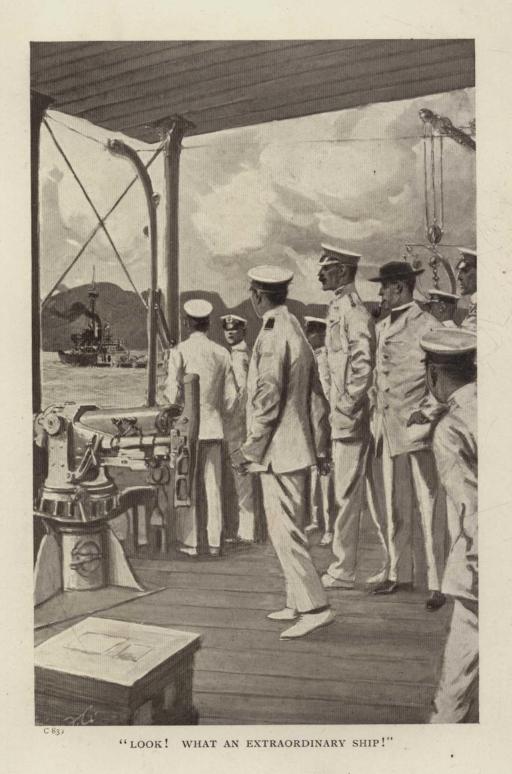
"LOOK! WHAT AN EXTRAORDINARY SHIP!"
This was the Havelock, and farther out lay several of the new small monitors with a single 9.2-inch gun in the bows or a 6-inch at each end. Inside the line of black buoys which marked the submarine net were also some twenty transports and store ships, a collier, a water-distilling steamer, and many trawlers. Picket-boats, tugs, and little motor-boats dashed about the harbour; a picket-boat towed a long string of transports' boats out towards a hospital ship lying farther away; but the strangest of all the craft there were the "water-beetles", which they now saw for the first time. These were lighters, painted black, with hinged gangways projecting over their bows, circular shields round their steering-wheels, and square box-shaped structures aft, each with a small funnel projecting from its roof, and the official number of the lighter painted, in huge white figures, on the side. One went grunting and thumping past, leaving a track of smoke and a smell of burning oil behind it, carrying perhaps five hundred soldiers inshore. Another lay alongside the nearest store ship, and the bales of hay which they were loading into her made her look like a huge haystack. Another, flying a Red Cross flag, grunted past from shore, filled with wounded. "Water-beetles" made a most appropriate name for them.
The only other men-of-war at anchor inside the "net" were the Swiftsure, Talbot, and Cornwall; but farther down the coast, off Anzac and Gabe Tepe, they could see their "sister" ship, the Bacchante, looking very much "out in the cold" as far as protection from submarines went, in spite of numerous trawlers and several destroyers patrolling round her.
Steamboats began to come alongside, and from their midshipmen the Honourable Mess soon learnt the news.
One midshipman told them "that the soldiers held the first two miles of the hill beyond Suvla Point, but could not get on any farther". "Have they joined up with Anzac and away to the right?" they asked. "I don't think so—not properly. We haven't advanced for the last two days." "I don't know how many wounded I have taken off," said one wornout-looking midshipman. "That's my job, and I've been at it almost day and night for the last five days—nearly eight thousand have been taken off altogether, I fancy."
Another snotty told them of the awful shortage of water during the first two fateful days, and how terribly the troops had suffered. "They couldn't stand it," he said. "It was frightfully hot, and by Saturday afternoon (they landed at 11 p.m. on Friday night) men were rushing down to the shore and dashing into the sea, quite delirious."
The Hun in his steam pinnace came back from a trip ashore, with a story of two shells which had fallen close to him. "It's like old times," he said excitedly.
It was—exactly; exactly as it had been at Helles, in front of Krithia and Achi Baba.
All that morning, at every opportunity, everyone went up on the after shelter-deck, or climbed up to the main-top, to try and find the exact position occupied by our troops and how far they had advanced. They gazed through their glasses at a huge amphitheatre extending from Suvla Point right down to Anzac—six and a half miles away—shut in by that semi-circular rampart of hills which barred the way to the other side of the Peninsula and the Dardanelles. Down at Anzac they could trace the maze of trenches along the slopes and spurs at that end of the rampart of hills, and could also trace the Turkish trenches on the crest and upper slopes. At first they thought that these last trenches were British; but they soon knew, by watching the shells from the Bacchante bursting among them, that they were not. Sweeping their glasses to the left, they followed the ridge of hills as it bent round in a huge curve some five miles and a half from shore, until they came to a dip, in front of which was Anafarta—-just such another village as Krithia—with its white houses and its row of windmills. At the left end of this village a tall minaret showed up very distinctly. Sweeping still farther to the left, the hills became higher, and then bent towards the sea, until they reached within a mile of Suvla Point itself as a ridge some 650 feet high. From this point—known as the Bench Mark—the ridge dropped in a series of shoulders, until nothing but a gigantic backbone of almost bare rock remained to jut out into the sea and form Suvla Point itself. Our men had at one time reached this Bench Mark, but had been driven back to the top of the next depression, which they still held. In fact, from the ship that morning the little khaki figures of our men were very clearly seen up there on the sky-line, two and a half miles from Suvla Point. This advanced post was known as Jephson's Post, and on the land side of it the scrub-covered ground sloped down in ridges and gullies to the plain, whilst behind, and away out of sight of the ships, it fell very abruptly to the sea, and ended in lofty, barren cliffs.