A NAVAL VENTURE (continued 6)
Reading edition
The coast-line from Suvla Point swept round in a deep curve to another point known as Nebuchadnezzar Point[#]—a mile and a half farther towards Anzac—and thus made Suvla Bay. Behind Nebuchadnezzar Point lay the little hill "Lala Baba", some 120 feet high, and just round the corner the shore stretched in an almost straight line right down to Anzac.
[#] Its actual name is Niebruniessi Point.
It was the aristocratic Major of Marines, who had been studying the military map, who pointed all these places out to them. He pointed out the guns already in position behind Lala Baba, and he showed them "Chocolate Hill", another elevation some 160 feet high and about three miles inland, where our people could be seen busy digging trenches, and every now and again being sprayed with shrapnel. Between these two little hills lay a broad, flat area, looking like dry mud. "That is the Salt Lake," the Major told them. "It is dry all the summer."
Except for the people who could be seen up at Jephson's Post, more men moving behind a line of trenches running down the slope from that position, and the people digging on Chocolate Hill, the only indication of the general line we held was to be gained by watching where the Turkish shrapnel occasionally burst.
By this time—the 12th August—after having seen so much of operations ashore, every officer in the gun-room and ward-room had become an expert military strategist and tactician—as you can imagine; so it was quite unnecessary for the gallant Major of Marines—who, of course, was the leading expert of all ("because he wore a red stripe down his trousers," Bubbles said)—to explain that "Anafarta village must be captured; that this was the first thing to be done".
"I guessed that—in once," bleated the China Doll in an undertone.
"The whole success of this new operation depended on capturing Anafarta, and the ridge behind it, by a coup de main," went on the Major, as though addressing a class at Sandhurst. "The whole situation now demands an entire reconsideration of plans. I must say that I feel doubtful of ultimate success unless very heavy reinforcements arrive." Whereupon he shut his old-fashioned telescope with a snap, and went below, as if, from his point of view, he had washed his hands of the matter.
Uncle Podger, the Sub, Bubbles, the Orphan, and the China Doll remained to watch the ambulance wagons slowly trailing across the Salt Lake towards the cluster of hospital tents to the left of Lala Baba—the First Casualty Clearing-station—at "Wounded A" beach, and to watch the battalions in reserve enjoying a rest under some low cliffs this side of Lala Baba, many hundreds of men splashing merrily in the sea, undeterred by shrapnel bursting over them at intervals.
The Havelock lay at anchor quite close to these men.
"If I were running the show," the China Doll suggested confidently, "I should——" But how success could have been achieved will never be known, for "eight bells" struck, lunch waited down in the gun-room, and the China Doll knew the disadvantage of a late start, so flew away like a "rigger".
Many of the gun-room officers came up again after a hasty meal, and began examining the details of the extraordinary Havelock, when, all of a sudden, a spout of water flew up close to her.
"Hello! What's that? There goes another! Someone's having a "go" at her. Look! Look at those two puffs of smoke amidships! She's been hit! Ah! She's getting under way—about time too."
Her cable came in, and she slowly moved out of the way, signalling that three men had been wounded. One or two more spouts of water sprang up, but then they let her alone, and the water spouts began creeping towards the Cornwall—past her—over—back again—short. The Cornwall hastily got her anchor up, and circled away from that unpleasant spot; and then the little shells began falling quite close to the Swiftsure, at anchor only some four hundred yards away from the Achates.
"Short! Short again! Hello! that hit—on her starboard quarter! I saw it bounce off—it's close to her ward-room! There's another! That went in! Look! you can see the hole—close to the water-line."
"Look! Look! Look!" cries came from all round—it was getting exciting now—as three shells, one after the other, burst close to her for'ard funnel and the smoke of them drifted away.
"She's getting it hot. She'll be off in a minute. Ah, she's shortening in!"
They heard the Swiftsure's buglers sounding "Action".
"It will be our turn next," they laughed—a little nervously, as the Swiftsure circled away towards the line of submarine-net buoys; and, sure enough, in a couple of minutes there came a loud, wailing, rushing noise, which seemed to pass between the foremast and next funnel, and a "flomp" as a shell fell into the water on the other side, some sixty yards away.
They ducked and went down below, but not before another drawn-out wail ended in a "flomp" a hundred yards short of the ship. "Action Stations" sounded, and everyone cleared away to their quarters; the China Doll, very pale, and not enjoying himself at all, having to climb up the rigging to the fore-control top. He heard a shell coming, caught his breath, clung to the ratlines, and knew it would hit him. He heard it "flomp" into the sea behind him; and the irritated Gunnery-Lieutenant, coming up after him, hurried him up the rigging with angry oaths. "Get that range-finder uncovered. What's the range of that village? Quick! Quick! Quick! I've got nothing to fire at. There are no orders yet."
Down on the foc's'le the Commander, the Bos'n, and a few men were getting up the anchor as fast as possible, and in five minutes off went the Achates.
Directly these four ships began moving about, the Turks left off firing at them and threw shells at the transports lying farther out; but these lay at the extreme range of their guns, and that afternoon, at any rate, they made no hits. After a while they ceased firing, and the ships came back and anchored. The Hun, who had been away all this time in his steamboat, came down into the gun-room in a great state of excitement, as a shell had fallen within ten feet of his boat. The Swiftsure presently signalled that she had five men killed and fourteen wounded. News came from the Grafton, out beyond Suvla, round the northern corner, that she too had been shelled, and had lost nine men killed and twenty wounded—all these casualties caused by one small shell which came down a hatchway and burst among a crowd of men gathered there.
"What a change, after six weeks of peace at Ieros!" Bubbles gurgled. "I don't think much of this war. I call it rotten."
"Jolly uncivil of them—and our first day, too!" Uncle Podger said.
"Whatever rhymes with Achates?" asked Rawlins, whose poetical genius had once more been roused. "'Not afraid is,' would do, but I can't fit it in; or 'What a day 'tis'—that's jolly difficult to fit in too."
The rest of the afternoon passed quietly, and that evening the reconnoitring aeroplane which flew over from the island of Imbros—from the aerodrome at Kephalo—reported that she had seen the Turks digging emplacements for four big guns on the top of the ridge.
"Well, that's not very cheering," Uncle Podger grimaced as he smoked a pipe in the Sub's cabin after dinner. "If they can make us shift about and keep under way with those small things, as they did this afternoon, they'll drive us out altogether with their big guns—and submarines will be waiting for us there."
"We shall have to knock 'em out," the Sub said; "that's all."
"We couldn't do it at Helles; I don't see how we are going to do it here," Uncle Podger said. "Did anyone see the guns that were firing at us?"
The Sub shook his head. "I don't think so."
They went back into the gun-room just in time to hear the China Doll plaintively saying: "I didn't like going up to the top one bit; a shell came very close to me;" and the others singing out: "What does your carcass matter? Wind up the gramophone and let's have a noise!"
A most perfect night followed, and nearly everyone slept on deck; but hardly had they been turned off the quarter-deck next morning, when shells began whistling across the Achates, and off she had to go again to get away from them. These shells came from a 4.1-inch high-velocity gun, and gave about three seconds "notice" before they arrived. That morning, for the first time, the Turks turned a 5.9-inch gun on the shore—the same calibre gun as "Gallipoli Bill"—bursting high explosives with their tremendous roar, abreast the ship, on what was known as "New A" beach, a convenient little split in the rocks where most of the boats ran in, and close to where "Kangaroo Pier" was being built. These shells fell almost vertically and did very little harm, but their noise was extremely disconcerting.
That evening the battleship Venerable arrived, and next day the Achates became more or less of a depot ship for the Naval transport officers, the Harbour-master, the surveying officers, and (as Uncle Podger said, when their midshipmen "assistants" and the midshipmen of all the "stray" pickets came to live in her)—a "home for lost dogs". The gun-room was again invaded by tired, weary snotties, in their grimy Condy's-fluid-stained uniforms, who, when they were not eating, lay about on the leather cushions and odd corners, and slept. The Pimple and the China Doll were almost reduced to tears when they thought how the gun-room stores would disappear once more.
It was a depressing day; they could not call the gun-room their own. They heard of the fall of Warsaw; nothing seemed able to stop the German advance through Poland and Galicia; and this new landing gave not any hope of success.
"Oh, bother it all! Stick another needle in, China Doll, and start that rotten gramophone," they said.
At the mention of gramophone the Lamp-post would always slink out of the Mess.
The Turks had left them alone that day—as far as shells were concerned; but Fritz, the submarine, evading the patrolling trawlers, let go a torpedo at the balloon ship—the Manica—outside, beyond the nets.
A plaintive signal came from her that a torpedo had passed underneath her, and a submarine had been seen from the balloon—that yellow monstrosity waggling above her. That meant another interval for excitement, and a manning of the small guns in case Fritz took it into his head to pop up his periscope anywhere near. The balloon was hauled down, and off went the Manica to seek protection behind the "net" at Kephalo, in Imbros Island.
More shells came along on the Sunday morning, just when the Honourable Mess, clothed only in towels, clamoured for "next turn" at the little baths. Again the ships had to get under way, and the Swiftsure reported one hit, without casualties. It was a quaint crowd of undraped young officers who gathered behind the six inches of armour round Y1 casemate, and waited for the "sh—sh—plonk" of the Turks' shells to cease, and the bugle to sound the "carry on", before they rushed back to complete their toilet. Don't imagine that the ships took their insults "lying down". They blazed away at where the guns were reported to be, or where they thought they were; but as you should know by now, it was practically impossible to spot them; and, in time, everybody learnt that the best thing to do was to plug a few shells into Anafarta village (keeping clear of the Red Crescent flags which decorated it), where one shrewdly expected that the Turkish Head-quarters Staff and its German "pals" had comfortable "diggings". A few shells there, delicately placed, generally had the desired effect. One could almost imagine the German Staff Officer (when shells began knocking down the houses round him) cursing: "Gott im Himmel! it's not good enough being bothered like this. Telephone to that confounded battery to leave 'em alone, till I've finished my breakfast; it's not doing any good, anyway."
That Sunday afternoon our troops tried to advance along the ridge beyond Suvla Point, and did make some headway; but they came up against a wretched redoubt, a thousand yards from Jephson's Post, crammed with machine-guns, and were brought to a standstill.
The Talbot and the Swiftsure did most of the covering work; but the Turkish trenches up there, and that redoubt, were so protected by the folds and curvatures of the hills that their high-velocity guns were very ineffective.
When this business was finished, "Cuthbert", the hostile aeroplane, came over from Maidos, and made a "bee-line" for the balloon ship once more. As he approached, the Manica commenced hauling down the balloon and its observers, and simply screeched at "Cuthbert" with her maxims; but the aeroplane did not take anything seriously, plumped down two bombs within half a mile of her—not nearer—appeared to be perfectly content, and went home again, followed by some very pretty shrapnel from the Talbot.
There was very heavy firing on shore on the extreme left that night—all through the night—and by the morning the soldiers had lost the ground they had gained the day before.
In the usual "strafe" that morning, two shells hit the Achates without causing any casualties; but by now it had become thoroughly understood that if the ships remained where they were, and did not get up anchor and move about, the Turks would soon leave off shooting at them. So, from now onwards, ships seldom shifted billet during these frequent shellings. This may have spoilt the Turks' amusement—for it must have been most amusing to the Turkish gunners to see them scurrying about the harbour—but the constant shifting became too boring altogether. The poor old distilling ship—the Bacchus—and the Ajax, a store ship, came in for the worst time. The Turks had a special "down" on them both, and seldom a day went by without them being hit, first of all with small "stuff", and, later on, by 5.9-inch shells.
Fritz put in another appearance that Monday morning, and had another "go" at the balloon ship—the Hector this time—but something had gone wrong, as before, with the "balance chamber" of his torpedo, and it gracefully dived underneath her. However, she hauled down the balloon in a hurry—she thought the "balance chamber" of the next torpedo might be in better working order—and inside the submarine net she came, only to be driven out again by shells which flew chirpily over the Achates, and dropped all round her. A lucky shot in the balloon—and "finish" that—so up came her anchor, and she pushed across to Kephalo.
On the Tuesday everyone became heartily sick of the "retire" bugle. The Turks seemed unusually generous that day. They shelled the Achates at half-past six; they rested until the Honourable Mess had commenced their breakfast, when "swish—sh—sh—flomp" went a shell just alongside, and the wretched bugle sounded again. At ten o'clock, at half-past twelve, and twice during the afternoon they disturbed everyone; and when they had packed up for the day, "Cuthbert" came along and made a most deliberate attempt to bomb her. She circled overhead twice, and on each occasion dropped bombs which fell with the sounds of express trains and burst, one about a hundred yards and the other about forty yards away.
"It's not very restful, is it?" the little Padre said wistfully, as he joined, for the fifth time that day, the little crowd of "idlers" who were taking cover behind the after turret during the last spell of shelling.
It wasn't. The continued strain became most intensely wearisome, and affected a great many people very noticeably. For more than three weeks the Achates had these wretched shells coming round and over her, at intervals, practically every day. It was the noise of them which became so trying—the noise, and the wondering where "that one" would hit.
Perhaps, in the gun-room, the most marked effect was the smartness with which everyone "turned out" in the morning (they slept on the quarter-deck), looked to see if the sun had risen behind Anafarta, and scampered down to get his bath and be dressed before those beastly shells came round. Breakfast became a remarkably punctual meal, for the Turks liked to have their little joke at half-past eight; and no one in the gun-room, except the Sub, Bubbles, and sometimes Uncle Podger, could stay and enjoy their food if that side of the ship swung to the shore, and the "swish—sh—sh—flomp" of those shells came through the scuttles in her thin side.
"Divisions", at half-past nine, had to be held out of sight, in the battery, for the temptation always proved too great for the Turks when they saw men falling in on the quarter-deck or fo'c'sle.
On one memorable occasion when, "divisions" having been reported correct to Captain Macfarlane, the men were all marched aft on to the quarter-deck for prayers, the ship's company made one almighty "duck" as a shell came over them and burst not ten yards away in the water. If eye-witnesses speak the truth, the only people who did not "duck" on that occasion were Captain Macfarlane—who made the excuse that "he had been rather deaf for the last few days"—and the little Padre, who apologized most profusely that he had been so busy trying to prevent the wind blowing his surplice round his neck, that he hadn't noticed it.
At any rate, after that, "divisions" and prayers were held in the battery out of sight.
The people who had the most unpleasant time were the signalmen on the fore-bridge, the telegraphist in the "wireless" room on the shelter-deck, and the people on watch on the quarter-deck.
"What am I to do?" the Sub growled to Uncle Podger one day. "Here we have half a dozen boats round the gangways, a couple of hundred men working about the upper deck, and along comes a jumping Jimmy of a shell and flops fifty yards short of the ship—then another, a hundred or a couple of hundred over. It may be all a mistake—they may be coaxing them along to the distilling ship—and the next may fall a thousand yards over. How am I to know? What am I to do? If I don't stop work and sound the 'retire', then the next one will probably come 'splosh' into our chaps and lay half a dozen of them out. Then what will the Commander say?—losing his best hands perhaps; and the Skipper will want to know why I didn't clear 'em all off the upper deck. It's worrying; that's what it is!"
"My dear chap," said Uncle Podger, "I'll tell you exactly what I feel. When I go on deck I am certain that those Turkish gunner chaps over there on the hills sing out 'Hello! here comes the most valuable clerk in the whole British Navy; any of you chaps got a spare round to have a 'pot' at him?' I walk up and down the quarter-deck with my ears cocked towards the shore to hear that beastly whining swish—a shell or two will fall in the water—those big chaps, with their infernal thunder-clap, burst on the shore—and I gradually find myself edging away to the hatchway, and going down to the office or the gun-room, where I can't hear the things so plainly. It gets on my nerves, I can tell you that."
Whatever happens, the routine of the ship's work must be carried on: the decks are scrubbed; the hands fall in; they work about the upper deck, splicing wires, scraping paintwork, repairing boats, overhauling gear—all the thousand-and-one jobs which have to be done; boats have to be called away, and go about their business; the meat, potatoes, and bread have to be served out; the office work has to go on just the same; the sick have to be attended and treated; the signalmen and upper-deck watch keepers have to keep their watches; the men have to have their meals and scrub the mess-decks; the cooks have to cook the ship's company's food; and all these routine duties go on, either without any protection whatever, in the open, or behind a half-inch of steel which won't "look at" a shell of any sort or description. A battleship or cruiser is designed to fight an action which may last for an hour or for five hours, but, at the end of that time, life on board reverts to its ordinary routine—as far as it may. She is not intended or designed to be constantly under shell-fire for weeks at a time.
The Pink Rat, whose nerves had never recovered from his experience at "W" beach, frankly could not stand the spells of shelling; the China Doll grew restless and more baby-like than ever; the Pimple was nearly as bad; the Lamp-post hated the shells perhaps more than anyone, for he had a most vivid imagination, but he controlled his feelings wonderfully, and never showed the least outward sign of "nerves", except that he became more than usually boisterous after sunset—when all was peace. Rawlins and Bubbles treated the whole thing as a joke. "Don't think about 'em," Bubbles gurgled to the Pink Rat, "and then you won't worry." The Hun did not seem to trouble so long as he had something to do in his steam pinnace; he had to remember to live up to his D.S.C., too. The Orphan, who felt he also had a reputation to keep up, worried very little either.
The midshipmen in the boats and their crews had to carry on their usual work at all times. It sounds simple enough when talked about in a comfortable chair at home; but just put yourself in the place of a midshipman in a steamboat, with perhaps a lighter in tow, who is coming off from shore and sees a shell burst in the water fifty yards ahead of him, knows that another will come along in a few seconds, and has to take his boat through the swirl made by the first shell! Or, again, he sees a ship hit, or shells falling all round her, and has to take his boat alongside her, and, worse still, wait alongside her. This is what these midshipmen and their crews had constantly to do; and when they went inshore, shells were constantly dropping close to them, not only the small 4.1-inch, but the big high-explosives.
The strain and the long hours caused many of these midshipmen to break down, but there was no instance that can be brought to mind when any of them showed the slightest sign of treating shells too "respectfully" when on duty.
Don't imagine that the ships themselves remained idle all this time. One or other constantly fired at known gun positions, on enemy working parties, at convoys, at the enemy observation posts and trenches at Anafarta—in fact, at every target they could find or the Army point out to them. The monitors with long-range guns fired across at the Turkish transports and store ships anchored in The Narrows; the big ships constantly bombarded enemy camps and depots behind the hills, helped by spotting aeroplanes, for, of course, they could not see where their shells fell. Destroyers and the "Edgar" class constantly harassed the Turks along the coast.
CHAPTER XIX
The Army again comes to a Standstill
Nearly every night, for the first week after the arrival of the Achates at Suvla, reinforcements poured across from Mudros in "troop-carriers", fleet-sweepers, destroyers, and small cruisers. Among these came the veteran 29th Division—which had been brought up to fair strength by constant drafts from England—and also the 2nd Mounted Division—yeomanry who came to fight as infantry. These yeomen were men of such magnificent physique that the Syrian interpreter on board the Achates told the Orphan that, though the pick of the Greek, Serbian, Bulgarian, and Turkish armies had come frequently under his observation, he had never seen such fine troops as these.
One more attempt was to be made to advance and, if possible, gain possession of Anafarta.
But to reach Anafarta, and the gap in the great semicircle of hills behind it, a whole series of smaller slopes and ridges, spurs and shoulders of the main hills, had to be seized first. Even without preparation for defence they formed a tremendous obstacle, and by this time the Turks had been digging and burrowing and wiring them, day and night, for a whole fortnight.
From the main-top of the Achates, on the 20th August, these small ridges and slopes looked as though a huge colony of moles had been at work on them, and when the sun sank low over Imbros the barbed wire in front of these "mole runs" made glittering streaks along them.
A terrible task it was, as everyone knew.
However, one little hill, somewhat detached from the main line of defence, projected into the plain towards Chocolate Hill. This was Hill 70, perhaps better known as "Scimitar Hill" from a broad, sweeping, burnt patch running up the near slope. If this hill could be stormed and held, it would assist further attacks on the main position.
The 29th Division were told off to capture it.
On Saturday, the 21st August, all dispositions were completed, and a little before two o'clock in the afternoon the four ships, the Venerable, Swiftsure, Talbot, and Achates, which had previously anchored in single line ahead, as close to the shore as possible, bombarded Scimitar Hill, "W" ridge beyond it, and every known or probable enemy gun position. The Army heavy guns assisted.
In a very short time the Turks had to abandon many of their trenches; and if only it had been possible to continue bombarding until the attacking infantry had almost reached those trenches, the 29th Division might have stormed them without much loss.
But this was not possible. For one thing, the range was too great—over four miles—to make certain of not hitting our own troops. The ships had to cease fire, and thus gave time for the Turks to rush back to their trenches and bring their machine-guns along with them.
As the 29th Division advanced, some thirty or forty enemy guns opened on them with shrapnel and high explosives; and though a brigade stormed Scimitar Hill, its losses were so great that the remnant who gained the crest could not hold it against the tremendous whirlwind of fire from the higher ridges beyond and a fierce counter-attack.
Farther along, to the right, the remainder of the 29th Division and the 11th Division, attacking the southerly spurs of "W" ridge, gained a footing on them, but could not reach the crest.
The flat ground over which they had just advanced with such heavy loss was thickly covered with scrub and trees, and the high-explosive shells bursting among them quickly set this scrub alight in several places. These fires much hampered the rapid bringing up of supports.
At the commencement of the action, that division of dismounted yeomanry whose physique and bearing had so roused the admiration of all, was held in reserve behind Lala Baba, and rested there, in full view from the ships. At about half-past two or three o'clock these yeomen fell in, circled round the flank of Lala Baba, extended as they gained the open mud-flats of the Salt Lake, and commenced to advance across it towards Chocolate Hill. The Turkish gunners saw them almost immediately, and burst hundreds of shrapnel over their heads. No "gunners" could ask for a better target than these poor fellows made, and for twenty minutes they suffered terribly, without any hesitation or faltering in their ranks. To those who watched them from the main-top of the Achates, it was a wonderful relief when they gained the cover of the trees and thick scrub near Chocolate Hill and the shrapnel began to leave them alone.
Abreast the Achates, and some half-mile from the beach, was a little green mound, dignified with the name of "Hill 10" on the military map. On the rear slope of this, a field-gun battery had been very active all the afternoon, and presently the Turks thought it about time to put a stop to this. They turned one or two 5.9-inch guns on to Hill 10, and simply plastered it with high-explosive shells, bursting them with their horrid, rending thunder-claps every few seconds among the field-guns and the limbers in rear. For half an hour those field-guns pluckily went on firing, but they did not know where the big shells were coming from—nobody did—so none of the ships could help them, and at length they were compelled to cease fire and the gunners to take shelter.
"What are they? New Army or Territorials?" asked Uncle Podger. None knew; but, whoever they were, they put up a most plucky fight.
By five o'clock the smoke from the bush fires obscured the whole field of battle between Chocolate and Scimitar Hills, and, though the rattle of musketry and machine-guns went on continuously, no more of the fight could be seen from the Achates—only the ambulance wagons coming across the Salt Lake, and the stretcher-parties clearing away the wounded yeomanry.
By dusk the flames of these bush fires showed up plainly, and as darkness fell on that fateful day they lighted up the whole plain, Chocolate Hill and Lala Baba standing out black against them. They burnt fiercely, the flames eating their way along the plain, running this way, then that; and on board ship one could only grimly conjecture what was happening to the helpless wounded cut off by them—and keep the horrors of one's thoughts to oneself, if one could.
Fighting went on all that night; and by dawn the attacking divisions had fallen back to their original positions in front of Chocolate Hill, except on the right, where the 11th Division maintained a point some six hundred yards in advance.
From that day no serious attempt was made to advance, and the idea of forcing a way across to the Dardanelles was for all practical purposes abandoned. From now onwards, trench warfare commenced, and continued until the definite abandonment of The Great Adventure.
All that Saturday afternoon and all that Saturday night a continual stream of wounded were brought to "Wounded A" beach, attended to, and as fast as possible sent off to hospital ships. The Hun with his steam pinnace, and a couple of boats in tow, helped cope with the enormous amount of work. At dawn next morning the Orphan relieved him, and by Sunday night very nearly six thousand wounded had been evacuated. They all went to hospital ships, but only the serious cases and the severe leg injuries stayed there. The others, who could walk, crossed over the hospital ships from one side to the other, and went down into trawlers waiting alongside. These, when full, steamed across to Kephalo, on Imbros Island, and landed them there.
It now became generally understood that the Germans and Austrians intended to break through Serbia, march across Bulgaria, and join hands with the Turks. The Bulgarians were much more likely to assist than resist them; and it did not require any great strain on the mental powers of the military experts in the gun-room to enable them to realize that, once the Turks obtained heavy guns and an ample supply of ammunition, they could drive us and the French off the Peninsula.
It was anything but a pleasant prospect, especially with the autumn fast approaching, and the fierce winter gales which would make the landing of stores impossible.
A peaceful three days followed this battle of the 21st August. The Turks had probably expended all their ammunition and were busy replenishing their magazines. At any rate, three days later they shelled the harbour and the ships very lavishly. The Venerable had a man killed and some wounded, and the Swiftsure had a man wounded by a fragment of a shell which burst on the Venerable's fo'c'sle. From this date they always managed to spare the ships a few rounds—at the usual hours—every day. They killed an unfortunate stoker in the Achates soon after this. The crew were at "Action Stations", and he had gone on to the mess-deck to make certain that his fire-hose had been screwed on properly, when a shell coming in through the side (it actually burst on the edge of a scuttle) took off his head.
They then attempted a night attack on our left flank. Firing burst out suddenly one night just after eight o'clock, and though the Honourable Mess had not yet reached the "pudding" stage of their dinner they rushed up on deck to see what was happening—all of them. That fact alone proves that the noise of rifles, machine-guns, and shells must have been considerable.
A most brilliant spectacle this firing made. Many young officers in the trenches, on both sides, kindly contributed hundreds of pretty star shells; the Turks burst a very large number of shrapnel most picturesquely; the destroyer Grampus, out beyond the bay, lighted up the ridge near the Bench Mark with her search-light; the army field-guns did what they could to aid the display, and the Swiftsure obliged with four rounds of 7.5-inch shrapnel to give éclat to the occasion.
From a pyrotechnic point of view the scene from the quarter-deck of the Achates could not have been improved, nor could the orchestra of rifles, field-guns, maxims, and trench bombs.
But the attack evidently lacked backbone. Rifle-firing raged up and down the lines, but it never reached the pitch of inarticulate firing and determination which marked those night attacks at Helles. As a matter of fact, the Turks never left their trenches; and even before the laconic signal came from shore: "Situation well in hand", that well-known military expert, the China Doll, not seeing in the dark that Captain Macfarlane happened to be standing next to him, lisped out: "That's nothing; it's nothing like those other shows at "W" beach; they don't mean anything; I'm going down to finish dinner." Captain Macfarlane thanked him very gravely: "I am much obliged to you, Mr. Stokes" (which perhaps you remember was the China Doll's name), "you have relieved my anxieties immensely." The wretched China Doll disappeared down the hatchway like a shot rabbit.
Now there was a cocksure young subaltern of the New Army at Suvla to whom the whole art of warfare had become an open book. He claimed relationship with the Lamp-post, and, on the strength of that, came off at times to get a decent meal and a bath. There was also a certain 5.9-inch gun hidden away somewhere near Anafarta which enjoyed throwing high-explosive shells into the "so-called" "Rest Camp", and this young officer had suffered frequent annoyance from them. He became a little peevish, and made sarcastic remarks about naval gunnery not much to the liking of the Honourable Mess, especially one day when the Swiftsure had nearly broken her Gunnery-Lieutenant's susceptible heart by not knocking out this particular gun after some fifteen rounds. They explained gently to him that the gun could not be seen from the ships, and that, at five and a half miles, firing at "where-it-was-thought-to-be" did not give much chance of hitting it.
One afternoon, when he happened to be aboard, a French aeroplane, with engine troubles, planed down to the beach beyond Lala Baba, and could not get away. She had not been there for ten minutes when the Turks commenced dropping shell round her.
"Now you'll see how easy it is," the Lamp-post said ironically. "Remember, the Turks can see that aeroplane—they can see it with the naked eye. We can't see 'Anafarta Annie' through a telescope." Well, they counted more than a hundred and fifty shell—shrapnel and common—fired within the next thirty-five minutes, and the aeroplane appeared not to have been touched.
At least they thought the "Young Friend" might apologize, but he only laughed: "Well, at any rate, you Navy chaps aren't the rottenest shots in the world."
"I do hope 'Annie' drops one in his 'dug-out'," the Hun said angrily, when he went ashore. "Don't you ever ask him off again, Lamp-post, or we'll work the gramophone at meals."
"I never do ask him; he comes," the Lamp-post smiled.
"Annie", so the Observation Post nearest to Anafarta reported, lived in a tunnel or deep gully, and when her crew wanted to do a "hate" they ran her out on rails, fired her, and ran her back again. It was also said that if shells fell anywhere near her, the crew used to run across to a little white house about a hundred and fifty yards away, and take cover there. So one morning the Gunnery-Lieutenant of the Swiftsure, always ready to woo a fair lady, "went" for her; and when he thought her crew had probably run her back into her tunnel and gone across to their cosy little white house, he peppered that with 14-pounder shells. No one can go on with this game—at five and a half miles—for ever; and when the Swiftsure ceased firing, "Annie's" crew, appreciating the humour of it all, ran back to her, fetched her out (presumably), and dropped half a dozen high-explosive shells among the mules and stacks of bully-beef boxes above "A" beach.
They were full of noisy humour, these Turks; but what did jar on their nerves was the sight of a battleship or cruiser coaling. They objected most strongly, and always burst shrapnel over, and dropped shell at the "coaling" ship directly the collier had come alongside and she had commenced that dirty job.
They also had a rooted objection to the Arno, a trim little destroyer attached to the General Headquarters Staff; and whenever she anchored inside the "net" they did their best to make her feel uncomfortable. She might have always had the General Head-quarters Staff on board, to judge by the persistent way they plugged at her.
And as for Jephson's Post, up there on the top of the ridge, on the left, they took a positive dislike to it and to the Naval Observation Station, just below it. This Observation Station was manned by some naval ratings and two naval officers—a gaunt, hawk-like Commander and a Lieutenant-Commander belonging to other ships. These two took duty in turns—three days "on" and three days "off". The three days "off" they spent on board the Achates, sleeping most of the time.
This post was constantly under fire from heavy and light guns. It also received all the "overs" and the stray bullets fired from the Turks, farther along the ridge, at Jephson's Post and the trenches in front of it, so it was not at all a "health" resort.
"The view in the early morning is charming," said one of the Observation officers; "and but for the fact that I'm certain there's a dead mule or a dead 'something' among the bushes somewhere near—has been there for the last fortnight—and that we get something like thirty to forty shell over it every day—often more—it wouldn't be half bad."
Another Naval Observation Station had been established on Chocolate Hill, and to visit either of these positions made exciting afternoon walks and climbs, whenever any of the Honourable Mess ventured ashore. On one occasion the Lamp-post and the Orphan landed at "A West" beach one afternoon, and walked up to the Observation Post near Jephson's Post. Pretty hard going it was, under the hot sun and along the sandy mule-track which wound up the lower slopes among the concealed field-guns. Then they had to climb along a steep path, with a parapet on the enemy side, till they came to the second line of trenches, and heard the intermittent sniping close to them. In the morning the Post had been severely shelled, and they found the Commander lying flat on the ridge, some forty yards away from it, behind a natural parapet of rocks, reinforced by some sand-bags, his telephone box close to him.
"You must have had a warm time of it this morning, sir," they said admiringly.
"That was all right. I was here all the time. There wouldn't have been much left of me if I had stayed there. Come along and see." He took them back below the ridge, climbed up to the rear of the Post—a little three-sided affair, partly made out of large stones and sand-bags piled on each other, partly of natural rocks, with a timber and sand-bag roof over it all.
"Pretty untidy, isn't it, here? You can have the base of that shell—one of this morning's little lot; if you hunt round, you'll find another somewhere, I expect. They keep their eye on this place; I shouldn't wonder if they are watching us now. Let's put back some of these rock things."
The front parapet had been partially knocked down that morning, so that the "observing" loophole was now four or five feet wide. If they could see him when there was only a small loophole, thought the Lamp-post, they'll be able to see us, all right, now. They had just finished piling up the last of the stones and sand-bags in their old places—-more or less—when the accustomed ears of the Commander caught the sound of a Turkish gun.
"That's my gun!" he cried, throwing himself down. "Lie down. That will be short," he said coolly, as they heard the "swish—h—h" of an approaching shell. "Short, not very; keep down, some of the bits may come in."
"Whump" burst the shell about thirty yards below them, and something rattled against the parapet they had just built up. The stinging smell of smoke came in through the crevices.
"Scoot out of it!" the Commander said, scrambling to his feet, and taking them down to where they had found him at first—soldiers dashing for cover all along the ridge. "Keep close in behind those rocks," he said, as they lay down, and he peered out between his sand-bags.
"I thought so. The same two old guns, on the far side of the 'Rectory Field'. They've shifted 'em since the morning. They've fired again. They keep those two especially for my benefit."
"Whump" burst a shell, then another, up along the ridge, somewhere close to the Observation Post, whilst the hawk-like Commander rapidly took "angles" with his sextant, and examined the squares and dots on his military map.
Then he rang up the Naval Observation Post, and giving them the new position of the guns told them to ask Swiftsure to try a few rounds.
"Keep down!" he sang out to the two boys. "Snuggle up to those rocks. Those chaps sometimes try lower down the slope."
During the next quarter of an hour some fifteen or sixteen shells burst close to the old Observation Post, and the Orphan wriggled to a place where he could look down, across the harbour, to where the Swiftsure, Venerable, and Achates lay. They did look small.
"Hello! there goes one from the Swiftsure," he cried, and wriggled farther round to see if its shell went anywhere near those guns that had been firing.
"Twenty yards short—good shot!" the Commander sang out. "They'll fire another, if either of the guns are loaded—— Yes—there they go—keep down! Then they'll pack up."
"B-r-r—whomp" burst a shell, just as the Swiftsure fired again, and they watched for her shell to burst. "I believe that's a hit; if it wasn't, it was jolly close. Go up and see what damage they have done; it's perfectly safe now."
The two midshipmen scrambled to their feet and made their way up to the old Observation Post, whilst the Commander busied himself with the telephone.
"My aunt! Look, Lampy!" sang out the Orphan, who reached it first. "Jolly lucky that we didn't stay!"
They had a difficulty in crawling in, because two of the balks of timber had been blown down at one end. All those stones and sand-bags they had replaced twenty minutes ago lay scattered on the ground—some outside among the bushes, others inside. In one torn and half-emptied sand-bag they found the fuse of the shell which had apparently done the damage. It was still warm.
"Oh, look! there's your stick! You must have left it. Look! That will be a bit of a curio, won't it?"
"It isn't mine; it's the Pink Rat's," the Lamp-post grinned, as he picked up the two pieces. "I wish it had been mine."
They took the broken pieces and went back to the Commander. "They've knocked it about no end, sir. It's lucky we didn't stay there. You'll have to give it up, won't you, sir?"
"Oh no! rather not. I shall use it again to-morrow; but I shan't touch it—leave it just as it is. Probably I'll put some sand-bags here, where they can see them, and let them pot at this place instead. Come along, we'll give you a drop of tea, down in my 'dug-out'. The Swiftsure has finished firing."
"Did she hit either of them?" they asked.
"Went jolly close," he said. "I rather fancy she did hit one, but it's very difficult to say for certain."
The Commander's "dug-out" was some fifty yards below the crest of the ridge, and out of sight of Suvla Bay and the plain of Anafarta. From it the Lamp-post looked over the Gulf of Zeros, the Bulgarian and Turkish coast-lines, and, on the left, the lofty island of Samothrace, rearing its crest above the clouds. Down in the sea at his feet—some five hundred feet below him—the Grampus, destroyer, steamed slowly along to protect the extreme left flank of the army, which extended from behind Jephson's Post to the actual beach. Beyond her, either the Grafton or the Theseus came slowly along towards Suvla Point, pushing through the glittering water. Trawlers and drifters, with their reddish-brown mizzen-sails giving a peaceful and home-like appearance to the beautiful view, patrolled very, very slowly the stretches of the Gulf between Samothrace and the Peninsula.
From this "dug-out" the ground sloped very abruptly to the sea, its surface composed of scattered rocks interspersed with coarse bushes. The bivouacs of the brigade in reserve were here, and hundreds of men lay about smoking, talking, and mending their clothes, or fast asleep. Bathing parties went down to the sea, chattering noisily, or scrambled back, half naked, to dry themselves in the sun.
As the two snotties drank their tea, two men on stretchers were carried past, on their way to a Dressing Station, a little way below and to the left. One man smoked a cigarette and looked quite cheery; the head of the other lay back oddly on the stretcher, with that horrid grey colour on his face—he was dead.
"Have another cup of tea? I'm sorry there's no cake," the Commander said. "Those infernal snipers get some fifteen or twenty of our chaps up here every day. They paint themselves green—their hands and faces—dress up in green clothes, or fix themselves up in twigs and leaves. They're plucky chaps, I must say. We found one chap, down in the plain, the other day, over there"—and he jerked his thumb up the ridge towards Anafarta—"we found him half a mile inside our lines, up a tree, lashed to a branch. One of our chaps happened to be walking back from the trenches, and walked right under the tree; thought he heard a noise, looked up and saw him. Luckily he had his rifle, so he shot him, but had to climb the tree and cut him clear before the body fell to the ground. On one side of that Turk hung a basket with a few figs in it, and on the other side a basket full of cartridge cases. Most of them were empty, so that he must have had a pretty good 'run' for his money."
A messenger came to say that the Turks were commencing their usual evening "hate" on the beaches and ships. "Well, you'd better get along back," he said. "Now, don't play the fool. For the first few hundred yards past the Observation Post you will be in full view of their firing-trench along the ridge; so don't loiter. I must be off to see whether any of those guns have shifted since yesterday. Good-bye!"
So back they went, with the base of one shell, the fuse of another, and that broken stick belonging to the Pink Rat. As they neared the beach, big shells kept dropping on it, so they waited a little while before going down to "A West". A friendly A.S.C. sergeant invited them into his roomy "dug-out"; and luckily they did go in, for shrapnel began bursting very close, and an empty case buried itself in some ground between two lines of mules, not twenty yards away.
Flies had been bad up in the Commander's "dug-out". Here they were ten times worse—worse even than they had been before they left "W" beach at Cape Helles.
Having added to their trophies that empty shrapnel case (the A.S.C. sergeant had sent across a couple of Indians belonging to his transport column to dig it up), and the firing having ceased, they presently found themselves in the Hun's steam pinnace, on their way off to the ship.
You can imagine that these two young officers had a good deal to talk about when they did get on board. Neither of them had much chance of going ashore, because, after the first few days, so many of the original midshipmen of the "stray" boats broke down and had to be sent back to their ships, that they were almost constantly employed in steam-boats.
There were the "night patrols", when they steamed, up and down, along the line of submarine-net buoys, from sunset to sunrise—fearfully tedious and monotonous work, only enlivened by the very occasional submarine "scares". Some trawler or drifter—out beyond—would think she had seen one, and fire two Very's lights; and then there would be a hustle and a bustle, and the patrolling picket-boats with their maxims would dash up and down, in case Fritz came along, and they could get a shot at his periscope. For some days the Orphan had to take charge of the Harbour-master's picket-boat, and used to spend most of his nights outside the nets, often in a lumpy, unpleasant sea, meeting troop-carriers coming across with reinforcements, or store ships—all according to programme—and imploring their Captains to go between the two lights on the buoys at the submarine-net "gate"; not that the troop-carriers ever made mistakes—they had had too much practice—but some of these store ships seemed incapable of coming in without fouling the net, picking up some of it with their screws, and giving twenty-four hours' work hacking it clear and then repairing it. Most of the daylight hours during that time the Orphan spent in sleep, but not all by a long chalk, for things were always going wrong with a line of lighters supporting some borrowed torpedo-nets, and the Harbour-master was always wanting to go along and see what could be done. As these lighters were constantly being shelled, this was a most unpleasant job.
One evening, after snatching a couple of hours' sleep, he found that a 3-pounder gun had been mounted in the bows of his boat, and the usual maxim taken away.
"Hello!" he said to the coxswain. "What's this for?"
"I fancy we're going to hunt for Fritz to-night, sir."
"Why, has he been round to-day?"
"He fired a torpedo at the Jonquil this afternoon, sir; somewhere round the left flank, sir."
When the Orphan climbed on board to find out more news, he ran across the Sub on the quarterdeck.
"Hello, my jumping Jimmy! I was looking for you. We've got to go away to-night and see if Fritz goes to sleep in Ejelmar Bay—about seven miles along the coast, round Suvla Point. He's been making a nuisance of himself again. What kind of a coxswain have you?"
"Not particularly good," the Orphan said. "He's not very fond of shells."
"Hum! I suppose we can't change him," the Sub said, scratching his head. "I've got Bowditch, the gunner's mate, coming along to run the 3-pounder, so that will be all right." Then, bursting with excitement, he thumped the Orphan's chest. "My perishing Orphan! Just fancy if we bag a submarine!"
"Promotion for you, too," grinned the Orphan.
"I hadn't thought of that," beamed the Sub. "Wouldn't that be grand?"
They were interrupted by a signalman running aft. "Hostile aeroplane, sir!" he called out. The "guard call" sounded, and the marines began tumbling up the hatchways with their rifles.
It was "Cuthbert", the aeroplane, coming along for his evening visit; but this time he was not bothering his head about the ships at Suvla, but flew past at a great height, evidently off to Kephalo, in Imbros Island, twelve miles across the water, to try and drop a bomb on the aerodromes there, or on the General Headquarters Camp.
"We aren't going away until nearly midnight," the Sub said, as they watched "Cuthbert" growing smaller and smaller. Suddenly there was a shout of "Hello! One of ours is after him! Look! He's heading him off!"
Sure enough, they saw another dot against the blue sky rapidly closing "Cuthbert", who had evidently seen him and swerved to the right.
As far as they could see, the English aeroplane was the higher of the two, though a long distance separated them.
"Hello! Look there! He's coming back! Look! He's dropped his bombs" (two spouts of water flew up on the sea). "He'll get away now!"
With the weight of the bombs "off" him, "Cuthbert" came back very fast, and presently the English machine gave up the long, stern chase and turned back to Kephalo.
"Well, they stopped him dropping bombs there," the Orphan grinned.
Just before midnight—pitch-dark it was—the Sub, the Orphan, and Bowditch, the gunner's mate, climbed down into the picket-boat and pushed off. They steamed outside, turned to the right, and, half an hour later, met the Grampus destroyer—the left-flank-guard destroyer—who piloted them along the coast-line for some seven miles. Then she stopped. Her skipper shouted across, through a megaphone: "We're right opposite it now. Off you go. I'll wait for you."
In they went—very slowly, to prevent making a noise, and so as not to bump anything in the dark—eventually finding themselves in a bay, with high cliffs all round it. Here the darkness was more intense than ever, and all was absolutely silent. They "felt" round the cliffs at one side, going dead slow, but not a trace of Fritz could they find. Then they pushed across to the opposite cliff, where there was a lighter patch—probably a break in the cliffs—and just as they had searched this other side, a most startling crackling of musketry burst out from the direction of that lighter patch, and bullets fairly hummed round their ears. The coxswain put his helm hard over as the Sub roared for the engines to go full speed ahead, and the picket-boat naturally began turning a circle, and would have headed for the foot of the cliffs in a moment or two, had not the Orphan swung the helm back again. The Sub, coming back from the bows, where he and Bowditch had been "standing by" the 3-pounder and looking for Fritz, took the wheel from him, and steered out into the open.
"My! but that was warm," the Sub said, drawing a deep breath. "That was the hottest bit of fire I've had yet; it beats Ajano. I've never heard so many bullets at the same time. Phew! One lucky shot, and the boat might have been disabled."
"We don't have much luck, do we?" the Orphan said, when he had recovered his normal state of mind.
"No, we don't. Still, there wasn't a submarine there—of that I'm certain. We were sent to find that out—so never mind. Phew! That was hotter than I liked it—it was. I can't think how they missed us."
The Grampus escorted the picket-boat back to Suvla Point, and just after the sun had risen and the hands had been turned out, she ran under the stern of the Achates, and the Sub and the Orphan climbed up the "jumping-ladder".
The Lamp-post, with a relief crew, stood waiting to take over the picket-boat.
"No luck, Lampy; nothing doing," the Orphan said. But his pal was too interested watching the colour effect of the sunrise on the mountain top of Samothrace—to the right of Imbros—and made the tired Orphan look at it too. "Bother old Samothrace, Lampy! I want something to eat. I hope they won't start shelling us" (a big shell had just burst on the beach, opposite the ship) "till I've had a bath and my breakfast. Where are you going?"
"They ran a lighter ashore at 'C' beach last night, and I've to go and clear her, and try to get her off."
"C" beach was round Nebuchadnezzar Point, out of sight behind Lala Baba, and the Turks shelled most things that went there—at any odd hour of the day.
"Poor old Lampy! They'll start shelling you directly you go there—they did me yesterday. Bath—breakfast—sleep—that's what I'm going to do. Nighty! Nighty!"
"Swish-sh-sh—flom-p" went a shell, half-way between the distilling ship and the Achates.
"R-r-r-omp" burst a high explosive on the beach. Another shell, falling into the water close to the Achates, burst, and the smoke drifted along the surface to her bows.
"Bugler! Bugler! Sound the 'Retire'!" sang out Mr. Meredith, on watch. "Get away in that boat of yours," he told the Lamp-post, as the old crew came up the jumping-ladder, and the relief crew waited to take their place. "Coal and water her when this 'show's' finished."
"Good luck to 'C' beach and the lighter, old Lampy! Don't duck when they come along. Nighty! Nighty!" the Orphan called out to him, and went below, as another wailing swish sighed through the air over the ship.
Outside X2 casemate the China Doll leant against the thin armour, with his sponge and soap in his hand and a towel round him. "Where are those horrid shell dropping? Anywhere near us?" he asked, blinking his eyes.
The Pink Rat, inside the casemate, looked very miserable. "Any luck, Orphan?" he asked nervously.
"I'm going to 'bag' your baths. I'm so sleepy I can't wait till these silly old Turks have finished," the Orphan said, and sang out for Barnes to get him a cup of tea.
It was now four weeks since the night of the Suvla landing, and, as you have heard, flies were more of a plague on shore than they had been when the Achates' midshipmen left "W" beach. They swarmed on board the ships. Bubbles declared that you could see them sitting along the gunwales of every boat that came off from the beach, and that directly it got alongside they flew on board and made themselves at home. The Honourable Mess presented the China Doll with a "swatter", and made him spend most of his waking hours killing flies in the gun-room, but the more he killed the more flew in through the scuttles or from the mess-deck. Both in the ward-room and the gun-room the noise of the fly "swatters" went on continuously all through the daylight hours.
Dysentery commenced to rage throughout the Army; and whether the flies brought it off from shore or whether they did not, dysentery commenced to break out among the ships' companies, especially among those men who worked in boats, or those living ashore—signalmen and beach-party men—all who were frequently in contact with the soldiers. The Pink Rat, grown visibly thinner, and the Hun both went on the sick-list. They lay in cots on the half-deck, but had often to turn out and get behind the armour, on one or other of the casemates, when the Turks' shells began whistling over the skylight above them. They lived chiefly on condensed milk—"poor brutes", as the China Doll said sympathetically.
So many of those "stray" snotties who had lodged in the Achates had by now been sent back to their own ships, ill, that the Honourable Mess had the gun-room almost to themselves again. Nor had those precious stores been seriously raided this time, so they had no real grievance.
At last the Achates herself received orders to return to Mudros to coal and "rest"; and on the 6th September she slipped out through the submarine "gate" after dark, left the twinkling camp-fires of Suvla behind her, and steamed through the double row of submarine nets at Mudros early next morning.
CHAPTER XX
Hard Work at Mudros
The Achates had not been at Mudros for nearly three months and a half, and during this period the appearance of the shores on either side of the harbour had changed very greatly indeed. Where, previously, fifty tents or marquees had stood, there were now thousands—multitudes of them—the French on the east, the British on the west side. The French, anticipating a winter campaign, had already built rows of wooden barrack-huts; the British had begun to do so.
Stone and brick buildings for offices, workshops, and store-houses, a narrow-gauge railway with petrol-driven engines, electric generating stations, half a dozen substantial piers, and miles and miles of roads—all had been built since the end of April. In the harbour itself lay more transports, store ships, colliers, oil ships, and water-tank ships than before the first landing. A line of French battleships faced a line of British. Monitors big and monitors little, cruisers, scouts, and sloops off duty, coaled, provisioned, and rested prior to returning to their bombarding or submarine-hunting jobs. Up in a corner, near Mudros West, and opposite Turkish Pier, lay the Blenheim, the mother ship of destroyers, surrounded by those of her children off duty. At another part of the harbour the submarines, resting after having come down from the Sea of Marmora through the nets across the Dardanelles, or preparing calmly to go up there again, nestled alongside the Adamant. Two or three white hospital ships were at anchor inside the harbour; eight or nine out beyond the nets at the entrance. Among all these puffed and snorted a great number of motor-lighters, the "water-beetles"—doing all the work of moving troops and stores, and doing it marvellously well. In fact, it is difficult to imagine how the work would have gone on without them.
The first day of her "rest" the Achates coaled, and on the second took in provisions from the little Dago. This little steamer ran between Malta and Mudros with frozen meat and vegetables for the fleet. She also at times brought the private stores ordered by the gun-room messman, so that the Honourable Mess had a warm spot in their hearts for her.
That week's rest extended for nearly two months and a half. During this time, so many of the officers and men were employed away from the ship that the Achates became immobilized, and did not take her turn for "guard" duties or as "emergency" ship. Every morning sometimes as many as two hundred and fifty of her men were called for by the "water-beetles", and taken away to coal leviathan transports, or to dig up rubble and load it into some steamers which were being prepared to be sunk as breakwaters off the various beaches on the Peninsula. The big steamer Oruba presently arrived, and the Achates had the job of dismantling her and preparing her to be sunk at Kephalo.
Those coaling jobs did not appeal to the snotties, though even they had their compensations, as the Orphan proved when he came back from coaling the Mauretania for three whole days, dirty and tired, but with tales of pleasant meals on board her, and hugely proud because he had managed to buy two boxes of kippers and one of haddock.
For a whole week, each of the Honourable Mess had a kipper or a haddock for breakfast, and Bubbles considered that "it wasn't such a rotten war after all".
The Pink Rat about this time finally broke down, and had to be sent to the naval hospital ship Soudan with a recurrence of his old "W beach" dysentery. He never rejoined the Achates, and on the broad shoulders of Bubbles devolved his light duties as "senior snotty".
Flies were troublesome, but not so bad as at Suvla, and the weather remained gloriously fine until the end of October.
Every evening after "seven-bell" tea, whenever it was possible to obtain a boat—a whaler or a gig—as many of the Honourable Mess as could get away would pull or sail down to the harbour entrance, land, cross over a narrow neck of land near the wireless station, and bathe in a delightful little cove; afterwards they would kick a football about on some level ground there, and sail or pull back with grand appetites for dinner. Why the China Doll was never drowned on those expeditions it is difficult to explain.
Two football grounds had been made, quite close to this "wireless" station, and the use of them was given to each ship in turn—two matches a day on each. So, often the ward-room and gun-room combined to play the officers of other ships; often, too, the men arranged matches between different parts of the ship—Bubbles and his fo'c'sle men—the Orphan and the Sub with their foretop men—the War Baby and his marines—the Lamp-post and Rawlins with their quarter-deck men.
Many good games they had, and if only there had been any cheering news, this period would have been a very pleasant one. But nothing went well anywhere. The great "push" in Flanders and France had come to a full stop; the Russians only just managed to keep the Germans from advancing—in fact, but for the approach of winter, people wondered whether they could keep them out of Petrograd (no one could get used to that name), and whilst the Germans and Austrians swept across the Danube into Serbia, the Bulgarians poured across the eastern frontier. Troops in thousands, French and British, had been rushed across to Salonica, but Greece still "sat on the fence"; she would not help, and the French and British arrived too late to prevent Serbia being overwhelmed. No attempt had been made on the Peninsula to advance; and dysentery raged in the army—thousands of cases being taken away every week. The number of German submarines in the Mediterranean had become more numerous, and the area to patrol with trawlers, destroyers, scouts, and sloops was so vast that the difficulties of suppressing them grew enormously. One thing alone was satisfactory: enough stores had been landed on the various beaches to maintain the army there, at a "pinch", for six weeks—long enough to tide over any probable period of bad weather, when landing might be impossible. There was also a certain satisfaction in seeing the constant stream of ships which came in through the harbour entrance every morning, and to know that they had safely run the gauntlet of the submarines; but everyone realized that "The Great Adventure" had failed, and that to maintain the army in its present precarious footing on the Peninsula was causing an immense drain on the resources of British shipping, without any apparent disadvantage to the enemy.
One bright spot cheered everyone—the deeds of our own submarines in the Sea of Marmora. But for them, the prestige of the Allies in the East would have fallen to a very low ebb at that time.
By the middle of October "all white" uniform changed to "all blue", and this marked the commencement of cooler weather.
Lord Kitchener arrived early in November, inspected all the army "positions", and went away again.
Till his coming, there had been some speculations as to the possibility of evacuating the Peninsula; but the extraordinary difficulties of this operation had been so evident, that those two military experts, the China Doll and the Pimple, had long since decided that it could not be accomplished without tremendous loss of life, a huge number of men left behind as prisoners, and most of the guns abandoned.
Now, again, everyone wondered what Lord Kitchener thought, and what would happen.
After his departure the weather broke up temporarily, and a south-westerly gale—only a mild one—left Suvla and Anzac and Cape Helles beaches strewn with wrecked or stranded picket-boats, lighters, and "water-beetles".
In the third week of November the Achates received the welcome order to proceed to Kephalo. The full moon shone brilliantly as she slipped out through the nets, and off she went. Two hours after leaving Mudros the track of one torpedo shot across her bows, and half a minute later another passed some eighty yards astern of her—Fritz, or one of his brothers, had fired two torpedoes—so she increased speed and "zig-zagged".
The danger had vanished by the time it had been realized; and all that the Honourable Mess and the gramophone knew about it, was the sudden rushing down of men to close those water-tight doors and hatchways which remained open, and a lurid description from the Pimple afterwards. It did not interrupt the delightful concert with worn-out records and blunted needles.
By three o'clock she entered the submarine-net "gate" at Kephalo; and when the sun rose next morning it shot up from behind Achi Baba, and once again they heard the distant booming of guns.
Kephalo, at the corner of Imbros Island nearest to the Peninsula, is a narrow harbour with high hills on one side and a narrow spit of land on the other. It is entirely open to the north-east—the quarter from which the worst of the winter gales blow—so three ships, including the big Oruba, had been sunk across it, higher up, to give protection to the little piers built there, and to the picket-boats, motor-lighters, and ordinary lighters which worked round them.
Kephalo had become the advanced base of Anzac and Suvla, ten and twelve miles away respectively, and it was absolutely necessary that troops and stores should be able to be landed or embarked at all times. Here, too, were the aerodromes which "Cuthbert" and his brothers so delighted to bomb. One of these was stationed on the low spit of ground; and the Orphan, who had the knack of making friends with everyone, and the knack of generally being in the right place at the right moment, managed one afternoon to be taken "up" in a reconnoitring aeroplane. He and Bubbles had strolled along to the aerodrome, wandered round until someone invited them to tea in the "mess"; and whilst in the middle of it, the "Flying Officer" on duty received an urgent signal: "Hostile submarine reported off Gaba Tepe, steering S.W.; please send aeroplane reconnaissance to search".
"Confounded nuisance!" exclaimed the Flying Officer. "I wanted to write some letters; the mail goes to-morrow morning. Well, you chaps can tell a submarine from a shark, I suppose; which of you would like to come along and spot old Fritz?"
They both grinned with delight; but Bubbles carried too much weight—at least a stone and a half more than the Orphan—so the Orphan was chosen.
The emergency aeroplane—a biplane—rested on its wheels outside the sheds. They walked across to it.
"Climb in!" said the Flying Officer. "No, you won't want a coat; stick on this cap and goggles—pull the flap down over your ears—and get in as you are; we shan't be away more than an hour. Sit down behind; I've altered the control gear—can work it from the front seat."
The Orphan had never been in an aeroplane before, and tingled with excitement. He sat down and winked at the disappointed Bubbles whilst his new friend climbed up in front of him and began to play about with levers and switches. "If you do see Fritz, signal with your hand—bang me on the back—it's no good shouting: I shan't be able to hear you."
The blades began whizzing round as the engine buzzed; men gave the machine a shove and a push; the blades went so fast that they only made a mist in front of the Orphan's eyes; the ground dropped away, and he shouted to Bubbles to wait for him—though it wasn't much use shouting, because of the noise of the engines.
Up they went, passing over the Swiftsure, the Achates, and the other ships in the harbour, and out beyond the line of submarine-net buoys.
They headed right over the sea, first of all towards Helles; passed it, swept round, and the Orphan clutched at the sides of the "body" as the aeroplane altered course, for he thought she was slipping sideways. Not a sign of Fritz did he see, but below him lay the end of the Peninsula, its white tents, "W" beach, the hull of the poor old Majestic showing clearly under the sea, Achi Baba and the streaks which represented the Turkish trenches. In another ten minutes he looked down on Gaba Tepe, at one of the "Edgar" class firing shells which he could see bursting among the streaks on top of the hills there. Up the coast the aeroplane sped, passed Suvla with its black submarine-net buoys—he counted one hundred and fifty-two of them; the two battleships inside them looked tiny, so did the tents on shore. Then, with another wide sweep over the sea, and bending to the right, he was carried along the left-flank coast till he could see the little gap of Ejelmar Bay, where he and the Sub had tried, that night three months ago, to find Fritz; and beyond it, with some humpy hills between, the sun glittered on a broad sheet of water and a silver streak which came in sight, in and out beyond the hills—the Sea of Marmora and The Narrows.
Round swept the aeroplane; he clutched the sides; she steadied and flew back towards Helles again, but not a sign of a submarine could he see; and in fifty-five minutes from the time he had started, he was landed with a gentle bump outside the aerodrome, and found Bubbles waiting for him.
"You are a lucky chap," he bubbled. "Did you see Fritz?"
The Orphan shook his head. "But I saw The Narrows and old Marmora; wasn't that splendid?"
"Anybody fire at you?" Bubbles asked.
"Oh no!" explained the Flying Officer; "there was a bit of a haze over the sea, so I could not go very high—shouldn't have seen Fritz if I had—so it was dangerous to go too near land. We never climbed above 2500 feet."
They only just had time to catch the evening boat off to the Achates, so they had to wish their new friend good-bye and hurry back along the beach, the Orphan talking thirteen to the dozen.
Pride filled the bosom of this young officer, for he was the only one in the ship who had seen either The Narrows or the Sea of Marmora. "It looks so near to The Narrows!" he said to the Sub that night. "It doesn't look more than an hour's walk. Things have turned out rottenly, haven't they?"
"It is rather tragic—really," the Sub said.
The first job the Achates had, after arriving at Kephalo, was to send working parties across to Anzac to help salve some lighters, a tug, and two picket-boats, driven ashore by the first of those gales from the south-west. The first of the fierce gales from the north-east followed, after two days of calm, and drove such heavy seas into Kephalo harbour that the ship had to put to sea, and anchor round the corner of the island, behind another row of submarine nets, in Aliki Bay. She came back as soon as that gale had blown itself out; but on the 27th of November another north-easterly gale commenced, and next day she again had to shift round to Aliki Bay. Here she and all the other ships that had come round for shelter rode out that three days of blizzard which caused such horrible suffering to the troops at Suvla—to British and Turk alike. The temperature on board ship never fell below 30 degrees, but at Suvla it fell to something like 15 or 18, even lower. First of all, before the gale it rained in torrents, and as the water collected and flowed down from the hills behind Anafarta into the valley, it washed over the Turkish trenches, levelling them, and carrying drowned Turks, drowned mules, barbed wire and their posts right over a long section of the British lines, drowning a large number of the British, flooding their trenches, and carrying everything before it till the Salt Lake was reached. When the rain ceased the bitter north-east gale flung itself down from the hills, bringing at first heavy snow; then the terrible cold froze the water in the trenches, and hundreds of our men, up to their middles in it, died of exposure, and very many hundreds suffered from frost-bite.
During those three days the troops at Suvla experienced the climax of hardship and exposure. The Turks suffered even more than our own people; and when daylight broke after the worst night, they were left exposed in the open with their trenches swept away, and our men—those whose hands were not too numbed to fire a rifle—shot them down like rabbits. Afterwards, a gentle breeze sprang up from the south-west, and, almost as if in pity, a warm sun shone down on those much-tried armies.
On the Tuesday the ships trailed back to Kephalo again, getting a glimpse of Samothrace with its snow-clad peak glittering in the sun—a most gorgeous, exquisite spectacle.
They found that the centre one of those three breakwater ships had disappeared entirely, and the head of the harbour behind them, close to the piers, was absolutely littered with wreckage. This centre ship had broken in half on the Sunday night, and the seas sweeping through the gap had hurled all the picket-boats and lighters sheltering behind her on to the shore, in one jumbled, tumbled mass.
They presented a most extraordinary sight piled on top of each other, and half buried in a huge mass of seaweed swept in with them. A big distilling steamer, with her rudder gone and her rudder-post smashed, had been driven ashore farther along the bay; beyond her lay a "water-beetle" high and dry, and, still farther along the shore, one of those small provisioning "coaster" steamers which ran between Kephalo and the Peninsula.
Salvage work commenced immediately. The Lamp-post and Rawlins took fifty men ashore, and worked, day after day, digging away the seaweed which blocked the little piers, and trying to refloat the least damaged of the steamboats; the Sub, with a number of men, had to rig shears to lift out the engines and boilers of those which were hopelessly smashed—all very unpleasant work, because that seaweed decomposed quickly under a hot sun and gave out the most unpleasant odour.
A more pleasing job had Bubbles and the Orphan. With a large working party they commenced to dig a channel through the sand—good, honest, clean sand—in order to refloat a stranded "water-beetle". They paddled about all day and had a huge lark.
On the second morning, as they prepared to go ashore, Uncle Podger, on his way to his bath, sang out: "Take your little buckets and spades and go down to the beach, dears, but promise Mummy not to get wet."
"We'll promise Uncle a jolly 'thick ear' when we do come back," they laughed. "Come along by the seven-bell boat, bring a basket and some tea 'grub', and we'll have a picnic there."
"Cuthbert" came over from Maidos once or twice, just to make "kind enquiries", find out how the salvage operations progressed, and see whether three or four bombs would be of any assistance. They were not; none of them dropped near enough to help, and all much too far away to do any damage.
The weather became simply perfect, and after a week's hard work the Swiftsure had hauled off the distilling ship and one of the "water-beetles", the Achates had towed off that small steam "coaster", and Bubbles and the Orphan had dug a channel sufficiently deep for a tug to come along and tow off their stranded motor-lighter.
That especial job being finished, these two midshipmen again had time to look round and see what life would bring. It brought news of woodcock and partridge—woodcock in the deep sheltered valleys, and partridge on the slopes of the hills. The little Padre lent them his shot-gun, and away they tramped one day, taking the China Doll to "beat" for them and to carry home all the birds. They swore a solemn oath that each should fire alternate shots, an arrangement which made a "right and left" difficult to get when frightened coveys were put up. Bubbles fired the deadly shot which eventually killed a partridge, and, of course, by the time the Orphan had seized the gun the rest of that covey had swooped out of range.
They sent the China Doll to retrieve the bird, and sat down to smoke their pipes and shout good advice at him; for the hill-side was covered with boulders and thick scrub, and the China Doll had a big job in front of him. "Keep it up, China Doll; never despair!" they shouted encouragingly as he came back with his hands and knees scratched and bleeding. "'If at first you don't succeed, try, try, try again.' We've got another hour to wait for you. Off you go!"
At last the bird was picked up; and in the gun-room that night they held an inquest on it, and found that "it had been well and truly killed by one or more missiles discharged from an explosive weapon, and that no trace of foul play, such as bludgeoning or being strangled, could be discovered".
Then came the question as to how it should be "hung", and for how long. The China Doll said that "the proper thing to do was to hang it by the head, and when the corpse dropped off, then it would be just right." They thought of trying the experiment on him, but desisted on the urgent representation of Uncle Podger that, if the China Doll's body dropped off his head, the work of the Ship's Office would be seriously delayed whilst he, Uncle Podger, attended the funeral as chief mourner—and, besides, he had no crêpe band to go round his arm.
Eventually Bubbles and the Orphan ate that bird on the second day—after innumerable visits to the gun-room galley to see how it progressed—and it was as tough as tough could be. They gave the China Doll the gizzard.
A week later the little Padre mildly suggested that next time they borrowed his gun they might clean it before they put it back in the case. "It doesn't get quite so rusty," he said apologetically.
For many months the southern portion of Anzac—Brighton Beach and Watson's Pier there—had practically been abandoned, because "Beachy Bill", a high-velocity 4.1-inch gun, somewhere up in the Olive Grove, above Gaba Tepe, had the range of the pier so exactly that he would hit the end of it, or lighters lying alongside, with his very first shot of the day, and his fire at night was almost as accurate. Several attempts had been made to destroy him (probably he had several brothers), but these had not been successful.
One day—the 10th December—the Bacchante, an "Edgar" cruiser, and two monitors went across from Kephalo, and fired a great number of rounds into the Olive Grove. Whether "Beachy Bill" or his brothers were hit or not, no one could actually say; but only one gun fired after that day, and it made such inaccurate shooting as not to interfere with work either on the pier or the beach. It did not fire at all at night.
At the time no one, except perhaps Captain Macfarlane, knew the meaning of this great expenditure of ammunition; but two days later, "all hands and the cook" were told off for various jobs, either at Suvla or Anzac, in motor-lighters or picket-boats, or actually on the beaches themselves; and it dawned on the enthusiastic Honourable Mess that, after all, an attempt was to be made to evacuate those places, and that the last prodigal bombardment of the Olive Grove had been for the purpose of finally destroying the guns there, and making it possible to use Brighton Beach and Watson's Pier for the embarkation.
So secretly had everything been carried out, that no one in the gun-room knew that most of the stores and the greater part of the guns, horses, and mules had already been withdrawn.
They had seen fleet-sweepers and the troop-carriers—the Osmanieh, the Ermine, Reindeer, Redbreast, Abassiah, and several others—crowded with troops on their way to Suvla or Anzac; but they had not seen them returning still more densely packed with men, nor the transports with horses, guns, and stores. This had all been done by night.
Rumours flew round that though Suvla and Anzac were to be abandoned, the end of the Peninsula, in front of Achi Baba, was to be reinforced by all that remained of the 29th Division, and maintained at all costs.
The Lamp-post and Rawlins, ordered to take charge of two "water-beetles", donned their dirty old khaki delightedly, and took over their "commands". The Lamp-post had K26, a single-screw lighter driven by one big motor. K67 belonged to Rawlins, and possessed two little motors driving twin screws. For the first day they were employed in Kephalo harbour, and had a great argument that night as to which would prove the faster. The Lamp-post bet Rawlins a dinner at the club at Malta, or at the first civilized place the Achates went to, that his one big engine would beat the two small ones.
Next day they had the opportunity of deciding, for they were ordered to Suvla. The Lamp-post led the way through the "gate" in the submarine net, and waited outside for Rawlins to come abreast and make a fair start.
"The first one through Suvla 'gate' to win!" he shouted. "Off we go!" and they raced each other across the twelve miles of sea, the Lamp-post winning his dinner very easily.
Now, though the chief stokers—old pensioners—in these two lighters pretended to be just as excited about the race as the midshipmen themselves, actually they were much too wise to press their motors hard, knowing full well that two hours driving at top speed would probably disable them for days. However, the Lamp-post and Rawlins did not know this—they thought they were having a "ding-dong" race—so it did not matter.
They arrived there at dusk, just as the usual high-explosive shells dropped on "'A' West" beach, and some little ones fell into the harbour near the Cornwallis, others near the poor old distilling ship.
Off "'A' West" pier there was now quite a comfortable little harbour, made by two steamers which had been sunk at right angles to each other, with a gap between them just sufficiently wide for two "water-beetles" to pass through side by side.
They had helped to fill these two steamers with stones and rubble at Mudros two months ago, so recognized them—the Fieramosca and the Pina.
On this same day, Bubbles and the Orphan rigged themselves in khaki, joyfully packed away a few things in their battered, old tin cases, and took charge of two picket-boats—the Orphan of one belonging to the Swiftsure (this ship had no midshipmen), and Bubbles of one which had belonged to the ill-fated Majestic. The unfortunate Hun looked very miserable as he waved "good-bye" to them. He had not regained strength after his attack of dysentery, and Dr. O'Neill would not let him take any job on shore.
"You've got your D.S.C., old Hun; so don't worry," the Orphan consoled him. "I only wish that I could get it!"
CHAPTER XXI
The Evacuation of Suvla Bay
In a little wooden hut, perched on a mound just above the landing-places at Kephalo, lived two naval Captains—the Fierce One and the Not So Fierce One.
Bubbles, the Orphan, and eight other snotties, with their picket-boats, found themselves handed over to the anything but tender mercies of the Fierce One; and the morning after Rawlins and the Lamp-post had raced their "water-beetles" (or thought they had raced them) across to Suvla, these ten gathered, expectantly, outside this wooden hut, and waited whilst the Captains finished their breakfast and smoked their pipes.
All these ten midshipmen were dressed in some sort of khaki except the two Lord Nelsons, who wore ordinary blue uniform, and grinned and nudged each other as though they shared some secret joke which they couldn't possibly divulge.
Presently the Fierce One came out, and they all stiffened to attention. He gave a preliminary roar—just to clear his throat and make way for what was coming—rapidly casting his eye over them. "Who's the senior snotty here? Why the—the—the—don't you report to me?"
The ten had never thought of that. They muttered, and looked at each other, and at last the very microscopic Lord Nelson's midshipman (known generally as the Cheese-mite) nervously reported: "All midshipmen present, sir."
"What's your name?" he growled.
"The Cheese-m—— Morrison, I mean, sir."
"Morrison be hanged! I don't care a tuppenny biscuit what you were christened. What's your boat?"
"Lord Nelson's first picket-boat, sir."
"Um! Lord Nelson No. 1. That's your name. What in the name of goodness d'you mean by it? This isn't a fancy-dress ball; what are all these individuals doing, coming along here like a lot of dysenteric soldiers?" and he shook his fist at the eight disconcerted midshipmen in khaki. "If I see 'em dressed again except in uniform, I'll—I'll—wring their necks!"
Then he went from one to the other, to learn the names of their steamboats, glaring at each, and "sizing" them up as he did so.
Bubbles became Majestic, the Orphan Swiftsure. This having been concluded, he went through them again to make certain that he knew their boats, and from that moment never made a mistake.
"Lord Nelson No. 1 and No. 2, Swiftsure, and Majestic fall in on the right—make a gap between you and the others. You four will work at Suvla—the other six at Anzac. You'll all get more orders presently, but remember this. Your job is to take off stragglers on Saturday and Sunday nights—those are the two nights of the evacuation. You'll have some pulling boats in tow, and you are not to leave behind a single man who gets down to the shore. Remember that. Saturday night ought not to be difficult; but on Sunday night, when the last few men rush down with the Turks after 'em, you'll have your work cut out. You'll have to 'wash out' any idea of bullets and nonsense like that, and if any one of you doesn't do his job, I'll—I'll—wring his neck! Oh!" he roared, "you'll wish you'd never met me."
A good many of the young officers had begun to wish that already.
He went on: "The boats you'll have to tow will come round in a day or two—those that aren't here now; and here's a list of things to be done, one for each of you. Away you go!"
He handed them each a paper, and stalked back to the wooden hut, but turned and growled fiercely: "Remember this: every man Jack who is on the Peninsula now is useless to England; every man who gets away is one to the good. Remember that, and do your job, or by the—the—the—I'll wring your necks! Off you go, and don't let me see any more of you in those dirty ragamuffin clothes of yours."
They made their way down to the little piers and the wrecked boats which still littered the shore.
"You are a rotter, Cheese-mite. You might have told us. You knew it all the time," they said. "We thought we must come in khaki."
"I couldn't tell that you were coming like that, and it was a jolly sight too late for you to go back and shift," the Cheese-mite explained.
"My aunt!" the Orphan said to Bubbles as he read his paper; "wooden boards to be fitted inside the glass windows of cabins. Whatever's that for?"
"Splinters, I expect. When we're chock-full of Tommies, some will have to crowd below, and a bullet coming in and smashing the glass would fling the bits all round."
"They don't expect us to have a warm time—do they?"
"Not half!" Bubbles grinned.
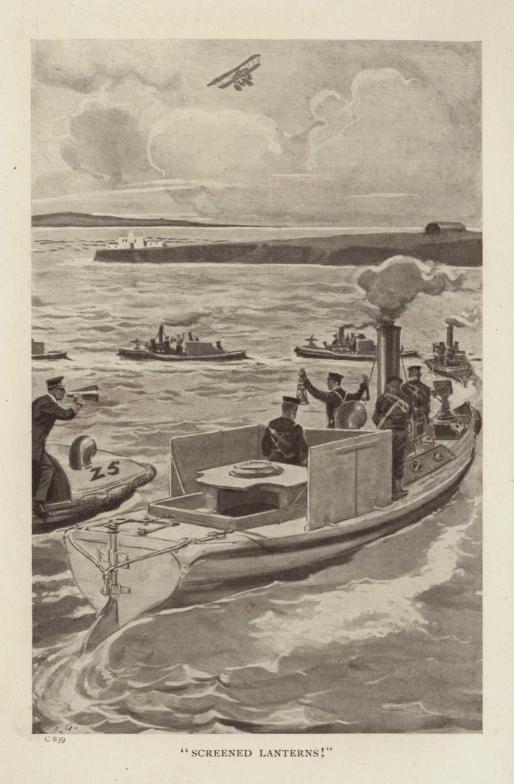
"SCREENED LANTERNS!"
They soon stowed away their khaki and shifted into blue uniform, and for the next two days fitted out their boats with maxims, two boxes of belts, towing-spans[#] over the sterns (as on the occasion of the first landing), fitting shields round the steering-wheels of those boats which had none, making screens for hand-lanterns, testing their steam-pumps, and seeing that the thirty or forty items down on their "lists" were on board.
[#] Towing-span, a rope or wire passing all round a boat under her gunwales, with a hook secured to the bight at the stern. The painter or tow-rope of a boat to be towed is secured to this hook.
On the Thursday morning the Fierce One came out in his fussy little "Z" motor-boat, and all the ten picket-boats followed him, making a circle round him whilst he inspected them.
The maxims—he could see them; anchors—he could see them too; but when he shouted through his megaphone "Screened lanterns!" every snotty had to hold up his lantern with one hand and the canvas screen in the other. The same with the semaphore flags, boats' signal-books, axes, compass-boxes, and ammunition-boxes.
"Work your pumps!" he roared; and after a furious interval all ten picket-boats began squirting jets of water.
Then he bellowed "Megaphones!" and all held up their megaphones except the Cheese-mite.
He dashed alongside Lord Nelson No. 1, and seized the Cheese-mite by his coat collar.
"Where's your megaphone? you—you—you——"
"Please, sir, I had it this morning; but when that destroyer went past just now the picket-boat rolled, and it went overboard."
"I'll roll you overboard," he growled, holding up the Cheese-mite as though he were a kitten. "You'll get another before night, or I'll—I'll——"
"Knives!" he shouted.
Now nearly all the snotties had taken for granted that every man aboard would have one. But only a few had them, and the Fierce One flew in a towering rage.
Eventually he took all the picket-boats outside the submarine net to make certain that those maxims would fire; and it can be easily imagined what happened when ten strange maxims were worked by ten not very experienced "hands", in ten bobbing picket-boats, under the supervision of ten much less experienced snotties.
A bullet hit the gunwale not two feet from where the Orphan stood, and goodness only knows why there were no casualties. Little, though, cared the Fierce One, so long as he made certain that every machine-gun was in working order.
That day they practised towing their pulling-boats—four to each of the Suvla boats, three to each of the Anzac ones.
A very busy day they had, for in the evening a transport came into harbour loaded with mules from Suvla, and tried the simple plan of slinging them overboard and letting them swim to the shore.