WOOD-SHAVINGS IN MENDING AND MAKING MANY OBJECTS
Reading edition
“In human industry, there is on an average a loss of fifty per cent. in labour or material.”—Observations on Art, by Charles G. Leland.
There is no country in the world in which the art of mending is so much required as in the United States of North America. The reason for this is the extraordinary and sudden changes in temperature, causing the expansion and contraction of cells and fibre, especially in wood, which results in cracks. Thus seasoned furniture and carvings, which have remained unchanged for centuries, it may be for a thousand years, in any part of Europe, shrink and split very often within a month after being placed in a drawing or dining room in Boston or Philadelphia, as I know by sad experience. Thus I have known a very beautiful Italian mandoline, three hundred years old, richly inlaid with ivory, to so shrink and warp in America that a professional mender declared that nothing could be done with it. The sounding-board had curled up like a scroll and split, and the mosaic or inlaying had fallen out in bits.
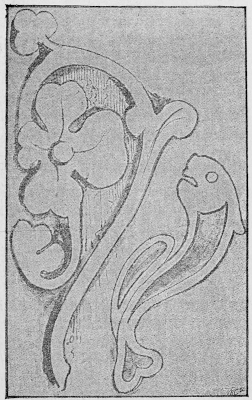
Patterns cut from Wood-Shavings.
In such a case, carefully detach the warped piece or pieces, and dampen the concave side carefully with a sponge till it resumes its flatness or usual form. When this is attained, take very thin shavings of a firm wood, as thin as they can be shaved, and glue them transversely, or grain across grain, to the under or plain side of the board. This will probably prevent all warping in future, especially if the best mastic and fish-glue is employed. It may here be noted that where the shavings cannot be obtained, thin parchment or even note-paper may be used, and that good, strong varnish, or not too thin, may be used for a binder. There are many cases in which parchment or paper are preferable to wood in repairing, as being less liable to warp or crack.
Wood-shavings, which are as yet but little utilised in art, have, however, before them “a great future.” Combined with glue, or other binders, they can be made, even under the hand-roller, into boards, which have the advantage that they can be moulded, curved, or turned to suit many emergencies which would require a great deal of saw or carving work.
It is not unusual to employ veneers, or very thin sheets of wood, as a guard across the grain where shrinking is to be apprehended, as in tablets for painting on or panels, and it is a great pity that this very cheap precaution is so little used. But there are very few cases in which shavings are not as applicable, and they have the great advantage of being obtainable wherever there is a plane and wood.
Holes or defects in wood—for example, in American shingle roofs or the clap-boarded sides of houses—can often be more cheaply and readily repaired with shavings and glue (into which oil is infused) than by any other means. And it may be observed that such a coating of shavings and glue, laid on to a new roof, is the cheapest and most effective protector against rain or sun or frost.
In certain work wood-shavings can be advantageously combined with paper to give a solid, smooth surface and firm body. Here the paper-paste, with or without sawdust, is first forced into the cavities, and the shavings superadded.
Shavings and glue are excellent for the temporary repair of boats, and if the mending be properly executed, it will be as durable as the original wood. It would be an easy matter indeed to make a canoe entirely of shavings and glue. If the hand-roller be well used and thoroughly applied, the result will be a very firm fabric.
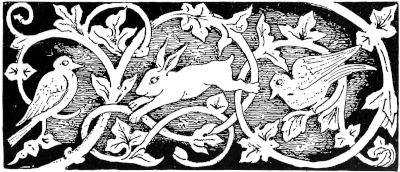
Pattern to be cut out of Shavings and applied with Glue to a Panel.
It may be worth knowing in the wilderness, that where a backwoodsman has a plane (and he can always make one if he has a chisel, which, again, can be made out of a knife-blade) he can make shavings, and with these and some kind of binder—even clay—he can lay a dry, hard floor, when perhaps boards are not to be obtained. The substratum may be of beaten clay or stone. If of sufficient thickness and well rolled, such a floor as this would be impervious to damp.
Any surface can be very well veneered with shavings and glue. Smooth the surface by pressure or rolling, and when dry glass-paper it. Veneers are often not to be had; shavings may be got in every carpenter’s shop.
Not only very strong and elastic canes, but even bows of a superior quality, can be made of shavings. The Indians in Pacific America make the latter by pasting and pressing one shaving on another with great care. It may be understood that where the grain, as in a piece of wood, runs altogether in one way, it will split with the grain. But where it is not uniform or connected, and is very powerfully incorporated by pressure with a good binder, we may easily have a very elastic and tough fabric, not so likely to split as wood. Thus we can make from hickory shavings a wood less liable to warp or split than the original wood itself.
Wood-shavings and glue are admirably adapted to repair broken boxes or any other articles of wood, especially for smoothing over roughly mended surfaces and covering knot-holes or other defects. In all cases when possible use the roller, and when pasting one piece on the other cross the grains.
Musical instruments, such as guitars, violins, and mandolins, are very easily repaired with shavings and glue; and this is, indeed, in many cases, the very best means of reparation, since, while a piece of wood may or may not injure the tone, the shavings always give a good vibration. And where it is quite beyond the power of any ordinary amateur, say a lady, to set in a piece of wood or apply one, or to get it of a proper thickness, anybody with care can paste on thin shavings—the thinner the better—till the defect is repaired. In many cases parchment or paper will answer just as well, and I have myself thus perfectly mended violins which were apparently beyond all bettering, and got to the stage of lasciate ogni speranza, or hopelessness.
There are, however, many cases of badly fractured objects in which the owner gives up hope, because it seems impossible to make a beginning. Now, “whatever can be made can be mended” is true of everything except morals, and even in these there is more to be done than men wot of. And in a great number of these cases parchment strips, thin linen tape, or especially wood-shavings, can be used with success. Bring the broken edges together if they warp apart, and attach them with the strip and strongest cement; that is, with small pieces of the “fastener.” Do not attempt to do everything at once. When the edges are united and the binder dried, fill in all crevices or holes with a suitable paste or “filler”—not too much at once, in certain cases. Then, as will generally be required, cover the surface with thin shavings and binder; as it dries, file or glass-paper it smooth. The shavings will make, with mastic and fish-glue, in many cases, a far better repair than could be effected with a piece of wood or parchment, because they will never split, like the former, if they are applied lying transversely or crossways, nor stretch like the latter.
It may depend, in many cases, on what wood the shavings consist of. As I have observed, even in the bush a plane can be made with a chisel or a piece of a table-knife blade, set in a wooden block; but elsewhere any carpenter will easily supply what is wanted, ad libitum.
The paste or filler of wood-powder or paper-pulp will be found described in other chapters.
ORNAMENTAL WORK OF SHAVINGS—MARQUETRY
A curious kind of ornament can be made by cutting out decorative patterns, human figures, animals, flowers, &c., from shavings with scissors or pen-knives, then glueing them on a smooth soft board. Apply as much pressure as possible, so as to make them sink into the wood, and when dry coat the whole with varnish, till an even surface is established. Rub over the dried surface with finest glass or emery-paper, and then smooth patiently with the palm of the hand. If this be well executed the result will be a perfect imitation of inlaid wood, although it is really an art by itself, which, I believe, is my own invention. Thin veneers may also be used instead of shavings. Ebony or walnut thus appliqué on larch or holly make exquisite work.
This kind of ornament has great advantage over inlaid wood or marquetry, for the pieces of which it consist are far less liable to be detached or peel off, while it looks quite as beautiful. And be it observed that, laid with a transverse grain, it prevents warping and strengthens the ground, while inlaying weakens it; for to make the bed for inlaying or mosaic we must excavate the bed till it is extremely thin and liable to warp, whereas in shaving-work we make a light but very strengthening addition.
A single experiment will suffice to convince the reader of the merits of this very useful, elegant, and novel art. It is specially applicable to ornamenting albums and book-covers, where it may be used even on pasteboard.
REPAIRING PANEL PICTURES WITH SHAVINGS
It is often a very difficult matter to obtain a thin panel or strips and do all the work properly when we wish to put into shape a warped panel, let us say of an old picture, which is on the point of splitting. The inserting screws is very dangerous. I myself have inadvertently thus made a fearful blemish in a Madonna’s face. But if we use shavings there is no such danger. Wet the back till the panel is flat, and then gradually glue on the shavings across the grain. This is as well done with small bits as large. With a picture it would be well to continue the coating to the thickness of one-third of an inch or more, but a very thin coating will go far to prevent warping or bending. The thinnest panels or veneers may be thus “backed up” into solid boards. In all cases where practicable, use heavy pressure on the roller.