REPAIRING LEATHER-WORK TRUNKS, SHOES, OR IN ANY OTHER FORMS—JOINING STRAPS—MAKING CHEAP SHOES
Reading edition
Leather-work when much worn is seldom restored, and, except by a few experts, it is generally regarded as incurable. That is to say, that leather-work is only repaired by the same method in which it is made—that is, by sewing—when in fact a great deal is lost which might be saved, and much imperfectly repaired which might seem like new by resorting to a more scientific process. And therefore, having devoted much attention to it, I am persuaded that the worst cases may be mended. Within a week I purchased two small folio volumes which had been beautifully bound in black leather, embossed in deep relief, about 1520, in a style which was then becoming antiquated. The pattern had been cut in a wooden mould, stamped on the wet leather, and then completely worked over by hand with tracers and matted or stamped in the ground. But the black colour had been worn away from the relief and turned brown, and it was otherwise dilapidated at the edges.
I took a volume and where the surface was ragged moistened it, applied gum-arabic in solution, and smoothed it down with an agate burnisher. Leather treated in this way soon becomes like a paste. When it was all even I painted it over with strong liquid Indian ink. Common ink would have done as well. Then I varnished it over lightly with the admirable vernis à retoucher, No. 3, of Soehnée, which is flexible, preservative, and does not crack. I may add for ladies that it smells like eau de cologne. This dries almost immediately. It may be had at all artists’ material shops. Finally, I rubbed it for some time by hand. Then the binding was as good as new, yet not too new. It was simply perfectly restored.
I have in the introduction mentioned another work which I also restored. This was a Madonna in high relief, very much dilapidated; that is to say, it was of thin leather, which had been originally made in a mould, and was accordingly puffed out, so to speak, like a pie-crust. On the mould there had been laid a coat of muslin or cotton fabric; this, when dry, had been very thinly covered with gesso or plaster of Paris, and on this, when dry, a thin wet leather had been pressed. I may here note that very often the gesso was then blackened without any leather being applied, and that when thus blackened, covered, and varnished it looked exactly like leather—an easy art, which may be practised to profit by any one who can carve or buy moulds.
On examining this, I found that it would be very difficult to repair it with good leather. I found in a shop some thin black sham-leather, such as the Japanese apparently manufacture from leather dust, made by grinding up all kinds of leather waste to a powder. It was wretched, rotten stuff as leather, but all the better suited to my purpose. Some of this I cut into small bits, and with a knife soon mashed it, mixed with gum-arabic and water, into a very smooth paste. With such a paste one can repair any tear, roughening, or imperfection, care being taken that the paste and leather be alike in colour. With this I filled the hollows at the back, making the work solid; and having wetted all the ragged edges and fractured or torn places, smoothed them down with gum and a pen or paper knife, supplying deficiencies with the black paste. When all was smooth and dry I applied a coat of Soehnée’s varnish, and then rubbed it well down by hand. It was quite restored.
As this varnishing leather may sound like a heresy to artistic leather-workers, I would ask them if they would consider an application of tannin in solution—which is the preservative principle of leather itself—as “inartistic.” Certainly it is not, nor is the application of Soehnée (which is more of a simple preservative than a glaze) a mere finish for show.
The leather-paste of which I speak has certain qualities of its own which make it quite different from any other substance. We may include in leather “paste” not only the mere dust made from the dried substance, but all scraps, and also any thin leather, thoroughly softened or macerated. Even in the latter form it is, combined with a binder, really a plastic substance, since it can be worked into any form with ease. Mixed with caoutchouc or indiarubber in solution, and then dried, it is invaluable for mending boots and making waterproof soles. As I have indicated, it is excellent for mending old books. And here I may mention that if you have, let us say, one cover of a book in high relief, and the other, it may be, lost or worn plain, you can supply or make the duplicate very easily, very cheaply, and in a short time as follows:—Take a sheet of soft, white newspaper, dampen it, and press it on the relief. As soon as possible, taking care not to wet the book, fill in the back of the squeeze either with other coats of wet paper, melted wax, or liquid plaster of Paris. When this is dry, wax or oil carefully the face of the squeeze, wipe it dry, and make a cast from it in leather-paste. Thus you will have a facsimile of the relief. From a solid plaster mould, well oiled or boiled in wax, a cast may be taken in softened or wet leather, which is even better; it sets hard and tough.
I may here mention that it is very unusual to see books bound in deep relief with hand-worked, black, or black and gold, antique patterns, and that such a cover, say of eight by ten inches, would probably cost at least a pound, and be cheap at that. And yet any girl of ordinary capacity with, let us say, fifty shillings’ worth of moulds, and two weeks’ practice in tracing and stamping grounds, could produce from two to four such book-covers as those before me in a day.
There is now generally sold in furnishing or chemists’ shops a good waterproof glue. Leather softened and then well incorporated with this is also waterproof, and may be used to mend trunks. I have known a torn boot to be mended in this manner, and that so well that it lasted for a long time. Even a leather strap which is subjected to great tugging may be restored, if cut or broken in two, by shaving the edges obliquely, so as to sharpen them.

Then apply glue with acid, and before it is quite dry apply pressure, though not so great as to squeeze the glue out. Shaving across the edges, judicious pressing together, and final smoothing are of the greatest importance in all leather patching and piecing, because it depends on these to make the juncture imperceptible. Very few persons—even shoemakers—are at all aware of the degree of perfection to which mending rents in foot-covering can be carried by the use of waterproof glue, such as is sold by many chemists. I have worn such a patch for months, and it was hardly perceptible. But, like every art, it requires some practice to apply such patches properly, and I cannot promise to any lady that she can perfectly and neatly patch a boot by simply daubing on a piece of leather at a first trial.
It may be noted that in such strap-joining as that which I have described, the repair will be greatly strengthened by pasting very thin bits of leather, or even of muslin, over the edges and pressing them in. It is true that this cover will soon wear away, but meanwhile the mended leather is all the while growing stronger and uniting more perfectly. Even paper, glued and pressed on, materially aids to make the exposed joint unite.
And here I may say that many a lady and youth would do well to take a few practical lessons from any shoemaker in the noble art of cobbling; that is to say, of heeling, soleing, and patching, all of which are as easy to learn as steps in dancing, and are even more interesting or amusing when once mastered. It is, moreover, an art which will be of use through life. Those who can do this will probably, if ambitious by nature, progress to making slippers, it may be shoes; and he who can do this may be assured that he never need quite starve to death while human beings go shod. It is not so difficult as many think, for I have known shoemakers of very ordinary minds, and I also once knew a mechanical artist who learned to make a fine pair of shoes in a few weeks. In fact, there is a living in a great many things for those who have once learned to use their fingers.
Few people are aware of the extraordinary durability of leather-work of certain kinds. There are in the British Museum Roman sandals, probably made of raw hide, but cut into pretty form, which were found in the Thames, and which look as new as if recently made. I have seen within a day as I write a gracefully formed pitcher of the early fifteenth century of very solid black leather, like the old blackjacks once common in England, which has probably passed through centuries of use, and is as perfect as ever. Wood splits, earthenware breaks, and metal rusts, but raw hide, or cuir bouilli, as set forth in the old song of the “Leather Bottél,” seems to endure every trial. As the man commemorated in “Æsop’s Fables” declared, “After all, there is nothing like leather.” The reader who may be especially interested in this easiest of all the minor arts may consult on this subject my Manual of Leather-Work (5s.); Whittaker & Co., 2 White Hart Street, Paternoster Square, London, E.C.
Strips of raw hide are without equal for repairing broken vehicles, wheels, saddles, and similar articles, because they shrink while drying, drawing everything tight, and set so hard when once dry that what is mended is often stronger than before. I have elsewhere mentioned that the strongest trunks in the world are made in America from it, as they had need to be, since there is no country in the world where the “baggage-smasher,” figurative or literal, is so much to be feared.
The reader who has occasion to repair anything in leather should study the chapter of this book which treats of indiarubber and gutta-percha, the subjects being in many respects the same.
A strong cement for leather is made by combining gutta-percha and Schwefelkohlenstoff, or bisulphide of carbon, with petroleum to a syrupy consistency. A very good cement specially adapted to joining leather straps is as follows:—
Asphalt 12
Resin 10
Gutta-percha 40
Bisulphide of carbon 150
Petroleum 60
The materials, excepting the Schwefelkohlenstoff, are put together in a bottle which stands in hot water for several hours; when the mass has grown thick with the petroleum add the rest, and let the whole stand for several days, shaking it very often. If the pieces of leather to be united are first heated and then pressed very tightly together, the adhesion will be increased. This cement is as well adapted for glass, crockery, horn, ivory, wood, or metal as for leather. It is admirable for mending trunks, whether made of leather, wood, or pasteboard.
When a trunk is made of any of these, and a hole is broken through the side or top, take a newspaper and coat it with this cement, applying another, till there are a dozen or more thicknesses. If, as it gradually dries, this be pressed and hardened with a roller, or even a round ruler, it will be much improved. Glue this into or upon the fracture. In most cases with care it can be made as strong as ever. Where a rib is broken it should be promptly replaced. (Vide Metal-Work.) All trunks should be covered with waterproof glue or varnish, as it effectually protects them from exposure to the rain. This is very rarely done, however, the result being an immense amount of loss to all travellers. In any town where there is a chemist’s shop, and where a bit of indiarubber is to be had, even at the stationer’s, a waterproof cement can be at once manufactured. The easiest of these to prepare is the following:—
Gutta-percha 100
Pine resin 200
The resin is first melted in a pan, the gutta-percha, in very small bits, being gradually stirred in till all is amalgamated. When used it must be warmed again. This cement can be used for as many different articles as the preceding.
It may here be noted that vast quantities of waste leather from shoemakers and bookbinders, which sell for a mere trifle, can be utilised to make admirable waterproof carpets and wall-covers. The leather is first soaked till soft, then smoothed out and mixed with waterproof cement, and rolled into one flat piece. This makes a very cheap sub-carpet for winter—better than oil-cloth, being softer. For walls it can be pressed in moulds, gilded, or painted. If varnished there is no unpleasant smell from it. The harder it is compressed or rolled the more will all smell disappear. Even with rolling by hand with a bread-roller almost all substances—for instance, paper, cloth-rags, sawdust, leather, clay, wool, cotton-wool, when combined with any fit adhesive or cement—can be made very hard or tough; and it is remarkable, considering the cheapness of the materials, how little this principle is as yet applied.
It may be remarked that there are many people who do not know what to do when the sole of a boot splits off or wears away and there is no shoemaker at hand. If the heel is lost and no leather can be had, a very good substitute can be cut from wood and cemented on. A few tacks will make it last as long almost as leather. If a piece of sole leather can be got, even from another old shoe, one or two layers can be cemented on to make a sole. A short screw or nail through three-quarters of the heel greatly aids in making the layers adhere. This may also be done with a vice.
In the town of Bagni di Lucca, where I now am, a pair of leather shoes with wooden soles, such as are commonly worn by women and children, cost only fivepence. They are, of course, rough, but still far better than none. The sole is rudely and very easily cut, with a high heel, from white pine or larch wood. The upper is a single piece of leather, which only covers the front half of the foot. It is moistened and bent into shape, and then tacked or glued on. Many people simply buy the soles, then the leather, and make the shoes for themselves, in which case the expense does not amount to more than twopence. In Florence there is often added to this the back, or heel-piece, which costs twopence more, and makes an almost perfect shoe. This art would be worth knowing in a wild country.
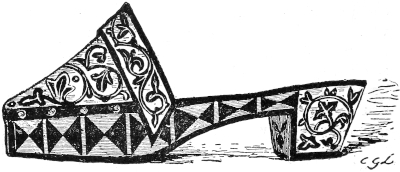
Italian (Lucchese) Peasant Shoe, costing from 5d. to 8d. per pair, undecorated.
Lehner (vide Indiarubber and Gutta-percha) specially commends for mending soles the composition of—Gutta-percha, 10; benzine, 100; linseed-oil varnish, 100. It is extremely elastic and tough, and therefore suitable to soles. Mixed with black dye, or made with japan, it forms patent leather or polished leather. It should for this purpose be applied with a broad brush in thin successive coats, and well dried before applying a new one. This is far superior to ordinary blacking; it is more easily applied, and does not injure the leather so much, because the latter is often made with vitriol, which, while it promptly gives a shine, eats away the fibre. Boots and shoes will, in fact, wear much longer with this coating than without it.
This is even more applicable to a great deal of harness, saddle, and bridle mending, and restoring sheet leather in every form; as, for instance, waggon curtains, when worn and dry. First soften the leather, then restore its quality, if required, with tannin or indiarubber in solution. If very dry and exhausted, it may first be treated with neat’s-foot oil for several days. Then sew it up, if a seam, or mend by applying leather and the cement. If all persons who own much harness would carefully study this subject, they would be astonished to find what economy could be effected by judicious mending.
It may happen that the reader may have occasion to wish to renew black, glazed leather-work, or to make a brilliant black pattern on a brown ground in stamped leather. I have often executed it with success. In such a case it suffices to simply blacken the leather with ink or dye, and then coat it with any flexible varnish; that is, one into which glycerine or gutta-percha has been infused. Any one who can draw can in this manner execute very beautiful work for covering walls, panels, chests, or doors. Or flexible black varnish can be directly applied.
Lehner gives a recipe for attaching leather to metal, which may also be applied to any other substance:—Cover the leather with a thin and very hot coating of glue, press it on the metal, and then wet the other side with a strong solution of gall-apples or tannin (Lohe, extract of oak-bark) till it is thoroughly-penetrated. The tannin combines with the glue, and attaches the leather with extreme tenacity to the metal, &c. It is advisable to roughen the metallic surface to facilitate adhesion.
By combining glue (and many other adhesives) directly with the tannin or gall nut astringent we obtain a waterproof cement of great strength, which is very useful for shoes. It is, in fact, not at all a difficult matter, where other appliances are wanting, to make from leather, without sewing, a soled shoe when tannin and glue are obtainable. The same can be done with canvas.
During the great wars in America thousands of soldiers often went barefoot in winter-time, with abundance of horses or cattle killed all round them, because they did not know that a strong moccasin can be made by cutting out a piece of raw hide, piercing holes in it, and drawing it up like a bag round the ankles, as is so commonly done here in the mountain districts in Italy. I once astonished a soldier in the war by suggesting this, and he declared he must try it. It is remarkable how rarely man in an uneducated state ever invents anything, be it a myth, a tale, or a practical invention.
If the upper leather of a slipper or shoe be cut out, it can, if wet, be easily made to assume the form of a foot by drying it on a last, or even on another shoe. Let the seam of the back jut or flap over the edge, and allow full selvage for the rest to turn under the sole. The latter may be of sole leather. If there is none, glue two or three pieces of the leather together with the tannin cement, and roll them over strongly. Then glue the back and the under-lap with great care. With a little practice a fairly good shoe can be thus made. Canvas can be used in the same way. To dwellers in the wilderness this may be valuable information. But very pretty ornamental slippers can be made by young ladies out of scraps of gaily coloured leather. They can buy a pair of soles, and get the leather at a leather-dealer’s. This is all simply substituting glueing for sewing, and strong tannin-glue holds quite as strongly as a great deal of the sewing of cheap, machine-made shoes. It would, indeed, not be a very difficult or expensive thing to shoe or clothe all mankind comfortably, were it not for the fashions followed by the wealthy.
These very cheap shoes, made with either wooden or leather soles, and that so easily that a child can learn to manufacture them in an hour, can be easily ornamented so as to be really attractive. Take the leather, moisten it with a sponge, and then with a tracer, which is like the end of a screw-driver—i.e.— draw a pattern in the damp, soft leather. When it dries the pattern will remain. Then with a point or stamp, dot or roughen the ground. Finally, when dry, paint the pattern black, and then varnish it. Anybody with the least knowledge of drawing can make and sell such ornamented shoes for a good profit, as they are as yet hardly known to anybody. Other colours may be substituted for black, or gilding applied.
I have in another place shown (vide Papier-Mâché) how good artificial leather can be made by combining paper—best in pulp—with indiarubber and benzole fluid solution. Also how soles can be made by steeping pasteboard in the same, and how these, which are very easily and cheaply made, can be glued on to the leather so as to protect the latter from wearing out, for ever, if renewed. A bottle of this cement, combined with Diamond or Turkish Cement, will in like manner repair boots when the sole begins to split or part; and if applied when it begins to gape, it will be closed for a long time. This is such a practical, cheap, and easy method of making boots and shoes last, that my wonder is that every man who goes shod, and especially every traveller, has not a bottle of it by him. Observe that the two edges should be well pinched or screwed together (a six-penny vice will answer for this), and the leather first heated, though all this is not a sine quâ non, but only an improvement.
Leather thus attached by a very strong cement is quite as durable and much pleasanter to wear than “copper toes” or iron heels, which assimilate their wearers to horses. And it takes no longer to make and attach a heel or a sole in this manner than to black a pair of boots, as I have myself verified within a few hours.
Where seams rip out, the best repairing is by sewing as shoemakers do, which is not hard to learn, and I advise all young people to learn it. But where sewing cannot be resorted to, the cement, well applied and compressed till dry, will hold almost any break for a long time.
I urge ladies of all classes and conditions to carefully consider this chapter. They are more accustomed to repairing than men, and will take to it more intelligently. As their chaussures are made of thinner leather than ours, they need repair oftener, but are, on the other hand, so much the easier to repair. Every mother of a family will at least profit by studying this book.
Shoemakers’ paste, much used for shoes, belongs properly to leather-work. It is made by boiling crushed barley to a thick mess, the water being kept extremely hot. It is then set aside till fermentation begins, which announces itself by an extremely offensive smell. Thence it passes to a stage in which it is a brownish syrupy mass, possessing great power as an adhesive. It is now taken from the fire and a little carbolic acid added to arrest fermentation. This can be used by itself for an adhesive; it also combines well with indifferent substances, such as powdered lime, or chalk, white zinc, ochre, clay, or umber. It may be as well used for binding books.
I have already given a very good recipe for reuniting broken leather straps. I here add another from Lehner. It is very good, but hardly worth the very considerable extra trouble and expense as compared to the former:—
Gilders’ glue 250
Sturgeon’s bladder 60
Gum-arabic 60
Reduce to bits and boil in water to a solution, to which add:—
Venice turpentine 5
Oil of turpentine 6
Spirits of wine 10
The strap-ends, or pieces of leather, having been thoroughly cleaned, are now covered with the adhesive and pressed together between hot plates, where the work must remain till cold.
A very good artificial leather, perfectly waterproof, may be made by covering a strip of strong paper, or, better still, one of glazed muslin, with the gutta-percha cement. Add to this fresh layers of cement and paper, till the requisite thickness is obtained. This is useful for mending soles. Where the gutta-percha or indiarubber cement is not to be had, substitute copal varnish and glycerine, or thick turpentine varnish and a little glycerine.