PAPIER-MÂCHÉ REPAIRING TOYS—MAKING GROUNDS FOR PICTURES AND WALLS—CARTON-CUIR AND CARTON-PIERRE
Reading edition
Soft paper, when mixed with water, gum, or, better still, with flour-paste, forms a substance which can be moulded to any form, and which, when dry, will be as hard as cardboard. Its hardness and durability may be increased by mingling with it many substances.
Combined with soft leather in small fragments or with the dust of leather, it forms what the French call carton-cuir. In this, or even in its natural state—that is, paper and paste—papier-mâché, as it is termed, can under pressure be made as hard as any wood. I have seen all kinds of articles of furniture made from it. In America there are manufactories in which pails or buckets, tubs, firkins, and even durable boats, are thus manufactured. There is in Bergen, Norway, a church built entirely of it mixed with lime. For certain kinds of mending it is very valuable.
Though not so plastic as clay, papier-mâché can, with a little practice, be moulded into any form. It consists simply of pasting piece on to piece, pressing it meantime as much as possible with the fingers or a wooden implement like a pestle. The pressure should be applied as it gradually dries. Any one can thus make very hard cardboard with a bread-roller on a board.
If you have the cardboard cover of a book badly damaged, with even a portion gone, it can be restored by using papier-mâché in which a solution of glue or gum has been infused. Glue it specially at the edges. For such repairing take paper-dust or pulp, combined with gum-arabic in alum-water solution, or simply the gum. This is easily moulded and smoothed into any cracks or torn places.
If parchment be torn away it is easily replaced. Cut a piece to replace the missing portion, dampen it and the edge which it is to join till quite soft, then glue the two together, using pressure. I have just effected this myself with a cover of which half was gone, and the mending is hardly visible. Use the broad knife freely to press down the edges.
By combination with a mixture of nitric or sulphuric acid and water, soft paper becomes parchment-like and very hard. This requires careful experimenting, for its success depends on the quality of the acid and the texture of the paper. Very remarkable results have been obtained from this, such as material resembling ivory, horn, and tortoise-shell, in large blocks.
Waste-paper is so common and cheap that papier-mâché can always be made anywhere. It is well adapted to close cracks in wood, walls, or elsewhere; and for those who wish for an employment or amusement, it affords endless facilities. One of these is the mending or making of toys.
A common mask is made as follows. On a face carved in wood and oiled there is spread common coarse soft paper wetted, which is carefully pressed down, and more paper and paste added, till it is of the requisite thickness. It is then, when rather dry, taken off and left to dry perfectly. It is then painted and varnished. Should a mask be broken, wet it, paste glue-paper over it, and paint it again.
Papier-mâché is popularly synonymous with that which is trashy and sham in art, simply because its capacities and applications are not known. Thus leather-work was long despised as only affording imitations of carved wood. But in the hands of a true artist—that is, of an original designer, who applies, and not a mere artisan, who imitates or copies—papier-mâché is as much a subject for art as any other material. It can be used in many ways, more or less allied to mending, as are all arts. Thus paper in fine powder, or reduced to a fine paste—or pulp—can be, with a little practice, mixed with gum and painted with a brush on a surface so as to produce relief. A very little elevation or depression thus serves to produce grounds which may serve to give light or shadow to pictures. Thus pastel painting or crayon in colours rubbed in, which has always been, even in the most vigorous hands, a weak or “softly sweet” art, may be made very vigorous by firmly relieving and roughening the ground; for, as the great American painter, Allston, often strengthened his colours by mixing sand with them, so pastel painting which lacks “sand” can have it supplied by mixing it with the gum for the ground.
To understand this process more clearly, let it be observed that, as the illuminators of mediæval manuscripts gave relief and the appearance of solidity to gold by making a raised surface with a powder of gesso (plaster of Paris) and clay and gum, so this principle can be carried out to a far greater extent by giving relief to a ground. Here those of limited views, who never get beyond the merely artisan stage of art, will at once decry this as shamming, and as imitating effect by the aid of modelling, and not being true art, quite forgetting that all is true to genius, and everything more or less sham in the mere imitation.
Having a surface, either panel or Bristol board, which latter had better be pasted to a panel or good thick solid cardboard, begin by taking a little gum or glue in tolerably fluid solution on the point of a brush, and incorporating with it the paper pulp or cloth-dust to a very soft paste, with which paint what is to be in relief. The same effect is produced in oil by using a heavier, thicker kind of paint. That is all the difference, one being as legitimate as the other. By intermixing chalk or sand or clay, and by using glass-paper where the crayon, &c., refuse to take easily, the relief adapts itself to every substance. In this, as in every process known, the artist must at first experiment a little, according to his materials.
Solid sheets of fine hard paper, with strong paste between, when passed between rollers form a kind of papier-mâché which, is as hard as wood, fire-proof, and, what is most singular, more durable than iron. Wheels for railway carriages are often made of it, and they never warp under the action of heat or cold, neither do they crack nor bend. You can make this cardboard for yourself of very good quality by this process:—Take a sheet of writing-paper—the better the quality the better the result will be—cover it with good flour-paste in which there is a little alum and glue and a few drops of oil of cloves, which latter will prevent paste from turning or souring. Then lay on this another sheet, apply another coat of paste, and when it is a little dry or past the softer stage, yet while still capable of adhesion, lay the sheets on a hard, smooth slab or table, and pass a roller over them, at first gently, but eventually frequently, and with force. Add as many sheets as necessary for the thickness required. It will be understood that if the surface on which this sheet is formed were an intaglio-cut die or mould, the cardboard when taken up would present a bas-relief of it as hard as any wood, and the whole would form a panel which could be used for the side of a box or to be set in a cabinet. If made of good paper and firmly rolled, this panel will be in every respect equal to wood for all decorative purposes.
As anybody who can carve wood at all can cut moulds, and as a wooden mould, if kept well oiled (or otherwise secured from yielding to moisture), will serve for papier-mâché and leather or wood-paste casting, it is remarkable that such work is so very little practised by the students of the minor arts. That such panels can be very easily and rapidly made I know by experience; that the materials for the work are cheap speaks for itself; and, finally, that beautiful panels for cabinets and doors, whether made of carved wood, stamped leather, or papier-mâché bring a very good price will also be most apparent to anybody who will go to a fashionable cabinetmaker and order them. Thus we will say that a small plain cabinet costs £5. Put into it six panels, really costing about 6d. each to mould, and the price will be £10. Such pressed panels are admirably adapted for binding books, as, when properly made and dried, they cannot warp or bend. If covered with relief they may be made very beautiful. Simply blackened or browned, then rubbed with oil, varnished with Soehnée, No. 3, and rubbed by hand, they are as beautiful as polished wood or leather.
Papier-mâché, pulp, or paper powder can be combined with caoutchouc or indiarubber, which latter can be itself dissolved in benzine, camphine, sulphuric ether, and other solvent mediums, so as to form a paste which becomes like indiarubber when dry or as it hardens. Mixed with sulphur this forms vulcanite. Or it may be combined with white colouring matter of almost any kind. This can be applied to mending the broken noses of dolls, or any other wounds which these pretty semblances of humanity often receive, their beauty being unfortunately generally more shortlived than that of their prototypes. The final finish of such reparation is a coat of paint. In many cases this is better when rubbed on with the finger than when directly painted. The reader who shall have studied this work will find no difficulty in restoring any toy.
I may, however, here remark that “no solution of india rubber can be well moulded without intimate intermixture of sulphur, aided by heat and pressure. This is a difficult process, and the amateur would do well, therefore, to purchase rubber composition, which he may do at any large shop in which rubber goods are made as a specialty” (Work, May 21, 1892).
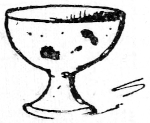
It is easy to make any article of papier-mâché if the mere beginning of a form has once been shaped; because, after that is set, all that we have to do is to gradually paste one piece of paper on, here and there, till it is finished. This beginning is very easy if we have an object on which to begin. Thus take a vase or cup. Oil this, and then lay on and all around it soft, damp paper. Newspaper will do—a soft, white printing paper. Then, with a broad brush, lay on paste, and apply a second coat of paper. Press it meanwhile as hard as you can. Continue this till the papier-mâché is thick enough. When dry, take a penknife and cut a line through from top to bottom. Scale it off, and reunite the edges with strong glue; then paste over the line of junction a strip of paper. Then you will have a cup.
If it be rough, cut it smooth and use glass-paper. When finished it may be painted or covered with wet leather, which can be worked into relief. Or it may be made to look like ivory by the process elsewhere described. Paper may in this process be combined with soft leather rags; as, for instance, pieces of old gloves out of which the thread has been taken, old chamois, bookbinders’ clippings, or the like. This forms effectively leather.
Carton-pierre, or stone-paper, is a very useful composition, which is very fully described by George Parland in Work, July 2, 1893. It consists of paper scraps, in the proportion of an ordinary washing boiler or copper one-half full of boiling water and about one-half paper waste. Add two pounds of best flour-paste; also, in a separate vessel, a quart of water, into which sprinkle a handful of fine plaster of Paris. Let it stand ten minutes before mixing it. “When the paper in the copper has become a fine pulp add the flour-paste, keeping the whole well stirred. Fifteen minutes after add the plaster, and a few minutes later rake out the fire from under the boiler. Have ready three pails of fine ground whiting; pour in one pail of whiting and stir up well, adding more whiting till the stick used to stir will stand of itself in the mixture. Let it cool, and it will be ready for use.
“Some firms,” writes Mr. Parland, “add powdered alum in the boiling process, others add one pint of boiled linseed-oil; but if made according to the previous directions, an excellent carton-pierre will result, which gives very fine impressions from moulds. If it be cast in a plaster mould, the latter should have two or three coats of shellac varnish, and then be well oiled.... In using the carton, sprinkle some fine plaster of Paris on a bench, and taking a lump of the newly made carton, mix it well with dry plaster, adding more plaster, as bakers would add flour to their dough. Having worked it well in this way until it will not stick to the fingers, with clean hands roll pieces very smooth in the palms, or on a smooth level board, and press each roll into the cavities and hollows of the mould, often wetting the edges of the carton in the mould before adding a fresh piece to it. The casts must not be more than from an eighth to a quarter of an inch in thickness, except at the outside edges of the mould.... The casts must stand about twenty-four hours, and then be baked in not more than 100° heat.”
The reader who is specially interested in papier-mâché will find a series of articles on the subject in Work, Nos. 3, 6, 12, 17, 22, 25.
Pipeclay, to which calcined magnesia, whiting, or baryta may be added or omitted according to the body required, may be combined with papier-mâché and gluten, such as gum-arabic or dextrine or flour-paste, which will form under pressure, or even by hand-rolling, a very hard and finely grained substance, which is specially adapted to painting pictures. Plates or tavole are sold very cheaply in Florence of papier-mâché, which are as hard, heavy, and glossy as ebony. It is not generally realised that an expensive hydraulic-press or steam-engine is not needed by the amateur to harden papier-mâché. A common bread-roller, passed many times over the material, will work it “down and in,” quite as well as direct pressure, and very often much better.
Papier-mâché mixed and macerated with indiarubber or gutta-percha and benzole (vide Indiarubber) forms in many cases a very good substitute for leather. It can also be combined with flexible varnish to make leather. Very valuable soles can be made, or broken ones repaired, by taking card or pasteboard and soaking it in a hot solution of indiarubber. These waterproofed soles, whether of cardboard or leather, are easily prepared, as easily applied and renewed, and they will keep the true sole from wearing out forever, if renewed.
Singular as it seems, there are not many persons who are familiar with the properties or texture of so familiar a substance as paper. We know that if wetted it grows soft, but still remains, as it were, knotty, and that when chewed it does not properly dissolve. Yet if the reader will take a piece of thoroughly wetted paper, and knead or macerate it with a knife for some time with gum in solution, he will find it gradually becomes a soft paste, as flexible and as capable of moulding as putty or clay. This is not the same as papier-mâché, which consists of paper merely wet or mixed and boiled with paste, and contains fibre and knottiness. The finely macerated paper, combined with an adhesive, is ductile, impressionable, sets well, and readily receives pressure on rolling, under which it becomes extremely hard. Paper thus completely softened is readily made into sheets, and may be easily applied not only to fill up worm-holes in leaves and completely torn-away corners, &c., but is very useful for cracks and cavities in wood and other substances. It may be made up with any gums, such as gum-arabic, dextrine, fish-glue, and also with caseine, gutta-percha, varnish, and most of the substances used in cements. Paper when thus softened and mixed with, e.g., fine glue and glycerine, or with flour-paste, can be moulded and applied in ornamental forms to any surface.
There is this great difference between simply wet paper, however wet it may be, and that which is completely softened by maceration. The former is always lumpy, the latter passes under the blade of a knife like soft clay or putty. When made up with gum, glue, and glycerine, or strong paste, it is, when dry, like light wood, but less brittle. Kneaded with Indiarubber solution and glue, it becomes like leather, and can be used in several varieties of repairs. Rolled into sheets, this composition makes very good and cheap artificial leather for hangings. To manufacture these, spread the composition with a broad brush or dabber on a slate or marble table, and when rather dry pass over it a wooden roller. Some practice is needed not to roll it when too soft. If intaglio patterns are cut in the roller, the sheets will give them in relief. It is worth noting here that a great many pieces of old hangings sold as leather are really only made of papier-mâché, or carton-cuir, and glue. These hangings, whether of leather or counterfeited, can be often bought in a damaged condition very cheaply, and can be easily restored with this composition, to great profit. When mixed with white lead, or oil paint and glue, soft paper becomes harder and firmer, and under pressure is as hard and heavy as any wood. White paper with holly wood or white larch or lime-tree wood in powder, and white gelatine—better if bone or ivory dust be added, with a little Naples yellow (oil)—forms a beautiful cement.
It will be seen by what I have written that cavities, holes, cracks, and defects in most substances, including wood and leather, can be perfectly remedied with paper in combination with glue, gum, or other substances; and as it is always to be obtained, a knowledge of its nature and applications cannot fail to be of value to all menders and restorers.
Papier-mâché, like all substantial or putty-like cements, involves moulding or casting. This subject is exhaustively treated in the Vollständige Anleitung zum Formen und Giessen, by Eduard Uhlenhuth; Vienna, A. Hartleben, price 3s. On the subject of paper consult the Handbuch der praktischen Papier-Fabrikation, by Dr. Stanislaus Mierzinski, three volumes, which is not only the latest, but by far the most comprehensive, work on the subject with which I am acquainted. And here I may observe in this connection that if my references have been chiefly to German works, it is because, in the minor technical applications of chemistry to the arts, and in preparing intelligible practical treatises on such subjects, the Germans have been, especially of late, by far the first nation in Europe.
I may mention that since writing the foregoing passages I purchased, for a mere trifle, in Florence two carved heads of the fourteenth century in walnut wood. They had suffered very much from time and wanton abuse, their noses having been hacked off. I made a mixture of soft paper-paste and gum-arabic, working the two thoroughly in together with a knife-blade till the composition was as soft as butter. This thorough maceration is essential to produce a durable body. With this I filled up the holes, made new noses, and painted the whole with Vandyke brown, or brown-black. In a few minutes the restoration was complete, and the heads which had cost one franc each are now worth at least thirty francs. I should say that the portions restored are as hard as the original wood.
It is not always an easy matter to reduce paper to a perfectly soft paste, such as is called in French papier-pourri. A small quantity can be mashed with a knife-blade and flour-paste or gum. A large quantity is prepared as follows:—
Take clippings of paper and leave them a long time in water, which must be occasionally changed. When quite dissolved or soft, bray the paper in a mortar, and finally boil in very hot water. To give it consistency, add flour-paste or gum. This makes a very fine cement, which will receive the most delicate impression. It is invaluable for all kinds of dry mending.
As I have shown, it can be applied to make or mend defective leaves of books, to fill up worm-holes in leaves, to repair drawings and pictures on wood or canvas, and when mixed with any gum which sets hard, to restore, add to, fill, or imitate woodwork. Under pressure and combined with different powders it becomes as hard as ebony and fire-proof. Its extraordinary value and general utility are as yet very far from being much known.