MENDING METAL-WORK OR REPAIRING BY MEANS OF IT FIREPROOF CEMENTS, WITH IRON BINDERS
Reading edition
Metal-work, especially in iron, requires so much forging and so many appliances that it is to a certain extent beyond the ordinary mender, who must in most cases have resort to the smith or artificer. But there is still much within the capacity of the amateur to effect, and this I will describe.
One of the commonest requirements in repairing trunks and many other objects is to make a strap or strip of metal hold either to a surface or to itself. This is to be promptly effected by riveting. If the iron band on a trunk is broken, you cannot well nail it again into its place. A nail will not hold in the thin side, possibly of pasteboard. To learn how to repair in such a case, take a piece of common hoop iron, lay it on a block of wood or a board, and with a fine nail or brad-awl and hammer knock a hole in it. Then take a rivet or any flat-headed tack, put it through the hole, lay it with the head of the tack down on iron or stone if possible, and then give the point a blow, a little sideways. The result is that the point will be flattened and the tack firmly held. The result will be the same if the rivet passes through two thick pieces of metal. In this manner the two ends of an iron hoop for a box are fastened. Therefore, if we take a piece of tin or sheet-iron, put it in the trunk against the side, and bring down the broken strip on the outside, we can, with a little care, rivet it. It is advisable, when this is done, to paste a strong piece of muslin or leather over the tin to prevent it from cutting anything in the trunk. These riveted strips are far better for surrounding and holding many bundles than cords. They are better for books, because they do not leave marks on the edges, neither do they untie nor are they hard to fasten, requiring no knotting.
Riveted bands, corners, or bent pieces of sheet-metal are more generally applicable to broken furniture than is generally supposed. The plate thus applied can generally be concealed either by chiselling a place for it or by hammering it into the wood, and then cementing and painting it over.
Wire is also very useful for mending of many kinds, either in metal or wood. To manage it we need a pair of cutting pliers or pincers, as well as the long-nosed and flat pliers. Thus, to attach two bodies—for instance, the two parts of a broken gunstock—begin by fastening one end of the wire in one piece, and wind it round both, drawing it as tightly as possible with the flat pliers. When united, fasten the other end by driving it under the twist or into the wood. This also can be so adroitly treated that the wire, flattened with a file and hammered down, can be concealed under paint and varnish. By means of wire passed through holes made with long brad-awls or fine gimlets, picture-frames can be firmly repaired. In many cases the wire should be brought round and the ends fastened or wound together; in others, make a double ring in one end of the wire and nail it down, then pass the wire through the hole and fasten the other end in the same way. Many kinds of broken implements may be thus mended. Endeavour to get strong, flexible wire for such purposes.
Boxes containing goods will be doubly strong when protected by strips of iron nailed round them. Hoop-iron is generally used for this purpose.
Soldering is, however, the best and most usual means of repairing all kinds of metal-work, and this is very far from being so difficult as is generally supposed; indeed, a lady-writer on metal-work goes so far as to declare that it is fascinating. As every tinker and tinman knows how to “sodder,” and will willingly give instruction for a trifle (children, indeed, often behold the whole process admiringly for nothing), and, finally, as it is most unlikely that any reader of this work should be in a place where neither tinkers nor tinmen are to be found—for I have read that a gipsy tinker was once discovered mending a kettle seated in the shadow of the Great Wall of China—it is hardly necessary to describe in detail processes which any one can take in at a glance. The principle is this:—As in cementing glass, the glue which binds requires powdered glass to be mixed in it, so that it may establish a quicker and closer affinity with the glass; so to unite two metallic surfaces we must have a flux or some fusible substance as an intermediary. For this purpose various substances, such as resin and borax, are employed with the solder, which is a compound of metals, which melts very easily, takes a firm hold of other metals, and sets hard at once. There are many varieties of it, adapted to different metals. It is generally sold in small sticks for use.
I lay some stress on the fact that there should be some one in every family knowing how to repair, especially in metal, because there is no household in which there is not damage of tin and iron ware, trunks, kitchen utensils, and often even of jewellery, which a clever youth or young lady could easily restore. A pin is detached from a brooch. You could repair it yourself in five minutes, at a halfpenny’s expense; but no, it must be sent to a jeweller’s to be mended for a shilling. It is the same with earrings and chains and bracelets and clasps and securing-rings. When they become shaky you fasten them with thread. It will hold for the present, of course; and then comes an advertisement in the Times: “Lost—Twenty-five Pounds Reward!” All because you never learned how to repair or solder.
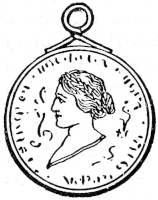
But, as ’tis never too late to mend, and no one should be a mend I-can’t, or go begging to others to do for him what he can do for himself, I trust that reflection on this subject will induce many to become practical repairers. If you have a valuable coin, do not take half the value out of it, as most people do, by boring a hole through it. Make a simple twist and eyelet of a bit of silver wire and solder it on the edge. Do not tie a gold chain with twine; mend it properly. Rivet your broken scissors, and when hinges come out screw them on again. If there were really anything difficult in all this I would honestly say so, but there is not, and people who have received some education learn how to do it all with ease in a short time.
A recipe for a cement to attach metal to any other substance is made as follows:—
Purified flint-sand (or glass-powder) 10
Caseine or curd 8
Slacked lime 10
Mix thoroughly, and add water to a creamy consistency.
The following for metals is also very strong:—
Sturgeon’s bladder solution 100
Nitric acid 1
The acid is stirred in at the same time with the cement, which should be as dense as possible, and with this mixture the surfaces of the metal are covered. “The nitric acid is intended to make the surfaces of the metal rough, but it has the drawback that it hinders the drying of the glue” (Lehner). This slowly drying is, however, a great advantage. The same is found when it is mixed with common glue, which generally dries too rapidly. Cements which dry rather slowly take hold the most firmly and permanently. The acid hardens the mass by contracting the cellular tissue. To hasten the drying, the metallic parts, which should be very strongly compressed together, must be exposed to heat.
A simpler method for light articles of metal is to wet the surfaces with nitric acid for a few minutes till they are roughened, then wash away the acid in water, and cement the metal with sturgeon’s bladder cement.
A special cement for zinc is made by thickening very strong dense glue with powdered slacked lime, into which is kneaded one-tenth part of flowers of sulphur.
A so-called Jeweller’s Cement, which holds firmly, is the so-called Diamond, elsewhere given; also the following:—
Sturgeon’s bladder 100
Gum mastic varnish 50
The sturgeon’s bladder is dissolved in as little water as possible with strong spirits of wine (equivalent to ordinary spirits). To prepare the mastic varnish, mix finely powdered mastic with the most highly rectified spirits of wine and benzine, and use as little liquid as possible. The two mixtures must be then rubbed as intimately as possible together. When carefully made this cement will serve for anything—glass or china, &c.
A cement for zinc, especially for ornaments and small work:—In ten parts by weight of silicate of soda (solution) stir two parts of cleansed chalk and three of zinc in powder. This is kneaded for some time into a putty, with which defects, roughnesses, &c., can be remedied. After twenty-four hours, when polished with agate, this cement has all the appearance of zinc.
It may be observed that other metals in fine powder may be substituted for the zinc, and that with bronze powders, oxides of metals, and indeed with all the range of painters’ colours, combinations may be formed of infinite application in the arts. According to Lehner the silicate of soda should be of 33°.
A specially strong and valuable cement, capable of many uses in metal, wood, glass, or china, or to fasten glass to metal, is made as follows:—Take best purified litharge, stir it with glycerine until it becomes a thin homogeneous mass, which in less than an hour will become a very hard mass, which is of almost universal application. It is not affected by water, and resists the action (according to Lehner) of almost all acids, the strongest alkalies, as well as etherised oils and the fumes of chlorine and alcohol. The surfaces which are to be united with it must first be covered with pure, thick glycerine.
It will readily occur to the reader that in or to this, as in every recipe given in this book, modifications, alterations, and additions can be made, of very great value, adaptable to a great variety of substances. It is to be observed that in such cases as this, where one cannot be sure of the exact result, it is best, e.g., to first experiment with a very little finest pulverised oxide of lead with the glycerine.
Another form of this powerful metallic cement is given as follows:—
Concentrated glycerine ½ litre
Litharge 5 kilogs.
To make a cement to fill or close joints in zinc-work:—Soak three parts by weight of glue in water, pour off the superfluous water, dissolve the glue in warm water, stir into it six parts of slacked lime and one of flowers of sulphur.
When ironwork, as, for instance, window-bars, is to be set in stone, the following is commended as taking a firm hold:—
Calcined gypsum 30
Finely powdered iron 10
Vinegar 20
The following recipes, though I have found many of them in other works, are here taken, with acknowledgment, from Lehner, as his proportions are invariably accurate, or confirmed by experiment.
An iron cement which resists heat and moisture:—
Clay 10
Iron filings 5
Vinegar 2
Water 3
A very strong waterproof cement for iron:—
Iron filings 100
Sal-ammoniac 2
Water 10
This in a few days will begin to turn into a hard rust.
Another OXIDISED CEMENT, which holds like iron, is made as follows:—
Iron filings 65
Sal-ammoniac 2 .5
Flowers of Sulphur 1 .5
Sulphuric acid 1
The sulphuric acid is diluted with water and added to the mixed powders.
A rust or oxide cement, resisting fire:—
Common iron filings 45
Clay 20
Finest porcelain clay 15
Salt in water 8
Fine clay may be used in lack of the finest porcelain clay.
An iron cement to resist heat:—
Iron filings 20
Clay in powder 45
Borax 5
Salt 5
Peroxide of manganese 10
The borax and salt are melted in water and then quickly mixed with the remaining ingredients, which are in a combined powder. At a white-heat this becomes a glassy substance, which seals hermetically.
Iron cement to resist intense heat:—
Peroxide of manganese 52
White oxide of zinc 25
Borax 5
This is applied with silicate of soda. It must dry gradually.
Iron cement to resist heat:—
Iron filings 100
Clay 50
Salt 10
Flint-sand 20
Fireproof cement:—
Iron filings 140
Hydraulic cement 20
Flint-sand 25
Sal-ammoniac 3
This powder is made into a paste with vinegar. It must dry for a long time before being submitted to heat.
Another cement of the same kind is as follows:—
Iron filings 180
Clay 45
Salt 8
This is also made up with vinegar, and must be dried for a long time.
To set iron in stone:—
Iron filings, fine 10
Calcined gypsum 30
Sal-ammoniac 0 .5
Also combined with vinegar.
When there are defects in iron castings, they may be filled up with the following cement:—
Clean iron filings 100
Flowers of sulphur 0 .5
Sal-ammoniac 0 .8
To be mixed with water to a paste. It does not fuse nor act as a paste until exposed to great heat. Before applying it wash the edges to be united with liquid ammonia. Brimstone or sulphur melts iron very promptly when the latter is red-hot, and applied to it, the iron will drop like melted sealing-wax.
A cement for iron stoves is made as follows:—
Iron filings 100
Chalk-marl 40
Flint-sand 50
Vinegar 20
This is made into a paste, which can be rendered porous by mixing with it bristles, chopped straw, sawdust, or chaff. When the latter is converted to coal by heat, the cement is, of course, full of cavities. In like manner, clay for water-coolers is made light and spongy by mixing it with salt. The salt gradually melts in the damp clay, forming a porous substance.
When iron doors are to be hermetically sealed at very high temperatures the following may be used:—
Finest iron filings 100
Sal-ammoniac 1
Limestone 10
Silicate of soda 10
When the iron plates about a fireplace give way the following may be used:—
Iron filings 20
Iron dross or refuse 12
Calcined gypsum 30
Common salt 10
This mixture may be combined with either blood or silicate of soda, preferably the latter, as the former has a disagreeable smell.
Iron filings mixed with vinegar are allowed to stand till of a brown colour, and then driven with plugs and hammer into cavities, where they form a rust cement.
For cracks in iron pots, &c.:—
Iron filings 10
Clay 60
This is mixed with linseed-oil to a paste. It requires several weeks to harden, but forms a hard cement.
A black cement for ironware:—
Iron filings 10
Sand 12
Ivory black 10
Slacked lime 12
Lime water 5
Schwartz’s iron cement for holes in pots, &c.:—
I.
Finely powdered glue 4-5
Finest iron dust 2
Peroxide of manganese 1
Common salt ½
Borax ½
To be powdered extremely fine or levigated and made with water to a paste. Resists fire and hot water.
II.
Pulverised peroxide of manganese 1
White oxide of zinc 1
To be finely pulverised and combined with silicate of soda.
An important part of all metal-mending is soldering. This is based on the principle that certain metallic compounds which fuse at a very low heat can, however, be so brought into union with others which have an affinity for them as by melting to unite the harder objects. Thus bismuth, which will melt in hot water, has an affinity for lead, which combines easily with tin and brass, &c.; as, in like manner, borax and resin with iron.
Newton’s solder (Lehner):—
Bismuth 8
Tin 3
Lead 5
This melts at 94.5° Celsius.
Rose’s solders:—
I.
Bismuth 2
Lead 1
Tin 1
II.
Bismuth 5
Lead 3
Tin 2
A metallic-glass solder:—
Lead 30
Tin 20
Bismuth 25
The lead is first carefully melted, then the tin added, and the melted mixture carefully stirred; the bismuth is put in last of all.
Cement for iron stoves:—
Wood-ashes 10
Clay 10
Calcined lime 4
To be mixed with water to form a firm paste. Also applicable to holes in trees. Clay mixed with waste-paper is also applicable for the latter purpose (Lehner). (Glue may be added to it.) This mixture of clay and paper should be well mixed with sour milk.
Claus’s cement for metal and glass:—40 grammes of starch and 320 grammes purified chalk are dissolved in 2 quarts water, into which is stirred ½ pint solution of caustic soda.
The most important part of mending broken metal-work is soldering, and this is so difficult to practically teach by mere writing, while it can be so easily learned from any tinsmith, or even tinker, that I deem it common-sensibly best to acquire it from the latter. Those who would study it in all its details, scientific or technological, may do so in Das Löthen und die Bearbeitung der Metalle, by Edmund Schlosser; Vienna, A. Hartleben, price 3s.