Chapter IX · THE LATER FOUNDERS OF THE SEVENTEENTH CENTURY.
Reading edition

THOMAS GORING, 1668. JOSEPH LEE, 1669.
F these two founders nothing is known beyond what is recorded in two short entries on the books of the Stationers’ Company, viz.:―
1668. The Master and Wardens requested to certify to the Archbishop of Canterbury that Thomas Goring, a member of this Company, is an honest and sufficient man, and fit to be one of the four present founders; there being one now wanting, according to the Act of Parliament.
1669. Mr. Joseph Lee and Mr. Goring to give at the next Court an account in writing, what sorts of letter they have made, and for whom, since the Act of Parliament in that case was provided.
The names of both these founders occur in the list, already referred to, of former Stewards of the Brotherly Meeting of Masters and Workmen Printers, issued in 1681.367 {194}
ROBERT ANDREWS, 1683.
This founder, who was born in 1650, succeeded Joseph Moxon, probably about the year 1683,368 and transferred his foundry to Charterhouse Street, where he continued in business till 1733. His foundry, of which, Mores informs us, Moxon’s matrices formed the most considerable part, was, next to that of the Grovers, the most extensive of its day; and it would appear that, for some time at any rate, these two shared between them the whole of the English trade. Andrews’ foundry consisted of a large variety of Roman letter and Titlings; and in “learned” founts was specially rich in Hebrew, of which there were no less than eleven founts, and five Rabbinical. Of peculiar sorts, he possessed the matrices of Bishop Wilkins’ “Real Character,” also the correcting-marks used by Moxon in his Mechanick Exercises, and other symbols, besides three or four founts of square-headed music.

Μ 47. Nonpareil Rabbinical Hebrew, from R. Andrews’ Foundry. (From the original matrices.)
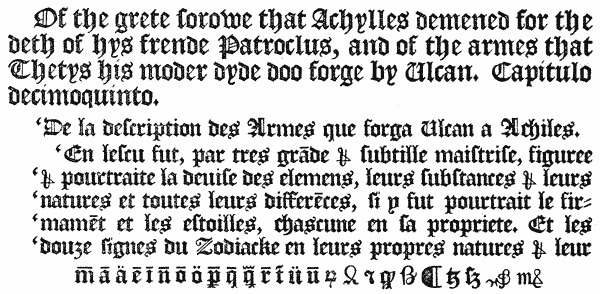
Μ 49. Old Blacks from R. Andrews’ Foundry, 1706. (From the original matrices.)
He also possessed the Hebrews and the Ethiopic369 used in Walton’s Polyglot; the Irish cut by Moxon for Boyle’s New Testament, and a curious alphabet of Great Primer Anglo-Norman; besides a fine specimen of old Blacks (two of which are here shown), probably handed down from some of the early English {195} printers, whose character they strongly resemble. His son, Silvester Andrews, as we shall notice later on, founded at Oxford, whither he appears to have taken matrices of some of the Romans and one fount of Hebrew from his father’s foundry.
The following is the list of matrices in the foundry in 1706, as given by Mores. Founts of which the punches or matrices are still in existence are distinguished by an asterisk; those descended from the Polyglot foundry are marked [P.], and those from Moxon’s [M.]:―
“Mr. ROBERT ANDREWS’ FOUNDERY, 1706. ORIENTALS. Hebrew.― 2-line English, 32. [P.?] Double Pica, 68. [P.?] Great Primer, 35. English (the common German face), 47. English, 73. [P.?] Pica, 65. Long Primer, 35. Brevier, 35. Small Pica, old, 42. Small Pica, another, 77. Small Pica, another, 73. Nonpareil, 35. Rabbinical Hebrew.― English (German), 30. Rashi, Pica, 29. Rashi, Long Primer,* 30. Rashi, Brevier,* 29. Rashi, Nonpareil,* 29. Large face points, 42. Accents, 27. Small face points, 28. Samaritan.― (Leusdenian), 21. Syriac.― Great Primer, 47; Points, 13. Arabic.― Great Primer, 104. English, 62. MERIDIONALS. Æthiopic.― Great Primer,* 212. [P.] OCCIDENTALS. Greek.― English.‡ Long Primer.‡ Brevier.‡ Long Primer, 457. Brevier, 331. Nonpareil, 329. ‡ “These three were purchased by Thos. James, 20th April 1724, ten years before the sale of the foundery.” Roman and Italic.― 2-line English full face caps, 31. 2-line English Roman, 147. 2-line English Italic, 108. Double Pica large face Roman, 122. Double Pica small face Roman, 115. Double Pica Italic, 107. Double Pica 2, Roman, 118. Double Pica 2, Italic, 66. Another, 126. Great Primer 1, Roman, 114. Great Primer 1, Italic, 102. Great Primer 2, Roman, 110. Great Primer 2, Italic, 66. English Roman and Italic, ... English 2, Roman, 92. English 3, Roman, 96. English Roman lower-case, 32. Pica Roman, 117. Pica Roman, lower-case, 27. Pica Roman, and Italic, long face, ... Long Primer Roman, 84. Long Primer Italic, 80. Long Primer Roman lower-case, 42. Long Primer Roman lower-case, another, 38. Long Primer Italic capitals and double-letters, 45. Brevier Roman lower-case, 57. Brevier Roman lower-case, another, 57. Brevier Italic, ... Title Letters and Irregulars.― 4-line Pica full face caps, 30. Canon Roman, 27. [M.] Canon Italic, 74. [M.] 2-line Double Pica Roman, 127. 2-line Great Primer full face caps, 31. 2-line Pica full face caps, 31. 2-line Pica Roman lean face, 58. Paragon Roman, 122. Paragon Italic, 100. Small Pica Roman, 76. Small Pica Italic, 82. Small Pica Italic, another, 98. Small Pica Italic, another, 80. Small Pica Roman and Italic, ... Bourgeois Italic, 72. Nonpareil Roman, 80. Pearl Roman, 2 sets. SEPTENTRIONALS. Anglo-Saxon.― Pica, 16. Pica, another, 21. Anglo-Norman.― Great Primer capitals, 24. English.― Great Primer with law, 116. English* with law, 106. Pica with law, 125. Pica small face, 71. Long Primer,* 78. Brevier with law, 118. Small Pica* with law, 120. Small Pica,* 58. Nonpareil,* 43. Secretary.― Great Primer capitals, 15. Hibernian.― Pica,* 60. [M.] Bishop Wilkins’ Real Character, English, 160. [M.] Mr. Adam’s symbols, 20. [M.] Mr. Moxon’s correcting marks, English, 16. [M.] Mathematical Characters, English and Small Pica, 42. [M.] Astronomical and Astrological, 31. [M.] Music.― 2-line Great Primer, 54. Paragon, square-headed, 44. Large old square-headed, 61. Sundry old square-headed, 155.
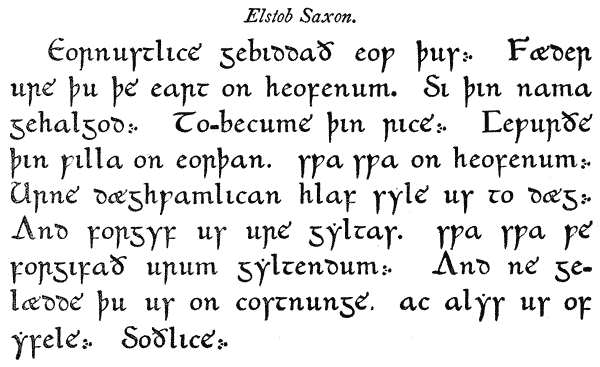
Μ 48. Saxon cut by R. Andrews for Miss Elstob’s Grammar, 1715. (From the original matrices.)
Although he accumulated a large quantity of matrices, Robert Andrews does not appear to have been a good workman. The very indifferent manner in which he cut the punches for Miss Elstob’s Saxon Grammar has been elsewhere recorded,370 and the fact that his apprentice, Thomas James, after quitting his {197} service and setting up for himself, furnished his new foundry entirely with foreign matrices, speaks somewhat unfavourably for the merits of the English letter then in common use.
Three of the Greek founts, however, James did subsequently purchase, in 1724, for his own use; and nine years later, on Andrews’ retirement from business, he purchased the whole of his foundry, and that of his son, with the exception of the Canon Roman and Italic, which were acquired by Mr. Caslon.
Robert Andrews was one of the Assistants of the Stationers’ Company. He only survived his retirement two years, and died November 27th, 1735, at the age of 80.
His name appears as a contributor of £5 5s. towards the subscription raised by Mr. Bowyer’s friends in 1712, after the destruction by fire of that eminent printer’s office.
JAMES GROVER, circ. 1675. THOMAS GROVER, his son.371
This foundry, which, according to Rowe Mores, was supposed to include founts formerly belonging to Wynkyn de Worde, was the most extensive, and in many respects the most interesting of the later seventeenth century foundries. It seems probable that James and Thomas Grover began business in partnership, about the year 1674, in succession to one of the “Polyglot” founders, whose matrices they appear to have acquired. Their foundry was situated in Angel Alley, Aldersgate Street; and, about 1700, at which date Rowe Mores fixes his summary, was evidently of considerable extent.
Although many of the founts are of little importance, it is worthy of note that among the Roman and Italic matrices is included, for the first time, a Diamond; and that a Pica and Long Primer are distinguished as “King’s House” founts, and were probably reserved for the service of the Royal press at Blackfriars. The large-face Double Pica Roman and Italic, there is reason to suppose, is the famous fount cut by John Day about 1572, which had subsequently been in the possession of one of the Polyglot founders.372 In Scriptorials, Cursives and other fancy letters, as well as in peculiar and mathematical sorts, the foundry was unusually rich. The Great Primer and 2-line Great Primer Black matrices are those reputed to have belonged to De Worde; and from these {198} founts, says Mores, were taken the two specimens shown on page 343 of Palmer’s General History of Printing.373
Among the “learned” founts, the English Samaritan matrices were those from which had been cast the type for Walton’s Polyglot, in 1657, as were also those of the larger Syriac; while the Double Pica large and small faced Greek claim a still earlier origin, being the founts in which was printed Patrick Young’s Catena on Job, in 1637, the matrices having been procured from the proceeds of the fine on the King’s printers for their scandalous errors in the printing of the “Wicked” Bible, as detailed in a former chapter.374 The smaller face, as we have noticed, bears the strongest resemblance to the Greek of the Eton Chrysostom. Mores states that the Great Primer Arabic of the Polyglot was in this foundry, but omits to include the matrices in his summary.375
The following is the full list of the matrices in the foundry, circ. 1700, as given by Mores:―
“THE FOUNDERY OF THE TWO MR. GROVERS, circ. 1700. ORIENTALS. Hebrew.― Great Primer, 30. Pica, 80. Long Primer, 60. Brevier, 130. Samaritan (with English face).― English,* 32. [P.] Syriac.― Double Pica, 60. [P.] Pica, 80. Arabic.― Double Pica, 30. Great Primer, [P.?] MERIDIONALS. Coptic (the new hand),* 81. “This seems to be a mistake of the cataloguers, who had fallen upon something which they did not understand; we suppose the Alexandrian fount, which from the semblance they took to be Coptic; the number 81 was made up with something else they were strangers to; and so are we. But whatever it was (it is in the foundry) it is now in its proper place.” OCCIDENTALS. Greek.― Double Pica large face, 183. [Royal.] Double Pica small face, ... [Royal.] Great Primer, 144. English, 350. Greek.― Pica, 380. Pica, another, 120. Long Primer, 120. Brevier, 426. Very fine. Brevier, another, imperfect. 2-line full face capitals, 23. Roman and Italic.― 2-line English full face capitals, 31. 2-line English Roman, 100. 2-line English Italic, 77. Double Pica Roman large face, 120. [Day?] [P.?] Double Pica Italic, 98. [Day?] [P.?] Double Pica Roman small face, 126. Double Pica Italic, 98. Great Primer Roman large face, 102. Great Primer Italic, 105. Great Primer Roman small face, 153. Great Primer Italic, 105. Great Primer small capitals, 27. English Roman, 159. English Italic, 114. Roman and Italic.― Two other English Roman and Italic. (One called the Old English.) English small capitals, 27. Pica Roman broad face, 85. Pica Roman, 146. (Called King’s House.) Pica Roman and Italic, 292. Pica Italic, 42. Pica small capitals, 27. Long Primer Roman and Italic, 177. Long Primer another, 226. (Called King’s House.) Long Primer another, 219. Long Primer two others. Small capitals, 27. Brevier Roman large face, 96. Brevier Roman and Italic, 241. Brevier Roman and Italic, small face. Brevier Italic. Title Letters and Irregulars.― 5-line Pica full face capitals, 31. Canon Roman, 87. Canon Italic, 70. Canon Roman lean face capitals, 57. 2-line Double Pica full face capitals, 26. 2-line Great Primer full face capitals, 31. 2-line Great Primer Roman, 86. 2-line Great Primer Italic, 68. 2-line Pica full face capitals, 31. 2-line Pica Roman, 83. 2-line Pica Italic, 77. 2-line Small Pica full face capitals, 27. 2-line Long Primer full face capitals, 31. 2-line Brevier full face capitals, 21. Paragon Roman, 106. Paragon Italic, 38. Small Pica Roman and Italic, 175. Small Pica Roman and Italic, another, 233. Small Pica small capitals, 27. Minion Roman and Italic, 175. Nonpareil Roman and Italic, 174. Nonpareil Roman and Italic, another, 175. Pearl Roman and Italic, 167. Diamond Roman and Italic, 94. SEPTENTRIONALS. Anglo-Saxon.― Great Primer, ... Pica, 30. English.― Double Pica, 69. Great Primer, 66. [De Worde?] Great Primer, another, with law, 73. English, 82. English, another, with law, 128. Long Primer 1, 74. Long Primer 2, 89. Long Primer 3, 74. Brevier, 73. 2-line Great Primer, 69. [De Worde?] Small Pica, 70. Nonpareil, 88. Scriptorial.― Double Pica Court, 80. English Court,* 100. Great Primer Secretary, 105. Double Pica Union Pearl,* 61. Cursive.― Double Pica, ... Great Primer, 69. English 1, 68. English 2, 57. Pica,* ... Long Primer, 68. Geometrical and Algebraical Symbols. Astronomical, Astrological, and Pharmaceutical Characters.― English, 55. Figures struck in circles and squares.― English, 22. Pica Astronomical Characters belonging to Pica King’s House, 22. Pica Algebraical and Pharmaceutical Marks, and cancelled figures, 3 sets. Long Primer Dominical Letters, Astronomical and Pharmaceutical Marks and Characters. Long Primer Fractions, 20. Music.― Great Primer, 176. Flowers, 200. Space Rules, Metal Rules, Braces, 150. Punches.― Some for Pica, Long Primer and Nonpareil Greek. Long Primer and other Punches.
Respecting one of the founts in this foundry a special interest exists, which calls for particular reference here. Among the “Meridionals” in the list is included a “Coptic (the new hand) 81 matrices,” an entry which Mores considers {200} to be “a mistake of the cataloguers, who had fallen upon something they did not understand—we suppose the Alexandrian fount, which from the semblance they took to be Coptic. The number 81 was made up with something else which they were strangers to, and so are we.”376 Later on, in noting the various founts missing in the collection of John James, he again refers to this “New Coptic,” adding, “it certainly was the Alexandrian which they called New Coptic”;377 and a specimen of this Alexandrian Greek duly appears in the catalogue of James’s foundry, prepared by Mores in 1778. This fount, which we are thus enabled to trace back with tolerable certainty to an earlier date than 1700, is interesting as being the first attempt at facsimile reproduction by means of type. The history of its origin is vague, but there seems reason to believe that it may have been in existence at least half a century before coming into the hands of the Grovers.
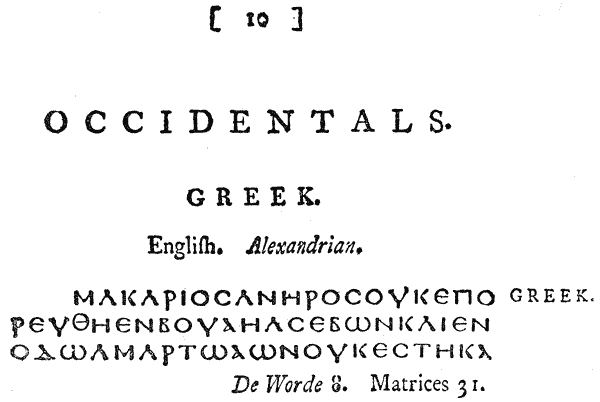
Μ 50. Alexandrian Greek in Grover’s Foundry, ante, 1700. (From the Catalogue of James’s Foundry, 1782, p. 10.)
In the year 1628 Cyrillus Lucaris, a native of Crete and Patriarch of Constantinople, sent to King Charles I, by the hand of Sir Thomas Rowe,378 English ambassador to the Grand Seignor, a manuscript of the Bible in four volumes, written in Greek uncial or capital letters, without accents or marks of aspiration, and supposed to be the work of Thecla, a noble Egyptian lady who lived in the {201} sixth century. This precious work was received by Charles I and deposited in the Royal Library of St. James, of which at that time Patrick Young was the Keeper.
Young applied himself with enthusiasm to the work of collating and examining the Manuscript, with a view to putting forward a literal transcript of its contents in print. Having published at Oxford, in 1633, an edition of the first epistle of Clemens Romanus to the Corinthians, in Greek and Latin, the text of which is included in the Alexandrian MS., he was encouraged to put forward, in 1637, his Catena on Job, which contained the entire text of that book transcribed from the same Codex. This book was printed in the Greek types of the Royal printing office, purchased under the peculiar circumstances already detailed.379 After this, says Gough, Young “formed the design of printing the entire text of the Codex in facsimile type, of which, in 1643, he printed a Specimen, consisting of the first chapter of Genesis, with notes, and left behind him scholia as far as to the fifteenth chapter of Numbers.”380
Of this specimen, unfortunately, no copy can be discovered; although as to the existence of such a document there is no lack of contemporary evidence. In his Prolegomena to the London Polyglot of 1657, Bishop Walton, who had made a careful study of the Codex, and availed himself freely of Young’s notes, distinctly states that he had seen the specimen, and that the proposal to carry through the work had been discouraged by the advice of Young’s friends.381 Walton shows a few words of the Alexandrian Greek, poorly cut in wood, among the specimens in his Prolegomena: a circumstance which would suggest that in 1657 the matrices used for Junius’ facsimile, if in existence, were not then available.
Walton’s statement was confirmed by Grabe, Mill, and others, who made a study of the Codex and its history; and in 1707 Young’s biographer and successor in the task of preparing the Codex for print, Dr. Thomas Smith, repeated it with the authority of one who had also personally inspected the Specimen.382 {202}
It has been assumed by later writers that both Walton and Thomas Smith made reference to a proposed facsimile reprint of the Manuscript; and Gough’s circumstantial statement, already quoted (which is adopted by Nichols and copied by others, such as Horne, Edwards, etc.), leaves little doubt that the chapter of Genesis was actually put forward in 1643, in facsimile type, as a specimen of the forthcoming work. The evidence as to the existence of the types receives further countenance from the presence of these matrices in Grover’s foundry, certainly before the year 1700.
Anthony à Wood states that Young’s project excited much curiosity and expectation, and that in 1645 an ordinance was read for printing and publishing the Septuagint, under the direction of Whitelock and Selden. The troublous times which ensued, however, as well as certain doubts as to the fidelity with which the original text was being treated by the transcriber, led to the abandonment of the scheme during Young’s tenure of office, which ceased in 1649. In that year Bulstrode Whitelock became Library Keeper, and consequently custodian of the MS. It would appear, however, from a sentence in one of Usher’s letters,383 that as late as 1651 Young retained his purpose of publishing the Bible from the text of the Codex, but his death in the following year finally stopped the enterprise.
What became of the specimen chapter of Genesis it is impossible to say. Bishop Walton, as he himself states, acquired possession of the scholia to the end of Numbers and the remainder of Young’s Greek and Latin MSS., Wood informs us, came to the hands of Dr. Owen, Dean of Christ Church, Oxford. Assuming the matrices to have existed, their natural location would be either the Royal Printing Office, or the foundry in which already had been deposited the Greek types and matrices used in the Catena on Job. If, however, they remained in the St. James’s Library, it is possible to conceive of their disappearance for a considerable period, as Whitelock’s principal duties during his term of office appear to have been to check the depredations which in Young’s own time had already deprived the Library of many of its treasures.384 {203}
At the Restoration, the Keepership of the Library was bestowed on Thomas Rosse, by whom was once more revived the suggestion of reproducing the Alexandria Codex in facsimile, not this time by means of type, but by copper-plate. This circumstance is thus related by Aubrey in his inedited Remains of Gentilism and Judaism, preserved among the Lansdowne MSS. in the British Museum.385
“. . . . ye Tecla MS. in St James Library . . . was sent as a Present to King Charles the First, from Cyrillus, Patriark of Constantinople: as a jewell of that antiquity not fit to be kept among Infidels. Mr. . . . Rosse (translator of Statius) was Tutor to ye Duke of Monmouth who gott him the place (of) Library-Keeper at St James’s: he desired K. Cha. I (sic) to be at ye chardge to have it engraven in copper-plates, and told him it would cost but £200; but his Maty would not yeild to it. Mr. Ross sayd ‘that it would appeare glorious in History, after his Maty’s death.’ ‘Pish,’ sayd he, ‘I care not what they say of me in History when I am dead.’ H. Grotius, J. G. Vossius, Heinsius, etc., have made Journeys into England purposely to correct their Greeke Testaments by this Copy in St James’s. Sr Chr. Wren sayd that he would rather have it engraved by an Engraver that could not understand or read Greek, than by one that did.”
The Manuscript was subsequently handed, in 1678, to Dr. Thomas Smith to collate and edit, with a view to its reproduction; but once again the scheme fell through, and (with the exception of Walton’s Polyglot) it was not till Grabe, in 1707, published his Octateuch (accompanying his preface by a small copper-plate specimen of the MS.), that any considerable portion of the Bible appeared from this ancient text.
Of the subsequent successful attempt to produce the entire Manuscript in facsimile type we have spoken elsewhere.386 Meanwhile, we find from the facts here given, that in 1643 a specimen of a portion of the text of the Codex is said to have been issued in facsimile type; that constant efforts had been made during the latter half of the seventeenth century to carry out Patrick Young’s purpose of reproducing the entire Bible in this form; that in 1657 Bishop Walton was presumably unaware of the existence of any matrices from which to exhibit a specimen of the uncial Greek of the Codex; that Grabe, similarly ignorant, made use of copper-plate in 1707 for a similar purpose; but that prior to the year 1700, concealed under the erroneous name of “Coptic—the new hand,” there existed in the foundry of the Grovers (where already were deposited several of the “King’s House” matrices, as well as those of the Greek fount used in Junius’ Catena on Job in 1637) a set of matrices consisting of a single alphabet of the Alexandrian Greek, which apparently lay undetected until 1758, when that foundry came into the hands of John {204} James, or more probably until 1778, when Rowe Mores applied himself to the task of arranging and cataloguing the various matrices of interest in that miscellaneous collection.

Μ 51. Scriptorial in Grover’s Foundry, 1700. (From the original matrices.)
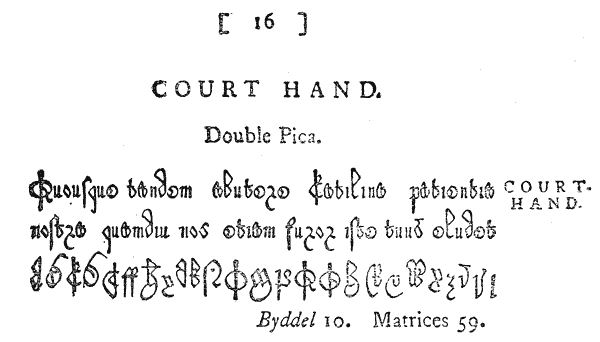
Μ 52. Court Hand in Grover’s Foundry, 1700. (From the Catalogue of James’s Foundry, 1782, p. 16.)

Μ 53. Union Pearl in Grover’s Foundry, 1700. (From the original matrices.)
It may be added that the letters of this fount (like those of the old Greek, Court Hand, Scriptorial and Union Pearl in the same foundry) are struck inverted in the copper387; a peculiarity which may be due either to their foreign execution, or to the ignorance of the English striker, and which, in either case, goes far to account for the confusion which existed respecting their identity.
Unfortunately, the link which might definitely connect these Alexandrian matrices with the facsimile types of Patrick Young is, in the absence of any copy of the specimen chapter of Genesis of 1643, wanting. But, apart even {205} from this, the fount undoubtedly claims the distinction of being the first attempt at facsimile by means of type388; on which account this somewhat lengthy note as to its history will, perhaps, be pardoned.
Thomas Grover had several daughters, one of whom, Cassandra, was the wife of Mr. Meres389; and Mr. Meres’ daughter Elizabeth was the wife of Mr. Richard Nutt.390 On Thomas Grover’s death391 his foundry became the joint property of all his daughters, who attempted to dispose of it by private contract in 1728, when it was appraised by Thomas James and William Caslon. Mr. Caslon actually made an offer for its purchase, but at so low a figure that it was not accepted. The foundry therefore remained locked up in the house of Mr. Nutt, who appears to have been a printer, and to have provided himself with type for his own use during his tenure of the matrices. Finally, on the death of all Grover’s daughters, the foundry became Mr. Nutt’s absolutely, and was by him sold on the 14th September 1758 to John James.
GODFREY HEAD, 1685,392
was one of the authorised founders in 1685, when the following record against him was entered on the Court minutes of the Stationers’ Company:―
“The next dividend of the Stock of Mr. Godfrey Head to be detained in the treasurer’s hand until further order, for his not giving a due account of the letter he is to cast, as the Act of Parliament prescribes.—1685.
“Godfrey Head’s dividend paid on his submission, and giving 20s. to the poor’s box.” {206}
His foundry, Mores informs us, was in St. Bartholomew’s Close. Whether Head succeeded to it or established it, we are unable to ascertain. Of his productions, two founts only can be traced with any certainty, the Pica Greek and the English Black, both of which subsequently passed into Mr. Caslon’s foundry. He was succeeded by
ROBERT MITCHELL,
who had formerly been servant to Mr. Grover. Mitchell removed the foundry first to Jewin Street, and afterwards, says Mores, “lived over Cripplegate, and afterwards in Paul’s Alley, between Aldersgate Street and Red Cross Street. His foundry, containing nothing very curious, unless it were the Blacks, was on the 26th July 1739 purchased by William Caslon and John James jointly, and divided between them.”
The following is Mores’ summary of the contents of this foundry, at its partition:―
“Mr. ROBERT MITCHELL’S FOUNDERY. MR. CASLON’S CHOICE. Greek.― Pica. Roman and Italic.― 4-line Pica‡ 2-line Great Primer‡ 2-line English‡ 2-line Pica‡ and Great Primer, English, Long Primer, Brevier, and Nonpareil. ‡full-face capitals. English (Black).― Great Primer, English, Pica, Long Primer, Brevier, Small Pica. The Music matrices. The Flower matrices. MR. JAMES’S SHARE. Roman and Italic.― Canon, 2-line Great Primer, 2-line English, Double Pica (small faced), Great Primer (3 founts), English (large face), Pica, Brevier (3 founts), Small Pica, Minion, Pearl (2 founts). Algebra.― English. Cancelled Figures.― Pica. Almanac matrices.― Long Primer.
THE “ANONYMOUS” FOUNDRY.
Over and above the foundries described by Mores as having been absorbed by that of Thomas and John James, there remained in his possession a certain number of matrices—some of them of some importance—of whose former owners he was unable to give us an account. “These may be considered as a distinct foundery,” he says, “and distinguished by the title of ‘anonymous,’ for we know not whence they came. Our account of Mr James’s purchases is accurate, and these are not included amongst them, but at the end of our scrutiny remained unclaimed. Let them be called ‘The Anonymous Foundry’.” {207} We do not presume to step in where Rowe Mores fears to tread, and therefore leave the matrices, of which the following is his list, still unappropriated:―
“THE ANONYMOUS FOUNDERY, absq. dat. ORIENTALS. Arabic.― Double Pica. Æthiopic.― English. OCCIDENTALS. Greek.― Great Primer. Roman and Italic.― Great Primer. English. Long Primer. Brevier. 2-line Double Pica full face capitals. 2-line Great Primer full face capitals. 2-line English full face capitals. 2-line Pica full face capitals. Small Pica. Bourgeois. Nonpareil. Pearl. SEPTENTRIONALS. Gothic.― Pica. Anglo-Norman.― Pica. English.― English. Pica. Long Primer. Small Pica. (“of all of which a more full account will be given in the ensuing catalogue.”)
OXFORD FOUNDERS.
PETER WALPERGEN, or Walberger, as we have stated in our account of the Oxford Foundry, was doubtless the individual alluded to by Bagford when, in recounting Fell’s services to Oxford, he says: “The good Bishop provided from Holland . . . a Letter Founder, a Dutchman by birth, who had served the States in the same quality at Batavia in the East Indies.”393 Bagford, it is true, does not name this founder, but as there exists in the Bodleian Library a copy of a Portuguese version of Æsop’s Fables, edited by Jo. Ferreira d’Almeida, and printed at Batavia by Pedro Walberger in 1672,394 we have no hesitation in identifying our founder with this Dutch typographer, and in fixing his settlement at Oxford somewhere about the above date, which, it will be remembered, was the year in which Fell and others took upon them the charge of the University Press, and furnished from abroad all the necessaries for its use and advancement.
That he was well known at Oxford in 1683 is also apparent from a casual reference to “Mr. Walberger of Oxford” in Moxon’s Mechanick Exercises,395 where the writer dwells with some minuteness on a peculiar and elaborate tool, called the “Joynt-Flat-Gauge,” contrived by this founder for polishing the faces of his punches after hardening them, and before striking them into the copper. {208}
It was doubtless from this casual notice that Rowe Mores derived his scant reference to Walpergen, of whom he knows nothing, save that he founded at Oxford in 1683, was sometimes called Walperger, and by name appears to have been a foreigner, therefore probably a “transient,” by means of his countryman Michael Burghers, the University engraver.
Of Walpergen’s work little is known beyond the fact that he appears to have devoted his attention chiefly to the production of Music type, impressions of which appear in the University Specimen of 1695. The punches and matrices of this interesting fount are still preserved at Oxford, and are singular relics of the old letter-founders’ art.396
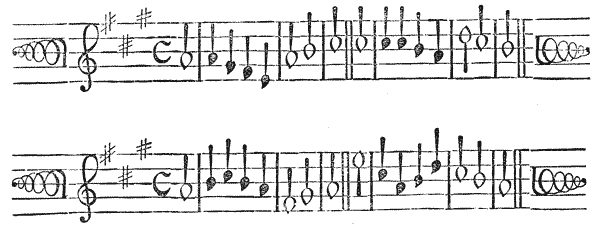
54. Music, cut by Walpergen, Oxford, circ. 1695. (From the original matrices.)
Although the Music was the only fount cut by Walpergen of which we have any certain knowledge, it is probable that the experienced Dutch artist, whom Bagford describes as an excellent workman, did not confine his labours to that class of work. What were his exact relations with the University Press is also a matter of conjecture. But it seems probable, from the manner in which he is spoken of by Moxon, and in the Oxford Specimen, that he practised as a letter-founder on his own account, and not wholly as an official of the University.
He died in 1714.397 Among the University archives is preserved an inventory of his chattels, which, if a full account of his earthly possessions, speaks {209} poorly for the profits of the profession of letter-founding in those days. This highly interesting document runs as follows398:―
An inventory of the Chattels of Peter De Walpergen, deceased, taken the tenth day of January 1714–5. Being the Moiety of a Fount of Musick.
£ s. d.
Two hunderd and two pounds weight of Mettal (? cast type) at four pence per pound his part is 1 13 8
One hunderd fourty seven Matrices at one Shilling per piece his part is 3 13 6
Nine quadrats at two pence per piece his part is 0 0 9
Four moulds at two shillings six pence per piece his part 0 5 0
Sixty three puncheons at five shillings (i.e., for the lot) his part 0 2 6
Four cases at four shillings his part 0 2 0
Two galleys at two shillings his part 0 1 0
A box at sixpence his part 0 0 3
Appraised by us, LEONARD LICHFIELD. RICHARD GREEN.
The extraordinarily low value of the punches is quite consistent with the esteem in which these now precious steel originals were held at the time, after once being struck.
Walpergen’s music matrices were secured by the University Press, in whose Specimens the type had already figured for some years; but we have, so far, been unable to discover any important works in which the character was used.
SYLVESTER ANDREWS, who succeeded to Walpergen’s foundry before the year 1714, was the son of Robert Andrews, the London founder. His foundry, which, with the exception of one alphabet of Hebrew, consisted entirely of Roman and Italic, was, Rowe Mores informs us, nothing compared with that of his father, and was indeed a part of his father’s. The following is the list of his matrices:―
“MR. SILVESTER ANDREWS’ FOUNDERY; furtim: Hebrew. 30 Brevier (at first 33) Roman and Italic. 2-line English Capitals ... 125 Great Primer Roman, large face 82 Great Primer Italic 148 English Roman 98 English Italic 153 Pica Roman, large face 148 Pica Roman, small face 110 Pica Italic 27 Pica Roman, lower case 119 Long Primer Roman 102 Long Primer Italic 130 Brevier Roman, large face 135 Brevier Roman, small face 105 Brevier Italic (2 sets of Capitals) 2-line Pica Italic ... 146 Small Pica Roman 28 Small Pica Italic Minion Roman and Italic ... 140 Nonpareil Roman, large face 105 Nonpareil Italic 94 Nonpareil Roman, small face 98 Pearl Roman 38 Pearl Italic
Although his stock of matrices was limited, he appears to have done a considerable business, not only with the University, in whose service he was probably retained, but also with other printers practising in Oxford, notably with John Baskett, the king’s printer, to whom, with two others, the “Chancellor, Masters and Scholars of the University,” leased their “privilege and interest in printing” for twenty-one years from March 1713.
In the year 1719 Baskett, who had two years previously produced the magnificent “Vinegar” Bible399 at Oxford, mortgaged his stock and privilege at the University to James Brooks, stationer, of London, as security for a loan of £3,000. And in a schedule attached to an indenture, dated May 23, 1720, having reference to this transaction, occurs an inventory of the type at that time in the printer’s possession, which is highly interesting, not only as throwing light on Andrews’ business, but as indicating the contents of a large office of the period, and the extent to which Dutch type at that time competed in this country with English. The schedule is as follows:―
An Account of the Letter Presses and other Stock and Implements of and in the Printing house at Oxford belonging to John Baskett, Citizen and Staconer of London:― A Large ffount of Perle Letter Cast by Mr. Andrews. A Large ffount of Nonpl Letter, New-Cast by ditto. Another ffount of Nonpl Letter, Old, the whole standing and Sett up in a Com’on Prayer in 24mo Compleat. A large ffount of Minn Letter, New-Cast by Mr. Andrews. Another Large ffount of Minn Letter, New-Cast in Holland. The whole Testament standing in Brevr and Minn Letter, Old. A Large ffount of Brevr Letter, New-Cast in Holland. A very Large ffount of Lo. Primr Letter, New-Cast by Mr. Andrews. A Large ffount of Pica Letter, very good, cast by ditto. Another Large ffount of ditto, never used, Cast in Holland. A small Quantity of English, New-Cast by Mr. Andrews. A small Quantity of Great Primr, New-Cast by ditto. A very Large ffount of Double Pica, New, the largest in England.400 A Quantity of Two Line English Letters. A Quantity of ffrench Cannon. Two line Letters of all Sorts and a Sett of Silver Initiall Letters. Cases, Stands, etc. ffive Printing Presses, very good, with other Appurtenances, etc.
The schedule is signed “Jno. Baskett.”401
In 1733 Sylvester Andrews’ foundry was purchased, at the same time with that of his father, by Thomas James, and removed to London. His epitaph remains, and gives an amusing glimpse of his character and the reputation he bore at Oxford.
On a Letter-Founder at Oxford.
“Underneath this stone lies honoured Syl
Who died, though much against his will;
Yet, in his fame he will survive―
Learning shall keep his name alive;
For he the parent was of letters,―
He founded, to confound his betters;
Though what those letters should contain
Did never once disturb his brain.
Since, therefore, reader, he is gone,
Pray let him not be trod upon.”402