Chapter VI · THE OXFORD UNIVERSITY FOUNDRY.
Reading edition

RINTING was practised at Oxford within a year of the introduction of the art into England. Setting aside the legend of Corsellis and the “1468” Exposicio Simboli, we find that a printer, presumably Theodoric Rood, from Cologne, was settled here in 1478, and issued three works anonymously from his press during that and the following year. Between 1480 and 1483, Rood printed eight works bearing his own name, and in 1485 and 1486, in partnership with an Englishman named Thomas Hunte, he produced six more.
Whether the first Oxford printer made his own type or procured it from abroad, we have no information, but the distinctly Cologne character of the two earliest founts favours the supposition that, like Caxton, he brought at any rate his first types with him from the Continent. The vague reference which Rood and Hunte make to their labours at the end of the Phalaridis Epistolæ in 1485,230 does not throw much light on the question, although the boast of an independent discovery of the art of printing there recorded may possibly mean that towards the close of their career they had arrived at a knowledge of the mystery of making their own types.
Without attempting a detailed examination of the seventeen works of the {138} first Oxford printers, we observe that during the eight years in which they practised their art, they made use of seven different kinds of type, which arrange themselves chronologically as follows231 :
KNOWN DATE. TITLE. TYPE. GROUP.
“1468”† Exposicio Symboli a Group I, “1468”-1479. (No printer’s name.)
1479 Aristotelis Ethica a
1479 Ægidius de peccato originali a
... Cicero pro Milone b Group II, 1481–82. (Theodoric Rood.)
... Latin Grammar in English b
1481 Alexander de Ales. Expositio de Animâ. Two Editions b,c
1482 Lattebury. Morales. Two editions b,c
... Hampole. Explanationes d,e Group III, 1483–86. (Rood and Hunte.)
... Swyneshed. Insolubilia d,e
... Anwykyll. Compendium. 1st edition d[e?]f
... Anwykyll. Compendium. 2nd edition d,f
... Lyndewode. Constitutiones c,d,e,f
1485 Phalaridis Epistolæ c,f
1486 Liber Festivalis f,g
... Textus Alexandri d,f,g
† Misprint for 1478.
It will be noticed from the above list that type [a] was used solely by the first anonymous Oxford printer, and disappeared entirely as soon as Rood began to print in his own name. The letter is a Black of similar character, as Mr. Bradshaw points out, to that used by Zell and Guldenschaft at Cologne, and was probably brought thence to this country. The body corresponds closely to the present “English.” One peculiarity about type [a] is that in the mis-dated Exposicio Simboli the capital is always printed sideways (), whereas in the two following books it appears correctly.


During the two years that Rood printed under his own name alone, he made use of a compressed Black-letter of English body, type [b], with which, in the Ales and Lattebury, he combined a larger Black, type [c], on Double English body for chapter-headings or initials.
Type [b] disappeared entirely at the close of Rood’s solitary labours. Type [c], however, was preserved; we find it used in single letters, or very sparsely in two later works.
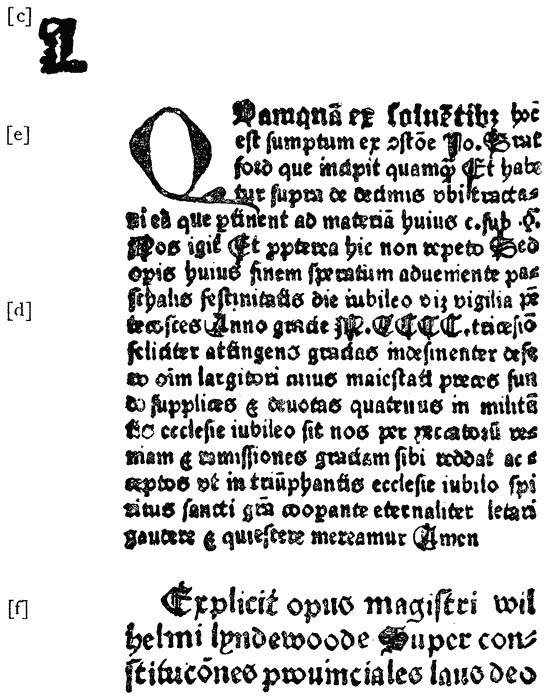
27. Colophon of Lyndewode’s Constitutiones. Oxford, 1482 (?). Showing the types [c], [d], [e], [f].]
Rood and Hunte inaugurated their partnership by the introduction of two {139} new founts of Black-letter, types [d] and [e], or rather one fount having one size of capitals, and a small and large size of “lower-case,” all cast on the same body, about a Pica, and capable of being used interchangeably. Subsequently they used another double fount, types [f] and [g], cast in the same manner, [f] being the small, and [g] the large “lower-case,” with one size of capitals for both, all cast on a body closely corresponding to Great Primer. The character of this letter is decidedly Caxtonian, and suggests the possibility that at this stage of their labours the printers may have learned the art of making their own type. Type [f] had been in use for some time in combination with [c], [d] and [e], before type [g] appeared. The accompanying facsimile from the Lyndewode shows types [c], [d], [e] and [f].
We thus find that the seven early Oxford types reduce themselves to four principal founts, and one fount of initial letter, of which the following table will briefly sum up the typographical details :
TYPE. CHARACTER. APPROXIMATE BODY. NOTES.
a Cologne Black English Used with no other type.
b Narrow Dutch Black English Used alone or with [c] for headlines.
c Heading and Initial Black 2-line English Used chiefly with [b], also with [d], [e], [f].
d Small lower-case Dutch Black With one set of Capitals. Pica Used chiefly with [e], also with [f] and [g].
e Large lower-case Dutch Black Pica Used chiefly with [d], also with [f].
f Small lower-case Caxtonian Black With one set of Capitals. Great Primer. Used chiefly with [g], also with [d] and [e].
g Large lower-case Caxtonian Black Great Primer. Used chiefly with [f], also with [d].
The first Oxford press disappeared altogether in 1486, between which date and 1517 no work is known to have issued. In 1517 John Scolar, another German, printed a few small works very neatly in English and Brevier black-letter, with a Great Primer for titles, and made use of the University arms for the first time, either on his titles or last pages. Scolar’s press, in turn, came to an abrupt standstill in 1519, after which, in common with the other provincial presses of the country, printing at Oxford remained dormant for upwards of half a century.232
It was not till the year 1585 that the art was actively resumed. In that {140} year the Earl of Leicester presented a press, and the University made a grant of £100. The Star Chamber Decree of the following year formally allowed (with rigid restrictions) the establishment of the new press, and under Joseph Barnes, the first University printer, it rapidly rose to prominence. It appears from the outset to have been well provided with types, many of them of a beautiful cut, particularly those of the Greek character. The Chrysostomi Homiliæ, printed by Barnes in 1586, and the Herodotus of 1591, were both noticeable for the excellence of their letter. The former is said to be the first Greek book printed at the University.
The reputation of the University for its Greek types was enhanced some years afterwards by the acquisition of the letter in which the magnificent edition of St. Chrysostom233 had been printed at Eton by John Norton in 1610–13, at the charge and under the direction of Sir Henry Savile.234 This work, one of the most splendid examples of Greek printing in this country, is said to have cost its author £8,000. Respecting the origin of the types, Bagford says, in one of his MSS.: “Sir Henry Savile, meditating an edition of St. Chrysostom, prepared a fount of curious Greek letters, which in those days were called the Silver letter, not being cast of silver, but for the beauty of the letter so called.” Beloe,235 on the other hand, considers that the types were procured from abroad. “They certainly resemble,” he says, “those of Stephens, and the other Paris printers, as well as those of the Wechels at Frankfort, at a subsequent period. From the Wechels indeed they are said by some to have been procured, but this fact I have not been able to ascertain. It appears beyond a doubt, from a passage in one of the Epistles of Isaac Casaubon, that they were cast abroad.”236
The fine execution of this work obtained for Norton the distinction accorded to Robert Estienne of Paris by Francis I, of “Regius in Græcis Typographus.” Scarcely less high an honour had been paid to this printer in 1594, when we are told Paul Estienne (son of Henri Estienne II) visiting England, and appreciating his merit, permitted him to make use of the device of the Estiennes.237
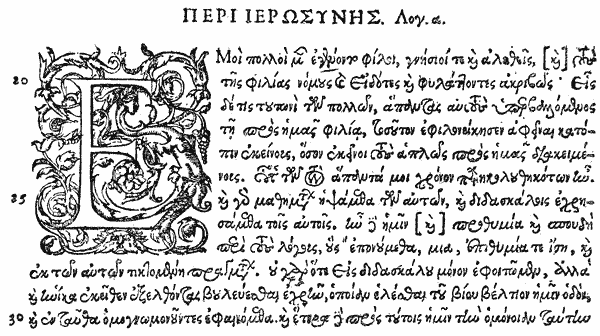
Μ 28. Greek fount of the Eton Chrysostom, 1613.
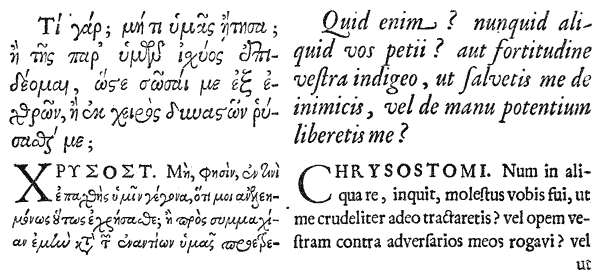
Μ 29. From the Catena on Job. 1637.
At what date these famous Greek types came into the possession of the {141} Oxford University Press it is impossible to determine. It was probably not till after some years of rough usage following Sir Henry Savile’s death; as Evelyn,238 in one of his letters, after lamenting the loss of Sir Simon Fanshaw’s medals, says that “they were after his decease thrown about the house for children to play at counter with, as were those elegant types of Sir Henry Savill’s at Eton, which that learned knight procured with great cost for his edition of St. Chrysostom.”
The types, of which we give a specimen (No. 28), were of a Great Primer body, very elegantly and regularly cut, with the usual numerous ligatures and abbreviations which characterised the Greek typography of that period.
During the early part of the seventeenth century the Oxford Greek types do not appear to have been extensively used; and in 1632 we find it recorded that Lord Pembroke, the then Chancellor of the University of Cambridge,239 applied for and obtained the loan of one of these founts for the purpose of printing the Greek Testament,240 which was issued in that year by Buck, the University printer, and which, says Beloe,241 “has ever {142} been admired for the perspicuity of its types as well as for the accuracy of its typography.”
The reason urged for this loan was, that the Oxford press made no use of the Greek type itself. This reproach was, however, shortly afterwards removed by the bounty and interest of Archbishop Laud, whose generous encouragement of printing at Oxford must always entitle him to an honourable mention in any record of the history of the art.
Laud, at that time Bishop of London, was appointed Chancellor of the University in 1630, and in the same year projected, among other acts of bounty, two important measures for the advancement of printing at that Academy. These were:―
“To procure a large Charter for Oxford, to confirm their Ancient Privileges, and obtain new for them, as large as those of Cambridge, which they had got since Henry the 8th and Oxford had not.
“To set up a Greek press in London and Oxford, for printing the Library-Manuscripts, and to get both Letters and Matrices.”242
The former of these projects was carried out in 1632, when Charles I granted a charter to Oxford, giving her equal privileges with the sister University, authorising her to employ three printers, and securing to her a right for a certain term over all books issued. In forwarding this charter to the University, Laud mentioned by name two of the printers—King and Motteshead, but urged Convocation as yet to nominate no one as the third, in order, he said, “that you may get an able man, if it be possible, for the printing of Greek when you shall be ready for it.”243
This is clearly an allusion to the Bishop’s other project, which, however, was only partially fulfilled during his lifetime.
A Greek press was established in London in 1632, under peculiar circumstances, which, though not strictly bearing upon the history of letter-founding at Oxford, we may here refer to as an interesting episode in the history of English printing.
Robert Barker and Martin Lucas, the King’s printers in London, were arraigned before the High Commission Court for a scandalous error in a Bible244 printed by them in 1631, whereby the seventh commandment was made to read, “Thou shalt commit adultery.” For this grave offence, the impression (which numbered 1,000 copies and was full of typographical errors) was called in, and {143} the printers were ordered to pay a fine of £300.245 This sum of money Laud received the royal authority to expend in the purchase of Greek types, according to the terms of the following letter addressed to him by the King, dated January 13, 1633:
“Most reverend father in God, right trusty and right entirely beloved counsellor, we greet you well. Whereas our servant, Patrick Young, keeper of our library, hath lately with great industry and care published in print an epistle of Clemens Romanus246 in Greek and Latin, which was never printed before, and has done this to the benefit of the church, and our great honour, the manuscript, by which he printed it, being in our library; and whereas we further understand that the right reverend father in God, Augustin,247 now Bishop of Peterborough, and our said servant Patrick Young, are resolved for to make ready for the press one or more Greek copies every year, by such manuscripts as are either in our library or in the libraries of our universities of Oxford and Cambridge, or elsewhere, if there were Greek presses, matrices, and mony ready for the work which pains of theirs will tend to the great honour of our self, this church, and nation; we have thought good to give them all possible encouragement herein, and do therefore first require you, that the fine lately imposed by our high commissioners upon Robert Barker and Martin Lucas for base and corrupt printing of the Bible, being the sum of three hundred pounds, be converted to the present buying of such and so many Greek letters and matrices, as shall be by you thought fit for this great and honourable work. And our further will and pleasure is that the said Robert Barker and Martin Lucas, our patentees for printing, which either now are, or shall hereafter succeed them, being great gainers by that patent, which they hold under us, shall at their own proper costs and charges of ink, paper, and workmanship, print, or cause to be printed in Greek, or Greek and Latin, one such volume in a year, be it bigger or less, as the right reverend father aforesaid, or our servant Patrick Young or any other of our learned subjects shall provide and make ready for the press, and shall print such a number of each copy, as yourself, or your successors for the time being, shall think fit; and all this they shall perform, whether the said copy or copies be to be printed in London, Oxford, or Cambridge, which shall be left free to their judgments and desire, whose pains prepare the copy or copies for the press. And last of all, our further will and pleasure is, that the aforesaid patentees do without any delay procure such, and so many matrices and letters, as aforesaid, that no hindrance be put upon the work, and that they be at the charge of printing in the mean time with such letters, as are already in the kingdom. Of all which or any other necessary circumstances for the furtherance of this work, we shall not fail to call for a strict account from you; and therefore do look that you call for as strict a one from them: provided always, that it shall be, and remain in your power to mitigate their fine aforesaid, according as you shall see their diligence and care for the advancing of this work.”248
This letter Laud forwarded to the printers, who in reply, “accounted it so {144} great a happiness” to receive the royal commands in the matter, and stated that they were already labouring “to find out the best fount and matrices, and to purchase the same at what cost soever.”249
The new Greek press, thus furnished, was in due time settled in London, at the King’s Printing House in Blackfriars, and from its types was printed, in 1637, Patrick Young’s Catena on Job,250 “in as curious a letter,” says Bagford, “as any book extant.” In this interesting work, from which we here give a facsimile, two Greek founts are used, the larger being a handsome Double Pica,251 not dissimilar to that in which Estienne’s great folio Greek Testament was printed in Paris. The smaller fount, a Great Primer, bears so close a resemblance to the fount used in the Eton Chrysostom, that it is probable it may have been cast abroad from the same matrices. The Double Pica Roman and Italic used in the work are the same as those employed by Day in the preface to the Ælfredi in 1574; the matrices having apparently been secured by the Archbishop for the use of the Royal press.
Although Laud’s project for the establishment of a Greek press at Oxford, similar to that in London, was not fully realised, his efforts on behalf of the University and its press continued unabated. In 1635 he presented his fine collection of Oriental Manuscripts, and established a Chair of Arabic, which greatly encouraged and promoted the study and printing of works in that and other Eastern languages. This favour he followed up with a gift of Oriental types, which is alluded to in a letter from John Greaves to Dr. Peter Turner, dated 1637.252 Greaves approves of the bargain formed by the proctor’s brother, Mr. Browne, for the purchase at Leyden253 of some printing types, of probably an {145} Eastern language. The only danger is that some are wanting. Mr. Bedwell, when he bought Raphelengius’s Arabic press, found some characters defective, which he was never able to get supplied. The writer hopes that, “now that Archbishop Laud has taken such care for furnishing the University with all sorts of types, and procuring so many choice MSS. of the Oriental languages, that some will endeavour to make true use of his noble intentions, and publish some of those incomparable pieces of the East, not inferior to the best of the Greeks or Latins.”254
In a letter addressed May 5, 1637, to the Vice-Chancellor, the Archbishop himself refers to these recent acquisitions in the following terms:―
“You are now upon a very good way towards the setting up of a learned press; and I like your proposal well to keep your matrices and your letters you have gotten, safe, and in the mean time to provide all other necessaries, that so you may be ready for that work.”255
One of the last recorded services of Laud to the Oxford press was the recovery, in 1639, of the Savile Greek Types, which had been clandestinely abstracted by Turner, the University printer. His letter on the subject is characteristic of the fatherly care which he exercised over the interests of the Oxford Press:
“I am informed,” he says, “that under pretence of printing a Greek Chronologer . . . Turner, the printer . . . got into his hands all Sir H. Savil’s Greek letters amounting to a great number, some of them scarce worn. It was in Dr. Pink’s time. I pray speak with the Dr. about it and call Turner to an account before the heads what’s become of them. I doubt Turner’s poverty and knavery together hath made avoidance of them.” Oct. 18, 1639.
“Feb 13th. Turner brought back the Greek letters, and delivered them by weight as he received them: there were not any wanting. He came very unwillingly to it.”256
This celebrated Greek fount does not appear to have been much used after this, and no trace of it now remains at the University press.257
Unfortunately for the cause of learning at Oxford, as elsewhere, the political troubles of the following years abruptly terminated Laud’s services in that {146} direction, and suspended for a time all further progress in the development of the press.258
A revival took place during the Commonwealth, on the appointment, in 1658, of Dr. Samuel Clarke, the learned Orientalist (who a short time previously had assisted in the correction of Walton’s Polyglot), as Archi-Typographus. This responsible functionary was “a person,” so the University Statute ordained, “set over the printers, who shall be well skilled in the Greek and Latin tongues, and in philological studies, . . whose office is to supervise and look after the business of Printing, and to provide at the University expence, all paper, presses, types, etc., to prescribe the module of the letter, the quality of the paper, and the size of the margins, when any book is printed at the cost of the University, and also to correct the errors of the press.”259 This office was, by the same Statute, annexed to that of superior law bedel, as having less business than the rest.
After the Restoration, printing at Oxford made still greater advances, chiefly through the instrumentality and munificence of Dr. John Fell.
This eminent scholar and theologian was born in the year 1625. He entered as a student of Christ Church at the age of eleven, and in 1643 bore arms in the civil wars for the king in the garrison of Oxford. At the Restoration he received ecclesiastical promotion, and in 1666 became Vice-Chancellor of the University.260 In this capacity he exerted himself strenuously to continue the work begun by Laud for the advancement of learning and encouragement of printing at the University;261 and about 1667 presented a complete typefoundry, consisting of the punches and matrices of twenty founts of Roman, Italic, Orientals, Saxons, Black and other letter, besides moulds and all the apparatus and utensils necessary for a complete printing office.
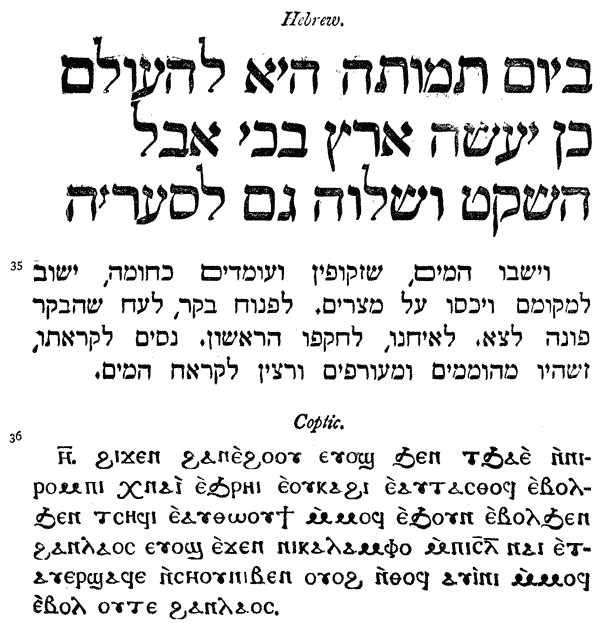
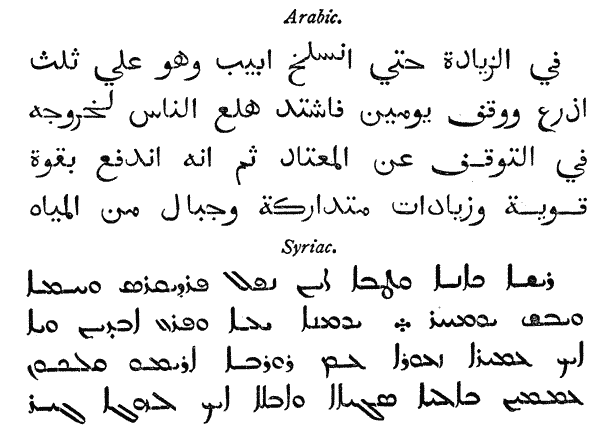
34 to 38. Oriental Founts presented to the Oxford Press by Dr. Fell in 1667. (From the original matrices.) 34, 35, Hebrew.; 36, Coptic.; 37, Arabic.; 38, Syriac.
The extent of this noble gift, the importance of which can only be estimated {148} by recalling the low condition of letter-founding in England at the time, will best appear by the following Inventory, published by the University in 1695:
An Account of the Matrices, Puncheons, etc., given by Bishop Fell to the University of Oxford262:―
34 BOXES OF MATRICES.
121 1. Great Primer Roman
123 2. Double Pica Roman
5133. Pica Greek
3534. Augustin Greek
354 5. Long Primer Greek
456 6. Great Primer Greek
121 7. Long Primer Italic
142 8. Small Pica Italic
155 9. Long Primer Roman
156 10. Pica Roman
156 11. Brevier Roman
40 12. Great Brass Roman Caps.
142 13. Augustin Roman
73 14. English Black
142 15. Small Pica Roman
135 16. Coptick
114 17. Augustin Italic
130 18. Pica Italic
121 19. Nonpareil Italic
134 20. Nonpareil Roman
445 21. & 22. Paragon Greek
121 23. Syriac
87 24. Double Pica Italic
204 25. Great Canon
134 26. Brevier Italic
70 27. Music
198 28. [Pica Roman and Italic, bought by the University, an. 1692.] Roman, 93; Italic, 78; Small Caps., not justified, 27; in all
87 28. Great Primer Italic
25 29. Astronomical Signs, Pica
30 29. Samaritan, English
21 29. Mathematical Marks
10 29. Cancelled Figures, Pica
16 29. Brasses, Long Primer
10 29. Mathematical Marks, Small Pica
292 30. Hebrew, Great and Small
254 31. Hebrew, Great and Small
7 31. Armenian
228 32. Arabic, Syriac, and Hebrew
10 32. Arabic Figures
110 33. Sclavonian, Great Primer
A paper of Flower Matrices.
A paper of Great Primer Roman and Italic, cut by Mr. Nichols—not good.
New Music Puncheons and Matrices, cut by Peter Walpergen.
P
UNCHEONS SEALED UP IN AN
E
ARTHEN
P
OT
.
For the Double Pica Roman and Italic, and some for the Double Pica Greek.
For the Great Brass Roman Capitals.
For the Black, English.
For the Coptick.
For the Syriack.
For the Samaritan.
For the Cannon Roman and Italic.
For the Astronomical Signs and Figures.
[For the Pica Roman and Italic.]
[For the Sclavonian also there were 109 punches.]
U
TENSILS FOR
P
RINTING
.
1 small anvil.
4 hammers.
28 moulds.
1 engine to make brass rules with a plane.
1 wyer sieve.
332 dressing sticks. {149}
2 great vices.
2 hand vices.
21 great files.
1 pair of sheers.
2 iron pots.
4 dressing planes.
3 dressing blocks.
3 plyers.
2 rubbing stones.
1 grinding stone.
26 copper borders.
32 copper letters.
7 printing presses, with all things belonging to them.
2 rolling presses, with all things necessary to them.
132 upper and lower cases.
5 pair of capital cases.
5 pair of fund cases.
13 pair of Greek cases.
50 chases.
Dr. Fell supplemented this gift by a further signal service, which is thus recorded by Bagford:―
“The good Bishop provided from Holland the choicest Puncheons,263 Matrices, etc., with all manner of Types that could be had, as also a Letter Founder, a Dutchman by Birth, who had Served the States in the same quality at Batavia, in the East Indies. He was an excellent workman, and succeeded by his son, who has been since succeeded by Mr. Andrews.”264
The Dutchman here spoken of was Walpergen, who, as will be seen later on, preceded Sylvester Andrews as typefounder in Oxford.
Fell was a zealous defender of the privileges enjoyed by his University, and in 1679 drew up a report setting forth its claims in the matter of printing.265 In this report he mentions that, in the year 1672, several members of the University, himself included, taking into consideration the “low estate of the manufacture of printing” in the kingdom, and particularly in the University, “took upon themselves the charges of the press in the said University, and at the expence of above four thousand pounds furnisht from Germany, France and Holland, an Imprimery, with all the necessaries thereof, and pursued the undertaking so vigorously, as in the short compass of time which hath since intervened, to have printed many considerable books in Hebrew, Greek and Latin, as well as in English; both for their matter and elegance of paper and letter, very satisfactory to the learned abroad and at home.”
It is probable that the transaction here recorded constituted a portion of what became known as Dr. Fell’s gift to the University; a series of benefactions which doubtless extended over several years—from 1667 to 1672—and included, when complete, the whole of the types and implements named in the above Inventory. Mores, who is responsible for the date, 1667, leads us to suppose {150} that the gift was completed in that year; but he gives no authority; and the absence of any second inventory of the acquisitions made in 1672, points strongly to the conclusion that the two transactions were part of the same gift.
In 1675 Dr. Fell was created Bishop of Oxford, and continued his active services to the cause of learning until the time of his death in 1686, having, as Anthony à Wood remarks, “advanced the learned press, and improved the manufacture of printing in Oxford in such manner as it had been designed before by that public spirited person, Dr. Laud, Archbishop of Canterbury.”266
In 1677 the University press was further enriched by another important gift of type and matrices, presented by Mr. Francis Junius.
This learned scholar, whom Rowe Mores styles the restorer—if not more than the restorer—of the knowledge of the Septentrional languages in England, was a German, the son of Francis Junius, the theologist, of Heidelberg. He resided for some time in England as librarian to the Earl of Arundel, during which time he zealously prosecuted his philological studies. In 1654, being then at Amsterdam, he furnished himself with a set of Saxon punches and matrices, respecting which he wrote as follows to Selden in that year267:―“In the meanwhile have I here Anglo-Saxonic types (I know not whether you call them puncheons) a cutting, and I hope they will be matriculated and cast within the space of seven or eight weeks at the furthest. As soon as they come I will send you some little specimen of them to the end I might know how they will be liked in England.” In addition to this Saxon, Junius also obtained founts of Gothic, Runic, Danish, Icelandic, Greek, Roman, Italic, and a pretty Black, all cast on Pica body. These he brought over with him to this country. Of the Gothic, Runic, Saxon, and Greek he certainly brought punches and matrices as well as types, as these are to this day preserved at Oxford, and there is reason to suppose all his founts were similarly complete.268
Junius, who had spent much time in his younger years at Oxford for the {151} sake of study, libraries, and conversation, and had visited it frequently since, retired there at last in 1676, and executed a deed of gift whereby he presented his books in the Northern language and his punches and matrices to the University, the latter consisting of the following founts:―
Pica Runic.
Pica Gothic.
Pica Anglo-Saxon.
Pica Icelandic.
Pica Danish.
Pica Black.
Pica Greek.
Pica Roman.
Pica Italic.
English Swedish.
Junius died the following year at Windsor, at the great age of ninety. A quaint tribute to his memory exists in a note from Dr. (afterwards Bishop) Nicolson, who, writing to Thwaites in May 1697, says, “My acquaintance with that worthy personage was very short, and in his last days, when he was near ninety . . . . alas! I can remember little more of him than that he was very kind and communicative, very good, and very old.”269
The custodians of his valuable gift scarcely appear at first to have been impressed with an adequate sense of their responsibility, for we find that the Junian punches and matrices disappeared shortly after their presentation, and remained lost for a considerable period, when they were discovered by chance under the circumstances thus humorously narrated in a letter from Dr. (afterwards Bishop) Tanner, dated All Souls College, Aug. 10, 1697, and addressed to Dr. Charlett:―
“Mr. Thwaites and John Hall took the courage last week to go to Dr. Hyde about Junius’ matrices and punchions which he gave with his books to the University. These, nobody knew where they were, till Mr. Wanley discovered some of them in a hole in Dr. Hyde’s study. But, upon Mr. Hall’s asking, Dr. Hyde knew nothing of them; but at last told him he thought he had some punchions about his study, but did not know how they come there; and presently produces a small box-full, and taking out one, he pores upon it, and at last wisely tells them that these could not be what they looked after, for they were Ethiopic270: but Mr. Thwaites desiring a sight of them, found that which he looked on to be Gothic and Runic punchions, which they took away with them, and a whole oyster-barrel full of old Greek letter, which they discovered in another hole.”271 {152}
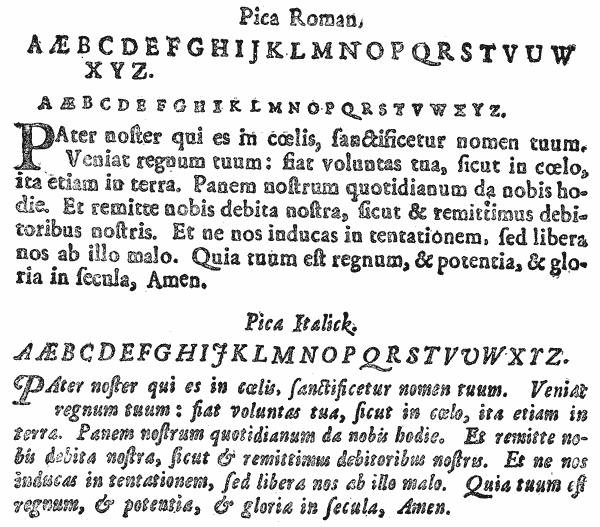
Μ 32. Pica Roman and Italic presented to the Oxford Press by Dr. Fell, 1667.
Μ
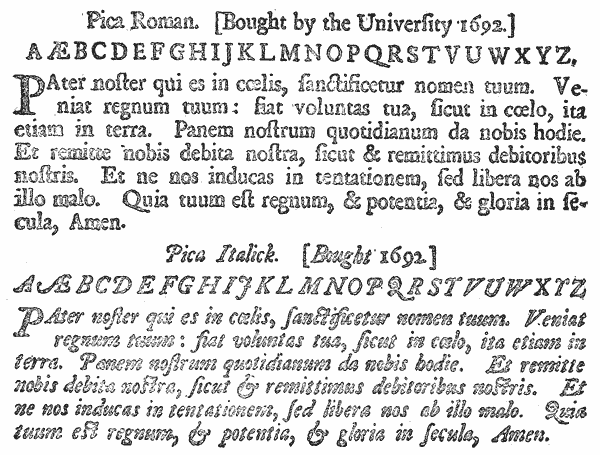
33. Pica Roman and Italic bought by the University in 1692.
(From the Specimen of 1692.)
{153}
The combined gifts of Dr. Fell and Francis Junius laid the foundation of the Oxford University foundry as it now exists. Even before the close of the century it had been augmented by numerous small additions and purchases. About the time of Fell’s gift the press received a second fount of Coptic, presented by Witsen, the Burgomaster of Amsterdam.272 In 1694, Dr. Charlett, writing to Archbishop Tenison, refers to the founts of Slavonic and Armenian types, “very elegantly cut, which M. Ludolfus is bringing to Oxford from Holland.” The University also purchased matrices of Pica-Roman and Italic in 1692, besides adding to its stock some indifferent Great Primer matrices by Nichols, and music cut by the Oxford founder, Walpergen.273
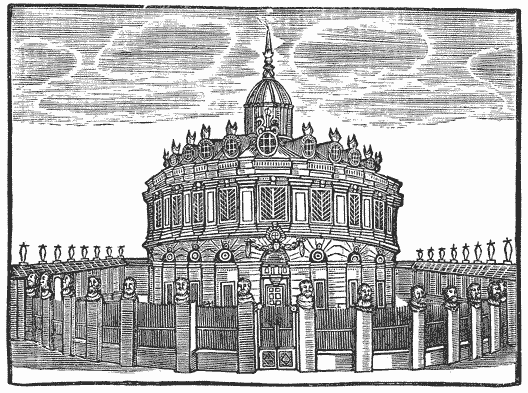
30. The Sheldonian Theatre. (From an old wood block in the Oxford University Press.)
About the year 1669 the foundry, which, together with the press, had been carried on in hired premises provided by Fell, was transferred to the basement of the then new Sheldonian Theatre.274 Here it was that, in the year 1693, appeared the earliest known “Specimen of the several Sorts of Letter given to the University by Dr. John Fell, late Lord Bishop of Oxford, to which is added the Letter given {154} by Mr. F. Junius.” A manuscript note on the title-page of the Bodleian copy of this interesting specimen adds “with puncheons and matrices bought of others.” These additions, besides those already noted, include an Ethiopic “bought of Dr. Bernard,” and some supplementary Arabic sorts and Syriac vowels “bought by Dr. Hyde.” The Specimen consists of eighteen leaves.
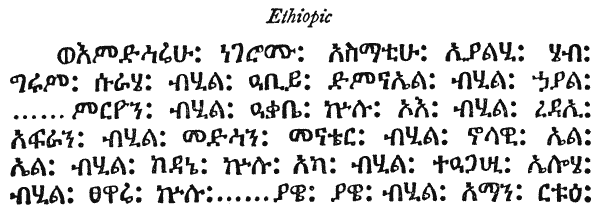
39. Ethiopic, purchased by the Oxford Press in 1692. (From the original matrices.)
In 1695 a fuller specimen (of twenty-four leaves) appeared with the same title, and included the Junian Danish, a few later acquisitions, such as the new Slavonic, and a fount of spoon-shaped music cut by Walpergen. To this document was also appended the inventory of “utensils for printing,” already given in the account of Dr. Fell’s gift.
Of the estimation in which this specimen was held at the time, the following eulogium of Bagford may be taken as testimony. He says: “For the satisfaction of the curious, I shall give a catalogue and specimen of the letter presented by Dr. Fell, the like of which cannot be shown by any of the great printing houses in Europe, which may be seen by that printed in 1695, although it may fall into the hands of foreign printers of Holland, Flanders, Italy, Germany and France, they must confess that they had not seen the like, both for the great beauty and goodness of the letters.”275
Apart from its value as a specimen of the Oxford foundry, considerable interest attaches to the specimen of 1695, as being the first polyglot production in this country in which a stated portion of the Scripture—the Lord’s Prayer—appears in as many as forty-five different forms and nineteen different languages. In this respect, however, it was shortly afterward eclipsed by a polyglot Oratio Dominica, published in London in 1700,276 exhibiting the Lord’s Prayer in upwards of one hundred versions. This may, to some extent, be regarded as a specimen of the University press, as the two principal sheets of the work were printed at Oxford containing the prayer in the Hebrew, Samaritan, Chaldee, {155} Syriac, Coptic, Ethiopic, Amharic, Arabic, Persic, Turkish, Tartaric, Malayan, Gothic, Runic, Icelandic and Sclavonic, of the University foundry.277 These constitute the most interesting part of the collection, as the remaining versions, requiring special characters, are produced chiefly in copperplate.278 Rowe Mores points with some pride to this specimen as showing how far superior we were at that time to our neighbours abroad in the variety of our metal types.279
Specimens of Dr. Fell’s and Junius’ gifts, and an account of the foundry with its recent acquisitions, were frequently printed in the early part of the eighteenth century. Rowe Mores mentions four between 1695 and 1706. In the latter year the document had grown to twenty-five leaves, and included a Great Primer and a two-line Great Primer, purchased in 1701, and other additions. The inventory mentions twenty-eight moulds as being the number still in use in the foundry, and seven presses in the printing-house. It also distinguishes certain types as being of the Dutch height, a discrepancy to which, in all probability, may be traced that unfortunate anomaly of “Bible height” and “Classical height,” which to this day hampers the operations of a foundry where, in perpetuation of a blunder made two centuries ago, types are still cast to two different heights, agreeing neither with one another nor with any British standard.280
A later specimen, without date, was issued in broadside form, in which the old title gave place to the more simple one of A Specimen of the several Sorts of Letters in the University Printing House, Oxford. In this specimen, while including all the recent acquisitions, several of the older and less sightly founts comprised in Dr. Fell’s gift are discarded. {156}
In the year 1712 the University press was removed from the Sheldonian Theatre to occupy its new quarters in the Clarendon Printing House, erected for its accommodation—a building considered at the time one of the finest printing-houses in the world.281
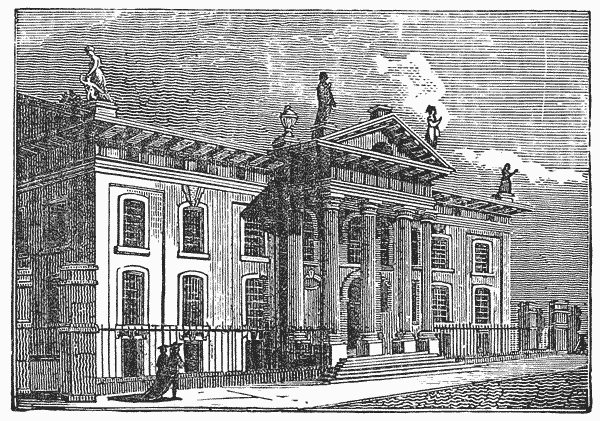
31. The Clarendon Press. (From an old wood block at the Oxford University Press.)
The encouragement given by Junius to the study of the Northern languages resulted in the production of many important works in that branch of literature at the University press during the early years of the eighteenth century. Foremost among these was Dr. Hickes’ Thesaurus,282 printed in 1703–5, a learned and elaborate work, in which the types presented by Junius are many of them displayed to advantage.
Rowe Mores, for the honour of his University in general, and his own college in particular, gives a list of the famous “Saxonists” of Dr. Hickes’ time. Amongst these, not the least eminent was Miss Elizabeth Elstob, who published in 1715 an Anglo-Saxon Grammar, printed in types, which, as they subsequently found their way into the Oxford foundry, call for a particular mention here.
William Bowyer the younger had printed in 1709 a work entitled An English-Saxon Homily on the Birth-Day of St. Gregory, translated by the Rev. William Elstob of Oxford and his sister, a young lady of great industry and {157} learning, whom Mores describes as the “indefessa comes” of her brother’s studies, and a female student of the University.283 In 1712, in the same types, was issued a specimen of Miss Elstob’s Anglo-Saxon Grammar.
Before, however, this work could be completed, Bowyer’s printing-house was destroyed by fire, and his types, including the Anglo-Saxon, perished in the flames. This disastrous event was the occasion for a remarkable display of sympathy on the part of Mr. Bowyer’s many friends, both in and out of the profession, which found expression in several forms,284 one of the most practical of which was the offer of Lord Chief Justice Parker (afterwards Earl of Macclesfield) to be at the cost of cutting a new set of Anglo-Saxon types for Miss Elstob’s Grammar. The drawings for the new types were made, at Lord Parker’s request, by Humphrey Wanley,285 the eminent Saxonist, and the cutting of the punches entrusted to Robert Andrews the letter-founder, who, however, proved unequal to the task. “I did what was required,” Mr. Wanley wrote, “in the most exact and able manner that I could in all respects. But it signified little; for when the alphabet came into the hands of the workman (who was but a blunderer), he could not imitate the fine and regular stroke of the pen; so that the letters are not only clumsy, but unlike those that I drew. This appears by Mrs. Elstob’s Saxon Grammar.”286 {158}
Poor as the letter-founder’s performance was, the Grammar duly appeared in the new letter in 1715,287 and the punches, matrices and types remained in the possession of Mr. Bowyer and his son, being used occasionally in some of their subsequent works, though not in any other of which Miss Elstob was the authoress.288 In 1753 they were sent by William Bowyer the younger, to Rowe Mores, with the following letter, for presentation to the University of Oxford:―
4th December, 1753.
“To EDWARD ROWE MORES, Esq., at Low Leyton.
“Sir,—I make bold to transmit to Oxford, through your hands, the Saxon punches and matrices, which you were pleased to intimate would not be unacceptable to that learned body. It would be a great satisfaction to me, if I could by this means perpetuate the munificence of the noble donor, to whom I am originally indebted for them, the late Lord Chief Justice Parker, afterwards Earl of Macclesfield, who, among the numerous benefactors which my father met with, after his house was burned in 1712–13, was so good as to procure those types to be cut, to enable him to print Mrs. Elstob’s Saxon Grammar. England had not then the advantage of such an artist in letter cutting as has since arisen,289 and it is to be lamented, that the execution of these is not equal to the intention of the noble donor, and, I now add, to the place in which they are to be reposited. However, I esteem it a peculiar happiness, that as my father received them from a great patron of learning, his son consigns them to the greatest seminary of it, and that he is, Sir, your most obliged friend, and humble Servant,
“W. BOWYER.”
The adventures of this epistle and the gift which accompanied it, before reaching their destination, are almost romantic. For some reason which does not appear, Rowe Mores, on receipt of the punches and matrices, instead of transmitting them to Oxford, took them to Mr. Caslon’s foundry to be repaired and rendered more fit for use. Mr. Caslon having kept them four or five years without touching them, Mr. Bowyer removed them from his custody, and in 1758 entrusted them to Mr. Cottrell, from whom in the same year he received them again, carefully “fitted up” and ready for use, together with 15 lbs. of letter cast {159} from the matrices. In this condition the whole was again consigned by Mr. Bowyer to Rowe Mores, together with a copy of Miss Elstob’s Grammar, for transmission to Oxford. On hearing, two years later, that his gift had never reached the University, he made inquiries of Mores, from whom he received a reply that “the punches and matrices were very safe at his house,” awaiting an opportunity to be forwarded to their destination. This opportunity does not appear to have occurred for three years longer, when, in October, 1764, the gift was finally deposited at Oxford. Its formal acknowledgment was, however, delayed till August 1778, exactly a quarter of a century after its presentation.290
The correspondence touching this transaction, amusing as it is, throws a curious light on Rowe Mores’ character for exactitude, and it is doubtful whether the publication of Mr. Bowyer’s first letter in the Dissertation,291 together with a few flattering compliments, was an adequate atonement for the injury done to that gentleman by the unwarrantable detention of his gift. Nor does the title under which the gift was permitted to appear in the University specimen, suppressing as it does all mention of the real donor’s name, and giving the entire honour to the dilatory go-between, reflect any credit on the hero of the transaction. The entry appears thus: “Characteres Anglo-Saxonici per eruditam fœminam Eliz. Elstob ad fidem codd. mss. delineati; quorum tam instrumentis cusoriis quam matricibus Univ. donari curavit E. R. M. e Collegio Regin., A.M. 1753.
“Cusoria majuscula 42 (desunt et ) Matrices majusculæ 44. Cusoria minuscula 37 (desunt e et ) Matrices minusculæ 39.”


It does not appear that these types were ever made use of at Oxford. The punches and matrices remain in the University press to this day.292
Between the Broadside sheet following the specimen of 1706, and 1768, no specimen of the Oxford foundry occurs. There exists, however, in the works issuing from the Press during that period ample testimony to its activity. The proposal to print Dr. Mawer’s Supplement to Walton’s Polyglot, with its types, is evidence of the continued reputation of its “learned” founts; while such an admirable specimen of typography as Blackstone’s Charter of the Forest, printed in 1759,293 affords proof that Oxford was not behindhand in that famous {160} revival of printing which received such impetus from the taste and genius of Baskerville.
The Delegates of the Press had, indeed, so high an opinion of the talents of this famous artist, that they employed him in 1758 to cut a fount of Great Primer Greek type for a Greek Testament shortly to be issued.294 The performance was pronounced unsuccessful, but the Greek types duly appeared, together with numerous other acquisitions, including a Long Primer Syriac purchased from Caslon, in the Specimen of 1768–70.295
Of this specimen Rowe Mores (who informs us that it was printed at the request of foreigners) falls foul as inaccurate. “The materials from which this account (i.e., his summary of the contents of the Foundry) is drawn,” he says, “are not so accurate as might have been expected from an Archi-typographus and the Curators of the Sheldonian. In excuse may be alleged that neither the Archi-typographus nor the Curators are Letter-founders; certainly that the matter has not been treated with that precision which in so learned a body should seem to be requisite. For one instance among others, which might be produced, take the Double Pica, Brevier and Nonpareil Hebrew, the only Hebrew types the University then had. They are two-line English, English and Long Primer. And this mistake has run through all the editions of the Oxford specimen, and in the last of 1770, the leanest and the worst of all, appears most glaringly. For this Brevier is placed immediately under Caslon’s Long Primer, a diversity sufficient one would think to show the blunder without the aid of a magnifier. The Nonpareil as it is called is omitted in this last specimen, and so are many other sets of matrices which have been given to the University, touching which enquiry should be made out of respect (at least) to the memory of the donors.”296 {161}
Another specimen appeared in 1786, in which more of the old founts are discarded in favour of more modern letters, among which are noticeable several Roman founts cast on a large body, to obviate the necessity of “leading”; including an English, cast for Mr. Richardson’s Dictionary. Almost all the “learned” founts presented by Fell and Junius are here shown, as well as a considerable number of borders and ornamental initials.
In 1794 a still fuller specimen appeared, which included a Great Primer Greek, cut by Caslon, and several new titling letters. To this specimen is appended a detailed inventory, both of the punches and matrices at that time in the possession of the University, and of the quantity of type of various kinds in stock, with the utensils for printing.
The following is a summary of the foreign and “learned” punches and matrices included in this catalogue:―
PUNCHES.
79 Anglo-Saxon
33 Arabic
65 Armenian
72 Black, English
116 Coptic, Pica
25 Gothic
114 Greek, Great Primer
148 Greek, Great Primer (Baskerville’s)
190 Greek, Double Pica
10 Greek, 2-line English
20 Hebrew, with points
220 Music
24 Runic
28 Samaritan, English
21 Saxon
106 Slavonian
90 Syriac, English
47 Turkish, Persian, Malayan
MATRICES.
228 Arabic, Syriac and Hebrew
10 Arabic figures
83 Anglo-Saxon
77 Armenian
7 Armenian
7 Armenian
73 Black, English
135 Coptic
27 Coptic
224 Ethiopic
351 Greek, Augustin (or English)
493 Greek, Great Primer
167 Greek, Great Primer (Baskerville’s)
239 Greek, Double Pica (bad)
432 Greek, Paragon (Double Pica)
352 Greek, Long Primer
11 Greek, 2-line English
230 Hebrew, large and small
250 Hebrew, large and small
228 Music
70 Music
89 Runic, Dutch, Saxon, Gothic and Greek
30 Samaritan
20 Saxon, Small Pica, Long Primer, Pica
110 Slavonic
120 Syriac, English
5 Syriac, vowels
47 Turkish, Persian, Malayan
10 Welch
Of the printing utensils, the following items will give an idea of the extent of the press at that date:― {162}
CASES (FILLED WITH TYPE).
267 Common cases
44 Single cases and boxes
26 Fount cases
34 Long Greek cases
30 Frames
129 Chases
37 Letter boards
5 Presses
1 Proof press
Of the presses, one is described as “mahogany, set up in the year 1793,” and another as “on the new constitution which works with a lever, set up in 1793.”
We have now brought our account of letter-founding at Oxford to the close of the last century. Its later history is of comparatively slight interest. The foundry still remains a part of the Press, and the reputation of the University for its oriental and learned founts has been maintained by numerous additions to its punches and matrices. Of such matters, however, in the absence of periodical general specimens, it is impossible to give particulars. The list of matrices given by Hansard in 1825 is entirely misleading, as he merely summarises the list taken by Mores from the Specimen of 1768–70.
We may, however, observe that at the present moment, under able management, the foundry is in active operation, and that the University Press possesses probably the largest collection of “Polyglot” matrices of any foundry in the kingdom.
The famous gifts of Fell and Junius are now relegated to the relics of this venerable yet still flourishing foundry, where, in company with Baskerville’s Greek, Walpergen’s music and Miss Elstob’s Anglo-Saxon, they rest from their labours, and remain to this day the most interesting monuments our country possesses of the art and mystery of its early letter-founders.
Appended is a list of the various specimens issued by the Oxford press from 1693 to 1794.―
1693. A specimen of the Several sorts of Letter given to the University by Dr. John Fell, late Lord Bishop of Oxford. To which is added, the Letter given by Mr. F. Junius. Oxford, printed at the Theater, A.D. 1693. 8vo. (Bodl. C., i, 24, Art.)
1695. A specimen of the Several sorts of Letter given to the University by Dr. John Fell, sometime Lord Bishop of Oxford. To which is added the Letter given by Mr. F. Junius. Oxford, Printed at the Theater, A.D. 1695. 8vo. (Bodl. Gough, Ox., 142; B. M. Harl. MS. 1529.)
1706. A specimen of the Several sorts of Letters given to the University by Dr. John Fell, sometime Lord Bishop of Oxford. To which is added the Letter given by Mr. F. Junius, Oxford, Printed at the Theater, A.D. 1706, 8vo. (Bodl. Gough, Ox., 142.)
No date. A specimen of the Several Sorts of Letters in the University Printing House. Oxford. Broadside. (Bodl. C., i, 24, Art.)
No date. Characteres Anglo-Saxonici per eruditam fœminam Eliz. Elstob ad fidem codd. {163} mss. delineati, quorum tam instrumentis cusoriis quam matricibus Univ. donari curavit E. R. M. e. collegio Regin. A.M. 1753. 8vo leaf. (W. B.)
1768–70. A specimen of the Several sorts of Printing Types belonging to the University of Oxford at the Clarendon Printing House, 1768 (together with New Letters purchased in the years 1768, 1769, 1770). Clarendon Press, Sept. 29, 1770. 8vo. (Univ. Pr.)
1786. A specimen of the Several sorts of Printing Types belonging to the University of Oxford at the Clarendon Printing House, 1786. 8vo. (Univ. Pr.)
1794. A specimen of the Several Sorts of Printing Types belonging to the University of Oxford, at the Clarendon Printing House, 1794. 8vo. (W. B.)