Chapter XV · JOSEPH AND EDMUND FRY, 1764.
Reading edition

HIS foundry, first known as Fry and Pine’s, had its origin in Bristol in the year 1764.
Mr. Joseph Fry, a prominent and enterprising Bristolian, was the son of Mr. John Fry, and was born in the year 1728. He entered the medical profession, where, says a biographer,611 “his affable, courteous manners and sound Christian principles soon secured to him a large practice amongst the highest class of his fellow citizens. Possessing uncommon energy and activity of mind, he was led to take a part in many new scientific undertakings, actuated more by the desire to be useful to society and advance the arts than by any hope of individual profit.”
This spirit of enterprise induced him, in the year 1764, to turn his attention to letter-founding, which, though hardly to be called a new scientific undertaking, was at least a novel industry for a provincial city. The success of Baskerville’s foundry at Birmingham, at that time in the height of its celebrity, was undoubtedly an incentive to the adventurers of Bristol, whose first founts were avowedly cut in close imitation of those famous models.
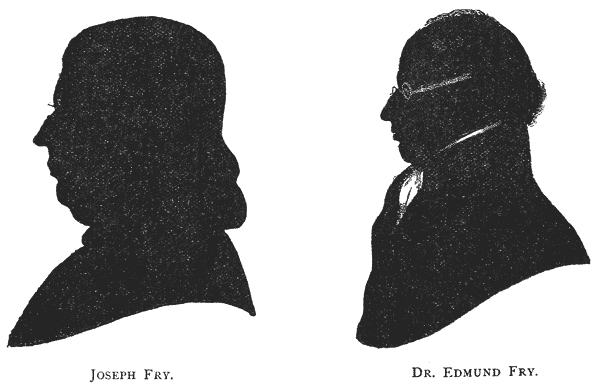
73A. Joseph Fry and Dr. Edmund Fry. From Silhouettes in the possession of Francis Fry, Esq., of Bristol.
William Pine, Mr. Fry’s partner, was a practical printer of some note in his native city. He was the first printer of the Bristol Gazette, and carried on a considerable business at his premises in Wine Street. The new foundry was {299} attached to his office, and its productions may be traced in several works which issued from his press between the years 1764 and 1770.612 Messrs. Fry and Pine’s manager was one Isaac Moore, who (Rowe Mores informs us) was originally an ingenious whitesmith of Birmingham before he removed to Bristol. The practical superintendence of the foundry, if not the actual cutting of its punches, devolved on him; and his services appear to have been acknowledged by his admission into the partnership at an early stage of the undertaking, the business being carried on in his name.
Renouard mentions a Specimen by Isaac Moore, Bristol, in 1768, of which he possessed a copy mounted on linen,613 and which he describes as displaying “caractères assez bien gravés, et imitant ceux de Baskerville.” If this was, as it would appear from the title, issued at Bristol, we must conclude that the removal of the foundry to the metropolis took place in the same year, as there exists in the Sohmian Collection at Stockholm, where it was recently discovered by Mr. W. Blades, a broadside Specimen by Isaac Moore and Co. in Queen Street, near Upper Moorfields, London, showing the Roman series from five-line to Brevier, bearing the same date. Whether the two specimens are the same or not, it is hardly likely that their contents could have varied much during the brief interval. Two years later, however, the progress of the undertaking was announced by the issue of a fresh broadside sheet containing the complete series of Romans, cut after the Baskerville models, from eight-line to Pearl, with Italics to most of the founts, besides a fair display of flowers. The general appearance of the letters is elegant, especially in the larger sizes.
Appended to the specimen, in the form of a postscript, is the following address to the public (the first of a series of florid effusions which characterised the specimens of this foundry), in which the proprietors announce the principles on which their venture is to be conducted, and refer with satisfaction to the success already achieved by their productions:―
“The Proprietors of the above Foundery having nearly compleated all the Roman and Italic Founts, desire with great Deference, to lay this Specimen before the Trade; and intreat the Curious and critical, before any decisive Judgement be passed, on the Merits or Demerits of the Performance, to make a minute Examination and Comparison of the respective letters and founts of each Size, with the same Letters and Founts of the most respectable Founders in the Kingdom; For as all Letters, whether Roman or Italic, bear a great Similitude to each other, to apprehend the peculiar Beauty or Deformity of them are only to be discovered by such a Comparison. In making {300} which they hope the Candid and Judicious will set aside the Influence of Custom and Prejudice (those Great Barriers against Improvement) and attend to Propriety, Elegance and Mathematical Proportion. And as these have been objects particularly attended to in the Course of the Work, they apprehend it will appear on such a Disquisition, that all the above sizes bear a greater Likeness to each other, than those of any other Founder. They have been already favoured with the Encouragement and Approbation of several very respectable printers, who have wrought off many large Editions on their Founts, which have been Experienced to wear extremely well; owing to the Letter being clearly and deeply cut and to the Goodness of the Metal, which they make of an Extraordinary Composition; the Singular Advantage of which cannot but be obvious. Therefore hope that others will likewise make Trial of them, as they doubt not but they also will find it greatly to their Satisfaction.”614
It is doubtful whether the encouragement accorded to the new foundry on its first establishment in the metropolis came up to the expectations of the proprietors; and a circular issued shortly afterwards by two of the partners, suggests that some fillip was deemed necessary to awaken a more extended patronage of the concern. This curious document is entitled Proposals for discovering a very great Improvement which William Pine, printer of Bristol, and Isaac Moore, Letter Founder, in Queen Street, Upper Moorfields, London, have made in the Art of Printing, both in the Construction of the Press and in the Manner of Beating and Pulling, and publicly offers the secret of the invention (the precise nature of which is not apparent) to any customer of the new foundry ordering type to the value of ten pounds and upwards.615 {301}
How far this ingenuous offer had the effect of stimulating the type business is not recorded; but the proprietors were forced before long to recognise the desirability of adopting other and surer methods for gaining the popular favour.
Although Luckombe, writing in 1770,616 mentions Moore along with Caslon and Jackson, as one of the three London founders, the same authority makes a decidedly disparaging reference to his types617; a circumstance which may be accounted for by the then growing prejudice amongst metropolitan printers against the Baskerville form of letter adopted by the new foundry.
Representations of a similar nature having been made from several influential quarters, it became evident to the proprietors that if they were to retain public favour at all, it must be by adapting themselves to public taste, and abandoning the formal, delicate models of Baskerville for the more serviceable, dashing characters of Caslon.
This laborious task occupied several years in completion. Meanwhile the original founts were not discarded.
The printing office connected with the foundry distinguished itself in the interval by the production of two highly interesting Bibles, the one a folio, published in 1774, and the other an 8vo, in five volumes, published 1774–6.618 Both are elegantly printed in the clear Great Primer letter shown in the 1770 Specimen; the latter being in long lines specially for the use of the aged. The general appearance of the folio edition compares not unfavourably with the Baskerville Bible of 1772.
In 1774, Pine printed at Bristol a very neat Bible in the Pearl type of the foundry, “being”, says the preface, “the smallest a Bible was ever printed with, and made on purpose for this work.”619 {302}
Moore’s connection with the business appears to have terminated in 1776, after which the style of the firm became J. Fry and Co., who in the following year issued, in their own name, reprints of the folio and octavo Bibles above referred to.620 No specimen-sheet of their types appeared till seven years later, by which time Mr. Pine had also withdrawn from the business.621 He continued to print the Bristol Gazette in Wine Street, Bristol, till the time of his death, which occurred in 1803, at the age of sixty-four years.
Left to himself, Mr. Fry, in the year 1782, admitted his sons Edmund and Henry into partnership, under whose supervision the work of re-cutting the Romans of the foundry made active progress.
Edmund Fry, probably the most learned letter-founder of his day, had, like his father, been educated for the medical profession, and had taken his doctor’s degree. But the infirmity of deafness prevented him from following that walk in life, and he abandoned it for typefounding, applying himself to that pursuit, not only with the enthusiasm of an ardent philologist, but also with considerable natural ability for conducting the practical operations of the art.
The year of his entry into the business (1782) was signalised by an important event in the typefounding world—the sale of James’s foundry. This event has been fully alluded to elsewhere,622 but it is interesting to note that the Frys were considerable purchasers on the occasion, securing amongst other items the chief part of the “learned” and foreign matrices, for which that collection was noted.
The following list of their purchases forms an interesting connecting link between the old and the new letter-foundries; particularly as either punches or matrices of all the founts (and in some cases both) still exist, many of the latter being to this day in occasional use:― {303}
Blacks.623― [A.] English [A.] Pica [A.] Small Pica [A.] Long Primer [G.] Brevier [G.] Nonpareil
Hebrew.― [A?] English Small Pica Long Primer (or Bourgeois) Brevier
Rabbinical Hebrew.― [A.] Small Pica [A.] Brevier [A.] Nonpareil
Greek.― [G.] Alexandrian [G.] Great Primer [R?] Another [R?] Pica
Arabic.― [A?] Great Primer
Irish.― [M.] [A.] Small Pica
Ethiopic.― [P.] [A.] English Pica
Samaritan.― [P.] [G.] English Long Primer
Scriptorial.― [G.] Pica [G.] English
Union Pearl.― [G.] Double Pica
Court Hand.― [G.] English
Flowers.— Nearly all
The business was shortly afterwards removed to Worship Street, hard by the old premises; and here, in 1785, the first specimen-book of the foundry was issued. This volume exhibits the greater part of the new Caslon series of Romans, which the proprietors in their “Advertisement” frankly admit to have been cut in the closest possible imitation of that ingenious artist’s models.624 It includes also two pages of Hebrew type. Later in the same year appeared a large broadside sheet printed both sides, containing an epitome of the specimen-book, and displaying, besides the Arabic, Hebrews, Greek and Samaritan {304} recently acquired at James’s sale,one or two fresh Hebrew founts lately finished. Considerable variety is thrown into this and later specimens by showing each size not only on its own body, but upon the bodies next larger and next smaller,—short descending sorts being specially cut for the latter. The broadside also includes a Diamond Roman, the first in England, for which the founders claim that it is “the smallest letter in the world,” adding subsequently that it “gets in considerably more than the famous Dutch Diamond.”
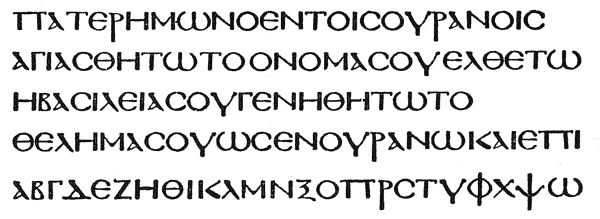
Μ 74. The Alexandrian Greek (formerly Grover’s), rejustified by Dr. Fry, 1786. (From the original matrices.)
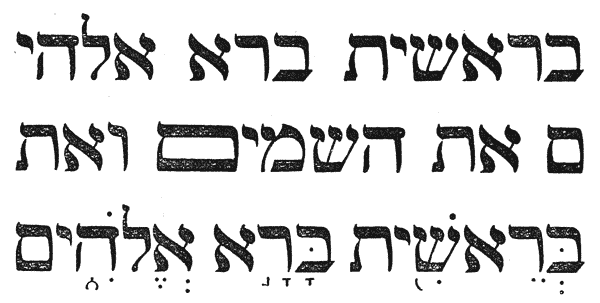
Μ 74A. Two-line Great Primer Hebrew, cut by Dr. Fry, circa 1785. (From the original matrices.)
Another Specimen followed in 1786, showing several more of the new founts, and including seven pages of Orientals. This volume is dedicated to the Prince of Wales, and is prefaced by an address to the public of the usual self-laudatory character, with a somewhat aggressive reference to the rival foundry at Chiswell Street.625
In the following year Mr. Joseph Fry retired from the business. Besides founding a chocolate business in his native city, and becoming a considerable {305} partner in the new Bristol Porcelain Works, he had added to his other enterprises that of a Chemical Works at Battersea, and later still had established some important Soap Works in partnership with Mr. Alderman Fripp of Bristol.
He did not long survive his retirement, and died, after a few days’ illness, on March 29, 1787, aged fifty-nine, greatly respected. He was buried in the Friends’ burial-ground at the Friars, Bristol. A silhouette portrait of him is to be seen in Mr. Hugh Owen’s Two Centuries of Ceramic Art in Bristol, where also many interesting details of his life are to be found.626
In 1787 was issued a Specimen of Printing Types by Edmund Fry and Co.—the first mention of the firm under its new title. This was followed in the next year by a full specimen of the foundry, with a preface and dedication similar to those of the 1786 edition, but showing several fresh additions, particularly among the Orientals, which occupy twelve pages. Of the latter, several founts had been cut by Dr. Fry himself.
The specimen of 1787 was included in the Printer’s Grammar627 published in that year—a work which makes considerable reference to the Frys’ foundry, whose specimens and standards are used in illustration of the various subjects dealt with. The introductory note to the specimen gives the following account of the then condition of the foundry. It “was begun in 1764 and has been continued with great perseverance and assiduity, at a very considerable expence. The plan on which they first sat out, was an improvement of the Types of the late Mr. Baskerville of Birmingham, eminent for his ingenuity in his line, as also for his curious Printing, many proofs of which are extant and much admired: But the shape of Mr. Caslon’s Type has since been copied by them with such accuracy as not to be distinguished from those of that celebrated Founder. They have at present Twenty-seven complete Founts in punches and matrices of Roman and Italic, besides many sizes of larger Letter cast in Sand; also an elegant assortment of Blacks, with Hebrews and Greeks, and many other Orientals: They have also a greater variety of Flowers than are to be met with in any other Foundery in this Kingdom.”
The premises at Worship Street becoming inadequate for the type and printing business combined, Dr. Fry took a plot of ground opposite Bunhill Fields in Chiswell Street—then open fields—and there built the foundry which gave its name to Type Street. To these premises the business was removed in 1788; and the Specimen of that year dates from the Type Street Foundry. {306}
Among many elegant works printed at this time in the types of this foundry was the Rev. Mr. Homer’s fine edition of the classics,628 printed by Millar Ritchie,629 in which the somewhat rare compliment was paid the founder, of adding his name to the list of typographers engaged on the work.
The printing business was about the same time dissociated from the type-founding, and remained at Worship Street under the management of Henry Fry, who styled his office the “Cicero Press.”630
In the year 1794 Dr. Fry took Mr. Isaac Steele into partnership, and the specimen of this year, under the title of Edmund Fry and Isaac Steele, Letter-Founders to the Prince of Wales, shows a marked advance on its predecessors. Besides the additional Romans, it includes the Irish fount originally cut by Moxon in 1680, and is further supplemented by a considerable display of “Metal Cast Ornaments, curiously adjusted to paper”, of which a specimen had already appeared in the preceding year. Rude as many of these cuts now appear, they were much affected at the time, while a few of their number bear evident testimony to the wholesome revolution then being effected in the art of engraving by Mr. Bewick. A distinct improvement in the same direction may be traced in the series of “Head and Fable Cuts” for Dilworth’s Spelling Book, a specimen of which was issued shortly afterwards.631
In 1798 Dr. Fry put forth proposals for publishing the important philological work on which he had for sixteen years been engaged, and which, in the following year, was issued under the title of Pantographia, with a dedication to Sir Joseph Banks, President of the Royal Society. {307}
This important work,632 which displays great learning and research, was favourably received. It exhibits upwards of 200 alphabets, amongst which are 18 varieties of the Chaldee and no less than 39 of the Greek. Many of the letters were cut by the author expressly for the work, under the direction or with the advice of some of the most eminent scholars of the day, and not a few subsequently found a place among the specimens of the foundry.
In 1799 Mr. George Knowles was admitted into partnership, and the firm became Fry, Steele and Co.
A new revolution in the public taste necessitated at this stage the abandonment of the Caslon Old Style faces, and the adoption of the modern cut Roman letter then coming into vogue; and the specimens between 1800 and 1808 are interesting as marking the gradual accomplishment of this task. The specimen of 1803 showed the first of the new Romans, and in 1808 Stower’s Printer’s Grammar contained the series almost complete.633
The new style may have been considered an improvement at the time, but a later judgment has endorsed the regret with which Dr. Fry and others witnessed the then entire abandonment of the time-honoured and graceful Elzevir-cut characters of the first Caslon.
Naturally conservative in most matters pertaining to his art, Dr. Fry viewed with the utmost displeasure another innovation of the same period, in the introduction of ornamental type; and to the end of his career he strenuously resisted the “pernicious fashion,” as he styled it; yielding only to the extent of one small series of flowered titling-letters, which crept into his later specimens. But, although opposed to ornaments in this form, the Type Street specimens show no lack of flowers, and Stower’s book includes a profuse specimen of these ornaments, arranged in fantastic designs by Mr. Hazard, the printer, of Bath.634
Both Mr. Steele and Mr. Knowles appear to have retired about the year 1808, when Dr. Fry assumed the sole management of the business. In the specimen of 1816 he styles himself Letter Founder to the King and Prince {308} Regent. Soon afterwards, his own health failing, he admitted his son, Mr. Windover Fry, into partnership, and the firm became Edmund Fry and Son.
The subsequent specimens of the foundry are not marked by any special feature of interest, if we except the introduction of M. Firmin Didot’s Great Primer Script in 1821, containing upwards of sixty lower-case sorts, in a system of ligatures and connectors so elaborate as to necessitate the printing of a scheme to facilitate their composition, and the manufacture of special cases to hold them.
Dr. Fry’s philological studies had not ceased with the publication of Pantographia, and he was constantly adding to the stock of punches and matrices of the “learned” languages, in which his foundry was already rich. His excellence as a cutter of Oriental punches led to his selection by the University of Cambridge635 to execute several founts for that learned body; in addition to which he was employed to produce types for the works of the British and Foreign Bible Society, and similar biblical publications.
His most important effort in this direction was an English Syriac for Bagster’s Polyglot, with the points cast on the body, the entire fount consisting of nearly 400 matrices.
The specimen of 1824, which was issued both in octavo and (more sumptuously) in quarto, for presentation, signalised the completion of his efforts in this department, and at the same time notified that the name of the foundry had been changed—not inappropriately—to the Polyglot Foundry.
It is to be regretted that Dr. Fry’s energy in one particular branch of his art, congenial as it was to his own tastes, did not turn out lucrative from a business point of view; and the last few years of his career as a type-founder were not prosperous. His latest specimen was a broadside sheet of Newspaper founts in 1827.
In the same year he produced a raised type for the blind, under the following circumstances:—The Scotch Society of Arts, anxious to promote the welfare of the blind, and desirous to determine, among the many systems at that time proposed, which was the most suitable method of printing for their instruction, offered a gold medal of the value of £20 for the best communication on the subject. Twenty designs were sent in in 1833, of which Dr. Fry’s was the only one retaining the ordinary alphabetical characters. His specimen consisted of large and small square “sanseriff” capitals working in combination, with no deviation from the regular form. The committee occupied four years in arriving at a decision; employing the time in corresponding with and eliciting {309} the opinion of all the chief persons interested and experienced in the education of the blind, in reference to the various designs. Amongst others they received a long communication from the Rev. W. Taylor of York, who commended Dr. Fry’s system, approving specially of the absence of a “lower-case” letter.636 The report was published May 31st, 1837, awarding the medal to Dr. Fry, who, however, was at that time no more, his death having occurred two years previously.
The following summary of the contents of the Polyglot Foundry, as far as its foreign and rare founts were concerned, is taken from the Specimen Book of 1824, and corresponds closely to the list given in Hansard’s Typographia in the following year. With the exception of the founts purchased at James’ sale in 1782 (which are distinguished by the initials), most of the characters were cut by, or under the direction of, Dr. Fry himself.
DR. FRY’S FOUNDRY. Arabic.― [J?] Great Primer Great Primer, No. 2. English. Amharic.― English. Ethiopic.― [P.][A.][J.] English English, No. 2. [J.] Pica. German.― Long Primer. Greek.― Double Pica. Great Primer. English. Pica. Pica, No. 2. Small Pica. Long Primer. Long Primer, No. 2. Brevier. Nonpareil. Greek Alexandrian.― [G.][J.] Pica. Guzerattee.― Great Primer. Long Primer. Hebrew.― 2-line Great Primer. 2-line English. Double Pica with points. English with points. Pica. Small Pica. Long Primer. Bourgeois. Brevier. Nonpareil. Hebrew Rabbinical.― [A.][J.] Small Pica [A.][J.] Brevier [A.][J.] Nonpareil. Irish.― Pica. [M.][A.][J.] Small Pica Small Pica, No. 2. Malabaric.― English. Pica. Russian.― Double Pica. Samaritan.― [P.][G.][J.] Pica [J.] Long Primer Saxon.― Double Pica. Great Primer. English. Pica. Small Pica. Long Primer. Brevier. Syriac.― English. Long Primer. Music.― Large Plein Chant. Small Plein Chant. Psalm. Blacks.― 4-line. 2-line Great Primer. 2-line English. Double Pica. Great Primer. [A.][J.] English, No. 1. English, No. 2. Pica, No. 1. [A.][J.] Pica, No. 2. Small Pica. [A.][J.] Long Primer. Brevier.637
In 1828, being now of an advanced age, and after 46 years’ incessant labour, Dr. Fry decided to dispose of his foundry; and a circular was issued announcing the fact to the public. This document, throwing as it does considerable light on the history of the Type Street Foundry, is interesting enough to quote at length. After enumerating generally the contents of the foundry and stating the conditions of sale, Dr. Fry remarks:
“The Substructure of this Establishment was laid about the year 1764; commencing with improved imitations of Baskerville’s founts, of which every size was completed, from the largest down to the Diamond: but they did not meet the encouraging approbation of the Printers, whose offices generally, throughout the kingdom, were stored from the London and Glasgow Founderies with Types of the form introduced by the celebrated William Caslon, early in the last century; chiefly from the admired Dutch models, which gained so much credit to the Elzevirs of Amsterdam, Leyden, &c.
“By the recommendation, therefore, of several of the most respectable Printers of the Metropolis, Doctor Fry, the proprietor, commenced his imitation of the Chiswell Street Foundery, which he successfully finished throughout all it’s various sizes, at a vast expense, and with very satisfactory encouragement, during the completion of it. At which period a rude, pernicious, and most unclassical innovating System was commenced, which, in a short time was followed by the most injurious and desolating ravages on the property of every Letter Founder and Printer in the kingdom, by the introduction of fancy letters of various anomalous forms, with names as appropriate—disgraceful in a Profession, once held so Sacred, as to have it’s operations confined to consecrated Buildings, and those of the highest class.
“The Baskerville and Caslon imitations, all completed with Accents, Fractions, &c., were, in consequence of this revolution, laid by for ever; and many thousand pounds weight of new letter in Founts, estimated on the average at selling prices, at 2s. 6d. per pound, were taken from the shelves, and carried to the melting-pot to be recast into Types, no doubt, in many instances, more beautiful; but no instance has occurred to the attentive observation of the Proprietor of this Foundery, where any Founts of book letter on the present system, have been found equal in service, or {311} really so agreeable to the reader, as the true Caslon-shaped Elzevir Types; and this is the undisguised sentiment of many judicious Printers.
“When that eminent Printer, the late William Bowyer, gave instructions to Joseph Jackson to cut his beautiful Pica Greek, he used to say “Those in common use were no more Greek than they were English.” Were he now living, it is likely he would not have any reason to alter that opinion.
“The Greeks of this Foundery were many of them made in Type Street, copied from those of the celebrated Foulis of Glasgow; and there are two, a Pica, and a Long Primer, on the Porsonian plan. The Codex Alexandrinus was purchased at James’ Sale in 1782.638
“The Hebrews were also chiefly cut by Dr. Fry, subject to the direction and approbation of the most learned Hebraists.
“The two Arabics,639 Great Primer and English, were cut from the original drawings of, and under the personal direction of Dr. Wilkins, Oriental Librarian to the East India Company; and have no rival either in beauty or correctness.
“The Syriac640 has been made within the last two years, with all it’s vowel points, reduced to an English body, from the Double Pica of the eminent Assemann’s edition of Ludolph’s Testament.
“The English, No. 1, and Pica Ethiopics—the Pica and Long Primer Samaritans, were purchased at James’s sale. The other Orientals, viz. two Malabarics—the Amharic—Ethiopic, No. 3, and Guzerattee, were all cut at this Foundery. As was the fine collection of Blacks, or pointed Gothics, except the English, No. 1,—Pica, No. 2,—Long Primer, No. 1,—and Brevier, which were collected by the late John James. There is good authority for believing that this Pica Black, No. 2, was once the property of {312} William Caxton641; Doctor Fry having recut for a reprint of a work published by the celebrated man, all the contractions and accented letters exhibited in the Specimen Book.
“The Occidentals, as termed by Moxon, Mores, and others, viz. the Saxons, Hibernians,642 German, and Russian, were also produced at this Foundery. As were the two Plein Chants, and the Psalm Music.
“The Great Primer Script, which, it must be acknowledged, is the Ne plus ultra of every effort of the Letter Founder in imitation of writing, was made for the Proprietor by the celebrated Firmin Didot, at Paris; the Matrices are of Steel, and the impressions from the Punches sunk in inlaid Silver !643
“In taking leave of a Profession, which has for many years engaged his whole attention, the Proprietor begs to convey, through this channel, the high sense of obligation he hopes to retain during his life, for the great encouragement with which he has been favoured for so long a period; as well as for the generous assistance and advice of many of his learned Friends, in the getting up, and accurate completion of various undertakings. It is also with much gratification, that he can look back and recall to recollection, that he has carefully followed their advices, in not admitting into {313} his Foundery any article degrading or disgraceful, or unbecoming the dignity of that Art, which deserves to be looked up to and revered as the ‘Head of the republic of letters:’—claiming Permission to recommend to his Successor and Contemporaries, the steady pursuit of that plan which will secure the reputation of the once Sacred Profession, and restore to it the honourable Character it obtained several Centuries ago, of
“ARS ARTIUM OMNIUM CONSERVATRIX.”
“Polyglot Letter Foundery, 2nd month 14th, 1828.”
The foundry met with a purchaser in Mr. William Thorowgood, of Fann Street, to whose premises the entire stock was removed in 1829, where it now forms part of the Fann Street Foundry.
Dr. Fry retired to his residence at Stratford Green, and subsequently removed to Dalby Terrace, City Road, where he died Dec. 22, 1835.644
He was an old Member of the Stationers’ Company. In private life he was a man of genial disposition. A portrait of him, painted by Frederique Boileau, was exhibited in the Caxton Exhibition of 1877 by his son, the late Arthur Fry, and an excellent silhouette is also in possession of the family of the late Mr. Francis Fry, F.S.A., of Bristol, to whom we are indebted for our copy.
LIST OF SPECIMENS, 1768–1827.
1768. A specimen by Isaac Moore, Bristol, 1768. Broadside. (Renouard, Cat. ii, 310.)
1768. A specimen of Printing Types by Isaac Moore & Co., Letter Founders, in Queen Street, near Upper Moorfields, London, 1768. Broadside. (Sohmian Coll., Stockholm.)
1770. A specimen of Printing Types by Isaac Moore & Co., Letter Founders, of Queen Street, near Upper Moorfields, London, 1770. Broadside. (Caxt. Cel., 4371.)
1785. A specimen of Printing Types made by Joseph Fry and Sons, Letter Founders and Marking Instrument Makers by the King’s Royal Letters Patent. London, Printed in the year 1785. 8vo. (B. M., 679, e. 16.)
1785. A specimen of Printing Types by Joseph Fry & Sons, Letter Founders, Worship Street, Moorfields, London, 1785. Broadside. (T. B. R.)
1786. A specimen of Printing Types by Joseph Fry & Sons, Letter Founders to the Prince of Wales. London, Printed in the year 1786. 8vo. (W. B.)
1787. A specimen of Printing Types by Edmund Fry & Co., 1787. 8vo. (Printer’s Grammar, pp. 273–316.)
1788. A specimen of Printing Types by Edmund Fry & Co., Letter Founders to the Prince of Wales. London, Printed in the year 1788. 8vo. (T. B. R.)
1790. A specimen of Printing Types by Edmund Fry & Co., Letter Founders to the Prince of Wales. London, Printed in the year 1790. 8vo. (Sohmian Coll., Stockholm.) {314}
1793. Specimen of Metal Cast Ornaments, curiously adjusted to Paper by Edmund Fry & Co., Letter Founders to the Prince of Wales, Type Street, London. Printed by T. Rickaby, 1793. 8vo. (Amer. Antiq. Soc.)
1794. A specimen of Printing Types by Fry & Steele, Letter Founders to the Prince of Wales, Type Street, London. Printed by T. Rickaby, 1794. 8vo. (B. M., 11899, i. 18.)
1794. Specimen of Metal Cast Ornaments, curiously adjusted to paper by Edmund Fry and Isaac Steele, Letter Founders to the Prince of Wales, Type Street, London. Printed by T. Rickaby, 1794. 8vo. (W. B.)
1795. A specimen of Printing Types by Fry & Steele, Letter Founders to the Prince of Wales, Type Street, London. Printed by T. Rickaby, 1795. 8vo. (T. B. R.)
1800. A specimen of Printing Types by Fry, Steele and Co., Letter Founders to the Prince of Wales, Type Street, London. Printed in the year 1800. 8vo. (T. B. R.) Reprinted 1801 and 1803.
1805. A specimen of Printing Types by Fry & Steele, Letter Founders to the Prince of Wales, Type Street, London. Printed in the year 1805. 8vo. (T. B. R.)
1805. Specimen of Metal Cast Ornaments, curiously adjusted to paper by Fry and Steele, Letter Founders to the Prince of Wales, Type Street, London. Printed in the year 1805. 8vo. (W. B.)
No date. Specimen sheet of Head and Fable Cuts for Dilworth’s Spelling Book, cast on hard metal, and curiously adjusted to paper on the best Turkey Box, by Fry and Steele, Letter Founders, Type Street, London. Price £4 4s. (1805?). Broadside. (Caxt. Cel., 4386.)
1808. Specimens of Modern Cut Printing Types from the Foundry of Messrs. Fry and Steele; together with a Specimen of Flowers. 1808. 8vo. (Stower’s Printer’s Grammar.)
1816. A specimen of Printing Types by Edmund Fry, Letter Founder to the King and Prince Regent, Type Street, London, 1816. 8vo. (B. M., 11899, h. 11.)
1820. Specimen of Modern Printing Types by Edmund Fry and Son, Letter Founders to the King, Type Street, London, 1820. 8vo. (T. B. R.)
1824. Specimen of Modern Printing Types by Edmund Fry, Letter Founder to the King (Polyglot Foundry), Type Street, London. 1824. 4to. and 8vo. (B. M., 11899, h. 12.)
1825. A specimen of Diamond, by Edmund Fry, March 1825. 8vo. (T. B. R.)
1827. Fry’s Newspaper Specimen, Type Street, 1827. Broadside. (J. F.)