THE PREPARATION
Reading edition
The Association was not a sudden and startling phenomenon, but was a pure evolution. It was no growth of a day like Jonah's gourd, but it was the outcome and the harvest of a long, painful sowing-time. In our Hall we have two busts. These are no doubt looked upon (if noticed at all) with casual indifference. Few of us regard them as expressions of important periods in our struggle for Right and Equality, and as part of the preparatory process, the consummation of which is our grand Institution, of which we are justly proud, for our history fully illustrates the sentiment:
"Truth struck to earth will rise again."
It is not my intention to take a long and detailed retrospect, but just to enumerate a few of the events happening after 1860, all of which were assisting in clearing the ground, and inciting our formation and preparing men's minds gradually for, such an institution. These I will place in chronological order. First, there was the Mines Act which came into force in July 1861, which amongst other important provisions provided that no boy should go down the mine under twelve unless he could produce a certificate that he could read and write; that boys under twelve should go to school five hours per day; that minerals should be weighed, and that the workmen should be at liberty to appoint a checkweighman.
Another of the series was the Hartley calamity on the 16th of January 1862—a calamity which is unique in the history of mining disasters, which moved the heart of the nation, and turned the minds of men everywhere to two very important matters—first, the sinking of two shafts to every mine; and second, to the provision for the relatives of those who lose their lives, or for the workmen who are injured. And thus it has ever been: our industry has offered up its human sacrifices before necessary reforms have been introduced. Death has in many instances opened the gateway to life and blessing. It is sad, but yet true.
Then we had two very notable strikes—one at the Brancepeth Collieries, which is known as the "Rocking Strike." The name arose from the custom which obtained of setting out the tubs if they were not level full when they came to bank. In order that this might be attained the hewer used to walk around the tub and strike it with his "mell," or rock and shake it so that the jolting on the road out-by might not lower the coals below the rim of the tub, and thus result in the forfeiture of the entire contents. This system was enforced even after the Act of 1861, and in such a glaring manner, that the master's weighman was paid a commission upon every light tub he found. The demands of the workmen were payment by weight and an advance in wages. Those whose memory goes back to that period will remember the meetings that were held, and especially one not far from Mr Love's (the owner of the collieries) house, just outside Durham city, then called Mount Beulah, now by the more earthly name of Springwell Hall.
At that meeting on the platform was a working model of a miner rocking a tub, and a song composed by a local poet (Mr Cooke of Trimdon Grange) was sung. Part of the refrain was, as near as I can remember, as follows:—
"The rocking so shocking long, long we have bore, Farewell to the rocking, we will rock them no more."
The second strike took place at Wearmouth, and was the real, although not formal, starting-point of our Union.
This strike commenced about the middle of April 1869, and arose out of the conditions contained in the "Bond" of that year, which was brought out as usual in the month of March, when the hewers were told that, owing to the depressed condition of trade, there would have to be a considerable reduction in prices. In one instance the score price was reduced from 7s. to 5s. 10d., and the yard price from 1s. to 8d. There was no opposition offered at the time, as the men were willing to give the lower rate a fair trial. Afterwards they found they were not able to make a fair day's wage. They worked on until the 18th of May, when after going into the pit they all came out, and held a meeting on the green, and appointed a deputation of six to wait upon the manager and Mr Stobart. No concession being made the report was given, when the men declared it was impossible to maintain their families, and resolved that they would not resume work until the previous prices were paid. It is not part of my purpose to enter into all the phases of the strike, but one thing I will set forth, as it shows the method adopted to break the ranks of the workmen. The manager of the colliery was a man well-known in the North of England Coal Trade, Mr R. Heckles. He, believing there was great power in the beer jug, when the strike had continued for a fortnight sent six notes for fifty men each to get a quart of ale per man. These were placed before a meeting of 250 men. "On the offer of the beer being announced the men replied that the notes were to be sent back, as the day had gone by when the men were to be bought with beer, but that beef and bread would be better, and a resolution was carried not to resume work except at last year's prices."
The breaking of the bond brought the workmen into collision with the law, and four of them were summoned to appear at the Sunderland Court, on the 21st of June 1869. They were charged under the Masters and Servants Act. One of the cases, that of Thomas Fenwick, was taken. The magistrates were told they could impose a fine of £20, or commit to prison for three months. The defence was conducted by Mr Roberts, the "Pitmen's Attorney-General." The Bench decided that the defendant should give sureties of £20 to return to work, or be committed to prison for one month. Mr Roberts took objection, and pointed out that there was no attesting witness to the signing of the contract, and asked for a case to the Queen's Bench on the point. On that being raised the case was adjourned for a fortnight.
On the 6th of July the case again came up for hearing. The objection raised by Mr Roberts was then gone into. It was to the effect that the defendant was a marksman (that is, made his mark and did not sign his name), and that the bond was never read over to him. The matter was contested for a considerable time. Eventually Mr Roberts said he had "been told by the most influential men among the workmen that they wanted to be free from the villainous and iniquitous bond, and they would undertake to leave the houses within nine days." On that promise being made and accepted by the solicitor for the owners the bond by mutual consent was cancelled.
The men immediately arranged for vacating the houses and handing in their lamps. In one instance this was done in a unique and striking manner. The men formed in procession, over 300 in number, each man carrying his lamp and a copy of the colliery rules. Marching to the colliery they handed in their lamps, and returned the rules to the overman. The effect of the trial was speedily seen in the solidifying of the whole of the workmen at Wearmouth, as the deputies and others (while passively remaining from work, had never taken active part in the strike) now threw themselves into the struggle, and made common cause with the hewers, and the further effect was the impetus given to the cause of unionism throughout the county until it consummated in the Durham Miners' Union.
Another element assisting our formation was the desire for association which was burning in the breast of a few men whose ardour could not be damped by repeated failures or retarded by opposition or hardship. The last of the series of these attempts was in 1863, the meeting being held in the Victoria Hotel, Newcastle. There were 30 delegates present—27 from Northumberland, and only 3 from Durham, Whitworth, Washington, and Usworth, the membership being slightly over 4000. We are told by Fynes in his history that it was resolved to hold meetings in Durham "with the view of moving the men of this county to join them." At the next meeting Mr Crawford was appointed agent and secretary, with Mr Joseph Sheldon as a colleague. In that capacity the writer first saw Mr Crawford. He was the principal speaker at a meeting held on Sherburn Hill. He was on his way from the Leeds National Conference, and we find by reference to the report of that meeting that he was Chairman of the Committee on Law. This union of the two counties continued until the Northumberland men felt that to them it was like being connected with a body of death, and they realised that the connection would in the end be fatal, and in 1865 resolved to separate. This resolution was carried into effect, and county organisations were formed. The two agents were allotted as follows:—Mr Crawford being kept in Northumberland, and Mr Sheldon became the agent in Durham. His term of office was very short, as the Union here very soon died out. At the united meeting, embracing the two counties, held on November 21st, E. Rhymer was the only delegate, and he delivered a very characteristic speech, of which the following is a portion:—
"With respect to the county of Durham he was sorry that they appeared as a black spot in England respecting the Miners' Association. They numbered about 1000, but there were only 74 represented at that meeting. The hours of the men were eight hours working. The average wage being from 4s. to 4s. 6d. The hours of the boys upon an average were fourteen per day. The system with respect to the boys was the most wretched in the civilised world. They never saw the light of the blessed sun from Sabbath to Sabbath. He had authority to tell them that the district which he represented begged of them through him to send help to save them from starvation and misery."
These are very strong words and true, for the state throughout was deplorable. Here and there small societies existed having no federal connection, but they were of no earthly use. They only showed in darker colours the disorganisation which had set in. To use Milton's illustration, they made the darkness more visible. Still, there were some brave spirits who not only deplored the condition, but, as Fynes says, "set themselves the almost Herculean task of revising the Union and substituting harmony for the discord which then prevailed." For that purpose meetings were held in various parts of the county. The speakers who attended them ofttimes found themselves sleeping in a room whose walls were the horizon and the roof studded with the stars of heaven. Prominent we find the names of W. Crake and J. Richardson (two men who were sacrificed as the result of the Wearmouth strike), W. Patterson, T. Ramsey, and N. Wilkinson. Not only were there local men at these meetings, but strangers were sent from other districts, seeking to infuse new life into the apathetical and indifferent men of Durham. The most notable of these meetings was held at Thornley on Saturday, the 25th of September 1869. Amongst the speeches delivered I find two given at great length in The Durham Chronicle of the 1st of October by Mr T. Burt and Mr W. Brown, who was then residing in Yorkshire, but who afterwards became the agent for the North Staffordshire miners. The chair was occupied by Mr W. Patterson (our Patterson), and there were about 1000 men in attendance. If it were convenient I would place on record in this history those speeches in full, as they were worthy of the men and the occasion. One or two sentences may be quoted from Mr Burt's speech. He urged that "there were many reasons why men should be united: wages, better conditions, and safety at work." Their wages were not so high as they ought to be, neither was their social condition what it might have been, and he would candidly confess that the miners themselves were most to blame that such was the state of affairs. Had they worked together and exercised confidence where they displayed little else but petty jealousy, had they not spent their money for naught, their position might have been different that day. If proof were needed let them look at other classes and districts. "If the miners of the county of Durham compared their condition with any of the great combined bodies of English workmen they would at once see how different their position might have been had they been united. If they compared non-Union districts with Union districts they would contrast the rate of wages paid in Lancashire, Wales, Yorkshire, and Northumberland; and they would see a striking example of the effects of Union and non-Union." These remarks suggest a curious contrast between our relative position compared with other districts now and then, and the comparison proves the force and wisdom of Mr Burt's exhortation.
In this connection I find a letter from Mr Crawford bearing on the same subject, and published in The Durham Chronicle of the 15th of October 1869, which I insert in full.
Sir,—Seeing that the Durham miners are again trying to form amongst themselves an organisation for mutual protection, you will perhaps allow me to say a few words, having had some experience in connection with their last one some six years ago. Many of your readers will remember the strenuous efforts then made to organise the whole county, and at least the partial success which attended that undertaking. A great portion of the county did become united, and at one time promised satisfactory success. But those who expected such an accomplishment were doomed to be disappointed. After a short time the whole fabric collapsed, and miners were again subjected to all those difficulties and impositions which necessarily follow in the train of disorganisation. Since that time my mind has often been occupied in trying to ascertain the cause or causes of that disastrous downfall, and I have long since concluded that the following were the main if not the only causes which led to such a direful result:—
1st. Yearly hirings. For years before the Union began, these had existed in the county, and their baneful effects had been to reduce the wages of the miners from fifteen to thirty per cent. The coal was no better to get, and its market value ranged about the same. What, then, was the cause of men being reduced in some instances from 13s. 6d. to 9s. per score? It may be truly attributed to disorganisation and yearly hirings. When the Union began these still continued, and hence the impossibility of men gradually recovering that which they had lost. These yearly hirings had brought the county to the lowest possible social condition, and when brought, kept it there, rendering organisation difficult, and when attained making its continuance more difficult still. They have been the curse, the withering blighting curse, of thousands of miners in that county.
Again, the county is too wide and extensive for one association. To make the work not only practical, but effective, it ought to be divided into three, or perhaps four separate districts. These districts ought to be thoroughly independent of each other; not only doing their own business, but being self-supporting. Of course, in many instances, one district would find its interests best furthered by rendering assistance to a neighbouring one. In such cases let relief be unsparingly given. The more mutual support and sympathy there existed between the districts, the greater the chance of permanent success. Yet, in their working, collecting, and distribution of their finances, let an entire separation exist. We have not space to go fully into this matter here; but if the past will prove anything, it will prove what I have just said. And, if an instance is wanted, it will be found in the two distinct, but successful associations, which for years have existed in Yorkshire. Other causes operated to make short the existence of the last organisation; but these were unquestionably the main ones, and ought, therefore, to be avoided this time, especially the latter, that power being now with themselves, to put into immediate effect, while the former must be a work of time, at least for a few months.
The present condition of the Durham miners calls aloud for a change, and the power to effect that change is with themselves. Let them bestir, set to work in right earnest, and if that work be characterised by prudence and determination, I doubt not but that ultimate and entire success will crown their efforts.
William Crawford.
Bedlington, Northumberland, October 11th, 1869.
LAYING THE FOUNDATION
Currently with these meetings arising out of the Wearmouth strike, and the other matters mentioned, the young Union was gathering strength. Delegate meetings were being held, the machinery of the Association was taking shape, and the constitution outlined. The first of these was held on Saturday the 3rd of July 1869, the chairman being Mr J. Richardson of Wearmouth. In his opening remarks he said: "They had met not as delegates of an organised body of miners, but as representatives of collieries not yet united, to devise means whereby an organisation could be established throughout the county of Durham." No attempt was made to transact any business, but a number of addresses were delivered. The speakers were Mr Lynney of Wearmouth, Mr B. Irving and Mr Scranghann of Houghton, Mr Noull, Windy Nook, and Mr G. Parker of Spennymoor. All spoke of the deplorable condition of the county, and expressed their firm belief that nothing but union would bring about an amelioration.
The next meeting was held in the Market Hotel, Durham. I again quote from The Durham Chronicle report:
At the hour named there was only a limited attendance of delegates and, no others coming up as time passed on, no business was done, and the delegates present merely contented themselves with discussing the project of a county Union, to which the delegates from Thornley and Houghton stated the men in their respective districts gave perfect accordance, uniting with the Union in both cases the scheme of a benefit society. Mr Richardson of Wearmouth thought they ought to form their Union first, and leave the question of benefit and emigration societies in connection with it to a future time. A resolution that Wearmouth, Thornley, and Houghton form the nucleus of an organisation or union among the miners of the county, and that a paid agent be appointed to explain to the men the aim, object, and principles of the proposed association, was then passed. The following is the district set out for the lecturer to visit:—Ryhope, Seaton (and Seaham), Hetton, South Hetton, Haswell, Shotton, Castle Eden, Wingate, Trimdon, Fire Houses (Trimdon Grange), and Thornley. The agitation of the proposed organisation to be directed against the yearly bond.
The next account available is that of a meeting held at the half-way house near Thornley on the 23rd of September. It was held in connection with the demonstration referred to above, at which Mr Burt and Mr Brown spoke. The following are the names of the delegates who answered the roll, with the collieries represented:—
W. Crake, Wearmouth.R. Bousfield, Houghton.
H. Robson, Ryhope.J. Colledge, Murton.
W. H. Patterson, Heworth.A. Cairns, Thornley.
T. Ramsey, Trimdon.N. Wilkinson, Trimdon Grange.
J. Wylde, Quarrington Hill.C. Flynn, Shiny Row.
E. Furneval, Felling.C. Nichlson, Seaham.
This meeting was the most ambitious of any held, as a properly arranged business programme was before the delegates. The items discussed were the wages and expenses of the agent. The point discussed was not merely the amount per week, but whether he should be charged for stamps and all cost of correspondence. The meeting was equally divided, when the question was remitted to the lodges.
Next came the "Formation of a Central Fund." In this matter there was great fear as to the permanency of the movement. The predominant feeling was that it was better to wait until the roll of members reached a few thousands. Mr Patterson was among those who hesitated, and expressed himself in the following terms:—
"They had several times tried to form a Union, but had failed, the men appearing somehow to have little confidence in them." The Wearmouth delegate was more optimistic. He did not think it was necessary that they should have 5000 members before the fund was formed. Mr Patterson had hinted the Union might fail, but there was not the least fear in his mind that such would be the case. Following these came the persons to attend the delegate meetings (whether strangers should be admitted), the pay for attending (this was fixed at 6s. 6d. and third-class fare), the appointment of a committee to draw up rules, the adoption of a "Pass Card" as a guarantee of membership, the collieries for the agent to visit, and the appointment of an Agent, Secretary, and Treasurer. These offices were filled as follows:—Mr J. Richardson, Agent for three weeks; Mr Isaac Parks, Secretary; and Mr N. Wilkinson, Treasurer for three months.
The next meeting was held on Saturday, 20th November. It is important that we should note this meeting, as it was the real beginning of the Association. The following is the full report from The Durham Chronicle:—
DURHAM MINERS' MUTUAL ASSOCIATION
"A meeting of the delegates of this Association was held in the Market Hotel in this city on Saturday, when the delegates present represented 4328 members. The following resolutions were passed:—(1) Resolved that Stanley be exempted from paying any contributions this day. (2) That all members receive rules free. (3) That each delegate speak in rotation as on the list, and not to speak more than five minutes each time. (4) The following were appointed trustees:—Alan Murray, W. Crake, Isaac Parks, W. Patterson, R. Carr, W. Wilson, John Armstrong, and T. Noble. (5) That each delegate have one vote. (6) That Mr John Richardson be Agent and Secretary, and be paid 32s. per week, and allowed third-class railway fare when on the business of the Association when such business calls him more than four miles from his residence, the delegates to decide his place of residence. (7) That the delegates should manage the business at present, and that in future a president should be chosen at each meeting of delegates who shall have a casting vote. (8) That each delegate be prepared with security for the person proposed by his district for the office of treasurer. (9) That all suggestions be sent in at least seven days before the meeting. (10) That the miners of the county of Durham have their attention called to the objects contemplated by the Association by hand-bills, and that 500 be printed. (11) That the agent go into the Crook and Spennymoor districts and explain the advantages of the society."
Here we have the Union for the whole county fairly established on a weak foundation. Sufficient to dishearten, looking from our present proud position, but it must be remembered that there were giants in those days—brave, hopeful men, who were not to be turned from their purpose by any hindrance. They felt that united effort was the breath of our life, and they kept their eyes on that goal. A united Durham was their battle-cry and inspiration. If there had been any possibility of diverting them, the next meeting, which was held on 18th December 1869, was sufficient. That meeting was held again in the Market Hotel. There were delegates from only 19 collieries, representing 1964½ members. The outlay for the previous fortnight was £8, 11s. 5d., and there was a saving of £50, 11s. 1½d. Mr N. Wilkinson was appointed treasurer. Rules were submitted from various collieries. The agent was instructed to visit the Derwent District, and a very wise provision was made that no suggestion should be put on the programme that infringed the general rules. It was a little anticipatory, seeing the rules were not formed, but those men knew well that without order and law it was impossible to have any useful progress. Later experience proves the wisdom of their provision.
REARING THE BUILDING
The end of 1869 saw the foundation of the structure laid. The beginning of 1870 found the builders hard at work raising it. The first move made was to hold fortnightly delegate meetings. These appear to have been of the nature of Committee and Council Meetings combined, and were usually held in the Market Hotel, Durham. The first in the year was held on Saturday, 1st January. The first business, even in this early stage, was to deal with that permanent disease of Trades Unionism, the unfinancial member; for from the origin of things there have been men who were ready to take all and give nothing. Various schemes were suggested for dealing with such people, many of which were crude, but in the end the means most favoured by the delegates was analogous to, but somewhat more drastic than, the rule at present in operation for compelling members to keep themselves straight on the books. The other questions dealt with were the proposed formation of a sick fund, with sundry minor or local matters.
Passing over the meeting held on January 15th, except to note that the number of men represented was 2500, and the fortnightly contributions amounted to £48, 18s. 1½d., we come to an important one held on the 29th. The numbers in union were the same as a fortnight before. The meeting was important, because it is the first time we find the yearly bond as part of the business of the council. There was a very lengthy discussion upon, or rather expression of condemnation of, the bond. The most noteworthy portion of the proceedings was a letter from Mr A. Macdonald, as President of the Miners' National Association. The letter is worthy of note, because it is the first recorded instance of his official connection with Durham, and because of its opposition to the system of yearly bindings. He was desirous to ascertain what were the views of the miners in the county upon it. The Government were pledged to bring in a Mines Regulation Bill during the next session of Parliament, and it was necessary that their views should be expressed with a view to insert a clause in the new Bill to provide for fortnightly or monthly agreements. In Mr Macdonald's opinion, as in that of other leading gentlemen connected with the organised coal districts in Great Britain, it was useless to attempt to better the condition of the miners in Durham so long as that system existed.
The unanimous agreement of the meeting upon the subject was "that Mr Macdonald should be informed that the miners of the county of Durham considered the bond to be a great evil, and would hail with the greatest gratification any legislative enactment providing for its abolition."
At the meeting held on 12th February a much more satisfactory report was presented. The membership had increased to 3537½, and the contributions to £80, 4s. 8d. There had been a deposit of £70, making the banking account £288. In addition to this large increase in funds and numbers encouraging reports were given by the delegates as to the requests which were made from unorganised collieries for someone to attend to assist in inducing the men to join. In connection with this desire there came a question from Mr Macdonald and Mr Burt asking whether the young Association would take an active part in arranging for meetings, passing of resolutions, and getting up petitions in furtherance of the Mines Bill about to be introduced into Parliament. These gentlemen were extremely desirous that a series of meetings should be held, and they were willing to attend them if arranged. The result of the request was an agreement to hold three meetings at Sunderland, Bishop Auckland, and Durham, and the appointment of a committee to make the necessary arrangements.
At this meeting we have the first mention of an entrance fee, which was to be 6d. for a month, the payment of delegates out of the local funds, the attendance of trustees at every delegate meeting, and the most important appointment of President and Executive Committee. The custom had been to appoint a president from each delegate meeting pro tem., but now it was deemed advisable to elect for a longer period. The appointments were as follows:—
President W. Crake, Monkwearmouth.
Committee
Christopher Nicholson, Seaham. Isaac Parks, Trimdon. Martin Thompson, Murton. John Jackson, Thornley. Mr Allonby, South Hetton. W. H. Patterson, Heworth. W. Anderson, Murton.
These with the treasurer formed the committee. It was further arranged that the delegate meetings should be held once a month, and that the contributions be forwarded fortnightly to the general treasurer.
As a result of the arrangements for holding mass meetings in the county, two were held: on the 25th of February at Bishop Auckland, and on the 26th at Sunderland. These were addressed by Messrs Burt and Macdonald. Both meetings were very well attended; the object was to discuss the proposed new Mines Bill. Strong speeches were made against it. "It was too narrow in its application. It would permit a boy to be employed for 14 hours in the mine, and he would have to work a length of time equal to 62 days in the year, more than the child in the factory. There was a deficiency with regard to weighing. That they demanded should be remedied, because the system of measuring and gauging simply meant robbery and double robbery. In some districts the arithmetical tables had been altered to make a ton equal to 25 and even 28 cwt. Then there was a great need for more inspectors and for properly trained managers, for the absence of competent men had been a fruitful source of colliery accidents. Deputies and overlookers were not chosen, as they all knew, because of their excellence and skill, or their high moral qualities, but more because they were sycophants and tyrants in the hands of those who owned the mines."
There came a powerful appeal from Mr Burt on behalf of the Union. "Every great movement in the world was carried on by combined efforts. Single individuals had never been able to accomplish much. In all parts of the world one heard the declaration made that workmen were doing too much work, and receiving too little remuneration, and it needed but the organisation of this great army to gain for themselves justice. If they joined that army they would have education, temperance, prudence, and virtue rising up in the place of moral degradation; happiness in the place of misery; and comfort in every home where wretchedness now only prevailed."
At the monthly meeting held on the 12th of March 1870 there were delegates from 28 collieries, with a membership of 3650, being an increase for the month of over 100. The monthly income was £138, 17s. 3d. Of that sum £57 was paid for collecting the signatures for the petition to Parliament re the Mines Bill, and a balance of £70 was added to the banking account. Two petitions were in evidence, one being 35 and the other 36 yards long—the cost in the former case being over £12, and in the latter over £4. A deputation attended this meeting from Yorkshire soliciting subscriptions for a colliery on strike in that county. In response to the appeal £10 was sent, so that very early in its history the young society was learning the luxury that comes from doing good to your neighbour—a lesson it has not forgotten in its older and stronger days. The next monthly meeting was held on the 9th of April. There was a sad falling off in the membership represented. The chairman was able to "congratulate the meeting on the fact that the bindings had passed off so satisfactorily, and that a slight increase in price had been secured."
There were only 25 collieries represented, with a membership of 2898. The variation in the number of delegates may be accounted for by the system of paying the delegates, it being borne by the lodges, and not as at present. A complaint was made by the delegates in regard to the dismissal of men at the late bindings. It was said that there were 30 at Trimdon Grange who had been treated in that manner. The owners had shifted 16 of them, but a claim was made for removal allowance from the Union at the rate of 5s. for the first mile and 1s. per mile afterwards.
The meeting held on the 23rd of April had a very full programme of business. The county was called upon to deal with another serious strike at Wearmouth, and the support of the men severely taxed the energies of the Union. A great deal depended upon the result of that contest. The business part of the meeting, apart from Wearmouth, was the appointment of a secretary and extra agents. The points under consideration were the number to be appointed, whether they should be in districts or be centralised, and what should be the salary. The decision was there should be two agents, and the salary 27s. 6d. per week, with house and firing. With respect to the secretary, it was resolved to appoint one—the choice in this, as in the agents, being left to a subsequent meeting.
On the 7th of May a full detailed list of the collieries and members was given, which it may be interesting to set forth.
Name of Colliery Number of MembersIncome for Month
Trimdon165½£8 5 6
Trimdon Grange64½ 3 4 6
Shiney Row62 3 2 0
Philadelphia40 2 0 0
Murton342½17 4 6
Ludworth32 0 16 0
South Hetton90 3 18 0
Whitworth107 5 7 0
Addison120 5 12 0
Norwood33 1 11 0
Evenwood63 2 1 0
Shildon Lodge41 2 1 0
Page Bank28 0 14 0
Black Boy77 5 3 0
Tudhoe120 6 0 0
Adelaide90 4 15 0
Thornley23011 10 0
Heworth70 3 10 0
Seaham150 4 3 0
Felling20 1 0 0
Quarrington Hill and Coxhoe52 2 11 6
Derwent174 4 7 0
The appointment of agents and secretary was then taken, the following being the result:—
As agents, Mr Munson, Philadelphia; Mr Crawford Bedlington, and Mr J. Richardson; the secretary being A. Cairns, Thornley. Mr Richardson was assigned to North East, Mr Crawford, Central, and Mr Munson, South-West. Each district to have a sub-delegate meeting, Birtley, Thornley and Bishop Auckland being the places of meeting.
Mr Crawford was not long in the county before he began to make himself felt, and let the people know he was around, as the Yankee would say. In The Durham Chronicle for the 3rd of June 1870 there is a very striking letter in his best style. Those of us who knew him are well aware what his best meant in 1870. He was writing in defence of Trades Unions—some writers had been speaking about the "terrible tyranny" of these unions. He turned on them, and showed that, "if there were tyranny anywhere, it lay on the side of the employers, and that the workmen were at all times inclined to act in a right and courteous manner. Still, while they so act, they have to be utterly and fiercely condemned, and the employing class applauded and eulogised for acting in a manner diametrically opposite, and about as near an approximation to truth and right, as are the North and South Poles. This seems a most anomalous condition of things, that with one class right should be called wrong, while with an opposite class that which is really wrong should be called right. But I have no hesitation in saying that, if the doings of working men's associations be closely and impartially sought into, it will be found that, instead of any of their members receiving full licence to do as they like, every action is closely watched, and not over-considerately examined, and that, if there be a fault, it often is in the executive power pressing rather too hardly any portion of their fellows who may wish to seek for an amelioration of their wrongs. Let the general public examine both the origin and mode of conducting our trade disputes, and, as a rule, it will be found that, instead of the toiling population deserving their unsparing contumely, the employing class are alone the undivided cause of these struggles, and the course they generally afterwards pursue ought to call forth the bitterest indignation, and often does beget in the heart of the working men a feeling of dislike and disregard not unmixed with contempt."
At the meeting held on the 4th of June a fourth district was formed. It was called the South-Western, and Mr Patterson was appointed agent to it. As a further consequence of this additional district the Executive Committee was increased from seven to nine, the wages of the agents being fixed at 25s. 6d. and expenses. At this meeting we have the first safeguarding rule against collieries striking illegally:
"That any colliery coming out on strike in an unconstitutional way be not allowed any support from the Central Fund, or have their case considered at the Central Board."
The next delegate meeting was held on the 30th of July. There was an attendance of thirty-two delegates. The only matters needing a place in our history were the appointment of another agent or assistant, and an increase in the wages of the agents. It was decided to appoint "Tommy Ramsey," and his wage to be 28s. per week. The wage of the other agents was fixed at 25s. per week, with 10s. travelling expenses and 5s. per week house rent. These sums to include all expenses within their respective districts.
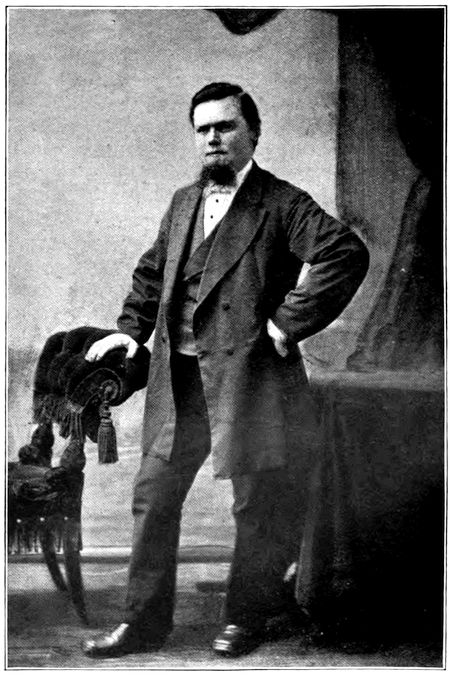
N. Wilkinson
The first Annual Meeting was held on December 3rd, 1870, in the Market Hotel, Durham, and the proceedings and programme occupy three columns of The Durham Chronicle.
The reason arises out of the dual nature of the meeting, it being council and committee. The secretary's report showed that there were 1891 financial members on the books, and the total worth of the Society was 7s. 1½d. per member. Our purpose will be met if we select the main points, leaving those of a local and temporary character. First, in that general category we have a request for Durham to join the Amalgamated Association of Miners. This was not acceded to, but copies of the rules were written for. Second, the appointment of treasurer and his payment. Mr N. Wilkinson was appointed, and his salary was to be 25s. per quarter (much less than many of our local treasurers receive now). Yet Mr Wilkinson felt proud of the office, and promised to merit their confidence during the year. Third, the question of sending a delegate to the Miners' National Conference, and the business, which was to discuss the Mines Bill. It is very obvious that the county was feeling its way very carefully, and with great regard to economy, for one delegate said it would take one-twelfth of the income to send a representative, independently of the entrance fee. It was finally agreed to send Mr Crawford. Fourth, the question of cumulative voting was brought forward by Murton as follows:—"That each delegate have an additional vote for every 100 members he represented." The proposal, however, was lost by fourteen to eight. Fifth, the appointment of the officers for the year. These were elected as follows:—
Secretary, A. Cairns; Treasurer, N. Wilkinson; President, W. Crawford; Vice-President, W. H. Patterson; the Committee being Mr Munson, T. Mitcheson, M. Thompson, M'Mann, J. Jackson, W. Coulthard, and I. Perks.
A very fitting finish to the year 1870 will be a reference to another letter by Mr Crawford. The object of his attack was the Rev. Mr Blagdon, Newbottle. This gentleman had said he hated and detested unions, and this roused the temper of Crawford, and plainly he talked to him. He reminded the parson of the condition of the miner, and he pointed to the contrast between his conduct and that of Christ.
"But I suppose," said Crawford, "things are changed. Of course, we live in an age of progression, and we ought to leave behind us those old and antiquated practices of practical philanthropy. Christ always spoke the truth too. When He made a promise it was always kept."
Then he asks:
"What wrong are the workmen doing? Our only aim is the establishment of common justice amongst mankind. We have myriads of men, women, and children who but seldom receive an approximate sufficiency of the commonest necessaries of life. And it is a self-evident fact that nothing will render human existence so miserable and short as social destitution, bringing, as a matter of consequence, mental pressure or anxiety of mind. Even comparative want is prejudicial to physical health. This brings care and anxiety. They act and react on each other, often doing their deadly work ere men have passed half their allotted threescore years and ten. That these things exist are incontrovertible facts. And does their removal by moral and philosophical means not in part pertain to the work which this gentleman has chosen for himself in life? History and observation alike teach that, where a people are socially depressed, moral culture is a most difficult matter, and, where moral cultivation is no easy task, to spiritualise is next to an utter impossibility. So that in reality, when rightly viewed, there is a very near kinship, and ought to be, in working a very close connection between the Union to which the Philadelphia Society belongs and the work in which this reverend gentleman is engaged. Whether or not Mr Blagdon will endorse these sentiments I cannot say; however, be that as it may, when in future he makes a promise let him keep it, and likewise cease to give utterance to such vehement expressions as hating and detesting that about which he seems to understand but little indeed. By pursuing such a course he will in future save himself the merited contempt of his parishioners."
This quotation will serve a twofold purpose: it will give an example of Mr Crawford's vigorous style of writing when roused and at his best, and it will indicate the kind of opposition the young Association was met with at this very delicate and important period of its existence. Those who should have welcomed all effort towards better things should have assisted instead of thwarting and maligning.
The year 1871 found the builders of the Association untiring in their efforts, but still meeting great discouragements. These came mainly from the apathy of the people whom they were trying to help. Like Nehemiah they had their Sanballats, who did their best to prevent the work; but, inspired by the belief in the power of a united people to better their own condition, they fought and built, making headway but slowly. In the early part of January a Miners' Conference was held in Manchester to consider the Mines Regulation Bill, the Trades Union Bill, the Truck Bill, and kindred subjects. The delegate from Durham was Mr W. Crawford, and the number he represented was 18,000.
Before proceeding further with the account of the building we will place on record the first collective action taken by the young Association. This was in relation to the inundation which happened at Wheatley Hill on Thursday, the 19th of January 1871. The colliery had been in operation about six months; there were thirteen hewers, five putters, and three helpers up, with the necessary deputies and others, at the time it occurred. There were five lives lost, and others had a very narrow escape. There is no need to describe in detail the whole circumstances. It will be sufficient to say that a man named Roberts was in a place which was being driven in the main coal at Thornley for the purpose of tapping some water which was lying on the Thornley side in order that it might be run to the other colliery which lies to the "dip." In addition to those who lost their lives, other two were rescued after being in the mine fifty-four hours.
The Miners' Association was not slow in taking part in the subsequent proceedings, and at the inquest which opened on the 25th at the Colliery Office, Wheatley Hill, by Mr Crofton Maynard (whose able services are still given to inquiries into the sad accidents in the Easington Ward), the Association was represented by Mr W. Crawford. On his application that witnesses should be summoned on behalf of the workmen the Coroner readily consented to an adjournment until Wednesday, the 8th of February. The adjourned inquest was held at Wingate Grange, when Mr A. Cairns, Secretary, and Mr W. Crawford, Agent, were present on behalf of the Association, with Mr Kewney, Solicitor, of North Shields, to watch the proceedings. After a very long and exhaustive inquiry the verdict was "that the deceased were killed on the 19th of January by a burst of water in the Wheatley Hill pit, through the gross negligence of W. Spencer, head viewer, W. Hay, resident viewer, and Thomas Watson, overman; and that the said W. Spencer, W. Hay, and T. Watson did kill and slay the five deceased previously mentioned by neglecting to put in proper bore holes for the safe working of the mine." On that verdict the Coroner committed the accused for trial at the Assizes on a charge of manslaughter.
The trial took place at the March Assizes before Baron Martin. The counsel for the Association were Mr Herschell (afterwards Lord Chancellor) and Mr J. Edge. The writer of this history was in court, and heard the trial, and the able speech made by Mr Herschell, whose object was to show that there had been a violation of the Mines Act of 1860, the fifteenth rule of which was to the effect "that bore holes should be kept in advance, and if necessary on both sides, on approaching places likely to contain a large quantity of water." The Grand Jury had thrown out the Bill, but the case was still proceeded with. It was clear the judge was against the proceedings after the throwing out of the Bill; and eventually the workmen's counsel withdrew the case, because the judge was of the opinion that Roberts (the hewer in whose place the water broke away) should have known as well as the manager how near the water was to them, and because, on the technical point, it was quite clear how the judge would direct the jury. The accused were therefore acquitted. One little piece of funny puzzling of the judge is very vividly remembered. Roberts was not a native of the county, but was doing his best to train himself in the peculiarities of a dialect which, when spoken by a Durham man, is to a stranger difficult to understand, but more so when it comes from a Welsh tongue. At one part of the proceedings the judge asked Roberts what he was doing when the water broke in. The reply was: "Aw hed getten me jud korved, and the hole marked off, and was gannen back for the drills." With surprise the judge repeated the question, and received the same answer. Perplexed, but not enlightened, a second query was put: "What did you do then?" "Aw run doon the board and up the stenton." Innocently the judge put a supplementary question: "Was it a wide plank you ran along?" thinking the word board meant a piece of timber laid for Roberts to walk on. Upon an explanation being given he confessed that, in the whole of his experience, he had never been so much puzzled before.
In our review of the building of the Association it will not be necessary to mention the work in the county except so far as it relates to the object we are dealing with: the raising and strengthening of the organisation and the changes in policy and procedure. The first Council in 1871 was held on March 25th. The attendance of delegates was moderate, and Mr Crawford, the President of the Association, was called to the chair.
At this meeting we have the first mention of the Yearly Demonstration. It was moved "that the Council take into consideration the desirability of holding a general meeting of miners in the central district, the expenses of such to be paid from the Central Fund." The time named was shortly after Easter. It was likewise arranged for the agents to live in Durham. Mr Crawford at that time was residing in Sunderland, and Mr Patterson in Bishop Auckland. This, it was felt, interfered very much with the necessary consultation and arranging of work. A series of resolutions was brought forward by Mr Crawford. First, that "minerals be weighed only, seeing that measuring and gauging are sources of endless losses to the hewers." Second, "that miners ought to be allowed to place on the pit bank as checkweighman a man of their own choice, whether such person be one of the workmen or not." Third, the appointment of an additional number of inspectors or sub-inspectors is required—the number of pits in 1869 in the whole country being 3206, and only 12 inspectors, which gave an average of 267 pits each. The following resolution was carried:—
"We believe that to make inspection thoroughly effective, mines ought to be inspected at intervals not exceeding three months."
The fourth resolution was "that no boy should be allowed to work more than ten hours a day." The Murton delegate seconded the resolution, and said: "Miners were often referred to as an ignorant set of men, but if they received more attention than they did in the seed-time of life perhaps better fruit would be received. At present their boys went to work at half-past four in the morning, and did not leave the mine till half-past five in the evening. By the time they got home, washed themselves, and had a little refreshment it was seven o'clock. Certainly night schools were provided for the boys, but he could not see the utility of them, as the minds of the lads after being so many hours in the pit were incapable of receiving instruction. Providing schools under these circumstances for pit lads was like preparing food for persons who had no appetite." That speech is worth quoting and remembering, because it gives us so clearly the condition in that year and shows so graphically the change since then. The young men at least will do well to ponder the lesson. To them it means much, and tells them the benefit they have (in this alone) received from the labours of those men who so unselfishly toiled in the early days.
At this time a question arose which evoked great feeling in the Thornley district in particular, and throughout the county in general. This was the refusal by Mr Cooper, the manager at Thornley, to bind Mr A. Cairns, the Secretary of the Association, who was checkweighman, and Mr J. Jackson, one of the Executive Committee. At that time, it should be remembered, a man to be a checkweighman must be, and remain, a workman on the colliery, and therefore be "bound" as all other men were. The situation is interesting for two points—first, because it was productive of some very strong letter writing by Mr Crawford in defence of the two men; and second, because it is the first recorded instance of an offer from the men to apply arbitration as a means of settling disputes between employers and workmen under this Association. The offer was contained in a resolution passed at a special Council held in the Market Hotel, Durham, on 8th April. The following is a portion of the resolution:—
"This meeting strongly urges on the Thornley workmen the propriety of offering to submit the whole case to arbitration, the members of the Board chosen to be composed of an equal number from both sides; the arbitrators to elect an umpire whose decision shall be final."
I quote two sentences from one of Mr Crawford's letters:
"The entire transactions both on the part of the masters, and these perfidious hirelings [certain blacklegs] is contemptible in the extreme, clearly showing to working men that where they have not, by combination, the power to protect themselves they will only be endured so long as they are passive slaves in the hands of grasping greediness. Men need to arise, and by an active concentration of organised power frustrate that intolerance so rampant among them, an intolerance diametrically opposed to the spirit of the age, and one that will not hesitate to build its own advancement on the spoliation and desolation, and if necessary the damnation, of myriads of immortal beings."
OUR FIRST GALA
The first in the long series of meetings was held in Wharton's Park, Durham, on Saturday, the 12th of August 1871. For some time prior district meetings had been held in different parts of the county, and great efforts made to secure a good gathering. In addition, a "sum amounting to £20 was offered in three prizes for a Band Contest, and liberal money prizes for various athletic sports." There was a charge for admission, and it was estimated that between 4000 and 5000 paid for admission. The speakers outside the Association were A. Macdonald, W. Brown, Staffordshire, and John Normansell, Yorkshire. The local speakers were Mr W. H. Patterson, Mr Hendry, Addison Colliery; Mr T. Ramsey, Mr N. Wilkinson, Mr Allens, Mr Young, Addison Colliery; and Mr Ferguson, Edmondsley. The platform was decorated with the Thornley banner, and in the arena was a banner bearing the inscription: "A fair day's wage for a fair day's work." The chairman was Mr W. Crawford. His first words were: "This is the first great Gala Day of the Durham Miner's Mutual Confident Association, and I only pray that it will not be the last." He reminded them that he and his colleagues had only been trying to organise the county. They had met with great difficulties, but they were still alive, and more likely to continue alive than ever. "I can assure you," he said, "that on this, the 12th day of August 1871, the Durham Miners' Association was never in a more healthy position; never more healthy with regard to its feeling and determination to carry on its great work of organising the county; never more healthy with respect to its funds; and never more healthy in reference to the general progressive tendency of its operations, since the first day the Association was established." To quote the speeches would be foreign to the purpose of this history. The speakers were men who did great work in the Trades Union movement in the period with which we are now dealing. William Brown had peculiar methods, partaking more of a religious revivalist. He ofttimes at home opened his meetings with prayer, and had a small collection of songs (entitled melodies and poems), from which he would sing before he commenced to speak (and he was a singer). For some months it was the privilege of the writer to be engaged as a lecturer in the Midlands by the Miners' National Union in 1878, three weeks of which were spent with Brown in North Stafford, and therefore there was a good opportunity of judging. At this first Gala Brown sang two of these songs, and recited the following poem:—
WORKING MEN
"Think what power lies within you, For what triumphs you are formed; Think, but not alone of living Like the horse from day to day; Think, but not alone of giving Health for pelf, and soul for pay. Think, oh! be machines no longer, Engines made of flesh and blood; Thought will make you fresher, stronger, Link you to the great and good; Thought is a wand of power, Power to make oppression shrink, Grasp ye then the precious dower, Poise it, wield it, work and think."
These men, heroes of the highest order, who inaugurated one of the finest series of labour meetings ever held in this or any other county, who saw the possibilities which lay within us, and who spoke such words of hope, have all passed to the reward which awaits the good and the true who battle for the right in whatever clime or sphere of life. Their spirits still live and move and have being in many to-day, bearing testimony that "the good men do lives after them."
A delegate meeting was held on the 9th of September 1871, Mr Crawford presiding, at which three general matters were transacted. It was decided to retain a solicitor to transact the legal business of the Association and act as adviser. Arrangements were to be made to open a proper banking account, and it was resolved to join the Miners' National Association.
The next delegate meeting of importance was held in the Shakespeare Hall, North Road, Durham. Mr J. Forman was now chairman (although still continuing to live at Roddymoor)—Mr Crawford being appointed secretary, Mr Wilkinson treasurer, and Mr Patterson agent. The matter under discussion was the wage settlement, some dissatisfaction being manifested at the difference between the men underground and those at bank, and a report was made of the first case settled by arbitration. This was at the Lizzie Colliery, the arbitrators being T. Taylor-Smith and Mr W. Crawford.
THE LEADERS
With the Council meeting held on Tuesday, March 26th, 1872, by the election of Mr Forman as president and Mr Crawford as secretary, and the regular meetings with the employers being recognised, we have the Association fully and solidly established. Before we proceed further it will be in natural order if we take a short glance at the men who were at the head of it. There is no need to enlarge upon them; a bare outline will be sufficient. The first in prominence and force was Mr W. Crawford. When appointed he was outside the county, but owing to his having been secretary of the combined counties he was known to the Durham men as an able and forcible Trades Unionist. When the separation between the two counties took place he was engaged as secretary of the Northumberland Association. This post, says Fynes in his history, he filled "with great ability until June 1865, and made himself a great favourite in Northumberland, but he then left the Association in order to take the secretaryship of the Cowpen Co-operative Store at Blyth." Mr Burt was elected to succeed him. In 1870, when Mr Crawford applied for the position of agent in Durham, he was selected from a number of candidates. It was at this time that the writer had the pleasure of making his acquaintance, and had large opportunities of forming an estimate of his ability. Never had any man more force of character or more executive power. His individuality was very large. He had no love for platform work, and the love for that sphere lessened as he grew older; but he had no superior and few equals in his grasp of, and power to find a solution of, the peculiar difficulties and complications which arise in an occupation like the miners. He was a solver of difficulty and a manager of men, and in every way fitted for the post of secretary of a trades organisation. From his appointment to his death he filled it with a skill few men can command.
N. Wilkinson, the first treasurer of the Association, had worked at Trimdon Grange as a fireman. At the date of his appointment he was earning a living by tea selling, having lost his employment on account of his Trades Union principles. His first appointment was temporary, and when elected permanently he was living at Coxhoe. As soon as the Union was fairly started he was made treasurer permanently, and so acted till 1882. As a speaker he was of a blunt, straightforward order. As Othello says: "His was a round unvarnished tale and he told it right on." At the commencement, when announced on the bills it was as "Nicky Wilkinson," and no man could be in the least doubt but that when he spoke to them on the Union and its usefulness it was from the heart. As a man in those stern and trying times he was, as those who were his colleagues would testify, a man upon whom they could depend in any testing circumstances.
Mr J. Forman.—He was the first regular chairman. At the time of his appointment he was checkweighman at Roddymoor, and when spoken of it was as "Forman of Roddymoor." He came from Northumberland to Annfield Plain when a young man. He acted as president of the Association for a time, and followed his occupation as checkweighman; then in 1874 he was appointed a permanent official, and removed to Durham. He continued in that position until his death on the 2nd of September 1900, at the age of seventy-seven. He was an ideal president. It is not saying too much—his superior could not be found. The fact of his appointment to that position indicated the prominent part he took in the formation of the Union. He was more of an adviser than a platform speaker. He preferred a quiet, retiring life in which he could be useful rather than ornamental. Although shunning public notoriety he was no shirker when danger demanded the presence of men, for in all the explosions which happened during the term of his office he was one of the foremost; and almost single-handed he stood out for the dust theory when men of noted scientific knowledge were against him.
W. H. Patterson.—His life's work, from start to finish, was the most conclusive testimony as to the sincerity of his purpose. There were men then, as now, whose motive is the loaves and fishes, willing to gather where they strew not and reap where they have not sown; but Patterson was not one of these. From the time when, but a mere boy living at Windy Nook, he threw himself into the work, with earnestness and energy, until his death, when a comparatively young man, he devoted himself and the best he could give to the establishment of and care for the Union. When it prospered no man was more cheerful, and when dark times came upon it his sorrow was genuine and large. He was not a Crawford (few were), yet for persistent plodding he was equal to any. With youthful buoyancy, and a heart full of desire and determination, he was the very man for the position in which he was placed. It would have been a useful addition to our own literature if he had placed on record the hardships he, with "Tommy Ramsey" endured in 1870-72. They lodged many a time in a room the walls of which were the horizon and the lamps the stars above them. Money was not plentiful, and it was not every person who dared to take an agitator in to lodge. It was in many quarters considered a crime almost deserving of capital punishment.
"Tommy Ramsey."—What can be said of "Tommy"? He was a most perfect type of an old school miner, and a sound Trades Unionist, one of the heroes of '44. There are numbers of men in the county who will remember the rugged old warrior in the noble cause, just as the picture hanging in the Hall describes him—a rough but true diamond of the first water. With bills under his arm and crake in hand he went from row to row announcing the meetings and urging the men to attend. His words were few, but forcible; not polished, but very pointed—and they went home. Like Longfellow's arrow shot in the air, they found a resting-place. He had one speech, the peroration of which was something like the following:—"Lads, unite and better your condition. When eggs are scarce, eggs are dear; when men are scarce, men are dear." It was impossible to miss the meaning in those words. Their simplicity was their greatest eloquence. His work was far from pleasant or safe. The writer of this was witness of a brutal attack on the old man by a bully who would disgrace any place in which he lived. This antipodes of a man, to curry favour with the manager, and to please those who bought him body and what soul he had, ill used Ramsey, and burnt his crake. At the subsequent meeting Crawford was wild in his denunciations. The words still ring in my ears. Brave old "Tommy" cared not; he got a new crake, and turned it with more emphasis. Grand old Ramsey, you are right now; if not, many of us have a poor chance. You in your way, in accordance with your ability, tried to open the prison doors to those who were bound, and to stir up a love of freedom in the breast of those who were in willing slavery.
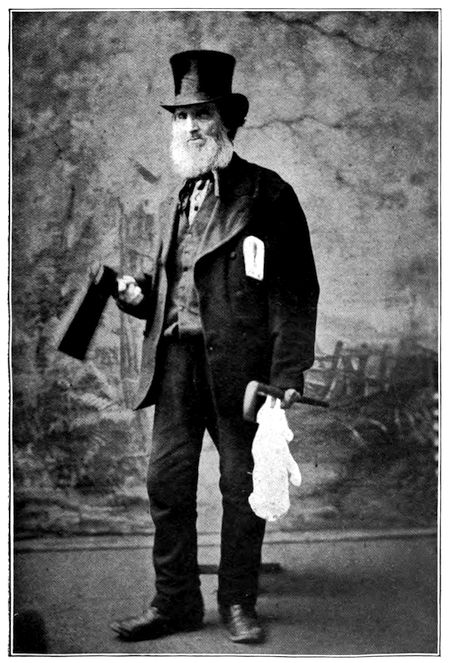
T. Ramsey
THE OPPOSITION TO THE BUILDING
This was fourfold, and it may be interesting to look at these seriatim. The first was not in the least unexpected. At that time Capital and Labour were looked upon as being natural enemies, and all their relations were on that principle. We see now how foolish is that idea. Then conflict and doubt formed the atmosphere which surrounded the two great parties in the industrial world. If men having common interest joined themselves, in order that they might act for the common welfare, the leaders were to be dealt with harshly, and if necessary banished. It was no infrequent occurrence, when the spirit of Union was abroad, for men to be driven away from localities they loved and from associations endeared by years of enjoyment. This was done with the view that terror might be struck into the hearts of others. The principle was: Drive away the shepherd and the sheep will flee. So much was that spirit abroad that in many places the establishment of the Permanent Relief Fund was treated coldly, obstacles thrown in its way, if not bitterly opposed, because it was regarded as the thin edge of the Union wedge. What more natural than for fierce opposition to rear itself, with threats for the braver spirits, and bribes and allurements for those whose nature was susceptible to such influences? Ale-houses were used as a means for preventing Unionism taking root and spreading. The sorrow of it is there have always been spirits who are ready to act meanly when required.
This opposition was, therefore, to meet and bear down and convince that a trades organisation was not an institution prone to evil, and set up for no other purpose. The men who are alive to-day, and who took part in that opposition, would, we may assert with confidence, confess their mistake if they were interviewed on the subject.
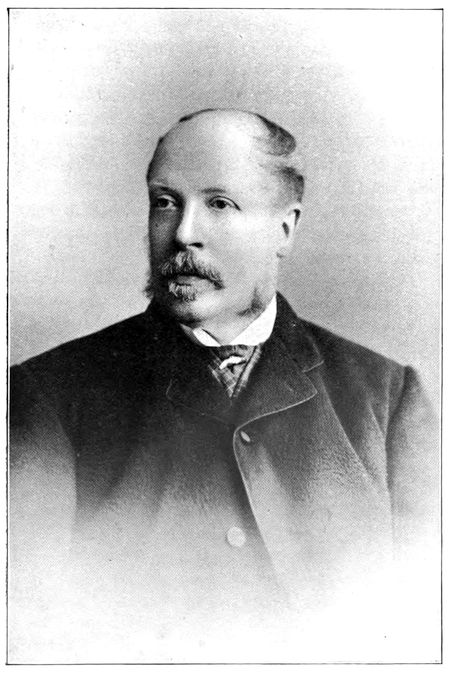
J. H. Veitch.
Then the law was against the Trades Unionists. We complain now, but they had more reason in those days. We must lift ourselves into the condition of things prior to the 1875 Act, which did a great deal towards equalising the positions of the employer and employed. The Master and Servants Act, with all its one-sided applications, was in force. For a long time an agitation was carried on for its repeal, but after twenty years the only result was the appointment of a select committee to inquire into the operation of the law. The law was very unequal. It had been framed on the principle that the workman alone was inclined to do wrong, and therefore wanted hedging in and punishing. In the year 1865 there were 1100 arrests under the Act in the country. Eight hundred of the accused were sent to prison. An Amending Act was passed in 1867, but between that time and 1875, 774 were convicted. "The state of the law was simply infamous. Its provisions made it a criminal act if a workman broke a contract, even under the most justifiable circumstances. He was arrested by warrant, and if the breach of contract was proved the magistrate was bound to inflict the punishment of imprisonment with hard labour. If, on the other hand, the employer broke the contract, ever so flagrantly, he could only be summoned by a civil process, and his punishment was simply a fine."
Then they were hindered by a system of boycotting before the word became proverbial. It was not merely difficult, but impossible in some places to get a meeting-place. The writer knows of one colliery where a place could not be got. Even the co-operative hall was closed against the Union, and the Union money had to be taken in the corner of a field. Beyond this, in Durham the printers refused to do the Union printing—all except Mr J. H. Veitch, who dared almost social ostracism and took the work, and the connection then formed has continued up till now. The refusal arose from two reasons—first, there was a fear that the Union would not be able to pay for the printing; and second, Trades Unions were in bad odour in the county generally, and none the less in Durham. There was none of the respectability about the institutions there is now, and little hope of them. Broadheadism at Sheffield, with its destructive policy, had filled men's minds with fear. The form of reasoning was: "Trades Unions are guilty of these evil things; this is a Trades Union, therefore it will be guilty of doing evil." Just as logical as if a man had said: "Murder is committed in England; these people are English, therefore they will commit murder." Mr J. H. Veitch (all honour to him) had none of those fears, nor that false logic. He took the work when social ostracism was in the air. We cannot forget the act nor the man.
Another great obstacle against which they had to contend was a host of anonymous writers, who wrote behind a variety of nom de plumes—such as "Geordie Close," which covered W. P. Shield, and "Jacky Close," but none under their own names. These writers used the most scurrilous and slanderous language about, and attributed the vilest motives to the men who were at the head of the movement. The situation was a complete analogue to that when Nehemiah commenced to build the walls of Jerusalem. Sanballat and Tobiah and Geshem laughed him to scorn, and despised him, and said: "What is this thing that ye do; will ye rebel against the king?" But as those sneerers in the far-off Jewish times had no effect on the builders of that day, so in those days the founders of our Association, the builders of our broken walls, heeded not those snarlers of thirty-six years ago, and the result is an all-round benefit.
The greatest of all the species of opposition they had to meet arose from the apathy and indifference of the people. Although the condition was bad in the extreme, yet often the earnest spirits and others scattered about the county had to ask each other, in the query of the prophet: "Who hath believed our report?" The state of apathy was quite natural. It was not because there was no real love of Union; it was the outcome of repeated failures. "Hope deferred maketh the heart sick." There had been spasmodic attempts at associated effort. The result was a feeling of hopelessness. Like men of whom we read in waterlogged ships or analogous situations on land, having tried oft to save themselves, they give up in despair, and say "Kismet," like an Eastern fatalist. The hold this feeling had on the mind is seen in the small results for a considerable time after the Association commenced. A thousand or two was their whole membership, their council was their committee as well, and the numbers so small that a room in an ordinary hotel could with ease contain them. At their meetings, sparse in attendance, they were often insulted and sometimes maltreated by the men they had come to help.
In this alone there was sufficient to deter them, and to lead men of talent and energy (such as they were) to turn themselves to other objects in life; but they loved their class, and, while they had aspirations for better conditions, they desired to raise their fellows with themselves. Any one of them could have made a position in other directions if their aims had been selfish; but they were men of different mould, and they were inspired by the love of the cause, and confident in its ultimate success if once they could clear away the dark pessimism which had fixed itself in the minds of the workmen. For this they endured the hardship and faced the opposition, until finally men saw the solidity and permanency of their work, with the result that the institution they founded occupies a rightly deserved foremost place among Trades Unions.
1872
The Coal Owners' Association—The Abolition of the Bond—First general Advance—Formation of the Joint Committee—First Gala—Mines Regulation Act—Second Advance
The Coal Owners' Association.—One of the results of the formation of the organisation was the commencement of the Durham Coal Owners' Association. There had been an association under the name of "The North of England United Coal Trade Association," but its functions were vastly different from those of the present organisation. Then the sphere of operations was parliamentary and legal, but the new body was formed for trade purposes. The first meeting to consider such a step was held on February 1st, 1872. There was an adjournment for a fortnight, when a set of rules was submitted setting forth the conditions of membership, contributions, the assistance to be rendered, and the appointment of officers. The chairman and vice-chairman were respectively Hugh Taylor and W. Stobart, and the secretary was T. W. Bunning. No sooner was the Association formed than communications were opened with the Miners' Association, as the following letter will show:—
Neville Hall, Coal Trade Office, Newcastle-on-Tyne, Feb. 5th, 1872.
Mr Crawford, my dear Sir,—I am directed to inform you that, at a large meeting of the representatives of the household coal collieries, held here last Saturday, it was resolved—
That it is considered desirable that a meeting should be held between the coal owners and a deputation of the representatives of the workmen, at one o'clock on Saturday, the 17th instant, at the Coal Trade Office, to discuss the various questions now in agitation by the workmen, with a view to their adjustment, and that a copy of this resolution be forwarded to Mr Crawford.
Will you be as kind as to acknowledge the receipt of this letter, and let me have the names of the deputation who will attend.
I beg to remain, dear Sir, very respectfully yours,
Theo. Wood Bunning.
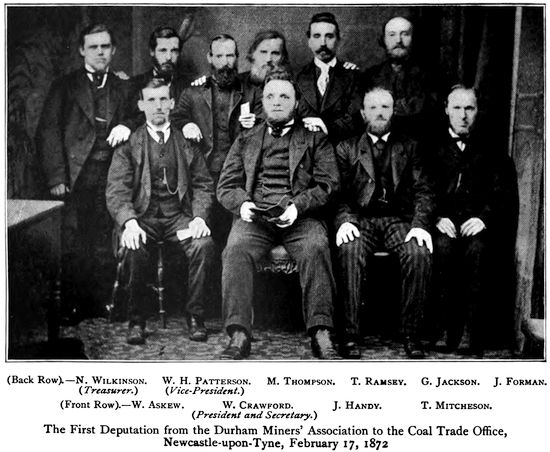
There were about a score of representatives of the employers present during the meeting, while ten delegates, representing 20,000 workmen, took part in the conference on the latter's behalf.
Mr Hugh Taylor occupied the chair, and the delegates were introduced by Mr Crawford. The first question for discussion by the conference was then brought forward—viz. the yearly bindings.
At the outset the employers intimated that they were perfectly willing to abolish the bond, and establish in its place either monthly or fortnightly agreements, giving preference to the former. The workmen's delegates at once intimated their readiness to abolish the yearly bond, and thanked the masters most kindly for the manner in which they had met them on that question. The men proposed in the place of the yearly bond to establish a fortnightly agreement, and it was ultimately decided to discuss the terms of the agreement at a second meeting to be held shortly.
The next matter was the question of the hours of boy labour, but after a short conversation it was also agreed to allow this question to stand over until the second meeting. The next question was with reference to an advance of wages. On this point the owners admitted that the men ought to share the present prosperous condition of the trade, the only difference of opinion that arose being what that share ought to be. The employers were of opinion that they and the men ought to meet as two associations—the combined masters on the one side and the combined workmen on the other—and discuss the question as to what would be fair to both parties. It was suggested at the same time that any advance asked or conceded should be based on prices in force at bound and unbound collieries of the county of Durham in April 1871. On the part of the employers it was pointed out that a great many collieries had at the present time presented petitions for an advance of wages, and in some cases they had intimated their decision of laying the pits idle in case their demands were not conceded, and it was now suggested that the delegates from the workmen present should do their utmost to get the petitions placed in abeyance until the next conference was held. This was readily agreed to, and the meeting then terminated.
It is satisfactory to note that during the continuance of the conference a most pleasant and amicable feeling prevailed on both sides.
The Association being formed and officered preparation was made for the removal of grievances. The first to which attention was turned was the abolition of the "Yearly Bond." For a long time there had been a protest against the system of partial slavery implied in a contract covering a year. The system was as follows:—On a Saturday near the 20th of March the whole of the workmen were called to the colliery office, and there the manager would read over (nearly always in tones inaudible to all except those who were close to him) the conditions of labour for the next twelve months. There was usually a balancing of the prices. As an inducement to the men there was, say, a sovereign given to the first man bound, ten shillings to the second, five shillings to the third, and then two shillings and sixpence to every man after. The crush to secure the first place was generally so great that the manager was fortunate if he were not carried off his feet. As a preparation for this rush certain men would be bribed to incite, and thus induce men to act in an unthinking manner.
This bare outline will suffice to show the evil of the "Bond," and that it was a wise step on the part of the newly-formed organisation to attempt to substitute a shorter term of contract. The first meeting for that purpose between the employers and workmen was held on February 17th, 1872. As this was the first united meeting in a series which has been for the benefit of all concerned it will be interesting to place on record the letter from the employers inviting the representatives of the Miners' Association to meet them. Of course, the employers were made aware of the desire amongst the people for this and other reforms, and that knowledge induced them to arrange matters amicably if possible. Another thing was in favour of the workmen: not only was their Union gathering strength, but the state of trade was in their favour. One result of the war between France and Prussia was to increase the demand for British coal, the result being a coal famine and excessive prices. The old pit heaps even were sent away, and a common saying at the time was: "Anything black was sold for coal." A conflict, therefore, would have been a dangerous and destructive thing.
(First General Advance)
IMPORTANT CONFERENCE OF COLLIERY OWNERS AND MINERS' AGENTS IN NEWCASTLE
(Durham Chronicle Account)
Agreeably to an arrangement made at the conference between the colliery owners and the miners' delegates held on the 17th inst. an adjourned meeting between the two bodies took place on Saturday at the Wood Memorial Hall, Newcastle. There was a large attendance of the masters, Mr Hugh Taylor, Chipchase, being in the chair. Mr W. Crawford, President of the Durham Miners' Mutual Confident Association, acted as principal spokesman for the miners' delegates, who were eight in number.
It will be remembered that at the last meeting the masters agreed to the abolition of the yearly bond, and the first question, therefore, taken into consideration at the present conference, was the nature of the future agreement between the masters and the men. On the one hand, the employers suggested monthly notices on both sides; but the men on the other hand were unanimous in the request for a fortnightly notice, with the option of either giving or receiving the same on any day except Sunday. After some discussion, the masters acceded to the wishes of the men on this point. The next question taken into consideration was the advance in pay demanded by the men.
A proposition for an increase of 35 per cent. on all prices paid in April last was submitted by the delegates, who, in answer to questions by the owners, admitted that the advance requested appeared to be a large one, but they urged that it was made in consequence of the low rate of remuneration received by the miners of the county at the time referred to.
To this advance the owners objected on the ground that it was excessive.
They also urged that for several years past coal had been low in the market, and the working of pits had been unremunerative, and submitted that it was unfair on the part of the workmen, when a slightly better price had been obtained, to make an exorbitant demand. They also pointed out that the advance asked for was greatly in excess of that obtained by the miners in other parts of the country. To this argument the delegates replied that they were of opinion that the advance asked for was not greater than the excessive profits of the masters would allow to pay; in fact they only wanted a reasonable ratio of the profits made by their labour, and they were also of opinion that the 35 per cent. advance would not place the miners of the county of Durham on an equality with the workmen of other counties. After some further discussion, the delegates intimated that they would be satisfied, if the owners did not feel disposed to give the increase asked for, with the average score price paid in Northumberland and South Yorkshire. They were willing, if the masters would divide the two last mentioned counties into four quarters each, and would select, according to arrangement, two collieries from each of the eight quarters, to accept the averages of the prices paid at the sixteen collieries as the standard scale in the county of Durham. The owners, after hearing this proposition, asked the deputation if the average would be accepted by the men at those collieries in the county who were at present working for only 5 per cent. less than the proposed standard. The delegates replied that every such colliery would accept the average if the masters would give it to the men of those collieries who were at present working for 50 per cent. less than the average named.
After some further discussion the delegates retired. On being called back into the room they were informed by the chairman that the owners did not think it was desirable to go to either Northumberland or South Yorkshire for an average, as they were of opinion that they were quite competent to manage their own affairs; and that they had agreed, in a spirit of conciliation, to offer an advance of 20 per cent. on all prices over and above all consideration money paid on April last.
The deputation stated that they had no authority to accept the offer of the owners, but they would in due course communicate it to the general body of the men. The conference shortly afterwards broke up.
The day fixed for a meeting on this question was the 2nd of March. In the meantime a special Council meeting was held in the Town Hall, Durham, Mr W. Crawford, as President, occupying the chair. There were present 160 delegates, and the members represented were about 20,000. The business was the discussion of the matters to come before the employers and the appointment of a deputation to attend the meeting.
The adjourned conference was held on Thursday, March 21st, and for the purpose of giving a proper knowledge I herewith record the press report from The Durham Chronicle.
CONFERENCE BETWEEN DURHAM COAL OWNERS AND WORKMEN
Another conference between the Durham coal owners and a deputation of the workmen of the county took place on Thursday sennight in the Wood Memorial Hall, Newcastle. The chair was occupied by Mr J. B. Simpson, Low Hedgefield, and there was a good attendance of the representatives of the owners, the deputation being, as at previous meetings, headed by Mr W. Crawford. Before proceeding to the disposal of the questions for which the conference had been convened, it was intimated to the deputation that Haswell Colliery was idle. It was explained that the workmen at that colliery had received an advance of 6d. per score on last April's prices in November last, and they now wanted an advance of 20 per cent. on that concession. A telegram was also produced which intimated that a strike on the same ground had occurred that morning at Castle Eden Colliery. The course adopted by these two collieries was utterly opposed to the arrangement which had been made between the two Associations of employers and workmen at their conference, and the representatives of the former body intimated that if such constant violations of the arrangements arrived at at these interviews were to continue, it would be better to break off all negotiations at once, and each side follow its own policy. The members of the deputation expressed their utter surprise and utter ignorance of the events that had occurred at the collieries named, the first intimation of which they had received was at that meeting, and they desired to be allowed a private consultation before they proceeded further. After a short consultation in private, the deputation drew up the following telegram, the substance of which they communicated to the employers:—
We regret to hear that Haswell and Castle Eden Collieries are idle.
You must know that you are wrong, and we strongly advise you to commence work to-morrow, otherwise steps will be taken to repudiate such reprehensible conduct, and if necessary the strongest action will be taken in the matter.
This was deemed satisfactory, and the conference then proceeded to the business which had drawn them together—viz. the remuneration of the offhanded men and boys. The employers stated that they had agreed to give all offhanded men and boys who work underground 20 per cent. advance on last April's prices, the same as they had conceded to the hewers. To the men who work above ground—viz. to the cinder drawers, joiners, blacksmiths, firemen, screenmen, and banksmen, and all other men and boys, with the exception of the enginemen and a few rare cases of cinder drawers—they offered an advance of 12½ per cent. on last April's prices.
The deputation, while expressing their perfect satisfaction with the underground men and boys' advance, suggested the propriety of the same advance being extended to all those men, as enumerated, who work above bank. On the part of the employers, however, it was stated that the reason only 12½ per cent. was offered to the above-bank men was that a reduction of 8 per cent. in their working hours had been conceded; and further that their work was not of so risky and dangerous a nature as that of the underground men, and also that there was always a superabundance of men willing to work on the screens, and to do other work above bank. After a conversation, the terms offered by the employers for both descriptions of men were accepted.
The report of the interview was given to a delegate meeting, Mr Crawford again presiding. The number of delegates was very large. The points under discussion were the two offers contained in the report above. It was agreed that the offer of the owners should be accepted, with the understanding that it come into operation at once.
This was the whole of the important business discussed.
It will serve no useful purpose to deal with every local strike, they are incidental to the main course. Mention will only be made when any incident cognate to the general purpose be connected with them. With that idea in view I refer to the strike at Seaham. This strike commenced on Monday, 17th May. The main causes of the stoppage were the length of the hours of the hewers and the time when the shifts should be worked. The hours of the putters had been reduced from twelve to ten, the pit at the time being a single or day shift. With the reduction of the hours the employers wanted to arrange for two shifts of putters and three shifts of hewers. Against this the workmen not only protested, but stopped work without notice. Two things are noticeable, and of interest to us. We have the first breach of discipline, and the first instance of censure of the general officials, because, in accordance with the obligations of their office, they enforced the rules of the Association, and candidly and clearly told the men their opinion.
The cause of complaint with reference to Mr Crawford and the officials of the Union, was a telegram sent to the lodge, which, with slight verbal variation, has formed the model of all sent since under the same circumstances. It read as follows:—"Do go to work. You must know you are wrong. You will get no support. Liable to punishment. Do return." For sending that message Mr Crawford was subject to some very scurrilous remarks at the meetings which were held in connection with the strike. These remarks called forth a public reply. In the press of that day is found a letter which contains an unflinching and manly statement of the facts of the case: the cause of the strike, the illegal position of the men, and an extenuation of the action of himself and his colleagues. I quote the concluding words. After pointing out how expeditious the agents had been in their attendance to the matter in dispute, how they (the men) were striking against their own agreement, how he had been vilified, and how his views were still unchanged, he wrote:
The report of yesterday's proceedings at Seaham Colliery has not changed my views on this matter. I repeat it, the men are in the wrong, and even liable to punishment. A miner characterised the telegram as an insult to the men at that colliery. Of this I have not the slightest doubt. I have recently been accused of both insults and incivility; and why? Because, as in the case of Seaham, my opinion has been asked, or advice sought, and where such opinion or advice has been adverse to their own preconceived ideas of right or wrong, and they have been told so decisively but courteously, then I became uncivil! These are the men who can prate about liberty of speech and freedom of action, and yet, because they are supposed to subscribe their mite towards a person's maintenance,—every penny of which is doubly worked for,—would only allow his tongue to utter words in accordance with their own crude and contracted views, even though such words were a mere utterance of the most glaring untruths, and a flagrant violation of all the rules now in operation as between masters and servants in their respective relations to each other. I willingly admit that these are but a small minority among the 30,000 members now composing our Association. From the men I have received the utmost consideration, demonstrating by their conduct, that they will give to those whom they employ that treatment which they would like to receive from those by whom they themselves are employed. I commenced my present agency amongst the miners of Durham on May 16th, 1870. From then, till now, I have done my utmost to protect and further their interests in a fair and equitable manner. Where I have deemed the doings of owners or agents to be wrong, I have not been slow to condemn them, and what I have done will do again; and where I have found the workmen to be wrong, I have pursued the same course, unhesitatingly making known my views without the slightest hesitation. If any man or number of men are mean and cowardly enough to think that I shall sit and become a mere machine of repetition, I beg to clearly intimate that they are sadly mistaken. I shall retain my individuality intact, holding myself free to unreservedly express my opinion of all matters which in any way may effect the welfare of our Association, being always willing to retrace my steps, if shown wherein I am wrong; but holding on, amid the folly of fools and the abuse of knaves, if convinced that I am right. And in conclusion, allow me to say that, if such doings are not in keeping with those of the men, the sooner I am replaced the better.
A Council meeting was held on the 25th of May in the Town Hall, Durham. The only thing of note was a proposition for the establishment of an institution for the benefit of old men. Nothing definite was done in the matter. After discussing it the Council decided to refer the matter to the Executive Committee, with instructions to draw up a plan or plans to be submitted to the county for acceptance or rejection. In this we have the germ which eventually developed, through the Permanent Relief Fund, into the Superannuation Fund, which has been such a blessing to hundreds of aged miners in the northern counties.
On Saturday, June 1st, an important conference was held between the coal owners and a deputation of representatives of the Association. The deputation consisted of J. Forman (President), W. Crawford (Secretary), W. H. Patterson (Agent), N. Wilkinson (Treasurer), T. Mitcheson, Coundon, M. Thompson, Murton, G. Jackson, and H. Davison, Thornley. The first question was the dispute at Seaham and the night shift in general. There was a long discussion, and eventually the employers promised not to commence any more night-shift pits unless it were a case of absolute necessity. The conference next turned its attention to the first rank for pony putters. The proposal of the men was that the distance should be 100 yards. It will be as well to say here that afterwards the distance was fixed at that number of yards.