THE PREPARATION (continued 3)
Reading edition
Towards the end of May preparations were being made for opening the new Hall, and a return was taken as to the mode of procedure. The place of meetings had been on a movable plan. At first the Committee meetings were held in 58 North Road, Durham. Then both Councils and Committees were held in the Market Hall. As the organisation increased the Councils alternated between the Shakespeare Hall and the Town Hall, and the Committees in the Western Hotel, Western Hill, Durham. The opening of the Hall took place on Saturday, June 3rd, the occasion being the consideration of a ten per cent. reduction at a special Council meeting. The cost of the buildings was £6000, and the architect, Mr T. Oliver, Newcastle—the council-room fifty-two feet by thirty-four; the tower thirty feet above the body of the Hall. The clock cost £130. The arrangements as to the lighting of the clock are: the city authorities pay for the gas, while the miners keep the clock in repair. For some time the City Council refused to bear the charge for lighting, and at first only agreed for six months as a trial.
There was no opening ceremony beyond a few words from the president, Mr Forman. The delegates took their places as per number of seat. Mr Forman then said he was glad to welcome them to their new Hall.
"The noble building had been built with the money of the working miners of the county of Durham. It was a great example of their forethought, their economy, industry, enterprise and unity, and he hoped that it would be one more link that would bind them together in the cause of mutual help and mutual endeavour, and be another great supporting prop to the noble edifice they had reared in their Association. He was sorry that the first business at the opening was to be the unpleasant one of discussing a ten per cent. reduction."
The first Council meeting was held in the new Hall on 17th June, and the first resolution was "that we refuse to send the reduction question to arbitration." The spirit of war was in the air, at least among the men who attended the lodge meeting to consider the subject at first. During the next week, however, a ballot of the members was taken, the result of which was declared at a special Council meeting—the voting being for arbitration, 20,190; against, 16,435; majority for, 3,755. There were resolutions passed to remit the question to open arbitration: That the Committee get up the case, but "if any person has to accompany the arbitrators out of the county, only the two men who conduct the case do so." At the same meeting Mr N. Thompson and T. Mitcheson (two of the London Committee) were removed from the trusteeship, and their places filled by John Wilson, Wheatley Hill, and W. Gordon, Ravensworth.
The arbitration commenced on 29th August in the Queen's Head Hotel, Newcastle, the umpire being G. J. Shaw-Lefevre, M.P. The arbitrators for the employers were Mr W. Armstrong and H. T. Morton, Mr L. Jones and Mr W. Crawford acting again for the workmen. The advocates on the owners' side were Mr Lindsay Wood and Mr J. B. Simpson and Mr T. W. Bunning; for the workmen were Mr J. Forman and Mr N. Wilkinson. There were two sittings. There is no need to review the arguments or facts in these cases, as that would extend our work too much, but there is one interesting point advanced by the employers in their rejoinder to the workmen's case. It refers to the cost of production at that time over 1871. The increase was thirty-seven or thirty-five per cent. higher than 1871—the items being, wages 14.68 per cent., and the effect of the Mines Bill 22.67 per cent. Assuming that the cost arising from the operation of the mines was divided between employers and workmen—eleven per cent. to each—there was still 26.35 per cent. to the disadvantage of the employer. On the credit side coal was only 5½ or 8.8 per cent. higher than in 1871, and therefore their conclusion was that the claim for fifteen and ten per cent. reduction was amply justified. At the conclusion of the two days' sitting it was agreed that the arbitrators should meet on the 16th of September, and if they failed to agree the umpire would decide. That meeting took place, and the umpire was asked to decide, which he did on September 25th, and awarded a reduction of six per cent. in the wages underground and four per cent. in the wages paid to surface men.
No sooner was the arbitration finished than the Association found itself face to face with a difficulty of a different but yet perplexing nature. The employers conceived the idea of separating the deputies from the miners. Their reasons for taking this step are stated in a subsequent letter. The mode of procedure they adopted was to exempt the deputies from the six per cent. reduction, providing a majority of the deputies on any colliery would leave the Miners' Association. The employers said their action was in response to a request by some of the deputies. The action drew from the Executive Committee a strong remonstrance. They pleaded with the deputies and protested against the action of the owners. The circular they issued was a lengthy one. Our object will be served if we quote a few portions. Addressing the deputies, they said:
"It appears in response to some application made by some of you the Owners' Committee have agreed that where a majority of deputies on any colliery are not members of ours, they will recommend that such deputies be freed from the recent reduction. Call this offer by what name you will it is neither more nor less than a special kind of bribery held out to you and we regret to hear, that some of you have been imprudent enough to accept it. Why make this difference between those who belong and those who do not belong to our Association? It is not because they respect the one party more than the other, or that the party who have left us are any better workmen or in any way more useful to the owners than those deputies who still belong to our Association. The most unknown amongst you as to your past history, or the most casual observer of present doings, ought to know that the motive which has induced the Owners' Committee to make this offer is not respect for you as a class, is not because they think your responsibilities are increased more than heretofore, neither is it because they think you underpaid, but it is because they want to induce you to sever your connection with an Association which has hitherto been able to gain many advantages for members and for none more than for your class. They offer you an inch now in order that they may take from you a foot hereafter. Most of you can remember the time (only five years ago) when your wages varied from 3s. 4d. to 3s. 8d. per day of eight hours' working, while with the recent reduction of six per cent. your wages are now 4s. 8d. for 7½ hours' working, or an advance in time and money of 39.58 per cent."
The circular then draws attention to a portion of a letter from the deputies who had left the miners to those of another colliery, and to the resolution of the Owners' Association. The portion of the deputies' letter said:
"If any member of our [the Deputies'] Association leaves and starts to hew, and has to go back to the Hewers' Association, the two pounds' entrance fee will be paid out of the Deputies' Association."
The resolution of the Owners read:
That this Association thinks that deputies, like overmen, should be the agents of the masters, and that under these circumstances it is imperative that they should not be restricted by any Trades Union resolutions.
In relation to these the Committee point out that they (the deputies) could not honestly be members even of the Deputies' Association, for by the stipulation of the employers they were not to be restricted by any Trade Union regulations. "It will thus be seen that if you do this, you sell your birthright, your independence, your manhood, your all, not even for a necessitous 'mess of pottage' but for an insignificant present advantage, in order that you may bring upon yourselves a future permanent and great evil."
Some of the deputies were desirous of serving two masters: they wanted to remain in the Miners' and at the same time enter the Deputies' Association for the sake of the six per cent. At the Council held on Saturday, 30th September, a resolution was carried declaring "that the Deputies be not allowed to remain in our Association and also become members of what is called the Deputies' Association." At the same time a sharp correspondence took place between the Owners' Association and the Miners', in which Mr Bunning sent a letter, bearing date 3rd November, which contained a protest and an extenuation.
November 3rd, 1876.
RESOLUTION OF COAL OWNERS
The members of this Association regret that the Representatives of the Miners' Association after five years' amicable correspondence, should have thought it necessary to communicate to them so uncourteous and offensive a document as that bearing date 24th October 1876, and relating to the resolution passed respecting the deputies, on October 11th, 1876. And, as this resolution was arrived at after mature deliberation, and from the conviction that both the safety of the mine, and discipline of the pits, are seriously endangered, by having the deputies subject to the restrictions imposed by the Miners' Union, no good can possibly arise from any discussion of the subject at a meeting of the two Associations.
The reply sent by the Executive repudiated all intention to be uncourteous or offensive in language, but at the same time they repeated the charge of bribery, for, said they, "viewed from the most favourable standpoint, your action in the matter can only be characterised as that of holding out a manifestly unfair inducement to the deputies." They asked what the employers would have thought, if, having the power, the Miners' Association had held out inducements to charge men? They reminded the owners that they asked for a reduction off all wages, and the award of six per cent. applied to all underground labour. Considering these facts they could not but look upon the action as a covert attack on the Association.
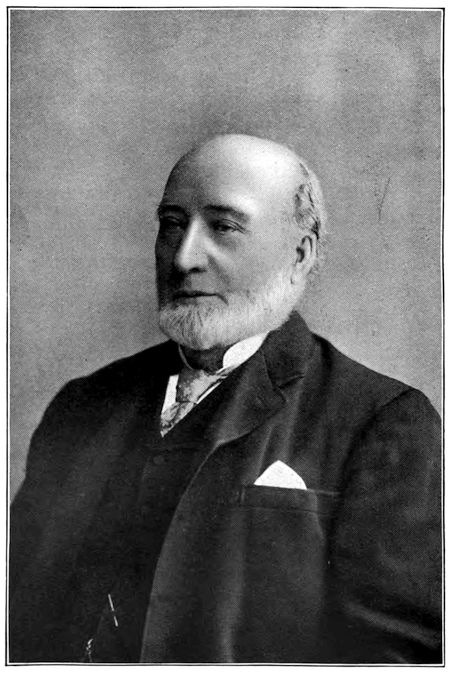
John Forman
The Executive acting on instruction from Council took a return, which resulted as follows:—
Total number of Deputies—2557. Total number in our Association—936. Total number in Deputies' Association—1621. Total number paid old wage—1449. Total number paid reduced wage—1044.
1877
Deputies—Sliding Scale—Relief Fund—Emigration
The dispute about the deputies opened the year. A very lengthy correspondence took place on the subject between the Employers' and Miners' Associations. On January 23rd the whole of it was sent to the lodges. They were informed that the Committee had done all they could to avert a conflict on the question. In keeping with a resolution of Council, the owners had been offered arbitration, which they had refused. The resolution referred to contained the alternative of giving the whole of the notices providing arbitration was refused. Now, to carry out the instructions contained in that resolution the Committee forwarded the ballot tickets for the purpose of taking the vote in accordance with the rule. They concluded by saying: "Whatever the result may be arising out of this case the entire onus of blame must rest with the owners themselves." A resolution was placed on the programme for Council on February 3rd by the ex-Committee asking "that the deputies who are still with us be paid the 6 per cent. out of the General Fund of the Association," but it lost. In addition, the subject was laid before the Central Board of the Miners' National Union. They expressed regret and surprise at the action of the employers in paying one portion of the deputies more than the others, and were of the opinion "that there can only be one object in view in this policy, the disruption of the Miners' Union. The Board earnestly appeal to the mine owners to withdraw from the position they have taken up. Should they fail to do this the Board will feel called upon to ask the members of the National Union to yield all the support to the Durham Miners' Association they can under the circumstances." Nothing further was done in the matter during 1877 except an occasional Council resolution. We shall, however, meet the same question in a few years.
THE FIRST SLIDING SCALE
Early in the year the Association was entering seriously into a new phase of our industrial relation with the employers and taking another step in the path of amicability by the arrangement of the sliding scale. For some time there had been an inclination in that direction. By the Minutes of the Executive Committee members were informed that negotiations were proceeding with a view to establishing a scale, and at the Council meeting held on December 9th, 1876, the following resolution was on the programme:—"Seeing that coals are up, we ask for 25 per cent. advance." The decision was that the question rest over until the sliding scale question is settled.
On February 16th a letter was received from the employers containing the following resolution:—
"This Association having anxiously considered the further serious depression in the Durham coal trade and the necessity for endeavouring to avert in some prompt and thorough manner the complete collapse which has set in to the ruin of many owners, and the casting adrift of large bodies of men, feels compelled to ask the Miners' Association to concur in a further reduction in wages and readjustment of hours."
The Executive Committee met the owners on Thursday, February 22nd, when they were informed that the depressed trade and lower prices demanded a reduction of ten per cent. from underground and six per cent. from the bank workmen, "coupled with an increase in the working hours which would, in a great measure, compensate the men for the reduction in their wages." The Committee could neither see the necessity for a reduction nor could they see the compensation in the lengthening of hours. They, however, arranged another meeting for Friday, 9th March, when they would further discuss the sliding scale, and, failing that, the reduction. In the statement explaining these proceedings the Committee placed before the members two scales—one proposed by them and the other by the owners. It will be interesting and instructive to give these scales.
December 22nd, 1876.
SLIDING SCALE PROPOSED BY THE DURHAM COAL OWNERS
PricePer cent.Wage
s. d.s. d.
5 204 8.0
5 1054 10.8
6 6105 1.6
7 2155 4.4
7 10205 7.2
8 6255 10.0
9 2306 0.8
9 10356 3.6
10 6406 6.4
11 2456 9.2
11 10507 0.0
12 6557 2.8
13 2607 5.6
January 2nd, 1877.
SLIDING SCALE AS PROPOSED BY THE DURHAM MINERS' ASSOCIATION
PricePer cent.Wage
s. d.s. d.
5 605 0
6 255 3
6 10105 6
7 6155 9
8 2206 0
8 10256 3
9 6306 6
10 2356 9
10 10407 0
11 6457 3
12 2507 6
12 10557 9
13 6608 0
In the explanation sent out it was shown that each scale would carry a minimum wage. Theirs would be five shillings, while the employers' would be 4s. 8d. The wages in the scale were for coal hewers only. The reduction the employers were asking for would bring the wages down twopence per man below the lowest wages offered in the owners' scale. They asked the members to leave the question entirely in their hands, as in their opinion a better settlement would be got than by any other way. A special Council was called for the 8th of March, and two subjects were sent out for discussion—(1) Should a sliding scale be adopted; if so, under what condition? (2) Should the owners be offered arbitration? The result was that the arranging of the scale was placed in the hands of the Committee, and on 14th March the first sliding scale was signed for two years.
THE FIRST SCALE
The following scale shall regulate the wages of hewers and labour below ground:—
SCALE
Price
at and above but below Wage
5 47½ per cent. reduction
5 45 85 " "
5 86 4Present Rate
6 47 05 per cent. advance
7 07 810 " "
7 88 415 " "
8 49 020 " "
9 09 825 " "
9 810 430 " "
10 411 035 " "
11 011 840 " "
11 812 445 " "
12 413 050 " "
13 013 855 " "
13 8 60 " "
And so on.
It will be observed that the grades were eightpence, and for that amount the change in wages was four per cent. Next, there was to be a minimum wage of 4s. 8½d. per day. This is worthy of special notice in the light of subsequent events, especially during the time the minimum existed, which was until 1879, and especially in view of the desire of many people to have a minimum established again. Another point was the amount of reduction, which would depend upon an ascertainment by accountants. Messrs Monkhouse, Goddard & Miller acted for the owners, and Messrs Benson, Eland & Co. for the workmen. The ascertainment was made known on the 31st of March, the average net price realised being certified at 5s. 3.97d. The Committee accompanied the ascertainment with a short circular, and informed the members "that a reduction of 7½ per cent. on underground men and boys and 'banksmen' wages and 6 per cent. on 'bankmen's' wages will take place on the pays commencing April 2nd and April 9th."
THE FIRST RELIEF FUND
As a consequence of the depressed state of trade very large numbers of men were thrown out of work, and the rules of the Association made no provision for them. Opinion had been ripening for some months, and the Committee realising that the time was opportune, and acting on a Council resolution, suggested the formation of a Relief Fund. In furtherance of the object they sent out the following:—
SUGGESTIONS FOR RELIEF FUND
Fellow Workmen,—At last Council meeting, you put into the hands of the Committee, the work of suggesting some plan to relieve the numbers of men now idle at various collieries in the county. After mature consideration, they suggest the following as a means of forming a Relief Fund:—
1. To take from the General Fund the sum of five thousand pounds to form the nucleus of such Relief Fund.
2. That this Fund be afterwards kept up by the payment of a levy, or extra contribution, of 2d. per member per fortnight.
These two are the basis of their suggestions, details can be discussed and arranged afterwards. But to make these suggestions—and especially the second one—a success, the Committee believe that the county will require to have brought before them our exact position. The best, if not the only, means of doing this is to hold a series of public meetings at the various lodges and districts in the county, grouping lodges together where such can be done. What they now ask is, can they have your consent to assist the agents in attending such a series of public meetings? It is the only means of rendering successful the getting of necessary means and would not cost more than an ordinary Council meeting.
In support of their proposals they adopted two modes of advocacy—first, to issue a circular, and second, to hold a series of meetings at all the lodges. This latter step they considered most essential, as they would thus be enabled to state the matter more clearly by speech and answer to the members. This view they placed before the lodges, and received sanction with very little objection; and, acting upon it, they arranged themselves into deputations of two each, and for about three weeks either addressed lodge meetings or groups of collieries where convenient, and as a consequence the Relief Fund was formed on the lines suggested. While it existed it proved itself a very useful institution for that period, which was the darkest through which the Association had to pass.
The amount paid, although small, was useful to the public as well as the members—to the latter by easing off the pinch of poverty, and to the former by the help to the rates, which would assuredly have been much more heavily weighted if the fund had not existed. It only existed a year, however, for the Committee placed a statement before the county on November 2nd which showed that, while there had only been £4144 contributed to the Relief Fund, the expenditure had been £9695, and that, adding the £5000 grant from the General Fund, the expenditure had exceeded by £551 the whole amount paid into it.
EMIGRATION AGENCY
During 1876 and up to July 1877 the agents had acted as emigration agents, and had been very useful in their advice to people who were inclined to emigrate by giving them advice upon points and matters of importance to them. All they did was done free of charge, and only with the view to help those who were members of the Association; but as in every movement there are men of the "viler sort," whose envy prompts them to attribute ill motives to those they envy, so in this case there were some who, instead of giving the agents credit for good motives, were not slow to charge them with selfishness and exploiting the volume of emigration for their own benefit. The agents bore this until the Council meeting held on July 21st, when Mr Crawford and his colleagues resolved to give it up. In doing so they gave their reasons in the following circular:—
EMIGRATION AGENCY
To the Members.
Gentlemen,—As announced at Council Meeting on Saturday last, we intend to give up the agency. It was taken with two objects—(1) To have ourselves well posted up in emigration news, so that we might be able to give the best advice possible; (2) to aid our members by allowing them the commission money, which is a very important item indeed. It was not taken with the view of making one penny of profit, but solely to assist our members by advice and also an abatement of their fares. But as some poltroon fellows, who are directly interested in getting emigrants in order that they may get the commission money, are causing some stir, and as, further, some of our lodges are listening to their statements, we think it necessary to give it up. You will be the only losers by it, but remember that it is amongst our own members that the real grumblers are found.
1878
The Hours Arbitration—Position of the Association—Federation Board
The first item of interest in 1878 was initiated on 15th March by a letter received from the employers re the lengthening of the coal-drawing hours. It was addressed to Mr Crawford as follows:—
Dear Sir,—I am desired to inform you that the present state of the coal trade in Durham seems to render it imperative to extend the hours of work and increase the facilities for drawing coal. And that the members of this Association would be glad to discuss the matter with you and your Committee with a view to arriving at some decision on the subject.
Could you fix Thursday next, the 21st, at two o'clock to meet our Committee here? An answer at your earliest convenience will oblige.
The Executive met the employers as requested, and found that the change was to increase from ten hours to eleven all the collieries working ten hours, that drawing time being the outcome of an arrangement. The owners were reminded that it was inconsistent with the sliding scale, and the demand should be withdrawn. They replied by quoting a portion of the scale: "Both parties shall remain at liberty to raise any question not inconsistent with the maintenance of the sliding scale." "Should any dispute arise as to the carrying out of these arrangements the question in dispute shall be submitted to the chairman of the Joint Committee, who, if he cannot act, shall appoint some other umpire to act in his place. The award in either case to be final." These were discussed at great length; finally three proposals suggested by the Executive Committee, subject to the approval of their members, were agreed to:
1st. Is it consistent with the sliding scale to even discuss a lengthening of the hours?
2nd. If it is consistent with the sliding scale to discuss the matter, is it necessary to lengthen such hours?
3rd. If the hours are lengthened, should there follow any increase in wages, and if so, how much?
The Committee were not sure whether the full body of owners would agree to them, as those present at the meeting objected to No. 2 being a question of reference. They informed the lodges that Mr Meynell had fixed 9th April for the hearing of the case. They were convinced that the employers could make the demand under the arrangements, and therefore all that was necessary was to say how many persons should attend and who they should be. The question was eventually placed in the hands of the members of Joint Committee to make the best settlement they could. On 15th April Mr Meynell gave the following award:—
COAL DRAWING
(Award)
Whereas the Durham Coal Owners' Association, being of opinion, that it is absolutely necessary that the working hours of all men and boys above 16 years of age should be increased, if they thought fit to place it before me, and to leave me to decide the question. And whereas it was also agreed that the following questions should be left to me for my decision:—
1st. Is it consistent with the sliding scale to discuss a lengthening of the hours?
2nd. If it is consistent with the sliding scale to discuss the matter, is it necessary to lengthen such hours?
3rd. If the hours are lengthened, should there follow any increase in wages, and, if so, how much?
Now, having heard and carefully considered the arguments on each side, I award, decide, and determine that it is not inconsistent with the sliding scale to discuss the question of lengthening the working hours; 2nd. that it is necessary to lengthen such hours; 3rd. that there should be an increase in the wages where the hours are lengthened.
I award and decide that the working hours of all men and boys above 16 years of age shall, or may be increased in accordance with my award, that the minimum wage to be paid to the hewers shall be, when the pit works 10½ hours, 4s. 10½d.; and when the pit works 11 hours, 5s. 0½d.; and that the wages of the datal men shall be increased in strict arithmetical proportion to the wages they are earning at the time of such increase in the hours. I determine that the increased hours shall or may commence on and after the first pays after the date of this my award.
As witness my hand, this 15th day of April 1878.
E. J. Meynell.
There immediately arose some dispute as to the application of the award, and he was called upon to define it, which he did in a decision given at Joint Committee on May 10th.
May 10th, 1878.
"I further award and decide that where the working hours shall be increased in accordance with my award, that the minimum wages to be paid to the miners shall be where the pit works 10 hours and a half, 4s. 10½d. and where the pit works 11 hours, 5s. 0½d. is intended to mean—that where the hewers are increased one quarter hour per shift, the county average wage shall, in that case, be considered as 4s. 10½d. instead of 4s. 8½d. as hithertofore; and where their hours are increased half-an-hour per shift, the county average wage shall be 5s. 0½d. instead of the present average of 4s. 8½d.
It is also intended that the working hours of any or all classes of workmen may be increased on the payment to them of proportionate increased rates as set out in the award; and that the maximum working hours for drawing coals be 11 hours per day in day-shift pits, and double shifts proportionately."
The employers then asked that there should be an allowance for the time taken by boys under age descending and ascending. With the ten hours the boys under sixteen came out after coal drawing was done, but under the eleven hours some were taken in at six A.M. and "rode" at four P.M. Some were taken at seven A.M. and came out at five P.M., when the coal drawing finished. There was, therefore, a loss of time at either seven or at four, and this should be allowed for. The matter was arranged on the following principle:—Whatever time was taken either at seven to send the under-age boys down, or at four to bring them up, should be added to the eleven hours. If it took ten minutes, then the coal drawing would be from six A.M. to five-ten P.M., but in no case was the time allowed to be more than a quarter of an hour.
POSITION OF THE ASSOCIATION
As the year progressed the trade became more depressed. Pits were being laid in or batches of men were being discharged. The price of coals was rushing down; the ascertainment for the four months ending November showed the average was 4s. 7.65d. per ton, a reduction of 8.32d. per ton since the scale was established without any reduction in wages. The evil of this was seen in the numbers of men being discharged and in the sad falling away in the membership. The extent of this may be gathered by a reference to the Executive Committee Minutes for May 13th. Without mentioning names here, suffice it to say that at one large colliery a deputation was sent from the Executive with power to "appoint someone to act as checkweighman and secretary and to guarantee his wages for six months," and that if the men at that colliery wished "the President attend as either steward or treasurer." The state of the county was growing so desperate that the Committee issued two circulars, the object being to place it clearly before the members. In the first they dealt with the Relief Fund. They commenced by saying:
"We are passing through a crisis in the coal trade, and during its continuance every step we take requires careful watching. We may even find it necessary to retrace our steps, by undoing what we have hithertofore done. We are well aware, that to many men this kind of conduct seems to portray a want of stability and necessary perseverance. Perseverance in a good and successful cause is highly commendable, but to persevere in a course of conduct, where perseverance means ultimate ruin is neither wise nor commendable. A renowned writer has said that "while fools persevere in their ways, wise men change their opinions and course of conduct." A body of men who either cannot or will not adapt themselves to existing exigencies must not expect success to attend their efforts."
Passing from these calm, wise words of warning they bring before the members the position of the Relief Fund. A year prior they (the Committee) had asked them to subscribe to assist those thrown out of employment by the bad condition of trade. To this there had been a response of twopence per fortnight. That had not been adequate to meet the demand, and the twopence had been increased to fivepence. Still the income did not keep pace with the outlay. For the six weeks previous there had been a loss of £2145. There was not only this monetary loss, but there was the more serious one, its effect on the membership.
Thousands of members are refusing to pay the fivepence per fortnight, and great numbers of men have left the Association, so that we are not only losing the fivepence but their ordinary labour contributions. This being our position, we would strongly advise you to at once abolish the payment of the Relief Fund levy.
While this was their opinion they would continue the benefits for three months. At the Council held on 15th June it was decided "that the benefits of the Relief Fund be continued for 12 weeks longer, but the contributions cease forthwith and the money required to meet the demands thereof be taken from the General Fund." This was done in order that the men in receipt of relief should not suddenly have their small resources cut off, but should have a little time to look round.
The second circular dealt with the General Fund in its relation to the demands upon it. As a preface to their suggested alteration they said:
The history of Trades Unions during the last 30 years would form a very curious chapter in the annals of our country. The vicissitudes which have happened to organised bodies of workmen have been manifold, and varied; but the disastrous consequences which have so often overtaken them have generally been the result of a want of policy, prudence, and forethought, on the part of those who have composed such Associations. It is just as much the study of those who have the more direct management of Associations like ours to look facts fully in the face before it is too late, as it is that of the head of a household to weigh his position and measure his stores both present and prospective, before he rushes into irretrievable ruin. Believing this to be our duty we now place before you our position both present and prospective.
They then point out that the expenditure was just double the income. During the previous nine months there had been £20,000 drawn from the deposit account. In the face of these facts there needed to be retrenchment. They then show that in 1869 the contribution was fixed at 6d. per fortnight, while the strike and breakage allowance was 10s. per week (and a colliery must be off two weeks before receiving anything), and the sacrificed allowance was 13s. per week, with 1s. per week for each child. These benefits continued until 1872, when work was plentiful and wages good. Then the strike and breakage allowance was raised to 15s. (and only to be off a week before being entitled), and the sacrificed allowance was made 20s., with 2s. 6d. for each child, per week. They therefore suggested a reversion to the original payment (except in the case of the week) and the reduction of the death legacy for children from £3 to £2, and they wound up by saying:
"It is not now a matter of choice, but one of positive compulsion. An Association wanting money is like a ship wanting a rudder in a boisterous sea. We would soon find ourselves driven on to the rocks of discontent, disaffection, and disunion, and in all probability shattered to pieces in the struggle. To pursue longer the course we are now pursuing must shortly leave us in that pitiable and helpless condition."
A special Council meeting was held on 11th October which gave sanction to the whole of the Committee's recommendation.
FORMATION OF THE FEDERATION BOARD
As soon as the other sections of labour had formed themselves into separate organisations in 1873-4, there sprang up a desire for a federation of forces, and from time to time there appeared resolutions on the Council programme all aiming at that end. In this year it took a more definite shape. On the Committee Minutes for January 28th there is a resolution as follows:—
That a deputation of three agents attend a meeting of cokemen, mechanics and enginemen as to the amalgamation of all those Associations.
In October a meeting was held at which a set of rules was drawn up and sent out to the county with an explanation. The members were informed that the suggestions were not unalterable, but in their crude form were submitted subject to their approval or amendment. And they were informed that:
"The Federation was formed to protect their joint interests. There might have been divisions but these must be forgotten. The workmen were unconnected, whilst acting against a thoroughly organised body of owners. There had been no cohesion, nor the remotest understanding, while at the same time they were dealing with the same combined body of capitalists. It must be clear to everyone that while in our present divided condition and negotiating with owners who act as one body we must be placed at a very serious disadvantage."
The county approved of the idea, and on November 13th the rules were issued to the county. At the Annual Meeting held on 6th December the first members of the Board were elected. Their names were J. Forman, W. Crawford, W. H. Patterson, N. Wilkinson, J. Wilson, and W. Johnson. Slightly anticipating the events happening in 1879, and for the purpose of keeping ourselves in as close sequence as possible, it may be stated here that the first meeting of the Board was held on January 28th, 1879, when Mr Crawford was appointed secretary, and Mr J. Dover (mechanic) treasurer. With respect to the chairman, it was decided to appoint an independent one for six months. He should only have a casting vote, and be paid 21s. per day and expenses. At the meeting held on February 7th Mr John Coward of Durham was elected to that position, and occupied it for some months, and during the strike of 1879, assisted by his counsel. By being unaffected in wage by that stoppage he was able to bring a cool and dispassionate feeling to bear upon the questions in dispute. It is due to him to say he took no remuneration for his services.
1879
Demand for Reduction—Strike of 1879—Dual Arbitration—Renewal of Sliding Scale
The Board was just formed when it was called upon to face one of the most serious crises in our history. At the Council meeting held on December 7th, 1878, it was decided that the average wages in the county should be taken, and that the formation of another scale should be remitted to the Committee, with power to renew it. The Committee were not satisfied with that indefinite resolution, and asked for more explicit instructions. There were certain alterations required, and therefore they asked for "full and uncontrolled power." They knew that in adopting that course they would risk a large amount of unpleasantness, but they were willing to risk it if they were assured of the confidence of the majority of the members. Further, they asked that the retiring members of the Committee should be allowed to remain in office until the scale was arranged and the crisis over. These requests as to power and suggestion as to the Committee were both accepted. The formation of the Federation Board, however, somewhat altered, and at first complicated, the situation, for the result was a complex and dual authority. The Board was not then, as now, the sole conductor of the wages disputes, but the various Committees acted collaterally, the Miners' Committee taking the leading part in the negotiations. The demands made by the employers were handed to the Miners' Committee on February 4th. The conditions were as under:
(1) That a reduction of 20 per cent. on present underground wages is a condition precedent to the re-establishment of a sliding scale.
(2) That a reduction of 12½ per cent. should be made in surface labour, but so that the wages of able-bodied men be not brought below 2s. 6d. per day.
(3) In the event of a scale being established, it shall have no limit upward or downward, and shall be subject to termination on 12 months' notice.
The Committee could not grant the request, but at once made an offer of seven and a half per cent., to take effect on Monday, the 10th, or they would submit the entire matter to arbitration. These offers were refused by the owners, and as a consequence the meeting was adjourned until the 20th. The Committee called a Council for the 15th of February. On the 7th the Federation Board met, and passed the following resolution:—
This Board feels that the position of the county in reference to wages is anomalous. The owners having as a body demanded a reduction of wages, and as such reduction includes all classes of labour in connection with collieries, we recommend that each Association call a Council meeting to discuss the advisability of adjusting a sliding scale for the regulation of wages, consistent with all our interests.
That the Secretary write and ask that at the meeting on the 20th inst. all the four Associations be represented.
The Miners' Council decided against the seven and a half per cent., but by the following resolution offered arbitration:—
"That having heard the report of the Committee on their interview with the owners on the reduction now asked by the latter, this meeting is of opinion that the best means of settling the difficulty is, to refer it to open arbitration as heretofore."
The owners refused to meet the Federation Board as a whole, and as a consequence the Miners' Committee met them on the 20th, in keeping with the Board Minute, on February 18th. At that meeting the owners modified their demand.
OWNERS' MODIFIED OFFER
February 22nd, 1879.
"1. That a reduction of 10 per cent. in underground, and 7½ per cent. in surface labour, be brought into operation in the first pay beginning March next.
2. That the additional 10 per cent. in underground, and 5 per cent. in surface labour, claimed by the owners in their Minute of January 11th, be referred to arbitration in the following manner, viz.:—
Representatives of the two Associations to meet within the first week of March, and if they can agree on a sole arbitrator, the matter to be forthwith referred to him; and if they cannot so agree, each side to appoint an arbitrator, which two arbitrators shall forthwith appoint an umpire, and if they fail to do so by March 15th, such umpire shall, on the application of either arbitrator, be appointed by Mr Meynell, County Court Judge of Durham.
In the event of there being two arbitrators and an umpire, they shall sit together to hear the case; and the award shall take effect in the first pay in April.
3. The expediency of re-establishing a sliding scale, to be left for consideration after the award has been given."
This was submitted to the Federation Board, who met the modification by the following:—
FEDERATION BOARD'S OFFER
March 6th, 1879.
1st. To offer the owners the 10 per cent. for underground workmen, and 7½ per cent. for bank workmen as a settlement of the whole question.
2nd. To offer them 7½ per cent. from underground, and 6 per cent. from above-bank workmen, and to refer any further claim they might make to arbitration.
The Miners' Committee supported the Board, and did this in a circular which contained some very plain and urgent statements.
"At best, the lookout is but a gloomy one, and we must try to bridge over the difficulty as best we can, and if possible, without the pits being stopped. We have no wish to descant on the generally depressed condition of trade, or the evil effects producible by a large surplus number of men. At the present time, both these things are operating amongst us, and the owners know this, and seem determined to use them in this crisis. Looking at the general condition of things, we would very strongly advise you to adopt one of the suggestions contained in this circular. They are the best we can get at the present time, and a refusal of one of the methods suggested cannot result in better terms for the great body of our members. You must remember that these are times when prudent men do the best, and get the most they can without running all the risks which always attend a stoppage of the pits when trade is paralysed and men both suffering and disorganised."
Immediately these offers were made known there arose a fierce agitation in the county, and on every hand mass meetings were held protesting against the terms. As is the case in matters of this kind, orators vehement if not polished sprang up from every quarter, whose stock-in-trade consisted of foul epithets which they hurled at the Committee and Federation Board. So desperate was the situation that certain of the Committee were in fear, and came into public view as little as possible. A personal incident may be excused here. A mass meeting was held on the sands in Durham. The writer, as chairman of the Wheatley Hill Lodge, marched to it. The first words heard were: "There's one of the——; let us put him in the river." The crowd surged and rocked. What the consequence might have been it is hard to tell, but just when the feeling ran highest and he was most in danger a man was knocked back over on to a drum which stood end up, and it went off with a loud report, and the cry was: "They are firing guns." In a moment a panic seized the people, and, as is recorded of the battle of Stanhope over the moor hen, "those who ran fastest got soonest out of town." There was a low wall (low on one side, high on the other) over which hundreds fell head foremost, and a good, kind lady who had come from Wheatley Hill to take care of her husband (the man whose presence was the cause of all the hubbub) was carried away by the crowd, and was so rushed along by the panic-stricken stream of humanity that she was with twenty others landed in a stable, the door of which stood invitingly open like a city of refuge. And so the result was the meeting was disturbed, and the culprit, one of the malodorous Committee, was left unhurt, Providence in the shape of a drum being the means of saving him.
Apart from the ludicrous incident of the bursting drum the feeling manifested towards the Committee there was only on a par with that found everywhere throughout the county. If one of those at the head of affairs appeared in the street and passed a group of men insult was rampant—slander, being cowardly, feels safe in a crowd. Still the Committee were not to be driven from their task. They regretted the action of the employers in refusing open arbitration, and who, knowing the condition of the Union, were determined to force their full demand; and they were sorry for the opposition of their members, but they knew they were moved by sheer desperation, and played upon by designing men who cared more for popularity, even if it were fleeting, than the welfare of the Union, and who would not hesitate to bring ruin if perchance small gain would come to them from it.
The Committee prepared for the struggle which they saw was inevitable if the employers did not move from the position they had taken up. Knowing this they set themselves to ascertain the true state of affairs in the county. They took the actual average of the hewers and reductions which at each colliery had been suffered at Joint Committee, or had been forced upon them since March 1877, with the hewing prices. It was found that while there was a nominal minimum wage of 4s. 8½d. where the drawing hours were ten, 4s. 10½d. where the hours were ten and a half, and 5s. 0½d. where the eleven hours prevailed, the actual average of the hewers throughout the entire county was only 4s. 6¾d. It was therefore about 5d. per day or seven per cent. below the theoretical minimum. This is worth considering when we are desirous of establishing it again. It may work in the summer of trade, but not in the winter of depression.
This state of things was brought about as the result of local reductions. There were well-known instances where whole collieries of men petitioned the Executive Committee to be allowed to work at twenty per cent. below the minimum wage. In the final arbitration of 1879, before Lord Derby, the employers admitted the actual average was only 4s. 6¾d. This they had taken just prior to the strike. They likewise stated in their case that many and considerable reductions were privately agreed to, and particularly where the owners possessed little capital or worked inferior or costly seams. The average taken by the Committee harmonised with the 4s. 6¾d.
Quotation from Owners' Case
34. At 43 separate pits arrangements for abatements of wages were made in the working of 65 different seams, varying from 2½ per cent. to 20 per cent. and upwards, and this state of things continued up to the close of the period to which the sliding scale applied, when negotiations for a general reduction of wages were entered into by the two Associations which eventually ended in the strike.
35. These local arrangements, as we have stated, were private, and between the individual worker owner and his workmen, and without the official knowledge of the Owners' Association.
It is believed that, if not in every case, certainly very many of the private agreements had the approval of the Miners' Executive, for some of these negotiations were conducted personally by their staff, who had the strong motive in thus keeping their constituents employed at the best wages they could obtain for them, of saving the Union funds from supporting every man, who, under the rules of the Association, was entitled to support when thrown out of employment.
The Committee in their reply before Lord Derby acknowledged that these reductions took place, but to strengthen their case they charged the whole blame on the employers. They said:
Sometimes this was done by threatening to stop the pits and sometimes by the more reprehensible practice of dismissing portions of men, in proof of which we can testify that men were personally canvassed, and if not found pliable were threatened and coerced. That reductions took place, and, as the owners state, in some cases they amounted to 20 per cent., is correct, thus making the wages of numerous bodies of hewers (in place of reaching the owners asserted 4s. 8d. or 5s. per day) fall far below even 4s. per day and proving what we have all along stated, that the average wages of the best paid class of men in the county, viz.—the hewers, are at least 10 per cent. and even more below the rate named by the owners. This proves the inability of our men to suffer any further reduction.
In their rejoinder the employers returned to the subject. They asserted that for two years the great bulk of the owners had kept faith with the workmen, at a loss to themselves when the selling price fell below the scale. In the cases where arrangements had been made they had been assisted and concurred in by the Miners' Executive. "We assert and challenge contradiction that the Executive were parties, if not to every abatement of wage in 1878-79, most certainly they were parties to many, and hence the folly of accusing the owners of conniving at the reductions when the Executive were straining every nerve to assist them, with the object, as we again assert, of saving their Union funds."
In addition to the general poverty of the workmen through low wages and slack work the Committee had to face a serious disorganisation. At some very large collieries the numbers had decreased very much. This fact was as well known to the owners as the Committee, for it was brought out very prominently at the meeting with the employers, when the Committee made the offer of ten and seven and a half per cent. as a full settlement. One of the employers, urging the acceptance of their claim, said: "There are a large number of men outside the Union, and these are not with you. The logic of events will decide the issue." The reply of one of the Executive was: "You mean the logic of circumstances, the logic of the cupboard. You have a good ally in our poverty."
Then there was a sadly depleted fund, which in itself was sufficient to fill them with pessimism, for every man deserving of being at the head of Trade Unions is bound to feel when faced by these circumstances—not in a cowardly manner, but a feeling evolved out of the dark background of poverty and hunger, not of men, but of the children. There was only £22,688 in property and bank. From this was to be deducted £4861 as money invested in the Industrial Bank and Houghton and Shotton Workmen's Hall, which was not available for strike purposes; therefore the war chest was very small, especially to enter upon a struggle such as lay before them.
In the face of these adverse circumstances—owners persistent in their demands, wages very low, partial disorganisation, small resources, and an angry people—the Committee stood firm. Their attitude was unflinching, and their advice fearless and clear, as witness the following quotation from a circular:—
The time has now come when there must be unmistakably plain speaking. It is now clear, beyond a doubt, that if you persist in your adherence to open arbitration alone, the owners will allow the sliding scale to run out without further interference or negotiation and at the end of that time they will take all that they can get, either along the whole line or piecemeal, whichever course may best suit their purpose, by enabling them to punish you by lowering wages and reintroducing pernicious practices. To attempt to fight at the present time without offering the terms which we shall further on advise you to offer, would be suicidal. Look around you, and what do you find? On every hand you can count idle men by hundreds and thousands. Many of these men have been idle for weeks and months. All their means have long since been spent, and they are waiting for work, begging for work, and cannot find it. We have spent in two years over strikes amongst our own members, at large and small collieries, nearly one hundred thousand pounds and there is not a single strike, either of large or small dimensions, where we have not signally failed.
The offer mentioned in the above was a ten per cent. off underground men and seven and a half per cent. off surface men as a final settlement, or seven and a half per cent. off underground wages and six per cent. off surface wages, and any further claim referred to open arbitration. The circular was submitted to a Council, and refused, but Mr Crawford was instructed to offer open arbitration on the whole question. This was done by telegram:
To T. W. Bunning, Coal Trade Hall, Newcastle.
Open arbitration having for many years been resorted to by your Association and ours in the settlement of wages questions, our members again wish to have recourse to it in the settlement of your present demand for a further reduction of wages.
On the same day a reply was received:
W. Crawford, 16 North Road, Durham.
The following resolution was passed by a full meeting of the Employers' Association before the receipt of your telegram and has since been unanimously confirmed—At a meeting of this body held to-day arrangements were made for giving notice to expire on April 5th to all men whose wages have been hitherto regulated by the Durham Miners' sliding scale, that from that date underground wages will be reduced fifteen and surface wages ten per cent.
It will be seen the offer of the owners confines it to the miners, as they alone were in the scale. This modification of demand and threat of notice was sent out in a circular on the 17th of March. They reviewed the whole situation both at home and in other counties. At home, within the previous six days, four collieries had received notice for depression of trade. In South Wales heavy reductions had taken place. In Scotland nearly the whole of the notices had been served for further reductions, while wages were as low as 2s. 6d. per day. In other parts of the country a similar state of things existed. In stating these matters there was no attempt to terrify. It was a simple statement of facts. It would require the pen of a master to place before them a true picture of "all the comparative and positive destitution to be found in the houses of thousands of men at the present time. With this dreadfully adverse condition of things is it possible to go into a struggle with a body of men, strong in their own cause, determined to fight, and who have every possible advantage on their side? To do so can only end in results the most damaging to our organisation and ruinous to ourselves and families. True valour is not shown in reckless and heedless action, but by waiting until a foe can be met on at least equal terms." It was no use offering arbitration, for the owners had persistently refused that. They urged the whole matter should be left in the hands of somebody chosen by themselves to make the best settlement they could. The voting at the Council was taken on the two questions: the Committee's suggestion or arbitration. The result was 118 for the former and 155 for the latter—being a majority of 37 for open arbitration on the whole question.
It will be obvious that the tendency of the owners' offer only being made to the miners would be to disintegrate. It would not be right to say such was the intention, yet that was assuredly the bias. The justification lies in this, the miners were the only parties to the scale at its formation. None of the other sections were parties to it, and therefore the negotiations only applied to them. The terms of the requests were very embracive: they are "underground wages" and "surface wages." This is certain, that no division took place. The action, right or wrong, was as solid as could be expected.
The voting on the questions, Committee suggestion or arbitration, did not give a satisfactory decision, and a second ballot was taken on the questions: "Strike" or "Owners' terms," with a result that the workmen refused the terms. The strike was entered upon, the notices terminating on 5th April. Some of the managers threatened to withhold the wages until the houses were vacant, and it was feared that this might provoke disturbance. Notice was sent out by the Committee, in which the action of such managers was condemned as "not only an illegal, but also an inhuman act." "But whatever course they may adopt, either in this or any other matter, be very careful not to be guilty of any breach of the law. Let nothing induce you to pursue a course which at all times is to be deplored, but which just now would be aggravated into the most heinous of crimes." As a result the conduct during the strike was most commendable, the only persons suffering being the Committee and Federation Board.
There were certain collieries to whom notice was not given, and the Committee felt it necessary to ask whether these should continue working or give in their notices. The returns of the voting were 224 for stopping the whole of the collieries and only 7 for working on. They were, therefore, ordered to give in their notices, and instructions were sent out as to the mode of procedure. That vote was taken on April 22nd, but on the 30th at a special Council meeting it was qualified by the following resolution:—
"This meeting deems it highly necessary that all those firms ought to be allowed to work their pits who will agree to arbitration as a settlement of their difficulties, or who will agree to a continuation of present prices without being affected by any county change."
An offer was made to the enginemen, which their representative brought before the Federation Board. At the meeting on April 21st they were advised "to only take such a reduction as the sliding scale would have warranted them in asking, had it been operative downwards as well as upwards. Should this be refused by the owners, this board would further recommend the enginemen, mechanics and cokemen who are yet employed to give in their notices and thus legally terminate their agreement."
The Board met again on the 28th of April, when the enginemen reported a change in their position, and the following resolution was passed:—
This meeting has heard with satisfaction that the owners on Saturday last offered the enginemen open arbitration in the settlement of their present wages difficulty. But it cannot but express its surprise at the conduct of the owners in so determinedly refusing to adopt the same principle in the settlement of the wages difficulty now existing between the miners and them. If the adoption of arbitration in the enginemen's case would have been a right and equitable way of settling, it surely must be right also in the case of the miners.
So the strike proceeded. The Committee were formed into a Strike Committee, with full power to manage it. They were called upon to defend themselves in the press. Every effort was made to get help from other districts. On the 4th of May a communication was received from the owners.
copy of a resolution unanimously passed at a meeting of the durham coal owners' association, May 3rd, 1879
The Durham Coal Owners' Association recognising
(1) That the public, as well as private interests, so seriously prejudiced by the strike, render it a duty to adopt a course most likely to bring about a settlement;
(2) That the proposition for each side appointing a Committee with the full powers seems to have met with general approval;
(3) That such Committee would undoubtedly provide the means by which difficult negotiations can be most successfully conducted;
Resolves:
That a Committee of 14 members of this Association be and are hereby appointed to meet a similar Committee, if such should be appointed by the Miners' Association, with full power to settle the matter at issue.
That the foregoing Resolution be communicated to the Miners' Association, and they be invited to adopt a similar course.
The Committee in response to that Resolution met the Owners' Committee on Saturday, the 10th of May, but failed to come to any agreement, and the meeting was adjourned until the 14th. The county was informed of the failure, and told to remain as they were until they heard from the Committee again. Mr Forman and Mr Crawford met Mr L. Wood and Mr D. Dale on the 14th. No settlement was come to as to amount of reduction, but it was arranged there should be a pro tem. arbitration, with Mr Bradshaw, County Court Judge, as umpire. The arrangement was that there should be an arbitration to say how the collieries should commence, and a second case after work was resumed to decide what further reduction should be granted. The preliminary case was heard on May 15th, and Judge Bradshaw, after passing in review the various stages of the dispute, decided "that there should be an absolute reduction in wages of 8¾ per cent. on underground and of 6¾ per cent. on surface labour, to take effect from that date, and the question whether any further reduction should be made be left to a future arbitration."
AWARD
In the matter of disputes relating to wages between the coal owners, members of the Durham Coal Owners' Association, and their workmen, members of the Durham Miners' Association:
Whereas the owners claimed a considerable reduction of wages, to take effect from the fifth day of April last, and the miners refusing to accept such reductions the collieries in the county of Durham have for some time been, and still are idle.
And whereas, with a view of settling the matter in difference between them, the Owners' Association appointed a Committee of 14 persons, and the Miners' Committee appointed a Committee of like number, with full power to determine the question at issue.
And whereas, after long negotiations, the Owners' Committee deputed to Messrs Lindsay Wood and David Dale, and the Miners' Committee deputed to Messrs William Crawford and John Forman, their respective powers.
And whereas, the said Lindsay Wood, David Dale, William Crawford, and John Forman having applied to me, the undersigned, for my advice and decision in the premises, and have laid before me the following statements, which are admitted by the parties on both sides, namely:—
1. That on February 20th last, the owners offered to accept an absolute reduction in wages of 10 per cent. on underground, and 7½ per cent. on surface labour, and to leave to arbitration the question whether any, and what further reduction should be made.
2. That on April 2nd last, the Miners' Association offered to concede an absolute reduction in wages of 7½ per cent. on underground, and 6 per cent. on surface labour, and to leave to arbitration the question, whether any, and what further reduction should be made.
3. That on the 10th inst., the Owners' Committee offered to accept an absolute reduction in wages of 8¾ per cent. on underground and 6¾ per cent. on surface labour, and to leave to arbitration the question, whether any, and what further reduction should be made.
4. That on the 10th inst., the Miners' Committee offered to concede an absolute reduction in wages of 6¼ per cent. on underground, and 5 per cent. on surface labour, and to leave to arbitration whether any, and what further reduction should be made.
Now, I, the undersigned, having duly weighed and considered the foregoing statement, and what has been alleged before me by the respective parties, Do Decide and Award, that there be an absolute reduction in wages of 8¾ per cent. on underground, and of 6¾ per cent. on surface labour, to take effect from the date of these presents; and the question, whether any, and what further reduction should be made, be left to future arbitration.
In witness whereof, I have hereunto set my hand, in duplicate, this fifteenth day of May, one thousand eight hundred and seventy-nine.
Thos. Bradshaw.
Then there arose a dispute as to whether it were competent for the men to show cause before the future arbitrator why there should be a rebatement of the eight and three quarters and six and three quarters per cent. It was again referred to the umpire. He decided that the contention of the workmen's representatives could not be sustained. The employers accepted his decision as an instalment of their claim, and to get the pits to work, but they in no way waived or relinquished their right to refer to arbitration, whether or not they were entitled to any, and if any, what further reduction over and above the absolute reduction by his award.
That definition the Committee accepted. Immediately the spirit of revolt ran through the county, and for a few days some lodges objected to resume work. Whenever the Executive appeared they were greeted with cries of "Judge Bradshaw" and "Eight and three quarters." Gradually the resumption of work became universal, and on the 22nd of July the arbitration was opened, with Lord Derby as umpire, in 12 Great George Street, London. Mr W. Armstrong and Mr D. Dale were arbitrators for the employers, with Mr L. Jones and Mr W. Crawford for the workmen. Advocates for the owners were H. T. Morton, L. Wood, and W. T. Bunning; for the employees J. Forman, N. Wilkinson, and W. H. Patterson. The names of the Executive Committee were:
W. Johnson.W. Robinson.
G. Newton.W. Longstaff.
J. Scott.G. Parker.
J. Bell.W. Gordon.
W. R. Fairley.J. Wilson.
There were two days' sittings, and on the 28th of July Lord Derby gave his award. He said it was agreed that the award should apply to all underground and surface men, except enginemen, firemen, joiners, smiths, masons, labourers, and cokemen. He awarded a reduction of one and a quarter per cent. in the present rate of wages paid to underground and surface men affected by his award.
Thus ended a stoppage of work—it is a misnomer to call it a strike—which should never have taken place. The men from the first were ready to appeal to reason, and the final decision proved the Executive Committee right in their offer. There is a closer spirit abroad now. The county has been in an atmosphere of amicability. May that better state take full possession and the day of strikes be gone for ever.
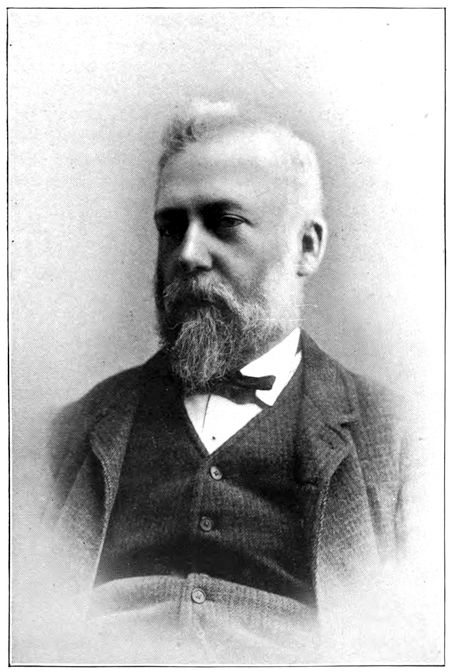
W. H. Patterson
The strike ended, the Committee set themselves to work to repair the broken places and put the Association on to a solid foundation again. They found themselves financially insolvent and shattered numerically. They were unable to meet the benefits provided by rule, and there was a great cry of distress from those who were out of work owing to depression of trade. A return was taken as to a levy to meet the latter class, but it was very unsatisfactory, not one half of the votes being cast, and the suggestions included levies varying from 2d. up to 1s. They therefore decided to call a special Council, warning the members that these people could not be paid from the General Fund. They had been compelled to pay those who were on the funds short allowance. The position was so desperate that "either the contributions must be increased or the benefits reduced," and at the Council the two questions were—first, the general question of contributions and outlay; second, the men idle from depression: how to raise money for their support and how much should they be paid? The Council acting on the advice of the Committee decided that the benefits for strike, lockout, and breakage should be 6s. and 3s. per week for members and half members respectively, and that these payments should only be paid for six months, when they should cease without appeal, the sacrificed allowance being reduced to 10s. per week without a reduction in time.
Their next difficulty was the unconstitutional district meetings which were held. At these the wildest statements were made, and as a consequence the minds of the members (as will always be the case when these meetings are in vogue) became unsettled, and disunion followed. Amid the natural difficulties of the situation the Committee were called upon to defend themselves. A circular was sent out which, after renewing the argument of the promoters of the meetings, said:
"If you determine to let those men go on, doing their endeavours to undermine your Association, then be prepared to accept with that choice all the evil consequences which must arise therefrom. These are the men who would "rather rule in hell than serve in heaven!" They have yet to learn the most important of all attainments—viz. how to rule themselves, before presuming to guide the thousands of people in this county. If complaints are to be made, let them be made regularly and right. If reformations are needed, let them be sought in keeping with the constitution."
History is apt to repeat itself in this mode of procedure as in others. Nothing but evil can result. We are not in Russia; we are a democracy, and have a free tribunal.
There were other four questions calling for arrangement: the fixing of the county average; the arranging for official recognition and the operation of the Federation Board; the rearrangement of the sliding scale; and the resumption of the Joint Committee. A dispute as to the average for hewers arose in reference to the figures from which the eight and three quarters per cent. and one and a quarter per cent. should be taken. The employers contended they should be deducted from the actual wage of the county for the three pays prior to the strike, which was found to be 4s. 6¾d. The Committee contended they should be deducted from the nominal minimum wage of 5s. 0½d. for the eleven-hour pits and 4s. 8½d. for the ten-hour pits. These were the wages from which the reductions were sought. If they were averaged as per the number of pits at each it worked out at 4s. 11d. It was therefore obvious that there would be a great difference in the result. If the two reductions were taken from the 4s. 11d. the average would be 4s. 5.16d.; if from the 4s. 6¾d. it would be 4s. 1.33d., or 3.83d. of a difference. It was finally agreed that the average for hewers should be 4s. 5d. for the eleven and 4s. 2d. for the ten hour pits.
The official recognition of the Federation Board was at first objected to by the employers. At a meeting of the Board held on the 23rd of September the details of the sliding scale were discussed. They were in doubt as to whether the owners would discuss it with them, or the miners alone. Eventually a joint meeting was held, and the second sliding scale was arranged on October 11th. The date of its commencement was fixed for December.
SLIDING SCALE, 1879
When the Net Average Selling Price of Coal There shall be made the following percentage additions to, or deductions from, the now prevailing tonnage rates and wages
ReachesBut does not reachAdditionsDeductions
s. d.s. d.
4 24 6NoneNone
4 64 10 2½ per cent."
4 105 2 5 ""
5 25 6 7½ ""
5 65 1010 ""
5 106 215 ""
6 26 617½ ""
6 66 1020 ""
And so on upwards, 2½ per cent. for each 4d.; the 5 per cent. variation for the 4d. range in price between 5s. 10d. and 6s. 2d. being limited to that special range.
s. d.s. d.Deductions.
3 104 22½ per cent.
3 63 10"
And so on downwards.
The difference between this and the previous one consists in the lessened grades. The 8d. grade was reduced to 4d. for two and a half per cent. change in underground wages and two per cent. in surface wages. Another variation was the giving up of the minimum wage. All parties were agreed on this point, as all had felt the evil arising from the operation of it during the two years of its existence. Long may it be before such another condition arises here, for the days were dark indeed; as witness the first ascertainment, which showed the average selling price of coal to be 4s. 3.3d. per ton. The accountants were, as now (1906), E. Spark, and Monkhouse, Goddard & Co.
The Joint Committee was suspended at the commencement of the strike on April 5th, and did not resume its sittings until December 12th. During the time intervening the rules were revised. A special Committee (which might be called an interregnum Committee) met, and transacted business of the same nature as that within the purview of the Joint Committee.
Before leaving the strike and the consequences it may be of interest to quote from Mr Crawford's first monthly circular his estimate of it.
The strike which took place in the months of April and May last will ever remain an epoch in the history of the Association. A more complete success never took place. At its beginning, strong doubts were expressed and great fears entertained as to what would be the ultimate consequences of such a step.
I was amongst those who doubted, but did not despair, and the end more than justified the expectations of the most sanguine. If we take the entire history of trade disputes, it will be found that not one ever commanded so much public sympathy. We had justice and right on our sides, and we took the only wise course—viz. to let the public know it. We deplore strikes as much as anyone can do, but there are times when they become necessary and such a climax had we arrived at in April 1879. Numbers of men who were outside our Association then came forward and joined with us and fought the battle side by side. There never was a more complete stoppage of work or one which to the workmen, at least, ended more satisfactorily.
We may fittingly close the year by a reference to the strong tide of emigration that was running. A miners' conference to consider a scheme to assist prospective emigrants and draw up a code of rules was called in Manchester in November. Such a scheme was formulated and the rules suggested, but nothing ever came of it. In connection with this large volume of emigration from the mining districts Mr Crawford took a trip to America in one of the Inman liners, and wrote an account of it in a pamphlet entitled "In the Steerage." A report was circulated in the press describing what purported to be the foul condition of the accommodation provided for the third-class passengers. With a desire to ascertain the truth or otherwise of these statements Mr Crawford went to New York in one of the Inman boats, and completely exposed the untruthfulness of it, and did a great deal towards easing the minds of many of the miners who were preparing for leaving the country.
1880
Violations of Scale—Restriction of Labour—Working Hours Arbitration—Deputies' Wage Arbitration—Employers' Liability
By the end of 1879 the consequence of the strike, as seen in disarranged collective machinery, had been reconstructed. One beneficial effect of the stoppage was the great number of men who joined the Union. When the notices terminated there were collieries where the numbers were few; but these men, as if moved by the instinct of self-preservation, ceased work, and to a very large extent became members, remaining until this day. It was the greatest piece of missionary effort ever seen. Instead of disunion and isolated action there were manifest loyal adhesion and solidity.
There were sure to be exceptions to this as to all rules, and early in the year the Federation Board was called upon to meet a class of trouble which was entirely illegal, and which arises occasionally now. Without specifying places (but dealing generally) it will suffice to say that in a few instances notices were given for advances beyond what the sliding scale gave. The employers requested the Board to meet them. This they did, and two resolutions, one dealing with the cokemen and the other with the miners at one colliery, were unanimously carried. The workmen were told that they had violated the rules of the Federation Board and sliding scale agreement. They were told (by a circular sent out by the Federation Board) that they were parties to the arrangement, and yet had given in their notices for an advance in direct contravention of its provisions. Having been parties to the scale they ought not to violate it with impunity. If this individual or lodge action were allowed it would end in disruption, and therefore it must be checked. The wisdom of that advice is obvious, and not only in that day, but for the present time. If agreements are made for men they should be adhered to. To violate them is lawlessness, which in the end is hurtful beyond the immediate act. If conditions are forced upon people it is right to repudiate, but for the last thirty-four years in this county there has been freedom and equality.
RESTRICTION OF LABOUR
At the Council meeting held on January 17th it was decided that there should be a restriction, and that no coal hewer should make more than 4s. 5d. or 4s. 2d. per shift, but this was never carried out in any general manner. On March 13th the Council again dealt with it, and declared all lodges unfinancial where it was not put in force. In furtherance of that resolution the Seaham Lodge put a notice on the pit heap to inform the members "that the restriction had commenced, and that a list be drawn up stating the number of tubs each man had to fill in his respective district or flat, no man to make more than the county average in any one day." To that notice the Owners' Association took objection. A letter was sent to Mr Crawford asking him whether the workmen had determined to enforce restriction, and if so, were they then acting on it. These questions Mr Crawford did not answer, but brought them before the Committee. As a result a circular was issued reviewing the whole case. They pointed out that when the Council carried it very few of the lodges put it in force, and the few who did soon left off, and that at the Council to enforce it the voting was 145 for, 126 against. They reminded the majority that "surely a minority so strong ought to have led to a reconsideration of a matter not only so vitally important, but which has at all times been found so very difficult to carry out in practice." Lodges were sending in resolutions refusing to carry out the Council resolution. That resolution said those lodges should be expelled. The position would be that whole collieries of men would be cut off from the Association because they were determined to abide by the scale agreement. In view of these facts, they resolved to call a special Council. They pointed out that one or two lodges had sent in motions of censure because advice had been given, and they met the censures by saying:
One or two lodges have sent motions seeking to pass a vote of censure on us for issuing the last circular. It would seem that these lodges would like to see us sit and do nothing, even though we were certain that an impending evil was threatening our very existence. We cannot regard this as our province. What we did was for the preservation of the Association. The moment we see that our efforts have not ended more satisfactorily we have called a special Council meeting to further consider the matter. Take our advice, and inasmuch as we have only done our duty, spare your censures. We have quite enough to do at present without wasting our energies in useless and pernicious quarrelling amongst ourselves.
The result of the special meeting proved the Committee right. A tabulated vote was taken—the voting being against restriction 130, for 117; majority against, 13. Thus ended the only county attempt to carry out a uniformity in piecework. It ended as all such will end. Human nature is too strong for such arrangements.
WORKING HOURS ARBITRATION
This case arose out of the hewers' hours at some of the collieries. Amongst them were Gurney Pit, Leasingthorne, Letch, and Wingate. These were eleven-hour pits, but during the depression of 1877-79 the hewers had been induced or coerced to go in at three A.M. instead of four A.M. The Executive Committee in their negotiations contended that this was a violation of Mr Meynell's award, and therefore ought not to exist. On the employers' side it was held that the award named only dealt with the coal drawing. After attempts to settle it was finally agreed to refer it to arbitration, with Lord Rowton as umpire. The arbitrators on the owners' side were Mr R. F. Mathews and Mr W. T. Hall, and for the workmen Mr L. Jones and Mr W. Crawford. There were two days' sitting in the Westminster Palace Hotel, London. On the 20th of August the umpire decided that the hours complained of should remain as they were.
THE DEPUTIES' ARBITRATION
This question of the deputies being paid a higher wage if they were not in the Miners' Association came up in a renewed application for uniformity of wage. This was sent to the owners amongst a number of other requests. The reply was that they were strongly of the opinion that the deputies should not be members of the Miners' Association. The Executive could not accept that reply. They had never asked about the Associations, but a just wage, and they considered the reply was an insult. They recommended to their members that it should be sent to the Federation Board. This was done, and on the 19th of March the Board offered to submit the matter to arbitration. The offer was refused by the following resolution:—
MINERS' REQUEST AND REPLY FORWARDED TO MR CRAWFORD
June 17th, 1880.
Deputies.—That deputies who are not members of the Deputies' Association be paid the same wages as those who are.
Considering the position in which the deputies stand to the hewers and other workmen, any change in the present arrangement is undesirable.
On the receipt of this the Board notified the county, and resolved to call a joint meeting of the four Associations. Their advice was that the whole of the notices be given in, and work to cease until the claim was conceded or arbitration granted. The meeting was held on August 26th. Negotiations proceeded, and in November the employers agreed to accept arbitration. The case was not heard until February 1881. The umpire on that occasion was Mr I. Hinde Palmer, M.P.; the advocates were Mr L. Wood, Mr W. Armstrong, Mr L. Jones, and Mr W. Crawford. The hearing lasted two days, and was held in the Westminster Hotel, London. The umpire decided upon two points:
(1) That it is competent under the sliding scale agreement of October 1879 for the deputies who are members of the Miners' Association to require that their wages be advanced.
(2) That the advance shall be such a sum as will make the amount of their wages respectively the same as the wages paid to those deputies who are not members of the Miners' Association.
THE EMPLOYERS' LIABILITY ACT
It is not intended to review the introduction and passing of Acts of Parliament, but mention may be made of the Employers' Liability of 1880, not with a view to explain its provisions, but to indicate steps which were taken towards contraction out of it. In Lancashire contracting out was made one of the conditions of hiring, and a strike took place in an attempt to resist it. With us in the north (for the two counties worked together) the same end was sought, but by different means. The aim of the employers here was to avoid litigation if possible, and, with that end in view, would have increased their contributions to the Permanent Relief Fund. The officials of that fund were desirous of bringing an arrangement about, believing it would strengthen their position. There were a few men outside the ranks of those officials who advised the miners to enter into a contract. At a meeting of the Permanent Fund Committee it was just on the point of being carried when a suggestion was made to the effect "that it was not a matter pertaining to the fund, but belonged to the Workmen's Associations, and that a joint meeting should be held." Such did take place, with the result that the proposal was defeated. The leaders of the Associations were very strong against it. Among the strongest was Mr Crawford, whose monthly circular for December contained some very clear and explicit reasons in opposition to the idea. There were threats from some employers as to smart money and subscriptions to the Permanent Relief Fund, but still the workmen refused to give way.
1881-82
Deputies' Wage again—Third Sliding Scale—Death of Mr Macdonald—Change in the Treasurership
In February this question was again in evidence. By reference to the award as given above it will be seen that the umpire decided clearly in the workmen's favour, but there arose a complication in the mode of application adopted by the owners. The mode of calculation was skilful and peculiar. The dispute arose in 1876 when, as an inducement for the deputies to form an organisation of their own, they were to be exempt from the six per cent. reduction; therefore, said the employers, we will give those deputies who are in the Miners' Union the six per cent. given in 1876, and then deduct all the reductions since, by this process bringing them to 4s. 1½d. per day. They seemed to forget that the deputies' arbitration was for the difference between the actual wages at that time—the difference being 6d. or 8d. per day. The anomaly was that two men might be doing the same work with equal responsibilities (in some cases the lower paid the best workman) and yet one have a much higher wage than the other.
Mr Bunning (on behalf of the owners) sent a copy of the instructions to the managers to Mr Crawford, asking him if they met with his approval. The answer was sharp. Instead of agreeing with them he considered them a clear violation of Mr Palmer's award. It was not based upon Shaw Lefevre's award, but upon the existing difference in the wages. And he informed the owners, that they would demand the higher wages. The negotiations continued until May, when the umpire by joint letter was asked to meet Mr L. Wood and Mr Crawford. He informed them he would write each of them an explanation, and save the journey. This he did, and said the award was clear and intelligible, and that he meant those who were in the Miners' Association to be paid the highest wages. On the strength of that interpretation the owners paid the wage, with everything kept off since the award.
THIRD SLIDING SCALE
As the two years for which the sliding scale was definitely fixed drew near completion it was obvious that there was a strong feeling against it. The circumstances were against it. Introduced at the conclusion of a very disastrous strike the whole of its operation was in the worst times—trade bad, wages low. There was no wonder that the men had little love for it. Recognising the opposition the Committee placed a motion on the Council programme suggesting that notice be given to terminate it at the end of the two years. This was adopted, and notice given at the proper time. In the meantime the miners generally were turning their attention to the question. A sliding scale conference was held on April 20th, 1881, in the Midland Hotel, Birmingham. The conference affirmed "that the principle of sliding scales is an equitable mode of settling wages questions, if rightly worked out in detail: That the best mode of taking out the selling price will generally be to take the price of coal sold, but that no coals should be taken which were sold on contract; only those sold at the current market price." In the matter of leaving firms out each district was left to its own option. It was considered desirous that the accountants should have more freedom in regard to the matters they were permitted to divulge. A second conference on the same question was called for October 19th in Birmingham, with a programme on very similar lines.
A Council meeting was held, and two delegates selected to represent Durham. Certain instructions were given them: sliding scales were the best arrangements for regulating wages; the open markets were preferable to the existing mode of ascertainment, with others of a kindred nature. On January 18th the Federation Board had under discussion a proposal from the employers. It was not accepted, but they were told the Board was ready to meet them at any time. At a special Council held on 25th February 1882 the situation was complicated by the miners deciding to ask for an advance of twenty per cent. if the owners refused the sliding scale drawn up by the Federation Board, and that body was instructed to meet the employers. The meeting took place on March 13th on the two questions, when the owners gave the Board the following:—
OWNERS' OFFER
March 13th, 1882.
The Durham Coal Owners' Association is unable to accept either of the propositions suggested in the Federation Board Minutes of February 25th, that is to say,—
1. The Association cannot regard "the sliding scale drawn up by the Federation Board as just and equitable," and consequently cannot adopt it.
2. The Association cannot grant "an immediate advance of 20 per cent. in the wages of all men and boys," nor admit "that trade warrants such an application," or any advance at all.
Having regard to the difference of view between the Owners' Association and the Federation Board, the Association can only suggest that the question whether wages shall be varied, and if so, to what extent, and in what direction, shall be left to open arbitration.
The Miners' Council then decided to take a ballot on the twenty per cent. If the question were not carried by a two-thirds majority, to arbitrate on the advance. When this was sent to the owners they replied that the advance could not be granted, but they were quite ready to leave it to open arbitration. The Federation Board as a whole considered itself in an anomalous position if any section were allowed to act as the miners were doing. If this were allowed to proceed, then on wage questions there was an end to all usefulness. Either the power must be taken away altogether, or they must unreservedly trust them. As the position was, they were in a crippled condition. "This renders our work on general questions nil, and the Federation instead of being a tower of strength is a source of weakness, inasmuch as it exposes to the owners our want of agreement and diversity of thought and action." They had, therefore, come to the conclusion to take a vote, with the view to have the matter settled. The response of the county was in favour of the Board by a large majority. Immediately they decided to ask for a scale with a minimum wage, and that the variations should be two and one and a half per cent.
A meeting between the Board and the owners was held on April 17th, when the workmen asked for an advance of seven and a half per cent. To this the employers objected, but said they would pay a wage as if the coals had reached 4s. 8d., which was equal to an advance of three and three quarters per cent., and would be an advantage of two and a half per cent., during the continuance of the scale. The Board strongly urged the acceptance of the offer, which in their opinion was preferable to arbitration. The workmen accepted their advice, and the following scale was signed on April 29th:—
THIRD SLIDING SCALE
When the Net Average Selling Price of Coal There shall be made the following percentage additions to, or deductions from, the now prevailing tonnage rates and wages, being those prevailing at November 1879