Chapter III · A NATION IN THE MAKING
Reading edition
General Washington’s first administration gave tone, direction, and presumption of permanence to the new government. His second term steadied it amidst its first serious difficulties, and gave the country a wholesome taste of its vigor. The vote of the electors was unanimous in 1792, as it had been in 1789, in choosing him President, and the seventy-seven votes which they cast for Mr. John Adams made him Vice President a second time by a safe majority. The congressional elections which accompanied the choice of the electors showed, it is true, an unmistakable reaction of opinion against the strong and systematic measures by which the Federalists had put Mr. Hamilton’s programme into execution. The majority in the new House of Representatives consisted of men inclined to follow Mr. Jefferson in the formation of a distinct party of protest, if not of opposition; though the more slowly changing Senate showed still a preponderance of Federalists. But General Washington still seemed to all the safest leader in affairs, the only possible guide and mentor in those first days when all things were yet to be brought to a stable order and a wise way of government.
It was a notable thing how a minority prevailed in all active policy and managed to keep affairs in its own hands,—the same minority whose sagacity and vigor and concert in action had secured the formulation and adoption of the constitution. The war for independence had been a democratic upheaval, and its processes had seriously discredited all government which was not directly of the people. It had made local committees of correspondence the real organs of opinion. Town meetings and the people’s representatives in the provincial assemblies had originated policy, while it lasted, with an almost sovereign freedom of choice and had kept their sovereignty when the war closed. Almost everywhere, except in Virginia, a majority of the leading families and of the professional classes of the colonies had thrown their influence against the separation and independence which the popular leaders demanded; against the trial of an out-and-out people’s government without king or parliament or ruling class to moderate and offset the sway of democracy; and when the end of the struggle came those whom the country had been accustomed to see lead in its commonwealths abandoned it in extraordinary numbers forever, preferring Canada and the Indies and the old country over sea, where government still kept the form and dignity and aristocratic flavor to which they were attached. Men enough of the classes hitherto honored and privileged remained to hand on the old traditions of initiative and service and authority which wealth and training and social influence had formerly secured; but the end of their predominance was plainly at hand. Aristocratic privilege and the natural precedence of birth and breeding were sadly discredited. The mass of common men had put their own leaders forward, had acted for themselves in town meetings and in voluntary organizations of their own, with regard to matters of the greatest scope and consequence. Power had plainly been levelled; equality had become the cardinal principle of politics, local autonomy and direct elections the standards and models of political organization. The central government which the constitutional convention of 1787 had devised and to which Washington and Hamilton had given power and authority had plainly been set up as if by reaction, to offset the heady autonomy and turbulent democracy of the people’s commonwealths. Many of the cherished ideals of a democratic revolution seemed lost and given up by its successful establishment; and the Federalists, with their frank preference for the old vigor of authority, their undissembled contempt for pure democracy, were not likely very long to maintain themselves in the people’s favor. Mr. Jefferson found men eager to put a check upon them and restrict the new government to a more modest scale of power. The minority were only temporarily in the saddle. They were permitted to rule only because of their vigor and efficiency, and the need to employ them in order to give definite shape to the government which they had originated.
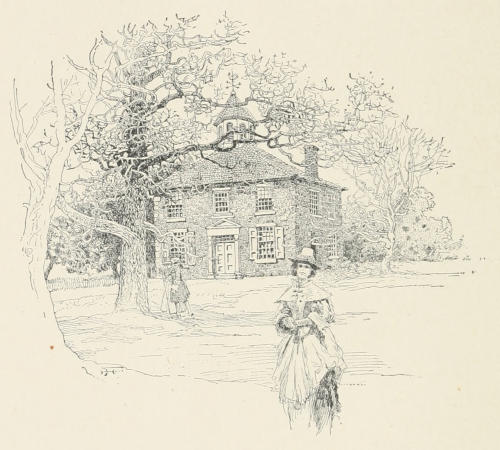
FIRST OHIO CAPITOL, 1801
It was a rural nation which had drawn together into this novel union,—a nation without aristocratic example now that its connection with England was cut off; with nothing but its own simple needs, naïve preferences, and manifest convenience to consider, now that it was no longer part of an extended and various empire. It had been obliged, because convinced by the unanswerable arguments of tumult and of ugly reprisals of State upon State, to set up at its centre a real government again, to take the place of the government over sea from which it had broken away: a government with an authority of its own which was likely to be even more efficacious in holding them together in a co-operative union than the authority of the King and Parliament. But, though opinion had reluctantly consented to that, it by no means followed that it would consent to see the new government given a scope and vigor such as Mr. Hamilton, with his notoriously high notions of prerogative, wished to confer upon it. The people could not, it is true, of a sudden shake off their life-long habit of following those who had always seemed their natural leaders. Their society was old; their commonwealths were compact of law that was rooted deep in the past; their thoughts were stuff of old tradition. Noble gentlemen who were of the gifts and breeding which had so long made the chief families among them seem a sort of privileged and authoritative class, to be looked to as of course for guidance, had endeared themselves to them anew by their cordial espousal of the popular cause and by their indispensable capacity in its successful promotion; had still an unmistakable prestige in affairs. But their governments had long been in fact democratic, and were now democratic in form also, and the privilege of leading could not much longer be monopolized amongst them.
And that notwithstanding the prescriptions of their law. Under the laws of the colonies only a minority of the adult male residents in each community had been allowed to vote,—those who held some not inconsiderable amount of property; and still fewer had been allowed to hold office,—the ownership of a still larger amount of property being prescribed as a qualification for candidates for political office. Most of the one-time colonies had transformed themselves into States upon their assumption of independence by an entire reformulation of their fundamental law; and some had modified it still further before the new central government over which General Washington was to preside had been set up; but the basis of their suffrage they had in most cases left substantially unaltered. It was still necessary that every voter should be a freeholder, or the possessor of an estate of (say) fifty pounds value, or at the least a tax-payer. Rhode Island and Connecticut had kept their colonial charters as their State constitutions and left their law substantially unchanged. There were probably not more than one hundred and twenty thousand men who had the right to vote out of all the four million inhabitants enumerated in the first census (1790). In 1792 Kentucky was made a State of the Union, and her constitution, with its frontier liberality, said nothing about any qualification for the suffrage except the qualifications of age and residence; but Tennessee, which came into the Union as a State four years later, though no less a frontier community than Kentucky, required by her constitution that voters should be owners of freeholds. There were also in almost every State property qualifications for membership in the lower House of the State legislature; and ownership of a very considerable amount of property was so universal a prerequisite for election to the Senates of the States that they were looked upon as bodies which of intention represented the propertied classes. Both by law and by ancient custom wealth and social consideration carried with them also political privilege.
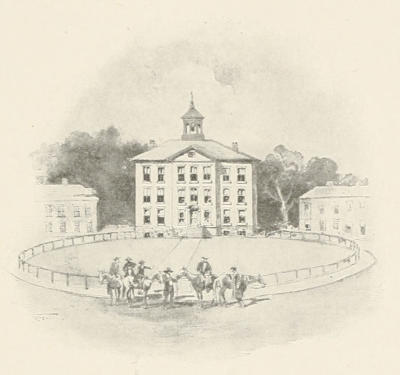
STATE CAPITOL OF KENTUCKY, 1796
But law and custom already felt in these matters the pressure of opinion. The party that was gathering about Mr. Jefferson purposed, among other things, the levelling of political privilege. The spirit of the rural nation was against social distinctions. The essential simplicity of its life made pretension ridiculous; the free movement of enterprise throughout its borders made the individual man, with or without property, if only he possessed energy and initiative, the real and only constant unit of power; and the new nation was not long in showing that it wished its government conducted with the economy, simplicity, and plainness of the individual man. There had been a significant flurry of excited comment when the first Congress under the constitution debated whether in official papers it should speak of the President of the United States as “His Highness” or “His Excellency,” or confer upon him some other title of even greater semblance of rank and dignity. “Does the dignity of the nation then consist,” Mr. Tucker, of South Carolina, had cried, “in the exaltation of one man and the humiliation of all the rest?” It raised a very storm of angry and even abusive comment when the houses voted their first salaries Bill, which gave to the President twenty-five thousand dollars a year, to the Vice President five thousand, to Senators and Representatives six dollars a day during the sessions of Congress, and to the Speaker of the House twelve dollars. It was known that General Washington would decline to draw his salary, and that while he remained President the salary voted to the chief magistrate would be merely nominal; but the bill fixed the salary for subsequent incumbents of the office, and it was very generally condemned for its wilful extravagance.
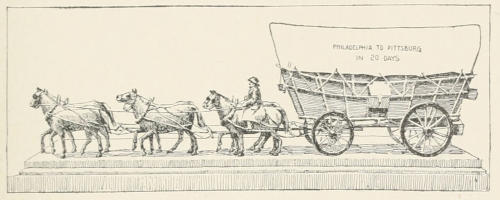
MODEL OF A CONESTOGA WAGON
The Congress felt the air of opinion out-of-doors very sensitively, and the President and his advisers sometimes found now the one house and again the other in a singular mood of uneasiness or suspicion. The Federalists who gathered about General Washington were watched very narrowly to see that they formed no “court” about the President and accumulated no private stock of privilege in their managing coteries. Their more democratic opponents made merry over their affectations of social preference and their manners copied from an aristocracy over sea; and their mirth had in it oftentimes a touch of sardonic bitterness. The prejudices of such critics were based upon their own radically simple lives. Their fears of plots and usurpations, of aristocratic pretension and the insidious bringing in of notions of government which would be more suitable for a monarchy than for a democratic republic sprang wholly from what they knew and had had taste of from a very different world across the sea. A spectre of tyranny stalked always somewhere in their forecasts of the future and in all their uneasy criticisms of the present. Their governors found it necessary not only to be but also to seem servants, not of one class or of any special interest, but of the whole people.
No society could have been more radically and essentially democratic. Agriculture, the northern fisheries, and the commerce of their ports,—their crops, their timber, their fish salted for the world, their ships showing their sails upon every coast,—summed up the chief interests of the little country commonwealths, more forest than field, more wilderness than plotted ground. Not a little of their clothing their people made for themselves out of their own flax and hemp, besides felt for hats, their own shoes, and many a pair of breeches of leather or buckskin. But English law had forbidden the export of such goods while they were colonists, which was but yesterday; and had made anything beyond the necessary spinning of the household a thing useless and unprofitable. Ships were built in every colony, but they carried only breadstuffs or lumber or shingles or tobacco or indigo in bulk. Not until the year of the constitutional convention (1787) had any considerable quantity of cotton even been gathered for export. It had for long seemed little more than an ornamental plant, a curiosity of the garden.
And even at the ports tradesmen and shippers and money-lenders and mechanics gathered in no great numbers. There were but six cities of noticeable size in all the country. The South, which held half the population, had but two, Baltimore and Charleston; and the population of these, added to the population of Philadelphia and New York and Boston and Salem, the other four, made up a total of only one hundred and thirty-one thousand all told. Virginia, with one-fifth of the total population of the country, had as yet no city at all. There were only five daily papers in the country, and these could not be sent in the mails because of their bulk and the heavy rates of postage. There were but seventy-five post offices the country through, and few of these saw the weary post-rider more than twice a week.
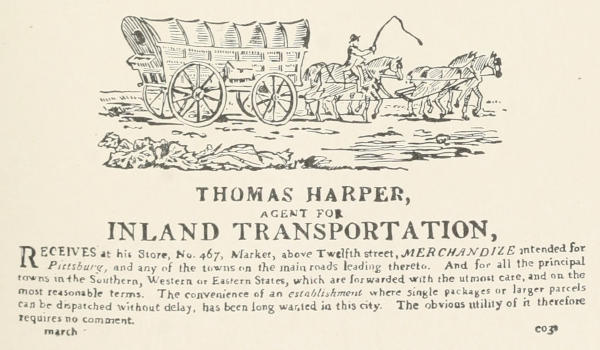
TRANSPORTATION ADVERTISEMENT
It was notable, nevertheless, how the population of the country taken as a whole had grown, despite the wars and the doubts and hazards of fortune which had marked the troubled time. When the war for independence began the people of the colonies had probably not numbered more than two millions seven hundred and forty-three thousand, counting black and white, slave and free. When the first census under the constitution was taken, in 1790, there were found to be very close upon four millions, an increase of quite twelve hundred thousand within the brief space of those fourteen troubled years. But the new men who came into the reckoning did not swell the population of the towns at the ports. They for the more part took up land and became freeholders in that free society, and added their force to the power of the new democracy, making a nation which must be governed upon principles of equal privilege or not governed at all.
The political weather held very fair until General Washington had a second time been made President. A little jealousy; an occasional discourtesy on the part of state officials who did not wish to yield in any point of dignity or precedence to the officers of the new government; a burst of hostile criticism now and again because the new Congress seemed to go too fast in its assumptions of authority or in its expenditures; annoying difficulties in getting men of right principle and first-rate capacity to serve as subordinate officials of the federal government; petty embarrassments without number beset the novel government of the Union, because it was new and as yet had its place and its methods to establish. But Washington’s wise way of being firm; his striking bearing in every matter which touched authority or precedence, half gracious, half austere, wholly commanding; his sensible moderation in counsel and straightforward vigor in action made such things of little consequence. The way in which the majorities necessary to carry Mr. Hamilton’s measures for the financial support of the government had dwindled from vote to vote in the Congress was the only sign that had looked ominous.
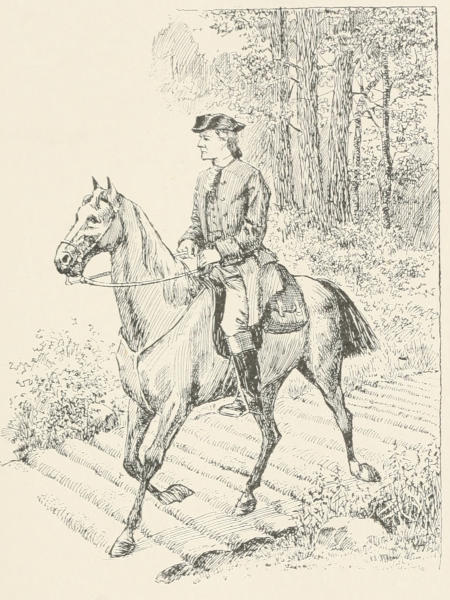
A MAIL CARRIER IN THE EIGHTEENTH CENTURY
A serious crisis had in fact been reached when it came to a vote on the proposition that the federal government should assume the war debts of the States. The southern members resolutely opposed the measure. Some States owed much more than others of the sum total which it was proposed all should pay. Some had already paid a portion of what they owed, and would lose outright what they had paid should the debts be assumed by Congress. The southern members did not wish either to admit the inability of their States to pay their debts or to make the federal government a general providence for the whole country in matters financial, and a patron and friend, besides, of the money-lenders; and their opposition defeated the measure by the narrow majority of two votes. The northern members were as resolutely determined that the measure should pass; and the heat of the debates and the bitterness of those who had lost in the vote gave to affairs for a moment almost a tone of revolution. Mr. Hamilton cleared the storm by a sudden stroke of astute management. The southern men were anxious that the federal district which the constitution had directed should be secured as a site for the Union’s capital should be laid out on the shores of the Potomac, within their easy reach and at a safe distance alike from the importunate merchants and money-lenders of the eastern ports and from the too philanthropic Quakers of the middle States, with their troublesome and impracticable agitations for the abolition of slavery. Mr. Hamilton arranged that the two measures should be associated, the assumption of the debts and the selection of a federal district. Two Virginian members consented to vote for assumption if the northern members would vote for a capital on the Potomac; and both bills were passed.
Since 1785 New York had been the seat of the federal government; and there the new government of the Union had first been set up. It was now decided (1790) that the government should be transferred to Philadelphia, the seat of the first Congresses of the Revolution and of the formal Confederation, until a capital of its own should be ready on the Potomac.
In Philadelphia, where the Confederation had been set up and the first councils of the Revolution held, the new government also saw its first years of stress and trial. Its sharp and trying test came the year Washington was for a second time made President (1793); and came from over sea,—a test alike of its motives and of its strength. That year the French revolution came to its keen pitch and passionate crisis.
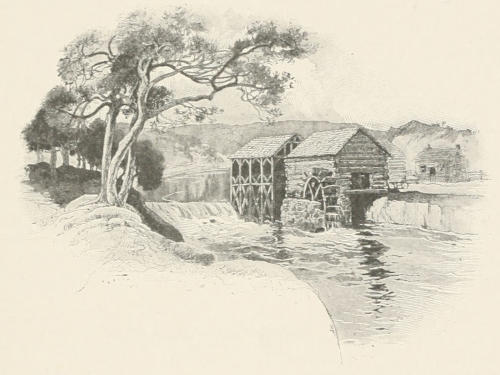
FIRST MILL IN OHIO, 1789
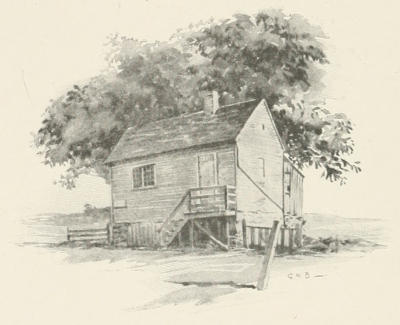
LAND OFFICE OF THE OHIO COMPANY, MARIETTA
It was the year of the Terror, and of wars which swept Europe like winds of destiny. But the Terror came at midsummer. Early in the year men in America knew only that France had gone the full length of revolution; that the monarchy had been abolished, the king sent to his death, a republic set up, and a new experiment like their own, an experiment in human liberty, begun, with all Europe to fight in order to make it good. No one in Europe doubted that America would cast in her lot with France in this day of her hope and sally for freedom, if only to requite the inestimable service France had done her in her own time of aspiration and struggle. No one in America doubted it, either, who merely gave rein to sympathy and thought nothing of the consequences. But Washington saw what the consequences would be; and his was the responsibility. His cabinet was unanimous in its agreement with him that the young republic, as yet without assured power or established friendships in the world, its own government still in its first stages of experiment, must stand neutral in European wars. Even Mr. Jefferson, though chief of the party whose passionate sympathy with the French revolutionists now stirred the quiet country from end to end, though himself touched at every point of thought by the speculations which were the principles of the revolution over sea, voted with his colleagues that the United States must stand aloof. France was at war with Prussia and Austria; with the spring news came that the circle of the spreading conflict had reached England and Spain; through England the flame might touch America. On the 22d of April, accordingly, the President issued a definitive proclamation of neutrality, drawn and signed by Jefferson himself, as Secretary of State. English troops still held the posts on the northwestern frontiers; Spain commanded the lower courses of the Mississippi. To go to war with England and Spain would be to renew all the peril of the struggle for independence. No prudent man among those who now supported Washington in his delicate task of giving the new government form and strength and character doubted either the wisdom or the opportuneness of the proclamation of neutrality.
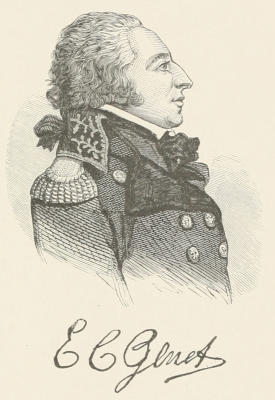
EDMOND CHARLES GENET
But the very day the newspapers of Philadelphia printed the significant and imperative proclamation “Citizen” Genet reached the city, the accredited minister of the French Republic to the United States. He had landed from a French frigate at Charleston on the 9th of April, had commissioned privateers and enlisted men there to prey upon English commerce before even presenting himself for recognition at Philadelphia, and had travelled from stage to stage of his pleasant journey northward to meet nothing but enthusiastic welcome everywhere. He had confidently expected to command America as his ally against the world. The governor of South Carolina had approved of his extraordinary acts at Charleston. Genet had commanded that English prizes should be brought into the nearest ports of the United States, and that French consuls should condemn them in prize court; and yet he had heard nothing but applause until he reached the presence of Washington. Jefferson loved France and welcomed Genet as a friend. The United States had linked themselves with France in close treaty of alliance in the old day of their own struggle for freedom, and Mr. Jefferson was willing to believe that the promises of assistance then given applied now to the new France and her new wars against Europe almost as M. Genet himself extravagantly interpreted them. The President found himself obliged to hold his own Secretary very sternly to his duty as the minister of a neutral state. England’s complaints were heeded; captured English prizes brought to the ports of the United States were released; the exequatur of the French consul at Boston, who had done as Genet bade him, was revoked; Americans who had enlisted on the privateers fitted out at Charleston were put on trial; and Genet’s recall was requested. His reception at the hands of the people had gone to his weak head. He thought, because he was feasted and fêted in Philadelphia itself, the seat of the federal government, that he could appeal to the country against its own government, and insolently threatened to do so, to learn too late that Washington was master. As soon as possible he was superseded.
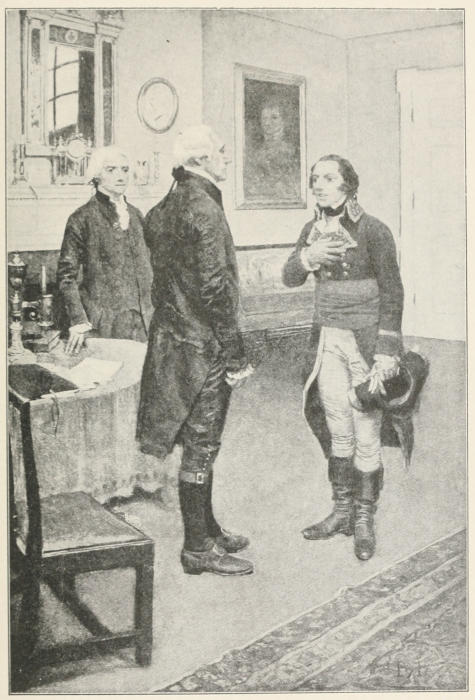
INTERVIEW BETWEEN GENERAL WASHINGTON AND “CITIZEN” GENET
The demonstrations with which he had been received were none the less genuine. A wave of deep feeling was sweeping over the country. The “civic” feasts and republican banquets, the elaborate celebrations of liberty and the Rights of Man, with which almost every town and hamlet excited itself, would have been impossible had not a sober and unaffected enthusiasm underlain all their extravagant charlatanry and affectation. Some enthusiasts cooled towards France when her King went to the guillotine as a sacrifice; more drew away when news of the bloody Terror came; but the tide of feeling did not permanently subside. Something of a deep, unfathomable faith remained. The firmness of the government and the discredit of Genet did not prevent the formation everywhere of democratic societies which established themselves upon the model of the Jacobin Club in Paris. Their sympathy with France was but a sign and incident of the thorough-going and undoubting democratic creed of the people themselves. They were the nuclei of the party which meant as soon as possible to take possession of the government and mould it to its principles,—the party which Mr. Jefferson withdrew from the cabinet to lead when the year was out (December 31, 1793). He knew how to estimate the real volume of opinion now running against the policy of the administration; he shared the principles and predilections of the men who represented it upon its more sober and thoughtful side; and he had realized now for a long time that in the cabinet his views could not prevail. He withdrew to form the gathering party for its ultimate triumph when Washington should be off the stage.
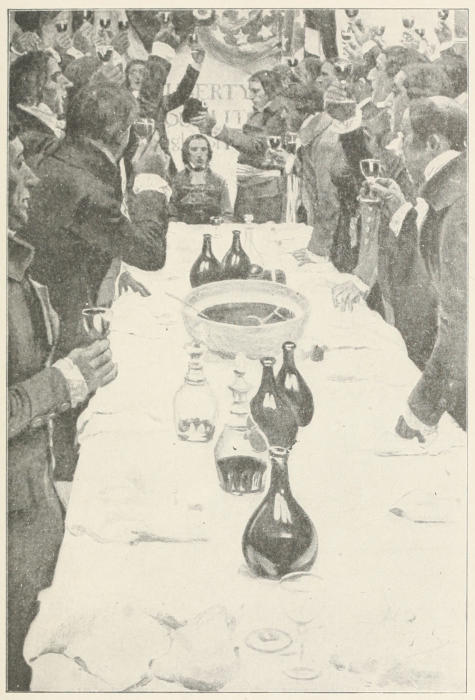
A BANQUET TO GENET
Washington felt very keenly the sharp power of the hot criticism to which his course towards France had subjected him. It was a heady current to stem. Unmeasured abuse beat upon him. He seemed for a little the leader of a party, and of a minority party at that, instead of the leader of the nation. He was made to seem for a time nothing but a Federalist, the head of a party which meant to make the federal government the people’s master and then use its mastery to serve England, whom they hated, and to humiliate France, whom they loved. And while the storm beat most fiercely he was obliged to seem to confirm hostile opinion with regard to the attitude of his party towards England.
Trouble with England had not been avoided by neutrality. She kept her garrisons in the northwestern posts because the debts due to British subjects before the war for independence had not been paid; and the presence of the unfriendly garrisons there seemed to keep the Indians of the border constantly inflamed for war. She seized and impressed American seamen on the high seas, under the pretence of mistaking them for her own runaway men. She seized American ships bound for French ports with corn, and condemned them in her admiralty courts as if they were lawful prizes; and she cut away the right of the States to trade with West Indian ports, whether her own or those of France, by every vexatious restriction and arbitrary interference. She would maintain no resident minister at the seat of the federal government, as if expecting America to break her neutrality and openly espouse the cause of France. And yet the President held Congress back from every measure of retaliation or hostility; commissioned Mr. Jay, the Chief Justice, to visit England and seek a satisfactory treaty of accommodation; and kept affairs at a balance until he should return.
And then, while the country waited, the President found himself obliged to use the power of the federal government to carry out by force an unpopular law. In 1791 Congress had passed, along with the rest of Mr. Hamilton’s measures for strengthening the government, an internal revenue bill which laid taxes on distilled spirits. The people of the far counties of Pennsylvania, beyond the Alleghanies, where the roads were bad and the markets far away, could make no profit on their corn unless they converted it into whiskey; were mulcted of part of that profit by the law; and felt the thing an intolerable burden. They therefore first ignored and then resisted it. Washington watched what they did until it reached the pitch of organized rebellion; then (1794) summoned the militia of the States and moved against the rebels in force, himself accompanying the troops till he learned that there would be no final resistance; and the first concerted effort to discredit the authority of the government he had been trusted to administer was crushed. “The servile copyist of Mr. Pitt thought he must have his alarms, his insurrections and plots against the constitution,” sneered Jefferson, against Hamilton, the author of the law. “It aroused the favorite purposes of strengthening the government and increasing the public debt; and therefore an insurrection was announced and proclaimed and armed against and marched against, and could never be found.” “The powers of the Executive of this country are more definite and better understood, perhaps, than those of any other country,” Washington had declared, “and my aim has been, and will continue to be, neither to stretch nor to relax from them in any instance whatever.” But the judgment of the Democrats was the judgment of Jefferson. This stroke against the people of the western counties was, in their view, an illustration of Mr. Hamilton’s all too subtile way of strengthening the federal government.
Meanwhile the country waited for Mr. Jay. He had sailed from New York on his mission on the 12th of May, 1794; on the 28th of May, 1795, he returned, bringing a treaty. On the 24th of June, 1795, it was confirmed by the Senate in secret executive session; and in July its contents were made known to the country. The storm of dissent that greeted it shook the country like the bitter excitements of the ominous Stamp Act time. It was a storm, not so much of criticism, as of blind and passionate anger.
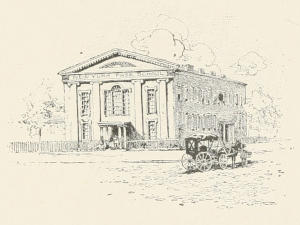
FIRST PUBLIC SCHOOL IN NEW YORK
The treaty was, in fact, a statesmanlike piece of work. Mr. Jay had the sobriety, the steadiness and largeness of view, and the high spirit of a statesman. He had gone to England feeling that the affair he was to engage in was not to be “a trial of diplomatic fencing, but a solemn question of peace or war between two countries, in whose veins flowed the blood of a common ancestry, and on whose continued good understanding might perhaps depend the future freedom and happiness of the human race.” Lord Grenville, with whom he had to deal, had met him in a like spirit of accommodation, and both believed when their work was done that no just exception could be taken to the terms of the treaty “except on the part of those who believed the interests of Great Britain and the United States to be in contradiction with each other, or who wished to make them so.” It was not only a treaty of accommodation, it was also a treaty of commerce,—the first it had proved practicable to get from England since the war of alienation and independence which had broken the old ties forever. It provided that the British garrisons should be withdrawn from the northwestern posts by the 12th of June, 1796; that a commission, to sit in Philadelphia, should determine and provide for the payment of debts due British subjects at the outbreak of the war for independence, and that a similar commission, to sit in London, should adjudicate and adjust the matter of the compensation of American merchants and ship owners for illegal captures or condemnations made during the war between France and Great Britain; and that all pending boundary disputes should go for settlement to a board of joint commissioners. It defined contraband of war, regulated privateering, and declared, to the betterment and elevation of invariable international practice hitherto, that war between the two countries should never be made a pretext for the confiscation of debts or the invalidation of contracts between individuals. The door of trade between the two countries it opened wide. Trade between America and the British East Indies also it made free. Only the clause governing trade with the British West Indies was unsatisfactory. It provided that no American vessel of more than seventy tons burden should be admitted to that trade, and that no sugar, molasses, coffee, cocoa, or cotton should ever be exported thence in American bottoms to European ports. That clause the Senate rejected. It was October, 1795, before better terms could be obtained and the treaty finally completed.
Mr. Jay had not been able to induce Lord Grenville to forego the impressment of seamen, or to pay for the hundreds of slaves taken away with the British armies at the close of the war. Neither had he been able to change in the least the arbitrary policy of the English ministers with regard to neutral trade with France. He had reminded himself at every step that his object was peace, had felt sure that he was gaining enough to secure that, and had satisfied himself that to press for more would be to fail. The country was angry because he had not failed. It wanted war with England, fiercely resented accommodation, and deemed it poltroonery and false patriotism for any one to wish it. To accept peace, above all to seek peace, was to truckle to England and betray France and America alike. Fishermen and ship owners, the vulgar and the well informed alike, at Boston, had been in a very frenzy for war, feeling to the quick their unjust losses at the hands of the British. “You cannot imagine,” wrote John Adams, “what horror some persons are in, lest peace should continue.” And when they knew that peace was assured by the treaty there were no bounds to their chagrin and passionate resentment, or to the violent expression of their passion. “Damn John Jay! Damn every one that won’t damn John Jay! Damn every one that won’t put lights in his windows and sit up all night damning John Jay!!!” was the vulgar explosion of wrath to be read upon a gentleman’s fence in a public street of the staid old town; and every town, particularly every seaport town, rang with the same license of vituperation. The temper of the whole country seemed of a piece with the temper of New England.
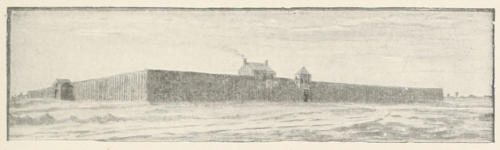
FRENCH FORT AT ST. LOUIS
It was, in mere sober fact, a bitter thing for high-spirited men to endure that Mr. Jay had been obliged to forego so much that was just and content himself with so little of what lay at the very heart of the matter. The treaty undoubtedly left England still free to impress American seamen; to close the ports of France, if she could, against ships laden with provisions, though they were neutral craft and carried no article of war; to shut America forcibly off from trade with the French West Indies, which France herself had declared free while the war should last; and to confiscate all French goods found on American vessels. “The treaty from one end to the other,” exclaimed Mr. Madison, “must be regarded as a demonstration that the party to which the envoy belongs is a British party, systematically aiming at an exclusive connection with the British government, and ready to sacrifice to that object as well the dearest interests of our commerce as the most sacred dictates of national honor”; and many another sober man, whose sentiment was not for France or the Rights of Man, but for the new government and the hard-bought independence of America, echoed the painful conviction. It was no light thing to play so humble a part. Washington himself hesitated and earnestly sought counsel in the matter. The alternative was war or the acceptance of the treaty. The treaty, for all England yielded so little by it, gained something for peace and amity and trade. In case of war the enemies of the young government, both at home and abroad, would have their day of opportunity. There was no money, no army, no navy. The purses of Europe would now be shut against the young republic. Her trade was with England, and that would be ruined. There seemed no wise choice but that which would certainly bring peace; and Washington chose steadily and firmly, as if there had been no clamor.
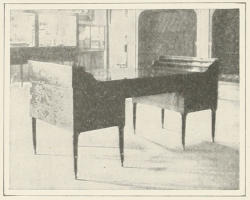
WASHINGTON’S WRITING TABLE
Slowly the storm blew off. The commission set up under the treaty in London awarded American ship-owners and merchants more than ten million dollars in damages for their losses; trade quickened at every port because of the renewed privileges of commerce with England. The country had obviously gained more than it had conceded, and tardily saw the debt it owed to Mr. Jay and to the administration, whose firmness and prudence had made his mission possible. But in the mean time things had been said which could not be forgotten. Washington had been assailed with unbridled license, as an enemy and a traitor to the country; had even been charged with embezzling public moneys during the Revolution; was madly threatened with impeachment, and even with assassination; and had cried amidst the bitterness of it all that “he would rather be in his grave than in the presidency.”
The country knew its real mind about him once again when the end of his term came and it was about to lose him. He refused to stand for another election. His farewell address, with its unmistakable tone of majesty and its solemn force of affection and admonition, seemed an epitome of the man’s character and achievements, and every man’s heart smote him to think that Washington was actually gone from the nation’s counsels.
The country, moreover, had swung once again to the Federalists before Washington withdrew,—the one man whose personal force and command upon the country had given the party its field and opportunity. Federalist majorities were returned to both houses of Congress in the autumn of 1796, notwithstanding the French frenzy and the treaty; and Mr. Adams was chosen President. There was no longer any unanimous choice. Mr. Adams received seventy-one of the electoral votes; Mr. Jefferson received sixty-eight and became Vice President. It was a narrow margin of preference.
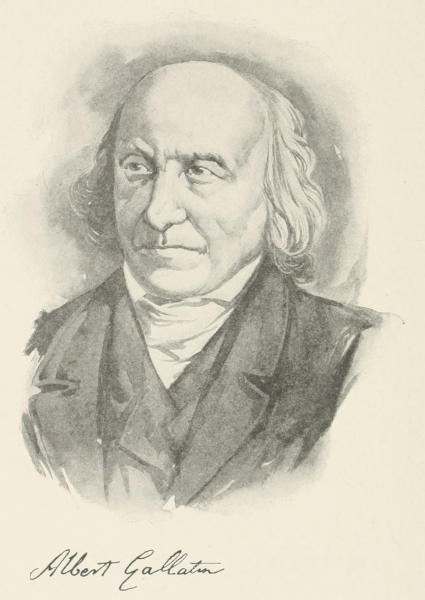
ALBERT GALLATIN
When Washington gave place to his successor a certain distinction seemed to pass from the office of President, which only he, whom all the world knew, could give it. Mr. Adams had a national standing second to no man’s save Washington himself; but he had not stood, as Washington had, in the gaze of the whole world, the maker of a nation; and when he became President affairs seemed to settle to a more workaday level, where parties could fight upon a parity, unembarrassed by the President’s personal prestige. Mr. Adams had shown a dignity, a capacity, and a devotion in the public service which had marked him both at home and abroad as a statesman of the highest principle and the most excellent gifts; but he was still the John Adams of the Revolution, stung by jealousies which he tried in vain to conquer, too sensitive, too hasty, too acid in judgment, erratic, intolerant, irascible, sometimes irresolute,—a man to trust in the long run and to stand loyal to with steady purpose, but not a man to love or to deem above parties.
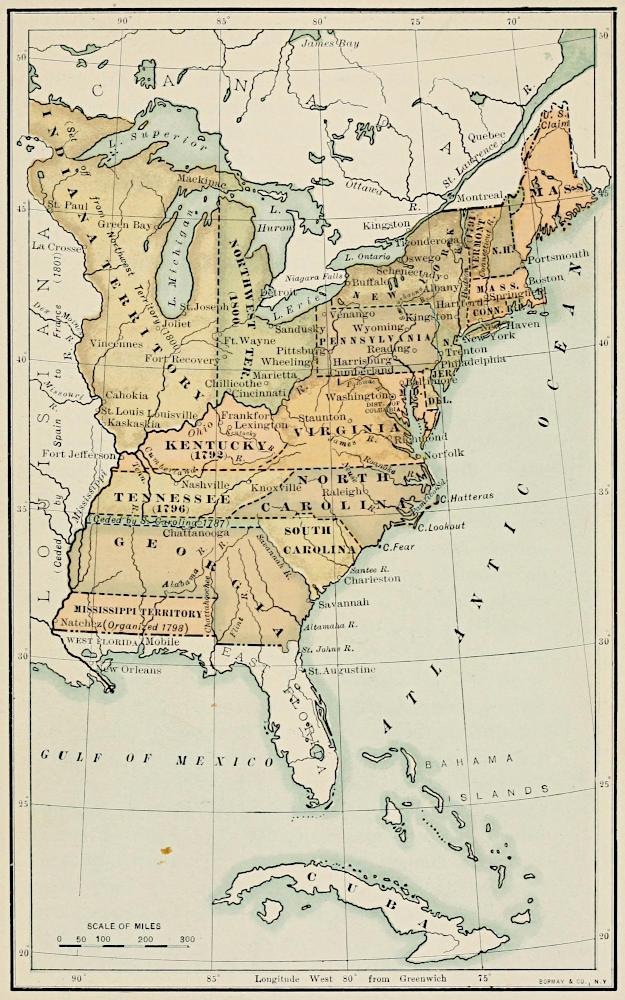
THE UNITED STATES, MARCH 4TH, 1801.
His four years of office saw the questions which had darkened and perplexed Washington’s second term mature and bear their unpalatable fruit. War with England had been avoided, but not war with France. France had hoped for and expected the success of the Jeffersonian Democrats in the elections; the French minister to the United States had even so far forgotten himself as to make a plea in the public prints for the principles and the party of Jefferson, the friend of France, and had uttered thinly veiled threats that the success of the Federalists in the presidential election would lead France to regard America as virtually an English dependency, to be treated as if as much an enemy as England herself. The cockade of the French republic became for the nonce the emblem of the partisans of Mr. Jefferson. The struggle for the presidency looked for a little like a game between French and English for political advantage. With such things in the air the success of the Federalists was the more assured. The country’s irritation over Mr. Jay’s treaty, it is true, had not cooled, and the Federalists seemed too much in the English interest to please men whose patriotism was quick to be jealous and take alarm; but the impudence of M. Adet, the French minister, and the unblushing aggressions of the French and their partisans were for the moment worse yet, and the Federalists kept their posts of authority.
When once the result of the election was known France put away all pretence of friendship. Already she had declared herself released from the treaties of commerce and alliance by which she had bound herself to the United States in 1778,—released by the mere fact that Mr. Jay had negotiated and the United States had accepted a treaty with England. Ever since 1793 she had been seizing American ships and cargoes on the high seas as she pleased, as freely and with as little regard for right as England herself. Her depredations upon the commerce of the country had been less serious than those of England only because her cruisers were less numerous than the English and did not move as freely upon the seas. Now she quickened her aggressive action, like a power at war. She even extended her seizures, searches, and confiscations to the very waters of the United States themselves. General Washington, during the closing months of his term as President, had recalled Mr. Monroe, then the minister of the United States at Paris, deeming him too much infatuated with French principles, too sentimental a friend of the government to which he was accredited, to act with proper vigor. The Directory of the heady republic refused to receive any other minister in his place until its grievances against the United States had been redressed. Its grievances were summed up in America’s friendship for England, and Mr. Jay’s treaty as an earnest of that friendship. Mr. Adams hurried three ambassadors over sea to secure accommodation and avoid war: Mr. John Marshall, Mr. Elbridge Gerry, and Mr. Charles Cotesworth Pinckney (June, 1797). M. Talleyrand, the foreign minister of the Directory, would not treat with them in person. His agents (MM. “X,” “Y,” and “Z,” the ambassadors designated them in their despatches) prescribed terms alike dishonorable and humiliating; even demanded money, “a great deal of money,” “for the pockets of the Directory,” as the price of accommodation; and war became inevitable. “I will never send another minister to France,” declared Mr. Adams, in a message to Congress, “without assurances that he will be received, respected, and honored as the representative of a great, free, powerful, and independent nation.”
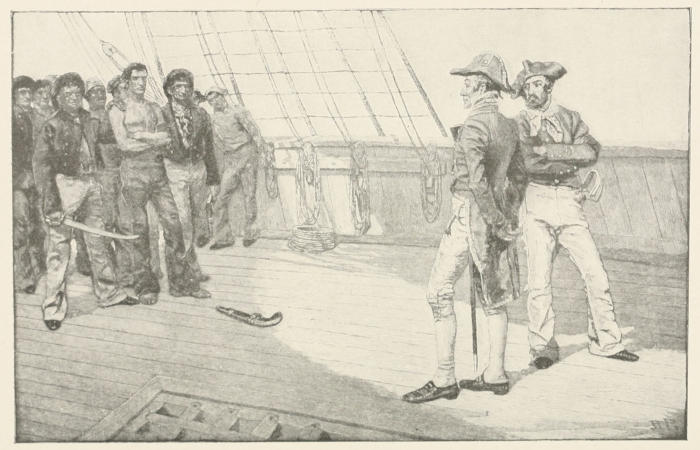
IMPRESSMENT OF SEAMEN
The war was brief and of no significant consequence in itself. No formal declaration of hostilities was made. There was only a season of sharp retaliation. A separate navy Department was created (April 30, 1798); existing treaties with France were declared abrogated (April 7, 1798); American vessels of war were expressly authorized to attack French cruisers (July 9, 1798); and active reprisals were begun. The little navy of the country, but just now reinforced by a few new frigates of first-rate strength, acted upon the permission to fight with spirit and success. American cruisers and privateers alike set about preying upon French commerce with the activity of genuine satisfaction. Measures were taken to raise an army, and General Washington was asked to take command of it. The publication of the extraordinary proposals of MM. X, Y, and Z to the American commissioners had effectually silenced every partisan of France, and war with the country’s one-time friend and ally had become for the moment almost popular. But fortunately the exposure of the intrigue attempted by the agents of M. Talleyrand had made a most unfavorable impression in France itself; Talleyrand saw that he must undo what he had done; and intimations were given early in 1799 that France would receive a minister from the United States and discuss honorable terms of accommodation. By the time commissioners of the United States were ready to discuss terms at Paris (March 30, 1800) the Directory was no longer in charge of the affairs of France. The Consulate had been set up, and Napoleon Bonaparte was First Consul, a master of men at least, with whom it was possible to make definite agreements, as if with a real government.
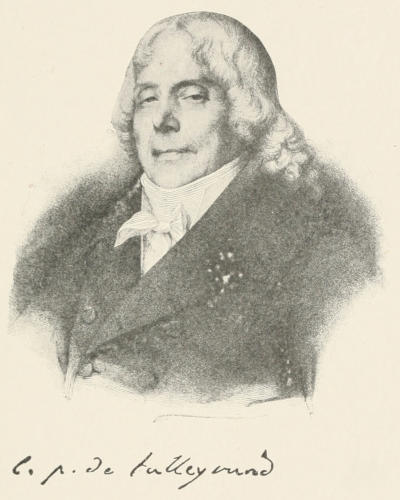
PRINCE TALLEYRAND
The terms of agreement, however, were by no means easy to decide upon. The American commissioners were instructed to secure indemnification for the losses France had wrongfully inflicted on American commerce; they were also instructed to secure the formal abrogation of the treaty of 1778, which had accorded to French privateers privileges in American ports which it was no longer wise or convenient to accord them, and which had pledged the United States to such a defence of the French possessions in the West Indies as they no longer felt justified in undertaking. But they could not get both indemnification and a release from the treaties. They were obliged to forego compensation for the French spoliations in order to get peace and relieve themselves of the burdensome obligations of the treaty of 1778, which, there having been no formal declaration of war, they could not insist upon having escaped from. A twelve-year convention, restoring amicable relations between the two countries, securing neutral ships against search and seizure, embodying a sensible and enlightened code of definitions with regard to the rights of belligerents and neutrals, and adjusting minor questions of dispute, was all that they could get. By February, 1801, such terms as could be had were agreed upon. It was Mr. Jay’s experience repeated.
But the war had ruined the great party whose leaders had framed the constitution and set the government afoot. At first it had seemed its legitimate triumph, and something like the hearty support of the country had been extorted. The Federalist majority in the House of Representatives, doubtful of its power at the outset of Mr. Adams’s administration, had by the elections of the autumn of 1798 been made strong and confident. The country evidently had not been displeased to see “France and all the world” convinced, as the President had declared he meant to convince them, that the people of the United States were not “a degraded people, humiliated under a colonial spirit of fear and sense of inferiority”; and opinion seemed about to regain tone and self-possession.
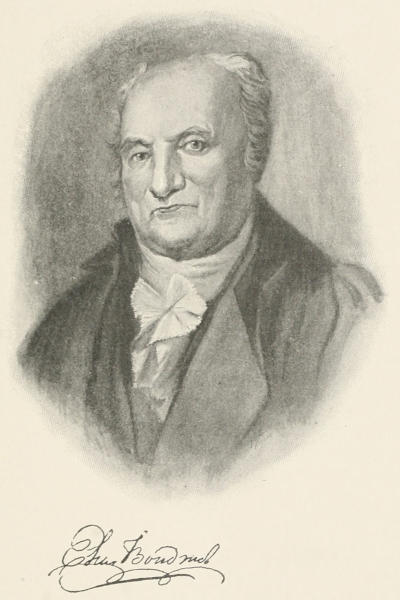
ELIAS BOUDINOT
But moderate counsels forsook the ruling party in the midst of its apparent triumph. Throughout four whole years the country had been kept under the excitement and anxiety of the trouble with France, not knowing whether it was at war or at peace,—from the recall of Mr. Monroe in December, 1796, until the conclusion of the convention with France in September, 1800. Throughout all that time a storm of bitter defamatory criticism had beat upon the Federalists, which unsettled their temper and broke their self-restraint at the very height and crisis of their success. They had been intrusted with the conduct of the government again and again by the free suffrages of the country, and yet they were assailed with every slander and defamed from half the presses of the towns by the republican partisans of France, who were also suffered and encouraged to be spokesmen against them in every domestic policy. It intensified their resentment and seemed to them a most sinister sign of peril to the country and its government that a great many of the men who were their bitterest enemies, and who used the public prints most scandalously and unscrupulously against them, were foreigners,—Frenchmen and Englishmen who were not even citizens, but mere adventurers, the irresponsible agents of a reckless and almost revolutionary agitation, which might jeopard the very existence of the young government, but ten years established, over which they had been bidden to preside. They therefore, during June and July, 1798, pressed through Congress four drastic statutes, aimed against aliens and against all, whether aliens or citizens, who should foster any kind of sedition. A Naturalization Act (June 18, 1798) increased the period of residence for those who would become citizens from five to fourteen years. An Alien Act (June 25th) and a Sedition Act (July 14th) authorized the arrest and deportation of turbulent and dangerous aliens at the discretion of the President, even in time of peace, and the arrest, trial, and punishment of any one who should either unlawfully combine with others to oppose any measure of government or “write, print, utter, or publish” anything with intent to defame the President or the houses of Congress, or to weaken their authority and bring them into contempt. An act directed against alien enemies (July 6th) authorized the President in time of war to restrain, secure, or remove from the country, as he pleased, all subjects of a hostile power.
Washington himself approved of these extraordinary laws, so passionately did he love order, hate faction, and fear for the safety of the new Union. Patrick Henry commended them, stout and consistent advocate though he was of the pure principles of thorough democracy. But the whole country presently knew how fatally the Federalists had blundered in passing them. The Alien law deprived foreigners of every privilege “without accusation, without jury, without public trial, without confrontation of the witnesses against them, without having witnesses in their favor, without defence, without counsel,” upon the mere suspicion of the President. The Sedition Act cut perilously near the root of freedom of speech and of the press. There was no telling where such exercises of power would stop. Their only limitations and safeguards lay in the temper and good sense of the President and the Attorney General. Protests came from every part of the country, and grew ominously in volume from month to month,—and petitions for repeal couched in every form and bearing thousands of signatures. It would have been well had the opposition stopped at petitions; but it did not. The legislatures of Kentucky and Virginia went further, much further. Each, in a series of resolutions, drawn in solemn form and sent through their governors to the legislatures of all the other States, as in the days of Parliament’s aggression, called the attention of the entire country to definitions of constitutional right as between the people and the federal government which were in the last degree radical and significant, and which seemed to carry with them an air as it were of revolution.
The Kentucky Resolutions (November 8, 1798) defined the constitution of the Union as a compact, whereby the States, the contracting parties, had set up a federal government of definitely specified and strictly limited powers, reserving to themselves or to the people every power not plainly granted; and declared that every State, as a party to the compact, had the right to judge for itself whether the fixed limits of the constitution were observed or transcended by the federal authorities: that it had the right to declare every unwarranted exercise of power void and unconstitutional, and to call upon the other States, its partners in the Union, to join with it in measures of redress. The Alien and Sedition laws they unhesitatingly and emphatically pronounced unconstitutional and of no legal effect. The Virginia Resolutions (December 21, 1798), briefer and milder in tone, were yet equally express in their doctrine that “in case of the deliberate, palpable, and dangerous exercise” by the federal government of powers not granted “by the plain sense and intention” of the constitution, “the States who are parties thereto have the right, and are in duty bound, to interpose for arresting the progress of the evil, and for maintaining within their respective limits the authorities, rights, and liberties pertaining to them.” Mr. Jefferson had drawn the original draft upon which the Kentucky Resolutions were based; Mr. Madison had drafted the Virginia Resolutions,—Mr. Madison, joint author of the Federalist papers, friend and coadjutor of Hamilton and Washington in the formation of the government of the Union,—a man whose reaction against Federalist policy and whose slow alienation from Washington and Hamilton might well mark for every thinking man the measure of the Federalist mistake with regard to the temper and inclinations of the people they were governing. Mr. Jefferson’s original draft, used by Mr. Breckinridge in framing the Kentucky Resolutions, had gone the length of proposing that each State should “take measures of its own for providing that neither these acts nor any others of the general government, not plainly and intentionally authorized by the constitution, should be exercised within their respective territories”; and in November, 1799, the legislature of Kentucky acted upon the suggestion and added to its former Resolutions the even more startling declaration “that a nullification” by the States “of all unauthorized acts done under color” of the constitution was “the rightful remedy.”
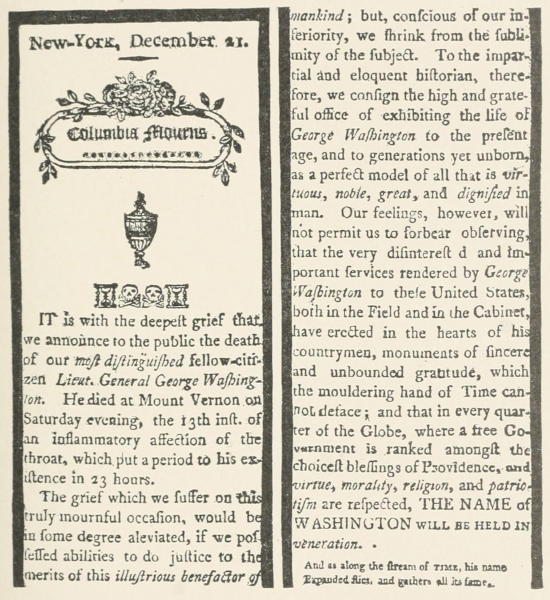
ANNOUNCEMENT OF THE DEATH OF WASHINGTON
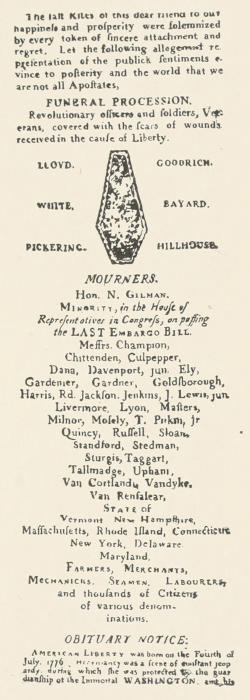
ADVERTISEMENT OF FUNERAL OF LIBERTY
The “nullification” of federal action by a single State went much beyond the meaning Mr. Madison and Mr. Jefferson had intended the Resolutions to speak. They meant only that, in case of an exercise of federal powers by Congress which was obviously, palpably excessive, the methods supplied by the constitution itself must be used to check it. “The ultimate arbiter,” as Mr. Jefferson said, as he looked back to these things in his old age and reassessed his principles of action, “the ultimate arbiter is the people of the Union, assembled by their deputies in convention, at the call of Congress, or of two-thirds of the States. Let them decide.... It has been the peculiar wisdom and felicity of our constitution to have provided this peaceable appeal, where that of other nations is at once to force.” Congress must not itself be suffered to determine its own powers unchecked. The Resolutions said nothing explicitly of constitutional method; but they implied much, and rang out very significantly upon the tense air of the time. Though no other legislature was willing to echo them, men noted their outspoken doctrine of federal limitations and State rights. The opposition recognized in them a formidable weapon of defence; and no one doubted that it was more than a passing sign of the times that such things should be said. There underlay all this something deeper than the mere antagonisms of party.
Clearly the Federalists had gone too far. The indictment of their enemies seemed proved,—they were the party of power, of autocratic power, and not the party of popular privilege. While the bad impression was at its height, moreover, a serious rift was disclosed in the counsels of the party itself. Mr. Adams broke with Mr. Hamilton. He had continued General Washington’s cabinet in office upon his own accession to the Presidency: and had thus put himself in the hands of men who looked to Mr. Hamilton, rather than to himself, for guidance, though Mr. Hamilton was himself no longer a member of the cabinet. The President frequently found it necessary to act without their knowledge or assent, in order to act with independence and without embarrassing interference from outside quarters. He had sent the embassy which concluded peace with France without their knowledge or approbation, greatly to their chagrin and to the deep annoyance of Hamilton, whom they deemed their party leader. Neither Hamilton nor they had wished peace with France. At last Mr. Adams found the friction intolerable. He dismissed his ministers, and substituted others whose unquestioning allegiance to himself he could command, branding the men he dismissed as “a British faction”; and so made the breach with Hamilton complete.
There was here something more than a mere breach between men. It was a breach which cut to the very foundations of the party itself. Hitherto Mr. Hamilton had been the real master of Federalist policy; but he had ruled the party through a minority in its ranks, not by persuasion or any tact of popular force, but by sheer mastery over men, a power in counsel, a gift of constructive statesmanship unmatched among his contemporaries. Mr. Adams disliked most other strong-willed men, and Mr. Hamilton had made himself almost his open enemy; but something deeper than mere personal antagonism separated them. It was spoken out in Mr. Adams’s angry charge that Hamilton and those who adhered to him as their personal chief were nothing better than “a British faction.” That was the charge of the opposition. That was the feeling of the county. It was unjust; it was false; but it was not without foundation. It was but a crude, undiscriminating way of interpreting the plain fact, which Mr. Hamilton made hardly a pretence of concealing, that the men who had hitherto led the Federalist party feared democracy, distrusted it with an ineradicable distrust, believed a strong government necessary, which should be intrusted to men of the older traditions of power and of statesmanship received from over sea, deemed the English government, if stripped of its abuses, the safest model of free institutions, and thought England the only European power worth keeping close friendship with in international dealings. They had not accepted the ideals of America set up at the Revolution; had refused to acquiesce in it as a definitive triumph of democracy. They were seeking to perpetuate the ideals of an older world, a more ancient conception of government. It was their lack of sympathy that the country felt. It was their unwillingness, their inability to act wholly for America in every matter of policy, without regard to their preferences for this alliance or that, that made Adams fling them off as a British faction.
And Adams spoke the real preferences of the rank and file of the Federalist party itself,—the very party which, until that day of breach, Mr. Hamilton had led with an almost undisputed supremacy. It had doubted and been vaguely uneasy even while it obeyed. Hamilton once out of command and its opinions freed from his masterful domination, its ideals in affairs showed no radical difference from those of the opponents whom Jefferson was drilling against it. Federalist voters were not infatuated with the French, as the men of the Democratic clubs had been; they did not dread, as Mr. Jefferson did, the conversion of the government of the United States under their leaders into a centralized tyranny by the mere process of using the powers of Congress and the President with vigor and courage and a touch of constructive statesmanship; they relished the predominance of men who had the temper to rule; but for the rest they were not of Mr. Hamilton’s making. They thought first of America in their hopes for the future and their plans for the present, dreaded democracy as little as they dreaded the tyranny of constitutional presidents, were heartily for such measures as should give the country independence and a free hand for its affairs, thought more of their own interests than of handsome or seemly alliances abroad, accepted democracy without squeamishness, and were robust believers in the happy destiny of their institutions. Mr. Adams was much nearer their spirit and temper than Mr. Hamilton and the group of masterful men whom he led; and his breach with Mr. Hamilton cut to the roots of the party itself. By the time another presidential election approached (1800) personal rivalries and antagonisms had robbed the party of coherence and leadership; it had lost its sense of unity; many who had voted with it felt their sympathies transferred to the other side; and the elections brought it humiliating defeat. Mr. Adams was personally popular enough, commended by his sturdy character, his manifest good faith and independence, his frankness and courage; but the section of his own party with which he had avowed himself out of sympathy was not loyal to him. Hamilton publicly argued that he was unfit for the office he held, egotistical, jealous, indiscreet, and of unsound views in matters of administration; Mr. Jefferson had at last imparted compactness and self-reliant vigor to the Democratic Republican ranks which he led; and Mr. Adams failed of re-election.
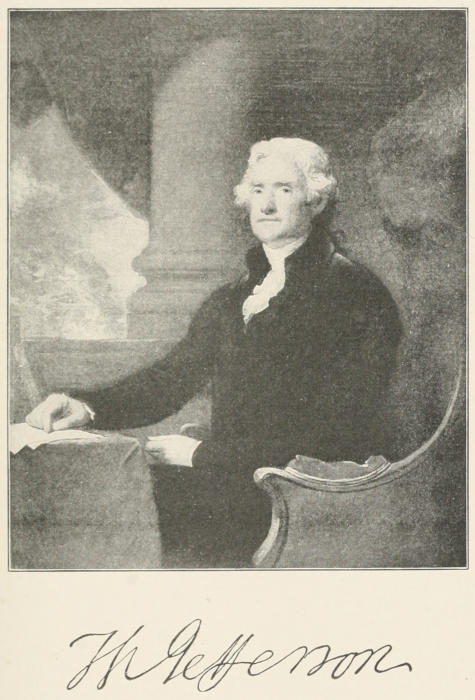
THOMAS JEFFERSON
No one was chosen President by the electors. As the electoral clause of the constitution then stood, each elector was directed to cast his vote for two persons, without designating which was his preference for President, which for Vice President; and when the votes were opened they were found to stand: seventy-three for Mr. Jefferson, seventy-three for Mr. Aaron Burr, Mr. Jefferson’s accomplished lieutenant in New York; sixty-five for Mr. Adams; sixty-four for Mr. Pinckney. It was necessary in such a case that the House of Representatives should itself select a President, from the two leading candidates; and the Federalists still, though for the last time, controlled the House. For a little while they were tempted to put Mr. Burr into the Presidency, rather than endure Mr. Jefferson; but that intrigue failed. Mr. Hamilton was too manly a politician to give it countenance for a moment. He denounced it roundly and induced the members of the majority to let Mr. Jefferson take the Presidency, to which he was clearly entitled by the well-understood preferences of the electors. But they yielded sullenly. They let Mr. Jefferson come in, not with their votes, but without them, by refraining from voting at all in sufficient numbers to leave his friends in a majority, and lost credit for good temper as well as for good faith.
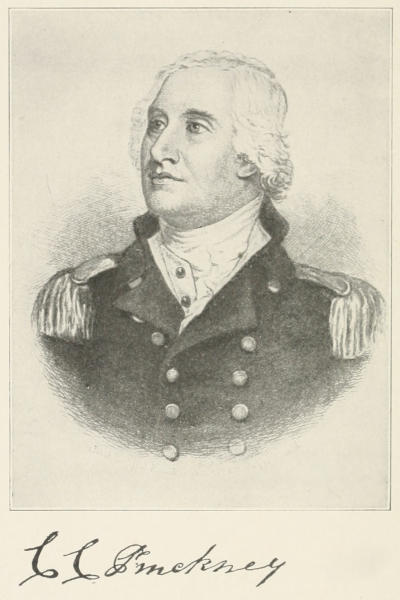
CHARLES C. PINCKNEY
Their last acts of power confirmed the impression of their critics that they neither trusted the people nor believed any but themselves capable of conducting the government or ruling the country. For more than three months after the presidential election they remained in control of Congress. They used their majority, when the result of the election became certainly known, to make themselves secure, as they hoped, of the possession of at any rate the judicial branch of the government. On the 13th of February, 1801, less than three weeks before the day upon which Mr. Jefferson was to become President, they put through Congress, by a strictly party vote, a Judiciary Act which very considerably enlarged the number of federal courts and judges and added some fifty thousand dollars to the annual judicial budget, notwithstanding the fact that the legal business of the country justified no such expansion of the federal judicial machinery; and Mr. Adams hastened to fill the new judgeships, as well as every other vacant place, great or small, with staunch Federalists. On the 31st of January he had appointed Mr. John Marshall, of Virginia, Chief Justice of the Supreme Court of the United States, an approved lawyer, but a tried Federalist, and but just turned of forty-five. The government of the country passed into Mr. Jefferson’s hands as stoutly fortified against change or misuse as a solidly Federalist personnel in the courts could make it.
The whole face of affairs, the very aspect of the government itself, seemed to change when Mr. Jefferson became President. For one thing, the seat of government was transferred from Philadelphia, the busy city and mart of trade, with its seventy thousand inhabitants, to the rural spaces of the new federal District of Columbia. The removal had been effected in the summer of 1800, during the closing months of Mr. Adams’s administration, and had suitably marked the exeunt of the Federalists, the party whose rule had been planned to draw about the federal government the support of the merchants, the bankers, the property owners, the chief men of means and influence in society and affairs, the men of the centres of trade, whose interests were larger than those of any single State or neighborhood. An extensive city, to be called “Washington,” had been plotted in the fields and woodlands which lay upon the northeastern bank of the Potomac, on the portion of land which Maryland had ceded for a federal district. The building of an official residence for the President had been begun in 1792, and the corner-stone of a capital building had been laid by General Washington in September, 1793. Some quarters for the executive departments had been erected; a few houses had been built here and there at long intervals upon the projected streets of the new city; and speculators had bought land there in expectation of high prices to come. But only one wing of the Capitol was completed when the government was at last actually transferred. The Congress had to be temporarily housed. The President’s residence was the only dwelling of any pretensions ready for occupancy. The streets of the quiet place ran through bits of forest, like avenues in a wild and wooded park, or were lost in open fields, where there was neither fence nor dwelling. There were not houses enough in all the spreading plot of projected avenues and squares to furnish members lodging during the sessions of the Congress. Some had to make their way as best they could over several miles of soft and miry road to find quarters. The stately proportions of the White House and of the rising Capitol looked strangely enough in such a place. Life there was a sad exchange for the comforts and the social stir and brightness of Philadelphia; and government could not seem there the handsome thing of etiquette and dignity and formal show of authority that the Federalists had made it appear in a city.
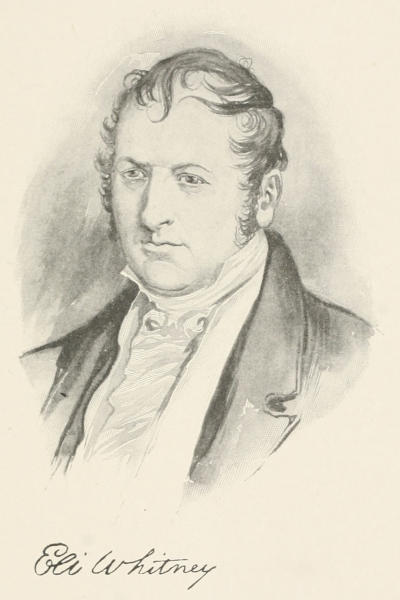
ELI WHITNEY
It was the more suitable place on that account for the coming in of Mr. Jefferson, and the change of scene and atmosphere which was to come with him. Here was a place for real democracy to be brought in, without show or circumstance. Mr. Adams set out upon his long ride homeward early on the morning of the 4th of March, having no stomach to wait and see Mr. Jefferson take the Presidency. The new President, accompanied by a few friends, and escorted by a company of Virginian artillery, as guard of honor, walked quietly from his boarding house to the Capitol; there took the oath of office and read his address to the people; and a new régime was inaugurated. John Marshall, the new Chief Justice, twelve years his junior, administered the oath; and the two men, as they stood thus face to face, Virginians both, bred to the same principles of life and courtesy, but opposite in every principle of politics, must have seemed to give each his silent challenge to the future in the act.
A noteworthy and momentous thing stood revealed in the simple ceremony. The democratic forces which had set the Revolution ablaze, and which had operated through seven years of war and reconstruction to work a radical change in the temper and practice of the whole country in public affairs, now once again reasserted themselves and took possession of the seats of government. They had been temporarily discredited during the troubled years when the Confederation was the makeshift government of the country,—discredited by the jealousies, the riotous disorders, the gross turbulence and distempers of the time. The new Union had been formed and the new constitution framed to check and govern them. The Federalists’ twelve years’ labor of organization had been undertaken and carried forward while the reaction lasted: to make strong the forces of conservatism, school the people in order and self-restraint, and make solid once more the foundations of authority. Democrats had spent their lungs, the while, in the cries of the French Revolution and in passionate outbursts against England and against all who parleyed with her. They had seen no vision of national duty, no workable creed until the Alien and Sedition laws were passed, and the Sedition law enforced against editor and pamphleteer. Then they had had sight at last of the constitutional principles and the domestic policy for which they must fight. Mr. Jefferson and Mr. Madison had cleared their thought with the strong sentences of the Kentucky and Virginia Resolutions,—no programme, but a warning cry which no man failed to hear or to understand; and the election of 1800 disclosed, behind Mr. Jefferson, no longer a body of agitators merely, but a national party, ready to play the sober rôle of administering a government.
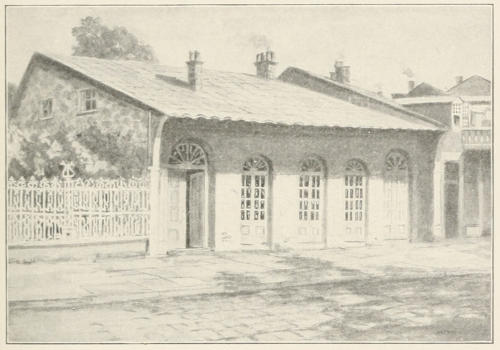
OLD COURT HOUSE, NEW ORLEANS
Nothing could exceed the fine tact and gentleness with which Mr. Jefferson gave tone of order and patriotic purpose in his inaugural address to the new way of government his followers expected of him. “We are all Republicans, we are all Federalists,” he exclaimed; “we are not antagonists, but live by an absolute acquiescence in the decisions of the majority, the vital principle of republics.” “To preserve the peace of our fellow citizens, promote their prosperity and happiness, reunite opinion, cultivate a spirit of candor, moderation, charity, and forbearance towards one another,” are “objects calling for the efforts and sacrifices of every good man and patriot.” “Let us unite with one mind,” he urged, in tones so quiet, so sweet and sincere of accent as to calm every mind they touched; “let us restore to social intercourse that harmony and affection without which liberty and even life itself are but dreary things. And let us reflect that, having banished from our land that religious intolerance under which mankind so long bled and suffered, we have yet gained little if we countenance a political intolerance as despotic, as wicked, and capable of as bitter and bloody persecutions.”
And what he did soon gave excellent proof of his sincerity. Mr. Jefferson was an interesting mixture of democrat, philosopher, and patrician. In taste and occupation and habit he touched and was familiar with the life of the cultured and moneyed classes, the aristocracy of the young nation, which constituted the Federalist strength. In creed and principle he was the comrade and work-fellow of the people. By gift of insight and genius for organization he was a leader of parties and of concerted action in affairs. An infinite sensibility taught him moderation, lent him tact, pointed out to him the practicable courses of persuasion and the certain prospects of popular support. His personal charm, his high breeding without arrogance or pretence, gave him hold upon every one with whom he came in contact. No other man could have so moderated, or so completed, a revolution in the spirit and conduct of the government.
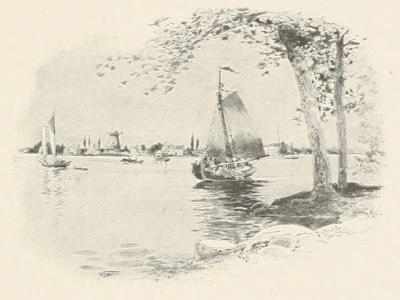
VIEW ACROSS THE NORTH RIVER, 1796
For a revolution it was, profound and lasting. Undoubtedly the chief merchants, the chief men of means and of responsible trust, the chief men of parts and learning and social influence in the country were Federalists. They looked upon Mr. Jefferson as “an atheist in religion and a fanatic in politics”; and they dreaded the direct thrusts of democracy at the careful system they had reared, as likely to be little less than the throwing down of the very props of society itself. Mr. Hamilton, more than any other man in their ranks, spoke their purposes and fears. It had been his wish and effort at every turn of policy in which he had any part to make the federal government virtually master of the affairs of the nation, fortified with an overwhelming strength against every force, whether of the States or of individuals, that might antagonize it. He believed, as his enemies supposed, in the maintenance of a strong army, even in time of peace. He wished to see the States absolutely subordinated to the general government. He thought the opinions of the masses an unimportant and negligible thing in the choice of policy. “No man,” he said, “has sacrificed or done more for the present constitution than myself; and, contrary to all my anticipations of its fate, I am still laboring to prop the frail and worthless fabric.” Assuredly he had labored for it. He had played no small part in establishing it also. But he had wished to have it serve as a buttress against democracy, a safeguard against the fickle play of opinion and the caprice of men unschooled in affairs.
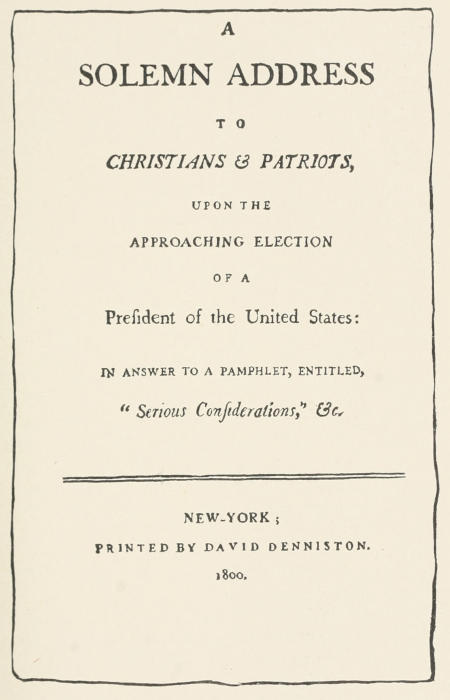
TITLE-PAGE OF A CAMPAIGN DOCUMENT, 1800
Mr. Jefferson’s was an opposite school of thought. “I am persuaded,” he said, “that the good sense of the people will always be found the best army. They may be led astray for the moment, but will soon correct themselves.” His belief was wholly sincere, aristocrat though he was in life and breeding and in instinctive aptitude for power; and it was wholesome for the country that the forces he so moderately and graciously represented should thus early gain their inevitable ascendency. It was impossible that the ruling classes of the older days should continue to govern the young nation now springing into life. Mere growth and change of life had broken every bond of habit and restraint of form. The nation of 1800 was not even the nation of 1790. Its population had grown in that decade from 3,929,214 to 5,308,483, and had spread itself northward and westward and northwestward, to Lake Ontario and round about to the St. Lawrence and Lake Champlain; to Lake Erie and into the Ohio country; and into Kentucky and Tennessee, until great communities mustered there more than three hundred thousand strong. Vermont and Kentucky and Tennessee had been added as States to the Union, and had brought the spirit of the frontier with them into its counsels. It was not the cities that grew, though they had their growth with the rest, so much as the spreading country-sides. The great spaces of virgin land at the west were filling in, and there stirred everywhere the air of enterprise and change.
No group of men could restrain, or measure, or even guide the quick, expanding life of that young people, before whom all ways of conduct and endeavor were open to be tried and made test of, in whose hands all things were making and to be made. Their industry kept pace with their numbers. The Parliament in England forbade any one to take out of England any industrial machinery whatever, or even the plans of machinery invented or perfected there; but it was impossible to keep as a secret and monopoly what master mechanics who chose to go to America could take away in their heads and in their trained and skilful fingers; and slowly the carefully guarded secrets of manufacture passed over sea. By 1790 Samuel Slater had set up a cotton-spinning factory, with complete machinery after the English models, at Pawtucket, in Rhode Island. In 1793 Eli Whitney, a Connecticut school master living in Georgia, invented a practicable gin for clearing cotton of its tenacious seed, and the South had no sooner realized what this new instrument meant than it suddenly sprang into competition with India and Egypt in supplying the world with cotton. In 1791 less than two hundred thousand pounds of cotton had been shipped out of the country; in 1800 nearly twenty million pounds went over sea. Everything that America produced found market, despite all obstacles. The trouble with England while Washington was President, the trouble with France while Mr. Adams ruled, had checked and jeoparded trade; but trade had strengthened and increased with an irrepressible growth, nevertheless. Nearly twice as much flour and wheat left the ports in 1800 as had been sent out in 1791. American ships were to be found in every sea, and carried cargoes of every sort.
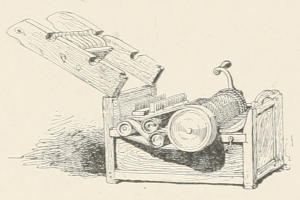
WHITNEY’S COTTON GIN
No class or region or single school of politicians or thinkers could keep the mastery or determine the course of such a people, growing after such a fashion, on such a continent. Democracy, free force, an equal footing for all men in opinion, effort, and attainment were the very conditions of its being: there could be no leading-strings. Mr. Jefferson spoke the spirit of the day, its only acceptable principle in affairs. The government had passed into the hands of the people’s party.
Its programme, as Mr. Jefferson spoke it, accorded with its origin: The restriction of federal powers within strait constitutional limits, an unembarrassed field for the powers of local self-government within the several States, the payment of the public debt, the reduction of the armed forces of the country, and consequently of the taxes, to the lowest practicable point, and as nearly as might be free trade at the ports: a government simple, inexpensive, unmeddlesome. Some of the latest and most partisan acts of the Federalists the new Congress, with its working majority of Republicans, proceeded to undo. The Judiciary Act, by which the Federalists had called new federal courts into existence to fill them with judges of their own party principles, was repealed, and the new courts were abolished almost before they had been organized. The other officials whom Mr. Adams had put into office during the closing days of his term were dismissed, and Republicans were put in their places. A few Federalist office-holders who had been offensively loud, partisan, and industrious in working against Mr. Jefferson’s election, and who had used their official power to influence the vote at the polls, were also removed and replaced by men of the President’s party. Sixteen federal officials were dismissed without cause assigned, in order, no doubt, to put the public service more in accord with the views of the new head of the government. All who were imprisoned under the odious Sedition law were at once pardoned and released. The law itself had expired by limitation; and Mr. Adams had not used the authority conferred upon him by the law against aliens. The Federalist Naturalization law of June, 1798, which required a residence of fourteen years as a condition precedent to the acquisition of citizenship by a foreigner, was repealed, and the old period of five years restored.
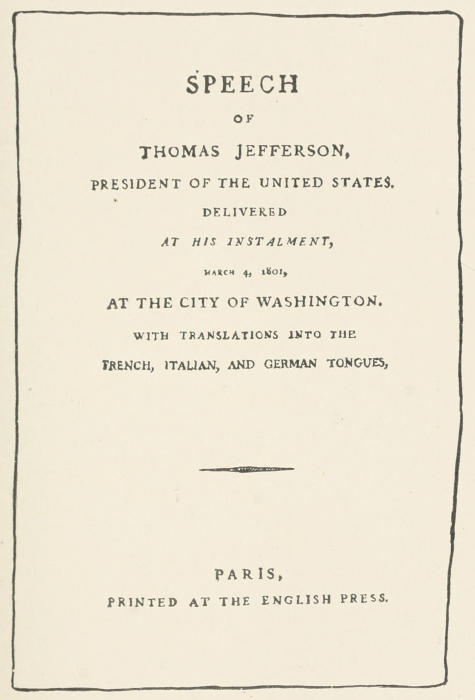
TITLE-PAGE OF JEFFERSON’S INAUGURAL ADDRESS
But there the reaction stopped. The new Congress reduced the federal taxes, and the customs duties at the ports; cut down the army and navy establishments; retrenched expenses and lessened burdens, as had been promised and expected; but the despondent forebodings of those Federalists who had looked to see a fatal retrogression in the character of the government were not fulfilled. The people’s men were not, after all, “Jacobins and miscreants,” and Mr. Cabot was apparently not yet justified in considering “democracy to be the government of the worst.” Mr. Jefferson called Mr. Madison to the Secretaryship of State, a man whom all the country knew to be a patriot and a statesman. He made Albert Gallatin, of Pennsylvania, Secretary of the Treasury, and financiers soon learned to trust the clear-headed Swiss for judgment and capacity almost as much as they had trusted Mr. Hamilton himself. There was, at any rate, no revolution in the business methods of the government.
Mr. Jefferson was too wise a politician to alienate the very men whose suffrages had brought him into office. He knew that many thoughtful men who had before always voted with the Federalists had in the last election voted for the Democratic Republican electors,—not because ready to see the government experimented with, but because they hated the taxes with which the Federalist Congresses loaded them, disliked the new tone and temper of the Federalist leaders, and believed that, for all they were so radical in their talk, the leaders of the opposition would simplify the government without weakening it or doing it damage. He knew that he was on trial to prove his conservatism as well as to prove his capacity for reform. He meant to prove himself no enemy of an efficient federal government, but only an enemy of extremes.
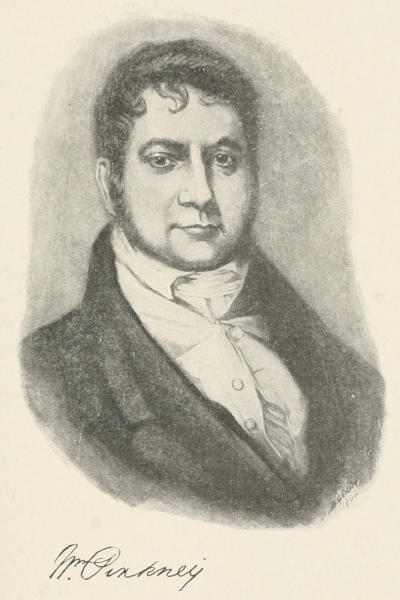
WILLIAM PINKNEY
It turned out that he had judged the temper of the country and the posture of affairs to a nicety, and had brought in a new régime which was to give its opponents abundant time to assess its qualities. Mr. Jefferson remained eight years in office; and handed on the presidency to men of his own school of political principle who kept it for sixteen years more. He was elected for a second term (November, 1804) by an overwhelming majority. Mr. Charles Cotesworth Pinckney and Mr. Rufus King, the candidates of the Federalists, received only the votes of Connecticut and Delaware, added to two of the eleven votes of Maryland. The country had turned with a sort of mild enthusiasm to the new party, which seemed with every year to grow more national and more typical of the natural disposition and principles of America. The more ardent Federalists grew very black and bitter under the sharp discipline of such a change, and talked intemperately and with a touch of reckless disloyalty of breaking up the Union rather than submit to the new régime. Hamilton, more wise and more patriotic, rebuked them passionately. “You are going to Boston,” he wrote to Colonel Trumbull. “You will see the principal men there. Tell them from me, as my request, for God’s sake, to cease these conversations and threatenings about a separation of the Union.” But Mr. Hamilton’s influence was presently withdrawn. Mr. Burr, the Vice President, stung by Hamilton’s attacks in a bitter political quarrel, in which words ran hot and unguarded on both sides, challenged him to a duel, which ended in a fatal tragedy (July, 1804). Mr. Hamilton was killed, and the one commanding figure among the Federalists was removed. They lost influence with every election, and the hands of the Republicans were free, in the presidency and in Congress.
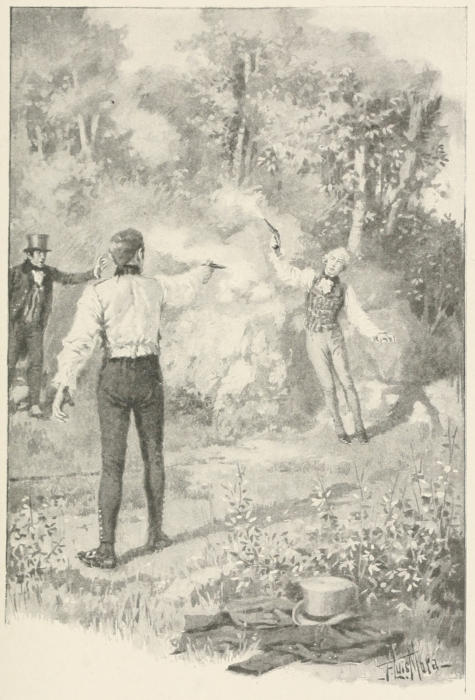
THE HAMILTON-BURR DUEL
The new unanimity in affairs sprang, not out of the repeals, retrenchments, and reforms of the party newly come to power, so much as out of its popular action in national affairs. For all their professions of an opposite set of principles in government, its leaders acted as its more conservative supporters had expected,—very much as Washington or Adams or Hamilton would have acted, when there was occasion to vindicate either the authority or the interests of the Union. Mr. Jefferson was hardly installed in office before news reached America that Spain had re-ceded the great province of Louisiana to France. It was one thing to have all the western bank of the Mississippi, its outlet at the Gulf, and all the continent between the Mississippi and the Pacific controlled by Spain, who had lost her power in the world; but it was quite another to let it pass into the hands of France, and Bonaparte her leader. “The cession of Louisiana and the Floridas by Spain to France,” wrote Mr. Jefferson, the lover of peace and friend of France, to Mr. Livingston, the American minister at Paris, “completely reverses all the political relations of the United States, and will form a new epoch in our political course. There is on the globe one single spot the possessor of which is our natural and habitual enemy. It is New Orleans, through which the produce of three eighths of our territory must pass to market. France, placing herself in that door, assumes to us the attitude of defiance. Spain might have retained it quietly for years.... The day that France takes possession of New Orleans ... seals the union of two nations, who, in conjunction, can maintain exclusive possession of the ocean. From that moment we must marry ourselves to the British fleet and nation.” An intense excitement spread through all the western country, which grew to a still quicker fever when it was learned that the Spanish governor at New Orleans had practically closed the port against the western trade, by way of preparation for the transfer to France.
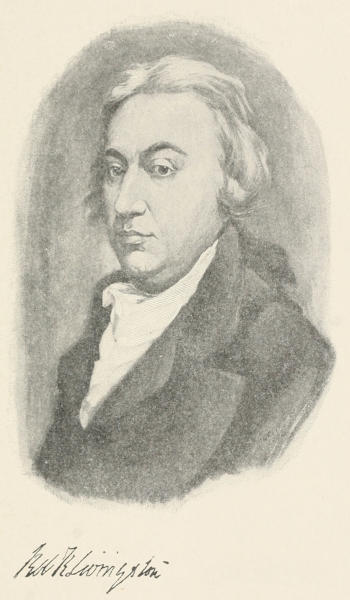
ROBERT R. LIVINGSTON
Mr. Monroe was sent to join Mr. Livingston at the French court. He was authorized to purchase Florida and a strip of the coast which should include New Orleans. He found Bonaparte willing to sell the whole of Louisiana or nothing. The American commissioners, therefore, exceeded their authority and agreed to buy the whole of the vast territory for fifteen million dollars. Bonaparte congratulated himself that he had replenished his purse for a war with England and had turned over to the United States lands and resources which should make them able themselves some day to humble England, even on the high seas and in trade.
Mr. Jefferson admitted that he could find nowhere in the constitution authority to buy foreign territory, and professed himself very anxious about the awkward situation that had arisen. He believed that such a purchase would be beyond the precedent even of Mr. Hamilton’s “implied powers,” and wished a constitutional amendment passed to make good what his representatives had done and he could not decline to accept. “I had rather ask an enlargement of power from the nation, when it is found necessary,” he said, “than to assume it by a construction which would make our powers boundless. Our peculiar security is in the possession of a written constitution. Let us not make it a blank paper by construction.” But in the same breath with which he urged his scruple he declared his readiness to abandon it. “If our friends think differently,” he said, “certainly I shall acquiesce with satisfaction, confiding that the good sense of our country will correct the evil of construction when it shall produce ill effects”; and the houses agreed to the treaty and voted the money for the purchase without so much as proposing an amendment (1803). The President acquiesced with startling facility in the apparent “necessity of shutting up the constitution” in such exigent cases of imperative policy. No one but the more extreme and partisan Federalists would patiently hear of any scruples in the matter. Nowhere except in New England was there sharp and acrid dissent.
Mr. Jefferson had given the country its first taste of his real quality in action. He was a Democrat, a people’s man, upon conviction, genuinely and with a certain touch of passion; but he was no lawyer. He stickled for a strict construction of the constitution only when he thought that a strict construction would safeguard the rights of common men and keep the old Federalist theories of government at arm’s-length: not because he disliked to see the country have power as a nation, but because he dreaded to see it put in bondage to an autocratic government. He wanted as little governing from the federal capital as might be; but as much progress as might be, too, and as much access of power and of opportunity to the people as a body of free men, unshackled by any too meddling government. It was his weakness to think it safe for the friends of the people to make “a blank paper” of the constitution, but the very gate of revolution for those who were not Democrats. If only Democrats led, “the good sense of the country would correct the evil of construction when it should produce ill effects”!
In the older and more stubborn Federalists it naturally bred a sort of madness to see Mr. Jefferson turn loose constructionist to do the very things which they most dreaded in their political calculations. In New England it seemed to many who were high in the Federalist counsels a thing not to be borne that a great field of expansion should be opened at the very doors of the South and West, to the undoing of the East, which had no free space in which to grow, and must lose her weight in affairs when the West came to its power. It was this that made them talk of disunion and of an independent Confederation to be set up at the North, despite the protests of Mr. Hamilton, who believed the purchase to be constitutional and knew it to be wise.
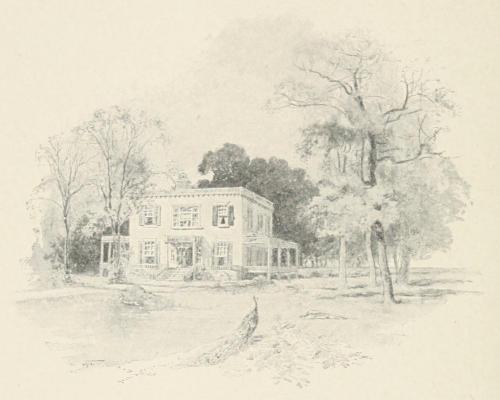
HAMILTON’S RESIDENCE. THE GRANGE
But they were in a hopeless minority. Even Mr. Jefferson’s attacks upon the judiciary, that last stronghold into which they had been driven, failed to bring on the storm they wished for. The process of impeachment was actively set afoot, that same year 1803, to effect the removal of such federal judges as made themselves most obnoxious to attack. The Democratic leaders of the House announced it as their theory of impeachment under the constitution that it was not a criminal prosecution but only a process of removal. Its ground, they said, need not be any crime or legal misdemeanor. Such acts sufficed to support it as made the judge called in question an instrument of opposition to the course of the government. A decision declaring an act of Congress unconstitutional would support it. It must be considered a means of keeping the courts in reasonable harmony with the will, of the nation. Here was enough and to spare to feed the fears and the rising anger of the Federalist leaders.
But Congress itself declined the theory. Judge Pickering was removed from office because of gross irregularities of conduct; but Judge Chase was acquitted, despite his violent partisanship outspoken from the bench. The Senate would not oust merely for opinions held, and the courts were safe. The Federalist leaders found, moreover, that their own partisans, upon whom they had thought that they could reckon, gave them no countenance. It was impossible to arouse or alarm them. Mr. Jefferson had proved no monster, after all, but an amiable and attractive gentleman, graceful in conciliation, and apparently honest in his desire to serve the whole country, spite of what was said against him.
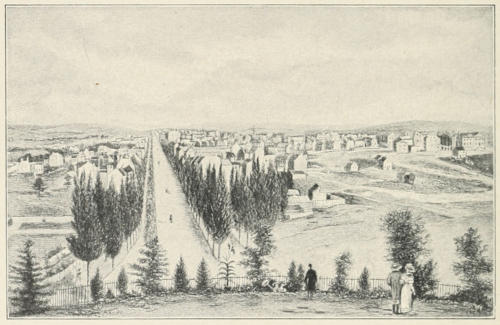
EARLY VIEW OF WASHINGTON CITY
He had surrounded himself, besides, with capable men, whose ability and integrity the whole country recognized. His Secretary of the Treasury was able, so sound did his management of the finances prove, to arrange for the payment of the fifteen millions due for the purchase of Louisiana without asking Congress to lay an additional tax. “I greatly fear that a separation would be no remedy,” wrote George Cabot to those who would have led in the Northern secession. The source of our evils “is in the political theories of our country and ourselves. We are democratic altogether,” and can expect nothing salutary “while we retain maxims and principles which all experience and reason pronounce to be absurd.” “It is impossible to alarm, much less to convince, a large portion of the Federalist party here of their danger,” explained Mr. Higginson to the radicals in Congress. “A small part only of those called Federal are sound in their opinions and willing to look into their real situation. Many even of our own party have as much yet to unlearn as to learn. They have yet much of the democratic taint about them.” Even extremists saw that they would have no following in revolutionary courses, and would have to wait for some grosser provocation, “which should,” as Mr. Cabot said, “be very generally felt and distinctly understood as chargeable to the conduct of our Southern masters, such, for example, as a war with Great Britain manifestly provoked by our rulers.” Almost the whole country outside their narrow coterie rejoiced in the acquisition of the lands beyond the Mississippi. To the southerner and the westerner it seemed a mere consummation of destiny, inevitable and not to be debated. The President turned, with such ease of conscience as he could command, to other things.
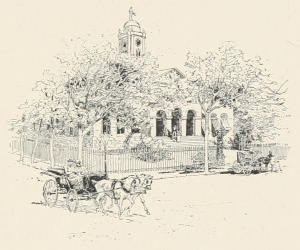
OLD STATE HOUSE, HARTFORD
“Other things,” it turned out, were to involve still more Federalist-like policy as affairs shifted: were to involve, in the end, a new set of troubles with England and France which were as serious as those which had made such mischief in Mr. Adams’s time, and which as inevitably led straight towards war and taxes and federal activity in foreign affairs, the pet aversions of the President and of every man who held the strict Jeffersonian creed in politics. Had Europe been at peace, America might have had her day of adolescence unchecked and clear of embarrassment. But France had set all Europe afire, and America, it turned out, was to be drawn into the storm,—was not to be suffered to be the only neutral, lest her advantage should be Europe’s ruin.
All the world being at war, hers was the only flag under which cargoes could make their way into European ports. It was the recognized law of nations that every ship that carried the flag of a belligerent was subject to be taken and made prize of by an enemy’s cruisers. England’s merchantmen could go abroad upon the seas with impunity enough, because England’s navy dominated the ocean waterways; but half of the ports of the continent were closed against them. French and Dutch ships did not venture out of port. Spain gave up her attempt to bring Mexican dollars and the ingots of the Peruvian mines out of the south under convoy in her own bottoms. That and all the rest of the carrying trade of the world fell to American skippers, who were free, as neutrals, to go where they pleased. They fetched cargoes of every kind from every quarter of the globe; put in with them at American ports, in order that they might there be reshipped; and took them thence to their destinations as neutral goods in neutral bottoms. The products of both Indies poured in at the ports of Holland, Spain, and France, without let or hindrance, if only Yankee skippers brought them; and made their way by river and canal to the markets of every kingdom and principality whose resources Bonaparte was using to subdue the world. Those who fought him seemed defeated by neutral trade, by means of what seemed to them, at that tremendous crisis, merely war disguised,—a veritable fraud of neutral flags by which the laws of war were annulled. Bonaparte could never be beaten unless this uninterrupted stream running into his coffers were somehow cut off.
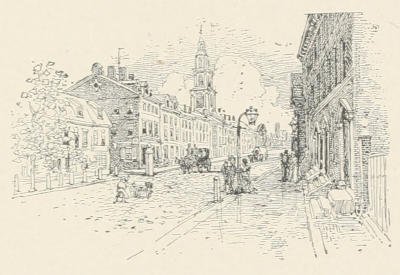
ARCH STREET PHILADELPHIA, IN 1800
England’s only mastery was on the sea. If she could not cut off the conquering Corsican’s resources there she could not hope to check him at all. For a little while she observed nominal peace with him (1802-1805), but that was soon broken. Nelson had utterly destroyed the French fleet at the Nile (August 1, 1798); and now broke the naval power of Spain and of France alike on the great day of Trafalgar (October 21, 1805). But on land, apparently, the Corsican could not be beaten. England determined that at least his coasts should be shut up and the trade of his allied and subject states destroyed; and, since she could not make an actual blockade of all Europe, she resolved to make a paper blockade, and enforce it as she might by captures at sea. By a series of Orders in Council (May, 1806–April, 1809) she virtually declared every port of Europe and the Indies closed against neutral trade. Napoleon answered with a series of decrees (November, 1806–August, 1810) which closed every English port also, so far as such cruisers as France had left could close them, or seizures in French ports make the orders good. Fine, condemnation, even capture and confiscation were to be the penalties imposed on all who should be caught ignoring the mandates of either imperious leader in that desperate combat of nations.
America was not the special target of these extraordinary measures. They were simply unprecedented acts of war in a struggle which had at last transcended every rule and standard. But America’s trade was likely to be cut away at the roots as effectually as if all Europe had declared war against her. Moreover, she was helpless. Mr. Jefferson had brought a party to power which had dismantled the navy which the Federalists had begun. The few ships that remained were tied up at the docks out of repair, out of commission, or lacking crews and equipment. English cruisers overhauled American merchantmen when and where they pleased, looked into their manifests and bills of lading, forbade them their voyage if they chose, and took their seamen off to serve in their own crews.
It was indisputable English law that a British subject’s allegiance was indefeasible and could not be renounced. Many a man upon American ships was in fact a deserter from the British navy, where the pay was poor enough and the discipline brutal enough to make any man wish for respite and escape. English captains were simply reclaiming runaway Englishmen, their government said. They were fighting single-handed against Napoleon with all Europe at his back; they could not suffer their navy to be drained of its men at such a time as that, when liberty the world over, it might be, was staked upon their success. Thousands of her sailors were in fact deserting; it was notorious where they went; and they must be found. Many of the men who were impressed could show American naturalization papers; but no naturalization papers could avail for their exemption from impressment if allegiance were indefeasible. The bitter and intolerable thing was, that British officers made no pretence of investigation; took what men they chose, American or English, not declining negroes even; and insulted the flag of the United States by every method they employed. Insult reached its climax when the English cruiser Leopard followed the American frigate Chesapeake out of Hampton Roads, fired upon her, and took four men from her as deserters,—the Chesapeake having but a single gun ready for use (1807).