Chapter II · FOUNDING A FEDERAL GOVERNMENT
Reading edition
The army disbanded and peace made, the chief business of the Confederation seemed concluded. The Articles which had given it a formal constitution had done little more than impart form and explicit sanction to the familiar functions which the Congress had for seven years exercised without them, and the exigency and occasion for the exercise of those functions seemed now gone by. Now that the war was over, the Confederation seemed to lack its old-time reason for being, and yet to have found no new reason, no new service to justify its existence and give it authority. It was still too much like an occasional body; still without powers suitable for seasons of peace and the ordinary courses of government: without administrative authority, without governmental efficacy,—a mere board of advice about things which had ceased to be interesting. All real vigor, all quick interest and vital ambition, all initiative and effective purpose centred in the several States. They alone had individuality and political power. The treaty of peace gave “the United States” vast territories which spread at large upon the map like a great empire; but it was an empire without organization, left to be ruled and peopled, as the States themselves had been, by the concert and initiative of pioneers and of single individuals who knew how to organize and how to lead. The enterprise of settlement did not lag. The masterful advance over the mountains and out upon the great slopes and into the fertile valleys which stretched, green and forested, to the far Mississippi had begun before the revolution itself, and sprang forward in trebled volume when war was done. It gave the young republic the early growing pains by which it got its first self-consciousness and its introduction to international difficulties. But it did not give it the organization, the centred authority, the coherent force necessary to its poise and conduct as a nation.
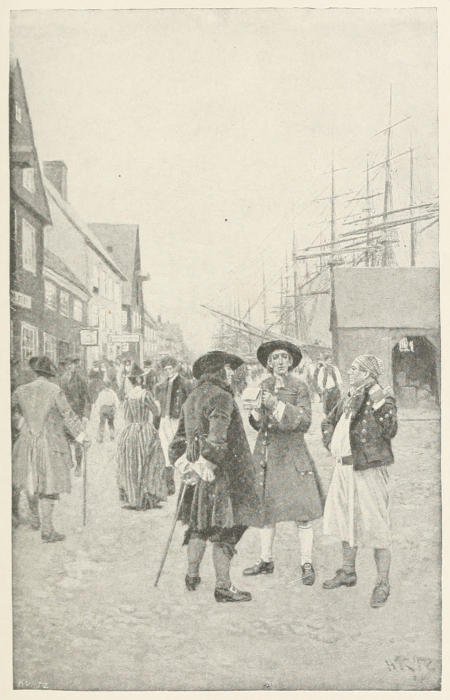
ALONG THE WATER FRONT, NEW YORK, ABOUT 1780
Migration into the West had been given its first impulse by the treaty of 1763, which closed the war with France and gave to the English all that the French had claimed east of the Mississippi. The war for independence had checked it for a little, but only for a little. It thronged forward again the moment the anxious strain of the fighting was off. Northwestward along the valleys of the Mohawk and the Delaware into the land of the Iroquois which Sullivan had harried,—where Sir William Johnson had reigned in days gone by over red men and white; straight towards the heart of the West along the upper courses of the Potomac, through the difficult country through which Braddock had gone his blundering way, to Fort Pitt and the lands by the Ohio; through the long forests to the fair Kentucky; down the valleys opened by the spreading tributaries of the Tennessee, and through the forests beyond to the Cumberland, whither the men who had ridden the passes to King’s Mountain had shown the way; around the southern end of the great Appalachians to the plains by the Gulf,—wherever the mountains opened or a way could be made, ever-increasing bands of emigrants essayed the long journey every open season, seeking new homes at the heart of the lands where once the French had had their posts and garrisons,—until there began to be communities beyond the mountains big enough to count in affairs: communities in whose behalf peace and government must be provided, and a way of intercourse and sympathy between East and West to which the great mountain ranges should be no effectual barrier. The war itself had not stopped this eager journeying into the West. The savage tribes upon those borders, north and south, found themselves checked and beaten, not by any sudden onset of armed men, but by this crowding in of the indomitable white man, this thickening of his stubborn, ineradicable settlements upon the western streams, the coveted hunting grounds.
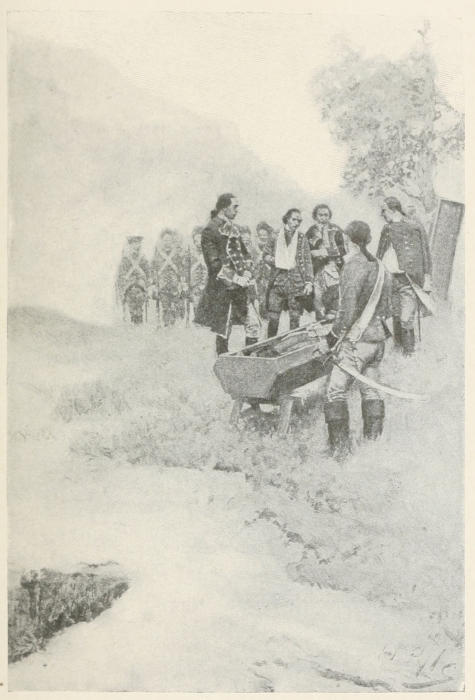
THE BURIAL OF BRADDOCK
Washington had seen the gates of that new world when, as a mere boy, he had acted as surveyor of Lord Fairfax’s estates within the valley of the Shenandoah; when, as a youth, he carried Dinwiddie’s warning to the French at fort Le Bœuf, ere they made themselves masters at the forks of the Ohio; and again when he went with unhappy Braddock against Duquesne. He saw more vividly than most men what this new movement of population meant, and must bring to pass in the future. When he had written his farewell to the army from his headquarters at Rocky Hill (November 2, 1783), had embraced his officers and comrades in arms in a last, affectionate leave taking at Fraunce’s Tavern in New York (December 4th), and had delivered up his commission to the Congress sitting at Annapolis (December 23d), he turned for a little respite to his home at Mount Vernon, to which these long years through his thoughts had reverted with an ever-increasing longing; but the very next year saw him over the mountains again, observing what lands were to be had there, and studying once more the best means of communication between East and West. The primary object of his visit was to procure good lands for himself and for old comrades who had made him their agent and adviser in that matter, but his statesman’s eye apprised him of the full meaning of the new migration now afoot along all the western border.
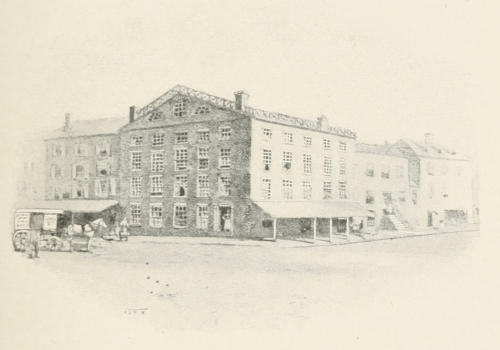
FRAUNCE’S TAVERN IN 1783
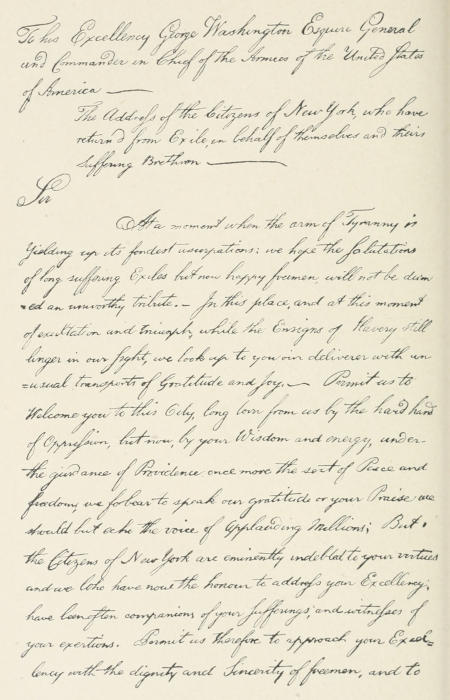
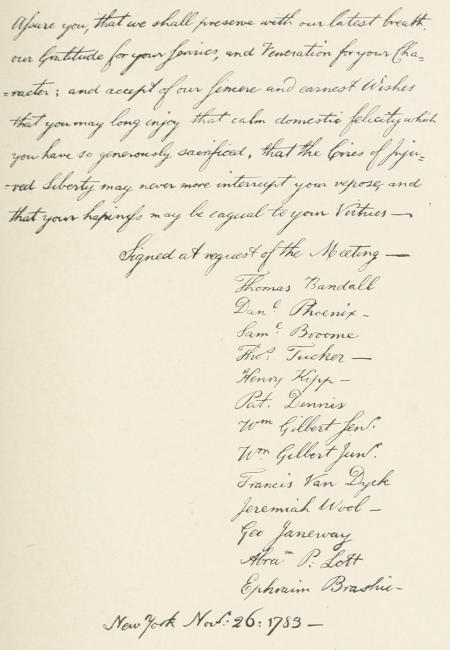
ADDRESS OF RETURNED CITIZENS, NEW YORK, 1783
For one thing, he saw how serious a situation it might prove should this body of settlers, sure to grow greater and more masterful from year to year, continue for very long to look back upon almost impenetrable mountains piled between them and the eastern ports and highways. Their natural outlet, when once the mountains were well behind them, would be the Mississippi, their natural highways the streams which ran to the Gulf. It was possible they might see their chief advantage in a connection with the Spaniards at New Orleans rather than with the wellnigh inaccessible eastern settlements on the Atlantic seaboard,—or even with the English again by the highway of the lakes and the St. Lawrence. “The western settlers,” he declared, “stand as it were upon a pivot. The touch of a feather would turn them any way.” He returned home to push again with renewed vigor the project which for now twenty years he had had at heart, and which had in these new days of independence, as it seemed to him, become a sheer political necessity,—the opening of the upper reaches of the Potomac to navigation, in order that the East might there at any rate be linked with the West, by joining the waters of the Potomac with the streams which ran down into the Ohio. This had been part of the plans of the old Ohio Company of which the Washington and the Fairfaxes had been members. The revolution had interrupted its plans; there was now added reason for renewing them.
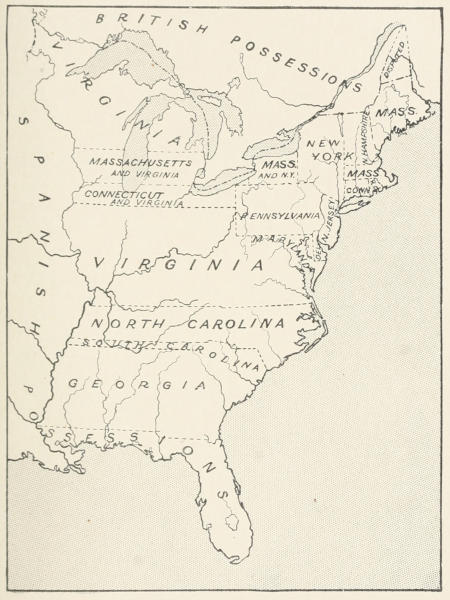
MAP OF THE UNITED STATES, 1783
In the old days the lands about the Ohio had been deemed part of Virginia’s domain. Almost every State upon the seaboard had had at the first a grant from the crown which read as if it had been meant to set no boundaries at the west at all except the boundaries of the continent itself; and Virginia’s grant was the oldest of them all. Virginia claimed practically all the western country which lay north of her own southern line extended, under the terms of her charter of 1609, which defined her territory as running from her boundaries at the sea-coast “up into the land throughout from sea to sea, west and northwest.” But the other colonies as they were formed had also received charters which had a straight westward outlook, practically without bound or limit this side of the Pacific; and each laid confident claim to its own long western strip of the continent. It was in part to quiet these conflicting claims, in part to give herself, who had no grant at all at the west, some parity with her partners in the Confederation, that Maryland had insisted, as a condition precedent to her acceptance of the articles, that all the western territory be ceded to the Confederation itself, as a joint and common property to be held for the use and benefit of all. New York, accordingly, had ceded her claims in 1781; and Virginia so much of hers as lay north of the Ohio, in 1783. The other States were virtually pledged to follow their example. The West was already practically common property. Whatever should be done to bind it to the East would bring so much nearer the promised dawn of a national life.
It was a noteworthy thing, too, how every one seemed to take it for granted that the Congress of the Confederation had the right to accept these gifts and act as a veritable sovereign in the government of a national domain, notwithstanding the Articles vouchsafed it no grant of power in the matter, and in everything else its authority, though explicitly granted, had fallen into contempt. Whatever the States might do in the administration of their own affairs and the government of their own people, a national domain meant a national government. Its very existence put another face upon affairs. It could not be redivided. The States had put it, a practically impassable barrier, between them and separation. Maryland had builded better than she knew.
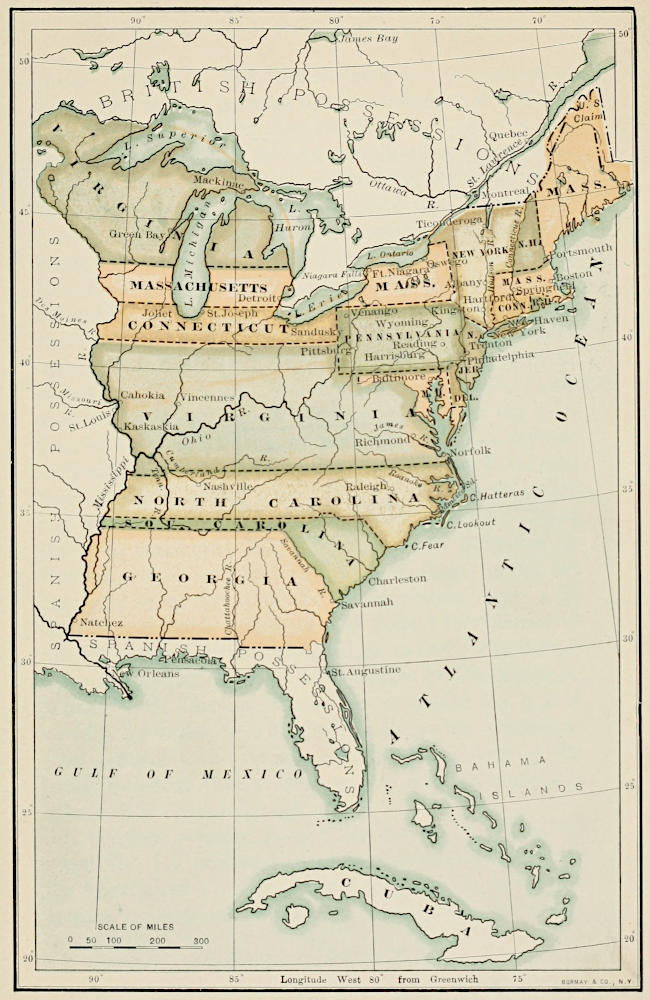
THE UNITED STATES, 1783. SHOWING CLAIMS OF THE STATES.
Already the western settlers were showing themselves, by not a little heady wilfulness, to be of the same stock that had made the original colonies first strong and then independent. In its April session, 1784, the legislature of North Carolina had followed the example of New York and Virginia by ceding to the general government her lands beyond the mountains. It committed the blunder, however, of making the grant contingent upon its acceptance by Congress, which might have been taken for granted, and of making no specific provision in the mean time for the government of the very flourishing and very mettlesome little group of pioneer settlements which John Sevier and James Robertson had helped to plant upon the upland streams which ran beyond the mountains into the Tennessee. These promptly concluded that, if they were not governed by North Carolina and had not yet been taken under the care and government of the Confederation, they were their own masters, and proceeded to erect for themselves an independent State, which they called “Franklin,” after the genial wit and philosopher at Philadelphia. When North Carolina thereupon rescinded her act of cession, in order to win them back to her dominion, they refused to be reannexed. It was a sign of the times, a taste of that western quality which the nation’s affairs were often to smack of.
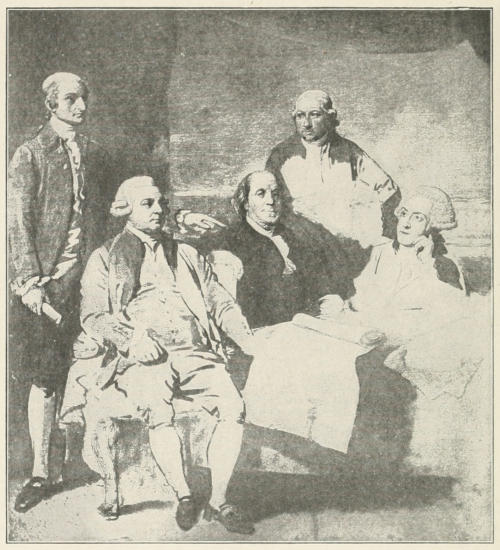
UNFINISHED PORTRAITS OF THE SIGNERS OF THE TREATY OF PARIS, 1783
The whole country caught the flavor of that quality when Mr. Jay proposed to relinquish the navigation of the Mississippi for a generation to Spain, in return for certain commercial advantages greatly desired at the Atlantic seaports. Spain had already shown an ugly temper with regard to the use of the river, whose outlet she controlled. She had seized merchandise passing down towards its mouth. She had instigated Indian raids against the new-made settlements on the Cumberland, which crowded too near its course. Mr. Jay had been one of the commissioners through whom the United States had got their western boundary at the Mississippi and their grant of the right to use the great stream, at the making of the treaties of peace; and he knew how difficult a thing it had been to force Spain backward to that boundary. But he had not seen that rising tide of emigration now pouring into the West; had not imagined the empire making there, the homes already established, the toil and success already achieved. He thought that there would probably be no occasion to use the Mississippi for twenty-five or thirty years yet to come. He proposed, therefore, in 1785, when Congress had made him its Secretary of Foreign Affairs and had bidden him negotiate a treaty of commerce with Don Diego Gardoqui, the newly arrived representative of Spain, to surrender the navigation of the lower Mississippi, which he thought was not needed, for a term of twenty-five years in exchange for commercial advantages which would redound to the profit of the merchants of the shipping colonies, together with certain concessions with regard to land claims in the West which were likely to please the people of the South. The instant cry of hot protest that came out of the West apprised eastern politicians of the new world a-making there, the new frontiers of the nation. The proposed treaty was not adopted.
It was hard for men in the East to realize how fast settlers were multiplying and their settlements growing to the stature of States beyond the mountains, where only the other day there had been nothing but unbroken wilderness,—faster a great deal than the original colonies themselves had grown. So early as 1784 the settlers in the Kentucky country deemed themselves numerous and independent enough to be detached from Virginia and set up as one of the States of the Confederation. When rumors reached them of what Mr. Jay proposed some of the bolder spirits among them negotiated in their own behoof a private treaty of commerce with the Spanish at New Orleans. When Virginia interposed delays and difficulties in the way of their plan to become a State, they listened very indulgently to certain lawless men who proposed that they make some stroke for entire independence. There was talk of the British at the North helping them to seize Spain’s possessions beyond the river by force of arms and drive Spain from the continent. No man knew what might happen there, should counsels of revolution prevail.
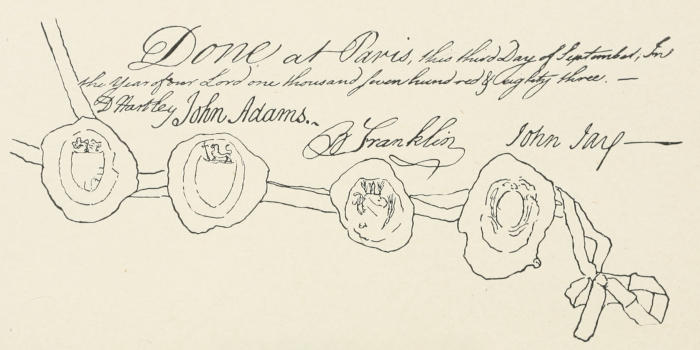
FACSIMILES OF SIGNATURES TO TREATY OF PEACE
No disquieting rumor or untoward prospect of new wars for independence in the West at all restrained the steady flood of emigration the while. In March, 1786, a new Ohio Company was formed in Boston for the active furtherance of the settlement of the western country. Soldiers of the revolution officered it and in large part made up its membership. The money script of the Confederation was bought up and used for the purchase of land in the new public domain. Subscriptions and systematic corporate action began to make the settlement of the Ohio country an enterprise of forethought and associated effort, like the settlement of the first colonies themselves.
The whole country was witness, the while, to the need for a real government, instead of a mere advisory Congress, to bind the inchoate nation together in a more than makeshift union. Every disorder, every difficulty but made this need the more pressing and the more painfully evident; and difficulties and disorders multiplied fast enough,—in the East as well as in the West. No hope of national achievement, no ideal of independence or of power could be fulfilled while the very organization of the nation stood thus formless and dissolved. “There is scarcely anything that can wound the pride or degrade the character of an independent nation,” cried Mr. Hamilton, “which we do not experience.” Efforts were made to secure for the Congress the right to lay and collect taxes, in order that at least its existence and such powers as it already had should not be at every turn dependent upon the attitude and action of the several States; but the States were not willing to increase its authority so much. In 1786 they were asked to intrust to the Congress at least the collection and use of a revenue laid upon imports; and so plain had both the necessity and the propriety of such an addition to its efficiency by that time become that all of the States except New York consented. But it required the unanimous consent of the States to amend the Articles of Confederation, and New York’s refusal set even this aside. New York had no mind to relinquish the duties which she collected for herself at her great port,—not only upon foreign commerce but also upon goods brought out of the other States, her neighbors: on farm produce and garden-truck from New Jersey and firewood from Connecticut,—making her spreading harbor a veritable toll-gate.
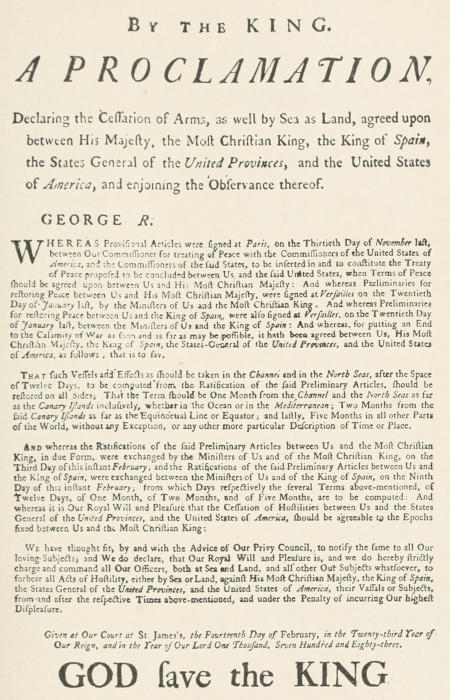
ROYAL PROCLAMATION OF CESSATION OF HOSTILITIES
There was in all this one of the most serious signs of the times. The States indulged to the top of their bent a petty hostility towards each other. New York was by no means the only State that laid duties on merchandise brought in from the farms and shops of her neighbors. There was everywhere the same jealous spirit, the same striving for every paltry advantage, the same alert and aggressive selfishness; and the more the States deemed their interests antagonistic the more like a mere rope of sand did the Confederation become. “We are either a united people, or we are not,” exclaimed Washington. “If the former, let us in all matters of general concern act as a nation which has a national character to support; if we are not, let us no longer act a farce by pretending to it.” England, apparently, expected the weak structure presently to fall to pieces. She would not withdraw her troops from the western posts because the debts of British merchants were not paid and the property rights of the exiled Tories were not restored. Neither would she send a diplomatic representative to America, seeming to regard the Confederation as of no international importance. France and Spain and Holland, seeing the Confederation utterly unable to repay the moneys they had loaned it, scarcely able to pay so much as the interest on its debts, alternated between anger and contempt in their treatment of it; and confidently expected to see it very soon in ruinous collapse and final disintegration. France and Spain were somewhat hopefully wondering, it was evident, what the spoils and plunder of the wreck would be, and to whom it would fall to do the plundering.
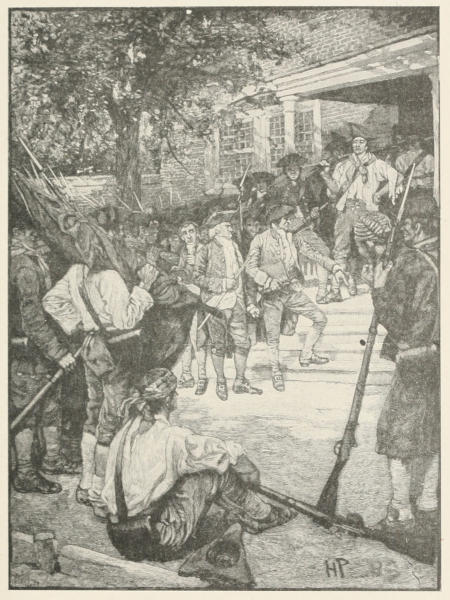
SHAYS’S MOB IN POSSESSION OF THE COURT HOUSE
Each year seemed to emphasize by new disorders the increasing need for the wholesome restraints and discipline of a common government. In the autumn of 1786 actual armed rebellion capped Massachusetts’ struggles against slack trade, heavy taxes, burdensome debts, and discontented farmers,—a debtors’ rebellion. Captain Daniel Shays, a veteran of the fight at Bunker Hill, a captain of the revolutionary army, was its foremost figure. Mobs in the inland counties, of the State and in the towns by the Connecticut closed the courts, to prevent the collection of debts. Local conventions, called to discuss the grievous circumstances and distresses of the time, broke up in riot. By the time winter had come Captain Shays had not scrupled to put himself at the head of a riotous muster which had the proportions of a veritable army. James Bowdoin was governor of Massachusetts, a man of probity who knew his duty and did not disrelish the performance of it. There was no mistaking the issue. “My boys,” one of the leaders of the insurrection had cried, “you are going to fight for liberty. If you wish to know what liberty is, I will tell you. It is for every man to do what he pleases, to make other folks do as you please to have them, and to keep folks from serving the devil.” It was flat anarchy. The treasury of the State was empty, but a hastily equipped force of militia under General Lincoln, paid for by a temporary loan raised by a few patriotic citizens, dispersed the rebels and restored the authority of the government. It was an ominous thing, nevertheless, to see how the people of the State sympathized with the rebels. They would not have Bowdoin for governor again, deeming him too harsh. Rhode Island passed resolutions of sympathy for the rebels and Vermont offered them refuge. Leaders of the rebel force were captured and convicted, but no one dreamed of venturing to execute upon them the penalty denounced by the law against what they had done. The rebellion had plainly been a symptom, not an isolated or singular thing. It had been extraordinary only in its violence.
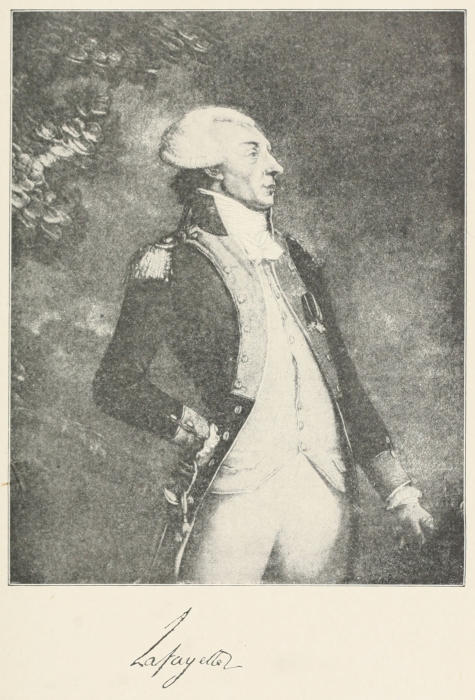
LAFAYETTE
Disorders like these were for the mass of men, who did not see the significance of signs less gross and tangible, the best possible evidence of the sore straits the country was in to maintain even so much as its local governments and its respect for law. But it was not violence of this sort so much as the subtle, all-pervasive air of uneasiness, of rivalry, and even hostility between the States, of commercial enmity and a universal unneighborly spirit of reprisal which moved the thoughtful and masterful spirits of the country most deeply, and led them to bestir themselves while yet there was time to forestall disaster. It made them fear the worst, too, for the honor and very life of the country to see how debt demoralized the States: how they yielded upon every side to the temptation to repudiate their obligations by some new evasion, and encouraged individuals to practise a like dishonesty by passing stay laws against the collection of private debts and making legal tender of paper money issued without limit, whose value dropped with every week it was in use. Business as well as government seemed about to go to pieces, bankruptcy to go hand in hand with virtual anarchy.
It was Washington’s scheme of making the West accessible through the valley of the Potomac which, after all, as it turned out, opened the way for statesmanlike measures of union. There was but one method by which to save the Confederation now, as there had been but one method by which to concert and carry forward the revolution. It had to be done, if done at all, by bringing the leading minds of the country to some sort of agreement: by correspondence, by individual effort; by personal appeals to individuals and to legislatures on the part of men who could gain a hearing because they had approved themselves by service. An infinite deal of letter writing: letters handed about from hand to hand which were like state papers for thoroughness, for sobriety of argument, for cogency and quiet power; personal interviews; persuasion that soaked slowly through from group to group in the simple society of the scattered towns and hamlets and plantations,—such was the machinery of reform, whether in opinion or in affairs; and Washington, with his quick conscience and steady competency in every matter that called for action, was the natural centre alike of counsel and of performance.
By the spring of 1785 the Potomac Company, pushed forward in its business by men like Washington, had developed plans serious and definite enough to engage the attention of the legislatures of Maryland and Virginia. The Potomac ran with Maryland on the one bank and Virginia on the other: it was necessary that the two States should agree upon plans for its use and navigation. They united, therefore, in appointing commissioners to meet at Alexandria in March, 1785, to consult upon this matter not only, but also upon the general commercial relations of the two commonwealths which this matter touched and which there was no general government to regulate. Washington invited the commissioners to adjourn to Mount Vernon, near by, as his guests; and there, though not of their number, he was freely admitted to their counsels. They did not report to their legislatures all the hopes and questions to which their thoughts had broadened as they talked, but they set forth matters significant enough for the present. The Potomac, they pointed out, could not be connected with the western waters without affecting Pennsylvania, as well as Maryland and Virginia; they recommended, therefore, that she also be called into conference before that business was carried further. The rest of their task, which concerned common commercial regulations, uniform duties on imports, and joint rules touching the currency, they completed. The Maryland legislature, when it received their report, happily read it in as liberal a spirit as any statesman could have wished for. If Pennsylvania was to be drawn into conference about the Potomac, why should not Delaware also be consulted, with a view to carrying a straight watercourse, by canal, from Chesapeake Bay to the Delaware River? And if Pennsylvania and Delaware might be asked to confer about these specific things, what was to prevent a general conference of the States, in which all the uncomfortable questions of their intercourse with one another might be frankly discussed? Governor Bowdoin, of Massachusetts, had that very year urged his legislature to invite the States to such a general convention, in the interests of amicable trade, and it might be that it would meet with universal approbation.
Virginia was willing. There were men in her legislature to whom such suggestions seemed full of hope and good counsel. Under their influence, therefore, the Burgesses (January, 1786) asked all the States of the Confederation to send delegates to a convention to be held at Annapolis on the first Monday of September, to consider the questions of trade and common intercourse which were disturbing the whole country. The response was disappointing. Connecticut, South Carolina, and Georgia ignored the call altogether. Even Maryland fell suddenly indifferent and failed to act, though the plan was her own. New Hampshire, Massachusetts, Rhode Island, and North Carolina appointed delegates, but when the conference had assembled it was found that they had not taken the trouble to attend. Only Virginia, Pennsylvania, Delaware, New Jersey, and New York were represented; and their delegates did not feel that, alone, they could do anything. They could only urge another and fuller conference.
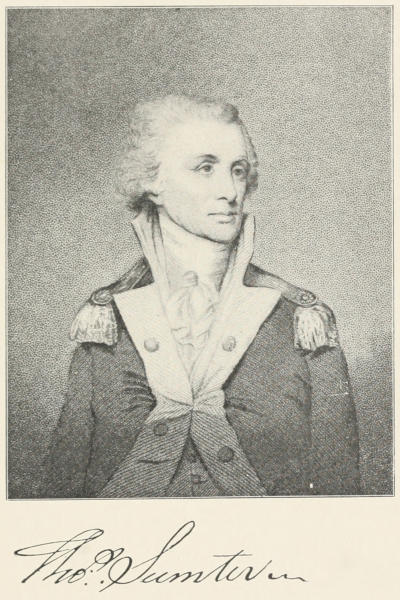
THOMAS SUMTER
New Jersey had taken a very lively interest in these new plans of consultation and co-operation. She felt very keenly the serious commercial and political disadvantage at which she was placed by a geographical position which made the much more powerful States of New York and Pennsylvania her jealous rivals at either outlet to the sea, and along every mile of her border to the westward. She had, accordingly, given her delegates a broader commission than the others bore. She had bidden them “consider how far a uniform system in their commercial regulations and other important matters might be necessary to the common interest and permanent harmony of the several States”; and Mr. Hamilton, one of the delegates sent from New York, being a statesman and no partisan, induced the conference to make a like suggestion in asking for another and fuller convention of the States. Alexander Hamilton had been born, and bred as a lad, in the West Indies. He had established himself while yet a very young man in New York; but he had taken no color from the place; had kept a mind detached from merely local interests and provincial prejudices; had served under Washington in the field, as his aide and confidant; and had learned to see as clearly as any of his elders in affairs the needs and dangers of the country. He lacked still several months of being thirty; but he had been quickened to a singular maturity in that time of stress. He proposed an address to the States in which they should be asked to come together at Philadelphia, on the second Monday of the following May, not merely for the consideration of questions of trade, but also for the purpose of devising “such further provisions as should appear to them necessary to render the constitution of the federal government adequate to the exigencies of the Union,” and of reporting to the Congress “such an act as would effectually provide for the same”; and the conference, being in earnest, adopted the paper as he had drawn it.
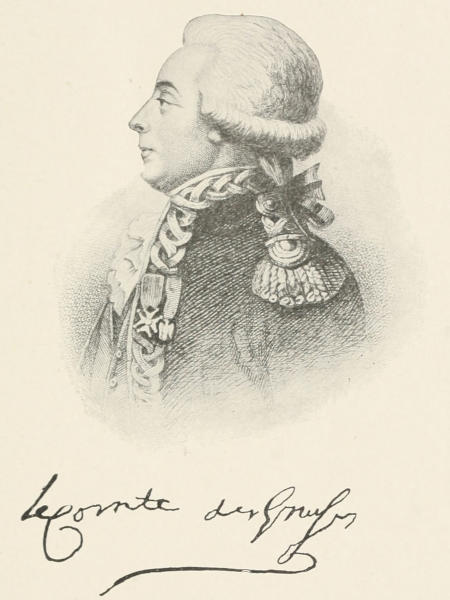
COUNT DE GRASSE
Again the States would have been indifferent and conference of no avail, had not the winter which followed been darkened and made very ominous indeed by Shays’s rebellion. Every one of the little commonwealths felt the threat of unmanageable disorder and the upsetting of government itself which that spoke. “You talk, my good sir,” wrote Washington to Harry Lee, in Congress, “of employing influence to appease the present tumults in Massachusetts. I know not where that influence is to be found, or, if attainable, that it would be a proper remedy for the disorders. Influence is no government. Let us have one by which our lives, liberties, and properties will be secured, or let us know the worst.” There was the same feeling everywhere. Government was too slack, order too uncertain. The authority of law could nowhere be stronger than each individual State was prepared to make it. There was no common power, no effectual combination, no aggregate force to render it beyond peradventure firm and lasting. The object-lesson had come in good season. The Congress of the Confederation had heretofore been opposed to a general conference; it now sanctioned and advised it. The States were at last effectually shaken from their indifference, and appointed delegates to attend at Philadelphia in May, to take part in the new Continental Congress.
It proved a notable assembly,—more notable than the Congress of 1774; for its business was not protest but the reconstruction of a government, and it proved equal to the task. A certain very noticeable anxiety attended the opening of its sessions. The delegates came very slowly and tardily in. A full week had gone by after the day set for convening before so many as seven States were represented. The delegates from New Hampshire were two months late in arriving. It was evident at first that the members were nervous and set about their work of conference and debate with a touch of reluctance and apprehension. They knew that their business was critically important. It might be that the breaking up of their Union, or its consolidation, the setting in or the happy and final preclusion of civil war, would follow upon the completion of their labors. Affairs, and opinion, too, hung at a perilous poise, and might easily be turned this way or that by their success or failure.
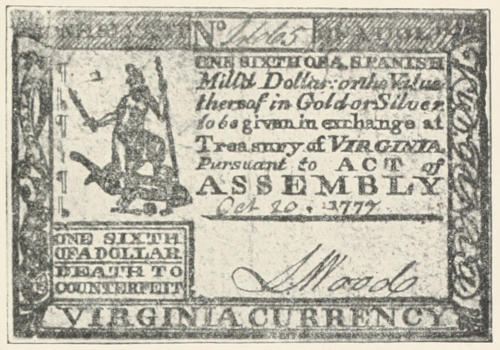
SPECIMEN OF VIRGINIA CURRENCY
They gathered confidence, however, as they got hold of their task and gained knowledge of one another. There were fifty-five delegates in attendance at last: every State except Rhode Island had sent commissioners. Many of the more famous figures of the revolutionary time were missing. Samuel Adams had declared himself opposed to “a general revision of the Confederation.” John Adams was in England. Jefferson was in France. Patrick Henry declined to attend. The men who had organized the Continental Congress and the Congress of the Confederation had in large part given place to others. Younger men had come forward, and were speaking with authority: men like James Madison, of Virginia, who was but just turned of thirty-six, and Alexander Hamilton, of New York, who was only thirty. But older men were there also, and it was reassuring to find how carefully the States had picked their representatives. Robert Morris was there, the experienced financier of the revolution; Roger Sherman was there, whose practical good sense had steadied the early counsels of the Continental Congress; and John Rutledge, whom South Carolina had made a sort of dictator in her affairs while the revolution held; and Benjamin Franklin, in his eighty-second year. Virginia had sent seasoned jurists past middle life, like John Blair, who had been president of her council, and George Wythe, who had drafted her protest against the Stamp Act; and had added George Mason, her best type of conservative country gentleman, and General Washington, as of course, as well as handsome Edmund Randolph and studious Mr. Madison, still in their thirties.
Every day’s debates gave strength and confidence to the counsels of the conference. There were many sharp differences of opinion among its members; but they held together, and a sound practical sagacity prevailed. Leadership among them fell to Madison, whose quiet suggestions always smacked of moderation and of a real knowledge of the subject in hand; to James Wilson, of Pennsylvania, whose shrewd Scots sense and thorough knowledge of law,—the law of nations and of governmental structure as well as the law every lawyer could talk of,—enabled him to clarify and strengthen every topic he touched; to Roger Sherman, of Connecticut, rugged, practical, hard-headed; to Dr. Franklin, who could utter the mellow wisdom of age, and utter it in sentences men could remember; to Gouverneur Morris or Rufus King, who knew how to cast propositions for a vote,—to the men who could think steadily and see things whole, or who could strike out practicable lines of definite action.
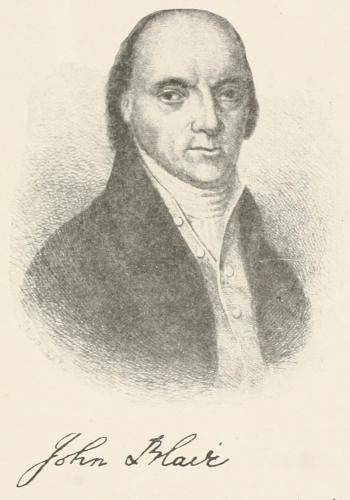
JOHN BLAIR
The convention wisely sat with closed doors. It sat all the summer through, and until September was more than half gone; let no one know what it debated or had its doubts and its sharp differences of opinion about; merely published its work when finished, and went home to press it for acceptance. It gave it great dignity that Washington had presided over its counsels and was heart and soul for the adoption of the measures it proposed. His name and quiet force had steadied the convention on many an anxious day when disagreement threatened hopeless breach. His fame and influence infinitely strengthened also the measures proposed, now that they were completed. He supported them because they were thorough-going and courageous and cut to the root of the difficulties under which the country was laboring. Issue had been joined now, as he had wished to see it joined, between government or no government, and the country was to know at last where it stood in the most essential matters of its life.
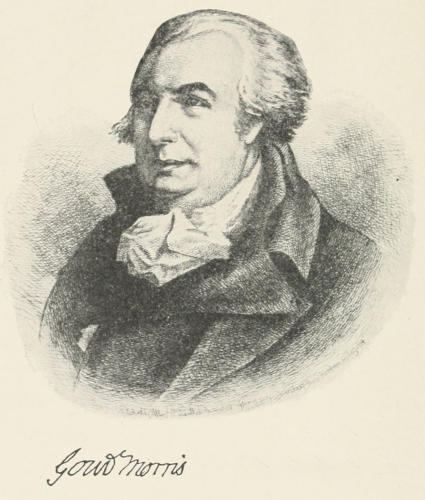
GOUVERNEUR MORRIS
The convention had drafted nothing less than a new constitution,—no mere amendment or series of amendments to the Articles of Confederation; a radically new scheme of government and of union, which must stand or fall upon its own merits. It was recalled, many years afterwards, how General Washington had stood in the midst of a little group of delegates, during the anxious first days at Philadelphia, while they waited for commissioners enough to justify them in effecting an organization, and had cried, “Let us raise a standard to which the wise and honest can repair. The event is in the hand of God.” It was in that spirit that the convention had acted. They had not taken measures to please, but measures to save the country. The constitution which they proposed showed by its very simplicity and directness the statesmanlike vigor, definiteness, and consistency of purpose with which it had been conceived and drafted. It conferred upon the federal government powers which would make it at once strong and independent: the power to tax, the exclusive power to coin money, the power to maintain an army and a navy,—the powers, within its sphere, of a supreme and sovereign government. Its laws were to be, not advisory, but imperative, and were to operate, not upon the States, but directly upon individuals, like the laws of any sovereign. It was provided with the executive the Confederation had lacked: a president in whose authority should be concentrated the whole administrative force of its government. It was to have its own courts, and in those courts, not in the courts of the States, were its powers to be finally determined, whenever challenged. The very equality of the States, that cardinal principle,—that cardinal defect,—of the Confederation, was in large part to be done away with. The legislature of the new government, which was to be no confederation, but a veritable State built upon a federal principle, was to consist of two houses. In one, the Senate, the States were to be equally represented; but in the other and larger house, the House of Representatives, the people were to be represented directly, by number,—one representative for every thirty thousand,—counting them within their States, indeed, but not as if they constituted separate commonwealths. The new government was to regulate commerce, both with foreign nations and among the States. The States were to be forbidden to enter into any treaty, alliance, or confederation; to emit bills of credit; to pass any law impairing the obligation of contracts; and to lay any imposts or duties on imports or exports, unless permitted to do so by the Congress of the United States. All foreign affairs, all questions between State and State, all common interests were to be controlled by the federal government; and it was to act directly, of its own will and initiative, through its own officers and its own tribunals.
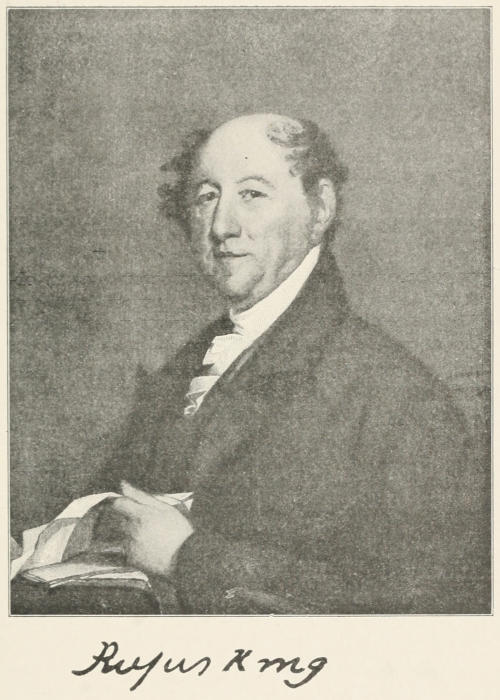
RUFUS KING
In brief, every salient feature of the existing Confederation was in this new instrument of government condemned and rejected:—the absolute equality of the States, the dependence of the general government upon them for the execution of the laws and for its very support, its lack of an executive and of executive powers, its futile function of mere advice. Even so, the changes proposed did not satisfy Mr. Hamilton. He had been a member of the convention, had signed the document now sent forth, and meant to devote himself very heartily indeed to advocating its adoption; but he had taken very little part in its formulation, because, as he had frankly told his fellow members, he himself desired something very different, which he knew he could not get. He had very little faith, he said, in federal government, or even in republican government, which it seemed to him impracticable to establish over so extensive a country as the United States. He could wish, he said, that the state governments, as independent political bodies, might be extinguished, or at any rate entirely subordinated; that the general government might be given “complete sovereignty”; that the new executive of the nation might hold for life, and at least one house of the national legislature for a like term, “or at least during good behavior.” His breeding was not of the colonies, his thinking marked him of the culture that belonged on the other side of the sea. He hated anarchy, and saw the country drifting into it. He believed that nothing short of a centralized government could be certainly relied upon to check and kill it. He was for efficiency rather than for sentiment. But he was above all a statesman, and contented himself, and that right heartily, with the minimum of what he desired,—with the government the convention had devised. He knew, as every one did who had been admitted to the counsels of the convention, by how sharp a struggle, by how delicate and difficult a series of compromises, the constitution as it stood had been obtained amidst the conflict of interests and of views disclosed in debate. The smaller States had assented to it only because the Senate was to preserve for them the old-time equality of the States in legislation. The slave-holding States of the South had assented only when it was agreed that three out of every five of their slaves were to be counted in reckoning population as a basis of representation in the lower house. A compromise had ended every serious divergence of opinion. The wonder was, not that so little, but that so much concentration and invigoration of authority had been agreed upon where counsel and interest differed by the width of the poles.
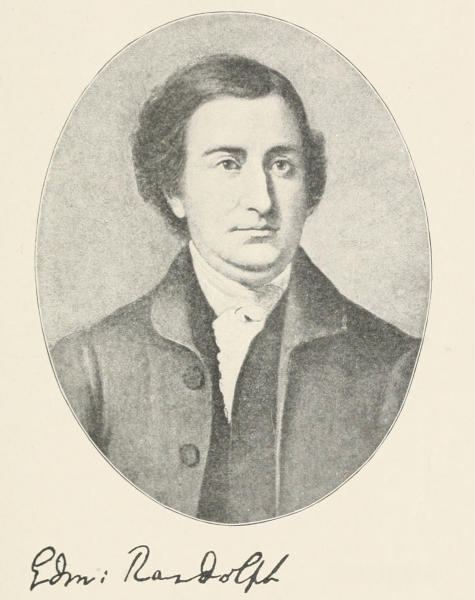
EDMUND RANDOLPH
So far as the country at large was concerned, the new constitution was startling and radical enough as it stood. Patrick Henry, of Virginia, had refused to attend the convention because he had foreseen and feared just such revolutionary proposals. George Mason and Edmund Randolph, of Virginia, and Robert Yates and John Lansing, Hamilton’s colleagues from New York, had refused to sign the constitution which it proposed. The new document was most revolutionary in the method which it proposed for its adoption by the States. There was but one way by which the Articles of Confederation, the existing federal law for which this was to be a substitute, could legally be amended: by the unanimous assent of the States. The convention proposed, nevertheless, that the new constitution should go into effect if adopted by nine out of the thirteen; and the Congress, seeing change probably impossible otherwise, sanctioned the proposal.
Fortunately, there was nothing novel in the details of the government proposed. Every practical provision in it, almost without exception, had been borrowed from the experience of the colonies themselves, or from English experience equally familiar:—the single governor, the two legislative houses, the supreme court, the partial equality of the States, the representation of the people, popular elections, brief terms of office, definite, chartered powers. Even the electoral college which was to choose the President, had its prototype in the electoral body through which Maryland chose the members of the upper house of her legislature. The convention had showed its conservative temper in every provision it touched; and not much of what it had done had to be elaborately explained. Many of the States were ready to accept the constitution at once. Delaware ratified it on the 7th of December, but a little more than three months after the adjournment of the convention; Pennsylvania followed her example on the 12th, and New Jersey on the 18th. By the 1st of June, 1788, eight States had given their assent,—Massachusetts among them, though she had hesitated,—but New York and Virginia still held off. Massachusetts had waited until Mr. John Hancock and Mr. Samuel Adams declared themselves willing to accept the constitution and had suffered their choice to shift the balance of opinion. New York held off, as she had held off from granting additional powers to the Congress of the Confederation, because she did not wish to yield her commercial independence; and Virginia because men whom she loved, like Mr. Henry, and men whom she had been accustomed to trust in counsel, like Mr. Mason, feared to see so powerful a central government set up.
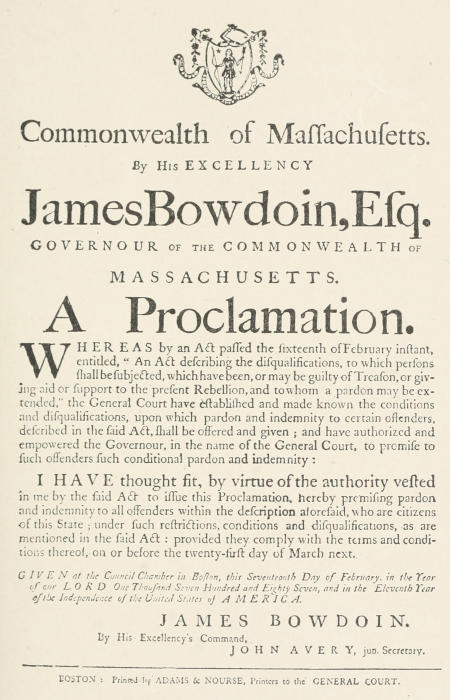
GOVERNOR BOWDOIN’S PROCLAMATION
New York yielded at last (July 26th), by a majority of only two votes out of fifty-seven, because Mr. Hamilton and the men who stood with him pressed every advantage of argument, influence, and persuasion,—and because news came that New Hampshire had accepted the constitution, the ninth State (June 21st), and that therefore the new government was quite certain to be tried without her. In Virginia the arguments of Madison and Randolph and Marshall and the personal influence of Washington prevailed at last (June 25th), notwithstanding the opposition of Lee and Henry and Mason. It was said in her convention that there were no safeguards in the new constitution sufficient to withhold the powerful government about to be set up from encroaching alike upon individual rights and upon the undoubted powers of the several States; and the opposition would have prevailed had not the ratification been coupled with resolutions which urged amendments which should constitute a sort of bill of rights,—amendments which the new government afterwards accepted.
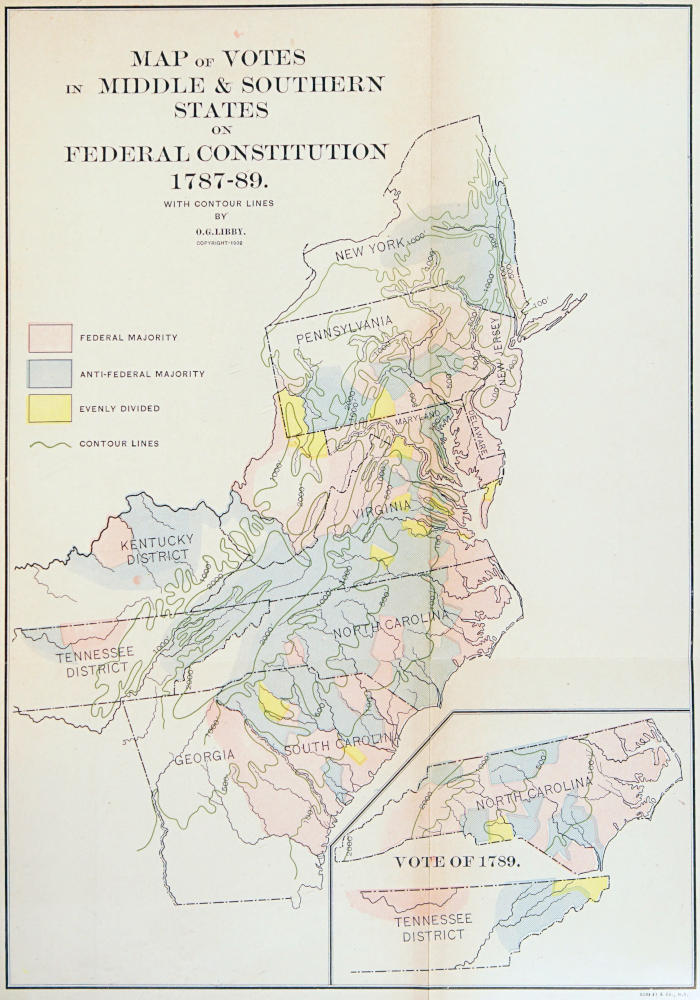
MAP OF VOTES IN MIDDLE & SOUTHERN STATES ON FEDERAL CONSTITUTION 1787-89.
WITH CONTOUR LINES BY O. G. LIBBY. COPYRIGHT 1902.
BORMAY & CO., N. Y.
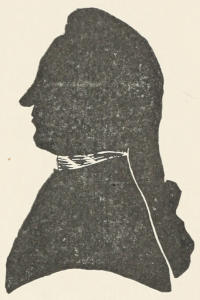
SILHOUETTE OF JAMES BOWDOIN
“The opinion of General Washington was of such weight,” said Count Moustier, the French minister to the United States, “that it alone contributed more than any other measure to cause the present constitution to be adopted.” No doubt the country did feel, throughout, the compulsion of loyal sentiment that went with his name. No doubt it felt, too, the mastery of the men who stood with him to lead, and yielded, in part, to their tact, their quick concert, their energy, their infectious enthusiasm, their ardor of unhesitating conviction. But it was interest and the pressure of affairs which told most decisively in the vote. Each State had uttered its choice with regard to the adoption of the constitution through a convention chosen for the purpose; and it was noteworthy how the delegates stood divided. Those from the larger towns and the districts where hamlets and homes lay thickest, where commerce moved upon the rivers and to the sea; those from the farming regions which lay by tide-water or near the long rivers which crossed the boundaries of States and floated produce to markets within another jurisdiction; those who came from exposed frontiers where there was nothing to hope for from independence and much to hope for from a protecting common government:—all who felt the wide movements of trade or the need for free markets or the too sharp pinch of rivalry between State and State or the imminent threat of division and disorder, to the unsettling of property and the upsetting of their lives, voted for the constitution. It was opposed by the men who lived remote from the centres of population and the stronger currents of trade, whose lives had no wide connections and sufficed them; by men who were more likely to be debtors than to be creditors and wished their States left at liberty to legalize a depreciated currency; by men whose homes were upon the western rivers which ran towards Spanish territory, not towards the ports of the East, and who doubted their real connection of interest with the seaboard; by the great land-owners of New York, whose estates shut free farmers out, who had been masters of the State hitherto and wished to keep intact her right to collect duties at her great port, her power to put her neighbors at a disadvantage; by conservative men who feared to see one group of States take advantage of their majority to obtain commercial ascendency over another group. “Tories” voted for the constitution because they hoped to be safer under it; many extreme “Whigs” voted against it because they thought that they would be a little freer without it. Those who admired a centred and efficient government like that of England and regretted separation, were its advocates; those who ardently preferred their own little commonwealths and looked upon them as their best field of prosperity or of personal ambition were its opponents. Men voted for it because they hated anarchy and confusion of authority and wished to see a nation created in America, as Mr. Hamilton did; and against it because they thought that where anarchy was impossible liberty was insecure. No doubt, could there have been a counting of heads the country through, a majority would have been found opposed to the constitution; but the men who were its active and efficient advocates lived at the centres of population, had the best concert of action, filled the mails and the public prints with their writings, were very formidable in debate and full of tactical resources in the conventions, could win waverers, and prevailed. North Carolina and Rhode Island alone rejected the constitution, waiting without to see what would come of the new union.
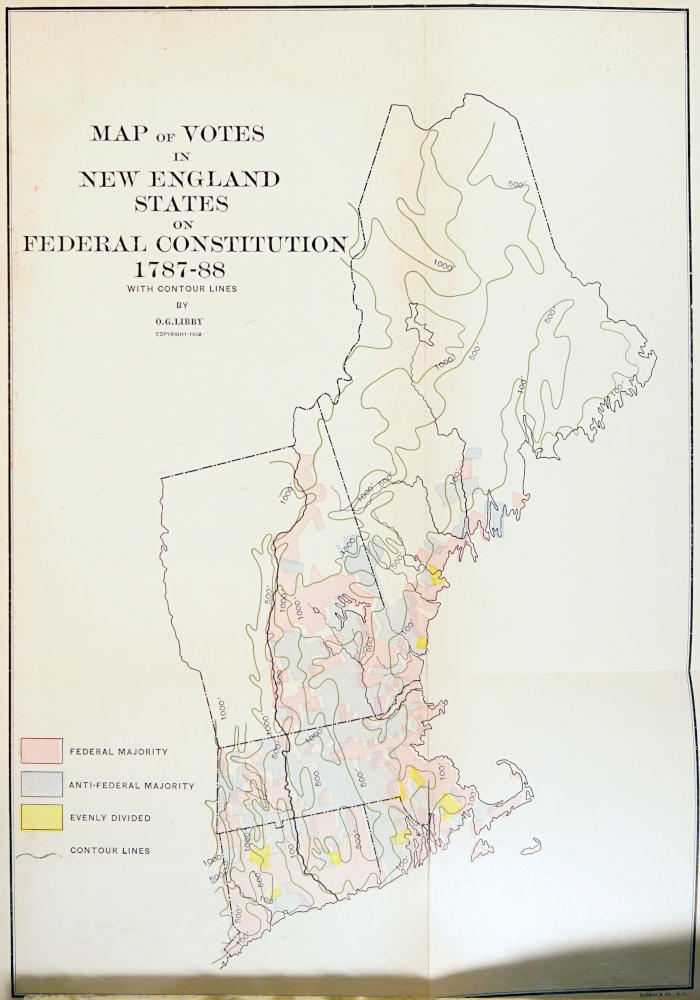
MAP OF VOTES IN NEW ENGLAND STATES ON FEDERAL CONSTITUTION 1787-88 WITH CONTOUR LINES BY O. G. LIBBY. COPYRIGHT 1902.
BORMAY & CO., N. Y.
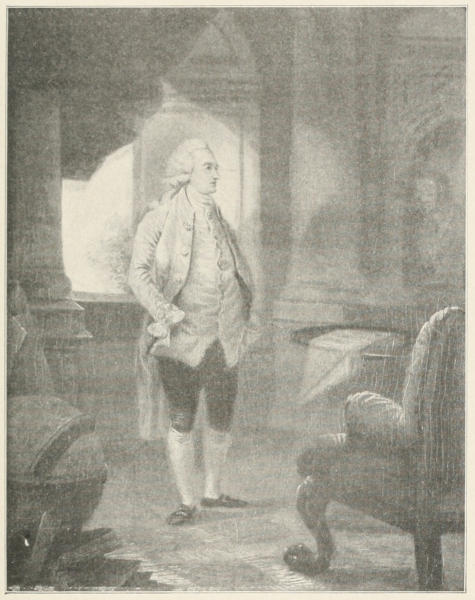
JAMES BOWDOIN
It had been a notable thing to see how wide the discussion had swung which attended the drafting and adoption of the new form of government, through how broad a range of topics it had run, and with how statesmanlike a tone and thorough-going a method alike of advocacy and of opposition. It had produced pamphlets which, for sobriety and thoroughness, might some of them have served as manuals of free government, and for form and vigor as models of lucidity and force in the use of English prose. At the very outset of the Revolution, at the first touch of national feeling, America had found her voice and produced of a sudden her school of statesmen and of writers. The strong emotions of the time had seemed to spring easily into words,—into words that told instantly upon men’s spirits on both sides of the sea, and made themselves at once vehicles of power. Now a new strain, a new impulse, the strain and impulse of those who build and make good what they have achieved, was upon the leaders of the young States, and they spoke their chastened thought like masters.
Very few men in America had used the pen for achievement or the satisfaction of the force that was in them until this supreme day of struggle came when a new nation was born and the very abstract principles of liberty entered into their imaginations and possessed their minds, like things that lived and had of themselves power to prevail. Men had not often turned to the making of books during the long days of settlement, when the colonies were a-making and every man’s fire went into his work in the forests or upon the sea or in the conduct of affairs. Here and there some man of thoughtful spirit, bred to his books in old England, would turn again, for solace and relief of heart in that wilderness, to his studies, as gentle George Sandys did, Sir Edwin’s brother, who had quickened the heavy nights at Jamestown with coining noble English verses out of the Metamorphoses of Ovid. Once and again some gentle woman, like Anne Bradstreet, of quick wit and thoughts that moved uneasy amidst her narrow, pent-up life, would seek outlet of spirit in bits of prose, that spoke her deeper moods, or verses into which she sought to put her image of the world. Men did not always merely preach, or speak only in town meeting, or put pen to paper only in letters of business. William Bradford, the peasant scholar who ruled Plymouth, wrote the moving narrative of his people’s pilgrimage and establishment in the New World with the dignity of the true historian, minded to hand a great story on to men of other days. Mr. John Winthrop kept daily chronicle of what went forward in the little commonwealth in which he ruled a generation through like one who works upon the records of a great State and people. But there was in none of this the full breath of letters.
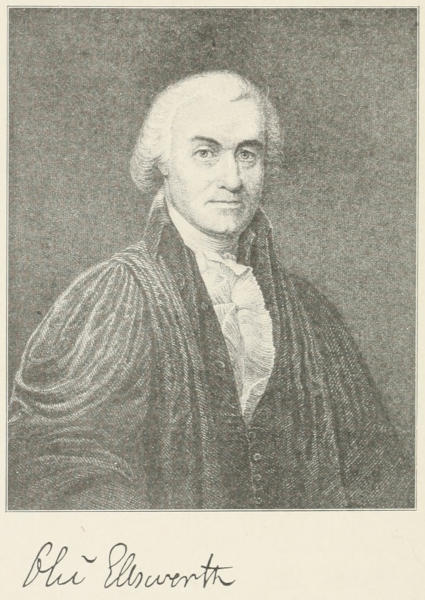
OLIVER ELLSWORTH
Men wrote, for the most part, only to set some business forward, of church or state. It was thus that Captain Smith had written his True Relation of the first planting of Virginia, his Description of New England, and his General History of Virginia, Summer Isles, and New England, and that the many books, great and small, about the planting of the colonies had come into existence. Partisans of each enterprise set its merits forth; opponents foredoomed it to failure; those who had tried America and found it a bitter place to live in spoke out in ridicule, condemnation, slander against it. It was in a like tone, as of men who carry an enterprise forward in their words, that the governing divines of the New England commonwealths had uttered their treatises upon the workings of Providence and the disciplinary purposes of the established polity among them. Mr. Hooker’s discourses rang always of man’s salvation or of the affairs of state which must rule his conduct. Mr. Cotton’s spoke always a purpose to govern men by the terms of his Puritan creed. Roger Williams wrote always of some matter that touched his mission as the founder of a free commonwealth or an evangelist among the Indians. Cotton Mather had set down, in his rugged Tudor prose, the judgments of God among men, as they had been revealed to him in the lives of those who had lived about him or in the affairs of the New England churches. Even their verses were but another engine of doctrine and reproof, when they made verse their vehicle of utterance, as did Michael Wigglesworth, the “little shadow of a man,” more soul than body, who through half a century was pastor at Maldon.
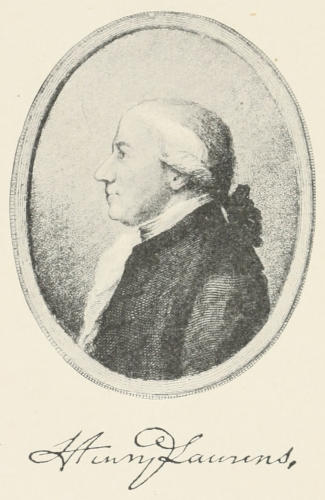
HENRY LAURENS
Not until that first century of initial strife and experiment had closed and a new age had come, with broader outlooks and airs of common enterprise, did any touch of genius lift letters to the levels of abiding power. In Jonathan Edwards the doctrine and philosophy of the Puritan churches found a voice which knew the full gamut of noble and effective speech. Every thought that he touched lived. His mind wrought always with a gift of creation. What he wrote was no longer the mere matter of the preacher; it was always living matter of thought as well, which searched meanings to their bottom, and was put forth to be reckoned with by every man who pondered aught of the weightier matters of his life. But it was spoken at the end of an age. The cool eighteenth century had come in. Men were beginning to ask, not for counsels of righteousness, but for common-sense maxims of conduct, for a philosophy of this world, not of the next; and were turning away from the religion, as they were turning away from the politics, of the age gone by. They stopped once and again to record what that age had done. Each little commonwealth could presently point to some quiet gentleman, like Mr. Hugh Jones and Mr. Robert Beverley in Virginia, and Mr. Thomas Prince in Massachusetts, who had made note of its history while yet the memory of it was fresh, its documents safe at hand. But the passion of the older time was no longer upon them. The spirit of another day turned men’s faces to the future, rather than to the past. New affairs were afoot, new thoughts astir, and men who thought, thought upon the enterprises and the principles of their own day.
Mr. Benjamin Franklin was their typical man of letters. That he was a man of letters seemed only an accident of his career as a man of affairs. His plain, straightforward, manly prose seemed with him an instrument of business. For all it had about it the flavor of his singular individuality and had an unmistakable touch of the nice art of speech upon it, it used everywhere the accents of the shop, the street, the lecture room, or the council chamber, and had seldom about it the free disengagement of letters. The homely saws and wise maxims of Poor Richard’s Almanack had the true flavor of his career, and were as close to practical experience as he himself kept all his life through. His passion for physical science oftentimes took him, it is true, away from the workaday world into the realms of speculation; but science was for him, after all, but the experimental side of practical achievement in the arts and conveniences of life. He was a savant of the people.
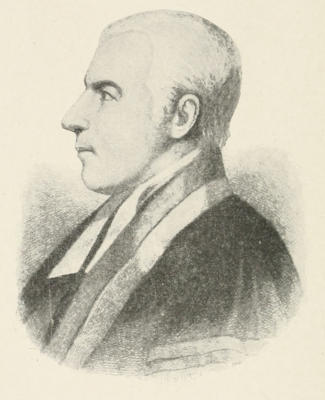
WILLIAM PATTERSON
In the literature of the Revolution forces were released which transformed letters into an instrument of creation and brought nothing less than a nation into self-consciousness. It had had its beginnings in the protest against the Stamp Act, grave state papers, the addresses of colonial assemblies and of the Congress at New York, the arguments of jurists, and the letters of observant men of affairs. Here was the structure of an empire to be debated. The very scope and capital significance of such a debate called to the best minds of the colonies like a challenge. Pamphlets began to come from the press which showed quiet men unexpectedly turned statesmen and masters of style to state the case for the liberties of the colonies. Mr. Daniel Dulany’s Considerations on the Propriety of Imposing Taxes on the British Colonies for the Purpose of Raising Revenue by Act of Parliament supplied the great Pitt with the chief grounds of his argument against taxing America. A Maryland lawyer had turned from leading the bar of a province to set up the true theory of the constitution of an empire, with the dignity, the moderation, the power, the incommunicable grace of a great thinker and genuine man of letters. Mr. Richard Bland, of Virginia, antiquary and mere jurist though he seemed to be, published an Enquiry into the Rights of the British Colonies, which put in blunt and bitter sentences what Mr. Dulany had said with restrained and sober eloquence,—that, and more besides. Mr. Bland did not hesitate to speak of Virginia as a “distinct and independent state,” bound, indeed, in allegiance to England’s king, but not bound to her Parliament; a dominion “settled by Englishmen at their own expense, under particular stipulations with the crown,” and entitled to deal with the crown alone. Mr. Townsend’s Acts of 1767 called forth a series of Letters from a Farmer in Pennsylvania to the Inhabitants of the British Colonies, into which John Dickinson had put the very heart of good sense and justice, to support the theory of liberty to which all America adhered, with an urbanity, a simple grace, a fine, natural power of statement which gave him instant place, on both sides of the sea, among famous Americans.
It seemed quite in the order of nature that James Otis and John Adams in Boston should enter the lists to make themselves champions of the people’s side in such an argument; and they wrote as they spoke, with a point and efficacy sure to win attention. It was much more significant that a like passion of speech should take hold of men hitherto withdrawn from popular leadership, for whom, it seemed, principles were the ultimate realities, not the mere play of affairs. And as the debate broadened, so did the volume of American letters grow. Her writers were serving their apprenticeship in the statement of the ideals by which she was to live. From the first Continental Congress came forth an earnest address to the King, sober memorials to the people of Great Britain and to the people of British America, and a solemn declaration of rights which were as firm, as moderate, as cogent in reasoning, as sagacious in method as if they had been the state papers of an ancient parliament. Men everywhere marvelled at their power of convincing statement, their telling force of quiet eloquence, as coming from a people without any writers, except Dr. Franklin, that anybody had heard of. There was here a breeding in letters which no man could well comprehend who had not breathed the keen airs of political inquiry moving upon the coasts of America.
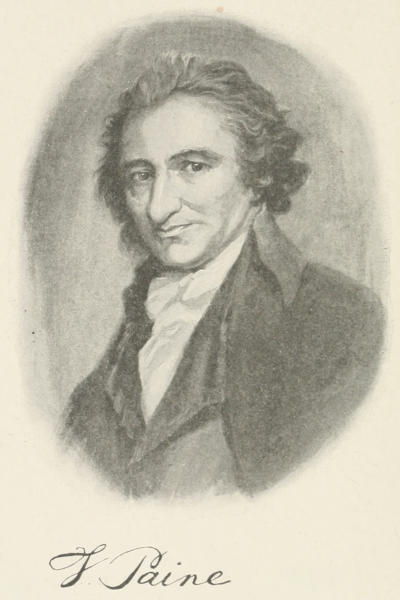
THOMAS PAINE
Presently there was the air of revolution, too. Pamphlets which argued with slow and sober power gave place to pamphlets which rang with passionate appeals; which thrust constitutional argument upon one side and spoke flatly for independence. One such took precedence of all others, whether for boldness or for power, the extraordinary pamphlet which Thomas Paine, but the other day come out of England as if upon mere adventure, gave to the world as Common Sense. It came from the press in Philadelphia early in January, 1776, the year the Congress uttered its Declaration of Independence, and no writing ever more instantly swung men to its humor. It was hard to resist its quick, incisive sentences, which cut so unhesitatingly to the heart of every matter they touched; which spoke, not the arguments of the lawyer or the calculations of the statesman, but the absolute spirit of revolt, and were as direct and vivid in their appeal as any sentences of Mr. Swift himself could have been. They were cast, every one, not according to the canons of taste, but according to the canons of force, and declared, every one, without qualification, for independence.
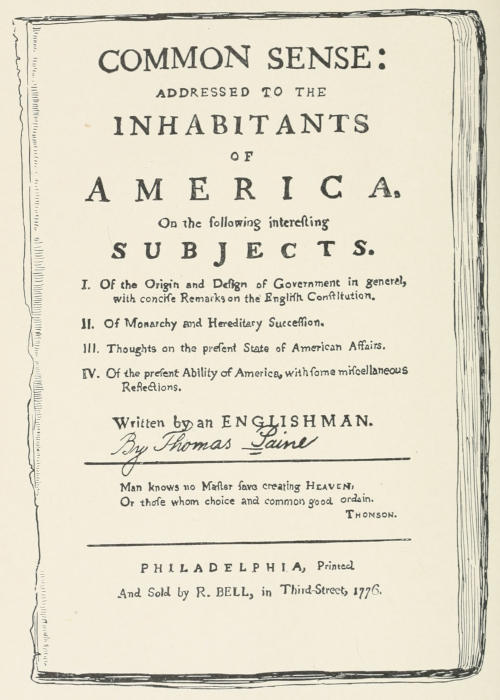
TITLE PAGE OF “COMMON SENSE”
Upon that, issue was joined. Men like Mr. Dickinson and Mr. Dulany drew back, and pleaded for the peaceful ways of constitutional agitation. Men like Joseph Galloway threw their sturdy power upon the same scale. Samuel Seabury, “The Westchester Farmer,” had already written letters against the extreme courses of the Congresses of 1774 and 1775 which were as difficult to answer as those of Mr. Dickinson himself, and men drew from them very effective weapons of controversy as affairs thickened towards revolution. Men mustered now upon that side who were very formidable, whether for influence or for skill and persuasiveness as advocates,—among the rest the redoubtable Jonathan Boucher, the robust preacher who was General Washington’s friend: who had met Washington in mid-stream of the Potomac as he fared to the Congress at Philadelphia and had warned him very solemnly to beware what he did to make cause against the King’s government in England. Issue joined, passion was the more quickened. There was vehement give and take. The sting of satire and invective was added to the bitterness of conflicting views upon this vital matter which must involve all men’s fortunes, and many used in ugly temper the worst weapons of abuse. Friends parted company in hopeless alienation. Men fought for their mere good name who resisted the rising spirit of the revolution. It was no light matter to come under the lash of verse-makers like Philip Freneau, whose satire burned like the flames about a stake. It was almost as hard to face John Trumbull’s stinging jests, touched sometimes with mirth but never with pity. These men were masters of their weapons, and wielded them with a certain grim pleasure. Perhaps Philip Freneau might, in some other age, have struck into the fine, sweet tones of genuine poetry; strains came now and again from his pen which marked him a poet with the real gift of song. But
“An age employed in pointing steel Can no poetic rapture feel,”
and he spent his force upon bitter satire, whose voice the men of his day welcomed and applauded. The passion of such a time could yield nothing more gentle. Men’s ears were not waiting for music. They spoke to give their speech efficacy as an instrument of action. The very private letters of the time read like minor pamphlets, ran always upon some theme of public concert in affairs, upon principles and measures, and were grave bits of counsel. Heads of colleges, like redoubtable John Witherspoon, of Princeton, kept the field in this fight for principles of government; Timothy Dwight, whom Yale afterwards preferred to her presidency, wrote its songs of war.
And so a generation was schooled for the making of a nation and the framing of constitutions: a generation bred to the debate of polities and the acute discrimination of principles of government; bred also to the severest and most analytical forms of discussion, and to the statement of political reasoning in words which told upon the mind like a demonstration. It was such a generation that debated the setting up and constitution of the Confederation, its weakness, the significance of Shays’s rebellion and of the disorders, some obvious, many obscure, which followed the war, the necessity for a new and better form of union, and the character of the government it ought to be provided with.
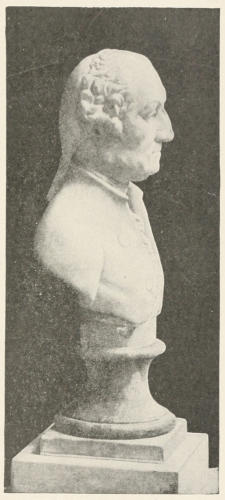
GEORGE WASHINGTON, FROM THE BUST BY ECKSTEIN
The chief part in the critical discussion of the constitution proposed by the convention of 1787 fell, of course, to the leaders of the several state conventions which met to consider its adoption or rejection. But there came also a flood of pamphlets from the press, and the newspapers of the seaport towns teemed with letters from men whose every line showed how schooled they had grown in the art of assessing questions of government. Public opinion had first to be dealt with before the state conventions should come together. There were opponents of the new scheme of union as ready to speak out as its advocates, and they spoke with a certain advantage of argument on their side. They could very easily make it seem, both to themselves and to those whom they addressed, that they were but continuing their advocacy of the principles of the Revolution in opposing the creation of a central government likely to command them as they had but just now refused to be commanded by the immemorial government of the King over sea, a government made sacred by old allegiance. But the victory was again with those who concerted action. The most notable papers of the whole controversy were the eighty-five Federalist letters addressed, in quick, unbroken series, to “The People of the State of New York” from the columns of The Independent Journal, The New York Packet, and The Daily Advertiser during the weeks which intervened between the promulgation of the text of the constitution and the assembling of New York’s convention.
Each letter bore the signature Publius, but the series was in fact written by three several authors. Those which analyzed the general powers of the proposed government, those which sought to make clear its historical and theoretical foundations, and many of those which expounded its details, were the work of Mr. Madison. Mr. Hamilton examined, in his thorough-going, unanswerable way, the defects of the existing Confederation, such of the details of the constitutional convention’s plan for the reconstitution of the government as Mr. Madison had not the time to develop, and those general conceptions of government which he handled so like a master. Mr. Jay discussed the fitness of the new government for dealing with the foreign relations of the States. What distinguished these papers from all the rest with which printers and politicians were so busy was their breadth of view, their fine temper, their range of topic, their texture woven both of fact and principle, their candid and yet conclusive comment upon every matter that could be drawn into controversy. They read like what they were, the utterances of statesmen,—of statesmen drawn for the nonce out upon the general field of the theory and practice of government. It was easy to see in reading them how Mr. Madison had served and guided the convention at Philadelphia, and how Mr. Hamilton might have served it, had he liked its work while in progress as heartily as he now accepted and advocated it. These papers were henceforth to be the chief manual of all students and historians of the constitution. And their style, with its unfailing lucidity, its cogency without artificial emphasis, its unmistakable distinction and elevation of tone, matched their matter. This was the masterpiece of letters in the sober kind bred by revolution.
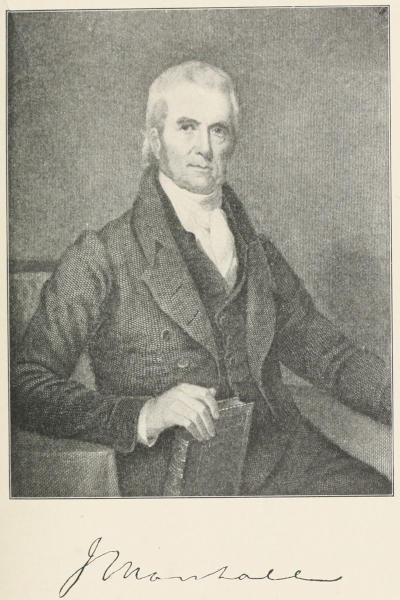
JOHN MARSHALL
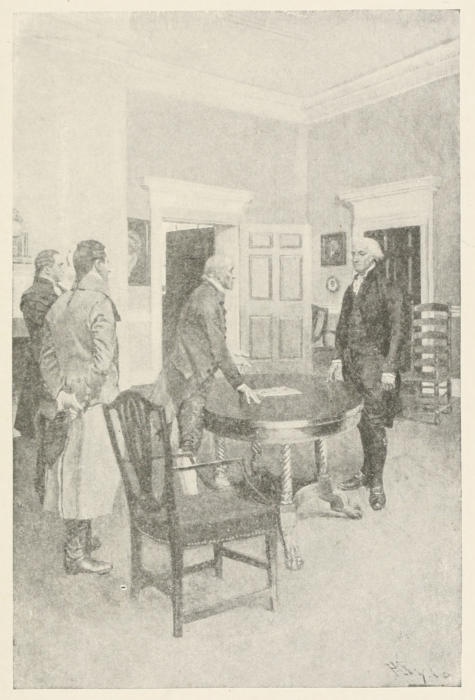
THOMSON, THE CLERK OF CONGRESS, ANNOUNCING TO WASHINGTON, AT MOUNT VERNON, HIS ELECTION TO THE PRESIDENCY
No man could say whether argument or interest had won the fight for the constitution; but it was at least certain that nothing had been done hastily or in a corner to change the forms of union. These close encounters of debate had at least made the country fully conscious of what it did. The new constitution had been candidly put through its public ordeal. All knew what it was, and for what purposes it was to be set up. Opinion had made it, not force or intrigue; and it was to be tried as a thing the whole country had shown itself willing to see put to the test.
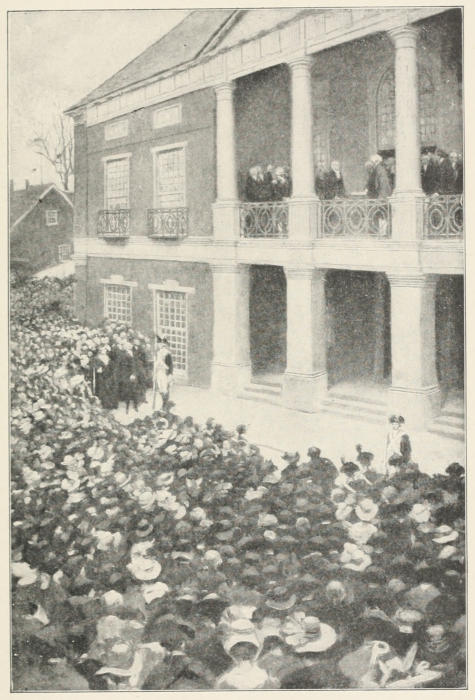
INAUGURATION OF WASHINGTON IN NEW YORK
Fortunately, there was one “Federalist” leader whom all the country trusted, and against whom even the bitterest opponents of the new constitution hesitated to speak in malice or detraction. The choice of men everywhere turned spontaneously to Washington as the one man who ought to be first President of the United States. The constitution provided that electors should be chosen in the several States, and that by them a President and Vice President should be selected. Their votes were to be sent to the Congress, to be opened and counted in a joint session of the two houses. The 4th of March, 1789, had been set as the day for the convening of the new Congress and the inauguration of the government; and New York was the place appointed. But the members were laggard and tardy, as they had been at Philadelphia when the constitution was to be framed. It was the 6th of April before they found a quorum and counted the electoral votes. On the 7th they sent Charles Thomson, who had been clerk of every Congress since 1774, to Mount Vernon to inform General Washington that he had been unanimously chosen President. By the 27th Washington was in New York, ready for his duty. He had come with unaffected reluctance. He called himself a mere soldier, and an old man besides; doubted his civil capacity; and coveted peace and retirement. But he had known it his duty to come; and on the 30th he was inaugurated President of the United States.
The first thing to be done was to give the new government dignity, vigor, and pre-eminence, lest it should inherit the taint of contempt which had fallen on the Confederation. It was the office and authority of the President, rather than the increase in the powers of Congress, that constituted the chief difference between the new government and the old. It was to be a government which could not only make laws, but execute them also; and Washington knew that no small part of its efficacy and prestige must depend upon him, its Executive. “I walk,” he said, “upon untrodden ground. There is scarcely an action the motive of which may not be subjected to a double interpretation. There is scarcely any part of my conduct which cannot hereafter be drawn into precedent.” He must, he saw, mix prudence with firmness, conciliation with command, a reasonable accommodation with the strict execution of the law; and yet not abate the new authority. The new constitution had yet to prove itself acceptable; the new government had yet to win respect. No sentiment attached to it. It must be begun amidst curiosity rather than reverence; in a cool air almost of indifference; without many warm partisans of the rank and file; as an experiment, lacking yet for some time the dignity of an institution.
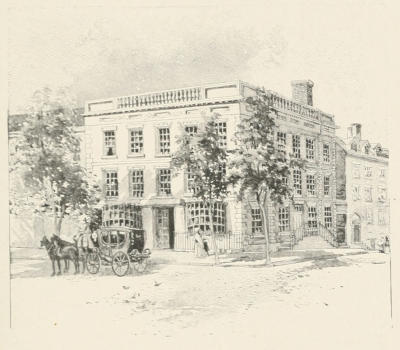
THE FIRST PRESIDENTIAL MANSION, AT PEARL AND CHERRY STREETS, NEW YORK
In such circumstances questions of etiquette assumed the importance of questions of statecraft. The President insisted, first of all, upon personal precedence. He would receive but not make calls, would give invitations but not accept them; the representatives of foreign governments must deal with him, not directly, but through the Department of State, the country’s new foreign office; the governors of States, when he travelled, must call first on him, not he first on them. He made a point of visiting different parts of the country when he could, in order that the people might everywhere have visible proof of the existence and of the dignity of the President, the head of the nation. He practised no foolish seclusion. It was inbred in his principles that he should serve the people in true republican spirit, without affectation or pretension. He walked the streets like other men; rode forth for his exercise on horseback, as was his Virginian habit; was but little more punctilious in dress and manner than he would have been at home. But the natural majesty of his person, his habitual gravity, his breeding in a formal society, the impression he made upon every one of a man of high passion self-controlled, inevitably gave him distinction, and magnified his office in the imagination of all who saw or dealt with him.
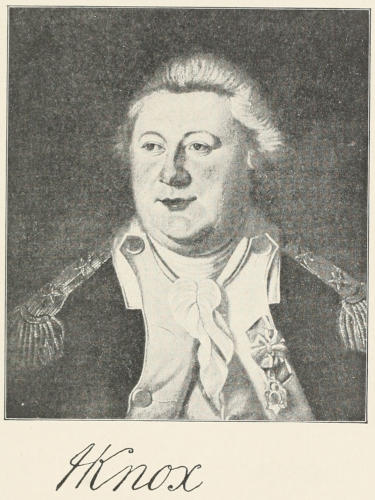
HENRY KNOX
It was easier for him to play his own part of quiet authority and matter-of-course precedence than to fill the new offices of federal administration with men who could lend a like flavor to the conduct of affairs. Ambitious men looked askance upon the new government; preferred the service of their States, if they wished political office at all; had to be persuaded to take federal office, and were asked to say nothing of the offer and refusal if they declined it. Fortunately, there were not many offices to be filled; and for these efficient men were found. The Congress created but three administrative departments at the outset: the Department of State, the Department of the Treasury, and the Department of War; though it provided also for the appointment of an Attorney General. Washington chose Thomas Jefferson to be Secretary of State, Alexander Hamilton to be Secretary of the Treasury, General Henry Knox to be Secretary of War, and Edmund Randolph to be Attorney General. Mr. John Jay he made Chief Justice of the Supreme Court of the United States. His strong desire was to join parties in a common support of the general government,—join them at the outset, when their formation was but foreshadowed, not yet hardened to a definite purpose. Alexander Hamilton the whole country knew to be one of the chief advocates of the new and stronger government; General Knox, too, was an avowed “Federalist,” as well as a close personal friend of General Washington’s; but Mr. Jefferson, who had been in France when the constitution was framed and adopted, came rather lukewarmly to its support, and Mr. Randolph, though he had stood for its adoption, with Mr. Madison, in the Virginian convention, had favored it rather as a sensible politician than as an earnest friend. Mr. Jay was known to be a Federalist.
When parties formed it would be in Congress; and the elements there were not difficult to reckon. There were but eighty-one members, all told: in the Senate twenty-two, in the House fifty-nine, until Rhode Island and North Carolina should come into the Union. It gave weight to the administration that John Adams had been chosen Vice President, and stood with all his sturdy frankness for Federalism, and represented, besides, distinguished national service, both at home and abroad. He had been the first minister of the new republic at the court of St. James, and had made himself and his country respected there, alike for statesmanship and for integrity. He had been at Paris and at The Hague, always alert, always serviceable, always efficient, if never quite genial or attractive, and brought with him to his new duties in New York the excellent traditions of his State in politics and morals.
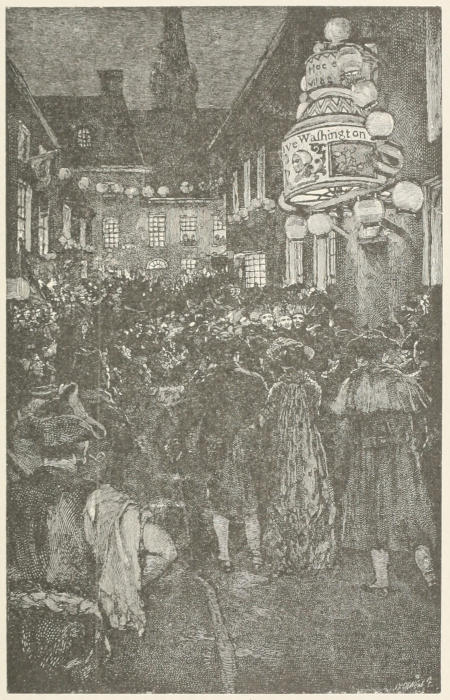
CELEBRATION IN NEW YORK ON THE NIGHT OF WASHINGTON’S INAUGURATION
There were marked differences of opinion in the houses from the first: some were inclined to a very liberal construction of their new powers under the constitution; others cried a warning against it, and pressed very earnestly for methods which should above all be conservative, and hold all things to a moderate course. It was easy to see how parties could form,—were forming; but as yet they revealed themselves only vaguely, and legislation moved unembarrassed.
The task of the new Congress was nothing less than the organization of the government. By an act of the 24th of September, 1789, it definitively set up the Supreme Court for which the constitution had provided; giving it a membership of six justices, of whom one should be Chief Justice. Its statutes erected the Departments of State, War, and the Treasury; created the office and functions of Attorney General; put the military establishment upon a modest peace footing; and confirmed the regulations which the Congress of the Confederation had made with regard to the government of the Northwest Territory ceded by the States to the general government.
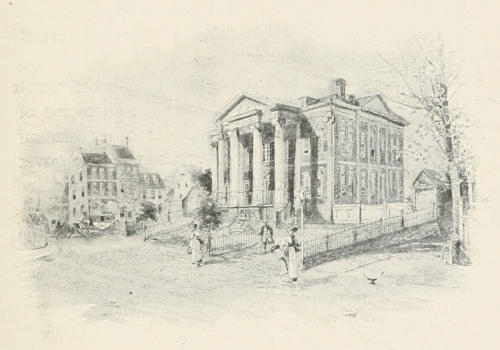
GOVERNMENT HOUSE AT THE BATTERY, NEW YORK, 1790
Its measures of policy affected the whole action of the government in the matters most likely to give it strength and credit; and even the operation of the constitution itself. Virginia was not the only State which had given its assent to the constitution upon the virtual condition that so soon as the government went into operation amendments should be adopted which should explicitly safeguard the more essential rights of individuals and of States. North Carolina, South Carolina, New York, Massachusetts, and New Hampshire had also urged amendments; and those who had been the chief advocates of the constitution in their several conventions had virtually promised that amendment should be undertaken at the earliest practicable moment. The Congress, therefore, promptly proposed twelve amendments; and of these twelve the States accepted ten. Eight of them ran in the phrases of Magna Charta, the Petition of Right, the Declaration of Independence, and the Virginia Bill of Rights; the principles they embodied had come out of the long processes of English constitutional history, out of the precedents of English courts and the practice of English justice; out of charters and constitutions and ancient parliamentary protests. They made secure against federal encroachment the rights of individuals in respect of religion, freedom of speech, military service and the use and maintenance of armies, search warrants, trial in accordance with fixed law and by the judgment of juries, criminal accusations, the inflicting of punishments, and the exaction of bail. The ninth provided that “the enumeration in the constitution of certain rights should not be construed to deny or disparage others retained by the people.” The tenth declared that “powers not delegated to the United States by the constitution, nor prohibited by it to the States, were reserved to the States respectively or to the people.”
So much Congress did to keep faith with the country and to clear the constitution of even the suspicion of a character unfavorable to liberty. Its other measures were intended, not to justify or excuse the new government, but to give it efficiency. It was by common consent the chief business of the session to set the finances of the country effectually to rights and to regulate commerce: to give the new Union unquestionable standing in the markets and the banks of the world. Congress put itself in these matters under the guidance of Hamilton. The advice given by the young Secretary was characteristic alike of his capacity and of the purposes which he entertained with regard to the government. And he declared his views with characteristic candor and directness. “To justify and preserve the confidence of the most enlightened friends of good government; to promote the increasing respectability of the American name; to answer the calls of justice; to restore landed property to its due value; to furnish new resources both to agriculture and commerce; to cement more closely the union of the States; to add to their security against foreign attacks; to establish public order on the basis of an upright and liberal policy; these,” he said, “are the great and invaluable ends to be secured by a proper and adequate provision at the present period for the support of the public credit.” In a series of carefully considered reports in which he showed himself, as always, a consummate master of constructive argument and of that sort of exposition which itself convinces,—reports on the public credit, on the excise, on the establishment of a national bank, on manufactures,—he proposed that a tariff act be passed which should incidentally protect and encourage domestic manufactures; that the foreign debt of the Confederation should be assumed and paid in full; that the domestic debt of the Confederation, also, though it had long ago fallen below par and had largely passed into the hands of speculators at an enormous discount, should nevertheless be paid at its face value; that even the debts which the several States had incurred during the Revolution should be assumed and paid by the federal treasury; and that a national bank should be established to serve as the fiscal agent of the government. Each of these proposals in turn Congress acted upon and adopted,—not, of course, at once and without debate: only after severe and even bitter contests, indeed, which ran through two annual sessions, and by majorities which grew narrower and narrower with each vote until they dwindled and were lost altogether, to be regained again only by an adroit parliamentary bargain;—but adopted, nevertheless, and made the deliberate policy of the government.
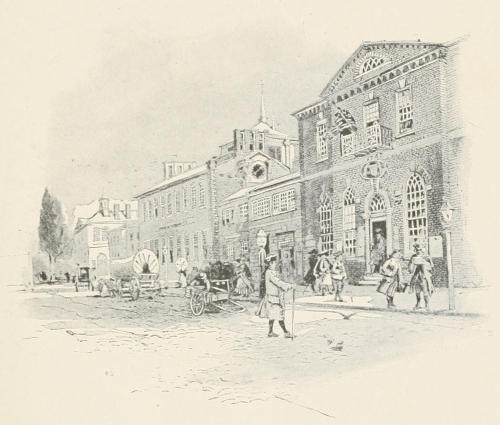
CONGRESS HALL, 1790-1800
Here was more than conservative men could digest. Even Madison, who in most things led the houses, as he had led the constitutional convention, hesitated and drew back. Jefferson protested, with rising heat, in the cabinet and out of it. Parties began to gather definite creed and purpose, and divided upon lines which grew more and more fixed and clear. It was undoubtedly Hamilton’s purpose to draw men of wealth and property to the support of the government by means of his financial measures: to give them definite reasons for wishing it to succeed, and for determining to stand by it until it did succeed, building for the government a great backing of interest; and that of itself condemned what he did in the eyes of some. It seemed to make what he proposed legislation for a class: for a class which did not always prefer the interests of communities to its own. More than that, some of the measures which Congress had adopted, notably that which established a national bank, involved a doctrine of powers implied, as well as of powers explicitly granted, by the constitution. The new government had looked formidable enough with the powers explicitly granted; who should say where the elaboration of its powers would end if still others were to be drawn forth by implication? The constitution nowhere explicitly gave Congress the right to create a corporation, like the new Bank of the United States. Hamilton argued that that right was included under the clause which gave it power to make all laws which should be “necessary and proper for carrying into execution” the powers specifically granted; because he held that the Bank was a necessary financial agent in the handling of the federal funds. But whither would the country be led if men of Hamilton’s school in politics were permitted to interpret the word “necessary”?
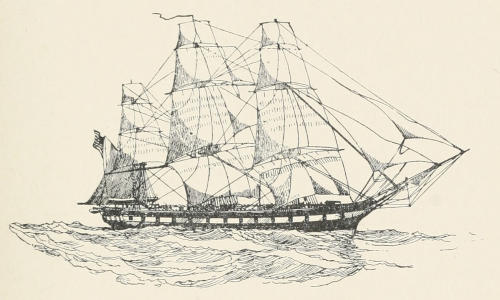
UNITED STATES FRIGATE, 1812
Those who had opposed the constitution because under it the authority of a common government could command the financial policy of the States, and those who had opposed it because it subordinated the States in every chief matter of politics and made of them fractions instead of integers in the political life of the country, had, of course, been ready from the first to stand against Mr. Hamilton and his policy of concentration. When his whole plan was disclosed many Federalists also drew back, with Mr. Madison, fearing whither they should be led by the doctrine of implied powers which the young Secretary thus so boldly pressed at the very outset. Many a sign of sharp reaction gave the Federalist leaders plain warning of what they might expect, should they persist.
Mr. Jefferson became the real leader of the new party of opposition, even before he left the cabinet: at first covertly, at last openly; giving it the name Democratic Republican, which savored of the Rights of Man and took men’s thoughts over sea to the sharp struggle for liberty then ablaze in France; giving it also organization and the spirit of party, like the master of men he was,—philosopher and politician in equal compound. But Washington accepted the leadership of Hamilton, as Congress did, and for a time nothing could withstand the purposes of those who meant to make the new government strong, national, and permanent. When two years had gone by (1791) a new House was chosen, and in part a new Senate; but the Federalists still kept their ascendency in most of the constituencies, and the first policy of the government was not stayed.
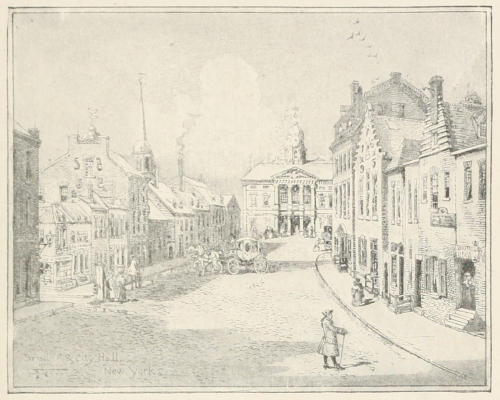
VIEW OF BROAD STREET AND CITY HALL, NEW YORK, 1780
Meanwhile North Carolina (November 21, 1789) and Rhode Island (May 29, 1790) had come into the Union, and the original roster of the States was complete again. Two more States were presently added: Vermont,—“the New Hampshire Grants,” territory which New York and New Hampshire both had claimed,—in March, 1791, and Kentucky, Virginia’s lusty and restive offspring, in June, 1792. Whatever doubts of policy or contests of party marked those opening days with threat of divided counsels, the Union was at least established,—was already expected to last. Kentucky’s incorporation within it showed that the hopeful West was turning to it. Public questions touched its measures, but had already ceased to touch its life. A veritable government had at last been set up to hold the country together. It had been “a novelty in the history of society,” as de Tocqueville said, “to see a great people turn a calm and scrutinizing eye upon itself, when apprised that the wheels of government had stopped; to see it carefully examine the extent of the evil, and patiently wait until a remedy was discovered, which it voluntarily adopted, without having wrung a tear or a drop of blood from mankind.” But this the people of America had done, under the men who had called upon them to amend the Articles of Confederation and provide themselves with a real government: under the men who, with Washington, had set that government up and given it immediate credit and standing in the world.
The general authorities for this period are the sixth volume of Bancroft’s History and his History of the Constitution; the third volume of Hildreth; the second volume of Timothy Pitkin’s Political and Civil History of the United States; the first volume of George Tucker’s History of the United States; John Fiske’s vivid Critical Period of American History; George Ticknor Curtis’s Constitutional History of the United States, History of the Origin, Formation, and Adoption of the Constitution, and The Constitution of the United States and its History, in the seventh volume of Winsor’s Narrative and Critical History of America; John B. McMaster’s History of the People of the United States; Francis N. Thorpe’s Constitutional History of the American People and Constitutional History of the United States; Richard Frothingham’s Rise of the Republic of the United States; Judson S. Landon’s Constitutional History and Government of the United States; C. Ellis Stevens’s Sources of the Constitution of the United States; George Gibbs’s Memoirs of the Administrations of Washington and Adams; Edward Stanwood’s History of the Presidency; J. P. Gordy’s History of Political Parties in the United States; and Joseph Story’s Commentaries on the Constitution of the United States. Hermann von Holst’s Constitutional and Political History of the United States and James Schouler’s History of the United States of America under the Constitution here begin to serve us as guides and mentors.
The sources are to be found in the published writings and correspondence of the leading men of the time; the Annals of Congress; Jonathan Elliot’s Debates on the Federal Constitution; The Federalist; Thomas H. Benton’s Abridgment of the Debates of Congress; the federal Statutes at Large; The American State Papers; Niles’s Weekly Register; H. D. Gilpin’s Papers of James Madison; Paul L. Ford’s Pamphlets on the Constitution of the United States and Essays on the Constitution; Thomas Jefferson’s Anas; and William Maclay’s Journal, covering his service in the first Senate of the United States.