Chapter III · A NATION IN THE MAKING (continued 2)
Reading edition
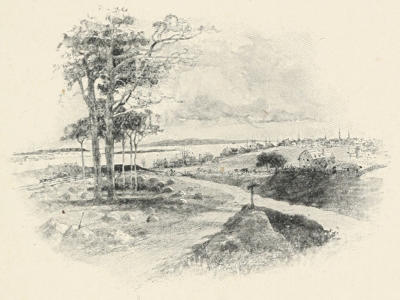
NEW YORK ABOUT 1800. FROM THE NORTH
Mr. Jefferson saw the face of war in all this, but would not propose any means of redress. The only remedy he would suggest was a fleet of gunboats for the defence of the ports, less costly than fortifications, less dangerous also, his creed said, to principles of self-government and the maintenance of a modest central power, than a formidable navy. If American seamen were not safe against attack at sea, it was best that they should stay in port, where the country could make good their defence. He found it impossible, indeed, to do away with sea-going ships of war altogether. At the very outset of his administration he had been obliged to send a squadron against the pirates of Tripoli, who openly made war on the commerce of the United States. The six frigates then kept in commission proved unsuitable for the service, and he was forced to consent to the construction of a few vessels more suitable, which promptly brought Tripoli to terms. But he did not allow even the Tripolitan war (1802-1805) to bring a real navy into existence.
He tried negotiation with England, through Mr. Monroe and Mr. William Pinkney, for many weary months, and through many changes of ministry over sea, but could get nothing better than Jay’s treaty (then about to expire by limitation), and would accept nothing less than a renunciation of the right of search and of impressment, which England would not relinquish. When the Leopard fired on the Chesapeake he ordered all British men-of-war out of American waters and forbade them her ports; but there was no remedy in that. At last, driven to retaliation but unalterably opposed to war, he recommended an embargo, which should at least make English merchants smart by cutting off their lucrative trade with the United States.
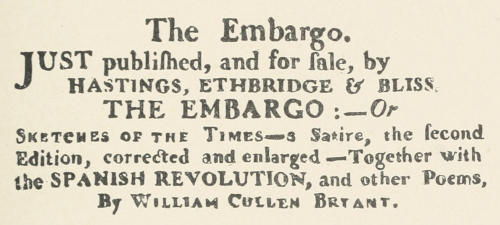
BRYANT’S SATIRE
On the 22d of December, 1807, an Embargo bill became law which absolutely prohibited all foreign commerce, whether in foreign or in American bottoms. A year before Congress had authorized the President to forbid the importation of certain classes of English goods on and after a certain date. But the date had been deferred until the eve of more radical measures. The Embargo Act closed the ports against all nations, and even against the exit of American ships. Even coasting vessels were required to give bond to land their cargoes within the United States. Such an experiment in retaliation, cried Josiah Quincy, of Massachusetts, in the House, had “never before entered into the human imagination. There is nothing like it in the narrations of history or in the tales of fiction.”
“My principle,” said the President, “is that the conveniences of our citizens shall yield reasonably, and their taste greatly, to the importance of giving the present experiment so fair a trial that on future occasions our legislators may know with certainty how far they may count on it as an engine for national purposes,”—as a substitute for war in bringing foreign nations to terms of reason; and he had his way to the utmost. His personal influence prevailed in everything. Members of Congress knew very well how sorely the bill would pinch, but they never dreamed of disobeying. “All our surplus produce will rot on our hands,” cried a member of the House. “God knows what all this means! I cannot understand it. I see effects, but I can trace them to no cause.... Darkness and mystery overshadow this House and the whole nation. We know nothing; we are permitted to know nothing. We sit here as mere automata; we legislate without knowing; nay, sir, without wishing to know why or wherefore.” The embargo was to be tried because Mr. Jefferson believed in its efficacy.
The closing year of his presidency was darkened and distressed by its effects. The States themselves suffered from the act more than the nations whose trade they struck at. America’s own trade was ruined. Ships rotted at the wharves,—the ships which had but yesterday carried the commerce of the world. The quays were deserted. Nothing would sell any more at its old price. The southern planters suffered even more keenly than the New England merchants. Their tobacco and rice and cotton could not be sold, and yet their farm hands, who were slaves, could not be discharged and had to be maintained. The wheat and live stock of the Middle States lost half their market. It was mere bankruptcy for the whole country. No vigilance or compulsion could really enforce the act, it is true. Smuggling took the place of legitimate trade, where it could. Even within the year, too, manufactures began to show a little more as if they would grow, to supply what importation could no longer supply. But there was small palliation for the keen distress of the time in smuggling or the feeble beginnings of manufacture; and before irreparable mischief had been done the fatuous system broke down.
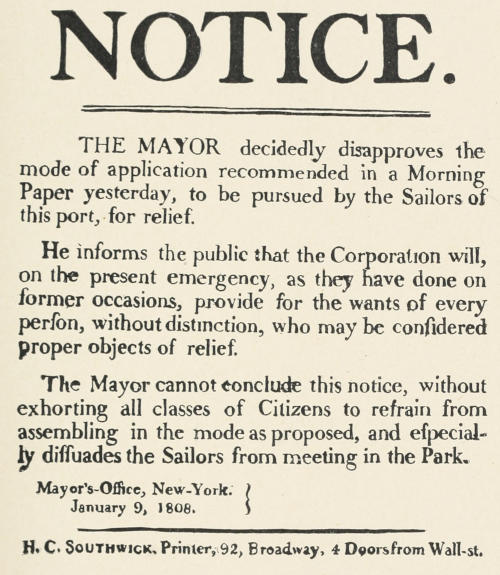
NOTICE CONCERNING THE RELIEF OF SAILORS
It bred distress not merely, but actual disaffection as well. The distress was universal; disaffection showed itself only in New England, where the Federalists still kept their organization and their power. The sea was New England’s farm, as Mr. Pickering said. To be shut out from using it for trade and adventure was as sharp a blow at her habit and her livelihood as that which had been dealt by Mr. Townshend’s Acts, which had played their part, as everybody knew, in bringing on a revolution. Exasperation could not easily be kept within bounds; and no one seemed wise enough to restrain it. New Englanders deemed the embargo a more open and more partisan attack upon their interests than the purchase of Louisiana had been, and thought it significant enough that it came from Mr. Jefferson, the Virginian, leader of the South and West. As a matter of fact, the Act cut nearer the roots of life in Virginia than in Massachusetts. The merchants of New England lost the profits of trade, indeed; but British cruisers would very likely have confiscated those in any case. Their capital at least was safe; and New England, like Pennsylvania, found means to reimburse herself in the home markets suddenly opened for her simple manufactures which Virginia and the South had no opportunity to employ. It showed a singular constancy and steadfastness in principle and in party loyalty on the part of Virginia and her neighbor States at the south that they should thus face ruin to support Mr. Jefferson.
The Federalist coterie in Massachusetts and Connecticut were at such a pitch of exasperation, allowed themselves such license of bitter and disloyal speech, seemed so stubbornly bent upon opposition to the utmost, that even men very little given to panic fear began seriously to apprehend the worst. Indeed, the worst was presently to be seen at hand. It was a long coast to keep ships from, that which stretched all the way from the rivers of Maine round about Spanish Florida to the rivers and inlets of the Gulf, and before the President and his advisers had done with the hateful Act they were driven, in order to make it effective, to measures as arbitrary and as inquisitorial as the Alien and Sedition laws and Mr. Townshend’s Acts to enforce the Parliament’s laws of trade. In January, 1809, in accordance with the recommendations of a report from Mr. Gallatin, Congress passed an Enforcing Act which authorized the President, through the collectors of customs, to seize any goods of American growth or manufacture that might be found in any kind of boat or in any vehicle going towards the sea, and to hold them until heavy bonds were given that they would not be taken out of the United States. At that the temper of New England broke down, as the temper of Kentucky and Virginia had broken down under the Alien and Sedition laws. A committee of the Massachusetts senate recommended a law to protect the people of the State against “unreasonable, arbitrary, and unconstitutional searches.” When Mr. Dearborn, the Secretary of War, requested Governor Trumbull, of Connecticut, to select officers of the militia of that State to assist the collectors in enforcing the Act, he flatly refused, and plainly declared his determination to defy the authority of the federal government. “Conceiving, as I do, and believing it to be the opinion of the great mass of citizens in this State,” he said, “that the late law of Congress for a more vigorous enforcement of the embargo is unconstitutional in many of its provisions, ... my mind has been led to a decided and serious determination to refuse compliance with your request, and to have no agency in the appointments which the President has been pleased to refer to me.”
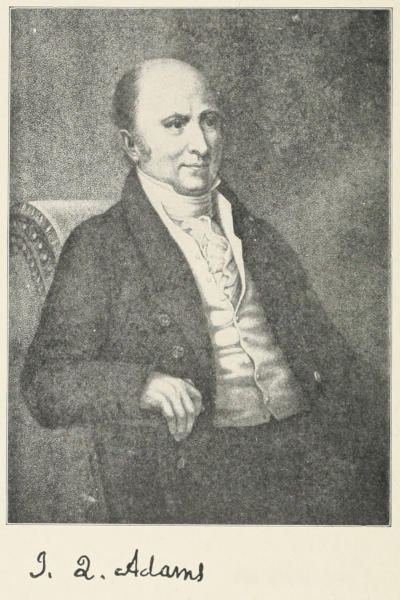
JOHN QUINCY ADAMS
Already, the year before, Mr. John Quincy Adams had informed Mr. Jefferson that there was a plan afoot in New England to nullify the embargo and defeat the laws, and that secession, it might be, and union, or at least alliance, with England would follow. Here was a notable sign of the times! John Adams’s son, bred in the strictest school of federalism, and himself senator from Massachusetts, had of a sudden left his party, had voted for the embargo, and now, cool and distant though he was with all men, came forward to warn and counsel Thomas Jefferson and shield the country from the consequences of Federalist folly. Mr. Jefferson knew at once how singular and significant a thing had happened; knew that Mr. Adams had acted from a love of duty, not from love of him; felt a touch of panic himself; and acted as the crisis seemed to demand.
Amidst such an accumulation of embarrassments, at home and abroad, it was no doubt better to yield a good deal to the spirit of discontent, before actual strife came on, than to provoke it to excesses. The end of Mr. Jefferson’s term was at hand, his successor chosen, his party’s supremacy secure, and concession could be made without material sacrifice. On the 1st of March, 1809, accordingly, a Non-Intercourse Act, which prohibited trade with the ports of England and with all countries under the control of France, but set it free again to move as it pleased so far as the rest of the world was concerned, was substituted for the absolute embargo. The signing of the new measure was almost the last official act of Mr. Jefferson’s administration. On the 4th of March, with no slight sense of relief, he handed over to Mr. Madison the responsibilities of his great office,—a burden which increased, as he had found, from year to year.
Mr. Madison had been chosen without difficulty to the Presidency (1808). The supremacy of his party was almost unquestioned; he was Mr. Jefferson’s choice for the succession; the nomination was an affair arranged by the party leaders in Congress and formally ratified in a caucus of the Republican members of the two houses,—not without rivalries and a show of contest, indeed, but without difficulty; and the electors readily confirmed the choice. Massachusetts, Rhode Island, and New Hampshire returned in the election to their Federalist allegiance; three Federalist votes in North Carolina were added to the two which Maryland again stood ready to give: and Mr. Pinckney and Mr. King, who were again the nominees of the Federalists, received forty-seven electoral votes, instead of the beggarly fourteen they had received four years before. But Mr. Madison received one hundred and twenty-two. Mr. George Clinton, of New York, who had been chosen Vice President with Mr. Jefferson, after Mr. Burr’s retirement, became Vice President for a second term with Mr. Madison. The reaction against the embargo had not touched the country at large.
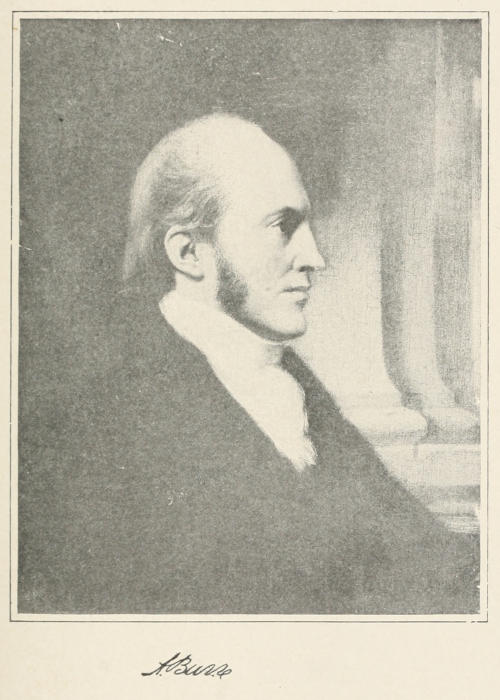
AARON BURR
The country, indeed, had turned with a singular heartiness and unanimity from the Federalists to Mr. Jefferson and the party he had made, as if he had spoken the natural humor and inevitable principles of a new country wishing a new life of its own. The Federalists seemed of a sudden statesmen no longer, but a mere faction which wished accommodation with England upon any terms, for the sake of trade and the maintenance of a tradition. They seemed out of humor with the making of a free democratic nation, full of wholesome but irregular force; and handed even their one-time principles over to the Republicans: opposed them when they magnified the federal power by the purchase of Louisiana, and echoed the protests of the Virginia and Kentucky Resolutions when they enforced the embargo. It was evidently the tone and method of the new party rather than its rigidity in principle or consistency in action that had taken the fancy of the country. It used power as freely, and stretched the constitution with as little compunction in the using, as the Federalists before it. Though for a little while after its first elevation to the place of government it had railed in good set terms against the constitution itself, because it prevented the removal of obnoxious judges by mere address of the two houses; had wished impeachment to be regarded as a political, not as a judicial process; and had tried to use it to subordinate the courts to the political control of the President, it had soon forgotten that madness, and had used a very different tone in most things. It had voted money to build a great national road through the Cumberland Gap into the West, as readily as Federalists would have voted it, and with almost as little doubt or scruple as to constitutional powers. What had seemed a bit of treason against the government in the West had been snuffed out as promptly and unhesitatingly as the whiskey rebellion in western Pennsylvania had been snuffed out by Washington and Hamilton in their more questionable day of authority, when, Jeffersonians had said, a party acted and not the nation.
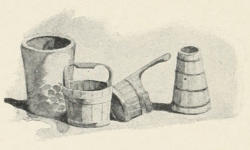
WESTERN COOKING UTENSILS
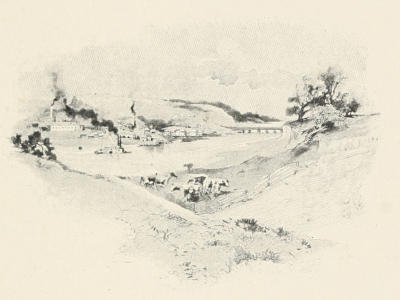
PITTSBURG, 1810
The treason, if treason it was, had been Mr. Burr’s, now a discredited, it might be also a desperate, man. His duel with Hamilton, which seemed like nothing less than a political murder, had rendered him of a sudden almost a political and social outcast; the last months of his vice presidency he had passed in bitter isolation from old friends and associates; and he had left office (March 4, 1805) stricken in every legitimate ambition. I am “under ostracism,” he said. “In New York I am to be disfranchised, and in New Jersey to be hanged. Having substantial objections to both, I shall not, for the present, hazard either, but shall seek another country.” The forced pleasantry covered no man could tell what purpose. His “other country”, was the West. Leaving Washington in May, 1805, he swept in a swift journey through all the forested country which lay upon the eastern banks of the Mississippi from Kentucky to far New Orleans and back again, as if upon an errand. The next year he repeated the journey; and boats, provisions, munitions of war began to be gathered here and there on the Ohio and the Cumberland. It was said he meant to attack Mexico; that he meant to set up an independent empire in the West; that some great treason, or at the least some lawless scheme of freebooting, was afoot. Nothing could be proved. Mr. Burr was indicted and tried for treason (May-September, 1807), but there was not evidence enough to convict him. He left the country and wandered in restless loneliness through foreign lands, a ruined and hopeless man.
He had at least furnished proof, men felt sure, that the loyalty of the West to the East could no longer be doubted or seriously tampered with: for, whatever it had been that he was plotting, he had got, it was certain, very little aid or counsel there, spite of appearances. The reign of the new party in national affairs had, at any rate, knitted East and West together; the makeweight of Louisiana had been added to the national scale; and Mr. Madison had the bulk of the country back of him.
Mr. Madison loved peace, as Mr. Jefferson did, and was willing to secure it by any slow process of law or negotiation that promised to keep war at arm’s length. But he presently found himself caught in the tangled network of policy which, as Secretary of State, he had woven for Mr. Jefferson. Mr. Jefferson’s foreign dealings had turned, not merely upon Napoleon’s decrees and the English Orders in Council against neutral trade, but also upon his desire to add the purchase of West Florida to the purchase of Louisiana, and so make good the dominion of the Union to the east as well as to the west of the Mississippi. First, when he thought England would aid him in that matter, he had played for a close friendship with her. When England failed him and it seemed as if Napoleon would compel Spain to make the cession if America would but turn away from England to him, friendly dealings with England had been given up and everything had been pulled about to please the master of France. Napoleon’s diplomacy ran deeper than that of England. He stuck at nothing to gain his ends; was determined that America should serve him, not the English, in the mighty struggle he had entered upon to bring the world to his feet; promised everything to win America away from England, and then, having gained what he wished, repudiated his promises and did nothing. Mr. Jefferson had become deeply entangled, beyond hope of extrication; had become the professed friend of France, and had not gained Florida. Mr. Madison was left to face two unfriendly powers, to the more false and dangerous of whom it was his cue, it seemed, to play the complacent servant.
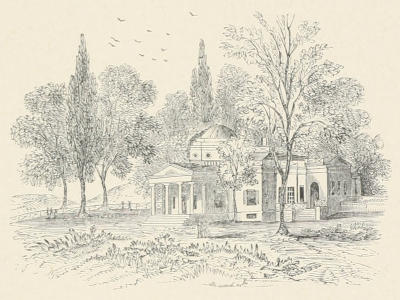
MONTICELLO. THOMAS JEFFERSON’S RESIDENCE
For a brief space affairs seemed to clear very hopefully, as if the old tangle were about to be unravelled and dealings with England brought to a right posture again. Mr. Erskine, the British minister at Washington, young, sanguine, and inexperienced, agreed to a withdrawal of the Orders in Council, and Mr. Madison gladly suspended the operation of the Non-Intercourse Act in respect of Great Britain, as the terms of the Act permitted. But it turned out that the young minister had acted without authority. He was recalled, the Act was again put into force against England (August 9, 1809), and affairs looked uglier than ever.
Then Napoleon practised anew upon the credulity of the Administration. On May 1, 1810, Congress formally repealed the Non-Intercourse Act, which would have expired by limitation at the close of the session without repeal, and authorized the President, in case either Great Britain or France should “cease to violate the neutral commerce of the United States,” to revive and enforce non-intercourse with the other, should she fail to do the same. Napoleon promised that his decrees against American shipping should be revoked on the 1st of the following November, provided England would before that date withdraw her Orders in Council. England replied that she would rescind the Orders when informed that the Emperor had revoked his decrees. The Emperor sent word to Mr. Madison that his decrees were in fact revoked, and should cease to have effect after the 1st of November, if in the mean time the United States should “cause their rights to be respected by England.”
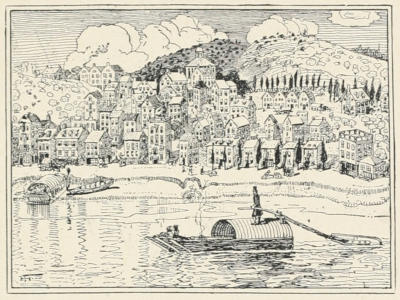
CINCINNATI IN 1810. FROM HOWE’S HISTORY OF OHIO
There was no doubt what that meant: non-intercourse with England as the price and condition of release from the intolerable restraints of France. And intolerable they were. Nearly every port of the continent, whether on the Atlantic, the Mediterranean, or the Baltic, was under the Corsican’s control; and everywhere American ships were seized and confiscated on the pretext that they were carriers for England, whom he meant to beat at any cost. Napoleon’s decrees, like the English Orders in Council, had been nothing less than acts of war against the United States from the first, though not primarily aimed at her, and would at any time have justified a declaration of hostilities. But Mr. Madison did not want war. The United States were not strong enough,—particularly now that the party in power had disbanded its army, dismantled its navy, and reduced its revenues to a minimum. The President’s principles clearly forbade war, besides. He wished to fight only with the weapons of nominal peace: embargoes and retaliatory restrictions. If Napoleon would yield his decrees, so much the greater pressure could be brought to bear upon England to yield her Orders in Council, and the vexatious game might at last be won. The Emperor was no doubt bringing the end of it within sight.
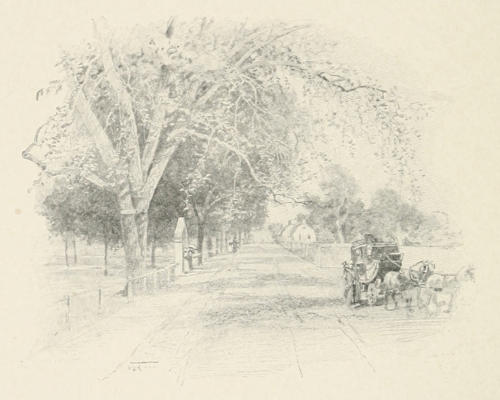
TREMONT STREET, BOSTON, 1800. LOOKING NORTH
Again too precipitate and too confiding, therefore, the President acted as if the game were already won and the matter already settled, so far as France was concerned. The 1st of November having come and England’s Orders not yet being withdrawn, on the 2d he made proclamation that intercourse with Great Britain and her dependencies would again be suspended on and after the 2d day of February (1811) following, until England should yield. Only after he had fully committed both himself and the country did he learn how deeply and shamefully he had been deceived. The seizure of American ships in continental ports did not stop. Other decrees, other restrictions, old and new, sufficed for their condemnation as well as the decrees said to have been revoked. The revoked decrees themselves were still acted upon if occasion demanded. American skippers were but lured by a false security into virtually hostile ports. Their ships and cargoes were seized and confiscated without compunction or subterfuge, at a loss of quite ten million dollars in a single season. Ill feeling between England and the United States was seriously deepened, as the astute and unscrupulous master of France had meant that it should be; and every negotiation for an amicable settlement grew the more confused and doubtful. Every sinister influence seemed to draw Mr. Madison towards what he most dreaded and contemned,—towards a war of arms, brought on by a programme of peace.
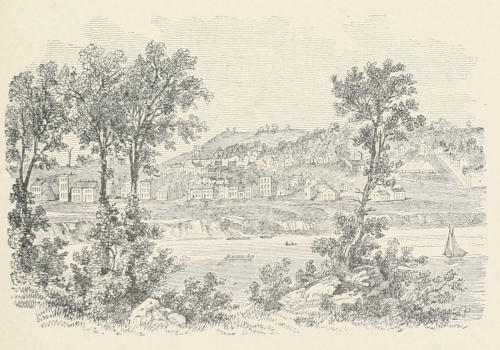
CINCINNATI, FROM NEWPORT, IN 1812
Negotiations dragged very slowly then, with the coming and going of tardy ships, which had oftentimes to steal like fugitives in or out of port. But all through the long year 1811, though hopes and plans and anxious fears came and went with doubtful ebb and flow, and no one knew what either England or France would do, it grew more and more evident that the government of the United States must do something, if only to keep itself in countenance. It had pledged itself to believe that France had in good faith yielded to its demands. England made no pretence of having yielded or of intending to yield. Evidence multiplied that France was playing a double and lying part. Mr. Madison’s mortification was complete and very bitter; but no one deemed it possible that the United States should fight both France and England at once. Men’s minds were slowly made up to stomach France’s deceptions and fight England. At least it was so with the President, who saw no way of retreat not too humiliating to be borne; and it was so with Congress, which had passed under the control of new leaders.
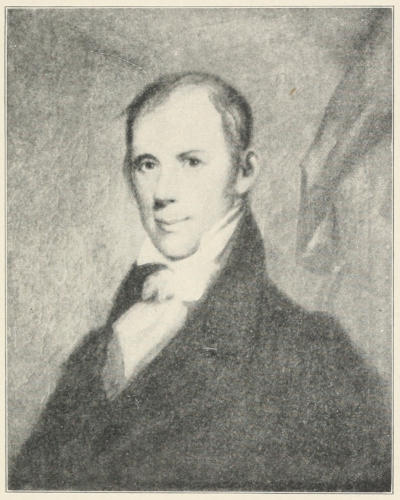
HENRY CLAY
An air of radical action began to stir the moment Congress assembled (November 4, 1811). It was the first session of the Twelfth Congress. In the House seventy members, out of a total of one hundred and forty-one, were new men, and for the most part young men: their leaders young men like themselves. Most conspicuous among them was Henry Clay, a man not yet turned thirty-five, whose tall and striking figure, easy way of comradeship among men, free and ringing eloquence in speech, and ready mastery in the battle of debate gave him an engaging pre-eminence, which no man without an equal charm and power could dispute with him. There was something in the whole make-up of the man,—his free pose, his candid way of utterance, his dash and telling vigor,—which bespoke him the Kentuckian, the man of the new and confident West, where the frontier of settlement was near at hand and where the forces of irresistible growth and initiative were abroad. And yet there was an art, a winning persuasiveness, a reverence for old ideals, a flavor of old principles in all that he did and said which seemed a reminiscence of his birth in Virginia, where tradition was from of old and kept its votaries. Scarcely less striking was John C. Calhoun, the new member from South Carolina, a young man not yet thirty, who showed in every piece of business he handled a maturity like that of the young statesmen of the constitutional convention. There was the air of the scholar and student about him. His luminous sentences, uttered in debate, shone upon every matter they touched with singular steadiness and with a light at once vivid and diffused, disclosing the distant view no less than the thing at hand. A strain of passion and of quiet energy showed in him which caught the imagination and touched the purpose of those about him. It was inevitable that these men should lead,—these and the other men of the new age who stood with them and were of like principle and purpose: in the House, Langdon Cheves and William Lowndes, of South Carolina; Richard M. Johnson, of Kentucky; Peter Buel Porter, of New York; and in the Senate, William H. Crawford, of Georgia.
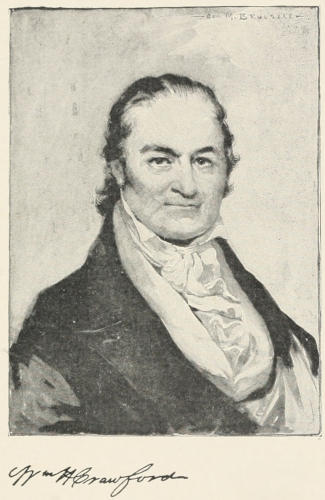
WILLIAM HARRIS CRAWFORD
Mr. Clay was chosen Speaker and organizer of the House, and it proceeded to the business which led to war. These men had made up their minds that the country should fight. The President could not but take their purpose, having no alternative to suggest. The tangle of French diplomacy could not be straightened out, the stubbornness of England could not be budged: the country, as if by hereditary choice, chose to fight England and let France go her way for the present. The grounds of the war were singularly uncertain. France was doing much more to injure neutral trade than England was. That very spring (1812) a French fleet put to sea confessedly commissioned to burn American merchantmen wherever found. Mr. Madison urged against England the old grievance of impressment, and no one could doubt its weight or gravity. Nearly every twelvemonth between 1804 and the embargo close upon a thousand men a year had been seized out of American ships. American tonnage increased seventy thousand tons a year so long as American skippers were permitted to enjoy the profits of neutral trade; four thousand two hundred additional men were needed yearly to put crews into the new craft, and it was estimated that twenty-five hundred of the new men were in fact British subjects, no small proportion of them unquestionably deserters from his Majesty’s navy. Every American sailor went about with a certificate of citizenship which described his “eyes and nose and mouth and chin, the color of his hair and complexion, and the marks and scars about his person,—like the advertisement of a runaway slave,”—and yet was not safe. Actual outrages often accompanied the ceaseless impressments, and only the embargo, which kept ships in port, had thrown the matter for a little into the background. But it had been thrown into the background. Mr. Jefferson had let it go almost without protest since his commissioners had failed to induce England to abandon it. It was now clearly an afterthought as a ground for war. There was no excitement in the country; only a vague irritation and fretfulness. But the drift had set in, and the majority went with it, dragging the country. In April, 1812, an embargo was enacted, preparatory to war; and on the 18th of June war was declared. The very day before (June 17th) the English Parliament had repealed the Orders in Council. The change of mind and of policy long looked for in England had come at last, and the cause of the war was taken away on the very eve of its outbreak.
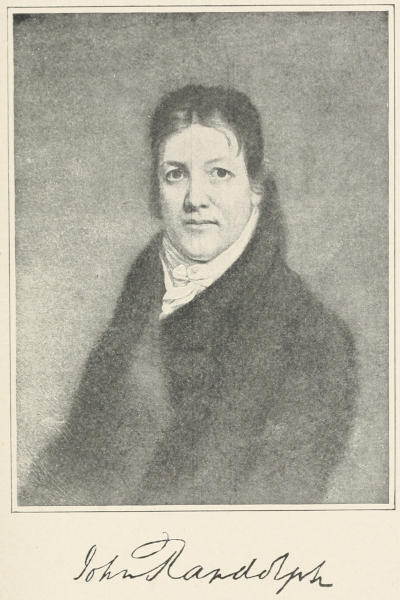
JOHN RANDOLPH
It was a foolhardy and reckless risk the Congress was taking. The country had been “embargoed and non-intercoursed almost into a consumption,” as Mr. Randolph said, very passionately. It was certainly no time for battle. The party in power had relied on embargoes and non-intercourse and had disbanded the army. The revenues of the government were scarcely more than sufficient for its meagre peace establishment. The very Congress which voted the war refused to provide for the taxes which Mr. Gallatin told them would be necessary to carry it on. The preceding Congress had refused to recharter the Bank of the United States, the government’s only effective financial agency, and the currency was already falling, as a consequence, into hopeless confusion, running through a quick depreciation.
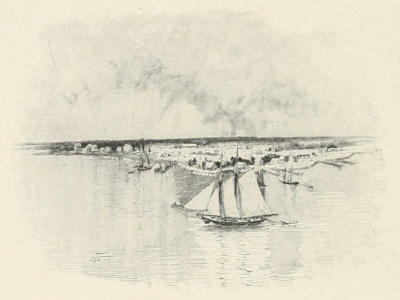
DETROIT IN 1815
What was worse, the risk of the war was not a whit more obvious than its deep impolicy. Napoleon was the enemy of the civilized world, had been America’s own enemy in disguise, and had thrown off the disguise. England was fighting him almost alone, all Europe thrown into his scale and hers almost kicking the beam; and now America had joined the forces of Napoleon, in fact if not in intention, as he had subtilely planned. It was natural that the raw and rural nation should thus have seen its own interests in isolation and indulged its own passion of resentment with selfishness. England’s policy had cut America to the quick and had become intolerable, and it did not lessen America’s exasperation that that policy had been a measure of war against the Corsican, not against her. It was a tragical but natural accident that the war should be against England, not against France.
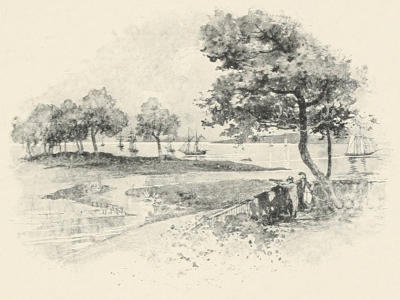
THE PORT OF BUFFALO, 1815
It was thus that the New England Federalists saw the war; but they deemed the accident inexcusable and pressed their opposition almost to the verge of treason. The trade of the shipping ports had of course suffered immensely at the hands of both England and Napoleon. But the profits of the neutral carrier were enormous, nevertheless, in that troubled time. Such ships as escaped seizure and made good their voyage recouped their owners for many lost. Ship building went forward very prosperously in America despite every order and decree of the belligerents; and so long as there was no embargo to restrain and make them outlaws at home merchants almost cheerfully took the risks of the sea. The embargo which immediately preceded the war was intended, of course, to call the shipping in for its own protection; but merchants hurried every available vessel to sea as soon as they heard it was to be passed, in order to be beforehand with it and take the risks Congress sought to protect them against. Once again, when the embargo came, the opposition of New England became factious and desperate. It spread to New York, which passed from the control of a Republican to the control of a Federalist majority. It threatened hopelessly to embarrass the government, if not to jeopard its very existence.
The course of the war did little to improve matters. The government had neither the means nor the organization to conduct it. The President was authorized to increase the regular army from six to twenty-five thousand men, to call for fifty thousand volunteers, and to employ one hundred thousand men from the militia of the States. But volunteers were not to be had for the asking; and officers were even harder to find than men. The governors of Massachusetts, Connecticut, and New Hampshire, though they would not forbid recruiting, refused to permit the use of their organized militia outside the limits of their States, thinking themselves legally justified by the terms of the constitution, which authorized Congress to provide for calling forth the militia only “to execute the laws of the Union, suppress insurrections, and repel invasions,” and said nothing of a war like this. The President, accordingly, withdrew all federal garrisons from New England. The only general officers available were either veterans of the Revolution, too old to be serviceable, or mere politicians who claimed preferment as a political favor. The income of the government never while the war lasted rose above ten millions a year; but its expenses for the war turned out to be from thirty to forty millions per annum. Loans had constantly to be resorted to; most of the money of the country was in New England or at the great ports, where the war was hopelessly unpopular; men were inclined to refuse to aid a government which had already more than once ruined trade and prostrated business,—if only to show their temper in affairs; and the credit of the government sank lower and lower. Congress was obliged to resort at last to the very excise taxes which all Republicans had so hotly condemned the Federalists for imposing; to lay direct taxes on such articles of personal use as household furniture and watches; and finally, when the war was over but not the difficulties of finance, to re-establish the Bank of the United States (April, 1816). A few light duties on imports could not support the government when every principal harbor of the country was blockaded.
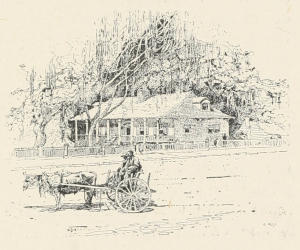
JACKSON’S HEADQUARTERS, NEW ORLEANS
For almost three weary years the war dragged on. It was a war upon the borders: the long northern frontier, the defenceless coast, the easy points of approach on the Gulf. As in the Revolution so now, the heart of the country went untouched. Along the short lines of the Detroit, the St. Clair, and the Niagara; on the waters and shores of the great lakes; and up and down the line of Champlain, where Burgoyne had moved in the wilderness, were the chief scenes of the uncertain fighting. On the coasts English fleets swarmed thicker and thicker until almost every important port was effectually closed. Finding no opposing force to attack, their crews made frequent descents upon defenceless settlements, which they burned and plundered. In August, 1814, a strong British force landed in Chesapeake Bay, close to the capital; marched upon Washington, which the government, knowing the place to be of no strategic importance whatever, had not thought of providing with defences; took it without difficulty, the officers of the government barely escaping capture; burned the public buildings; and turned to an attack on Baltimore which was gallantly repulsed.
The year 1814 had set England free to prosecute the war with vigor. Napoleon was beaten. The very month Congress declared war against England he had attacked Russia for a final triumph. Five hundred and fifty thousand men he took against her, the combined armies of subjugated Europe. But disaster dogged him at every step. Three hundred thousand lives he threw away; more than a hundred thousand men he left in the hands of the enemy. He came back with barely one hundred thousand (December, 1812), to face a rising of the nations. Germany, Spain, Sweden, every people in Europe roused itself to crush him. His armies dwindled and were beaten, by Wellington in Spain, by Blücher beyond the Rhine. By the end of March, 1814, the allies leagued against him were in Paris; in April he was an exile in Elbe.
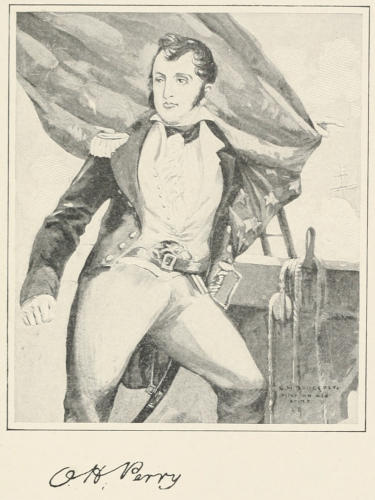
OLIVER HAZARD PERRY
But America by that time had drilled troops and experienced officers, trained by the hard processes of the war itself. What proved of as much consequence, her little navy startled the world by its extraordinary exploits. There were but seven frigates, great and small, besides a corvette or two and a few small brigs; but her seamen were professionals, not amateurs like her soldiers. Whenever they could elude a British fleet watching at the harbors where they lay, and come to a reckoning with their foes, vessel with vessel on the sea, they almost without exception won, and won promptly, by expert seamanship and good gunnery; and British captains were ordered to sail, not singly but in company, to be safe against them. Little navies were created, too, on the lakes, where they were built while the war lasted. Commodore Perry in a single gallant action (September 10, 1813) won entire control of Lake Erie, and set a body of troops across the lake whose decisive victory on the Thames ended the war in the northwest. In the summer of 1814 Commodore Macdonough met the English on Lake Champlain (September 11th) and won a victory which once for all ended plans of invasion there.
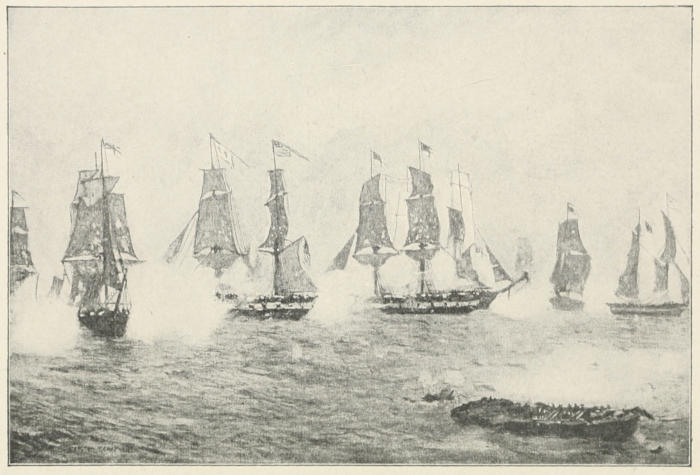
BATTLE OF LAKE ERIE
As the war progressed discipline came to the raw armies of the Union and they began to be handled by men who understood their duty and performed it in soldierly fashion. The war had begun with a series of defeats in the north at once ridiculous and disgraceful; but the whole face of affairs changed when the Americans drove the British troops from their batteries at Lundy’s Lane (July 25, 1814) and kept their victory half the black night through against assault after assault; and the fortunes of the field swung measurably even after that from action to action.
The war closed in the South. There the British sent Pakenham with twelve thousand men, veterans for the most part from the fields of Spain, to take New Orleans, which they meant to hold for such terms as might suit them when the war was done. There, on the 8th of January, 1815, General Andrew Jackson received him, at the trenches the Americans had drawn across a narrow strip of land below the city, and beat him off with half the force: sent him back in utter rout, with twenty-five hundred men less than he had brought. Jackson himself lost but eight killed and thirteen wounded.
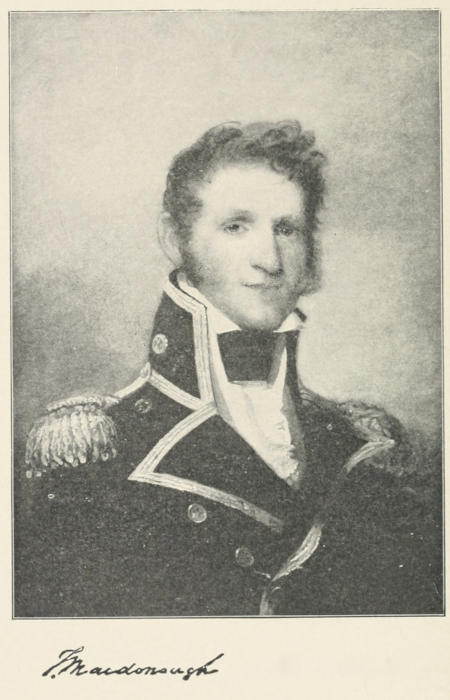
THOMAS MACDONOUGH
Two weeks before that notable affair at New Orleans (December 24, 1814) a treaty of peace had been signed at Ghent, of which the country knew nothing. England had several months earlier made known her willingness to treat. The war was costing her ten millions sterling a year; and she made no real headway in it. Mr. Madison hurried commissioners over sea at the word, and by December terms had been agreed upon. It was a mere treaty of peace and of boundaries. The Orders in Council were long ago repealed; impressment was not mentioned,—was, indeed, itself a matter settled well enough by the defeat of Napoleon and by the new respect America had gained on the seas. The war itself was no doubt sufficient guarantee that another for a like purpose would never be necessary.
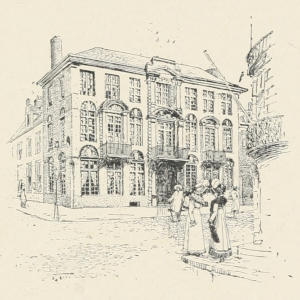
HOUSE OF AMERICAN COMMISSIONERS AT GHENT
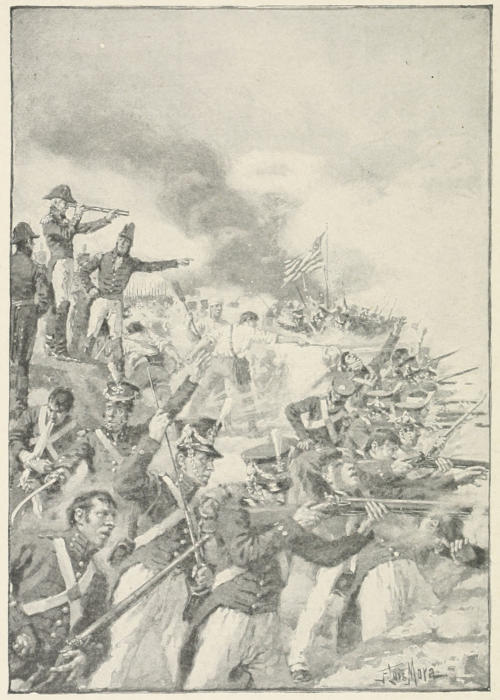
IN THE AMERICAN TRENCHES. BATTLE OF NEW ORLEANS
Peace came none too soon to check the sinister influences of politics at home. New England had contributed men and money to the war as the law required and her means permitted. Because she was wealthy and populous, she had, indeed, contributed more than the South and West, whose representatives in Congress had brought the war on despite her passionate protests. But the temper of her leading men grew more and more impatient and insubordinate as the war advanced. In December, 1814, at the call of the legislature of Massachusetts, a convention of delegates from Massachusetts, Connecticut, and Rhode Island met at Hartford whose secret sessions made the whole country uneasy. There was nothing actually revolutionary in what it did, so far as the country could learn; it had met for consultation, no doubt, not for action. But it spoke the very language of the Kentucky and Virginia Resolutions in the papers which it put forth; it was known to represent men who had more than once been openly and aggressively a pro-British faction, men who Hamilton and John Quincy Adams had feared might go the treasonable length of disunion; it insisted upon amendments to the federal constitution which should protect minorities of States from majorities. When the war closed a committee of its members was in Washington to demand of the government that the federal taxes should be divided and the New England States permitted to retain those which their own people paid in order that they might apply them as they pleased to their local defences. The treaty of peace sent them home belated and derided. The Hartford convention was the end of the Federalist party. But it had none the less been a very sinister sign of the times.
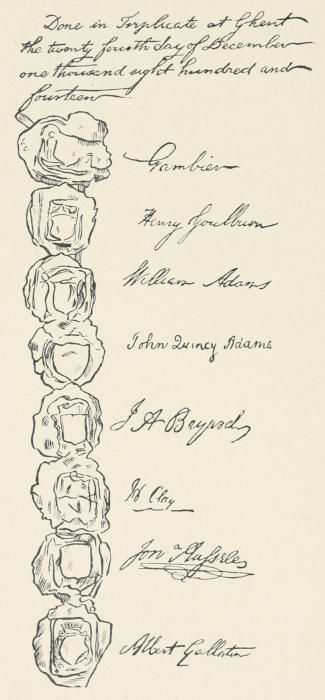
FACSIMILE OF SIGNATURES TO THE TREATY AT GHENT
If the war had done nothing else, however, it had at last made the country quick with the spirit of nationality, and factions were discredited. The war of the Revolution had needed a war for independence to supplement it, as Mr. Franklin had long ago said. Until now, notwithstanding the separation, English statesmen had deemed the United States still in no small degree dependent upon England for their place and privilege in the world, and America had virtually in her thought accepted a position of dependence. The Federalists had been ashamed of no concession or submission to England, when once their greater leaders had fallen silent. This clumsy, foolhardy, haphazard war had at any rate broken that temper. The country had regained its self-respect. The government of the Union, moreover, was once more organized for rational action. The party which controlled it had once for all given up the theories which made it conscientiously weak and inefficient upon principle. It was ready now upon occasion to raise armies, impose direct taxes, avail itself of the services of banks, and serve the country by means which should hold the nation united and self-centred against the world.
Authorities: For general guidance through this period we have the fourth, fifth, and sixth volumes of Hildreth, the first three volumes of George Tucker’s History of the United States, the second and third volumes of John Bach McMaster’s History of the People of the United States, the first and second volumes of James Schouler’s History of the United States of America under the Constitution, the first volume of Dr. Hermann E. von Holst’s Constitutional and Political History of the United States, and the fourth volume of Bryant and Gay’s Popular History of the United States. With the accession of Mr. Jefferson to the presidency, Mr. Henry Adams’s admirable History of the United States during the administrations of Jefferson and Madison becomes indispensable. The late Mr. Alexander Johnston contributed to J. J. Lalor’s Cyclopaedia of Political Science, Political Economy, and United States History articles on the chief topics and events of this period, such as the purchase of Louisiana, the embargo, and the war, which exhibit at their best the painstaking and the judicial temper of the trained historian. For the rest, our general authorities are John C. Hamilton’s History of the Republic of the United States of America as Traced in the Writings of Alexander Hamilton and His Contemporaries, a voluminous work in seven volumes; Edward Stanwood’s History of the Presidency; George Gibbs’s Memoirs of the Administrations of Washington and Adams; William H. Trescot’s Diplomatic History of the Administrations of Washington and Adams; the first volume of J. P. Gordy’s History of Political Parties in the United States; Charles Francis Adams’s Life of John Adams; George Tucker’s Life of Thomas Jefferson; John T. Morse’s Life of Alexander Hamilton; Henry Adams’s Life of Albert Gallatin; William C. Rives’s History of the Life and Times of James Madison; Josiah Quincy’s Memoir of the Life of John Quincy Adams; Edmund Quincy’s Life of Josiah Quincy; Henry Cabot Lodge’s Life and Letters of George Cabot; C. W. Upham’s Life of Timothy Pickering; Moncure D. Conway’s Omitted Chapters of History, disclosed in the Life and Papers of Edmund Randolph; Matthew L. Davis’s Memoirs of Aaron Burr; H. M. Brackenridge’s History of the Late War; William Jones’s Military Occurrences and Naval Occurrences; Charles J. Ingersoll’s Historical Sketch of the Second War between the United States of America and Great Britain, 1812-1815; Benson J. Lossing’s Pictorial Field Book of the War of 1812; and Theodore Roosevelt’s Naval War of 1812.
The very notable set of brief biographies known as The American Statesmen Series constitute, when put together, an excellent history of the country from the points of view of its several public men of chief importance. The volumes for this period are those on Washington, John Adams, Hamilton, Jefferson, Madison, Jay, Gallatin, Gouverneur Morris, John Marshall, John Randolph, Clay, John Quincy Adams, and John C. Calhoun. Having been prepared by different authors, these volumes are necessarily unequal in authority and merit, but the series as a whole is of remarkable excellence.
The documents and contemporary materials are to be found in the Annals of Congress; Thomas H. Benton’s Abridgement of the Debates of Congress; the American State Papers; the Works, Papers, and Correspondence of the leading public men of the time; John Marshall’s Life of George Washington; John Quincy Adams’s Memoirs; the Diary and Letters of Gouverneur Morris; Timothy Dwight’s Travels in New England and New York (1796-1813); Rochefoucault-Liancourt’s Voyage dans les États-Unis (1795-1797); J. Weld’s Travels through the States (1795-1797); Thomas Ashe’s Travels in America (1806); John Melish’s Travels in the United States (1806-1811); John Davis’s Travels of Five Years and a Half (1798-1802); S. G. Goodrich’s Recollections of a Lifetime; William Sullivan’s Familiar Letters on Public Characters; Memoirs and Letters of Dolly Madison, Wife of James Madison; John Randolph’s Letters to a Young Relative; William Cobbett’s Porcupine’s Works; Henry A. Wise’s Seven Decades of the Union; Timothy Dwight’s Character of Thomas Jefferson as exhibited in His Writings; Henry Adams’s Documents Relating to New England Federalism; James Monroe’s View of the Conduct of the Executive in the Foreign Affairs of the United States; J. Stephen’s War in Disguise, or the Frauds of the Neutral Flags; Coggeshall’s History of the American Privateers; Dwight’s History of the Hartford Convention; S. Leech’s Thirty Years from Home (upon a vessel of the United States); and, after 1811, Niles’s Weekly Register.