Chapter II · THE SWARMING OF THE ENGLISH
Reading edition
I. The Virginia Company
It was the end of the month of April, 1607, when three small vessels entered the lonely capes of the Chesapeake, bringing the little company who were to make the first permanent English settlement in America, at Jamestown, in Virginia. Elizabeth was dead. The masterful Tudor monarchs had passed from the stage, and James, the pedant king, was on the throne. The “Age of the Stuarts” had come, with its sinister policies and sure tokens of revolution. Men then living were to see Charles lie dead upon the scaffold at Whitehall. After that would come Cromwell; and then the second Charles, “restored,” would go his giddy way through a demoralizing reign, and leave his sullen brother to face another revolution. It was to be an age of profound constitutional change, deeply significant for all the English world; and the colonies in America, notwithstanding their separate life and the breadth of the sea, were to feel all the deep stir of the fateful business. The revolution wrought at home might in crossing to them suffer a certain sea-change, but it would not lose its use or its strong flavor of principle.

KING JAMES I.
The new settlers came in two small ships and a pinnace, the Goodspeed, the Sarah Constant, and the Discovery, all of which belonged to the Muscovy Company, which usually sent its ships for trade much farther north, to Hudson’s Bay and Davis Strait, or to bring cargoes from Greenland and the Cherry Islands. The little band of adventurers had gone aboard their craft at Blackwall, on the Thames, and had begun to drop down the river to put to sea on the next to the last day of December, 1606; but rough weather held them for weeks together in The Downs, and it was past the middle of February, 1607, before they got finally away. Their course fetched a wide compass round about by the Great Canaries and the West Indies in the south, and it was the end of April before they saw at last the strange coasts for which they were bound.
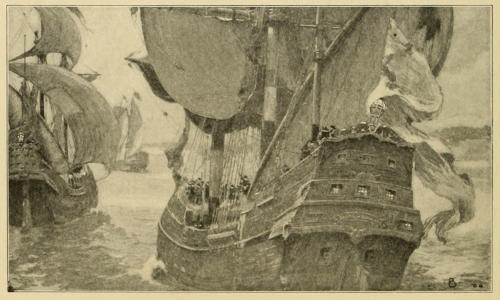
THE GOODSPEED, SARAH CONSTANT, AND DISCOVERY AT THE CAPES OF THE DELAWARE
It was a lonely age in which to be four months upon the great sea, for “ships were rare,” only “from time to time, like pilgrims, here and there crossing the waters.” You were sure to see no sail anywhere as you went. And the land to which they came was as lonely as the sea, except for the savages who lurked within its forests. The three little merchantmen came none the less boldly in at the capes, however; and the tired men on board thought the shores of the vast bay within very beautiful, with their “fair meadows and goodly tall trees,” and their “fresh waters running through the woods,” better than any wine to men who for four months had drunk from the stale casks on the ships. And yet the loneliness of those spreading coasts, forested to the very water, was enough to daunt even brave men.
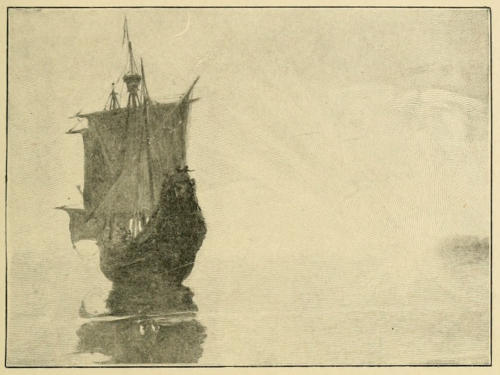
“SHIPS WERE RARE”
They presently found a great “river on the south side, running into the main,” and they chose a place on its banks for their settlement which was quite forty miles above the mouth of its stately stream; for they wished to be away from the open bay, where adventurous seamen of other nations, none too sure to be their friends, might at any time look in and find them. They named their river the James, and their settlement Jamestown, in honor of the king at home. Eighty years before there had been Spaniards upon that very spot. They had built houses there, and had planned to keep a lasting colony. There had been Spaniards in the West Indies these hundred years and more,—ever since the days of Columbus himself; and in 1526 Vásquez de Ayllon had led a great colony out of Santo Domingo to this very place, no fewer than five hundred persons, men and women, with priests to care for their souls and to preach the gospel to the savages. But discord, fever, and death had speedily put an end to the venture. The place had soon been abandoned. Scarcely one hundred and fifty of the luckless settlers survived to reach Santo Domingo again; and when the English put ashore there, where a tongue of low and fertile land was thrust invitingly into the stream, no trace remained to tell the tragic story. It was as still and bare and lonely a place as if no man else had ever looked upon it.
There were but a few more than a hundred men put ashore now from the English ships to try their hands at making a colony, and not a woman among them to make a home. They had been sent out by a mercantile company in London, as if to start a trading post, and not a community set up for its own sake, though there could be little trade for many a long day in that wilderness. Certain London merchants had united with certain west-country gentlemen and traders of Bristol, Exeter, and Plymouth in the formation of a joint-stock company for the purpose of setting up colonies in both “the north and south parts of Virginia”; and to this company royal letters patent had been issued on the 10th of April, 1606. The name “Virginia” had been given, in honor of Elizabeth, the Virgin Queen, to the mainland which Ralegh’s first explorers found beyond Roanoke. So far as Englishmen were concerned, the name covered the greater part of the Atlantic coast of the continent. The patentees of the new company were to attempt both a northern and a southern settlement, and, to serve their double purpose the better, were divided into two bodies. The London stockholders were to undertake the first colony, in some southern part of “Virginia,” between the thirty-fourth and the forty-first degrees of north latitude; while the incorporators who were of Somerset and Devon were to undertake a second colony, to be conducted to some point farther north,—though all were to remain under the government of a single general council.
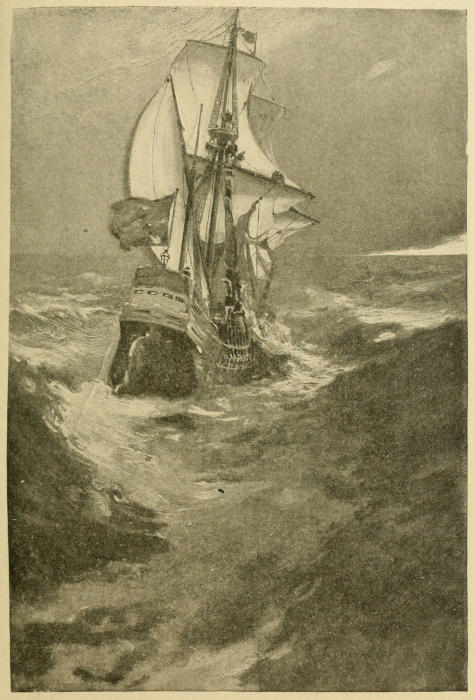
“LIKE PILGRIMS, HERE AND THERE CROSSING THE WATERS”
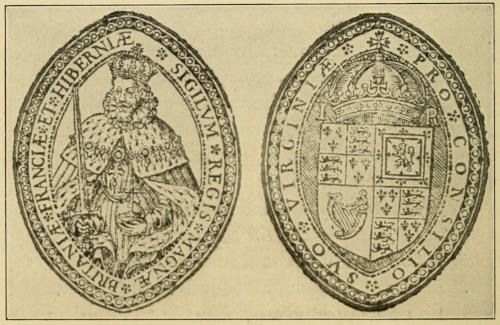
BOTH SIDES OF THE SEAL OF HIS MAJESTY’S COUNCIL OF VIRGINIA
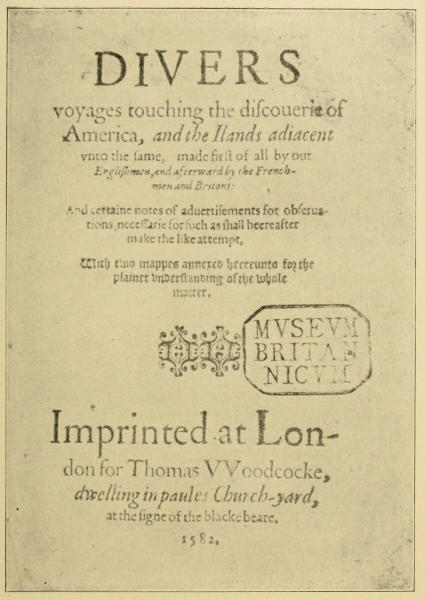
TITLE-PAGE OF HAKLUYT’S DIVERS VOYAGES
There were men of capital importance and quick energy among the London incorporators; and the enterprise they had taken in hand was not all novel. Several of them were members also of the East India Company, which had been formed seven years before, and of the “Russia or Muscovy Company,” whose trade in far-away seas was a thing established and familiar. They were most of them men who had heard all there was to be told or read of the voyages and adventures by which America had become known in England; and some notable sailors were also of their number who had themselves seen the strange seas and unfamiliar coasts which others only read of. Richard Hakluyt, the genial and learned churchman, who loved every tale of daring and who knew more of the New World than any other man in the kingdom, was their associate in the new company. Captain Newport, to whom they intrusted the command of their little fleet, borrowed from the Muscovy Company, had already been twice to America: a clear-eyed man hardly turned of forty, and likely to understand what he saw. Bartholomew Gosnold, whom they commissioned captain of the Goodspeed, had himself discovered the short route to America by way of the Azores, and went now permanently to cast in his lot with the colonists. There were capacity and experience and audacity and steadfastness enough embarked in the service of the Virginia Company, it must have seemed, to make it sure of its success.
RICHARD HAKLUYT
And yet nobody very well understood what this new business of establishing colonies was to be like, for all that; and the colonists whom these capable London gentlemen sent over with Captain Newport were a sorry lot, it turned out, with whom to attempt an enterprise which should need for its execution every manly quality of courage and steadfastness and industry. Prosperous and steady men who were succeeding at home were not likely to be willing to go to America, of which they knew nothing except that it was full of savages, and that Ralegh’s colonists had been lost there, never to be found again. Only men hopelessly out of work or out of sorts, and reckless men, young and fond of adventure, were likely to think the prospect inviting, or the novel risk worth taking, to better their fortunes, or to get the monotony out of their lives.
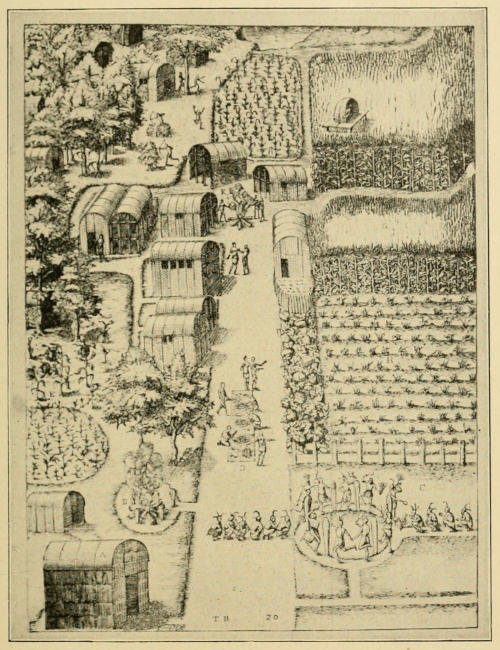
INDIAN VILLAGE OF SECOTAN
It happened that England was full of idle men, because her life was changing. The very quickening and expansion of commerce and of adventure in trade and conquest which had changed all the age and the aspect of the world itself since the first crossing of the Atlantic had given England a new place in the geography of the planet, and was radically altering men’s lives and occupations and ambitions there. New trades and industries were springing up, and the towns were reaping the benefits of a diversified commerce. But the people of the rural districts had fallen upon evil days. Land, like everything else, had become a sort of commodity as trade gained its mastery. The old tenures, under which small holders had so long lived unmolested, were breaking up. The city merchants bought estates for their pleasure, and wanted no tenants. The older land-owners got rid of small farmers as fast as they could, in order to turn their lands into pasture for the sheep whose wool was so much in demand by the merchants and the manufacturers. They even enclosed and appropriated for the same purpose commons which had time out of mind been free to all, and swept hamlets away to make the more room for their flocks. The demand for agricultural labor sadly slackened. “Your sheep, that were wont to be so meek and tame,” cried Sir Thomas More, in his anger and pity to see such things done, “are now become so great devourers and so wild that they eat up and swallow down the very men themselves. They consume, devour, and destroy whole fields, houses, and cities.” Town and country-side alike filled with men out of work, who “prowled about as idle beggars or continued as stark thieves till the gallows did eat them”; and unguarded wayfarers were robbed upon the highways by desperate men who could find no other way to obtain subsistence. James’s craven eagerness for peace had put an end to the wars with which Elizabeth’s day had resounded, and London was full of idle soldiers, mustered out of service. Younger sons and decayed and ruined gentlemen seemed to abound more than ever.
It was men out of work or unfit for it who chose to go to America; and not men of the country-sides so much as discredited idlers and would-be adventurers of the towns. More than one-half of the company Captain Newport conducted to James River called themselves “gentlemen,”—were men, that is, of good blood enough, but no patrimony, no occupation, no steady habit, who were looking for adventure or some happy change of fortune in a new land, of which they knew nothing at all. Very few, indeed, of the rest were husbandmen or carpenters or trained laborers of any sort. There was only one mason, only one blacksmith, in all the hundred and twenty. Only two were bricklayers, only six carpenters; while thirty-five were gentlemen, and most knew not what to call themselves. The things it was most necessary to do when at last the landing had been made at Jamestown,—the planting of crops, the building of houses, the dull labor of felling trees and making a beginning in a wilderness,—were the very things which the men the Virginia Company had sent over knew least about, and had the least inclination to learn. They expected the company to send them supplies out of England, and gave little thought to what they were to do for themselves. When Captain Newport’s ships put to sea again and left them, they were at their wits’ ends to know how to maintain themselves.
It would have gone desperately with them had there not been one or two men of masterful temper and governing talents among them. Captain Newport came again with supplies in the winter; and still another ship followed him the next spring. And, besides supplies, the two ships brought a hundred and twenty new settlers between them. But among the new-comers there were shiftless “gentlemen” in the usual proportion; and there came with them a jeweller, two goldsmiths, two refiners, and a perfumer,—as if there would be need of such people! Such additions to the settlement only made it so much the harder to develop or even maintain it; and the few men who could rule stood out like masters among the inefficient idlers of whom the incorporators in London had thought to make pioneers.
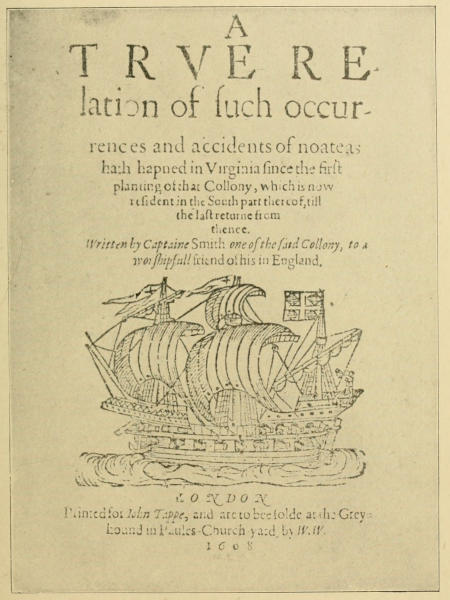
TITLE-PAGE OF CAPTAIN JOHN SMITH’S “TRUE RELATION”
There was one among them, Captain John Smith, to whom, in large part at any rate, they owed their salvation from utter helplessness and starvation. Captain Smith had a gift for narrative which his fellow-adventurers did not have, and has set his own achievements down in notable books whose direct and rugged ways of speech, downright temper of action, and air of hardihood bespeak the man himself. He was not yet thirty years of age when he began to play his part there in Virginia; he was exasperatingly sure of himself; older men found his pretensions wellnigh unbearable. But it was certain he had seen more of the world and of adventure than any other man of the company. He had known and had come to conclusions with men of many races and of every kidney, as he had cast about the world, a soldier of fortune; and he knew how they were to be governed, as he presently demonstrated. He rang like brass without, no doubt, but had a quality of gold within. He was a partisan of his own way of making a colony, and it may be colored the narratives he wrote to be seen at home; but he was no sluggard at work, and knew how to take the burdens of tasks which no one else would attempt. He at least found ways of getting food from the Indians, and of making interest with their chiefs. Though he took authority when it was not given him, he made the lazy, “humoursome, and tuftaffety sparks” of the settlement work, upon penalty of being set across the broad river to shift for themselves or starve; prevented would-be deserters from running away with the boats; explored the neighboring coasts and river-courses,—for two years and a half played his part very capably and very manfully in keeping the struggling settlement alive, when the majority of his comrades would have been glad to abandon it. He compelled no man to do what he did not willingly do himself. “Gentlemen,” under the spur of his example and command, learned to make a pleasant pastime of labor in the forest,—so that “thirty or forty of such voluntary gentlemen,” as Master Anas Todkill said, “would do more in a day than one hundred of the rest that must be prest to it by compulsion,”—though doubtless “twenty good workmen would have been better than them all.” No doubt there were others who seconded Captain Smith in the maintenance of order and of hope, and who worked as he did to take some hold upon the wilderness for their principals at home; but upon him fell the chief burden of the task, because he could carry it and prevail.
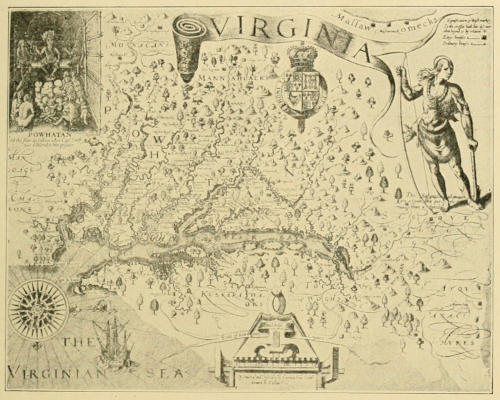
CAPTAIN JOHN SMITH’S MAP OF VIRGINIA, 1612
When at last, in the autumn of 1609, he was obliged to take ship for England, dangerously wounded by an explosion of gunpowder, it looked as if the worst were over at Jamestown. The company at home had been very busy getting colonists, and had sent them over in goodly numbers. There were about five hundred persons at the settlement when Captain Smith left,—a few women among them, making it look at last as if the lonely place were to see homes established; and fifty or sixty simple houses had been put up. But numbers, it turned out, did not improve the living. Too many of the new-comers were “unruly gallants, packed thither by their friends to escape ill destinies” at home; and those whom they joined at their landing still did not know how to support themselves in the wilderness, or how to keep themselves safe against the fevers which lurked within the damp forests by the river. Added numbers made them a little more helpless than before; and the six months which immediately followed Captain Smith’s departure brought upon them a desperate “starving time,” which no man who survived it ever forgot. There were few to work where every one was ill and in want. They tore their rude houses down for firewood before the winter was over; do what they could, only sixty of them lived to see the spring again, and a gleam as of madness played in the eyes of those who survived those days of desolation. One came and cast his Bible into the fire, crying out that there was no God. It was resolved at last, when they could, to abandon the desolate and hopeless place, and the forlorn little band were actually on their way down the river, meaning to seek food and shelter among the fishermen in Newfoundland, when Lord Delaware met them at its very mouth with fresh colonists and supplies sent by the company to their relief.
The radical difficulty was, not that the company did not do its part to sustain the colony, but that it could get few colonists of the proper sort, and was trying to do an impossible thing. The settlers sent out had no hopes or prospects of their own, as the company managed the business then. They were simply its servants, fed out of a common store, and settled upon land which belonged to no one but was used for all alike. No man would work well or with quick intelligence if he could not work at all for himself, but must always be working for the company. First-rate men would not consent to be the company’s drudges. And what could the company get out of the wilderness in return for its outlay by the work of such men as it could induce to go to Virginia upon such terms? A few cargoes of timber, a few new varieties of medicinal herbs found in the forests, could not make such expenditure worth while. Captain Newport, after his second voyage out, had gone back to England with his hold full of glistening earth, which he supposed to contain gold; but it contained nothing of the kind. It was only shining sand.
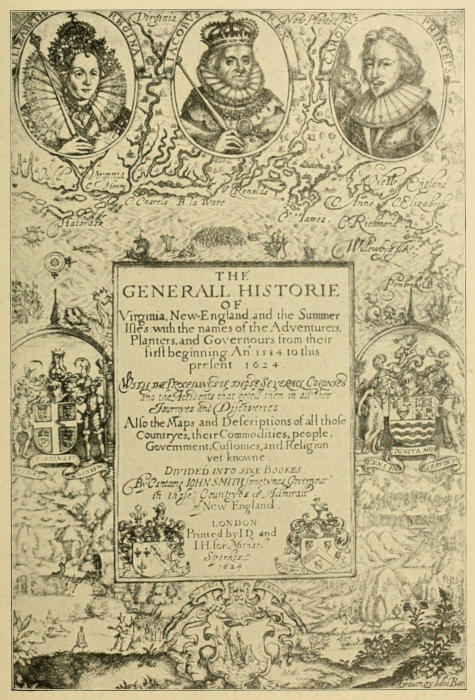
TITLE-PAGE OF CAPTAIN JOHN SMITH’S “GENERAL HISTORIE”
Lord Delaware, though a little slow and stiff and fond of wearing fine apparel and going about attended by officers and halberd-bearers, which seemed fantastic enough there in the shadow of the untouched forests of that wilderness, was a wise and capable man, and no doubt saved the colony by coming out, that hopeless spring of 1610, as Governor and Captain General for the company. But it needed a radically new policy to give real life to such an enterprise; and that it did not get till Sir Thomas Dale came the next year (1611), after Lord Delaware had gone home stricken with a fever. The new policy it needed was one which should give it expansion and a natural vitality of its own. It was necessary that new towns should be built upon the river which should not be, like Jamestown, mere stations where men worked at tasks for the company, but veritable communities in which men should be allowed to have land of their own, and should be given leave to work for themselves as well as for the incorporators in London. For five years (1611-1616) Sir Thomas Dale and Sir Thomas Gates pushed this new policy forward; and it was their new and better way of doing things that really made and established Virginia. “Henricus,” “Hampton,” “New Bermuda,” and other new settlements like them, were added to Jamestown, each with its fort and its stockade, its military commander and discipline, and each with its group of virtually independent land-owners, free to work for themselves.
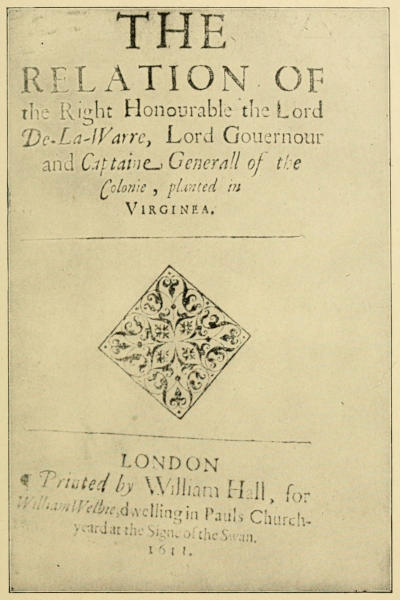
TITLE-PAGE OF LORD DELAWARE’S “RELATION”
Most of the colonists, it is true, were still held at Jamestown to serve the company, and driven to their work, as little better than slaves, by their new task-masters. Gates and Dale came with authority to rule by martial law, without let or mercy, and colonists of the poorer sort got nothing but blows and rations for their bitter toil. Those who mutinied or ran away were put to death or to the torture, if need were, to keep the discipline of toil and order which the company’s treasurer and merchant adventurers were now steadfastly minded should be wrung from the colony. But the new plantations showed the way to a new life. There were independent settlers here and there upon the river, as well as men who were mere servants of the company. The better sort, even of the men whom the company had sent out, were given their patches of land and their time,—if it were only one month out of the twelve,—to do work for themselves, in order that the new plans might thrive. A strong root as of a little commonwealth was planted at last.
Dale and Gates both belonged to that capable race which had been bred under Elizabeth, willing to be soldiers or sailors by turns, if only they could be always in the thick of action. They had both been soldiers in the Low Countries against Spain, and, now that fighting flagged there, were both serving their turn at this interesting business of setting up colonies. Dale was the more capable and masterful of the two: a terror to men who would not work or were slow to obey; a leader after their own hearts for men who meant to do their tasks and succeed,—and his stay in Virginia was, fortunately, longer by three years than Gates’s. He was but Gates’s deputy so long as Gates was in Virginia (1611-1613); but he was master when Gates was gone,—prevailed even when Gates was there,—and it was his rough and soldierly energy which made the little group of “plantations” at least ready to last and to expand into a lusty piece of England over sea. When he had finished his five years’ work, the colony, though small and primitive still, was yet strong and spirited enough to survive being despoiled by an adventurer. For a year after Dale quit the colony it was left under the government of Captain George Yeardley, the commandant of one of the new settlements. But in 1617 Samuel Argall came out to take his place, and proved himself no lover of the people he had come to govern, but a man chiefly bent upon serving his own fortunes. He was of gentle blood, but had too long followed the sea in those disordered times, as little better than a freebooter, to relish law or justice overmuch; and it was excellent proof that the colony had grown strong and able to take care of itself that it endured for full two years his tyrannous and selfish exactions (1617-1619), and yet was ready at the end of them to assume a sort of independence, under a new form of government which gave it the right to make its own laws.
In 1619 Captain Yeardley, now become Sir George, returned out of England commissioned to take Argall’s place and govern the plantations under a new and better charter. He was to call together an assembly of representatives from the several plantations, and that assembly, sitting with the governor’s council, was to have the full right to make laws for the colony, subject always to the approval of the court of the company sitting in London. Here was a very radical change. The colony was to be no longer the mere mercantile venture of a trading company controlled by its stockholders. It was to be a little state, governed by its people. The fact was that a notable change had come over the company at home. Until now it had been managed by men who were mere merchants, not statesmen: by men who cared very little about anything but the profits some time to be got out of the colony,—the sooner the better. Now men of another sort were in control; the chief among them Sir Edwin Sandys, a man who loved liberty, had a statesman’s knowledge how it was to be set up and maintained, and wished to see the settlement thrive for its own sake, and the noble Earl of Southampton, whom Shakespeare loved. It was upon the initiative of these men that Sir George Yeardley had been sent out to give the colony self-government.
Here, under the quiet forms of a mere administrative change in the management of the colony, was a veritable revolution wrought. Sir George brought with him a document, bearing date 13 November, 1618, which Virginians were always thenceforth to look back to as to their Great Charter of rights and liberties,—a document which made of their colony a little commonwealth. It was drawn in the spirit of the men for whom Sandys spoke. Five years ago Sir Edwin had stood in his place in the Commons and maintained in the face of all present “that the origin of every monarchy lay in election; that the people gave its consent to the king’s authority upon an express understanding that there were certain reciprocal conditions which neither the king nor the people might violate with impunity; and that a king who pretended to rule by any other title, such as that of conquest, might be dethroned whenever there was force sufficient to overthrow him”; and here was now a constitution for Virginia drawn in like spirit. No wonder the King had cried, “Choose the devil, if you will, but not Sir Edwin Sandys,” when he heard that the Virginia Company had a mind to make this too free-thinking friend of Hooker and Selden its chief and treasurer, and deemed it revolutionized and made an instrument of sedition against him when it chose Sir Edwin notwithstanding.
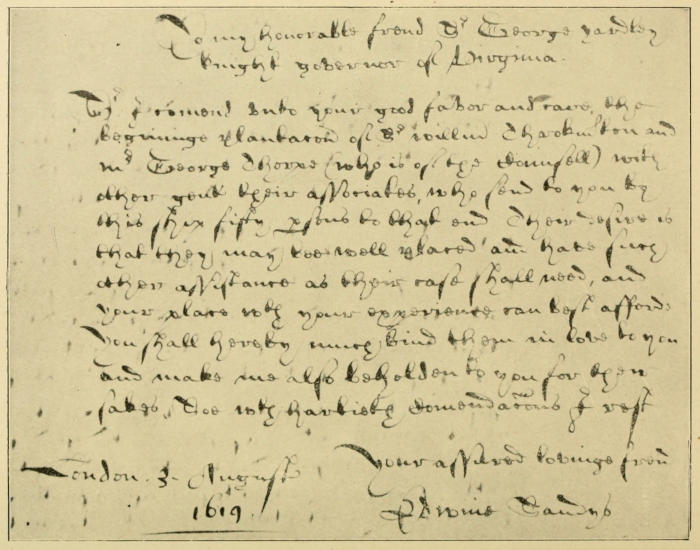
FACSIMILE OF LETTER OF SIR EDWIN SANDYS TO SIR GEORGE YEARDLEY
The new Virginian assembly met in the chancel of the church at Jamestown, on the 30th of July, 1619. We look back with some emotion upon it, as to the first representative assembly in America,—as to the beginning of liberty and self-government in the English colonies; but the colonists themselves seem to have taken it very quietly, as if they had expected it and looked upon it almost as a matter of course in the circumstances. Its sessions were as brief, as businesslike, and as much without ado as if they were already an established part of the custom of the colony. Certain necessary enactments were adopted touching trade with the Indians, the use of tobacco as currency, the salaries and authority of clergymen, and various other matters in which special regulations for Virginia seemed called for; but for the rest it was taken for granted that the common law of England was in force there, as in every other place where there were Englishmen; and within six days of its coming together the little assembly was ready to adjourn. The quiet and ready capacity with which the colonists accepted this radical change in the method of their life and government afforded the best proof that they were fit for the responsibilities it involved.
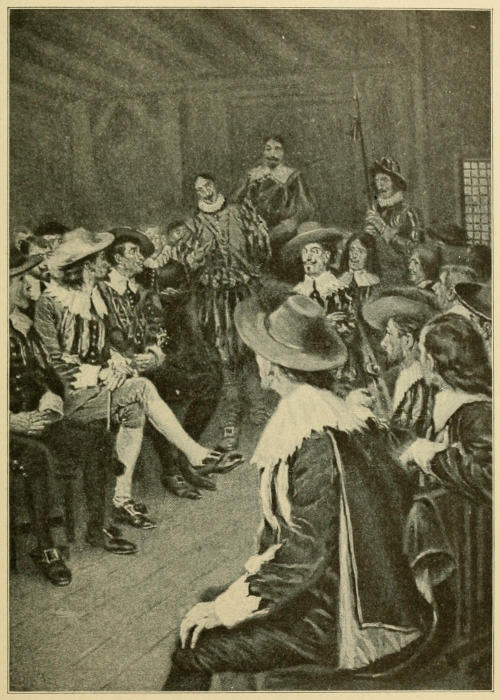
FIRST VIRGINIA ASSEMBLY—GOVERNOR YEARDLEY PRESIDING
The company, under its new leaders, was a little too eager to help the colony to prosper. Settlers were hurried over much faster than they could be provided for. During the three years 1619-1621 quite three thousand five hundred came pouring in, men, women, and children, fleet after fleet of the company’s ships appearing in the river to put their mixed hosts of inexperienced people ashore. And yet at the end of the three years there were but twelve hundred settlers, all told, in the colony. Cleared land and means of immediate subsistence could not be found upon short notice for so many. Hundreds succumbed to the dangerous fevers and sudden distempers drawn out of the damp forests by the summer sun or the first chill of the autumn nights. A sore process of “seasoning” tried out the river settlements every year, and only a few could endure it. It was reckoned inevitable that hundreds of new-comers should die. Many saw how things stood and went back to England again. But those who remained and survived prospered well; and the settlements grew, after all, as fast as it was safe for them to grow.
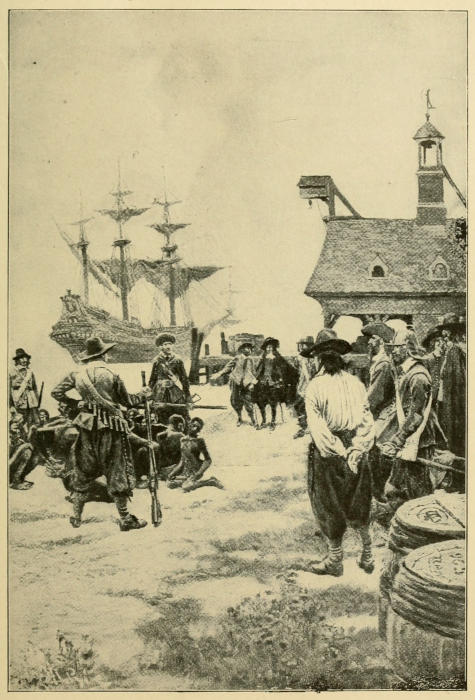
LANDING OF NEGROES AT JAMESTOWN FROM A DUTCH MAN-OF-WAR, 1619
The terms under which land was granted to settlers became more and more liberal as things settled to an established way of life. Even Dale had not relieved the tenants of his day from the duty of working part of their time for the company; and the colony had been conducted, until Sir George Yeardley came, like a joint-stock enterprise in which only stockholders might expect private profit. But under the changed conditions which followed Sir George’s coming virtually independent land holding became possible on very easy terms; and, what was quite as good, the company no longer insisted that everything bought or sold should pass through the hands of their factor, as the only middle-man, so that the profits of all trade might fall to them. It turned out to be a very important thing that Mr. John Rolfe, one of the colonists, had in 1612 introduced the cultivation of tobacco; for tobacco grew amazingly well and of exceeding good quality in Virginia, and proved a most profitable crop. By 1620 forty thousand pounds of the delectable herb were exported from the colony in a single year, and everybody who could was planting tobacco instead of grain. Its leaves even became the currency of the plantations, coin being very scarce. “The people of the South-parts of Virginia,” it was reported, “say that God in the creation did first make a woman, then a man, thirdly great maize or Indian wheat, and fourthly, Tobacco.”
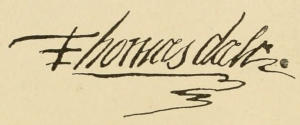
SIGNATURE OF SIR THOMAS DALE
In 1619, the year Sir George Yeardley came to set up an assembly, another very notable thing happened. A Dutch man-of-war came into the river and sold twenty negroes to the colonists as slaves. A handful of slaves made no great difference at first; they were so few as scarcely to affect the life of the colony, and it was to be many a long day before their number was much added to. But their coming was the beginning of a great change which was slowly, very slowly, to alter the whole face of society in the settlements.
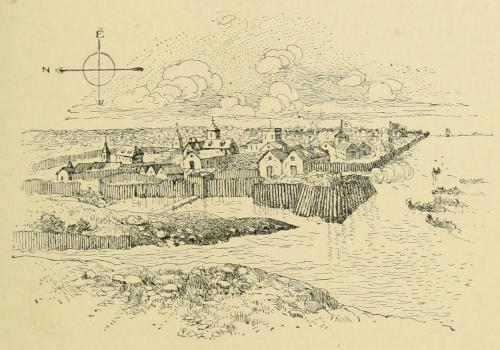
JAMESTOWN IN 1622
By 1622 it seemed as if the chief difficulties of settlement were safely passed and the plantations secure of their growth and permanence. But in the very moment of assurance a great calamity came upon them, sudden, overwhelming, like a bolt out of a clear sky. On the same day and at the same hour (22d of March, 1622) the Indians fell upon every settlement from the falls of the river to the bay, all the tribes of all the region round mustering in concert to strike a single exterminating blow. The colonists had suffered themselves to be deceived by the submissive friendliness of their savage neighbors, and had grown strangely heedless of danger from them. For years they had traded with them, mingled with them, admitted them freely to their homes, taught them the expert use of firearms, made servants and even confidants of them, without caution or reserve, deeming them an inferior race who had accepted the white men as masters. But the old Powhatan, a real friend of the English, who had been ruler among the redmen ever since the landing at Jamestown, was dead. Opecanchanough, their subtle and implacable enemy, had succeeded him. For four years the wily savage had been drawing the tribes together for a decisive treachery; and the dreadful secret had all the while been kept safe behind the steady eyes of every Indian who entered the settlements. Only at the last moment did one or two faithful native servants warn their masters of the fearful peril; and then it was too late to do more than put a few households on their guard. Before the sun went down that fatal day three hundred and forty-seven men, women, and children lay dead in the desolate settlements. Only because the Indians feared the white man with an overmastering dread, and drew back dismayed wherever a firm stand was made against them, if only by a single settler barred within his house, did the terrible slaughter stop short of sheer annihilation. No place escaped the carnage. But the colony, though stunned, was not killed. The Indians’ courage had not held out to finish the bloody work. There was henceforth an endless reckoning in store for them,—no longer any friendship vouchsafed or any consideration. Steadily, relentlessly, and by a masterful advance from settlement to settlement which they could in no wise withstand, they were pushed back into the forests. The very year which followed the massacre found nearly two thousand white men still in the scattered villages and plantations of the indomitable English, and their quiet way of growth had been resumed.

GRAVE OF POWHATAN
But the great company which had founded the settlements and seen them safely through their first struggles for life and maintenance was not to be suffered to live. The King did not relish the politics and suspected the loyalty of the gentlemen who were in charge of its affairs. They were of the party which opposed him in Parliament. He had dismissed his Parliament and meant to rule without it; but this great company, with names upon its rolls which were among the chief of London not only but of the kingdom itself, held meetings every quarter under his very eyes which were like another parliament; which brought his enemies very near him, and held the attention of the town. Those who wished his favor or the ruin of Sandys and Southampton told him that they used their conferences to plot sedition against him, and the councils of the company to keep a constitutional opposition together; and he determined to be rid of them. Every mismanaged or ill-judged affair with which the company was chargeable was magnified and made the most of, and, despite a very gallant fight in the law courts to save it, its charter was taken away, and the government of the colony transferred to the hands of the King and his ministers. It made little practical difference to the colonists. They kept their assembly, and could live as comfortably under a governor sent them by the King as under a governor sent them by the company. The course of affairs in Virginia was not disturbed. But a great company was destroyed, and the public-spirited men who had given it its best life and the colony its first taste of self-pleasing liberty were deeply wronged.
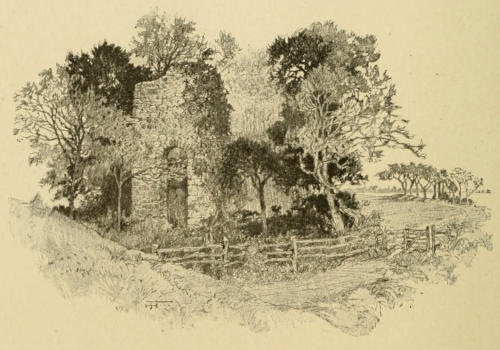
ALL THAT IS LEFT OF JAMESTOWN
Authorities on the history of Virginia during the seventeenth century. Excellent general narratives of the founding and early development of Virginia are to be found in the first volume of Mr. John A. Doyle’s English Colonies in America and in Mr. John Fiske’s Old Virginia and Her Neighbours. Charles Campbell’s History of the Colony and Ancient Dominion of Virginia is the standard history of the colony; John Burk’s History of Virginia is the most solid and extensive of the older accounts; and Robert R. Howison’s History of Virginia has the dignity of resting upon careful research. William Stith’s History of the First Discovery and Settlement of Virginia brings the narrative down only to 1624, but is compact of the most interesting matter, and is a significant example of the scholarship of the middle of the eighteenth century in Virginia. Mr. Stith was President of William and Mary College. The Rev. Hugh Jones’s Present State of Virginia was published in 1724, and is an excellent early authority. Miss Ann Maury’s Memoirs of a Huguenot Family contains the authentic records and letters of three generations of a family driven from France to Virginia by the revocation of the Edict of Nantes, and affords a very intimate picture of the life of more than a century. The Rev. E. D. Neill, in his History of the Virginia Company of London, his Virginia Vetusta, and his Virginia Carolorum, has brought together a vast deal of scattered information out of which very direct impressions may be got of the life and history of the colony. Bishop Meade, in his Old Churches and Families of Virginia, has brought together an extraordinary mass of authentic details, most of which relate to the eighteenth, but many of which belong to the seventeenth century.
The original sources of Virginian history are to be found in Captain John Smith’s True Relation of Such Occurences as Have Happened in Virginia, published in 1608, and Generall Historie, published in 1624, both of which many modern readers are inclined to take with a grain of salt; in the Collections of the Virginia Historical Society (which, among many other important things, contain the Proceedings of the Virginia Company from 1619 to 1624); in W. W. Hening’s invaluable and remarkable collection of the Statutes at Large of Virginia, which begins with the acts of the first assembly, in 1619, and is brought down, with scarcely an omission, to the end of the eighteenth century; in Sainsbury’s Calendar of [English] State Papers, Colonial, I. and V.; in the two volumes of Mr. Alexander Brown’s Genesis of the United States, which is a notable mine of material; in Peter Force’s Tracts and Other Papers Relating to the Colonies in North America; in the Collections of the Massachusetts Historical Society; in the notable collection of papers gathered under the title Archaeologia Americana; in the Virginia Historical Register; in the Virginia Magazine of History and Biography; and in the Southern Literary Messenger.
II. New Netherland and New Plymouth
Meanwhile other colonies were being successfully planted in the north. On the great river St. Lawrence, which doughty Jacques Cartier had explored quite seventy years before, the French had set up trading-posts at Montreal and Quebec. They had established, besides, a struggling settlement or two nearer the mouth of the river; and to the southward, within the Bay of Fundy. A little colony of Englishmen had begun to make homes for themselves in Newfoundland. Dutch traders were established on the Hudson. A company of English dissenters were building a New Plymouth within Cape Cod, and little groups of English adventurers were trying to secure a foothold upon the southern shores of the wide Bay of Massachusetts. Nowhere except in Virginia had more than a beginning been made; but the settlement of the continent seemed at last to have been begun in earnest; and the future looked interesting enough with the French, the Dutch, and the English all entered as active competitors in the race for possession.
The Dutch were likely to be harder rivals to beat than the French. Their little, compact home states in the Netherlands were, it is true, scarcely one-fourth as big as England, but they teemed with a thrifty people almost as numerous as the English themselves, and their chief power was upon the sea. With them, at home, the very land itself was one-half sea. They had been bred fishermen and mariners time out of mind; and of late, because the Spaniard provoked them to it, they had put great fleets on the high seas and had made conquests at the ends of the earth.
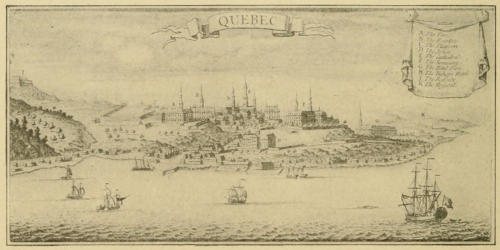
VIEW OF QUEBEC ABOUT 1732
At first they had not thought of conquest. They had simply made themselves, with their stout craft and seasoned tars, the ocean carriers for Europe,—because the Portuguese, who had captured rich lands and set up a great trade all the way from the Persian Gulf to Japan, did not trouble themselves to bring their cargoes beyond their own port of Lisbon, and because the Spaniards brought their treasures out of South America no farther than Seville, and some one was needed to carry what they would sell to the merchants and princes of the rest of Europe. No doubt the Dutch would have been content to be only traders and carriers, had Spain but let them alone. But Spain, in her folly, undertook to force the Dutch to be Roman Catholics; and they, being stout Protestants and stubborn men, resisted after a fashion that in the end set the whole power of rich Spain at naught. The war began in 1568; all Europe was stirred by it; and when, forty-one years later, the Spaniard, quite out of breath, agreed to a truce, the world had changed. Holland had become a great sea-power; had driven the Portuguese from the Orient, taking their trade and their colonies; was sinking imperial fleets upon the very coasts of Spain herself, and sweeping Spanish treasure by the ship’s cargo into her own coffers. She was beforehand even with England in making herself mistress of the seas, and had turned to this new task of taking possession of America with confidence and audacity.
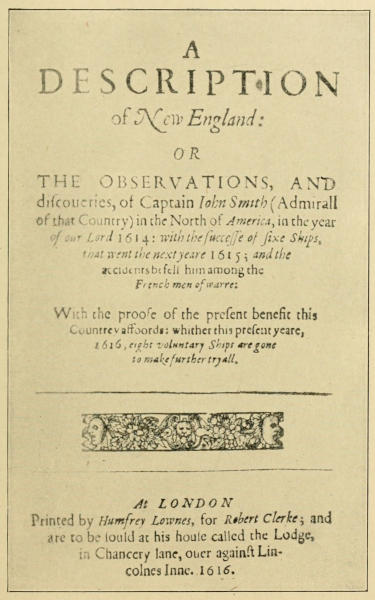
TITLE-PAGE OF JOHN SMITH’S “DESCRIPTION OF NEW ENGLAND”
The Dutch combined conquest with trade, as England did, and it was a Dutch East India Company of merchants which drove the Portuguese from their possessions in the East, as it was an English East India Company of merchants which afterwards conquered India for England. And when their East India Company had made itself powerful and famous by its conquests and adventures, the Dutch formed a West India Company also, to trade and take what it could upon the western coasts of Africa, upon both coasts of South America, and among the southern islands of the Atlantic. It had, as Mr. Motley has said, a roving commission to trade and fight and govern for twenty-four years; and it incidentally undertook to establish Dutch settlements on the Hudson and the Delaware. Henry Hudson, an English sailor in the service of the Dutch East India Company, had, in the year 1609, discovered the great river which was to bear his name,—the very year the baffled Spanish agreed to a truce with the redoubtable states of the Netherlands. He had also entered the great bay and stream of the Delaware. The Dutch had promptly named the Hudson the “Great North River,” the Delaware the “South River,” and all the rich country which lay about and between them “New Netherland”; meaning from the first to keep and occupy what their seamen had found.
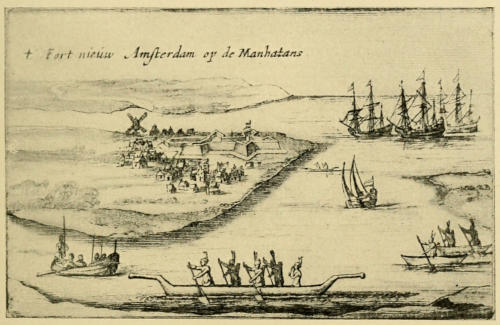
EARLIEST VIEW OF NEW AMSTERDAM
There had been a New Netherland Company, formed in 1614, before there was a West India Company. Its charter had given it commercial control of all the coast country of America from forty to forty-five degrees north latitude, a region which the Dutch described as lying “between New France [on the north] and Virginia.” This was at the very heart of the country which James of England had granted to the Virginia Company; but the Dutch knew little of that, and would very likely have thought as little had they known more. It was the profitable fur trade with the Indians of the Great North River that had first attracted them. Individual adventurers among them had built a small “fort” or trading post far up the river in the heart of the wilderness, as well as a little group of huts on the seaward point of Manhattan Island in the bay, and had been trafficking there with the willing natives for quite four years before they formed their New Netherland Company.
It was the New Netherland Company that grew into the greater West India Company, whose principal business it was to be to wrest what it could from the Portuguese and the Spanish in the south, but which was also to keep an eye all the while on the North and South rivers, where the New Netherland Company had put its trading posts. It was 1623 before the great company found time amid its other business to carry out any systematic plans of settlement in North America; but by 1625 there were already two hundred colonists on the lands they claimed: some up the great stream of the North River at the little post which they called Fort Orange, some within the South River at “Fort Nassau,” some on Manhattan Island, a few on Long Island,—even a little group of families as far away as the “Fresh River,” which the English were to call the Connecticut. It remained to be seen how they would fare scattered there in the wilderness; but there they were, a very hard people to discourage, by the time Virginia was fairly established in its own scattered settlements on the James, and the rights of the great Virginia Company taken into the hands of the King,—and there they meant to stay.
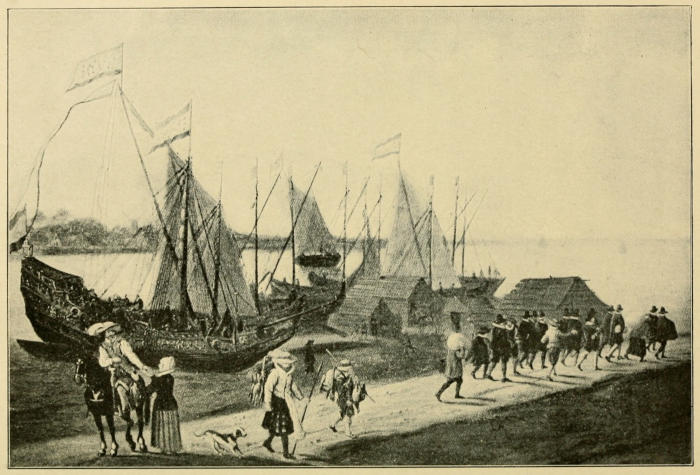
DEPARTURE OF THE PILGRIMS FROM DELFT HAVEN
Meanwhile there had come out from Holland itself a band of exiled English settlers, to be their neighbors and rivals at the north, and so put them between two growing English colonies,—not “between New France and Virginia,” as their first charter had said, but between New England and Virginia. The new-comers were exchanging a temporary exile in Holland for a permanent exile in America, and effected their settlement within the sheltering arm of Cape Cod. Englishmen had begun to muster many thousands strong in Holland within a generation, and the two countries had been drawn very near to each other. Long before the war began which brought Spain and the Netherlands to a grapple, hundreds of English merchants had established themselves in the Dutch seaports; and young Englishmen were beginning, even before dissenters were shut out from Oxford and Cambridge, to resort in influential numbers to the Dutch universities. When the Low Countries grappled with Spain, English volunteers crowded into their armies. The troops Elizabeth sent over after 1585 found the Dutch ranks already full of their countrymen. English churchmen, too, for whom the policy of the Establishment proved too rigorous under the imperious Tudor queens, had learned to seek in Holland the freedom of worship denied them at home. At the same time refugees from the ravage and slaughter of Alva’s armies poured across the sea from the lower Netherlands into England, and the two countries seemed to be exchanging populations. Tradesmen, weavers, mechanics, farmers, fled terror-stricken into the eastern and southern counties of England, often braving the sea in open boats when danger pressed most desperately. Their coveted skill and industry, which English statesmen knew how to value, their foreign birth and humble rank in life, which seemed to depress them below the level of political influence, gained for them an indulgence in theological error and separate worship which was denied to Englishmen themselves, and presently the English towns in the east and south teemed with thousands of Dutch artisans, who were suffered to be Anabaptists, Lutherans,—what they would, so long as they taught England the industries and handicrafts which were to make her rich.
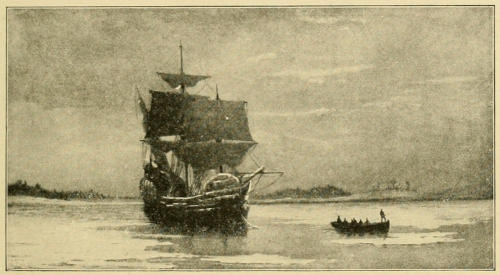
THE MAYFLOWER IN PLYMOUTH HARBOR
The little company of Englishmen who, in 1620, exchanged Holland for America were not soldiers and traders like the men who had led and established the colony at Jamestown, but members, most of them, of a humble congregation of dissenters who had fled from the very districts of their native land in which foreign heretics were tolerated, to escape the tyrannical surveillance of the Church, and who had found a refuge for a time in the great university town of Leyden. They came now to America because they did not wish their children to become Dutch or lose altogether their English speech and customs, and because they could look to have an even more untrammelled freedom upon the fruitful coasts of the New World than in the ancient states of the Netherlands, into whose life they found themselves thrust like those who must be always aliens. They were Protestants, and had left England because they could not brook the domination of her Church; and yet the reason for their exile was as much political as religious. Many men in England, some of them high in the counsels of the Church itself, held the same doctrines that they held,—the doctrines which Calvin had made the creed and fundamental basis of belief among all Protestants of the sterner sort,—and yet were not exiles, because they had not broken, as these men had, with the discipline and authority of the Church.
England’s Protestantism had a color and character of its own. Her “Reformation” had struck at the roots of nothing except the authority of the Pope at Rome. Her Church had always deemed itself national, had always held itself less subject than other churches to be ruled by papal delegates, or turned this way or that by the vicissitudes of continental politics and the policies of the papal state. She had broken with Rome at last, when the Reformation came, not because she was deeply stirred in thought and conscience by the doubts and the principles of belief which Luther had put afloat to the upsetting of Europe, so much as because her King, the wilful Henry, was vexed by the restraints put upon his marriages and divorces by the papal authority, and therefore chose to lead her still further along upon the road of independence to which her position and her pride inclined her, in religion no less than in politics.
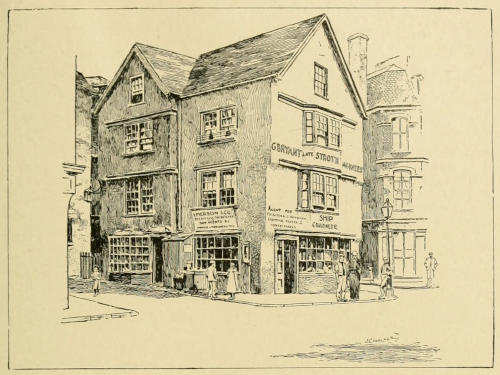
HOUSE IN PLYMOUTH, ENGLAND, WHERE THE MAYFLOWER PILGRIMS WERE ENTERTAINED
When the change had been made, stupendous as it looked amid the ruin of the monastic houses which the King had promptly despoiled, Englishmen found themselves very little more at liberty than before to choose forms of worship or of church government for themselves. The Church had become more than ever a part of the state. The King was its head and master, instead of the Pope. He did not insist very much upon matters of doctrine, being himself in no case to set an example in that kind; but he did insist upon the authority of the Church in matters of government,—upon uniformity in worship and in discipline; because the discipline of the Church was now the discipline of the state, and part of his own sovereignty. He deemed schism a form of disloyalty, though opinion, if it kept within discreet bounds, he would not too curiously look into. It was an easy enough rule. Things might have gone very quietly and with a normal growth and liberalization, had not Mary, a fanatical Catholic, become Queen, and tried forthwith to force every one in the kingdom back into the Church of Rome; had not Elizabeth, in her turn, proved so absolute a martinet in every matter of obedience to the crown,—in matters which affected the Church no less than in matters which affected only her crown and government. Mary drove those who resisted her to the stake, or out of the kingdom. Elizabeth looked shrewdly into every movement that threatened the uniformity of worship, as changes of opinion inevitably did, and saw to it that all men were turned to adopt her preference.
Most persons quietly submitted. Even men of strong convictions deemed it better to remain within the Church and purify its beliefs and practices without schism or revolution than to fling out of it, breaking both its unity and the peace of the country. Such men even drew together as a distinct party of “Puritans,”—men who wished the Church to be pure and to hold the essential doctrines of the great reformers who had given life and substance to protestantism, but who did not mean to lead it faster than it could go in the new ways, or to separate themselves from it and set up a Church and worship of their own, even though it were the excellent forms and beliefs of the church of Geneva. Others, however, were of a more exacting conscience, a more imperious and separate way of belief. It meant a great deal to them to have come into direct contact with the Word of God, to have thought upon its living sentences with the free, unbidden, individual right of interpretation of which great Luther had set the example. It was King Henry himself who had authorized the publication of the Bible in English, and who had commanded that it be made accessible everywhere in the churches; and when once they had thought upon it for themselves and had found their thought, sober and chastened as it was, running in unsanctioned channels, some men preferred their own consciences and their own views of the truth to obedience, and refused to conform. They followed the example of the Dutch, now to be found almost everywhere among them, and set up independent congregations,—became “Separatists,” secretly and in defiance of the crown.
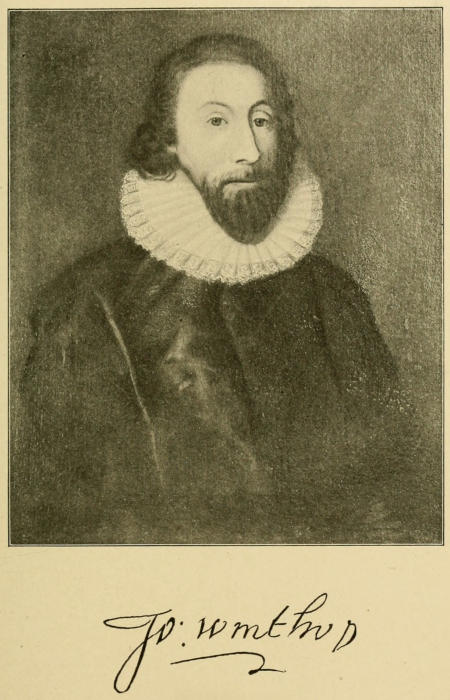
JOHN WINTHROP

Elizabeth, bent upon being sovereign in all things, had grown harsher and harsher towards those who would not submit to authority in matters of belief and worship. Law upon law had been passed to prevent Englishmen from organizing any worship of their own which the bishops did not sanction; and whatever was law Elizabeth saw to it should be executed. And then, when Elizabeth was gone, James of Scotland came to the throne and completed the discomfiture and despair of those who had clung to the Church through all that had gone before, in the hope of better times and more liberal ways of government. He had seemed a veritable Presbyterian so long as he was King of Scotland; but when he became King of England also he turned out to be of another opinion. “A Scottish presbytery,” he exclaimed, “agreeth as well with a monarchy as God with the devil.” He was head of the Church, he declared, not only because Henry had cast loose from Rome, but also because it was of divine ordinance and appointment that he should be. The bishops of the Church were his agents. “No bishop, no King,” he said; and men found that they must obey the King in matters of religion as never before.
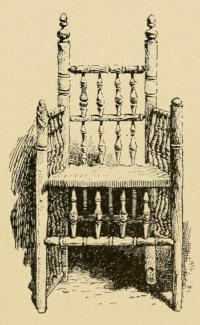
ELDER BREWSTER’S CHAIR
It was in the disheartening days of this new tyranny that the little company of “Separatists” fled from England into Holland who were afterwards to seek new shelter within Cape Cod in America. They had waited only until there should be peace between the Netherlands and Spain; and the truce had come at last in 1609 which gave them their freedom to go, following after scores of their countrymen who had gone before them. They had formed their separate association for worship in England three years before, in defiance of the law, meeting quietly in the old manor house at Scrooby, a little hamlet just within the borders of Nottinghamshire, on the great north road from London to Edinburgh. They were humble folk, for the most part, of no social consequence, with only two or three scholars among them,—William Brewster, their elder, and John Robinson, their “teacher,” and one or two others bred at Cambridge, men of strong convictions and an exalted sense of independence and duty, who had been driven from the Church for nonconformity. But, humble though they were, they could not keep their ways of worship hid from prying eyes. The law was rigorously enforced against them, and they soon found that they could have no peace in England.

They fled first to Amsterdam, but after about a year removed to Leyden (1609). There they made comfortable enough homes for themselves, by dint of careful thrift and hard labor. Their new neighbors liked them and helped them, because they found them capable, honest, and diligent. But it was not like being in England, after all. They felt themselves exiles all the while. Mr. Robinson, with his learning and his sweet eloquence, made friends and found congenial tasks at the university, where his gifts were recognized and honored; and Mr. Brewster established himself as a teacher, “instructing students at the university, Danes and Germans, in the English language,” and even set up a printing-press, where books forbidden as heretical in England could be printed. Scholars were by breeding men of the world, and could adopt the manners and enjoy the companionships of a new country with a certain zest and relish. Mr. Brewster had known these strange places before. Close upon five-and-twenty years before, when the great war and tragic grapple with Spain was at its heat, he had come into the Netherlands with William Davison, the hard-headed Scottish Puritan whom Elizabeth was pleased to employ as her ambassador in that quarter. He counted statesmen and travellers and men about the sovereign’s person among his friends, and could be well enough at ease wherever duty or employment led him. But the majority of the little band were humble folk and found their lot hard. Even a bare living was difficult to eke out in a strange country, whose manners were as unfamiliar to them as its language. They saw their children growing up, too, as the years went by, in a way that threatened to make them as Dutch as their neighbors, and forfeit their nationality altogether; and that was deeply distasteful to them. When the truce approached its end, therefore, and war was again at hand, a final argument of discouragement was added, and they determined to try their fortunes in the New World, where Virginia had now become fairly established and seemed secure of its future.
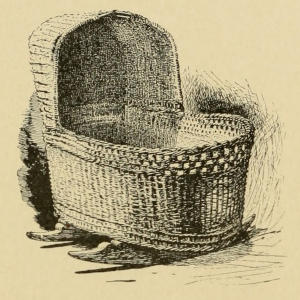
A PILGRIM BABY’S CRADLE
They sent agents to London to speak with the managers of the Virginia Company, and obtain leave to settle within their grant. Mr. Brewster could go to Sir Edwin Sandys as to a man who knew him and would befriend him willingly. He had lived at Scrooby manor house as agent of Sir Samuel Sandys, Sir Edwin’s brother, and Sir Edwin knew his integrity and was of too liberal a temper to distrust him for his independency in matters of belief and worship. The exiles could count upon favor in that quarter, now that a statesman ruled in the counsels of the great company. They did not wish to go to Jamestown or to lose in any way their separate organization as a congregation by being merged with plantations already made; and for a little, while their negotiations with the Virginia Company dragged slowly, because Sir Edwin Sandys and its other leaders were of necessity called off to other things, they thought of entering into some arrangement with the Dutch West India Company to secure a separate allotment of land near the Great North River of New Netherland. But that plan fell through, and some of them at last set forth with a charter from the Virginia Company,—a charter conceived in the liberal spirit of the men who had sent Sir George Yeardley out to give Virginia a representative assembly and the full privileges of Englishmen.
By it their leaders were authorized to associate with themselves “the gravest and discreetest” of their companions and to make for themselves such “orders, ordinances, and constitutions for the better ordering and directing of their business and servants” as they should deem best, provided only that they should ordain nothing contrary to the laws of England. They were to be from the first their own masters in making a way to succeed. Not all could go. There was not money, there were not ships enough. Sir Edwin Sandys, with his generous public spirit in such matters, loaned them three hundred pounds without interest; but they had no resources of their own, and the rest of the money they needed they were obliged to borrow from unwilling merchants who exacted the utmost usury, and made many delays about letting them have the little they consented to lend. It was the month of September, 1620, before those who could go, a hundred and two in all, got fairly upon their way, in a single small vessel, the Mayflower. Mr. Brewster went with them, as their leader, but Mr. Robinson stayed behind; for the greater number remained, to await a later opportunity, and wished to keep their pastor with them.
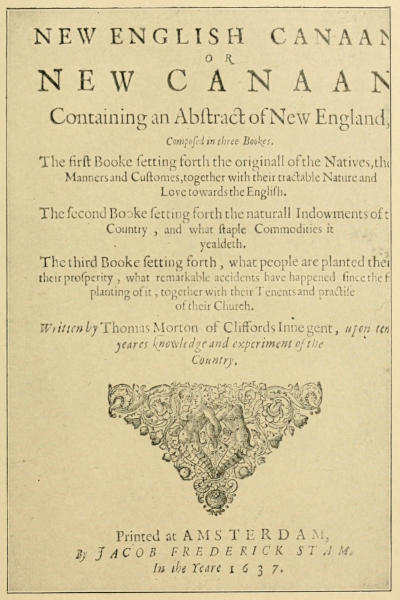
TITLE-PAGE OF MORTON’S “NEW ENGLISH CANAAN”
Stress of weather kept the little Mayflower nine weeks on the Atlantic; and when at last, in the bleak days of late November, they sighted land, it turned out to be Cape Cod, and not the Virginia coast at all. The master of the ship had let his reckonings go wrong, was many leagues north of the land-fall he had been instructed to make, by the Bay of Delaware, and found himself, as he closed with the coast he had blindly come upon, involved in shoals from which he did not very well know how safely to extricate himself. The Virginia Company had been divided into two bodies, as Mr. Brewster’s people knew very well, and the gentlemen in London from whom they had got their charter had no rights over this northern coast. It belonged now to the separate “Plymouth” branch of the company. The immigrants had half a mind to make for Hudson’s River, after all. But the season was late and stormy, and the captain surly and unwilling, and they determined to land where they were and make the best of what they had hit upon. They took care first, however, to have some sort of government made ready for the landing. Their charter from the Virginia Company being no longer serviceable, and a few even of their little group of settlers being persons taken aboard in England who were not of their congregation,—and not certain, therefore, to submit without compulsion to be governed by their authority and discipline,—they judged it best to draw up an agreement before going ashore, by which all should bind themselves to accept the authority of their leaders, until, at any rate, they should obtain a grant of lands and of power from the Plymouth Company, upon whose coasts they were thus unexpectedly to be set down. That done, they were ready to make their landing, and see what sort of a home the new coast would afford them.
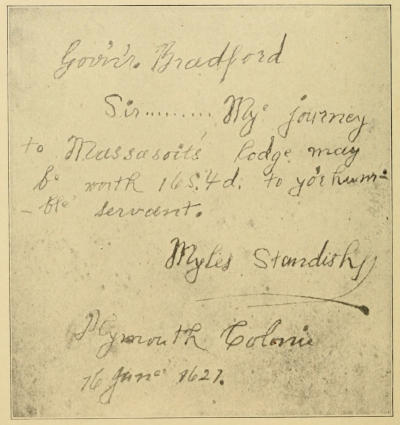
FACSIMILE OF A LETTER FROM MYLES STANDISH TO GOVERNOR BRADFORD
The shores of the sea within Cape Cod by no means showed the soft summer aspect which Captain John Smith had found upon them in 1614, when he had cruised along these coasts. They had reminded him then of green Devonshire and the soft slopes of England. But now they were bleak and frosted and desolate. The pilgrims were not men to lose heart, however, and their leaders were of such quality as to relish difficulty and find a zest in daring. Besides Mr. Carver, who had been their agent in obtaining the Virginia charter, which they could not use, and whom they had chosen to be their governor, first under their Virginian grant and now again under the voluntary compact signed there in the ship’s cabin, Captain Myles Standish was of their company, whose people had served England ever since Agincourt, and before, who had himself fought, for the love of it, against the Spaniard in the Low Countries, and who, when the fighting was over, had happened upon their little congregation at Leyden, and had chosen to cross with them to America because he liked both them and the enterprise. There was Edward Winslow, also, a young gentleman of Worcestershire, who had in like manner chanced to come upon them in his travels and had of like preference cast in his lot with them; and William Bradford, of their own humble sort, who had gone with them into Holland when but a lad of twenty, had made himself a bit of a scholar while he plied his trade as a silk-weaver, and was now, at thirty, counted already a tried man of counsel and of action.
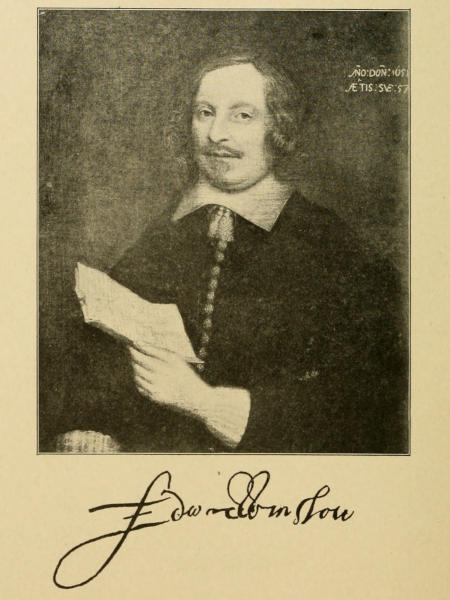
EDWARD WINSLOW
Several weeks elapsed before a suitable place was found for landing and erecting shelter; and even then it was only “the best they could find,”—the quiet harbor, within a little bay, upon which Captain Smith had written “Plymouth” on the map he had sketched as he passed that way, putting into bays and examining harbors with businesslike curiosity, six years before. January had come, and the first rigors of winter, before they got to work to put up shelter. Happily, the winter was mild, though icy cold, for all that. The strenuous work and cruel exposure of those first weeks, which wearily lengthened into months ere spring came, and the poor and insufficient food eked out from their scant supplies, brought upon them agues, fevers, scurvy, and all the other distempers that want and exposure bring, and they saw what the settlers at Jamestown had seen of the pitiless power of the wilderness. Before that dreadful season of suffering had passed full half their number were dead, Mr. Carver among the rest, and they had seen a time when there were but six or seven sound persons among them all to care for the scores who were stricken. But they were steadfast, as always. They elected Mr. Bradford governor in the stead of Mr. Carver, and went on as they could with their fight to live. They knew of no place to which to go back, and no one asked to go with the Mayflower when she set sail for England again in April.
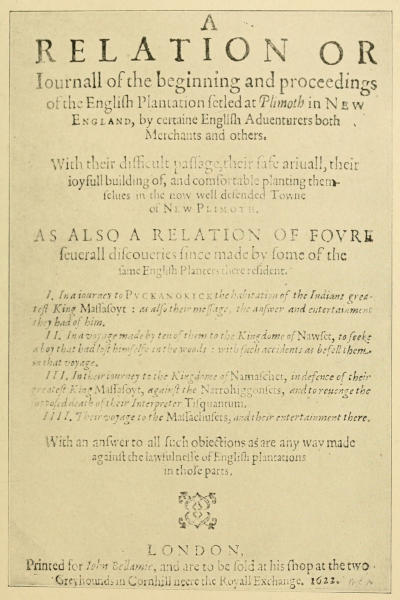
TITLE-PAGE OF MOURT’S “RELATION”
The earliest published book relating to Plymouth Colony
They worked against tremendous odds there on that barren coast; but they wrung a living from it almost from the first, and year by year patiently learned to succeed at the hard thing they had undertaken. It was a great burden to them that they had had to borrow large sums of money from exacting London merchants to pay for the ship that was to take them out and for the stores she was to carry. They had been obliged to take the lenders into a sort of partnership, and very soon found that they were expected to return a profit almost from the outset, working for a common store as the hapless colonists of the Virginia Company had worked till sheer failure brought them a change of system. It was many a long year before they were able to buy themselves out of that quandary and begin at last a free life for themselves. Additional settlers came out to them in small companies, season by season; but they were not always such persons as they wished for. They were, too many of them, young fellows of an irresponsible and unmanageable sort, “who little considered whither or about what they went.” It was not until a full ten years had gone by that the little congregation were able to fulfil their long-cherished hope and bring over from Leyden considerable numbers of their old-time comrades in exile; and before that time came Mr. Robinson, their beloved pastor, whom they had most desired, was dead.
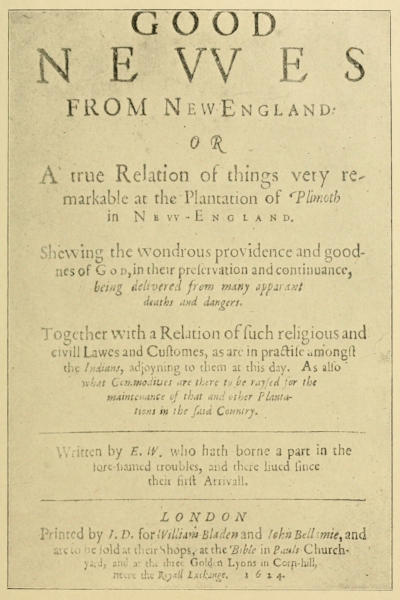
TITLE-PAGE OF EDWARD WINSLOW’S “GOOD NEWES”
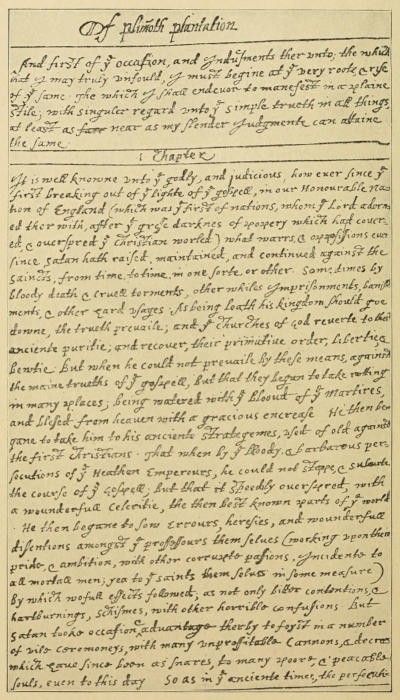
PAGE FROM BRADFORD’S “HISTORY OF PLIMOTH PLANTATION” SHOWING BRADFORD’S HANDWRITING
They were not a little troubled, and even endangered, moreover, by helpless or unmanageable neighbors: bands of Englishmen of one sort or another,—some mere adventurers, others sober and earnest but not fit for the grim work of making homes or winning a livelihood in a wilderness such as that was,—who came to attempt settlements, or trade with the Indians, on the great Bay of Massachusetts near by. Sometimes it was necessary in mere pity to succor these people; sometimes it was necessary very summarily to check them or drive them off, lest they should make irreparable mischief with the Indians.
Despite every difficulty, nevertheless, Mr. Bradford’s indomitable colonists made their foothold secure at Plymouth; worked themselves free from the London partnership; found how to get good crops, and what sorts of crops to get, out of the unwilling soil; established fisheries upon the near-by coasts, and trading posts here and there among the more distant Indian tribes,—one as far away as Kennebec, in Maine. The “Council for New England,” which represented the new company established in England to control and develop these northern coasts once included in the Virginia grants, was very glad to encourage these their unexpected colonists at Plymouth, and sent a liberal charter out to them by the very first ship that came from England after the return of the Mayflower; and when they were ready to ask for more privileges,—as, for example, for leave to set up a post on the Kennebec,—very promptly gave them what they asked for. By the time their old friends from Leyden came to them, in 1630, they had reason to feel secure enough in their new home, and had only their neighbors to fear,—only the past to sadden them.
It was at first only unruly or shiftless English settlers who gave them cause for uneasiness; but they had not been long at Plymouth before they were given reason to think about the Dutch also, as jealous neighbors and rivals who might cause them serious annoyance, if nothing worse. A very cordial treaty of alliance between England and Holland had been concluded when King James died, and his son, the first Charles, came to the throne, in 1625; and there was likely, for the present at least, to be peace and good will between the two peoples. But there was no telling how long it would last, and the Dutch were meanwhile growing very numerous and strong on Hudson’s River. The treaty with England had, indeed, seemed to give the Dutch West India Company fresh heart for their enterprise in New Netherland. They immediately despatched thither an active man as governor, and began to erect warehouses and batteries of good stone masonry at “Fort Amsterdam” on Manhattan Island, where guns could command some portion of the great bay of the North River and the approaches to the great river itself very handily. The scattered families at Fort Orange and on the South River, at Fort Nassau, were brought together for greater strength and security at Fort Amsterdam, and there were presently close upon three hundred settlers there, so busy with their labor and trading that before two years had gone by under the new governor (1628) they had sent home, in two ships alone, sixty-one thousand guilders’ worth of timber from the forests, and of furs bought from the northern Indians. Mr. Bradford and his people at Plymouth set up a trading post some twenty miles to the southward on Buzzards Bay, but it turned out that the Dutch could beat them there; for it was chiefly on Long Island, which the Dutch controlled, that the wampum was to be obtained which the Indians accepted as money, and the Plymouth traders were at a serious disadvantage without it. They were cut off from the lucrative fur trade of the North River, and were every way pushed very hard by the shrewd Dutch traders.

The governors of the rival colonies exchanged very courteous letters, and the secretary of New Netherland was sent on a visit of ceremony and good will to Plymouth; but even in this friendly correspondence there were prophetic hints of something less gentle and peaceable. Bradford called Governor Minuit’s attention to the fact that the Dutch were settled within the limits of grants made by the English crown to the Virginia Company, and that their right to be there might some day be called in question; and Minuit replied, very spiritedly, “As the English claim authority under the King of England, so we derive ours from the States of Holland, and will defend it.” No doubt, too, the secretary of the Dutch colony was sent upon his visit of courtesy as much to see how the English fared and report upon the strength of the Plymouth settlement as to carry messages of good feeling. It is from him that we learn what the pilgrim colony looked like in that early day, when it was but seven years old (1627): how a broad street, it might be eight hundred feet long, ran up the hill straight from the landing place in the harbor, and was crossed midway by another street, with four cannon in the open place at the crossing, and the governor’s house close by upon the upper corner; how the houses, all of good hewn plank, stood in their little gardens ranged at intervals along the streets, and stockaded against attack; and how, crowning the hill, there stood a square building, large and very stoutly made, on whose top, as on a platform, there were six cannon placed, to command from their elevation the country round about and the harbor below, and within which was their place of meeting and of worship. They went always to church in military array, he said, their captain commanding, and laid their arms down close beside them while they worshipped and heard the sermon. They remembered their sojourn in Holland with much gratitude, and accorded the Dutch secretary a hearty welcome. But it was likely that New Amsterdam and New Plymouth would be keen rivals, nevertheless, and no love lost between them in the long run.
Authorities on the history of New Netherland and New York in the seventeenth century. The first volume of John Romeyn Brodhead’s History of the State of New York gives the history of the Dutch period in a narrative of unusual dignity, lucidity, and fulness. The second volume brings the narrative down to 1691. Edward B. O’Callaghan’s History of New Netherland, in two volumes, is a careful and detailed narrative of the Dutch period only. Mr. John Fiske, in his Dutch and Quaker Colonies, sketches the whole length of New Netherland and New York history in his well-known broad and lucid way, with a wealth of incidental illustrative detail. William Smith’s History of the Late Province of New York from its Discovery to 1762 is contained in the Collections of the New York Historical Society. Bancroft and Hildreth both sketch the history of New York in tolerably full outline in their general histories of the country.
The sources of New Netherland and New York history are to be found chiefly in E. B. O’Callaghan’s Laws and Ordinances of New Netherland, 1638-1674, and in the same author’s Documentary History of the State of New York; in the fifteen volumes of E. B. O’Callaghan’s and Berthold Fernow’s Documents Relative to the Colonial History of the State of New York; in the Memoirs of the Long Island Historical Society; in the Publications of the Hakluyt Society; in Sainsbury’s Calendar of [English] State Papers, Colonial V.; in Stedman and Hutchinson’s Library of American Literature; in the Appendix to Read’s Henry Hudson; and in the Records of New Netherland from 1653 to 1674, edited by Berthold Fernow.
Authorities on the history of New Plymouth in the seventeenth century. John Gorham Palfrey’s History of New England (1492-1774) and Compendious History of New England (1497-1765), the former in five and the latter in four volumes, are the standard general histories of the group of colonies of which Plymouth was the first. Mr. J. A. Doyle, in the second volume of his English Colonies in America, gives an excellent account of the Plymouth colony in the modern critical method. Mr. John Fiske sketches its history in his Beginnings of New England. Bancroft and Hildreth set it forth at some length in their histories. Mr. F. B. Dexter gives a brief critical sketch of it in the third volume of Winsor’s Narrative and Critical History of America.
The original sources of the narrative are to be found, for the most part, in William Bradford’s History of the Plymouth Plantation, always admirable for its accuracy and good temper, which brings the account down at first hand to 1647; in the Plymouth Colony Records; in the Collections of the Massachusetts Historical Society; in Alexander Young’s Chronicles of the Pilgrim Fathers and Chronicles of Massachusetts; and in Stedman and Hutchinson’s Library of American Literature.
For accounts of the general Puritan movement in England of which the Plymouth emigration formed a part, see the references following Section III. of this chapter.
III. The Massachusetts Company
The business of both Church and State had altered very ominously in England during the eventful years which brought James’s reign to a close and gave Englishmen their first taste of Charles’s quality. The air had filled with signs of revolution; and it was one of the most serious of these that the Puritans, who had once been merely champions of pure doctrine and a simplified worship within the Church, had now become a political party, and were trying to put a curb upon the King in every matter. At first they had thought that they might reform the Church, which they loyally loved, by the slow and peaceable ways of precept and example,—by preaching the new doctrines of Calvin, and by systematically simplifying the worship in their churches until they should have got the forms and notions of Rome out of them altogether. Elizabeth taught them that that was impossible while she was queen. Her harsh measures hardened their temper, and made them a distinct and active party: first for concert within the Church; now at last for concert also in matters of state, because the times had changed.
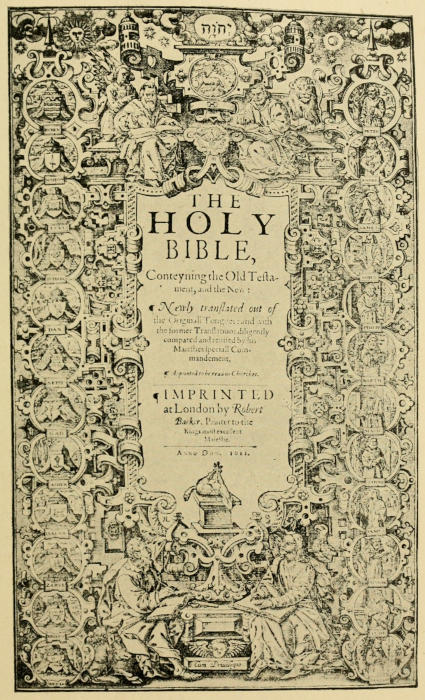
TITLE-PAGE OF FIRST EDITION OF KING JAMES’S BIBLE
James had come to the throne and grievously disappointed them; and Charles, after him, had turned out to be not even a serious opponent of Rome itself. In 1618, while James was yet king, the terrible Thirty Years’ War had come, that mighty struggle between the Protestant and the Roman Catholic states of the Continent, which threatened to tear away the very foundations of liberty and of national life, should the papacy prevail; and yet Charles had married a Roman Catholic princess, and showed himself as ready to make bargains with Roman Catholic as alliances with Protestant princes. Moreover, he was as indifferent to the political rights of his subjects as he was to their Protestant opinions. When his Parliament, disapproving his policy, refused to vote him money, he levied taxes without their consent, and seemed determined to break as he pleased every understanding of the constitution. The salvation of the Church and the salvation of the liberties of England he made to seem one and the same thing: for he would respect neither law nor opinion. And so the chief Puritan gentlemen of the kingdom became politicians, and filled the House of Commons with men of their way of thinking, grimly determined to make a single piece of work of the purification of the Church and the maintenance of liberty. Charles found no way to be rid of their protests except to do without a Parliament altogether; and to that at last he made up his mind. He dismissed the Parliament of 1629, resolved to have done with Parliaments. For eleven years he kept his resolve. No Parliament was summoned; money was raised without warrant of law; and the government was conducted entirely as he willed.
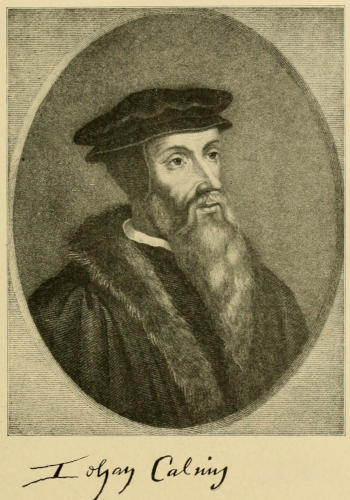
JOHN CALVIN
It was in that way he brought a great revolution on and lost his head, for he was dealing with men who could not safely be defied. But for the moment he seemed master. The first shock of such events was enough to dismay men who were lovers of law and of right, who had intended no revolution, who had meant to fight tyranny only by legal process and in behalf of privileges acknowledged time out of mind. Even stout-hearted men lost hope for a little, and thought their cause undone in that dark year 1629, when they saw their leaders in the King’s prisons, and the King masterful and hot against all who dared so much as protest. And so a new exodus began, not to Holland this time, but direct to America,—an exodus not of separatists, of whom the law had already made outlaws, but of those sober Puritans who had remained in the Church, and had been its hope of reform.
A company had been formed among them for the purpose of attempting a settlement in America even before the end of all Puritan hopes had seemed to come. Lands had been purchased from the Council for New England in March, 1628, and a party of settlers had been sent out that very summer under John Endecott, a blunt, passionate, wilful man, hard to deal with, but more efficient than any other the company could find, and more likely to succeed. He chose Salem, not far within the northern cape of the great Bay of Massachusetts, as his place of settlement; and when a large body of new settlers were sent out to him the next summer he and his people were ready for them, with houses built and crops ripening. That same year, 1629, the company in England obtained a charter from the crown, and assumed a new importance and authority as “The Governor and Company of Massachusetts Bay in New England.”
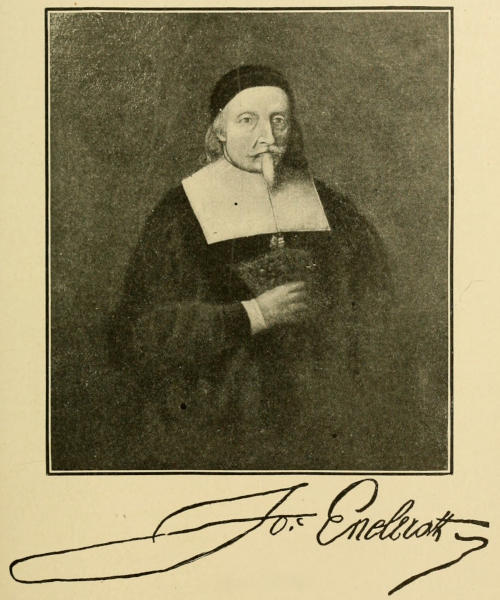
JOHN ENDECOTT
There could have been no better time to get recruits for a Puritan colony,—not mechanics merely, and such humble folk, or men out of employment, but people of substance also, who would give themselves and their fortunes to the enterprise, in the hope that they might at any rate find freedom of conscience, and establish a free state in America. Most of those who entered the company meant also to become its colonists. The company itself, therefore, was transferred over sea, its governor and council themselves taking ship to the colony they were to govern. There was not to be a “Governor and Company of Massachusetts Bay” set up in London to rule and dispose of a distant colony, as the Virginia Company had ruled Virginia. It was to have its seat where it had its possessions. It kept still a group of its incorporators in London, organized for the management of its financial interests; and the law officers of the crown no doubt for a time deemed these the council of the company itself. But they learned presently that they were not. The real rulers of the new colony had no mind to conduct their business in London in open courts under the eye of the King and draw all the talk of the town upon them, as the Virginia Company had done, to its undoing. There was nothing in their charter which prescribed where the councils of the company should meet. They made bold, therefore, to take their charter and all the business done under it with them to America. More than seventeen ships and a thousand colonists got away from the western and southern seaports,—Bristol, Plymouth, Weymouth, Southampton,—in the spring and summer of 1630, Mr. John Winthrop, a man of gentle breeding, of education, of private means, and of the high principles of the best Puritan tradition, a man trained to the law, and, what was much better, schooled in a firm but moderate temper, sweet yet commanding, going out as governor to supersede Endecott. Thomas Dudley went as his deputy, a man cast in another mould, and of another type, a doughty Puritan soldier who had served under Henry of Navarre; an uncompromising partisan, more man-at-arms than statesman.
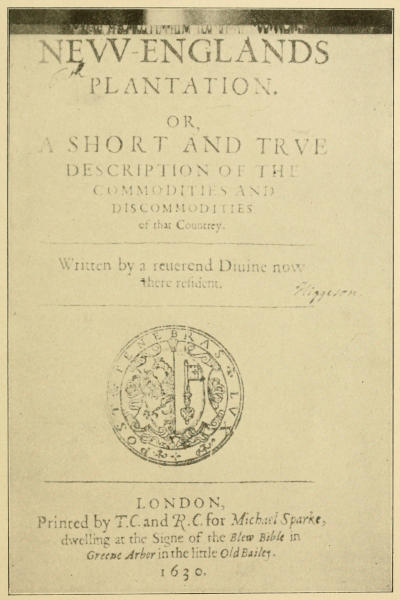
TITLE-PAGE OF FRANCIS HIGGINSON’S BOOK
Want and disease had done their accustomed work among Endecott’s people before the new governor and company reached the Bay. Mr. Higginson, who had written them from Salem scarcely a year ago that “a sup of New England’s air was better than a whole draught of old England’s ale,” was hardly able to stand to preach to them when they landed, a fatal fever having taken hold upon him. It was necessary to separate at once and begin other settlements where Mr. Winthrop’s people might prepare shelter for the winter. As soon as possible, therefore, places were chosen. Watertown, Roxbury, Boston, Dorchester were begun, and the preparation of Charlestown, already begun before their coming, was pushed forward,—all places far within the Bay, where groups of sheltering islands shouldered out the heavier seas, and harbors were quiet. But the work was sadly belated. Autumn had come and was gone before much could be accomplished. A full hundred of the immigrants lost heart and went back with the ships to England. Winter found those who remained short of food and still without sufficient shelter, and want and disease claimed two hundred victims among them. Even the ships they despatched hastily to England for corn brought very little when they came again, for grain was scarce and dear at home also.
With the spring came health and hope again, as always; but bad news, too. Those who had returned home disheartened had spread damaging reports about the colony, not only telling of the sore straits it was in to live, but also declaring that Mr. Winthrop and his people had openly repudiated the Church of England and turned separatists, like the people at Plymouth. It was difficult to quiet these reports, because they were practically true. It was not easy to explain away what had undoubtedly been done. Both the immigrants with Mr. Endecott at Salem and those who had come with Mr. Winthrop had left home members of the Church of England: Puritans and reformers, indeed, but still not separatists, and publicly professing a warm loyalty for the mother Church. “We esteem it an honor,” they had said, as they uttered their final partings at Yarmouth, “to call the Church of England, from whence we rise, our dear mother.” “We shall always rejoice in her good, ... and while we have breath sincerely desire and endeavor the continuance and abundance of her welfare, with the enlargement of her bounds.” And yet Endecott had hardly begun his settlement at Salem before he took counsel with Mr. Brewster and other leaders at Plymouth, and rearranged both the worship and the government of his church after their model. Mr. Winthrop’s people had done the same. Those who protested and showed themselves unwilling to accept the new ways of church government were compelled either to conform or return home to England. The whole thing looked like the carrying out of a deliberate plan made beforehand to get rid of the Church as well as of the government of England: to set up a separate church along with a separate commonwealth.
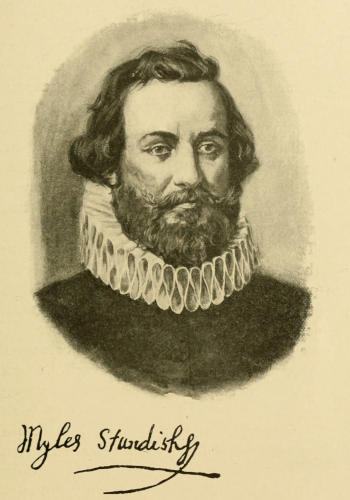
MYLES STANDISH
They could hardly say that it was the necessary result of their removal to a distant continent; for the numerous body of Englishmen long ago settled in Virginia had done nothing of the sort, though they maintained their own churches. The Virginians had remained staunch supporters of the Church as it was at home. Their own assembly had passed strict laws to enforce the accustomed discipline of the English Church and to protect its forms of worship. It could not be said that they did not love their freedom as much as the settlers at Plymouth and the Bay loved theirs. They were glad enough to have an ocean between them and the bishops, did not hesitate to discard the surplice, simplified their worship as they pleased, and took leave to make very free use of the opportunity to rule their own affairs. But they loved none the less the ancient Church in which they had been bred, and they meant to maintain it.
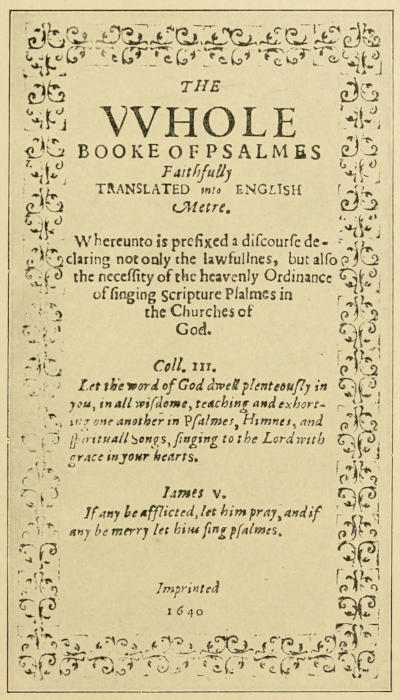
TITLE-PAGE OF THE “BAY PSALM BOOK”
Virginia had been planted before the full warmth of the Puritan temper had made itself felt in England, when it was esteemed a reproach to be called a separatist, and a proud duty which went along with a man’s allegiance to hold fast to the standards of the nation’s Church. Virginia had been recruited, too, as she grew, not out of a special class like the Puritans, with a cause at their hearts, but out of the general body of the English people, in whose lives and thoughts the disputes which grew so keen from year to year within the Church played very little part. They had brought their religious beliefs and their forms of worship with them to Virginia as habits in their blood, unseparated and undistinguished from their English citizenship. The new settlers on Massachusetts Bay, on the contrary, had been selected out of a special class. They were men bent for conscience’ sake upon setting up a particular standard of their own both in church and in state. They had a deliberate plan from the first to withdraw themselves from the general body of Englishmen and establish in America what should seem to them “a due form of government, both civil and ecclesiastical.” “God sifted a whole nation that He might send choice grain out into this wilderness,” one of their own preachers said. They tried to explain away their novel proceedings when they wrote to persons of influence at home; they tried to persuade even themselves that they were not separatists, but only a distant and necessarily distinct fragment of the Church of England, of the form which they hoped and expected to see that great Church some day assume; but they were, in fact, founding a separate establishment which denied the authority of the mother Church altogether.
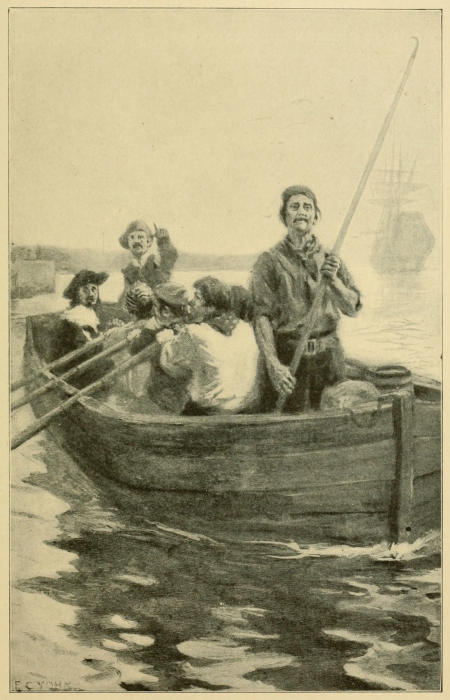
A VIRGINIA PLANTER WITH HIS ATTENDANTS IN HIS BOAT ON THE JAMES RIVER
Virginia had slowly grown to a population of five thousand while the Puritans organized their company and transported it to America. Virginians bore themselves very much as Englishmen did everywhere. There was nothing peculiar about them except their hardihood, as of frontiersmen, and their knowledge of how life was to be managed and set forward in a wilderness. It had not made much difference among them that the Virginia Company was dissolved and the colony put into the hands of the King. For the first four years that followed the change no assemblies were summoned, it is true, and they were ruled by the governors and the governors’ councils whom the King appointed. But the governors chosen by the King during those years were men of their own number, their trusted friends, already experienced in their affairs, men whom the company also had employed. Leading men of the colony were appointed to the council also. The general interest was consulted, though there were no elections. Before a governor not to the people’s taste was put over them the old practice of calling assemblies had been resumed. Virginians wished their individual rights to be left untouched, and watched their government narrowly to see that it did not impose upon them; but their life went well enough, and they were not disposed to seek radical changes either in church or state.
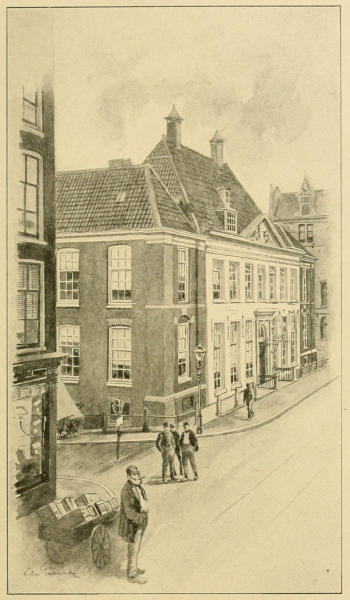
DUTCH WEST INDIA COMPANY’S HOUSE, HAARLEM STREET, AMSTERDAM
They were not settled in close groups, and were not always discussing their common affairs, as men do who live together in towns or organize themselves in compact neighborhoods for business. There was no real town in the colony, except Jamestown. The homes of the colony were scattered through wide neighborhoods along the margins of the rivers, which flowed broad and deep and from every quarter, the natural highways of the place. Each planter farmed as much of the fertile land as he could; but he planted little for sale except tobacco. His tobacco he shipped away in vessels which came to his own wharf and the wharves of his neighbors to be laden. It was not hard to live in that genial climate. Great clearings had at last been made; the sun had been let wholesomely in to take the feverish vapors of the forest off; and the land had begun to yield health as well as abundance. Secluded country churches were the neighborhood gathering places of the colony, for talk as well as for worship. Planters made their way to Jamestown down the rivers in their own boats, or through the quiet paths of the forest on horseback, to be present at the gathering of the assembly, or to attend the quarterly meetings of the governor’s council, at which lawsuits were heard and determined. It was all a leisurely way of life, and was not apt to bring changes rapidly about so long as the King suffered them to enjoy their reasonable liberty as Englishmen and did not put men who wished to rule overmuch into their governor’s chair.
New Netherland grew also, in a way which might have looked to a chance visitor very like the growth of Virginia. The Dutch West India Company had found that if they kept to the plan with which they had begun, they could not hope to make anything more than a mere trading station out of their slow-growing settlement at Fort Amsterdam. The council of the company, accordingly, determined to offer large tracts of land to any one who would send over at his own cost fifty adult settlers, with stores and equipment,—and with the land extraordinary powers of independent control, which should constitute the owner a sort of feudal prince, as “patroon” and lord of his estate. The offer had in it the enticing prospect of dignity and power and safe wealth, such as the landed gentry of Holland had time out of mind enjoyed and the merchants of the towns had envied them as long, and some were tempted, as the company had hoped. Some rich men did bestir themselves to send settlers over, and great stretches of the best land on both the North and the South rivers of New Netherland were presently made over to private owners. It was no easier, however, for private individuals than it had been for the company to bring the land successfully under cultivation, or to establish settlements which would thrive and endure; and the new way of building up the colony went as slowly as the old. Many of the new proprietors failed; only a few succeeded. The most notable of the estates which were actually peopled and established was that of Kilian van Rensselaer, the wealthy jeweller of Amsterdam, which stretched for miles upon either bank of the North River in the fertile region far up the stream where the company’s Fort Orange stood, and where the heart of the fur trade with the Indians was.
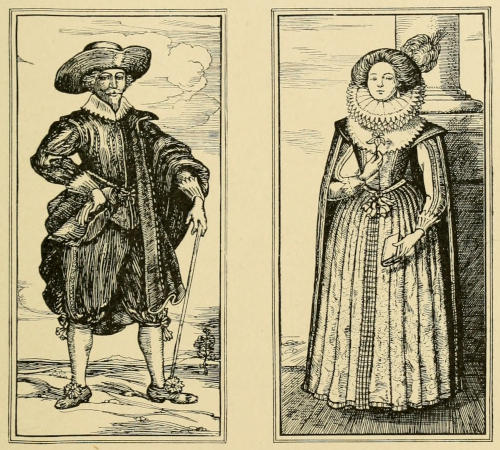
ENGLISH GENTLEMAN, 1633; ENGLISH GENTLEWOMAN, 1631
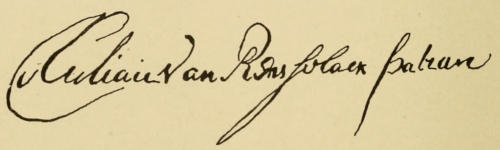
SIGNATURE OF KILIAN VAN RENSSELAER, PATROON
Even where this new way of growth succeeded, however, it was in fact very different from the slow and natural spread of broad plantations in Virginia, where no man was by law more privileged than another. The Dutch farmers and peasants who slowly filled the estates of the patroons with tenants were not like the free yeomen of the southern colony of the English. They were just as little like the New England colonists to the northward. Among these settlement had still another way of growth. They did not develop by the slow spreading of private estates along the river valleys. The New England valleys were not fertile; the rivers were not deep or broad enough to be the highways of the colony. The sort of government the Puritan settlers wished to maintain, moreover, would have been almost impossible had the people not kept together in close groups for common action and worship. The governor and company who ruled Massachusetts Bay governed there very watchfully in the midst of the settlements, and took care to know the men to whom they made grants of land. Sometimes they made grants to individuals for special services or liberal contributions to the company’s funds; but usually they gave land only to bands of settlers who meant to form communities, and who were under the leadership of persons whom the governor and his associates trusted. The new settlers of each locality owned their lands jointly, as if they were a corporation. Their “town meeting” determined what portion each individual among them was to have for his own use. No other settlers could join them unless admitted by their town meeting to the partnership. All local affairs were managed by officers whom the town meeting elected. Each town, the newest no less than Salem or Charlestown or Roxbury or Boston, was its own mistress, except when matters which the company determined in the common interest were to be acted on.