Chapter II · THE SWARMING OF THE ENGLISH (continued 3)
Reading edition
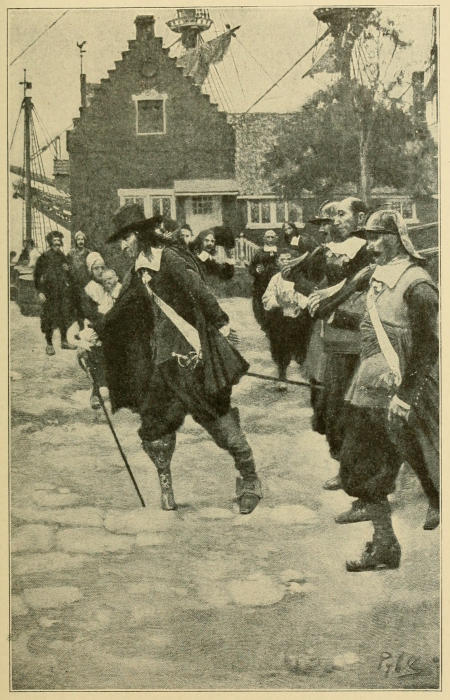
ARRIVAL OF STUYVESANT AT NEW AMSTERDAM
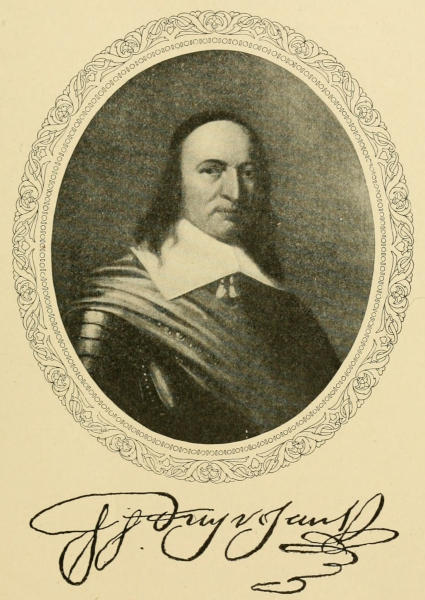
PETER STUYVESANT
Peter Stuyvesant had been sent over as governor in 1647. He made an odd figure with his wooden leg, marvellously contrived with bands and ornaments of silver, and the sly burghers of the simple-mannered New World made a jest of his pretentious way of carrying himself by calling him their “grand Muscovy Duke.” But he moved about among them with a certain show of force and dignity, for all that, if he did have to limp at the business, and he made men understand at least that he was a person to be obeyed. He was quite as truculent and violent of temper and arbitrary as Kieft had been before him; but he was much more efficient, and was able to come to an understanding with his neighbors, both on the Sound and within the South River. In 1650 a treaty was at last agreed upon with the English which fixed the boundaries between their settlements and the Dutch, reserving on the Connecticut itself only the fort of Good Hope and the little plot of ground about it; and though the people at Hartford nevertheless seized and appropriated that also, once for all, when they heard of the war between the Netherlands and the Commonwealth at home (1654), that was no great loss, and did not disturb the boundaries which had been drawn beyond Greenwich on the mainland and athwart Long Island at Oyster Bay. Stuyvesant more than compensated himself for the loss of Good Hope; for that same year (1654) he took a force that could not be withstood to the South River, and conclusively put an end to the Swedish power there, making the river once more a part of New Netherland, not to be disputed again by Sweden.
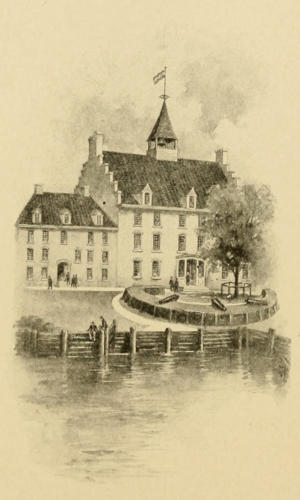
OLD STATE HOUSE OF NEW AMSTERDAM
Death the while thrust his hand into the affairs of New England, and sadly shifted the parts men were to play there. In 1647, the year Stuyvesant came, Mr. Hooker had been taken, leaving no such shrewd and kindly statesman and pastor behind him; and in 1649, the year the King died upon the scaffold, John Winthrop departed,—the man who had founded Massachusetts, and who had seemed its stay and prop. Then Mr. Cotton died (1652), to be followed, scarcely six months later, by Mr. Dudley. Mr. Haynes went in 1654, and the gentle Winslow in 1655; and then Standish, the bluff soldier, who had carried so many of Plymouth’s burdens at the first (1656), and Bradford, the peasant gentleman and scholar, whom all had loved and trusted (1657). Last of all, Mr. Eaton was taken (1658), and New Haven mourned her grave and princely merchant and governor as one whom she could not replace. The first generation of leaders had passed away; men of a new kind were to take their places.
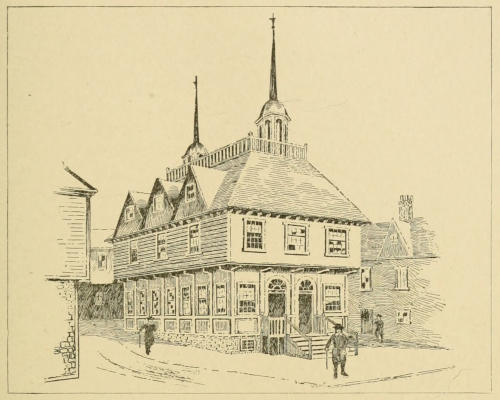
ORIGINAL TOWN HOUSE, BOSTON, 1657-1711. BUILT BY THOMAS JOY, FROM HIS OWN DESIGN
Endecott still lived, to be elected governor year after year till he died (1665). Thirty years in the wilderness had done little to soften his hard rigor against those who offended, though it were never so little, against the law or order of the colony, whether in matters of life or doctrine. He was quick to bring men and women alike to punishment for slight offences; and the days of his rule were darkened by the execution of several Quakers who had refused to quit the colony when bidden. The air cleared a little of such distempers when he was gone.
The authorities and sources for the period covered in this Section have already been named, in connection with the history of the several colonies, under Sections I. to V. of this chapter. There should be added, however, to the authorities on Virginia, Robert Beverley’s History of Virginia, which is here almost a first-hand source.
For the history of this period in England the exhaustive authority is Mr. Samuel Rawson Gardiner, in his History of the Great Civil War, 1642-1649, and his History of the Commonwealth and Protectorate.
VII. The Restoration
All Europe feared England’s power while Cromwell ruled. No such masterful spirit had stood at the front of her affairs since great Elizabeth’s day, and there seemed to be revived in him the same wide vision in the making of plans and the same passionate resoluteness in executing them that had drawn Ralegh and Drake and Frobisher and Hawkins forth to their adventures on the sea, seeking conquests for England at the ends of the earth. It was not enough for him that he should subdue Ireland and quiet Scotland by force of arms, and make himself master at home. He deemed it his duty to lead England forward once again towards the great destiny of conquest and power which men had had clear sight of in the brave days of Shakespeare and good Queen Bess, but had seemed to forget and lose heart for while the unkingly Stuarts reigned. Acting upon secret instructions from the Protector, Major Robert Sedgwick, of Charlestown, in Massachusetts, and Captain John Leverett, of Boston, led an English force into Acadia, where the French were, upon the Bay of Fundy, and made it by sudden conquest an English province (1654). That same year Admiral Blake was sent into the Mediterranean to punish the Duke of Tuscany and the pirates of Tunis for injuries they had inflicted on merchantmen out of England; and the next year, 1655, a great fleet was put upon the seas to go into the West Indies against the possessions of Spain, and there gave the great island of Jamaica the flag and commerce of England.
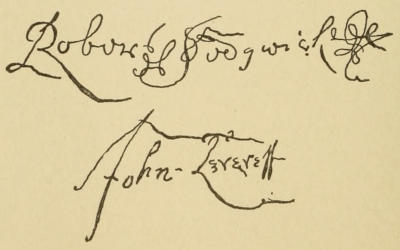
SIGNATURES OF ROBERT SEDGWICK AND JOHN LEVERETT
Cromwell had demanded of Spain freedom of trade in the West Indies and the exemption of English subjects from the horrid tyranny of the Inquisition; not because he thought that Spain would grant these things, but because he saw what England must demand and get if she would compete for power with the Spaniard, who still every year drew great stores of gold and silver and other treasure from her rich colonies in the West. He no doubt expected Spain to refuse what he demanded, and meant from the first to send men-of-war to take what she would not give. He seemed to know, like the statesman he was, what the possession of America and of her trade would mean in the future, and he was acting under counsel from America itself in what he did: the counsel of Mr. Hooke, the shrewd pastor at New Haven, his confidant and relative, of Mr. Cotton, of Boston, whom Mr. Hooke had urged to write to the Lord Protector, and of Roger Williams, who was in England (1651-1654) while the thing was being considered, who was often admitted to private conferences with the Lord Protector, and whose knowledge, sagacity, frankness, and sweetness of nature proved much to that great soldier’s liking. These men were Puritans of the same stock, breeding, and party with himself. They hated Spain as he did, as the chief instrument of the Romish Church, and they wished to cut her treasures off.
The Lord Protector was no stranger to America. It was told that he had himself tried to get away to the safe refuge of the Puritan colonies in the dark days when Charles was master and would not call a Parliament. He had joined others in signing the letter which certain members of Parliament sent into New England inviting Mr. Hooker to come back to England to assist at the reform of the Church; and he had been one of the commissioners whom Parliament had appointed in 1643 to dispose of all things in the colonies as they saw fit—the commissioners from whom Mr. Williams had obtained his charter for the Providence Plantations. No doubt Cromwell would have made a greater empire for England in America had his hands been free at home; but death overtook him ere his plans had widened to that great work (3 September, 1658).
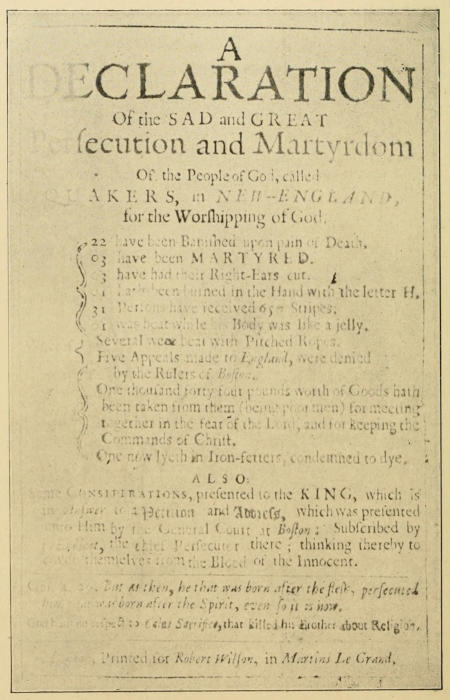
TITLE-PAGE OF PROTEST OF THE QUAKERS PUBLISHED IN LONDON EARLY IN 1660
Massachusetts used the time while the Commonwealth stood not only to settle a little more carefully the forms of her own government, but also to extend her jurisdiction over the new settlements which were springing up about her to the northward, and to set up a mint of her own to coin shillings, sixpences, and threepences to take the place of the money so fast drawn off into England to pay for the goods brought thence. And, since her people were nearly all of one mind and creed in matters of religion, she took occasion to regulate her church affairs even more stringently than the Puritans at home ventured to regulate the faith and worship of England. She put her new “Cambridge platform” rigorously into practice, stopping to doubt neither its righteousness nor its expediency. She not only thrust Quakers out, but sternly forbade all dissent from the doctrines taught by her preachers, and required that even the officers of her militia should be members of the authorized church. There was here no radical change. Massachusetts was but confirming herself in her old ways with a somewhat freer hand than before, because no fear of reproof or correction from the government over sea any longer restrained her.
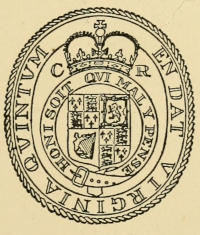
SEAL OF VIRGINIA AFTER THE RESTORATION
Virginia, meanwhile, underwent a veritable transformation. When the Parliamentary commissioners came to Jamestown in 1652, in their frigate, to summon the colony to make her submission to the Commonwealth, they had had to deal, as they knew, with no special class of Englishmen like the Puritans in New England, but with average Englishmen, mixed of gentle and common, too far away from England to be very hot party men upon either side in respect of the sad quarrel between the King and the Puritans. They professed, like other English subjects, to belong to the Church of England, and their own government there in the colony had but the other day sent nearly a thousand settlers packing out of its jurisdiction into Maryland because, though quiet people enough and fair to deal with in other matters, they had refused to observe the forms of the Church, and had openly practised a manner of worship and of church government like that set up in New England, and now in England itself. But the Virginians, take them rank and file, were not really very strenuous about the matter themselves. The Burgesses commanded very strictly the observance of the canons of the Church of England in every matter of worship; but the scattered congregations of easy-going colonists were in fact very lax, and observed them only so far as was convenient and to their taste. Archbishop Laud would very likely have thought them little better than Puritans in the way they governed their churches,—for each neighborhood of planters was left to choose its own minister and to go its own way in the regulation of its forms of service. They revered the great mother Church over sea very sincerely, and meant to be faithful to it in everything that should seem essential; but the free life of the New World made them very democratic in the ordering of the details of practice, and they were glad that there were no bishops nearer than England. Some among them, perhaps not a few scattered here and there, were known to think like the Puritans in matters of government, if not in matters of worship; and there were men of substance among the number, men like Captain Samuel Mathews, for example, one of the chief men of means in the colony, whom all deemed “a true lover of Virginia,” notwithstanding the frank and open freedom he used in differing with his neighbors when they exalted Church or King.
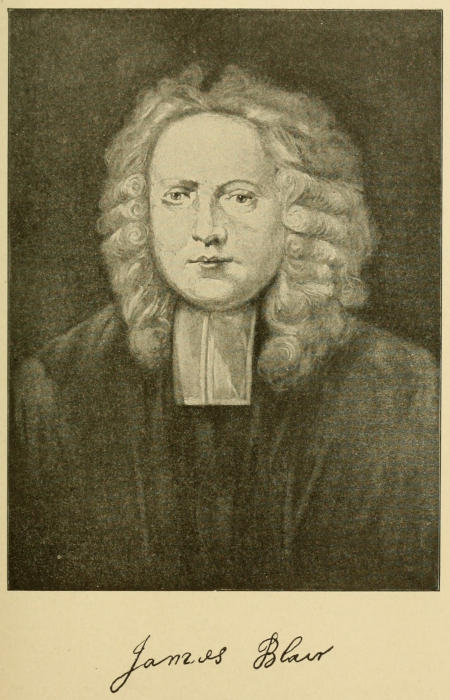
JAMES BLAIR
Captain Richard Bennett they elected governor under the new agreement with the Commonwealth in England, notwithstanding the fact that he had been the leader of the Puritans whom Sir William Berkeley had driven into Maryland for contumacy in disobeying the laws of the colony, and had, besides, been one of the commissioners who had compelled them to submit to the Puritan government in England. When his term was out they chose Mr. Edward Digges, who was no Puritan, and then Captain Mathews himself, who died in the office just as the Commonwealth came to an end in England. The Burgesses were the real governors of the colony all the while, as they made Captain Bennett and Mr. Digges and Captain Mathews understand, and the House of Burgesses was made up of men of all opinions. Some parts of the colony were very impatient under the government that had ousted the King, and those parts were as freely represented among the Burgesses as any others. There was Northampton county, for example, lying almost by itself, on the “eastern shore” beyond the Bay, whose local authorities, not content with what the Burgesses had put into their resolutions concerning the death of the King, had themselves proclaimed Charles, the dead king’s son, “King of England, Scotland, Ireland, and Virginia, and all other remote provinces and colonies, New England, and the Caribda Islands” (December, 1649). It cost a good deal of watchfulness and steadiness in governing to keep such men quiet even under their own assembly; and the Burgesses themselves hastened to call Sir William Berkeley back to the governorship again when they learned that Richard Cromwell had declined to maintain his father’s place in the government at home. England had not yet enthroned Charles II.; things hung for many months in a doubtful balance; and the Burgesses conducted Virginia’s government the while in their own name. Sir William Berkeley was only their servant as yet, and they chose Captain Bennett also to be of the governor’s council; but Sir William was more to their mind, after all, than commonwealth men, and they very promptly acknowledged him the King’s governor again when they knew that Charles had been received and restored in England,—returning with a certain sense of relief to their old allegiance and their long accustomed ways of government.
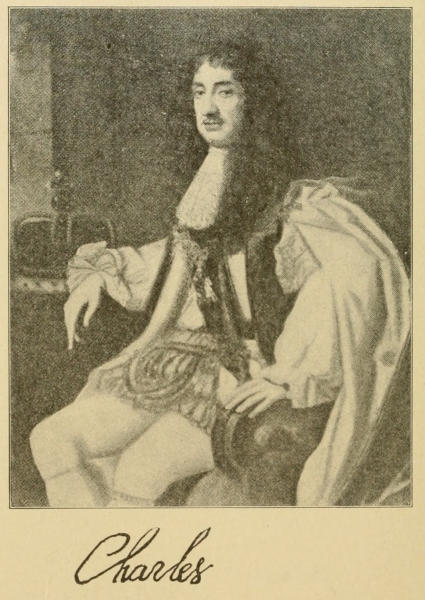
CHARLES II.
Then it was that it began to become apparent how much Virginia had changed while the Commonwealth stood, and how uneasy she must have become had the Commonwealth lasted much longer. During that time a great host of royalist refugees had sought her out as a place of shelter and safety, if not of freedom,—a great company, to be counted at first by the hundreds and then by the thousands, until Virginia seemed altered almost in her very nature and make-up. The steady tide of immigration did not stop even at the fall of the Commonwealth and the restoration of Charles, the King. The congenial province still continued to draw to itself many a Cavalier family whom days of disaster and revolution had unsettled, or to whom she now seemed a natural place of enterprise and adventure. Not the regions of the first settlement merely, on either side the James, but the broad tide-water country to the northward also between the York and the Rappahannock, between the Rappahannock and the great Potomac, filled with the crowding new-comers. In 1648 there had been but fifteen thousand English people in Virginia; in 1670 there were thirty-eight thousand, and nine new counties sent Burgesses to her assembly. The population had more than doubled in about twenty years; and most of those who had come from over sea to be added to her own natural increase were Cavaliers, men who wished to see the rightful King upon the throne, and England secure once more under her ancient constitution.
This great immigration, though it brought to Virginia men who were all of one tradition and way of life, did not mean the introduction of a new class of gentlefolk. No doubt a great many of them were of gentle blood and breeding; no doubt an unusual number of them were persons of means, who could afford to purchase and maintain large estates on the rich river bottoms. It is certain that with their coming came also a very noticeable change in the scale and style of living in the colony. More big grants of land were made. Great plantations and expensive establishments became more common than before. Negro slaves were more in request, and the Dutch and New England ships which brought them in from Africa or the Indies more welcome in the Bay than ever. The society of the little province was enriched by the gracious presence of many a courtier, many a cultured gentleman, many a family of elegance and fine breeding, drawn from the very heart of English society. But this was not the first time that Virginia had seen such people come to live on her fertile acres. There was no novelty except in their numbers. There had been men of like extraction, manners, and principles in the colony from the first,—not a great many, perhaps, but quite enough to keep all men in remembrance of the gentle middle and upper classes at home: gentlemen as well as boors, noted blood and obscure, good manners and bad. There now came men a great many like Colonel Richard Lee, of the ancient family of Coton Hall in Shropshire, honored since the thirteenth century with places of trust and distinction in the public service; like Mr. John Washington, grandson of Lawrence Washington, of Sulgrave and Brington, and cousin of that gallant Colonel Henry Washington who upon a famous day had stormed Bristol with Rupert,—who had told Fairfax he would hold Worcester till he should receive his Majesty’s command to yield it up, even though his Majesty were already a prisoner; men like the Randolphs, the Pendletons, the Madisons, the Ludwells, the Parkes, the Marshalls, the Cabells, the Carys, who had time out of mind felt the compulsion of honor bred in them by the duties they had performed, the positions they had won, the responsibilities they had proved themselves able to carry. But Virginia received them as of no novel kind or tradition. Men of Cavalier blood were no breeders of novelties. They were not men who had doctrines to preach or new ideals of their own to set up. They were merely the better sort of average Englishmen. They preferred settled ways of life; had more relish for tradition than for risky reforms; professed no taste for innovation, no passion for seeing things made unlike what they had been in older days gone by,—openly preferred the long established order of English life. They gave to the rapidly growing tide-water counties in which they settled their characteristic tastes and social qualities; established a very definite sentiment about government and social relationships, like that at home; but they rather confirmed the old tendencies of the place than gave it a new character.
They only made complete the contrast that had all along in some degree existed between Virginia and New England. It was men of the King’s party, the party of the Restoration, to whom Virginia now became a familiar home, and the coming of the second Charles to the throne seemed an event full of cheer in the southern colony. Men bred like the Cavalier families of Virginia in every social matter, drawn from sound county stock and ancient lines time out of mind gentle and elevated to the ranks of honor, had gone into New England also at the first: Winthrops, Dudleys, Winslows, Saltonstalls, Chaunceys,—men bred, like Cromwell himself, to influence and position. But they were men whom a new way of thought had withdrawn from the traditions of their class and set apart to be singular and unlike the rest of Englishmen. To the Cavalier gentlemen of Virginia the home government now seemed healed and sound again, and affairs settled to that old familiar order which best suited Virginia’s taste and habit. There came increase of wealth, too, with the tide of immigration, which ran steadily on; and the plantations seemed quick with hopeful life once more. To the Puritan gentlemen of New England, on the contrary, all hopeful reform seemed at an end, and the government they had made and cherished put in critical jeopardy. Their chief concern, now as always, was to be let alone; to be allowed to conduct their affairs for themselves, after the Puritan model, unchecked and unmolested. They had liked the setting up of the Commonwealth in England, not because they felt any passion against the King, but because the new government was a government of their own friends, and might no doubt be counted upon to indulge them in the practice of a complete self-government. Their passion was for independence. Their care was to cut off all appeal from their authority to that of the government at home. They meant to maintain a commonwealth of their own; and there was good reason to fear that the King, whom the Puritans in England had kept from his throne, and Cromwell’s death had brought back, would look with little favor upon their pretensions.
As a matter of fact, it was the Puritan Parliament itself which had taken the first step towards bringing all the colonies alike into subjection to the government in England,—at any rate, in everything that affected commerce. In 1651 it had enacted that no merchandise either of Asia, Africa, or America should be imported into England, Ireland, or any English colony except in ships built within the kingdom or its colonies, owned by British subjects, and navigated by English masters and English crews,—unless brought directly from the place of its growth or from the place of its manufacture in Europe. It was no new policy, but an old, confirmed and extended to a broader reach and efficacy. It was not meant as a blow at the trade of the colonies,—except, it might be, at the trade of Virginia and the Barbadoes, which had been a little too bold, outspoken, and insubordinate in protesting against the execution of Charles and the setting up of the Commonwealth,—but for the aggrandizement of Englishmen everywhere. Sir George Downing had suggested the passage of the act, a man born in New England and of the Puritan interest on both sides of the sea. The new leaders in England had revived the purposes and hopes of Gilbert and Ralegh and Elizabeth, and meant to build up a great merchant marine for England, and so make her the centre of a great naval empire. They were striking at the Dutch, their rivals in the carrying trade of the seas, and not at the colonists in America, their fellow-subjects. The Dutch recognized the act as a blow in the face, and war promptly ensued, in which they were worsted and the new mercantile policy was made secure against them. It was a way of mastery which caught the spirit of the age, and men of the King’s party liked it as well as those did who had followed Cromwell. The very first Parliament that met after the Restoration (1660) adopted the same policy with an added stringency. It forbade any man not a subject of the realm to establish himself as a merchant or factor in the colonies, and it explicitly repeated the prohibitions of the act of 1651 with regard to merchandise brought out of America or Asia or Africa. Certain articles, moreover, produced in the colonies, it reserved to be handled exclusively by English merchants in England. Chief among these were the sugar of the Barbadoes and the tobacco of Virginia. These were not only to be carried exclusively in English bottoms, but were also to be exported only to England. It seemed a great hardship to the Virginian planters that they were thus put at a double disadvantage, forbidden to choose their own carriers and also forbidden to choose their own markets, obliged both to pay English freights, whatever they might be, and also to put everything into the hands of English middlemen. But Parliament gave them compensation, after all, and they found in due course that there was little less profit under the acts than before. Treble duties were put upon Spanish tobacco brought into England, that they might have the market to themselves, and a great part of their cargoes went on, through England, to the northern countries of the continent, with a handsome rebate of duties. They soon adjusted themselves to the system.
An act of 1663 made a very weighty addition to the series of restrictions. It forbade the importation into the colonies of “any commodity of the growth, production, or manufacture of Europe” except out of England and in English ships. No ship, though an English ship and manned by English seamen, might thereafter lawfully carry any merchandise directly out of Europe to the colonies. England must be the entrepôt. The frank preamble of the act stated its purpose. It was intended to maintain “a greater correspondence and kindness” between the people of his Majesty’s plantations and the people of England, to keep the plantations “in a firmer dependence” upon the kingdom, and to render them “yet more beneficial and advantageous unto it” by using them for “the further employment and increase of English shipping and seamen” and as “the vent of English woollen and other manufactures and commodities, rendering the navigation to and from the same cheap and safe, and making this kingdom a staple, not only of the commodities of those plantations, but also of the commodities of other countries and places, for the supplying of them.” Such, added the preamble, was “the usage of other nations, to keep their plantations’ trades to themselves.”
To obey these acts meant to exclude all foreign ships from English ports in America, the ships of the neighborly Dutch at New Amsterdam with the rest, and to cut the colonies off from all direct transactions with foreign markets, making them dependent upon England whether they bought or sold. But, if obedience were forced upon them, there were compensations. English capital, after all, supplied them with the means to grow and to make their adventures in commerce, and deserved its reasonable encouragement without grudging. Ships built in the colonies were English-built ships under the meaning of the statutes, and New England turned her hand with a great aptitude and ardor to building ships out of the incomparable timber which stood everywhere ready in her virgin forests. It transformed both her life and her industry to be thus set to rival the Dutch and the shipbuilders and seamen at home in the carrying trade of the seas, and every village that had its port or outlet set up stocks and built sea-going craft, if only to carry cargoes up and down the long coast. European stuffs, too, though brought out of England, oftentimes cost less than the English themselves had to pay for them; for in England they paid duties to his Majesty’s customs, but if they were sent forward to the colonies the duties were remitted. The system appeared not so niggardly when looked at on every side.
Moreover, the acts might be disobeyed with some impunity at the safe distance of America. New England did, in fact, openly ignore them. For more than fifteen years after the passage of the act of 1660 she traded as she pleased, in entire disregard of the authority of Parliament. These Acts of Navigation (for so they were called) had not been passed with their consent, the Massachusetts General Court declared, and were not binding upon them. But neglect of laws passed by Parliament only made it the more certain that the government of the King would some day, when it found leisure for the business, turn its hand to discipline and bring the too independent colonists to a reckoning. The colonies were now no longer the insignificant settlements they had been before the air in England darkened with the trouble between Parliament and Charles I. They had become lusty States, very noticeable, and altogether worthy of the attention of the home government. They were subject, under the arrangements of English law, entirely to the authority of the King in council,—that is, to such members of the King’s Privy Council as he chose to clothe with authority in the matter of their government; and there stood at the elbow of the new King a man of statesmanlike power and perception, Edward Hyde, Earl of Clarendon, whose advice began to give a novel thoroughness of system to the administration of the growing possessions of the crown. He became a member of the general council appointed to oversee all foreign plantations at the very outset of the new King’s reign (December, 1660), and presently became a member also of the special committee of the Privy Council charged in particular with the settlement of the affairs of New England (May, 1661), giving to its policy spirit and direction.
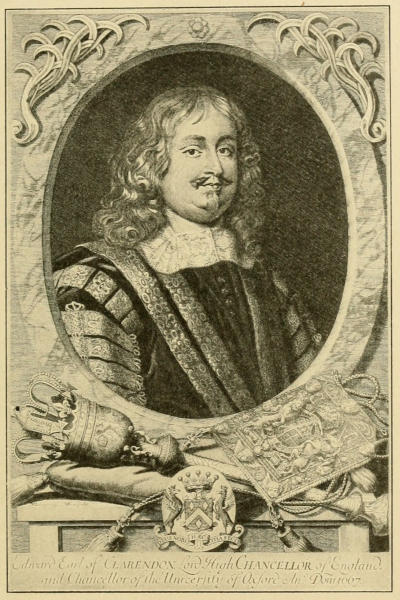
EDWARD HYDE, EARL OF CLARENDON
Massachusetts was keenly aware how open she was to attack, if it came to a question of obedience. Her magistrates had from the first systematically neglected to administer the oath of allegiance to new settlers, though their charter explicitly commanded that it should be administered. They administered, instead, an oath of fidelity to the government of Massachusetts. They had excluded members of the Church of England not only from the right to vote, but even from the right to use the appointed services of that Church in their worship. They had extended their authority over districts to the northward which clearly lay beyond the bounds of the lands granted them in their charter. They had denied to those who sought to exercise it the right to appeal from their decisions to the King’s courts in England, and had even punished some who made as if they would appeal in spite of them. They were not surprised, therefore, when, in 1664, the King appointed commissioners to look into their dealings with the crown, with their neighbors, and with their own subjects, and prepared themselves for as shrewd a defence and fight for their independent powers as the circumstances might permit. They had offended in the very points in respect of which Clarendon felt most clearly justified in insisting that they should submit to royal authority. He meant to insist upon an observance of the Navigation Acts, upon the recognition of the civil rights of members of the Church of England, and upon the subordination of the colonial courts to the courts of the King by the establishment of the right of appeal, at any rate in cases of special significance.
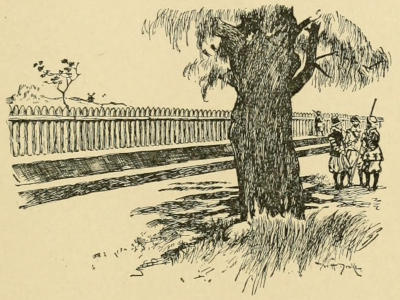
THE WALL, WALL STREET, NEW YORK, 1660
Massachusetts, moreover, had been very slow about proclaiming Charles II. king. Her magistrates had waited more than a year after first hearing of the Restoration before they publicly and in proper form proclaimed his authority, wishing to make sure that the unwelcome news was true and the King actually accepted in England. The ship which brought the news, in August, 1660, had brought also two officers of Cromwell’s army, Edward Whalley and William Goffe, who had signed the late King Charles’s death-warrant, and were now fugitives from England; for the Parliament had excluded from the Act of Indemnity and pardon, which had accompanied the new King’s return, all “regicides,” all who had been directly concerned in the death of Charles I. Many of those who had not fled were already under arrest, Sir Harry Vane among the rest, presently to be sent to the scaffold; but the colonists in New England befriended these men who had fled to them, and Colonel John Dixwell also, who soon followed them; and kept them safe against all searches of the King’s officers until they died. Massachusetts sent agents of her own into England to make her peace with the King; but they returned with a letter from his Majesty which commanded an immediate recognition of his authority, the administration of justice in his name, the toleration of the Church of England, and a repeal of the laws by which the right to vote was restricted to members of their Puritan churches. It was the sharp tenor of this letter that made them anxious how they should fare at the hands of the royal commissioners who came in 1664.
Fortunately for Massachusetts, the settlement of her government was not the first or chief business of the commissioners. Their titles showed for what they had been chosen,—Colonel Richard Nicolls, Colonel Sir Robert Carr, and Colonel George Cartwright, officers of the royal army, with but one civilian associate, Samuel Maverick, a one-time resident of Massachusetts, but long since forced out of the colony for his failure to agree with the exacting magistrates in matters of worship and of government. Though they were directed “to dispose the people” of the New England settlements “to an active submission and obedience to the King’s government,” and came upon a business like that which the commissioners of the Commonwealth had twelve years ago so quietly carried through in Virginia and Maryland, their chief errand was to make an end of the Dutch power in America. They came with a fleet of three ships of war and a transport carrying four hundred and fifty soldiers, to capture New Amsterdam and make New Netherland once for all an English province. Not that England was at war with the Dutch. It was claimed that England had from the first owned all the country of the coast, and that the Dutch had all along been intruders, as the English settlers on the Connecticut had again and again told them. The claim was not just; for the Dutch had unquestionably been the first to discover and the first to settle upon the Hudson, the Connecticut, and the great Sound itself; but it was true that the kings of England had all along asserted their exclusive title there, as elsewhere on the long Atlantic seaboard, all the way from the French settlements in the north to Florida and the Spanish settlements in the south, and had more than once included the lands upon which the settlements of New Netherland lay in their grants to trading companies and to individuals who promised to take settlers out.
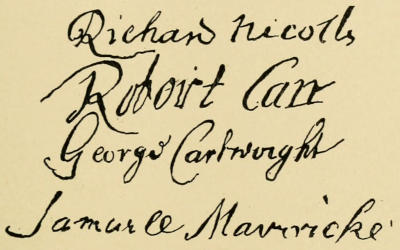
SIGNATURES OF THE COMMISSIONERS TO RETAKE NEW NETHERLAND
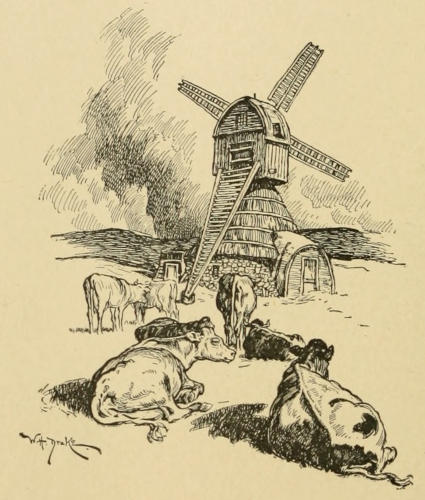
EARLY WINDMILL, NEW YORK
“The Dutch had enjoyed New Netherland during the distractions of the reign of Charles II. without any other interruption” than the occupation of their lands upon the Connecticut by the New Englanders, and the settlement first of the Swedes and then of the English on the Delaware; but the ministers of Charles II., though they were “for some time perplexed in what light to view them, whether as subjects or as aliens, determined at length that New Netherland ought in justice to be resumed.” Such was the way in which English writers afterwards spoke of the matter, putting into their histories what they wished to believe. But the facts are plain enough. The claim of right was a pretext. English statesmen saw that they could not enforce the Navigation Acts in America so long as the English colonies had the Dutch next door to trade with as they pleased. They saw also that the great Hudson was the natural highway to the heart of the continent and to the land of the fur trade. They knew how inconvenient it was, and how dangerous it might become, to have the Dutch power thrust, a solid wedge, between their own northern and southern colonies, covering the central port and natural mart of the coast. They made up their minds, therefore, to take what they wanted by force. The ministers of Charles were but resuming the plans of Cromwell, who had sent a fleet into America to do this very thing, when the first Navigation Act provoked the Dutch to war, and had withdrawn it only because he immediately got, by a treaty of peace, something that he wanted more.
The first step taken by King Charles was to give New Netherland by royal grant to his brother James, the Duke of York and Albany, all the lands lying within the wide sweep of a line drawn up the western bank of the Connecticut River, from the sources of the Connecticut to the sources of the Hudson, “thence to the head of the Mohawk branch of the Hudson River, and thence to the east side of Delaware Bay” (March, 1664). The commissioners were sent on their men-of-war to take possession in the Duke’s name. The thing proved easy enough. The doughty Stuyvesant was taken entirely by surprise, had no force with which to withstand Charles’s ships, found the peaceable burghers about him loath to fight, and yielded without a blow struck, though he would rather have lain in his grave, he said, bitterly, than make such a surrender. There was no choice with but an hundred and fifty men trained to arms and but twenty guns upon the fort against the King’s frigates and an army.
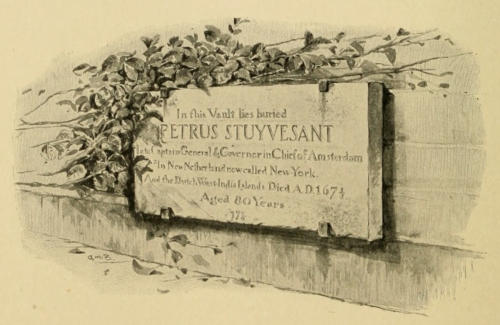
SLAB MARKING THE TOMB OF PETER STUYVESANT, OUTER WALL OF ST. MARK’S CHURCH, NEW YORK
The settlement of the forms of government under which the English should rule was almost as easily effected; for Colonel Nicolls, the English commander, was not less a statesman than a soldier, knew how to be wisely generous and make liberal provision for privileges and securities of right and property which should belong to the Dutch settlers as freely as to the English, and within a year of his coming had transformed New Netherland into New York, under laws which promised toleration and good government, and which all sensible men accepted with satisfaction. And yet it was not, Colonel Nicolls found, an easy place at which to be set down as governor. There was a very puzzling mixture of peoples and of institutions to be dealt with. The Duke’s grant covered all of Long Island, which the Dutch had not tried to govern beyond Oyster Bay. English towns dotted the island which had been parts of Connecticut or of the colony of New Haven, and which had always used their English liberty in matters of local government. Near at hand upon the island, and up the long reaches of the North River, where the Dutch towns lay, magistrates ruled whom Stuyvesant had appointed, or the agents of some potent patroon. At New Amsterdam itself men of all nationalities, creeds, and ways of life were to be found mixed in cosmopolitan variety. On the South River were settlements half Swedish, half Dutch. It was impossible to thrust upon all of these a single system of government. Where the Dutch had ruled it was still feasible to govern without elections, through officers whom the governor appointed, and under laws enacted in the governor’s council; but the English towns insisted upon having a voice in the choice of their own magistrates, and used their town meetings, whether they were legal or not under the Duke’s decrees, to direct the officers whom they elected in the discharge of their duties. Fortunately Colonel Nicolls was but thirty-nine when he came to the task, had still the elasticity of a young man in his make-up, saw with clear, frank eyes, and was no less conciliatory than firm in action. His tact and decision established “the Duke’s Laws” with little difficulty outside the English towns, though with many a local adaptation, and even in the English towns he managed to lack nothing that was essential to his authority. The governor and his council, themselves the appointees and servants of the Duke of York, ruled the whole colony without serious let or obstacle, and made new laws when there was need; but ruled with a new temperance which the Dutch had not seen before, and made provision for just methods of administration in everything. There was trial by jury, there were equality and unquestioned security in the tenure of lands, and practically absolute freedom of belief and worship; and the inhabitants of the captured province saw much to be content with.
It was of the first consequence that English power should be well and wisely rooted there at the gates of the Hudson. That mighty river, pouring down out of the north, came straight from the country where the French were masters. Its valley and the valleys which opened into its own, bringing their waters also out of the north, and the lakes which stretched above, almost to the stream of the St. Lawrence, were the veritable keys to the continent. There English power must be kept or broken. Charles, the King, may not have comprehended the full significance of what he did when he sent his fleet to plunder the Dutch and make New Netherland a province for his brother. But every thoughtful man in America knew. Here was not only the greatest of all the highways to the country of the fur trade; here was also the strategic centre of the continent itself. Whoever should be indeed master here might call all America his own, upon all the coast and throughout all the deep forests which lay upon it. The colonies of the English could not be drawn together either for mastery or for defence without this central harbor and water-way to the heart of the north. It was well the Duke had sent so wise a man and so capable to make good the English foothold there.
But it was not a little disturbing that the King had sent the fleet to annex a part of New England as well as all of New Netherland to the Duke’s domain. He had made his grant to the Duke run eastward to the banks of the Connecticut; and yet (had he forgotten?) he had already given away the lands there, on both sides of the river, not two years before, by a formal charter grant (April, 1662), to John Winthrop, governor of the settlements that had taken the name Connecticut. Until then the settlers there had had no charter at all. For seventeen years they had lived under a government of their own framing, and with only such rights as they were able to buy under former grants made by the old Council for New England. But now, by the address and good management of their capable governor, the accomplished son of the John Winthrop who had died governor of Massachusetts, they had been secured in their rights both of occupation and of government under a most liberal charter, which left them as free to choose their own governors as before. The younger Winthrop, himself a man of fifty-six, was well known in England. It was his privilege to assist, almost at this very time, in the foundation of the Royal Society, and afterwards to become one of its Fellows; he had influential friends near the person of the King; his own charm of manner and gifts of mind were calculated to make his Majesty forget that he was son-in-law to Hugh Peter, who had preached to the first Charles at his condemnation; and he got what he wanted for Connecticut.
In the indefinite terms of his charter the boundaries of Connecticut were to run westward to the South Sea (as the English still called the Pacific); to the deep chagrin of the New Haven people, it included their own towns; certainly it ran athwart the later gift to the Duke of York. For the time being that was not a matter of much practical importance. The Duke did not attempt to exercise his authority in the Connecticut settlements, and an agreement was presently reached that Connecticut should have jurisdiction to within twenty miles of the Hudson. Though that agreement never received the royal sanction, it sufficed for the moment. What seemed to the New Haven people of much more consequence was that Governor Winthrop had managed to sweep their towns within his charter grant. They liked neither the politics nor the church government of the Connecticut towns above and about them, and for two years stood out against being absorbed. It seemed better, however, to belong to Connecticut than to belong to the Duke of York’s province, as they might be obliged to if they did not accept Mr. Winthrop’s charter; Mr. Winthrop was himself very wise, moderate, and patient in pressing the union upon them; and in 1665 they yielded, making Mr. Winthrop governor of the united towns upon the river and the Sound.
The King’s commissioners did not fare very well when they turned from the taking of New Netherland to the examination and settlement of affairs in Massachusetts. In the other colonies which they had been directed to set in order they had little difficulty. Connecticut and Rhode Island were just now in favor at court, and gave the commissioners little to do except settle the boundaries between them. Rhode Island had obtained a new charter from the King in July, 1663, scarcely a year after Mr. Winthrop had got his for Connecticut; and, though she had had some difficulty in saving an important strip of territory which Connecticut’s charter had been made to include, that matter was in the way to be adjusted before the commissioners came. In Plymouth they found the magistrates ready to make most of the concessions his Majesty had instructed them to demand. But in Massachusetts they were utterly defeated of their purpose.
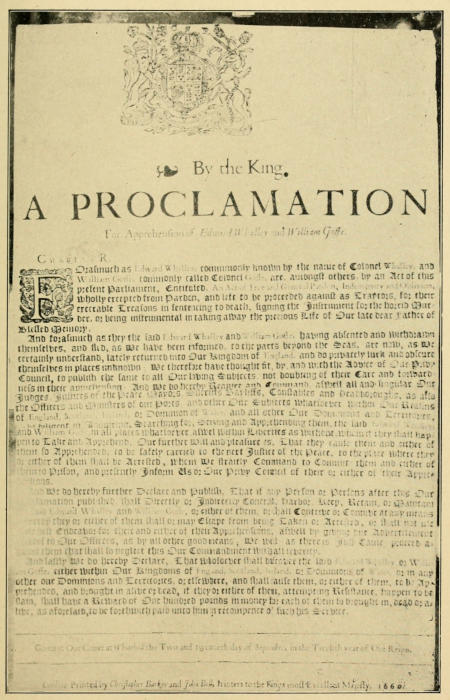
FACSIMILE OF THE KING’S PROCLAMATION FOR THE ARREST OF WHALLEY AND GOFFE
Colonel Nicolls could be very little with them, because he was engrossed in the pressing and necessary business of settling the government of the Duke’s province of New York; and yet they were not permitted by their commission to take any official action without him. Sir Robert Carr and Colonel Cartwright were men wholly unfitted to transact business of delicacy and importance. They had neither tact nor weight of character, nor any knowledge or experience in such affairs as they now tried to handle; and they were dealing with astute men who knew every point of the controversy and every mooted question of law like parts of a familiar personal experience. The Massachusetts General Court had adopted a declaration of their rights by charter the very year they tardily proclaimed Charles II. king (1661), as if anticipating an attack upon their government. In it they had argued their right to a complete self-government, and had declared that they owed no further direct duty to the King than allegiance to his person, the safe-keeping of that part of his territories over which they exercised jurisdiction, the punishment of crime, and the protection of the Protestant religion; and they maintained nothing less now in the presence of the commissioners. It proved impossible to bring them to terms. The commissioners more than once put themselves in the wrong by a loss of temper or an unwarranted assumption of authority; and the whole matter had at last to be referred back, unsettled, to the King. A letter thereupon came out of England commanding Massachusetts to send agents over to deal with the authorities there; but they found a way to avoid obedience to the summons, and once again, as when their charter had been attacked thirty years before, the attention of statesmen at home was called off from their business to matters of more pressing consequence. Clarendon, who was the master spirit of the new policy of the government towards the colonies, too stout for prerogative to suit the Parliament, too stiff for right to suit the King, lost his place and was banished the kingdom in 1667, the year after the commissioners returned to England with their report of failure. The Dutch accepted the gage of war thrown down by England’s seizure of New Netherland, and the struggle widened until it threatened to become a general European conflict. Without Clarendon, politics dwindled in England to petty intrigue. There was time to take breath again at the Bay. Massachusetts was, it turned out, to keep her jealously guarded charter for nearly twenty years yet.
Here the chief authorities and sources are those already referred to under Sections I. to V. of this chapter.
VIII. New Jersey and Carolina
The Restoration and the reassertion of royal authority had done much to check the growth of Massachusetts and her neighbor colonies of the Puritan group, but it had noticeably stimulated settlement to the southward, near where Virginia lay with her Cavalier leaders; and even in New England a natural growth went slowly on. Clarendon had been statesman enough to see that the colonies in America were no longer petty settlements, lying outside the general scheme of national policy. He saw that they were now permanent parts of a growing empire, and he had sought until his fall to bring them under a general plan of administration, which the commissioners of 1664 were to take the first step towards setting up. America was no longer merely a place of refuge for Puritans and royalists, each in their turn, no longer merely a region of adventure for those whose fortunes desperately needed mending. It was henceforth to be a place of established enterprise and of steadfast endeavor pushed forward from generation to generation; and the steady advance of English settlement, showing itself now almost like the movement of a race, already sufficiently revealed what the future was to bring forth.
The capture of New Netherland, though it brought war upon England, seemed to secure peace for America. There was no longer, when Colonel Nicolls was done, an alien power between New England and Virginia. The whole coast was at last indisputably English land, all the way from the little settlements struggling for existence far to the north in the bleak forests which lay beyond the Massachusetts grant to Spain’s lonely forts in the far south by the warm bays of Florida. That was a royal principality which the Duke of York had received from the lavish Charles,—all the great triangle of rich lands which spread northward and westward between the Connecticut and the lower waters and great Bay of the Delaware, Long Island, Nantucket, Martha’s Vineyard, and all their neighbor islands, great and small, included,—and Colonel Nicolls had established his authority, at any rate at the centre of it, where the Dutch had been, in a way that gave promise of making it abundantly secure. But the Duke was a Stuart, and no statesman; loved authority, but was not provident in the use of it; and parted with much of the gift before it was fairly in his hands. Colonel Nicolls and his fellow commissioners did not take possession of New Amsterdam until August, 1664, and it was then nearly two months since the Duke had given a large part of New Netherland away to his friends Lord John Berkeley, Baron of Stratton, and Sir George Carteret, of Saltrum.
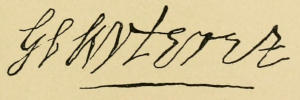
SIGNATURE OF GEORGE CARTERET
Late in June he had granted to these gentlemen, his close associates in friendship and in affairs, his colleagues in the Board of Admiralty, over which he presided, all his own rights and powers within that part of his prospective territory which lay to the south of 41° 40′ north latitude and between the Delaware River and the sea, touching the Hudson and the harbor of New York at the north, and ending at Cape May in the south. This new province he called New Jersey, in compliment to Sir George Carteret, who had been governor of the island of Jersey when the Parliament was arrayed against the King, and who had held it long and gallantly for his royal master. Colonel Nicolls, the Duke’s able governor in New York, knew nothing of the grant of New Jersey until the ship Philip actually put into the harbor in July, 1665, bringing a few settlers for the new province and Philip Carteret, a kinsman of Sir George’s, to be its governor. Colonel Nicolls had but just completed his careful organization of the Duke’s possessions; had put his best gifts of foresight and wise moderation into the settlement of their affairs, to the satisfaction of the numerous Dutch as well as of the less numerous English established there; and was not a little chagrined to see a good year’s work so marred by his improvident master’s gift. There was nothing for it, however, but to accept the situation and receive the representative of the new proprietors with as good a grace as possible, like a soldier and a gentleman. Knowing nothing of the grant to Berkeley and Carteret, he had already authorized a settlement at Elizabethtown, on the shore that lay nearest to Staten Island to the westward, and had granted rights and titles to other purchasers who had settled on the southern shore of the great outer Bay, near Sandy Hook; and the new colonists there now discontentedly doubted what their rights would be.
Much the larger part of the population of the original province of New Netherland, however, still remained under the authority of Colonel Nicolls and “the Duke’s Laws,” notwithstanding the setting apart of New Jersey to be another government,—in one direction, indeed, more than the Dutch themselves had pretended to govern; for the Duke’s possessions included all of Long Island, the portion which lay beyond Oyster Bay and which had been conceded by the Dutch to the English in 1655, as well as the parts which lay close about the bay at New York. There were probably about seven thousand souls, all told, in New Netherland when the English took it, and of these fifteen hundred lived in the little village which was drawn close about the fort at New Amsterdam. The rest were near at hand on Long Island and on Staten Island, or were scattered up and down the lands which lay upon the Hudson on either hand as far as Fort Orange, which Colonel Nicolls renamed “Albany,” because James was Duke of York and Albany. The Swedes, also, who had settled on the South River (the Delaware), and whom Stuyvesant had conquered, had built for the most part on the western bank of the river, and were outside the bounds of New Jersey. On the eastern bank, where Lord Berkeley and Sir George Carteret were to be proprietors, there were but a handful of Dutch and Swedes at most. These, with the little Dutch hamlets which stood near New York on the western bank of the Hudson, at Weehawken, Hoboken, Pavonia, Ahasimus, Constable’s Hook, and Bergen, and the new homes of the English families whom Colonel Nicolls had authorized to settle within the grant at Elizabethtown and by the Hook, contained all the subjects the new proprietors could boast.
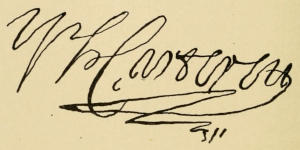
SIGNATURE OF PHILIP CARTERET
The government which the proprietors instructed Philip Carteret to establish was as liberal and as sensible as that which Colonel Nicolls had set up in New York. On the day on which they appointed their governor they had signed a document which they called “The Concessions and Agreements of the Lords Proprietors of New Jersey, to and with all and every of the adventurers and all such as shall settle and plant there,” and which offered not only gifts of land upon most excellent good terms to settlers, but religious toleration also and a free form of government. “The Duke’s Laws,” which Colonel Nicolls had set up for the government of New York, were equally liberal in matters of religion, but not in matters of self-government. The New Jersey lords proprietors directed their governor to associate with himself in the administration of the province a council of his own choosing not only, but also an assembly of twelve representatives, to be chosen annually by the freemen of the province. This assembly was to make the laws of the colony, and no tax was to be laid without its consent. The governor and his council were to appoint only freeholders of the colony to office,—unless the assembly assented to the appointment of others. It did not seem necessary to call an assembly at once; the scattered hamlets could separately attend to their own simple affairs well enough until more settlers should come. The first years of the new governor’s rule were quietly devoted to growth.
The governor established himself and the thirty odd settlers and servants who came with him at the new hamlet just begun at Elizabethtown; and the next year, 1666, the Philip brought other settlers to join them. The governor took pains to make known the liberal terms of settlement he was authorized to offer, in New England and elsewhere in the colonies already established, as well as at home in England. A steady drift of colonists, accordingly, began to set his way. In 1666 the Elizabethtown tract was divided to make room for other settlements at Woodbridge and Piscataway. The same year numerous families from Milford, Guilford, Branford, and New Haven came and began to make homes for themselves at Newark, on the Passaic,—dissatisfied with the condition of affairs on the Sound since they had been tied to the Hartford government, and determined to have a free home of their own where only church members of their own way of thinking and of worship should have the right to vote or to hold office. It was a very notable migration, made in organized companies, as the first settlements upon the Sound had been, and sapped the New Haven towns of their old stock. “The men, the methods, the laws, the officers, that made New Haven town what it was in 1640, disappeared from the Connecticut colony, but came to full life again immediately in New Jersey.” Even Mr. Davenport left the familiar seat he had himself chosen and returned in his old age to Boston. By April, 1668, New Jersey seemed to the governor ready for its first assembly, and he called upon the freemen to make their choice of representatives.
The Puritans of the new settlements controlled the assembly when it came together at Elizabethtown the next month (26 May, 1668) and passed a bill of pains and penalties against various sorts of offenders which was drawn in some of its parts directly from the Book of Leviticus, as an earnest of their intentions in matters of government; but they had been in session scarcely four days when they grew impatient to be at home again, and adjourned. When they met a second time, in November, the little hamlets on the Delaware, which had not sent delegates to the first session, were represented; but the people of the “Monmouth grant,” by Sandy Hook, were not. They were angry because Governor Carteret had refused to acknowledge their right to make rules of local government for themselves, under the terms of their grant from Colonel Nicolls, given before the New Jersey grant was known of in New York; and they declared that the persons who had assumed to act for them at the first session of the assembly, in May, had had no real authority to do so. The representatives who did attend the November sitting soon went home again, dissatisfied that the governor’s council did not associate itself with them closely enough in the conduct of the assembly’s business, and impeded, as they thought, the execution of the provisions of the “Concessions,” the great document which was their constitution from the proprietors. It was to be many years yet, as it turned out, before the conduct of the government of the colony was to be satisfactorily provided for. The several scattered settlements had little sympathy with each other, and New Jersey was not yet a complete or organized colony.
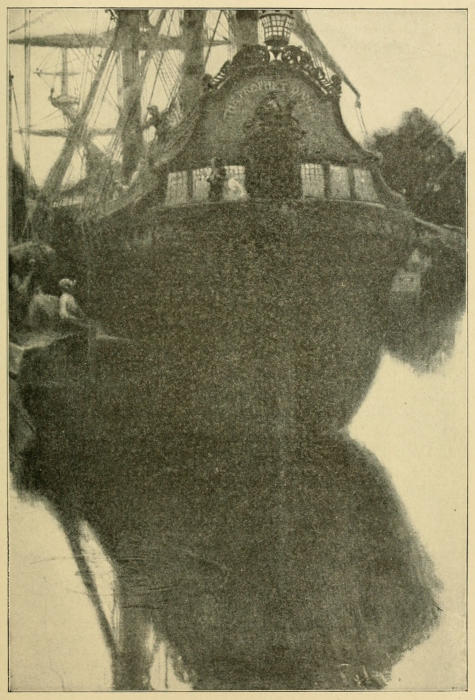
LOADING SHIPS IN ALBEMARLE SOUND
It was a day of new proprietary grants to gentlemen in favor at court; but the making of grants was very different from the making of governments. At the very time when Governor Carteret was trying to form a government that would hold the scattered towns of New Jersey together in some sort of discipline and order, the representatives of another proprietary government of the same kind were trying the same experiment with much the same fortune in the south on the “Carolina” grant, which the King had made the year before he gave New Netherland to his brother. In 1663 he had granted the lands which lay south of Virginia between the thirty-first and the thirty-sixth degrees of north latitude to eight proprietors: the great Earl of Clarendon, General George Monk, now Duke of Albemarle, William Lord Craven, Anthony Lord Ashley (soon to be Earl of Shaftesbury), Sir John Colleton, John Lord Berkeley and Sir George Carteret, to whom the Duke of York was the next year to give New Jersey, and Sir William Berkeley, brother of Lord John and governor of Virginia. Here, as in New Jersey, settlers had long ago entered and begun a life of their own. The Virginians had spoken of the region hitherto as “South Virginia,” and it was some of their own people who had begun its settlement. In 1653 Roger Greene had taken a hundred settlers to the coast of the broad Sound which was afterwards to be called Albemarle,—after the great General Monk’s new ducal title,—and had established them on a grant at “Chowan,” given to him by the Virginia House of Burgesses as a reward for the “hazard and trouble of first discovery,” and as an “encouragement of others for seating those southern parts of Virginia.” Nine years later (1662) George Durant followed with other settlers, Quakers driven out of Maryland and Virginia, whom the Virginian authorities were glad to be rid of and have settled out of sight in the wilderness. They began to build to the eastward of Mr. Greene’s people at “Chowan,” upon the next peninsula of the same indented coast, in what was called the “Perquimans” region. And then, the next year, 1663, the King handed their lands over to be governed by the eight lords proprietors of “Carolina.”
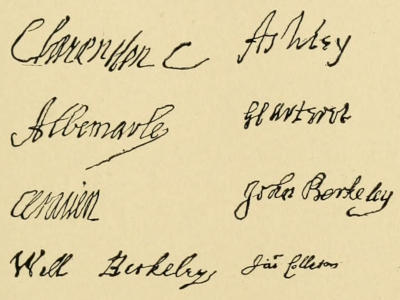
SIGNATURES OF CAROLINA PROPRIETORS
There were by that time quite three hundred families settled there; and there were none besides in all the vast tract that the King’s charter called “Carolina.” These first comers had chosen for their settlements a region neither fertile nor wholesome. Great pine barrens stood there upon the coast, interspersed with broad swamps dense with a tangle of cypress and juniper. Inside the coast districts, where the land rose to drier levels and the virgin soils lay rich and wholesome, were some of the finest regions of all the continent, fertile and sweet-aired and full of inviting seats; but there was no highway to these. Only the sea and the rivers were open. The land was everywhere covered with untouched forests, pathless and unexplored. For the present settlers were obliged to content themselves with the flat, unwholesome coast, in spite of its killing fevers, because it alone was accessible. This Albemarle country was Virginia’s frontier, the refuge of the restless, the unfortunate, and the discontented, and of all who found her laws and her power to enforce them irksome and unbearable. Some very steady and substantial people there were also, no doubt, who chose to live there,—like the good Quakers whom Mr. Durant had brought thither because they could find a welcome nowhere else. There was a good profit to be made out of timber cut from those splendid forests, and out of the breeding of cattle, which was easy enough; and many industrious families liked the steady trade of the region, with its accompaniment of a free life in the ungoverned wilderness. But it was as yet the shiftless, the irresponsible, and the adventurous who were most attracted.

SEAL OF THE LORDS PROPRIETORS OF CAROLINA
What with adventurers who were ungovernable and men of industry and ability who wished to be let alone, it was not an easy or a promising place in which to set up the authority of proprietors who were in England and had done nothing to help the men whom they meant to govern. Sir William Berkeley, nevertheless, being himself one of the proprietors, took the first step towards making good the rights of the new masters in 1664, when, by the authority of his associates, he commissioned William Drummond to act as governor among the people at Chowan and Perquimans. The appointment of a governor made little difference at first. Not until three years later did the proprietors attempt the establishment of a regular government, and even then the arrangements which they made were very liberal. They that year, 1667, sent over Samuel Stephens from England to be governor in Drummond’s place, and they sent with him a document of “Concessions,” very like that which Lord Berkeley and Sir George Carteret, two of their number, had lately granted to the settlers in New Jersey. There was to be perfect freedom in religion; the elected representatives of the people were to make the laws of the settlements; no taxes were to be imposed without their consent; and they could assemble upon their own motion, without waiting for a summons from the governor. The governor was to have twelve councillors and the people were to have twelve representatives, as in New Jersey; but half of the governor’s council were to be chosen by the assembly itself, and governor, councillors, and representatives were to sit together as a single body,—so that the people’s delegates were sure of a majority in all its deliberations.
The assembly used its power to exempt all new-comers from taxes for a year after their coming, and to provide that for five years to come no suits should be heard for debts or any other obligations contracted outside Carolina. Of course such laws brought insolvent Virginian debtors and all sorts of Virginian outlaws in larger numbers than ever to the settlements, and the Virginians called the place “Rogues’ Harbor”; but others of a better sort came also, and it was population first of all that the Albemarle law-makers wanted. A more settled life and a less irregular and questionable way of encouraging immigrants came afterwards in due time,—as well as unexpected troubles with the proprietors. The first grant, of 1663, had not in fact included the Albemarle settlements, though those who framed it supposed that it did; but in 1665 a new charter was obtained which advanced the boundary line far enough northward to make sure of including them. And then the proprietors, having a taste for a more elaborate way of governing, adopted a highly complicated and detailed plan, drawn up by Mr. John Locke, who was then, at thirty-seven, secretary to Anthony Lord Ashley, one of the proprietors. The document contained eighty-one articles, was called the “Fundamental Constitutions” of Carolina, and was elaborate enough for a populous kingdom. It bore date 21 July, 1669.
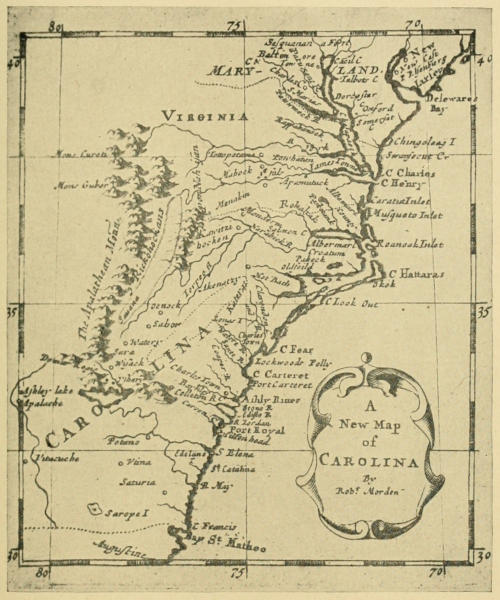
MAP OF CAROLINA, 1687
The proprietors were too much men of the world and of affairs to suppose that that simple community, only just now begun, was ready for an elaborate government, which, among other things, proposed to change very radically the free tenure of the land into a sort of feudal holding under hereditary nobles; but they meant to establish their system when they could, and were in too great haste, it turned out, to believe that parts of it could at once be made to apply. Even yet “Carolina” had no settlements except those at Albemarle. In 1660 a few families from Massachusetts, looking for some betterment of fortune, had established themselves near the mouth of the Cape Fear River, purchasing their lands from the Indians; but they had left the place disheartened in 1663, the very year the lords proprietors got their first grant from the crown. News of the grant stimulated some of the English who were in the Barbadoes to attempt the same thing that the Massachusetts men had attempted. In May, 1664, they began a settlement upon a new site, far up the spreading stream of the Cape Fear. But three years were enough for them also; in 1667 they, too, were gone, and the river country was again empty.
It proved no light matter to govern even the little settlements at Albemarle. The publication there of the formidable Fundamental Constitutions in 1673, when the proprietors seemed bent upon putting them at any rate partially into operation, disturbed the as yet unfettered settlers very deeply,—for they loved and meant to have a free life in the wilderness. Though they had been promised freedom of belief and worship, these Constitutions, as published among them, threatened to make every man pay for the maintenance of the Church of England as an established church. Moreover, the air was at that very time full of disquieting rumors. News came that the King had given all of Virginia to Lords Arlington and Culpeper,—not to rule, indeed, but to own; and it was said that the proprietors of Carolina meant to divide the province among themselves, and give the Albemarle country to Sir William Berkeley, whom they would have exceedingly disrelished as their master, being quit, as they had hoped, of Virginia’s imperious governor. Worst of all, the governor whom the proprietors had sent them sided with the King’s officers in enforcing the Navigation Acts, whose enforcement would spoil their trade. They sold their timber and their cattle very freely to shrewd skippers out of New England, who brought them what they needed from the ports of the Puritan colonies, got their timber and cattle, disposed of them in the West Indies, and came back again thence with good cargoes of sugar, rum, and molasses, for which they took tobacco, to be sold at home for export into England,—all without license from the crown and in plain defiance of the Acts.
The colonists preferred their trade to the laws of Parliament, and their freedom to the laws of the lords proprietors. Moreover, the very charter under which the proprietors acted had given their lordships the right to make laws and constitutions only “by and with the advice, consent, and approbation of the freemen” of the colony, or their representatives; and these new regulations had never been so approved or ratified. The temper of resistance among the colonists proved more than the agents of the lords proprietors could manage; and for almost ten years after the publication of the “Constitutions” the settlers at Albemarle took leave to have their own way upon every critical occasion. In 1675 their governor, Carteret, Stephens’s successor, went to England in a sort of despair, to explain that he was not allowed to govern. In 1677 the colonists seized the collector of the revenues, and several thousand pounds of the revenue with him, because he tried to break up their trade with New England and the West Indies. They were quieter without a governor than with one, and meant to obey authority only on their own terms.
The proprietors were to find that it was not much easier to govern settlements of their own planting than to govern the rough-and-ready hamlets at Albemarle, which had been set up without them. By August, 1669, the month after they signed the first draft of their Fundamental Constitutions, they had an expedition ready to go into the southern parts of Carolina and plant a colony which should be worth helping and worth governing; and by April of the next year it was actually planted. There had been many disasters to face by the way. The settlers had been kept a long time at the Barbadoes, to repair their ships and get supplies, and colonists to recruit their number; and they had come away from the islands with Colonel William Sayle, a man stricken in years, for governor, instead of Sir John Yeamans, who knew the coast and was in the full vigor of manhood. The aged soldier who took them to their place of settlement had founded a colony of Presbyterians in the Barbadoes twenty years ago, and still showed not a little of the steadfastness and strength of purpose that had marked him for a leader then; but he was too old for this new task, and died the next year in the doing of it. The place chosen for the settlement was a pleasing bluff within the fair Kiawah River,—which they presently called the Ashley, in honor of the distinguished nobleman for whom Mr. Locke had written the Fundamental Constitutions. Their settlement they called Charlestown; and there they lived for ten years without notable incident, except that Sir John Yeamans, who was their governor from 1671-1674, brought negro slaves with him when he came from the Barbadoes in 1672. Mr. Joseph West was governor most of the time during the first years of settlement, and ruled very sensibly, assisted by a council of which the freemen of the colony elected a part. Things went quietly enough until the proprietors and the government at home bestirred themselves to enforce the Fundamental Constitutions and the laws of trade.
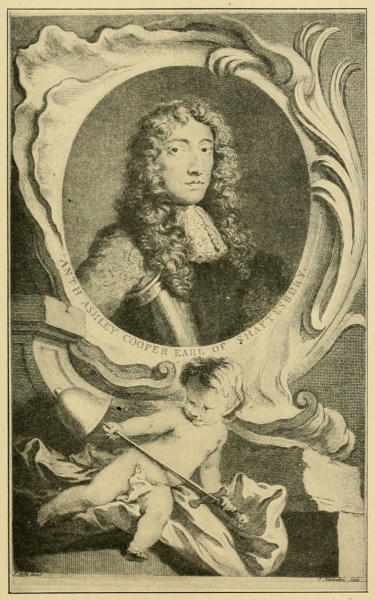
EARL OF SHAFTESBURY
It was no mere perverseness of temper or mere love of license that set the colonists so stubbornly against the plans and the authority of their governors. It was rather their practical sense and their knowledge of their own necessities. They knew that, if they were to thrive at all, they must be let live as they could in the wilderness, as the actual and inevitable conditions of their own lives permitted, not cramped by elaborate constitutions or by the rigid restrictions imposed by the Parliament’s laws of trade, but with a freedom suitable to their rough and simple ways of living. Virginia herself, for all she was so much older, so staid and loyal, was moved to revolt almost as easily as Albemarle and Charlestown when put upon more grossly than she could bear. She was herself in rebellion at the very time the men at Albemarle were openly defying their governor to put into force among them the laws which forbade their trade with the Indies.
Virginians had seen their burdens and their grievances against the government alike of their governor and of the King grow ominously heavier and heavier ever since the Restoration, which they had once deemed so happy an event, until at last the condition in which they found themselves seemed quite intolerable. Sir William Berkeley was no longer the manly, approachable gentleman he had been in the earlier time of his first governorship,—bluff and wilful, but neither bitter nor brutal. The long days of his enforced retirement, while the Commonwealth stood (1652-1660), had soured his temper and alienated him from the life of the colony; and he had come out of it to take up the government again, not a Virginian, like the chief Cavalier gentlemen about him, who now accounted Virginia their home and neighborhood, but a harsh and arbitrary servant of the crown and of his own interests, ready to fall into a rage at the slightest contradiction, suave only when he meant to strike.
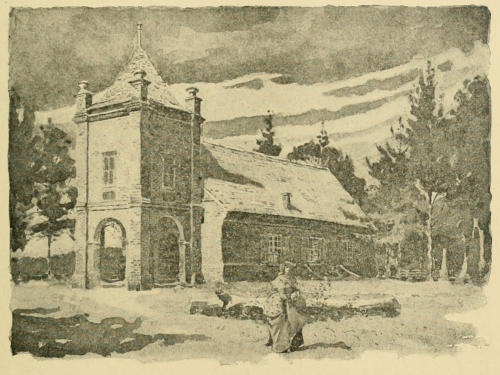
ST. PETER’S CHURCH, KENT COUNTY, VIRGINIA
The change was not obvious at first; but it became evident enough ere long. The King recommended mere place hunters and adventurers to Sir William for appointment in Virginia, wishing to be rid of them, or to pay his personal obligations at Virginia’s cost. Sir William put them in office in the colony, and along with them his own friends, kinsmen, and favorites, until councillors, sheriffs, magistrates, surveyors, customs clerks, the whole civil service of Virginia, seemed a body of covetous placemen who meant to thrive whether justice were done and the laws kept or not. Nor was that the worst of it. It was next to impossible for the small planter, or for any man who did not thrive exceedingly, to pay the growing taxes and the innumerable petty exactions which were demanded of him to pay these men, satisfy the King’s collectors, and maintain the expensive government of the colony. The Navigation Acts forbade the colonists to send their tobacco anywhere but to England, in English ships, and so the English skippers could demand what freight they pleased and the English merchants could buy the tobacco at such prices as suited them. The same Acts forbade any goods to be brought into the colonies except from England, and so the English merchants could exact what they chose for the supplies they sent and the skippers could get their return freight charges. There was no coin in Virginia, or next to none; tobacco itself, her principal crop, served as money, and when it was worth little and the goods it was used to pay for were worth a great deal, it was hard to live at all, and poverty seemed a thing enacted and enforced.
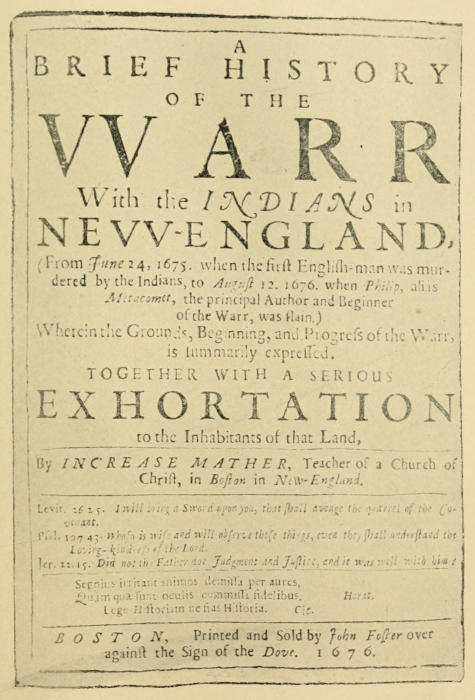
TITLE-PAGE OF INCREASE MATHER’S “BRIEF HISTORY OF THE WARR WITH THE INDIANS”
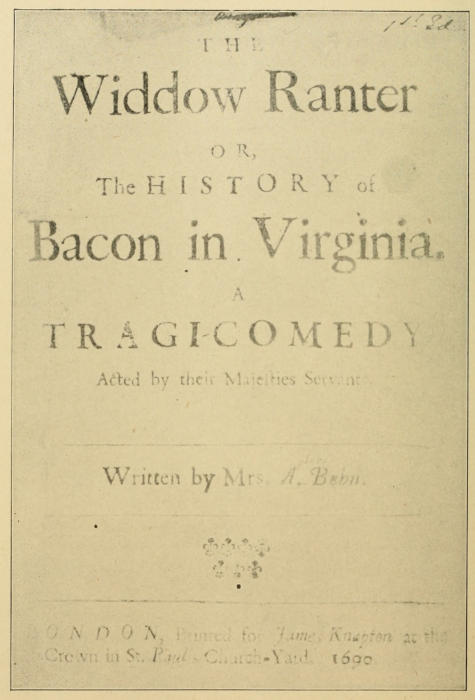
TITLE-PAGE OF MRS. APHRA BEHN’S “WIDDOW RANTER”
Time had been, before the meddlesome Acts of Navigation, when the Dutch ships which came in at the river paid five shillings on every anchor of brandy they brought in, and ten shillings on every hogshead of tobacco they took out; and the money had been appropriated to make good the defence of the frontier against the Indians. But no Dutch skippers came in since the Acts, and that charge also fell upon the poor planters. “It hath so impoverished them,” declared Mr. Bland, of London (1677), looking for the sake of untrammelled trade into these matters, “that they scarce can recover wherewith to cover their nakedness.” Taxes were not levied upon the land, so that each man might pay in proportion to his property, but by the poll, each man alike, and every servant assessed with his master; so that the poor man bore the chief burden, and sweated under it intolerably. His tobacco, with the diminishing price the English merchants put upon it, was all he had to pay with, and seemed every leaf of it to go to the tax gatherer,—who got his office by favor, and himself took ten per cent. of what he collected. Members of the governor’s council were exempt from the poll tax, with ten servants apiece, and yet were paid salaries out of the taxes. The government seemed a thing planned for the support and behoof of “the grandees” of the governor’s court, the men of the Virginian democracy said, and their discontent grew with their numbers. Their numbers grew fast enough. There were six thousand white indentured servants in the colony. Every year quite fifteen hundred of these saw the hoped-for end of their term of service come, and were given fifty acres of land apiece to shift for themselves and join the ranks of taxpayers. When the price of tobacco fell, one evil year, to a halfpenny a pound, Mr. Ludwell declared to the governor that nothing but “faith in the mercy of God, loyalty to the King, and affection for the government” restrained them from rebellion. And their affection for the government cooled fast enough.
The restrictions put upon the carrying trade had but the other day been made complete in their kind. In 1672 an act for the still “better securing of the plantation trade” had forbidden even a coastwise trade among the colonies themselves, or with the English Bermudas, in sugar, tobacco, cotton, wool, indigo, or any other of the enumerated articles of the former Acts, except they were first taken into England, or paid at the port of export the duties levied at the English wharves.
As if poverty, and heavy taxes to make it the more burdensome, were not enough, deep anxiety lest Virginia should lose even the forms of her liberty was added, and finally war with the Indians, to make the measure full to overflowing. It was useless to appeal to the House of Burgesses for a redress of grievances, because Sir William Berkeley would allow no election of a new House. For fifteen years he kept alive the House which had been chosen in 1661, at the time of the Restoration. It was made up of hearty partisans of the King’s government, as was natural, having been chosen when it was, and was quite ready to follow Sir William’s lead in most things. He would adjourn its sessions from time to time, but would not dissolve it; and so there were no elections at all. The Burgesses themselves were content enough to prolong its life, and keep the governor in good humor by their votes. Each member received two hundred and fifty pounds of tobacco for every day he spent in the assembly, to keep himself, his servant, and a horse; every committee of the assembly had its paid clerk and money out of the colonial treasury for its liquors; and there was oftentimes more profit to be got out of a long session than out of diligent tobacco planting at home.
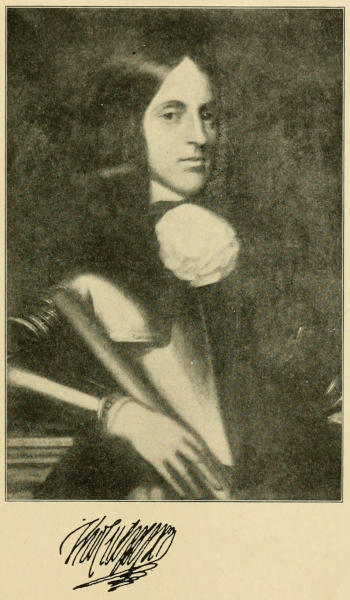
LORD CULPEPER
In 1673 came the news that the King had given all Virginia to Lords Arlington and Culpeper, to be their proprietary province, like Carolina and New Jersey, and several gentlemen had to be sent over to England in haste to plead, intrigue, and protest, as if for the very life of the colony, against such a usurpation. Their lordships kept the royal quit-rents, spite of all opposition, and a new poll tax of sixty pounds of tobacco a head had to be levied to pay the expenses of the commissioners sent to plead the colony’s case against them. And then, in 1675, when affairs seemed most darkened and confused by selfish and arbitrary action both at home and over sea, there came hot trouble with the Indians, which the governor refused either to deal with himself or allow others to settle.
It was that that brought the explosion. A sort of desperate wrath took possession of the stronger and more daring spirits of the colony, and they presently found a leader who gave Sir William good cause to fear what might come of their anger. The governor ought to have remembered that other year of blood, 1644, when last the Indians were on the war-path, and how sad a blow it had dealt the colony. True, there had then been scarcely ten thousand people in Virginia, and there were now no doubt close upon fifty thousand, armed and able in all ordinary straits to take care of themselves. It was not likely the Indians could strike very far within the borders or threaten the heart of the colony. But men and women and children lived on the borders no less than at the heart of the colony. Precious lives could be wasted there as well as elsewhere,—plain people, no doubt, but Englishmen,—and the colonists were not likely to stand tamely by and look on at the massacre of their own people. No doubt the Indians had been unwisely, unjustly dealt with and provoked, goaded to hostile acts by attacks upon one tribe for what, it may be, another had done; such things had too often happened, and the colonists were not over-careful to avoid them. But that was no reason for refusing to put a force into the field to stop the massacres. What was the governor’s scruple? He alone could grant licenses to trade with the Indians, and he did not grant them for nothing. It was something more than a surmise that he shared the profits of the trade, and let the traders sell what they would to the savages, though it were firearms and powder and shot, against the laws of the colony, to make the profits worth while. Did he hesitate to interrupt his lucrative fur trade with the redmen; or was he reluctant to put any armed force into the field for fear of what it might do for the redress of grievances within the colony after the danger from the Indians had been made an end of? Whatever his motive, he would not act, and could not, he said, until the assembly came together for its regular meeting in March, 1676. Meanwhile scores of people had been murdered, plantation after plantation had been destroyed (sixty in a single county within a space of little more than two weeks), and the border was desolate and terror-stricken. And even when March came and the meeting of the Burgesses, Berkeley played them false. The assembly met, the “Long Assembly” elected fifteen years ago,—met for the last time, as it turned out,—and voted to send a force of five hundred men against the savages; but Berkeley disbanded the little army before it could take the field; and defence was again abandoned.
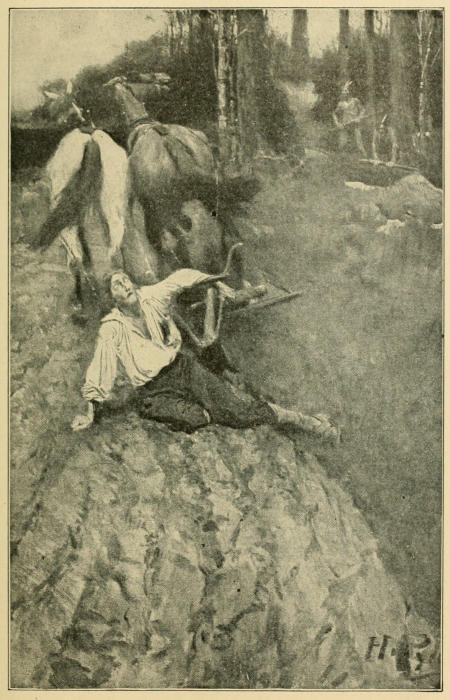
ON THE WAR-PATH
Here was more than could be endured; and there were men in Virginia who were ready to defy the governor and get their rights by arms. Nathaniel Bacon had sworn with a hot oath that if the redskins meddled with him he would harry them, commission or no commission; and he kept his threat. He was of the hot blood that dares a great independence. He was great-grandson of Sir Thomas Bacon, of Friston Hall, Suffolk, cousin to the great Lord Bacon, of whose fame the world had been full these fifty years; and though he was but nine-and-twenty, study at the Inns of Court and much travel in foreign lands had added to his gentle breeding the popular manners and the easy self-confidence of a man of the world before he turned his back upon England and came with his young wife to be a planter on James River in Virginia. In May news came that the Indians had attacked his own upper plantation and had murdered his overseer and one of his favorite servants; and he did not hesitate what to do. A company of armed and mounted men begged him to go with them against the redskins, and he led them forth upon their bloody errand without law or license, member of the governor’s council and magistrate though he was. He sent to ask the governor for a commission, indeed, but he did not turn back, or lose his armed following either, when word was brought that the governor had refused it, and had proclaimed him and all with him to be outlaws. It was flat rebellion; but Bacon’s pulse only quickened at that, and Virginia for a little while seemed his to command.
He put a stirring tragedy upon the stage there in the quiet colony with its sombre forests, and played it out with a dash and daring that must take every generous man’s imagination who remembers how fair and winning a figure the young leader made through all those uneasy days, and how irresistibly he caught the eye and the fancy with the proud way in which he carried himself, lithe and tall and dark of skin, and that melancholy light in his dusky eyes, a man of action and of passion,—such passion as it moves and wins other men to look upon. That was a summer to be remembered in which he pushed to the front in affairs,—and most of all its sad ending.
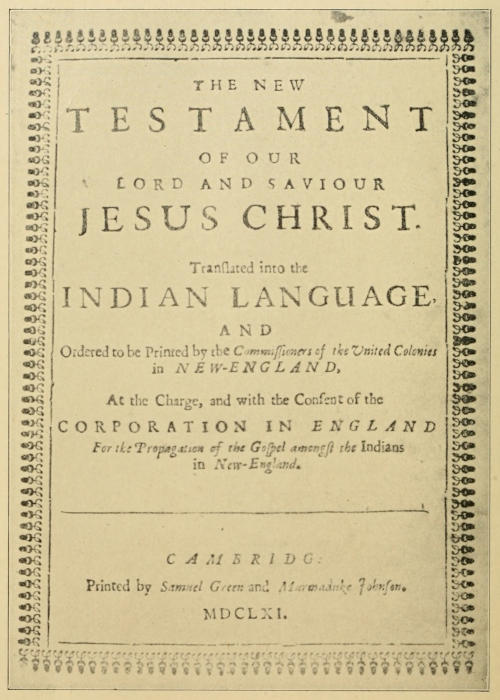
TITLE-PAGE OF ELIOT’S ALGONQUIN VERSION OF THE NEW TESTAMENT
Berkeley found that he could not openly treat Bacon as a rebel without kindling a flame of discontent on every hand among the colonists. He was obliged to dissolve the “Long Assembly,” call a new one, admit Bacon himself to a seat in it, hear his bad administration debated, and consent at last to the levying of an effective force to fight the Indians. But what he could not do openly he tried to do secretly and by treachery. One night while the assembly still sat Nathaniel Bacon fled from Jamestown, warned that his life was in danger. He returned with six hundred men at his back and compelled the governor to give him a commission. Once more he was proclaimed an outlaw, and all his followers outlaws with him, the moment he had turned his back and plunged into the Indian country; and a war for protection turned to civil war.
Bacon’s blows were quick and terrible, and more to be feared than his biting speech. He had well nigh exterminated the Indian tribe of Susquehannocks before he heard of or heeded his outlawry. Then he turned in his hot anger against the government itself, as if it had declared war upon him. He required and took of his followers an oath to resist not only the governor, but the very troops of the King himself should they come, until wrongs should be righted; and Berkeley was driven, a fugitive, to the far counties beyond the Bay. When he returned with a motley force to Jamestown he was driven forth again, and Jamestown was burned. Only Bacon’s death ended the ugly business. As autumn approached he sickened and died (the first day of October, 1676), overcome by the passion of action and of feeling, and the exhausting life of the camp and the field; and his followers dispersed.
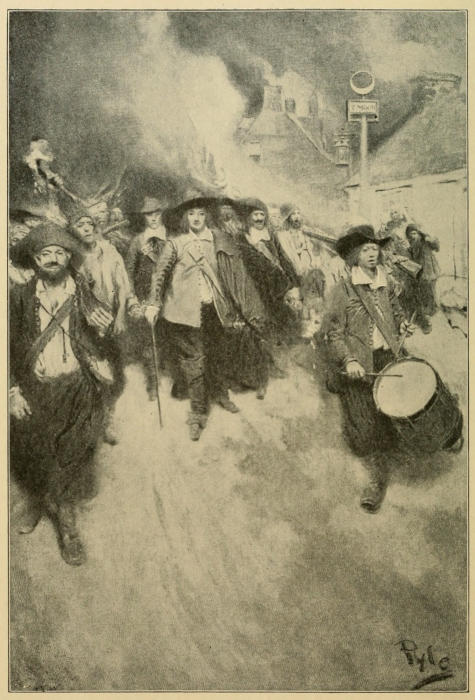
NATHANIEL BACON AND HIS FOLLOWERS BURNING JAMESTOWN
He had gone too far. At first, rank and file, no doubt, had been with him, men of substance with the rest, for the right to live and to better the government; but most of the chief planters had held aloof even then; and as he went on they were more and more alienated. It became more and more an affair of the rabble, of the men who were poor and desperate and had nothing to lose. When he burned Jamestown he also sacked the plantations of the greater land-owners thereabouts, knowing them to be his enemies; and he died with the spirit of the outlaw too much kindled within him by the lawless work he had done, almost determined to withstand the King as well as the governor, and to make those who had not joined him pay for his work of resistance and reform,—no longer merely a champion of reasonable reformation, but a revolutionist. Nothing less could have alienated his friends, broken his party, and given Berkeley his full time of revenge against those whose cause had been just.
That revenge was only too complete. A fleet arrived out of England in January, 1677, with a regiment of the King’s troops aboard, and commissioners to settle the troubles in the colony to the re-establishing of order; and the commissioners had themselves to rebuke and restrain the insensate bitterness of the maddened governor. He had set the hangman to work before they came, and by the time January was out had sent more than twenty persons to the gallows for their participation in the rebellion; among the rest William Drummond, the capable Scotsman whom he had deputed to be the first governor of the settlements at Albemarle, and who had governed very quietly there, knowing the men he had to deal with, but who was now in Virginia again, Mr. Bacon’s friend and counsellor. “As I live,” cried the King, when he learned the news from Virginia, “the old fool has put to death more people in that naked country than I did for the murder of my father”; and he showed little patience when the old man came home to make his peace. The King would not see him, and the broken governor was dead,—of chagrin, men said,—by midsummer (1677). Virginia was rid of him; forgot how well she had liked him at first; and remembered without compunction how her people had celebrated his departure with bonfires and the booming of cannon.
It was in that year, 1677, when Virginia’s rebellion was over and her chief rebels hanged, that the heady settlers at Albemarle rose against the proprietors and the Acts of trade, thrust their governor out, and seized three thousand pounds of the customs revenue. They were but four thousand people, all told, but they were all of one mind, and did what Mr. Bacon could not do. For two years they governed themselves, upon such a model as might have pleased Virginia’s rebel. William Drummond, who had lived among them, had led Mr. Bacon to hope, and half expect, that these Albemarle men would send him aid and make common cause with him against the power of a royal governor and rich land-owners; but they had saved their strength for themselves. They took little thought for Virginia; and they could not have helped Mr. Bacon to succeed had they wished to help him. He had rebelled against powers which were already firmly established and which were to dominate Virginia throughout all the rest of her youth, and of her growth to maturity.
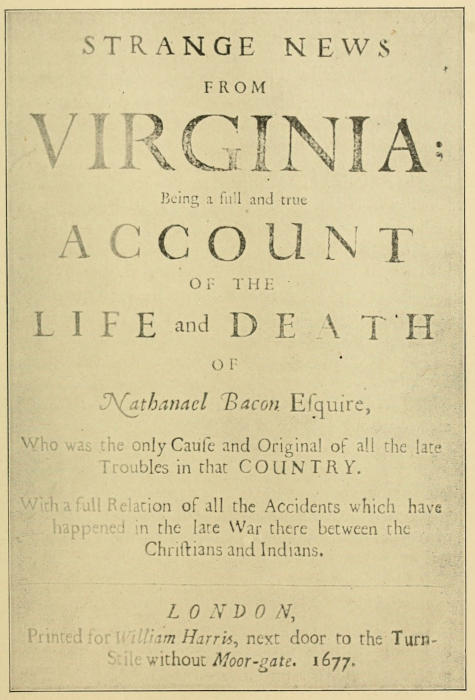
TITLE-PAGE OF “STRANGE NEWS FROM VIRGINIA”
That notable immigration of royalist gentlemen that had been pouring into the colony these five-and-twenty years, and which had brought Mr. Bacon himself to Virginia, had inevitably transformed the character of the little commonwealth. Large estates multiplied faster than small ones. Estates descended from father to son by the rule of primogeniture and were kept together by the strict law of entail. The ruling part in affairs fell more and more, and as if by a sort of social law of nature, to men who believed in aristocratic privilege in matters of government and dreaded a democratic levelling. Being for the most part men of breeding and of honor, they were ready to condemn quite as heartily as Mr. Bacon himself the corrupt and headstrong ways into which Sir William Berkeley had fallen; but they deemed revolution rather a new disease than a good remedy, and left Mr. Bacon to find his recruits among those who had less at stake.
Virginia’s government was singularly like the government to which these ruling gentlemen had been accustomed at home in England; and her most influential men were as certain to make up her governing class as were the country gentlemen of England to procure magistracies in their counties. The Long Assembly had made changes in the law which rendered their supremacy more certain than ever before. The rule in respect of every office was appointment, not election. Only the Burgesses were elected out of all who took part in the government of the colony, and it was fixed custom from of old to select them from the members of the county bench, whom the governor appointed. Even they were to be chosen henceforth, the Long Assembly had decreed, by the freeholders only, and not by the common vote of all free residents, as before the Restoration. Local government was altogether in the hands of the ruling class. The vestry was the governing and directing body in every parish, and its twelve members were to be chosen now in each parish, since the Long Assembly’s law of 1662, not by free election, as in the old days, but by the vote of the vestry itself, which was henceforth to fill its own vacancies. The county courts were made up of magistrates appointed by the governor; the sheriffs were nominated by the county courts, who always named some one of their own number; for a long time it had been the custom to elect one or more of the county magistrates to represent the county in the House of Burgesses; the county militia was organized under lieutenants,—one for each county,—who were commonly chosen from among the members of the governor’s council. There was no place for any but men of means and influence in such a government.
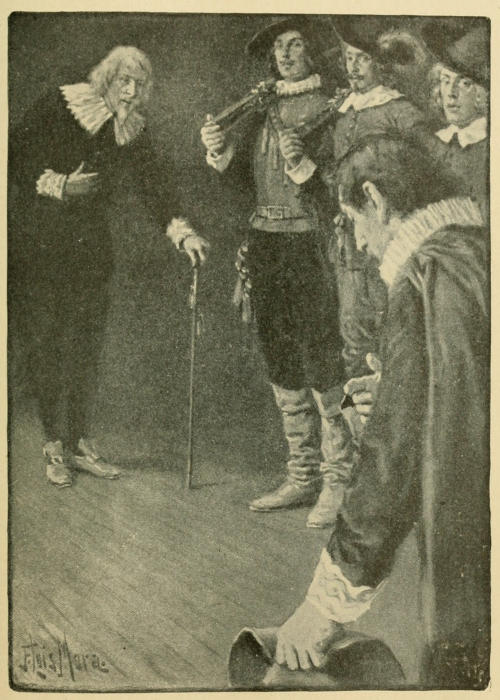
GOVERNOR BERKELEY CONDEMNING WILLIAM DRUMMOND TO DEATH
It was not an exclusive aristocracy. The life of the colony was too simple, too essentially democratic for that. Magistrates and vestrymen, sheriffs and county lieutenants, all felt themselves neighbors and fellows of the men they governed and took taxes of in those quiet river neighborhoods. They were really representatives of the people they ruled, in temper and interest, if not in estate. They knew how their neighbors lived,—as Mr. Jefferson explained long afterwards, in behalf of the like magistrates of his own day,—because they did not live very differently themselves. Their motive to do their duty justly and well was the sufficient motive of pride and self-respect, their desire for the esteem of the people about them in the intimate life of the rural country-side. Their rule was mild and public-spirited for the most part, more and more so as the life of the colony settled to a fixed and stable order, and the men who found their way into the vestry and the county magistracy were generally men whom all esteemed and looked up to. But their rule was the rule of men of property, in favor of maintaining authority, sure to discountenance irregular attempts at radical reform; and Mr. Bacon’s rebellion was the last of its kind. It had come too late, and was never repeated.