Chapter II · THE SWARMING OF THE ENGLISH (continued 2)
Reading edition
In each town there were “selectmen” chosen to administer the general business of the town; constables to keep order; cowherds to take the cattle to the common pasture, keep them there while their owners did their tasks through the day, and bring them back at sunset; swineherds to drive the swine to their feeding and return them safe in the evening; a hayward to catch stray beasts and keep them fast till they were claimed: a man for each simple duty. The swineherd made his way along the village streets early in the morning, sounding his horn, and every man who had swine brought them out to him at the summons to join his noisy procession, going forth to the woods for their feeding for the day. The cowherd took all his lowing charges to pasture from a common pen, to which their owners brought them in the grey of the dawn, and was charged to be back with them ere the sun should set. The town meeting decided all things, small and great. It did not hesitate to order in what way the houses should be set and roofed and distributed along the street, and their gardens disposed about them. In Newtown the freemen ordered by vote that all houses within the village “be covered with slate or board, and not with thatch,” and that they be built so that they should “range even” and stand just six feet from the street. Every freeman and proprietor of the village had his vote in the meeting, and deemed himself self-governed when it governed him.
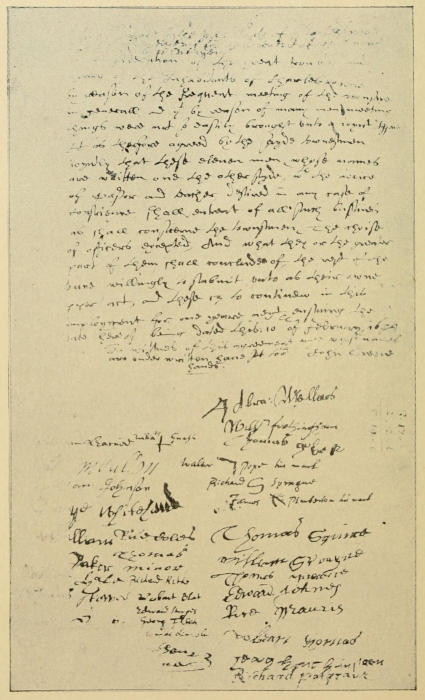
FACSIMILE OF ORDER CREATING BOARD OF SELECTMEN, CHARLESTOWN, 1634
The government of the colony as a whole was by no means so democratic. The “company” governed; and the company consisted only of those who were admitted as “freemen” by its own vote. At first there were only twenty such among all the thousand settlers at the Bay, and twelve of these twenty were the officers of the company. By slow degrees the number was enlarged; but the company was very reluctant and very cautious about increasing its membership. Four years went by before there were so many as three hundred and fifty “freemen,” and by that time there were more than three thousand settlers. The new and very severe rule was adopted that no one should be chosen a freeman who was not a member of some one of the churches of the settlements. In England every subject was reckoned by law a member of the Church of England; but in Massachusetts men became members of the churches only by profession of faith and upon a searching examination in matters of doctrine and worship. Those who did not hold the strict creed of the Puritan ministers, being excluded from the church, were excluded also from voting. “The best part is always the least,” was Mr. Winthrop’s sententious doctrine, “and of that best part the wiser part is always the lesser.”
The rule of doctrine and church authority did not stop with a restriction in the number of freemen who should vote in the company’s general court. Men were fined, whipped, sentenced to have their ears cut off, or banished the colony altogether for speaking scandalously of either the church or the government. Several who had come to the Bay before the Massachusetts Company was formed were so put upon and sought out for prosecution by their new masters, the magistrates of the company, for their refusal to conform to the new practices in matters of worship, that they finally resisted to the length of bringing sentence of banishment upon themselves, or voluntarily took themselves off to escape the searching tyranny. It was a very rigorous government, under which only those could live and be at ease who professed and proved themselves Puritans; and common men suffered more than gentlemen, after the manner of the age, so that it seemed an aristocratic as well as an ecclesiastical establishment.
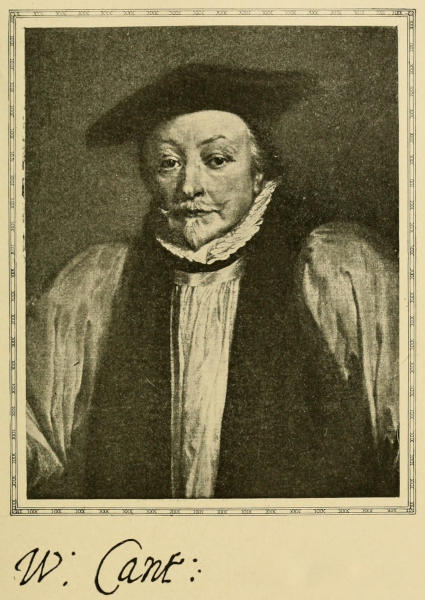
WILLIAM LAUD, ARCHBISHOP OF CANTERBURY
The King and his ministers over sea did not fail to observe how the company made its colony a stronghold for the obstructive Puritans. The temper of Charles’s government grew harsher and harsher during those first years of settlement at the Bay, and became as meddlesome and tyrannical in the management of the Church as in the management of the State. In 1633 he had made Laud Archbishop of Canterbury. Now he was backing the implacable primate in a thoroughgoing and pitiless attempt to clear the Church of all Puritans and nonconformists. Laud was quick to see what comfort the rapidly growing colony at Massachusetts Bay gave his enemies, and complained very hotly that it was filling up with persons openly hostile to the King’s government. Certain persons connected with the old Council for New England, jealous of the prosperous company at the Bay, with its independent royal charter, easily persuaded the all-powerful archbishop, and through him the law officers of the crown, to take steps to destroy it; and in 1635 the blow came. A judgment was obtained against the Massachusetts charter in the court of King’s Bench; the government of the colony was declared transferred into the King’s hands, as the government of Virginia had been, and orders were issued which authorized the despatch of a governor-general, to be accompanied, if necessary, by an armed force. Mr. Cradock, who presided over the company’s financial board in London, had been summoned by the imperious primate and by my lord Privy Seal to come before them for an explanation, and bring the charter of the company with him; and had been rated very roundly as an “imposturous knave” when he declared that it had been sent over sea with the colonists. But the spiriting away of its charter had not been allowed to stay the judgment against the company.
The magistrates at the Bay, when the ugly news reached them, came to the desperate resolution to resist by force. But troubles in England saved them. Their charter was, indeed, in law annulled, but the judgment was not carried out. The King’s purse was empty. His subjects were very slow about paying the illegal taxes he demanded of them. Signs of revolution were growing more and more frequent, more and more open and ominous. Charles could not afford to send an expensive expedition out to New England, and was much too anxious about things at home to think very often about the little group of troublesome settlements across the sea. Mr. Winthrop and his associates, accordingly, lived quietly on under their forfeited charter, as if nothing had happened, and admitted no one they did not like to the partnership.
An introduction to the various phases of the Puritan movement in England, which led to the Puritan exodus to America, may be got in G. H. Curteis’s Dissent in its Relation to the Church of England (the Bampton lectures for 1871); in David Masson’s Life and Times of Milton; in D. Neal’s History of the Puritans; in Samuel R. Gardiner’s History of England from the Accession of James I., volumes I. and IV.; in the second volume of J. R. Green’s History of the English People; in G. E. Ellis’s Puritan Age and Rule; and in the second volume of J. A. Doyle’s English Colonies in America.
The leading general authorities on the history of Massachusetts in the seventeenth century are John Gorham Palfrey’s History of New England (1492-1774) and Compendious History of New England (1497-1765); J. A. Doyle’s second and third volumes on The English Colonies in America; John Fiske’s Beginnings of New England; S. R. Drake’s The Making of New England; and Justin Winsor’s Memorial History of Boston.
Glimpses of some of the most important special aspects of Massachusetts history are to be had in W. B. Weeden’s Economic and Social History of New England; Charles Francis Adams’s Three Episodes of Massachusetts History; and Herbert B. Adams’s Germanic Origin of the New England Towns, published in the first volume of the Johns Hopkins University Studies in Historical and Political Science.
Most of the important original sources of Massachusetts history are brought together in John Winthrop’s History of New England, edited by J. Savage and The Life and Letters of John Winthrop, edited by R. C. Winthrop; in the Collections and Proceedings of the Massachusetts Historical Society; in Alexander Young’s Chronicles of Massachusetts; in the Records of the Governor and Company of the Massachusetts Bay; in Peter Force’s Tracts and Other Papers relating to the Colonies in North America; in the Publications of the Prince Society; in the papers of the American Antiquarian Society; and in the New Hampshire Historical Collections.
IV. The Province of Maryland
It was a thing for statesmen to take note of, and all to wonder at, how Englishmen of all sorts and creeds began to think of America, and to desire homes there, when once it had become evident that Virginia and Plymouth and the Massachusetts settlements were certainly permanent, and colonization no mere scheme of the foolhardy. There were others besides the Puritans who felt uneasy at home in England because of the troubles in church and state and the threatening face of affairs. For men who loved novelty and adventure, life in the New World had always a charm which even direst hardship could not take away; but such men were nowhere in a majority, and it was not mere love of adventure that made the English swarm to America. It was the spirit of liberty and of mastery. It was the most spirited men who were the most uneasy in those evil days of the Stuart kings; and because they were cramped and thwarted and humbled at home they thought the more often and the more wistfully of the freedom they might find in America. Virginia had been planted and had thriven, it is true, before there was this sting of uneasiness to drive men over sea. She had been created because of the spirit of trade and of conquest, the impulse of international rivalry, the love of gain, and the capacity for independent action which had come to Englishmen in the stirring sixteenth century; and it was, after all, that “ancient, primitive, and heroic work of planting the world” which was to prove the permanent motive of English success in America. But now, for the time being, there was added to the high spirit of mastery the unquiet spirit of discontent, and America reaped a double harvest.
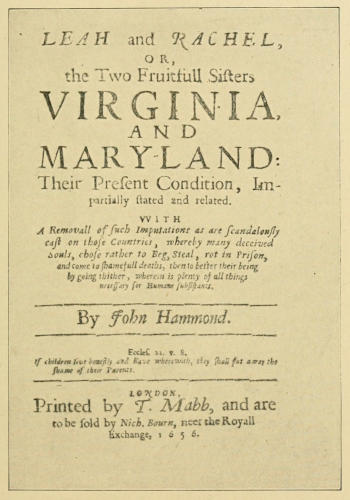
TITLE-PAGE OF HAMMOND’S “LEAH AND RACHEL”
It happened that Roman Catholics felt almost as uneasy as Puritans. James, it was true, had proved himself no Presbyterian, after all, and Charles had put Laud at the head of the Church, as if to carry it back as far as possible towards Rome, if not all the way to Rome itself. But it needed no seer to perceive how the temper of the nation darkened at sight of these things, and no thoughtful Roman Catholic could find sound reason to hope for a long period of toleration. America would no doubt prove a freer place for Roman Catholics as well as for Puritans, and their exodus began the very year Laud became primate. It was for them that Maryland was founded by Cecilius Calvert, Lord Baltimore. It was a scheme he had inherited from his father. Sir George Calvert had been a very noticeable figure when James was king. He had stood in the Commons, alongside Wentworth, his friend, as spokesman for the King, whose intimate companion and devoted servant all knew him to be, facing Sir Edwin Sandys there, to whom the House had looked for leadership since it began to fear that James meant some deep mischief to the liberties of England. There was much to admire in his courtesy, his tact and moderation, his unobtrusive devotion to affairs. He had none of Wentworth’s striking initiative and vigor, and showed a modesty, gentleness, and acquiescence in the service of the court which seemed mere weakness to those who looked on; and yet he was greatly trusted and won deep esteem. The opponents of the crown in Parliament thought him servile, and suspected him of being corrupt, like the rest of the King’s agents; but those who knew him said that he acted upon conviction in making choice which side he should take, and both in public and in private bore himself like a man of honor.
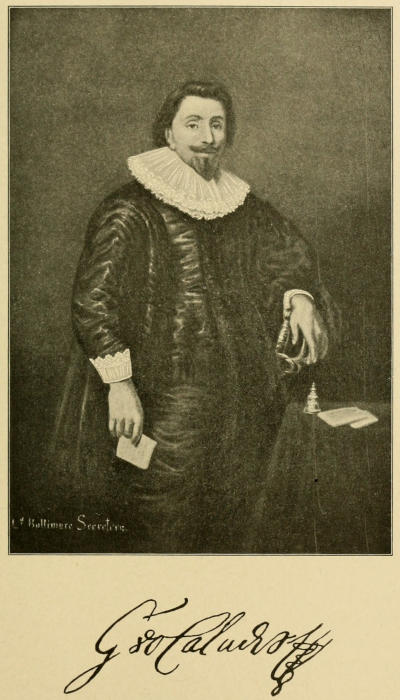
GEORGE CALVERT
In the last year of the reign he had resigned his offices and withdrawn from the King’s service, while still in his prime. He had become a convert to Roman Catholicism, had committed himself with the energy of real conviction to bringing about the marriage of Prince Charles to the princess of Spain, and would not draw back to please either the prince himself or great Buckingham, because he deemed both the cause of Catholicism and the plighted word of England, given in solemn treaty, involved in the project. His position at court had become untenable, and he withdrew both to save his interest and to give candid expression to his religious convictions. James had created him Baron Baltimore at parting, as a special evidence of his good will, and then Calvert had turned to devote himself to plans of colonization. He had been a large subscriber to the funds of the East India Company, had become a member of the New England Company, and had served on the commission appointed in 1624 to wind up the affairs of the great Virginia Company. As far back as 1620 he had interested himself in colonizing schemes of his own, while he was yet in the midst of affairs,—before Plymouth was founded. He had bought an extensive tract of land lying on the southern peninsula of Newfoundland; had put colonists upon it; and when he turned from holding office under the King, had himself gone to reside among his settlers.
But a single year in that rigorous climate, with its icy cold from October to May, convinced him it was no place in which to build a colony, especially with the French near at hand to be reckoned with, in addition to the weather. The French upon the near-by coasts had not forgotten how Captain Argall had put in at their struggling settlements and burned them, scarcely ten years ago, carrying off cattle and settlers alike as his prize of private war, and meant to have no English for neighbors if they could find means to drive them off. Calvert had stayed his year out at “Avalon” only because his ships were as heavily armed and better handled. The bleak land with “a sad fare of winter” upon it, which let no blade of herbage appear in the earth, nor any fish even in the sea, for close upon eight months together, seemed hardly worth fighting for.
He turned his thoughts southward, therefore, and in 1629,—the very year Parliaments ceased to sit and the Massachusetts people got their charter,—asked King Charles to grant them lands on either side the great Bay of Chesapeake, close by Virginia: from the Potomac northward and eastward, across the Bay, to the fortieth degree of north latitude and the river and bay of Delaware. All this was land granted long ago to the Virginia Company; but the Virginia Company was dead; the King had resumed his sovereign rights with the withdrawal of its charter,—cared very little whether he twice granted the same thing or not,—and was Calvert’s friend, as his father had been before him. The Virginian colonists were hot against the grant, and many influential persons in England, who seemed to hope still to see the old Virginia Company revived, protested to the Privy Council against it. But though they held the matter off for a year and a half, until Calvert was dead, they did not prevent it. The charter was issued in 1632, and Cecilius Calvert, the second Lord Baltimore, carried out his father’s plans in his father’s spirit.
It had been evident from the first that George Calvert had meant his colony to be, among other things, a place of refuge, freedom, and safety for men of his own faith. There had long been stories afloat in London how he had carried Romish priests with him to Newfoundland, and had celebrated mass there every Sunday. He had named his colony there Avalon because it was at Glastonbury, which men had once called Avalon, in old Somersetshire, that the Church of Rome had first set up her altars in Britain. The colonists whom Cecilius Calvert sent out to Maryland late in the autumn of 1633 were by no means all Romanists, but probably quite half of them were; and Jesuit priests, who had covertly come aboard after the ships left the Thames, went with them to act as their spiritual leaders and preceptors in the New World. Protestants and Catholics, however, consorted very comfortably together on the voyage and after the landing. It was no part of Lord Baltimore’s purpose to be a proselytizer and make converts of all whom he sent out, and he was too cool and prudent a man to wish to set up a colony to which none but Roman Catholics should be admitted. He knew very well how all England would soon be talking and protesting about such a colony as that, should he attempt it. He meant only to make a place so free that Roman Catholics might use full liberty of worship there no less than Protestants, for he knew that there was as yet no such place in America.
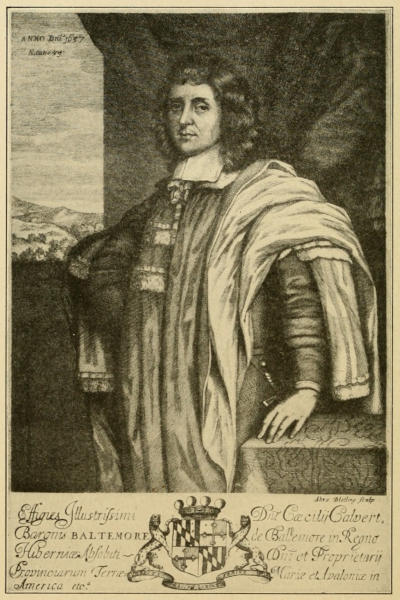
THE SECOND LORD BALTIMORE
His colonists reached their new home in March, 1634, and chose for their place of settlement a high bluff which rose upon the eastern bank of a little stream which emptied itself into the great Potomac but a little way from the Bay. The mighty Potomac, flowing silent between its wide banks there in the lonely wilderness, made a deep impression on them. “The Thames, compared with it,” they said, “can scarcely be considered a rivulet. It is not rendered impure by marshes, but on each bank of solid earth rise beautiful groves of trees, not choked up with an undergrowth of brambles and bushes, but as if laid out by the hand, in a manner so open that you might easily drive a four-horse chariot in the midst of the trees.” It was this broad and stately stream which was to be their boundary line, separating them from Virginia. Lord Baltimore called his province Maryland, in honor of the queen, and the first settlement there on the bluff they called St. Mary’s, in honor of the Virgin.
It was a very bitter thing to the Virginians that they should be obliged thus to give up all the fair region of the upper Bay to these new-comers, whom they disliked equally as intruders and as papists; and feeling ran so high among them against Lord Baltimore’s people that they deemed it an intolerable sort of treason for any man to speak so much as a kind word concerning them. They knew that they might themselves once have had all the Bay for the taking, and now the King had granted it away forever. They had, indeed, established a trading outpost on Kent’s Island, which lay within reach of the spreading stream of the great Susquehanna, the noble river which brought its waters to the Bay all the long way which lay between Virginia and the forest haunts of the mighty Iroquois at the north,—the forests whence the rich furs came which all the continent coveted. Mr. Clayborne, who was of the governor’s council, had interested himself to make commerce there with the natives; and Mr. Clayborne, with his good estates and high credit in Virginia, his influential commercial connections in London, his indomitable will and strong relish for action, was an ill man to oust. He insisted not only upon his own rights of property in the island, which no man of Lord Baltimore’s interest would have denied or interfered with, but also upon Virginia’s jurisdiction over it. There could be no questioning the fact, nevertheless, that the island lay within the King’s new grant; and though Mr. Clayborne begged aid of the Privy Council at home, and even put arms into the hands of his servants to keep his own by force, it was of no avail. The King’s grant made Lord Baltimore master, and Mr. Clayborne had to stomach as best he could the unpalatable necessity of submitting.
Maryland’s settlers had come to stay, and yearly spread and multiplied; and the Virginians in due time let their anger cool. Singular good fortune and provident good management made them secure from the first against any starving time such as there had been at Jamestown, or any bitter struggle to live and make a beginning. They had found an Indian village at St. Mary’s where they landed, long established and set in the midst of open fields cultivated and ready for the plough. The Indians whose home the place had been freely sold them both its wigwams and its fallow clearings, for a few hatchets and hoes and a little cloth. Before the white men came they had resolved to quit the region, to be rid of fear of the Susquehannocks, the terrible Iroquois neighbors whose inroads made peace impossible. Here were cornfields ready for the planting, therefore, and the very first autumn of their stay in that wide wilderness the new colonists had grain enough to send a shipload to New England, to be exchanged for salt codfish. The Virginians, for all they hated them, did not refuse to sell them cattle and swine at a profit; and want was not an enemy they needed to reckon with.
Maryland turned out another Virginia in its ways of life and government. In form, indeed, its government was very different. The King had no direct authority there. Lord Baltimore was made by his charter literally proprietor of the colony,—a sort of feudal prince, from whom, and not from the King, all titles and all authority were to be derived. He was empowered to confer rank even, and set up a kind of nobility, should he choose; and though his charter obliged him to submit such laws and regulations as he might think best to impose upon his province to the approval of the freemen of the colony, or their deputies, “called together for the framing of laws,” that need have restrained him little more than the King was restrained by the Parliament at home. He could create “manors,” also, with their separate courts, and proprietors as independent, almost, as the barons of old; and as the colony grew he did bestow here and there, upon a few of the richer men among his colonists, these greater gifts of privilege. The King had meant to reproduce in him the ancient powers of the stout churchmen who had kept the northern border against the Scot, and had had their separate sovereignty, as if of independent princes, for reward, making of their majestic cathedral on the high banks of Wear—
“Half house of God, Half castle ’gainst the Scot.”
He was to have, said his charter, “as ample rights, jurisdictions, privileges, prerogatives, royalties, liberties, immunities, and royal rights as any bishop of Durham within the bishopric or county palatine of Durham, within our kingdom of England.”
But, notwithstanding his power was so great on paper, he did not in fact use it to give the colony a character apart. Assemblies of the freemen met and made terms with the proprietor in Maryland as they had met and made terms with the company in Virginia. At first, while all the settlers were still within easy reach of St. Mary’s, there were no elections. The freemen came themselves instead of choosing representatives. It was only by slow degrees that a system of elections was established. But in the end things were arranged there very much as they were arranged in Virginia, in matters of government no less than in matters of daily life. There were broad rivers in Maryland as in Virginia, and ships traded from wharf to wharf upon them as in the older colony. There were few villages and many spreading plantations. Virginians might have felt that there was practically little difference between their own colony and Lord Baltimore’s, had they not seen Roman Catholics enjoy rights of worship there which were not granted them in Virginia. Virginians were expected to observe the ritual and order of the Church of England. Only in Maryland was there freedom in such matters, and the freedom there made Virginians feel, uneasily, that Maryland was in some unlawful way a Jesuit and papist refuge, which would bear jealous watching. The two colonies might speedily have forgot their differences but for that.
Authorities on the history of Maryland during the seventeenth century. The most trustworthy general authorities are John Leeds Bozman’s History of Maryland (1632-1660); William Hand Browne’s Maryland: the History of a Palatinate; John V. L. McMahon’s An Historical View of the Government of Maryland; the first volume of J. A. Doyle’s English Colonies in America; William T. Brantly’s English in Maryland, 1632-1691, in the third volume of Winsor’s Narrative and Critical History of America; Edward D. Neill’s Terra Mariae; Bancroft and Hildreth’s general histories; and the excellent monographs scattered here and there in the nineteen volumes of the Johns Hopkins University Studies in Historical and Political Science.
The more important original sources are to be found in the Maryland Archives, edited by W. Hand Browne; in the Fund Publications of the Maryland Historical Society; in Bacon’s Laws of Maryland; in Peter Force’s Tracts and Other Papers relating to the Colonies in North America; in W. Hazard’s Historical Collections, Consisting of State Papers and Other Documents; and in Stedman and Hutchinson’s Library of American Literature.
V. The Expansion of New England
While Maryland was being established, a county palatine, and Virginians accommodated their life and temper to the intrusion, affairs moved with strong tide in New England, and the whole face of the country was changed for the English, the Indians, and the Dutch alike. During the ten years 1630-1640, the first ten years after Mr. Winthrop’s company came to Boston, a great and ever-increasing immigration poured steadily in at the Bay. These were the years during which there was no Parliament in England, the years during which the government at home seemed most intolerable, and the Puritan colonies in America most inviting, to all Englishmen who took their politics and their religion seriously. No fewer than twenty thousand people came within that single decade to seek homes in New England. In 1634 fourteen ships came in at the Bay with settlers in the single month of June, and the next summer eleven came in in a single day. In 1638 three thousand immigrants arrived within a space of three months. There could be no pause in events while such a tide was running.
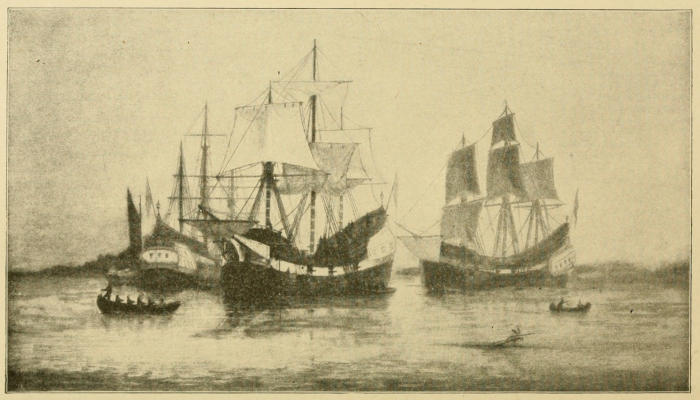
ARRIVAL OF WINTHROP’S COMPANY IN BOSTON HARBOR
Most of the new-comers found the Bay settlements altogether to their liking, and made their homes there very contentedly. They did not object to the strictness of the church government set up by the masterful rulers of the Massachusetts towns, for they were themselves Puritans almost to a man, and liked very well to see their own opinions made compulsory. It did not incommode them that the sterner ministers of the settlements made bold to imitate his Grace of Canterbury and silence those who differed with them. It was an age “when every sect demanded tolerance, yet none had the generosity to grant it,” and it was very comfortable to dwell with your own sect.
There was a great deal besides the church in New England,—a great deal to make the novel life in the wilderness stirring and interesting, and worth taking part in. The government, it was true, tried to regulate everything, just as the government at home did: made laws as to what wages should be paid to laborers, what prices should be charged by the merchants; prescribed what uses the farmer should make of his corn, how the fisheries should be conducted, and the fur trade with the Indians carried on. But it was not so easy to enforce such regulations as it was to make them. Fishermen fished in the open sea, upon a long coast, where there were few magistrates; fur traders carried on their barter with the Indians in the depths of the forest; merchants quietly took whatever purchasers were willing to pay; farmers used their land as they thought most profitable and advantageous; and the simple life of the colony was freer than life in England, after all.

There was not a little uneasiness and disquiet, nevertheless. These stirring, austere, uncompromising Puritans, who had crossed the sea to live in a wilderness rather than submit to Laud and the King, were not likely to be all of one mind, or always submissive to one another when they differed; and within less than five years after Mr. Winthrop’s first company had established themselves at the Bay signs of a partial breaking up began to appear. Each town was a sort of little commonwealth, and every town followed its minister, if he was of the mettle to lead. Some came from one quarter of the old land which had bred them all, some from another, some from quiet hamlets or rustic country-sides, some from busy towns; and each group, choosing its own place of neighborhood and settlement, kept its own flavor of local habit. And not the flavor of local habit only, but its own favorite views, also, it might be, upon questions of doctrine and polity, or its own strong preferences as to liberty of worship. Congregations had and kept their several characters; the politics of the growing commonwealth sprang out of their differences; and their ministers were their politicians. The Reverend Thomas Hooker, of Newtown, and the Reverend John Cotton, of Boston, were, in those first days, the most notable men among all the ministers of the colonies. Laud had picked both of them out as heretics specially to be feared and disciplined; they had been obliged to make their escape very secretly from England, and had been welcomed at the Bay with a special satisfaction and distinction of greeting upon their landing, in 1633. They were both scholars, and both orators whom it moved men to hear; but they were of opposite views and unlike tempers in dealing with affairs. It was observed after Mr. Hooker was settled at Newtown “that many of the freemen grew very jealous of their liberties.” The men of Watertown, near by, ventured to protest very strongly against being taxed for a fort to be built at Newtown, notwithstanding it was meant to serve in case of need against a common enemy; and it was not doubted that Mr. Hooker’s very liberal opinions in matters of government had spread to them, and inclined them thus to press their independence. He was very downright, very formidable in debate; Newtown was contesting with Boston the right to be considered the capital and centre of the Bay settlements; the freemen of the lesser towns looked to it for leadership, and found Mr. Hooker clear in counsel and fit to lead.
Mr. Cotton’s views were much more to the liking of the magistrates. “Democracy,” he said, “I do not conceive that God ever did ordain as a fit government either for church or commonwealth. If the people be governors, who shall be governed?” He had, moreover, “such an insinuating and melting way in his preaching that, he would usually carry his very adversary captive,”—a man less rugged than Mr. Hooker, more fitted to charm, the mystical power of a poet and the winning force of an ardent evangelist set forth for all to see in his fine eyes, his ruddy countenance, his locks of chestnut brown, his carriage as of a man sure of his mission and of his mastery. The magistrates generally invited him to preach, accordingly, at every crisis in affairs, to the freemen or to the courts which were to decide what to do, and he had presently such an ascendency “that whatever he delivered in the pulpit was soon put into an order of court or set up as a practice in the church.” The Newtown people, who deemed Mr. Hooker no less a master of wise speech and sound doctrine than Mr. Cotton, and Mr. Haynes, their chief citizen, as worthy to be governor as Mr. Winthrop himself, or Mr. Dudley, one or the other of whom the freemen seemed determined always to choose, grew jealous of a government which seemed to lie so entirely with Boston. They found the combined government of church and company itself a little burdensome. The water, too, at their wharves was too shallow, the soil on their fields too thin, and they were straitened for lack of meadow. Interest, pride, and opinion were very subtly compounded in their disquietude, and neither soft words nor harsh could rid them of it.
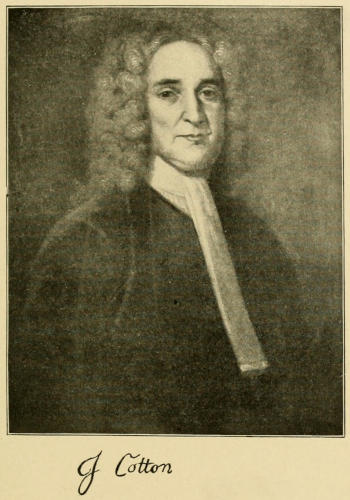
JOHN COTTON
They were too loyal and too prudent to wish to disturb the peace and order of the colony by insisting too strenuously or too hastily upon having their own way; but they did not dissemble their discontent, and asked leave of the company’s government to remove to another place of settlement. There was not a little alarm and opposition when it was learned that they wished actually to go outside the Massachusetts grant and establish themselves entirely apart on the distant Connecticut. But it became evident very soon that their spirits were too strongly bent upon their new purpose to be restored to ease or contentment where they were. Moreover, the same desire to get away began to show itself elsewhere,—in Watertown and Roxbury and Dorchester; and, with great bodies of new settlers constantly coming in, there seemed no conclusive reason why they should be held, unwilling, within the colony. Though the matter had to be fought through long debates and many delays, therefore, the magistrates at last felt themselves constrained to grant Newtown’s petition; and the people of Watertown, Roxbury, and Dorchester chose to consider themselves included in the permission. The three years 1635-1637 saw a notable migration begin. By the spring of 1637 there were fully eight hundred settlers on the banks of the Connecticut and on the shores of the Sound below.
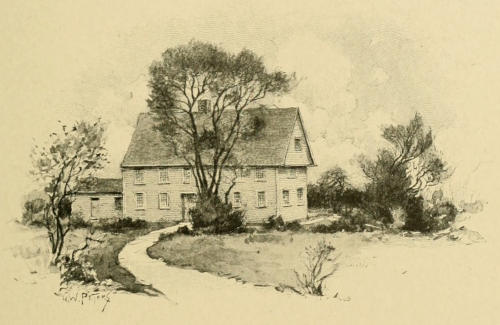
MINOT HOUSE, DORCHESTER
Dutch seamen had discovered the Connecticut so long ago as 1614, when the Virginia Company was still young, and the Massachusetts colony not yet thought of. They had explored also the shores of the Sound below, and both river and Sound had seen their trading boats pass often to and fro these many years. The Dutch had seen the English multiplying fast at Plymouth and the Bay of Massachusetts; had realized that they must be quick to secure what they had discovered and meant to claim; had formally purchased a tract of land from the Indians at the mid-course of the Connecticut; and at last, just before the English came, had built a little fort there to mark their possession, placing it at the fine turn of the river to which, as it fell out, Mr. Hooker also and his congregation from Newtown were presently to take a fancy. The Dutch agent in charge had hardly got further in his first work there than the throwing up of an earthen redoubt or two and the planting of a couple of small guns, and had but just named his post “Good Hope” (1633), when the English began to come. Men from Plymouth came first, to build a trading post, and then there followed these congregations from the Bay, as careless of the rights of the Plymouth men as of the rights of the Dutch. When once their coming had begun they crowded in faster and faster, closer and closer, despite every protest. Not many years went by before they were ploughing the very piece of land upon which the little Dutch fort stood, saying that it was a shame to let good bottom soil lie idle.
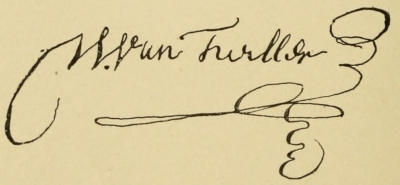
SIGNATURE OF WOUTER VAN TWILLER
Governor Winthrop had sent word to Van Twiller, the Dutch commander at Fort Amsterdam, that he must not build upon the Connecticut. It lay, he said, within the territories of the King of England. But Van Twiller had replied that he held the lands upon the river by as good a title, in the name of the States General of Holland and the authorized West India Company. “In this part of the world are divers heathen lands that are empty of inhabitants,” he had pleaded, “so that of a little part or portion thereof there need not be any question.” The tide of English immigrants swept in, nevertheless: a few from Plymouth, a great many from the Bay. The Dutch blustered and threatened and protested; but they did nothing more, and were soon outnumbered and surrounded. “These people give it out,” reported a Dutch sea-captain returned from the river, “that they are Israelites, and that we at our colony are Egyptians.” They called their own countrymen in Virginia the same. It was their mission to set up Puritan commonwealths. Those who were not of their faith and order of living were but a better kind of heathen whom they hoped either to oust or to keep at a safe distance.
In 1635 settlers from Watertown began to build upon the river, six miles below the Dutch at Good Hope, at a place which they presently called Wethersfield. The same year Dorchester people came and sat themselves down beside the little group of protesting Plymouth men at Windsor. There were men in England as well as at the Bay who had cast their eyes upon the valley of the Connecticut as a place to be desired, and they also chose this time to make ready for planting a colony. Lord Say and Sele, Lord Brooke, and others, men of consequence, friends and correspondents of the gentlemen at the Bay, had obtained a grant of lands upon the lower Connecticut and upon the shores of the Sound, as far east as the river of the Narragansetts and as far west as they chose, so long ago as 1631, from the Earl of Warwick, President of the Council for New England; and chose this very time of the migration from the Bay to make their claim good. In 1635 they sent out John Winthrop the younger, the Bay governor’s genial and capable son, as governor in their name “of the River Connecticut with the places adjoining,” and close upon his heels sent Lieutenant Lion Gardiner, a stout soldier bred to war, like so many another, in the service of the Low Countries, to build fortifications which should make them sure of whatever Mr. Winthrop might occupy. Mr. Winthrop made no serious trouble for the new settlers already come from the Bay. The action of their lordships his employers was friendly, not hostile; his own temper was easy and accommodating; Lieutenant Gardiner was detained at Boston a little while to assist with his expert advice at the construction of fortifications on Fort Hill, ere he went on to the Connecticut; and the fort which he built at the river’s mouth when at last he went forward on his errand, though stout enough to guard the place against all comers, was used only to keep the Dutch off. That very year, 1636, Mr. Hooker came with a hundred settlers from Newtown and joined some pioneers who had gone before him and planted themselves, as most unwelcome neighbors, close alongside the Dutch at Good Hope, calling their settlement Hartford.
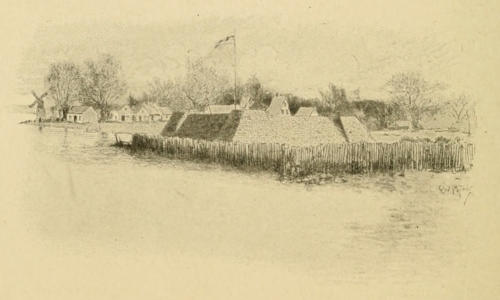
DUTCH FORT—“GOOD HOPE”
It had been no easy matter to struggle through the dense tangle of the almost pathless forests all the long ninety miles which lay between these new regions and the Bay. There were household goods and stores to be carried; there were cattle to be fed and driven all the long way; there were women and children to be thought of and spared; and those who made the hard journey spent weeks of weary travelling and lonely camping in those vast forests, which seemed to spread everywhere without border or any limit at all. Even boats could not be expected to make the journey round about by sea unless they chose their season; for when winter came the river was apt to be choked with ice. But these Puritans were not men to be daunted, as the Dutch found to their cost. The journey was made again and again and again, by party after party, as if there were no obstacles which even the women need dread.
Uneasy congregations were not the only people to quit the Bay in that day of eager movement, when men came by the thousands out of England; and the Connecticut was not the only goal of the new emigration. Many a man, many a family who found the rule of the Massachusetts magistrates over irksome, turned their eyes southward and went the shorter journey, of but a little more than forty miles, which carried them through Plymouth’s grant of lands into the country of the Narragansetts beyond, where deep rivers and a spreading bay, dotted with inviting islands, made an open way to the sheltered seas of the great Sound below. These shores and islands soon became a place of refuge for all who were specially thrust out from the Bay settlements for errors of life or opinion, and for all who voluntarily quit the austere churches there in search of an absolute individual freedom, such as was not to be had even with Mr. Hooker on the Connecticut. Roger Williams had led the way thither in 1636, the year Mr. Hooker went to Hartford. Mr. Williams was a man whom his very enemies were constrained to love, when they had hearts under their jackets,—even while they sincerely condemned his opinions. He had come to the Bay almost as soon as Mr. Winthrop himself, in February, 1631, in a ship which put in weather-beaten amidst a great drift of ice; and, though a mere youth, had given the magistrates trouble from the first. He was only the son of a merchant tailor of London; but nature had bestowed upon him gifts of mind and tongue which put him in a way to succeed as he pleased. He had become protégé and friend of the great Lord Coke, had got his training at Cambridge, and then had turned his back on all “gains and preferments in universities, city, country, and court,” for the sake of absolute liberty of conscience and belief. He would no more accept what he did not believe at the Bay than in England. He upbraided the congregations there which had not openly separated from the Church of England; he denied the validity of the colony’s charter, saying that the Indians alone, and not the King, owned and could grant the land; and he declared that magistrates had no rightful power except over a man’s body and goods, and were wrong when they tried to command what men should believe and how they should worship.
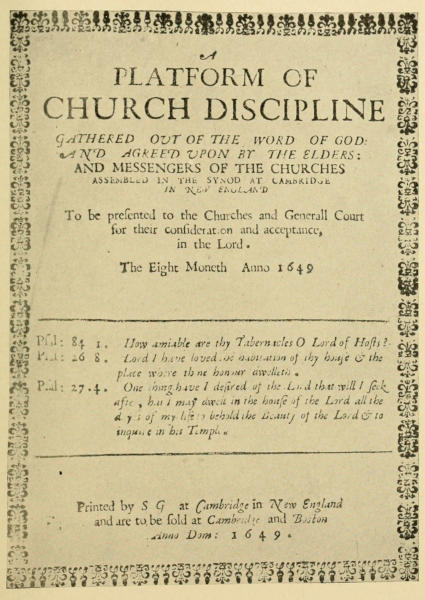
TITLE-PAGE OF THE CAMBRIDGE PLATFORM
The magistrates at the Bay could not permit such views as these to be preached and keep their authority. Mr. Williams had a most tender and outspoken conscience upon all things, and was often enough a mere “haberdasher of small questions,” as Mr. Cotton said in tart jest; but he raised great questions, too, and his reasoning as often as not struck at the very foundations of the curious structure of government the Puritan magistrates had been at such pains to rear. They were in effect separatists, if you but looked at them from the other side of the water; and yet they did not suffer their several churches and congregations to select or maintain what doctrines and practices they pleased. Synods ruled opinion, magistrates enforced their conclusions and their discipline, and Mr. Cotton, set high in the Boston pulpit where the chief men of the government were his disciples and parishioners, was a sort of bishop and primate of the churches. The masters of the Bay had no mind to let Mr. Williams speak or teach as he pleased. And yet it was five years before they made up their minds that he must be expelled from the colony. He was so gentle, so sweet-tempered, so ready to reason calmly with those who differed with him, so awkward to worst in an argument, so passionately loved by all his friends, so mildly hated by most of his foes, that they hesitated again and again what to do. It was unquestionable, nevertheless, that he kept the minds of the Salem people, to whom he preached, in something very like an attitude of rebellion towards the governing authorities of the colony; and at last he was driven out, obliged to fly secretly, even, lest they should seize and send him back to England. Undoubtedly he bred discord and contention wherever he went. He had lived for two years at Plymouth, to escape persecution at the Bay, before the final breach came; and even there, where they were inclined to be almost as liberal as he in matters of opinion, he had made trouble. “A man godly and zealous,” the kindly Bradford had pronounced him, “having many precious gifts, but very unsettled in judgment.” And so he became a fugitive, and went with four devoted companions, in the midst of bitter winter weather, deep into the icy forests to the southward, to find covert for a sensitive conscience beyond the grants of the crown.
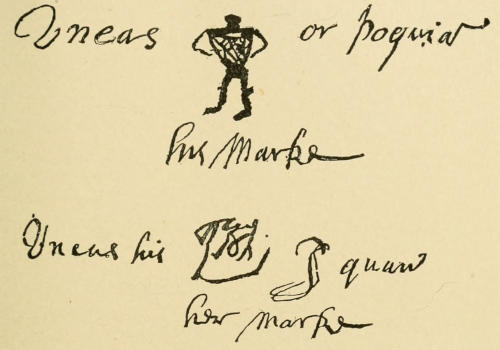
UNCAS AND HIS SQUAW. THEIR MARKS
And then, almost immediately, he was able to do the men who had banished him an inestimable service. That very summer (1637) war came,—war with the bold and dangerous Pequots, the Indian masters of the Connecticut and the shores of the Sound; and nobody but Roger Williams could have held the Narragansett tribes off from joining them to destroy the settlements. A hostile union and concerted onset of all the tribes, effected then, as the Pequots plotted, might have meant annihilation. There were but five thousand Englishmen, even yet, scattered in the settlements, and such a rising put everything at stake. The Narragansetts occupied the lands which lay between Plymouth and the valley of the Connecticut. Mr. Williams had been much among them while he lived at Plymouth; had learned their language, and thoroughly won their liking. Their keen and watchful eyes had seen how true and frank and steadfast he was, and how sincere a friend. They had given him lands very gladly when he came among them a fugitive; and now they hearkened to him rather than to the fierce Pequot chiefs, whom he faced at the risk of his life at their very council fires. The magistrates of the Bay had begged his intervention, and he had undertaken it cheerfully. Such was the generous nature of the man.
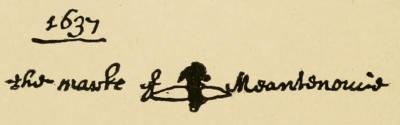
MIANTONOMO. HIS MARK
The Pequots had grown very hot against the English crowding in. No Englishman’s life was safe anywhere, upon the river or the Sound, because of them through the anxious winter of 1636-1637. Men at Lieutenant Gardiner’s little fort at Saybrook hardly dared venture forth for fuel or forage. When summer came, therefore, the settlers set themselves ruthlessly to exterminate the tribe. A single bloody season of fire and the sword, and the work was done: the braves of the tribe were slain or driven forth in little despairing groups to the far Hudson in the west; the few women who survived were taken and made slaves of. The terrible business cleared all the river valley and all the nearer regions by the Sound, and English settlers began to pour in again with a new heart.
Massachusetts had lent her aid to the annihilation of the tribe, but the Connecticut towns had begun the deadly work unaided. Until then Massachusetts had maintained a formal oversight, an unbroken assumption of authority among them; but now (1637), being clearly outside the Massachusetts grant, they took leave to hold a General Court of their own and assume independent powers. They had, indeed, no grant themselves, either of land or of authority, from the crown; but there were no King’s officers there in the quiet wilderness, and they would not, for the present at any rate, be molested. For two years (1637-1639) they acted without even formal agreement among themselves regarding the method or organization of their government, choosing and obeying their magistrates, electing and holding their assemblies, according to their habit before they came. But in 1639 they adopted a formal constitution, which they called their “Fundamental Orders.” Mr. Hooker’s liberal temper showed itself very plainly in the principles by which they resolved to be governed. “The foundation of authority is laid in the free consent of the people,” he had said, preaching to them from Deuteronomy, i. 13 (“Take you wise men, and understanding, and known among your tribes, and I will make them rulers over you”); and it is best that it should be so, for “by a free choice the hearts of the people will be more ready to yield” obedience. This was the principle of the Fundamental Orders. Their governor was always to be a member of some approved congregation; but any man might be a freeman and voter and fill any other magistracy whose town admitted him to be a resident, without test of doctrine or church membership; and the freemen were to elect the deputies by whom the laws of the colony were to be made in General Court.
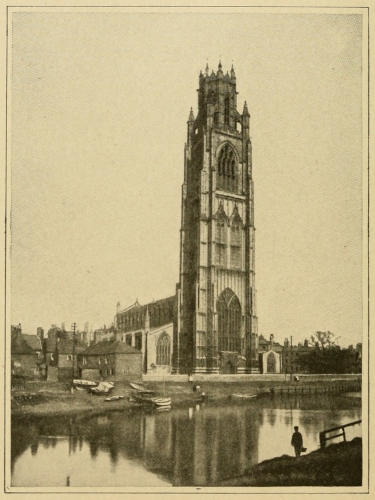
ST. BOTOLPH’S CHURCH, BOSTON, LINCOLNSHIRE, ENGLAND
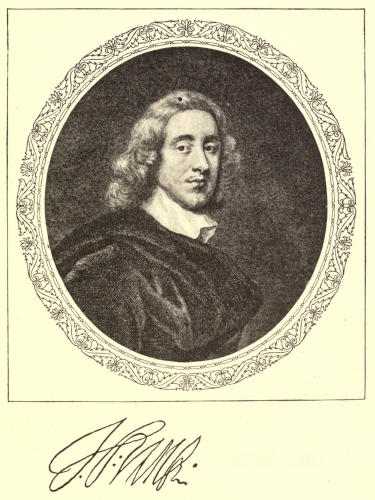
SIR HENRY VANE
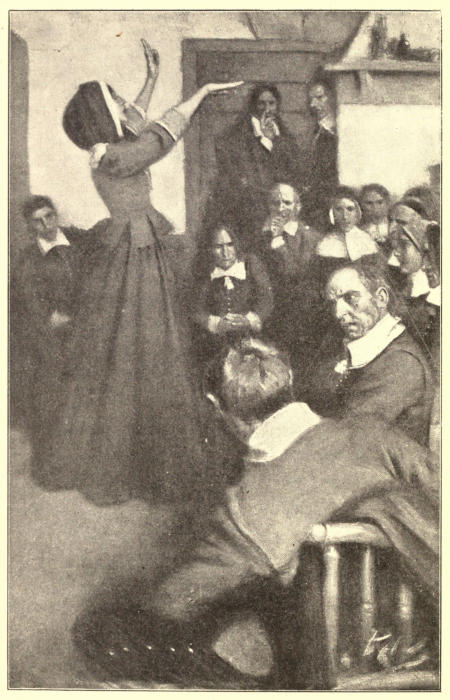
ANNE HUTCHINSON PREACHING IN HER HOUSE IN BOSTON
The churches at the Bay had found very promptly that they could ill spare Mr. Hooker from their counsels. They had sent for him, indeed, at a very critical juncture in 1637: when the ministers needed all the support they could get against a single masterful woman in Boston. Mrs. Anne Hutchinson had come to the colony in 1634, to be near Mr. Cotton once more, whom she had been used to hear and love in old Boston, in Lincolnshire, where, until Laud drove him from the kingdom, he had been minister of stately St. Botolph’s. At first she had seemed only a very energetic and helpful woman, with an engaging earnestness and eloquence which gave her a noticeable pre-eminence among her sex in the little town; but before two years were out she had set the whole colony agog. She undertook to preach in her own house, and before her day of exile came both men and women were crowding in to hear her. Great and small alike felt the woman’s singular charm and power. The whole colony knew before long how many persons of parts and wit had become her partisans,—how many magistrates, gentlemen, scholars, soldiers. Even grave Mr. Winthrop, though he heartily disliked her doctrine, shielded her from criticism. Young Mr. Harry Vane, the most distinguished and engaging youth that had yet come to the colony, whom all had loved from the moment of his landing, and whom the freemen had chosen governor within six months of his coming, though he was but twenty-four, was openly of her party. But only Boston, after all, was within reach of her power. Elsewhere men knew only her opinions; and they were rank heresy. She taught mystical errors touching the Holy Ghost which no church of the colony could accept. She even claimed, it was said, direct revelation to herself. The council to which Mr. Hooker was summoned roundly condemned her opinions. It had hardly done so before it began to look as if the woman’s partisans would bring not only ineradicable mischief into the churches, but also disorder and contempt of authority into civil affairs. Boston men who were of her party refused to enlist for the Pequot war. That year, accordingly (1637), saw very peremptory action taken. Mrs. Hutchinson was commanded to quit the colony by the next spring. She turned, in her exile, like other refugees for opinion’s sake, to the Narragansett country, whither Roger Williams had shown the way.
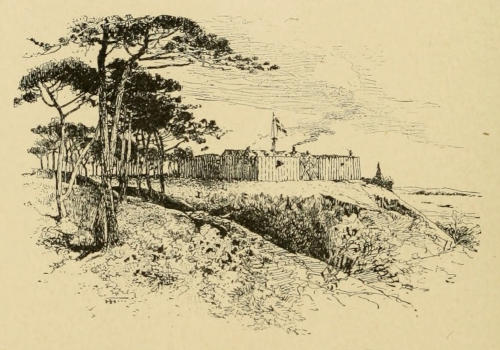
OLD FORT AT SAYBROOK, 1639
And then, the Pequots being driven from the forests, and Massachusetts purged of Mrs. Hutchinson’s heresies, every one began to think again of the new settlements to the westward and southward, on the Connecticut and the Sound. The tide of immigrants from over sea was still pouring in at the Bay, with no show of slackening. More came in 1638 than ever before. Finding the lands by the Bay already full, hundreds pressed on to the farther shores below. Settlements were presently to be found scattered at intervals, long and short, all the way from Saybrook at the mouth of the Connecticut to Greenwich, built within twenty miles of the Dutch at New Amsterdam: here a group of villages, there an isolated hamlet, set far apart. The Sound itself was crossed, and new settlements nestled here and there within the bays and harbors of the northern shore of Long Island. It was plain enough by what long and steady strides the English were approaching the gates of the Hudson. New Amsterdam grew and throve well enough in a slow way; but new colonists did not come to the Dutch by families, shiploads, congregations, as they came to the Bay. The Dutch saw very clearly what they were to expect. They had already found the English of “so proud a nature that they thought everything belonged to them,” and knew very well how aggressive they would be.
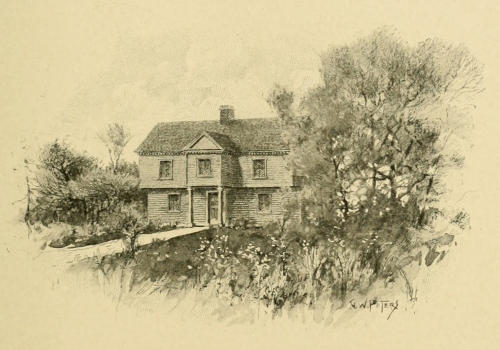
HOOKER’S HOUSE AT HARTFORD
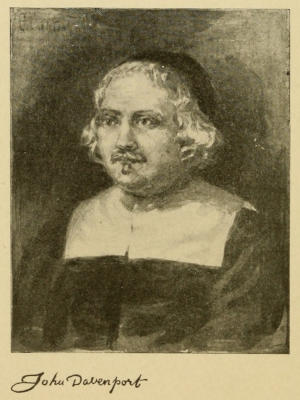
JOHN DAVENPORT
Most of the settlements near the river or the Sound, no matter how deeply buried in the forested wilderness, connected themselves with the free and simple government set up by Mr. Hooker’s people at Hartford; but no community or government owned the region more than another, and some chose to keep an independent authority of their own. In June, 1637, a very notable company had arrived at the Bay under the leadership of the Reverend John Davenport,—people of substance, merchants for the more part, the chief men of a congregation Mr. Davenport had served in London. They wished, above all things else, to keep together, make and maintain a separate church and parish for Mr. Davenport, and live their life in a place of settlement of their own. They found what they wanted (1638) within a safe and pleasing harbor on the Sound, which they presently called New Haven. Busy Captain de Vries, putting in at New Haven in June, 1639, found “already three hundred houses and a handsome church” built there. They had been at the pains to erect “fair and stately houses, wherein they at first outdid the rest of the country”; and they soon found their town become a sort of capital for that part of the shore. Almost immediately other settlements sprang up close at hand,—Milford upon the one hand, Guilford on the other, and others still as the years went by. Deeming themselves a group apart, though in the midst of towns joined with the river settlements above them, these associated themselves with Mr. Davenport’s people to form an independent government, upon another model. No one but a church member, admitted under the strictest tests of belief, could among them, it was decreed, either vote or hold office. They tried, in their singular stiffness and candor of faith in an absolute and uncompromising Puritan order, for commonwealth no less than for church, to make the laws of the Old Testament the laws of their own political life and practice also, and steadfastly held themselves to the self-denying liberty they had left the Old World to find.
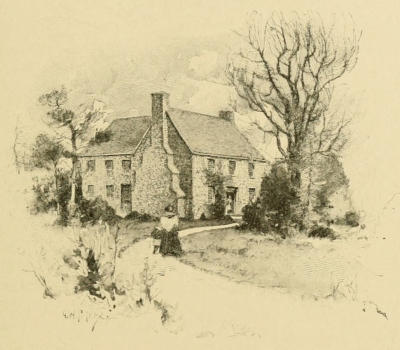
HOUSE AT GUILFORD, 1639
Settlements grew almost as numerously in the Narragansett country, though not in just the same way. By 1638 some fifty settlers had drawn about Mr. Williams at the place of refuge which he had reverently called “Providence”; and as the other shores of the Sound filled, Narragansett Bay was not overlooked. Colonists crossed the waters of the Bay from Providence, which lay at its head, to the fair island at its seaward end, which the Dutch had named Rhode (Red) Island, because when first they saw it its cliffs showed ruddy in the sun. There Pocasset and Newport were founded. But the settlers on those waters were not like settlers elsewhere. They were people of many creeds and beliefs,—Baptists, dissentient Puritans, partisans of Mrs. Hutchinson,—men and women whose views and practices were not tolerated elsewhere. They came hither, as Mr. Williams had come, to escape being governed at all in matters of opinion. Mr. Williams had spoken, in his catholic tolerance, of “the people of God wheresoever scattered about Babel’s banks either in Rome or England.” It looked for a little as if the shores of Narragansett were to be the banks of Babel. Men of all creeds made free to establish themselves upon them. They set up very simple forms of government,—for they generally agreed in wishing as little government of any kind as possible,—and yet, how slack soever the authority of rulers among them, they did not find it easy to live together. They were often turbulent; always disposed, upon a disagreement, to break away and live elsewhere in small, independent groups, rather than in strictly organized communities. Mrs. Hutchinson herself, who came to Pocasset when forced to leave the Bay in 1638, did not stay long. Her presence bred disquiet even there, and she soon removed again (1642) to a place on Long Island, within the territory of the Dutch, only twelve miles from New Amsterdam.
Many of the immigrants who crowded the ships that came yearly in at the Bay came expressly to be with old friends and comrades at Plymouth; and not a few others turned thither also when they had had time to make a choice. Until 1632, which was twelve years after its founding, the single village upon the hill at Plymouth had sufficed to hold all who came; but between 1632 and 1639 the colony was transformed by mere growth. Seven towns were after that to be counted within the Plymouth grant; the government of the colony had been readjusted, and a new code of laws drawn up. A new and more various life had come to the quiet bay. Captain Standish had been the first to set the example of expansion. In 1632 he had crossed the little harbor which lay before the town and had begun to build at Duxbury. Others followed his lead. Villages sprang up in quick succession, both on the shore to the northward facing the open sea, and on the shore to the southward which lay within the sheltering curve of the great arm of Cape Cod. Settlers turned inland also, and began to build at Taunton, full twenty miles and more away in the forest, upon one of the larger streams which ran southward into the bay of Narragansett.
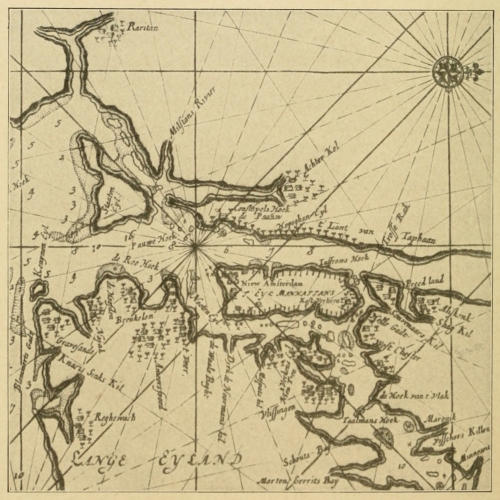
MAP OF NEW AMSTERDAM AND VICINITY, 1666
The Dutch were not slow to see what they must do against the swarming of the English at their doors. The best and only chance for New Netherland, it was plain, lay in pushing her own enterprises very vigorously and multiplying her own population as fast as possible, and so growing too strong to be despised and encroached upon. The great grants of land and privilege offered to patroons had attracted a few rich purchasers, but not many actual settlers. Not many could be found who wished to go to the New World to live under feudal lords more absolute than any in the Old. The company changed its policy, therefore. It offered patroons less and actual farmers more. It arranged to let every settler have land “according to his condition and means,” and to give him free passage to the colony; and it opened the trade of the colony to all upon equal terms. French Huguenots, as well as Dutch farmers, even Englishmen from New England and Virginia, came to take advantage of the new terms of settlement. It was no small part of the attraction of the place for the English in New England that there was as complete liberty of conscience in New Netherland as at Providence with Mr. Williams or on Rhode Island. The colony grew steadily, therefore, and in a way to countenance very sanguine hopes.
But every prospect was marred by bad administration. The place was spoiled by a veritable pest of governors. The company sent out either mere clerks, or else men of questionable reputation and ruined fortunes, to take charge of its affairs. The weak and sluggish Van Twiller, who blustered and threatened but did not act when the English began to crowd in at the Connecticut, was succeeded in 1638 by the no less foolish Kieft,—a good enough agent for business to be done on a small scale and by rote, but incapable of understanding strong and efficient men or any large question of policy; and Kieft brought everything to the verge of utter ruin by his faithless and exasperating dealings with the Indians. He prompted attacks upon them for what they had not done; demanded tribute from friendly tribes who were the colony’s best defence against those which were hostile; suffered them to be treacherously massacred when they fled to Fort Amsterdam for succor against the Iroquois; finally brought friend and foe alike to such a pitch of exasperation that they united for a war of extermination. Every outlying farm was rendered uninhabitable; scores of white men were put to death; the nearer English settlements suffered with the Dutch, and all the slow work of peaceful growth was undone. In that fearful year of plunder and death (1643) Anne Hutchinson lost her life, her last refuge swept away with the rest.

SIGNATURE OF SAMUEL BLOMAERT
In the South River the very friends of the Dutch played them false. Kieft did not scruple, in 1642, to drive away a body of English settlers there whom the New Haven people had sent down to take the trade of the region; but quite three years before that other rivals had fixed themselves on the western banks of the river of whom it was not so easy to get rid. In 1638 Samuel Blomaert, who had but a little while before taken out the rights of a patroon under the Dutch West India Company, and Peter Minuit, who had once been the company’s governor at New Amsterdam, set up a colony at the South River under a charter from the King of Sweden, Minuit himself leading the settlers thither, and bringing with him more Dutch than Swedes. And there the colony he established remained, safe at its “Fort Christina,” because stronger than the Dutch at their lonely “Fort Nassau.” The new-comers cheerfully lent a hand in driving the New Haven men out; but they kept their own foothold; multiplied faster than the men of New Netherland; grew steadily Swedish rather than Dutch in blood; and seemed likely, though neighborly enough for the present, to oust their lagging rivals in good season.
The principal general authorities on the history of New England during the seventeenth century are John Gorham Palfrey’s History of New England (1492-1774) and Compendious History of New England (1497-1765); the second and third volumes of J. A. Doyle’s English Colonies in America; John Fiske’s Beginnings of New England; Justin Winsor’s Narrative and Critical History of America, volumes III. and V.; Bancroft and Hildreth’s general histories of the country.
The development of the several colonies which were added to Massachusetts in the Puritan group, and some of the special phases of the growth of the little New England commonwealths, may be traced in detail in Benjamin Trumbull’s Complete History of Connecticut, from 1630 to 1764; Samuel Greene Arnold’s History of Rhode Island; George W. Greene’s Short History of Rhode Island; Edward E. Atwater’s History of the Colony of New Haven to its Absorption into Connecticut; Charles H. Levermore’s The Republic of New Haven (one of the Johns Hopkins Studies); Hubbard’s History of Massachusetts in the Collections of the Massachusetts Historical Society; Peter Oliver’s The Puritan Commonwealth: An Historical View of the Puritan Government in Massachusetts; Charles Francis Adams’s Three Episodes of Massachusetts History; various monographs in the Johns Hopkins Studies in Historical and Political Science; and W. B. Weeden’s Economic and Social History of New England.
The chief original sources are to be found in the Colonial Records of Rhode Island, Connecticut, and New Haven; the Provincial and Town Papers of New Hampshire; the Massachusetts Colony Records; the Collections of the Historical Societies of Massachusetts, Connecticut, New Hampshire, and Maine; Farmer and Moore’s Historical Collections of New Hampshire; the publications of the Gorges Society; the Narragansett Club Publications; Peter Force’s Tracts and Other Papers Relating to the Colonies in North America; the Publications of the Prince Society; John Winthrop’s History of Massachusetts, edited by J. Savage, and The Life and Letters of John Winthrop, edited by R. C. Winthrop; and Thomas Hutchinson’s History of Massachusetts.
VI. The Civil Wars and the Commonwealth
On the 19th of May, 1643, commissioners representing Massachusetts, Plymouth, Connecticut, and New Haven, sitting in Boston, made a formal agreement that their colonies should be joined in a confederation for mutual support and defence, under the name of The United Colonies of New England. Mr. Hooker and Mr. Haynes had been urging such a union for quite six years, ever since the synod of churches had sat, in 1637, to draw up its list of heresies and unwholesome opinions in reproof of Mrs. Hutchinson and her supporters in Boston; for the Connecticut towns had no charter of their own, and these prudent gentlemen knew how much they might need the aid and countenance of their neighbor colonies should the time come when their rights were too narrowly questioned,—by the Dutch, for example. New Haven, with her government but just formed, and with as little show of charter rights from the crown as the towns of the Connecticut, was glad to come into the arrangement for very much the same reason. Plymouth and Massachusetts agreed because there was common danger from the Indians all about them and from the French in the north, and because there were awkward boundary disputes to be settled between the several colonies, for whose discussion and peaceful decision it would be well to have some common authority like that of a confederation. Massachusetts, by far the greatest and strongest of the colonies, no doubt expected to rule in its counsels. The other colonies hoped to restrain Massachusetts and hold her back from dominating overmuch.
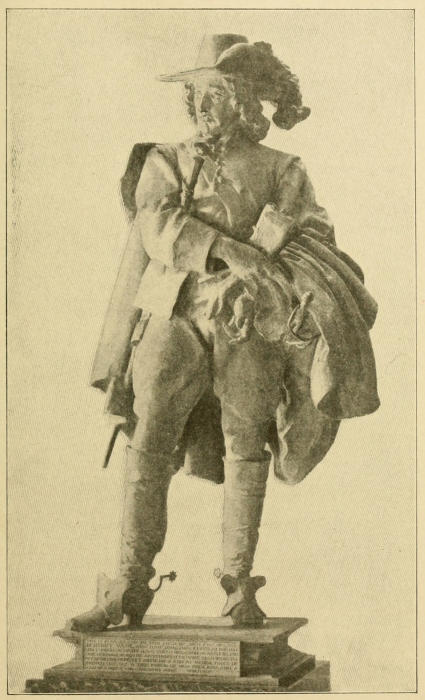
STATUE OF SIR HENRY VANE
That same year, 1643, Roger Williams went to England to get a charter for the settlements in the Narragansett country. It was hard to deny Mr. Williams anything he seriously set himself to get and went in person to obtain, and young Mr. Vane, who had been governor of Massachusetts in Mrs. Hutchinson’s day, and who was Mr. Williams’s friend, being now returned into England, was one of the “Commissioners for Plantations” whom the Parliament in England had recently appointed to govern the colonies; so that by March, 1644, “Rhode Island and Providence Plantations” had their own separate charter rights, and could assert them upon a footing of equality with Plymouth and Massachusetts. The settlements on the Narragansett waters had been excluded from the confederation formed in Boston because they were thought to be too full of troublesome persons and uneasy politicians to be safe or peaceful partners; but now that they had their own charter they could endure the exclusion without too much anxiety as to how their rights should fare.
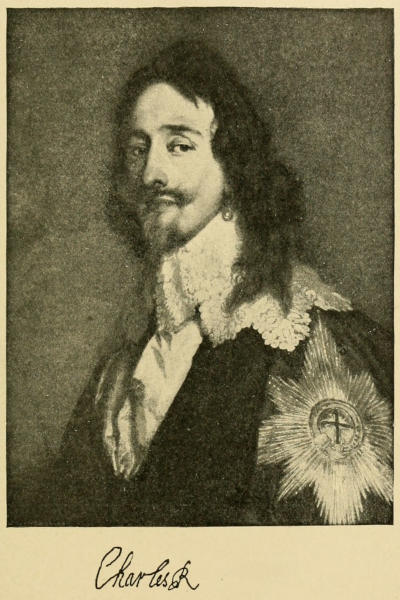
CHARLES I.
The articles of confederation which gave the Puritan colonies their new union spoke of advice and protection expected from the mother country over sea; but they said nothing of England’s authority over her colonies. The contracting parties conducted themselves like independent states, and asked no one’s leave to unite. At another time, perhaps, they would have hesitated; but now they had an opportunity that might not come again. England was convulsed with civil war. At last she was reckoning with Charles, the false king, who for ten years had refused to summon a Parliament, and who had seemed from year to year to become more and more openly an enemy of the liberties which Englishmen most cherished, until the slow fire of indignation against him, which had smouldered hotter and hotter the dark years through, burst into flame in Scotland, and men saw a revolution at hand. Even Charles saw then how fierce a tempest had sprung up against him, and yielded so far as to consent to call a Parliament. The Parliament, once called together, assumed a novel tone of mastery. Under the leadership of such men as the steadfast Pym, direct in speech, indomitable in purpose, no revolutionist, but a man whom it was wise for a king who ignored the laws to fear, and Hampden, whom all just men loved because he was so gentle and gracious in his gallant uprightness, the Commons impeached the men who had aided the King’s injustice, and proceeded to bring the government back again under the ancient restraints of freedom.
Charles saw that he must either yield all or else openly resist. He chose to resist; set up his royal standard at Nottingham (August, 1642); called upon all loyal subjects to rally about it for the defence of their king; and so brought civil war and a revolution upon England. Every one knows what followed: how at first the cause of the Parliament seemed desperate, because Pym died and Hampden was slain, and there was no leader in the field who could withstand Prince Rupert; and then how an increasing number of steadfast partisans of Parliament in Norfolk, Cambridge, Essex, Suffolk, and Hertford formed an association, levied troops, and put Oliver Cromwell beside the Duke of Manchester to command them; how Cromwell’s horsemen drove Prince Rupert’s men in hopeless, utter rout from Marston Moor on a July day in 1644; and then, in June of the next year, at Naseby, repeated the terrible work, and finished what they had begun, to the utter undoing of the King; and how Charles, on a day in May, 1646, seeing his cause desperate, surrendered himself into the hands of the Scots, in order to play the game of politics,—the game of war having failed; knowing that the Scots, who were Presbyterians, would not easily come to terms with Cromwell, whom it would be very hard to bring into any Presbyterian arrangement.
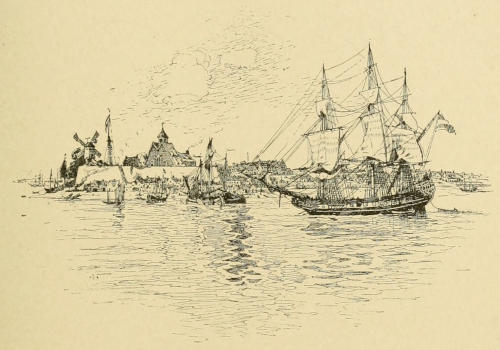
VIEW OF NEW AMSTERDAM, 1656
Three years went by, and the subtile King lay dead upon the scaffold at Whitehall (January, 1649), showing a gentle majesty and steadfastness at the last, though he had not known how to keep faith even with himself and his own friends while he lived. He was not brought to his death by the Parliament, but by the army, and the army did not represent the nation. Cromwell had not put his men to any test of opinion; but in the end it had turned out that the rank and file of the army were, for the time at any rate, “Independents,” holding opinions concerning worship and the government of church and state like those which he held, and the strict Puritans who had gone over sea into New England. They were the more likely to hold their opinions stiffly and without compromise because Parliament, leagued with the leading men of Scotland, was Presbyterian, was jealous of the army’s rising power, and wished to disband and send them home without so much as voting their pay. Though Cromwell held them back as long as he could from violent measures, they at last made bold to win by force in their contest with the Commons, and he found it best to lead them. All who were not partisans of the army and of the Independents were driven from the House, and the handful who remained brought the King to his trial and condemnation, and finally to his death at Whitehall, close by the window of his banqueting hall. They were acting for a minority of the nation, but no one dared withstand them.
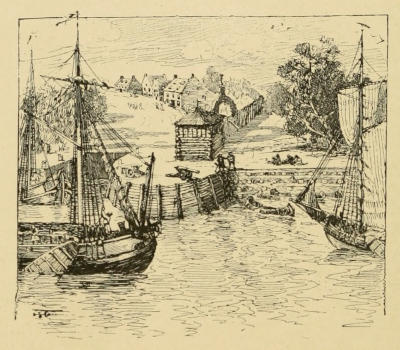
WATER GATE, FOOT OF WALL STREET, NEW YORK, 1674

FIRST MEETING-HOUSE, 1634-1638. ROGER WILLIAMS’S CHURCH
With such matters as these to look upon at home, there was no time in England to watch events in the far colonies across the sea. The New Englanders could form their confederation if they pleased without molestation. But if the war gave them freedom of action, it brought other things in its train which were not so acceptable. No new settlers came any more. Men began to return into England instead,—ministers to give counsel, as well as soldiers and men of affairs to lend their aid in the field of action. Stephen Winthrop, the governor’s son, George Fenwick, of Saybrook, Israel Stoughton, captain of the Massachusetts men sent against the Pequots, and not a few others of general note, entered the Parliamentary army. Edward Hopkins, who had but just finished his term as governor of Connecticut, and Edward Winslow, who had been with the Plymouth people from the first, went back into England to assist in the administration of the navy maintained against the King. Mr. Hooker was begged by letters signed by many chief men of the Parliament to come over and lend his counsel in the task of reforming the Church, but would not go because he saw the Presbyterians so strong in Parliament, and did not wish to be in a minority. It looked for a little as if John Winthrop himself might be drawn into the struggle at home. Mr. Hugh Peter, of Salem, who had been a leader among those who drove Roger Williams forth from the Bay into the wilderness, was among the first despatched to England to give counsel in the Puritan cause; and it was he who “preached the funeral sermon to the King, after sentence, out of Esaias”: “Thou art cast out of the grave like an abominable branch, ... as a carcass trodden under feet.... Because thou hast destroyed thy land and slain thy people.” It was a Puritan revolution, and the thoughts and hopes of the Puritans in New England turned eagerly towards the mother country again.
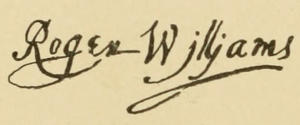
SIGNATURE OF ROGER WILLIAMS
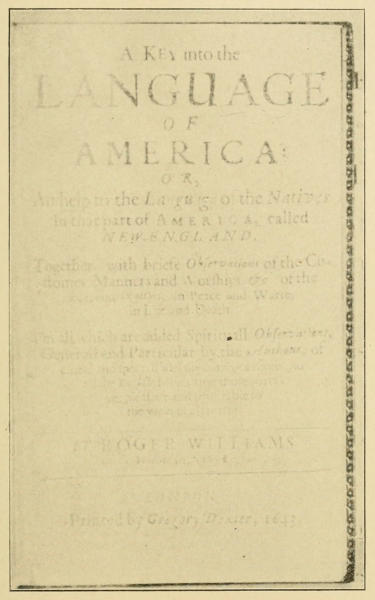
TITLE-PAGE OF ROGER WILLIAMS’S “LANGUAGE OF AMERICA”
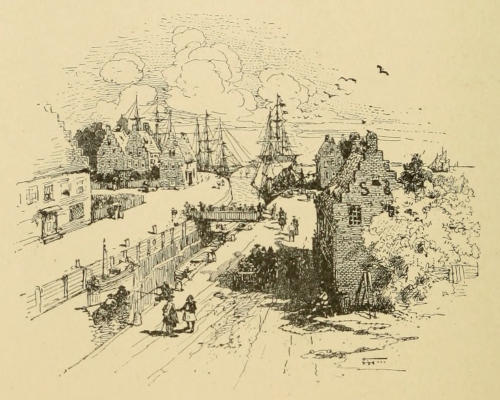
THE CANAL, BROAD STREET, NEW YORK, 1659
It was a very serious thing for the Puritan colonies that their rapid growth was thus stopped of a sudden. It meant that no farmer there could any longer get the high prices for his cattle or for his corn, or for any crop he might raise, which he had learned to count on while immigrants poured in; that the value of land suddenly declined; that every trade fell off; that money, always exceedingly scarce from the first, now stopped coming in altogether, for it could come only from England. Some of the colonists lost heart, and hastened to return to England, not to see the wars, but to escape ruin. Some took themselves off to the islands of the West Indies, where, they heard, it was easy to live. Some joined the Dutch at Hudson’s River. It required not a little steadiness of mind and purpose, not a little painful economy and watchful good management, to get over the shock of such changes and settle down to make the best of the new conditions. Happily the colonists were not men to be dismayed, and had made too good a beginning to fear actual failure. Massachusetts, with her four counties and thirty towns, her fourteen hundred freemen, her organized militia, her educated clergy, and her established leadership among the colonies of the north, was ready to stand upon her own feet, with a little practice; and the other colonies, on the Connecticut and on the Sound, had proved themselves from the first to be fit to live by struggle. Massachusetts had even established a college of her own, and was no longer entirely dependent upon the universities at home to supply her clergymen and her gentlefolk with an education. The General Court had begun the setting up of a proper school in 1636, had changed the name of Newtown, where the school was placed, to Cambridge, in order that it might seem to the ear a more suitable home for it, and, two years later, had called the little college Harvard, in honor of the young clergyman who, dying in their midst (1638), had bequeathed to it his library of two hundred and sixty books, and a few hundred pounds, the half of his modest estate. The doughty little commonwealth had already learned in no small degree how to be sufficient unto herself.
Only Virginia reaped any sort of direct material benefit from the civil wars. Her people were not Puritans. They were drawn from the general body of Englishmen who believed in the sanctity of the Church and of the crown, at the same time that they loved their own liberty and did not mean to be imposed upon by any man’s power, whether in church or state. Perhaps they did not know how much they were attached to the established order of things in England until those days of revolution came; for until then they had been very easy-going in church discipline, and very tolerant indeed of differences of opinion, acting untrammelled and without too much thought of uniformity, as if in the spirit of the free wilderness about them; for they were men picked out of every rank and class, followed no one opinion, lived in separated houses, and looked every one chiefly to his own business. But when they heard of what was happening over sea in England they knew their own minds very promptly, for they looked upon disloyalty as a thing not to be separated from dishonor. Their assembly, when they learned of the King’s death, flatly declared it an act of treason, the more impudent because brought about under the forms of law, and resolved that it was the right of Charles, the dead monarch’s son, to be king in Virginia “and all other of his Majesty’s dominions and countries.” They were led in their hot defiance by their governor, Sir William Berkeley, who had come to them by the King’s appointment the very year Charles set up his standard at Nottingham (1642). A bluff, outspoken man was Sir William, bringing with him to the rural colony the gallant, thoroughbred airs of the court, and standing square to his opinions and traditions. But the frank and genial humor of his ordinary moods gave place to very hot and stubborn passion when he saw how things went against the King at home, and it was he who led the Burgesses in their defiant protests against the revolution.
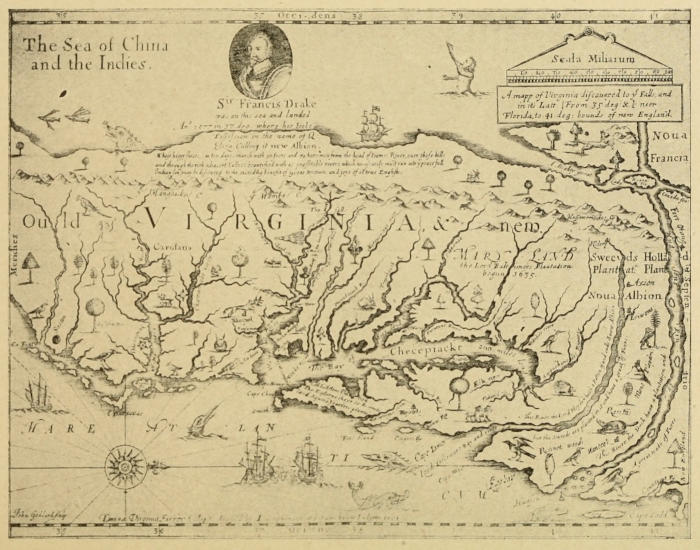
FARRER’S MAP OF VIRGINIA, 1651
The King’s partisans in England, when they found things grow too desperate for them at home, were quick to perceive that Virginia was their natural and safest place of refuge, and her open countries began slowly to fill with exiled Cavaliers. The tide-water counties began to get a new character with this fresh infusion of rich blood, and Virginia grew while New England stood still.
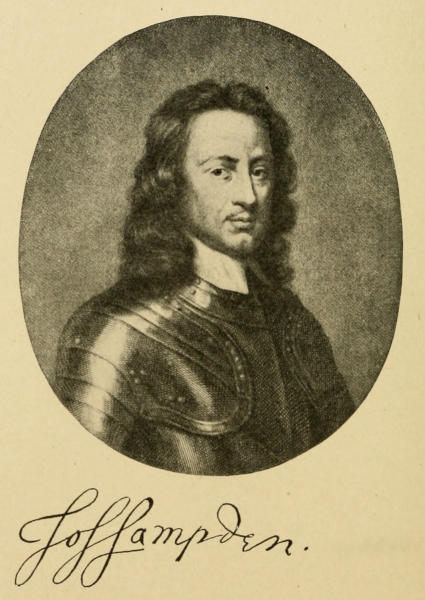
JOHN HAMPDEN
But it was not safe for Virginia, for all she was so far away, to defy the Puritan government at home. For, the fighting in England over, and the intrigue that centred about the King ended, the Puritan leaders were masters of the kingdom. Even Sir William Berkeley swallowed his mortification and submitted when an armed frigate came into the river (1652) with commissioners on board whose orders were to reduce Virginia to obedience to the commonwealth, and who had the promise of all necessary force to sustain them in what they did. The real temper of the colony was not as fierce as the tones of the Burgesses’ resolutions had been when they condemned those who had killed the King. There was a singular mixture among the Virginians of loyal sentiment and stubborn, matter-of-fact independence in all practical matters. The rank and file of them, though Church of England men in religion, had in them a dash of hard-headed sagacity very like the circumspect caution of the Puritans themselves,—a way of seeing the wrong time to fight and the right time to make terms. They saw as well as other men the necessity to bow, at any rate for the present, to a government which had Cromwell at the head of its forces,—and Sir William Berkeley accepted the course of prudence with the rest. The commissioners, fortunately, were men who knew the colony, and they came with instructions which prescribed in a very generous spirit what they should do. It had been one of the first acts of the Long Parliament to grant again to “the Adventurers and Planters in Virginia” the old charter rights which James had annulled, and to permit the old Virginia patent to be taken out again under the broad seal of England; and its commissioners were instructed accordingly. They did not oblige Virginia to receive a governor at the hands of the Parliament; they simply ousted the King’s men, and put the government into the hands of the Burgesses, the people’s representatives. Until 1660 Virginia was to rule herself, practically as she pleased, herself a commonwealth, subject to the greater commonwealth over sea.

SIGNATURE OF SIR WILLIAM BERKELEY
She was very well able to take care of herself. Her neighborly counties held already more than fifteen thousand thrifty English people,—and more, a great many, were being added now that ships were fast coming in full of the fugitive friends of the King,—sixteen hundred, once and again, in a single company. Twenty thousand cattle grazed upon the broad pastures which sloped green to the margins of the rivers, as well as great flocks of sheep, and, in the deep woods, swine without number. Ships passed constantly in and out at the rivers,—from Boston and New Amsterdam, as well as from London and Bristol, and the home ports of Holland. Though many in the colony ate from rich plate and were wealthy, the well-to-do were not much better off than the humble, after all, for no man needed to be very poor where there was such abundance for all. It was a democratic place enough, and the poor man’s small beer went down with as keen a relish as the rich man’s wine. The rough, disorderly ways of the early days of settlement were past, and were beginning to be forgotten now. Virginia had acquired some of the sober dignity and quiet of a settled commonwealth. Her clergy had often, at first, been as rough fellows as those not of the cloth, who came to Virginia to have leave to live as they pleased, and had been no help to religion; but now men of a better sort began to rule in her churches, and to sweeten her life with true piety. She could fare very well upon her own resources, whether in church or state. The Parliament’s commissioners had made rules under which any reasonable man could live. Any who pleased might drink the King’s health within doors, at their own boards, if they did nothing against authority out-of-doors. Speech was not to be throttled, men’s sentiments were not to be too curiously looked into. The exiled royalists who came steadily in, seeking a refuge, need sacrifice nothing but what they had already given up. Their very flight was confession of defeat; here in Virginia defeat might seem less bitter, though the necessity to obey Parliament and the Lord Protector was not less imperative.
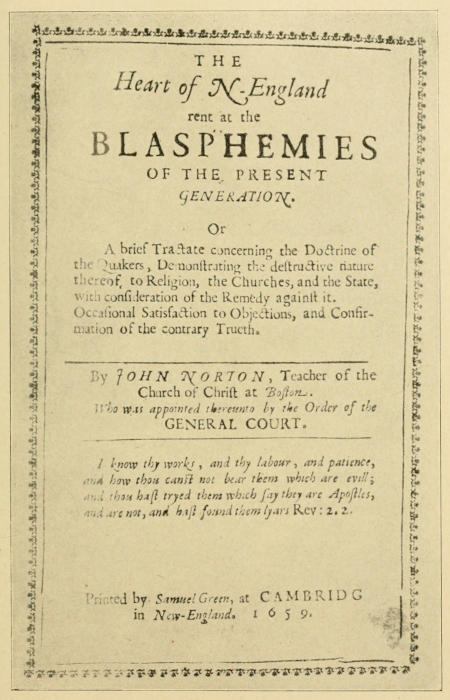
TITLE-PAGE OF NORTON’S BOOK AGAINST THE QUAKERS
In Maryland, Virginia’s neighbor, things wore a much harder face because of the revolution. The Parliament’s commissioners were friends of Virginia, and had dealt very lightly with her, but they felt no kindness for Maryland. Before their coming the little province had had its own taste of war. Late in 1644 William Clayborne, seeing his opportunity, had seized Kent Island again, from which Lord Baltimore had driven him at the first setting up of his government; and in February, 1645, one Richard Ingle, master of the armed ship Reformation, bearing letters of marque from the Parliament, put men and arms ashore and seized St. Mary’s itself. The Reformation was one of eight ships the Parliament had commissioned to bring food, clothes, arms, and ammunition to the province “for the supply and defence and relief” of the planters who were of its party against the King; and those who bore the commission used their power with little scruple. Master Ingle, in particular, had the strong stomach for adventure and for his own gain which comes to roving sailors in a lawless age, and a spirit of mastery which was his own. Ships out of Bristol carried the King’s commission to take ships out of London; ships out of London the authority of the Parliament to take all craft out of Bristol, and every man acted for his party and himself. “It pleased God,” Ingle said, “to enable him to take divers places” from the papists and malignants, “and to make him a support to the well affected”; and it was close upon two years before Leonard Calvert found himself strong enough to bring a force out of Virginia and re-establish his brother’s authority. The government of the province had not been destroyed, the while, but there had been a sad time of disorder and reprisal; partisans of the proprietor and of the King had seen their affairs shamefully handled; and the men who ruled had governed as if upon an exigency in a day of revolution. And then, six years later (1652), the parliamentary commissioners came, and William Clayborne was one of them. At first they thought it best to make the same moderate use of their power in Maryland that they had made of it in Virginia, and simply confirmed its government as it stood, content that it should be conducted in the name of the Commonwealth in England; but they thought themselves warranted in keeping their authority under their commission from the Parliament, and two years later asserted it again to effect a revolution, because they saw the proprietor likely to regain control of his province. They assisted (1654) to put the government of the colony into the hands of a group of Puritans who had made a settlement there, and for a time,—until Cromwell himself intervened to give Lord Baltimore his rights again,—the distracted province was ruled very rigorously by a masterful minority.
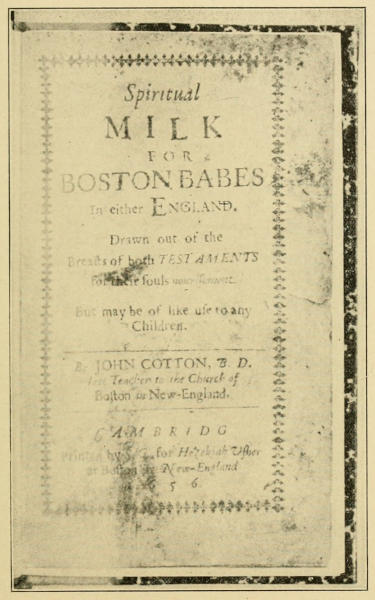
TITLE-PAGE OF ONE OF JOHN COTTON’S TREATISES
The Puritans who were thus made masters had most of them come out of Virginia. For a little while they had maintained their congregations unmolested, almost unnoticed, in Virginia, in the quiet lower counties below the river and near the Bay; but Berkeley had driven them out when he grew hot against the Puritan revolutionists in England, and they had made a new home for themselves in tolerant Maryland, where not only custom, but a formal Act of Toleration, drawn by the proprietor’s own hand, made them safe against molestation. They did not use their own power gently, however, when the parliamentary commissioners gave them control of the government of the colony; and called together an assembly of their partisans to support them. They repealed the Act of Toleration, and no more suffered any man to differ with them than Laud had permitted Englishmen at home to differ with him before the revolution, or than the Puritan Parliament had tolerated dissent from its purposes since. For three years they had their own way in all things, and the province was no better off for their handling when the courts in England at last gave it back into Lord Baltimore’s hands, in 1657.
FACSIMILE OF CROMWELL’S LETTER TO JOHN COTTON
The new government in England meant to maintain its authority in the colonies and at home no less steadily and effectively than the old government of the King had done, and Cromwell, when he became Lord Protector, proved a more watchful master than Charles had ever been, as well as a more just. But Massachusetts took leave, because it was a government of Puritans and her own friends, to practise a little more openly the independence in the management of her own affairs which she had all along meant and contrived to maintain. She very promptly dropped the oath of allegiance to the King when she heard that the Parliament had broken with him (1643); and now, when a commission which the Parliament itself had set up sought to dictate to her, though it had explicit authority “to provide for, order, and dispose all things as it saw fit” in the management of the colonies, she boldly declared that she thought it her right to govern herself without interference or appeal, so long as she remained obedient and faithful to the government at home in all things that affected Englishmen everywhere.
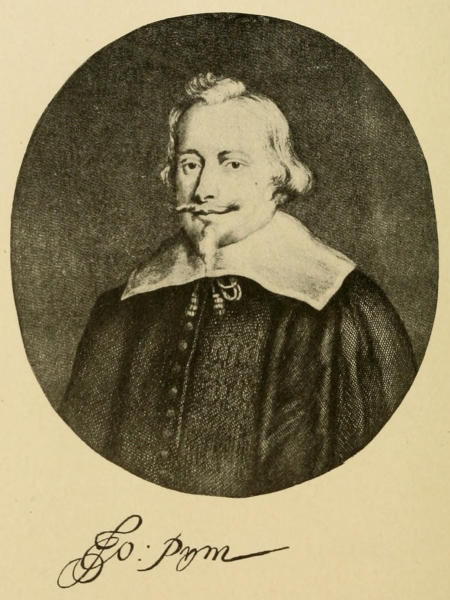
JOHN PYM
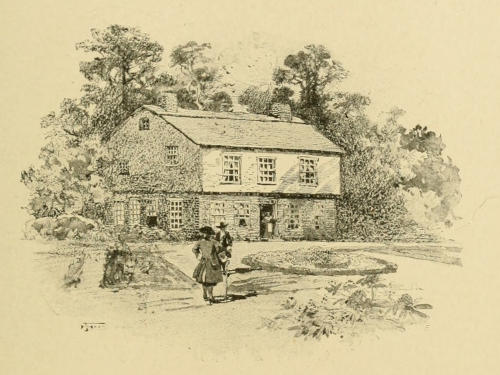
PETER STUYVESANT’S BOWERY HOUSE
She took occasion, while things went their new way, to set her own government in order (1644),—between Mr. Pym’s death and the day of Marston Moor,—while England was too much distracted to know what sort of government she herself had. The Bay government was not a comfortable government for any man to live under who was not a Puritan. The magistrates stood behind the ministers of the congregation to enforce their judgments in matters of morals, as well as to fulfil the law’s commands in every ordinary matter of government. The discipline of life which was thus imposed upon all alike, of whatever age or estate, made the little commonwealth a model place of steady work and clean living. Nowhere else in the world would you hear so few oaths uttered, or see so few idle or drunk or begging. The magistrates watched the lives and behavior of their people very diligently, and no man who did not live decently and reverently could long escape their punishment or rebuke. The weak and the sensitive suffered very keenly under their rigor, and those who were naturally gay and of high spirits found it very irksome and painful to be always on their guard not to jest too often or amuse themselves overmuch. Sometimes the reason of a high-wrought nature here and there would break down under the burden of stern doctrine and colorless living put upon it by church and state. But the strong and naturally grave men who predominated in the staid towns found it a fine tonic to be so governed, and were confirmed in their strength and self-control. In 1648 they drew more sharply than ever the lines of the church’s right to rule, in a formal platform adopted, in synod, at Cambridge. The authority of the clergy was given clear definition of law; the power of the magistrates to coerce all churches which should “walk incorrigibly or obstinately in any corrupt way of their own,” was affirmed more definitely than ever; and the ecclesiastical polity of the New England churches was declared to be such a “Congregational” establishment as should in no wise be confounded with any of “those corrupt sects and heresies which showed themselves under the vast title of Independency.” This “Cambridge platform” the General Court submitted to the congregations and the several congregations adopted. Henceforth no man need doubt what compulsion of worship and belief he must live under there.
New Haven and Connecticut could have admired the orderly peace and prosperity of Massachusetts more if they had found her juster and more generous in the part she played in the government of the confederation. In that they deemed her selfish. The colonies had an equal vote in the council of the confederation, but were obliged by the articles of their union to contribute to its expenses, not equally, but in proportion to their population, which threw much the heaviest burden upon Massachusetts. She, therefore, opposed all occasion of expense in matters in which she was not herself particularly interested. She would not vote to help New Haven get redress for the injuries which the Dutch had done her in the South River; she absolutely refused to take part in levying war on the Dutch when the other commissioners of the confederation voted it, when England herself was at war with the Netherlands; and she demanded tolls upon all goods brought from the other colonies into Boston, because the confederation sustained Connecticut’s right to charge tolls at the mouth of the Connecticut River. It seemed a profitless partnership enough to Plymouth and Connecticut, but most of all to New Haven, which had suffered most from the Dutch.
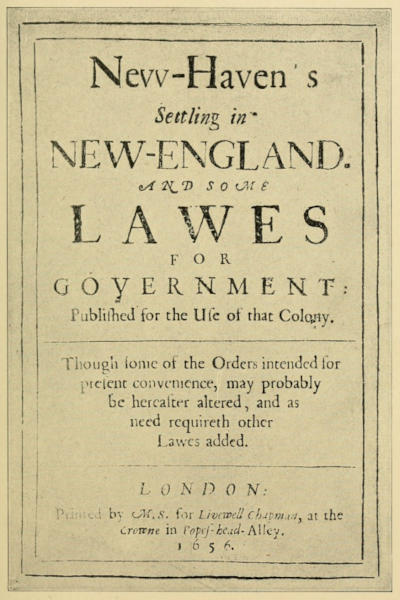
TITLE-PAGE OF THE EARLIEST BOOK ON THE NEW HAVEN COLONY
The New Haven men were merchants, and had not forgot their purposes of trade when they came from London with Mr. Davenport to seek a place where they might worship as they pleased. They had chosen the quiet southerly harbor at which they had settled because of its outlook upon regions of trade, north and south, within the forests and along the coasts which spread about them; and it had come close upon ruining them to lose all that they had laid out upon the settlement on the South River of New Netherland which the Dutch had destroyed. Nothing seemed to prosper with them. While they yet waited and hoped to get redress from the Dutch, they laid out a full thousand pounds upon the fittings and freight of a vessel to be sent into England, with some of their chief men on board, to obtain both trade and a charter in the mother country; and had cut the ice in their harbor at midwinter in their haste to get her out. But they never saw the ship again, nor any that went out upon her. One June day, indeed, in 1649, while a vague mist lay upon the bay, there suddenly appeared the form of a ship upon the water, with all her tackling, and her sails set, “and presently after, upon the top of the poop, a man standing with one arm akimbo under his left side, and in his right hand a sword stretched out towards the sea. Then from the side of the ship which was from the town arose a great smoke, which covered all the ship, and in that smoke she vanished away.” For as much as a quarter of an hour the crowd upon the beach, both men and women, gazed steadfast upon the phantom; and many deemed when it was gone that they had seen their lost craft and treasure. That same year, 1649, they turned again to the commissioners of the confederation with their urgent prayer for forcible redress against the Dutch,—and got nothing. Massachusetts again declined to lend her assistance, and war between England and Holland blew off before it came to actual conflict between the Dutch and the English in America. New Netherland began to show itself stronger than ever under a new governor,—no very wise man, but much better than Van Twiller and Kieft and the rest of the foolish men who had preceded him.