Chapter II · THE SWARMING OF THE ENGLISH (continued 4)
Reading edition
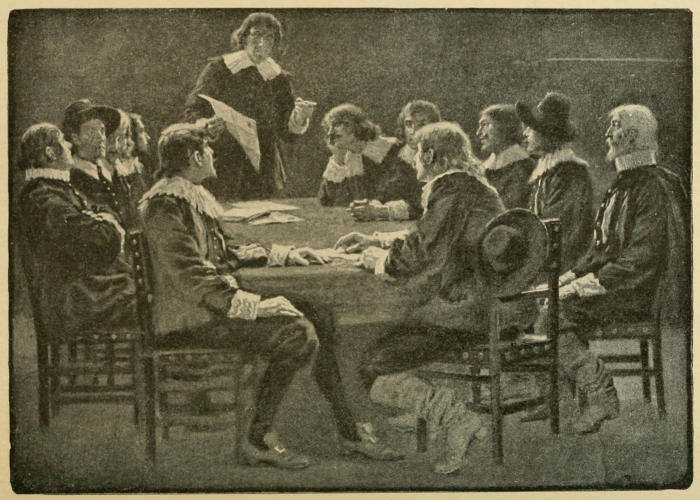
A VIRGINIA VESTRY MEETING AFTER THE RESTORATION
It was not this government of the “country gentlemen,” at any rate, that had brought on the fatal troubles with the redskins which had stirred Mr. Bacon to his first act of rebellion; for New England also, self-governed and free as yet, had had her own struggle with the Indians, even more terrible and bitter, which had ended that same eventful summer of 1676. The New England Indians had not forgotten the fate of the Pequots; but that was now close upon forty years ago; the terror of it was no longer fresh, and their own situation had meantime grown a bit desperate. They were being shut within intolerably narrow bounds, and they could not move away from the regions where the English were slowly crowding them from their hunting-grounds without invading the territory of other tribes who would have no welcome for them. The white men paid for the lands they took, but they did not permit the redmen to refuse to sell. They played the part of masters always, and there could be no hope of better times to come. Devoted missionaries had come among the tribes from the white settlements and had won many of them to believe in the gospel of the true God; but their preaching was like the telling of idle fables to most of the reticent, intractable people of the forest, and left them untouched. They were ready at last when a leader should arise to plot for an uprising and a last trial of strength with the invading palefaces. Such a leader arose in the person of Philip, the chief of the Wampanoags, whom the English had penned up within the narrow peninsula of Good Hope by the Bay of Narragansett. The flame which Philip kindled among the Wampanoags promptly spread to the Narragansetts and the Nipmucks, until it burned on every border, and New England saw a day of terror such as she had never seen before. There was no trouble like Virginia’s. No governor hesitated, no armed force lacked authority to do its work of protection and attack, no levy lagged or was tardy; the country rallied to the awful business. The fatal uprising began in June, 1675, and was ended,—for those tribes at least,—by August, 1676, as the Pequot war had ended, with the annihilation of the offending tribes. Those that were not killed or taken were driven forth in hopeless flight; those that were taken were sold as slaves in the West Indies. Thereafter there were only the tribes in the north to reckon with. But the white men’s loss was almost as great as that of the savages. More than one-half of the towns of Massachusetts and Plymouth had seen the torch and the tomahawk that awful year; twelve of them had been utterly destroyed; no fewer than six hundred buildings, chiefly dwellings, had been burned; six hundred men had lost their lives, and scores of women and children; debts had been piled up and damage suffered which it would take years of bitter toil to pay and repair; and New England was for a little like a place desolate and stricken. But she rallied in time, as always before, and slowly worked her way to better days, like the old days for peace and prosperity. Her dangers and anxieties were, at any rate, lessened in one matter that had often seemed to hold fear and danger permanently at its heart.
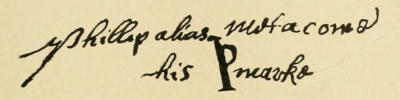
KING PHILIP’S MARK
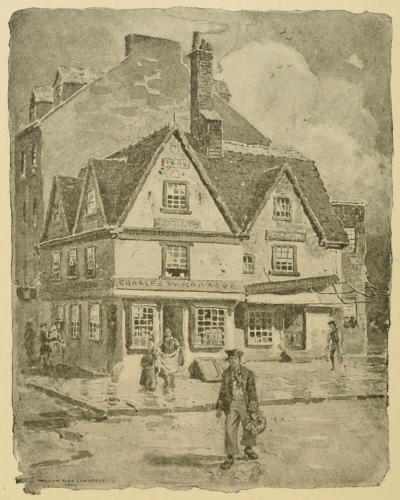
OLD HOUSE IN DOCK SQUARE, BOSTON
The chief general authorities for the history of New Jersey in the seventeenth century are Mr. William A. Whitehead’s East Jersey under the Proprietary Government, Contributions to East Jersey History, and The English in East and West Jersey, 1664-1689, in Winsor’s Narrative and Critical History of America, volume III.; Mr. Berthold Fernow’s Middle Colonies in the fifth volume of Winsor; the first and second volumes of Bancroft and the second volume of Hildreth; the second volume of Bryant and Gay’s Popular History of the United States; Andrew D. Mellick’s Story of an Old Farm; Austin Scott’s New Jersey, in the American Commonwealth Series; and Francis B. Lee’s New Jersey as a Colony and as a State, 4 volumes.
The chief sources are to be found in the archives of the State of New Jersey; Leaming and Spicer’s Grants, Concessions, and Original Constitutions of the Province of New Jersey, 1664-1682; the Collections of the New Jersey Historical Society; and Samuel Smith’s History of the Colony of Nova Caesaria, or New Jersey, to 1721.
The principal general authorities for the history of the Carolinas in the seventeenth century are Mr. J. A. Doyle’s English Colonies in America, volume I.; William J. Rivers’s Sketch of the History of South Carolina and The Carolinas, in the fifth volume of Winsor’s Narrative and Critical History of America; the first and second volumes of Bancroft and the second volume of Hildreth; the second volume of Bryant and Gay’s Popular History of the United States; the second volume of John Fiske’s Old Virginia and Her Neighbours; Dr. Francis L. Hawks’s History of North Carolina; David Ramsay’s History of South Carolina, from its First Settlement in 1670 to the year 1808; François X. Martin’s History of North Carolina, from the Earliest Period; and the valuable monographs, chiefly on the history of North Carolina, to be found in the Johns Hopkins University Studies in Historical and Political Science.
The chief sources for this period of the Carolinas are to be found in the Colonial Records of North Carolina; Sainsbury’s Calendar of [English] State Papers, Colonial, V.; B. R. Carroll’s Historical Collections of South Carolina, which contain, among much more material of the first importance, Alexander Hewatt’s Historical Account of the Rise and Progress of the Colonies of South Carolina and Georgia, originally published in London in 1779, John Archdale’s account of the development of the colony to his own day, the portion of George Chalmers’s Political Annals of the Present United Colonies which relates to Carolina, and Locke’s Fundamental Constitution for Carolina; the Charleston Year Books, into which many valuable records, otherwise scattered, are brought together; Peter Force’s Tracts and Other Papers Relating to the Colonies in North America; and Ben Perley Poore’s The Federal and State Constitutions, Colonial Charters, and other Organic Laws of the United States.
IX. Pennsylvania
The troubles of Massachusetts did not end with the death of King Philip and the extermination of the hostile tribes. That very year of blood and terror, 1676, on the contrary, saw an old danger renewed. Mr. Edward Randolph arrived out of England commissioned to command the authorities of the colony to send agents over sea to answer for their assumption of power over the settlements to the north, beyond the bounds set by their charter, and in despite of the rights of those who were the legal proprietors there. It was the beginning of a very serious matter. She was to be brought to book at last for her too great independence, and her acts as if of sovereignty over the settlements about her. Poor as she was, after her awful struggle with the redskins, she hastened to buy out the rights of those who claimed proprietorship in Maine and New Hampshire (1677) for twelve hundred and fifty pounds sterling; but that only angered the wilful King the more and hastened graver difficulties. She was charged with illegally coining money, with persistently violating the Navigation Acts and trading as she pleased, with exercising whatever powers of government she desired without stopping first to find them granted to her in her charter; and there was little defence she could make in face of the plain facts. Again and again she sent capable agents to England to excuse her acts and justify them; but they made little impression upon the Privy Council or on the King’s officers, and she was obliged in mere prudence to receive Mr. Randolph as the collector of customs, and speak submissively of the King’s power.
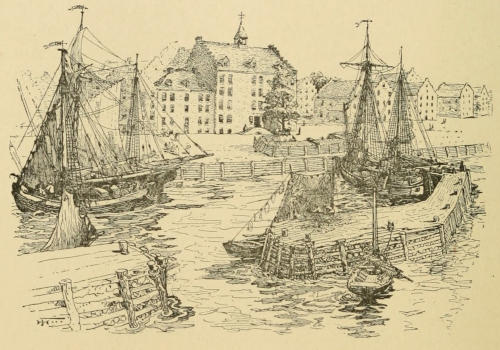
NEW YORK CITY HALL AND DOCKS IN 1679
At last there was an action of quo warranto against her (1683), and then a writ issued against her in the Court of Chancery, and in the end, October 23, 1684, an adverse judgment which declared her charter forfeited and her government returned to the crown. It was a bitter thing, but there was this time no escape from enduring it.
The same year, 1684, Virginia returned to her normal government again, as a royal province, and not the property of Lord Culpeper. The improvident King had not stopped with granting to Lords Arlington and Culpeper, in 1672, “all the dominion of land and water called Virginia,” and the quit-rents due from all the lands already occupied there; he had gone further, and in 1675 had appointed Lord Culpeper governor of the colony for life. Lord Culpeper had bought out the rights of Lord Arlington, his co-proprietor, and seemed commissioned at length to be Virginia’s veritable sovereign master. But his career both as owner and as governor stopped very far short of the term of his life. By 1684 the King, tired of him, had withdrawn his commission and bought off his rights, leaving him a proprietary title over only the “Northern Neck” of Virginia,—the great peninsula which ran back to the mountains between the Potomac and the Rappahannock rivers; and the colony was again directly subject to the crown.
Lord Culpeper was little in his province even while his term as governor lasted. Sir Henry Chicheley was generally to be found acting in his stead,—a real Virginian, whom all esteemed a man of honor and of parts, a resident in the colony these twenty-five years, and for long either burgess or councillor, a neighbor and friend of the men he ruled as deputy to his lordship. Culpeper wished to be popular, and courted the good-will of the colonists as he could; but a man without morals could not govern, and a man who would not stick at governing could not please the King, and his downfall was inevitable.
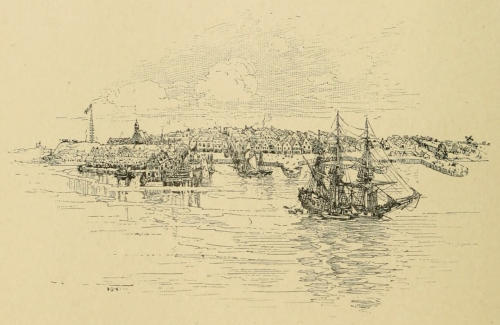
NEW YORK ABOUT 1673
It was in the bad times of his rule that a new disorder fell upon the colony. In 1679 and 1680 the crops of tobacco were immense; there was more, much more, than could be sold, and its value fell so much that it was worth little or nothing to make purchases with,—and yet it was the colony’s chief currency. The assembly wished to stop or limit the planting of tobacco for a little, by statute; but the King, through the governor, forbade the restriction; and there suddenly broke forth a new sort of rebellion. In 1682 mobs of excited people swarmed upon plantation after plantation, destroying the growing crops of tobacco, until what would have filled ten thousand hogsheads had been cut up as it grew, and two hundred plantations had been laid waste within a single county. The armed forces of the colony stopped the riotous, lawless work at last; three of the ringleaders were tried and hanged, and order was restored; but it was made evident once again to what a temper things could be brought in Virginia when her people were not allowed to regulate their own affairs by orderly course of law; and the King’s disgust with the rule of Lord Culpeper was not a little heightened.
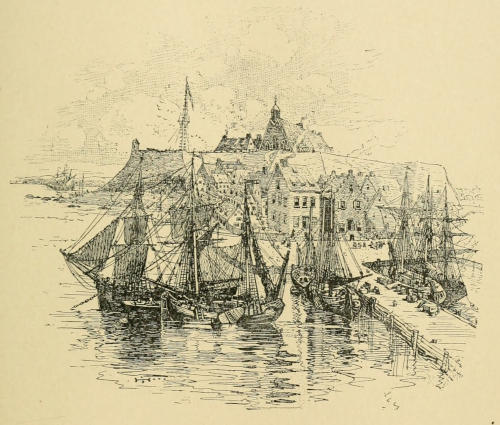
THE STRAND, NEW YORK, 1679
Government by proprietors did not seem to go anywhere very well. Even Lord Baltimore found Maryland an uneasy property, and kept it only by consummate tact and watchful management. There were elements of every sort combined in its make-up. Not one-tenth part of its people were of the proprietor’s creed any longer; and not many besides Catholics were heartily and by choice of his party in affairs. At every change of political weather there was sure to be some sudden tempest or some covert insubordination there. In 1660 the assembly of the province, headed by Mr. Josias Fendall, the proprietor’s own deputy, assumed sovereign power till it should hear that the restoration of King Charles was accomplished fact,—as the assembly in Virginia did,—thinking the new King would be in no mind to support a proprietor whom Cromwell also had befriended. Only when it found the King Lord Baltimore’s friend notwithstanding did it return to its allegiance. In 1675 Cecilius Lord Baltimore died, his only son, Charles, succeeding; and the next year one Davis and one Pate, taking their cue from Mr. Bacon in Virginia, made bold themselves to head an actual rebellion in arms. Their assembly, like Virginia’s, was chosen by freeholders only, contained a majority whom the proprietor could command and would not part with, and had ever since 1671, like Berkeley’s favorite Long Assembly, been kept alive by adjournment,—elections, apparently, having fallen out of favor on both sides the border. The Indians were upon their frontier also, and the taxes went, it seemed to the insurgents, for nothing but to pay for offices provided for the enjoyment of the proprietor’s own kinsmen and adherents. But success in Maryland depended upon success in Virginia. When Mr. Bacon died, the Maryland insurgents yielded as promptly as the Virginian; Davis and Pate went to the gallows; and there was an end of that. But there was no ease in affairs even then. Maryland was not so readily to be kept in hand as Virginia. Not her restless Puritans merely, but all her yeomen also, of the rank and file, with their peculiar freedom in local government, made her quick with the spirit as if of a fretful and aggressive democracy. She had a class of free tenants upon many of her estates who kept alive throughout her country-sides a form of liberty very ancient and very vital, and who made her life, so far as they were concerned, very different indeed from that of the country-sides of Virginia, where all alike looked to the magistrates, the sheriffs, and the county lieutenants for government. Many a chief estate in Maryland had its separate organization and its separate privilege of self-government as a manor, under the terms of the charter. In its court-leet, sitting under the presidency of the steward, its freemen enacted their own local bye-laws, chose their own constables and bailiffs, empanelled their own juries, and put all petty offenders to their trial and punishment. In its court-baron the freehold tenants sat as judges of law and fact in matters of rent, trespass, escheat, and the transfer of lands, not only in suits among themselves, but in the settlement of their rights as against their immediate lord the chief of the manor as well. Here was a school of sturdy self-assertion transplanted out of the feudal law of old England into an air never breathed in the Middle Ages, and men of the lesser sort were heartened in their democracy accordingly. The barons of Baltimore had the self-confident tenants of many a miniature barony to deal with in their province; and had occasion to discover very often how vital a commonwealth it was that surged restless under their government.
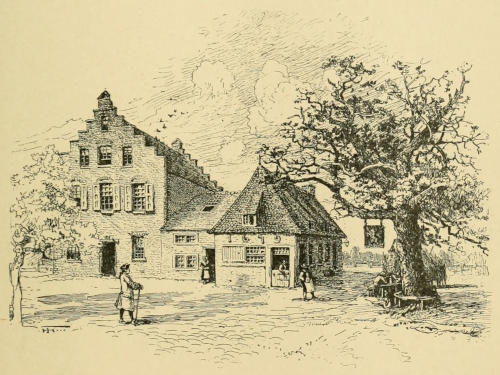
A NEW YORK HOUSE IN 1679
Newer proprietors had not the advantage of their experience, and were always slow to see how uncommon a sort of property a colony was,—and that the high-spirited men who undertook to settle in colonies, like Englishmen everywhere, must be governed, if governed at all, under a free system which took note of their real circumstances and had their assent. Carolina furnished an example. There were, in fact, two Carolinas. Since the abandonment of the settlements which had for a little while struggled for a permanent foothold on the Cape Fear (1664-1667), there was nothing but unbroken wilderness through all the long reaches of silent forest which lay between the Albemarle country and the settlement at Charleston,—full two hundred and sixty miles as the crow flies. There could not well be one government for both these separated places, except in name; and it was difficult to tell which was the harder to govern. For almost a whole generation (1669-1698) the proprietors tried to force their Fundamental Constitutions upon them, but made no progress whatever in the matter. The list of proprietors was constantly changing. Some wearied of the business and sold their shares in it, some became bankrupt, some died. And governors changed more rapidly even than proprietors,—no governor finding his seat very easy or being able to please both his masters in England and the colonists in Carolina. New proprietors brought no new wisdom, new governors no new capacity, to the unchanging task, and the settlements took their growth after a way of their own.
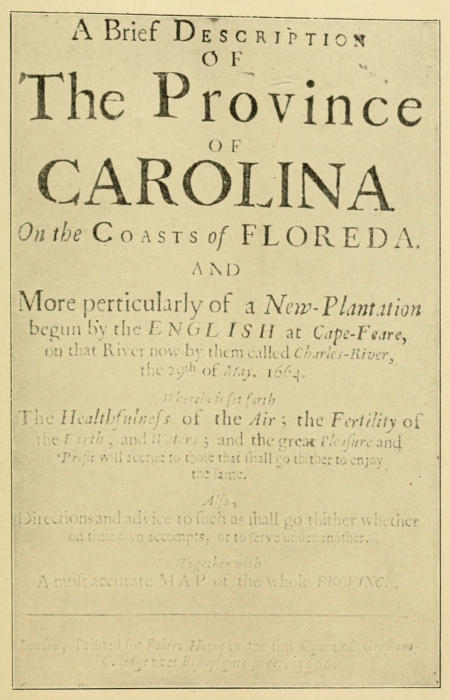
TITLE-PAGE OF “A BRIEF DESCRIPTION OF THE PROVINCE OF CAROLINA”
The Albemarle settlers, whose region presently came to be called “North” Carolina, were, on the whole, the more indulged. They endured many things, it is true, of many governors,—even to open robbery at the hands of one Seth Sothel, who bought the Earl of Clarendon’s interest in the colony and came among them to rule as proprietor and get what he could out of his purchase on the spot. But they drove him from the colony in 1689, after having put up with his intolerable insolence and greed for five years together with more than their ordinary patience. They made their temper pretty clearly understood at last, and were suffered to go their own way in most things, with only enough interference and enough demands for quit-rents to keep them uncomfortably in mind of the proprietors. The settlements about the broad Sound slowly filled, and were not a little steadied in their ways of life by a constant increase in the number of Quakers among them. French Protestants came also, and made settlements of their own a little farther to the southward, in Pamlico and on the Neuse and Trent. Swiss and Germans founded a little hamlet at New Berne. The rich heart of the fertile country within was still untouched. There were barely five thousand people there in the year 1700, after forty years of growth. The proprietors had little to show thereabout for their ambitious efforts at colony building. But the colonists themselves took heart to believe their lot established, and no one could doubt that here were at least communities about whose maintenance there need be no concern. They were there to stay, and to grow, though it were never so slowly.
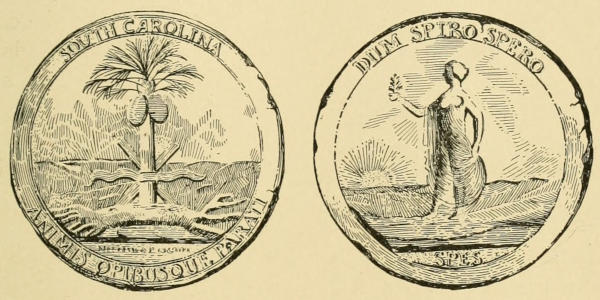
ORIGINAL BROAD SEAL OF SOUTH CAROLINA
There was more to be seen at the other far-away settlements in “South” Carolina,—a town, at any rate, and a safe port of entry, such as there was not anywhere upon the northern sounds. Charleston had been removed in 1680 from its first site to a fine point of land which lay opposite, where the Ashley and Cooper rivers joined to make a spacious harbor before passing to the sea. The removal had proved a mere stage in its growth,—a proof of its vitality. Englishmen, Irishmen, Scotsmen, Frenchmen, Germans sought the new colony out and made their several contributions to its founding. But the proprietors reaped little benefit. The English and Scottish colonists were not easy men to deal with when governors put the interests of the proprietors before the interests of the colony, or insisted, as they were bidden to insist, upon the enforcement of the impossible Fundamental Constitutions. Moreover, there were troubles peculiar to the place. The Spanish were close at hand at St. Augustine, watching their chance to attack and destroy the settlement. The colonists invited danger of still another kind by seizing Indians for slaves, and so exasperating the redskins. The English-speaking colonists did not wish to admit the Frenchmen who came among them to the full privileges upon which they insisted for themselves; but they were very keen for their own rights, and understood very well to what they were entitled under the charter to the proprietors. Governors lived no more comfortably among them than among the people of North Carolina. There were twenty-five hundred settlers in the colony by the time the new Charleston at the confluence of the rivers was six years old (1686), and seven thousand by the time the century was out (1700); but the more numerous they grew, the more steadfastly did they insist upon having no government they did not like.
Proprietary government was proving quite as difficult, meanwhile, in New Jersey; but the monotony of failure had been broken there by the sudden re-entry of the Dutch upon the scene. England and France had joined in war against Holland in 1672, and a hostile Dutch fleet presently found its way to the coasts of America. It first preyed upon the commerce of Virginia and Maryland in the south, and then, standing to the northward, entered the familiar harbor at New York, and took possession as easily as Colonel Nicolls had taken possession nine years before. From August, 1673, to November, 1674, the Dutch were masters in their old seats; there was no New York, no New Jersey; all alike was New Netherland once more. But it was a mere episode, a mere passing reminder of the old days when the Dutch were really masters there. In 1674 the war ended, and England regained her provinces by the treaty of peace (Treaty of Westminster, February 9, 1674).
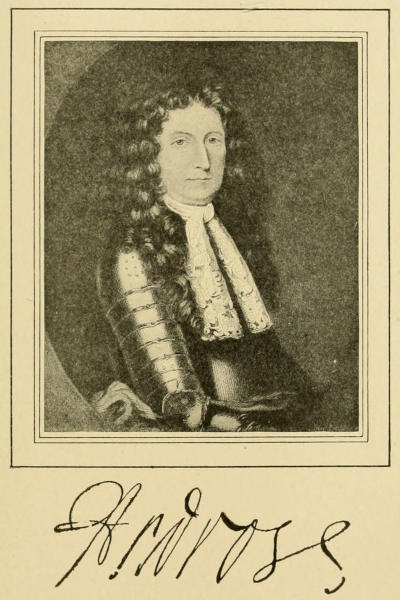
SIR EDMUND ANDROS
The withdrawal of the Dutch, however, did not put the affairs of the English back at the point at which they had been broken off by the conquest. There were new difficulties to face. Philip Carteret again became governor in New Jersey, for Sir George Carteret, the proprietor; and for a little his task seemed easier than it had been before the Dutch came. The chief English towns of the province had stubbornly resisted his authority until the very eve of the coming of the Dutch men-of-war, though he had been steadfast and had not ceased to rule in such matters as he could, or to press the interests and the powers of the proprietor. At last documents had come out of England which conclusively put an end to the claim of the uneasy colonists that they had a right to act independently of the proprietor; but they had hardly reached Carteret before the Dutch fleet came in. When the Dutch were gone again the once discontented towns received their English governor back with a sort of satisfaction, having been gladdened to see the alien masters go. But there were new difficulties, because Edmund Andros, that stirring major of dragoons, was governor of New York. King Charles made a new grant of New York to his brother the Duke of York in 1674, to cure any doubt the Dutch occupation might be thought to have put upon his title; and the Duke promptly granted East New Jersey over again to Sir George Carteret; but the new grant was not couched in the terms of the old, left a doubt upon the mind of a careful reader whether it meant to renew Sir George’s sovereignty or only Sir George’s ownership as overlord,—and his Grace had explicitly commissioned Andros to be his deputy in the government of New York “and its dependencies.” Andros understood Carteret’s new charter literally, as it read, and acted as if he had been bidden annul the right of Sir George’s governor to govern. He saw to it that the New Jersey towns should get as little comfort out of the resumption of their separate government as possible. He was a bluff soldier, bred in the school of Prince Rupert, as honest as he was direct and determined,—not a man to originate a policy of his own, but sure to do what he understood he was commanded to do very absolutely, without tact or scruple or hesitation, with the rough energy of a man who was no politician, but only a soldier. Moreover, he had in him the warm blood of thirty-four. At first he contented himself with collecting customs duties at the New Jersey ports as well as at New York for the Duke’s revenues; but when Sir George Carteret died, in January, 1680, he went further. He challenged Philip Carteret’s authority outright, accused him of acting without legal warrant within the Duke of York’s patent, “to the great disturbance of his Majesty’s subjects,” and, when he would not yield, seized him, deposed him from his government by force, and himself assumed the authority of governor in the New Jersey towns. The next year, 1681, saw Carteret upheld and reinstated and Andros rebuked by official letters out of England, and the discredited soldier went home to give his account of the affair. East Jersey was to have quiet again for a little under new proprietors.
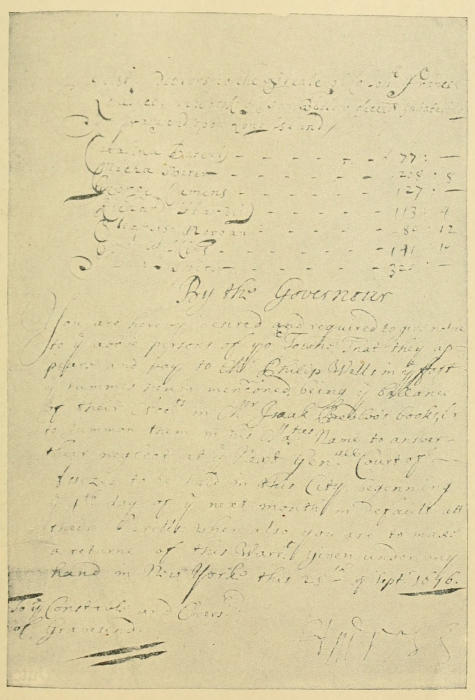
DOCUMENT BEARING AUTOGRAPH OF SIR EDMUND ANDROS
The King’s new grants made of New Jersey, not a single province, as before, but two distinct provinces, East Jersey and West Jersey. Lord Berkeley, Sir George Carteret’s associate in the original grant, had sold his interest in the province early in 1673, before the Dutch came, and when the Dutch were gone again Sir George Carteret’s grant was renewed, not for the whole of New Jersey, but only for “East” Jersey. “West” Jersey passed into the hands of those who had bought out Lord Berkeley’s interest in the original gift. It included all the southwestern portion of the province, below a line drawn from Little Egg Harbor at the sea sharply north and northwest to the northernmost branch of the Delaware in latitude 40° 41′. Its lands lay upon the great river from end to end, almost, of the original grant. All the spreading waters of the stream below and of the great Bay through which it opened to the sea were its highway and frontier.
East Jersey passed, after Sir George Carteret’s death, to a numerous company of proprietors, by purchase (1681),—men of all “religions, professions, and characters.” Some were high prerogative men, likely to be of any king’s party; some were dissenters, some papists, some Quakers. The governors whom they sent out were not likely to push any one interest or opinion or scheme of authority, and their province fell upon quieter days, when governors and colonists could generally agree and live in peace together.
West Jersey seemed sometimes, to outsiders, a place with no government at all. It, too, had numerous proprietors, whose shares were constantly changing hands, to the confusion both of questions of ownership and questions of government. But there was, in fact, a quiet growth of prosperous settlements, nevertheless. The several hamlets planted within the little province were established by people abundantly able to take care of themselves, and local government went peacefully on, whether there was any definite guiding authority fixed for the colony as a whole or not. Moreover, there was in due time, when affairs had settled and taken on a normal face, a very well ordered government for the province, under a popular assembly to which the proprietors accorded powers very freely, and which they let their governors heed and obey in a way that other colonies might very well have envied.
Both provinces prospered. Many settlers preferred the Jerseys to New York. There was less taxation there, and less interference with merchants’ dealings. The currency was kept freer from sudden changes of value than elsewhere, because the law did not play with its value. In West Jersey the laws for the punishment and suppression of crime were singularly humane and just. A wilderness lay between the towns near New York and on the Monmouth grant and the towns upon the Delaware; only an Indian trail here and there, like that which ran from the Puritan settlement at Newark south and southwest to the river, threaded the untouched forests; and it was not easy to pass from the one region to the other except by sea. But settlers poured in very steadily to the parts that were open, from New England and Long Island especially, as well as from over sea. Saw mills and iron mills were set up; tar, pitch, and turpentine were shipped in paying quantities from the pine forests; whales, caught upon the very coasts, yielded rich supplies of oil and whalebone; and the Jerseys made ready to be as forward as any other colony in growth and self-support.
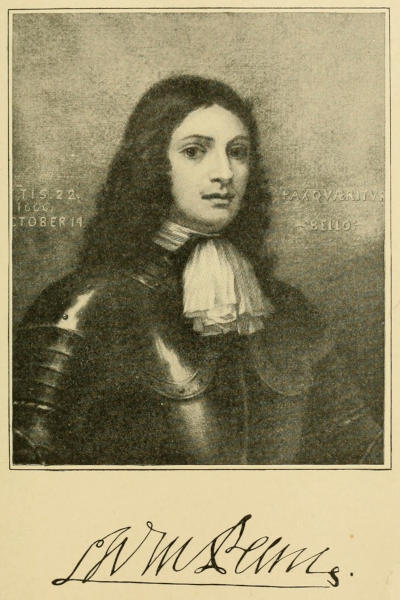
WILLIAM PENN
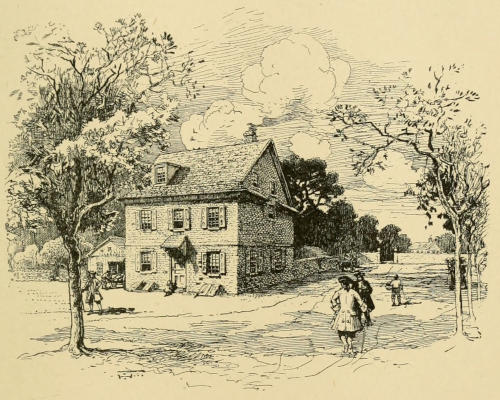
WILLIAM PENN’S FIRST RESIDENCE IN AMERICA (LETITIA COTTAGE)
The democratic government of West Jersey, the humane clemency of its laws, the full freedom of religious belief allowed to all comers, and all the features of liberality and tolerance which drew settlers to the Delaware were due in no small degree to the presence of influential Quakers among its proprietors. Among the rest was William Penn, a man at whose hands schemes of proprietorship in America were to receive a new dignity, and a touch almost of romance. He was but thirty-one when he bought a share in the province of West Jersey (1675). He had been born in 1644, the year before Mr. Ingle turned reformer and roving governor in Maryland,—two years after Sir William Berkeley came out to be governor in Virginia. That was also the year in which Mr. George Fox, the founder of the sect of Quakers, first began, a lad of twenty, to preach a new way of life. He preached no new creed, but only simplicity and purity of life, the direct gift of a guiding light from Heaven, without intermediation of priest or church or learned dogma, the independence of every man’s conscience, and his freedom from the authority of man or government in such things as concerned the life of the spirit. He spoke such words as made men’s hearts burn within them, and quickly kindled a fire which no man could put out or check. William Penn had become his follower at twenty-four, taken captive almost upon a first hearing by the new and generous way of thought which so gently bade men better their lives.
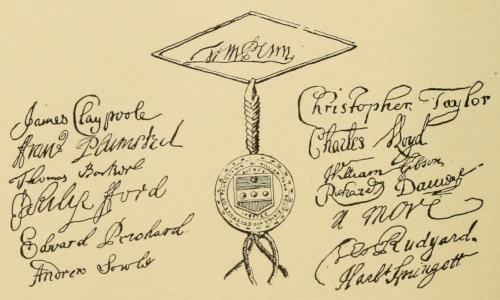
SEAL AND SIGNATURES OF THE PENNSYLVANIA FRAME OF GOVERNMENT
Penn was singularly unlike the plain, unlettered people who had been the first to hear Mr. Fox with gladness and live as he counselled. He was son to Sir William Penn, whom all the world knew as admiral in the royal navy, a great career behind him, a favorite with the King for the service he had done him when he was restored,—half man of the world, half bluff sailor; a man of fortune, and of a direct and ready fashion of making his own way; no lover of new-fangled notions or young men’s whims; and his son had so handsome a person, so gallant a manner, so manifest a charm in what he said and did, that Sir William’s head was filled with dreams of what he should become,—dreams of preferment and a notable career in affairs. It astounded and angered him mightily that the boy should turn Quaker and give up everything for a set of foolish notions. But it half pleased the old man, after all, when his first choler was passed, to see how steadfast his son was. It half amused him to recognize his own wilfulness turned to such a use. Presently he forgave the strange lad, like the frank sailor he was, and helped him to succeed in another way.
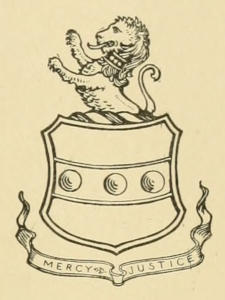
THE PENN ARMS
And so it turned out that West Jersey was bought,—so far as Mr. Penn and those who thought with him among the new proprietors were concerned,—to be a refuge and place of peace for the Quakers. It was the Quakers who principally crowded into the new province and gave it its prosperity and its sober way in affairs. But Mr. Penn’s plans widened as his thought became engaged in this great matter. A mere share in the ownership of West Jersey did not satisfy him. He determined to have a province of his own, a Quaker colony upon a great scale. The outcome of that purpose was the founding of Pennsylvania, whose peaceful story of orderly government and quick prosperity reads like the incidents, almost, of an idyl amidst the confused annals of colonial affairs in that day of change. Sir William Penn had died in 1670, and had left to his son, among other items of an ample fortune, a claim for sixteen thousand pounds against the crown. The young Quaker asked for a grant of land in America in satisfaction of the claim, and the King readily enough consented, glad to please an old friend’s son and be quit of an obligation so easily. Penn asked for and obtained the land “lying north of Maryland, on the east bounded with Delaware River, on the west limited as Maryland is, and northward to extend as far as plantable” into the unclaimed Indian country; and the King pleased his own fancy by calling the grant “Pennsylvania,” in honor of the old admiral whose claim against the crown he was thus paying off. The grant was dated March 4, 1681.

SEAL OF MASSACHUSETTS PROVINCE
There was a charming frankness and nobility about the spirit in which the young proprietor set out upon his great enterprise. He admitted “that government was a business he had never undertaken,” but he promptly assured those who were already settled in his province that they should be “at the mercy of no governor who comes to make his fortune great. You shall be governed by laws of your own making,” he said, “and live a free and, if you will, a sober and industrious people.” “For the matter of liberty and privilege,” he declared, “I propose that which is extraordinary, and to leave myself and successors no power of doing mischief,—that the will of one may not hinder the good of a whole country.” His wish was to honor God and the principles of the despised sect in whose service he had embarked his faith and his fortune. “The nations want a precedent,” he said; and it was his hope to give it them as boldly and wisely as possible. It was his belief, as it was the belief of the great Edmund Burke a hundred years afterwards, “that any government is free to the people under it (whatever be the frame) where the laws rule and the people are a party to those laws.” He meant that his colonists should have such freedom as his gift, and at the very beginning of their government.

MASSACHUSETTS COINAGE
There were, when he set up his gentle rule, scarcely five hundred white men, all told, settled within the territory Charles had given him: a few tiny Swedish hamlets, a few Quaker families who had crossed the river from West Jersey, stragglers here and there, looking for good lands. There was something of a village at Upland (whose name Mr. Penn was presently to change to Chester), on the river, where the authority of the new proprietor was first proclaimed and his liberal plan of government made known in September, 1681; but the real creation of the colony was to follow, when colonists began to pour in under the new arrangement. In August, 1682, Mr. Penn added to his first grant from the King the lands lying about New Castle and below, by purchase from the Duke of York, to whom they had passed with the rest of New Netherland when the Dutch were ousted; and a few hundred more were thereby added to the number of his colonists, Dutch as well as Swedes, and a few score scattered groups of lonely settlers. Maryland hotly protested the new grant. Her own charter gave her the Delaware for eastern boundary. She had never acknowledged the title of the Dutch there, and thought the title of his Grace of York no better. But her protests were not heeded. Mr. Penn was determined not to be shut within the continent, but to get his own outlet to the sea, and took what the wilful Stuart granted him. The very month of that new grant, August, 1682, he himself took ship for his province, with a goodly company of Quakers, to begin the real planting of the new region. He reached the colony in October; and during that autumn and the winter which followed (1682-1683) no fewer than twenty-three ships came into the Delaware bringing immigrants; to be followed presently by other ships seeking trade.
Within but a little more than a single year of his coming, Mr. Penn could boast, “I have led the greatest colony into America that ever any man did upon a private credit, and the most prosperous beginnings that ever were in it are to be found among us.” By 1685 there were more than seven thousand settlers there. Englishmen predominated among them, but almost one-half the number were of other nationalities,—French, Dutch, Swedes, Germans, Finns, Scots-Irishmen, whoever would come, men of all creeds and kinds, who had sought out the free place and had been accorded an ungrudging welcome. A company of Welsh Quakers arrived before the proprietor himself (August, 1682), and settled upon a tract apart, which it had been agreed beforehand they should have. The next year came a little colony of Germans to obtain like privileges upon a grant of their own, and to make ready for others of their race, a great many, who were to follow. And so company followed company, now of one nationality and again of another, bringing what creed and what peaceful practices of self-government they pleased, to be received and given grants of land without question. Quakers for a while predominated, as Mr. Penn had wished. The German settlers were most of them Mennonites, whose creed and way of simple living were very like those Mr. Fox had preached. And where there were Quakers government was apt to be a very simple matter. Few officers were needed in their hamlets, and for a while no courts at all. They settled their common affairs not only, but the private quarrels, differences, and difficulties of their members also, very quietly in their own stated meetings, and seemed to know the secret of enforcing good temper as well as orderly conduct in a way very honorable to their principles.
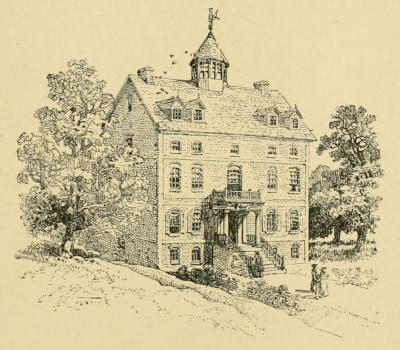
PROVINCE HOUSE, RESIDENCE OF THE ROYAL GOVERNORS OF MASSACHUSETTS
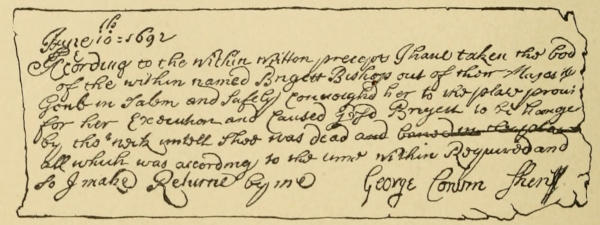
FACSIMILE OF A SHERIFF’S RETURN EXECUTION OF A WITCH
The chief town of the province was established at the confluence of the two fine rivers Delaware and Schuylkill, and Mr. Penn named it Philadelphia, wishing it to be a place of peace and good-will. At first those who were to build there lived in caves cut out of the bluffs which lined the river; but they were quick at substituting good houses. By the end of the year 1683 there were no fewer than one hundred and fifty dwellings built,—frail and cheap enough, no doubt, but sufficient until stone and brick could be had, and time in which to build with them. The change came very soon. The sober, substantial, yeomanlike folk who came into the colony preferred, whenever it was possible, to build of good, lasting stuff, and to build solidly and well. Before Mr. Penn sailed for home, in 1684, there were already three hundred and fifty houses erected, some of them several stories high, built with cellars and decorated with balconies. Outside the central town, with its busy two thousand colonists, there were quite fifty hamlets in the thriving province.
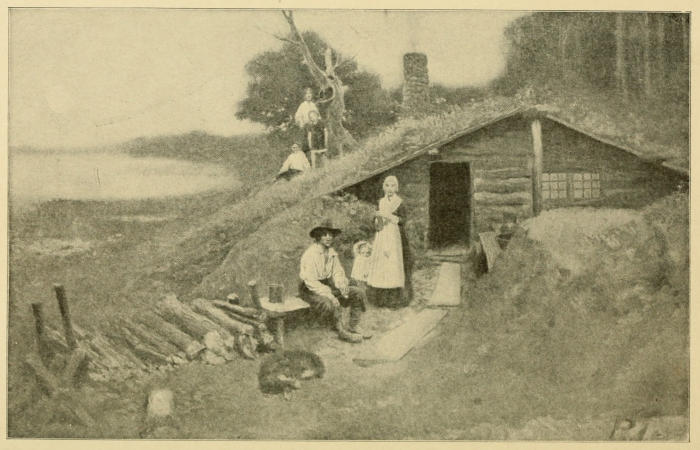
A PENNSYLVANIA CAVE-DWELLING IN 1683
Government did not go quite so easily after Mr. Penn returned to England. He left men behind who wished to have their own way, and whom no authority less than his own could restrain. “For the love of God, me, and the poor country,” he wrote them, “be not so governmentish, so uneasy and open in your dissatisfaction.” But, though the growth and prosperity of the colony were a little retarded by the bickerings of those left in control, there was, after all, less turbulence in the sober colony than Pennsylvania’s neighbor settlements had made shift to put up with and survive. The government was liberal in all things, and very simple in its make-up,—upon the familiar model of deputy governor, council, and assembly. The courts did not attempt the elaborate procedure of the courts at home. There were not lawyers enough in the colony for that, and no one was very anxious to see more of them there. A very simple method of trial sufficed for simple causes, with or without juries as the parties to the suit might agree; and the Quakers at their periodical meetings saw to it that as few of their own people should resort to the courts as possible. That various population was of course too heterogeneous and too spirited not to give its rulers trouble; but it went on to prosper very well, and to make its way in the world in a fashion so orderly that its neighbors might well have looked on in envious wonder.
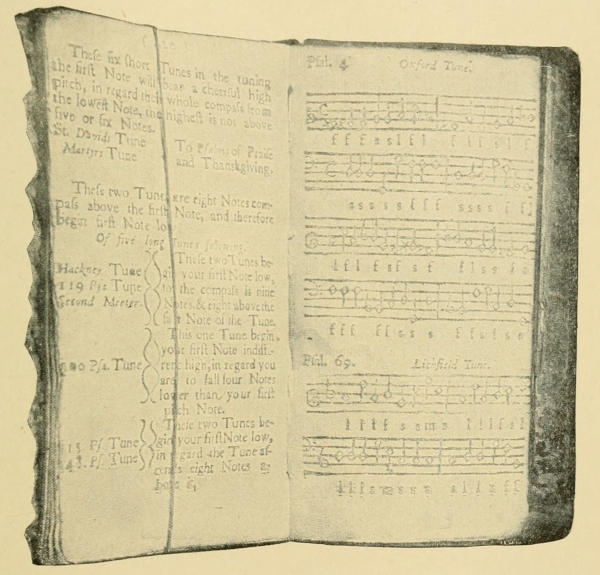
PAGE OF TUNES FROM THE “BAY PSALM BOOK”
For one thing, it kept peace with the Indians as its neighbors could not. The Quakers everywhere seemed to win the confidence of the redmen upon the instant, as Roger Williams had won it, whose doctrines and principles of life were so like their own. They won it by loving justice and keeping faith, and Mr. Penn set them an example which neither they nor any others who heard of it were likely to forget. He scrupulously purchased the land he occupied of its native owners. He hoped for their speedy civilization, and stipulated in the contracts which he made with those who in turn purchased from him that the Indians should have “the same liberties to improve their grounds and provide for the sustenance of their families as the planters” who were established there. There was something that took hold of men’s imaginations in the sober conference he held with the Indians, as if with the leaders of an equal race, at Shackamaxon, June 23, 1683, and in the terms of the free treaty then entered into. Peace between the white men and the red in Pennsylvania rested always upon the firm foundations of mutual confidence which were laid that day. It was a peace whose guarantee was good-will and friendliness. It was a colony of rigorous laws. “Profanity, drunkenness, the drinking of healths, duelling, stage plays, masks, revels, bull-baiting, cock-fighting, cards, dice, and lotteries were all prohibited,” and women might be fined for clamorous scolding, quite as in Puritan New England. But it was a more kindly rigor, as the Indians perceived. The New Englanders had sought to be just with the redmen; but the Quakers sought to add a gentle kindliness to justice, and their peace was more lasting than that of the English in the north.
And yet not even their fine temper and quick spirit of justice could have so steadily held the restless redskins off from mischief had not the fates of the forest made their borders a place of peace. The Indians they dealt with were not the men who had once made that wilderness a place of dread and caution. Six years before Mr. Penn got his charter (1675) the formidable Susquehannocks, once masters there, had turned their faces to the south, beaten and in retreat before the implacable hatred of their kinsmen of the Five Nations at the north, and had gone to harry the borders of Maryland and Virginia and bring Mr. Bacon to his fate. There were now none but humble Delawares to be dealt with in Mr. Penn’s province, men who paid their tribute right promptly to the masterful Iroquois who had driven the Susquehannocks out, accepted them as masters, and dared not lift a hand against the English, whom the Iroquois received and fought for as friends and allies.
The next year after Mr. Penn’s meeting with the Indians at Shackamaxon saw an infinitely more important treaty concluded with the Indians in the north. This was the treaty made with the great Iroquois confederacy itself at Albany, on the 2d of August, 1684, to secure the frontiers of the English alike against the redmen and against the French. The tribes of that memorable confederacy were the most capable and formidable anywhere to be found upon the eastern stretches of the continent. Their power extended from the lakes to the borders of the Carolina grant,—as the Susquehannocks had reason to know. The Dutch in New Netherland had early won their friendship,—the French in Canada their bitter enmity. It was with the firearms the Dutch had sold them that they had made themselves masters in all the Indian country north and south, and had brought their power to such a pitch that no settlement of the white man was safe without their good-will. The French had long ago sent missionaries among them, to speak to them both of the true God and of the sacred authority of his Majesty their king in France, and had used, through these, every argument of interest and every threat of power to bring them to an alliance; but the shrewd sachems who were their statesmen had stood out unchangingly against their advances, and had held fast to the English, seeing very clearly in their calm counsels, as they sat apart, how much greater the power of the white men grew in the south than in the north. The English governors of New York were as quick as the Dutch rulers of New Netherland had been to see the priceless value of this protecting friendship of the border, no less than of the great trade in furs of which it made Albany the mart and centre. They saw how it would serve them when it should come to the final rivalry between French and English for the possession of the interior of the continent; and they held the French off by a very close alliance with the masters of the forests.
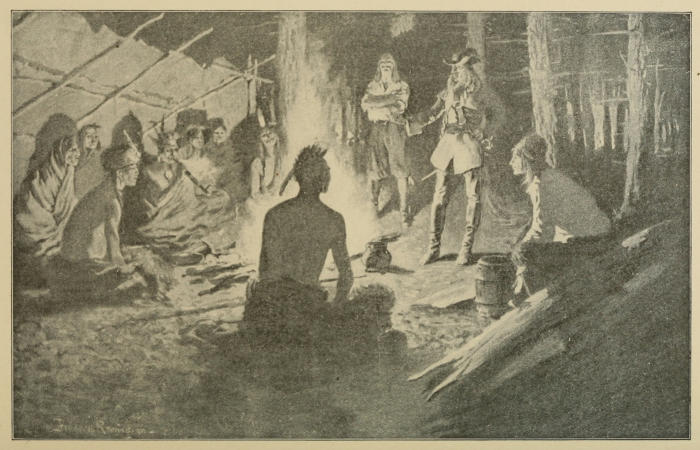
AT AN IROQUOIS COUNCIL FIRE
Governor Andros, being a soldier and man of affairs, had seen to this critical matter in person, going himself to the stronghold of the Mohawks and establishing a permanent board of Indian commissioners to keep warm the alliance with the powerful confederacy which the Mohawks represented. He was as efficient in the proper affairs of his own province of New York as he was arbitrary in pushing for authority beyond its borders in the Jerseys. And Colonel Thomas Dongan, whom the Duke of York selected to succeed him in the government of the colony, was no less watchful and competent. Had his Grace known as well how to choose servants and counsellors in England, he had fared better, and might have kept his throne when he came to it. Colonel Dongan was a soldier, an Irishman, and a Roman Catholic, and had served in the armies of France,—no good school for an English governor,—and yet he proved himself a wise ruler in a colony in which the Duke, his master, saw fit to permit liberty of conscience and to observe a very liberal policy in affairs.
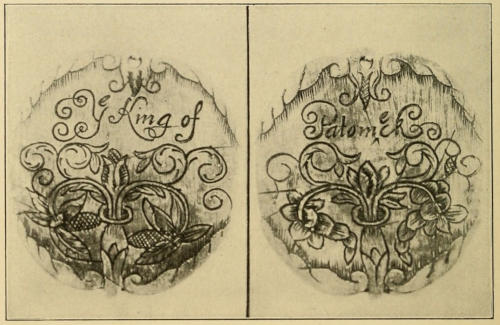
MEDAL PRESENTED BY JAMES II. TO THE KING OF THE POTOMACKS
Colonel Nicolls had established a singular government in New York at the very outset, nineteen years ago. There was nobody in all its organization to represent the colonists. Its officers were appointed; its decrees were absolute. But its decrees were also liberal and just, made in the interest of the colony as well as in the interest of the Duke. Andros had been knighted for his services there, and was Sir Edmund when he went home in 1681 to explain his quarrel with Philip Carteret; and no wonder, for he had done a notable thing. He had strictly enforced the laws of trade, admitting no vessel to discharge her cargo at the great bay where his government was which had not paid duties or made clearances as the English statutes commanded; and, instead of breeding rebellion by what he did, had linked New York to the home ports in England by a direct trade across sea, which every year grew greater, and which steadily tended to make his province the chief home in all America of loyalty and cordial feeling for the mother country, a chief port of entry for English ideas and English sympathies.
Colonel Dongan did no less for the Duke’s authority, but in another way. In his treaty with the Indians, that notable treaty of August, 1684, he did no more than confirm the policy of Sir Edmund and the Dutch. What made the treaty so impressive an event was the presence and co-operation of Lord Howard of Effingham, now governor of Virginia. It was an agreement establishing not merely the safety of the borders of New York, but also the claim of the English to a sort of sovereignty and overlordship over all the great stretches of the continent south and southwest of Lake Ontario. It concerned Virginia no less than it concerned New York; and the redskins regarded it the more because of the presence of the ruler of the English in far-away Virginia, as well as of the Duke’s governor in New York.
Colonel Dongan had been instructed to play a very different rôle in the internal government of his province from that which Andros had played. Despite the very liberal measures adopted and the sound public spirit shown by the Duke’s governors hitherto, it was not in English nature to be satisfied for twenty years together without such an assembly to speak and act for the people as every other colony had, north and south. Emphatic protests and a strong appeal crossed the sea close upon the heels of Sir Edmund Andros in 1681,—speaking not so much discontent with the Duke’s governor as a firm and rooted objection to the form of government, which the colony now seemed entitled to say that it had outgrown; and the Duke thought it wise to yield. Colonel Dongan came, in August, 1683, instructed to appoint a council and call an assembly; and by October New York had a government like that of her neighbor colonies. No tax or imposition was to be laid or law made except by act of assembly,—and that looked like privilege enough. The new governor, too, might well be to the mind of all who liked candor and capacity. He had the blithe humor of his race, and was a man to approve and relish as a comrade; and yet his firm purpose and clear eye in all points of action made him also a man to respect, obey, and follow.
And then, when all things seemed settled, of a sudden the whole sky changed, because in February, 1685, Charles II. died, and the Duke reigned in his stead, as James II.,—a man whom all the world knew to be a Roman Catholic, and presently discovered to be a tyrant, the more intolerable for his solemn bigotry. The same year Louis XIV., king in France, revoked the great Edict of Nantes, forbade the Protestants their worship in his kingdom, and so drove fifty thousand of the best people of France,—soldiers, men of letters, craftsmen, artificers,—forth from the land they had enriched, to make Holland, England, Brandenburg, and America so much the better off for their skill and thrifty industry. By spring-time Monmouth and Argyle were in the field, and England saw rebellion lift its head again, both in Scotland and in the south. It was an ominous beginning for the sullen King; and the colonies were to get their share of the change which his reign brought to Englishmen everywhere.
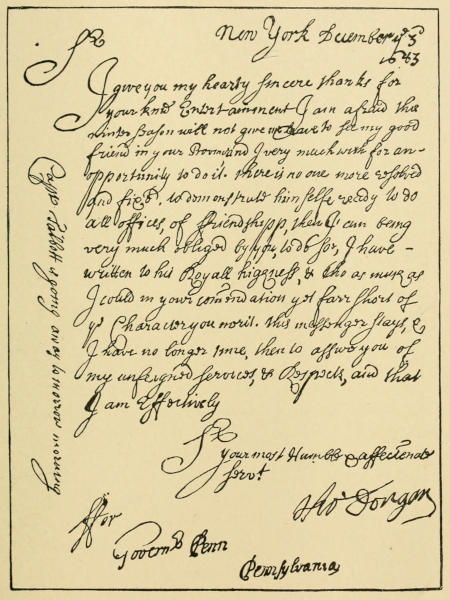
LETTER OF DONGAN TO WILLIAM PENN
It was a brief reign enough. James ran his course of tyranny with a sort of bitter haste, and had finished the mad business before the fourth year of his rule was ended. The first year (1685) saw the brutal Jeffreys ride his bloody circuit through Somerset and Dorset, to hang, scourge, or behead those who had incurred suspicion of sympathy, were it never so remote or slight, with Monmouth’s rising. More than eight hundred persons were sold into slavery over sea; three hundred and fifty said to be rebels were hanged; women were scourged from market-town to market-town, sent to the block, or burned; and all England stood horror-stricken to see the King’s revenge and bitter hate. The next year saw him openly bent upon freeing the Romish Church by his own authority from all restraint of law. Statutes he set aside by the use of what he said was the crown’s prerogative. He declared all creeds free; but he forbade the ministers of the established Church to preach its Protestant doctrine. Bishops who would not yield to his will he haled before the courts; and, lest the ordinary courts should prove disobedient, he set up a special Court of Ecclesiastical Commission, to do what he should bid in the discipline of the Church. He maintained a standing army without the consent or vote of Parliament, and levied taxes without its authorization. He was as subservient to France as to the Church of Rome, and admitted no one to his counsels who would not accept his creed and do his bidding.
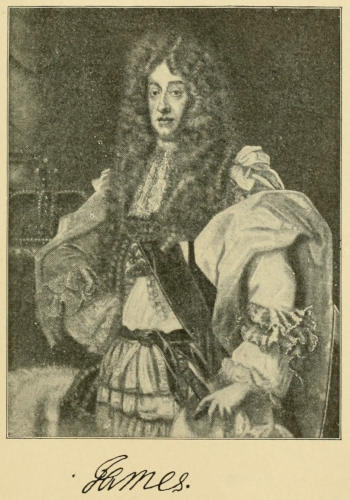
JAMES II.
It was strange the nation held its hand so long; and yet the end came swiftly enough. By midsummer, 1688, those who were ready to risk their lives and fortunes for England’s constitution had urgently prayed William, Prince of Orange, to come into England, put James from his throne, and save their liberties. William was husband to Mary, James’s daughter; was a Protestant, a statesman, and a man of honor. He came with an army at his back. But it was not necessary to conquer England. She knew her straits and was ready and glad to receive him. James miserably fled; the Parliament accepted his flight as a voluntary abdication; and the throne went by act of Parliament to William and Mary. Thus was accomplished what men who loved the ancient liberties of England were afterwards to look back to as “the glorious Revolution of 1688.” No king should henceforth pretend to any right to rule without consent of the Parliament, or in despite of the liberties of the nation which had executed Charles, ousted James, and re-established the throne in such fashion as suited its sense of justice and its own security. It was the formal setting up, as public law of England, of the bold doctrine of the people’s rights which Sir Edwin Sandys had preached from his place in the Commons seventy-six years ago to the deep displeasing of James I. The momentous thing was over and complete by February, 1689; and it was then just four years since Charles II. died.
For the northern colonies in America those four years had meant a memorable change of government, as ill to live under, almost, as the tyranny in England. For a little while after the loss of her charter in 1684 affairs had moved on smoothly and without serious incident in Massachusetts, though half-heartedly enough, it was plain, under a provisional government, waiting to see what the crown would do. The death of King Charles delayed a settlement; but James, when he came to the throne, very promptly showed what he meant to do. He resolved to put Massachusetts and the colonies lying immediately about her into the hands of a royal governor and an appointed council, without an assembly or any other arrangement for a participation of the people in the management of their affairs. At first (May, 1686) he named Joseph Dudley “President of the Council for Massachusetts Bay, New Hampshire, and Maine, and the Narragansett country, or King’s Province,” but gave him no authority to alter law or impose taxes. But that was only a temporary arrangement. The real change came with the arrival of Sir Edmund Andros, in December, 1686, to be “Governor-General and Vice-Admiral”; and Plymouth was added to his government.
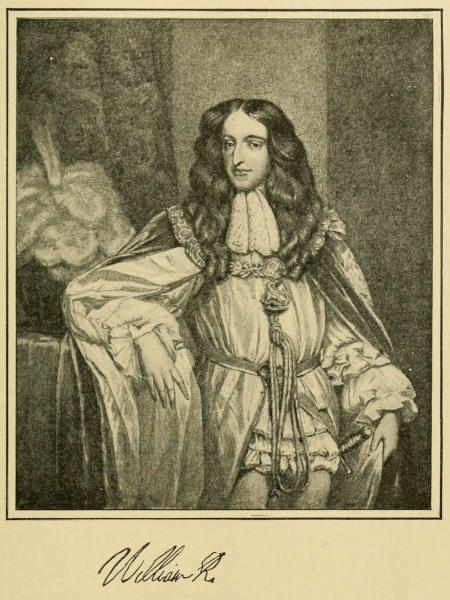
WILLIAM III.
Joseph Dudley had been unwelcome enough. It was a bitter thing for the people of Massachusetts to have this man, whom they deemed a traitor, nothing less, set over them. He was the son of Thomas Dudley, the stern Puritan of their day of first exile and settlement, who had been second to great Winthrop in the founding of the colony. And now Thomas Dudley’s son, once their agent in London to defend their charter, had consented to serve the crown in the overthrow of their liberties. But Andros was worse. Dudley was at least timid and time-serving and doubtful of his power; but Sir Edmund came with instructions and with a temper of command which no one could mistake. He meant no rank injustice, indeed, but he was no statesman, knew only the rough way of the soldier in carrying out his instructions, and had very definite and unpalatable instructions to carry out. He was bidden appoint persons of the best character and estate to his council, and to disturb the existing law of the colonies as little as possible; but he was also commanded to allow no printing press within his jurisdiction; to insist upon a universal toleration in matters of religion,—especially upon the encouragement of the worship of the Church of England; and to execute with vigilance and vigor the laws of trade. He was given, too, a small number of royal troops for his support, whose red coats were sadly unwelcome in Boston. Worst of all, he was authorized to govern and to lay taxes without an assembly.
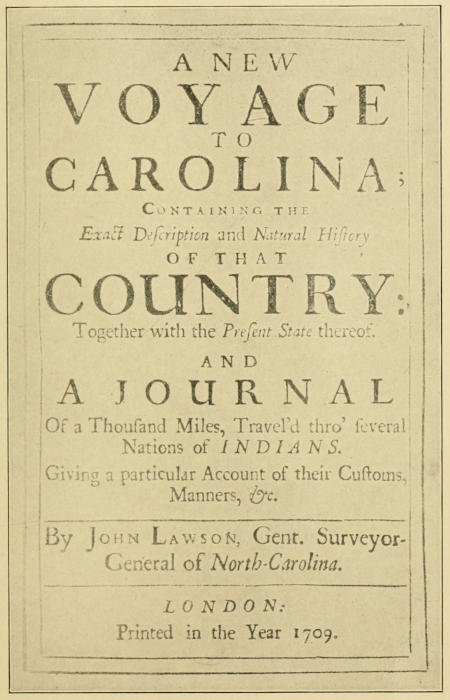
TITLE-PAGE OF LAWSON’S “A NEW VOYAGE TO CAROLINA”
This was evidently the sort of government the King meant to set up everywhere in the colonies. He had instructed the officers of the crown almost at the very outset of his reign to secure the annulment of the other colonial charters, and suits had already been prosecuted in the courts against Connecticut and Rhode Island, against the Carolina grants, and even against those he had himself given only the other day in New Jersey. The next year after Andros’s coming (1687) he turned upon Maryland. New York and Virginia were already practically his own, to deal with as he pleased. The same year Andros went to Boston, Governor Dongan, of New York, was instructed to forbid the popular assemblies granted but three years before. He was commanded, too, as Andros was, “to allow no printing press.” James meant to be master everywhere, and to permit not so much as a word of public comment upon what his servants did; and all America felt the change. Before the first month of his administration was over, Andros, acting upon the King’s command, had dissolved the government of Rhode Island, and assumed control of its affairs. The next year he did the same in Connecticut; and in 1688 New York and the Jerseys were nominally added to his government, Francis Nicholson acting as his deputy there.
The chief general authorities for the history of Pennsylvania during the seventeenth century and the first years of the eighteenth are the second volumes of Bancroft and Hildreth; the second volume of Bryant and Gay’s Popular History of the United States; John Fiske’s Dutch and Quaker Colonies; F. D. Stone’s The Founding of Pennsylvania, in the third volume of Winsor’s Narrative and Critical History of America; S. M. Janney’s Life of William Penn; C. B. Keen’s New Sweden, or the Swedes on the Delaware, in the fourth volume of Winsor; Thomas F. Gordon’s History of Pennsylvania from its Discovery by Europeans to 1776; Samuel Hazard’s Annals of Pennsylvania from the Discovery of the Delaware, 1609-1682; and Robert Proud’s History of Pennsylvania from the Original Settlement in 1681 till after the Year 1742.
The chief sources are to be found in Samuel Hazard’s Pennsylvania Archives; Minutes of the Provincial Council of Pennsylvania; Colonial Records of Pennsylvania; Duke of Yorke’s Book of Laws (1676-1682) and Charter to William Penn and Laws of the Province of Pennsylvania passed between 1682 and 1700, compiled by Staughton George and others; Votes and Proceedings of the House of Representatives of the Province of Pennsylvania; Memoirs of the Pennsylvania Historical Society; Ben Perley Poore’s The Federal and State Constitutions, Colonial Charters, and other Organic Laws of the United States; The Pennsylvania Magazine of History and Biography; and Stedman and Hutchinson’s Library of American Literature.
X. The Revolution
Happily the new tyranny had no longer life in America than in England. It came promptly enough to its end when the news reached the colonies of James’s disgrace and flight and William’s coming. The Boston people rose, as if by a common instinct; seized Andros and his officers; seized the fort; seized even the King’s frigate lying in the harbor; and resumed their old government under their old magistrates, to await further tidings from over sea. The other colonies round about followed suit. Sir Edmund had got himself well hated. He was an honest, well-meaning man enough, a plain and not very quick-witted soldier who executed his orders quite literally; but he was arbitrary and harsh, and showed sometimes an unwise and ugly temper when he was opposed. And the orders he tried to execute were intolerable to the people of the once free colony he governed. He levied taxes by the authority of the crown; he demanded quit-rents of all the land owners of the colony, because the loss of the charter, he was told by the law officers in England, destroyed the right of the colonists to the land they had acquired under it; he forbade even the ordinary town meetings; and he sought to crush opposition by harsh punishments. To these Puritans it was no small part of the trying experience that he encouraged some to set up a society to worship after the manner of the Church of England, and use the hated prayer-book; and that in 1688 the Episcopal congregation thus formed built a place of worship, which they called King’s Chapel, in Boston. It was a happy day when they got rid of the hateful tyranny; and an assurance of better times when they presently learned that the new government at home approved what they had done, and were willing that they should send Sir Edmund and his fellow prisoners to England for trial.
The action of the people was no less prompt and decisive in New York, James’s own province. Francis Nicholson, Andros’s deputy in New York and the Jerseys, was as little liked there as Andros himself was in Boston. Both he and the members of his council, because they supported him, were looked upon as tools of a papist king, and New York was Dutch and Protestant. The two regiments of the King’s regulars Sir Edmund had brought with him upon his second coming out, to be governor of all the northern coast, were Irish Catholics every man, and Nicholson had come out as commander of one of them. To the uneasy suspicions of the critical Protestants of the little seaport, affairs wore the ugly look of having brought them into the power of men who must of necessity prove the enemies of a Protestant king. With news of the revolution in England, moreover, came also news of war with France, the ousted King’s Romish friend and ally; and the King’s officers fell into an evident panic. While they hesitated what to do, a captain of the men-at-arms they had called together for their defence seized the fort and the government in the name of the Prince of Orange. This was Jacob Leisler. He had come to the colony close upon thirty years before (1660), as a soldier in the employ of the Dutch West India Company; had thriven in trade and made a place of influence for himself among the colonists; and now stepped forth as their champion against the officers of the papist King whom the Parliament had deposed.
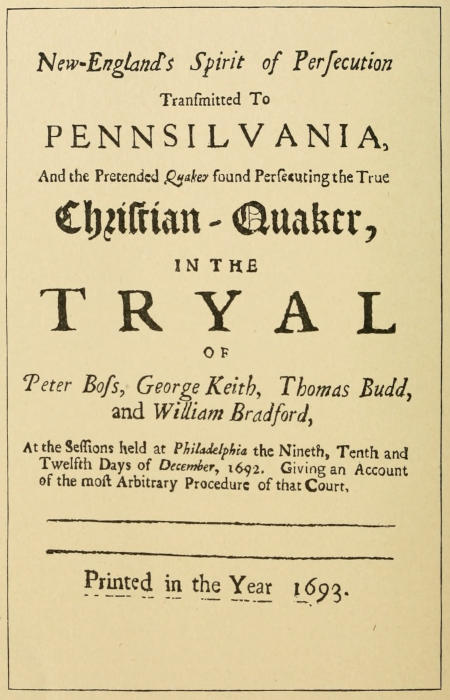
EARLY NEW YORK PRINTING BY WILLIAM BRADFORD
It was the news of war that chiefly wrought upon the fears of the town. It was yet spring-time, 1689, and the news that war had actually begun reached New York, a hasty rumor, before the fact. But it spoke truth, nevertheless; and no man could be ignorant what special interest New York had in the matter. Louis of France was in fact planning that very spring how he should make the place his own, to the undoing of the English in America. With the coming of summer his plans were complete. The veteran, indomitable Frontenac, master, if any man was, of the strategy of the forest, was to go back to Canada to take a force of one thousand French regulars and six hundred Canadians through the northern wilderness to Albany, thence to sweep down the river and meet the King’s fleet, sent timely out of France, at New York; and France was to be mistress at the centre of the continent before another winter was out, ready to strike a final blow, first at the Iroquois behind her in the forests, and then at the English on the northern coasts. France made no sign as yet; the whole plan kept covert in Paris, a closely guarded secret; no one in America knew what was afoot. But some seemed able to divine. A keen foreboding quickened the faculties of all who thought upon the hazard of fortunes in the struggle that had all but come; the air seemed full of something,—who could tell what?—and rumors crept through the forests and along the coasts in which men seemed to guess what Louis planned.
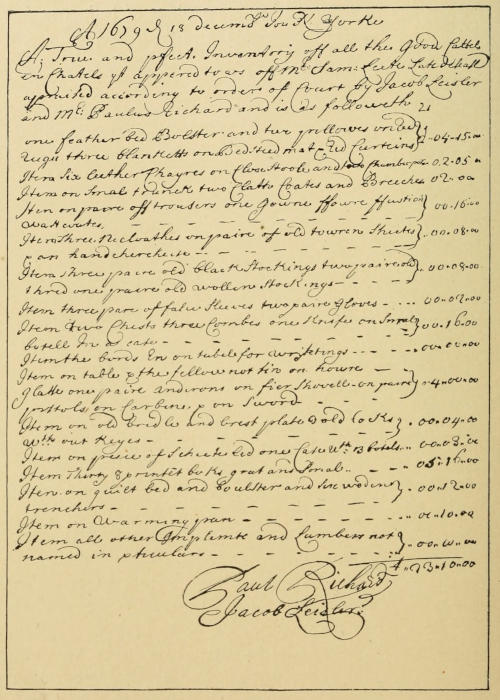
AN INVENTORY OF GOODS, SIGNED BY PAUL RICHARD AND JACOB LEISLER
Not a few new-comers to the busy settlements which lay about the bay at New York had special reason to fear to see Louis strike. It was but four years since the revocation of the Edict of Nantes. Many a Huguenot family had found welcome there and a refuge from death, and knew not what fresh misfortune might overtake them should their insensate King take also these free coasts of the New World. Every rumor bred a deeper uneasiness. No ship came in at the Narrows which did not seem for a moment to be come out of France, no group of ships that did not look like a fleet of French frigates. Nothing was so easy as to throw the simpler people of the little town into a state of mind to be glad of any friendly leadership which seemed to make them safe against plotting Catholics, whether out of France or out of England. Leisler was sure of the sympathy of the crowd, and seemed to it to give proof of honesty in all that he did. As a matter of fact, there was no danger. Colonel Dongan had done his work too well in the diplomacy of the forest. He had won the Iroquois to an alliance of which they gave, that very summer, instant and timely proof. As if some English statesman had set their work for them, they made King Louis’s plans impossible before ever they were put upon the field. Frontenac reached Canada in October to find that all the northern wilderness had been swept as with a flame by the fierce warriors of the great confederacy. The fur trade of the lakes was cut off; the posts upon the frontiers were taken and plundered; Montreal itself was barely saved from capture and destruction. There could be no expedition to Albany after that season’s work of rapine and slaughter.
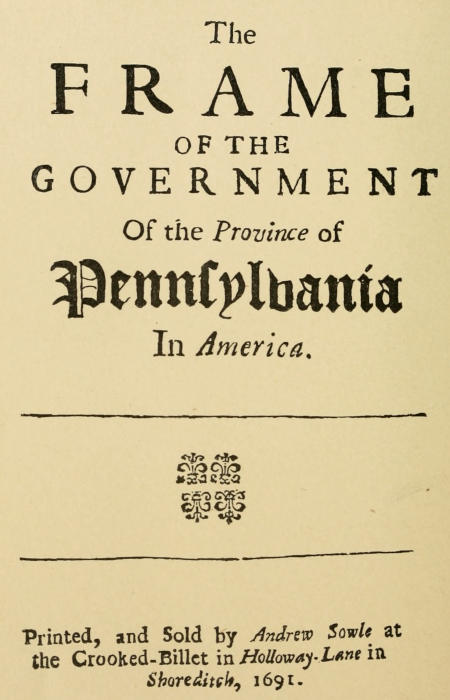
TITLE-PAGE OF THE PENNSYLVANIA FRAME OF GOVERNMENT
But New York did not know how safe it was; and Leisler had his day. It might have been well enough, had he stopped with thrusting Nicholson aside and assuming to play the new King’s partisan and governor till the air should clear. But he did not. For a year and a half he maintained himself as governor, in the new King’s name, but without his authority. He even resisted commissioned officers of the King, until a governor sent from England came; and then he was hanged for treason. It was a sad, unjust end. The man had been hot-headed, arbitrary, blind, and wilful, and had done much that the law could not sanction in order to have his own way; but he had done all, even that which was the deepest folly, in good faith. He had meant to serve the community he ruled, and had planned no treason against the King. There had been not a little of the heat of parties at the bottom of the trouble. The greater land owners, the King’s officials, and the rich merchants had wished Nicholson to keep the government until the new King should send some one in his stead. The small tradesmen, the artisans, and the sailors of the town heard that there was war with France, and that a French fleet was coming against the place, and believed that the rich men and the officials among them were no lovers of common men’s liberties, or of a Protestant church, either; and Leisler was their leader. His condemnation was a thing resolved upon and hurried to its execution in New York, not commanded from over sea; and in 1695 Parliament itself took off the stain of treason from his name.
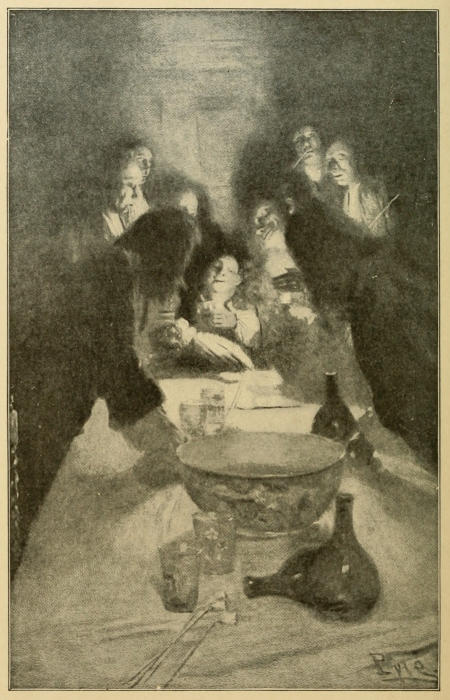
GOVERNOR SLOUGHTER SIGNING THE DEATH WARRANT OF LEISLER
In Maryland those who were unquiet and did not like the proprietor’s government took advantage of the time to overthrow it. There were men enough who had watched for such a chance. Though discontent with the proprietor’s government had met very sharp frustration and rebuke twelve years ago, when Davis and Pate went to the gallows for the treason of emulating the example of Mr. Bacon in Virginia, as many wanted a change now as had wanted it then, and this new opportunity seemed made for any who chose to act upon its invitation. The mere fact of being governed like a private estate and mediæval county palatine was very irksome to the more ambitious spirits of the colony; and the more closely and sedulously the proprietor attended to his government the more irksome did it become. He dealt very harshly with opposition; he openly interfered with elections to the assembly; he disallowed and set aside such legislation as he did not like; he gave the offices of government to men of his own kin or personal following; and the taxes were not always spent for the public benefit. It was like the government of Virginia with a petty king in residence. And that petty king, every one knew, was of the popish party, whose part the great King at home had played to his own undoing. Men fancied they saw new popish plots in every trivial incident or shifting of affairs. If the panic had touched New York and turned her government upside down, it was little to be wondered at that it touched Maryland also. Richard Talbot, Duke of Tyrconnel, the officer who reduced Ireland “from a place of briskest trade and best paid rents in Christendom to ruin and desolation,” and who had dared hold it for James Stuart, despite the Parliament in London and the authority of the Prince of Orange, was of Lord Baltimore’s kin and his very close friend; and Maryland teemed as no other colony did with Roman Catholic partisans. Lord Baltimore was, in fact, no laggard in his loyalty. He promptly despatched instructions out of England commanding the immediate proclamation of King William and Queen Mary to the province; but his messenger died on the way, and Maryland seemed to lag behind the other colonies in her loyalty. Upon which one John Coode, and some others, pretending, perhaps believing, that the proprietor’s officers in the colony meant to defy the crown and establish papacy, got together an “Association in Arms for the Defence of the Protestant religion, and for asserting the right of King William and Queen Mary to the Province of Maryland and all the English dominions,” officers of the militia and the very Speaker of the colonial House acting with them; seized the government of the colony (1689); convinced the King of their sincerity and good faith in what had been done, though many of the best people in the colony protested; ruled as their party pleased for two years; and then welcomed a royal governor (1692). They had made Maryland a royal province out of hand. Lord Baltimore was henceforth to receive only his quit-rents and the proceeds of the export duties.
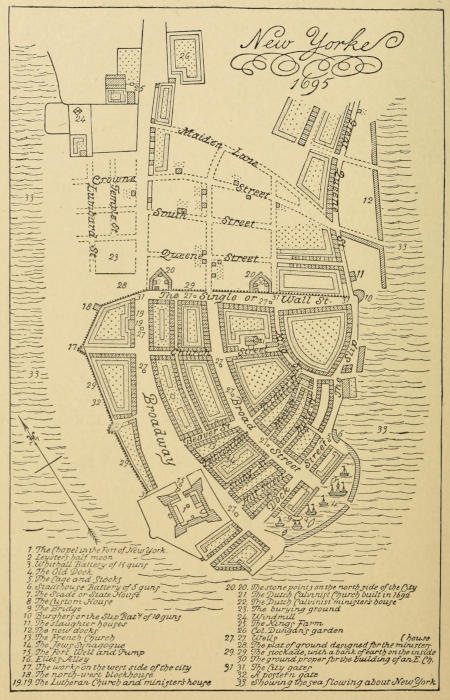
MAP OF NEW YORK IN 1695
It was a Protestant revolution with a vengeance. Taxes were ordered levied for the support of the Church of England. The immigration of Roman Catholics was prohibited and the public celebration of the mass forbidden by law. The seat of government was removed from St. Mary’s, where the Catholic families held sway to whom the colony had owed its establishment, and set up at Providence, presently to be known as Annapolis, where the Protestant influence centred. Maryland was transformed.
Everywhere in the colonies there was doubt for a little while what government to obey, until things should be settled in England, and his Majesty King William should have time to turn his attention to affairs in America. Nowhere was the doubt more embarrassing than in East and West Jersey, which seemed left without any general government at all. Formal negotiations had been afoot in 1688, the very year of the revolution, for the surrender of the rights of the East Jersey proprietors to the crown; repeated transfers of proprietorship and redivisions of jurisdiction, both by private sale and public grant, had from the first sadly confused authority in the province; and when news came of what had happened in England, some doubted whether there were either royal authority or private right for the government of the growing hamlets of either colony. Affairs presently settled even there, however, to their normal frame again. For quite fourteen years longer the proprietors kept their right to appoint governors and exercise superintendence there. The settlers in the two provinces, moreover, were for the most part hard-headed English and Scottish people, who were not to be disconcerted in the management of their own affairs by trouble in England or the mere lack of a settled general government. For quite three years (1689-1692) they waited, without disturbance or excitement or any unusual interruption of their quiet life, under the direction of their town and county officers; until at last they learned what their government as a province was to be. There were already five organized counties in East Jersey, and had been these twenty years, since before the second coming of the Dutch (1674); and ten thousand people crowded their little towns and the cleared spaces of the forest about them. West Jersey, on the other side of the forests, by the Delaware, had grown almost as fast. Both provinces had the means and the men to take care of themselves.
It was not very long, after all, before government became a settled and ordered power again under the new King. William of Orange was a businesslike master, a real governor, not likely to do less, likely, rather, to do more, than either James or Charles in the government of the colonies; and the colonies felt the power of his systematic way of rule very soon. The old charters of Connecticut and Rhode Island were presently recognized again and confirmed; but Massachusetts, instead of her old, got a new charter. Plymouth lost her separate rights altogether and was merged with Massachusetts; and many things were changed. It must have seemed to the older men in the towns of the Plymouth grant as if the old freedom and dignity of their life had been done away with forever. Plymouth was the oldest of the northern colonies, and had kept through all the long seventy years of her separate life not a little of the fine temper, the sober resoluteness, steadfastness, moderation, and nobility given to her at the first by her pilgrim founders. Surely the King’s advisers had forgotten her story when they thus summarily and without compunction handed her government and territory over to Massachusetts, to be, as it were, obliterated and robbed of their identity! But such, it seemed, was their way of bringing system into the administration of the northern colonies.
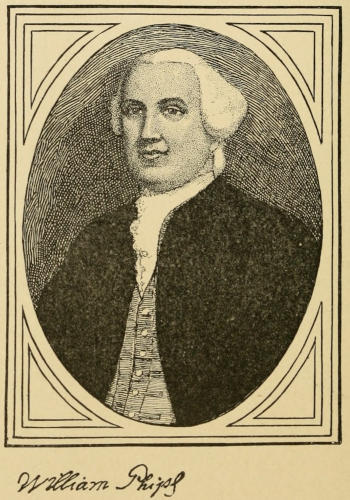
SIR WILLIAM PHIPS
The new charter was granted in 1691. It not only joined Plymouth to Massachusetts, but Maine also, carrying the northern borders of the province to the very banks of the St. Lawrence. But, though it extended her boundaries, it curtailed her liberties, and it was this that the men of the Bay principally noted. Their governor was thenceforth to be appointed by the crown. There were to be courts of admiralty, customs officers, and a post-office service directly dependent upon the ministers in London. There was to be a representative General Court, almost as before, consisting of the governor, his council, and a house of deputies, and the governor’s council of twenty-eight was to be every year, after the first, elected by the General Court itself, in which the people’s representatives predominated. Only the General Court could lay taxes and make general laws. But the King’s governor was to have the right to veto any law of which he did not approve, and the crown behind him might set the Court’s enactments aside, as disallowed, at any time within three years after they were passed. All the old rules as to who should vote for deputies, too, were changed. The right to vote was no longer to be confined to members of the Puritan churches; it was to be exercised by every man who had forty pounds’ worth of personal property, or a freehold estate in land worth two pounds a year. Judges were to be appointed by the governor and council; all other officials of the colony by the governor alone.
It was something to have one of their own fellow colonists, a familiar figure among them, at least, for their first governor under the new arrangement, though that did not alter his powers, and he was hardly the man they would themselves have chosen. Sir William Phips was only a rough, pushing, self-made sailor, one of the youngest of the twenty-one sons of an humble gunsmith in a little settlement close by the mouth of the far-away Kennebec. He had been a ship’s carpenter, a common seaman, a ship’s captain,—always sanguine, always adventurous, always on the make, risking everything to win his way, and as cheerful and hearty and full of confident plans when he had lost as when he had won. At last he had actually made the fortune he was in quest of, by finding and recovering the treasure of a sunken Spanish galleon in the southern seas. He had been much in England, and had won favor in the court and out of it by his bluff and honest energy and unfailing good-will, and his breezy manners, brought fresh from the salt seas. King James had knighted him Sir William for the Spanish treasure he brought into England, and had made him high sheriff of New England when Sir Edmund Andros was governor there. In the year 1690, the year before the new charter was signed, he had led an expedition into the north and taken Acadia from the French, with much excellent private plunder, and then had failed in an expedition against Quebec. He was no statesman, and it was not pleasant for any man to be the first governor under the new charter; but bluff Sir William, known to every man in Boston, was better than a stranger might have been.
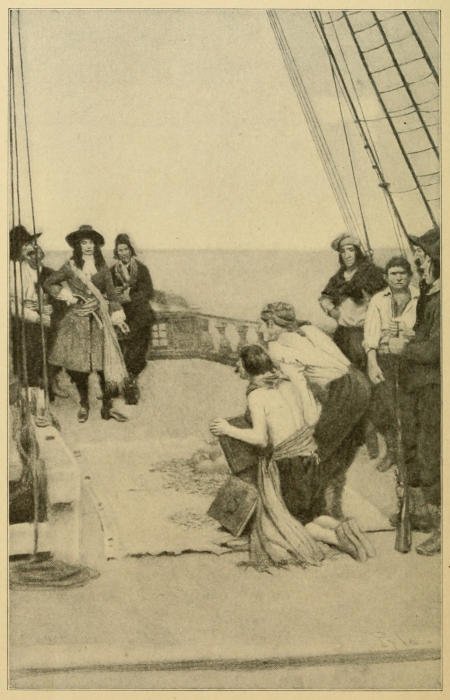
PHIPS RECOVERING THE SUNKEN TREASURE
The new King’s coming to the throne in England had brought war in its train, a long war with the French, as every one had foreseen it must.—“King William’s War,” they called it in the colonies; and war with the French meant fear and massacre on the northern borders, where the French were but too apt at stirring the Indians to their fierce attacks even in times of peace. It was this war Jacob Leisler had heard would surely bring French ships into New York and a Roman Catholic government. It gave Sir William Phips leave to make his expeditions against the north, for adventure and profit, instead.
In 1692 a distemper showed itself at Salem, in Massachusetts, which seemed for a little blacker than war itself,—an ominous distemper of the mind. It was the year of frenzy against what men fancied to be witchcraft, and Salem, where the chief madness was, saw nineteen persons swing upon her gallows hill for commerce with the devil. Some really believed them witches; some schemed to send their personal enemies to the gallows with a false charge. Governor Phips was induced to appoint special courts for the trial of the witches; and a long year went by before men’s better thoughts, natural pity, and awakened consciences called a halt upon the murderous frenzy, and Salem, with all the province, tried to forget what had been done to the innocent.
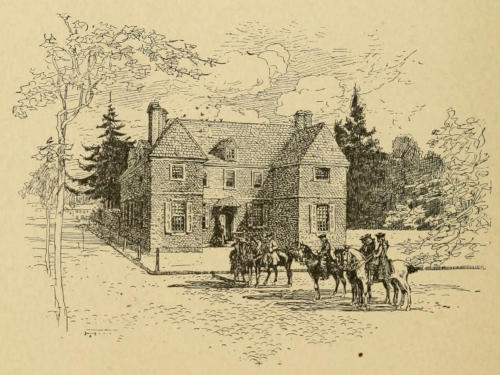
WILLIAM PENN’S RESIDENCE IN 1699
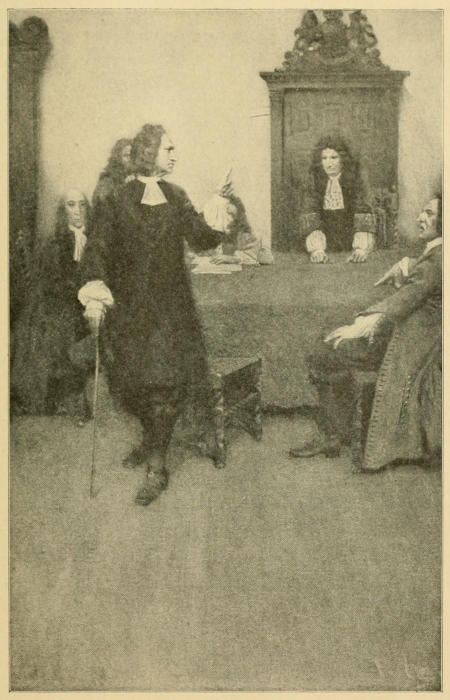
AN INTERVIEW BETWEEN SIR EDMUND ANDROS AND JAMES BLAIR
In that year, 1692, the King appointed Benjamin Fletcher to be governor of New York, and of Pennsylvania as well, which he was instructed to bring within his jurisdiction, for the consolidation of government; and Sir Lionel Copley, appointed in 1691, became royal governor of Maryland. Sir Edmund Andros, too, was that year once more commissioned governor, this time of Virginia, and stayed there full five years, a quieter if not a wiser man than in the days of King James. The Virginians did not wholly dislike him, taking him for what he was, a rough soldier, more efficient than patient, who meant to do his duty according to his instructions, but did not know how to do it in the wise way for his own interests and the general peace. He honestly devoted himself to the welfare of the colony, encouraged the growth of cotton in order that cloth might be made, improved the methods of administration, and sought in more than one way to better the sources of wealth. But the Virginians liked as little as the other colonists did his zeal in the enforcement of the acts of trade; and his arbitrary temper ruined him at last by bringing him into collision with James Blair.
Andros’s predecessor in the governorship of Virginia had been Francis Nicholson, a man who had been hardly more than a tool of James’s tyranny a little while before in New York, but who was at heart something better than a mere placeman. He was intemperate, and in private often showed himself gross and licentious; but he had some of the gifts of a statesman, and in quiet Virginia devoted himself very steadily to the welfare of the people he governed, no less than to the advancement of the general interests of the crown. James Blair had found in him an intelligent friend, and not an opponent, when he sought to set up a college in the colony. A great deal of Virginian politics centred in Mr. Blair. He was a Scotsman bred to orders in the English Church, and was but thirty-six when Sir Edmund Andros was made governor of Virginia. He had come to the colony in 1685, at twenty-nine; and in 1690, the year Mr. Nicholson became governor, he had been appointed commissary for Virginia by the Bishop of London. Virginia was supposed to lie within the see of London, and as the bishop’s commissary there it was Mr. Blair’s duty to inspect, report upon, and administer discipline in the church of the colony. He made it his first task to establish a college,—the assembly, the governor, and every true friend of Virginia at his back in the enterprise,—in order that education might sustain order and enlightenment. The King granted a charter and revenues to the college in 1692; the merchants of London subscribed right handsomely; Governor Nicholson handed over to it three hundred and fifty pounds voted to him by the assembly; and Virginia at last had the college she had wished and planned for ever since the days of Sir George Yeardley. It was agreed that it should be called the College of William and Mary.
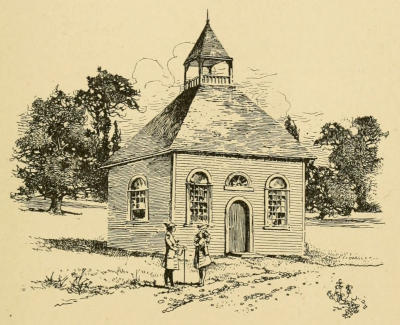
THE FIRST CHURCH IN NEWARK, NEW JERSEY
But when Sir Edmund Andros came, Mr. Nicholson being sent to administer the affairs of Maryland, it was found, after a few years’ trial, that he and Mr. Blair could not live in the same colony. Mr. Blair was as hot-tempered as Sir Edmund, and spoke his mind in as choleric and unstinted a way. But Mr. Blair, though he was often boisterous, generally managed, after the canny Scots manner, to be right as well, and generally had both the law and the interests of the colony on his side when it came to a contest, while Sir Edmund had a great talent for putting himself in the wrong. When at last it came to a breach between the two, therefore, as it did, Sir Edmund lost and Mr. Blair won. Sir Edmund was recalled to England, and Mr. Nicholson was named governor once more. It was a long time before Mr. Blair ceased to reign in Virginia. Mr. Nicholson became instrumental in removing the capital from Jamestown, which Mr. Bacon had burned, to Williamsburg, more wholesomely placed, ten miles back from the river. The college also had been placed there; and there Mr. Blair continued to preside as governors came and went.
For the authorities and sources for this period, see the references under Sections I. to V. and VII. to IX. of this chapter, so far as they cover the later years of the seventeenth century.
END OF VOL. I.