Chapter III · THE WAR OF AMERICAN INDEPENDENCE
Reading edition
Ticonderoga and Crown Point.
The War of American Independence began with the skirmish at Lexington on the 19th of April, 1775. The battle of Bunker’s Hill was fought on the following 16th of June. Between these two dates a forward move was made towards Canada by the American colonists, and the forts of Ticonderoga and Crown Point on Lake Champlain were surprised and taken.
Carleton urges the upkeep of strong forts in North America.
Years before, shortly after taking over the administration of Canada, Carleton had called attention to the dilapidated condition of these forts. In a letter, dated the 15th of February, 1767,[58] he wrote to General Gage, then Commander-in-Chief in North America—‘the forts of Crown Point, Ticonderoga, and Fort George are in a very declining condition, of which, I believe, your Excellency is well informed. Should you approve of keeping up these posts, it will be best to repair them as soon as possible.’ The letter went on to suggest that, in addition to repairing the forts in question, there should be ‘a proper place of arms near the town of New York and a citadel in or near the town of Quebec’, the object being to secure communication with the mother country and to link the two provinces together. Written in view of ‘the state of affairs on this continent’, the letter was statesmanlike and farseeing in a high degree. The writer argued that ‘the natural and political situation of the provinces of Quebec and New York is such as must for ever give them great influence and weight in the American system’. He pleaded, therefore, for strong forts at Quebec and New York, and strong posts on the line between New York and Canada. Thus, in the event of war breaking out, the King’s magazines would be kept secure, the northern colonies would be separated from the Carleton’s policy: (1) adequate defences and garrisons: (2) attachment of the Canadians to the British Crown especially by giving them employment under the government. southern, and delay in transport and difficulty of communication, so dangerous, especially in the early stages of a war, would be averted. In the years which preceded the War of American Independence, Carleton had constantly in view the twofold contingency of war with France and war with the British colonies in America; and there were two cardinal points in his policy, which he never ceased to impress upon the Home Government, on the one hand the necessity for adequate military forces, and adequate forts in America, on the other the necessity for taking such steps as would attach the Canadians to the British Crown.
In November, 1767,[59] he wrote to Shelburne, ‘The town of Quebec is the only post in this province that has the least claim to be called a fortified place; for the flimsy wall about Montreal, was it not falling to ruins, could only turn musketry.’ He went on to show how the French officers who still remained in Canada, and the Canadian seigniors who had served France, had lost their employment through the conquest of Canada, and, not having been taken into the English King’s service, had no motive to be ‘active in the defence of a people that has deprived them of their honours, privileges, profits, and laws’; and again he urged the importance of building a citadel, for which he enclosed a plan, within the town of Quebec. ‘A work of this nature,’ he wrote, ‘is not only necessary as matters now stand, but supposing the Canadians could be interested to take a part in the defence of the King’s Government, a change not impossible to bring about, yet time must bring forth events that will render it essentially necessary for the British interests on this continent to secure this port of communication with the mother country.’
In January, 1868,[60] he wrote again to Shelburne, and referring to his previous letter and to the scheme for constructing a citadel at Quebec, he said—‘Was this already constructed, and I could suppose it impossible for any foreign enemy to shake the King’s dominion over the province, still I shall think the interests of Great Britain but half advanced, unless the Canadians are inspired with a cordial attachment and zeal for the King’s Government.’ Once more he urged that the Canadians had no motive of self-interest to attach them to British rule. The laws and customs which affected their property had been overturned. Justice was slow and expensive. The different offices claimed ‘as their right, fees calculated for much wealthier provinces’; and the leading Canadians were excluded from all places of trust and profit. Give the people back their old laws and customs in civil matters, let them feel thereby secure in their property, take a few Canadians into the service of the Crown, enlist in the King’s forces ‘a few companies of Canadian foot, judiciously officered’, ‘hold up hopes to the gentlemen, that their children, without being bred up in France, or in the French service, might support their families in the service of the King their master,’ and, at any rate, some proportion of the French Canadians would be found loyally attached to the British Government.
Another letter, written to Lord Hillsborough in November, 1768,[61] was in similar terms. It referred to rumours of French intrigues and of a contemplated rising on the part of the Canadian gentry. Carleton discredited the rumours, but added, ‘Notwithstanding this, and their decent and respectful obedience to the King’s Government hitherto, I have not the least doubt of their secret attachment to France, and think this will continue, as long as they are excluded from all employments under the British Government.’ He reflected ‘that France naturally has the affections of all the people: that, to make no mention of fees of office and of the vexations of the law, we have done nothing to gain one man in the province, by making it his private interest to remain the King’s subject’. He went on to point out that ‘the King’s dominion here is maintained but by a few troops, necessarily dispersed, without a place of security for their magazines, for their arms, or for themselves, amidst a numerous military people, the gentlemen all officers of experience, poor, without hopes that they or their descendants will be admitted into the service of their present Sovereign’, and he argued that, were a war with France to coincide with a rising of the British colonies in North America, the danger to the British power would be great. ‘Canada, probably, will then become the principal scene, where the fate of America may be determined.’ On the other hand he urged—‘How greatly Canada might for ever support the British interests on this continent, for it is not united in any common principle, interest, or wish with the other provinces, in opposition to the supreme seat of government, was the King’s dominion over it only strengthened by a citadel, which a few national troops might secure, and the natives attached by making it their interest to remain his subjects.’
Carleton’s sympathy with the French Canadians.
In the second of these letters[62] from which quotations have been made, Carleton said that he would endeavour to represent the true situation of the province to the ministers at home, who were already engaged in considering ‘the improvement of the civil constitution of Quebec’, lest the King’s servants, with all their ability, should be at a disadvantage in forming their conclusions ‘for want of having truly represented to them objects at so great a distance, and in themselves so different from what is to be found in any other of his dominions’. But it was not merely a case of the man on the spot advising the men at a distance; the value of Carleton’s advice was largely due to the fact of his being a soldier. To this fact must be attributed, in great measure, the strong sympathy which the soldier-governors felt with the French Canadians, and on Carleton’s part more especially with the French Canadian gentry. As Murray had pointed out,[63] the Canadians were a people of soldiers; they were The French Canadians were a people of soldiers accustomed to personal rule. accustomed to personal rule and attachment rather than to the rule of the law. To high minded English officers, themselves brought up in the King’s service, trained to discipline, to well ordered grades of obedience, the old Canadian system with its feudal customs was congenial and attractive, and they resented attempts to substitute for it the beginnings of undisciplined democracy. Hence Carleton laid stress on taking Canadian gentlemen into the government service, and on enlisting companies of Canadian soldiers, in other words, on making the Canadians feel that they were, as they had been in past times, the King’s men. Hence, too, we find him in a letter to Shelburne of April, 1768,[64] recommending full recognition and continuance of the old feudal tenures of Canada, including ‘a formal requisition of all those immediately holding of the King, to pay faith and homage to him at his castle of St. Lewis’. If left to himself, he would have liked to repeal entirely the Ordinance of September, 1764, which introduced English laws into Canada, ‘and for the present leave the Canadian laws almost entire;’[65] and, though he assented to the compromise embodied in the Quebec Act, whereby the criminal law was to be that of England, while in civil matters Canadian law and custom were in the main to prevail, we find him in June, 1775,[66] after war had begun, writing to Dartmouth, ‘For my part, since my return to this province I have seen good cause to repent my ever having recommended the Habeas Corpus Act and English criminal laws.’
It was due to Carleton that the Ordinance of 1770, to which reference has already been made,[67] was passed, taking away from the justices of the peace jurisdiction in matters of private property which had been exercised to the detriment of the French Canadians. It was due to him that in 1771 a new Royal Instruction was issued, authorizing the governor to revert to the old French system of grants of Crown lands ‘in Fief or Seigneurie’;[68] and his influence was all in favour of the clauses in the Quebec Act which were favourable to the ‘new subjects’, the French Canadians, who, at the time when the War of American Independence began, seem to have numbered under 100,000.[69]
Carleton returns from England in September, 1774, and sends two regiments to Boston.
As has been told, Carleton came back from England to Quebec in the middle of September, 1774, finding the French Canadians in great good humour at the passing of the Quebec Act. Twenty hours after his arrival an express letter reached him from General Gage, still Commander-in-Chief in North America, who was then at Boston.[70] In it Gage asked his colleague to send at once to Boston, if they could be spared, the 10th and 52nd Regiments, which formed a large part of the scanty garrison of Canada. The transports which brought the letter were to take back the troops. September, 1774, was a critical month in the North American provinces. The first continental Congress met at Philadelphia; and at Suffolk, near Boston, on the 9th September, a public meeting passed resolutions,[71] boldly advocating resistance to the recent Acts of Parliament.
Proposals to raise Canadian and Indian forces.
Accordingly, in addition to his request for the two regiments, Gage wrote—‘As I must look forward to the worst, from the apparent disposition of the people here, I am to ask your opinion, whether a body of Canadians and Indians might be collected and confided in, for the service in this country, should matters come to extremities.’ Carleton promptly replied: ‘Pilots are sent down the river, the 10th and 52nd shall be ready to embark at a moment’s notice;’ and the regiments were sent to Boston, as in later years Lord Lawrence, at the time of the Indian Mutiny, denuded the Punjaub of soldiers, in order to strengthen the force which was besieging Delhi. Carleton’s letter continued: ‘The Canadians have testified to me the strongest marks of joy and gratitude, and fidelity to the King, and to his Government, for the late arrangements made at home in their favour: a Canadian regiment would complete their happiness, which in time of need might be Carleton strongly favours raising a Canadian regiment. augmented to two, three, or more battalions ... the savages of this province, I hear, are in very good humour, a Canadian battalion would be a great motive and go far to influence them, but you know what sort of people they are.’ Here was the opportunity which Carleton desired, of taking the Canadians into the King’s service. Following on the Quebec Act, he looked to such a measure as likely to rivet Canadian loyalty to the British Crown, and evidently took himself, and inspired the Home Government with, too hopeful a view of the amount of support to be expected from the Canadians, looking to and sympathizing with the seigniors rather than the lower classes of the people of Canada. It will be noted that both Gage and he contemplated employing Indians, in the event of war between the mother country and the North American colonies. Indians had been used on either side in the wars with the French, but it seems strange that there is no hint or suggestion in these letters of the danger and impolicy of employing them against the British colonists.[72]
In November, 1774, writing to Dartmouth,[73] Carleton still spoke of the gratitude and loyalty of the French Canadians, but there was a warning note in his letter. While the respectable members of the English community at Quebec supported the Government, there was much disloyalty among the British residents at Montreal. The resolutions of the Philadelphia Congress, and their address to the people of Canada, had reached that place. Walker was much in evidence, embittered by the outrage which he had suffered some years before,[74] and, with others, was organizing meetings and petitions both at Montreal and at Quebec. These proceedings, Carleton wrote, were causing uneasiness to the Canadians, and he concluded that ‘Government cannot guard too much, or too soon, against the consequences of an infection, imported daily, warmly recommended, and spread abroad by the colonists here, and indeed by some from Europe, not less violent than the Americans’.
The year 1774 ended in anxiety and suspense, and the year 1775 opened, memorable and disastrous to Great Britain. On Christmas Day, 1774, Gage had written again to Carleton on the subject of Canadian and Indian levies, and on the 4th of February, 1775, Carleton answered the letter.[75] Political matters relating to the Indians, he said, Canadian feeling at the beginning of 1775. he had always considered to be the special charge of the late Sir William Johnson, and outside the sphere of his own authority, but his intelligence was to the effect that the Indians would be ready for service if called upon.[76] Of the Canadians Carleton wrote that they had in general been made very happy by the passing of the Quebec Act, but he reminded Gage that that Act did not come into force until the 1st of May following, that the new commissions and instructions expected in connexion with it had not yet arrived, and that the whole machinery for carrying out the new system of government had still to be created. ‘Had the present settlement taken place,’ he Carleton strongly urges employing the Canadian gentry in the regular army. added, ‘when first recommended, it would not have aroused the jealousy of the other colonies, and had the appearance of more disinterested favour to the Canadians.’ He pointed out that the gentry, ‘well disposed and heartily desirous as they are, to serve the Crown, and to serve it with zeal, when formed into regular corps, do not relish commanding a bare militia.’ They had not been used to act as militia officers under the French Government, and they were further deterred from taking such employment by recollection of the sudden disbandment of a Canadian regiment, which had been raised in 1764, and subsequently broken up, ‘without gratuity or recompense to officers, who engaged in our service almost immediately after the cession of the country, or taking any notice of them since, though they all expected half pay.’[77] The habitants, again, had since the introduction of civil government into Canada, and in consequence of the little authority which had been exercised, ‘in a manner emancipated themselves.’ Time and good management would be necessary ‘to recall them to their ancient habits of obedience and discipline’, and meanwhile they would be slow to allow themselves to be suddenly and without preparation embodied into a militia. Carleton accordingly deprecated attempting to raise a militia force in Canada and recommended enlisting one or two regular battalions of Canadian soldiers. ‘Such a measure might be of singular use, in finding employment for, and consequently firmly attaching the gentry to our interests, in restoring them to a significance they have lost, and through their means obtaining a further influence upon the lower class of people, a material service to the state, besides that of effectually securing many nations of savages.’
Summary of the political conditions of Canada at the beginning of the War of American Independence.
From the above correspondence we can form some impression of the state of political feeling in Canada, when the great revolt of the American colonies began. We have the picture of a conquered people, accustomed to a military system, to personal rule, and to feudal laws and customs. This people had been brought by the fortune of war under the same flag as covered very democratic communities, which communities were their immediate neighbours and had been their traditional rivals. The few years which had passed since the conquest of Canada had, with the exception of the Indian rising under Pontiac, been years of uncomfortable peace and administrative weakness. The government of the country, which was the mother country of the old colonies and the ruler of the new possession, was anxious to curtail expenses as much as possible, in view of the great expenditure which had been caused by the Seven Years’ War; to maintain and, if possible, to emphasize its precarious authority over the democratic communities of the Atlantic seaboard; and, on the other hand, in a sense to relax its authority over Canada, by modifying in the direction of English institutions the despotism which had prevailed under the old French régime. The net result was that on the American continent the Executive, having insufficient force behind it and in the old colonies no popular goodwill, was increasingly weak, and the people were more and more unsettled. The democratic communities became more democratic, and from those communities individuals brought themselves and their ideas into the sphere of French conservatism, adding to the uncertainty and confusion which attempts to introduce English laws and customs had already produced in Canada. The Canadian gentry under British rule found their occupation gone, their importance minimized, and no outlet for their military instincts and aspirations. The peasantry found old rules relaxed and unaccustomed freedom. Strength was nowhere in evidence in Canada. The forts were falling into ruin; the English soldiers were few; there was the King’s Government without the backing of the King’s men; the old subjects were a small number of men, of whom a large proportion were noisy, disloyal, adventurers; the new subjects were not held in submission, but not admitted to confidence. On the other hand, the French Canadians had recent and undeniable evidence of the goodwill of the British Government in the passing of the Quebec Act. Their governors, Murray and Carleton, had transparently shown their sympathies with the French Canadian race, its traditions, and even its prejudices. Amid many inconveniences, and with some solid grounds for discontent, the Canadians had none the less tasted British freedom since the cession of Canada; and they had not yet imbibed it to such an extent as to overcome their traditional animosity to, and their inveterate suspicion of, the militant Protestants of the old colonies who were rising against the King.
It is unnecessary for the purposes of this book to give a full account of the War of American Independence, except so far as Canada was immediately concerned. Here the Americans appeared in the character of invaders, and the issue really depended upon the attitude of the French Canadians. Would they rise against their recent conquerors and join hands with the rebellious colonists, or would their confidence in Carleton, coupled with their long standing antipathy to the British settlers in America, keep them in allegiance to the British Crown? For the moment all went well for the Americans.
The Green Mountain rising.
It was characteristic of the state of unrest which prevailed at this time in America that, while the colonies as a whole were quarrelling with the mother country, one portion of a colony was declaring its independence of the state to which it was supposed to belong. On the eastern side of Lake Champlain were a number of settlers who had come in under grants issued by the Governor of New Hampshire, but over whom the government and legislature of New York claimed jurisdiction, the New York claim having moreover been upheld by the Imperial Government. These settlers were known at the time as the ‘Green Mountain Boys’, and they were the nucleus of the present state of Vermont. In April, 1775, they held a meeting to declare their independence of New York, their leaders being Ethan Allen, who had been proclaimed Ethan Allen. an outlaw by the Governor of New York in the previous year, and Seth Warner. They had already apparently in their minds the possibility of taking possession of the forts on Lake Champlain. There were few men Capture of Ticonderoga and Crown Point. at Ticonderoga and Crown Point, only about fifty at the former and half a dozen or so at the latter, belonging to the 26th Regiment, enough and no more than sufficient to guard the guns and the stores. The garrison apprehended no attack and had made no preparations for defence.
The news of Lexington suggested to the Green Mountain Boys to commend themselves to Congress by at once securing these two forts. If they had any instructions in planning their expedition, those instructions seem to have come from Connecticut; and though, before a start was made, Benedict Arnold was sent up by Congress to take the matter in hand, the insurgents refused his leadership; and, while he accompanied the expedition, it was Allen who mainly carried out the enterprise. Under Allen’s command, on the night of the 9th of May, a band of armed men, variously estimated at from under 100 to over 200 in number, marched to the shore of the Lake Champlain, where it narrows to little more than a river immediately opposite Ticonderoga; and, crossing over in two parties, early on the morning of the 10th were admitted to the fort on pretence of bringing a message to the commandant, overpowered the guard, and surprised the rest of the little garrison in their beds. Two days later Crown Point was secured by Seth Warner; and shortly afterwards, under the command of Arnold, part of the expedition made their way in a captured schooner to the northern end of the lake, took prisoners a dozen men who represented the garrison at the fort of St. John’s, seized a vessel belonging to the Government which was lying off the fort, and retreated up the lake on the approach of a detachment from Montreal.[78]
Thus the old fighting route by the way of Lakes George and Champlain, the scene of numberless raids and counter-raids, where Robert Rogers, William Johnson, Montcalm, Abercromby, Amherst, and many others had played their parts, passed into the hands of the revolutionary party, and only the forts of St. John’s and Chambly, beyond the outlet of Lake Champlain, barred the way to Montreal. The British power in Canada seemed gone to nothingness, and at the beginning of June, in reporting to Dartmouth what had taken place, Carleton wrote: ‘We are equally unprepared for attack or defence; not six hundred rank and file fit for duty upon the whole extent of this great river,[79] not an armed vessel, no place of strength; the ancient provincial force enervated and broke to pieces; all subordination overset, and the minds of the people poisoned by the same hypocrisy and lies practised with so much success in the other provinces.’[80]
The gentry and clergy, he reported, had shown zeal and loyalty in the King’s service, but they had lost much of their influence over the people, and the Indians had been as backward as the peasantry in rallying to the defence of Canada. The crisis had come, and Carleton’s warnings of past years had been amply justified. Absence of military preparations, and neglect to take measures to attach the Canadians to the British Crown had resulted in a situation full of danger, a province open to invasion, a government without material for defence, and a confused and half-hearted people. Even Carleton’s forecast had not been wholly accurate. He seems to have over-rated the Miscalculations as to Canadian feeling. good effects of passing the Quebec Act, and not to have fully realized the strength of class feeling in Canada, or the extent to which the peasantry, under the influence of the disloyal British minority and of emissaries from the revolting colonies, had emancipated themselves from the control of the seigniors and the gentry. It was even suggested that the lower orders in the province, instead of being grateful for the Quebec Act, regarded it with suspicion and dislike, as intended to restore a feudal authority which they had repudiated, and such no doubt would have been the doctrine taught by the British malcontents inside and outside the province. ‘What will be your lordship’s astonishment,’ wrote Hey, the Chief Justice of Canada, to the Lord Chancellor, towards the end of the following August,[81] ‘when I tell you that an Act passed for the express purpose of gratifying the Canadians, and which was supposed to comprehend all that they either wished or wanted, is become the first object of their discontent and dislike. English officers to command them in time of war, and English laws to govern them in time of peace, is the general wish. The former they know to be impossible (at least at present), and by the latter, if I understand them right, they mean no laws and no government whatsoever. In the meantime, it may be truly said that General Carleton has taken an ill measure of the influence of the seigniors and clergy over the lower order of people.’ If Carleton had misjudged the feelings of the Canadians, the Chief Justice frankly admitted that he himself had been fully as much deceived.
Mistakes of the Home Government.
The mischief was that the Government in England had imbibed the confident anticipations of Canadian loyalty which had been formed by the men on the spot immediately after the passing of the Quebec Act; and, instead of sending reinforcements to Canada, they expected Carleton to reinforce Gage’s army in New England. On the 1st of July, Dartmouth wrote to Carleton, instructing him to raise a body of 3,000 Canadians to co-operate with Gage; on the 24th of July, having had further news from America, he doubled the number and authorized a levy of 6,000 Canadians; and no hope was given of sending British troops to Canada until the following spring. At the beginning of the American war the greatest danger to the British Empire consisted in the utter weakness of the position in Canada. It was some excuse, no doubt, for the ministers at home that the Governor of Canada had latterly over-estimated the loyalty of the Canadians; and it may well have been too that the dispatch of troops to the St. Lawrence was delayed in order not to alarm the American colonies, before they openly revolted, and while there was still some faint hope of peace, by a measure which might have been interpreted as a threat of war. But those who were responsible for the safe keeping of British interests in America stand condemned in the light of the repeated warnings which Carleton had given in previous years. As a skilled soldier, he had pointed out, and history confirmed, the vital importance of Canada in the event of war in America, its commanding position for military purposes in relation to the other[82] provinces. He had urged the necessity of military strength in Canada, of strength which was both actual and apparent; of forts strong enough to be defended and of British soldiers numerous enough to defend them; moreover, of forts strong enough and British soldiers numerous enough to at once compel and attract the attachment of a military people. As a statesman, he had recommended more than a Quebec Act, years before the Quebec Act was passed. Political and financial exigencies outside Canada may have made it impossible to take his guidance, but had it been followed, the whole course of history might have been changed.
Carleton moves troops to St. John’s.
On hearing of the capture of the forts on Lake Champlain, Carleton took what measures he could. He moved all his available troops, including some Canadian volunteers,[83] to St. John’s, and strengthened its defences. He went up himself from Quebec to Montreal, where he arrived on the 26th of May. On the 9th of June he called out the Canadian militia under the old French law, with little effect beyond causing irritation and discontent, which American emissaries and sympathizers turned to account; and on the 2nd of August he went back to Quebec, to summon the first Legislative Council which was constituted under the Quebec Act, that Act having now come into operation. Meanwhile, after the battle of Bunker’s Hill, the American Congress had resolved on invading Canada in force; General Philip Schuyler was placed in charge of the expedition, but, his health giving way, the command devolved upon Richard Montgomery, The Americans under Richard Montgomery invade Canada. who had served under Amherst throughout the campaign which ended with the conquest of Canada, and had subsequently settled in the state of New York and married an American lady.
At the beginning of September, the American troops moved northward down Lake Champlain, and took up a position at the Isle aux Noix, twelve miles from the fort at St. John’s, preparatory to besieging that fort. ‘The rebels are returned into this province in great numbers, well provided with everything, and seemingly resolved to make themselves masters of this province. Hardly a Canadian will take arms to oppose them, and I doubt all we have to trust to is about 500 men and two small forts at St. John’s. Everything seems to be desperate,’ so wrote Chief Justice Hey from Quebec to the Lord Chancellor on the 11th of September.[84] On the 17th he added, ‘The rebels have succeeded in making peace with the savages who have all left the camp at St. John’s, many of the Canadians in that neighbourhood are in arms against the King’s troops, and not one hundred except in the towns of Montreal and Quebec are with us. St. John’s and Montreal must soon fall into their hands, and I doubt Quebec will follow too soon.’
There was skirmishing between scouts and outposts, and on the night of the 24th of September, a party of about 150 Americans under Ethan Allen crossed over into the island of Montreal and penetrated to the suburbs of the town. Their daring attempt, however, miscarried: they were driven out: Allen was taken prisoner and sent in irons to England: and his failure gave for the moment some encouragement to the Loyalists’ cause.
Carleton applies to Gage for reinforcements.
On hearing of Schuyler’s and Montgomery’s advance Carleton at once hurried back from Quebec to Montreal. There were two possibilities of saving the town, and with it, perhaps, the whole of Canada. One was by obtaining reinforcements from the British army at Boston, the other by contriving, even without reinforcements, to hold the forts at St. John’s and Chambly until winter drove the invaders back whence they had come. Early in September Carleton applied to Boston for two regiments, the same number that in the previous autumn he had sent to Boston at Gage’s request; his message came to hand on the 10th of October, just as Gage was leaving for England, and Howe, who took over the command of the troops, at once prepared to send the men. But there was a blight on English sailors as on English soldiers in America in these days. Admiral Graves, who commanded the ships, refused Admiral Graves refuses to move. to risk the dangers of the passage from Boston to Quebec at the season of the year, and Carleton in his sore straits was left unaided. All, therefore, turned on the defence of the forts.
The siege of St. John’s and Chambly.
St. John’s fort was manned by between 600 and 700 men, 120 of whom were Canadian volunteers, the rest being regulars. Chambly was held by some 80 men of the line. A few men were stationed at Montreal, but Quebec was almost emptied of its garrison. Major Preston,[85] of the 26th Regiment, commanded at St. John’s, and Chambly was in charge of Major Stopford. On the 18th of September Montgomery laid siege to the former fort, cutting off communication between the defenders and the outside world; but, notwithstanding, news reached Preston of Allen’s unsuccessful attempt on Montreal, and he held out bravely, helped by the fact that Montgomery had hardly any artillery, and could only rely on starving out the garrison, while his own men were suffering from exposure, privations, and want of ammunition. But in the middle of October the outlook was changed, for, after less than two days’ siege, the fort at Chambly, said to have been well provisioned, The two forts taken. and with ample means of defence, was on the 17th of that month surrendered,[86] providing Montgomery with supplies, guns, and ammunition to be used against the main fort. Preston’s condition was now desperate. An attempt made by Carleton to cross from Montreal to his relief on the 30th of October was beaten back, and on the 2nd of November, St. John’s surrendered, after having held out for forty-five days.
Carleton leaves Montreal,
The fall of St. John’s made the defence of Montreal impossible. Carleton dismissed such of the militia as were in arms to their homes, and with the few Imperial troops in the town, rather over 100 in number, and any arms and supplies that he could carry away, embarked on the afternoon of the 11th of November to make the best of his way to Quebec. On the 13th, Montgomery which is occupied by the Americans. and his men entered Montreal. Already advanced parties of the Americans were heading down the river banks. Colonel Maclean, who had come up from Quebec as far as the Richelieu river with a small body of Canadians and Scotchmen, to co-operate with Carleton for the relief of St. John’s, had fallen back, Benedict Arnold was threatening Quebec itself, and it became a question whether Carleton would ever reach the city to take charge of its defence. His vessels and boats sailed down the river to a point some miles above Sorel at the confluence of the Richelieu river. There one of them grounded; the wind veered round and blew up-stream; for three days the Carleton narrowly escapes capture and reaches Quebec. little flotilla remained stationary; the enemy overtook them on the land, raised batteries in front to bar their progress, and summoned them to surrender. On the night of the 16th Carleton went on board a whale boat; silently, with muffled oars, and at one point propelled only by the rowers’ hands, she dropped down-stream, undetected by the watchers on the banks. On the 17th Carleton reached Three Rivers, with the American troops close behind him, and lower down he met an armed British ship, which carried him in safety to Quebec. He entered the city on the 19th. On the same day the vessels in which he had started from Montreal surrendered with all on board, and, being brought back to Montreal, were used to carry Montgomery and his men down to Quebec.
Quebec was already threatened by a small force under Benedict Arnold. In the year 1761, while General Murray was in military command of the city and district, an engineer officer, acting under his instructions, had marked Arnold’s march from the mouth of the Kennebec to Quebec. out a trail along the route from the Atlantic coast, at the mouth of the Kennebec river, to the confluence of the Chaudière with the St. Lawrence over against Quebec. In 1775, when the American colonists determined to invade Canada, Washington decided to send an expedition by this route to co-operate with the main advance by Lake Champlain and the St. Lawrence. The enterprise required a daring, resourceful leader, and the command was given to Arnold. In the middle of September, Arnold embarked with 1,100 men at Newbury port at the mouth of the Merrimac, and sailed for the Kennebec. In the latter days of September he began his march: some 200 batteaux were taken up the Kennebec, carrying arms, ammunition, and supplies; the troops were partly on board the boats, partly kept pace with them on the banks. The expedition followed the course of the Kennebec and its tributary, the Dead River, crossed the height of land, reached the headwaters of the Chaudière in Lake Megantic, and descended the Chaudière to the St. Lawrence. It was a march of much danger and privation, no easy task for a skilled backwoodsman to accomplish, and full of difficulty when it was a case of transporting a small army. All through October and into November the men toiled in the wilderness, boats were lost, provisions were scarce, the sick and ailing were left behind, the rearguard turned back, but eventually Arnold brought two-thirds of his men through, and, with the goodwill and assistance of the Canadians on the southern bank of the St. Lawrence, emerged at Point Levis on the 8th of November, having achieved a memorable exploit in the military history of America. On the 14th he crossed the river by night, landed where Wolfe had landed before his last memorable fight, and, after summoning the city to surrender without effect, retreated to Pointe aux Trembles, nearly twenty miles up the river, to await Montgomery’s arrival. Meanwhile, Carleton passed by and entered Quebec.
Montgomery arrives before Quebec.
On the 5th of December, Montgomery came upon the scene, having landed his guns at Cap Rouge, about nine miles above the city.[87] A threatening letter which he sent to Carleton on the day after his arrival summoning the British general to surrender, received no answer, and he took up his position and planted batteries within reach of the walls on the western side—the side of Wolfe’s attack, while Arnold occupied the suburb of St. Roch, on the north of the city, with the river St. Charles behind him. So far the American advance had been little more than a procession. Montreal had received Montgomery without fighting. Three Rivers had given in its adhesion to the revolutionary cause, without requiring the general’s presence, as he passed down the river. Nearly all the British regulars were prisoners; and, with the help of the disloyal element in the population, Montgomery had good reason to expect that Quebec would forthwith pass into his hands and the Imperial Government be deprived of its last foothold in Canada. He was soon undeceived, however, and found the task beyond his strength.
The siege of Quebec.
His whole force, when united to Arnold’s and including some Canadians, seems not to have exceeded 2,000 men; his artillery was inadequate, and winter was coming on. On the other hand, Carleton’s garrison was a nondescript Number of the garrison. force of some 1,600 to 1,800 men. Nearly one-third of the number were Canadians. About 400 were seamen and marines from the ships in the harbour, including the Lizard ship of war, which, with one convoy ship containing stores and arms, represented all the aid that had come from England. There were less than 300 regulars, including about 200 of a newly-raised corps under Colonel Maclean’s command, Scotch veterans who were known as the Royal Highland Emigrants; and there were about 300 militia of British birth. But the city was well provisioned; the disloyal citizens had been ejected; Carleton himself had been through the famous winter siege of 1759-60; and the preparations which had been made during his recent absence at Montreal, showed that he had capable officers serving under him. The upper classes of Canada had from the first sided with the British Government, and now that Quebec, the hearth and home of Canada, was in deadly peril, some spirit of Canadian citizenship was stirred in its defence.
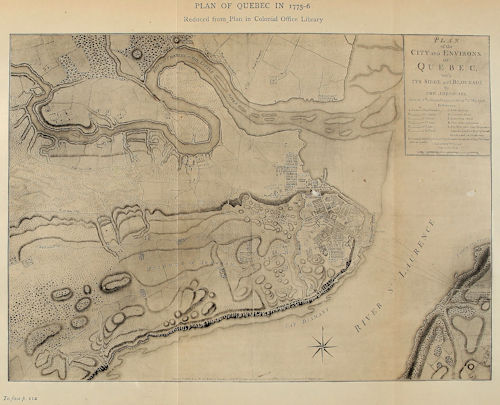
click here for larger image.
PLAN OF QUEBEC IN 1775-6
Reduced from Plan in Colonial Office Library
To face p. 112
Montgomery plans a night attack.
Montgomery’s army was too small in numbers, without the support of powerful artillery which he did not possess, to justify a direct assault upon the town walls, and a prolonged siege in the depth of winter meant severe strain on the American resources with no sure hope of ultimate success. Moreover, many of the men had enlisted only for a specified term, which expired at the end of the year. Before the year closed, therefore, the general determined to attempt a night surprise, and laid his plans not to attack the city from the plateau, but to storm the barricades which guarded the lower town by the water’s edge, and thence to rush the heights above.
The attack of December 31, 1775.
Before dawn on the morning of Sunday the 31st of December,[88] 1775, between the hours of two and seven, in darkness and driving snow, the attempt was made. From Montgomery’s batteries on the Heights of Abraham the guns opened fire on the town. At Arnold’s camp at St. Roch, troops placed themselves in evidence under arms; and, while this semblance of attack was made, the two leaders led two separate columns from opposite directions, intended to converge in the centre of the lower town, so that the combined parties might force the steep ascent from the port to the city on the cliff.
Repulse of Montgomery and his death.
About two in the morning Montgomery led his men, according to one account, 900 in number, down to the river side at Wolfe’s landing-place; and signalling with rockets to Arnold to begin his march, started about four o’clock along a rough pathway which skirted the river under Cape Diamond and led to the lower town. Unnoticed, it would seem, by an outpost on Cape Diamond, and by an advance picket, he came at the head of his force within thirty yards of a barricade, which had been constructed where the houses began at Prés de Ville. Up to this point the defenders had given no sign, but now every gun, large and small, blazed forth: the general fell dead with 12 of his following, and the whole column beat a hasty retreat.
Repulse of Arnold’s column.
Meanwhile, on the other side, in the angle between the St. Charles and the St. Lawrence, Arnold led forward 700 men, passing below Palace Gate, and fired at from the walls where the garrison were all on the alert, for Carleton had for some days past been warned of a coming attack. The Americans crossed a small projecting point, known as the Sault au Matelot, and reached one end of the narrow street which bore the same name. Here there was a barricade, a second barricade having been erected at the other end of the street. The first barrier was forced, but not until Arnold himself had been disabled by a wound; and led by the Virginian, Daniel Morgan, who was second in command, and who, later in the war, won the fight at Cowpens, the assailants pressed boldly on to take the second barricade and effect a junction with Montgomery. But Montgomery was no more; the garrison grew constantly stronger at the threatened point; the way of retreat was blocked; and caught in a trap, under fire from the houses, the attacking party surrendered to the number of 431, in addition to 30 killed, including those who fell with Montgomery. The day had hardly broken when all was over, the result being an unqualified success for the English, a crushing defeat for the American forces. Quebec was saved, and with Quebec, as events proved, the whole of Canada.
Continuance of the siege.
The English, according to a letter from Carleton to General Howe, written on the 12th of January, only lost 7 killed and 11 wounded on this memorable night; but, notwithstanding, in view of the small numbers of the garrison, the governor did not follow up his success by any general attack on the American lines; he contented himself with bringing in five mortars and a cannon from Arnold’s position, and settled down with his force to wait for spring. The Americans, from time to time reinforced by way of Montreal, continued the blockade, but it was somewhat ineffective, as firewood and even provisions were at intervals brought into the town. On the 25th of March a party of Canadians, who attempted to relieve Quebec by surprising an American battery at Point Levis, on the other side of the St. Lawrence, were themselves surprised and suffered a reverse; on the 4th of April the battery in question opened on the town with little effect: on the 3rd of May a fire ship was directed against the Quebec relieved on May 6, 1776. port and proved abortive. On the 6th of May English ships once more came up the river with reinforcements, and the siege was at an end. The Congress troops retreated in hot haste, as Levis’s men had fled when Murray was relieved: artillery, ammunition, stores, were left behind; and the retreat continued beyond Three Rivers, as far as Sorel, at the mouth of the Richelieu.
Carleton’s Report.
‘After this town had been closely invested by the rebels for five months and had defeated all their attempts, the Surprise frigate, Isis and sloop Martin came into the Basin the 6th instant.... Thus ended our siege and blockade, during which the mixed garrison of soldiers, sailors, British and Canadian militia, with the artificers from Halifax and Newfoundland, showed great zeal and patience under very severe duty and uncommon vigilance.’ So wrote Carleton to Lord George Germain on the 14th of May, 1776, having conducted a singularly successful defence of an all important point. Murray’s defence of Quebec had been marked by a severe reverse, great sickness, privation, and loss. Nothing of the kind happened under Carleton. He had, it is true, a far smaller army against him than besieged Murray, and he had the inestimable advantage of personal experience of the former siege, but on the other hand the force which he commanded was infinitely weaker, numerically and in training, than Murray’s. He made no mistakes, incurred no risks, his one aim was to save Quebec, and he saved it.
Importance of holding Quebec.
The more the history of these times is studied, the greater importance will be attached to Carleton’s successful defence of Quebec, and his defeat of the American forces beneath its walls; the more clearly too it will be seen that the net result of the American war was due at least as much to the agency of individual men as to any combination of moral or material forces. Whoever held Quebec held Canada; and, if Great Britain had lost Quebec in the winter of 1775-6, she would in all probability have lost Canada for all time. Wolfe’s victory before Quebec, and the surrender of the city which followed, determined that Canada should become a British possession. Carleton’s defeat of Montgomery and Arnold in the suburbs of Quebec, and the holding of the city which followed, determined that Canada should remain a British possession. It was not merely a question of the geographical position of Quebec, great as was its importance from a strategical point of view. It was a question of the effect of its retention or its loss upon the minds of men. The Canadians were wavering: the tide was flowing against the English: one rock alone was not submerged: the waves beat against it and subsided. Thenceforward Canada was never in serious danger. The Americans were not liked in Canada. They carried many of the Canadians with them in the first impulse, but, when once they were checked and driven back, the Canadians were given time to think, and they inclined to the cause personified by the man who had stemmed the tide of invasion and held Quebec.
Carleton as a general,
When the news of what had taken place reached England at the beginning of June, Horace Walpole wrote to his friend Sir Horace Mann. ‘The provincials have again attempted to storm Quebec and been repulsed with great loss by the conduct and bravery of Carleton, who, Mr. Conway has all along said, would prove himself a very able general.’[89] Two months later he wrote again to the same friend: ‘You have seen by the public newspapers that General Carleton has driven the provincials out of all Canada. It is well he fights better than he writes. General Conway has constantly said that he would do great service.’[90] Of Carleton’s merits as a soldier there can be no question. No one ever gauged a military situation better. No one ever displayed more firmness and courage at a time of crisis, made more of small resources, or showed more self-restraint. But he was more than a good military leader; he was also a statesman of high and as a statesman. order, and, had he been given a free hand and supreme control of the British forces and policy in America, he might well have kept the American colonies as he kept Quebec. For Carleton was an understanding man. No Carleton’s character. Englishman in America, or who dealt with America, was of the same calibre. He knew the land: he knew the people: he had the qualities which were conspicuously wanting in other English leaders of the time, firmness, foresight, breadth of view, sound judgement as to what was possible and what was not; above all, he had a character above and beyond intrigue. Had he not been ousted by malign influence, but been given wider powers and a more extensive command, the British cause in North America might have had the one thing needful, a personality to stand in not unworthy comparison with that of Washington.
Carleton was a little over fifty years old at the time of the siege of Quebec. The two American generals who confronted him were younger men. Montgomery was just under forty years of age when he was killed; Arnold at the time was not thirty-five. It would have been well for Arnold’s reputation had he shared Montgomery’s fate. A New Englander by birth, a native of Connecticut, he Benedict Arnold. seems to have been a restless, adventurous man, with no strong sense of principle. His name is clouded by his grievous treachery at West Point, but his military capacity was as great as his personal courage, and of all the American leaders in the earlier stages of the war, he was the man who dealt the hardest blows at the British cause in Canada. From the capture of the forts on Lake Champlain till the fights before Burgoyne’s surrender at Saratoga, at almost every point on the frontier he was in evidence, leading attack, covering retreat, invaluable as a leader in border war.
Richard Montgomery.
Of Montgomery, Horace Walpole wrote that he ‘was not so fortunate as Wolfe to die a conqueror, though very near being so’.[91] He was so far fortunate in his death, that his name has passed into American history as that of a martyr to the cause of liberty. He was known to Burke, Fox, and the leaders of the Opposition in England; and he seems to have been an attractive man in private life as well as a capable soldier. We read in the Annual Register for 1776 that ‘The excellency of his qualities and disposition had procured him an uncommon share of private affection, as his abilities had of public esteem; and there was probably no man engaged on the same side, and few on either, whose loss would have been so much regretted both in England and America’.[92] In America addresses and monuments commemorated his name, Tryon county of New York was renamed Montgomery county in honour to his memory, and in 1818 his remains were exhumed and taken to New York for public burial. In England leading politicians bore tribute to his merits, and as late as the year 1791, in the House of Commons, Fox called to Burke’s remembrance how the two friends had ‘sympathized almost in tears for the fall of a Montgomery.’[93] He died fighting for what proved to be the winning cause, and men spoke well of him. But there is another side to the picture which should not be overlooked. Montgomery was not, like Arnold, born and bred on New England soil. He was ‘a gentleman of good family in the kingdom of Ireland’,[94] and educated at Trinity College, Dublin. He had worn the King’s uniform from 1756 to 1772; he had served as a subaltern at the capture of Louisbourg, under Amherst again on Lake Champlain, and with Haviland’s division in the final British advance on Montreal, by the line by which in 1775 he led the American troops into Canada. After the British conquest of Canada he had seen active service in the West Indies. His connexion with the North American colonies consisted in having bought an estate in New York, having married a lady of the well-known Livingston family in that state, and having made his home there after retirement from the army. That retirement took place in 1772. In 1775 he was a brigadier-general in the American army, not concerned to defend house and home against unprovoked attack, but to lead an army of invasion into a neighbouring British province, endeavouring to wrest from Great Britain what he himself had fought to give her, and identifying oppression with one whose worth he must well have known, with a fellow British soldier of Carleton’s high character and name. Montgomery was an Irishman. In his case, as in that of Arnold, the wife’s influence probably counted for much; and the time was one when what were called generous instincts were at a premium and principles were at a discount. But the terms[95] in which he summoned Carleton to surrender suggest unfavourable contrast between his own words and actions on the one hand, and on the other the stern old-fashioned views of loyalty and military honour which Carleton held, and which forbade him to pay to Montgomery in his lifetime the respect which was ensured by a soldier’s death.
Montgomery had charged Carleton with inhumanity. Carleton was a soldier who did not play with war and rebellion, but he was also a humane man, and the charge, if it needed any contradiction, is belied by a proclamation which he issued on the 10th of May, four days after the relief of Quebec. In it search was directed to be made for sick and wounded Americans, reported to be ‘dispersed in the adjacent woods and parishes, and in great danger of perishing for want of proper assistance’. They were to be given relief and brought in to the General Hospital at Quebec, a promise being added that, as soon as their health was restored, they should be at liberty to return to their homes.[96]
Quebec was relieved on the 6th of May. Some ships were sent up the river, but Carleton waited for the reinforcements which were fast coming in from England before making a decided move, and it was not until the beginning of June that Three Rivers was re-occupied by the Royal troops. Meanwhile, the American head quarters at Montreal had been alarmed by a diversion from another quarter. The invading forces had broken into Canada at The affair of the Cedars. two points only. Montgomery’s advance had been direct to Montreal: Arnold had marched straight on Quebec. The British outposts above Montreal and in the west had been left undisturbed. One of them, very small in numbers, was stationed at Ogdensburg, then known as Oswegatchie, a few years previously the scene of the Abbé Piquet’s mission of La Présentation. The commander was Captain Forster of the 8th Regiment of the line, the same regiment which in the later war of 1812 played so conspicuous a part in the defence of Canada. Towards the end of the second week in May, Forster, with about 50 regulars and volunteers and some 200 Indians,[97] started down the St. Lawrence, his objective being the Cedars, a place on the northern bank of the St. Lawrence below Lake St. Francis in that river, and a few miles above Lake St. Louis and the island of Montreal. Here an American force was stationed, numbering nearly 400 men. On the 18th and 19th of May Forster attacked the post, which surrendered on the second day; and on the 20th another small party of Americans, rather under 100 in number, which was advancing from Vaudreuil, seven miles to the north of the Cedars, surrendered to a mixed body of Canadians and Indians. By these two successes Forster secured between 400 and 500 prisoners, and crossing over to the island of Montreal, he advanced against Lachine, where a considerable force of Americans was encamped. These men were under the command of Arnold who, on recovering from the wound which he had received at Quebec, had been placed in charge of the Congress troops at Montreal. Forster found the position and the numbers defending it too strong to attack, although he had been reinforced by a large party of Canadians. Accordingly, he retired to the mainland. Arnold then attempted to cross and make a counter attack, but was in turn obliged to recross to the island. There then followed negotiations for the release of the prisoners, who were handed over to Arnold on condition that British prisoners should be subsequently released in exchange, and at the end of the month Forster returned to Oswegatchie.
His exploit had been a notable one. With a very insignificant following he had defeated superior numbers and had threatened Montreal. History repeated itself; and, as in the days of New France, the Canadians and Indians showed themselves formidable in sudden raids, supplementing the regular plan of campaign. The affair of the Cedars proved that, as long as Quebec and the mouth of the St. Lawrence were in British keeping, the American army of occupation would be troubled on the western side by home-bred combatants, stiffened by British outposts which could only be dislodged as the result of a general conquest of Canada. Canada was in fact far from conquered, and in a very short time the country was cleared of its foes.
But Forster’s enterprise obtained notoriety for another and a different reason. The Congress of the revolting Dispute with Congress as to the exchange of prisoners. states refused to ratify the agreement to which Arnold had consented. The American prisoners, with the exception of a few hostages, were sent back, but the promised exchanges were not made, and the reason given for not fulfilling the engagement was that some of Forster’s prisoners had been murdered and others maltreated and plundered. Congress therefore resolved not to give back the requisite number of British prisoners, until the authors and abettors of the alleged crimes had been handed over and compensation made for the plunder. The allegations seem in the main not to have been substantiated, as is shown by a letter from one of the American hostages themselves.[98] That the Indians looted some of the prisoners’ property was undeniable, but Forster appears to have used every effort to secure the safety and good treatment of those who were in his hands, and the charges of murder were not made good. Carleton wrote strongly on the subject,[99] attributing the action of the American Congress to a desire to embitter their people against the English and to prolong the war; but at this distance of time it is unnecessary to revive the controversy. What is worth noting is the feeling aroused when coloured men are enlisted, or even alleged to be enlisted, on either side in white men’s quarrels, the exaggerated reports which are spread abroad, and the credence which is given to them. The record of Indian warfare in North America was a terrible one, and it is no matter for surprise if, when Indians were found fighting on the British side, the barbarities of the past were reported to have been reproduced at a later date.
American delegates sent to Montreal.
Before Quebec had been relieved, the weakness of the American hold on Canada, and the condition of the army of occupation, had given anxiety to Congress, who sent special commissioners to Montreal. The commissioners were three in number. One was Benjamin Franklin, and another was Carroll, a Roman Catholic, who was accompanied by his brother, a Jesuit priest. The object was to ascertain the actual position of matters military and political, and to conciliate Canadian feeling. What was ascertained was depressing enough, and the efforts at conciliation came to nothing. While the commissioners were at Montreal, they received news of the relief of Quebec, and events soon swept away recommendations. The American army fell back from Quebec to the Richelieu; Retreat of the American army. and, as the troops came in from England, including some German regiments under Baron Riedesel, Carleton sent them up the St. Lawrence by land and water, Burgoyne being in command. In the first days of June Three Rivers was garrisoned; and within a week, on the 8th of June, an American general, Thompson, who made an attempt to regain the position, crossing over by night from the southern shore, was cut off and taken prisoner with over 200 of his men. This completed the discomfiture of the Americans: small-pox and other diseases were rife in Montreal re-occupied by the English, and preparations made for an advance up Lake Champlain. their ranks: their posts on the line of the Richelieu were hastily abandoned; Arnold barely had time to evacuate Montreal; and, before the last week of June began, Montreal, Chambly, and St. John’s were all again in British possession, and the invasion of Canada was at an end.
The Americans, however, still retained their hold on Lake Champlain. It was impossible to dislodge them without organizing transport by water as well as by land, and building armed vessels to overpower the ships with which they commanded the lake. For when they overran Canada as far as Quebec, they secured all the sailing craft and bateaux on the Upper St. Lawrence. ‘The task was indeed arduous,’ says a contemporary writer, ‘a fleet of above thirty fighting vessels, of different kinds and sizes, all furnished with cannon, was to be little less than recreated.’[100] Three months, therefore, were taken up in boat-building, the material being in large measure sent out from England, in making roads, constructing entrenchments, drilling the troops, and collecting supplies. The troops, over 10,000 in number, were stationed at La Prairie on the St. Lawrence, immediately opposite Montreal, at Chambly, St. John’s, and the Isle aux Noix, with detachments lower down the Richelieu river than Chambly in order to keep all the communications open; and in September, when the preparations were nearly completed, advanced parties were moved forward to the opening of Lake Champlain.
Fighting on Lake Champlain.
In October the newly-constructed gunboats ascended the Richelieu river from St. John’s, and entered the lake. On the 11th they came into touch with the American vessels, which were then stationed, under Arnold’s command, between Valcour Island and the western shore of the lake. The place was about five miles south of Plattsburg, about twenty-five miles south of what is now the boundary line of Canada, and a little less than fifty miles to the north of Crown Point. The strait between the island and the mainland is about a mile wide, and across it was the American line of battle. The English had the superiority in numbers and, as the result of the first day’s fighting, being carried to the south of the enemy’s ships, were at the close of the day drawn up in line to intercept their retreat. At night, however, Arnold, bold and skilful as ever, found a passage through and sailed off to the south, hotly pursued by Carleton’s squadron. On the 13th fighting began again, and ended with the capture Destruction of the American flotilla. or destruction of twelve American vessels, out of a total of fifteen, over 100 prisoners being taken including the second in command to Arnold. Crown Point was set on fire and Crown Point abandoned by the Americans. abandoned by the Americans, and on the 14th Carleton wrote from his ship off that place reporting his success. In his dispatch he expressed doubts whether anything further could be done at that late season of the year, and he subsequently came to the conclusion that an attack on Ticonderoga, which was held by a strong force under Gates, must be postponed till the following spring. Nor did he think it prudent to occupy Crown Point, which was in a dismantled and ruined condition, through the Close of the campaign. winter, and by the middle of November, he had withdrawn all his forces to the Isle aux Noix and St. John’s, whence he had started.
Carleton censured by Germain.
It was a good summer’s work. Quebec had been relieved, the whole of Canada had been recovered, and on the main line of invasion, Lake Champlain, the English had obtained the upper hand by the destruction of Arnold’s vessels. This last part of the campaign stands out in bright contrast to the abortive Plattsburg expedition in the later war of 1812. If there had been any delay, it was largely due to the fact that Carleton had not received from England all the boats and materials for boat-building for which he had requisitioned; and, to judge from Horace Walpole, intelligent observers in England were not disappointed with the outcome of the autumn fighting. ‘You will see the particulars of the naval victory in the Gazette,’ he wrote to Sir Horace Mann on the 26th of November, 1776, ‘It is not much valued here, as it is thought Carleton must return to Quebec for the winter.’ Nevertheless, the British Government, as represented by Lord George Germain, professed to be dissatisfied that more had not been achieved, and that, having reached Crown Point, the general had not made a further advance against Ticonderoga, or at least held his ground where he was through the winter. Germain, who in January, 1776, had succeeded Dartmouth in charge of colonial matters, had begun by finding fault with Carleton, complaining that the latter had left the Home Government in the dark as to his plan of operations after the relief of Quebec, and as to the position in Canada. The result was, Germain wrote, that it was impossible at the time to send Carleton any further instructions.[101] It would have been well if the impossibility had continued. He found new ground for criticism in Carleton’s temporary retreat from Lake Champlain, but the criticism was wholly without justification. Carleton was a cautious leader; he had shown caution in the defence of Quebec, where events had justified his attitude; but the whole record of the 1776 campaign had proved him to be at the same time a man of energy, firmness, and resource, unwearied in organizing, prompt in action. Wolfe, it might be said, would at all hazards have attacked Ticonderoga, but it must be remembered that Wolfe in America, where he always preached and practised forward aggressive movement, was fighting Frenchmen and Indians, not soldiers of the same race as his own. If we compare Amherst, on the other hand, with Carleton, we find that Amherst in 1759, having taken Ticonderoga and Crown Point by the beginning of August, made no further move till the middle of October, and then, after an abortive start down Lake Champlain, gave up active operations for the winter. There is no valid reason to suppose that Carleton’s judgement was otherwise than sound. At any rate, to quote his own words to Germain in a letter written on the 20th of May, 1777, ‘Any officer entrusted with the supreme command ought, upon the spot, to see what was most expedient to be done, better than a great general at 3,000 miles distance.’[102]
The English generals in America.
Less capable than Carleton were the other British officers in America, and far less satisfactory were the results of their efforts. In the early days of 1775, before fighting actually began, Amherst, the former Commander-in-Chief in North America, was invited by the King to resume his command, but declined the invitation, and General Gage was accordingly retained in that position. To support him, three generals were sent out from England, Howe, Burgoyne, and Clinton. They arrived towards the end of May, 1775, after the fight at Lexington had taken place, and before the battle of Bunker’s Hill. Early in 1776 Lord Cornwallis also appeared upon the scene. After the battle of Bunker’s Hill, Gage was recalled to England, and Howe was placed in command of the troops on the Atlantic seaboard, while Carleton was given independent command in Canada. Gage left in October, 1775, and Howe, his successor, remained in America till May, 1778, having sent in his resignation a few months previously. Clinton succeeded Howe, and held the command until the surrender of Cornwallis at Yorktown in October, 1781, turned out the ministry and practically finished the war. Then, when it was too late, Carleton was named as commander-in-chief, and arrived at New York in May, 1782, by which time the fighting was practically over.
These men, who commanded the armies of England in America during a disastrous war, were by no means hopelessly incompetent. Howe had been one of the best Howe. of Wolfe’s officers. He had led the advanced party which stormed the Heights of Abraham on the memorable morning of the 13th of September, 1759. In the revolutionary war, though found wanting in some of the qualities which make a great general, he none the less showed firmness, courage, and skill in various actions from Bunker’s Hill onwards, and he achieved several notable successes. Clinton proved himself to be at least Clinton. an average commander. Burgoyne, in a subordinate position, was apparently a good soldier; and the subsequent Burgoyne. career of Lord Cornwallis showed that he was a man of capacity. Comparing them with the predecessors of Wolfe and Amherst in the late French war, with Cornwallis. Loudoun, Webb, and Abercromby, and bearing in mind that they had a far more difficult task, they stand in no unfavourable light. But they were not leaders of men themselves, and there was no man in power in England, such as Chatham had been, who was a leader of men, strong enough to break down political intrigue and court influence, to find the best men and send them out, superseding the second best, encouraging and supporting his soldiers and sailors, but not worrying them with ill-timed and ignorant interference.
The English admirals.
On the sea England was even less fortunate in the men who served her than on land, whereas, as events proved, the possibility of success in the war depended entirely on keeping command of the sea. In the time of the Seven Years’ War, the English admirals were at their best. Hawke, in his brilliant fight at Quiberon, did hardly better service than the less known Admiral Saunders, who co-operated heart and soul with Wolfe at Quebec. Widely different was the naval record of the War of American Independence. The French navy, it is true, was stronger than in former years, but the naval commanders on the English side were also less adequate. The competent men were superseded by, or had to serve under, senior and less competent officers. Sir George Collier, who showed energy and ability, was succeeded by an inferior man, Marriot Arbuthnot; and, at the most critical point of the campaign, when the French admiral, de Grasse, combined with Washington to procure the surrender of Cornwallis, Sir Samuel Hood, one of the best, had to take his orders from Admiral Graves, one of the least competent of British naval officers. Even Rodney, who had not yet won the great victory in the West Indies, by which he is best remembered, seems to have been remiss in regard to North America; and, if Hood be excepted, Lord Howe alone among the famous seamen of England, during a short period of the war, showed something of the skill and energy which, at other times, and in other than American waters, characterized the leaders of the British navy.
Military science was not conspicuous in the American War of Independence.
Apart altogether from its causes and its results, and dealing only with the actual operations, the War of American Independence was a most unsatisfactory, and for the English, a most inglorious war. It might well have resulted in a far more crushing defeat for England, and yet have left a much better impression on English minds. Though the war lasted for fully seven years, on neither side, with one exception, were very great military reputations made. The American Civil War of later days was marked by notable military achievements, and extraordinarily stubborn fighting. It was a terrible but a heart-whole struggle, fought hard to the bitter end under men, among winners and losers alike, whose names will live to all time in military history. In the American War of Independence, on the other hand, though good soldiers were engaged on either side and some, such as the American general, Nathaniel Greene, deservedly attained high reputation, yet the only name which lives for the world at large because of the war itself, is that of Washington; and it lives not so much because of brilliant feats of generalship, as because he led a murmuring people through the wilderness with statesmanship, rare nobility of character, and unconquerable patience. ‘Few of the great pages of history,’ writes Mr. Lecky, ‘are less marked by the stamp of heroism than the American Revolution.’[103] The Americans muddled through, because the English made more mistakes, and because, though the American people were divided among themselves, their leaders, at any rate, knew their own minds, and were not half-hearted like the majority of leading men at the time in the United Kingdom.
For neither the English nation nor the English Government were wholehearted in the war. It was of the nature of a civil war, with little to appeal to on the English side. It is true that it was for a time popular in England, that the intervention of France prolonged its popularity, and that the outrageous extravagances of Fox and other extreme Whigs also tended to provoke honest patriotism in favour of the Government and their policy; but it was not truly a nation’s war, guided by the nation’s chosen leaders. Not only was there strong opposition to it in England, for reasons which have already been given, strong especially in the personality of men like Chatham and Burke who opposed it, but the ministry themselves showed that their heart was Wavering attitude of the English Government not in their work. Twice in the middle of the struggle they tried to make peace. In 1776, the brothers Howe at New York, Whigs themselves, were commissioned to open negotiations with the colonists: but their powers in granting concessions were far too limited to satisfy opponents, who had already, on the 4th of July in that year, declared for independence. Again in 1778, under an Act of Parliament, specially passed for the purpose, commissioners were appointed to negotiate for peace. They were five in number, two being, as before, the brothers Howe,[104] and the other three being delegates specially sent out from home. This time ample powers were given to make concessions, but the situation was wholly changed. Burgoyne had surrendered in the preceding autumn, the French had joined hands with the colonists, and Philadelphia was being evacuated by the British troops. Had the commissioners been sent out after some striking success on the side of England, offering generous terms from a strong and resolute nation, they might have gained a hearing, and the proffered concessions might have been accepted. Under the circumstances the mission was interpreted as a sign of weakness, and the messages which were brought were treated with contempt.
and of the generals.
As it was with the Government, so it was also with the military men. Amherst would not serve because of his old friendly relations with the Americans. General Howe, for similar reasons, was at first loth to serve, and his delays and shortcomings in prosecuting the war may perhaps be in part attributed to the same cause. Howe, Burgoyne, and Clinton all came out in 1775 from the House of Commons, politicians as well as soldiers.[105] Burgoyne was brought home towards the end of 1775. He went out again to Canada in the spring of 1776, again went home in the autumn of that year, and again went out in 1777 for his last disastrous campaign. Cornwallis went to England twice in the course of the war. It was probably a mere coincidence, but the fact remains that the two commanders who suffered the greatest disasters, were the two who went back and fore between England and America, and presumably came most under the influence of the mischievous ministry at home. It is true that Wolfe had gone home in 1758 after the taking of Louisburg, discontented with the tardiness of Amherst’s movements, and that he went out again in 1759 to his crowning victory and death; but Wolfe went home to Chatham, Burgoyne and Cornwallis to Lord George Germain.
Want of continuity in the military operations on the English side.
Take again the spasmodic operations of the war. Boston, held when war broke out, and for the retention of which Bunker’s Hill was fought, was subsequently abandoned. Philadelphia was occupied and again evacuated. The southern colonies were over-run but not held. At point after point the Loyalists were first encouraged and then left to their fate. Everything was attempted in turn but nothing done, or what was done was again undone. The vacillation and infirmity of purpose, which has so often marred the public action of England, was never more manifest than in the actual campaigns of the War of American Independence. The great difficulty to contend with was the large area covered by the revolting colonies; and the one hope of subduing them lay in blockading the coasts and concentrating instead of dispersing the British land forces. Lord Howe and Lord Amherst are credited with the view that the only chance of success for England lay in a purely naval war; and it is said to have been on Amherst’s advice that Philadelphia was abandoned and the troops concentrated at New York. The true policy was, as Captain Mahan has pointed out,[106] and as Carleton had seen before the war came,[107] to cut the colonies in two by holding the line of the Hudson and Lake Champlain; and the object of sending Burgoyne down from Canada by way of Lake Champlain in 1777 was that he might join hands with the British forces on the Atlantic coast, as they moved up the Hudson from New York. But, while Burgoyne was marching south, Howe carried off the bulk of the troops from New York to attack Philadelphia; and there followed, as a direct consequence, the ruin of Burgoyne’s force and its surrender at Saratoga. No positive instructions had reached Howe as to co-operating with Burgoyne, and the well-known story goes[108] that this oversight was due to Lord George Germain, who had fathered the enterprise, going out of town at the moment when the dispatches should have been signed and sent. At any rate, it is clear that, even when the British Government had formed a right conception of the course to be followed, they failed to take ordinary precautions for ensuring that it was carried into effect. In Canada alone did the English rise to the occasion. Here, and here only, was a man among them in the early stages of the war who moved on a higher plane altogether than his contemporaries in action, a statesman-general of dignity, foresight and prudence. Here alone too the English were repelling invasion, and keeping for the nation what the nation had won. In this wrong-headed struggle the one and only ray of brightness for England shone out from Canada.
Operations on the Atlantic seaboard.
After the battle of Bunker’s Hill, in June, 1775, the British army of occupation at Boston spent the year in a state of siege. Gage was recalled to England in October, the command of the troops being handed over to Howe. Burgoyne too went home, returning to Canada in the following spring. The autumn and the winter went by, Carleton being beleaguered in Quebec, and Howe cooped up in Boston, while British ships bombarded one or two of the small seaport towns on the American coast, causing misery and exasperation, without effecting any useful result. Early in 1776, Clinton and Cornwallis were sent to carry war into the southern states, and towards the end of June made an unsuccessful attack on Charleston Harbour.
Howe evacuates Boston and occupies New York.
In March Howe evacuated Boston, and brought off his troops to Halifax. In June he set sail for New York, which was held by Washington; established himself on Staten Island, where he was joined by his brother, the admiral, with strong reinforcements; and, having now ample troops under his command, he took action in the middle of August. Crossing over to Long Island, he inflicted a heavy blow on Washington’s army on the 27th of August, but did not follow up his success, with the result that Washington two days later carried over his troops to New York. In the middle of September New York was evacuated by the Americans and occupied by the English, and through October and November, Washington was driven back with loss, until by the beginning of the second week in December, he had retreated over the Delaware to Philadelphia, and the whole of the country between that river and the Hudson, which forms the State of New Jersey, was in British hands. The American cause was further depressed by the temporary loss of General Charles Lee, who had been surprised and taken prisoner. He was one of the few American leaders who was a practised soldier, having been before the war a half-pay officer of the British army; at the time of his capture he stood second only to Washington.
Howe’s delays.
Howe had been almost uniformly successful, but at each step he had been slow to follow up his successes. In all wars in which trained soldiers are pitted against untrained men, it must be of the utmost importance to give as little breathing space as possible to the latter, for delay gives time for learning discipline, regaining confidence, and realizing that defeat may be repaired. Easy to check and to keep on the run in the initial stages of such a war, the untried levies gradually harden into seasoned soldiers, taking repulses not as irreparable disasters, but as incidents in a campaign. For those who set out to subdue a stubborn race it is a fatal mistake to give their enemies time to learn the trade of war. Especially is it a mistake when, as in the case of the Americans, the causes of the war and the ultimate objects are at the outset not yet clearly defined, when there are misgivings and hesitations as to the rights and wrongs, the necessities of the case, the most desirable issue: most of all when one side represents a loose confederation of jealous states, and not one single-minded nation. Howe seems to have lost sight of these considerations, and not to have wished to press matters too far. While engaged in taking New York, he was also busy with his brother in trying vainly to negotiate terms of peace; and subsequently, while mastering New Jersey, instead of completing his success by sending ships and troops round to the Delaware to attack Washington in Philadelphia, he dispatched Clinton to the north to occupy Newport in Rhode Island, a point of vantage for the naval warfare, but held at the cost of dispersing instead of concentrating the British forces.
Yet, as the year 1776 drew towards its close, all seemed going well for the English in America. Carleton from Canada, Howe from New York, had uninterrupted progress to report. With Christmas night there came another tale. In fancied security after the late campaign, Howe’s Washington’s victory at Trenton. troops in New Jersey were quartered at different points, the commander-in-chief remaining at New York, and Cornwallis, who had commanded in New Jersey, being on the point of leaving for England. The village of Trenton on the Delaware, through which passed the road from New York to Philadelphia, was held by a strong detachment of Hessians under General Rahl, whose whole force, including a few British cavalry, numbered about 1,400 men. No entrenchments had been constructed, few precautions had been taken against attack, and Christmas time and Christmas weather made for want of vigilance. Crossing the Delaware with 2,500 men, Washington broke in upon the position in the early morning of December 26th, amid snow and rain, and the surprise was complete: General Rahl was mortally wounded; between 900 and 1,000 of his men were killed, wounded, or taken prisoners; and not many more than 400 made good their escape. Returning with his prisoners to Philadelphia, Washington again re-crossed the Delaware, and during the rest of the winter and the first six months of the year 1777 continually harassed the English in New Jersey, avoiding a general engagement, which Howe vainly endeavoured to bring on. At length, towards the end of July, Howe evacuated the Howe retreats from the Jerseys, and occupies Philadelphia. territory, and, leaving Clinton with over 8,000 men at New York, shipped the rest of his army for Chesapeake Bay, resolved to attack the enemy from the opposite direction and to take Philadelphia. Washington gave him battle on the Brandywine river early in September and was defeated. On the 26th of September Howe entered Philadelphia: and on the 4th of October at Germantown, five miles distant from the city, he successfully repelled a sudden attack by which Washington attempted to repeat the success of Trenton. At Brandywine, Washington lost some 1,300 men, at Germantown over 1,000; but, while Germantown was being fought, Burgoyne’s army on the upper reaches of the Hudson was nearing its final disaster.
Far-reaching consequences of the fight at Trenton.
The War of American Independence, to quote the words of the Annual Register for 1777,[109] was ‘a war of posts, surprises, and skirmishes, instead of a war of battles’. The disaster to the Hessians at Trenton was what would have been called in the late South African war a regrettable incident, but it had far-reaching consequences. The German troops employed by the British Government were not unnaturally regarded by the American colonists with special dislike and apprehension. They were foreigners and professional soldiers, alien in sympathies and in speech, partisans in a quarrel with which they had no concern, fighting for profit not for principle. The citizen general, at the darkest time of the national cause, came back to Philadelphia, bringing a number of them prisoners, and broke at once the spell of ill success. There followed, as a direct consequence, the abandonment of the Jerseys by the English, the rising again of colonial feeling throughout the region, and corresponding depression of the Loyalists. But almost more important was the effect on the side of Canada; for the Trenton episode led to the supersession of Carleton and to his eventual resignation.
The Secretary of State for the American Department.
In the year 1768 the office of Secretary of State for the American Department was created in England, to deal especially with colonial matters. The Council of Trade and Plantations, which in one form or another had hitherto taken charge of the colonies, was not superseded, but to the new Secretary of State it fell to handle questions of war and peace with the American colonies. The appointment was not long lived, being abolished, together with the Council of Trade and Plantations, by Burke’s Act in 1782. The first Secretary of State for the American Department was Lord Hillsborough; the second, appointed in 1772, was Lord Dartmouth, in character and sympathy, a pleasing exception to the type of politicians who at the time had power in Great Britain; the third, appointed at the beginning of 1776, was Lord George Germain who, when he took office, was about sixty years of age.
Lord George Germain.
No name in English political history during the last 150 years is less loved than that of Lord George Sackville, or, as he was known in later years, Lord George Germain. He was born in 1716, a younger son of the first Duke of Dorset. Lady Betty Germain, who died in 1769, left him the Drayton estate[110] in Northamptonshire, and he took her name. Ten years before, he had been cashiered for disobedience to an order to charge at the battle of Minden in 1759, laying himself open by his conduct in that battle to what was no doubt an unfounded charge of cowardice. He took to political life, and has been commonly regarded as in a special manner the evil genius of the British ministry during the war with America. Yet he was not a man without parts. In his early life he had some reputation as a soldier, being highly spoken of by Wolfe. After he was dismissed from the army, he pertinaciously demanded a court-martial, though warned that more serious results even than dismissal might follow from re-opening the case. The inquiry was held, and the dismissal confirmed; but, helped no doubt by his family connexions, he held up his head in public life, and became, in Horace Walpole’s opinion, one of the five best speakers in the House of Commons.[111] Walpole, and probably others also, disbelieved the charge of cowardice;[112] and certainly in politics, whatever may have been the case on the battlefield, Germain cannot be denied the merits of courage and tenacity, though he may well have been embittered by his past, and hardened into fighting narrowly for his own hand. He became a follower of Lord North, and under him was appointed a Lord Commissioner of Trade and Plantations and Secretary of State for the American Department. He was an unbending opponent of the colonists and their claims. ‘I don’t want you to come and breathe fire and sword against the Bostonians like that second Duke of Alva, the inflexible Lord George Germain,’ wrote Horace Walpole in January, 1775,[113] before Germain had taken office. To use Germain’s own words, he would be satisfied with nothing less from the Americans than ‘unlimited submission’.[114]
Germain seems to have been deeply imbued with the great political vice of the time, that of dealing with national questions from a personal and partisan point of view. It was a vice inculcated by George the Third. The King was a narrow man: his school bred narrow men: and one of the narrowest was Lord George Germain. Such men are fearful of power passing from their hands, and are consequently prone to be constantly interfering with their officers. Hence it was that the evil of ministers trying to order the operations of generals, and of men in one continent purporting to regulate movements in another, was more pronounced at this time than at almost any other period in English history. Moreover, Lord George Germain having been a soldier, though a discredited one, no doubt thought that he could control armies; and, mixing military knowledge with political intrigue, he communed with the generals who came home, and formulated plans with slight regard to the views of the responsible men in America. The result was disastrous, in spite of the fact that he seems to have formed a true conception of the campaign, viz., that the one army in Canada and the other at New York should co-operate and cut in two the revolting colonies. The immediate outcome of his arrogant meddling was the loss of Carleton’s services.
His correspondence with Carleton.
On the 22nd of August, 1776, while Carleton was busy making preparations to drive the Americans back up Lake Champlain, Germain wrote to him, commending what had been done, expressing a hope that the frontiers of Canada would soon be cleared of the rebel forces, and giving instructions that, when this task had been accomplished, Carleton should return to Quebec, to attend to civil duties and the restoration of law and order, while detaching Burgoyne with any troops that could be spared to co-operate with Howe’s army acting from New York. Written when it was, the letter could hardly have been received in any case before the year’s campaign was drawing to its close, and before events had already determined what could or could not be done. It might have been received, wrote Carleton in a dignified and reasoned reply, at the beginning of November,[115] and coming to hand then could only have caused embarrassment. As a matter of fact, the ship which carried Germain’s letter, was driven back three times, and Carleton only received a duplicate in May, 1777, under cover of a second letter from Germain which was dated the 26th of March in that year. This Carleton censured and superseded in command of the army on the side of Canada. second letter attributed the disaster to the Hessians at Trenton, which had happened in the meantime, in part to the fact that by retreating from before Ticonderoga in the preceding autumn Carleton had relaxed the pressure on the American army in front of him, which had thereby been enabled to reinforce Washington; and it announced that two expeditions were in the coming campaign to be sent from Canada, one under Colonel St. Leger, the other under Burgoyne, while Carleton himself was to remain behind in Canada and devote his energies to the defence of the province, and to furnishing supplies and equipment for the two expeditions in question. It will be remembered that Burgoyne had in the meantime returned to England, reaching Portsmouth about the 9th of December, 1776, and had brought with him Carleton’s plans for the operations of 1777, which were therefore well known to Germain when he wrote in March.