Chapter III · THE WAR OF AMERICAN INDEPENDENCE (continued 2)
Reading edition
It is difficult to imagine how a responsible minister could have been at once so ignorant and so unfair as Germain showed himself to be in this communication. To suppose that the movement or want of movement on Lake Champlain could have had any real connexion with the cutting off of a detachment on the Delaware river, which was within easy reach of the rest of Howe’s forces, overpowering in numbers as compared with Washington’s, was at best wilful blindness to facts. To supersede Carleton in the supreme command of the troops on the Canadian side was an act of unwisdom and injustice. It is true that, already in the previous August, while Carleton was still on the full tide of success, it had been determined to confine his authority to Canada, and apparently, in order that his commission might not clash with that of Howe, to place under a subordinate officer the troops which were intended to effect a junction with Howe’s army. But in any case Personal relations of Germain and Carleton. it is not easy to resist the conclusion that Germain had some personal grudge against the governor.[116] From a letter written by the King to Lord North in February, 1777, it would seem that, had Germain been given his way, Carleton would have been recalled, and, writing to Germain on the 22nd of May, Carleton did not hesitate to refer to the reports which were set abroad when Germain took office, to the effect that he intended to remove Carleton from his appointment, and in the meantime to undermine his authority. In his answer, dated the 25th of July, 1777, Germain gave the lie to these allegations, assuring Carleton that ‘whatever reports you may have heard of my having any personal dislike to you are without the least foundation. I have at no time received any disobligation from you’; he stated categorically that the action which had been taken for giving Burgoyne an independent command was by ‘the King’s particular directions’, and he added that the hope that Carleton would in his advance in the previous autumn penetrate as far as Albany was based upon the opinions of officers who had served in the country, and was confirmed by intelligence since received to the effect that the Americans had intended to abandon Ticonderoga, if Carleton had attacked it.[117] But, whatever may have been the facts as to the personal relations of Carleton and Germain, it seems clear that the small-minded minister in England was bent on ridding himself of the best man who served England in America.[118]
The case of Chief Justice Livius.
As Germain superseded Carleton in his military command, so he set aside his advice, and over-rode his appointments in civil matters. Reference has already been made to the evil effects produced by appointing unfit men to legal and judicial offices in Canada. The climax was reached when Germain in August, 1776, appointed to the Chief Justiceship of Canada a man named Livius, whose case attained considerable notoriety in the annals of the time. Peter Livius seems to have been a foreigner by extraction. Before the war broke out, he had been a judge in New Hampshire; and, his appointment having been abolished, he came back to England with a grievance against the governor and council, with whom he had been on bad terms while still holding his judgeship. A provision in the Quebec Act had annulled all the commissions given to the judges and other officers in Canada under the Royal Proclamation of 1763, which that Act superseded: and the English ministry seems to have taken advantage of this provision to displace men who had done their work well, and whose services Carleton desired to retain, substituting for them unfit nominees from England.
One of the men thus substituted was Livius, for whom they saw an opportunity of providing in Canada. Lord Dartmouth wrote to Carleton in May, 1775, notifying the appointment of Livius as a judge of Common Pleas for the district of Montreal; and in August of the following year he was promoted by Germain to be Chief Justice of Canada. Livius succeeded Chief Justice Hey, who had held the office since 1766, and had in August, 1775, requested to be allowed to retire after ‘ten years honest, however imperfect, endeavours to serve the Crown in an unpleasant and something critical situation’.[119] Hey was a man of high standing and character, and had been much consulted by the Government in passing the Quebec Act. Livius was a man of a wholly different class. Carleton’s Carleton’s description of Livius. unflattering description of him in a letter written on the 25th of June, 1778,[120] was that he was ‘greedy of power and more greedy of gain, imperious and impetuous in his temper, but learned in the ways and eloquence of the New England provinces, valuing himself in his knowledge how to manage governors, well schooled, it seems, in business of this sort’. ‘’Tis unfortunate,’ he wrote in another and earlier letter, referring apparently to Livius, ‘that your Lordship should find it necessary for the King’s service to send over a person to administer justice to this people, when he understands neither their laws, manners, customs, nor their language.’[121]
He dismisses him from office.
Livius’ appointment as Chief Justice apparently did not take effect till 1777, and he lost no time in making difficulties. Though paid better than his predecessor, he protested as to his emoluments and position; he claimed the powers which had been enjoyed by the Intendant under the old French régime, and both in his judicial capacity and as a member of the council, constituted himself an active opponent of the government. As Chief Justice, he espoused the cause of a Canadian who had been arrested and sent to prison for disloyalty by the Lieutenant-Governor Cramahé, and in the council, in April, 1778, he brought forward motions directed against what he held to be illegal and irregular proceedings on the part of the governor. The result of his attitude was that on the 1st of May, 1778, Carleton, before he left Canada, summarily, and without giving any reason, dismissed him from office.
Livius appeals to the King.
Both Livius and Carleton went back to England, and in September Livius appealed to the King. His appeal was referred to the Lords Commissioners of Trade and Plantations, whose report on the case was in turn referred to the Lords of the Committee of Council for Plantation Affairs, and with their recommendation was brought before the King in Privy Council, Livius having in the course of the inquiry stated his case fully both in person and in writing, while Carleton declined to appear, and contented himself with referring to his dispatches and to the minutes of council. On technical grounds Livius had a strong case. Appointed by the King, he had been Merits of the case. dismissed by the governor without any reason being assigned in the letter of dismissal. His conduct in a judicial capacity had not been specifically impugned, and the two motions directed against Carleton, which he had brought forward in the Legislative Council immediately prior to his dismissal, had, at any rate, some show of reason. The first was to the effect that the governor should communicate to the council the Royal Instructions which had been given him with respect to legislation, and which by those instructions he was to communicate so far as it was convenient for the King’s service. The second referred to a committee of five members of the council, which Carleton had constituted in August, 1776, a kind of Privy Council for the transaction of executive, as opposed to legislative business, in which Livius was not included. Livius contended, and his contention was upheld, that the instruction under which the governor had appointed this board or committee, did not contemplate the formation of a standing committee of particular members of council, but only authorized the transaction of executive business by any five councillors, if more were not available at the time.
The appeal upheld and Livius restored to office. His subsequent career.
The result of the inquiry was that the Chief Justice was restored to his office, but he never returned to Canada. In July, 1779, a mandamus for his re-appointment as Chief Justice was sent to Governor Haldimand, Carleton’s successor, and in the same month he was ordered to go back at once to Quebec. But he remained on in England on one pretext or another. In March, 1780, he was still in London asking for further extension of leave, to see his brother who was coming home from India. Two years later, in April, 1782, he had not gone, though he alleged that he had attempted to cross the Atlantic and had been driven back by stress of weather; and he pleaded with rare audacity that it was advisable that he should still prolong his absence from Canada, as otherwise it would be his duty to oppose the high-handed proceedings, as he deemed them to be, of General Haldimand. So matters went on until Carleton, now Lord Dorchester, returned to govern Canada in the autumn of 1786, when a new Chief Justice was at once appointed, and Livius finally disappeared from history.[122]
Moral of the case.
It has been worth while to give at some length the details of this somewhat squalid incident, because it is a good illustration of the difficulties which may arise from one of the most valued and valuable of English principles, the independence of the judicature. In the distant possessions of Great Britain, even more than at home, a great safeguard and a strong source of confidence is and always has been that the judges are in no way dependent on the Executive; and yet the case of Livius is by no means the only case in which serious mischief to the public service has resulted from this very cause. There can be no doubt that on technical grounds the Privy Council were right in upholding Livius’ appeal. What weighed with them most of all was that Livius had not been dismissed for judicial misconduct; and short of such misconduct, flagrant and proved beyond all shadow of doubt, it would still be held that a judge should not be removed from office by the King himself, much less by the governor. Carleton, like other men cast in a large mould, did not sufficiently safeguard his action. A mischief-making adventurer was placed in high office for which he was clearly unfit. At a time of national crisis he used his powers of making mischief, and feeling secure in the independence of his judicial position, sought to undermine the authority of the Government. Unwilling to leave the difficulty for his successor to solve, the outgoing governor, fearless of responsibility, summarily dismissed the man, and contemptuously refused to justify the grounds of dismissal. He acted in the best interests of the public service, but, in doing so, he placed himself in the wrong, and the restoration of Livius to his office must be held to be justified, while his original appointment admits of no excuse.
Carleton resigns.
In June, 1777, Carleton sent in his resignation, but a year passed before he was able to leave Canada, and a bitter year it was for the English cause in America. Germain’s letter to him of the 26th of March, to which reference has already been made, gave a minute account of Germain’s plan of campaign for 1777. the plans for the year’s campaign. Carleton was to remain behind in Canada with 3,770 men. He was to place under command of General Burgoyne 7,173 men, in addition to Canadians and Indians, and after providing him with whatever artillery, stores, and provisions he might require, and rendering him every assistance in his power, ‘to give him orders to pass Lake Champlain and from thence, by the most vigorous exertion of the force under his command, to proceed with all expedition to Albany, and put himself under the command of Sir William Howe.’ In an earlier part of the same letter the phrase is used that Burgoyne was ‘to force his way to Albany’, leaving no doubt of the writer’s intention that at all hazards Burgoyne was to effect a junction with Howe. Carleton was further to place under Lieutenant-Colonel St. Leger 675 men, also to be supplemented by Canadians and Indians, to give him all the necessaries for his expedition, and to instruct him to advance to the Mohawk river, and down that river to Albany, where he was to place himself under Sir William Howe. St. Leger’s force was to be supplementary to Burgoyne’s: as phrased elsewhere in the same letter, he was ‘to make a diversion on the Mohawk river’.
Minuteness of the instructions.
It is noteworthy how this remarkable letter purported to settle all the details. The exact number of men for each service are counted, the particular regiments and companies of regiments are told off, no discretion is left to Carleton or to Burgoyne as to whom they should send forward to Lake Champlain or the Mohawk, and whom they should keep in Canada. No mention is made of the reinforcements which Carleton had written were necessary. Nothing is allowed apparently for sick or ineffectives. All is on paper, concocted by the man at a distance who persisted in knowing better than the far more capable man on the spot. But the most damning passage in the letter is as follows, ‘I shall write to Sir William from hence by Germain fails to communicate with Sir W. Howe. the first packet, but you will nevertheless endeavour to give him the earliest intelligence of this measure, and also direct Lieutenant-General Burgoyne and Lieutenant-Colonel St. Leger to neglect no opportunity of doing the same, that they may receive instructions from Sir William Howe.’ Sir William Howe’s Narrative of his operations, given to a Committee of the House of Commons in April, 1779, states explicitly that the promised letter was never sent to him by Germain; that it was not until the 5th of June that he received from Carleton a copy of the letter which has been quoted above, unaccompanied by any instructions; and that, before Burgoyne left England, Germain had received Howe’s plans for the Philadelphia expedition, and had written approving them. Such was Lord George Germain’s conduct of the war in America.
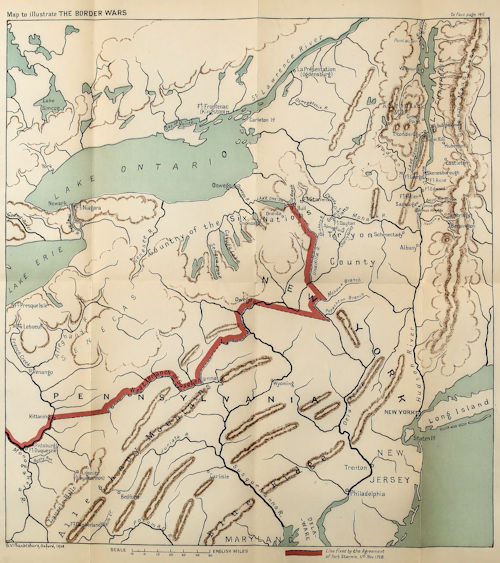
click here for larger image.
Map to illustrate
THE BORDER WARS
to face page 145
B. V. Barbishire, Oxford, 1908
Burgoyne and Carleton.
On the 27th of March Burgoyne left London. On the 6th of May he arrived at Quebec. There was no friction between him and Carleton. He had made no attempt to supplant Carleton, and, bitterly as Carleton resented his own treatment by Germain, he gave Burgoyne the utmost assistance for the coming campaign. ‘Had that officer been acting for himself or for his brother, he could not have shown more indefatigable zeal than he did to comply with and expedite my requisitions and desires.’ Such was Burgoyne’s testimony to Carleton, in his Narrative of the ‘state of the Expedition from Canada’ as given to the House of Commons.[123]
St. Leger’s expedition to the Mohawk river.
Before following the fortunes of Burgoyne and his army, it will be well to give an account of how St. Leger fared in the ‘diversion on the Mohawk river’. As in the days of the French and English wars, the twofold British advance from Canada followed the course of the waterways. While the main army moved up Lake Champlain to strike the Hudson at Fort Edward and thence move down to Albany, St. Leger’s smaller force was dispatched up the St. Lawrence to Oswego on Lake Ontario, in order by lake and stream to reach and overpower Fort Stanwix on the upper waters of the Mohawk river, and then to follow down that river to the Hudson, and reach the meeting-point with Burgoyne’s troops at Albany. At Albany both Burgoyne and St. Leger were to place themselves under Sir William Howe’s command. Oswego, the starting-point of St. Leger’s expedition, owing to its geographical position always played a prominent part in the border wars of Canada and the North American colonies. From this point Count Frontenac started when, in 1696, Oswego. he led his men to Onondaga, burnt the villages of the Iroquois, and laid waste their cornfields. The first fort at Oswego was built in 1727 by Governor Burnet of New York, who reported that he had built it with the consent of the Six Nations. It was built on the western bank of the mouth of the Onondaga or Oswego river, which here runs into Lake Ontario, and it was still the main fort in 1756, when Oswego was taken by Montcalm, although a subsidiary fort had also lately been built upon the opposite—the eastern side of the river. The effect produced both in England and in America by the French general’s brilliant feat of arms marked the importance which was attached to the position. The place was re-occupied by Prideaux and Haldimand with Sir William Johnson in 1759; and subsequently a new fort was constructed on the high ground which forms a promontory on the eastern side of the estuary. This fort, which after the War of Independence passed into American hands, was stormed and taken by Gordon Drummond in the war of 1812.
The Oswego river, or one branch of it, runs out of Lake Oneida: and into that lake, at the eastern end, runs the stream which was known as Wood Creek. From the Wood Creek there was a portage to the Mohawk river, and at the end of the portage stood Fort Stanwix, held by an American garrison, and barring St. Leger’s way to the Mohawk valley and the Hudson. All this was the country The Six Nations. of the Six Nation Indians, Six Nations instead of Five since the early part of the eighteenth century, when the Tuscaroras, driven up from the south by the white men, had been admitted to the Iroquois Confederacy. The Allies of the English. people of the Long House, as the Iroquois called themselves, had always been, in the main, allies of the English as against the French. From the time when the state of New York became a British possession, these Indians, who had had friendly trading relations with the Dutch, transferred their friendship to the English, and the chain of the covenant, though often strained, was never completely broken. When the War of American Independence began, and the English were divided, the Six Nations, though confused by the issue and by the competing appeals of the two parties, adhered as a whole to the Royalist cause. The majority of the Oneidas, and possibly the Tuscaroras, inclined to the American side, the Oneidas having come under the strong personal influence of a New England missionary, Samuel Kirkland, but the other members of the league were for the King. After the battle of Oriskany, where, among others, the powerful clan of Senecas suffered heavily, the enmity between these Indians and the colonists became more pronounced, and took the form of a blood feud, accompanied by all the horrors of militant savagery.
There were various reasons why the Iroquois should espouse the side of England against America. They looked to the Great King beyond the sea as their father and protector. The English colonists on their borders had shown little respect for their lands: and in 1774, in one of the inevitable conflicts between white men and red on the Virginian frontier, which was known as Cresap’s war, some of the Six Nation warriors had been involved, and the family of a friendly Cayuga chief had been murdered by the whites, bringing bitterness into the hearts of the western members of the Iroquois Confederacy. But, most of all, the Mohawks shaped the policy of the league, and they in turn were guided by the Johnson family, and by their famous fighting chief Thayandenegea, more commonly known by his English name of Joseph Brant.
The Mohawks.
The Mohawks had always been the leaders among the Six Nation Indians, though, by the time when war broke out between England and America, they were comparatively few in number, worn down by constant fighting, and by other causes.[124] Of all the Iroquois, they had been most consistently loyal to the English, and the most determined foes of the French. Their homes were at the eastern end of the Long House, in the valley of the Mohawk river, and they had therefore always been in close touch with the settlements at Albany, Schenectady, and along the course of the river to which they gave their name. They had mingled much and intermarried with their white neighbours; and for thirty-five years they had had living among them the Englishman, or rather the Irishman, who above all others won the confidence of the North American Indians, Sir William Johnson. They adopted Sir William Johnson. him and he adopted them, taking to wife in his later years, a Mohawk girl, Mary or Molly Brant. If Johnson in large measure lived down to the Indians, he also endeavoured to make the Indians live up to the white men’s level. He encouraged missionary effort, and promoted education, sending, among others, Joseph Brant, brother of Molly Brant, to a school for Indian boys at Lebanon in the state of Connecticut. Johnson represented the authority of the King, and he used his authority and his influence for the protection of the Indians against the inroads of the white men into their lands. The Mohawks, from their position, were more exposed than the other members of the confederacy to white land-jobbers, whose aggressiveness increased after Johnson’s death in 1774. Accordingly, while their traditional sympathies had always been with the English, when the civil war came, they had no hesitation in attaching themselves to the King’s cause. It was the cause of their protector; it was the cause of the Johnson family; it was the cause to which both interest and sentiment bade them to adhere. When Sir William Johnson died, he left as his political representative, his nephew and son-in-law, Colonel Guy Johnson: the heir of his estates was his own son, Sir John Johnson. Both the one and the other were pronounced Loyalists: they drew the Mohawks after them; and when, in the summer of 1775, after hearing of the fight at Bunker’s Hill, Guy Johnson left the Mohawk Valley for Oswego and crossed over to Canada, the majority of the Mohawks left their homes and followed him. In Canada, it was said, they received assurances from Carleton, which were confirmed by Haldimand, that they should not be allowed to suffer for their loyalty to the King.[125]
Joseph Brant.
The leader of these Mohawk friends of England was Joseph Brant, who was born, the son of a full-blooded Mohawk, in 1742. He was therefore a man of between thirty and forty years of age at the time of the American Revolution. In the period intervening between the British conquest of Canada and the battle of Waterloo, North America produced three very remarkable men of pure Indian descent. Pontiac was one, Joseph Brant was the second, the third was Tecumseh, who fought and fell in the war of 1812. Of these three, Joseph Brant alone sprang from the famous Iroquois stock. Pontiac was to a greater extent than the others a leader of the red men against the whites. So far as he had sympathies with white men, they were with the French as against the English. Brant, in the main, and Tecumseh played their parts when French rule had ceased to exist in North America; they were fast allies of the English as against the Americans or, to put it more accurately, of the English controlled from home as against the English installed in their own right in America. But all these three Indian chiefs had, in one form or another, the same main motive for action, to prevent what the red man had being taken from him by the white man. Of the three, Brant was by far the most civilized. He was an educated man and a Christian. He was, as has been seen, sent to school in Connecticut, he was a friend of the missionaries, he visited England twice, went to Court, had interviews and correspondence with Secretaries of State, made acquaintance with Boswell, was painted by Romney, and was presented by Fox with a silver snuff-box. He was poles asunder from the ordinary native inhabitant of the North American backwoods. He had known war from early boyhood, had borne arms under Sir William Johnson against the French, and had apparently fought against Pontiac. At the outbreak of the revolution he followed Guy Johnson to Canada, and seems to have taken part in opposing the American advance on Montreal. He paid his first visit to England towards the end of 1775, returned to New York in July 1776, and before the year closed made his way back up country to the lands belonging to or within striking distance of the Six Nations. Throughout the coming years of the war his name was great and terrible in the borderland, the main scene of his warfare being what was then known as the Tryon county of New York, the districts east of the Fort Stanwix treaty line, which were watered by the Mohawk river and its tributaries, and by the streams which flow south and south-west to form the Susquehanna. Once portrayed as the embodiment of ruthless ferocity, Brant was afterwards given a place in history as a hero. He was present at the Cherry Valley massacre, but in his fighting he seems to have been beyond question more humane than most Indian warriors, and at least as humane as some white men in these border wars, while his courage, his skill in bush-fighting, and his rapidity of movement were never surpassed. He was not a devil, and not an angel. Like other men, both coloured and white, he no doubt acted from mixed motives. His friendship for the English, and his patriotism for the native races, may well have been coupled with personal ambition. But he fought heart-whole and with no little chivalry for the cause which he espoused; and in war, as in peace, he was above and beyond the normal level of the North American Indian. After the war was over, he settled with his people in Canada, where he died in 1807, and the town of Brantford preserves his name.
St. Leger’s force too small for the task.
St. Leger’s expedition had been suggested to Germain by Burgoyne, while the latter was in England: indeed, some enterprise of the kind had been contemplated by Carleton. In view alike of past history and of the general plan of the summer’s campaign, it had much to recommend it; but the opposition which the English were likely to encounter, and actually did encounter, was under-rated, and the force was too small for the task imposed upon it. The total number has usually been given at 1,700 men, including Indians; but this seems to have been an over-estimate, at any rate when the fighting came. The white troops probably did not in any case exceed 650 in number. There were only 200 British regulars, half of whom were a detachment of the 8th, now the King’s (Liverpool Regiment), the same regiment which had furnished a company for the attack on the Cedars. There were a few German troops, who had just arrived in Canada, and some of whom did not reach Oswego until the expedition was over. The Germans, being wholly ignorant of the country, were quite unsuited for bush-fighting and bateau-work. There was a corps of New York Loyalists under the command of Sir John Johnson, and known as Johnson’s Royal Greens. Colonel John Butler led a company of the Rangers, and a small body of Canadians also took part in the expedition. The Indian contingent numbered over 800 men. Brant joined at Oswego at the head of 300 Indian warriors, mostly Mohawks, and the Senecas were much in evidence. The Indians, as a whole, were under the command of Colonel Daniel Claus, Johnson’s brother-in-law, who for many years was one of the officers charged by the British Government with the superintendence of Indian affairs. Thus St. Leger had with him most of the men whose names are best known on the British side in the annals of the border warfare in these troubled times. Guns were taken with the force, though of too small calibre to overpower a well-built fort; and, when the advance began towards the end of July, no precautions were neglected, a detachment was sent on a day’s march or so in front of the main column, and the latter was led and flanked on either side by Indians.
Fort Stanwix had at the time been renamed Fort Schuyler by the Americans, presumably in honour of General Schuyler, who commanded the American forces in the Northern Department. The older and better known name was subsequently restored. The fort stood on the Mohawk river, not actually on the bank of the river, but about 300 yards distant, guarding the end of the portage from Wood Creek. The length of the portage where the two rivers were nearest to each other, was rather over a mile.[126] The old blockhouse, Fort Williams, which had been the predecessor of the existing fort, and the ruins of which were standing at the time of St. Leger’s expedition, was destroyed by the English general, Daniel Webb, in 1756, as he retreated in hot haste on hearing of the capture of Oswego by Montcalm. Two years later General Stanwix built a new fort, which bore his own name. The town of Rome now covers the site on which Fort Stanwix stood. The fort was square in form. It had evidently been carefully designed by a trained soldier and strongly constructed, but during the years of peace, in this case as in those of the other border forts, the defences had fallen more or less into decay, and had not been fully repaired or rebuilt when the siege began. None the less, they proved to be too strong to be overpowered by St. Leger’s light guns. The garrison consisted of 750 men, 200 of whom came in, bringing stores and provisions, on the very day on which the forerunners of St. Leger’s force appeared on the scene. The commander of the garrison was Colonel Gansevoort, the second in command was Colonel Willett, Fort Stanwix. both thoroughly competent men.
St. Leger’s advanced guard, consisting of a detachment of 30 men of the 8th Regiment, under Lieutenant Bird, with 200 Indians under Brant, arrived before the fort on The siege of Fort Stanwix begins. the 2nd of August. They had been sent on, as is told in St. Leger’s dispatch, ‘to seize fast hold of the lower landing-place, and thereby cut off the enemy’s communication with the lower country.’[127] It had been hoped that they would be in time to intercept the reinforcements which were due at the fort, but they arrived too late for this purpose. They took up their position at the point named, below and due south of the fort, on the bank of the Mohawk river, athwart the road to Albany. On the following day, the 3rd of August, St. Leger came up himself, sent a proclamation into the fort, and began to invest it, fixing his main encampment about half a mile to the north-east of the fort, and higher up the river, which here runs in a curving course, so that a straight line drawn from the main British camp to the post at the lower landing-place would cross and recross the river, forming the base of a semi-circle. The Americans had blocked up Wood Creek with fallen timber, and St. Leger reported that it took nine days and the work of 110 men to clear away the obstructions, while two days were spent in making several miles of track through the woods in order in the meantime to bring up stores and guns. The siege, therefore, began long before the necessary preparations had been made, and long before the besieging force had been concentrated and duly entrenched. On the evening of the 5th of August there were not 250 of the white troops in camp, and at this juncture St. Leger was threatened by a strong body of Americans who had gathered for the relief of the fort.
The fight at Oriskany.
When news came to the New York settlements of the British advance, the militia of Tryon county were called out by their commander, General Nicholas Herkimer. The rendezvous was Fort Dayton, at the German Flatts, lower down the Mohawk valley than Fort Stanwix. The German Flatts were so named after settlers from the Palatinate, who had come out early in the eighteenth century, and from this stock Herkimer was himself descended. On the 4th of August he moved forward, the number of his force being usually given at from 800 to 1,000 men. St. Leger reported that they were 800 strong, and assuming that the total was between 700 and 800, the relief force and the garrison together equalled, if they did not outnumber, the whole of St. Leger’s army, the majority of which moreover consisted, as has been seen, of Indians. On the 5th Herkimer encamped near a place called Oriskany, about eight[128] miles short of Fort Stanwix, where a stream called the Oriskany Creek flowed into the Mohawk river. From this point he sent on messengers to the fort to secure the co-operation of the garrison. Meanwhile intelligence had reached St. Leger, sent it was said by Molly Brant, of the coming relief force, and at five o’clock on the evening of the 5th he dispatched 80 white troops, being all that he could spare, with 400 Indians, to intercept the advancing Americans before they came into touch with the fort, and ambush them among the woods. Sir John[129] Johnson was placed in command of the detachment, and with him were Butler and Joseph Brant. It was work for which Brant was eminently suited, and he seems to have been the leading spirit in planning the ambuscade. Very early on the morning of the 6th of August, urged on by his impatient followers, and against his own better judgement, Herkimer, without waiting for reinforcements or for a sign from the beleaguered fort, continued his advance. He reached a point between two and three miles beyond Oriskany, and within six miles of the fort, where the path descended into a semi-circular ravine, with swampy ground at the bottom and high wooded ground at the sides. Here the Americans were caught in a trap, which would have been more complete had not the Indians begun fighting before the plan of ambush had been fully developed. The American rearguard, which had not yet entered the ravine, broke and fled: the main body were surrounded, Johnson barring their way in front, Brant falling on their rear, while others of the Indians and Butler’s rangers fought on the flanks. There followed a confused fight among the trees, gradually becoming a hand to hand struggle, with a brief interlude caused by a heavy storm of rain. Herkimer was mortally wounded, many, if not most, of the other leading American officers were killed; while, on the British side, the Indians suffered heavy losses. In the end the remnant of the American force seem to have beaten off or tired out their assailants, and made good their retreat, but according to St. Leger’s report only 200 of them escaped. Butler estimated the total American casualties in killed, wounded, and prisoners, at 500, and, according to American accounts, the total was about 400. The white casualties on the British side were very small, but the casualties among the Indians seem to have numbered from 60 to 100.
While the engagement was going on, a sortie was made from the fort, and it was probably news of this movement, coupled with the Indian losses, which put an end to the fight at Oriskany. Bird, the commander of the post at the lower landing-place, had been misled by a rumour that Johnson was hard pressed, and led out his men to support him, leaving the post undefended. Meanwhile, Willett at the head of 250 men marched out of the fort, apparently in ignorance of the ambuscade and designing to join hands with Herkimer’s force. Willett found the post practically deserted, mastered it, and carried off its contents, eluding an attempt which St. Leger made to cut him off on his return to the fort.[130] This ended the day’s work. Herkimer’s force had been blotted out, but it must have become increasingly evident that St. Leger’s men and resources were hopelessly inadequate for the task which had been set him, to force his way to Albany.
St. Leger fails to take Fort Stanwix and retreats to Oswego.
After the battle of Oriskany, St. Leger summoned the fort to surrender, but without effect. He continued the siege, but made little or no impression upon the defences. On the night of the 10th of August Willett made his way out of the fort, reached Fort Dayton, and went on to Albany where he met Benedict Arnold who had been charged with the duty of relieving Fort Stanwix. Arnold gathered troops for the purpose and in the meantime, with his usual cleverness, contrived to send on rumours which caused alarm in the British camp. A thousand men were reported to be coming, then 2,000, then 3,000, and Arnold’s own name may well have been a potent source of apprehension. The Indians, already depressed by their losses at Oriskany, and by the prolonging of the siege, became more and more out of hand, deserting, marauding, and spreading exaggerated tales; and at length, on the 22nd or 23rd of August, St. Leger beat a hasty retreat by night, leaving behind him most of his stores and guns, and returned to Oswego, whence he went back to Montreal and on to Lake Champlain in the wake of Burgoyne’s army. Joseph Brant took a less circuitous route. When St. Leger retreated from Fort Stanwix, Brant made one of his marvellous flying marches down the Mohawk Valley: and, after passing for over a hundred miles through the heart of the enemy’s country, which was also his own, in two or three days’ time joined Burgoyne’s force on the banks of the Hudson river.
Misconduct of the Indians.
When he returned to Oswego, St. Leger, on the 27th of August, wrote a dispatch to Burgoyne, giving details of his expedition, but not punctuating his failure. The failure was due to insufficiency of numbers and artillery in the first place, and in the second, beyond question, to the misconduct of his Indian allies. The employment of Bad effects of employing them in the war. Indians in this war with British colonists may have been inevitable, but it was certainly politically inexpedient, notwithstanding the fact that the colonists themselves were ready to avail themselves of similar aid. Indians had been engaged on the English side in the wars with the French, but sparingly and under strict supervision. Carleton, as long as he directed operations in the War of Independence, had been equally careful in using these savage tools.[131] In St. Leger’s expedition the disadvantages of enlisting Indian fighting men came fully to light. They became, St. Leger wrote to Burgoyne, ‘more formidable than the enemy we had to expect.’ Disappointed of looting the enemy, they plundered their friends and endangered, if they did not in some cases take, their lives. Unstable as friends, ferocious as foes, they were not fit helpmates for Englishmen in fighting Englishmen, even their value as scouts was diminished by their incurable habit of believing and exaggerating any report. As in the war with the French in Canada, the English gained ground by the scrupulous care which they took to prevent outrages on the part of the savages who accompanied their armies, so in the later war with their own countrymen, they distinctly lost ground through calling out the coloured men of America against colonists of British birth.
Burgoyne’s address to the Indians.
Burgoyne’s instructions from Lord George Germain included the employment of Indians under due precautions; and he formally addressed his Indian followers in his camp at the river Bouquet, on the western side of Lake Champlain, on the 21st of June, 1777. ‘The collective voices and hands of the Indian tribes over this vast continent,’ were, he told them, with a few exceptions, ‘on the side of justice, of law, and the King.’ He bade them ‘go forth in might of your valour and your cause: strike at the common enemies of Great Britain and America’. On the other hand, he sternly forbade bloodshed except in battle, and enjoined that ‘aged men, women, children, and prisoners must be held sacred from the knife or hatchet, even in the time of actual conflict’. Compensation would be given for the prisoners taken, but the Indians would be called to account for scalps. His listeners replied, through an old chief of the Iroquois—‘We have been tried and tempted by the Bostonians, but we have loved our father, and our hatchets have been sharpened upon our affections.’ They promised with one voice obedience to the general’s commands.
Burgoyne.
At this date, in the year 1777, Burgoyne was fifty-five years of age, having been born in 1722, two years before Carleton was born. He was clearly a man of ability, and unusually versatile. He was also, as times went, an honourable man. In his relations to Carleton, at any rate, he seems to have been open to no reproach. But he tried too many things to be first-rate in anything; he was not adequate to a great crisis and to heavy responsibility: and because he was not of the first class, and also because he had much dramatic instinct, he seems to have had more eye for present effect than for the root of matters. He was educated at Westminster School, and, when he died in 1792, he was buried in the northern cloister of Westminster Abbey. He was a soldier, a politician, a dramatist, and a man of society. He entered the army in 1740, again two years before Carleton’s military service began. He became so involved in debt that he had to sell his commission. He rejoined the army in 1756, and in 1762 he distinguished himself in Portugal, where the English supported the Portuguese against Spain and France. A few years later, however, in 1769, Junius referred to him as ‘not very conspicuous in his profession’.[132] He went into the House of Commons in 1761 as member for Midhurst. In 1768, through the influence of his father-in-law, Lord Derby, he became member for Preston, and, in connexion with his election, was attacked by Junius for corruption and also for his gambling propensities. As a politician he was, before he went to America, more or less of a free-lance. He spoke on foreign and Indian questions, and in 1773 made a speech in the House of Commons, attacking Clive. After the catastrophe at Saratoga, and his return to England, he threw in his lot with the Whigs, having been befriended by Fox and his followers; he became Commander-in-Chief in Ireland under Rockingham; and in 1787 he managed the impeachment of Warren Hastings. Before the American war broke out, he produced in 1774 a play called The Maid of the Oaks, of which Horace Walpole wrote: ‘There is a new puppet show at Drury Lane as fine as scenes can make it, called The Maid of the Oaks, and as dull as the author could not help making it.’[133] At a later date, however, Walpole had to confess that ‘General Burgoyne has written the best modern comedy’.[134] This was The Heiress, which was brought out in the beginning of 1786, and achieved a great success. Walpole had no love for Burgoyne, at any rate at the time when the latter served in America. ‘You ask the history of Burgoyne the pompous,’ he wrote in October, 1777,[135] the month in which the surrender at Saratoga took place; and after describing him as ‘a fortunate gamester’, he continued, ‘I have heard him speak in Parliament, just as he writes: for all his speeches were written and laboured, and yet neither in them nor in his conversation did he ever impress me with an idea of his having parts.’ Burgoyne’s affectation and mannerism may have been due to the fact that he was essentially a man of society, as society was then. He had eloped in early life with Lord Derby’s daughter, and, like Charles Fox, was a confirmed gambler. The world of London was his world, and the standard by which he measured things was not the standard of all time. When he went out in 1777 to command the expedition from Canada, he was on the flowing tide of fortune, and the tone of his proclamations gave Walpole cause for sarcastic comment. ‘Have you read General Burgoyne’s rhodomontade, in which he almost promises to cross America in a hop, step, and a jump?’[136] ‘Burgoyne has sent over a manifesto that if he was to over-run ten provinces would appear too pompous.’[136] ‘I heard to-day at Richmond that Julius Caesar Burgonius’s Commentaries are to be published in an Extraordinary Gazette of three-and-twenty pages in folio to-morrow—a counterpart to the Iliad in a nutshell.’[136] All these three passages were written in August, 1777, while Burgoyne’s expedition was proceeding. The writer of them did not like Burgoyne, and did not like the war in which Burgoyne was engaged; but, though Burgoyne lent himself to criticism and lacked the qualities which the time and place demanded, his story is by no means the story either of a bad soldier or of a bad man; it is rather the story of a second-rate man set with inadequate means to solve a problem of first-rate importance.
Burgoyne’s advance against Ticonderoga.
Having completed his preparations, Burgoyne reached Crown Point on the 26th of June, preparatory to attacking Ticonderoga. The full control of the operations had passed into his own hands, for, by Germain’s instructions, Carleton’s authority was limited by the boundary line of Canada, and that line was drawn far north of Crown Point and Ticonderoga, cutting the outlet of Lake Champlain near the point of land named Point au Fer. The total force amounted to rather over 7,000 men, nearly half of whom were Germans under the command of Baron Riedesel. The advance was made on both sides of the lake, the Germans being on the eastern shore, the British on the western—the side on which were Crown Point and Ticonderoga. The Americans, too, held positions on The American position at Ticonderoga. both sides of the lake, for, over against the peninsula on which Ticonderoga stood, there jutted out another point of land, described in Burgoyne’s dispatch as ‘high and circular’, but in reality rather oblong in form, rising well above the level of the lake and skirted in part on the land side by a rivulet. It was called Mount Independence, and was strongly held and fortified. The lake, here narrowed to a river, is about a quarter of a mile across, and between Ticonderoga and Mount Independence a bridge had been constructed, consisting of sunken timber piers connected by floating timber, the whole being guarded in front by a heavy boom of wood strengthened by iron rivets and chains.
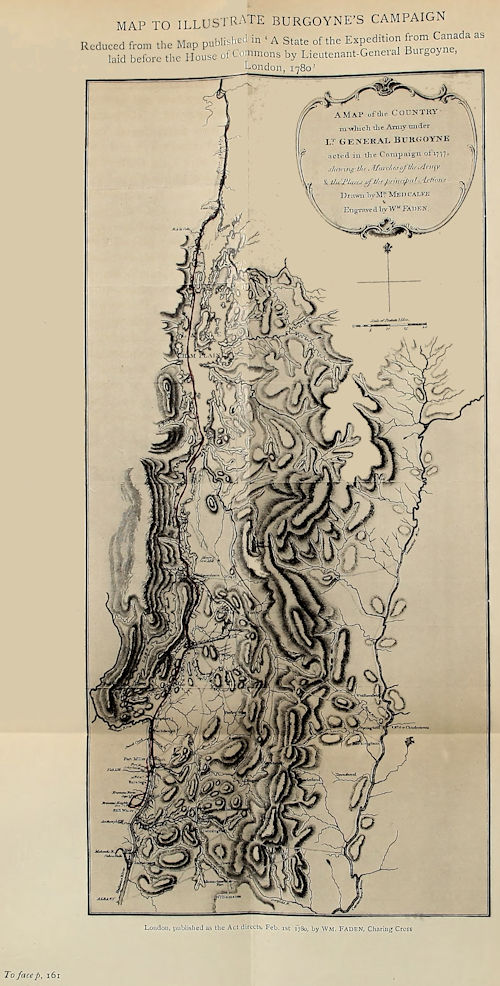
click here for larger image.
MAP TO ILLUSTRATE BURGOYNE’S CAMPAIGN
Reduced from the Map published in ‘A State of the Expedition from Canada as laid before the House of Commons by Lieutenant-General Burgoyne, London, 1780’
London, published as the Act directs, Feb. 1st 1780, by Wm. Faden, Charing Cross
To face p. 161
The Indian name Ticonderoga signified the confluence of three waters. At this point the long narrow southern arm of Lake Champlain, coming in from the south-east, meets the stream which carries out the waters of Lake George into the third water, the main lake Champlain. The outlet of Lake George describes a complete semi-circle, and runs into Lake Champlain due west and east. The direct route therefore from Lake Champlain to Lake George runs well to the west of and inside the peninsula of Ticonderoga, cutting the semi-circular stream without touching the peninsula. In this consisted the weakness of the American position: unless the works were extended further afield than they had men to hold them, part of the attacking force could pass them by and invest Ticonderoga on the southern as well as on the northern side, blocking retreat by the line of Lake George. So it happened when Burgoyne’s army came on the scene.
Burgoyne’s operations against Ticonderoga.
After three days’ stay at Crown Point to bring up all his forces, the general on the 30th of June moved forward his leading corps on either side of the lake, and on the next day the whole army followed. On the 2nd of July the Americans were reported to have abandoned the post which guarded the bridge over the river from Lake George, to the west of Ticonderoga, where saw-mills stood and which was the starting-point of the ‘carrying place’ from Lake Champlain to Lake George. They abandoned it, in order to concentrate their strength against the English advance on the north-west. Burgoyne immediately moved forward his troops and, driving the enemy back, on the night of the 2nd occupied the high ground on the west which commanded the communications with Lake George, and thereby cut off the possibility of retreat in that direction. On the 3rd and 4th the attacking forces drew nearer to the two beleaguered forts, in spite of cannonade; and on the night of the 4th, a party of light infantry occupied a height called Sugar Hill, which stood on the southern bank of the outlet from Lake George, in the angle between that stream and the southern arm of Lake Champlain, overlooking and commanding both Ticonderoga and Mount Independence at an estimated distance of about 1,400 and 1,500 yards respectively. On the 5th guns were being brought up to the hill, but, The Americans evacuate their position, when the morning of the 6th came, it was found that the American general, St. Clair, had carried his troops across by the bridge from Ticonderoga, and, having evacuated both that post and Mount Independence, was retreating by land and water.
and are followed up by the English.
By land and water Burgoyne’s men followed on the same day, the bridge and boom being broken for the gunboats to pass through. At Skenesborough, where the navigation of Lake Champlain ends, the enemy’s vessels were taken or destroyed by the British squadron, and the detachment of Americans who held the fort set fire to it and retreated to Fort Anne. Meanwhile, diverging to the east in the direction of Castleton on the road to Connecticut, General Fraser, commanding the van of the troops who pursued by land, followed hard throughout the 6th upon the American rearguard; Riedesel came up behind him with supports; but, by agreement between the two commanders, Fraser, when night fell, bivouacked three miles in front of his colleague. Early on the 7th he attacked the Americans, who outnumbered his own troops, near a place named Huberton, and was on the point of being beaten back when the arrival of Riedesel converted a repulse into a victory. The colonists were broken, their leader, Colonel Francis, and some 200 of his men were killed, about the same number were taken prisoners, and a large number of wounded were supposed to have lost their lives in the woods. Having completed the rout, on the 8th and 9th Riedesel and Fraser came into touch with the main army at Skenesborough.
Fight near Fort Anne.
At Skenesborough there was a portage from Lake Champlain to Wood Creek,[137] a stream which flows into the lake from the south. While boats were being dragged across from the lake to the river with a view to further advance, the 9th Regiment was sent on by land to Fort Anne, twelve miles distant in a due southerly direction. By the evening of the 7th the English drew near to the fort, and on the following day they were attacked and hard pressed by a stronger body of Americans. They took up a position on a hill, and held their ground resolutely, until the whoop of Indians told that reinforcements were coming up: the Americans then gave way, and, setting fire to Fort Anne, fell back to Fort Edward. The English in their turn returned to Skenesborough, in the neighbourhood of which, on the 9th and 10th of July, the whole army, excluding the troops required to garrison Ticonderoga, was concentrated, the line extending eastward from the head of Lake Champlain towards Castleton.
Result of the operations.
‘General Burgoyne has taken Ticonderoga, and given a new complexion to the aspect of affairs, which was very wan indeed,’ wrote Horace Walpole, when the news reached England.[138] So far the operations had been triumphantly successful. Hardly an attempt had been made by the Americans to hold their ground at Ticonderoga and Mount Independence, although months had been spent in strengthening the positions, and the number of the defenders was variously estimated at from 3,000 to 5,000 men. Great quantities of stores, of boats, of guns had fallen into British hands: the enemy’s loss on the retreat had been heavy, and the rapidity with which the retreat had been followed up had caused widespread alarm. For the moment there seemed nothing to check the tide of British victory, but time, place, and insufficiency of numbers gradually told against Burgoyne’s enterprise. He, too, had suffered some losses, though small when compared with those of the Americans; and his army, already inadequate in numbers for the expedition, was further weakened by the necessity of garrisoning Ticonderoga with some 900 men. He applied to Carleton to supply the requisite number of soldiers for the garrison from the troops who, in accordance with the instructions from home, were retained for the defence of Canada, but Carleton felt himself bound to refuse the request. It was Germain who had given the orders, and yet the same man, writing from England in the following September, on receipt of Burgoyne’s account of the capture of Ticonderoga, stated that he presumed that the post would be garrisoned from Canada.[139]
The two routes to the Hudson.
Burgoyne’s objective was the Hudson river and Albany. Fort Edward stood on the left or eastern bank of the Hudson, a little below the point where that river curves to the south, to flow direct to the Atlantic. It was twenty-six miles distant from Skenesborough, and due south of that place. The first twelve miles of the route from Skenesborough lay along Wood Creek, until Fort Anne was reached, and from Fort Anne to Fort Edward was an interval of fourteen miles. Three miles short of Fort Edward the road joined the road to Fort Edward from Fort George, previously known as Fort William Henry, at the head of Lake George, which was at much the same distance from Fort Edward as Fort Anne, viz., fourteen to sixteen miles. The more obvious route of advance towards the Hudson from Ticonderoga, and the one originally contemplated, was along Lake George, and Burgoyne’s line of advance. Burgoyne was criticized for not taking that line—without good reason, because the American retreat had already determined the choice of routes. Having immediately followed the enemy up as far as Skenesborough, Burgoyne, as he justly pointed out, would have been unwise to make a retrograde movement in order to adopt the alternative line of advance by Lake George. Moreover, while the troops were moving forward from Skenesborough viâ Wood Creek and Fort Anne, supplies were being forwarded along Lake George in order to meet him when he reached Fort Edward. But there was a further reason, which in His object was to threaten the New England States. Burgoyne’s mind made for the more easterly of the two routes. His own scheme for the campaign had inclined to carrying war to the east into Connecticut and the New England states, in preference to a direct advance to the Hudson and Albany; and, though his instructions prevented his carrying out the plan which he preferred, he might yet, as he advanced, threaten New England, and at the same time gather supplies from a more promising country than would be found in the Adirondack region on the west of Lake George. Thus in a private letter to Germain, which accompanied his dispatch from Skenesborough, detailing the success of his recent operations, he wrote: ‘I a little lament that my orders do not give me the latitude I ventured to propose in my original project for the campaign, to make a real effort instead of a feint upon New England. As things have turned out, were I at liberty to march in force immediately by my left, instead of by my right, I should have little doubt of subduing before winter the provinces where the rebellion originated.’ It must be remembered that at this time British troops were in occupation of Rhode Island, and that Sir William Howe had originally planned a campaign in New England in 1777, only giving up the scheme when he found that sufficient reinforcements from Europe would not be forthcoming.
It was with the object of keeping the New England States in fear of invasion, or, as he himself phrased it, ‘of giving jealousy to Connecticut, and keeping in check the whole country called the Hampshire Grants,’[140] that Burgoyne, while encamped at Skenesborough, detached Riedesel to occupy Castleton about fourteen miles to Riedesel sent to Castleton. the east. Castleton was an important point, because through it ran a road which connected Skenesborough by land with the shore of Lake Champlain opposite Ticonderoga and Crown Point. Riedesel was absent for about twelve days, and in the meantime preparations were pressed forward for a further advance of the main army, the road to Fort Anne and the parallel waterway of Wood Creek being cleared of obstructions. Simultaneous preparations were made at Ticonderoga for forwarding supplies by Lake George. On the 23rd of July the advanced guard moved forward to Fort Anne: on the 25th the whole army had reached that point; on the 29th, the van arrived at Fort Edward, which the Americans had already evacuated, and on the 30th Burgoyne arrived at the same place. A large convoy of provisions sent by Lake George reached the head of that lake by the 29th, Fort George like Fort Edward having been abandoned The army arrives at Fort Edward on the Hudson river. by the enemy, who had carried off their stores. Thus the end of July found Burgoyne on the Hudson, well on his way to Albany; the main difficulties of the expedition seemed to be past; but as a matter of fact the most trying time was yet to come. His communications were insecure, for he could not spare men to guard them. His transport was inadequate, and so were his supplies. Delay in bringing up stores meant time to the Americans to recover their spirits and gather in his front: he had no tidings from Howe, and no sure knowledge of St. Leger’s progress. He only knew that at all hazards he was expected to make his way to Albany.
The beginning of misfortunes. Murder of Jane McCrae by the Indians.
While he halted at Fort Edward, two untoward incidents took place. The first was a brutal murder by Indians of a young white woman named Jane McCrae, who had remained behind at or near Fort Edward, when the Congress troops fell back before Burgoyne’s advance. The story went that she was engaged and about to be married to an officer in Burgoyne’s army. Falling into the hands of the Indians, she was murdered with purposeless, savage fury, and the tale of the outrage, embellished with horrors, was spread far and wide through the land. Colonists hitherto inclined to the loyal cause, felt that their homes and womenkind would not be safe, if they awaited the coming of the English and their savage allies: the opponents of England found additional justification for the stand which they had taken up; the sympathizers with the American cause in England were given a new text for denouncing the war; and Burgoyne lost Indian support by taking steps to prevent a recurrence of such enormities.
The second misfortune which happened—a most grave misfortune—was an unsuccessful expedition in the direction of Bennington. Bennington is in the state of Vermont, The expedition to Bennington. to the south-east of Fort Edward, lying about twenty-four miles due east of the stretch of the Hudson river, between Saratoga on the north and the confluence of the Mohawk on the south, which was known as Stillwater. It is in the forks of the two streams which combine to form the Hoosick river, a tributary of the Hudson, flowing Objects aimed at by the expedition. into the main river from the east. Burgoyne’s information was to the effect, quoting his own words, that it was ‘the great deposit of corn, flour, and store cattle’, intended for the use of the Congress troops, which he designed to secure for his own army in view of the difficulty and delay experienced in bringing up supplies from Canada. The German general, Riedesel, seems to have originally suggested such an expedition, from knowledge gained while he was stationed at Castleton. He was anxious to obtain horses to mount his men and to carry the baggage; there was evidence of a considerable Loyalist element in the population, and little reason to apprehend strong opposition from the colonial militia. Above all Burgoyne had constantly in his mind the object of threatening the New England states: and, having by this time received intelligence that St. Leger was before Fort Stanwix, he wished to make a diversion to the east, in order to prevent reinforcements being sent up the Mohawk river to the relief of that post. The instructions which he issued for the expedition show that he contemplated that the detached force, if things went well, would penetrate far beyond Bennington, up to the Connecticut river, and possibly not rejoin the main army until the latter had reached Albany.
Strength and composition of the force.
About 500 men, according to his dispatch, were detailed for the enterprise, but the number appears to have been larger.[141] It was a mixed body. There was a strong contingent of Germans, chiefly dismounted dragoons, ill suited for a cross-country march, and there were also picked marksmen from the British regiments, Canadians, provincials, and about 100 Indians. Out of compliment to Riedesel, the command was given to Colonel Baum, Colonel Baum in command. one of his officers, and in selecting German troops for the expedition, Burgoyne marked his appreciation of the good service which those regiments had rendered in following up the retreat of the Americans from Ticonderoga. The starting-point was the Batten Kill stream, running into the Hudson on its eastern side, ten miles lower down than Fort Edward. From this point to Bennington, by the route which Baum was finally instructed to take, was a distance of under thirty miles. The advance guard of Burgoyne’s army had already been moved down the Hudson to the Batten Kill, and, on the 14th of August, after Baum had started, they were thrown across the main river a little higher up under the command of General Fraser, and moved forward on the western bank as far as Saratoga, with the object of a further advance to Stillwater in the event of Baum’s expedition proving successful. The temporary bridge of rafts, however, by which they had crossed, being carried away, the troops were recalled and passed back in boats to the eastern side.
Baum started from the Batten Kill early on the morning of the 13th of August, reached a place called Cambridge in the afternoon of that day, and on the following day arrived at Sancoick Mill near the confluence of the two branches of the Hoosick river, about four miles short of Bennington. There he found that the enemy in front of him were more numerous than had been anticipated, and he sent back to Burgoyne for reinforcements. Colonel Reinforcements sent under Colonel Breyman. Breyman, another German officer, was dispatched to his support with nearly 700 men: he started early on the morning of the 15th, but, owing to the difficulties of the route, and want of horses and forage, he made slow way, and was far short of Baum when evening came. On the 16th a number of men, as from the country side, Baum’s force surprised and cut up. came to where Baum was encamped: they were taken to be friends and Loyalists, and made their way within his lines. On a sudden, while beginning to move forward,[142] he found himself attacked on all sides: the component parts of his little force were separated from each other, and only the German soldiers held together, fighting bravely, as long as they had powder left, and then vainly endeavouring to cut their way out with their swords. The end was inevitable. The Indians dispersed in the woods: some of the British contingent with their commander, Captain Frazer, escaped, and so did a good many of the Canadians and provincials: but Baum was mortally Baum mortally wounded. wounded, and nearly all of his Brunswickers were killed or captured. On the afternoon of the same day, ignorant of what had happened, Breyman’s force was coming Breyman attacked and forced to retreat with heavy loss. up and was in turn suddenly attacked. Again the men fought hard until their ammunition gave out, and eventually the main body made good their retreat, though they suffered heavy losses and had to leave their guns behind. John Stark was the leader of the Americans in these hard fought engagements.
Consequences of the disaster.
The immediate result of the fighting was the loss to the English of over 500 men and four guns,[143] and the total failure of the expedition. The ultimate effect was much more serious. Burgoyne’s small army was still further reduced: his hope of securing supplies and horses from the surrounding country was entirely gone; his expectation of Loyalist support, upon which the English had counted, was shown to be groundless; the chance of facilitating the main operations by a successful diversion was lost; the enemy were put in good heart; and such fickle allies as the Indians were further alienated. The enterprise was subsequently made the subject of much hostile criticism, and blame was variously assigned. Burgoyne considered that the failure was due to the fact that Baum had not taken up a position in the open in accordance with instructions, to the chance co-operation of bodies of the enemy who happened to be near, and to undue slowness on Breyman’s part. The truth seems to have been that the expedition was not badly conceived, but imperfect knowledge of the country and faulty intelligence as to the enemy’s strength and movements in this, as in many similar cases, procured disaster.[144]
Burgoyne’s views on the situation.
Burgoyne’s anxiety as to the future was expressed in a private letter which he wrote to Germain on the 20th of August, accompanying the public dispatch of the same date in which he reported the failure of the Bennington expedition. He wrote that, in spite of St. Leger’s victory, Fort Stanwix was holding out obstinately, that no operation had been taken in his favour, and that the American forces under Gates in his front had been strengthened and now outnumbered his own. Only one letter had reached him from Sir William Howe. That letter was written from New York on the 17th of July, and in it Howe stated that he had heard of Burgoyne’s victory at Ticonderoga, adding ‘My intention is for Pennsylvania, where I expect to meet Washington, but if he goes to the northward contrary to my expectations and you can keep him at bay, be assured I shall soon be after him to relieve you’. As has been already stated, no instructions from Germain had reached Howe on the subject of Burgoyne and his army, though he had received from Carleton a copy of Germain’s dispatch of March 26th, 1777, in which the programme of the expedition from Canada had been detailed. Situated as Burgoyne was, knowing that further advance would entail cutting of his communications with Ticonderoga, it is no wonder that in his letter to Germain he wrote that, had he latitude in his orders, he would have thought it his duty to remain where he was encamped opposite Saratoga, or further back at Fort Edward where his communications would be secure, until events in other quarters facilitated a forward movement. But his instructions were ‘to force a junction with Sir William Howe’, or at any rate to make his way to Albany; and, as he sadly wrote, when the catastrophe was over and he was a prisoner, ‘The expedition I commanded was evidently meant at first to be hazarded. Circumstances might require it should be devoted.’ A very strong man in his position would have taken the responsibility of temporary retreat, but, good soldier as he was, he was not a commanding character. He knew the power which Germain possessed of making and unmaking men, he had before his eyes the harsh treatment of Carleton, because Carleton had exercised wise discretion in falling back from Crown Point in the preceding autumn. His instructions freed him from responsibility if he went forward, the blame would be his alone if he fell back. The evil influence of Germain blighted loyal commanders and soldiers in America. George the Third’s system was working itself out, and the British Empire was being sacrificed to the ‘King’s Friends’.
The first necessity was to bring up supplies from Lake George for the further advance, enough to last for twenty-five to thirty days, inasmuch as crossing the Hudson and moving south meant the loss of communication with Canada. This Burgoyne anticipated, and his apprehensions proved true. Shortly after he crossed the Burgoyne’s communications attacked by the colonists. Hudson and began his southward march, a force of colonists, assembling at Skenesborough, on the 18th of September attacked the British garrisons at Ticonderoga and Mount Independence. They were repulsed after four or five days’ fighting, but not until they had taken outposts at the saw-mills, Mount Hope, and Sugar Hill, captured three companies of British soldiers, and taken or destroyed a large amount of stores and a number of boats. Retreating up Lake George, they attacked a detachment on an island in the lake named Diamond Island and, though they were again beaten off, their operations served the purpose of making Burgoyne’s communications utterly insecure.[145]
From the 16th of August to the 13th of September, the British army remained on the eastern bank of the Hudson over against Saratoga. The reinforcements which joined them apparently amounted to only 300 men. News seems to have reached the army, before they moved onward, that St. Leger was retreating from Fort Stanwix, so that hope of co-operation in the direction of the Mohawk river was at an end; on the other hand there was a possibility that St. Leger’s men, brought down the St. Lawrence and up Lake Champlain and Lake George, might be able to join the main force. It is not clear what was the exact number of men who crossed the Hudson under Burgoyne’s command. According to the evidence given at the subsequent Parliamentary inquiry, the regulars, British and German, were rather short of 5,000 men, but, if the Canadians and provincials were included, the total fighting force must have reached 6,000. From Fort Edward to Albany is a distance of over forty miles and to the confluence of the Mohawk river about thirty-four; but Burgoyne was already encamped ten miles south of Fort Edward and the Americans, who had previously fallen back to what was The Americans under Gates take up a position at Bemus’ Heights. known as the Half Moon at the mouth of the Mohawk river, after the British defeat at Sancoick Mills and the relief of Fort Stanwix, moved up the Hudson a little way above Stillwater, and took up a strong position on high ground called Bemus’ Heights, where they were within ten miles’ distance of the point where Burgoyne crossed the river.
General Philip Schuyler had been in command of the Congress troops on the side of Canada. He was a man of the highest character, and apparently a perfectly competent soldier, whose Fabian tactics were beginning to achieve success when he was superseded. After the abandonment of Ticonderoga and the rout which followed, the tide of public opinion set against him—without any adequate reason. The New Englanders were jealous of a general from New York state; and, under a resolution of Congress, Schuyler was in the middle of August replaced by Horatio Gates, a godson of Horace Walpole, who, like Richard Montgomery, had been born in the United Kingdom and had served in the British army, having been badly wounded in Braddock’s disastrous expedition. Gates, who in the previous year had commanded the garrison at Ticonderoga, was a self-seeking, intriguing man. His subsequent disloyalty to Washington, and his defeat at Camden, clouded what reputation he gained through receiving Burgoyne’s surrender. When he took over the command of the troops opposing Burgoyne, his task was comparatively easy. He had good men with him, among others Arnold, who had returned from the march to relieve Fort Stanwix and between whom and Gates there was no love lost, he had also Daniel Morgan and Lincoln; while the army under their command had received an accession to its numbers in consequence of Howe having moved off from New York to Philadelphia. The Americans now largely outnumbered Burgoyne’s force, and behind them, lower down the Hudson, the Highlands were held against a possible movement on the part of Clinton, who commanded the troops left behind at New York when Howe sailed for Chesapeake Bay.
Burgoyne crosses the Hudson and advances South.
About six miles below Fort Edward, between that fort and the Batten Kill stream, at a place named Fort Miller, there were rapids in the Hudson, where a portage was necessary for the boats descending the river; below it navigation was unimpeded, and the stores and baggage of the army could be carried by water. A bridge of boats was thrown over the river about half a mile above the Batten Kill, and by this bridge the whole army crossed the Hudson on the 13th and 14th of September from the eastern to the western shore. Burgoyne was subsequently criticized for crossing, but the criticism had no sound foundation. If he was to reach Albany at all, he must cross the river at some point or other, and the further he went down stream the more difficult the crossing was likely to be. Moreover the high road ran along the western bank, while on the opposite shore swamp and mountain would have made it impossible at certain points to march close to the river bank, and the army would therefore have been separated from the boats. On the western side of the Hudson the country, through which the troops advanced, was wooded and broken, the road and bridges over the intervening creeks had been cut up by the enemy, and progress was slow; but by the 17th less than four miles intervened between the two armies. On the 18th there was skirmishing, while the British force were repairing bridges and cutting a way through the bush: and on the 19th a general action took place.
Action of September 19.
The British army advanced in three divisions. On the right under General Fraser were the 24th Regiment, the light infantry and the grenadiers, accompanied by Indian and Canadian scouts and supported by some German troops under Colonel Breyman. The centre column, entirely composed of British regiments, was under Burgoyne’s immediate command. The left wing was in charge of Riedesel, and included the main body of the German soldiers with most of the artillery. The left marched along the high road on the lowland following the course of the river, and one British regiment, the 47th, on the bank of the river, guarded the boats which carried the stores. There was a deep ravine between the armies, and Fraser’s division made a wide circuit to the right in order to keep on the high ground. The movement was successfully carried out, and Fraser established himself in a strong position while the centre column moved forward, crossed the ravine, formed on the other side, and bearing to the right became engaged with the enemy. The centre of the battle was a clearing in the woods, where there was a homestead known as Freeman’s farm; from this farm the Americans had molested Burgoyne’s advance, and being dislodged by artillery fell back into the cover behind. Their intention had been to turn the British right, but, finding that Fraser was too strongly posted, they counter-marched and placed their full force in front of the centre column. Here the battle was fought, and for four hours, from three o’clock in the afternoon till seven, the brunt of the fighting fell upon three British regiments, the 20th, the 21st and the 62nd, a fourth regiment, the 9th, being held in reserve. Some help came from Fraser’s men, but the safety of the army depended upon his holding his ground on the right, so that he could not bring up his whole division in support of the centre. Constantly reinforced and covered by the woods, the Americans, led by Arnold, who commanded the left wing of their army, pressed hard upon the fighting regiments, until, late in the day, Riedesel, having pushed forward his troops along the line of the river, wheeled them sharp to the right and struck in on the flank. This decided the battle, and, as darkness fell, the forces of the Congress drew off, leaving Burgoyne’s army in possession of the field.
Result of the fight—Burgoyne’s losses.
The fight was won, but, as Burgoyne wrote in his subsequent dispatch, ‘it was soon found that no fruits, honour excepted, were attained by the preceding victory.’ He had lost about 500 men, the 62nd Regiment having especially suffered, and though the losses of the Americans had possibly been heavier, reinforcements were available for them and their position grew stronger and stronger. On the day after the battle the English moved forward slightly until they were almost within cannon shot of their enemies, at a distance of about half a mile, and in turn threw up entrenchments. On the 21st Burgoyne received a message from Clinton, dated the 12th, to the Message from Clinton. effect that in about ten days’ time he intended to move up the Hudson and attack the American forts in the Highlands. Burgoyne sent back word, urging the necessity of some such operation in his favour in order to divert part of the American force which was barring his way, and he stated that he would hold his ground if possible, till the 12th of October. The days went on: Scarcity of provisions. provisions began to run short: on the 3rd of October it was found necessary to reduce the soldiers’ rations: and, some movement having become inevitable, Burgoyne Further movement necessary. determined on the 7th to make a reconnaissance on the enemy’s left—the side furthest removed from the Hudson, in order definitely to ascertain whether there was a possibility of either forcing a passage or at any rate so far dislodging the enemy as to enable the British army to retreat unmolested. At the same time it was hoped that under cover of the reconnaissance, forage, badly needed, might be collected for the horses.
Action of October 7.
Only about 1,500 regular soldiers were available for the movement, with ten pieces of artillery: and, small as the number was, hardly enough men were left behind to guard the lines. The detachment advanced, and was formed within about three-quarters of a mile of the enemy’s left, waiting for some of the marksmen with Canadians and Indians to make a detour through the woods still further to the right and take the enemy in the rear. On a sudden the Americans in superior numbers made a determined attack on the left wing of the little force, where were the grenadiers and a German regiment. At the same time the flank of the right wing was in imminent danger of being turned: and, while the troops on this side were being drawn back and reformed in order to secure the retreat, the Americans redoubled the attack on the grenadiers and the Germans. The German regiment gave way, the grenadiers were overpowered, and complete disaster was averted only by the stanch fighting of the gunners and by bringing up supports The English heavily defeated and their corps partly taken. from the right under General Fraser who, in carrying out the movement, was mortally wounded. Hard pressed and heavily defeated, leaving six guns behind them, the force regained their lines, but the Americans, who fought with conspicuous boldness and resolution, followed on, broke through the entrenchments, and eventually stormed the post in the rear of the right which was held by Colonel Breyman and the scanty German reserve. The position was taken, but night came on, Arnold who had led the fight was wounded, and the Congress troops drew off, content with the success which they had already gained. Under cover of the same night Burgoyne fell back, and took up a new position on high ground in the rear of his former camp.[146]
Up to this point in the campaign General Burgoyne may have made mistakes, but at any rate he had not shown himself to be either irresolute or incompetent. He had been sent to achieve the impossible: he had loyally attempted to carry out his instructions, even when opposed to his own views; and, bearing in mind the small number of his troops and the difficulty of securing provisions and supplies, it is not easy to find ground Burgoyne’s fatal delay. for criticism either in his delays or in his fighting. But now his duty was clear, to retreat at once on Fort Edward and save the remnant of the expedition. Every hour was of importance, for every hour numbers greater than his own, emboldened by success, were gathering round him and threatening his retreat. The position in which he was placed after the battle of the 7th of October was no doubt one of great difficulty, but at any rate there was only one practical course to be taken, and a firm resolute man, intent only on the public good, would have taken it at once. Burgoyne acted otherwise, his movements were leisurely and almost invited the final catastrophe. Reading the account of what took place, and his own defence, it is difficult to resist the conclusion that the personal element was strong in him, that there was a theatrical strain in his character, and that he was concerned with public opinion and effect, instead of simply gripping the nettle in manful fashion, neglecting no chance, and fighting out hard to the last.[147]
All day on the 8th the army remained in their new position offering battle, and burying General Fraser with the honour due to a brave and much loved man, while parties of the enemy crossed the Hudson, and fired on the British camp from the opposite side. A day Beginning of the retreat. was lost, the Americans were beginning to turn the right or inland flank, and on the night of the 8th the retreat began, the wounded being left behind in hospital. The weather was bad, the baggage encumbered the army, it was necessary to guard the boats on the river, yet the distance to be traversed to Fort Edward was less than twenty miles and a hurried retreat would have saved the army. When the morning of the 9th came, however, Burgoyne called a halt for his wearied men, and through the greater part of that day no further movement was made. Late in the afternoon the march was resumed, when darkness came, the troops passed through Saratoga and crossed the Fish Kill stream, and on the morning of the 10th the artillery was brought over. Meanwhile the Americans had pressed forward up the eastern bank of the Hudson, and, when the British troops neared Saratoga, they found a party of the enemy already in front of them on the western side, who were beginning to throw up entrenchments, but withdrew as the British came up, leaving the road still open for retreat. On the 10th some troops were sent forward by Burgoyne to hold the ford opposite Fort Edward and to cover the work of repairing the bridges, but were recalled when the main American force attacked the rear of the British army on the line of the Fish Kill. The boats could now Loss of the boats. no longer be adequately defended against the American guns, the provisions were taken out of them, and they Burgoyne’s irresolution. drifted into the enemy’s hands. Through the next three days, the 11th, the 12th and the 13th, Burgoyne remained inactive. Councils of war were held, and it was contemplated to make a night march and try to cross the river near Fort Edward, but the procrastination and indecision of the general put off the movement until it was too late. ‘The army’, wrote Burgoyne in his subsequent dispatch, ‘took the best position possible and fortified, waiting till the 13th at night, in the anxious hope of succours from our friends or, the next desirable expectation, an attack from our enemy’. On the 14th Negotiations with Gates. negotiations were begun with General Gates, they continued for three days, terms were signed late on the 16th, and on the 17th the English surrendered to the American The final surrender. general and his army, kindly and generous in the hour of victory as they had been strong and stubborn in fighting.
The delay in the conclusion of the matter was due at first to the wording of the terms which Gates dictated, and subsequently to intelligence which reached both Clinton’s movements. armies of Clinton’s movements up the Hudson. On the 4th of October Clinton started up the river from New York with some ships of war, carrying 3,000 men, and on the 6th stormed two American forts which barred the passage of the river about fifty miles from the sea; some of the ships went higher up stream but did not come within many miles of Albany; and, brilliant as the operation was, it could not in any case have affected the main issue and only served, with the help of rumour and report, to make Gates anxious to conclude the negotiations of surrender and Burgoyne for a few hours reluctant to sign the terms. At length the inevitable was accepted and the remains of the English army, under 5,000 in number, of whom about 3,500 were fighting men, were taken as prisoners of war to Albany and Boston.[148]
Causes of the disaster.
The ultimate cause of the disaster was Lord George Germain. Here is Carleton’s judgement upon the matter, contained in a letter to Burgoyne dated the following Carleton on Lord George Germain. 12th of November, ‘This unfortunate event, it is to be hoped, will in future prevent ministers from pretending to direct operations of war, in a country at 3,000 miles distance, of which they have so little knowledge as not to be able to distinguish between good, bad, or interested advices, or to give positive orders in matters which from their nature are ever upon the change.’ The more Character of Burgoyne. immediate cause was the character of Burgoyne. His condemnation is written in his own dispatch.
‘The bulk of the enemy’s army was hourly joined by new corps of militia and volunteers, and their numbers together amounted to upwards of 16,000 men. After the execution of the treaty General Gates drew together the force that had surrounded my position, and I had the consolation to have as many witnesses as I had men under my command, of its amounting to the numbers mentioned above.’
Why had the 16,000 men gathered round him? Because he had given them time to do so, because in the hour of need his thought was rather of saving his own reputation than of saving the force under his command. Would Wolfe, weakly and suffering, have waited helplessly for something to turn up, looking for co-operation from Amherst in the far distance, as Burgoyne looked for it from Clinton? Would he have found consolation in allowing the enemy’s numbers to grow and counting up how far superior they were to his own? Would he have been at pains to make the story plausible and dramatic, so that he might hold up his head thereafter in London circles and retain the favour of those who were in high places? It was not English to court surrender, and to cast about for excuse for surrender. Had Chatham been in Germain’s place, no such foolhardy expedition would have been ordered cut and dried from England. Had Wolfe been in Burgoyne’s, if success was possible he would have achieved it, if it was impossible he would have redeemed failure or died. Military skill, daring, manhood, self-reliance, leadership of soldiers and of men, were the qualities which less than twenty years before had shone out in dark days round Quebec; the same qualities seemed dead or numbed, when Burgoyne bade his men lay down their arms by the banks of the Hudson river.
The story of this ill-fated expedition has been told at some length because it is part and parcel of the history of Canada. The scene of the later years of the War of Independence was the Atlantic seaboard; and Canada, except on her western borders, though threatened, was unmolested. The surrender of Burgoyne’s army by no means finished the fighting, the English were still to win Consequences of the disaster. barren successes before the final catastrophe at Yorktown; but after Saratoga the war entered upon a wholly new stage. The surrender in itself was serious enough. No colonists had in modern history achieved so great a triumph, no such disaster had ever clouded British arms in the story of her colonization. The Preface of the Annual Register for 1777 refers to the ‘awful aspect of the times’, awful indeed to a country whose best men had no faith in her cause. But the great practical result which followed on the reverse of Saratoga, the result which eventually decided the war, was that the French The French intervene in the war. now joined hands with the Americans, and the latter thereby secured the help of a fleet, strong enough, when the Spaniards at a later date also entered the ranks of England’s enemies, to compete with the British navy on the western seas.
While, however, the intervention of France greatly increased the difficulties with which Great Britain had to contend at this critical time of her history, for the moment it made the war more popular in England, inasmuch as Englishmen were now called upon to fight against their The French alliance with the Americans tended to protect Canada from invasion. old rivals and not merely against their kinsfolk. In another respect too it was of distinct advantage to the British Empire, in that it brought to Canada immunity from invasion. The American colonists welcomed French aid in securing their independence, but they had no mind to restore Canada to France, and they looked with suspicion on any proposal or utterance which might seem to point in that direction. Though the French in their treaty with the United States disclaimed any intention of national aggrandizement in America,[149] Admiral D’Estaing, in October, 1778, a few months after his arrival in American waters, issued a proclamation to the Canadians, appealing to their French nationality; and Lafayette proposed a scheme for an invasion of Canada which Congress accepted but Washington set aside. There was sufficient uneasiness in American minds with regard to French designs to restrict French co-operation in the main to the Atlantic side; and, though the Canadians were excited by their countrymen’s appeal, they did not rise in arms themselves, nor did the Americans attempt to repeat the movement by which Montgomery had over-run the country up to the walls of Quebec.
It would not indeed have been easy for them to do so, for Carleton and his successor Haldimand, though badly in need of reinforcements, were yet better prepared and had more men at their command than when the war first broke out. Immediately after Burgoyne’s capitulation Precautions taken in Canada against invasion. Ticonderoga and Crown Point were abandoned, and the troops were withdrawn to the northern end of Lake Champlain. A year later Haldimand directed the whole country round the lake to be cleared of settlement and cultivation, as a safeguard against American invasion. At various points, where such invasion might take place, he established posts, on an island at the opening of Lake Ontario, which was named Carleton Island; at the Isle aux Noix at the head of the Richelieu river, and at Sorel at its mouth: on the river St. Francis which joins the St. Lawrence below Sorel, flowing from the direction of Vermont: and on the Chaudière river over against Quebec, lest Arnold’s inroad by the line of that river should be repeated.
Border War.
Nor was this all. As in Count Frontenac’s time, and with much the same ruthlessness as in those earlier days, Canada was defended by counter attacks upon the border settlements of the revolting colonies, Loyalists and Indians dealing the blows and bearing the penalties. In May and June of 1778, Brant harried the New York frontier and burnt the town of Springfield; in July, in order, it was said, to counteract American designs against Niagara, Colonel John Butler, with a force of Rangers and Indians, carried war far into the enemy’s country and uprooted the settlements at Wyoming, on the eastern branch of the Susquehanna river within the borders of Pennsylvania. Fact and fiction have combined to keep alive the memories of the massacre at Wyoming; and, together with the even more terrible tragedy of Cherry Valley which followed, it stands to the discredit of England in the story of these most barbarous border wars.[150] In September the Mohawk leader burnt to the ground the houses and barns at the German Flatts, though the settlers had been warned in time to take refuge in Fort Dayton. In November Brant joined forces with Walter Butler, son of the raider of Wyoming; and together they carried death and desolation into the Cherry Valley settlement in Tryon county. In the following year the Americans took a terrible revenge for these doings, and a strong force under General John Sullivan turned the country of the Six Nation Indians into a wilderness. ‘General Sullivan,’ wrote Washington to Lafayette, ‘has completed the entire destruction of the country of the Six Nations, driven all the inhabitants, men, women, and children out of it’.