Chapter II · CAUSES OF THE AMERICAN WAR OF INDEPENDENCE AND THE QUEBEC ACT (continued 2)
Reading edition
Presentment of the Grand Jury in October, 1764.
In September, 1764, the ordinance constituting courts of justice was promulgated, and in the following month the Grand Jury at Quebec made a presentment, enumerating a number of alleged grievances, concerned not merely with the administration of justice, but also with various matters which lay wholly outside their sphere. ‘We represent,’ so the framers of the presentment wrote, ‘that as the Grand Jury must be considered at present as the only body representative of the colony, they, as British subjects, have a right to be consulted, before any ordinance that may affect the body that they represent be passed into a law.’ It was an impertinent document, a kind of manifesto against the Government; and, taken by itself alone, gave ample evidence of the class and the temper of the men who were determined to make trouble in Canada. It was signed by some French jurors as well as English, but a supplement to it, signed by the English, or, at any rate, by the Protestant members alone, protested against Roman Catholics being admitted as jurors, and it soon appeared that the French jurors had signed the main document in ignorance of its contents.[43] ‘Little, very little,’ wrote Murray, ‘will content the new subjects, but nothing will satisfy the licentious fanatics trading here, but the expulsion of the Canadians who are perhaps the bravest and the best race upon the globe, a race who, could they be indulged with a few privileges which the laws of England deny to Roman Catholics at home, would soon get the better of every national antipathy to their conquerors and become the most faithful and most useful set of men in this American Empire.’[44]
The Grand Jury’s presentment was followed by a petition for the recall of Murray, drawn up in the next Petition for recall of Murray. year and signed by twenty-one persons, which accused him of military prejudice against civil liberties, and of discouraging the Protestants and their religion. It asked for a new governor of a less military type, and for a House of Representatives composed of Protestants alone, though Roman Catholics might be allowed to vote for Protestant members. Never did a small minority make more extravagant claims, or attack with greater want of scruple those who were trying to hold the balance even.
Carleton succeeded Murray, and soon after his arrival showed that he was as little disposed, as Murray had been, to submit to dictation. A side issue had arisen as to the appointment and precedence of members of the council, and, in answer to a protest addressed to him by some of the councillors, he laid down that ‘I will ask the advice and opinion of such persons, though not of the council, as I shall find men of good sense, truth, candour, and impartial justice; persons who prefer their duty to the King, and the tranquillity of his subjects to unjustifiable attachments, party zeal, and to all selfish mercenary views.... I must also remind you that His Majesty’s service requires tranquillity and peace in his province of Quebec, and that it is the indispensable duty of every good subject, and of every honest man, to promote so desirable an end.’[45] Still intrigue went on: religious bitterness did not abate, as men spoke and wrote on either side: legal confusion became worse confounded, and reports were made on what was and what ought to be the state of the law, by the English law officers of the Crown, by a delegate sent out from England, and by Masères, the Attorney-General in Canada. One crying evil, however, The ordinance of 1770. arising from the proceedings for the recovery of debts, which were enriching magistrates and bailiffs and reducing Canadian families to beggary, was remedied by Carleton in an ordinance dated 1st February, 1770, which among other provisions deprived the justices of the peace of jurisdiction in cases affecting private property.[46] It was a righteous ordinance, and those who had profited by the old system raised an outcry against it, but in vain. Eventually The Quebec Act. the Quebec Act was passed in 1774, the provisions of which must now be considered.
Its objects.
‘The principal objects of the Quebec Bill,’ we read in the Annual Register for 1774,[47] ‘were to ascertain the limits of that province, which were extended far beyond what had been settled as such by the King’s Proclamation of 1763. To form a legislative council for all the affairs of that province, except taxation, which council should be appointed by the Crown, the office to be held during pleasure; and His Majesty’s Roman Catholic subjects were entitled to a place in it. To establish the French laws, and a trial without jury, in civil cases: and the English laws, with a trial by jury, in criminal; to secure to the Roman Catholic clergy, except the Regulars, the legal enjoyment of their estates, and of their tythes from all who were of their own religion. These were the chief objects of the Act.’
It has been seen that, under the Proclamation of 1763, the province of Quebec included the settled part of Canada,Extension of the boundaries of the province of Quebec. as far as the point where the 45th parallel of latitude intersected the St. Lawrence, midway between Montreal and Lake Ontario. Outside the province were the Labrador coast from the river St. John to Hudson Straits, which, with the island of Anticosti and other small islands in the estuary of the St. Lawrence, was placed ‘under the care and inspection’ of the Governor of Newfoundland; the government of Nova Scotia, including at the time Cape Breton Island, the territory now forming the province of New Brunswick, and the island of St. John, afterwards Prince Edward Island; the territories of the Hudson’s Bay Company; and the great undefined region of the lakes and the Ohio as far as the Mississippi. The Quebec Act restored to Canada or, as it was still styled, the province of Quebec, the Labrador coast and Anticosti, and included in it, within the lines which the Act prescribed, the Western territories for which England and France had fought so hard.
The Labrador coast added to the province of Quebec.
The reason for re-annexing the Labrador coast to Canada was that since 1763, when it had been placed under the Governor of Newfoundland, there had been constant disputes and difficulties as to the fishing rights on that coast. It was the old story, so well known in the case of Newfoundland itself, of a perpetual struggle between those who lived on or near the spot, and the fishermen who came over the Atlantic from English ports, and who wanted the fisheries and the landing-places reserved for their periodical visits. The Governor of Newfoundland in the years 1764-8 was an energetic man, Sir Hugh Palliser, who built a fort in Labrador, and set himself to enforce the fishing rules which prevailed in Newfoundland. But the Labrador fisheries, it was contended, were of a more sedentary nature than those of the Newfoundland Banks, sealing was as prominent an occupation as cod-fishing;[48] the regulations which kept Newfoundland for the Dorset and Devon fishing fleets could not fairly be applied to the mainland, and the coast of Labrador should be placed under regular civil government, and not be left in the charge of the sea captains who held authority in Newfoundland.
It was really a case, on a very small scale, of England against America; and the interesting point to notice is that the opponents of the Newfoundland régime included alike French Canadians and New Englanders. The few settlers on the Labrador coast, and the fishermen and sealers who came either from Canada or from the New England states, were all concerned to prevent Labrador from being kept, like Newfoundland, as a preserve for Englishmen, and a nursery for English sailors; and it illustrates the confusion of thought which existed among the opponents of the Quebec Act that, in the debate on the Act, we find Chatham, the champion of the rights of the American colonists, denouncing the provision which gave back Labrador to Quebec, on the ground that it would become a nursery for French instead of English sailors, forgetful that the system which he wished to perpetuate, had been persistently obstructed by the men of Massachusetts, forgetful too that true statesmanship conceived of the French Canadians, on sea or land, as future loyal citizens of the British Crown.
Inclusion of the western hinterland in the province of Quebec.
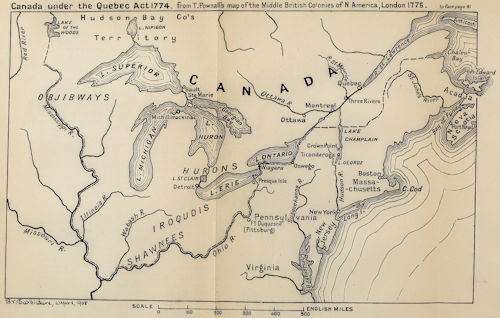
But the extension of the boundaries of the province of Quebec on the Atlantic side was after all a small matter, though the most was made of it for party purposes. Nor could exception be taken to the enlargement of the province to the north and north-west, until it reached the territories which had been granted to, or were claimed by, the Hudson’s Bay Company. Far more important and more debatable was the inclusion of the western and south-western regions, which had been left outside the government of Quebec by the Proclamation of 1763.
click here for larger image.
Canada under the Quebec Act 1774. from T. Pownall’s map of the Middle British Colonies of N. America, London 1775. to face page 81
B. V. Barbishire, Oxford, 1908
It will be remembered[49] that these territories had not been included in the province of Quebec for three reasons: that their incorporation with the conquered province might have been held to be an admission that the British title to them only dated from the conquest of Canada, that their annexation to any particular province would have given to that province a preponderating advantage in regard to trade with the Indians, and that the extension to them of the laws and administration of the province of Quebec would have necessitated the establishment of a number of military garrisons throughout the territories. The first of these three objections was, in fact, taken in the debates on the Quebec Bill. ‘The first object of the Bill,’ said Mr. Dunning in the House of Commons on the 26th of May, 1774, ‘is to make out that to be[50] Canada, which it was the struggle of this country to say, was not Canada.’ The second objection was clearly potent in the minds of the partisans of the old British colonies, who opposed the Bill. It would seem that when the Proclamation of 1763 was issued, the British Government had contemplated passing an Act of Parliament, constituting a separate administration for the Western territories, but the plan, whatever it was, never came to the birth;[51] and, as the King had foreseen, ‘great inconvenience’ had arisen ‘from so large a tract of land being left, without being subject to the civil jurisdiction of some governor’.[52] This inconvenience the Quebec Act tried to rectify by bringing these western lands under the government of Canada.
The line now laid down, on the motion of Burke in the House of Commons, was carried from the point where the 45th parallel of latitude intersected the St. Lawrence to Lake Ontario, up Lake Ontario and the Niagara river into Lake Erie, and along the southern or eastern shore of Lake Erie, until it met the alleged frontier of the state of Pennsylvania, or, if that frontier was found not to touch the lake, up to the point nearest to the north-western angle of Pennsylvania. From that angle it skirted the western boundary of Pennsylvania down to the Ohio, which river it followed to the Mississippi.
Claims of Pennsylvania.
In the debate in the House of Commons a petition was presented from the Penns, claiming that part of the province of Pennsylvania was situated to the north-west of the Ohio, and Lord North offered no opposition to the petition, on the ground that the Bill was not intended to affect existing rights. On a map of 1776, after the passing of the Act, Pennsylvania was shown as jutting out at an acute angle into Lake Erie, and the boundary line, identical with the western frontier of the state, started from the lake near Presque Isle, and struck the Ohio at Logs Town, west of Fort Duquesne and slightly east of Beaver Creek, leaving to Pennsylvania the whole course of the Alleghany, and Fort Duquesne or Pittsburg. It will be noted that, further east, the line, being drawn along the St. Lawrence and the lakes, excluded from Canada the whole country of the Six Nations, which had been demarcated as Indian Territory by the Agreement of 1768.[53] The net result was to leave the boundary line south of the St. Lawrence, where it had been drawn in 1763, as far as the intersection of the 45th parallel with the river, and thence to follow the waterways up to the point in the southern shore of Lake Erie where the old French route to the Ohio left the lake. From the Atlantic up to this point the present international line between Canada and the United States is not far different at the present day, though more favourable to the United States, especially where, since the Ashburton Treaty of 1842, the state of Maine runs northward into the provinces of Quebec and New Brunswick. But, by carrying the boundary from Lake Erie to the Ohio and down the Ohio to the Mississippi, all the Illinois country and all the western lands, for which English and French had contended, were confirmed to Canada.
Reasons for the extension of the province.
There were good reasons for taking this step. Eleven years had passed since the territories in question had been left as an Indian reserve. Events move quickly in a border land, and encroachments grow apace. The time had come for some defined system, some recognized law and government. As far as there were permanent settlers in these regions, they were, it would seem, although the contrary was averred in the House of Commons, French rather than English; and it would be more palatable for colonists of French origin to be incorporated with Canada than to be absorbed by the purely English colonies. The native population would unquestionably be better cared for under the government of Quebec than under the legislatures of Pennsylvania and Virginia. The waterways still, as in old times, made communication easier from Canada than from the southern colonies; and to those colonies, on the brink of war against the mother country, the mother country could hardly be expected to entrust the keeping of the West.
Arguments urged against it.
On the other hand there was bitter and intelligible opposition to the annexation to Canada of ‘immense territories, now desert, but which are the best parts of that continent and which run on the back of all your ancient colonies’.[54] The decision which was now taken meant cutting off the existing English colonies from the West; and, in view of the other provisions of the Act, the incorporation of the new territories with Canada placed them under an administration in which there was at the time no element of self-government and which gave formal recognition to the Roman Catholic Church. It was, in short, or seemed to be, an admission that the old claim of Canada to the regions of the Ohio, against which, while Canada was still a French possession, the British Government and the British colonies had alike contended, was after all a valid claim; and it was, or seemed to be, a pronouncement that in years to come the future of the Western lands was to be shaped on Canadian principles and Canadian traditions, rather than on those which had moulded and inspired the ever-growing colonies of the British race.
It has been argued that true statesmanship would, in accordance with the plan which had been at one time contemplated, have constituted the territories beyond the 45th parallel a separate province under the Crown, separate alike from Canada on the one hand, and from Pennsylvania and Virginia on the other. This might possibly have been a preferable course; but, as subsequent experience showed in the case of Upper Canada, an inland colony, whose only outlet is through other provinces, is always in a difficult position; and the multiplication of communities in North America had already borne a crop of difficulties. Moreover, the particular circumstances of the time accounted for the decision which was taken, as they accounted also for the strong antagonism which that decision called forth. In the same session in which the Quebec Act was passed, the British Parliament had already enacted three punitive laws against the recalcitrant colony of Massachusetts; one closing the harbour of Boston; another altering the legislature, and giving to the governor the power of appointing and removing the judges, magistrates, and sheriffs; and a third empowering the trial of persons accused of capital offences in the discharge of their public duties to be held outside the limits of the province. If it was thought necessary thus to limit the liberties of one of the English colonies by Imperial legislation, it would have been hopelessly illogical to enlarge the borders of others among the sister communities; and if the only possible alternative was to keep the Western territories directly under the Crown, it was simpler, and involved less friction and debate, to attach them by a single clause in a Bill to the existing province of Quebec, than to treat them as a separate unit and to provide them with an administration and a legislature by a separate law. Furthermore, their annexation to Canada outwardly, at any rate, strengthened at a critical time the one province in America where the Crown still held undivided sway.
Sections in the Act which dealt with the religious question.
The fifth, sixth, and seventh sections of the Act dealt with religion. They provided for the free exercise of the Roman Catholic faith by the members of that Church, subject to the King’s supremacy as established by the Act passed in the reign of Queen Elizabeth; but they substituted a simple oath of allegiance for the oath required by Queen Elizabeth’s statute, and they confirmed to the Roman Catholic clergy ‘their accustomed dues and rights’. Protestants were expressly exempted from these payments; but the Act provided that, from such dues as they would otherwise have paid, provision might be made for the encouragement of the Protestant religion and the maintenance of a Protestant clergy. In other words, freedom of religion was guaranteed, the establishment of the Roman Catholic Church was recognized by law, and the principle of concurrent endowment was introduced.
Other provisions of the Act.
The eighth section of the Act restored Canadian law and custom in civil matters, and confirmed existing rights to property, with the exception of the property of the religious orders. The eleventh section continued the law of England in criminal matters. The twelfth, laying down that it was at present inexpedient to call an Assembly, provided for a nominated Legislative Council, consisting of not more than twenty-three and not less than seventeen members, no religious test being imposed. The next section withheld from the council the power of taxation, such additional taxes as were deemed necessary being imposed by a separate Act of the Imperial Parliament.[55]
The Act embodied a compromise.
Such were the principal provisions of the Quebec Act. It embodied a fair and reasonable compromise. In part the Government retraced their steps; they restored Canadian civil law, they postponed indefinitely a representative legislature, but they gave what could under the circumstances be suitably and prudently given, religious toleration, trial by jury in criminal matters, and a council to which the Crown could call representatives of all creeds and interests. The Bill was attacked in the House of Opposition to it. Lords, and in the House of Commons; and, even after it had become law, in 1775, Lord Camden in the House of Lords, and Sir George Savile in the House of Commons, presented petitions from the British inhabitants of the province of Quebec against the Act and moved for its repeal. The corporation of London petitioned against it. The American colonists made it the text of the manifesto to the people of Canada, which has already been noticed.[56] In the debates in Parliament various points were taken. Fox argued that, as the Bill gave tithes to the Roman Catholic clergy, it was a money Bill, and should not have originated, as it did originate in the House of Lords. Others criticized the absence of any provision for the rights of Habeas Corpus,[57] and the abolition of trial by jury in civil cases; but the main attack was on the lines that the law gave formal recognition to the Roman Catholic Church, that it withheld popular representation, and that it extended these two unsound principles to new territories whose lot should rather have been cast with the English colonies. Reference was made to the case of the colony of Grenada, in which limited representation in the popular Assembly had been given to Roman Catholics; but the opponents of the Quebec Act had not the courage to declare for a popular Assembly for Canada, without any religious test, for it would have meant an almost exclusively Roman Catholic legislature. They Inconsistency of the opponents. were at one and the same time fighting for the Protestant minority and contending for popular representation, but Protestant claims and popular representation in Canada were hopelessly at variance. This made the case of the opposition weak, and this was the justification of the Act. Lord Chatham denounced it as a most cruel, oppressive, and odious measure. Burke tried to appeal to popular prejudice against the Canadian seigniors. He attacked them, and he pressed the claims of the Protestant minority on the ground of their commercial importance, descending to such clap-trap as that in his opinion, in the case in point, one Englishman was worth fifty Frenchmen. The tone of the opposition was unworthy of the men, but minds had been so embittered and judgements so clouded by years of wrangle and debate on the American question, that the Act for the better government of Canada was viewed by the opponents of the ministry and the partisans of the colonies mainly as a case of French against English, and Papists against Protestants. None the less, the Act was a just and generous measure, and, when Carleton returned to Canada in September, 1774, his reception by the leading French Canadians showed that they appreciated it. Because, when war came, the Canadians as a whole stood aloof in a quarrel which was no concern of theirs, and some of them joined the revolting colonies, it was argued in the English Parliament that the Act had not conciliated them, and therefore stood condemned; but history has proved that this view was not true. No one measure or series of measures can at once obliterate differences of race, language, and creed; but, passed as it was at a time of failures, recrimination, and bitterness, the Quebec Act stood and will to all times stand to the credit of English good sense, in dealing with the actual facts of a difficult position, and the feelings and prejudices of an alien people.