Chapter III
Walter Armstrong translation
Sculpture.
§ 1. The Origin of Statue-making.
The art of imitating living forms by means of sculpture was no less ancient in Egypt than architecture. We do not mean to say that it already existed in those remote ages when the first ancestors of the Egyptian people built their mud cabins upon the banks of the Nile; but as soon as their dwellings became something more than mere shelters and began to be affected by the desire for beauty, the figures of men and animals took a considerable place in their decoration. The oldest mastabas that have been discovered have bas-reliefs upon their walls and statues in their mummy-pits.
The existence of these statues and their relative perfection show that sculpture had advanced with strides no less rapid than those of the sister art. It may even be said that its progress had been greater than that of architecture. Given the particular kind of expressive beauty which formed the ambition of the Egyptian sculptor, he produced masterpieces as early as the time of the Pyramid builders. We cannot say as much of the architect. The latter showed himself, indeed, a master in the mechanical processes of dressing and fixing stone, but the arrangement of his buildings was simple, we might say elementary, and many centuries had to pass before he had become capable of imagining and creating the sumptuous temples of the New Empire, with those ample porticos and great hypostyle halls which were the culminating achievements of Egyptian architecture.
In order to explain this curious inequality we need not inquire which of the two arts presents the fewest difficulties. It is with nations as with individuals. Some among them succeed with ease in matters which embarrass their neighbours. It is a question of circumstances, of natural qualifications, and of surroundings. Among the Egyptians the progress of sculpture was accelerated by that national belief in a posthumous life for the body which we have described in connection with their funerary architecture. By the existence of this constant and singular belief we may explain both the early maturity of Egyptian sculpture and the great originality of their most ancient style.
We have already described the arrangements which were necessary to enable the inhabitant of the tomb to resist annihilation. Those arrangements were of two kinds, a provision of food and drink, which had to be constantly renewed, either in fact or by the magic multiplication which followed prayer, and a permanent support for the ka or double, a support that should fill the place of the living body of which it had been deprived by dissolution. This support was afforded to some extent by the mummy; but the mummy was liable to be destroyed or to perish by the action of time. The Egyptians were led to provide against such a catastrophe by the invention of the funerary statue. In the climate of Egypt, stone, and even wood, had far better chances of duration than the most carefully embalmed body. Statues had the additional advantage that they could be multiplied at will. There was nothing to prevent ten, twenty, any number of them, being placed in a tomb.[170] If but one of these images survived all the accidents of time, the double would be saved from that annihilation to which it would otherwise be condemned.
Working under the impulse of such an idea, the sculptor could not fail to do his best to endow his statue with the characteristic features of the original. "It is easy, then, to understand why those Egyptian statues which do not represent gods are always portraits of some individual, executed with all the precision of which the artists were capable. They were not ideal figures to which the desire for beauty of line and expression had much to say, they were stone bodies, bodies which had to reproduce all the individual contours of their flesh-and-blood originals. When the latter was ugly, its reproduction had to be ugly also, and ugly in the same way. If these principles were disregarded the double would be unable to find the support which was necessary to it."[171]
The first Egyptian statue was not so much a work of art as a cast from nature. If photography had been invented in the time of Menes, photographers would have made their fortunes in Egypt. Those sun-portraits, which are supposed to present a perfect resemblance, would have been put in the tomb of a deceased man in hundreds. Wanting such things, they were contented to copy his figure faithfully in stone or wood. His ordinary attitude, his features and costume, were imitated with such scrupulous sincerity that the serdabs were filled with faithful duplicates of himself. To obtain such a likeness the artist cannot have trusted to his memory. His employer must have sat before him, the stone body must have been executed in presence of him whose immortality it had to ensure. In no other way could those effigies have been produced whose iconic character is obvious at first sight, effigies to which a contemporary would have put a name without the slightest hesitation.
This individuality is not, however, equally well preserved in all Egyptian sculpture, a remark which applies to the early dynasties as well as to the later ones, though not in the same degree. In those early ages the beliefs which led the Egyptian to inclose duplicates of his own body in his last resting-place were more powerful over his spirit, and the artist had to exert himself to satisfy the requirements of his employers in the matter of fidelity. Again, those centuries had not to struggle against such an accumulation of precedents and fixed habits, in a word, against so much conventionality as those which came after. There were no formulæ, sanctioned by long custom, to relieve the artist from the necessity for original thought and continual reference to nature; he was compelled to make himself acquainted both with the general features of his race and those of his individual employers. This necessity gave him the best possible training. Portraiture taken up with intelligence and practised with a passionate desire for truth has always been the best school for the formation of masters in the plastic arts.
In those early centuries, then, Egypt produced a few statues which were masterpieces of artistic expression, which were admirable portraits. In all countries, however, great works are rare. The sepulchral statues were far from being all equal in value to those of the Sheik-el-Beled, of Ra-Hotep from Meidoum, or of the scribe in the Louvre. This intelligent and scientific interpretation of nature was not reached at a bound; Egyptian sculpture had its archaic period as well as that of Greece.
Moreover, even when the art had come to maturity, there was, as in other countries a crowd of mediocre artists whose work was to be obtained at a cost smaller than that of the eminent men whom they surrounded. The leading sculptors were fully employed by the kings and great lords, by ministers and functionaries of high rank: their less able brethren worked for that great class of functionaries of the second order, who composed what may be called the Egyptian middle class. It is probable too, that, although his work was to be hidden in the darkness of the serdab, the artist took more care in reproducing the features of a great personage whose appearance might be known from one end of the Nile valley to the other, than when employed by some comparatively humble individual. Before descending into the tomb, the statue must for a time have been open to inspection, and its creator must have had the chance of receiving those praises which neither poet nor artist has been able to do without, from the days of Memphis to those of Modern Europe.
In most cases, however, he had to reproduce the features and contours of some obscure but honest scribe, some insignificant unit among the thousands who served Cheops or Chephren; and his conscience was more easily satisfied. If we pass in review those limestone figures which are beginning to be comparatively common in our museums, we receive the impression that many among them bear only a general resemblance to their originals; they preserve the Egyptian type of feature, the individual marks of sex and age, the costume, the familiar attitude, and the attributes and accessories required by custom, and that is all. It may even be that, like a certain category of funerary steles among the Greeks of a later age, these inferior works were bought in shops ready carved and painted, and that the mere inscription of a name was supposed to give them that iconic character upon which so much depended. A name indeed is not always found upon these images, but it is always carved upon the tombs in which they were placed, and its appearance there was sufficient to consecrate the statues and all other contents of the sepulchre to the support of the double to which it belonged. Whether it was copied from a sitter or bought ready-made, the statue became from the moment of its consecration an auxiliary body for the double. It preserved more of the appearance of life than the corpse saturated with mineral essences and hidden under countless bandages; the half-open smiling lips seemed about to speak, and the eyes, to which the employment of enamel and polished metal give a singular brilliance, seemed instinct with life.
The first statues produced by the Egyptians were sepulchral in character, and in the intentions both of those who made them and of those who gave the commissions, they were portraits, executed with such fidelity that the double should confidingly attach himself to them and not feel that he had been despoiled of his corporeal support. As the power and wealth of the Egyptians grew, their artistic aspirations grew also. They rose by degrees to the conception of an ideal, but even when they are most visibly aiming at grandeur of style the origin of their art may still be divined; in their happiest and most noble creations the persistent effect of their early habits of thought and belief is still to be surely traced.
§ 2. Sculpture under the Ancient Empire.
The most ancient monument of sculpture to which we can assign, if not a date, at least a chronological place in the list of Egyptian kings, is a rock-cut monument in the peninsula of Sinai. This is in the Wadi-maghara, and represents Snefrou, the last monarch of the third dynasty, destroying a crouching barbarian with his mace. In spite of its historic importance, we refrain from producing this bas-relief because its dilapidated state takes away its interest from an artistic point of view.[172]
There are, besides, other statues in existence to which egyptologists ascribe a still greater age. The Louvre contains three before which the historian of art must halt for a moment.
Two of these are very much alike, and bear the name of a personage called Sepa, who enjoyed the style and dignity of prophet and priest of the white bull. The third is the presentment of Nesa, who is called a relation of the king, and was, in all probability, the wife of Sepa (Fig. 172). These statues were of soft limestone. Both man and woman have black wigs with squared ends, which descend, in the case of the former, to the shoulders, in that of the latter, to the breasts. Sepa holds a long staff in his left hand, and in his right the sceptre called pat, a sign of authority. His only robe is a plain schenti, a kind of cotton breeches fastened round his waist by a band. His trunk and legs are bare, and the latter are only half freed from the stone in which they are carved. Nesa is dressed in a long chemise with a triangular opening between the breasts. Upon her arms she has bracelets composed of twelve rings. In each figure the wig, the pupils, eyelids, and eyebrows, are painted black, while there is a green stripe under the eyes. The bracelets are also green.
De Rougé asserted boldly that these were the oldest statues in the world.[173] He believed them to date from the third dynasty, and his successors do not think he exaggerated; they would perhaps give the works in question an even more venerable age.
This impression of great antiquity is not caused by the short inscriptions on the plinths. The well-carved hieroglyphs which compose them are in relief, but this peculiarity is found in monuments of the fourth and fifth dynasties. The physiognomies and general style of the figures are much more significant. They betray an art whose aims and instincts are well developed, although it has not yet mastered its mechanical processes. The sculptor knows thoroughly what he wants, but his hand still lacks assurance and decision. He has set out upon the way which will be trodden with ever-increasing firmness by his successors. He follows nature faithfully. Observe how frankly the breadth of Sepa's shoulders is insisted upon, how clearly the collar-bones and the articulations of the knees are marked. The rounded contours of Nesa's thighs betray the same sincerity. And yet there is a certain timidity and awkwardness in the group which becomes clearly perceptible when we compare it with works in its neighbourhood which date from the fifth dynasty. The workmanship lacks freedom, and the modelling is over-simplified. The arms, which elsewhere are laid upon the knees, or, in the case of the woman, passed round the neck of her husband, are too rigid. One is held straight down by the body, the other is bent at a right angle across the stomach. The pose is stiff, the placid features lack expression and will.
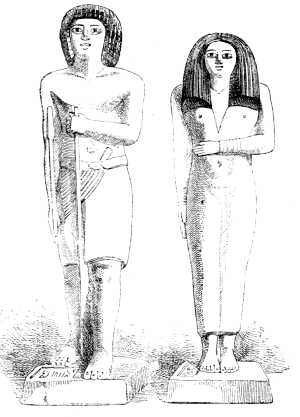
Fig. 172.—Sepa and Nesa, Louvre. Four feet eight inches high.
The induction to which we have been led by the style of these figures is confirmed by an observation made during recent explorations in the necropolis of Memphis. The patch of green paint under the eyes has, as yet, only been found in statues from a certain peculiar class of tombs at Gizeh and Sakkarah. These are chambers cut in the rock, in which the roofs are carved into imitations of timber ceilings of palm wood. Some of the texts which have been found in them contain the name of a king whose chronological place has not yet been satisfactorily determined, but who seems to have been anterior to Snefrou. The figures upon which the adornment in question occurs would appear therefore to be contemporary with the oldest tombs in the neighbourhood of the pyramids.[174]
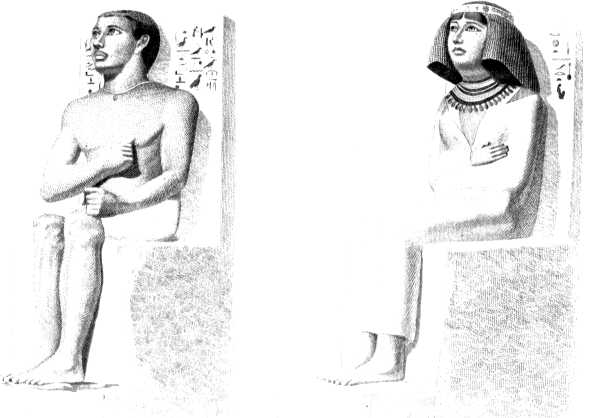
RA-HOTEP AND NEFERT BOULAK MUSEUM Imp. Ch. Chardon
Progress was rapid between the end of the third dynasty and that of the fourth. It was during the latter dynasty that the art of the Ancient Empire produced its masterpieces. Mariette attributes the two famous statues found in a tomb near the pyramid of Meidoum to the reign of Snefrou, the predecessor of Cheops. They are exhibited, under glass, in the Boulak Museum (Plate IX).[175]
"One of them represents Ra-hotep, a prince of the blood, who enjoyed the dignity of general of infantry, a very rare title under the Ancient Empire; the other is a woman, Nefert, the beauty; her statue also informs us that she was related to the king. We do not know whether she was the wife or sister of Ra-hotep. The interest excited by the extreme beauty of these figures is increased by our certainty of their prodigious antiquity. In the mastaba where they were found everything is frankly archaic, everything is as old as the oldest of the tombs at Sakkarah, and those date from before the fourth dynasty. A neighbouring tomb which, as is proved by the connection between their structures, dates from the same period as that of Ra-hotep, is that of a functionary attached to the person of Snefrou I. We may, therefore, fairly assign the two statues from Meidoum to the last reign of the third dynasty."[176]
Each of these figures, with its chair-shaped seat, is carved from a single block of limestone about four feet high. The man is almost nude; his only dress is a ribbon about his neck, and white breeches like those to which we have already alluded. The woman is robed in the long chemise, open between the breasts, which we have seen upon Nesa. Besides this a wide and richly designed necklace spreads over her chest. Upon her head she has a square-cut black wig, which, however, allows her natural hair to be visible in front. Over the wig she has a low flat cap with a decorated border. The carnations of the man are brownish red, those of the woman light yellow.
These statues betray an art much more advanced than that of Sepa and Nesa. The pose is much easier and more natural, but the right arm of Ra-hotep is stiff and held in a fashion which would soon cause cramp in a living man. The modelling of the body is free and true, though without much knowledge or subtlety. The breasts, arms, and legs of Nefert are skilfully suggested under her robe. But the care of the sculptor has been mainly given to the heads. By means of chisel and paint-brush he has given them an individuality which is not readily forgotten. The arched eyebrows surmount large well-opened eyes; the eyelids seem to be edged with heavy lashes and to stand out well from the eyeball. In the case of the latter the limestone has retained its primitive whiteness, giving a strong contrast with the pupil and iris (Fig. 173). The noses, especially that of Ra-hotep are fine and pointed; the thick but well-drawn lips seem about to speak. Her smooth cheeks and soft dark eyes, eyes which are still common among the women of the East, give Nefert a very attractive look. Her smiling and restful countenance is in strong contrast to that of Ra-hotep, which is full of life and animation not unmingled with a little hardness.
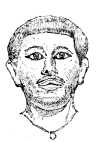
Fig. 173.—Ra-hotep. Drawn by Bourgoin.
The longer we look at these figures the less ready are we to turn away from them. They are portraits, and portraits of marvellous sincerity. If they could be gifted with life to-morrow, if we could encounter Ra-hotep and Nefert working under the sun of Egypt, the man semi-nude, sowing the grain or helping to make an embankment, his companion robed in the long blue chemise of the fellah women and balancing a pitcher upon her head, we should know them at once and salute them by name as old acquaintances. We find none of the marks of inexperience and archaism which are so conspicuous in the statues of Sepa and Nesa. A few later figures may seem to us more delicately modelled and more full of detail, but taking them all in all, we cannot look upon these statues as other than the creations of a mature art, of an art which was already in full command of its resources, and of a sculptor who had a well-marked personal and original style of his own.
We find the same qualities in another group of monuments ascribed by Mariette to no less remote a period.[177] The same eye for proportion, the same life-like expression, the same frankness and confidence of hand are to be found in those sculptured wooden panels of which the museum at Boulak possesses four fine examples. They were found at Sakkarah in the tomb of a personage called Hosi, where they were enframed in four blind doorways. They are on the average about 3 feet 10 inches high and 1 foot 8 inches wide. The drawings which we reproduce give a good idea of the peculiarities of style and execution by which they are distinguished (Figs. 174-176).[178]
At first sight these carvings are a little embarrassing to the eye accustomed to works in stone. The type of figure presented is less thickset. The body, instead of being muscular, is nervous and wiry. The arms and legs are thin and long. In the head especially do we find unaccustomed features; the nose, instead of being round, is strongly aquiline; the lips, instead of being thick and fleshy, as in almost all other Egyptian heads, are thin and compressed. The profile is strongly marked and rather severe. The general type is Semitic rather than Egyptian. And yet the inscriptions which surround them prove that the originals were pure Egyptians of the highest class. One of them, he who is represented standing in two different attitudes, is Ra-hesi; the other, who is sitting before a table of offerings, bears the name of Pekh-hesi. The decipherable part of the inscription tells us that he was a scribe, highly placed, and in great favour with the king.
The tomb in which these panels were found was not built on the usual plan of the mastaba. Mariette alludes to certain peculiarities which are to be found in it, but he does not describe them in detail. The hieroglyphs are grouped in a peculiar fashion; many of them are of a very uncommon form. The arrangement of the objects borne in the left hand of Ra-hesi is quite unique. Struck by these singularities, Mariette asserts that "the style of these panels is to Egyptian art what the style called archaic is to that of Greece."[179] This assertion seems to us inaccurate. Not that we mean to contest the validity of the reasons which Mariette gives for ascribing these panels to an epoch anterior to the great pyramids; but, whatever may be their age, it seems to be impossible, in view of the style in which they are executed, to call them archaic. They show no more archaism than the statues of Meidoum. The Egyptian artist never carved wood with greater decision or with more subtlety and finesse than are to be seen in these panels. As for the differences of execution which have been noticed between these figures and the stone statues of the same epoch, they may easily be explained by the change of material and by the Egyptian love for fidelity of imitation. Wood is not attacked in the same fashion as soft stone. Its constitution does not lend itself to the ample and rounded forms of lapidary sculpture. It demands, especially when a low relief is used, a more delicate and subtle modelling. Again, these were portraits; all the Egyptians were not like one another, especially in that primitive Egypt in which perhaps various races had not yet been blended into a homogeneous population. Among the contemporaries of Cheops, as in our day, there were fat people and thin people. Men who were tall and slender, and men who were short and thickset. Countenances varied both in features and expression.[180] In time art succeeded in evolving from all these diversities a type of Egyptian manhood and beauty. As the ages passed away the influence of that type became more and more despotic. It became almost universal, except in those cases where there was a rigid obligation to reproduce the personal characteristics of an individual with fidelity. But at the end of the third dynasty that consummation was still far off. And we need feel no surprise that the higher we mount in the stream of Egyptian civilization the more particular are the concrete images which it offers to us, and the more striking the variation between one work of art and another.
It must not be supposed, however, that the features which we have mentioned as peculiar in the cases of Ra-hesi and Pekh-hesi are not to be found elsewhere. If we examine the profile of Nefert, still more that of Ra-hotep, we shall find that they also have the sloping forehead and aquiline nose. The body of Ra-hotep is rounder and fatter than those in the wooden reliefs, but the lines of his countenance have a strong resemblance to those which have excited remark in the figures on the panels.
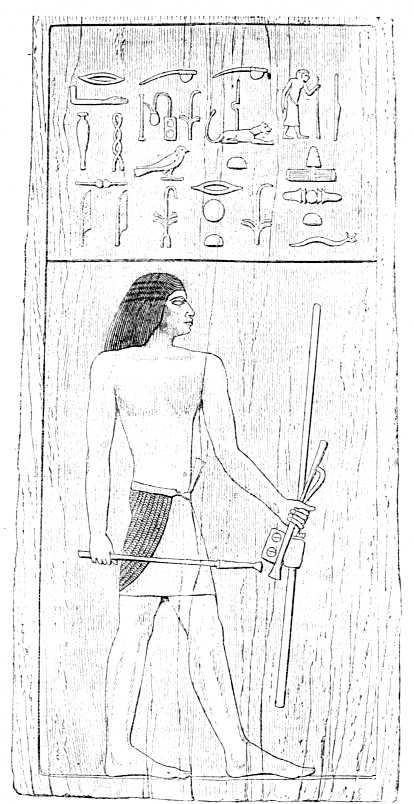
Fig. 174.—Wooden panel from the Tomb of Hosi. Drawn by Bourgoin.
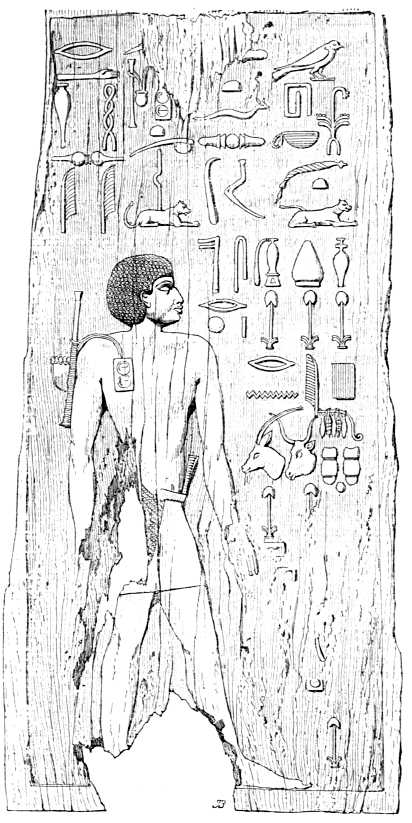
Fig. 175.—Wooden panel from the Tomb of Hosi. Drawn by Bourgoin.
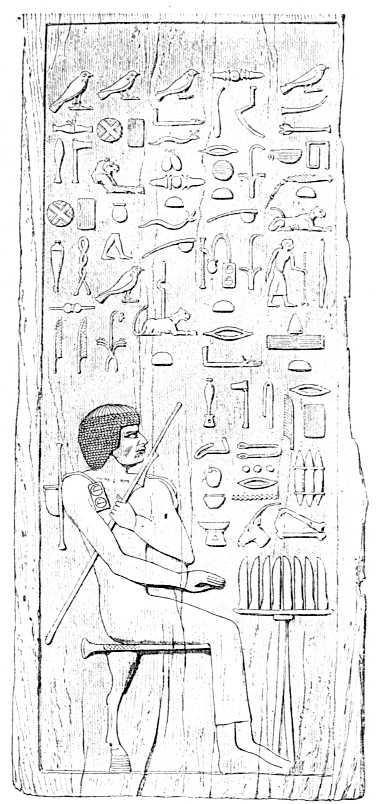
Fig. 176.—Wooden panel from the Tomb of Hosi. Drawn by Bourgoin
In the case of a limestone head, covered with red paint, which stands in the Salle Civile, in the Louvre, the cranium is no less elongated, the cheekbones are no less large, the cheeks themselves are as hollow, the chin as protuberant, and the whole head as bony and fleshless. We do not know whence it came, but we have no hesitation in agreeing with De Rougé, Mariette, and Maspero, that this head is a masterpiece from one of the early dynasties. It may be put by the side of the Meidoum couple for its vitality and individual expression. The unknown original must have been ugly almost to vulgarity, but it rouses in the spectator the same kind of admiration as a Tuscan bust of the fifteenth century, and a pleasure which is not diminished by the knowledge that the man whose faithful image is under his eyes passed from the world some five or six thousand years ago (Fig. 177).
The little figure which occupies the place of honour in this same saloon (Plate X.), though more famous, is hardly superior to the fragment just described. It was found by Mariette in the tomb of Sekhem-ka, during his excavation of the Serapeum. Other figures of the same kind were found with it, but are hardly equal to it in merit. They are believed to date from the fifth or sixth dynasty.
This scribe is seated, cross-legged, in an attitude still familiar to those who have visited the East. The most superficial visitor to the Levant must have seen, in the audience-hall of the cadi or pacha, the kiatib crouching exactly in the same fashion before the chair or divan, registering sentences with his rapid kalem, or writing out despatches. Our scribe is listening; his thin and bony features are vibrating with intelligence; his black eye-balls positively sparkle; his mouth is only closed because respect keeps him silent. His shoulders are high and, square, his chest ample, his pectoral muscles very large. People who follow a very sedentary occupation generally put on much fat on the front of their bodies, and this scribe is no exception to the rule. His arms are free of his sides; their position is easy and natural. One hand holds a strip of papyrus upon which he writes with the other, his pen being a reed. The lower parts of the body and the thighs are covered with a pair of drawers, whose white colour contrasts with the brownish red of the carnations. The breadth and truth with which the knee-joints are indicated should be remarked. The only details that have, to a certain extent, been "scamped," are the feet. Trusting to their being half hidden by the folded legs, the sculptor has left them in a very rudimentary condition.
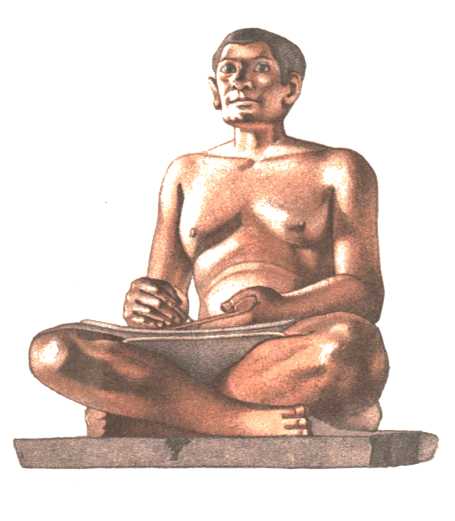
THE SCRIBE (LOUVRE) Imp. Dufrenoy
The eyes form the most striking feature in this figure. "They consist of an iris of rock crystal surrounding a metal pupil, and set in an eyeball of opaque white quartz. The whole is framed in continuous eyelids of bronze."[181]
This clever contrivance gives singular vitality and animation to the face. Even the Grecian sculptor never produced anything so vivacious. The latter, indeed began by renouncing all attempts to imitate the depth and brilliancy of the human eye. His point of departure differed entirely from that of his Memphite predecessor; his conception of his art led him, where the Egyptian would have used colour, to be content with the general characteristics of form and with its elevation to the highest pitch of nobility of which it was capable. This is not the place for a comparison of the two systems, but accepting the principles of art which prevailed in early Egypt, we must do justice to those masters who were contemporary with the Pyramids. It must be acknowledged that they produced works which are not to be surpassed in their way by the greatest portraits of modern Europe. In later years the Egyptian sculptor ceased to paint the eyes. Even in the time of the Ancient Empire the Egyptian custom in this particular was the same as the Greek, so far as statues in hard stone were concerned. The great statue of Chephren is an instance. In it the chisel has merely reproduced the contours of the eyelids and the salience of the eyeball. No attempt has been made to imitate the iris or to give brightness to the pupil. In none of the royal statues that have come down to our time do we find any effort to produce this kind of illusion, either by the use of paint or by the insertion of naturally coloured substances.
There is a statue at Boulak which may, perhaps, be preferred even to the scribe of the Louvre. We have already alluded to it as the Sheik-el-Beled (Fig. 7, Vol. I.). In its present state (it is without either feet or base) it has no inscription but it is sometimes called Ra-em-ké, because that was the name of the person in whose tomb it was found. It is of wood, and, with the exception of its lower members, is in marvellous preservation. The eyes are similar to those of the scribe, and seem to be fixed upon the spectator while their owner advances upon him. The type is very different from those we have hitherto been describing. The face is round and flat, and so is the trunk. The smiling good humour of the expression and the embonpoint of the person indicate a man well nourished and comfortably off, a man content both with himself and his neighbours.[182]
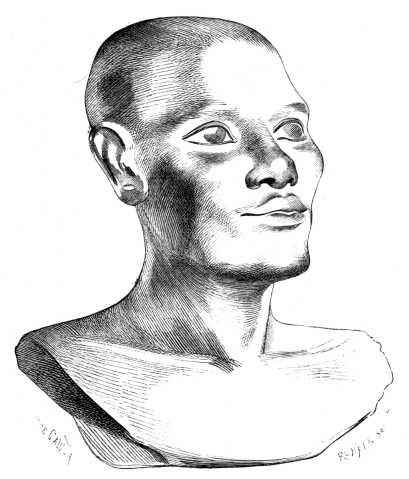
Fig. 177.—Limestone head, in the Louvre. Drawn by Saint-Elme Gautier.
This statue is dressed in a different fashion from those we have hitherto encountered. The sheik has his hips covered with a kind of petticoat gathered into pleats in front. His legs, torso, and arms are bare. The last named are of separate pieces of wood, and one of them, the bent one, is made in two parts. When the statue was first finished the joints were invisible. The whole body was covered with fine linen, like a skin. Upon this linen a thin layer of plaster was spread, by means of which, when wet, refinement could be added to the contours by the modelling stick; the colours of nature were afterwards added by the brush. Such figures as these have therefore come down to us in a condition which resembles their primitive state much less than that of the works in stone. They have, so to speak, lost their epidermis, and with it the colours which served to distinguish the flesh from the drapery.[183]
It would seem that the sculptor in wood often counted upon this final coat of stucco to perfect his modelling. There are in fact wooden statues which seem to have been but roughly blocked out by the chisel. There are three figures in the Louvre in which this character is very conspicuous. The largest of the three is reproduced in our Fig. 178.[184] Acacia and sycamore wood is used for this kind of work.[185]
Finally, in this epoch or perhaps a little later, under the fifth and sixth dynasties, funerary statues were cast in bronze. This notable fact was first proclaimed by M. de Longperier. We quote the observations which he addressed to the Academy of Inscriptions.[186]
"The fact that bronze was employed in Egypt in very ancient times has long been ascertained. The knob from the Sceptre of Papi, a Pharaoh of the sixth dynasty, which exists in the British Museum, is enough to prove this fact. M. Chabas has called our attention to the fact that bronze is mentioned in texts which date from a period anterior to the construction of the great Pyramids.[187]
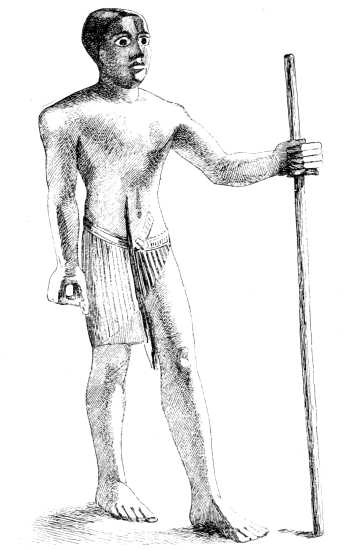
Fig. 178.—Wooden statue in the Louvre. Three feet eight inches high. Drawn by Saint-Elme Gautier.
"That the earliest Egyptian bronzes representing the human figure are much older than was formerly thought, is proved by two statuettes belonging to M. Gustave Posno. One of these is twenty-six inches high, the other nineteen. They merit a short description: 'No 1: A man standing; left foot forward, the left hand closed and raised to a level with the breast. This hand, doubtless, held a spear. The right hand which hangs straight down by the thigh formerly clasped, in all probability, the small sceptre which is represented in many bas-reliefs. The loins are girt with the garment called the schenti, the band of which supports a dagger. The hair is arranged into regular rows of small square knobs. The eyes and eyebrows, which were inlaid, have disappeared (Fig. 179).'[188]
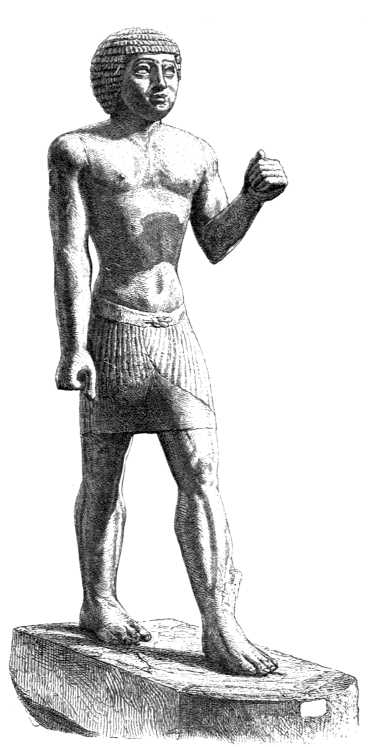
Fig. 179.—Bronze statuette. Two feet two inches high. Drawn by Saint-Elme Gautier.
"'No 2: A man standing; his loins girt with the schenti, his left foot forward, his right hand raised to the level of his breast, the left hanging by his left thigh. The inlaid eyes and eyebrows have been abstracted. His hair, which is less abundant than that of his companion and allows the contour of his head to be easily seen, is arranged into very small knobs. A vertical inscription on the left side of his chest gives the name of the personage, in or after which appears the ethnic Schasou, which seems to indicate an Oriental origin.' The Schasous are mentioned in several Egyptian texts and seem to have occupied the country which bordered Egypt on the North-East (Fig. 180)."[189]
"In these two statuettes the muscles of the arms and legs, and the articulation of the knees, are expressed with a care and truth which denote a very remote age. We cannot fail to recognize a phase of art earlier than the Second Empire. But if the first mentioned figure recalls, by its features and the management of the hair, the sculptures in stone of the fifth and sixth dynasties, the second cannot, perhaps, be referred to quite such an early period. In the latter the vertical line of the back and right leg slopes slightly forward, betraying an attempt to express movement; the dorsal line of the first figure is, on the other hand, quite perpendicular.
"Even in the photographs certain details are visible, such as the form of the hair, the features, the rendering of the anatomical contours, which denote a school anterior to that of the eighteenth dynasty.
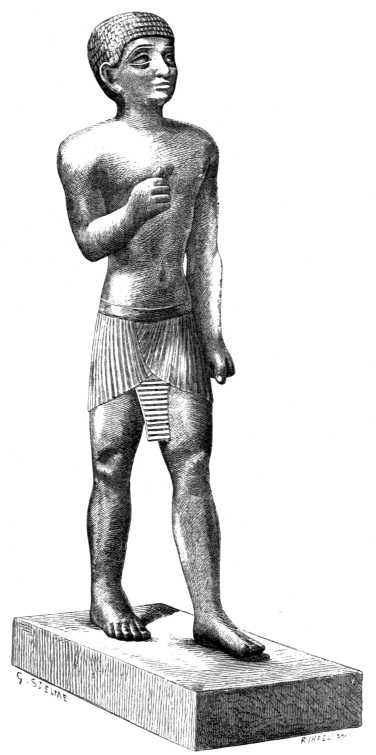
Fig. 180.—Bronze statuette. One foot seven inches high. Drawn by Saint-Elme Gautier.
"Egypt, then, was first in the field in bronze casting, as she was in stone and wood carving. One at least of the Posno statuettes carries us so far back in the history of humanity that it is difficult to see where we can look for earlier works of art, especially of so advanced a style. We have already ascertained that the first named of these two figures is far superior, both in style and modelling, to the Asiatic canephorus of Afadj,[190] a work which was dedicated to a goddess by a king, and must therefore be considered a good example of the art of Western Asia."
We agree with M. de Longperier in all but one point, and that one as to which he is careful not to commit himself. According to him the second figure is later than the sixth dynasty and earlier than the eighteenth, so that it would belong to the first Theban Empire. But we do not see why, supposing the Egyptians of the Ancient Empire capable of making the first figure, they should not have made the second. Between the two statuettes there are but slight differences of handling, differences much the same as those to be found in the wooden and stone statues which we have already mentioned. Neither the artists nor their sitters had quite the same capabilities.
The technical skill shown in these bronzes is extraordinary. The most ancient Etruscan and Greek bronzes are solid castings, on the base of which are rough protuberances, sometimes of considerable length, resulting from the fact that the metal was allowed to solidify in the orifice by which it was poured into the mould. Here there is nothing of the kind. No imperfection in the mechanical part of the work is allowed to interfere with its artistic effect. The casting is light, hollow, and in one piece; the method employed must have been excellent in itself and thoroughly understood.[191] They also understood how to add finish by chasing the metal after its relief from the mould. The small circular ornaments on the chest of the second figure, ornaments which are so delicate in execution that they could not be reproduced in our engraving without giving them too much importance, and the hieroglyphs cut in the same figure, are instances of this.
That so few bronze statuettes have come down to us seems to show that the use of the metal by sculptors was quite exceptional. They used wood far more than bronze, and stone more than wood. Most of the sepulchral statues are cut in soft limestone (see Figs. 6, 49, 88, 89, Vol. I., and Fig. 172, Vol. II.). Sometimes these statues are isolated, sometimes they form family groups, often consisting of father, mother, and children.
Statues of men are the most numerous. Differences between one and another are many and frequent, but they are, on the whole, less striking than the points of resemblance. Here we find a head bare, there enveloped in either a square or rounded wig. The bodies are never completely nude, and the garment which covers their middles is arranged in a variety of ways. Fashions, both for men and women, seem to have changed in Egypt as elsewhere. In the statues ascribed to the last dynasties of the Ancient Empire the national type seems more fixed and accentuated than in earlier works. These funerary statues are the portraits of vigorous and powerful men, with broad shoulders, well-developed pectoral muscles, thin flanks and muscular legs. Ra-nefer, priest of Ptah and Sokar, stands upright, his arms by his sides, and each hand grasping a roll of papyrus (Fig. 181).[192] A dagger is passed through the belt of his drawers.
The person represented in Fig. 182 is distinguished from Ra-nefer by the fashion in which he wears his hair and by his costume. His loose skirt is arranged in front so as to form a kind of triangular apron. This peculiar fall of the garment was obtained by the use of starch and an instrument similar to our flat-iron. It is better seen in the statue of Ti, the great personage to whose gorgeous tomb we have so often referred.[193] The Albanians obtain the curious folds of their kilts in the same fashion.[194] Ti wears a periwig of a different kind from that of Ra-nefer. The Egyptians shaved their heads from motives of cleanliness. The priests were compelled to do so by the rules of their religion, which made purity of person even more imperative upon them than upon the laymen. It was necessary, however, that the head should be thoroughly protected from the sun, hence the wig. The shaved Mohammedans of our day replace the periwig with the turban.
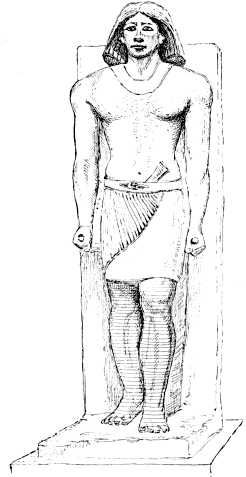
Fig. 181.—Ra-nefer. Boulak. Drawn by Bourgoin.
One wooden statue at Boulak offers a variety of costume which is at present unique among the remains of Egyptian civilization. It is, unfortunately, in very bad preservation. It represents a man, standing, and draped in an ample robe which covers him from head to foot. His right arm is free; it is held across the body, and meets the left hand, which is thrust through an opening in the robe. The place where this statue was found, the material of which it consists, and the character of the workmanship, all combine to prove that it is a production of the early dynasties (Fig. 184).[195]
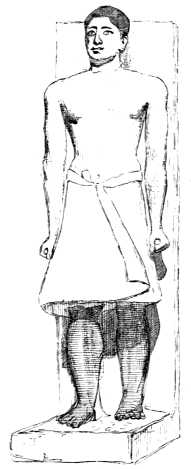
Fig. 182.—Statue in the Boulak Museum. Drawn by Bourgoin.
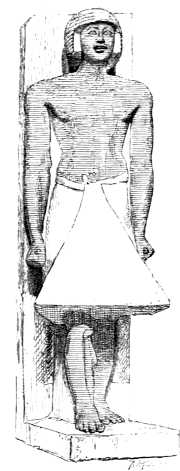
Fig. 183.—Statue of Ti. Boulak. Drawn by Bourgoin.
A few kneeling statues have also been found. The anonymous personage whose portrait is reproduced in Fig. 185 is upon his knees. His clasped hands rest upon his thighs. His eyes are inlaid; they are formed of numerous small pieces skilfully put together.[196]
There is no less variety in those groups where the sculptor has been charged to represent a whole family reunited in the tomb. Sometimes the husband is sitting and the wife standing. She has her left arm round his neck, the left hand resting on his left shoulder, while with her right hand she holds his right arm (Fig. 88, Vol. I.). Sometimes a father and mother are seated upon the same bench, but here too the woman confesses her dependence on, and shows her confidence in, her master by the same affectionate gesture (Fig. 186). Both are of the same height, but between them, and leaning against the bench upon which they are seated, appears their child, quite small. His gesture is that to which the Egyptian artist has recourse when he wishes to express early childhood (Fig. 187). We also find the husband and wife standing erect in front of a slab; the relation which they bear to each other is here also indicated by the position of the woman's arms (Fig. 188).[197] Sometimes the woman is altogether absent (Fig. 89, Vol. I.). The head of the family is placed by himself, on a raised seat. In front of this seat, and hardly reaching to their father's knees, are two children, boy and girl, the boy holding the right leg, the girl the left. The boy has the lock of hair pendent over the right ear, which, like the finger in the mouth, is a sign of tender years. He is nude; the girl is dressed in an ornamental robe reaching to her ankles. There is a piquant contrast between these two tender little bodies with their childish heads, and the virile power of the father and protector who towers so high above them.
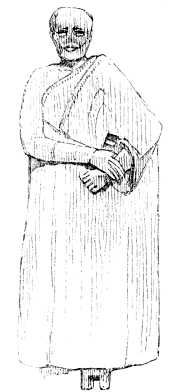
Fig. 184.—Wooden statue, Boulak. Drawn by Bourgoin.
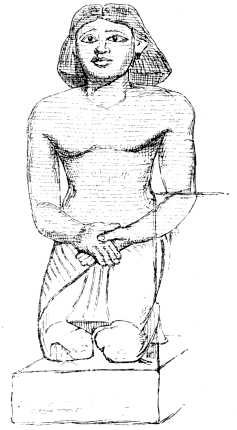
Fig. 185.—Statue in limestone, Boulak. Drawn by Bourgoin.
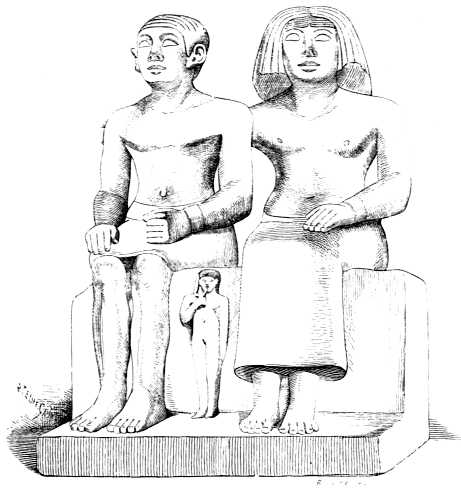
Fig. 186.—Limestone group in the Louvre. Height twenty-eight inches. Drawn by Saint-Elme Gautier.
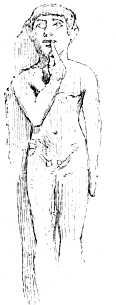
Fig. 187.—Wooden statuette, Boulak. Drawn by Bourgoin.
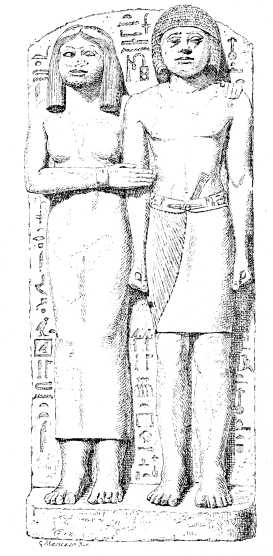
Fig. 188.—Nefer-hotep and Tenteta. Boulak.
These limestone groups do not, as a rule, appear to have been executed with any great care. Their makers do not seem to have taken much pains to give them an individuality of their own; but in spite of this feebleness of execution, they please by their composition. They are well arranged, their attitudes are simple and their gestures expressive. As a whole they have an air of calmness and repose which is thoroughly in accord with the ideas of the Egyptians on the question of life and death.
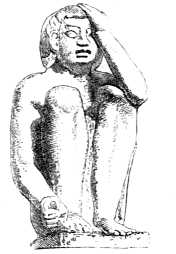
Fig. 189.—Limestone statue, Boulak. Drawn by Bourgoin.
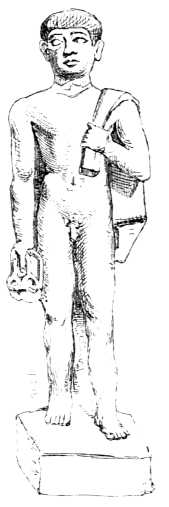
Fig. 190.—Limestone statue, Boulak. Drawn by Bourgoin.
From the same memphite tombs many limestone statues have been recovered, representing, not the defunct himself, but those who mourn his decease and the crowd of retainers attached to his person. All these are expected to carry on their labours for his benefit and to be ready to satisfy his wants through all eternity. Here we find one seated upon the ground, his hand upon his head in sign of grief (Fig. 189).[198] There a young man, completely naked, advancing with a sack upon his left shoulder which falls down to the centre of his back. He carries a bouquet of flowers in his right hand (Fig. 190).[199] A man seated upon the ground holds a vase between his knees, into which he has plunged his right hand (Fig. 191).[200] Another bends over a wide-mouthed jar of mortar in which he is mixing flour and water (Fig. 192). A young woman, in a similar attitude, is occupied over the same task (Fig. 193). Other women are rolling the paste thus obtained on a plank, or rather upon a stone slab, before which they kneel upon the ground. The muscular exertion necessary for the operation is rendered with great skill (Figs. 193 and 194).[201] Women are still to be encountered at Elephantiné and in Nubia, wearing the same head-dress and carrying out the same operation in the same attitude and with exactly similar utensils. We reproduce two sketches by M. Bourgoin, which show the details of this head-covering, which, among the women of the lower orders, supplied the piece of the wig; it consists of a piece of stuff held upon the head by a ribbon knotted at the back of the neck (Figs. 196 and 197).
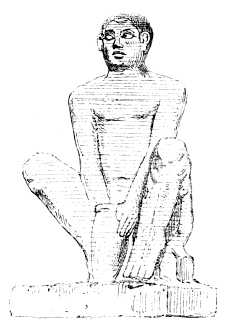
Fig. 191.—Limestone statue, Boulak. Drawn by Bourgoin.
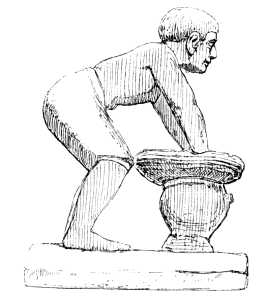
Fig. 192.—Limestone statue, Boulak. Drawn by Bourgoin.
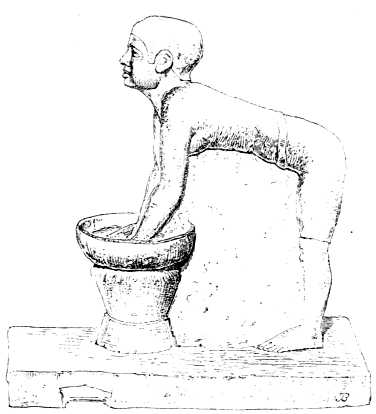
Fig. 193.—Woman kneading dough, Boulak. Drawn by Bourgoin.
Mariette brought all these figures to Paris in 1878, where they excited the greatest interest among artists and archæologists. They were eminently well fitted to enlighten those who are able to see and to do away with many rooted prejudices. What an abyss of difference they showed between Egyptian art as it used to be defined some thirty years ago and the reality. The stiffness and rigidity which used to be so universally attributed to the productions of the sculptors of Memphis and Thebes, were forgotten before their varied motives and free natural attitudes. The whole of these works, in fact, are imbued with a spirit which is diametrically opposed to the unchanging inflexibility which used to be considered the chief characteristic of Egyptian art. They are distinguished by an extraordinary ease of attitude, and by that curious elasticity of body which still remains one of the most conspicuous physical qualities of the race.
"The suppleness of body which distinguished the female fellah is marvellous. She rarely sits down. When she requires rest she crouches with her knees in the air in an attitude which we should find singularly fatiguing. So too with the men. Their habitual posture corresponds to that shown on the steles: the knees drawn up in front of the face to the height of the nose, or on each side of the head and level with the ears. These attitudes are not graceful, but when the bodies thus drawn together are raised to their full height they are superb. They are, to borrow a happy expression of Fromentin, 'at once awkward and magnificent; when crouching and at rest they look like monkeys; when they stand up they are living statues.'"[202]
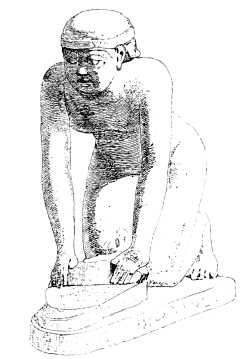
Fig. 194.—Woman making bread, Boulak. Drawn by Bourgoin.
This early art never carried its powers of observation and its exactitude of reproduction farther than in the statue of Nem-hotep, which we show in full-face and profile in Figs. 198 and 199. Whether we call him, with Mariette, a cook, or, with Maspero, a master of the wardrobe or keeper of perfumes, it cannot be doubted that. Nem-hotep was a person of importance. One of the fine tombs at Sakkarah was his. He certainly did not make his way at court by the graces of his person. He was a dwarf with all the characteristics that distinguish those unlucky beings. His head was too large, his torso very long, his arms and legs very short; besides which he was marvellously dolichocephalic.
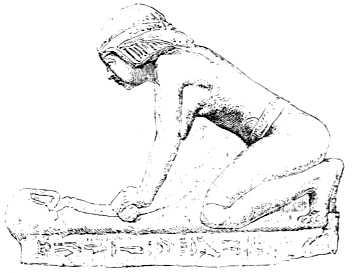
Fig. 195.—Bread maker, Boulak. Drawn by Bourgoin.
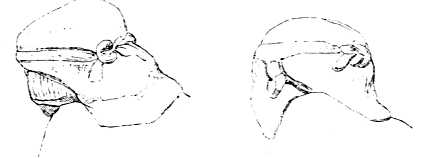
Figs. 196, 197.—Details of head-dresses.
The sincerity of Egyptian art is conspicuously shown in its treatment of the foot. Winckelmann noticed that the feet in Egyptian statues were larger and fatter than in those of Greece. The great toes are straight, no articulations being shown. The second toe is always the longest, and the little toe is not bent in the middle but straight like the others. These peculiarities spring from the Egyptian habit of walking bare-foot on the Nile mud; they are very strongly marked in the feet of the modern fellah.[203]
The general characteristics of these works in the round are repeated in the bas-reliefs of the mastabas at Gizeh and Sakkarah. Of these we have already given numerous illustrations; we shall therefore be content with reproducing one or two which are more than usually conspicuous for their artistic merit.
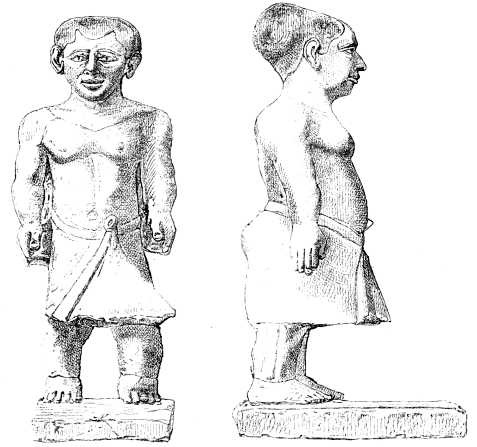
Figs. 198, 199.—Nem-hotep; limestone statue at Boulak.
The sculptures of Wadi-maghara and the wooden panels from the Tomb of Hosi are enough to prove that work in relief was as old in Egypt as work in the round. In the mastabas sculptures in low-relief served to multiply the images of the defunct. He is figured upon the steles which occupy the principal wall, as well as in various other parts of the tomb. Sometimes he is shown seated before the table of offerings (Fig. 200), sometimes standing upright (Figs. 57 and 120, Vol. I.). But the sculptor did not restrict himself to these two motives. In the preparation and presentation of the funeral gifts he found many themes, to which he was able to give more or less development according to the space at his command.
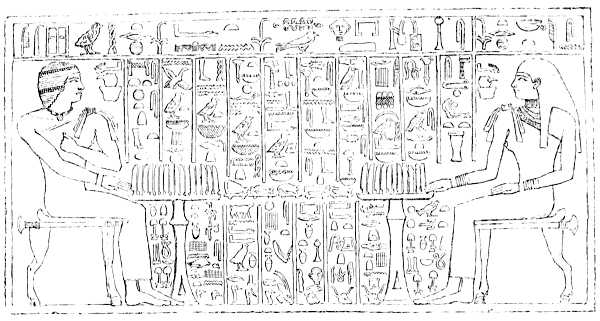
Fig. 200.—Funerary bas-relief; Sakkarah. Drawn by Bourgoin.
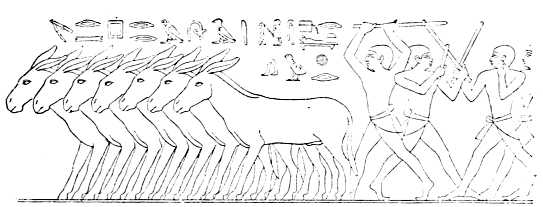
Fig. 201.—Bas-relief from the Tomb of Ti, Sakkarah.
Even in the earliest attempts that have come down to us, the Egyptian sculptor shows a complete grasp of the peculiar features of the domesticated animals of the country. Men accustomed to the careful study of the human figure could make light of rendering those of beasts, with their more striking distinctions between one species and another. In the time when the oldest existing tombs were constructed, the ass was already domesticated in Egypt. Then as now, he was the most indispensable of the servants of mankind. There were, in all probability, as many donkeys in the streets of Memphis under Cheops as there are now in Cairo under Tewfik. Upon the walls of the mastabas we see them trotting in droves under the cries and sticks of their drivers (Fig. 201), we see the foals, with their awkward gait and long pricked ears, walking by the sides of their mothers (Fig. 202), the latter are heavily laden and drag their steps; the drivers brandish their heavy sticks, but threaten their patient brutes much oftener than they strike them. This is still the habit of those donkey boys, who, upon the Esbekieh, naïvely offer you "M. de Lesseps' donkey." The bas-relief to which we are alluding consists only of a slight outline, but that outline is so accurate and full of character, that we have no difficulty in identifying the ass of Egypt, with his graceful carriage of the head and easy, brisk, and dainty motion.
The same artists have figured another of the companions of man with equal fidelity; namely, the deep-sided, long-tailed, long-horned, Egyptian ox. Sometimes he lies upon the earth, ruminating (Fig. 29, Vol. I.); sometimes he is driven between two peasants, the one leading him by a rope, the other bringing up the rear with a stick held in readiness against any outburst of self-will (Fig. 203). In another relief we see a drove advancing by the side of a canal, upon which a boat with three men is making way by means of pole and paddle. One herdsman walks in front of the oxen, another marches behind and urges them on by voice and gesture (Fig. 204). In another place we find a cow being milked by a crouching herdsman. She seems to lend herself to the operation in the most docile manner in the world, and we are inclined to wonder what need there is of a second herdsman who sits before her nose and holds one of her legs in both his hands. The precaution, however, may not be superfluous, an ox-fly might sting her into sudden movement, and then if there was no one at hand to restrain her, the milk, which already nears the summit of the pail, might be lost (Fig. 30, Vol. I.).
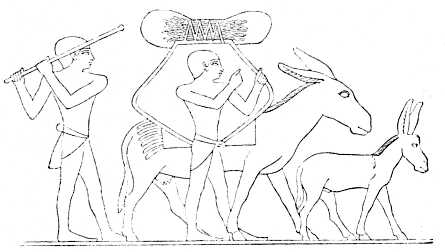
Fig. 202.—Bas-relief from the Tomb of Ti, Sakkarah.
By careful selection from the sepulchral bas-reliefs, we might, if we chose, present to our readers reproductions of the whole fauna of Ancient Egypt, the lion, hyena, leopard, jackal, fox, wolf, ibex, gazelle, the hare, the porcupine, the crocodile, the hippopotamus, the different fishes in the Nile, the birds in the marshes, the flamingo, the ibis, duck, stork, crane, and goose, the dog and the cat, the goat and the pig. Everywhere we find the same aptitude for summarizing the distinctive characteristics of a species. This accuracy of observation has been recognized by every connoisseur who has treated the subject. "In the Boulak Museum," says M. Gabriel Charmes, "there is a row of Nile geese painted with such precision, that I have seen a naturalist stand amazed at their truth to nature and the fidelity with which they reproduce the features of the race. Their colours, too, are as bright and uninjured as upon the day when they were last touched by the brush of the artist."[204]
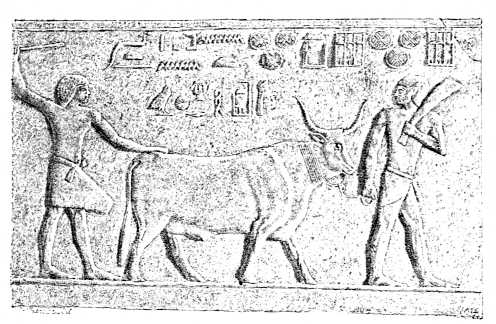
Fig. 203.—Sepulchral bas-relief, Boulak.
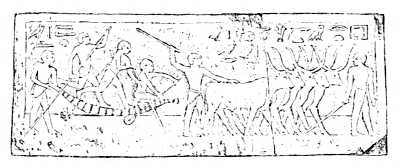
Fig. 204.—Bas-relief from the Tomb of Ra-ka-pou, Boulak.
The figures of men and animals to which our attention has been given all belong to the domain of portraiture. The artist imitates the forms of those who sit to him and of the animals of the country; he copies the incidents of the daily life about him, but his ambition goes no farther. All art is a translation, an interpretation, and, of course, the sculptors of the mastabas had their own individual ways of looking at their models. But they made no conscious effort to add anything to them, they did not attempt to select, to give one feature predominance over another, or to combine various features in different proportions from those found in ordinary life, and by such means to produce something better than mere repetitions of their accidental models. They tried neither to invent nor to create.
And yet the Egyptians must have begun at this period to give concrete forms to their gods. In view of the hieroglyphs of which Egyptian writing consisted, we have some difficulty in imagining a time when the names of their deities were not each attached to a material image with well marked features of its own. To write the name of a god was to give his portrait, a portrait whose sketchy outlines only required to be filled in by the sculptor to be complete. Egypt, therefore, must have possessed images of her gods at a very early date, but as they were not placed in the tombs they have disappeared long before our day, and we are thus unable to decide how far the necessity for their production may have stimulated the imaginative faculties of the early sculptors. In presence, however, of the Great Sphinx at Gizeh, in which we find one of those composite forms so often repeated in later centuries, we may fairly suspect that many more of the divine types with which we are familiar had been established. The Sphinx proves that the primitive Egyptians were already bitten with the mania for colossal statues. Even the Theban kings never carved any figure more huge than that which keeps watch over the necropolis of Gizeh (Fig. 157, Vol. I.). But Egypt had other gods than these first-fruits of her reflective powers, than those mysterious beings who personified for her the forces which had created the world and preserved its equilibrium. She had her kings, children of the sun, present and visible deities who maintained upon the earth, and especially in the valley of the Nile, the ever-threatened order established by their divine progenitors. Until quite recently it was impossible to say for certain whether or no the Egyptians of the Ancient Empire had attempted to impress upon the images of their kings the national belief in their divine origin and almost supernatural power. But Mariette—again Mariette—recovered from the well in the Temple of the Sphinx at Gizeh, nine statues or statuettes of Chephren. The inscriptions upon the plinths of these statues enable us to recognize for certain the founder of the second pyramid.
Most of these figures were broken beyond recovery, but two have been successfully restored. One of these, which is but little mutilated, is of diorite (Fig. 205); the other, in a much worse condition, is of green basalt (Fig. 56, Vol. I.).[205]
An initial distinction between these royal statues and the portraits of private individuals is found in the materials employed. For subjects even of high rank, wood or limestone was good enough, but when the august person of the monarch had to be immortalized a substance which was at once harder and more beautiful was employed. The Egyptians had no marble, and when they wished to do particular honour to their models they made use of those volcanic rocks, whose close grain and dusky brilliance of tone make them resemble metal. The slowness and difficulty with which these dense rocks yielded to the tools of the sculptor increased the value of the result, while their hardness added immensely to their chances of duration. It would seem that figures which only took form under the tools of skilful and patient workmen after years of persevering labour might defy the attacks of time or of human enemies. Look at the statue on the next page. It is very different from the figures we have been noticing, although it resembles them in many details. Like many of his subjects the king is seated. His head, instead of being either bare or covered with the heavy wig, is enframed in that royal head-dress which has been known, ever since the days of Champollion, as the klaft.[206] It consists of an ample band of linen covering the upper part of the forehead, the cranium, and the nape of the neck. It stands out boldly on each side of the face, and hangs down in two pleated lappets upon the chest. The king's chin is not shaved like those of his subjects. It is adorned like that of a god with the long and narrow tuft of hair which we call the Osiride beard. At the back of Chephren's head, which is invisible in our illustration, there is a hawk, the symbol of protection. His trunk and legs are bare; his only garment is, in fact, the schenti about his middle. His left hand lies upon his knee, his right hand holds a rod of some kind. The details of the chair are interesting. The arms end in lions' heads, and the feet are paws of the same animal. Upon the sides are figured in high relief the two plants which symbolize the upper and lower country respectively; they are arranged around the hieroglyph sam, signifying union.
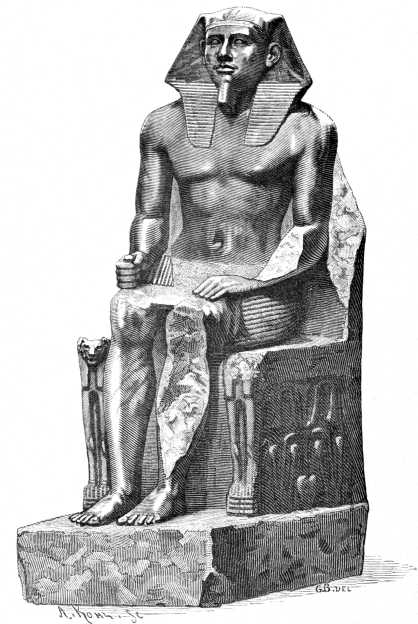
Fig. 205.—Statue of Chephren. Height five feet seven inches. Boulak. Drawn by G. Bénédite.
The other statue, which now consists of little more than the head and trunk, differs from the first only in a few details. The chair is without a back, and, curiously enough, the head is that of a much older man than the Chephren of the diorite statue. This difference makes it pretty certain that both heads were modelled directly from nature.
These royal statues are, then, portraits like the rest, but when in their presence we feel that they are more than portraits, that there is something in their individuality which could not have been rendered by photography or by casts from nature, had such processes been understood by their authors. In spite of the unkindly material the execution is as free as that of the stone figures. The face, the shoulders, the pectoral muscles, and especially the knees, betray a hand no less firm and confident than those which carved the softer rocks. The diorite Chephren excels ordinary statues in size—for it is larger than nature—in the richness of its throne, in the arrangement of the linen hood which gives such dignity to the head, in the existence of the beard which gives length and importance to the face. The artist has never lost sight of nature; he has never forgotten that it was his business to portray Chephren and not Cheops or Snefrou; and yet he has succeeded in giving to his work the significance of a type. He has made it the embodiment of the Egyptian belief in the semi-divine nature of their Pharaohs. By its size, its pose, its expression and arrangement he has given it a certain ideality. We may see in these two statues, for similar qualities are to be found in the basalt figure, the first effort made by the genius of Egyptian art to escape from mere realism and to bring the higher powers of the imagination into play.
The reign of those traditional forms which were to be so despotic in Egypt began at the same time. The type created by the sculptors of the fourth dynasty, or perhaps earlier, for the representation of the Pharaoh in all the mysterious dignity of his position, was thought satisfactory. The calm majesty of these figures, their expression of force in repose and of illimitable power, left so little to be desired that they were accepted there and thereafter. Centuries rolled away, the royal power fell again and again before foreign enemies and internal dissensions, but with every restoration of the national independence and of the national rulers, the old form was revived. There are variants upon it; some royal statues show Pharaoh standing, others show him sitting and endowed with the attributes of Osiris, but, speaking generally, the favourite model of the kings and of the sculptors whom they employed was that which is first made known to us by the statue of him to whom we owe the second pyramid. The only differences between it and the colossi of Amenophis III. at Thebes are to be found in their respective sizes, in their original condition, and in the details of their features.
The moulds in which the thoughts of the Egyptians were to receive concrete expression through so many centuries were formed, then, by their ancestors of the Ancient Empire. All the later revivals of artistic activity consisted in attempts to compose variations upon these early themes, to remodel them, with more or less felicity, according to the fashion of the day. Style and technical methods were modified with time, but types, that is the attitudes and motives employed to characterise the age, the mental power, and the social condition of the different persons represented, underwent little or no change.
This period of single-minded and devoted study of nature ought also to have transmitted to later times its care and skill in portraiture, and its realistic powers generally, to use a very modern phrase. Egyptian painters and sculptors never lost those qualities entirely; they always remained fully alive to the differences of conformation and physiognomy which distinguished one individual, or one class, from another; but as the models furnished by the past increased in number, their execution became more facile and superficial, and their reference to nature became less direct and continual. Neither the art of Thebes nor that of Sais seems to have produced anything so original and expressive as the two statues from Meidoum or the Sheik-el-beled, at Boulak, or the scribe in the Louvre.
We may easily understand what surprise and admiration the discovery of this early phase of Egyptian art excited among archæologists. When the exploration of the Memphite necropolis revealed what had up to that time been an unknown world, Nestor L'Hôte, one of the companions of Champollion, was the first to comprehend its full importance. He was not a savant; he was an intelligent and faithful draughtsman and his artistic nature enabled him to appreciate, even better than the illustrious founder of egyptology, the singular charm of an art free from convention and routine. In his letters from Egypt, Champollion showed himself impressed mainly by the grandeur and nobility of the Theban remains; L'Hôte, on the other hand, only gave vent to his enthusiasm when he had had a glimpse of one or two of those mastabas which were afterwards to be explored by Lepsius and Mariette. Writing of the tomb of Menofré, barber to one of the earliest Memphite kings, he says: "The sculptures of this tomb are remarkable for their elegance and the finesse of their execution. Their relief is so slight that it may be compared to that of a five-franc piece. Such consummate workmanship in a structure so ancient confirms the assertion that the higher we mount upon the stream of Egyptian civilization the more perfect do her works of art become. By this it would appear that the genius of the Egyptian people, unlike that of other races, was born in a state of maturity."[207]
"Of Egyptian art," he says elsewhere, "we know only the decadence." Such an assertion must have appeared paradoxical at a time when the Turin Museum already possessed, and exhibited, so many fine statues of the Theban kings. And yet Nestor L'Hôte was right, as the discoveries made since his time have abundantly proved, and that fact must be our excuse for devoting so large a part of our examination of Egyptian sculpture to the productions of the Ancient Empire.
§ 3. Sculpture under the First Theban Empire.
After the sixth dynasty comes an obscure and barren period, whose duration and general character are still unknown to egyptologists. Order began to be re-established in the eleventh dynasty, under the Entefs and Menthouthoteps, but the monuments found in more ancient Theban tombs are rude and awkward in an extreme degree, as Mariette has shown.[208] It was not until the twelfth dynasty, when all Egypt was again united under the sceptre of the Ousourtesens and Amenemhats, that art made good its revival. It made use of the same materials—limestone, wood, and the harder rocks—but their proportions were changed. In Fig. 206 a wooden statue attributed to this period is reproduced. The legs are longer, the torso more flexible, than in the statue of Chephren and other productions of the early centuries.
Compared with their predecessors other statues of this period will be found to have the same characteristics. It has been asserted that the Egyptians, as a race, had become more slender from the effects of their warm and dry climate. It is impossible now to decide how much of the change may fairly be attributed to such a cause, and how much to a revolution in taste. Even among the figures of the Ancient Empire there are examples to be found of these slender proportions, but they certainly appear to have been in peculiar favour with the sculptors of the later epoch. Except in this particular, the differences are not very great. The attitudes are the same. See, for instance, the statue in grey sandstone of the scribe Menthouthotep, which was found by Mariette at Karnak and attributed by him to this epoch. Both by its pose and by the folds of fat which cross the front of the trunk, it reminds us of the figures of scribes left to us by the Ancient Empire. The nobler types also reappear. There is in the Louvre a statue in red granite representing a Sebek-hotep of the thirteenth dynasty (Fig. 207). He sits in the same attitude, with the same head-dress and the same costume, as the Chephren of Boulak. There is one difference, however, his forehead is decorated with the uræus, the symbol of royal dignity, which Chephren lacks.[209] The dimensions, too, are different. We do not know whether the Ancient Empire made colossal statues of its kings or not, but this Sebek-hotep exceeds the stature of mankind sufficiently to make it worthy of the name.
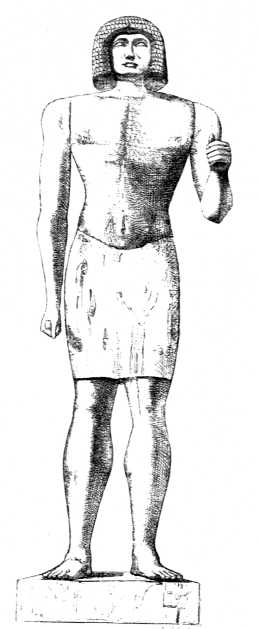
Fig. 206.—Wooden statue, Boulak. Drawn by Bénédite.
The Louvre possesses another monument giving a high idea of the taste of the sculptors belonging to this period, we mean the red-granite sphinx (Fig. 41, Vol. I.), which was successively appropriated by one of the shepherd kings and by a Theban Pharaoh of the nineteenth dynasty: the ovals of both are to be found upon it. Like so many other things from Tanis, this sphinx must date from a Pharaoh of the thirteenth dynasty. This De Rougé has clearly shown.[210] Tanis seems to have been a favoured residence of those princes, and most of their statues have been found in it. A leg in black granite, now in the Berlin Museum, is considered the masterpiece of these centuries. It is all that remains of a colossal statue of Ousourtesen.[211]
According to Mariette, many of those fine statues in the Turin Museum which bear the names of princes belonging to the eighteenth dynasty, Amenhoteps and Thothmeses, must have been made by order of the princes of the twelfth and thirteenth dynasties. In later years they were appropriated, in the fashion well known in Egypt, by the Pharaohs of the Second Theban Empire, who substituted their cartouches for those of the original owners. On more than one of the statues signs of the operation may still be traced, and in other cases the usurpation may be divined by carefully studying the style and workmanship.[212]
It was in the ruins of the same city that Mariette discovered a group of now famous remains in which he himself, De Rougé, Devéria, and others, recognised works carried out by Egyptian artists for the shepherd kings. These works have an individual character which is peculiar to themselves.[213] They differ greatly from the ordinary type of Egyptian statues, and must have preserved the features of those foreign invaders whose memory was so long held in detestation in Egypt. This supposition is founded upon the presumed identity of Tanis with Avaris, the strong place which formed the centre of the Hyksos power for so many generations.
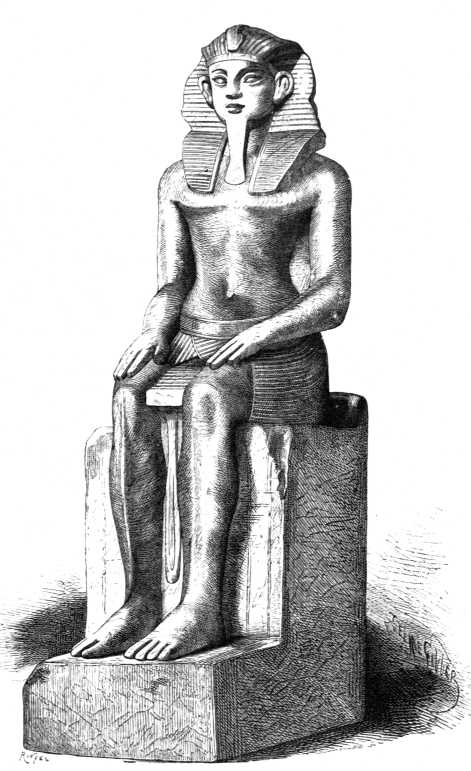
Fig. 207.—Sebek-hotep III. Colossal statue in red granite. Height nine feet. Louvre. Drawn by Saint-Elme Gautier.
Confirmation of this theory is found in the existence of an oval bearing the name of Apepi, one of the shepherd kings, upon the shoulder of a sphinx from Tanis. The aspect of this sphinx, and the features and costume of certain figures discovered upon the same site and dispersed among the museums of Europe, are said to have much in common with the ethnic peculiarities of the Syrian tribe by which Middle and Lower Egypt was occupied. M. Maspero, however, who has recently devoted fresh attention to these curious monuments, is inclined to doubt the justness of this conclusion. The position of the cartouche of Apepi suggests that it may be due to one of those usurpations which we have mentioned. For the present, therefore, it may be as well to class these monuments simply among the Tanite remains. Tanis, like some other Egyptian cities, had a style of its own, but we are without the knowledge required for a determination of its origin. We shall be content with describing its most important works and with calling attention to their remarkable originality.
The most important and the best preserved of all these monuments is a sphinx of black granite which was recovered, in a fragmentary condition, from the ruins of the principal temple at Tanis (Fig. 208). Three more were found at the same time, but they were in a still worse state of preservation. The fore-part of one of them is figured in the adjoining woodcut.
"There is a great gulf," says Mariette, "between the energetic power which distinguishes the head of this sphinx and the tranquil majesty with which most of these colossi are endowed. The face is round and rugged, the eyes small, the nose flat, the mouth loftily contemptuous. A thick lion-like mane enframes the countenance and adds to its energetic expression. It is certain that the work before us comes from the hands of an Egyptian artist, and, on the other hand, that his sitter was not of Egyptian blood."[214]
The group of two figures upon a common base, which is such a conspicuous object in the Hyksos chamber at Boulak, seems to have had a similar origin. We give a front and a side view of it (Figs. 210 and 211), and borrow the following description from Mariette.[215]
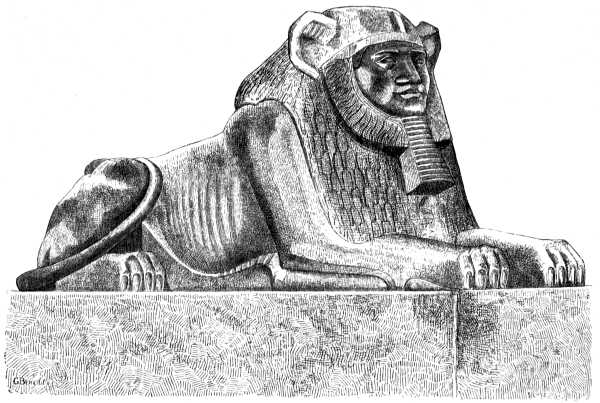
Fig. 208.—Sphinx in black granite; from Tanis. Drawn by G. Bénédite.
"Huge full-bottomed wigs, arranged into thick tresses, cover the heads of the two figures. Their hard and strongly-marked features (unfortunately much broken) bear a great resemblance to those of the lion-maned sphinxes. The upper lips are shaven but the cheeks and chins are covered with long wavy beards. Each of them sustains on his outstretched arms an ingenious arrangement of fishes, aquatic birds, and lotus flowers.
"No monument can be referred with greater certainty than this to the disturbed period when the Shepherds were masters of Egypt. It is difficult to decide upon its exact meaning. In spite of the mutilation which prevents us from ascertaining whether they bore the uræus upon their foreheads, it cannot be doubted that the originals of the two statues were kings. In after years Psousennes put his cartouche upon the group, which assuredly he would never have done if he believed it to represent two private individuals. But who could the two kings have been who were thus associated in one act and must therefore have been contemporaries?"
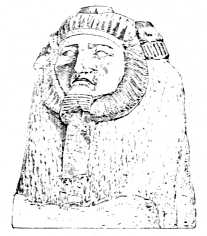
Fig. 209.—Head and shoulders of a Tanite Sphinx in black granite. Drawn by G. Bénédite.
This explanation seems to carry with it certain grave objections. It is not, in the first place, so necessary as Mariette seems to think that we should believe them to be kings. Similar objects—fishes, and aquatic flowers and birds—are grouped in the same fashion upon works which, to our certain knowledge, neither come from Tanism or date from the Shepherd supremacy. Their appearance indicates an offering to the Nile, and we can readily understand how Psousennes claimed the merit of the offering by inscribing his name upon it, even although he were not the real donor.
Mariette does not hesitate to ascribe to the same series a figure discovered in the Fayoum, upon the site of the city which the Greeks called Crocodilopolis (Fig. 212). He describes it thus:—[216]
"Upper part of a broken colossal statue, representing a king standing erect. No inscription.
"The general form of the head, the high cheek-bones, the thick lips, the wavy beard that covers the lower part of the cheeks, the curious wig, with its heavy tresses, are all worthy of remark; they give a peculiar and even unique expression to the face. The curious ornaments which lie upon the chest should also be noticed. The king is covered with panther skins; the heads of two of those animals appear over his shoulders.
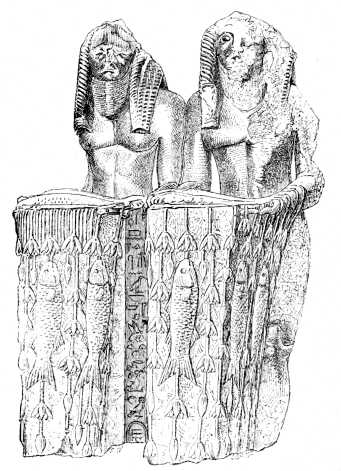
Fig. 210.—Group from Tanis; grey sandstone. Drawn by Bourgoin.
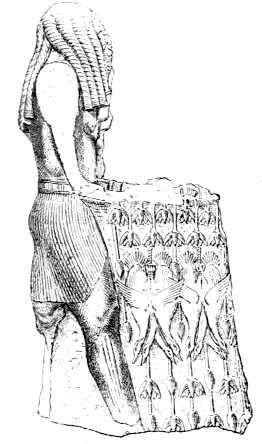
Fig. 211.—Side view of the same group. Drawn by Bourgoin.
"The origin of this statue, which was found at Mit-fares in the Fayoum, admits of no doubt. The kings who decorated the temple at Tanis with the fine sphinxes and groups of fishermen which I found among its ruins, must also have transported the vigorous fragments which we have before our eyes to the other side of Egypt."
Finally, Devéria and De Rougé have suggested that a work of the same school is to be recognized in the fragment of a statuette of green basalt, which belongs to the Louvre and is figured upon page 237.[217] They point to similarities of feature and of race characteristics. The face of the Louvre statuette has a truculence of expression not unlike that of the Tanite monuments, while the workmanship is purely Egyptian and of the best quality; the flexibility of body, which is one of the most constant qualities in the productions of the first Theban Empire, being especially characteristic. The king represented wears the klaft with the uræus in front of it; his schenti is finely pleated and a dagger with its handle carved into the shape of a hawk's head is thrust into his girdle. The support at the back has, unfortunately, been left without the usual inscription and we have no means of ascertaining the age of the fragment beyond the style, the workmanship, and the very peculiar physiognomy. Devéria suggests that it preserves the features of one of the shepherd kings, some of whose images Mariette thought he had discovered at Tanis and in the Fayoum.[218]
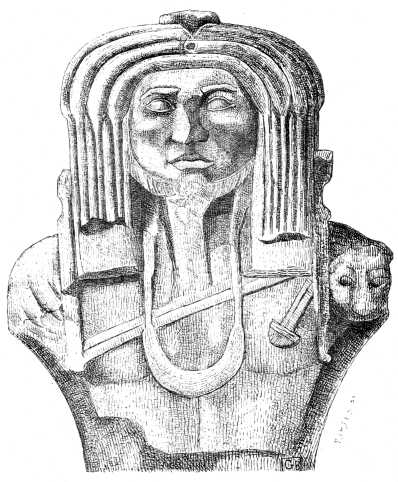
Fig. 212.—Upper part of a royal statue. Grey granite. Boulak. Drawn by G. Bénédite.
It cannot be denied that there are many striking points of resemblance between the different works which we have here brought together. Mariette laid great stress upon what he regarded as one of his most important discoveries. This is his definition of the type which the Egyptian artist set himself to reproduce with his habitual exactness: "The eyes are small, the nose vigorous, arched, and flat at the end, the cheeks are large and bony, and the mouth is remarkable for the way in which its extremities are drawn down. The face as a whole is in harmony with the harshness of its separate features, and the matted hair in which the head seems to be sunk adds to the singularity of its appearance."[219]
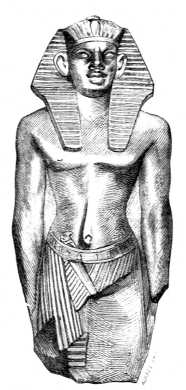
Fig. 213.—Fragmentary statuette of a king; height seven inches. Drawn by Saint-Elme Gautier.
Both Mariette and Ebers declare that this type has been preserved to our day with astonishing persistence. In the very district in which the power of the shepherds was greatest, in the neighbourhood of that Lake Menzaleh which almost bathes the ruins of Tanis, the poor and half savage fishermen who form the population of the district possess the strongly marked features which are so easily distinguished from the rounder and softer physiognomies of the true Egyptian fellah. Ahmes must have been content with the expulsion of the chiefs only of those Semitic tribes who had occupied this region for so many centuries. The mass of the people must have been too strongly attached to the fertile lands where they dwelt to refuse obedience to the conqueror, and more than one immigration, like that of the Hebrews, may have come in later times to renew the Arab and Syrian characteristics of the race.[220]
Whatever we may think of these conjectures and assertions, the sculptors of the First Theban Empire and of the Hyksos period took up and carried on the traditions of the Ancient Empire. The processes are the same except that in a few particulars they are improved. More frequent use is made of the harder rocks such as granite, basalt, and diorite, and a commencement is made in the art of gem-cutting.
Even the bas-relief carries on the themes which had been in favour in the first years of the monarchy. We have already illustrated two steles of this period (Figs. 86 and 164, Vol. I.). In the second, and especially in the woman, may be noticed those elongated proportions which characterize the sculpture of the first Theban dynasties. Apart from the steles, which come mostly from Abydos, we have few bas-reliefs which may be referred to this epoch. The mastabas with their sculptured walls were no longer constructed, and the most interesting hypogea of the middle Empire, those of Beni-Hassan, were decorated with paintings only. The sepulchral grottos of El-Bercheh possess bas-reliefs dating from the twelfth dynasty, and the quality of their workmanship may be seen in our Fig. 43, Vol. II. The style is less free and more conventional than that of the mastabas. The men who haul upon the ropes and those who march in front of them, are all exact repetitions one of another, causing an effect which is very monotonous. The paintings of Beni-Hassan, which are freer and more full of variety, are more able to sustain a comparison with the decorations of the mastabas. Even then, however, we find too much generalization. Except in a few instances there is a less true and sincere feeling for nature, and a lack of those picturesque motives and movements caught flying, so to speak, by an artist who seems to be amused by what he sees and to take pleasure in reproducing it, which are so abundant in the mastabas.
§ 4. Sculpture under the Second Theban Empire.
The excavations at Tanis have helped us to understand many things upon which our information had been and still is very imperfect. We are no longer obliged to accept Manetho's account of the Shepherd invasion. In his desire to take at least a verbal revenge upon the conquerors of his country the historian seems to have greatly exaggerated their misdeeds. We know now not only that the native princes continued to reign in Upper Egypt, but also that the interlopers adopted, in the Delta, the manners and customs of their Egyptian subjects. So far as we can tell, there were neither destructions of monumental buildings nor ruptures with the national traditions. Thus the art of the three great Theban dynasties, from Ahmes to the last of the Rameses, seems a prolongation of that of the Ousourtesens and Sebek-hoteps. There are no appreciable differences in their styles or in their processes, but, as in their architecture, their works of art as a whole show an extraordinary development, a development which corresponds to the great and sudden increase in the power and wealth of the country. The warlike kings who made themselves masters of Ethiopia and of Western Asia, had aspirations after the colossal. Their buildings reached dimensions hitherto unknown, and while their vast wall spaces gave great opportunities to the sculptor they demanded efforts of invention and arrangement from him to which he had previously been a stranger. These great surfaces had to be filled with historic scenes, with combats, victories, and triumphal promenades, with religious scenes, with pictures of homage and adoration. The human figure in its natural size was no longer in proportion to these huge constructions. In order to obtain images of the king which should correspond to the extent and magnificence of the colonnades and obelisks, the slight excess over the real stature of human beings which contented the sculptors of the Ancient Empire was no longer sufficient. Whether they were cut, as at Ipsamboul, out of a mountain side, or, as at Thebes, Memphis, and Tanis out of a gigantic monolith, their proportions were all far beyond those of mankind. Sometimes the mortals who frequented the temples came nearly as high as their knees, but oftener they failed to reach their ankle-bones. The New Empire had a mania for these colossal figures. It sprinkled them over the whole country, but at Thebes they are more thickly gathered than elsewhere. In the immediate neighbourhood of the two seated statues of Amenophis III., the savants of the French Commission found the remains of fifteen more colossi.[221]
There were at least as many on the right bank. On the avenue leading through the four southern pylons at Karnak, the same explorers found twelve colossal monoliths, each nearly thirty-five feet high but all greatly mutilated, and the former existence of others was revealed to them by fragments scattered about the ground. They were able to reckon up eighteen altogether on this south side of the building.[222]
Similar stone giants peopled the other religious or political capitals of Egypt—Abydos, Memphis, Tanis, Sais, etc. The largest of all, however, are the colossi at Ipsamboul representing Rameses II. They are about seventy feet high. Among those cut from one enormous block brought from Syene or elsewhere, the best known are those of Amenophis III. at Thebes. They are fifty-two feet high without the pedestal. But the statue of Rameses II., which stood in the second court of the Ramesseum, must have been more than fifty-six feet high, as we may calculate from the fragments which remain. The head is greatly mutilated but the foot is over thirteen feet long.[223]
These statues were generally seated in the attitude which we have already described in speaking of Chephren and Sebek-hotep. Some, however, were standing, such as the colossal figure of Rameses which stood before the Temple of Ptah at Memphis. This figure, which is about forty-four feet high, is cut from a single block of very fine and hard limestone. It lies face downwards and surrounded by palm trees, in a depression of the soil near the village of Mitrahineh. In this position it is covered by the annual inundation. The English, to whom it belongs, have hitherto failed to take possession of it owing to the difficulty of transport, and yet it is one of the most careful productions of the nineteenth dynasty. The head is full of individuality and its execution excellent.
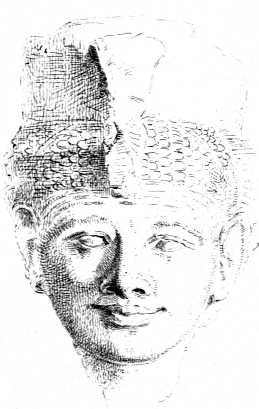
THE QUEEN TAIA BOULAK MUSEUM J. Bourgon del. Imp. Ch. Chardon Ramus sc.
In spite of their taste for these colossal figures, the Egyptian sculptors of this period rivalled their predecessors in the skill and sincerity with which they brought out their sitter's individuality. It was not, perhaps, their religious beliefs which imposed this effort upon them. The readiness which successive kings showed in appropriating the statues of their ancestors to themselves by simply placing their ovals upon them, proved that the ideas which were attached by the fathers of the Egyptian race to their graven images had lost their force. Effigies which were brought into the service of a new king by a mere change of inscription, were nothing more than monuments to his pride, destined to transmit his name and glory to future generations. The early taste, however, was not extinguished. When the sculptor was charged with the representation of one of those kings who had made Egypt great, or one of the queens who were often associated in the sovereign power, he took the same pains as those of the early Empire to make a faithful copy of his august model.
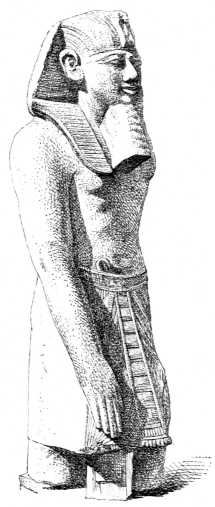
Fig. 214.—Thothmes III. Boulak. Granite.
Among the monuments of faithful portraiture which this period has left us the statues of Thothmes III. are conspicuous. The features of this prince are to be recognized in a standing figure at Boulak (Fig. 214), but they are much more strongly marked in a head which was found at Karnak and is now in the British Museum (Fig. 215). It formerly belonged to a colossal statue erected by that prince in the part of the temple built by himself. The features seem in no way Egyptian. The form of the nose, the upturned corners of the eyes, the curves of the lips, and the general contours of the face are all suggestive of Armenian blood.[224] Others have thought it showed traces of negro descent. In the first-named statue these characteristics are less conspicuous because its execution as a whole is less careful and masterly. The same physiognomy is to be found in a porphyry sphinx belonging to the Boulak collection.[225]
There is a strong contrast between the features of Thothmes and those of Amenophis III. the founder of Luxor. Of this we may judge by a head, as well preserved as that of Thothmes, which was found behind one of the statues of Amenophis at Gournah. It also is in the British Museum. The face is long and finely cut, with an expression and general appearance which we should call distinguished; the nose is long and thin; the chin well chiselled and bold in outline.[226]
Obliged to draw the line somewhere we have not reproduced this figure, but in Plate XI. we give a female head, discovered by Mariette at Karnak, and believed to be that of Taia, the queen of Amenophis III. Whether rightly named or not, this colossal fragment is one of the masterpieces of Egyptian sculpture.[227]
Mariette enumerates various reasons for believing Taia to have been neither of royal nor even of Egyptian blood. She might have been Asiatic; the empire of her husband extended as far as Mesopotamia. The point has little importance, but as M. Charmes says, "when we stop in admiration before the head of Taia, at Boulak, we feel ourselves unconsciously driven by her charms ... to forge a whole history, an historical romance, of which her enigmatic personality is the centre and inspiration, and to fancy her the chief author of these religious tragedies which disturbed her epoch and left a burning trace which has not yet disappeared."[228]
M. Charmes here alludes to the changes which Amenophis IV. wished to introduce into the national religion when he attempted to destroy the name and images of Amen, and to replace them with those of a solar god, who was represented by a symbol not previously encountered in the monuments (Fig. 2). If Mariette's hypotheses remain uncontradicted by later discoveries, we may admit Taia to be the mother of Amenophis IV., and to her influence in all probability would her son's denial and persecution of the great Theban deity be due. Our present interest, however, is with the features of Amenophis. They have been faithfully handed down to us by the artists employed at Tell-el-Amarna.[229] By the help of these bas-reliefs a statuette in yellow steatite, now in the Louvre (Fig. 216), has been recognized as a portrait of this Pharaoh. Its workmanship is very fine.
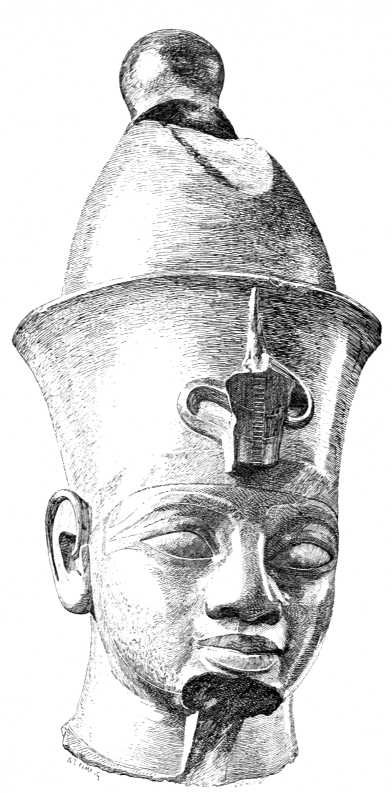
Fig. 215.—Thothmes III. British Museum. Red granite. Drawn by Saint-Elme Gautier.
Some have thought that in these bas-reliefs, and in the Louvre statuette, the "facial characteristics and the peculiar shapes of breast and abdomen by which eunuchs are distinguished, are to be found."[230] On the other hand, we know that while still very young Amenophis IV. married the queen Nowertiouta, and that he had seven daughters by her. "It is probable, therefore, that if the misfortune alluded to really befell him, it was during the wars waged by Amenophis III. against the negro races of the south." In any case, Amenophis IV. bore no resemblance to any one of the long procession of princes whose portraits have come down to us, from the early dynasties of the Ancient Empire to the Roman conquest. Lepsius devotes a series of plates to the iconography of the Egyptian kings, and among them all we find nothing that can be compared to the almost fantastic personality of Amenophis, with his low, unintellectual forehead, his pendulous cheeks, his feminine contours, and his general expression of gloom and melancholy. The fidelity with which all these unpleasing features are reproduced is extraordinary, and can only be accounted for by the existence of a tradition so well established that no one thought of breaking through it, even when the portrait of a semi-divine monarch was in question.
There are other works dating from this period which show the same desire for truth at any price. One of the series of bas-reliefs discovered by Mariette in the Temple of Dayr-el-Bahari may be given as an instance. The subject of these reliefs is the expedition undertaken by the regent Hatasu against the country of Punt.[231]
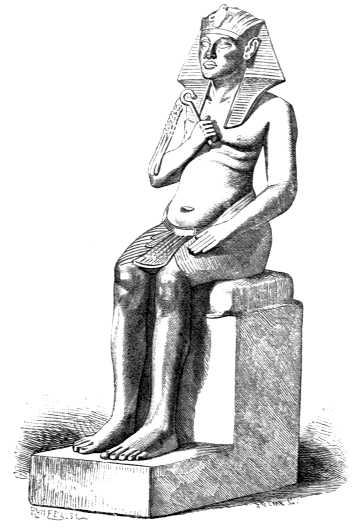
Fig. 216.—Statuette of Amenophis IV. Height twenty inches. Louvre. Drawn by Saint-Elme Gautier.
"In the most curious of these sculptures the savage chief advances as a suppliant. His wife walks behind him. Her hair is carefully dressed and plaited into a thick tail at the back; a necklace of large discs is round her neck. Her dress is a long yellow chemise, without sleeves, and reaching to the middle of her legs. Her features are regular enough, but virile rather than feminine, and all the rest of her person is repulsive. Her arms, legs, and chest, are loaded with fat, while her person projects so far in the rear as to result in a deformity over which the artist has dwelt with curious complacence." The legs, so far as the chemise allows them to be seen, are so large that they suggest incipient elephantiasis. The Egyptian artist was induced, no doubt, to dwell upon such a monstrosity by the instructive contrast which it presented with the cultivated beauty of his own race.[232]
Realist as he was when he chose to take up that vein, the Egyptian sculptor attained, however, to a high degree of grace and purity, especially in his representations of historic and religious scenes. When he had not the exceptional ugliness of an Amenophis IV. to deal with, he gave to the personages in his bas-reliefs a look of serious gravity and nobility which cannot fail to impress the greatest enthusiast for Greek models. He was no longer content with the sincere imitation of what he saw, like the artists of the Early Empire; his efforts were directed to giving everlasting forms to those superhuman beings, the Egyptian gods and Egyptian kings, with their sons and favourites, who lived in hourly communion with them. Egyptian art at last had an ideal, which it never realized with more success than in certain bas-reliefs of this epoch.
Mariette quotes, as one of the most learned productions of the Egyptian chisel, a bas-relief at Gebel-Silsilis representing a goddess nourishing Horus from her own breast. "The design of this composition is remarkable for its purity," he says, "and the whole picture breathes a certain soft tranquillity which both charms and surprises a modern connoisseur."[233]
We have not reproduced this work, but an idea of its style and composition may be formed from a bas-relief of the time of Rameses II., which we have taken from the speos of Beit-el-Wali (Fig. 255, Vol. I.). The theme is the same. A scene of adoration taken from a pier at Thebes (Fig. 176, Vol. I.) and, still more, a fine bas-relief in which Amenophis III. does homage to Amen, to whom he is presented by Phré, may also be compared with the work at Gebel-Silsilis. The movements are free and elegant, and nothing could be more expressive than the gestures of the two deities, than the attitude, at once proud and respectful, of the kneeling prince. The whole scene is imbued with sincere and grateful piety (Fig. 33, Vol. I.).
We find the same theme, with some slight variations, in the bas-relief at Abydos figured on page 390, Vol. I. The sculptures in the temple with which Seti I. adorned this city may be considered the masterpieces of Egyptian art in their own genre. Their firm and sober execution, and the severe simplicity of their conception, are well shown in our third plate. This royal figure, which we were compelled to detach from its companions in order that we might give it on a scale large enough to be of service, forms part of a composition which has been thus described by M. Charles Blanc: "Seated upon the round base of a column, we examined the noblest bas-reliefs in the world. Seti was present in his own temple. His noble head, at once human and heroic, mild and proud, stood out from the wall and seemed to regard us with a gentle smile. A wandering ray of sunlight penetrated into the temple, and, falling upon the gentle salience of the sculptured figures, gave them a relief and animation which was almost illusive. A procession of young girls, whose graceful forms are veiled only by their chastity, advance towards the hero with as much freedom as respect will allow.... Their beauty attracts us while their dignity forbids all approach. The scene lives before us, and yet the stone is but grazed with the chisel and casts but the gentlest shadow. But the delicacy of the workmanship is combined with such vigour of design and such true sincerity of feeling that these young women, who represent the provinces of Egypt, seem to live and breathe before us."[234]
The same qualities are found, though in less perfection, in those bas-reliefs which commemorate the conquests and military exploits of the great Theban Pharaohs on the pylons and external faces of the temple walls. The space to be covered is larger, the scene to be represented more complicated, than in the religious pictures, which, as a rule, include very few actors. The artist is no longer working for a narrow audience of gods, kings, and priests. His productions are addressed to the people at large, and he attempts therefore to dazzle and astonish the crowd rather than to please the more fastidious tastes of their social leaders. His execution is more rapid and less thoughtful, as may be seen in our illustrations taken from the battle scenes of Karnak, Luxor, the Ramesseum, and Medinet-Abou (Figs. 13, 85, 173, 174, 253, and 254, Vol. I.). In each of these scenes there is a central figure to which our attention is immediately attracted. It is that of the king, and is far larger than those of his subjects and enemies.