Front matter (continued 4)
Reading edition
The thigh-bone (femur) has no round ligament binding its articular head into its socket in the pelvis, a disposition which, while it affords greater flexibility and freedom to the hind-limbs in climbing, gives it much less firmness in walking on the ground. The proportionate length of the foot to its limb is greater in this genus than in any other of the Anthropoidea. The ankle (tarsus) is very short, and the bones (phalanges) of the toes form the longest part of the foot. The great-toe is especially short and divergent, its terminal bone being often absent, while the bones of the digits are long and curved. On account of the form of certain bones of the tarsus and their inter-mobility the foot is set obliquely to the leg through the action of one of its muscles (the tibialis anticus), so that the sole is pulled to the inside when walking. The outer edge of the foot, with the upper side of the fourth and fifth toes, is therefore applied to the ground in the act of progression, while the spread thumb supports most of the animal's weight. The wrist (carpus) contains the complete number of nine bones, as it possesses the os centrale wanting in Man and the Chimpanzees.
The breast-bone in the Orang is composed of ossifications arranged in pairs, instead of being formed of only two bones, as in the other members of the family.
Between the neck and the complex and solid sacral bone there are sixteen vertebrae, and there are twelve pairs of ribs, as in Man. The vertebral column presents slight but distinct indications of the curvature so characteristic of Man, and is nearly as much concave forward in its dorso-lumbar region as in a child.
The Orang-utan has no uvula as in Man and in the Chimpanzees. It possesses enormous air sacs—dilatations of the lateral cavities (ventricles) of the larynx, found in Man—which extend over the throat, the top of the chest, and as far as the arm-pits; these may even unite in the middle line. Its great-toe and thumb lack the long flexor muscles which are present in Man and in the Chimpanzees.
"Of all Apes, the Orang has the brain which is most like that of Man; indeed, it may be said to be like Man's in all respects, save that it is much inferior in size and weight, and that the cerebrum is more symmetrically convoluted and less complicated with secondary and tertiary convolutions." (Mivart.) The cerebral hemispheres are higher in proportion to their length than in any other Anthropomorpha, but they are elongated and depressed, as compared with Man. (Huxley.)
The colour of the hair of the Orang is a brick- or yellowish-red all over, but in old males it is sometimes darker on the limbs. Its length (twelve to sixteen inches) is greatest, and its character coarsest, on the arms, thighs, and shoulders; the face, ears, and throat are bare, and the skin of a reddish- or yellowish-brown colour; but there is a thin beard on the chin. The back of the hand and fingers are also thickly haired; on the arms the hair grows towards the elbow, as on the fore-arm, both meeting in a point at the elbow.
Between childhood and middle age the skin varies in colour from dark yellowish in the younger individuals to blackish-brown, or black, in the adults (the latter colour largely predominating). Very often the face and neck are almost or quite black, the palms light brown, and the breast and abdomen mulatto-yellow. (Hornaday.)
In size also the Orang varies greatly; the males being larger than the females. The largest male shot by Wallace measured 4 feet 2 inches. Hornaday, however, shot several exceeding 4 feet 4 inches, his tallest being 4 feet 6 inches, and one male was 3 feet 10½ inches; while his largest female measured 4 feet, and the smallest adult female 3 feet 6 inches. The breadth across the face in males varies from 11½ to 13½ inches, and in females 5½ to 6 inches. The young at birth is large in comparison with the size of the female. A male weighs often from 120 to 160 lbs.
Distribution.—The Orang-utan is confined to the islands of Borneo and Sumatra, in the East Indian Archipelago. In Sumatra it is far less common than in Borneo, and is found on the lowlands of the eastern coast, in the Palembang Residency, and the Djambi Sultanate. As far as I could ascertain, the natives of the southern portion of Palembang and of the Lampongs were quite ignorant of the animal, except as a name. In Borneo it inhabits the low forest-covered swamplands between the coast and the interior mountains, from the north of the island, round the west, southern, and eastern coasts, as far as the Mahakkam river, if not round the entire coast, as is most likely. In the dry season they retire into the depths of the forest. In the fruit season they come nearer to the coast, while at the height of the rains they frequent the river banks.
Habits.—The Orang-utan, the "forest-living Man" of the Malays, and the "Mias" of the Bornean natives, lives solitary in the leafy tops of the trees in the forests, except at the pairing season. A female is generally accompanied by one of her progeny, sometimes by two, the one always an infant, and the other a more or less grown but immature individual of a previous birth; for her young—of which she has only one at a birth—do not shift for themselves before they are approaching two years of age. At what age they attain maturity is unknown, but it is probably not before twelve to fifteen years. The infant clings by its arms to its mother when she is climbing, by grasping the hair of her arm-pits, while its legs embrace her sides above the hip. As already observed, the Orangs have none of the marvellous agility of the Gibbons. They are slow and deliberate in their movements; "surprisingly awkward and uncouth," according to Sir James Brooke; but their long and extremely powerful arms and hook-like fingers, which close with an amazing rigidity of grip, and their mobile legs and hand-like feet, enable them to lift and swing their bodies with great precision from branch to branch and tree to tree. "I have frequently seen them," says Hornaday, "swing along beneath the large limbs as a gymnast swings along a tight rope, reaching six feet at a stretch. When passing from one tree to another, the Orang reaches out and gathers in its grasp a number of small branches that he feels sure will sustain his weight, and then swings himself across." On the ground all this is very different. He walks very badly and unsteadily; he uses his arms as crutches, leaning his weight upon them with his fingers as already described, and swings himself forward on them. On the ground the Orang does not move, according to Sir James Brooke, so fast as to preclude a man keeping up with him easily through a clear forest. "The very long arms, which, when he runs, are but little bent, raise the body of the Orang remarkably, so that he assumes much the posture of a very old man bent down by age, and making his way along by the help of a stick." (Huxley.) The Orang, however, rarely comes to the ground of his own accord.
Mr. Martin gives the following account of a specimen which lived in the Zoological Gardens in London many years ago:—"Its attitudes were as varied as can be imagined, its actions slow and deliberate; excepting, indeed, on one or two occasions when it wished to follow its keeper, who had opened the door of its cage; even then it did not bound from branch to branch like a Monkey, but stretching out its arms, and grasping the branches within its reach, it swung itself onward, and so descended to the floor, along which it hobbled awkwardly and unsteadily. One thing, as respects both the hands and feet of this Orang, could not be overlooked; namely, that their mode of application to the branches, during the arboreal evolutions of the animal, was hook-like; and, from the power of the adductor muscles of the thumb, and flexor muscles of the fingers, tenacious and enduring, rather than tight and fixed. This observation is especially applicable to the feet; in these the shortness of the thumb, though capable in itself of firm and close application, renders it rather a fulcrum, against which the long fingers oppose their stress, than, by folding upon them, an adjunct to them in the act of prehension; and hence, though admirably fitted for the movements of the animal among the trees of the forest, and the kind of hold necessary for freedom and security, the foot of the Orang is, perhaps, less energetic in the grasp than that of the semi-arboreal Chimpanzee, in which the hind-thumb is proportionately longer, and the foot broader, than in the Orang."
The Orang drinks by dipping its fingers into the water, as the Siamang does, and sucking the water off its knuckles, or dropping it into its protruded trough-like lower lip.
"The rude hut which they are stated to build in trees, would be more properly called a seat or nest, for it has no roof or cover of any sort. The facility with which they form this nest is curious, and I had an opportunity of seeing a wounded female weave the branches together and seat herself within a minute." (Sir James Brooke.) "The Orang usually selects," writes Mr. Hornaday, "a small tree, a sapling, in fact, and builds his nest in its top, even though his weight causes it to sway alarmingly. He always builds his nest low down, often within twenty-five feet of the ground, and seldom higher than forty feet. Sometimes it is fully four feet in diameter, but usually not more than three, and quite flat at the top. The branches are merely piled crosswise. I have never been able to ascertain to a certainty, but it is my opinion that an Orang, after building a nest, sleeps in it several nights in succession, unless he is called upon to leave its neighbourhood." In this nest he sleeps during the night or lies spread out on his back during the day, with his hands and feet grasping the nearest branches. The food of the Orang-Utan—whose eating-time is during the middle of the day—consists of leaves and nuts, especially of the durian, the rambutan, and the mangosteen.
The Orang-Utan is of a very shy and uncertain disposition. If captured when full-grown, it is wild and ferocious; when young it is easily trained; but never lives in captivity to attain maturity. When attacked and hard driven by human enemies, and it gets to close quarters with them, it can be a formidable and dangerous antagonist, and has been known to fatally injure its assailants. It will rarely, unprovoked, attack a man. "In one case," as Dr. A. R. Wallace has recorded, "a female Mias on a durian-tree kept up for at least ten minutes a continuous shower of branches and of the heavy spined fruits as large as 32-pounders, which most effectively kept us clear of the tree she was on. She could be seen breaking them off and throwing them down with every appearance of rage, uttering at intervals a loud, pumping grunt, and evidently meaning mischief." They fight and defend themselves with their hands, and appear to seize and bite each other's fingers. Many of the specimens shot in the forest of Borneo have lost one or more of their fingers or toes; and present scars on the face (especially on the lips) and bodies from the teeth of their antagonists.
"When wounded he betakes himself to the highest attainable point of the tree, and emits a singular cry, consisting at first of high notes, which at length deepen into a low roar, not unlike that of a panther. While giving out the high notes, the Orang thrusts out his lips into a funnel shape; but in uttering the low notes he holds his mouth wide open, and at the same time the great throat bag, or laryngeal sac, becomes distended." (Huxley.)
The name given by the Dyaks to the larger species is "Mias Pappan." There is, however, a smaller variety, which they designate "Mias Kassu," of which Dr. Wallace has given an excellent and detailed account. These Mias Kassu have no tumour-like expansions on the sides of the head; the median crest is absent from the skull, for the muscular ridges remain some distance apart; the teeth are very large, especially the canines and the middle upper incisors. The females, which are smaller than the males, are also without the cheek-swellings and the prominent crests of the male, and have smaller canine teeth. This variety, named Simia morio by Sir R. Owen, bears a close similarity to that found in Sumatra. It has been considered a distinct species both by Owen and Wallace, but the variation, as the latter naturalist himself admits, is so very great in just those characters which have been considered to separate "Mias Kassu" from "Mias Pappan," that it is highly probable that both are of the same species, but of different ages. Mr. Beddard found that an Ape exhibited in the Zoological Gardens as an adult example of S. morio was in reality immature.
THE GORILLAS. GENUS GORILLA.
Troglodytes, Geoffr., Ann. Mus., xix., p. 87 (1812).
Gorilla, Is. Geoffr., C. R., xxxiv., p. 84, note (1852).
This genus, like the preceding, contains but a single species,
THE GORILLA. GORILLA GORILLA.
Troglodytes gorilla, Wyman, Bost. Journ. Nat. Hist. (2), v., p. 419, pls. 1-4 (1847); Winwood-Reade, P. Z. S., 1863, p. 171; Owen, Tr. Z. S., ii., p. 381; v., pp. 1, 243, pls. i.-xiii., and xliii.-xlix; Scl., P. Z. S., 1877, p. 303; Cunningham, Mem. Roy. Irish Ac., p. 1 (1886).
Gorilla gina, Is. Geoffr., Arch. Mus., viii., pls. 2-4 (1852).
Troglodytes savagei, Owen, P. Z. S., 1848, p. 29.
Gorilla savagei, Is. Geoffr., Rev. et. Mag. de Zool., p. 104 (1853); Gray, Cat. Monkeys Brit. Mus., p. 7 (1870).
Pithecus gorilla, Blainv., Osteogr., pls. 2, et 5 bis (errore P. gesilla).
PLATE XL.
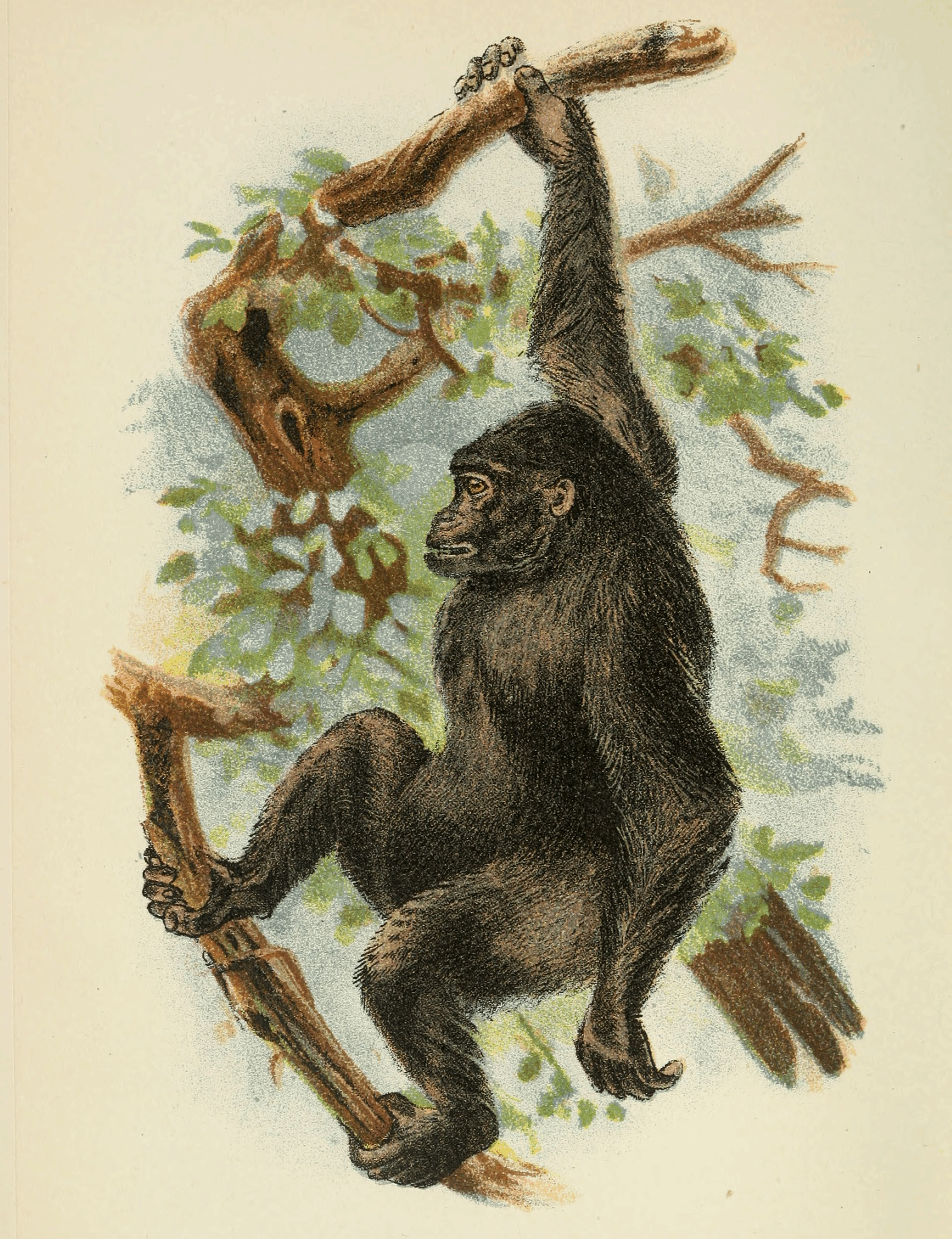
THE GORILLA.
Satyrus adrotes, Meyer, Arch. f. Naturg., p. 182 (1856).
Simia gorilla, Schl., Mus. Pays-Bas, vii., p. 8 (1876).
Gorilla mayema, Alix et Bouv. C. R., lxxxv., p. 58 (1878).
(Plate XL.)
Characters.—The face of this massive and most ponderous of all the Apes is naked and black, very wide and elongated. The large head has a ridge of hair along the central crest, and its lower jaw is very wide and far extended backward. The nose is long and high, and broad and flat at its extremity, and is also grooved longitudinally. The muzzle is broad, the mouth wide; the upper lip short, and the lower mobile and protrudable. The eyes are large; the ears naked and black, with the posterior upper angle pointed, and the lower margin produced into a rudimentary pendulous lobule.
The cranial region is comparatively small. The supra-orbital ridges, in which the eye-brows are set, form, from their prominence, a marked feature of the face. They overhang the eyes, causing them to appear very much sunk in the skull. The neck is short, the chest and shoulders wide, thickly haired and suggestive of great strength.
The arms are much longer than the fore-arms, and the feet, which have no in-step, exceed the hands in length, and are much broader than in other genera of the Simiidæ. The heel, which in the Orangs is small, is in the Gorilla strongly developed, on which account it can easily stand erect. Its opposable great-toe is large and flattened, and has a wide nail; while the lower joints of the second, third, and fourth toes—which are also short and thick—are united by a web. The arms, on which the hair converges on both sides of the joint towards the elbow, are so long as to reach down to the middle of the leg when the Gorilla stands erect. The thumb is short and thick, and is tipped with a broad nail. The hand is broad, thickly haired on the back, and wrinkled from the wrist to the fingers. The fur of the Gorilla consists of long, thick, straight, or stiffly curved bristles, beneath which is a shorter curled woolly hair, or under-fur.
The skull of the adult male has very protruding jaws, and enormous supra-orbital ridges. The cheek-bones are broad; the temporal muscles meet along the top of the cranium, and have enormous bony crests for their attachment. The same is the case on the back of the head for the powerful neck-muscles. The true form of the skull is obscured by these great ridges and by the extent to which the face protrudes. The brain-case is better shaped internally than appears externally. The orbits have the same form as in Man.
The canine teeth are enormously developed. The upper molars are four-cusped, and have the oblique ridge, already often referred to, from the front inner to the hind outer cusp, the posterior of the three being much larger than the other two, a character distinguishing its jaw from that of Man and the Chimpanzees. The anterior lower molars have five cusps, three on the outer side and two on the inner, as in Man.
The lower jaw has no true chin, and its symphysis is very long and quite different from what is seen in the human symphysis. The opening for the passage of the spinal cord is situated in the posterior third of the base of the skull, and not, as in Man, nearly in the centre.
The vertebræ of the neck, back, and loins number the same—seventeen—as in Man; but there are thirteen parts of ribs instead of twelve. The neck-vertebræ have long spines which contribute to the thickness of the neck. The curvature, characteristic of Man, in the lumbar region of the vertebral column of the young Gorilla, is more developed than in the Chimpanzee, and in both are earlier developed than in Man. (Symington.)
The wrist (carpus) contains but eight bones, as there is no central (os centrale) bone, a character in which it agrees with Man and the Chimpanzee, but differs from the Orang.
The volume of the brain in the largest Gorilla rarely exceeds 34½ cubic inches, which is only half the capacity of the human skull. It may be safely said that an average European child, of four years old, has a brain twice as large as that of an adult Gorilla. The weight of a healthy human brain never falls below 31 ounces; that of the largest Gorilla has probably never reached 21. (Huxley.)
In the brain of the Gorilla the cerebellum can be seen between the deep longitudinal fissure which separates the two halves of the cerebrum. It agrees in this with the Orang and Anthropopithecus calvus—the latter exhibiting even a greater divergence of the cerebral lobes.
The young male Gorilla differs much from the adult; its central cranial crest is less prominent than the occipital ridge for the neck muscles.
The female is much smaller than the male, but the cheeks are relatively broader; the cranial crests and ridges are less strongly marked, and the canines shorter and less powerful. Her breasts are long and pointed, not globular.
The height of the adult male Gorilla is over six feet, but the female rarely exceeds four feet six inches.
The general colour of the Gorilla is black or blackish; the whole skin of the face is glossy, set with a few hairs, and deep black; the crown reddish-brown, sometimes of a dark brown, the hairs being dun-coloured at the root, grey in the middle, and dark brown at the tip; on the sides of the face the hair is dark brown or black, grey at the root; on the neck and shoulders the hair is grey at the root, and lighter towards the point. The back, the region of the humerus, and the thighs are brownish, the hair being pale grey at the root, blackish-brown further up, and dark grey at the termination; the fore-arms, the hands, ankles, and feet, dark brown or black; round the posterior is a circle of white hair in some, in others of brownish-yellow. Old individuals become grey or grizzled.
Distribution.—Western Equatorial Africa, between the Cameroons and the Congo. This region presents a variety of hill and dale; the uplands are clothed with forest, and the dales are covered with grass and low bush, with abundance of fruit-yielding trees.
Habits.—This extraordinary animal, round which have gathered so many myths, derived mostly from the inexact and magnified tales of the natives, still further exaggerated by careless or imaginative visitors to the West Coast of Africa, was first brought to the knowledge of science by Dr. Thomas Savage, an American Medical Missionary, in 1847. From that time downwards numerous preserved specimens of the animal have been received in excellent condition, so that its anatomy is very fully known. In 1860 the first living individual reached Europe, and lived for some months in Wombwell's Menagerie. Since that date both English and continental menageries have had specimens in captivity. What we know of the habits of the Gorilla is greatly based on observations made on these captive animals. Abundant statements to the contrary notwithstanding, very few persons, competent to give an intelligent account of their habits, have ever seen the Gorilla alive in its native state. Even now, for our best accounts, we are indebted to Dr. Savage, who obtained most of his information from the natives, whose language and character he understood so thoroughly that he was able to extract from them, by carefully sifting their statements, most accurate information free from exaggeration and conjecture.
The Gorillas live in small companies, or rather families, consisting of their young of different ages, along with the father and mother. Like the Orang, the Gorilla is said to build a sort of platform-nest or shelter to pass the night in, of sticks or twigs laid crosswise on the branch of a strong tree, and within about twenty feet from the ground. The male sits, it is said, on guard below, the female and her family occupying the platform above. "My informants," says Savage, "all agree in the assertion that but one adult male is seen in a band." One gets the mastery by killing or driving out the other males.
Professor Hartmann writes: "The Gorillas roam [during the daytime only] through the tracts of the forest, which surround their temporary sleeping-places, in order to seek for food. In walking they place the back of their closed fingers on the ground, or, more rarely, support themselves on the flat palm, while the flat soles of their feet are also in contact with the ground. Their gait is shuffling; the motion of the body, which is never upright as in Man, but bent forward, is somewhat rolling, or from side to side. The arms being longer than those of the Chimpanzee, it does not stoop so much in walking; like that animal it makes progression by thrusting its arms forward, resting its hands on the ground, and then giving its body a half-jumping, half-swinging motion between them. In this act, it is said not to flex the fingers to rest on its knuckles, like the Chimpanzee, but to extend them, making a fulcrum of the hand. When it assumes the walking posture, to which it is said to be much inclined, it balances its huge body by flexing its arms upward."
The Gorilla has the power of moving the scalp freely forward and backward—as Man in many instances has the power of doing—and, when enraged, of corrugating his brows and erecting the hair over the central bony crest "so as to present an indescribably ferocious aspect." He is capable of emitting a "terrific yell that resounds far and wide through the forest"; and when shot his cry is like that of a human being in sudden and acute distress. The Gorilla is very ferocious and never runs away, as the Chimpanzee does; he advances to attack his enemies, but according to some observers, however, only when molested, rushing forward in a stooping attitude, then rising to his feet to strike. He is also credited with fighting with his teeth, as well as his hands, biting his antagonist, as the Orangs and the Chimpanzees do. He exhibits great intelligence, though less, perhaps, than the Chimpanzee.
The females prove affectionate mothers, bravely protecting their young at the cost of their own lives. "In a recent case," writes Dr. Savage, "the mother, when discovered, remained upon the tree with her offspring, watching intently the movements of the hunter. As he took aim, she motioned with her hand, precisely in the manner of a human being, to have him desist and go away. When the wound has not proved instantly fatal, they have been known to stop the flow of blood by pressing with the hand upon the part, and when this did not succeed to apply leaves and grass."
The food of the Gorilla consists of all sorts of forest and cultivated produce; but the top of the fruiting stem of the oil-palm (Elais guineensis), the Papaia (Carica), and plantains appear to be the fruits he most appreciates. Its dexterity in captivity in eating from utensils of civilised life is particularly remarkable, as Dr. Falkenstein records of a Gorilla he had alive for a considerable period. "He took up every cup or glass with instinctive care, clasped the vessel with both hands, and set it down again so softly and carefully that I cannot remember his breaking a single article.... He drank by suction, stooping over the vessel without even putting his hands into it or upsetting it, and in the case of smaller vessels he carried them to his mouth.... When he was anxious to obtain anything, no child could have expressed its wishes in a more urgent and caressing manner." When he was refused anything he had recourse to cunning, and looked anxiously to see if he was watched, and it was "impossible not to recognise a deliberate plan and careful calculation." When he had done what he had been forbidden or prevented from doing, "his whole behaviour made it clear that he was conscious of transgressing." The Gorilla is said by Dr. Savage to be very filthy in its habits, but Dr. Falkenstein's observations disagree with this statement. On this point the latter says "his cleanliness was remarkable."
The Gorilla generally adopts a squatting position, with its arms folded across its breast. When asleep he lies stretched out at full length on his back or side, with one arm under his head.
The Gorilla is very delicate, and rarely lives long in captivity, even in his own land.
THE CHIMPANZEES. GENUS ANTHROPOPITHECUS.
Anthropopithecus, De Blainville, Leçons Orales (1839).
Troglodytes (nec V.), Geoffr., Ann. Mus., xix., p. 87 (1812).
This genus contains those Apes which stand highest, next to Man, in the animal kingdom. This proximity, however, refers only to his external conformation and his anatomical structure.
The Chimpanzees approach very closely to the Gorilla in structure. Indeed the Gorilla was at first placed in the same genus as the Chimpanzee, which was much earlier known to science than its larger cousin, although an excellent description of the Gorilla, under the name of Pongo, was brought to this country by Andrew Battell, an English prisoner of the Portuguese in Angola, early in the seventeenth century, and published in "Purchas his Pilgrimage," in 1613, a story which for the first time referred definitely to the Chimpanzee.
The body is heavily built, but shorter and less robust than that of the Gorilla. The crown is depressed, and the supra-orbital ridges, from which rise stiff strong eye-brows, are prominent, but not remarkably so. The eye-lids are wrinkled, and their margins set with eye-lashes. The nose, of which the ridge is shorter than in the Gorilla, is depressed in the middle, flatter at the extremity, and, as in the last-named species, is furrowed longitudinally, its nostrils looking more downward and forwards. The lips are extremely mobile and protrusile, the upper one broad and the lower one retreating from the mouth, and not forming a true human-like chin, though it is more prominent than in the Orang. The cheeks are more wrinkled than in that Ape. The ears are large and projecting from the side of the head, and often carry a lobule. They are strangely like those of Man, and, as Mr. Darwin has remarked, the Chimpanzee never moves or erects its ears, so that they are equally rudimentary, as far as that function is concerned, as in Man. The shoulders and chest are broad, and indicate great strength. Their lower limbs are longer in proportion than in the Orang. The foot, which is anatomically in no respect a hand, is sometimes shorter than the latter, the great-toe is thick, opposable, and thumb-like, the other four toes are united together by a web, the heel is somewhat developed, and the whole of the sole of the foot is applied to the ground when walking. The arms, of which the humeral segment is about equal in length to the fore-arm, are long, but reach only a little below the knee—their span being about a half more than the height of the body. The hands, which are wonderfully human in form, are broad, comparatively short, and less hook-like than in the Orang. The hair on the arm and fore-arm converges towards the elbow, as in the Gorilla and Orang. The thumb is short in comparison with the same digit in Man, and, as in the human hand, the middle finger is the longest; the outer four fingers being united by a web reaching up to the first joint. The palm of the hand can be applied flat to the ground; but though the Chimpanzees can stand or run erect on the flat sole of the foot, they prefer to advance leaning forward, supporting themselves on the knuckles of the hand. They have no callosities on the ischiatic bones, on which they sit.
The female Chimpanzees are slightly smaller than the males, but the disparity between them is much less than between the two sexes of the Gorilla. The nose and teeth are less prominent, and the belly is more tun-shaped. The young males also exhibit fewer differences from the adult than among the Gorillas, though differing in many points of their soft anatomy and osteology. The nose lengthens, and its extremity widens, while the face becomes more prognathous with increasing years. In the young the frontal bone is low and flat. The skull in the Chimpanzee is elongated, and small in proportion to the body; the forehead is smaller, the crown more rounded than in the Gorilla, and the back of the head convex.[2] The central (sagittal) crest, so strongly developed in the Gorilla and the Orang, is here wanting; the supra-orbital ridges which extend across the face, and the occipital prominences for the back-muscles, though large, are also less marked. The orbits have a circular rim, and are less prominent than in the Gibbons. The nasal bones are but slightly arched, and the openings for the nostrils round and small. The jaws, which are smaller, proportionately to the cranium, in this genus, than in any other of the Simiidæ, protrude far forward, but the symphysis of the lower jaw is smaller than in the Gorilla, and its two halves low and wide. The bones of the skull are much hollowed out into cavities (sinuses) in the forehead, nose, and jaws, all of which communicate with each other. The plane of the foramen magnum (for the passage of the spinal cord) is oblique to the plane of the base of the skull.
The volume of the cranium is from twenty-six to twenty-seven cubic inches, or about one-half of the lowest capacity of a normal human cranium. A styloid process is more or less distinctly visible in the Chimpanzees.
The canine teeth are long and conical, but less than in the Gorilla; and the diastema, or gap, between them and their neighbouring teeth is smaller than in the other Apes. The molar teeth are four-cusped, and have the oblique ridge already described extending from the front inner to the hind outer cusp; and the middle lower molar has five cusps, both these dental characters being similar to those in Man. The anterior lower pre-molar, however, is pointed, and has a long sharp anterior edge, as in the Cercopithecidæ.
The vertebral column begins to show the S-shaped flexure, characteristic of Man's back-bone; it presents also a human character in the form of its second neck vertebræ, and there are thirteen pairs of ribs, as in Man. The hindmost vertebræ "give the impression of a rudimentary tail." (Hartmann.)
The humerus is nearly equal in length to the fore-arm; the wrist (carpus) has only eight bones (the central bone being absent), agreeing, therefore, with the number in Man.
All the ridges and grooves seen in the human brain are present in that of the Chimpanzee, but "they are simpler and more symmetrical, and larger in proportion to the brain." (Huxley.) The cerebellum, and the nerves also, are larger in proportion to the cerebrum than in Man; and certain structures (the corpora trapezoidea) which exist in the brains in the lower Mammalia are absent. These prominences, which are situated in that portion of the brain known as the medulla oblongata, at the summit of the spinal cord, disappear, as we have seen, in all the genera of higher rank than the Cebidæ, one of the lowest families of the Anthropoidea. The brain in its convolutions and in many other respects conforms to that of the Orang. This is especially the case in A. calvus.
The uvula, which is absent in the throat of the Orang, is pendulous in the Chimpanzees, as in Man. Large air-sacs are also present, and the hyoid bone is excavated posteriorly, suggesting the conformation of the same bone in Alouatta (the South American Howlers). The stomach is very similar to that of Man, and so are the digestive and reproductive organs. The round ligament, attaching the head of the thigh-bone into its pelvic socket, is present, and restricts the flexibility of the hind-limb of the Chimpanzees, compared with that of the Orang. Its presence, however, while acting somewhat less favourably in regard to the climbing capacities of these animals, whose habits are less essentially arboreal than the Orangs', beneficially assists them in walking, affording them a firmer support on the ground. In the Chimpanzee there is always a semi-lunar fold (plica semilunaris) in the inner corner of the eye, corresponding to the nictitating membrane (or third eyelid) of birds. In some of the Lemuroids it is well developed (suprà, vol. i., p. 90), and is large in some races of men.
The Chimpanzee is confined to the West African Sub-region, as defined by Dr. Bowdler Sharpe. It is known from Loango, along the banks of the Upper Congo, and Mr. Monteiro (P. Z. S., 1871, p. 544) says it is quite unknown to the south of the Congo; it also occurs throughout the country of the Manyema, in Central Africa, where Livingstone describes it under the name of Soko; and southward as far as 10° south latitude, to Lake Moero. Schweinfurth has recorded it from the Niam-niam country.
The Chimpanzees inhabit forest regions, and feed on wild fruits in the woods, and the products of cultivated gardens, not rejecting, when they can capture it, animal food. They live in separate families, or in limited communities of small families mixed together, but each male lives with his own single female. They are more arboreal than the Gorilla, but much less so than the Orangs. In many districts they seem to live on the ground.
They emit loud cries, shrieks, and howls in the morning and evening, and often during the night. "Since they are really accomplished in the art of bringing forth these unpleasant sounds, which may be heard at a great distance, and are reproduced by the echoes, it is impossible to estimate the number of those who take part in the dreary noise, but often we seemed to hear more than a hundred." (Pechuel-Lösche.) These Apes also build resting-places, not far from the ground, like the Orangs, composed of twigs and sticks on the branch of a tree or a crotch, in which the female and her young take refuge for the night, the male placing himself on guard beneath.
They seldom make an unprovoked attack on the natives wandering in the forest; on the contrary, they are peaceably disposed animals, glad to get out of the way of danger or possible enemies. Yet, when pressed, they form no mean antagonist. Biting is their principal mode of defence.
"As seen here," says Savage, "they cannot be called gregarious, seldom more than five or ten at most being found together. It has been said on good authority, that they occasionally assemble in large numbers in gambols. My informant asserts that he saw once not less than fifty so engaged, hooting, screaming, and drumming with sticks upon old logs, which is done in the latter case with equal facility by the four extremities.... When at rest, the sitting posture is that generally assumed. They are sometimes seen standing or walking, but when thus detected, they immediately take to all fours, and flee from the presence of the observer. Such is their organisation that they cannot stand erect, but lean forward. Hence they are seen, when standing, with the hands clasped over the occiput, or the lumbar region, which would seem necessary for balance or ease of posture."
Most of the accounts of the habits we have of Chimpanzees, refer to those of young individuals kept in captivity. There is still much to be discovered as to the ways and modes of life of the adults of both the Chimpanzee and the Gorilla. They are both very delicate, and in temperate climates rarely live more than a few months; a Bald Chimpanzee (A. calvus), however, survived five years in the Zoological Gardens, in London.
I. THE COMMON CHIMPANZEE. ANTHROPOPITHECUS TROGLODYTES.
Homo sylvestris (Ourang-outang), Tyson & Cowper, Phil. Trans., xxi., p. 338 (1699); Tulpius, Observ. Anat., p. 270, pl. 14 (1641).
Homo troglodytes, Linn., Syst. Nat., i., p. 32 (1766; pt.).
Simia troglodytes, Gm., Syst. Nat., p. 26 (1788); Blumenb., Handb., x., p. 73 (1803); Owen, Tr. Z. S. I., p. 344, pls. 48, 50-52, 55, 56 (1835); ii., p. 169 (1841); Schl., Mus. Pays-Bas, vii., p. 8 (1876).
Troglodytes niger, Geoffr., Ann. Mus., xix., p. 87 (1812); Desmar., Mammolog., p. 49 (1820); Lesson, Spec. Mamm., p. 37 (1840); var. Marungensis, Owen, Tr. Z. S., v., p. 3, pls. i.-ix.; p. 279, pl. xlix. (1866); Noalk, Zool. Jahrb., ii., p. 291 (1887).
Pseudanthropos (Troglodytes) leucoprymnus, Less., Ill., Prod. Syst. Mamm., pl. 12 (1811); Reichenb., Naturg. Affen., p. 191 (1862).
Pithecus leucopryma, Less., Ill. Zool., pl. 31 (1836; young).
Satyrus lagaros, Meyen, Arch. f. Naturg., p. 282 (1856).
Mimetes troglodytes, Gray, Cat. Monkeys Brit. Mus., p. 6 (1870).
Troglodytes vellerosus, Gray, P. Z. S., 1862, p. 181; id., Cat. Monkeys Brit. Mus., Append., p. 127.
Troglodytes schweinfurthi, Gigl., Studii Craniol. sui Cimpanzé iii., p. 56 (1872).
Troglodytes aubryi, Grat. et Alix, Nouv. Arch. Mus., ii., p. 1, pls. 1, 9 (1866).
Troglodytes tchego, Duvernoy, Arch. Mus., viii., p. 8 (1855).
Anthropopithecus troglodytes, Flower & Lydekker, Mamm., p. 736, fig. 357 (1891).
Characters.—Face, ears, hands, and feet dark-reddish flesh-colour, or more rarely of a blackish-brown colour; in general the colour of the hair is wholly black, except on the upper and lower lips, where it is white and very short, and in the region of the buttocks, where it is washed with reddish-brown.
Hair on the body straight and silky, with coarser hair interspersed; on the top of the head it lies smoothly to each side, away from a median line; round the face it forms bushy whiskers, extending down into a slight beard; it encroaches on the brow, leaving only a triangular central space naked; on the upper and lower lips are short, bristly hairs; the rest of the face naked and much wrinkled; on the shoulders, the back, and the hips, the hair is longer than elsewhere; the back of the hands and feet are thinly haired, the fingers and toes nude. The margin of the ears is often folded in for the greater part of its length.
The skin of the body is of a peculiar light, yet muddy, flesh-colour, sometimes verging on brown. Brownish or black spots on many parts of the body seem to vary in different individuals.
The expression of the face is grave, but less melancholy and pre-occupied than in the Orangs.
The weight of the brain in A. troglodytes varies from 6½ to 63⁄5 ounces.
This celebrated Man-like Ape has been known, by vague report at least, for nearly three hundred years. The earliest clear account of its existence, however, is derived from the "Strange Adventures of Andrew Battell, of Leigh in Essex, sent by the Portugals prisoner to Angola, who lived there and in the adioining regions neere eighteene yeares." It was first published in 1613 in "Purchas his Pilgrimage," and later more fully in 1625, in "Purchas his Pilgrimes."[3] Here it is related that in the Province of Mayombe, "which is nineteen leagues from Longo along the Coast, the woods are so covered with baboones, monkies, apes, and parrots that it will fear any man to travaile in them alone. Here are also two kinds of monsters, which are common in these woods, and very dangerous. The greatest of these two monsters is called Pongo, in their language, and the lesser is called Engeco." The Pongo turned out to be the Gorilla, the description given by the old prisoner Battell proving to be wonderfully accurate. The lesser monster, the Engeco, is equally certainly the Chimpanzee. The first record of a specimen actually seen in Europe is in 1641, and is noticed by Tulpius in his "Medical Observations," and the earliest scientific description of a Chimpanzee—a young specimen of A. troglodytes—is that of the anatomists Tyson and Cowper, published by the Royal Society in 1699. It was, however, not till 1835, that the osteology of a full-grown specimen was described, when Sir Richard Owen's memoir appeared, and shortly after a very detailed account of its habits was given to the world by Dr. Thomas Savage, the missionary to whom we have already referred (p. 184), followed by a further anatomical investigation of its structure by Dr. Wyman, of Boston, U.S.A.
Distribution.—This species is found over the greater part of Tropical Central Africa, and its range is co-extensive with that given above for the genus. Loango and the Gaboon, however, are the districts from which this Chimpanzee has chiefly been imported into Europe.
Habits.—The more characteristic habits of the common Chimpanzee have already been given under the description of the genus.
Its food consists of all sorts of forest fruits, and especially of the young shoots of the Scitamineæ, or ginger-plants.
The Chimpanzee can move the skin of its head, as the Gorilla does, but without causing the erection of the hair, which the Orang and the Gorilla are both able to accomplish. It can also to some considerable extent wrinkle its forehead, if disappointed or pleased, as when refused anything, or if tickled, when in the latter case it also utters a chuckling sound like that of smothered laughter, draws back the corners of its mouth, and wrinkles its eyelids.
The Soko observed by Livingstone in the Manuyema country would seem to be the common Chimpanzee. "According to Livingstone," to quote Mr. H. H. Johnston's note in his excellent "Life" of the great traveller, "these creatures often walk in an erect position, but steady their bodies by placing the hands on the back of the head. He represents this beast as being of great intelligence, and so cunning, that it is difficult to stalk him in front without being seen, and, therefore, when he is killed, it is usually from behind. The Manuyema people frequently string a number of nets round some enclosure in the forest and drive the Sokos into them and spear them. Brought to bay like this, they will frequently turn on their assailants, and will snatch their spears from them, and break them, and perhaps also bite off the ends of the men's fingers. But, as a rule, the Soko is not ferocious. They are said to kidnap children and run up the trees with them, and have to be lured down by bananas. When wounded the creature tries to staunch the blood by stuffing leaves into the wound. It lives in communities of about ten, and is monogamous. The female produces occasionally twins. As parents, they are very affectionate towards their offspring, the father relieving the mother of the burden of her young one in dangerous places. Their food consists of wild fruits. At times the Sokos collect together and drum with their fists on the trunks of hollow trees, and accompany this performance with loud yells and screams."
"According to the statements of the Niam-niam themselves," says Schweinfurth, "the chase of the Chimpanzee requires a party of twenty or thirty resolute hunters, who have to ascend the trees, which are some eighty feet high, and to clamber after the agile and crafty brutes until they can drive them into the snares prepared beforehand. Once entangled in a net the beasts are without much further difficulty killed by means of spears. However, in some cases, they will defend themselves savagely and with all the fury of despair. Driven by the hunter into a corner, they are said to wrest the lances from the men's hands and to make good use of them against the adversary. Nothing was more to be dreaded than being bitten by their tremendous fangs." The stories as to their carrying off young girls, and constructing nests are pure fabrications, according to Schweinfurth. Its name among the Niam-niam is "Ranya." "The life which the Ranya leads is very much like what is led by the Orang-Utan in Borneo, and is spent almost entirely in the trees, the woods on the river banks being the chief resort of the animals.... Like the Gorillas, they are not found in herds, but either in pairs, or even quite alone, and it is only the young which occasionally may be seen in groups."
PLATE XLI.
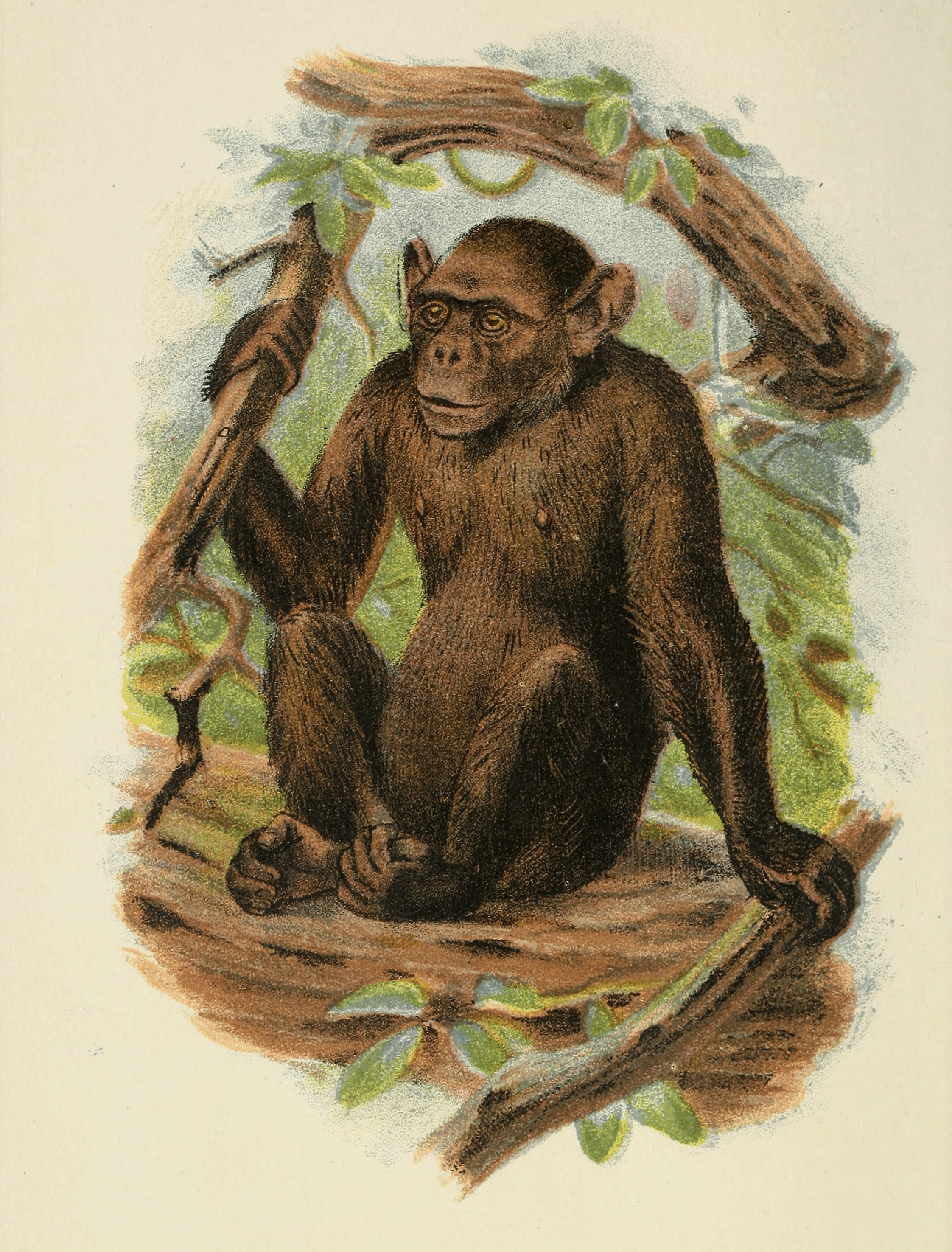
THE BALD CHIMPANZEE.
II. THE BALD CHIMPANZEE. ANTHROPOPITHECUS CALVUS.
Troglodytes calvus, Du Chaillu, Pr. Bost. Soc. Nat. Hist., vii., p. 296 (1861); id., Travels, pp. 32, 48, 63 (1861); Gray, P. Z. S., 1861, p. 273; Bartlett, P. Z. S., 1885, p. 673, pl. xli.; Beddard, Tr. Z. S., xiii., p. 177 (1893); Romanes, P. Z. S., 1889, p. 316.
Troglodytes kooloo-kamba, Du Chaillu, Pr. Bost. Soc. Nat. Hist., vii., p. 358 (1861); id., Travels, pp. 39, 49, 50 (1861); Gray, P. Z. S., 1861, p. 273.
Mimetes troglodytes, var. a (T. calvus), Gray, Cat. Monkeys Brit. Mus., p. 6 (1870).
Anthropopithecus calvus, Flower & Lydekker, Mammals, p. 736 (1891).
(Plate XLI.)
Characters.—This species was first indicated by Du Chaillu on his return from his celebrated journey to the Gaboon, but based on poor skins, which left much doubt as to the species being distinct. Excellently preserved specimens were, however, brought home by Marche and Dr. Compiégne, and some of them passed into the Dublin Museum, but it was not till 1885, when a living specimen, now known to fame as "Sally," was received at the Zoological Gardens in London, and lived there for five years, that the correctness of Du Chaillu, as to the distinctness of his "Kooloo-kamba," A. calvus, from A. troglodytes, was proved and accepted.
Similar to A. troglodytes, but distinguished from it by the face, hands, and feet being quite black, or brownish-black, instead of pale flesh-colour; the front, top, and sides of the head and face are nearly naked, having only a few short hairs on the head, which is quite destitute of any signs of the parting so conspicuous in A. troglodytes. The hair is blacker than in the latter species, and extends only for a short distance in front of the level of the ears, and on the sides of the face; the temporal region and cheeks show a scanty growth; on the chin and upper lip a sparse crop of short hairs, chiefly white; long scattered black eyebrows, which do not meet in the mid-line, spring from the supra-orbital ridges. The ears are as large as in A. troglodytes, very flat, but stand out more prominently from the side of the head; their margin is nude, and there is no lobule. The hands are haired across the knuckles, and again (after a naked band) on the back of the hand and arm; the foot is haired down to the first joints of the toes; the nails and fingers are very human in appearance.
Face very prognathous; the nasal bones ridged in the mid-line; the foot less like a human hand than even in the Orang. "Sally's" brain weighed 83⁄5 ounces.
The expression of the face, the expanded nostrils, the thicker lips, especially the lower lip, and the more elevated skull, all distinguish A. calvus from A. troglodytes; in its muscular anatomy and in its brain it also shows points of difference.
Distribution.—The interior of Gaboon, in Western Africa.
Habits.—The Bald Chimpanzee showed in captivity a disposition to live on animal food, which the Common Chimpanzee never does. "Sally" had also the singular habit of producing pellets, resembling the castings thrown up by Raptorial birds; they were composed of feathers (of the birds she had eaten) and other indigestible substances taken with her food. Moreover, "Sally," as this Chimpanzee, now famous in the annals of zoology, was named, was an expert rat-catcher, and caught and killed many rats that entered her cage. "Her intelligence was far above that of the ordinary Chimpanzee. With but little trouble she could be taught to do many things that require the exercise of considerable thought and understanding." (Bartlett.) In general habits A. calvus differs, so far as known, in no respect from A. troglodytes.
It was on this Ape that the late Dr. G. J. Romanes, attracted by its high intelligence, made his interesting psychological experiments, which are related in the Proceedings of the Zoological Society for 1889. "Her intelligence was conspicuously displayed by the remarkable degree in which she was able to understand the meaning of spoken language—a degree fully equal to that presented by an infant a few months before emerging from infancy, and, therefore, higher than that which is presented by any brute, so far at least as I have met with any evidence to show. Having enlisted the intelligent co-operation of the keepers, I requested them to ask the Ape repeatedly for one straw, two straws, or three straws. These she was to pick up and hand out from among the litter of her cage. No constant order was to be observed in making these requests, but whenever she handed a number not asked for, her offer was to be refused, while if she gave the proper number her offer was to be accepted, and she was to receive a piece of fruit as payment. In this way the Ape was eventually taught to associate these three numbers with their names.... As soon as the animal understood what was required, and had learnt to associate these three numbers with their names, she never failed to give the number of straws asked for. Her education was then extended in a similar manner from three to four and four to five straws." "Sally" rarely made mistakes up to that number, but above five and up to ten, to which one of the keepers endeavoured to advance her education, the result is uncertain. "It is evident that she understands the words seven, eight, nine, and ten, to betoken numbers higher than those below them, and when she was asked for any of these numbers above six, she always gave some number over six and under ten. She sometimes doubled over a straw to make it present two ends, and was supposed to hasten, with the small stock of patience she possessed, the attainment of her task." Dr. Romanes was disposed to think that the uncertainty which attended her dealing with the numbers six and seven was due to her losing patience rather than to her losing count. It was at all events evident that "Sally" could count accurately up to five. Dr. Romanes tried to teach her colours in the same way, but the result was so uniformly negative that he was disposed to think that she was colour-blind, as she was taught to distinguish between white straws and the straws of any other colour, but she could not be taught to go further.
In 1875 a female Ape, which received the name of "Mafuca," was received from the Loango coast at the Dresden Zoological Gardens. "This," says Dr. Hartmann, "was a wild unmanageable creature, 120 cm. in height, reminding us in many respects of the Gorilla. The face was prognathous [more so than in A. troglodytes]; the ears were comparatively small, placed high on the skull, and projecting outwards; the supra-orbital arch was strongly developed, and the end of the nose was broad, and there were rolls of fat on the cheeks. The creature was, moreover, strongly built, and the region of the hips and the belly was contracted, while the hands and feet were large and powerful. The general physiognomical resemblance between Mafuca and a female Gorilla [whose dead body I had examined] was very great." It was suggested that the creature might be a cross between a Chimpanzee and a Gorilla, as the traveller Koppenfels had affirmed he had shot such cross-bred animals. It is still an undecided question to what species it belonged.
Of the four genera of the Simiidæ, "the Gibbons are obviously most remote from Man, and nearest to the Cynopithecini (Cercopithecidæ).
"The Orangs come nearest to Man in the number of the ribs, the form of the cerebral hemispheres, the diminution of the occipito-temporal sulcus [groove] of the brain, and the ossified styloid process; but they differ from him much more widely in other respects, and especially in the limbs, than the Gorilla and the Chimpanzee do.
"The Gorilla is more Man-like in the proportions of the leg to the body, and of the foot to the hand; further, in the size of the heel, the curvature of the spine, the form of the pelvis, and the absolute capacity of the cranium.
"The Chimpanzee approaches Man most closely in the character of its cranium, its dentition, and the proportional size of the arms." (Huxley.)
THE HUMAN RACE. FAMILY HOMINIDÆ.
With this family we reach the culminating point of the zoological tree. It contains but one monotypic genus, Homo, with its single species, Homo sapiens. Although deriving his specific designation from the unique characteristic of his mental attributes, Man comes under review here alone in his physical aspect as one of the mammalian animals.
"Identical in the physical processes by which he originates—identical in the early stages of his formation—identical in the mode of his nutrition before and after birth, with the animals which lie immediately below him on the scale—Man, if his adult and perfect stature be compared with theirs, exhibits, as might be expected, a marvellous likeness of organisation. He resembles them as they resemble one another—he differs from them as they differ from one another." (Huxley.) On comparing his external form and internal organisation with that of all the other known zoological forms, he is found to fit no niche in the scale of classification, founded on the same principles of likeness and dissimilitude as applied to them, except in the vicinity of the Gibbons, the Orangs, the Gorillas, and the Chimpanzees, of whose order—the Primates—he forms only an additional though higher Family, solely on his structural characters and entirely apart from those intangible mental attributes which remove him supremely above all other creatures. Unbridged as is the chasm between the Ape and Man, "the structural differences which separate Man from the Gorilla and the Chimpanzee, are not so great as those which separate the greater from the lower Apes." (Huxley.)
Of the three higher Apes, the Chimpanzees are those which appear to approach Man most closely; but he is distinguished from them and from all the other members of the Simiidæ by his body being supported in the erect position upon the outer edge of a broad, arched, short-toed foot, articulated at right angles to the leg. This foot has a prominent heel and a stout great-toe, longer than all the digits, except the second, but lying parallel and not opposable to them, or capable of being moved away from them, because of the flat unrounded articular surface of the ento-cuneiform bone of the ankle. His back-bone has a strongly-marked, open S-shaped curvature, with its concavity in the lower back, giving it its elasticity and breaking any shock which might be transmitted otherwise to the brain through the jolt of walking in the vertical position. His arms are proportionately much shorter than the legs, and also the spine; the thumb is also longer in proportion than in the Apes, and, as the fingers have all separate movements, the hand is thus better able to be adjusted to minute operations. The head in Man is equipoised on the vertebral column just under the centre of its mass, and is thus easily supported and moved, whereas, in all lower forms of Vertebrates, it is placed further and further from the centre towards the back, with its weight thrown towards the front. In Man the skull cavity, not intruded upon and diminished by the roof of the orbits, is characteristically high and arched, its capacity being twice as great as any Ape's; still the difference in the cranial capacity of different races of Man is much greater absolutely than that between the highest Ape and the lowest Man. (Huxley.) His facial and jaw-bones are smaller, and project far less, even in the most prognathous of men, than in the Apes; the lower front margin of the under jaw is characteristically human, being produced forward to form the chin. In the human skull there is always a spike-like bone—the styloid process—dependent from and ossified to the ear-bones.
In Man the form of the pelvis—the large osseous block to which the legs are articulated—is very characteristic in its width; its great basin-shaped cavity receives and supports his lower internal organs; to its extensive external surface the muscles for enabling him to retain the erect position are attached, while its width, by separating the thigh-bones, gives to the body a form favourable to stability, which is increased by the wide angle at which the articulating head of the femur is attached to its shaft. "Were he to desire it, Man could not, with convenience, walk on all fours: his short and nearly inflexible foot, and his long thigh, would bring the knee to the ground; his widely separated shoulders and his arms, too far extended from the median line, would ill support the fore-part of his body; the great indented muscle which, in quadrupeds, suspends the trunk between the blade-bones as a girth, is smaller in Man than in any one among them; the head is heavier, on account of the magnitude of the brain, and the smallness of the sinuses or cavities of its bones; and yet the means of supporting it are weaker, for he has neither cervical ligament, nor are the vertebræ so modified as to prevent their flexure forward; he could, therefore, only maintain his head in the same line with the spine, and then, his eyes and mouth being directed towards the ground, he could not see before him." (Cuvier.)
The breadth of the sacrum is equal to or exceeds its length, and the width of the pelvis exceeds its height, the reverse of what is seen in Apes. The wrist (carpus) in Man has no central bone; the ankle (tarsus) is longer than the metatarsal segment, and that is again longer than the toe-bones, which are more compressed than the finger-bones. In Man the teeth form a continuous series—there is no diastema, which, with the exception of the extinct Anoplotherium, is alone true of Man; his canine teeth are never prominent or tusk-like.
The human brain differs from that of the Man-like Apes in regard to its convolutions and their separating grooves, only in minor characters; but in weight, as in capacity, very greatly. The weight of a healthy full-grown human brain never descends below thirty-two ounces, that of the largest Gorilla, far heavier than any Man, never attains to more than twenty. Yet, "the difference in weight of brain between the highest and the lowest Men is far greater relatively and absolutely than between the lowest Man and the highest Ape." (Huxley.)
Notwithstanding the enormous differences presented between the highest and lowest races of mankind, and widely as they are separated geographically, these dissimilar characters are not considered sufficient to constitute more than one species, since throughout the series one form graduates into another, and all of them are fertile with each other. Although there is but one species of Man, he is distinguishable, however, according to Sir William Flower, into three main races.
A. The Ethiopian Race.
Under this heading are included all the dark-skinned negroes, with black frizzly hair, long heads (i.e., whose breadth is less than four-fifths of its length), moderately broad faces, flat nasal bones, prominent legs, thick everted lips, protruding jaws, and long fore-arms. To this race belong (1) the Negroes, inhabiting Central Africa, of which there are numerous tribes: (a) the yellowish-brown Hottentots of the South African plains, and (b) the dwarfed straight-faced Bushmen, living outcast among the mountains and rocks, remarkable for their tufted hair, their great fatty buttocks, and the peculiar "click" in their speech; (2) the Negrillos, of Central and West Africa, with short heads (i.e., whose breadth is greater than four-fifths of its length); (3) the Melanesians, composed of the Papuans of New Guinea, New Caledonia, and the Solomon Islands, with strong supra-orbital ridges, and a narrow and prominent nose: the "hyper-typical" mountaineers of Fiji, the Tasmanians, and the Australians, especially of the northern portion of that continent, all belong to this race; (4) the round-headed Negritos of the Andamans, the Philippines, and the Malay Archipelago.
B. The Mongolian Race.
These are short in stature, have the skin yellow or brown, the hair black and straight, abundant on the head, but sparse elsewhere; the skull low and intermediate between long and broad; the face broad, flat, and with large cheek-bones; the eye-sockets high and round. To this stock belong (1) the Eskimo of Greenland and all the sub-arctic regions of Eurasia and N. America; (2) the Mongols, of whom the Japanese, the nomad Lapps, the Finns, both of mixed Caucasian and Mongol blood, and those descendants of the Mongols, the Magyars and the Turks, form a northern and much modified group, while the Chinese, the Thibetans, the Burmese, and the Siamese constitute a southern, more civilised, group; (3) the Malays of the Malayan Peninsula and Sumatra, in which the Mongolian features are very apparent; (4) the Brown Polynesians, inhabiting Samoa, Tonga, the Eastern Polynesian islands, and New Zealand; (5) the native American races inhabiting the continent from Terra del Fuego in the south, to the sub-arctic regions occupied by the Esquimo.
C. The Caucasian Race.
Of this stock there are two very distinct groups: (1) the tall, blond, straight, fair-haired, blue-eyed, light-skinned, well-bearded peoples of N. Europe, Scandinavia, Scotland, N. Germany—named Xanthochroi ("yellow-haired" and pale of complexion) by Huxley: these have extended, as a mixed race, also into N. Africa and Afghanistan; and by intermingling with the Mongols have produced the Finns and the Lapps; and (2) the Melanochroi ("black-haired") people, shorter in stature, with long heads, pale skins, prominent noses, but with black wavy hair and beards and dark eyes, who inhabit S. Europe, N. Africa, and S.W. Asia, and are found also in the British islands. They are known as Kelts, Iberians, Romans, Pelasgians and Semites. The Dravidians of India, the Veddahs of Ceylon, and probably the Ainos of Japan and the Maoutze of China belong to the Caucasian stock. The ancient Egyptians, of whom the Kopts and the Fellahs of Egypt of to-day are the descendants, are pure Melanochroi. (Flower.)
EXTINCT ANTHROPOIDEA.
As we have seen above (vol. i., p. 110) the earliest Lemuroids appeared in the Lower Eocene division of the Tertiary period in the New World, and in the Old World in its upper strata; they continued during the whole of the Eocene in the Western Hemisphere, and are last seen in the Lower Miocene of North America.
Fossil Apes, on the other hand, appear first in South America, in the Santa Cruz beds of Patagonia, in strata of Upper Eocene or Oligocene age. In the Old World they come on the scene only during the tropical ages of the Miocene epoch. When the middle and upper strata of the latter period were being deposited in Europe, Anthropoid Apes ranged from the Mediterranean shores to further north than the present northern limit of the Old World Apes.
In the Pliocene age Anthropoidea were living in Southern Asia, around where the Sivalik hills now stand, and in Southern Europe, as at Pikermi and Samos, being represented almost entirely by species of still existing genera, and one living species—the Orang. Chimpanzees had already then become differentiated, and perhaps Man had even appeared, though the evidence is not sufficiently conclusive.
In the Pleistocene, remains of many still living species have been brought to light both in the New and the Old Worlds, and unmistakable osseous remains, as well as abundant evidences of his handiwork, prove the existence of Man at that remote epoch.
FAMILY HAPALIDÆ (Vol. I., p. 129).
GENUS HAPALE (op. cit., p. 131).
Of this genus abundant remains of two species have been found in many of the Brazilian caverns of Pleistocene or recent age. These have been referred to two species: Hapale grandis (Lund), and the still-living H. jacchus (Linn.; cf. Vol. I., p. 132).
FAMILY CEBIDÆ (Vol. I., p. 150).
GENUS PROTOPITHECUS.
Protopithecus, Lund, Ann. Sc. Nat. (2), xi., p. 230 (1839); Zittel, Handb. Palæont., iv., p. 705 (1893).
This genus is founded on a very large leg-bone from the Pleistocene bone-caves of Brazil. The species has been described as Protopithecus brasiliensis, Lund.
GENUS CALLITHRIX (Vol. I., p. 158).
Two species have been described from the Pleistocene bone-caves of Brazil: Callithrix chlorocnomys, Lund, and C. primæva, Lund (= C. antiqua, Lund).
GENUS ALOUATTA (Vol. I., p. 192).
Remains of one species, Alouatta ursina (p. 149), has been discovered in the Pleistocene bone-caves of Brazil.
GENUS CEBUS (Vol. I., p. 204).
The Pleistocene bone-caverns of Brazil have preserved three species: one extinct, Cebus macrognathus, Lund, and two still living, C. fatuellus, Linn., and C. cirrifer, Geoffr.
GENUS HOMUNCULUS.
Homunculus, Ameghino, Rev. Argent. Hist. Nat., i., pp. 290, 384 (1891).
Ecphantodon, Mercenat, Rev. Mus. La Plata, ii., p. 74, pl. ii.; Zittel, Handb. Palæont., iv., p. 704 (1893).
The dental formula of this genus is I22, C11, P33, M33. The diastema, or break, in the dental series is very small; the incisors are chisel-shaped, the outer pair smaller than the inner pair. The canines, which have a small basal cusp behind, are only slightly prominent; the pre-molars have one root, and one low outer cusp, and two higher inner cusps. The molars are quadrangular, with two pairs of cusps, each united obliquely by a ridge; the anterior molar is smaller than the two hinder. The arm-bone (humerus) has an ent-epi-condylar foramen. (Zittel.) The front surface of the line of union of the two halves of the lower jaw is vertical. The terminal joints of the digits have nails. The thumb and the great-toe are opposable. Homunculus patagonicus, Ameghino (= Ecphantodon ceboides, Mercenat), the only known species, is found in the Upper Eocene or Oligocene of Santa Cruz, Patagonia.
GENUS ANTHROPOPS.
Anthropops, Ameghino, Rev. Arg. Nat. Hist., i., p. 387 (1891); Zittel, Handb. Palæont., iv., p. 704 (1893).
This genus is known from only a fragment of a lower jaw containing four small incisors, two strong canines, and anterior and median pre-molars, both one-rooted. One species, Anthropops perfectus, Ameghino, from the older Tertiary (Upper Eocene or Oligocene) beds of Santa Cruz, Patagonia, is known.
Two genera, Homocentrus (H. argentinus, Amegh.) and Eudiastus (E. lingulatus, Amegh.), described by Ameghino, from the Santa Cruz beds in Patagonia, are not yet sufficiently characterised.
FAMILY CERCOPITHECIDÆ (Vol. I., p. 248).
GENUS PAPIO (suprà, p. 253).
Several species of this still living genus have been recovered from strata of the Tertiary epoch: Papio sub-himalayanus (Meyer), from the Sivalik hills, of Lower Pliocene age; P. falconeri (Lydekker), from the Pleistocene bone-caves of Madras, India, and in the superficial deposits of Algeria, North Africa; and P. atlanticus (Thomas).
The Sivalik species was closely related to the existing North-African Baboons.
GENUS OREOPITHECUS.
Oreopithecus, Gervais, C. R., p. 1223, lxxiv. (1872); Ristori, Boll. Com. Geol. (3), i., pp. 178, 226, pls. vii., viii. (1890); Zittel, Handb. Palæont, iv., p. 705 (1893).
The characters which distinguish this genus are the incisors, which are chisel-shaped above and scoop-shaped below; the large upper and lower canine teeth; the upper pre-molars, which approach in shape to the molars, with the outer cusps higher than the inner, and the inner one strong; the upper molars with two pairs of opposite conical cusps, separated by a longitudinal furrow, and with a strong cingulum; the posterior upper molar smaller than the median; the lower molars smaller than the upper, with two pairs of cusps, and a fifth on their hind border, which in the hindmost tooth is developed into a strong talon. The face is short, and the chin rounded. Oreopithecus bambolii, Gervais, is the best known species, and was obtained from the Mid-Miocene lignites of Monte Bamboli, Casteani, and Monte Massi, in Tuscany. It has been placed by some Palæontologists among the Simiidæ, and by others in the Cercopithecidæ. According to Ristori, the under jaw shows its alliance with Papio and Cercopithecus; while the upper jaw more resembles the Anthropoid Apes. It is the largest known fossil Ape, and is excelled in strength only by Dryopithecus, Zittel.
GENUS MACACUS (suprà, p. 1).
Species belonging to this still living genus, occurred in Asia and in Europe in the age—the Pliocene—which immediately preceded the Great Ice age, as well as in the Pleistocene epoch itself. Macacus sivalensis is the oldest fossil of the genus, and was described by Mr. Lydekker from the Sivalik beds of the Punjaub. M. priscus is known from the Pliocene of Montpellier, in France; M. florentinus, Cocchi (the same as Aulaxinuus florentinus of Cocchi, and M. ausonianus of Forsyth Major), from the Upper Pliocene beds in the valley of the Arno. M. suevicus (Hedinger), which has been described from a well-preserved palate-bone, having all the molar, and two of the pre-molar teeth present, was found at Heppenlochs, in Würtemberg. M. trarensis (Pomel) is found in Algeria, in beds of the Ice age; while, in holes on the rock of Gibraltar, remains of the same species as is now living there—M. inuus—were discovered by Mr. Calderon in 1879. From another crevasse at Monstaines, in the Haute Garonne, M. Harlé obtained a fragment of a lower jaw of a species of Macacus, associated with the bones of Mammals of the Ice age. (Zittel.) Of the same antiquity is a jaw found, according to Mr. Lydekker, near the village of Grays, in Essex, a fact which indicates a very great difference in the climate of that part of England from that of the present day.
GENUS DOLICHOPITHECUS.
Dolichopithecus, Depéret, Mem. Soc. Geol. Fr., Palæont., i., p. 11 (1890); Zittel, Handb. Palæont., iv., p. 707 (1893).
Allied to Semnopithecus, but having the muzzle longer and the limbs shorter and stouter. The genus has been based on three crania, several teeth, and a number of the bones of the skeleton, belonging to the species Dolichopithecus ruscinensis, Depéret, from the Pliocene strata of Perpignan, in France. (Zittel.)
GENUS MESOPITHECUS.
Mesopithecus, Wagner, Abh. K. Bayer, Ak. (1) iii., p. 154; vii., abth., ii., p. 9; Zittel, Handb. Palæont., iv., p. 706 (1893).
This genus is based on a skull and teeth, which indicate an alliance with Semnopithecus, while the skeleton more resembles that of Macacus Inuus (the Barbary Ape). The male had much longer and more powerful canines than the female. Mesopithecus pentelici, Wagner, the typical species, was founded on a fragment originally brought by a soldier in 1838 from Pikermi to Munich. Since then the whole skeleton has been recovered, and this is now one of the best-known species of the fossil Anthropoidea. It lived in Pliocene times, apparently in troops in the forests of the Pikermi plains, which at that date extended far into what is now the Mediterranean Sea. Remains of the same species have been discovered near Baltavar, in Hungary.
GENUS COLOBUS (suprà, p. 85).
In the Mid-Miocene forests of Europe this genus was represented by a species described by Professor Fraas as Colobus grandævus, from Steinheim, in Würtemburg.
GENUS SEMNOPITHECUS (suprà, p. 100).
Among the forests in which bamboos, liquidambars, tulip-trees, magnolias, laurels, and pomegranates flourished in Upper Pliocene days, in the middle of Europe, there lived troops of Langurs, closely allied to those of our own time. Semnopithecus monspessulanus, Gervais, has been recovered from the strata of that age, at Montpellier, and near Casino in Tuscany. S. palæindicus (Lydekker) inhabited the forests in the region where the Sivalik hills now rise at the foot of the Himalayas, while S. entellus roamed over that region in the Pleistocene age, as its actual descendants do to-day.
FAMILY SIMIIDÆ (suprà, p. 143).
GENUS PLIOPITHECUS.
Pliopithecus, Gervais, C. R., xliii., p. 221 (1856); id., Zool. et Pal. Franc., p. 8 (1859); Forsyth Major, Atti. Soc. Ital. Sc. Nat., xv., p. 82 (1872); Zittel, Handb. Palæont., p. 708 (1893).
Protopithecus, Ed. Lartet (nec Lund), Ann. Dep. Gers., 1851, p. 11.
This genus is very nearly allied to Hylobates, but differs from it in the form and proportions of its teeth. The genus is based on a lower jaw found in the Mid-Miocene of Central Europe. The incisors are small and long; the canines strong and but little taller than the incisors; the pre-molars are low, the anterior having one cusp, and the next two cusps; the molars have two pairs of opposite short, thick, conical cusps, with an additional one on the hind border, which enlarges into a talon in the hindmost of the set. The type species, Pliopithecus antiquus, which very closely resembles the Gibbons, lived in the luxuriant forests of Sansan (Gers), and a variety of it, described as P. chantrei, Depéret, inhabited the woods round Mont Ceindre. Remains of the same animals have been obtained in the Brown-coal beds of Elgg, in Switzerland and Göriach, in Steyermark.
GENUS HYLOBATES (suprà, p. 148).
True Gibbons, indistinguishable from those now living in the island, have been found in the caves of Borneo.
A finely preserved limb-bone, from the Eppelsheim beds of the Pliocene age, has also been ascribed to a species of this genus.
GENUS DRYOPITHECUS.
Dryopithecus, Lartet, C. R., xliii., p. 221 (1856); id., Mem. Soc. Geol., Palæon., i., p. 1, pl. 1 (1890); Gaudrey, C. R. Cx., p. 373 (1890); Zittel, Handb. Palæont., iv., p. 709 (1893).
This genus is based on remains from the Mid-Miocene of St. Gaudens (Haute Garonne), which indicate the former existence of an Ape more Man-like than any other. In size it approached the dimensions of the Chimpanzee; the incisors are smaller—an elevated character—and shorter than those in the Gorilla or the Chimpanzee. The canines are, as in the Gorilla, thick, sharp behind, and taller than the cheek-teeth; the anterior pre-molar is large, as in the Gorilla, has one root, and a strong cingulum on the inner side; the posterior pre-molar is longer than broad, is two-cusped, and has a flattened talon. The molar teeth have two pairs of opposite cusps, and a fifth on the hind border, which develops, on the hindmost tooth, into a two-cusped talon. The line of union of the lower jaw is high, projects obliquely forward, and is longer and narrower than in Man. The late appearance of the last molar in the upper jaw was supposed to be a character which was alone common to Dryopithecus and Man; but Dr. Forsyth Major has observed that in Macacus the same late in-coming of the "wisdom tooth" occurs. The type species, Dryopithecus fontani, Lartet, which lived in the Mid-Miocene forests of St. Gaudens, though the most Man-like of all the Tertiary Apes, was nevertheless further distant from Man than the Chimpanzees (Anthropopithecus). The form of the symphysis of its lower jaw indicates that its snout was considerably lengthened. Certain molar teeth found in the Bohnerz strata from Melchingen and Salmendingen, in Würtemberg, and at one time considered to be human, have now been ascribed to D. fontani.
GENUS SIMIA (suprà, p. 170).
To this genus has been referred a molar tooth found in the Pliocene Strata of the Sivalik hills in India. It is considered to belong to an Orang-Utan, Simia satyrus.
GENUS ANTHROPOPITHECUS (suprà, p. 188).
A fragmentary jaw, also from the Pliocene beds in the Sivalik hills, has been described as Anthropopithecus sivalensis by Lydekker, who at first placed it in a new genus, Palæopithecus, but has more recently determined it to belong really to this now exclusively African genus. The relative smallness of the premolars distinguish it from the Orang. Should this determination be confirmed, the presence of a true Chimpanzee in Asia will be a fact of the highest interest in the geographical distribution of the Simiidæ.
FAMILY HOMINIDÆ (suprà, p. 203).
GENUS HOMO (suprà, p. 203).
Although, as has been stated above, the Primates, represented by lowly Lemuroids evincing relationship with the ancestors of the hoofed animals (Ungulata), first appeared in Eocene times, it would be a hopeless quest, as Professor Boyd-Dawkins points out, to seek for a highly specialised Man in a fauna where no living genus of Mammals was present.
The earliest appearance of Man on the globe has been considered by Dr. Hamy and M. de Mortillet to be in France in the middle of the Miocene age. They base their belief on flint fragments supposed to be artificially made, and on a cut upon the bone of an extinct Manatee considered to be of human handiwork. The evidence is, however, doubtful and unsatisfactory. In this age appeared such Anthropoids as Pliopithecus and the highly-developed Dryopithecus (p. 216), when the climate was tropical in mid-Europe, and warm and genial even within 8° 15′ of the North Pole. Professor Boyd-Dawkins believes that notwithstanding the favourable climate and the existence of so highly-developed an Ape as Dryopithecus, "were any Man-like animal living in the Miocene age, he might reasonably be expected to be not Man, but intermediate between Man and something else."
The Pliocene, i.e., that portion of the Tertiary period in which the genera of mammals are mostly the same as those now living—only one species is known to be identical,—is the next horizon in which human remains have been asserted to have been found. The evidence is based on a skull found in a railway cutting in France after a landslip, and on a supposed artificially incised bone; but both these data require confirmation. Senhor Ribeiro has, however, obtained in Portugal implements said to be of undoubted human manufacture in strata of this age, 1,200 feet below the surface; and it has been claimed by Professor Whitney that, in California, a skull, as well as a mortar and pestle, have been recovered from Pliocene beds. The latter evidence has also been called in question.
The discovery at Crayford and in Kent's Hole in England, and in the Grotte d'Église in France, of flint implements of human manufacture, demonstrates without doubt that Man was living in Europe in the Pleistocene age—at which time most of the species of Mammals were identical with those now living—before the climate (which had been cooling since the Miocene) had become so cold as to cause the Arctic Mammals to swarm down in front of the approaching glaciation of the Northern Hemisphere. At that epoch the River-drift Men, as they are called, would have had to contend with Wolves, Bears, and Lions; while Elephants and Rhinoceroses, Horses, Oxen, and Bison roamed wild around them. The implements of this "long-headed" race were stones, conveniently picked up and rough-hewn into rude choppers and scrapers, pointed borers, and cutting chips. There is evidence that their makers ranged across a more extended Europe than now, into Africa and continental India. After the River-drift Men, who disappeared with the Ice age, there came on the scene a race known as the Palæolithic "Cave Men." Associated with their bones there have been found, in numerous caverns, remains of the Reindeer (Cervus tarandus), the Woolly Rhinoceros (R. tichorhinus), and the Mammoth (Elephas primigenius). They were an artistic people, who have left drawings of extraordinary fidelity of the animals with which they were familiar, scratched on bones and horns of the animals themselves. Their implements were better chipped and shaped than were those of the River-drift Men. They appear to have been ignorant of the potter's art; but they clothed themselves in skins, wore teeth-ornaments, and hunted the Reindeer and other animals—they were men, as Sir A. Geikie remarks, who must have had much similarity with the Esquimo—an identification, however, which has lately been strongly contested. Many fragments of their skeletons have been found in caverns in various parts of Europe: a lower jaw and an ulna at Naulette, a skull at Cro-Magnon, a lower jaw in the Grotte des Fées at Arcy-sur-Cure (Yonne), another from the rock shelter of La Madelaine in the Dordogne; portions of skulls from Neanderthal, Cannstatt, and Gibraltar, and as far north as Derbyshire, in England. The remains are, unfortunately, all very fragmentary, and afford little more information as to the physical characters of the Palæolithic races, than that they were "long-headed." In 1886, however, in the Grotto of Spy, in the Belgian Province of Namur, were discovered two nearly complete skeletons, which showed that the Neanderthal skull, the lower jaw from Naulette, and the skulls from Cannstatt and Gibraltar all belonged to the same race. This race, which was widely spread over Europe in the Palæolithic age, presents more Simian characters than any yet unearthed. MM. Lohest and Fraipont, of Liege, who discovered and described the remains from Spy, have given in detail the following Simian characteristics which they present: The superciliary crests are far greater, and the forehead more retreating, than in any other known race—characters which closely resemble those in female and young male Orangs and Chimpanzees; and the occipital region of the skull shows a transverse crest as in some African tribes and in the above-named Anthropoid Apes. The lower jaw presents little or none of that markedly human character—the chin; and the slope of the interior (or posterior) surface of its symphysis is intermediate between that of Man and the higher Apes. The bones of the fore-arm (the ulna and radius) are curved so as to produce a space between them, wider than in any human subject, and resembling what is seen in Apes. The thigh-bone (femur) is so shaped and articulated to the leg-bone (tibia) "that in order to maintain equilibrium the head and body must have been thrown forward." This relation of the femur and tibia is found in the Apes, and it is highly probable that the Man of Spy presented a somewhat similar figure when walking; that is to say, the knees were bent and the body thrown forward. The crowns of the molar teeth of this race have, as in the lowest races of Man, four cusps, but with distinct and divergent roots, as among the Chimpanzees, but they increase in size from in front to behind, as they do in Apes. "The other and much more numerous characters of this long-headed skull, of the trunk and of the limbs, seem to be all human." (Fraipont.) "Under whatever aspect we view this [the Neanderthal] cranium ... whether we regard its vertical depression, the enormous thickness of its supra-ciliary ridges, its sloping occiput, or its long and straight squamosal suture—we meet with Ape-like characters, stamping it as the most pithecoid of human crania yet discovered." The cranial capacity being, however, about seventy-five cubic inches, "so large a mass of brain as this would alone suggest that the pithecoid tendencies indicated by the skull did not extend deep into the organisation.... In no sense, then, can the Neanderthal bones be regarded as the remains of a human being intermediate between Man and Apes." (Huxley, 1867.) "The distance which separates the Man of Spy from the modern Anthropoid Ape is undoubtedly enormous; between the Man of Spy and the Dryopithecus it is a little less. But we must be permitted to point out that if the Man of the later Quaternary age is the stock whence existing races have sprung, he has travelled a great way. From the data now obtained, it is permissible to believe that we shall be able to pursue the ancestral type of Man and the Anthropoid Apes still further, perhaps as far as the Eocene, and even beyond." (Fraipont.) As these fossil human remains are now admitted to be of the Palæolithic age of the Pleistocene period, they give some idea of "the rate of evolution of the human species, and indicate that it has not taken place at a much faster or slower pace than that of other Mammalia. And if that is so, we are warranted in the supposition that the genus Homo, if not the species which the courtesy or the irony of naturalists has dubbed sapiens, was represented in Pliocene or even Miocene times.... There is no reason to suppose that the genus Homo was confined to Europe in the Pleistocene age; it is much more probable that this, like other Mammalian genera of that period, was spread over a large extent of the surface of the globe. At that time, in fact, the climate of regions nearer the equator must have been far more favourable to the human species, and it is possible that under such conditions it may have attained a higher development than in the north." (Huxley.) Professor Huxley points out also, in the interesting article "The Aryan Question," in The Contemporary Review for November, 1890, from which we have taken the above extracts, that the Irish river-bed skulls, belonging to a dark-haired, long-headed race, and those of the Frisians, the blond, long-headed race, now living on the North German coast, unmistakably approach the Neanderthal and Spy type in many of their distinctive characters, "a sure indication" of the physiological continuity with the Pleistocene Neanderthaloid Men. The skulls of some of the Australian aboriginals and of the broad-headed people of Borreby, in Denmark, also present a remarkable similarity to the Neanderthal skull—perhaps an indication that those are characters of a stage in the pedigree of the human species before it differentiated into any of the existing races. (Huxley.)
The next palæontological evidence of Man is found in the Neolithic cavern deposits, alluvial accumulations, peat mosses, lake bottoms, pile dwellings, and shell-mounds in various parts of Europe. Between the time that Palæolithic Man left the caves he occupied, and the date when the earlier Neolithic people began to deposit fragments of the records of their history in the kitchen-midden, which they piled in front of their shelters, a long period appears to have elapsed in many districts. The objects found in these refuse-heaps are not associated with the remains of the Mammoth, the Woolly Rhinoceros, or the Elephant, but with those of animals still living, or such as have lived down to within historical times. The remains of his skeleton indicate that Neolithic Man varied very much in stature. Some were tall, some short; some had long and others broad skulls. The long-skulled people had the same tall stature and cranial peculiarities as the blue-eyed, light haired, and long-headed Xanthochroi living at the present day in Eastern Prussia, North Belgium, Northern France, and Britain, though their bony fabric "bears marks of somewhat greater ruggedness and savagery." The broad-skulled Men were short, and agreed in physical characters with the majority of the people now inhabiting the Mediterranean sea-board—the Melanochroi—with black hair and black eyes. Many Neolithic graves have given up also the remains of a tall, broad-skulled, and a short, long-skulled race.
Such are the only recovered links in the pedigree of our race, and extremely unsatisfactory they are; indeed, beyond these few spots in Western Europe, in California, and the Mississippi valley in North America, Palæontology is silent as to the history of Man, and sheds no light upon his origin, or his last pithecoid parents; for, in Professor Huxley's impressive words, "so far as that light is bright it shows him substantially as he is now, and when it grows dim it permits us to see no sign that he was other than he is now."
III.—THE GEOGRAPHICAL DISTRIBUTION OF THE PRIMATES.
By means of the accompanying tables and maps I have attempted to present in a concise and clear manner the distribution of the Lemuroidea and the Anthropoidea in time and in space.
For the distribution of existing forms I have followed the divisions of the Globe proposed by Dr. Bowdler Sharpe in his essay on the Zoo-Geographical Areas of the World, published in "Natural Science" (Vol. III., pp. 100-108).
I. Table showing the genera of Primates peculiar to, and common to, the Old and New Worlds.
A. LEMUROIDEA.
OLD WORLD. NEW WORLD.
(Palæogæa.) (Neogæa.)
Living. Extinct. Living. Extinct.
Fam. Chiromyidæ.
Chiromys † — — —
Fam. Tarsiidæ.
Tarsius † — — —
Fam. Megaladapidæ.
Megaladapis — † — —
Fam. Lemuridæ.
Perodicticus † — — —
Loris † — — —
Nycticebus † — — —
Galago † — — —
Chirogale † — — —
Microcebus † — — —
Opolemur † — — —
Lemur † † — —
Mixocebus † — — —
Hapalemur † — — —
Lepidolemur † — — —
Avahis † — — —
Propithecus † — — —
Indris † — — —
Fam. Anaptomorphidæ.
Microchærus — † — —
Mixodectes — — — †
Cynodontomys — — — †
Omomys — — — †
Anaptomorpha — — — †
Plesiadapis — † — —
Protoadapis — † — —
Fam. Adapidæ.
Adapis — † — †
Tomitherium — — — †
Laopithecus — — — †
Pelycodus — † — †
Microsyops — — — †
Hyopsodus — † — †
Indrodon — — — †
Opisthotomus — — — †
Apheliscus — — — †
Sarcolemur — — — †
Hipposyus — — — †
Bathrodon — — — †
Mesacodon — — — †
Stenacodon — — — †
B. ANTHROPOIDEA.
Fam. Hapalidæ.
Hapale — — † †
Midas — — † —
Fam. Cebidæ.
Chrysothrix — — † —
Protopithecus — — — †
Callithrix — — † †
Nyctipithecus — — † —
Brachyurus — — † —
Pithecia — — † —
Alouatta — — † †
Cebus — — † †
Homunculus — — — †
Anthropops — — — †
Lagothrix — — † —
Brachyteles — — † —
Ateles — — † —
Fam. Cercopithecidæ.
Papio † † — —
Theropithecus † — — —
Cynopithecus † — — —
Oreopithecus — † — —
Macacus † † — —
Cercocebus † — — —
Cercopithecus † — — —
Dolichopithecus — † — —
Mesopithecus — † — —
Colobus † † — —
Semnopithecus † † — —
Nasalis † — — —
Fam. Simiidæ.
Pliopithecus — † — —
Hylobates † † — —
Dryopithecus — † — —
Simia † † — —
Gorilla † — — —
Anthropopithecus † † — —
It will be apparent from the above tables that, while the living Lemuroidea are confined to the Eastern Hemisphere, in past times some genera were not only common to both Hemispheres, but the Order was equally well, if not indeed better, represented in the New, than in the Old, World. Among the Anthropoidea, on the other hand, then, as now, none of the genera were common to both Hemispheres; and a large number of the genera, which then existed, were identical with genera now living, to a greater extent than among the Lemuroidea.
II. Tables to illustrate the distribution of the genera of Primates in time, in the different Zoo-Geographical Regions into which the World has been divided.
A. Palæarctic Region.
Tertiary. POST- TERTIARY. NOW LIVING.
EOCENE. MIOCENE. PLIOCENE.




Lemuroidea.
Fam. Chiromyidæ — — — — — — — — — — — — —
,, Tarsiidæ — — — — — — — — — — — — —
,, Megaladapidæ — — — — — — — — — — — — —
,, Lemuridæ — — — — — — — — — — — — —
,, Anaptomorphidæ 2 1 — — — — — — — — — — —
,, Adapidæ 2 3 3 — — — — — — — — — —
Anthropoidea.
Fam. Hapalidæ — — — — — — — — — — — — —
,, Cebidæ — — — — — — — — — — — — —
,, Cercopithecidæ — — — — 2 1 1 4 1 2 2 1 3
,, Simiidæ — — — — 2 — — 1 — — — — —
,, Hominidæ — — — — ? — — ? — 1 1 1 1
B. Ethiopian Region.
Tertiary. POST- TERTIARY. NOW LIVING.
EOCENE. MIOCENE. PLIOCENE.
Lemuroidea.
Chiromyidæ — — — — — — — — — — — 1 1
Tarsiidæ — — — — — — — — — — — — —
Megaladapidæ — — — — — — — — — — 1 — —
Lemuridæ — — — — — — — — — — 1 12 42
Anaptomorphidæ — — — — — — — — — — — — —
Adapidæ — — — — — — — — — — — — —
Anthropoidea.
Hapalidæ — — — — — — — — — — — — —
Cebidæ — — — — — — — — — — — — —
Cercopithecidæ — — — — — — — — — — — 6 68
Simiidæ — — — — — — — — — — — 2 3
Hominidæ — — — — — — — — — — — 1 1
C. Indian Region.
Tertiary. POST- TERTIARY. NOW LIVING.
EOCENE. MIOCENE. PLIOCENE.