Front matter (continued 2)
Reading edition
Distribution.—West Africa: from Gaboon to the Congo.
Habits.—This species is not at all uncommon in menageries. Numerous specimens have from time to time been exhibited in the Zoological Gardens in London. Little is known, however, of the habits of the Moustached Monkey in its native forests. In captivity it is intelligent, lively, and good-tempered, but very shy. Its delicate constitution cannot resist the rigours of our climate for any length of time.
II. Cercopitheci Chloronoti.
In this section of the Guenons, the fur is more or less olive-green above; the under side and whiskers white, and the arms and legs grey.
XIII. THE MALBROUCK GUENON. CERCOPITHECUS CYNOSURUS.
Simia cynosurus, Scop. Delic. Flor. et Faun. Insubr., i., p. 44, pl. xix. (1786).
Cercopithecus cynosurus (Malbrouck), F. Cuvier, Hist. Nat., Mamm., i., livr. ii. (Janvier, 1819); Desmarest, Mamm., p. 60 (1820); Martin, Mammif. An., p. 515 (1841); Geoffr., Dict. d'Hist. Nat., iii., p. 306 (1849); Wagner, in Schreber's Säugeth. Suppl., v., p. 38 (1855); Schleg. Mus. Pays-Bas, vii., p. 72 (1876); Sclater, P. Z. S., 1893, p. 247.
Cercopithecus tephrops, Bennett, P. Z. S., 1833, p. 109.
Chlorocebus cynosurus, Gray, Cat. Monkeys Brit. Mus., p. 26 (1870).
Characters.—Head broad, and rounded above; muzzle thick. Face naked, flesh-coloured; nose and cheeks black-haired; ears nude, black; hands short, thumbs rudimentary; hairs on the side of the head not forming whiskers. Top of head and upper surface of body olive-green—the hairs being grey at their roots and ringed with black and yellow; external surface of the fore-arms and legs grizzled-grey, the hairs with black and white rings; sides of the neck, under surface of the body, inside of the limbs, and the under side of the tail white; an indistinct band across the forehead over the eyes, white; tail dark grey above; callosities scarlet; scrotal region in the male deep blue; hairs beneath the tail and round the scrotal region rufous. Length of body about 18 inches; tail, 16 inches.
Distribution.—West Africa. Probably Senegambia, but the exact habitat still unknown.
Habits.—Of the habits of the Malbrouck in its own home nothing has been recorded; but Mr. Martin remarks that in captivity it combines in its disposition a certain degree of sluggishness with a savage and vindictive temper. One of the specimens, he says, "in the menagerie of the Zoological Society, an adult male, was gentle, familiar, and pleased to be noticed or caressed; but, at the same time, it was neither lively nor playful. The other was deceitful, and though apparently calm, very suspicious; it was roused by the slightest provocation to anger, and would turn upon its disturber with the utmost malevolence depicted in its countenance, making every possible effort to assault him, exhibiting its teeth and gazing fixedly in his face.... On the whole, indolence and ferocity form the character of the adult, at least, in captivity."
XIV. THE GRIVET GUENON. CERCOPITHECUS SABÆUS.
Simia sabæa, Linn., Syst. Nat., i., p. 38 (1766).
Cercopithecus griseus (Le Grivet), F. Cuvier, Mamm., i., livr. vii. (Juin, 1819).
Cercopithecus griseo-viridis, Desmarest, Mamm., p. 61 (1820); Martin, Mammif. An., p. 518 (1841); Rüppell, Neue Wirbelth. Säugeth., p. 8 (1835); Blanford, Zool. Abyss. Exp., p. 224 (1870); Sclater, P. Z. S., 1893, p. 248.
Cercopithecus sabæus, Geoffr., Cat. Méth. Primates, p. 22 (1851); Schleg., Mus. Pays-Bas, vii., p. 74 (1876).
Chlorocebus engythithea, Gray, Cat. Monkeys Brit. Mus., p. 26 (1870).
Characters.—Head more pyramidal than in C. cynosurus, and the muzzle thinner; an angular patch of hair at the corner of each eye, pointing backwards; whiskers forming long and thick ear-tufts, directed backwards and partly concealing the ears; ears small; hands short and small. Face, ears, and lips dark violet; region round the eyes livid flesh-colour; the superciliary band joining the whiskers white; top of the head, back as far as the rump, shoulders and arms greyish olive-green—the hairs ringed with greyish-black and pale yellow; whiskers, chin, breast, under surface of body, fore part of shoulders, the inner side of the limbs, and the under side of the tail, white; forearms, rump, and thighs grey, slightly washed with olive; hands and feet entirely grey; upper side of the tail greyish-black, the tip paler. Scrotal region coppery-green, covered with orange hairs.
Distinguished from the Malbrouck by the form of the head, the greyer shade of the hair, and the colour of the scrotal region; and from C. callitrichus, described below, by the more sombre colour of its hair, the white superciliary band, and the long white whiskers. Length of body, about 19 inches; tail, 22 inches.
Distribution.—North-east Africa: throughout Abyssinia, Sennaar, and Kordofan, up to 4,000 feet.
Habits.—According to Dr. Blanford, this species is a true tree Monkey, and is very rarely seen except in the forest. "On the highlands of Abyssinia," he says, "I only once saw a flock—this was near Dildi, south of Lake Ashangi. I met with larger flocks on the Anseba, where they inhabited the high trees on the banks of the stream. The flocks seen were small, not exceeding twenty to thirty individuals. I had but few opportunities of observing their habits, but they appeared to differ but little from those of Macacus or Inuus, except that Cercopithecus is a quieter animal and less mischievous. In captivity they are well known as excessively docile and good tempered, and fairly intelligent."
XV. WERNER'S GUENON. CERCOPITHECUS WERNERI.
Cercopithecus werneri, Geoffr., C. R., xxxi., p. 874 (1850); id., Arch. Mus., v., p. 539, pl. xxvii. (1851); Wagner, in Schreb. Säugeth. Suppl., v., p. 42 (1855); Sclater, P. Z. S., 1893, p. 258.
Characters.—Nearly related to C. sabæus, but all the parts are olive-green where that species is greyish-green—the hairs being ringed with reddish-fawn and black; the former taking the place of the green rings in the hairs of the C. sabæus, and the black ones being much broader; the face black; the tail yellow at the tip as in C. sabæus.
Distribution.—The exact habitat of this species is unknown.
XVI. THE GREEN GUENON. CERCOPITHECUS CALLITRICHUS.
(Plate XXVIII.)
Singe Verte, Adanson, Voy. Sénég., p. 178 (1735).
Cercopithecus sabæa (nec Linn.), Erxleb., Syst. Regne An., p. 33 (1777).
Cercopithecus sabæus, Wagner in Schreb. Säugeth., v., p. 40 (1855); Martin, Mammif. An., p. 519 (1841).
Le Callitriche, F. Cuv., Hist. Nat., Mamm., i., livr. iv. (Mars, 1819).
Simia sabæa, Audebert, Singes, Fam. iv., Sect., ii., p. 7, fig. iv. (1797).
Cercopithecus callitrichus, Is. Geoffr., Cat. Méth. Primates, p. 23 (1851); Schleg, Mus. Pays-Bas, vii., p. 73 (1876); Sclater, P. Z. S., 1866, p. 79; 1893, pp. 248, 616.
Chlorocebus sabæus, Gray, Cat. Monkeys Brit. Mus., p. 25 (1870).
PLATE XXVIII.
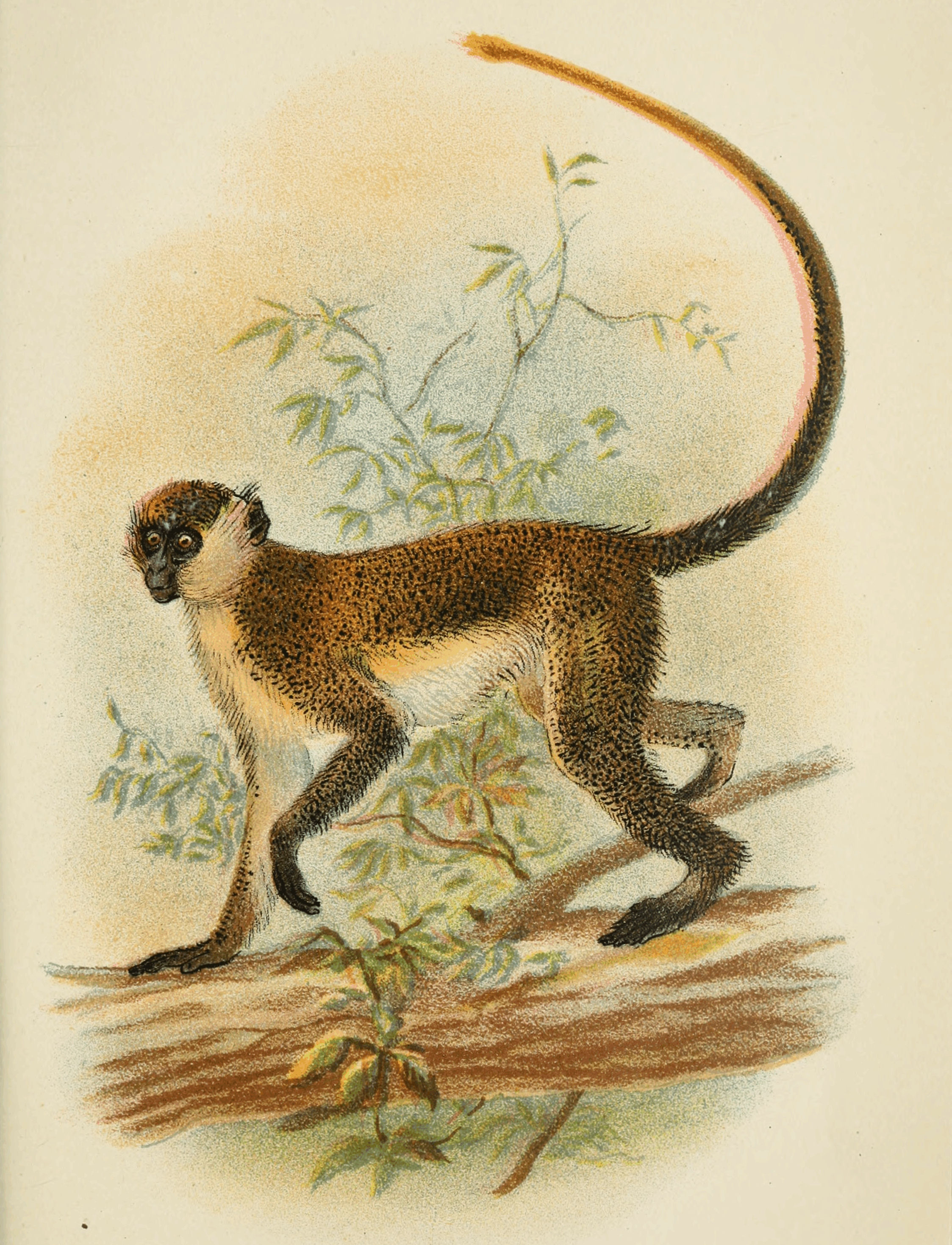
GREEN GUENON.
Characters.—Muzzle rather long; ears large, naked, and somewhat pointed behind; hairs on the side of the head long, thick, frill-like, and directed backwards toward the ears; hands and feet long, but the feet longer than the hands. Face, ears, palms, and soles, black; superciliary band bright yellow or white; head, back, shoulders, arms, and upper part of the forearms, the thighs, upper part of the legs, and upper side of the tail rich yellowish-green,—the hairs being ringed with broader bars of yellow, and narrower bars of black; external surface of the lower part of the fore- and hind-limbs grey, the hairs being ringed with white, or very pale yellow and black; cheeks, throat, under surface of the body, and inner side of the limbs, white, washed with yellow on the cheeks, throat, and along the mid-line of the belly. Tail tipped with a long tuft of bright yellow; under side of the tail greyish-green; hairs beneath the tail and on the scrotal region bright yellow; naked skin of the scrotal parts, green. Length of body, 24 inches; of tail, 29 inches.
Distribution.—West Africa: from Senegambia to the Niger. It is said to be now abundant in a wild state in the island of St. Kitts, in the West Indies, and Colonel Feilden identified it in Barbadoes. Into both of these islands it has been introduced from Africa, in the same way as into St. Jago, one of the Cape Verde Islands.
Habits.—The Green Monkeys frequent high trees in the great forests, living in small troops or sitting alone. They move about very noiselessly, and would seem to be devoid of voice, remaining silent even when attacked or wounded; although they knit their brows, gnash their teeth, and evince every sign of vexation and anger. This species is one of the commonest Monkeys introduced into Europe, as it appears to be able to stand, better than most of the other members of the genus, the northern climate. It has even bred in the Zoological Gardens in London. It is very active and intelligent, and when young it is gentle and of a good disposition, but as it grows older it becomes treacherous, malicious, and savage.
XVII. THE VERVET GUENON. CERCOPITHECUS PYGERYTHRUS.
Cercopithecus pygerythra (Le Vervet), F. Cuvier, Hist. Nat. Mamm., iii., livr. xxiv. (Janvier, 1821).
Cercopithecus pygerithræus, Desmarest, Mamm., Suppl., p. 534 (1820).
Cercopithecus pygerythrus, Lesson, Spec. des Mamm. Bimanes et Quadrum., p. 83 (1840); Geoffr., Dict. Hist. Nat., iii., p. 305 (1849); id., Cat. Méth. Primates, p. 21 (1851); Wagner, in Schreb. Säugeth., v., p. 39 (1855); Peters, Reis. Mossamb. Säugeth., p. 4; Martin, Mammif. An., p. 521 (1841); Schl., Mus. Pays Bas, vii., p. 76 (1876); Thomas, P. Z. S., 1885, p. 219; H. H. Johnston, Kilimanjaro Exped., p. 352 (1886); Scl., P. Z. S., 1893, p. 249 (nec Martin, nec. Schl.).
Cercopithecus pusillus, Delalande in Desmoul, Dict. Class., vii., p. 568.
Cercopithecus lalandii, Geoffr., Dict. d'Hist. Nat., iii., p. 305 (1849); Wagner, in Schreber's Säugeth., v., p. 39 (1855); Sclater, P. Z. S., 1893, pp. 248 and 615.
Cercopithecus rufo-viridis, Is. Geoffr., C. R., xv., p. 1038 (1842); Scl., P. Z. S., 1860, p. 420.
Chlorocebus pygerythrus, Gray, Cat. Monkeys Brit. Mus, p. 25 (1870).
Characters.—Very nearly allied to the Grivet (C. sabæus), to the Malbrouck (C. cynosurus), and to the last species, the Green Guenon. Distinguished from the Grivet by the chin, the hands and the feet, beyond the ankle, and the wrist being very black, instead of grey; and the tip of the tail (or its entire length) black, instead of being grey or yellow, as in the Malbrouck. It differs from both the Malbrouck and Grivet in having, according to Martin, long coarse fur, greyer in tint above, with a slighter wash of olive (= C. lalandii of Geoffroy); or in being more reddish-yellow or yellowish-green above (the true C. pygerythrus); also by having conspicuous superciliary bristles. The less thick and heavy muzzle and the green scrotal region distinguish it from the Malbrouck; the rust-red coloured hair on the space below the root of the tail distinguishes it from the Grivet. Length of body, 22 inches; tail, 27 inches.
The female is slightly smaller than the male.
Distribution.—South Africa: Cape Colony. "The Vervet is common in the forests along the Great Fish river, and other streams between Algoa Bay and Cape Town. Its range extends also along the Natal coast, throughout the Amakozi country, and Caffreland generally." (Martin.) Zambesia. On Kilimanjaro. Mr. H. H. Johnston observed it to be common, at 5,000 feet, in the cultivated gardens round the village of Moshi, and in the forests lower down, at Taveita.
Habits.—Their food consists of fruits, and particularly of the gum which exudes from various species of Acacia. In confinement, when irritated, they utter, it is said, a barking noise, display their teeth, and gaze with hatred in their eyes. They are very treacherous, ferocious, and daring, and their cage requires to be approached with much precaution. Mr. Johnston, when living on the slopes of Kilimanjaro, found them to be exceedingly familiar and mischievous, and given to stealing fruits, &c. They are entirely without the fear of Man.
This Monkey is very commonly to be seen alive in European menageries, where it appears to stand the northern climate fairly well. At a meeting of the Zoological Society in November, 1893, Dr. Sclater remarked that Cercopithecus callitrichus (= C. pygerythrus) had recently bred in the Gardens. Concerning the latter birth a curious fact had been observed and reported by the keepers—that the young Monkey, which lived about two months, had been in the habit of sucking both of the mother's teats at once.
XVIII. THE TANTALUS GUENON. CERCOPITHECUS TANTALUS.
Cercopithecus tantalus, Ogilby, P. Z. S., 1841, p. 33; Sclater, P. Z. S., 1893, p. 258; Schl., Mus. Pays-Bas, vii., p. 73 (1876).
Cercocebus tantalus, var. f., Gray, Cat. Monkeys Brit. Mus., p. 26 (1870).
Characters.—Head rounder and face shorter than in C. callitrichus. Face covered with very short hairs; nose prominent, and narrow between the eyes, flatter and broader towards the tip. Head, back, and sides, a mixture of yellowish-brown and green, of the same shade as prevails in the upper parts of C. callitrichus and C. pygerythrus; outer surface of the limbs clearer ashy-grey; whiskers, throat, breast, under side of the body, and inner side of the limbs, yellowish-white; tail brown at the root, pale grey at the tip; back of hands and feet light grey; face livid flesh-colour round the eyes, the short hairs on the nose and cheeks black; lips light brown; eyebrows black, surmounted by a broad white band across the forehead; scrotal region covered with yellowish hairs. (Ogilby.)
Distribution.—Africa, but the exact habitat is unknown.
Habits.—Unknown.
III. Cercopitheci Erythronoti.
The next three species constitute the red-furred group of Geoffroy and Sclater, being bright rufous above, and white beneath.
XIX. THE PATAS GUENON. CERCOPITHECUS PATAS.
Simia patas, Schreber, Säugeth., i., p. 98, pl. xvi. (1775).
Cercopithecus patas, Erxleb. Syst. Règne An., p. 34 (1777); Schleg., Mus. Pays-Bas, vii., p. 84 (1876); Scl., P. Z. S., 1893, p. 249.
Simia rubra, Gm., Syst. Nat., i., p. 34 (1788); Fischer, Synops. Mamm., p. 24 (1829).
Cercopithecus ruber, Geoffr., Ann. Mus., xix., p. 96 (1812); id., Dict. d'Hist. Nat., iii., p. 307 (1849); Desmar. Mamm., p. 59 (1820); Martin, Mammif. An., p. 509 (1841, pt.); Wagner, in Schreber, Säugeth. Suppl., v., p. 42 (1855); Scl., P. Z. S., 1874, p. 664.
Le Patas et Le Patas à bandeau noir, F. Cuvier, Hist. Mamm. i., livr. xv. (Avril, 1820).
Chlorocebus ruber, Gray, Cat. Monkeys Brit. Mus., p. 25 (1870).
Characters.—Head broad and flattened; nose depressed; muzzle short; fur long and silky on the back of the head, elsewhere short. Orbits narrow; cheeks and muzzle naked; whiskers thick and bushy, encroaching far on the cheeks, and extending back below the ears; chin with a few hairs, but no beard. Head, back, sides, and hinder aspect of the arms and fore-arms, and of the thighs and legs, and of the upper and lower sides of the base, and the upper side of the rest of the tail, foxy red; shoulders, chest, front and rest of the fore-limbs, entire under side of the body, and of the terminal portion of the tail, and inner side of the limbs, with the entire hands and feet, grey or greyish-white,—the hairs being ringed with black and white. The nude parts of the face and of the ears, hands, and feet, violet flesh-colour; a distinct superciliary arch black; a white bar from the eye to behind the ear; a black line from the superciliary stripe, extending down the nose-ridge and expanding on the tip; on the upper lip, a short moustache of black hairs; whiskers greyish-white, washed with yellow. This species varies considerably in size and in coloration.
In young animals the grey is often washed with rufous.
Distribution.—West Africa: Senegal.
Habits.—The Patas in its native forest lives in large troops, which unite together, as De la Brue has recorded, against a common enemy. He relates that as he passed along a river in his boat, the Patas came down to the tips of the branches out of curiosity, but after watching the party for a time they threw dry branches and other handy objects at them, till some of their number were at last shot. This so infuriated the survivors, that they redoubled their attack with stones and other missiles, giving utterance meanwhile to the most frightful cries. Mr. Martin, from whom we have condensed De la Brue's account, says that this species is lively in captivity, but very spiteful and capricious, its temper becoming worse with age.
XX. THE NISNAS GUENON. CERCOPITHECUS PYRRHONOTUS.
Cercopithecus pyrrhonotus, Hempr. et Ehrenb., Symb. Phys., pl. x. (1838); Geoffr., Dict. Hist. Nat., iii., p. 307 (1849); Wagner, in Schreber's Säugeth., v., p. 42 (1855); Sclater, P. Z. S., 1871, p. 623; 1893, p. 250; Schl., Mus. Pays-Bas, vii., p. 84 (1876).
Cercopithecus ruber, Rüpp., Neue Wirb. Säugeth., p. 8 (1835); Martin, Mammif. An., p. 509 (1841) (in part).
Le Nisnas, F. Cuvier, Hist. Nat. Mamm., i., pl. 27 (1830).
Chlorocebus ruber, Gray, Cat. Monkeys Brit. Mus., p. 25 (1870).
Characters.—Of the same size as C. patas, and very similar to it. Fur above, and on the lower part of the limbs rufous, and on the lower part of the back, and under side of the tail, much darker rufous than elsewhere; nose white, not black as in the preceding species; shoulders and external aspect of arms rufous like the rest of the body, and not grey as in C. patas.
Distribution.—North-east Africa: Kordofan and Darfur, to a height of 3,000 feet above the sea. A specimen living in the Zoological Gardens in 1882 was stated to have come from Somali-land.
Allied to the Patas and the Nisnas is Peters' Guenon (Cercopithecus ochraceus, Peters, Reis. Mossamb. Säugeth., p. 2, pl. 1a), from Querimba, Mozambique, which has the upper side yellowish, and is probably but a variety of C. pyrrhonotus.
XXI. THE REDDISH-GREEN GUENON. CERCOPITHECUS RUFO-VIRIDIS.
Cercopithecus rufo-viridis, Geoffr., C. R., xv., p. 1038 (1842); id. Dict. Hist. Nat., iii., p. 307 (1849); Schl., Mus. Pays-Bas, vii., p. 78 (1876); Scl., P. Z. S., 1893, p. 258.
Chlorocebus rufo-viridis, Gray, Cat. Monkeys Brit. Mus., p. 25 (1870).
? Cercopithecus flavidus, Peters, Reis. Mossamb., p. 3, pl. i.b.
Characters.—Face black; a large frontal band white; head above olive-green; back green washed with rufous, gradually becoming bright rufous, slightly speckled with black on the sides of the body between the fore- and hind-limbs; shoulders and thighs grey, washed with green; the rest of the external aspect of the limbs grey; under side of body and inner side of limbs white; hands speckled black; the feet greyish; tail, dark grey above, pale grey below.
Distribution and Habits.—Unknown. The form described by Peters as C. flavidus comes from Mozambique.
IV. Cercopitheci Melanochiri.
The species which we now proceed to describe belong to Prof. Schlegel's Section v., and Dr. Sclater's Cercopitheci melanochiri, of which the members have the arms and legs either black or dark grey, and have a black band from the outer corner of the eyes to the ears.
XXII. THE MONA GUENON. CERCOPITHECUS MONA.
Simia mona, Schreber, Säugeth., i., p. 97, pl. xv. (1775).
Cercopithecus mona, Erxleb. Syst. Regne An., p. 32 (1777); Geoffr., Dict. Hist. Nat., p. 304 (1849); Martin, Mammif. An., p. 527 (1841); Wagner, in Schreb. Säugeth. Suppl., v., p. 47 (1855); Gray, Cat. Monkeys Brit. Mus., p. 22 (1870); Schleg., Mus. Pays-Bas, vii., p. 80 (1876); Sclater, P. Z. S., 1893, p. 250.
La mone, F. Cuvier, Hist. Nat. Mamm., i., livr. ix. (Août, 1819).
Characters.—Top of the head brilliant golden-green, the hairs being black at the roots, yellow further up and tipped with black; back, sides of body, shoulders, and haunches chestnut-brown, speckled with black,—the hairs being grey at the base, ringed alternately with red, or brown and black; frontal band pale greenish; rump, with the exception of a distinctive elliptical white bar on each side, at the base of the tail, black; the hands and feet, and external aspect of the legs, thighs, and fore-arms, black; the under side of the body and inner side of the limbs pure white, separated by an abrupt line from the colours of the outer surfaces; the transverse black band above the eyebrows extending from the outer corner of the eyes to the ears; nude parts of face, ears, and hands livid flesh-colour; the whiskers bushy, covering much of the cheeks, descending on the sides and lower part of the neck, pale yellow, speckled with black marks.
The white bars on each side of the tail, on the rump, and the white frontal band distinguish this species from all others.
Distribution.—West Africa: Cameroons.
XXIII. SYKES' GUENON. CERCOPITHECUS ALBIGULARIS.
Semnopithecus albogularis, Sykes, P. Z. S., 1831, p. 106.
Cercopithecus albigularis, Sykes, P. Z. S., 1832, p. 18; Owen, P. Z. S., 1832, p. 18 (anatomy); Martin, Mamm. An., p. 512 (1841); Frazer, Zool. Typ., pl. ii. (1848); Wagner in Schreb. Säugeth. Suppl., v., p. 45 (1855); Gray, Cat. Monkeys Brit. Mus., p. 24 (1870); Schleg., Mus. Pays-Bas, vii., p. 79 (1876); True. Pr. U. S. Nat. Mus., xv., p. 448 (1893); Sclater, P. Z. S., 1893, p. 251; Matschie, S.B., Nat. Fr. Berl., 1893, p. 215; Thomas, P. Z. S., 1894, p. 137.
Cercopithecus erythrarchus, Peters, Reis. Mossamb. Säugeth., p. 1, pl. i.; Schl., Mus. Pays-Bas, vii., p. 77 (1876); Kirk, P. Z. S., 1864, p. 649; Reuvens, Zool. Gart., xxx., p. 207 (1889); Oudem, op. cit., xxxi., p. 267 (1890); Scl., P. Z. S., 1893, p. 249 (female).
? Cercopithecus monoides, Geoffr., Arch. du Mus., ii., p. 558, pl. 31 (1841); id., C. R., xv., p. 1038 (1842); id., Dict. Hist. Nat., iii., p. 303 (1849); Scl., P. Z. S., 1893, p. 256.
Characters.—Male.—Head rounded, short; ears small, rounded, and nearly concealed in the long fur of the head; eyes deep-set; superciliary hairs long; whiskers thick and bushy; no beard; facial angle large; cheek-pouches small but distinct, not observable even when filled, being concealed by the bushy whiskers; thumbs short; great-toes long; very small callosities; tail half as long as the body. Larynx with the usual two wide lateral sacs and a middle pouch extending forward about three inches under the skin of the neck, communicating with the larynx by a large opening.
Entire upper surface black, mixed with yellow,—the hairs being black, ringed with brownish-yellow bars. Face, cheeks, and lips black; shoulders, fore-limbs and hind-limbs (washed with yellowish), black, from the absence of the yellow bars, which predominate on the back and sides; under side of the body black, speckled with white; chin and throat white; no white thigh patches; tail, black.
Female.—Differs from the male in being smaller, and in having the rump, the upper and lower sides of the base of the tail, the region round the anus, and the posterior aspect of the upper part of the thighs and arms strongly tinged with reddish-brown. The lower side of the body and inner sides of the limbs whitish—the hairs towards their extremities being ringed with black and greyish-yellow. It has been described as Cercopithecus erythrarchus of Peters and other writers.
Distribution.—West Africa: Gold Coast (Pel); also said to have been obtained on the Congo. East Africa: Mozambique; believed to abound about Cape Corrientes (Peters). Quilimane and the Lower Zambesi are further given as habitats both by Dr. Peters and Sir J. Kirk. Mr. H. H. Johnston, H.M. Commissioner in Nyasa Land, has sent it from the Milanji Plateau, where it ranges from 3,000 to 6,000 feet above the sea. This species was at one time supposed, but quite erroneously, to come from Madagascar.
PLATE XXIX.
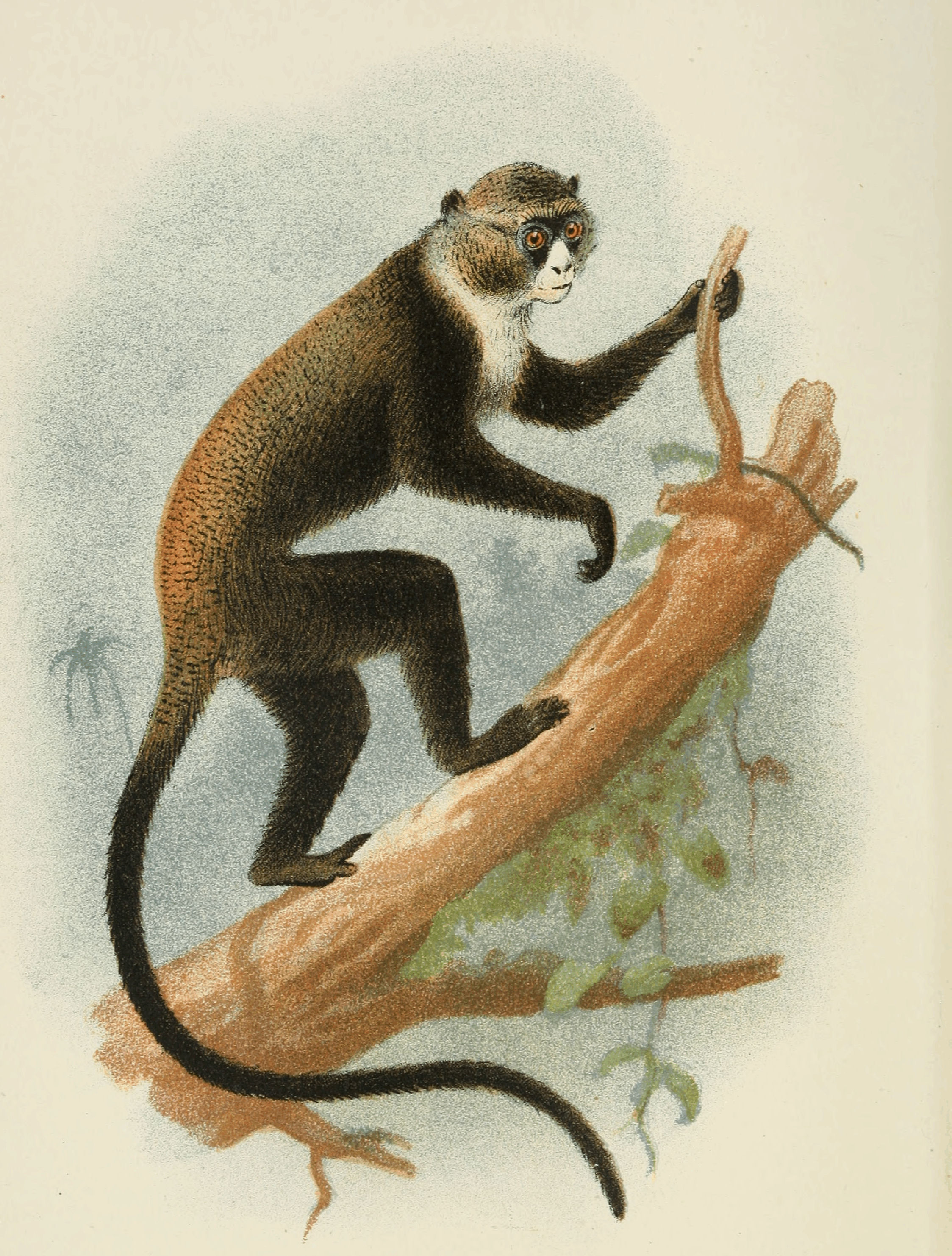
BOUTOURLINI'S GUENON.
Habits.—This Monkey is very frequently brought alive to Europe, and almost all that we know of its habits has been obtained from observing it in captivity. Colonel Sykes, who first brought this species to England and described it, says that "its manners in captivity are grave and sedate. Its disposition is gentle, but not affectionate; and though free from that capricious petulance and mischievous irascibility characteristic of so many of the African species, still it quickly resents irritating treatment, and evinces its resentment by very smart blows with its anterior hands. It never bit any person on board ship, but so seriously lacerated three Monkeys, its fellow passengers, that two of them died from the wounds. It readily ate meat, and would choose to pick a bone even when plentifully supplied with vegetables and dried fruits." Another individual, seen by Mr. Ogilby, exhibited the same antipathy to other Monkeys.
XXIV. BOUTOURLINI'S GUENON. CERCOPITHECUS BOUTOURLINII.
(Plate XXIX.)
Cercopithecus boutourlinii, Giglioli, Zool. Anz., x., p. 510 (1887); Scl., P. Z. S., 1893, pp. 256, 441.
Cercopithecus albigularis, Giglioli, Ann. Mus. Genov. (2), vi., p. 8 (1888).
Characters.—Male.—Body-hairs long and rough; upper surface black, with pale fulvous annellations, except on a line between the shoulders, which is nearly black; ears nearly nude, with an inner hairy pencil; nose, upper lip, chin, and throat, pure white; rest of the under surface and of the limbs and tail black, except the base of the tail, which has ringed hairs like the back all round. Length of body, 21 inches; of tail, 24 inches. (Sclater.)
Female.—Nearly similar, but smaller, and having the hairs less ringed on the back and the head. (Sclater.)
Distinguished from C. albigularis by its white nose and upper lips, black under surface, and blacker limbs.
Distribution.—North-east Africa: Kaffa, a province to the south of Shoa; and Gimma, a province in Central Abyssinia, to the south of Gojan.
XXV. CAMPBELL'S GUENON. CERCOPITHECUS CAMPBELLI.
Cercopithecus campbelli, Waterh., P. Z. S., 1838, p. 61; Fraser, Zool. Typ., pl. iii. (1848); Martin, Mammif. An., p. 544 (1841); Wagner in Schreber Säugeth. Suppl., v., p. 47 (1855); Gray, P. Z. S., 1868, p. 182; id., Cat. Monkeys Brit. Mus., p. 24 (1870); Schleg., Mus. Pays-Bas, vii., p. 82 (1876); Jentink, Notes, Leyden Mus., x., p. 9 (1888); Sclater, P. Z. S., 1893, p. 251.
Cercopithecus burnetti, Gray, Ann. N. H., x., p. 256 (1842).
Characters.—Fur long, longer on the hinder part of the back than on the front, separated along the back—the hairs black with broad yellow rings. Face bluish-black; lips flesh-coloured; band across the forehead white, washed with rufous—the hairs tipped with black; head as far as the nape of the neck, yellowish-brown; the fore part of the back brownish-black, the lower part of the back, the outer side of the hind-legs, the fore-legs, and basal third of the tail olive-black, washed with yellow; the long hair on the cheeks and side of the neck, which partly conceals the ears, greyish-white, ringed towards the tips with black and yellow; the inner side of the ears furnished with long yellow-flecked grey hairs; the chest, throat, under side of the body, inner side of limbs and fore part of the thighs white; posterior two-thirds of the tail yellowish-grey, the hairs ringed with black and faded yellow, those of the under side with brown and grey; tip of the tail with a small black tuft.
Distribution.—West Africa: from Sierra Leone to the Gold Coast.
Habits.—This is the commonest Monkey, both in the interior and on the coast of this region of Africa. It frequents the moderate-sized trees of the forest in troops of fifty or more in number; and it occasionally even takes to the water of its own accord.
XXVI. THE SAMANGO GUENON. CERCOPITHECUS SAMANGO.
Cercopithecus samango, Sundev. Öfvers. K. Vet.-Akad. Förh. Stockh., i., p. 160 (1844); Wagner in Schreber Säugeth. Suppl., v., p. 44 (1855); Peters, Reis. Mossamb., Säugeth., p. 4; Gray, P. Z. S., 1868, p. 182; id., Cat. Monkeys Brit. Mus., p. 24 (1870); Schleg., Mus. Pays-Bas, vii., p. 79 (1876; in part); Scl., P. Z. S., 1893, p. 251.
Characters.—Distinguished by the dirty white tint along the basal half of the tail, except along the median line of the upper side, which is black; end of the tail black. Back entirely blackish-olive—the hairs being yellowish-olive, ringed with black; inner side of the limbs, and entire under surface from the arms to the chin, dirty white; outer surface of the arms black, of the legs grey; the feet black; ears covered with whitish hairs.
Distribution,—South and East Africa: Natal and Mozambique; extending to Angola in the west.
XXVII. THE WHITE-LIPPED GUENON. CERCOPITHECUS LABIATUS.
Cercopithecus labiatus, Geoffr., C. R., xv., p. 1038 (1842); id., Dict. d'Hist. Nat., iii., p. 302 (1849); Sclater, P. Z. S., 1893, p. 256.
Cercopithecus samango, Schl., Mus. Pays-Bas, vii., p. 79 (1876; in part).
Characters.—Fur thick; a bunch of long hairs directed backwards on the cheeks; inner aspect of the ears covered with reddish-grey hairs; upper side of the body dark grey, speckled with pale olive-yellow; top of the head black, speckled with yellowish-green; forehead and jaws greenish-yellow, speckled with black; a black spot on the face above the commissure of the lips; rest of the lips and region of the mouth white; outer side of the fore-limbs, hands, and feet black; outer side of the hind-limbs greyish-brown; under side of the body faded white; inner side of the limbs ashy-grey; round the anus and the greater part of the under side of the tail, pale yellowish-brown; upper side of the tail, for same distance, reddish-black; remainder black.
Distribution and Habits.—Unknown.
XXVIII. THE RUMP-SPOTTED GUENON. CERCOPITHECUS OPISTHOSTICTUS.
Cercopithecus opisthostictus, Scl., P. Z. S., 1893, p. 725.
Characters.—Back black, speckled with pale grey; head darker; back of the neck, shoulders, external aspect of the hands and feet, and the tail (except at its base), black; a small spot on the lower back on each side of the tail rufous; under side blackish. Length of body, 24 inches; of tail, 25 inches. (Sclater.)
Distribution.—British Central Africa: near Lake Mweru.
Habits.—Unknown. The skin of this Monkey is used by the natives to form dresses, and from specimens of these, collected by Mr. A. Sharpe, H.B.M. Vice-Consul in Southern Nyasa Land, during his journey from the north end of Lake Nyasa to Lake Mweru and the Luapula, this species has been described by Dr. P. L. Sclater.
XXIX. STAIRS' GUENON. CERCOPITHECUS STAIRSI.
Cercopithecus stairsi, Sclater, P. Z. S., 1892, p. 580, pl. xl.; 1893, pp. 252, 443, and 612.
Characters.—Adult Male.—Face black, except a ring round the eyes, which is flesh-coloured; ridge of the nose and a band above the eyes from ear to ear black, surmounted by another band of long erect yellowish-white hairs; ears naked; whiskers bushy, greyish-white, washed with greenish-yellow; on each side of the forehead a bright chestnut band is carried over the head behind the ears; back of the head, nape, and anterior part of the back grey, variegated by black lines and washed with yellowish; back of the shoulders dark grey; back, especially the lower part, yellowish-grey, with a rufous patch on the rump above the tail; external surface of the arms blackish-grey; hands black; outside of the legs grey; feet not so black as the hands; anal region, and about three inches of the base of the tail rufous-yellow; scrotum dark indigo blue; throat, under surface of body, and inner side of limbs milky white; the whole of the hair of the upper parts minutely grizzled. Length of body, 18 inches; tail injured. (Sclater.)
Young Female.—Differs from the male in being lighter in colour; back below the nape, sides, thighs, legs, and upper surface of the basal third of the tail ochre yellow, washed with rufous; shoulders and fore-limbs grey; hands and feet black, under side of the body and inner side of the limbs and the throat (where the hairs are long) milky white; terminal two-thirds of the tail blackish-grey, darker at the tip.
The chestnut auricular spots in both sexes of this species distinguish it from all others.
Distribution.—The Zambesi Delta. The typical specimen (which is the female above described) was given, as Dr. Sclater tells us in his original account of this beautiful species, by Mr. Hillier, at Chindi, to Dr. Moloney (of Lieut. Stairs' Expedition). The latter brought it home alive, and presented it in 1892 to the Zoological Society's Gardens, where it lived till the beginning of 1893. The type specimen is now in the British Museum. A second specimen, the adult male (described above) was presented to the Society in June, 1893, by Mr. F. Hintz, whose brother had brought it from Mozambique, and had had it in captivity for eight years.
Habits.—Unknown.
XXX. MOLONEY'S GUENON. CERCOPITHECUS MOLONEYI.
Cercopithecus moloneyi, Sclater, P. Z. S., 1893, p. 252, pl. xvii.
Characters.—Related to C. samango, but larger; hairs long above, olivaceous, speckled with black; head darker; a broad band covering the middle and lower back, and the base of the upper side of the tail rufous—the hairs ringed with black; arms, externally from the shoulders down to the hands, and internally on the lower part of the fore-arm, black; outer aspect of the thighs and legs blackish-grey, washed posteriorly with yellowish; tail, except at the very tip, deep black; the face, lips, and ears naked, and black; a fulvous band across the forehead above the eyes; sides of the head fulvous, speckled with black; throat, creamy yellow; under side of body pale fulvous, the hairs ringed with black; the inside of the arms, thighs, and upper part of the legs greyish fulvous; feet black. Length of body, 28 inches; of tail, 26 inches.
Distribution.—British Central Africa. Procured from the natives of N-Konde, and brought from Karonga, at the north end of Lake Nyasa, by Dr. Moloney.
Habits.—Unknown.
XXXI. SCHLEGEL'S GUENON. CERCOPITHECUS NEGLECTUS.
Cercopithecus leucocampyx (nec Fischer), Gray, Cat. Monkeys Brit. Mus., p. 22 (1870).
Cercopithecus neglectus, Schlegel, Mus. Pays-Bas, vii., p. 70 (1876); Giglioli, Zool. Anz., x., p. 510 (1887); Scl., P. Z. S., 1893, p. 253.
Characters.—General colour greyish-brown, finely grizzled; under side of body black; crown, outside of limbs and base of tail black; anterior aspect of thighs and a band across the haunches white.
Distinguished from the true C. leucampyx by the colour of the front of the thighs, and by its banded haunch.
Distribution.—The White Nile, where it was obtained by Consul Petherick.
XXXII. THE DIADEM GUENON. CERCOPITHECUS LEUCAMPYX.
Simia leucampyx, Fischer, Syn. Mamm., p. 20 (1829).
Le Diane femelle, F. Cuv., Hist. Nat., Mamm., livr. xlii. (June, 1824).
Cercopithecus diadematus, Geoffr. in Bélang., Voy. Zool. p. 51 (1834).
Cercopithecus leucampyx, Martin, Mamm. An., p. 529 (1841); Geoffr., Dict. Univ. Hist. Nat., iii., p. 304 (1849); Schl., Mus. Pays-Bas, vii., p. 83 (1876); Giglioli, Zool. Anz., x., p. 510 (1887); Sclater, P. Z. S., 1893, p. 253 (♀).
Cercopithecus pluto, Gray, P. Z. S., 1848, p. 56, pl. iii.; 1868, p. 182; id., Cat. Monkeys Brit. Mus., p. 23 (1870); Wagner in Schreb. Säugeth. Suppl., v., p. 48 (1855); Sclater, P. Z. S., 1870, p. 670, 1871, p. 36, 1892, p. 97.
Characters.—Face, nose, and lips black; whiskers rounded and bushy; no beard; fur long and harsh; form robust and powerful; whiskers grizzled, the hairs ringed with black and white; across the forehead, over the eyes, a broad white bar (or diadem); the back beyond the shoulders, the sides and haunches, and the posterior aspect of the thighs, grizzly-grey, the hairs ringed with numerous greenish-white and black bars; tail grey at its base, rest black; a few yellowish hairs on the callosities, but all the rest of the body deep black. Length of body, 23 inches; of tail, 21.
Distribution.—West Africa: Angola, and the Congo, to Nyasa Land.
Habits.—Unknown.
V. Cercopitheci Auriculati.
The following three species form the fifth group of the Guenons, distinguished by their yellowish or rufous ear-tufts, and the three black lines over the forehead.
PLATE XXX.
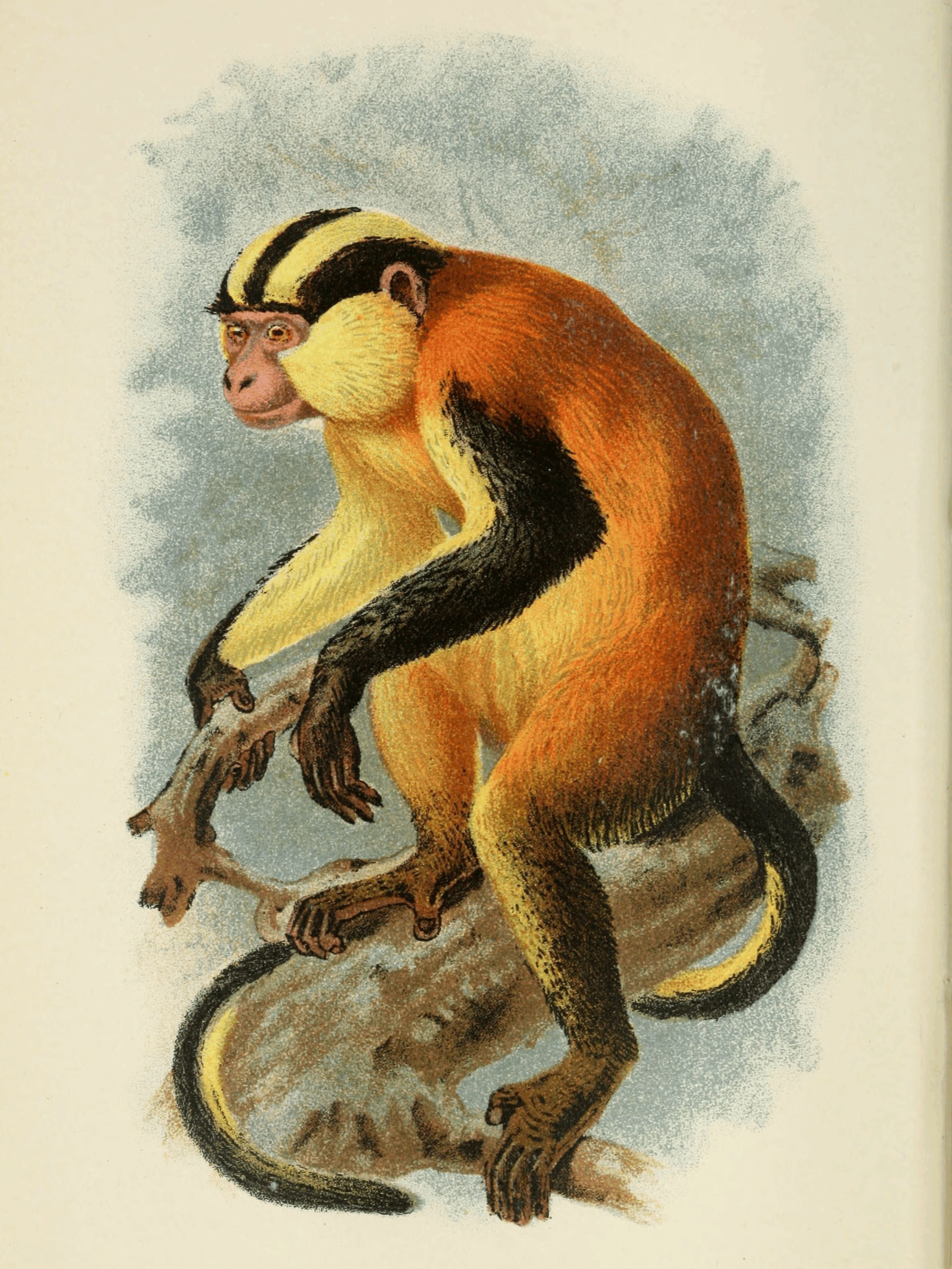
ERXLEBEN'S GUENON.
XXXIII. ERXLEBEN'S GUENON. CERCOPITHECUS GRAYI.
Cercopithecus grayi, Fraser, Cat. Knowsl. Coll., p. 8 (1850); Gray, P. Z. S., 1868, p. 182; id., Cat. Monkeys Brit. Mus., p. 22 (1870); Sclater, P. Z. S., 1893, p. 256.
Cercopithecus erxlebenii, Dahlb. et Puch., Rev. et Mag. de Zool., 1856, p. 96; 1857, p. 196; Dahlb., Zool. Stud., p. 109, pl. 5 (1856); Gray, P. Z. S., 1868, p. 182; id., Cat. Monkeys Brit. Mus., p. 23 (1870; in part); Sclater, P. Z. S., 1871, p. 36; 1893, p. 254; 1894, p. 484.
Cercopithecus pogonias, Schlegel, Mus. Pays-Bas, vii., p. 82 (part).
(Plate XXX.)
Characters.—Face and ears naked, flesh-coloured; whiskers commencing under the eyes, bushy, yellow; the ears with a rufous or yellow tuft internally; head yellow, but interrupted by three broad black streaks, extending from above each eye and from the nose to the back of the head; back, anterior aspect of the thighs, and the sides yellowish rufous, darker towards the lower back—the hairs ringed with black and yellow, upper surface and entire terminal third of the tail black. Under surface of the body, inner side of the limbs, anterior aspect of the thighs and legs, and the under side of the basal two-thirds of the tail, yellow or rufous yellow; region of the anus white; external aspect of the fore-limbs black; the hands and feet black.
A female specimen of this species which lived for some years in the menagerie of Lord Derby at Knowsley, and died in 1836, is now in the Derby Museum, Liverpool. It is the type of C. grayi, with which C. erxlebeni is identical.
Distribution.—West Africa: River Congo.
XXXIV. THE BEARDED GUENON. CERCOPITHECUS POGONIAS.
Cercopithecus pogonias, Bennett, P. Z. S., 1833, p. 67; Wagner in Schreber Säugeth. Suppl., v., p. 43 (1855); Lesson, Spec. Mamm., p. 74 (1840); Martin, Mammif. An., p. 543 (1841); Gray, P. Z. S., 1868, p. 182; id., Cat. Monkeys Brit. Mus., p. 23 (1870); Sclater, P. Z. S., 1893, p. 254; Schlegel, Mus. Pays-Bas, vii., p. 82 (1876).
Characters.—Similar to C. grayi, but differs in the yellow forehead being interrupted in the middle by only a few black hairs, and not by a streak; the whiskers paler; the back part of the head, the fore part of the back, and the sides grizzled, the hairs being black, ringed with white; while down the middle of the back to the base of the tail runs a broad black stripe.
Distribution.—Fernando Po.
XXXV. THE BLACK-FOOTED GUENON. CERCOPITHECUS NIGRIPES.
Cercopithecus nigripes, Du Chaillu, Pr. Bost. N. H. Soc., vii., p. 360 (1860); Gray, P. Z. S., 1868, p. 182; Scl., P. Z. S., 1893, p. 254.
Cercopithecus erxlebenii, var. nigripes, Gray, Cat. Monkeys Brit. Mus., p. 23 (1870).
Cercopithecus pogonias, Schlegel, Mus. Pays-Bas, vii., p. 182 (1876).
Characters.—Very similar to C. pogonias, but differs in being darker, and in having the dorsal stripe wider and more diffused lower down. It is probably only a variety of the preceding.
Distribution.—Gaboon, where it was discovered by Du Chaillu.
XXXVI. WOLF'S GUENON. CERCOPITHECUS WOLFI.
Cercopithecus wolfi, Meyer, Notes, Leyden Mus., xiii., p. 63 (1891); id., P. Z. S., 1894, p. 83, pl. vii.; Sclater, P. Z. S, 1893, p. 258.
Characters.—Face, except the lips, which are flesh-colour, and the temples, greyish-black; a yellowish-white bar across the forehead from ear to ear; whiskers greyish-yellow; ear-tufts reddish-brown; upper surface dark slate-grey; sides blue-grey, the hairs barred with several pale rings, and tipped with black; dorsal stripe, narrowing towards the tail, olive-yellowish, brighter on the crown, and brownish-yellow towards the tail; basal half of the tail above, ashy-grey, below white; an orange-yellow patch on the sides; chin, sides of neck, under surface of body and inner side of limbs white; belly washed slightly with orange; shoulders and outer aspect of the fore-limb, black—the hairs ringed with grey; on the hinder edge of the fore-arms an ochre-coloured stripe; outer side of thighs and legs bright red-brown, becoming orange on their anterior and posterior internal margin. Length of body, 18¼ inches; of tail, 24 inches.
Distribution.—West Africa: the exact locality is unknown.
VI. Cercopitheci Barbati.
The members of this group are distinguished by possessing a beard and a frontal crest.
XXXVII. THE DIANA GUENON. CERCOPITHECUS DIANA.
Simia diana, Linn., Syst. Nat., i., p. 38 (1766).
Cercopithecus diana, Erxleb., Syst. Regne An., p. 30 (1777); Desmar., Mamm., p. 60 (1820); Martin, Mammif. An., p. 523 (1841); Geoffr., Dict. Hist. Nat., iii., p. 304 (1849); Wagner in Schreb. Säugeth. Suppl., v., p. 48 (1855); Gray, Cat. Monkeys Brit. Mus., p. 22 (1870; pt.); Schl., Mus. Pays-Bas, vii., p. 92 (1876; pt.); Jentink, Notes, Leyd. Mus., x., p. 12; Sclater, P. Z. S., 1893, p. 254.
Cercopithecus diana, var. ignita, Gray, Cat. Monkeys Brit. Mus., p. 22 (1870).
Characters.—Face black. Sides of face with long bushy whiskers, terminating on the chin in a pointed white beard a few inches long; across the forehead run two arched lines of erect hairs, the lower black, the upper white; top of the head, back of the neck, shoulders, the sides, middle of belly, ashy-grey—the hairs being white and black ringed, and white-tipped; outside of limbs darker, the hands black; tail grey, the tip black; neck, chest, and anterior part of the arms white; from the middle of the back a deep chestnut spot extends, and widens to the root of the tail; from the base of the tail, the outer aspect of the thighs, white; posterior part of under side of body and inner side of thighs, orange-yellow, or orange red, or bright red bay (C. ignita of Gray). Length of body, 18 inches; of tail, 24 inches.
Distribution.—West Africa: from Liberia to the Congo.
Habits.—This beautiful and graceful Monkey is not uncommon in captivity, and nearly all we know of its habits has been obtained from such specimens. "Like the rest of its tribe," writes Mr. Martin, "it is gentle, lively, active, and familiar while young, but as age advances it becomes reserved and treacherous.... Its frontal crest of white hairs, and its white peaked beard 'of formal cut,' give a singular aspect to its physiognomy. This latter ornament it has been observed, so Mr. Ogilby states, to be solicitous in keeping neat and clean; when about to drink it takes the beard in its hand with amazing gravity, and holds it back in order to prevent it from dipping into the fluid."
PLATE XXXI.
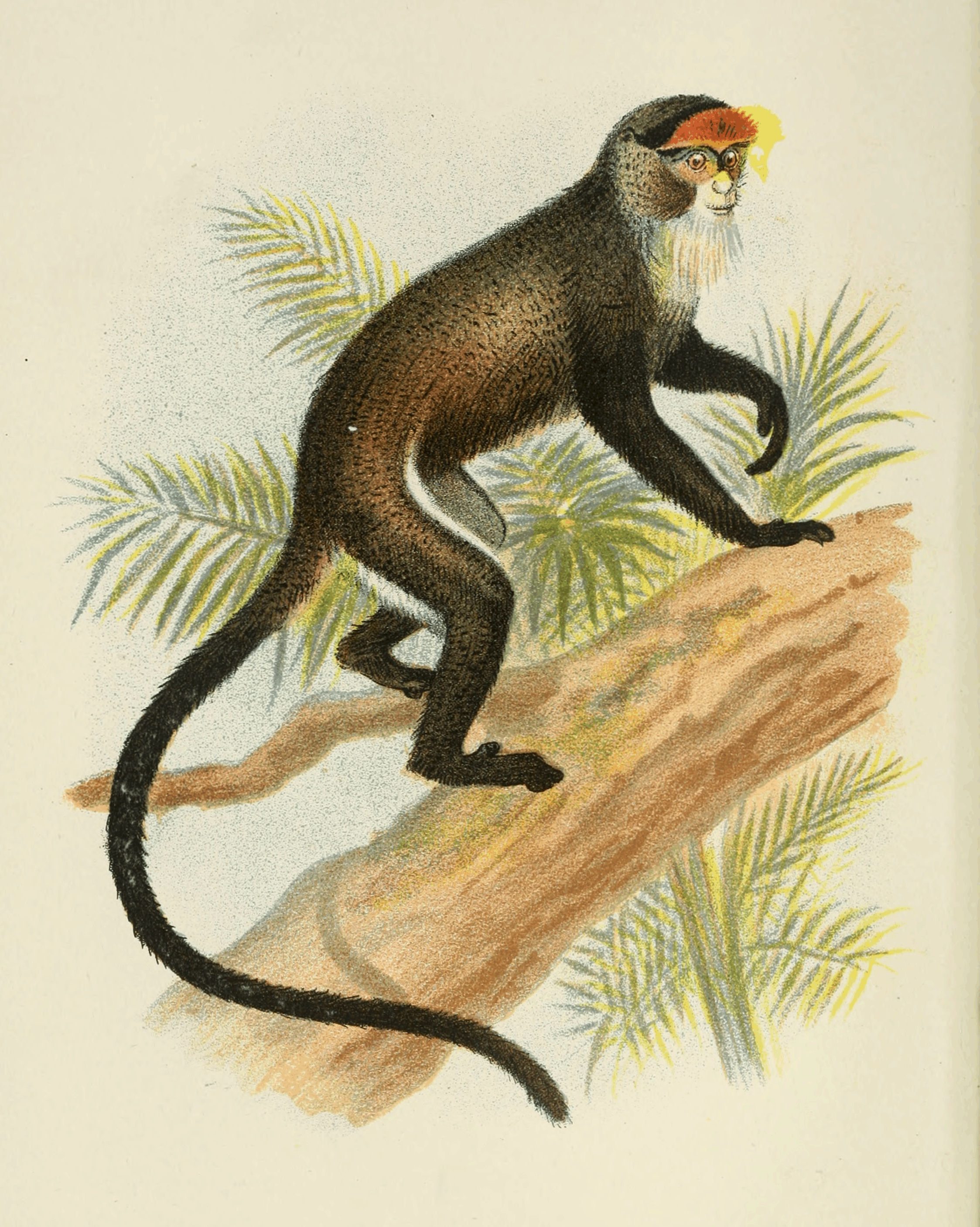
DE BRAZZA'S GUENON.
XXXVIII. THE PALATINE GUENON. CERCOPITHECUS PALATINUS.
Le Roloway ou la Palatine, Buff., Hist. Nat. Suppl., xv., p. 77 (1789).
Cercopithecus roloway, Erxleb., Syst. Régn. An., p. 42 (1777); Geoffr., Dict. Hist. Nat., iii., p. 304 (1849); Fisch., Synop. Mamm., p. 20 (1829).
Cercopithecus palatinus, Wagner, in Schreb. Säugeth. Suppl., v., p. 47 (1855); Scl., P. Z. S., 1893, p. 257.
Cercopithecus diana, Gray, Cat. Monkeys Brit. Mus., p. 22 (1870; pt.); Schl., Mus. Pays-Bas, vii., p. 92 (1876; pt.).
Characters.—Very similar to C. diana, but differs in having the back very dark brown, nearly black, instead of chestnut; the head, flanks, thighs, limbs dark grey; where the belly in C. diana is black, in C. palatinus it is white.
Distribution.—Gold Coast.
XXXIX. DE BRAZZA'S GUENON. CERCOPITHECUS BRAZZÆ.
(Plate XXXI.)
Cercopithecus brazzæ, Milne-Edwards, Rev. Sc. (3), xii., p. 15 (1886); Sclater, P. Z. S., 1893 pp. 255, 443, pl. xxxiii.
Characters.—Top of head, back, sides of face, outside of thighs, and root of tail pale fulvous, densely ringed with black; a frontal band, of dense erect hairs, chestnut, white-tipped, bordered behind by a broad black band from ear to ear; ears nearly naked; upper part of nose and a narrow line above the eyes, in front of the chestnut band, black; lower nose and upper lip white; a longish white beard on the chin and throat; belly dark fulvous, the hairs densely ringed with black; hands and feet black; inner side of thighs, arms, and a streak along the posterior aspect of the thighs, white; tail, except at its base, black. Length, 21 inches; tail, 22 inches. (Sclater.) Nearly related to C. neglectus.
Distribution.—West Africa: Upper Congo.
VII. Cercopitheci Trituberculati.
This section of the Family contains but one species, distinguished by the posterior lower molars having only three, instead of four, tubercles to their crowns. On this account it has been considered by some systematists to be the type of a distinct genus, Miopithecus.
XL. THE TALAPOIN. CERCOPITHECUS TALAPOIN.
(Plate XXXII.)
Talapoin, Buff., Hist. Nat., xiv., p. 287, pl. xl. (1766).
Cercopithecus talapoin, Erxleb., Syst. Régn. Anim., p. 36, no. 15 (1777), Geoffr., Ann. Mus., xix., p. 93 (1812); Desm., Mamm., p. 56; Martin, Mammif. Anim., p. 534 (1841); Schl., Mus. Pays-Bas, vii., p. 71 (1876).
Simia talapoin, Gm., Syst. Nat., i., p. 101 (1788); Schreber, Säugeth., i., p. 101, no. 18, pl. 17; Fischer, Synops. Mamm., p. 21 (1829).
Cercopithecus pileatus, Desm., Mamm., p. 57 (1820; nec Shaw).
Miopithecus talapoin, Geoffr., Dict. Nat. Hist., iii., p. 308 (1849); Gray, Cat. Monkeys Brit. Mus., p. 20 (1870).
PLATE XXXII.
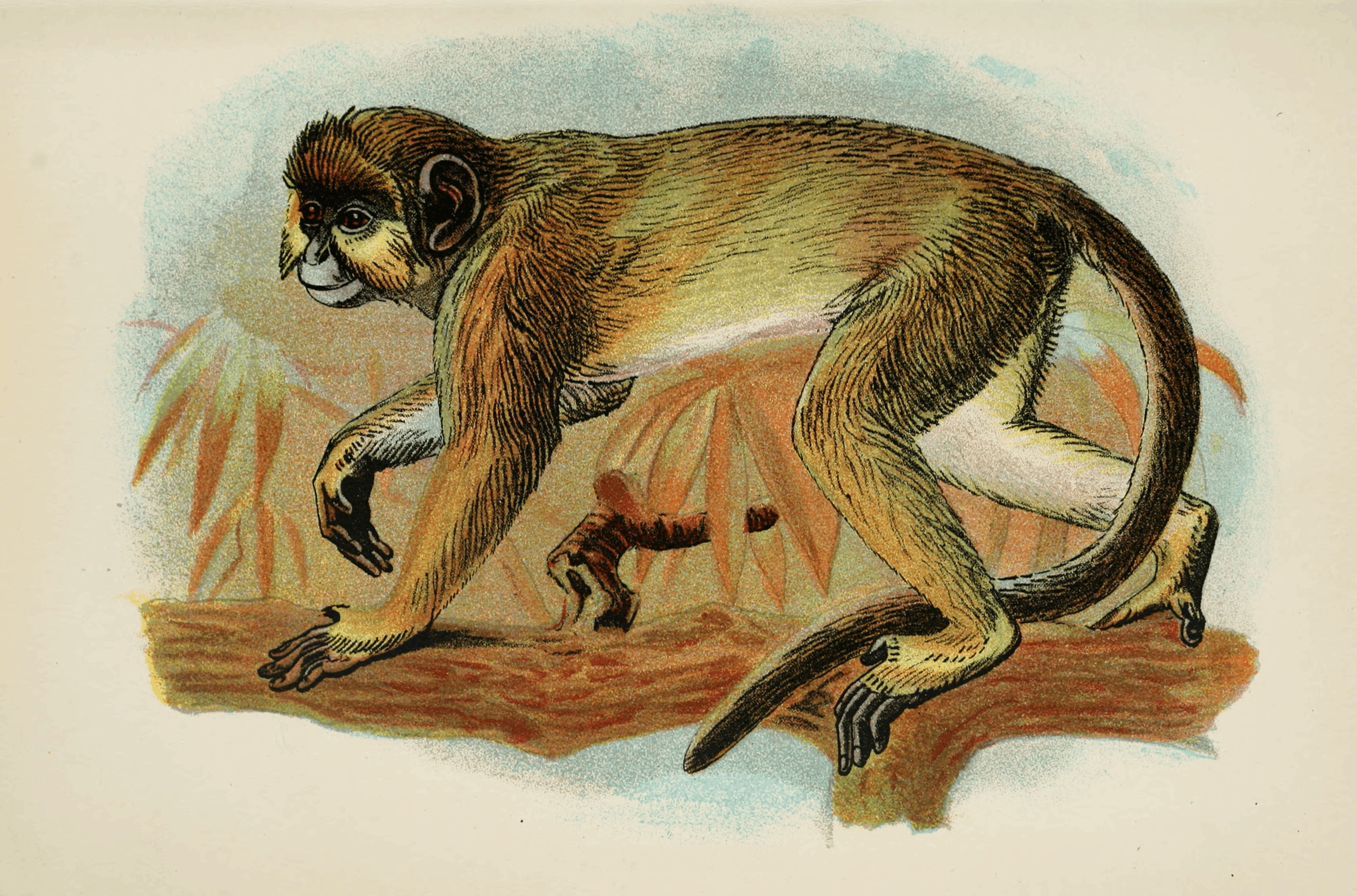
THE TALAPOIN.
Miopithecus capillatus, Geoffr., C. R., xv., p. 720 (1842.)
Simia melarhinus, Schinz, Synop. Mamm., i., p. 47 (1844).
Characters.—Small in size; head globular; muzzle very short; eyes large; ears very expanded; nose but slightly protruding, with oblong nostrils opening laterally, the septum thick; hands short, fingers united by a web.
Skull large; superciliary ridges and orbits also large; posterior molar in both jaws small; those in the lower jaw only three-cusped (two cusps in front, one behind); anterior and median lower molars four-cusped.
Naked skin round the eyes orange; upper lip yellow; whiskers directed downward, bright straw-yellow; upper eyelids white; nose black; ears naked, black; frontal hairs erect, forming a distinct curved crest. Fur speckled olive-green—the hairs grey at the roots, olive-green in the middle and black-tipped; fur darker on the body, paler and more washed with yellow on the outer side of the body and upper side of the hands and feet. Under surface of the body and the inside of the limbs white; tail ashy-grey. Length of body, 13½ inches.
Distribution.—West Africa: Gaboon.
Habits.—Nothing is known of the habits of this rare species, which is the smallest of the Guenons.
THE GUEREZAS AND LANGURS.—SUB-FAMILY SEMNOPITHECINÆ.
The members of this Sub-family are characterised, externally, by having elongated slender bodies, with their hind pair of limbs longer than their front pair, and a very long tail. Internally their digestive organs differ from those of the Cercopithecinæ, the stomach being three times as large as that organ in any Guenon of the same size. Instead of being a simple rounded sac, it is elongate and composed of several pouches. These compartments are quite different, however, from those seen in a Ruminant's stomach, such as that of the Ox. In the latter, each of the various divisions is differently constructed, and its mucous membrane is peculiarly modified; in the Guenon it is divided into two portions, the left of which forms a very considerable cavity, while the right is long and narrow. Two great, strong, muscular bands run along its entire length, one along the greater, the other along the lesser, curvature, like the muscles of the great intestine, forming a series of large cells. (Otto.) In addition to this, the whole organ is twisted upon itself, so that the entrance and exit regions come to be close together. Its mucous membrane is throughout of the same character and form. The cæcum has no appendix vermiformis, or worm-shaped tube, which is the representative (as in Man) of the elongate cæcum found among the Lemuroids, as among most of the Mammals. The muzzle in this Sub-family is very short, and the nose is generally, but slightly, prominent. There are ischial callosities, but no cheek-pouches among the Langurs, though small ones have been described in certain of the Guerezas (Colobus). When laryngeal sacs are present they are formed of a single sac with a median aperture into the windpipe, in the space below its superior opening; it may have large prolongations down the front of the neck, as far indeed as the arm-pits.
The frontal region of the skull is rounded, and the facial angle is comparatively large. The ascending portion of the hinder part of each half of the lower jaw is high, and its hindmost molar on each side has five cusps to its crown. Their breast-bone is very narrow. The vertebræ forming the tail are much elongated. All have the central (os centrale) bone in the carpus (or wrist).
The posterior lobes of the cerebrum project beyond the cerebellum and conceal it; they are very short among the Langurs. The principal grooves and foldings seen in the human brain are represented, and there is a perfectly distinct hippocampus minor—an eminence in the cavity of the posterior lobe, which was for a long time supposed to be a character peculiar to the human brain, and the presence or absence of which was once a celebrated cause of difference between certain distinguished anatomists.
The food of the Semnopithecinæ—of which they consume a large bulk at a time—consists chiefly of leaves and young shoots of trees. For this purpose their sacculated stomach forms a necessary receptacle and store for their food during their hasty collection of it.
The Sub-family practically consists of but two genera—Colobus and Semnopithecus. One species, forming a third genus (Nasalis), is closely related to the latter. The Colobi are confined to Africa, and the Semnopitheci—of which there are a large number of species—inhabit the mainland of India, the Malayan Peninsula, and the neighbouring Archipelago as far east only as Wallace's line, which runs between the islands of Bali and Lombock, and northwards to the east of Borneo.
THE GUEREZAS. GENUS COLOBUS.
Colobus, Illiger, Prodr. Syst. Mamm., p. 69 (1811).
The Guerezas are a group of Monkeys entirely confined to the African continent. The character which especially distinguishes them from the Langurs, which (with the exception of the monotypic Nosed Monkeys of Borneo) form the remaining members of the Sub-family, is the condition of their thumbs. In these animals the thumb is practically absent, being either quite invisible externally, or presenting merely a tubercle, which may or may not have a nail upon it. The hands are long and straight, and the nails of the fingers are compressed and pointed. In these animals the body is slender, though somewhat more robust than in Semnopithecus. The face is naked or covered only with a sparse and soft down, the nostrils being separated by a wide division. From this feature these Monkeys have been described by some naturalists as Platyrrhine or Megarrhine. The ears are rounded above, with the posterior upper angle pointed or square, and generally naked, but they are sometimes haired or tufted inside. All the Guerezas have a specially elongated tail, which is often tufted at the end. Their fur is long and slightly harsher than that of the Langurs, but it is not ringed with differently coloured bands. Their callosities are large and naked.
The skulls in Colobus and Semnopithecus are very similar in shape; but those of the former are often longer, larger, and have a greater cranial capacity than those of the Semnopitheci. The muzzle is short, and the hind molar of the lower jaw has five tubercles. The thumbs, even when apparently absent, are represented under the skin by a single bone, the ungual phalanx, which articulates directly with the metacarpal bone. The Guerezas differ from the Guenons in having very small cheek-pouches and no laryngeal sacs. Their stomach is transversely sacculated like the upper part of the great intestine in the human body.
The Guerezas, which represent the Langurs in Asia, inhabit Tropical Africa, ranging from Abyssinia and Zanzibar in the east, to Senegambia, Angola, and perhaps the island of Fernando Po on the west—between about 15° N. lat. on the eastern and 12° on the western side, to 10° S. lat. They live in small troops in the forest, both on the plains and on the mountains, their food consisting of fruits, but principally of leaves, which they eat in large quantities, as the peculiar and capacious form of their storehouse-like stomach, in lieu of cheek-pouches, would indicate.
Of their habits in their native state very little indeed is known, for they prefer to keep to the great trees of the forests far from human habitation; while, owing to their very delicate constitution enabling them to resist for a very short period the rigours of a climate cooler than their own, scarcely anything has been learnt of them in captivity. The beautiful skins of many of the species form a considerable article of commerce in Europe and America to adorn the costumes of the most refined and cultivated ladies, who vie for their possession with the semi-nude and barbarous warriors of Equatorial Africa, by whom they are also used as ornaments for their persons and for decorations for their weapons.
I. VAN BENEDEN'S GUEREZA. COLOBUS VERUS.
Colobus verus, Van Bened., Bull. Acad. Sc., Brux., v., p. 344, pl. 13 (1838); Less., Spec. Mamm., p. 70 (1840); Martin, Mammif. Anim., p. 503 (1841); Geoffr., Cat. Méth. Primates, p. 17, no. 4 (1851); Wagner, in Schreber, Säugeth. Suppl., v., p. 37 (1855); Gray, P. Z. S., 1868, p. 182; Schl. Mus. Pays-Bas, vii., p. 28 (1876).
Semnopithecus (Colobus) olivaceus, Wagner, in Schreber's Säugeth. Suppl., i., p. 309 (1840).
Colobus cristatus, Gray, Ann. and Mag. N. H. (3), xvii., p. 77 (1866); id., P. Z. S., 1886, p. 182, pl. xv.; id., Cat. Monkeys Brit. Mus., p. 19, et Suppl., p. 128 (1870).
Procolobus verus, Rochebr., Faun. Sénég., Mamm. Suppl., p. 97, pl. 1 (1887).
Characters.—Body stout; limbs robust; head oval, the muzzle slightly prominent; face and ears naked, brownish-black; thumb entirely absent; callosities large. Hair on the top of the head, forming a median crest, reddish-olive; whiskers, directed backward, pale yellow; over the eyes a frontal bar of the same colour, coalescing with the whiskers opposite the eyes; upper part of body to base of tail and down to the knees, covered with short dark olive-brown hair, finely ringed with black, and washed with rufous on the back of the neck and on the outside of the thighs; the tail long and thin, olive-brown or brownish-grey; shoulders, flanks, and outer surface of the limbs, pale greyish-green; upper sides of the hands and feet reddish-brown; throat, chest (the hair of which is elongated), under surface of the body and inner side of the limbs, ashy-grey. Length of body, 21 inches; of tail, 24¼.
Distribution.—West Africa. Forests of Fanti and Ashanti.
II. THE RED-CRESTED GUEREZA. COLOBUS RUFOMITRATUS.
Colobus rufomitratus, Peters, M. B. Akad. Berl., 1879, p. 829, pl. iA. and ii.
Tropicolobus rufomitratus, Rochebr., Faun. Sénég., Mamm., Suppl., p. 102 (1887).
Characters.—Body thick-set and covered with short hair; face and ears naked and brownish-black, the long superciliary hairs and the transverse crest, from ear to ear, black; front and back of the head to the nape of the neck brownish-red; cheeks and chin dark grey; back, from the nape of the neck, flanks, outer and hinder surfaces of the limbs, and the feet, dark brownish-olive; front of the shoulder, of the arm and part of the fore-arm, and the front of the thighs, pale reddish-yellow; breast, under side of the body and inner side of the limbs, of the same colour, but paler; tail coloured like the back, the tip tufted, brownish-black. Length of body, 26¾ inches; tail, 27¾.
Distribution.—This very rare species lives in East Africa. Forests at Muniuni, near Mombasa.
III. KIRK'S GUEREZA. COLOBUS KIRKI.
Colobus kirkii, Gray, P. Z. S., 1868, p. 180, pl. xv.; id., Cat. Monkeys Brit. Mus., p. 127 (1870); Schl., Mus. Pays-Bas, vii., p. 25 (1876); Kirk, Ann. and Mag. N. H. (5), xiii., p. 307 (1884).
Guereza kirkii, Trouess., Consp. Mamm., p. 14 (1879).
Piliocolobus kirki, Rochebr., Faun. Sénég., Mamm. Suppl., p. 112, pl. vi. (1887).
Characters.—Face and ears naked, bluish-black; tip of the nose greyish-white; head, with long divergent hairs, forming a kind of cap, bent backwards over the forehead; crown of head, back, and tail, reddish-brown, paler towards the extremity; the nape, shoulders, arms, outer and anterior aspects of the fore-arms, the centre of the outer aspect of the thighs and legs, and the hands and feet, black; forehead, cheeks, chest, front aspect of the shoulders, the whole of the under side of the body, and the inner side of the limbs, white; anterior aspect of the lower part of the arm, the hind-margin of the fore-arms, and the anterior and posterior aspects of the thighs and legs, greyish-white. (Gray.) Length of body, 25½ inches; of tail, 31 inches.
Distribution.—Island of Zanzibar. This Monkey was first sent to Europe by Sir John Kirk in 1868. Its discoverer, writing in 1884, says that even in 1868 the Monkey was rare, but was still to be found in many of the wooded districts of that island. He writes: "I am not aware that it has been found in Pemba Island or on the mainland; and now I discover that, if not extinct, it has become so rare as not to be procurable, even when I sent the hunters over the island. I have a report that it exists still in one spot, which they could not reach. I believe that two specimens were sent to Germany some time ago; but it looks as if the animal will be lost to science. This is due to the destruction of forest and jungle over the island."
"Colobus kirkii," writes Mr. H. H. Johnston, in 1886, "had disappeared from nearly every part of the island of Zanzibar, but a rumour prevailed that it still lingered on a clump of forest as yet unvisited by hunters. Thither Sir John sent his chasseurs to report on the Monkey's existence. After a week's absence they returned, triumph illumining their swarthy lineaments. 'Well, did you find them?' asked the British Consul General. 'Yes,' replied the men with glee, 'and we killed them every one!' wherewith twelve Monkey-corpses were flung upon the floor, and Colobus kirki joined the Dodo, the Auk, the Rhytina and the Moa, in the limbo of species extinguished by the act of man."
PLATE XXXIII.
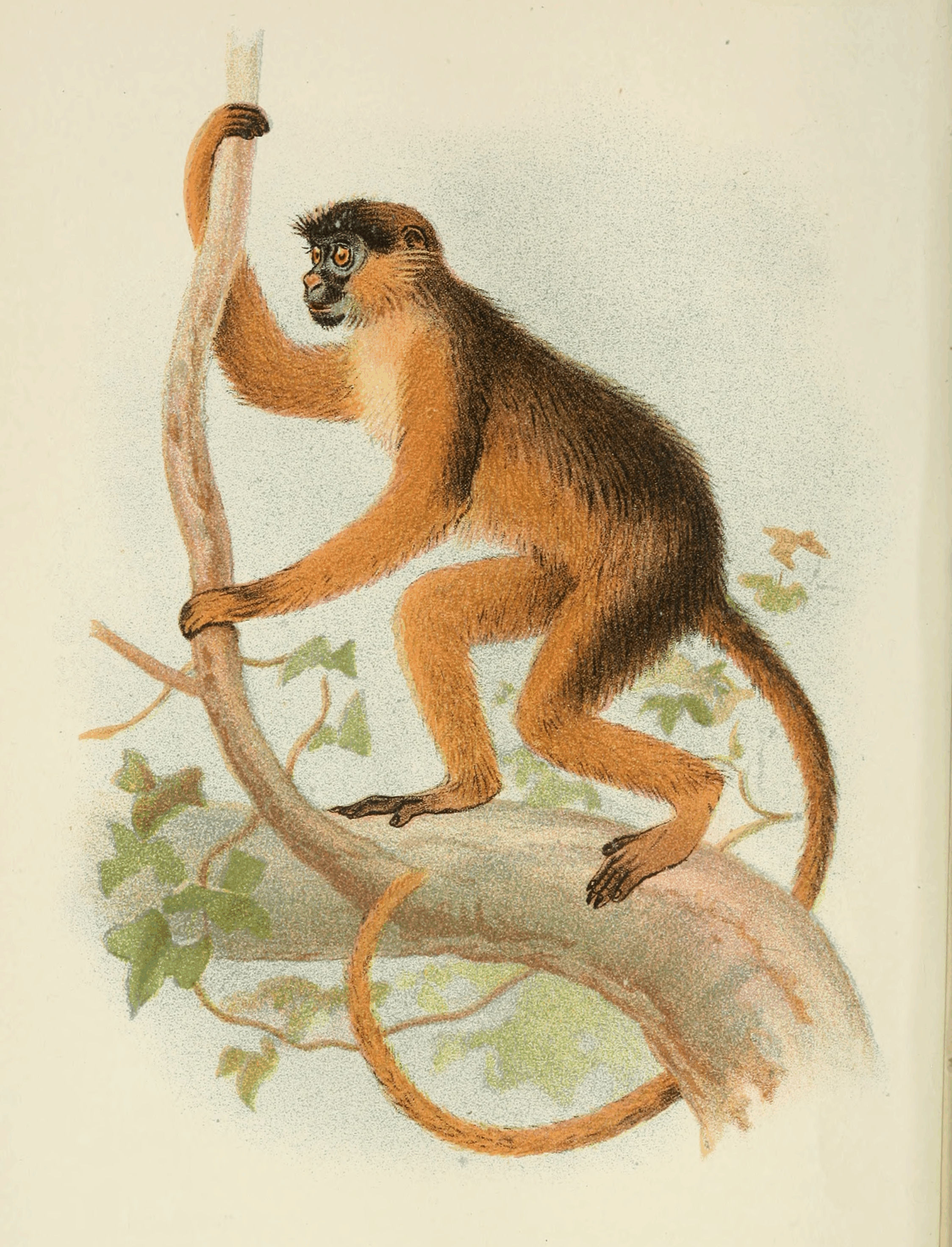
BAY GUEREZA.
IV. THE BAY GUEREZA. COLOBUS FERRUGINEUS.
(Plate XXXIII.)
Simia ferruginea, Shaw, Gen. Zool., i., p. 59 (1800); Desm., Mamm., p. 53 (1820); Fischer, Synops. Mamm., p. 13 (1829).
Colobus ferrugineus, Illiger, Prodr. Syst. Mamm., p. 69 (1811); Gervais, H. N. Mamm., i., p. 66 (1854); Gray, P. Z. S., 1868, p. 181; Schl., Mus. Pays-Bas, vii., p. 27 (1876); Rochebr., Faun. Sénég., Mamm., p. 25 (1883-5); Sclater, P. Z. S., 1890, p. 590, pl. xlviii.
Colobus ferruginosus, Geoffr., Ann. Mus., xix., p. 92 (1812); Martin, Mammif. Anim., p. 498 (1841).
Colobus temminckii, Kuhl, Beitr., Zool., p. 7 (1820); Desm., Mamm., p. 53 (1820); Ogilby, P. Z. S., 1835, p. 99; Martin, op. cit., p. 499 (1841).
Colobus pennantii, Waterh., P. Z. S., 1838, p. 57; Martin, op. cit., p. 501; Geoffr., Dict. H. N., iv., p. 209 (1849); Gray, P. Z. S., 1868, p. 181, var. 2.
Colobus ferruginea, Less., Spec. Mamm., p. 68 (1840); Gray, Cat. Monkeys Brit. Mus., p. 18 (1870).
Colobus fuliginosus, Ogilby, Cat. Mamm. Z. S., p. 97 (1839); Is. Geoffr., Cat. Méth. Prim., p. 17 (1851); Temm., Esquiss. Zool., p. 24 (1853); Dahlb., Consp. Mamm. p. 95 (1857).
Colobus rufo-fuliginosus, Ogilby, Cat. Mamm. Z. S., p. 270 (1839).
Colobus rufo-niger, Ogilby, Cat. Mamm. Z. S., p. 273 (1839); Martin, op. cit., p. 500 (1841); Gray, P. Z. S., 1868, p. 181, var. 1.
Piliocolobus ferrugineus, Rochebr., Faun. Sénég., Mamm. Suppl., p. 105, pl. iii. (1887).
Piliocolobus bouvieri, Rochebr., tom. cit., p. 108, pl. iv.
Piliocolobus tholloni, Rochebr., tom. cit., p. 110, pl. v.
Characters.—Body robust, covered with rather long hairs; face naked, blackish-blue, except the tip of the nose, corners of the mouth and edge of lower lips, which are flesh-colour; ears naked, blackish-blue; nose short and somewhat prominent; frontal hairs erect, directed forward, black; top and back of the head as far as the nape, black; back, sides, outer aspect of the thighs, base and upper surface of the tail, bluish or olive-black, with whitish hairs mingled on the shoulders and thighs; sides of the face from the middle of the cheek backwards to a point behind (enclosing the ears), neck, chin, and throat, the under surface of body, as well as the whole of the limbs (except the outer aspect of the thighs), and the under surface of the tail, rich rufous; tips of the fingers and toes black. Length of body, 29 inches; of tail, 31 inches. The hairs are all uniformly coloured. The thumb is often fairly well developed, and may have a nail.
This species is extremely variable in the coloration of its fur; the back in some varieties is rufous, the cheeks and throat may be sandy-yellow or white, and the under side whitish or white, and the outside of the fore-limbs may be black, or agreeing in colour with the outside of the thighs. The well-developed fœtus shows no signs of the varied coloration of later life, but is quite white.
Distribution.—West Africa. Not uncommon along the whole West Coast.
Habits.—Like many of the other species of the genus, this species keeps to the tops of the highest trees of the forest. Its food consists of fruits and leaves.
V. THE BLACK GUEREZA. COLOBUS SATANAS.
Colobus satanas, Waterhouse, P. Z. S., 1838, p. 58; Martin, Mammif. Anim., p. 497 (1841); Gervais, H. N. Mamm., p. 65 (1854); Sclater, P. Z. S., 1860, p. 246; Reichenb., Naturg. Affen, p. 88 (1862); Is. Geoffr., Dict. H. N., iv., p. 208 (1849); Gray, P. Z. S., 1868, p. 181; id., Cat. Monkeys Brit. Mus., p. 17 (1870); Schleg, Mus. Pays-Bas, vii., p. 27 (1876); Matschie, S.B. Ges. Natur. Fr. Berlin (1892), p. 226.
Semnopithecus anthracinus, Leconte, Proc. Acad. Nat. Sci. Philad. 1857, p. 10.
Guereza satanas, Truess. Consp. Mamm., p. 10 (1879).
Stachycolobus satanas, Rochebr. Faun. Sénég. Suppl. Mamm., p. 114, pl. vii. (1887).
Characters.—Fur very long, coarse; face naked, black; ears rounded, black; superciliary and frontal hairs very long; hairs of the cheeks long, very coarse, and directed backwards; fur entirely and uniformly black on the body and tail; hairs on tail short; tip not tufted. Length of body, 40 inches; of tail, 59½ inches.
Distribution.—West Africa. Forests of Senegambia, Sierra Leone, Gaboon, and the Congo. This is one of the commonest species in West Africa.
VI. THE URSINE GUEREZA. COLOBUS URSINUS.
? Full-bottom Monkey, Pennant, Quad., i., p. 197, pl. 24 (1781).
? Colobus polycomus, Illig., Prodr., p. 69 (1811).
Colobus ursinus, Ogilby, P. Z. S., 1835, p. 98; Less. Spec. Mamm., p. 70 (1840); Martin, Mammif. Anim., p. 495 (1841); Fraser, Zool. Typ., pl. i. (1849); Is. Geoffr., Dict. H. N., iv., p. 208 (1849); Sclater, P. Z. S., 1860, p. 245; Reichenb. Naturg. Affen, p. 86 (1862); Schl., Mus. Pays-Bas, vii., p. 24 (1876).
Colobus personatus, Temm., Mus. Lugd., fide Reichenb. t.c., p. 88 (1862).
Colobus polycomus, var., Gray, Cat. Monkeys Brit. Mus., p. 18 (1870); Rochebr., Faun. Sénég., Suppl. Mamm., p. 117, pl. viii. (1887), Matschie S.B. Ges. Natur. Fr. Berlin, 1892, p. 227.
Guereza ursinus, Trouess., Consp. Mamm., p. 10 (1879).
Characters.—Body large; fur long and glossy; face and ears naked and black; fur on neck, shoulders, and along the back forming a mantle; fur over the whole of the body and limbs deep black; front and back of head, auricular region, sides of the neck and throat, greyish-white, mingled with greyish-black; the tail long, short-haired, white at the extremity.
Young.—White, with a few scattered black hairs; tail well tufted.
Distribution.—West Africa: Sierra Leone.
N. B.—Sinoe is the most easterly region whence skins come to the coast.
Habits.—This species is often found alone, not in large troops. It is more rare in collections than C. ferrugineus.
VII. THE WHITE-THIGHED GUEREZA. COLOBUS VELLEROSUS.
Semnopithecus vellerosus, Is. Geoffr. in Bélang. Voy. Mamm., p. 37 (1830).
Semnopithecus bicolor, Wesmael, Bull. Acad. Sc. Brux., ii., p. 236 (1835).
Colobus leucomeros, Ogilby, P. Z. S., 1837, p. 69; Martin, Mammif. Anim., p. 497 (1841).
Colobus ursinus, Temm., Esquiss. Zool. Guin., p. 21 (1853).
Colobus vellerosus, Is. Geoffr., Dict. H. N., iv., p. 116 (1849); id., Cat. Méth. Primates, p. 17 (1851); Gervais, H. N. Mamm., i., p. 65 (1854); Sclater, P. Z. S., 1860, p. 246; Reichenb., Naturg. Affen, p. 87 (1862); Matschie, S.B. Ges. Natur. Fr. Berlin, 1892, p. 226.
Colobus bicolor, Gray, P. Z. S., 1868, p. 181; id., Cat. Monkeys Brit. Mus., p. 18 (1870); Schlegel, Mus. Pays-Bas, vii., p. 26 (1876); Rochebr., Faun. Sénég., Mamm., p. 24 (1885).
Guereza vellerosus, Truess. Consp. Mamm., p. 10 (1879).
Pterycolobus vellerosus, Rochebr., op. cit., Suppl. Mamm., p. 125, pl. x. (1887).
Characters.—Hair on the back, flanks, and loins, very long and silky; the fur everywhere deep black, excepting a frontal band, which coalesces with the long hair of the auricular region and sides of the neck, which are white, as well as the chin, the throat, a spot on each side of the buttocks, the external and posterior aspects of the thighs, and the short-haired tail, which is tufted at the tip; the thumbs very short, but distinct, and having a flat nail. Length of body, 28½ inches; of tail, 31 inches.
The young are similar in coloration to the adults, but the hair is not elongated.
Distribution.—West Africa: from the Gold Coast to Senegambia, where it is not uncommon.
VIII. THE ANGOLAN GUEREZA. COLOBUS ANGOLENSIS.
Colobus angolensis, Sclater, P. Z. S., 1860, p. 245; Reichenb., Naturg. Affen, p. 88 (1862); Gray, P. Z. S., 1868, p. 181; id., Cat. Monkeys Brit. Mus., p. 18 (1870); Schl., Mus. Pays-Bas, p. 24 (1876); Rochebr., Faun. Sénég., Suppl. Mamm., p. 119; Bocage, Jorn. Sc. Lisb., 1889, p. 10; Matschie, S.B. Ges. Nat. Fr. Berlin, 1892, p. 226.
Colobus palliatus, Peters, M. B. Akad. Berl., 1868, p. 637; id., op. cit., 1879, p. 830, pl. iv.A.; Gray, Ann. Mag. N. H. (4) iii., p. 171 (1869); Sclater, P. Z. S., 1880, p. 68; Matschie, S.B. Ges. Natur. Fr. Berlin, 1892, p. 227.
Guereza angolensis et G. palliatus, Trouess. Consp. Mamm., pp. 10 and 20 (1879).
Characters.—Face and ears naked, black; hair radiating round the face, long, and directed backward, especially on the temples and sides of the face, and on the shoulders, where it forms a lengthy mantle; hairs on the top of the head shorter than on the back. General colour deep glossy black, except the frontal band over the eyes, the temporal hairs, whiskers and mantle, which are white. Tail long and black, except for the terminal third, which is white, and has a thick tufted tip; a white spot on the perinæum. Length of body, 23½ inches; of tail, 34 inches.
Distribution.—East Africa: the valley of the Pangani. Said to extend to Angola on the south-west coast.
IX. RUPPELL'S GUEREZA. COLOBUS GUEREZA.
Colobus guereza, Rüpp, Neue Wirbelth. Saügeth., p. 1, pl. 1 (1835); Lesson, Spec. Mamm., p. 68 (1840); Martin, Mammif. An., p. 494 (1841); Is. Geoffr., Dict. H. N., iv., p. 117 (1849); id., Cat. Méth. Primates, p. 17 (1851); Temm., Esquiss. Zool. Guin., p. 23 (1853); Dahlb., Zool. Stud., i., p. 95 (1857); Sclater, P. Z. S., 1860, p. 246; Gray, P. Z. S., 1868, p. 182; Schl., Mus. Pays-Bas, vii., p. 25 (1876); Thomas, P. Z. S., 1885, p. 219; Matschie, S. B. Gesell. Natur. Fr. Berlin, 1892, p. 225, et seqq.
Guereza rueppelli, Gray, Cat. Monkeys Brit. Mus., p. 19 (1870); Rochebr., Faun. Sénégamb., i., Mamm., p. 25 (1885); id., t.c., suppl., p. 129, pl. xi. (1887).
Guereza guereza, Trouess., Consp. Mamm., p. 10 (1879.)
Guereza occidentalis, Rochebr., op. cit., Suppl., p. 140, pl. xiii. (1887).
Characters.—Face thinly covered with greyish-white hairs; nose and upper lip black; ears, naked, black; a bar across the forehead, expanding on the sides of the head, throat, sides of the neck, and chin, white; from the shoulders a mantle of long white silky hairs extending down each side and meeting on the lower back, so as to hang down over the sides of the body, the hips, and thighs; the outside of the latter greyish-white; the hinder third of the tail tufted and white, each hair ringed with numerous fine bands of brown; the whole of the rest of the body deep shining black. Length of the body, 28 inches; of the tail, 28½.
Distribution.—This remarkably beautiful Monkey inhabits North-Eastern Africa, where it is not uncommon in the provinces of Godjan and the kingdom of Shoa. Dr. Blanford, however, did not hear of it during his journey with the British army to Magdala. It is found also in the neighbourhood of Mount Kilimanjaro, and was shot in the forested plains near the coast by Mr. H. H. Johnston. The form of this species which has been described under the name of C. occidentalis is more or less confined to the south of Lulongo, in the Upper Congo, between 6° N. latitude and 12° East longitude.
Habits.—The "Guereza," as the natives of Abyssinia name this species, lives in small troops in the very highest trees of the forest, in the neighbourhood of streams. It is very active and lively, and quite harmless in disposition. The food of this Colobus consists of wild fruits, insects, and such like, which it searches for throughout the day only, retiring during the night. "The Colobus Monkey," observes Mr. H. H. Johnston, "is almost the only one that quite avoids the neighbourhood of Man; the other genera frequent the vicinity of native plantations, and doubtless profit by the abundance of cultivated food." The skin of this Monkey is in great request among the Masai warriors both for dresses, capes, and caps, the long white mantle of the creature forming a most ornamental costume; and also to cover their shields with.
X. THE WHITE-TAILED GUEREZA. COLOBUS CAUDATUS.
Colobus guereza caudatus, Thomas, P. Z. S., 1885, p. 219, pl. xii.; Johnston, Kilimanj. Exped., pp. 174, 388, 389, fig. 72; Matschie, S. B. Gesell. Naturf. Fr. Berlin, 1892, p. 225.
Guereza caudatus, Rochebr., Faun. Sénég. Suppl., Mamm., p. 136, pl. xii.
(Plate XXXIV.)
PLATE XXXIV.
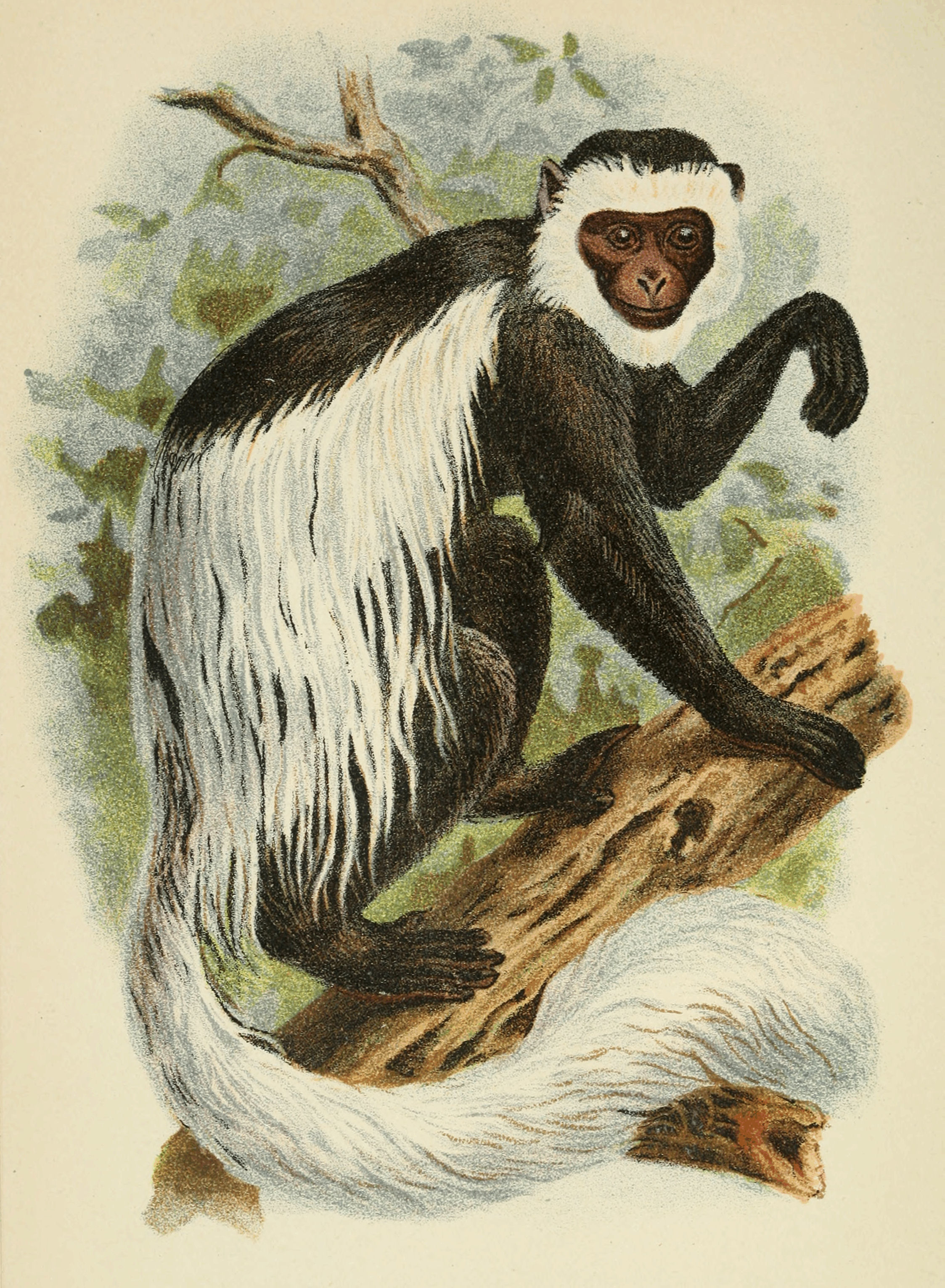
THE WHITE-TAILED GUEREZA.
Characters.—Very similar to C. guereza, but "characterised by having the white brush of the tail very much larger and finer than is the case in the true Abyssinian C. guereza. In the latter animal the proximal 12-16 inches of the tail is short-haired and quite black, only the terminal 8-12 inches being white and tufted, so that the white mantle hangs down from the body and hides only about one-third of the black part of the tail." (Oldfield Thomas.) In Colobus caudatus, Mr. Thomas adds, only some three or four inches of the base of the tail are black, and the remainder (with the hairs about 20 or 21 inches) is developed into a magnificent white brush, of which individual hairs are from seven to nine inches in length. The hairs of the white body-mantle—washed like the tail with yellowish cream-colour—entirely cover the black at the base of the tail, the white of the latter and of the mantle being quite continuous.
Distribution.—East Africa; very common all round the base of Mount Kilimanjaro, as Mr. Johnston—who discovered the species—reports. On Mount Kenia Dr. Gregory, of the British Museum, during his adventurous and remarkable journey, met with it at a great altitude. It has also been found at Kisongo, south-east of Lake Victoria and in Uniamuezi, where Sir Richard Burton obtained it.
Habits.—The habits of the White-tailed Guereza are very similar to those of the foregoing; but it would appear to be much more of a mountain-loving animal than the latter. A creature so strikingly—even glaringly—ornamented might be supposed to be a very conspicuous object among its native forests. Dr. Gregory, however, has informed the present writer that, notwithstanding its distinctive coloration when examined in the hand, he found it very difficult to detect it in its home amid the forest-trees at high altitudes, where all the branches are clothed with long grey-beard lichens, with which its fur very closely harmonizes. Mr. H. H. Johnston, in describing Mandara's soldiers, says: "On their heads were crescents made of ostrich feathers, or caps of the Colobus Monkey-skin. This last-mentioned animal also supplied them with mantles of long black and white fur, and contributed the heavily-plumed tails which these Çaga soldiers fixed on to that portion of their body where tails should rightly appear, if man had not dispensed with such appendages."
"The 'Polume,' as Dr. Livingstone calls this species, is in Uniamuezi known as the 'Mbega,' and is admired on account of its polished black skin and snowy-white mane. It is a cleanly animal, ever occupied in polishing its beautiful garb, which, according to the Arabs, it tears to pieces when wounded, lest the hunter should profit by it. The 'Mbega' lives in trees, seldom descending to the ground, and feeds upon fruits and young leaves." (Burton.)
THE LANGURS. GENUS SEMNOPITHECUS.
Semnopithecus, F. Cuv., Hist. Nat. Mammif. (1821).
Presbytis, Eschsch. Kotzeb. Entdeck. Reis., iii., p. 196 (1821).
The members of this genus have thin and elongated bodies, long limbs, and a very long and slender tail. The head is rounded, and shorter than in the Guenons; the muzzle short, depressed, and but little prominent. The thumb, although shorter than that digit among the Guenons and Macaques, is present in all the species, and forms a good prehensile finger with a flat nail. The hands and feet are long and narrow, and the finger-nails convex; the great-toe is thick and well-developed. The callosities are small as compared with the Guenons; the fur is abundant, and generally long, soft, and often glossy; and over the eyes they have usually a ridge of stiff hairs projecting in front. The members of this genus, as already observed, have no cheek-pouches; they have, however, a large laryngeal sac formed and situated as described above (p. 84).
The skull is round; the eye-sockets large, with a very prominent superciliary ridge projecting over them; the space between the eyes is broad, and the lower jaw is deep. The upper molars are four-cusped, and the posterior lower molar five-cusped.
The Langurs are, when young, good tempered and easily tamed; but when old they become sulky and ill-natured. They live chiefly in forest regions, in troops of considerable size. "This genus is spread over almost the whole of the Oriental region wherever the forests are extensive. They extend along the Himalayas to beyond Simla, where a species has been observed at an altitude of 11,000 feet, playing among fir-trees laden with snow-wreaths. On the west side of India they are not found to the north of the 14th parallel of latitude. On the east they extend into Arakan, and to Borneo and Java, but not apparently into Cambodia. Along the eastern extension of the Himalayas they again occur in Eastern Thibet, a remarkable species (S. roxellana) having been discovered at Moupin (about lat. 32° N.), in the highest forests, where the winters are severe and where the vegetation is wholly that of the Palæarctic region." (Wallace.)
The total number of Monkeys inhabiting the islands of the Eastern Archipelago is, according to the most recent census, as follows: In Sumatra, 12; Banka, 4; Borneo, 14; Java, 5; Celebes, 2; Natuna, Bali, Lombock, Flores, Sumbawa, and Timor, 1 each; the Philippine and Sulu Archipelagos, 1 each.
I. BARBE'S LANGUR. SEMNOPITHECUS BARBII.
Presbytis barbei, Blyth, J. A. S. Beng., xvi., p. 734 (1847); id., Cat. Mamm. As. Soc. Mus., p. 14 (1863); id., Mamm. Burma, p. 11 (1875).
Semnopithecus barbei, Anderson, Zool. Res. Exped. Yun-nan, p. 12 (1878); id., Cat. Mus. Calc., p. 48; Blanford, Faun. Brit. Ind., Mamm., p. 39 (1891).
Characters.—Nearly related to S. obscurus. Hair on the side of the head, and in front of the ears, long, projecting outwards; that on the top of the head long and directed backwards; beard short; face almost nude, bluish-black; lips thinly furnished with short yellowish hairs. General colour of the body everywhere black, except on the shoulders, the fore-limbs to the wrist, the joint of the legs, the back and sides of the head, and tail, which are washed with pale grey. Length of body, 19½ inches; of tail, 29 inches. The adult female is similar in coloration to the male. In the skull the orbits are rounded, and the inter-orbital region elongated. Dr. Anderson observes: "The differences which exist in certain dimensions between the skulls of well-authenticated examples of the two sexes are far greater than are generally found in the same sexes of different species."
Distribution.—Northern Tippera hills; Assam; and Mount Mooleyit, in Tenasserim. Dr. Anderson observed it in the Valley of the Tapeng, in the centre of the Kachin hills in Upper Burma, and in the defile of the Irawaddy.
Habits.—This species inhabits the thick forest, and is found in troops of from thirty to fifty individuals, distributed, according to Dr. Anderson, over three or four high forest-trees overhanging the mountain streams. It is generally tame and fearless.
II. THE BONNETED LANGUR. SEMNOPITHECUS PILEATUS.
Semnopithecus pileatus, Blyth, J. A. S. Beng., xii., p. 174 (1843); xiii., p. 467 (1844); Wagner in Schreb. Säugeth. Suppl., v., p. 30, pl. xxvi., fig. 3 (1855); Hutton, P. Z. S., 1867, p. 946; Schl., Mus. Pays-Bas, vii., p. 57 (1876); Anderson, Zool. Exped. Yun-nan, p. 13 (1878); id., Cat. Mus. Calc., p. 40; Blanford, Faun. Brit. Ind., Mamm., p. 37, fig. 9 (1891).
Presbytis pileatus, Blyth, J. A. S. Beng., xvi., p. 735 (1847); id., Cat. Mamm. As. Soc. Mus., p. 12 (1863); id., Mamm. Burma, p. 11 (1875).
Semnopithecus potenziani, Bp., C. R., xliii., p. 412 (1856).
Presbytis chrysogaster, Licht.; Peters, P. Z. S., 1866, p. 429; Blyth, Mamm. Burma, p. 10 (1875).
Semnopithecus chrysogaster, Licht.; Peters, M. B. Akad. Berl., 1879, p. 830, pl. iv.b; id., P. Z. S., 1866, p. 429; Blanford, Faun. Brit. Ind., Mamm., p. 38 (1891).
Characters.—Nearly allied to S. entellus. Face flattened and black; muzzle long and broad; head without a crest; some long superciliary hairs projecting in front, black; whiskers long, running down to the chin, and projecting outwards and backwards, partly concealing the ears, and of a reddish-yellow colour; beard short, also reddish-yellow; hair on the top of the head longer than on the back of the head and temples, black or dark ashy-grey, washed, especially on the front of the head, with rufous; neck, back, upper part of arm, lower portion of the fore-arm, outside of the thighs, and tail (except the tufted tip, which is black), ashy-grey—all these parts being slightly washed with rufous; hands and feet, black; remainder of the limbs rufous; throat, chest, and fore part of the under surface, rich orange-yellow, paler on the hind part of the belly and on the inner side of the limbs. Length of body, 18 inches; of tail, 28½ inches, and with the tuft, 31 inches. Cranium globular; supra-orbital ridges not prominent.
The young have the fur soft, silky, and rather long, and are much paler than the adults, and of a soft delicate grey, yellowish-white taking the place of the rufous colour of the adults. (Anderson.)
Distribution.—Northern Assam, Arracan, Upper Burma, and Tenasserim. Dr. Anderson observed a troop of this species at Tsingu Myo on the left bank of the Irawaddy, at the lower end of the first defile.
Habits.—This species lives in small troops in the forest. When young it is of a mild disposition; but, when fully adult, the males are ill-natured and fierce.
III. THE HANUMAN LANGUR. SEMNOPITHECUS ENTELLUS.
L'entelle, Audeb., Singes, Fam. V., sect. ii., fig. 2 (1797).
Simia entellus, Dufresne, Bull. Soc. Philom., i., p. 49 (1797).
Cercopithecus entellus, Latr., Hist. Nat. Buff., xxxvi., p. 283 (1809).
Semnopithecus entellus, Desm., Dict. Class. H. Nat., vii., p. 568 (1825); Sykes, P. Z. S., 1831, p. 199; Blyth, J. A. S. Beng., xii. (1843), p. 169; xiii. (1844), p. 470; Hutton, P. Z. S., 1867, p. 944; Gray, Cat. Monkeys Brit. Mus., p. 14 (1870); Schlegel, Mus. Pays-Bas, vii., p. 60 (1876); Anderson, Rep. Zool. Exped. Yun-nan p. 15 (1878; with full synonymy); Blanford, Faun. Brit. Ind., Mamm., p. 27 (1891).
Semnopithecus anchises, Elliot; Blyth, J. A. S. Beng., xiii. (1844), p. 470; xvi. (1847), p. 733.
Presbytis entellus, Gray, Hand-List Brit. Mus., p. 4 (1843; in part); Blyth., op. cit., xvi., pp. 732, 1271, pl. liv., fig. 1 1847; id., Cat. Mamm. As. Soc. Mus., p. 11 (1863); Jerdon, Mamm. Ind., p. 4 (1867).
Semnopithecus albogularis, Müll. u. Schl., Verh. Nat. Gesch., 1839-44, p. 58 (fide Anderson).
Characters.—Nearly allied to S. schistaceus. Crestless; hair on top of head radiating in all directions; ears large, whiskers short, not concealing the ears; prominent supra-orbital projecting hairs, black; face, ears, hands, and feet black. Head, body, limbs, and tail—which is a fourth longer than the body—pale yellowish-brown, darker on the shoulders and the outside of the limbs; under surface paler.
Female.—Smaller than the male.
Distribution.—According to Dr. Anderson, this species ranges from the Deccan northwards to the south bank of the Ganges; its distribution to the north-west, west, and south being uncertain.
Habits.—"Few, if any, wild animals," observes Dr. Blanford, "afford better opportunities for observation than the Hanuman Monkey of Northern and Central India. Generally protected and looked upon as sacred by many of the Hindu inhabitants, it has no fear of Man, and may be found in groves near villages, or even on the village trees, as often as in the depths of the forest. In many parts of India it is a common occurrence to see these Monkeys on the roofs of houses. They frequently pilfer food from the grain-dealers' shops, whilst the damage they inflict on gardens and fields, renders them a great nuisance to the natives. They feed on fruit and grain, but especially on leaves and young shoots. They live in the high trees of the forest and near to water, or in rocky hills, in moderately-sized troops composed of males, females, young, and infants clasping their mothers. An old male is occasionally found solitary. Two communities often enter into deadly combat for possession of some fruit grove, an interesting account of one of which is given by Mr. J. Hughes in the 'Proceedings of the Asiatic Society of Bengal' for 1884." They are at all times very active. "Their voice," continues Dr. Blanford, whose account we have condensed, "is loud and is often heard, especially in the morning and evening. The two commonest sounds emitted by them are a loud, joyous, rather musical call, a kind of whoop generally uttered when they are bounding from tree to tree, and a harsh guttural note, denoting alarm or danger. The latter is the cry familiar to the tiger hunter, among whose best friends is the Hanuman. Safely ensconced on a lofty tree, or jumping from one tree to another as the tiger moves, the Monkey by gesture and cry points out the position of its deadly enemy in the bushes or grass beneath, and swears at him heartily."
The Hanuman is of very tender constitution, and cannot bear up against great changes of climate and temperature and necessarily of elevation; it is, therefore, entirely restricted to the warm lowland regions. There is, according to Captain T. Hutton, no true migration of this species from the upper to the lower districts of Bengal, as has been stated. "I am inclined," writes this observer, "to restrict its range, somewhat loosely perhaps, to between 10° and 25° N. lat. and 75° to 88° E. long., forming with the line drawn across the country from Allahabad to Boondee, a triangular range entirely south of the rivers Jumna and Ganges."
IV. THE HIMALAYAN LANGUR. SEMNOPITHECUS SCHISTACEUS.
Semnopithecus entellus (nec Dufr.), Hodgs., P. Z. S., 1834, p. 95; Ogilby, Madr. Journ., xii., p. 144 (1840).
Semnopithecus schistaceus, Hodgs., J. A. S. Beng., ix., p. 1212 (1840); Schl., Mus. Pays-Bas, vii. p. 6 (1876); Anderson, Zool. Exped. Yun-nan, p. 16 (1878; with full synonymy); Blanford, Faun. Brit. India, Mamm., p. 30 (1891).
Semnopithecus nepalensis, Hodg., J. A. S. Beng., ix., 1840, p. 1212.
Presbytis entellus (nec Dufr.), Gray, Cat. Hodgs. Mamm. Nepal, p. 1 (1846); id., Cat. Monkeys Brit. Mus., pp. 14 and 15 (1870).
Presbytis schistaceus, Blyth, Cat. Mamm. As. Soc. Mus., p. 11 (1863); Jerdon, Mamm. India, p. 6 (1867); Blanford, J. A. S. Beng., xli., 1872, p. 32.
Characters.—Fur long; hair radiating on the crown; hair of cheeks long, hiding the small ears; tail slightly tufted; top and sides of head pale yellow, or whitish; face and ears, palms and soles black; back, sides, outside of limbs, tail, hands, and feet, dark slaty, or greyish-brown, sometimes washed with purple.
Aged specimens are grey or white on the head; young ones often have the feet darker than the adult.
Facial portion of the skull longer and the superciliary ridges less projected forward than in S. entellus. The nasal bones project beyond a line from the supra-orbital ridge to the front border of the pre-maxillaries; in S. entellus they do not project beyond it.
Distribution.—The Himalayas, from Kashmir to Bhutan from 5,000 to 12,000 feet above the sea, this species taking the place in those high altitudes of the lowland S. entellus.
Habits.—Similar to those of the Hanuman. According to Dr. Blanford, Capt. Hutton has observed it near Simla, at 11,000 feet, sporting amongst the fir-trees that were loaded with snow-wreaths at the time. "But," writes Dr. Anderson, "there is no evidence that any species of Monkey in the Himalaya is naturally resident at those heights at which snow annually lies, as was supposed by Hodgson, and it is the rarity of their occurrence at these high elevations, and during winter, that has directed so much attention to their hibernal wanderings. In the summer, they are much more widely distributed than in the winter, when, as a rule, they are driven to lower heights and into the warmer valleys."
V. THE MADRAS LANGUR. SEMNOPITHECUS PRIAMUS.
Semnopithecus priam, Elliot, MSS.; Blyth, J. A. S. Beng., xiii, p. 470 (1844).
Semnopithecus pallipes, Blyth, Ann. and Mag. N. H., 1844, p. 312.
Presbytis priamus, Blyth, J. A. S. Beng., xvi., pp. 732, 1271, pl. liv. (1847); xx., p. 313 (1851); id., Cat. Mamm. As. Soc. Mus., p. 12 (1863); Kelaart, Prod. Faun. Zeylan., p. 3 (1852); Jerdon, Mamm. India, p. 7 (1867).
Semnopithecus albipes, Is. Geoffr., Cat. Méth. Primates, p. 14 (1851); Gray, Cat. Monkeys Brit. Mus., p. 15 (1870); Anderson, Zool. Res. Exped. Yun-nan, p. 18 (1878).
Semnopithecus priamus, Blanford, Faun. Brit. Ind., Mamm., p. 31 (1891); Anderson, Zool. Exped. Yun-nan, p. 19 (1878; with full synonymy).
Presbytis thersites, Tennent, Ceylon, p. 132, plate, fig. 1 (1860).
Characters.—Nearly allied to S. entellus. Hair on head indistinctly radiated; back of head crested longitudinally; supra-orbital hairs very long and projecting forward; ears large, not hidden by the whiskers. Fur long; face and ears black; back, sides, outer aspect of fore-limbs, upper part of the thigh, and the tail, ashy-grey, or earthy-brown, sometimes slightly washed with purple; sides of the head, nape, lower half of the thighs, hands, and feet, yellowish, as also the under surface of the body and inside of the limbs. Length of body, 21 inches; tail, 28 inches.
Distribution.—The Coromandel coast of India, ascending to 6,000 feet; Ceylon, from the north as far as the Kandyan hills in the south.
Habits.—The same as those of S. entellus and S. schistaceus.
This species inhabits the northern and eastern provinces of Ceylon, and the wooded hills which occur in these portions of the island. In appearance it differs both in size and in colour from the common Wanderoo, being larger and more inclined to grey; and in habits it is much more reserved. At Jaffna, and in other parts of the island, where the population is comparatively numerous, these Monkeys become so familiarised with the presence of Man as to exhibit the utmost daring and indifference. A flock of them will take possession of a Palmyra palm; and so effectually can they crouch and conceal themselves among the leaves that, on the slightest alarm, the whole party becomes invisible in an instant. The presence of a Dog, however, excites such an irrepressible curiosity that, in order to watch his movements, they never fail to betray themselves. They may be frequently seen congregated on the roof of a native hut.
The Singhalese have the impression that the remains of a Monkey are never to be found in the forest; a belief which they have embodied in the proverb that "he who has seen a white Crow, the nest of a paddi bird, a straight coco-nut tree, or a dead Monkey, is certain to live for ever." This piece of folk-lore has evidently reached Ceylon from India, where it is believed that persons dwelling on the spot where a Hanuman Monkey, Semnopithecus entellus, has been killed, will die, and that even its bones are unlucky, and that no house erected where they are hid underground can prosper; and Buchanan observes that "it is perhaps owing to this fear of ill-luck that no native will acknowledge his having seen a dead Hanuman."
VI. THE MALABAR LANGUR. SEMNOPITHECUS HYPOLEUCUS.
Semnopithecus hypoleucos, Blyth, J. A. S. Beng., x., p. 839 (1841); xiii., p. 470 (1844); Anderson, Res. Zool. Exped. Yun-nan, p. 20 (1878; with full synonymy); Blanford, Faun. Brit. India, Mamm., p. 33 (1891).
Semnopithecus johnii, var., Martin, Mammif. Anim., p. 489 (1841); Gray, Cat. Monkeys Brit. Mus., p. 14 (1870).
Semnopithecus dussumieri, Is. Geoffr., C. R., xv., p. 719 (1842); id., Descr. An. Nouv. Fam. des Singes, p. 54, pl. xxx.; id., Cat. Méth. Primates, p. 13 (1851); Schl., Mus. Pays-Bas, vii., p. 62 (1876).
Presbytis hypoleucos, Blyth, J. A. S. Beng., xvi. (1847), p. 733.
Presbytis johnii (nec Fischer), Blyth, J. A. S. Beng., xxviii., p. 283 (1859); id., Cat. Mam. As. Soc. Mus., p. 12 (1863); Jerd., Mamm. India, p. 7 (1867).
Characters.—Similar to S. entellus. No crest; hair radiating on crown; back, sides, posterior aspect of thighs and tail dusky brown, darker on the middle of the back; fore-arm, front of thighs, and lower portion of legs, black; head dirty yellow; under surface yellowish-white; face, hands, and feet, black. Length of body, 21 inches; of tail, 32 inches.
Young.—Sooty-brown.
Distribution.—The forests and woods near cultivation along the Malabar coast of India, below 1,500 feet.
Habits.—Same as those of the Hanuman. It is, however, rather more shy.
VII. THE NILGIRI LANGUR. SEMNOPITHECUS JOHNI.
Simia johnii, Fischer, Syn. Mamm., i., p. 25 (1829).
Semnopithecus cucullatus, Is. Geoffr. in Bélang. Voy. Zool., pp. 38, 72, pl. i. (1834); Wagner in Schreber Säugeth. Suppl., i., p. 98 (1846); Gray, Cat. Monkeys Brit. Mus., p. 14 (1870).
Semnopithecus johnii, Waterh., Cat. Mamm. Mus. Zool. Soc., p. 5 (1838); Anderson, Res. Zool. Exped. Yun-nan, p. 21 (1878; with synonymy); Blanford, Fauna Brit. Ind., Mamm., p. 33 (1891); Schl., Mus. Pays-Bas, vii., p. 50 (1876).
Semnopithecus jubatus, Wagner in Schreb. Säugeth. Suppl., i., p. 305 (1840); Horsf., Cat. Mamm. E. Ind. Co. Mus., p. 14 (1851).
Semnopithecus cephalopterus, Blyth, J. A. S. Beng., xiii., p. 469 (1844; in part).
Presbytis johnii, Blyth, J. A. S. Beng., xvi., pp. 734, 1272 (1847).
Presbytis cucullatus, Blyth, J. A. S. Beng., xxviii., p. 283 (1859); id., Cat. Mamm. As. Soc. Mus., p. 14 (1863).
Presbytis jubatus, Jerd., Mamm. India, p. 7 (1867).
Characters.—Hair long and glossy, entirely black or brownish-black; hairs of crown and sides of head very long, not radiating, yellowish-brown; lower back and root of tail grey. Length of body, 26 inches; of tail, 30 inches; a very large individual measured, body, 29 inches; tail, 37. (Hornaday.)
Nearly allied to the next species (S. cephalopterus) of Ceylon, and S. obscurus, which inhabits the eastern side of the Bay of Bengal.
Female.—With a yellowish-white patch inside each thigh. (Davison.)
Distribution.—In the thick, sharply circumscribed woods of the Nilgiri hills, south to Cape Comorin, above 2,500 feet.
Habits.—This species lives in small troops of ten to twelve individuals, and is remarkable for the extraordinary leaps it can make. "It is shy and wary, the result," as Dr. Blanford states, "of human persecution. It is very noisy, having a loud guttural alarm cry, used also to express anger, and a long loud call." Jerdon relates "that when the sholas of the Nilgiri range were beaten for game, these Monkeys made their way rapidly, and with loud cries, to the lowest portion, and thence to a neighbouring wood at a lower level. In consequence of the beauty of their skins, and the circumstance that certain castes eat their flesh, these Monkeys are more frequently shot than most of the Indian species: hence their shyness."
VIII. THE PURPLE-FACED LANGUR. SEMNOPITHECUS CEPHALOPTERUS.
Cercopithecus vetulus, Erxl., Syst. Régn. An., Mamm., p. 25 (1777; in part).
Cercopithecus senex, Erxl., t.c., p. 24 (1777); Zimm., Geogr. Gesch., ii., p. 183 (1780); Blanford, Faun. Brit. Ind., Mamm., p. 35 (1891).
Cercopithecus kephalopterus, Zimm., op. et t.c., p. 185 (1780); Bodd., Elench. An., p. 58 (1785); Fischer, Syst. Mamm., p. 17 (1829).
Simia veter, Shaw, Gen. Zool., i., p. 36 (1800).
Cercopithecus leucoprymnus, Otto, N. Acta. Acad. Cæs. Leop., xii., p. 505, pl. xlvi. bis (1825).
Semnopithecus fulvo-griseus, Desmoul., Dict. Class. Hist. Nat., vii., p. 570 (1825); Geoffr., C. R., xv., p. 719 (1842).
Semnopithecus leucoprymnus, Desmaret, Dict. Sci. Nat., xlviii., p. 439 (1827); Wagner, in Schreber, Säugeth. Suppl., v., p. 25 (1825); Gray, Cat. Monkeys Brit. Mus., p. 14 (1870).
Macacus silenus, var. alba, Fischer, Syn. Mamm., 1829, p. 28.
Semnopithecus nestor, Bennett, P. Z. S., 1833, p. 67; Waterh., P. Z. S., 1844, p. 1.
Presbytes cephalopterus, Gray, Hand-List Mamm., p. 4 (1843); Blyth, J. A. S. Beng., xvi., pp. 734, 1271 (1847); Kelaart, Prodr. Faun. Zeylan., p. 1 (1852); Tennent, Ceylon, p. 5, plate, fig. 3 (1861); Blyth, Cat. Mamm. Mus. As. Soc. Beng., p. 13 (1862).
? Presbytis thersites, Elliot MSS.; Blyth, J. A. S. Beng., xvi., p. 1271, pl. liv., fig. 3 (1847); Blanford, P. Z. S., 1887, p. 626 (1891).
Presbytis albinus, Kelaart, Faun. Zeylan., p. 7. (1852).
Semnopithecus cephalopterus, Martin, Mammif. An., p. 482 (1841); Schlegel, Mus. Pays-Bas, vii., p. 51 (1876); Anderson, Rep. Zool. Exped. Yun-nan, p. 22 (1878; full synonymy); Blanford, Faun. Brit. Ind., Mamm., p. 34 (1891).
Semnopithecus kelaartii, Schl., Mus. Pays-Bas, vii., p. 52 (1876).
Characters.—Hair of crown not radiating; top of head and nape dusky-brown; back and limbs darker smoky-brown; lower back, base of tail, and upper posterior surface of thighs varying from ashy-grey to greyish-white, washed, in immature specimens, with brown; hands and feet black; supra-orbital hairs black, projecting outwards, extending nearly to the ears; the long and conspicuous whiskers white, concealing the base of the ears, and forming a sort of ruff, encircling the face; chin and throat white. Face purplish-black. Tail beyond the base dark grey, tufted at the tip and whitish. Under surface dusky-grey; inner sides of the thighs anterior to the callosities pale yellow or white. Length of body, 21 inches; tail, 31 inches.
Young.—Generally similar to the parents. A young female from Ceylon examined by Dr. Anderson was uniform pale-yellowish, the top of the head slightly washed with brownish, and the shoulder and mid-back washed with dusky.
A white variety (S. senex) sometimes occurs. "There can be no doubt," says Dr. Anderson, "that S. cephalopterus, S. ursinus, and S. johni are extremely closely allied to each other"; and indeed it is doubtful whether they are not local races of the same species.
Distribution.—The island of Ceylon.
Habits.—Sir E. Tennent, in his "Natural History of Ceylon," has given the following account of this species:—
"Although common in the southern and western provinces, this Monkey is never found at a higher elevation than 1,300 feet. It is an active and intelligent creature, little larger than the common Bonneted Macaque, and far from being so mischievous as others of the Monkeys in the island. In captivity it is remarkable for the gravity of its demeanour, and for an air of melancholy in its expression and movements which are completely in character with its snowy beard and venerable aspect. In disposition it is gentle and confiding, sensible in the highest degree of kindness, and eager for endearing attention, uttering a low, plaintive cry when its sympathies are excited. It is particularly cleanly in its habits when domesticated, and spends much of its time in trimming its fur, and carefully divesting its hair of particles of dust.