Front matter (continued 3)
Reading edition
"Those which I kept at my house near Colombo were chiefly fed upon plantains and bananas, but for nothing did they evince a greater partiality than the rose-coloured flowers of the red Hibiscus (H. rosa-sinensis). These they devoured with unequivocal gusto; they likewise relished the leaves of many other trees, and even the bark of a few of the more succulent ones.
"A White Monkey, taken between Ambepusse and Kornegalle, where they are said to be numerous, was brought to me to Colombo. Except in colour, it had all the characteristics of Presbytes cephalopterus. So striking was its whiteness that it might have been conjectured to be an albino, but for the circumstance that its eyes and face were black. I have heard that White Monkeys have been seen near the Ridi-galle Wihara in the Seven Korales, and also at Tangalle; but I never saw another specimen. The natives say they are not uncommon, and Knox states that they are 'milk-white both in body and face: but of this sort there is not such plenty.' The Rev. R. Spence Hardy mentions, in his learned work on 'Eastern Monachism,' that on the occasion of his visit to the great temple of Dambool, he encountered a troop of White Monkeys on the rock in which it is situated—which were, doubtless, a variety of the Wanderoo. Pliny was aware of the fact that White Monkeys are occasionally found in India.
"When observed in their native wilds, a party of twenty or thirty of these creatures is generally busily engaged in the search for berries and buds. They are seldom to be seen on the ground, except when they may have descended to recover seeds or fruit which have fallen at the foot of their favourite trees. When disturbed, their leaps are prodigious; but, generally speaking, their progress is made, not so much by leaping, as by swinging from branch to branch, using their powerful arms alternately; and when baffled by distance, flinging themselves obliquely so as to catch the lower boughs of an opposite tree, the momentum acquired by their descent being sufficient to cause a rebound of the branch, that carries them up again, till they can grasp a higher and more distant one, and thus continue their headlong flight. In these perilous achievements, wonder is excited, less by the surpassing agility of these little creatures, frequently encumbered as they are by their young, which cling to them in their career, than by the quickness of their eye, and the unerring accuracy with which they seem almost to calculate the angle at which a descent will enable them to cover a given distance, and the recoil to attain a higher altitude."
IX. PAITAN LANGUR. SEMNOPITHECUS SABANUS.
Semnopithecus sabanus, Thomas, Ann. & Mag. Nat. Hist. (6), xii., p. 230, pl. vii. (head), (1893).
PLATE XXXV.
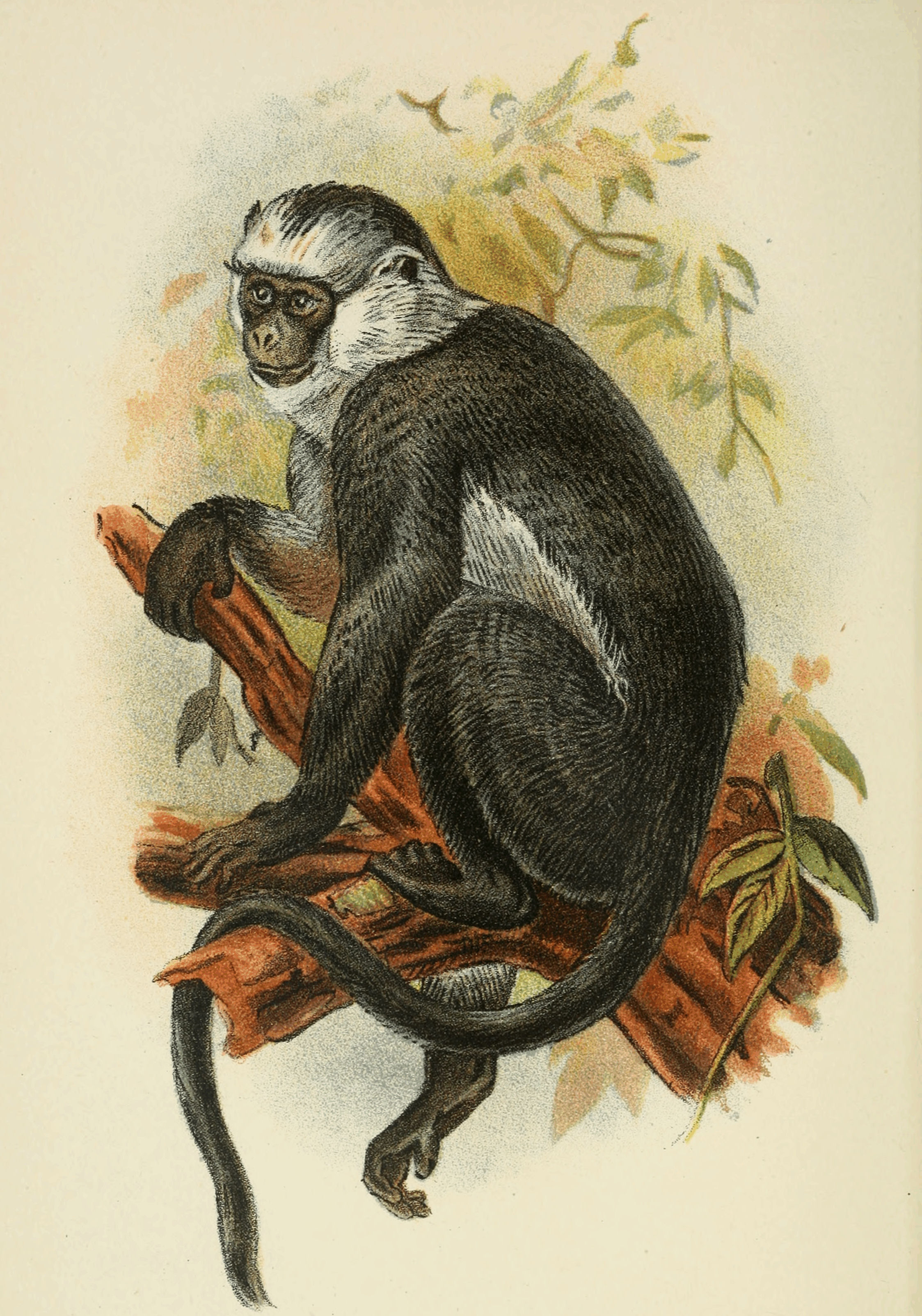
HOSE'S LANGUR.
Characters.—Allied to S. hosii, S. everetti, and S. thomasi. Body, tail, and limbs grey; forehead with a high vertical median crest, commencing on the brow, black, with some white hairs; superciliary bristles long, black, projected forward over the eyes; hairs of the forehead on each side of the crest, flat against the head, white over the whole crown (with a few black hairs), but darker tipped on the back of the head; sides of the face from the orbits to the ears quite black; occipital hairs directed backward, not forward as in S. thomasi. Chin, sides of neck, throat, and chest greyish, not white as in the allied species. Under side of the body and inner side of the upper arms, and the legs to the ankles white, becoming greyer distally; hands and feet shining black; fore-arms to the wrists, and legs to the ankles, grizzled grey, as also the tail, above and below. Skin of face probably flesh-coloured between and across the orbits and round the cheeks, elsewhere black. Length of body, 23½ inches; tail, 30 inches.
Cranium broader and rounder than in the allied species; the ascending process of the maxillary bones articulating with the frontals, shutting out the former bones from the side of the nasals. In the allied species the skin of the face is nearly, or quite, black all over, and the chin, sides of the neck, the throat, and the chest are pure white.
Distribution.—Paitan, N. Borneo. Discovered by the veteran Bornean traveller Alfred Everett.
X. HOSE'S LANGUR. SEMNOPITHECUS HOSII.
(Plate XXXV.)
Semnopithecus hosii, Thomas, P. Z. S., 1889, p. 159, pl. xvi.; Hose, Mamm. Borneo, p. 10 (1893).
Characters.—Crown with a longitudinal central crest, the hairs sloping evenly backward, with no reversed tuft of hair on the back of the head; general colour of back, shoulders, outer sides of limbs, and tail (though darker above than below) hoary grey, the hairs being commingled black and white; crest, centre of crown, and nape deep glossy black; all the rest of the head, forehead, temples, sides of crown and neck, cheeks, lips, septum of nose, tufted chin, front of neck, chest, under side of body and the inside of the limbs as far as the middle of the fore-arm and lower leg pure white; hands and feet deep black; face black.
Nasal bones long and thin, the profile quite straight and continuous with the line of the forehead. Length of body, 20½ inches; of tail, 26¼ inches. (Thomas.)
This handsome species differs from all known Semnopitheci in the marked contrast in colour presented by its black crest and white forehead and cheeks.
Distribution.—Niah, in the Baram district; Mount Dulit, Mount Batu Song: all in Sarawak, Borneo.
Habits.—"The type of this Monkey—the Bangat of the Kayans—was shot," writes Mr. Charles Hose (after whom the species is named), "at a place called Niah, in the Baram district. I have procured several specimens in different parts of the country, but although it is often seen in the low country, I think we must consider it to be a mountain species, which leaves the mountains at certain times in search of fruit. It ascends Mount Dulit to the height of 4,000 feet, but is more common at 2,000 feet. It frequents the salt-springs, which are common in the interior, churning up the mud, and it is at these salt-springs that the Punans procure numbers of specimens with the blow-pipe and poisoned arrows. From this Monkey the Bezoar stones are obtained, being found either in the gall bladder or the intestines. The noise that the animal makes is loud and distinct—Gagah, gagah. The young resemble the colour of the adult, and are exceedingly pretty little things, but they do not live long in confinement, and would never bear a voyage to England, as they suffer severely from sea-sickness."
XI. THOMAS'S LANGUR. SEMNOPITHECUS THOMASI.
Semnopithecus thomasi, Collett, P. Z. S., 1892, p. 613, pl. xlii.
Description.—A central occipital crest sloping at first backwards, reversed on the back of the head, black on the crown; with a lower indistinct crest on each side of the white forehead. General colour above dark grey—each hair being partly black and partly white; underneath, white; a black stripe from the upper jaw to the ear, and a black central stripe on the forehead; hands and feet black. (Collett.)
Very old males are darker in colour, with the upper part of the head brownish-black, the front whitish. Old females are smaller; the young are silky and nearly white all over.
Closely related and very similar to S. hosii, but the cheeks do not form a connected white area with the white forehead, the space being broken by a black band from the edge of the mouth to the ear (in the young male and in the female). In the old male the upper parts of the cheeks are quite black. Length of body, 24½ inches; tail, about 32 inches.
Distribution.—The present species was discovered in the Langkat district in the North-east of Sumatra, by Mr. Iversen, a Norwegian traveller in that island, and is named after Mr. Oldfield Thomas, the well-known Mammalogist of the British Museum.
Habits.—These Monkeys live in small companies composed of both sexes, in the highest trees in dry spots of the forest, never descending of their own accord to the ground, nor visiting the rice-fields, as their food appears to consist exclusively of fruits. They may be met with, according to Mr. Iversen, the discoverer of this species, at all seasons of the year in the same parts of the forest. They hardly ever visit the more open places, but keep to the highest tree-tops, and make most astonishing leaps from one branch to another. Those observed were very shy, and, on being perceived, would seek to hide in the leafy tops of the trees, even leaving their young exposed on the lower branches. The mother carries her young one under her belly. The species was often observed in company with the Siamang (Hylobates syndactylus), but not with other Monkeys.
XII. EVERETT'S LANGUR. SEMNOPITHECUS EVERETTI.
Semnopithecus everetti, Thomas, P. Z. S., 1892, p. 582, pl. xli.; Hose, Mamm. Born., p. 15 (1893).
(Plate XXXVI.)
Characters.—Very closely allied and very similar to S. hosii in size and coloration, but the white is everywhere replaced by dull cream-colour, giving a yellowish wash to the mixed grey of the back and tail; shoulders and middle of back darker; under surface of body and light parts of head cream-colour, instead of white; whole of the forehead and top of the head black, the lower limit of the black passing across the middle of the ear; entire back of neck black; spot in the centre of the forehead above where the eyebrows meet, yellowish-white. The colour of the face, cheeks, and sides of the neck, in contrast to the dark crown, distinguish this species from S. chrysomelas. Length of body, 21¾ inches; of tail, 25¾ inches. (Thomas.)
"Since Mr. Thomas described this Monkey," writes Mr. C. Hose in his "Mammals of Borneo," "I have obtained several other specimens, ... and the marking is quite constant."
PLATE XXXVI.
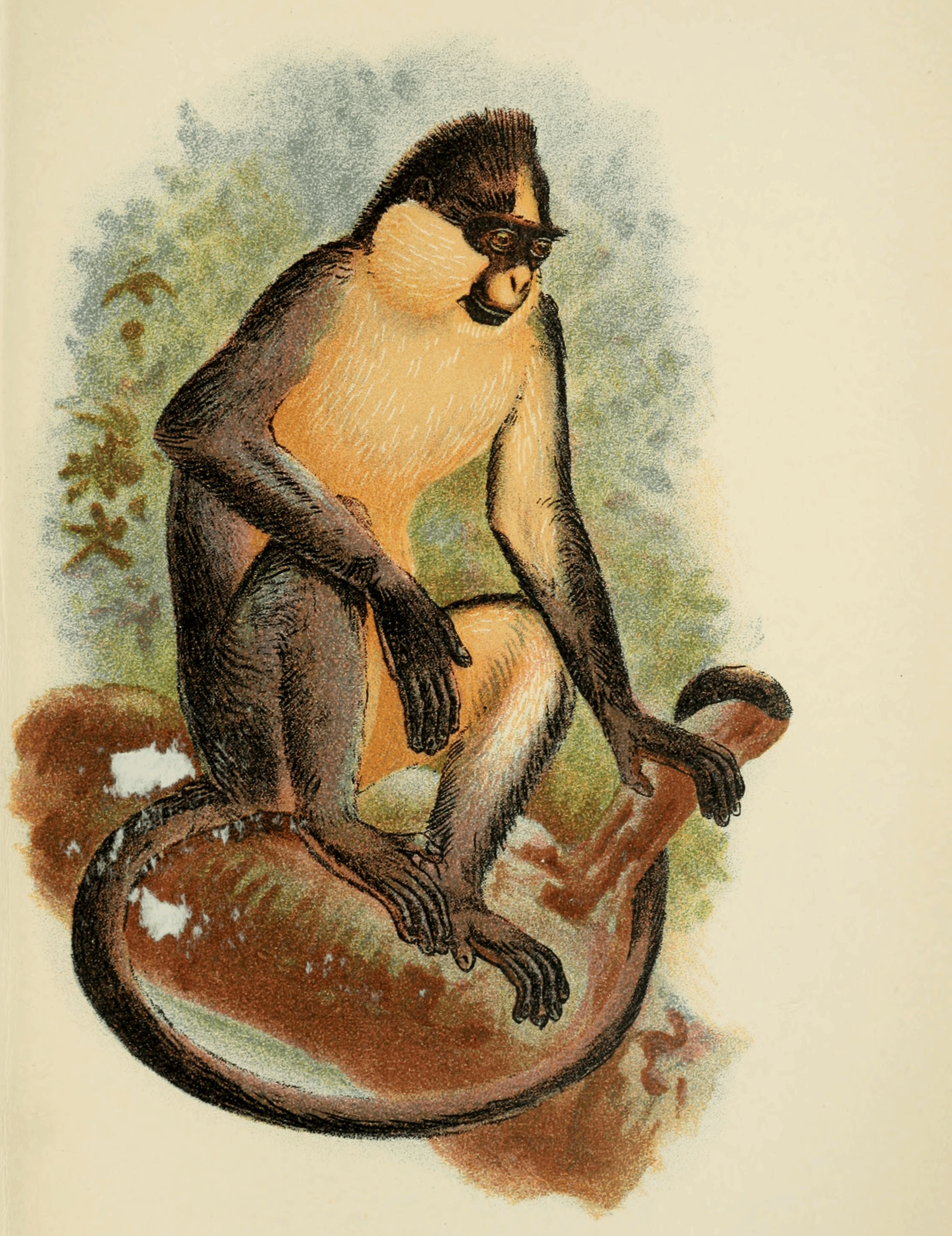
EVERETT'S LANGUR.
Distribution.—Borneo: Mount Kina Balu. Mount Dulit and Mount Batu Song in Sarawak, ranging from 3,000 to 3,500 feet above the sea.
Habits.—This species is a purely mountain form, and does not descend to the plains.
XIII. THE CROSS-BEARING LANGUR. SEMNOPITHECUS CRUCIGER.
Semnopithecus cruciger, Thomas, Ann. N. H. (6), x., p. 475 (1892); id., P. Z. S., 1893, p. 3; Hose, Mamm. Borneo, P. 15 (1893).
Characters.—Fur long and soft on the head and shoulders; hairs of the crown standing upright everywhere, but somewhat longer in the median line; crown chestnut; sides of the body from the axillæ, the haunches, and the outer aspect of the legs to the ankles, brilliant red, paler on the lower legs; shoulders and outer side of the fore-limb, the hands, nape, and median dorsal line, deep glossy black, sometimes broken with red and black hairs; eyebrows black; short facial hairs, whiskers, hair of the ears, the sides of the neck, chin, and the whole of the under side of the body, and lines down the inner sides of the limbs, glossy white, washed with yellow; tail at the base above, black, and duller at the tip.
The young are marked like the adults.
Distribution.—Borneo; Bakam, in the Baram district of Sarawak, where it was discovered by Mr. Charles Hose. He has since obtained it on the Batang Lupar river, in Western Sarawak.
XIV. THE URSINE LANGUR. SEMNOPITHECUS URSINUS.
Presbytis ursinus, Blyth, J. A. S. Beng., xx., pp. 155, 182 (1851); id., Cat. Mamm. As. Soc. Mus., p. 13 (1863); Kelaart, Prod. Faun. Zeylan., p. 2 (1852).
Semnopithecus ursinus, Anderson, Rep. Zool. Res. Exped. Yun-nan, p. 24 (1878); Blanford, Faun. Brit. Ind. Mamm., p. 36 (1891).
Characters.—Very nearly allied to S. cephalopterus, but larger; hair on the sides very long. Hair more rufous on the top of the head; the back of the head greyish; the lower back and thighs wanting the grey colour; whiskers, beard, throat, and chest, whitish; beneath, of the same colour as the back.
Distribution.—The island of Ceylon, where it is confined to the mountains.
Habits.—For an account of the habits of this species, we have again recourse to the pages of that delightful historian, Sir E. Tennent:—
"The low-country Wanderoo," he records, "is replaced in the hills by the larger species, P. ursinus, which inhabits the mountain zone. The natives, who designate the latter the 'Maha,' or Great Wanderoo, to distinguish it from the 'Kaloo,' or black one, with which they are familiar, describe it as much wilder and more powerful than its congener of the lowland forests. It is rarely seen by Europeans, this portion of the country having, till very recently, been but partially opened; and even now it is difficult to observe its habits, as it seldom approaches the few roads which wind through these deep solitudes. At early morning, ere the day begins to dawn, its loud and peculiar howl, which consists of a quick repetition of the sounds 'How, how!' may be frequently heard in the mountain jungles, and forms one of the characteristic noises of these lofty situations. It was first captured by Dr. Kelaart in the woods near Nuera-ellia, and from its peculiar appearance it has been named P. ursinus by Mr. Blyth."
XV. THE DUSKY LANGUR. SEMNOPITHECUS OBSCURUS.
Semnopithecus obscurus, Reid, P. Z. S., 1837, p. 14; Martin, Mammif. An., p. 486 (1841); Murie, P. Z. S., 1865, p. 742; Gray, Cat. Monkeys Brit. Mus., p. 14 (1870); Schl., Mus. Pays-Bas, vii., p. 49 (1876); Anders., Zool. Res. Yun-nan Exped., p. 25 (1878; with full synonymy); Thomas, P. Z. S., 1886, p. 66; Blanford, Faun. Brit. Ind., Mamm., p. 41 (1891).
Semnopithecus leucomystax, Müll. and Schl., Verhandl., p. 59 (1839-44).
Semnopithecus albocinereus, Less., Sp. Mammif., p. 65 (1840).
Presbytis obscura, Gray, Hand. List Mamm. Brit. Mus., p. 3 (1843); Blyth, J. A. S. Beng., xiii., p. 467 (1844).
Semnopithecus halonifer, Cantor, Proc. Linn. Soc., 1845, p. 235.
Characters.—Hair on crown not radiating; longer at the back, forming a tuft of yellowish-white. Body blackish-brown, darker on the forehead, sides of face, sides of body and limbs; hands and feet black; nape of neck, and along the middle of back, brownish; tail brownish, not tufted; under surface and inside of limbs not so dark as the back or sides; face black, but the mouth and eyelids whitish; length of body, 21 inches; of tail, 32 inches.
Female.—Slightly browner than the male.
Young.—Bright golden-red, but very soon changing to the colour of the adult.
Mr. Thomas mentions (P. Z. S., 1886, p. 66) a very remarkably coloured individual, differing from all others in having its crest, nape, arms, legs, and tail, yellow, contrasting markedly with the dark hues of the face, body, and feet. It is, however, approached by a specimen in the British Museum from Malacca, collected by Dr. Cantor, which has the crest yellow, and the limbs and tail lighter than usual. Its auditory bullæ, however, are larger and more projecting, and its teeth smaller than is usually the case with S. obscurus.
Distribution.—Siam; the Malayan Peninsula; Tenasserim, Mt. Mooleyit, at 5,000 feet.
XVI. ANDERSON'S LANGUR. SEMNOPITHECUS HOLOTEPHREUS.
Semnopithecus holotephreus, Ander., Zool. Res. Exped. Yun-nan, p. 27 (1878).
Characters.—"Uniform dark slaty-grey passing into black on the fore-arm and hands, and also on the feet. Under surface and inner side of the fore-limbs and thighs, pale yellowish-grey. Head slightly crested over the vertex, but with only a feeble tendency to lateral compression. Supra-orbital hairs moderately long and black. Whiskers rather long, directed backwards and outwards, hiding the ears in front. Face bluish-black; area round the eyes and lips white. Length of body, 21½ inches; tail, 24½ inches." (Anderson.)
Distribution and Habits.—Unknown.
XVII. GERMAIN'S LANGUR. SEMNOPITHECUS GERMAINI.
Semnopithecus germaini, Milne-Edwards, Bull. Soc. Philom., Séance, 12, Feb., 1876; Anderson, Zool. Res. Exped. Yun-nan, p. 27 (1878); Schl., Mus. Pays-Bas, vii., p. 34 (1876).
Characters.—Body blackish, washed with pale silvery-grey; hands and feet black. Supra-orbital hairs, projecting outwards and backwards, black; whiskers, long and grey; hairs of flanks, long and grey; tail, grey; under surface, grey.
Young.—"Bright orange-yellow; top of head, fore-arm, and feet, blackish." (Anderson.)
Distribution.—Cochin-China, where it was discovered by M. Germain.
XVIII. THE NEGRO LANGUR. SEMNOPITHECUS MAURUS.
Simia maura, Schreber, Säugeth., i., p. 107, pl. xxii. B. (1775); Shaw, Gen. Zool., i., p. 47 (1800).
Cercopithecus maurus, Erxleben, Syst. Régn. Anim., p. 41 (1777).
Simia cristatus, Raffles, Tr. Linn. Soc., xiii., p. 245 (1822).
Semnopithecus maurus, F. Cuv., Hist. Nat., Mamm., pl. xii. (1822); Wagner, in Schreber, Säugeth. Suppl., v., p. 23 (1855); Gray, Cat. Monkeys Brit. Mus., p. 15 (1870); Schl., Mus. Pays-Bas, vii., p. 54 (1876); Anderson, Zool. Res. Exped. Yun-nan, p. 27 (1878; with full synonymy).
Semnopithecus pyrrhus, Horsfield, Zool. Res. Java, plate (1821); Schl., Mus. Pays-Bas, vii., p. 50 (1876).
Semnopithecus pruinosus, Desmar., Mammolog., 1820, Suppl., p. 333; Schl., Mus. Pays-Bas, vii., p. 58 (1876); Jentink, Notes Leyd. Mus., xi., p. 215, pl. ix. (1887); id., op. cit., xiii., p. 207 (1891).
Simia ceylonicus, Desmoul., Dict. Class. Hist. Nat., vii., p. 572 (1825).
Semnopithecus cristatus, Müll., Tijds. V. Nat. Gesch., ii., p. 316 (1835); Müll. et Schl., Verhandl., pp. 61, 77, pl. 12, fig. 1 (young; 1839-44); Gray, Cat. Monkeys Brit. Mus., p. 15 (1870); Anderson, Zool. Res. Exped. Yun-nan, p. 29 (1878); Hose, Mamm. Borneo, p. 15 (1893).
Characters.—Hair radiating from a centre, or divergent all round the face, which is reddish-black; long and bushy whiskers on the sides of the face and passing behind the ears. Hair generally long. General colour all over, deep black, the hairs tipped with silver-grey in aged individuals; spot at the under side of the base of the tail white. Length of body, 17½ inches; of tail, 23½ inches.
Young.—Uniform reddish-brown, changing soon to the colour of the adult; the rufous vanishing from the whiskers last of all. The colour of the young is said especially to be the case in females only, and to persist through life; but, as Dr. Anderson remarks, it is not a common variety, and such coloured adults are highly prized in Java.
Distribution.—Malay Peninsula. Sumatra; Padang, Bencoolen, the Lampongs. Java. Billiton. Borneo; on the Baram river, and also on Mt. Dulit.
Habits.—These Monkeys ascend the mountains in Borneo to about 2,000 feet; they are also fairly common in the low country, and are called by the Dyaks "Bigok," and by the Kayans "Chikok," from the noise they make. (C. Hose.)
XIX. THE BANDED LANGUR. SEMNOPITHECUS FEMORALIS.
Simia maura, Raffles (nec. Schreb.), Tr. Linn Soc., xiii., p. 247 (1822).
Semnopithecus femoralis, Horsf. App. Life Raffl., p. 643 (1830); Martin, Mammif. An., p. 480 (1841; in part); Horsf., Cat. Mamm. E. I. Co. Mus., p. 10 (1851); Schl., Mus. Pays-Bas, vii., p. 45 (1876); Anderson, Zool. Res. Exped. Yun-nan, p. 30 (1878; with full synonymy); Thomas, P. Z. S., 1886, p. 66; Blanford, Faun. Brit. Ind., Mamm., p. 42 (1891); Hose, Mamm. Borneo, p. 13 (1893).
Semnopithecus chrysomelas, Müll. Tijds., Nat. Ges., v., p. 138, plate (1838); Wagner, in Schreb., Säugeth. Suppl., v., p. 22 (1855; in part).
Semnopithecus sumatranus, Müll. und Schl. Verh., pp. 6, 73, pl. 10 bis, fig. 1 (1839-44).
Simia femoralis, Cantor, J. A. S. Beng., xv., p. 175.
Characters.—Head with a rather short vertical crest directed backward, and the hair in front directed forward over the eyes. The dominant colour is brownish-black, replaced by white on the hinder part of the belly and tail, which is slightly tufted at the tip, and more or less on the inner side of both limbs, and on the centre of the chest. Face, ears, palms, and the sides of the feet, black.
Young.—Similar to the adults, but the throat, chest, abdomen, yellowish-white.
Distribution.—The islands of Sumatra and Borneo.
Habits.—This is a low-country Monkey, according to that excellent observer Mr. C. Hose, and is seldom to be found on the mountains, and then only up to about 1,000 feet. It is fond of living near the seashore, and is generally found, in numbers of from ten to thirty, sitting on the branches of tall trees in open spaces. Its Dyak name is "Bigit," and its Kayan name "Pant."
Very nearly related to this species, if indeed it be really distinct, is the GOLDEN LANGUR, or Lootoong of the Malays, S. auratus, Geoffr. (Ann. Mus., xix., p. 93, 1812), which is synonymous with the S. chrysomelas of Wagner, for the two agree in every respect except that the latter is lighter coloured, and has black hairs intermixed among the yellowish hairs on its head, tail, and limbs.
Professor Schlegel has (Mus. Pays-Bas, vii., p. 47) separated a specimen from Singapore, and closely related to S. femoralis, as a distinct species, under the name of S. neglectus. It is easily distinguished, as he points out, by the general hue of its fur being black turning insensibly into greyish-brown, speckled here and there with white; in the middle line of the chest, on the lower belly, and on the inner side of the fore-arm, and thighs alone, is there any white; this and the uniformly dark tail distinguish S. neglectus from S. femoralis and S. chrysomelas.
XX. THE MAROON LANGUR. SEMNOPITHECUS RUBICUNDUS.
Semnopithecus rubicundus, Müller, Tijdschr., Nat. Gesch., v., p. 137, cum tab. (1838); Martin, Mammif. An., p. 473 (1841); Gray, Cat. Monkeys Brit. Mus., p. 17 (1870); Anderson, Zool. Res. Exped. Yun-nan, p. 33 (1878; with synonymy); Schl., Mus. Pays-Bas, vii., p. 36 (1876); Hose, Mamm. Borneo, p. 9 (1893).
Characters.—Differs from S. rubicundus in its rich deep maroon-red colour, the radiating hair on the forehead, and its compressed, semi-erect, crest. As Dr. Anderson points out, it is the only species with radiating hair on the forehead.
Habits.—Mr. Hose observes: "This handsome red Monkey is called by the Dyaks of Sarawak, 'Jellu merah,' and by the Kayans 'Kaladi,' and is common everywhere. It is usually seen in large numbers, and some thirty or forty often pass one in the jungle, darting from branch to branch and making a tremendous noise. They will sometimes, when barked at by a dog, attack it and inflict a very bad bite. They ascend the mountains to the height of 3,000 feet; but at that height the colour of their hair becomes of a much deeper red. They are very destructive in the fruit gardens."
XXI. THE NATUNA LANGUR. SEMNOPITHECUS NATUNÆ.
Semnopithecus natunæ, Oldfield Thomas and Hartert, Nov. Zool. i., p. 652 (1894).
Characters.—Adult Male.—Size, proportions, and coloration showing a general resemblance to the S. femoralis group, the prevailing colours being black and white. While, however, the forehead, the fore-arms and hands, lower legs and feet, and tail (both above and below) are all deep glossy black, the back itself, with the occiput, nape, and shoulders, is brown. Thighs along a narrow strip on their outer aspect, ashy grey, darkening distally into the black of the lower legs, but their posterior aspect, continuous with their inner sides, is perfectly white, giving a very peculiar and characteristic appearance to the animal, and one which is quite unlike any species known to us, with the one exception that M. siamensis has whitish patches in somewhat the same position. Whole of under surface, with the sides of the neck, the hairs on the inside of the ears, and lines down the inner sides of the arms and legs, pure creamy white. Face thinly haired throughout, the hairs black, except those on the nose, where there is a whitish patch. Forehead with the hairs radiating outwards and backwards from a single central point about half or three-quarters of an inch behind the eyebrows; posteriorly these hairs are much lengthened, as are those on the occiput, the latter being directed forwards and upwards in such a way that the black hairs of the forehead and the brown ones of the occiput meet to form a high crest on the crown. (Oldfield Thomas and Hartert, l.c.).
Young.—Messrs. Oldfield Thomas and Hartert describe a new-born specimen as follows: "Middle line of dorsal surface from crown to anus, and whole of tail, deep black, the breadth of the black on the back being about an inch and a half; the outer sides of the shoulders greyish, and also the backs of the hands and feet commencing to become black. The whole of the rest of the animal, including the forehead, arms, and legs, wholly pure white."
"Although among the many closely allied species of Semnopithecus it is difficult to be at all sure of their mutual affinities, it would seem that S. natunæ is most nearly related to S. femoralis, Horsf., and S. siamensis, M. and S. Both of these have a similar arrangement of the hairs on the crown and nape; and, on the other hand, the former possesses the wholly black hands, feet, and tail of S. natunæ, and to a certain extent the browner tint of the back, while, on the other, S. siamensis has its whitish under side and light thigh-patch, although united with a widely different coloration."
Habits.—Mr. Everett gives the following note: "Native name 'Kĕkáh,' which is onomatopœic. These animals were common about the base of Mount Ranai, going in troops, and they commit great depredations on the native gardens. The irides are light cinnamon-brown; face livid black, the eyelids and muzzle, white; feet and hands very dark brown; the ears blackish externally, the outer edge and interior dull white, marbled to some extent with livid blackish spots. In an immature individual, barely half-grown, the white of the eyelids, nose, and chin was tinged with dull pink; and at the exterior angle of each orbit was a bare spot of bluish-white, showing very distinctly, owing to its different tinge of colour, the skin of the face otherwise being livid black. With maturity these naked white spots at the angle of the orbits disappear. I kept this animal alive, intending to bring it home, but it succumbed to the severity of our return passage. It fed on the leaves of sweet potatoes and tapioca, and, although it had been recently captured, in a few days it was very gentle and timid. The breeding-season with these Monkeys is either very prolonged, or is not defined at all, for I obtained them in October, when the rains were beginning, in all stages, from a fœtus three inches long, to half-grown specimens."
XXII. PHAYRE'S LANGUR. SEMNOPITHECUS PHAYRII.
Semnopithecus obscurus (nec Reid), Blyth, J. A. S. Beng., xiii., p. 466 (1844).
Presbytis phayrei, Blyth, op. cit., xvi., p. 733, pl. xxxvii., fig. 3 (1847); Wagner in Schreb. Säugeth. Suppl. v., p. 28 (1855); Tickell, J. A. S. Beng., xxviii., p. 428 (1859).
Semnopithecus argentatus, Blyth in Horsf. Cat. Mamm. E. I. Co. Mus., p. 7 (1851).
Presbytis cristatus, Raffl. apud Blyth, Mamm. Burma, p. 9 (nec Raffles).
Semnopithecus rubicundus, var. C., Gray, Cat. Monkeys Brit. Mus., p. 17 (1870).
Semnopithecus phayrei, Anderson, Zool. Res. Exped. Yun-nan, p. 34 (1878); id., Cat. Mamm. As. Soc. Beng., p. 49; Schl., Mus. Pays-Bas, vii., p. 33 (1876); Blanford, Faun. Brit. Ind., Mamm., p. 39 (1891).
Characters.—Top of the head with a peaked longitudinal crest; hair of crown not radiating, but elongated and directed backward; whiskers long and outwardly directed, partly covering the ears; back, sides, fore-arm, hands and fore part of the feet blackish-brown, the middle of the back washed with yellowish; the chin, chest, and under surface of the body pale yellow; inside of the fore-arm and thighs brown; face livid, but the eyelids, lips, and a ring round the eyes, white, flushed with flesh-colour; length of body, 18½ inches; tail, 21½ inches.
Supra-orbital ridges of the skull not prominent, the occipital region vertical; facial region sloping downward.
The Babu Ram Bramha Lányal, writing in July, 1893, from the Zoological Gardens, Calcutta, to Dr. Sclater, says: "I am not aware whether closely allied species of Semnopitheci have ever inter-bred anywhere. They are rather exclusive in their ideas in respect to matrimonial relationship. Anyhow, such an event has just happened in this Garden. The Phayre's Langur, or as it is often called, Phayre's Leaf Monkey (Semnopithecus phayrii, Blyth) has given birth to a young one—a lovely little babe, of a delicate light orange colour. As there has been no other male in the same cage except the S. cristatus, there is no doubt of the young one being a hybrid between these two species. These Monkeys have been living together since 1880, and although they agreed very well, they were never observed to be over friendly. Even now the male does not appear to take any interest in the offspring."
Distribution.—Confined, as far as is known, to Aracan.
XXIII. RUTLEDGE'S LANGUR. SEMNOPITHECUS RUTLEDGII.
S. rutledgii, Anderson, Zool. Res. Exped. Yun-nan, p. 38 (1878).
Characters.—Head with a very well-defined erect median compressed crest; frontal hairs not projecting over the face. General colour black, the hairs tipped with lustrous grey on the head, crest, trunk, and limbs. Hands and feet black. Under surface paler and the hairs more tipped with grey; tail black above, yellow below, tipped with grey; whiskers long, backwardly and upwardly divided, and broadly tipped with yellowish-grey; beard greyish; face bluish-black. Length, 17 inches; tail, 24½ inches. (Anderson.)
Distribution and Habits.—Unknown.
XXIV. THE WHITE-FRONTED LANGUR. SEMNOPITHECUS FRONTATUS.
Semnopithecus frontatus, Müll., Tijds., Nat. Ges., v., p. 136, pls. i. and ii. (1838); Martin, Mammif. An., p. 475 (1841); Gray, Cat. Monkeys Brit. Mus., p. 16 (1870); Schl., Mus. Pays-Bas, vii., p. 34 (1876); Anderson, Zool. Res. Exped. Yun-nan, p. 39 (1878; with full synonymy); Hose, Mamm. Borneo, p. 12 (1893).
Characters.—General colour dark yellowish-brown, with a wash of red on the flanks in some specimens; the tail tufted. This species is at once recognised by the bald triangular wrinkled area between the eyebrows, of a milky-white colour, the rest of the face being deep black, except the flesh-coloured lips. It is also remarkable for the erect median crest over-arching the forehead; and by the long dependent black hairs on the cheeks from near the nose, increasing in length on the hindmost part of the cheek, and reaching nearly to the shoulder.
The skull has a highly arched, narrow and retreating forehead; the facial portion is short.
Distribution.—South-east Borneo, where it is very rare.
XXV. THE DOUC LANGUR. SEMNOPITHECUS NEMÆUS.
Simia nemæus, Linn., Mantiss. Plant., p. 521 (1771); Schreber, Säugeth., i., p. 110, pl. xxiv. (1775).
Cercopithecus nemæus, Erxl., Syst. Règn. An., p. 42 (1777); Kuhl, Beitr. Zool., p. 8 (1820).
Pygathrix nemæus, Geoffr., Ann. Mus., xix., p. 90 (1812).
Lasiopyga nemæus, Desm., Mamm., p. 54 (1820); Gray, Cat. Monkeys Brit. Mus., p. 13 (1870).
Semnopithecus nemæus, F. Cuv., Hist. Nat. Mamm., livr. 14 (May, 1825); Martin, Mammif. Anim., p. 459 (1841); Wagner in Schreb. Säugeth. Suppl. v., p. 35 (1855); Schl., Mus. Pays-Bas, vii., p. 64; Anderson, Zool. Res. Exped. Yun-nan, p. 40 (1878; with full synonymy).
Presbytis nemæus, Blyth, J. A. S. Beng., xliv., p. 11 (1875).
Characters.—Head without a crest. The naked face, the callosities, and the naked portions of the hands and feet yellow; head brown, with a narrow band of chestnut passing under the ears backwards, and a second but broader one, margined with black, across the chest, from shoulder to shoulder; whiskers long and directed backwards, pale grey—the hairs ringed with black and white; upper surface of the body and sides grey; base of the neck, chest, and shoulders as well as the upper part of the fore- and hind-limbs, with the hand and feet, black; the forehead paler; the fore-arm to the middle of the hands, the rump, posterior region of the loins, and the tail pure white; the lower portion of the hind-limbs to the middle of the feet reddish-brown. Tail shorter than the body. Length of body, 25 inches; of tail, 20½ inches.
In the skull the forehead is low, the intra-orbital region broad and the facial portion broad at the base. (Anderson.) The thumb is well developed. The fœtus is remarkable for its motley coloration, and shows also the white rump-spot.
Female.—Like the male. The young differ but little from the parents. Aged individuals retain the coloration of their maturity.
Distribution.—Northern Cochin-China; Hainan. (Meyer.)
Habits.—The Douc goes about in large troops.
XXVI. THE BLACK-FOOTED LANGUR. SEMNOPITHECUS NIGRIPES.
Semnopithecus nigripes, A. Milne-Edwards, Nouv. Arch. Mus. vi., p. 7 (1871); Schl., Mus. Pays-Bas, vii., p. 32 (1876); Anderson, Zool. Res. Exped. Yun-nan, p. 4 (1878).
Characters.—Similar to S. nemæus, but differing in having the posterior limbs black, and the fore-arms grizzled, instead of white. The whiskers are short and black, the body more slender, longer, and entirely white. The hind-limbs are also more elongated. Both sexes are alike; and the young differ little from the adults.
The brain-case is depressed, the face short, and the inter-orbital swelling peculiar to so many of the crested Semnopitheci, is wanting.
Distribution.—Saigon in Cochin-China, and the forests bordering the Mekong river towards its mouth.
XXVII. THE BLACK-CRESTED LANGUR. SEMNOPITHECUS MELANOLOPHUS.
Simia melalophus, Raffles, Tr. Linn. Soc., xiii., p. 244 (1821).
Semnopithecus melalophus (Le Cimepaye), F. Cuv., Hist. Nat., Mammif., livr. xxx. (July, 1821); Raffles, Tr. Linn. Soc., xxii., p. 245 (1822); Desmar., Dict. Sc. Nat., xlviii., p. 38 (1827); Martin, Mammif. Anim., p. 470 (1841); Geoffr., Cat. Méth. Primates, p. 16 (1851); Gray, Cat. Monkeys Brit. Mus., p. 16 (1870); Schl., Mus. Pays-Bas, vii., p. 43 (1876; in part); Anders., Zool. Res. Exped. Yun-nan, p. 34 (with full synonymy; 1878).
Semnopithecus flavimanus, Lesson, Cent. Zool., p. 109, pl. xl. (1830); Is. Geoffr., Cat. Méth. Primates, p. 16 (1851).
Semnopithecus sumatranus, var. auratus (nec Geoffr.), Müller and Schl. Verhandl., pl. x. bis, fig. 2 (1839-44).
Presbytes melanophus, Gray, Hand. List Mamm. Brit. Mus., p. 2 (1843).
Presbytes flavimana, Gray, t.c., p. 2 (1843).
Semnopithecus nobilis, Gervais, Hist. Nat., Mammif., p. 63 (1854); Gray, Cat. Monkeys Brit. Mus., p. 17 (1870).
Semnopithecus ferrugineus, Schl., Mus. Pays-Bas, vii., p. 42 (1876).
Characters.—Head crested; the crest dark-brown, tipped with dusky; forehead pale yellow; a line from the outer corner of the eye to the ear, dark brown; back, sides, and shoulders reddish, washed with pale brown; the rest of the fore-limbs, the whole of the hind-limbs, and the tail, orange-red. Length of body, 18 inches; of tail, 32 inches.
The golden variety (S. auritus) from Sumatra, is generally yellowish-red throughout.
The skulls present a good deal of variation in the form of the internal orbital angles of the frontal, and in the occipital, bones.
Distribution.—Sumatra: Padang, Indrapoera, Bencoolen, Palembang, and the Lampongs.
Habits.—The "Simpai," as the Malays call this Langur, is very abundant in Sumatra, where the present writer has obtained it both in the north of the Palembang Presidency and in the south of the Lampongs. It is undoubtedly in part to this species that Dr. Wallace refers in his "Malay Archipelago," when, at Lobo Raman, he says that they frequented the trees overhanging the guard-house in which he was staying. "Two species of Semnopithecus were most plentiful—Monkeys of a slender form and long tails. Not being much shot at, they are rather bold, and remain quite unconcerned when natives alone are present, but when I came out to look at them, they would stare for a minute or two and then make off. They take tremendous leaps from the branches of one tree to those of another a little lower, and it is very amusing when one strong leader takes a bold jump, to see the others following with more or less trepidation; and it often happens that one or two of the last seem quite unable to make up their minds to leap till the rest disappear, when, as if in desperation at being left alone, they throw themselves frantically into the air, and often go crashing through the slender branches and fall to the ground."
XXVIII. THE MITRED LANGUR. SEMNOPITHECUS MITRATUS.
Presbytis mitrata, Escholtz, in Kotzeb. Reis., p. 196, cum tab. (1821).
Semnopithecus comatus, Desmar., Mamm. Suppl., p. 533 (1822); Martin, Mammif. Anim., p. 468 (1841); Wagner in Schreber Säugeth. Suppl. v., p. 24 (1855).
Semnopithecus fulvo-griseus, Desmoul., Dict. Hist. Nat., vii., p. 570 (1825).
Semnopithecus fascicularis, Owen, P. Z. S., 1833, p. 75.
Semnopithecus mitratus, Schl., Essai Phys. Serp., p. 237 (1837); Geoffr., Cat. Méth. Primates, p. 16 (1851); Gray, Cat. Monkeys Brit. Mus., p. 16 (1870); Schl., Mus. Pays-Bas, vii., p. 37 (1876); Anders., Zool. Res. Exped. Yun-nan, p. 36, (1878; with full synonymy).
Semnopithecus siamensis, Müll. u. Schl., Verh., p. 60 (1841); Anders., t.c., p. 37 (with synonymy).
Semnopithecus albo-cinereus, Blyth, J. A. S. Beng., xii., p. 175 (1843); Schl., Mus. Pays-Bas, vii., p. 38 (1876).
Presbytes argentatus, Blyth; Horsf. Cat. Mamm. E. I. Co. Mus., p. 7 (1851).
Semnopithecus nigrimanus et S. cinereus, Mivart, P. Z. S., 1864, pp. 625, 626.
Presbytes cristatus (nec Raffles) et P. melanolophus, Blyth, Mamm. Burma, p. 9 (1875).
Characters.—Head with a compressed blackish crest; hairs radiating from the forehead over the eyes; crown above grey, mingled with black, becoming black on the front of the crest and nape of the neck; flanks, under surface of the body and tail, as well as the inner side of the limbs, dirty white; hands and feet whitish, mixed with black or reddish hairs; upper surface of the tail dark grey, the tip paler and tufted; ears and face deep black; legs flesh-coloured; chin and throat white. Length of body, 20½ inches; of tail, 28½ inches.
The hind-most lower molar has generally only four tubercles.
The variety of this species inhabiting Siam has a fleshy-white area round the eyes and mouth.
Distribution.—Siam; the Malay Peninsula; and Sumatra.
XXIX. THE MOUPIN LANGUR. SEMNOPITHECUS ROXELLANÆ.
Semnopithecus roxellanæ, A. Milne-Edwards, C. R., lxx., p. 341 (1870); Schl., Mus. Pays-Bas, vii., p. 65 (1876).
Rhinopithecus roxellanæ, id., Rech., Mammif., p. 233, pls. xxxvi., xxxvii. (1868-1874); Blyth, Mamm. Burm., p. 11 (1875).
Semnopithecus (Nasalis) roxellanæ, Anders., Zool. Res. Exped. Yun-nan, p. 43 (1878).
Characters.—Face naked, nose depressed in the middle, the tip elevated and terminating in a singular leaf-like point; sides of the face and brows clothed with a thick ruff, which extends in a line across the face towards the nose; face green; the frontal region, sides of the face, auricular region, sides of the neck and shoulder, chin, chest, inner side of the fore-limbs, and upper aspect of the feet, yellow; top of head greyish-black washed with rufous; from the nape (with the outer aspect of the fore-limb) to the lower back silvery-grey, darker towards the neck, brightening towards the tail and front of the thighs, where it is washed with bright yellowish-grey; callosities and outer aspect of the thighs, bright yellow; under surface of the body grey washed with yellow; tail grey at the base, tufted at the tip and yellow; thumb very short. Length of body, 26 inches; of tail, 21 inches.
Female.—Similar to the male, but duller.
Young.—Also paler, with more yellowish-grey round the ears, but the top of the head not black. (Anderson.)
Distribution.—The present species inhabits the forests of the high mountains which clothe the western region of the Principality of Moupin, in North-western China, to Kokonoor and Kansu Kinsu.
Habits.—This very remarkable animal, whose discovery we owe to the researches of that renowned traveller, the Abbé David, lives in large troops on the highest trees of the forest, in regions where the snow lies throughout the greater part of the year. It feeds on fruits, leaves, and the young shoots of the forest-trees, and of the wild bamboo. It has been placed by some systematists in a separate genus, Rhinopithecus, along with Nasalis larvatus, from Borneo, on account of the extraordinary form of its nose and of the length of the arm being greater than the fore-arm; but in its structural characters it is very closely related to Semnopithecus.
THE NOSED MONKEYS. GENUS NASALIS.
Nasalis, Geoffr., Ann. Mus., xix., p. 90 (1812).
This genus contains only one species,
THE PROBOSCIS MONKEY. NASALIS LARVATUS.
(Plate XXXVII.)
Cercopithecus larvatus, Wurmb., Verhand. Bat. Genootsch., iii., p. 145 (1781); Kuhl, Beitr. Zool., p. 12 (1820).
Simia nasica, F. Cuv., Dict. Sc. Nat., xx., p. 32 (1821).
Nasalis larvatus, Geoffr., Ann. Mus., xix., p. 90 (1812); Lesson, Spec. des Mamm., p. 66 (1840); Jacq. et Puch., Voy. au Pole Sud, Zool. iii., p. 17, pls. 2, 2A, 2B (1853); Lenz, Zool. Gart., xxxii., p. 216; Gray, Cat. Monkeys Brit. Mus., p. 13 (1870); Hose, Mamm. Borneo, p. 8 (1893).
PLATE XXXVII.
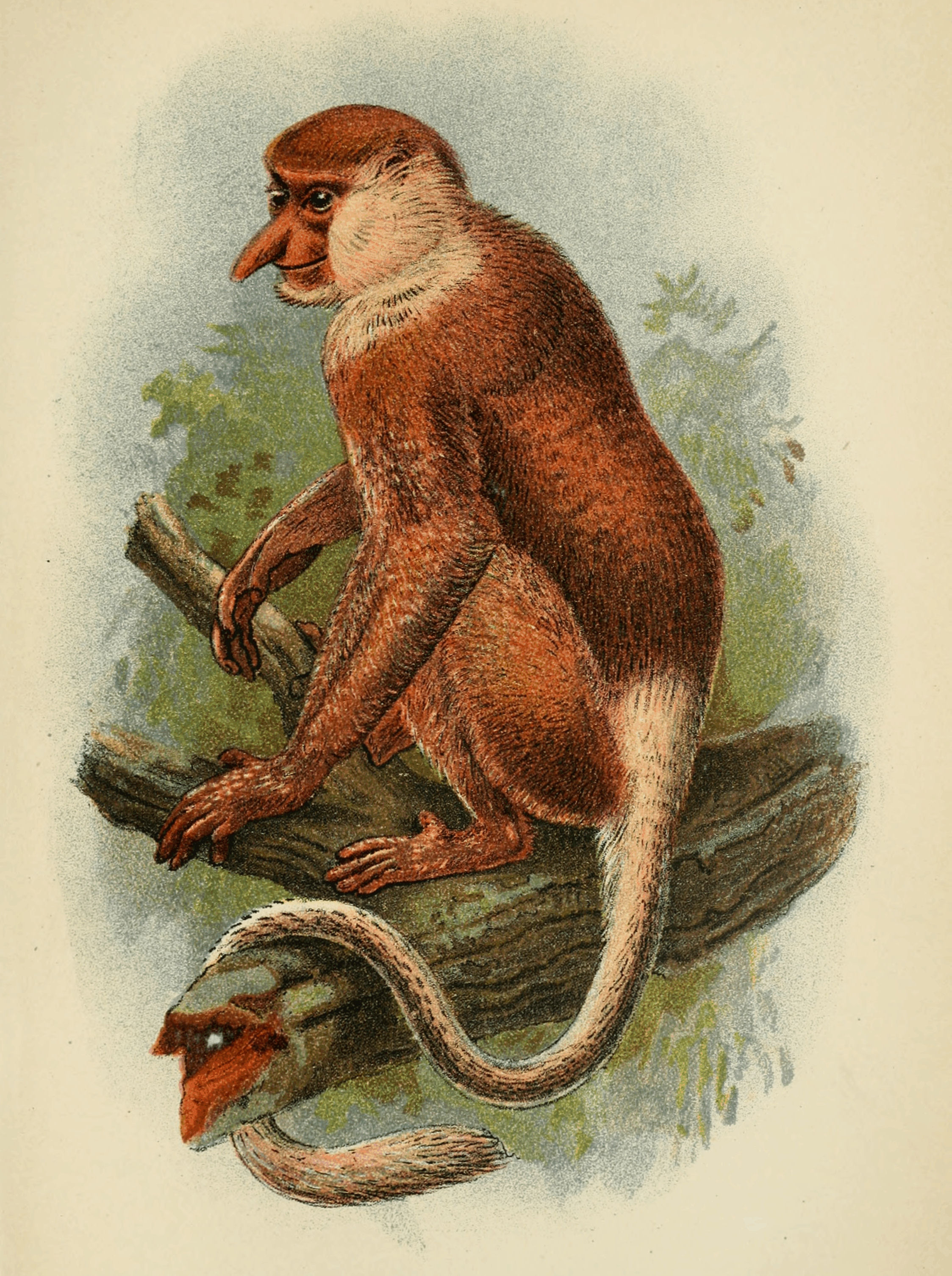
THE PROBOSCIS MONKEY.
Cercopithecus nasicus, Desmar. et Virey, Nouv. Dict. d'Hist. Nat., xv., p. 574 (1817); Wagner in Schreb. Säugeth. Suppl. i., p. 102, pl. x.B (1840).
Semnopithecus nasicus, Desmoul., Dict. Class. d'Hist. Nat., vii., p. 570 (1825); Schinz, Syn. Mamm., i., p. 43 (1844); Wagner in Schreb. Säugeth. Suppl. v., p. 35 (1855).
Nasalis recurvus, Vigors et Horsf., Zool. Journ., iv., p. 109 (1828-9; head of young figured); Martin, P. Z. S., 1837, p. 71.
Semnopithecus larvatus, Fischer, Syn. Mamm., p. 16 (1829); Martin, Mammif. An., p. 453, figs. 279, 280-2 (1841).
Rhynchopithecus larvatus, Dahlb., Stud. Zool., p. 93, pl. iv. (1856).
Semnopithecus (Nasalis) larvatus, Anderson, Zool. Res. Exped. Yun-nan, p. 42 (1878; with full synonymy).
Characters.—Face cinnamon-brown; ears blackish, as also the palms and soles; upper surface of the head, neck, back and sides yellowish-brown, conspicuously marked with reddish-brown and white; rump, tail and limbs yellowish-grey; tails of old specimens quite white; sides of face yellow, and a stripe of the same colour on the shoulders. Under surface yellowish-white.
Hair on the head, which is parted down the centre, on the sides of the face, neck and shoulders, long; the chin full-bearded and the tail tufted; ears small; the nose the most conspicuous feature of the face, produced into a proboscis capable of dilatation, with large nostrils opening downwards, separated from each other by a septum of thin cartilage extending to the extremity. In old males the point of the nose reaches quite below the lowest part of the chin; it is pear-shaped, and furrowed down the middle, giving it the appearance of being double tipped; it is widest in the middle of the free portion. The proboscis is fully developed only at an advanced age in both sexes, being much shorter in the young, and turned upwards. Vigors and Horsfield described their N. recurvus from a specimen which appeared to them to be perfectly adult. The forehead is low; the eyes are wide apart, and the neck is short and much dilated from the presence of a very large laryngeal sac. Length of the body, 29½ inches; of the tail, 26 inches.
Female.—Similar to the male, but it is smaller, and wants the greyish rump markings; while the proboscis is somewhat less developed.
Young.—Have the face blackish and the cheeks wrinkled; the back of the head, down to the shoulders and upper part of the fore-limb is dark reddish-brown. "Through a series of changes during which the red-brown of the upper parts first increases in strength, and the grey-brown of the hips and upper side of the tail change to yellowish-white, the adult pelage is reached." (Anderson.)
This extraordinary animal presents all the structural characters of the genus Semnopithecus; but the lower border of the nasal bones, forming the entrance to the nasal chamber, extends considerably below the lower border of the eye-sockets. The facial portion of the skull does not much exceed the brain-case.
The Proboscis Monkey has the sacculated stomach already described in the Langurs.
Distribution.—The Proboscis Monkey is confined to the island of Borneo. Mr. Hornaday found it along the west bank of the Sarawak river, both near the sea and two miles below the town. It occurs also in some abundance on the Batang Lupar river. Mr. Hose says that it is chiefly found near the mouths of the rivers in Southern Sarawak.
Habits.—The Proboscis Monkey, variously called Blanda (or White Man) and "Rasong" by the natives, is an arboreal creature living in small troops. "As usual," writes Mr. Hornaday, "they were over water, and, being swift climbers and quite shy, were hard to kill. I saw altogether, during my ramblings in the forests of Borneo, perhaps a hundred and fifty Proboscis Monkeys, and, without a single exception, all were over water, either river, lake, or submerged forest. As long as they are in sight they are very conspicuous objects, choosing the most commanding positions in open tree-tops. Once I saw thirteen in one tree, sitting lazily on the branches, as is their habit, sunning themselves and enjoying the scenery. It was the finest sight I ever saw in which Monkeys played a part. The cry of the 'Blanda,' is peculiar and unmistakable. Written phonetically it would be 'Honk,' and occasionally 'Kec-honk,' long drawn and deeply resonant, quite like the tone of a bass viol.... The Proboscis Monkey is a large animal of striking appearance both in form and colour. Taken altogether, Nasalis larvatus is, to the hunter-naturalist, a very striking object of pursuit, and were he not partially eclipsed by the Orang he would be the most famous Quadrumane in the East Indies."
THE MAN-LIKE APES. FAMILY SIMIIDÆ.
In this family are included the Gibbons, the Orangs, the Gorillas, and the Chimpanzees, the most highly organised and the nearest to Man in structure of all the Anthropoidea. To these groups the term "Ape," has been by many writers chiefly restricted, the remaining families of the Old World, and all of the Western Hemisphere, being designated "Monkeys" as a convenient method of nomenclature. The outward resemblance of the Simiidæ to Man has made the various members of the family objects of the greatest interest, not alone to the naturalist, but to every intelligent person; and has naturally suggested a constant inter-comparison between the characters of both.
They are all essentially arboreal climbing animals, yet when they come to the ground they progress in a semi-erect position of their own accord. Their front-limbs are always so much longer than their hind-limbs, that when walking on a level surface their fingers reach the ground, without stooping lower than their semi-erect attitude. Their front-limbs vary in length in the different genera; so does the thumb; but their great-toe is always smaller in proportion to the foot than it is in Man, and, unlike his, is opposable to the other toes. As they belong to the Catarrhine group, their nose has a narrow partition between the nostrils, which are directed downwards. In all, an external tail, cheek-pouches, and (except among the Gibbons) ischial callosities are wanting. All are covered with hair, some more thickly than others, but no Ape has on its head the long abundant locks which Man possesses.
The form of the skull varies very greatly in the Simiidæ. It is, however, always longer than broad. In its frontal region it is never so rounded and elevated as in Man. The roof of the eye-sockets projects into the fore part of the brain-cavity, and considerably reduces its capacity. The pre-maxillary bones (carrying the incisor teeth) are relatively more distinct and much larger than in Man, "the sutures separating them from the maxillary bones remaining visible after the adult dentition has been obtained." (Mivart.)[1] The Simiidæ have a bony meatus or canal to the ear. The back part of the head, which among the Guenons is flat, is convex among the Simiidæ. The palate is long and narrow, and the margins of the jaws nearly parallel. The lower jaw is always in one piece, the two halves being firmly ossified in the middle. The dental formula of the Man-like Apes is I22, C11, P22, M33 (i.e., 32 teeth in all); their inner upper incisors are larger, and the lower are smaller than the outer pair; the canines are large, and between them and the neighbouring incisor above there is a vacuity (or diastema), and, below, between them and the nearest pre-molar. The upper pre-molars have three roots, and the lower, two; the upper molars have four tubercles, their crowns being relatively wide; the lower molars have five tubercles, but the posterior has no hind talon.
The opening for the passage of the spinal cord is situated towards the posterior portion of the base of the cranium, and is thus further from the centre than in Man.
Except among the Gibbons, the vertebral column shows in the sacral region indications of that curve—or concavity in the back between the two convexities of the neck and loins—which is one of the distinctive characters of the human skeleton. The processes for the interlocking of the vertebræ, which are large in the lower Anthropoids, are much reduced in the Man-like Apes, and become inconspicuous in Man.
The breast-bone is flat, and resembles that of Man, and, in all, except the Orang, is composed of two bones. The arm-bone is often shorter than the fore-arm. The radius and ulna can be completely rotated. The articulating surface of the trapezium, the wrist-bone (carpus), to which the thumb is attached, has a rounded face like that of the ento-cuneiform bone in the ankle (tarsus), a form which, as already pointed out (Vol. I., p. 11), was in the Lemuroids correlated with an opposable great-toe, so here it is correlated with a true opposable thumb. In the Monkeys and Lemuroids this bone is not generally rounded, and they have not the thumb opposable in the strict sense that it is among the higher Apes.
The thigh-bone (femur) is shorter than the arm-bone (humerus); and the foot is very long; yet the absolute length of the tarsus is never so great as in Man; it is the rest of the foot which is so much longer relatively in Apes. The ento-cuneiform, or articulating bone of the ankle for the great-toe, has a sub-cylindrical surface, which gives a great range of motion to that digit, towards and from the plane of the foot.
The brain of the Apes closely resembles in general form and structure that of Man; but the cerebral hemispheres differ in being much elongated and depressed, and the cranial capacity of the skull, which is never less than 55 cubic inches in any normal human subject, is in the Chimpanzee 27½ cubic inches; in the Gorilla 35 inches; in the Orang 26 inches; and in the Gibbons very much less. The cerebrum has its surface richly convoluted; and its posterior lobes always entirely over-arching the cerebellum, except in the Siamang (Hylobates syndactylus).
"As to the convolutions, the brains of the Apes exhibit every stage of progress, from the almost smooth brain of the Marmoset, to the Orang and the Chimpanzee, which fall but little below Man. And it is most remarkable that as soon as all the principal sulci [or grooves] appear, the pattern according to which they are arranged is identical with that of the corresponding sulci of Man. The surface of the brain of a Monkey exhibits a sort of skeleton map of Man's, and in the Man-like Apes the details become more and more filled in, until it is only in minor characters, such as the greater excavation of the anterior lobes, the constant presence of fissures usually absent in Man, and the different disposition and proportions of some convolutions, that the Chimpanzee's or the Orang's brain can be structurally distinguished from Man's.... And the difference between the brains of the Chimpanzee and of Man is almost insignificant when compared with that between the Chimpanzee's brain and that of a Lemur." (Huxley.)
The Anthropoid Apes have no cheek-pouches. The larynx has large dilatations of the shallow depressions—called ventricles—of the mucous membrane on each side of its inner surface—which may extend down as far as the arm-pits, and be connected with powerful voice possessed in most of the species. The stomach is simple, like that of Man, and not sacculated, as in the last family (the Cercopithecidæ).
The uterus and other structures connected with the reproductive system resemble those in the human subject. The length of gestation varies probably in the different genera, and is unknown in many of the species. The period for which the young are suckled by the mother lasts about six months. "The proportions of the limbs to one another and to the body do not sensibly change after birth; but the body, limbs, and jaws enlarge to a much greater extent than the brain-case." (Huxley.) Observations are still required, in regard to most of the species, as to the age at which they arrive at maturity, and are able to reproduce.
The Simiidæ—the most intelligent of the animal kingdom—are all diurnal animals, and essentially arboreal. Many of the members of the family have, when walking, a tendency to tread on the outer edge of the foot, turning, therefore, the toe inward on account of the free motion which is possible between the various bones of its ankle, whereas, in the human foot, these bones are more solidly bound together. When climbing, the power of turning in the sole is, as is evident, of the greatest advantage to the Ape. Their food is chiefly vegetable; a few species exhibit slight carnivorous tendencies.
"Of the various genera of the Simiidæ, the Gibbons are most remote from Man. The Orangs come nearest in the number of the ribs, the form of the cerebral hemispheres, and certain other characters of the brain and skull; but they differ from him much more widely in other characters, especially in the limbs, than the Gorilla and the Chimpanzee do. Of the Chimpanzees the Gorilla is more Man-like in the proportions of the leg to the body, and of the foot to the hand; and likewise in the size of the heel, the curvature of the spine, and the absolute capacity of the cranium. The true Chimpanzees approach Man most closely in the skull, dentition, and proportionate length of the arms." (Huxley.)
The Simiidæ are confined to the Ethiopian and Indian Regions. The Gorillas and Chimpanzees live exclusively in the Tropical Regions of Western and Central Africa; the Gibbons range into all the four provinces of the Indian Region; while the Orangs are confined to two islands of the Indo-Malayan Sub-region.
THE GIBBONS. GENUS HYLOBATES.
Hylobates, Illiger, Prodr. Syst. Mamm., p. 67 (1811).
The group of Tree-walkers, as the term Hylobates signifies, embraces the smallest-sized, the slenderest-bodied, the longest-limbed, and the most perfectly arboreal of all the Man-like Apes. All are covered with thick woolly hair, which, on the arms and fore-arms, converges (except in H. agilis) towards the elbow.
Their head is small and round, and the face compressed. Except the Orangs, the Gibbons have the longest arms of all the Apes, so long that when they stand erect the points of their fingers can touch the ground. Compared with the spinal column, their arms are as 19 to 11, while the legs are one-third longer than it. The fore-arm is much longer than the arm itself; the hand is longer than the foot, and the thumb is very long in proportion to the hand. The knee is free from the side of the body, and the great-toe is well developed and nearly one-half the length of the foot. The nails of both the thumb and the great-toe are flat. Callosities, which are wanting in all the other genera, are present in Hylobates, but are very small.
In the skull the occiput is convex; the orbits are very large and deep, and the supra-orbital ridges prominent. The canine teeth are much larger than the others, and equally large in both sexes. They are generally the last of the permanent teeth to come in, but in the Gibbons they generally precede, or are developed along with, the last molar.
The vertebral column is nearly straight, presenting but little of the spinal curvature seen in Man; it has also in the dorso-lumbar region one vertebra more than in the human skeleton. The articulating head of the arm-bone (humerus) loses the direction it had among the Monkeys, and looks upward and forward as in Man. The wrist (carpus) has nine bones, as in the lower Anthropoidea. The skeleton of the hand is more than half the length of the spine, and the foot is slightly under half its length. The Gibbons have two pairs of ribs more than Man. The ends of the ischial bones are much everted to support the callosities.
With regard to the brain, this genus is remarkable for the great reduction of the occipital lobes of the cerebrum.
The tongue is very similar to that in Man, but it is furnished with a sub-lingual process like that already described among some of the Lemuroids. The Gibbons (except the Siamang) have no laryngeal sacs. The stomach closely resembles the human organ.
The Gibbons are very delicate, and rarely live long in confinement, even in their own country. They are in general highly intelligent, very gentle, and become most affectionate and engaging animals if kindly treated. They are, however, occasionally irascible and ill-tempered, especially when adult.
Their feats of climbing and leaping are almost proverbial. It would be impossible to excel them as acrobats. When walking on the ground they assume the erect posture, putting the soles of their feet to the ground, separating the thumb and the great-toe widely from the neighbouring digits.
"They walk erect, with a waddling or unsteady gait, but at a quick pace; the equilibrium of the body requiring to be kept up, either by touching the ground with the knuckles, first on one side then on the other, or by uplifting the arm so as to poise it. As with the Chimpanzee, the whole of the narrow, long sole of the foot is placed upon the ground at once and raised at once, without any elasticity of step." (Martin.)
Their voice is very powerful and can be heard at a great distance, especially when they are howling in chorus. The Wau-Wau and the Siamang, the one without, and the other with, a laryngeal sac, are equally vigorous in this respect.
The female produces but a single young one at a birth, of which she takes the greatest care. She carries it about, clinging to the under side of her body, for many months. It is said that she even takes it to the waterside from time to time, and with much solicitude, and in spite of its cries and resistance, washes its face.
The Gibbons frequent the great upland forests; but the Siamang (H. syndactylus) may be met with at quite low levels and close to the coast. Their food consists of fruit, leaves, and insects, eggs of birds, and apparently birds and lizards, and especially spiders. They drink either by putting the mouth down to the water, or by dipping in their hands and thus carrying it to their mouths.
The Gibbons are confined to two Sub regions of the Indian Region. With the exception of the Siamang, all the so-called species of Hylobates are so closely allied to each other, and differ by characters of such slight importance, that they seem to be hardly worthy of specific distinction. (Thomas.)
I. THE AGILE GIBBON. HYLOBATES AGILIS.
Pithecus lar (nec L.), Geoffr., Ann. Mus., xix., p. 88 (1812).
Hylobates agilis, F. Cuv., Hist. Nat. des Mammif., Sept. 1821, pls. v., vi.; Müller, Tijdschr. Nat. Gesch., ii., p. 326 (1835); Martin, Mammif. Anim., p. 416 (1841); Fry, P. Z. S., 1846, p. 11; Gray, Cat. Monkeys Brit. Mus., p. 12 (1870); Schl., Mus. Pays-Bas, vii., p. 17 (1876); Anderson, Zool. Res. Exped. Yun-nan, p. 9 (1878; with full synonymy).
Pithecus agilis, Desmar., Mamm., p. 532 (1820).
Simia lar (nec L.), Raffl., Tr. Linn. Soc., xiii., p. 242 (1822).
Hylobates lar (nec L.), F. Cuv., Hist. Nat., Mamm., pls. 7, 8 (1824); Blyth, J. A. S. Beng., xliv., ex. no., p. 2 (1875).
Hylobates variegatus, Temm., Monogr. Mamm., i., p. xiii. (1827); Wagner in Schreb. Säugeth. Suppl. v., p 16 (1855); H. O. Forbes, Nat. Wand. East. Arch., p. 156 (1885).
Hylobates rafflesii, Is. Geoffr., Cat. Méth. Primates, p. 8 (1851); Gray, Cat. Monkeys Brit. Mus., p. 11 (1870).
Hylobates pileatus, Gray, P. Z. S., 1861, p. 136, pl. xxi.; id., Cat. Monkeys Brit. Mus., p. 10 (1871); Anderson, Zool. Res. Exped. Yun-nan, p. 6 (1878).
Characters.—Face black; colour entirely black, but becoming brown on the back and sides, and with a white superciliary band, and sometimes ashy-grey cheeks.
This is the typical form of the species in Mid-Sumatra, where the present writer had the opportunity of examining it alive. It was with difficulty distinguished from H. syndactylus, except from its size and the presence of the white superciliary band.
Other specimens (but none of them met with to the south of the Moesi river by the present writer) have been described, with the occiput, the back from immediately behind the shoulders, the flanks, the hips, and the outer surfaces of the fore- and hind-limbs, pale yellow. The shoulders, chest, and belly, and the inside of the limbs and feet dark brown; eyebrows and whiskers pale grey. (Anderson.)
The variety described as H. pileatus is distinguished by a black cap-like patch on the top of the head; the chest, throat, and belly black; the back of the head, the upper surface of the body, the limbs and area round the black cap grey. This variety may also be entirely white, except for the coronal cap and chest being black, and the back brown; or the pervading colour may be brown, the sides of the face and the under surface black, and the whiskers white. The index and middle fingers are occasionally webbed together.
All the hairs on the arm and fore-arm converge towards the wrist.
Distribution.—This species is confined to Sumatra and to Siam. In the former country it is known by the name of "Ongka" by the Malays, who, with the keen powers of observation they possess in regard to all natural objects, recognise two varieties, the white or yellow variety—"Ongka putih," and the black one—"Ongka itam" (H. rafflesi). The capped variety (H. pileatus) with its variously coloured forms inhabits Siam.
Habits.—The habits of the "Ongka" are very similar to those of the Wau-wau, or the Siamang (H. syndactylus). The natives, however, aver that it is much more silent, rarely howling as either of these other two species do. They are also seen generally in quite small troops, and often in pairs only.
"It is almost impossible," writes Mr. Martin of a specimen that lived formerly in the Zoological Gardens, "to convey in words an idea of the quickness and graceful address of her movements: they may, indeed, be termed aërial, as she seems merely to touch, in her progress, the branches among which she exhibits her evolutions. In these feats her hands and arms are the sole organs of locomotion; her body hanging as if suspended by a rope, sustained by one hand (the right, for example), she launches herself by an energetic movement to a distant branch, which she catches with the left hand. But her hold is less than momentary; the impulse for the next launch is acquired; the branch then aimed at is attained by the right hand again, and quitted instantaneously, and so on, in alternate succession. In this manner spaces of twelve and eighteen feet are cleared with the greatest ease, and uninterruptedly for hours together, without the slightest appearance of fatigue being manifested; and it is evident that if more space could be allowed, distances very greatly exceeding eighteen feet would be as easily cleared.... Sometimes on seizing a branch in her progress, she will throw herself, by one arm only, completely round it, making a revolution with such rapidity as almost to deceive the eye, and continue her progress with undiminished velocity. It is singular to observe how suddenly this Gibbon can stop, when the impetus given by the rapidity and distance of her swinging leaps would seem to require a gradual abatement of her movements. In the very midst of her flight a branch is seized, the body raised, and she is seen, as if by magic, quietly seated on it, grasping it with her feet.... A live bird was let loose in her apartment; she marked its flight, made a long swing to a distant branch, caught the bird with one hand in her passage, and attained the branch with her other hand; her aim, both at the bird and the branch, being as successful as if one object only had engaged her attention. It may be added, that she instantly bit off the head of the bird, picked its feathers, and then threw it down, without attempting to eat it."
II. THE WAU-WAU GIBBON. HYLOBATES LEUCISCUS.
A. Javan Race (H. leuciscus).
Simia leucisca, Schreber, Säugeth. i., pl. iii. b. (1775).
Pithecus leuciscus, Geoffr., Ann. Mus., xix., p. 89 (1812).
Hylobates leuciscus, Kuhl, Beitr. Zool., p. 6 (1820); Desmar. Mamm., p. 51 (1820); Martin, Mammif. An., p. 416 (1841); Is. Geoffr., Cat. Méth. Primates, p. 7 (1851); Wagner, Schreb., Säugeth. Suppl. v., p. 16 (1855); Gray, Cat. Monkeys Brit. Mus., p. 15 (1870); H. O. Forbes, Nat. Wand. East. Arch., p. 70 (1875); Schl., Mus. Pays-Bas, vii., p. 19 (1876); Anderson, Zool. Res. Exped. Yun-nan, p. 7 (1878; with full synonymy).
B. Bornean Race (H. concolor).
Simia concolor, Harlan, Journ. Acad. Nat. Sc. Phil., v., p. 229 pl. ii. (1827).
Hylobates harlani, Less., Bull. des Sc. Nat., xiii., p. 111 (1827).
Hylobates concolor, Schl., Essai Phys. Serp., p. 237 (1837); S. Müller, Verhand. Gesch., p. 48 (1841); Blyth, J. A. S. Beng., x., p. 838 (1841); Martin, Mammif. An., p. 417 (1841); Fry, P. Z. S., 1846, p. 15; Wagner in Schreb. Säugeth. Suppl. v., p. 17 (1855; in part); Schleg., Mus. Pays-Bas, vii., p. 20 (1876); Anderson, Zool. Res. Exped. Yun-nan, p. 11 (1878).
Hylobates mülleri, Martin, Mammif. Anim., p. 444 (1841); Is. Geoffr., Cat. Méth. Primates, p. 7 (1851); Schlegel, Mus. Pays-Bas, vii., p. 21 (1876); Anderson, Zool. Res. Exped. Yun-nan, p. 8 (1878; with full synonymy); Hose, Mammals of Borneo, p. 6 (1893).
Hylobates funereus, Is. Geoffr., C. R., xxxi., p. 874 (Dec., 1850); Wagner in Schreb. Säugeth. Suppl. v., p. 18 (1855).
? Hylobates fuscus, Winslow Lewis, Bost. Journ. N. Hist., i., pt. i., p. 32, pls. i., ii. (1834).
Characters.—Fur thick, long and woolly. General colour ashy-grey, paler on the lower back and rump; hair round the face grey; superciliary streak white; top of the head black; fingers and toes black.
This species has been found to possess occasionally a supernumerary finger on each hand.
Distribution.—The Indo-Malayan Sub-region. Java, Borneo, and the Sulu Archipelago between Borneo and the Philippines.
Habits.—The Wau-Wau—the Malay name for this Gibbon—is one of the first of the Quadrumana that makes its presence known to the traveller in Java, when he reaches its upland forest regions. In the evening, just about sundown, and more especially in the early morning commencing before sunrise and finally ceasing when the sun is above the tops of the trees, he will be surprised by a sudden outbreak of what appears to be now the loud plaintive wailings of a crowd of women, now the united howling of a band of castigated children. The present writer's first acquaintance with this charming genus of Monkeys was made among the Kosala hills in Western Java, and it will ever remain with him as one of many most pleasant recollections of a long tropical sojourn. Their "woo-oo-ut—woo-ut—woo-oo-ut—wut-wut-wut—wŭt-wŭt-wŭt," always more dolorous on a dull heavy morning previous to rain, is just such a cry as one might expect from the sorrowful countenance so characteristic of the species of Hylobates. The Wau-Wau has a wonderfully human look in its eyes; and it was with great distress that the writer witnessed the death of the only one he ever shot. Falling on its back with a thud on the ground, it raised itself on its elbows, passed its long taper fingers over the wound, gave a woeful look at them and at his slayer, then fell back at full length—dead—"saperti orang" (just like a man), as his Malay companion remarked. He kept in captivity for a short time a specimen which was brought to him by a native, and it became one of the most gentle and engaging creatures possible; but when the calling of its free mates reached its prison house, it used most pathetically to place its ear close to the bars of its cage and listen with such intense and eager wistfulness that it was impossible to retain it in durance any longer. It was accordingly set free on the margin of its old forest home. Strange to say, its former companions, perceiving perhaps the odour of captivity about it, seemed to distrust its respectability, and refused to allow it to mingle with them. Amid the free woods we may hope that this taint was soon lost and that it recovered all its pristine happiness.
In general habits it in no way differs from the other species of Hylobates already described.
In regard to the Bornean specimens of this species, Dr. Anderson makes the following observations: "This species varies from grey to dark yellowish-brown, but the grey tint in certain lights appears pure ashy, and in others of a brownish tint. In some the chest and abdomen are frequently yellow, and this seems to be the character of individuals met with on the west coast of Borneo, while those inhabiting the meridional parts of the island have the hands and fore part of the body of a black-brown or reddish-brown. In both of these varieties there is a yellowish-white superciliary streak. The last of them leads into the varieties of Hylobates from the neighbouring islands of Sulu, to the north-east of Borneo, in which the upper parts of the body are either grey or brownish, the lower part of the back and the loins being a little more clear than the rest." The outer surface of the limbs, the back part of the head, the supercilium, and the sides of the face are more or less pure ashy-grey. "Specimens of this Gibbon obtained by me," writes Mr. Charles Hose, who is well known for his Bornean researches, "at Claudetown, and now in the British Museum, show that the colouring in different parts of the body must be considered of little importance, as I obtained eleven specimens, five of which were in the same troop and the other six from the same locality, varying in colour as much as it is possible for them to do; some had yellowish backs and black chests, others black backs with yellowish chests, and some were nearly black all over; whilst others were almost a complete silver-grey. I, therefore, come to the conclusion that H. muelleri and H. leuciscus cannot be separated. The peculiar bubbling noise they make is similar. I think it very unlikely that two distinct species should be so constantly found together as they are in Sarawak.
"The natives call the silver-grey variety 'Emplian' or 'Wa-Wa,' and the dark one, 'Emplian arang' (coal), because of its colour."
III. THE WHITE-CHEEKED GIBBON. HYLOBATES LEUCOGENYS.
Hylobates leucogenys, Ogilby, P. Z. S., 1840, p. 20; Blyth, J. A. S. Beng., x., p. 838 (1841); Martin, Mammif. Anim., p. 445, cum fig. (1841); Is. Geoffr., C. R., xv., p. 717 (1842); id., Arch. Mus., ii., p. 535 (1843); Gray, Cat. Monkeys Brit. Mus., p. 11 (1870); Schl., Mus. Pays-Bas, vii., p. 13 (1876); Scl., P. Z. S., 1877, p. 679, pl. lxx.; Anderson, Zool. Res. Exped. Yun-nan, p. 6 (1878; with synonymy).
Characters.—Fur glossy, thick, and woolly; the hair of the upper and back part of the head standing vertically erect; the face, chin, and ears black; round the face from the level of the eyes and meeting below the chin runs a white border, forming whiskers and beard; elsewhere the colour is entirely black. Length of the body, 26 inches.
Distribution.—Siam.
Habits.—This rare species is very active and gentle in confinement. It will hang suspended, as Martin observed in the first specimen brought to Europe, from a branch for the whole day, except when asleep or reposing.
The type specimen was described in 1840,—its skin being preserved in the British Museum; but it was not till 1877—after a lapse of thirty-seven years—that a second specimen was brought to this country. It was sent to the Zoological Gardens by Mr. W. H. Newman, H.B.M. Consul at Bankok.
IV. THE WHITE-HANDED GIBBON. HYLOBATES LAR.
Homo lar, Linn., Mantiss. Plant., App., p. 521 (1771).
Simia longimana, Wagner in Schreb. Säugeth. i., p. 66, pl. iii., figs. 1, 2 (1775); Erxl., Syst. Reg. An., p. 9 (1777).
Simia lar, Bodd., Elench. An., p. 55 (1785); Fischer, Syn. Mamm., p. 12 (1829; in part).
Pithecus lar, Latr., Hist. Nat. Buff., xxxvi., p. 276 (1809).
Pithecus varius, Latr., op. et loc. cit.
Pithecus variegatus, Geoffr., Ann. Mus., xix., p. 88 (1812).
Hylobates lar, Illig., Abhandl. Akad. Berl., p. 88 (1815); Martin, Mammif. Anim., pp. 416, 433 (1841); Blyth, J. A. S. Beng., x., p. 838 (1841); Gray, Cat. Monkeys Brit. Mus., p. 10 (1870); Scl., P. Z. S., 1870, p. 86, pl. v.; Schlegel, Mus. Pays-Bas, vii., p. 15 (1876); Anders., Zool. Res. Exped. Yun-nan, p. 5 (1878; with full synonymy); Blanford, Faun. Brit. Ind., Mamm., p. 7 (1891).
Hylobates variegatus, Kuhl, Beitr. Zool., p. 5 (1820; young); Desmar., Mamm., p. 51 (1820); Is. Geoffr., Zool. Bélang. Voy., p. 27 (1834).
Simia albimana, Vig. et Horsf., Zool. Journ., iv., p. 107 (1828).
Simia variegatus, Fischer, Syn. Mamm., p. 11 (1829).
Hylobates albimanus, Is. Geoffr., Zool. Bélang. Voy., p. 29 (1834).
Hylobates entelloides, Is. Geoffr., C. R., xv., p. 717 (1842).
Hylobates leuciscus, Cantor, Ann. and Mag. N. H., xvii., p. 338 (1846).
Characters.—Male.—Everywhere deep black, except the face, which is reddish-brown, with the thick hair round it light grey or white, and the hands and feet, which are pale yellow or white; superciliary ridges, whiskers and beard, white. The hair on the fore-arm is nearly erect, with only a very slight forward inclination. The species is subject to great variation, and may be of all shades, from deep black to entirely whitish-yellow (H. entelloides).
Head round; the eyes large; the cheeks flat and depressed; the nose slightly projecting, its tip furrowed, and its nostrils small and converging; the upper lip is divided in the centre by a vertical furrow. In very young individuals the top of the ear is markedly pointed.
Skull with the orbital ridges larger, the muzzle shorter, and the teeth smaller than in H. hoolock; the second and third toes sometimes united by a membrane.
Female.—Generally similar to the male, but more frequently entirely pale yellow, with the hands and feet paler.
Distribution.—Aracan, Lower Pegu, Tenasserim, and the Malay Peninsula.
Habits.—The White-handed Gibbon inhabits the upland forests as high as 3,500 feet above the sea; living in troops numbering from ten to twenty-five. Its habits are very similar to those of other Gibbons, although Tickell observed that they were less light and active than the Hoolock, and had a different voice. It is said to drink, as the Siamang does, by dipping its hands into the water, and not to put its mouth down to it like the Hoolock. "So entirely does it depend on its hands for locomotion amongst trees," remarks Dr. Blanford, "that it carries everything in its feet. Tickell, from whom I take these details, says that he has seen a party of H. lar escape thus with their plunder from a Karen garden in the forest." "The young are born in the early part of the cold season," continues Dr. Blanford, "and each sticks to the body of its mother for about seven months, after which it begins gradually to shift for itself."
V. THE HOOLOCK. HYLOBATES HOOLOCK.
Simia lar, Phil. Trans., lix., p. 607 (1769.)
Simia hoolock, Harlan, Tr. Am. Phil. Soc., iv. (n. s.), p. 52, pl. 2 (1834.)
Hylobates coromandus, Ogilby, P. Z. S., 1837, p. 689; Martin, Mammif. Anim., p. 415 (1841); Is. Geoffr., Arch. Mus., ii. P. 535 (1843); Blyth, J. As. Soc. Beng., xiii., p. 464 (1844.)
Hylobates hoolock, Waterh., Cat. Mamm. Mus. Zool. Soc., p. 3 (1838); Martin, Mammif. Anim., p. 416 (1841); Is. Geoffr., Arch. Mus., ii., p. 535 (1843); id., Cat. Méth. Primates, p. 9 (1851); Sclater, P. Z. S., 1860, p. 86, pl. v.; Gray, Cat. Monkeys Brit. Mus., p. 11 (1870); Schl., Mus. Pays-Bas, vii., p. 14 (1876); Anderson, Zool. Res. Exped. Yun-nan, p. 1 (1878; with full synonymy); Blanford, Faun. Brit. Ind., Mamm., p. 5 (1891).
Hylobates hulok, Wagner, in Schreb., Säugeth. Suppl., v., p. 20 (1855.)
Hylobates niger, Harlan; Ogilby, P. Z. S., 1840, p. 21.
Characters.—Black all over, except a frontal band, continuous or interrupted, above the eyes. There is a good deal of variation in this species, more in the female than in the male, the black being in many individuals of a brownish tinge.
Young Males.—Often of a brownish-black, like many of the females.
Female.—With the black generally of a brownish tinge, but often pale or greyish-yellow; sometimes the upper parts are pale yellow and the under parts and side of the head brown, and the area round the nude parts of the face white. (Anderson.)
Distribution.—Lower ranges of Bhutan—its furthest western range—(Pemberton); hill ranges of Upper Assam (Blyth), Sylhet, Chittagong, Aracan.
Habits.—"I first met with this species in Upper Burma," Dr. Anderson relates, "in passing through the magnificent defile of the Irawaddy, below Bhamo, where the river is enclosed by high hills, covered with dense forest, for about fifteen miles of its course. It was early morning, and the air was resonant with the loud cries of this Gibbon; large troops were answering each other from the opposite banks, and the hills echoed and re-echoed the sound. The Hoolock is also common on the Kakhyen hills, on the eastern frontier of Yun-nan; and there, too, my attention was called to them at daybreak, when they passed up from their sheltered sleeping-ground in the deep and warm valleys to heights of about 4,000 feet. We, in the middle distance, first caught a faint murmur of voices, but every minute it became more and more distinct, till at last the whole troop rushed past in a storm of sound, vociferating Whoko! whoko! and in a few more minutes their cry was heard far up the mountain-side. Considering that their progress is almost exclusively arboreal, the rapidity with which they make their ascent is wonderful.
"Associated with this arboreal habit of progression, we find that H. hoolock derives its nourishment from leaves, insects, eggs, and birds, the essential features of sylvan life." It also eats the leaves of Ficus religiosa, the aquatic Convolvulus (Ipomœa reptans), and the brilliant red flowers of the Canna indica. It "has a marked partiality," continues the same naturalist, "for Spiders and their webs, which become tangled in its long slim fingers, and Orthopterous insects are regarded by it with special favour, and over which it utters its peculiar cry of satisfaction. Eggs also are to it a bonne bouche. It was first in the Calcutta gardens that I become aware of the circumstance that small living birds were devoured by it with a method and eagerness which has left no doubt in my mind that this species, in its natural state, must be a scourge to the feathery tribe."
The Hoolock lives in large flocks as a rule, keeping chiefly to the hill forests. Sometimes, however, an old male may be discovered living by himself.
They move chiefly by means of their long arms, by which they swing themselves for prodigious distances from branch to branch, and from tree to tree. They descend hill-sides at a surprising pace, their descent being accomplished by grasping bamboos or branches that bend beneath their weight, and allow them to drop until they can seize the ends of other bamboos or branches lower on the slope and take another mighty swing downwards. They also ascend with great rapidity, swinging themselves from tree to tree. (Blanford.)
When walking on the ground the Hoolock rests on its hind feet alone, with the sole flat on the ground and the great-toe widely separated from the other digits. "They walk erect," writes Dr. Borrough, "and when placed on the floor, or in an open field, balance themselves very prettily by raising their hands over their head and slightly bending the arm at the wrist and elbows, and then run tolerably fast, rocking from side to side; and if urged to greater speed they let fall their hands to the ground and assist themselves forward, rather jumping than running, still keeping the body, however, nearly erect."
VI. THE HAINAN GIBBON. HYLOBATES HAINANUS.
? Hylobates pileatus, Swinhoe, P. Z. S., 1870, p. 224 (nec Gray).
Hylobates hainanus, Thomas, Ann. & Mag. Nat. Hist. (6), ix., p. 145 (1892).
Characters.—Very closely related to H. hoolock, but differs by the entire absence of the white superciliary streak, the animal being jet black all over.
Distribution.—The island of Hainan.
Habits.—This species has not been seen alive in its native haunts by any European naturalist. Consul Swinhoe made many efforts to obtain a living specimen in the island of Hainan, but was unsuccessful. "I never ceased," he says, "to enquire after it. Every one knew that such an animal did exist, and many had seen it; but they all spoke of the great difficulty of keeping it alive. At Taipingsze (Central Hainan) the wonderful stories that were told about it showed that the Yuen was not often seen there. The magistrate of that district assured me, with a serious face, that it had the power of drawing into its body its long arm-bones, and that when it drew in one arm, it pushed out the other to such an extraordinary length, that he believed the two bones united in the body; and he said that the bones of the arm were used for chop-sticks." Mr. Swinhoe, however, published, in 1870, some curious extracts from the Chinese gazetteer of the Kiung-shan district of Hainan, which with little doubt relate to this interesting animal, of which skins have, since he wrote, been received at the British Museum, while a young individual lived for some months in 1893 in the Zoological Gardens of London, where it attracted much attention. The gazetteer says as follows: "Yuen: male black, female white; like a Macaque but larger, with the two fore-arms exceedingly long. Climbs to tree-tops and runs among them backwards and forwards with great agility. If it falls to the ground, it remains there like a log. Its delight is in scaling trees, as it cannot walk on the ground. Those desiring to rear it in confinement should keep it among trees; for the exhalations of the earth affect it with diarrhœa, causing death; a sure remedy for this, however, may be found in a draught made of the syrup of fried Foo-tsze (seeds of Abrus precatorius, Linn.)." The gazetteer then continues: "Hainan has also the Rock Yuen. It is small, about the bigness of one's fist. If allowed to drink water, it grows in size. This is also called Black Yuen, and is now likewise difficult to obtain."
Those who had an opportunity of observing the specimen that lived in the Zoological Gardens, will recall its extraordinary acrobatic feats, which were performed with marvellous precision and certainty, either with one or with both hands, and yet with the most careless air. It offered a striking contrast to an Orang-utan, which occupied the adjoining cage. This more robust Ape exhibited in its arms equally perfect powers of climbing; but it moved with the greatest circumspection, deliberation, and composure, exhibiting none of the volatile activity so characteristic of the Gibbons; but moving only one pair of its limbs at a time, and only when the other pair had firm hold of some support.
VII. THE SIAMANG GIBBON. HYLOBATES SYNDACTYLUS.
Pithecus syndactylus, Desmar., Mamm., p. 531 (1820).
Hylobates syndactylus, F. Cuv., Hist. Nat. Mammif., pl. iv. (1821); Is. Geoffr., Cat. Méth. Primates, p. 9 (1851); Bennett, Wanderings in N. S. Wales, ii., p. 151 (1834); Martin, Mammif. An., p. 420 (1841); Flower, Nat. Hist. Rev., 1863, p. 279 (cum fig.); Giebel, Z. Ges. Nat., p. 186 (1866); Schl., Mus. Pays-Bas, vii., p. 22 (1876); Anderson, Zool. Res. Exped. Yun-nan, p. 10 (1878; with full synonymy).
Simia syndactylus, Raffl., Tr. Linn. Soc., xiii., p. 241 (1822).
Siamanga syndactyla, Gray, Cat. Monkeys Brit. Mus., p. 9 (1870), id., op. cit., p. 9 (1870); H. O. Forbes, Nat. Wand. East. Arch., p. 129 (1885).
(Plate XXXVIII.)
Characters.—This is the largest species of the genus, measuring more than three feet; it is stouter than H. hoolock, and its hair is entirely glossy black, having no white hairs anywhere; the face is black, as is also the distensible skin of the large bare patch on the throat, which overlies its great laryngeal pouch. The second and middle toes are united by a web as far as the last joint. The hair on the arms and fore-arms converges towards the elbow.
The skulls in most of the species of this genus closely resemble each other; that of the Siamang is distinguished by its larger size, and in having the supra-orbital ridges more developed, while the occipital region is more truncated, and there is at the symphysis of the lower jaw a true, though slight, chin.
PLATE XXXVIII.
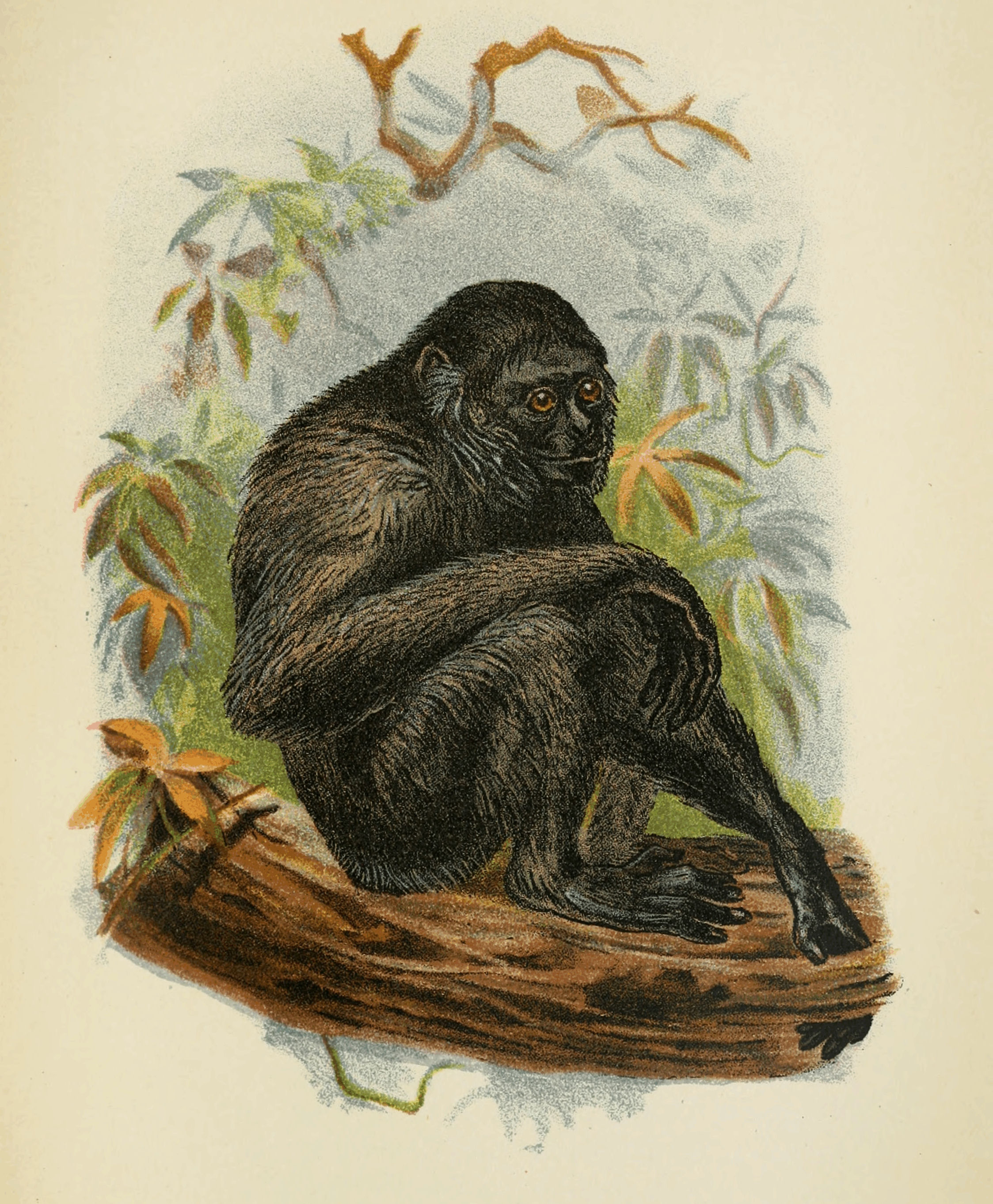
THE SIAMANG GIBBON.
The frontal lobes of the brain are broad and much flattened, and not full and rounded as in the Orang. The olfactory bulbs project forward, slightly beyond the frontal lobes of the cerebrum; the occipital lobes are much reduced, while the large cerebellum projects distinctly backwards from below the cerebrum—characters in which this very highly organised member of the genus shows a retrogressive development, thus differing from all the other Man-like Apes, in all of which the cerebrum entirely covers both the olfactory lobes in front, and the cerebellum behind.
The large laryngeal sac, communicating by two openings with the larynx, and formed by the extension of the thyro-hyoid membrane, distinguishes this from all the other Gibbons.
Distribution.—The Siamang is confined to the island of Sumatra. It has been recorded from Malacca and Tenasserim; but some doubt exists as to the accurate determination of the individuals referred to, no really authentic specimen having yet been obtained out of Sumatra.
Habits.—The Siamang is gregarious, frequenting the great forest-trees from 200 to 300 feet above the sea up to 3,000 or 4,000 feet.
I made the acquaintance of this species in Southern Sumatra, and during my stay in that island had various opportunities of observing many of them in their homes. It was not uncommon to come suddenly on a colony of them both in the forest and among the tall isolated outliers, when they happened to be covered with fruit. The satiated members of the company might then be often seen hanging by one arm from a bare branch, with perhaps eighty unobstructed feet between them and the ground, making the woods resound with their loud barking howls, uttered apparently for pure love of making a noise. On one occasion a young one, found clinging to its mother, which had been shot, was brought in alive. It had been only stunned by a pellet on the head, and had no bones broken. In a very short time it became a most delightful companion. The following observations in reference to it are taken from the writer's Journal: "Its expression of countenance is most intelligent and often very human; but in captivity it generally wears a sad and dejected aspect, which quite disappears in its excited moods. With what elegance and gentleness it takes with its delicate taper fingers whatever is offered to it! Except for their hairiness, its hands, and, in its youth at all events, its head, seem to me more human than those of any other Ape's. It rarely, however, brings its thumb into opposition with the other fingers, but usually clasps the whole hand, without that digit, on an object. It will never put its lips to a vessel to drink, but invariably lifts the water to its mouth, by dipping in its half-closed hand and then awkwardly licking the drops from its knuckles. It generally sits with its arms crossed over its chest, and its fingers overlaid behind its head. The gentle and caressing way in which it clasps me round the neck with its long arms, laying its head on my chest, and watching my face with its dark brown eyes, uttering a satisfied crooning sound, is most engaging. Although it often inflates its laryngeal sac, it rarely gives utterance to more than a yawn-like noise or suppressed bark; but this dilatation has no reference apparently to its good or bad temper, although, when very eager and impatient for anything, a low pumping bark is uttered. Every evening it makes with me a tour round the village square, with one of its hands on my arm. It is a very curious and ludicrous sight to see it in the erect attitude on its somewhat bandy legs, hurrying along in the most frantic haste, as if to keep its head from outrunning its feet, with its long free arm see-sawing in a most odd way over its head to balance itself, and now and again touching the ground with its finger-tips or its knuckles. That they can leap the great distances from tree to tree ascribed to them is no doubt an accurate observation; but they appear to be sometimes terror-stricken and unable to perform these feats to save their lives. During the felling of the forest near this village, a small colony of Siamangs got isolated on a tree separated from the next clump by some thirty feet or so. They scampered up and down in the crown of the tree howling in the most abject terror at every stroke of the axe; yet they would not venture to leap the intervening space, and even, when the tree was falling, they did not attempt to save themselves by springing to the ground, but perished in its downfall.
"When teething my companion suffered severely—as the human infant so often does—both locally and constitutionally, as indicated by boils and inflamed finger-tips. On lancing and poulticing the latter, and extracting some of its obstructing teeth, the poor creature seemed greatly relieved, and I was delighted to watch it recover, without contracting for me any antipathy for the pain I had inflicted on it, but rather the reverse." At a later date the following extract occurs:—
"During my march to the coast my Siamang accompanied me, occupying, with the most grave demeanour, a seat on one of the packages carried in the rear, near to myself. Here it sheltered its head, to the amusement of all whom we met, under a Chinese umbrella, which I had bought for it to protect it from the midday sun, and for which, after every halt, it held out its hands in the most knowing way, screaming lustily if the porters dared to move on before it had comfortably arranged itself. To my intense regret, a misadventure put an end to a most charming existence, before I could send it to London."
THE ORANG-UTANS. GENUS SIMIA.
Simia, Linn., Syst. Nat., i., p. 34 (1766); Erxl., Syst. Régne An., p. 6 (1777; part).
Pithecus, Geoffr., Ann. Mus., xix., p. 87 (1812); Huxley, Anat. Verteb. An., p. 403.
Pongo, Geoffr., Ann. Mus., xix., p. 89 (1812).
This genus contains one species, well known as
THE ORANG-UTAN. SIMIA SATYRUS.
Simia satyrus, Linn., Syst. Nat., i., p. 34 (1766); Kuhl, Beitr. Zool., p. 4 (1820); Schreb., Säugeth., i., p. 54, pls. 2, 2 B. (1775); Fischer, Syn. Mamm., p. 9 (1829); Owen, Tr. Z. S., i., p. 344, pls. 49, 53-56 (1835); Wallace, Malay Archip., i., p. 62 (1869); Gray, Cat. Monkeys Brit. Mus., p. 8 (1870); Schlegel, Mus. Pays-Bas, vii., p. 9 (1876).
Simia agrias, Schreb. Säugeth, i., pl. 2, ii. B et ii. C (1775).
Pongo wurmbii, Geoffr., Ann. Mus., xix., p. 89 (1812); Kuhl, Beitr. Zool., p. 21 (1820).
Papio wurmbii, Latr. Singes, i., p. 196.
PLATE XXXIX.
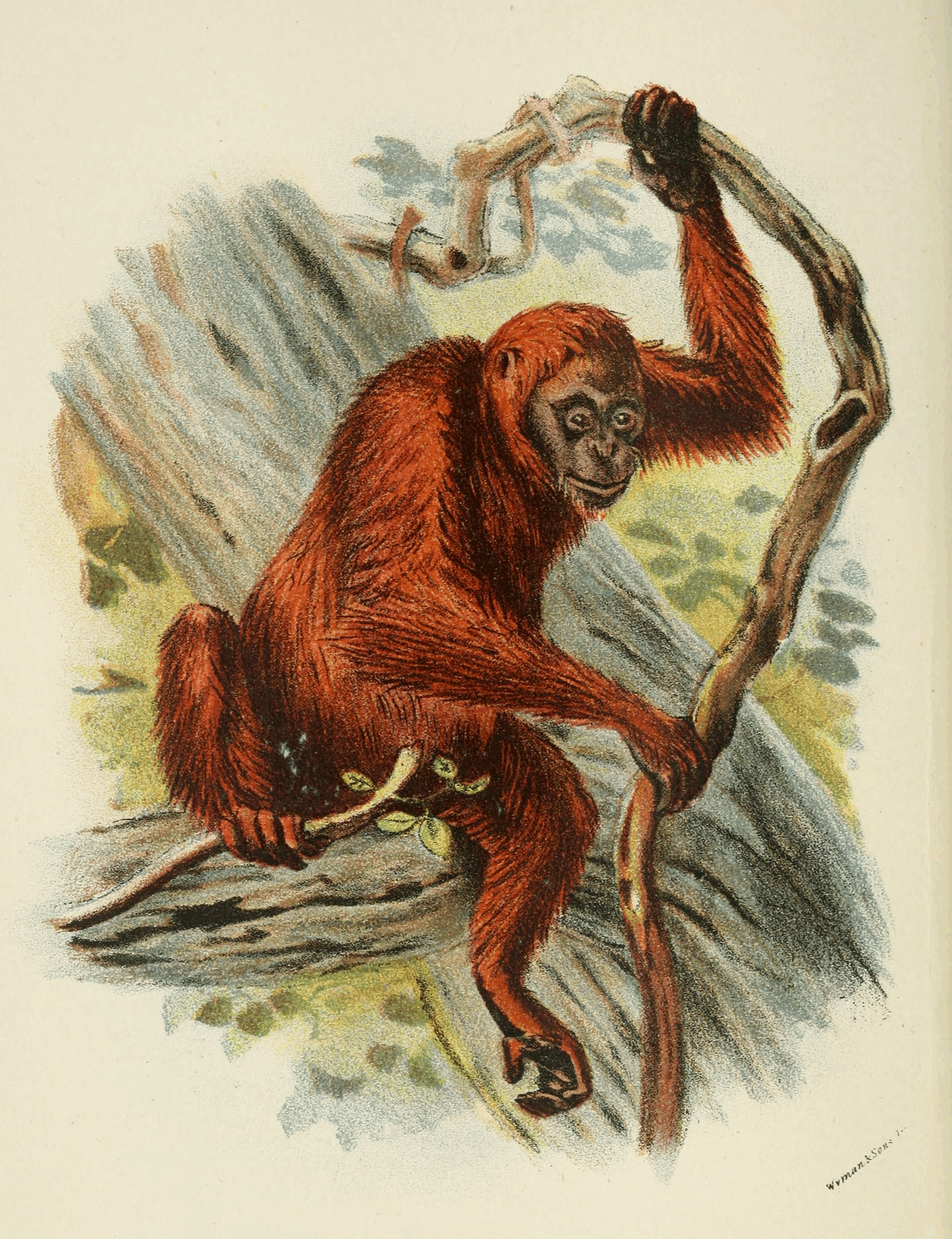
THE ORANG-UTAN.
Pithecus satyrus, Blumenb., Abbild., Naturh. Geg., fig. xii. (1810); Geoffr., Ann. Mus., xix., p. 88 (1812); Latr., in Buff. Hist. Nat., xxxv., p. 166, pl. 3; xxxvi., p. 276; Cuv. et Geoffr., Hist. Nat., Mamm., livr. xlii.; Desmar., Mamm., p. 50 (1820); Martin, Mammif. Anim., p. 388 (1841); Owen, Tr. Z. S., iv., p. 82, pl. 29 (1862).
Simia wurmbii, Kuhl, Beitr. Zool., p. 21 (1820); Fischer, Syn. Mamm., p. 32 (1829); Owen, Tr. Z. S., ii., p. 165, pls. 30-32 (1841); Brooke, P. Z. S., 1841, p. 55 (Mias Pappan).
Pithecus wurmbii, Owen, Tr. Z. S., iv., p. 95, pl. xxxiii. (1862).
Pongo abelii, Clarke, Asiat. Res., xvi., 489 (1826); id., Edinb. Phil. Journ., p. 375 (1827).
Simia abelii, Fischer, Syn. Mamm., p. 10 (1829; Sumatra).
Simia morio, Owen, P. Z. S., 1836, p. 92; id., Tr. Z. S., ii., p. 168, pls. 33, 34 (1838); Brooke, P. Z. S., 1841, p. 55 (Mias Kassar); Wallace, Malay Archip., i., p. 84 (1869); Sclater, P. Z. S., 1891, p. 301; Beddard, Tr. Z. S., xiii., p. 20 (1893; Sumatra and Borneo).
Pithecus morio, Martin, Mammif. An., p. 395 (1841).
Simia gigantica, Pearson, J. A. S. Beng., x. (2), p. 660 (1841).
Pithecus bicolor, Is. Geoffr., Arch. Mus., Paris, ii., p. 526 (1841; Sumatra).
Pithecus owenii, Blyth, J. A. S. Beng., xxii., p. 375 (1853).
Pithecus curtus, Blyth, op. cit., xxiv., p. 525 (1855).
(Plate XXXIX.)
Characters.—The Orangs are large and heavy in build, with the head set on a very thick neck, the hair long and directed forward, and the abdomen round and protuberant. The naked face is melancholy. On each side of the face there is, in the full grown male, but not in the female, a large, soft, smooth tumour-like and flexible expansion, which gives a remarkable breadth to the visage. The forehead is nude and purplish in colour; the middle of the face across the nose is sooty-brown. The lips are broad, extremely mobile, and of the colour of the skin—generally of a yellowish brown; and, when eating and drinking, the animal thrusts them far out. The lower jaw retreats at once from the lips, and there is therefore no chin, as so recognised in Man. The ears are more like those of Man, small and flat. The arms are very long, reaching to the ankles in the erect posture, their span being twice the animal's height. The arm is equal in length to the fore-arm; the hands are long and narrow. The fingers are united by a web; the thumb short and often without its terminal joint. The back of the hand is but slightly haired. The hair on the arm is directed downwards and that on the fore-arm upwards, so as to meet at the elbow. The legs are very short and bowed at the ankles; the long and narrow foot, which is articulated obliquely to the leg, is longer than the hand and (except in the Gorilla) is longer than in any other Ape. The great-toe is very short and is often destitute of a nail.
The cranium is very variable in form; the crown is high and pointed, the forehead round and elevated, and the occipital region convex. No two individuals are exactly alike. "The slope of the profile, the projection of the muzzle, together with the size of the cranium, offer differences as decided as those existing between the most strongly marked forms of the Caucasian and African crania in the human species. The orbits vary in width and height; the cranial ridge is either single or double, either much or little developed, independent of age, being sometimes more strongly developed in the less aged animal." (Wallace.) The supra-orbital ridges are prominent, without being particularly so. The contour of the head is more human in form, however, in youth than in age, when the forehead is large and convex. The canine teeth are very large and tusk-like in the male, but smaller in the female. The upper molars exhibit on their crowns complex rugosities; they have four cusps and an oblique ridge, as in Man, from the front inner, to the hind outer, cusp; the lower molars are five-cusped. The permanent canine teeth sometimes appear before the last permanent molar has come into place.