Front matter (continued 5)
Reading edition
Female and Young Male.—Similar to the adult male, but less in size, and the coloration paler than in the adult male. Elbows and feet black; under side of the body greyish-yellow. The white stripe on the sides of the face is wanting in the young female.
Distribution.—Chyavetas, Nauta, and Elvira in the Peruvian Amazons; Upper Rio Negro, Serra de Cocoi; Upper Cauca river, a southern confluent of the Orinoco; Venezuela. "This species is found on both sides of the Peruvian Amazon (or Marañon), on both shores of the Huallaga, and in the interior forest near the town of Chamicuros. I was told by some of the oldest Indians that these animals are common in the dense forest on the hills near the latter town, their range extending between the Huallaga river and Ucayali river to the head-waters of the Huallaga, between the towns of Lamas and Sarayaçu.... Then again on the Rio Tigri ... and over the head-waters of the Rio Napo, Rio Japurâ and Rio Negro, where Natterer first discovered it." (Bartlett.)
Habits.—This Monkey, the "Chuva de Baracamorros" of Humboldt, which is the most beautifully coloured of its group, is said to go about in small parties, passing through the forest at a rapid rate, feeding on different kinds of berries.
II. GEOFFROY'S SPIDER-MONKEY, ATELES GEOFFROYI.
Ateles geoffroyi, Kuhl, Beitr. Zool., p. 26 (1820); Schl., Mus. Pays Bas, vii., p. 181 (1876); Alston, in Godman and Salvin, Biol. Centr. Amer. Mamm., p. 8 (1879).
Ateles melanochir, Desmar., Mamm., p. 76 (1820); Gray, Cat. Monkeys Brit. Mus., p. 43 (1870); Sclater, P. Z. S., 1871, p. 226, pl. xv., 1875, p. 419, pls. xlviii. and xlix.
Eriodes frontatus, Gray, Ann. Nat. Hist., x., p. 256 (1842); id. Voy. H.M.S. "Sulphur," Zool., p. 9, pl. i.; Scl., P. Z. S., 1882, p. 186; Von Frantzius, Arch. f. Naturg., xxxv., 1869, pp. 257, 258.
Sapajou geoffroyi, Slack, Pr. Ac. Sc. Philad., 1862, p. 511 (= female).
Ateles variegatus (nec Wagn.), Von Frantzius, Arch. f. Naturg., xxxv., 1869, p. 257.
Ateles hybridus, A. ornatus et A. albifrons, Gray, Cat. Monkeys Brit. Mus., pp. 43 and 44 (1870).
Characters.—Body light greyish-drab all over; hands, elbows, feet, knees, and the upper side of the extremity of the tail, black; face black, with the exception of the lips and a ring round the eyes, broad above and narrow below, flesh-coloured. Hair of forehead reflexed, meeting that of the crown above the eyes, forming a triangular patch of erect black hairs. Top of the head and upper part of the tail buff. Length of body, 17 inches; of tail, 21 inches. Thumb entirely wanting.
This species is remarkably variable. The description given above belongs to the form described as A. melanochir by Desmarest from the same specimen in Paris, which Kuhl described under the name of A. geoffroyi. Every gradation is to be met with between this and the form described by Dr. Gray as A. ornatus, in which the face is entirely black, the whiskers pale reddish-yellow, the patch of erect black hair on the forehead yellowish at its base; the top of the head, sides, lower back, rump, upper part of the arms, outer, inner and posterior portion of the thighs and legs, and under side of the base of the tail, brownish-red; nape, shoulders and remainder of the tail reddish-brown, washed with black; lower part of arms, fore-arms, hands, feet, and anterior aspect of thighs and legs, black.
In some specimens the grey, or reddish-black colour, merges on the under surface, into yellowish-cream, or rufous, and the black wash is more or less distributed.
Mr. Alston, in speaking of this species, remarks that the best character by which the darker (A. ornatus) forms may be distinguished from our next species (A. rufiventris) is the want of a distinct line of demarcation between the colours of the upper and lower parts, the tint of the flanks, whatever it may be, passing almost insensibly into that of the breast and belly in all the varieties.
Distribution.—The variation in colour described above is not due to local causes, every variety occurring between the lightest and darkest, in all the regions which this species is known to inhabit. The localities from which it has been recorded are on both the Atlantic and Pacific coasts of Nicaragua; Costa Rica, where it occurs in large numbers from the coast forests up to nearly 7,000 feet on the mountains; Panama, and the U.S. of Colombia.
Habits.—Geoffroy's Spider-Monkey is gregarious and arboreal, frequenting the highest trees of the forest, both in the low country and at high elevations, and living on fruits and insects, but chiefly on the former. Mr. Belt relates that on the banks of the Antigua he saw a valuable tree, the "Nispera" (Achras sapota), growing on the dryer ridges. "It bears a round fruit about the size of an apple, hard and heavy when green, and at this time it is much frequented by the large yellowish-brown Spider-Monkey (Ateles), which roams over the tops of the trees in bands of from ten to twenty. Sometimes they lay quite quiet until I was passing underneath, when, shaking a branch of the Nispera tree, they would send down a shower of the hard round fruit; but fortunately I was never struck by them. As soon as I looked up they would commence yelping and barking and putting on the most threatening gestures, breaking off pieces of branches and letting them fall, and shaking off more fruit, but never throwing anything, simply letting it fall.[13] Often when on lower trees, they would hang from the branches, two or three together, holding on to each other and to the branch with their fore-feet and long tail, whilst their hind-feet hung down, all the time making threatening gestures and cries. Sometimes a female would be seen carrying a young one on its back, to which it clung with legs and tail, the mother making its way along the branches, and leaping from tree to tree, apparently but little encumbered by its baby. A large black and white Eagle is said to prey upon them, but I never saw one, although I was constantly falling in with troops of the Monkeys. Don Francisco Velasquez, one of our officers, told me that one day he heard a Monkey crying out in the forest for more than two hours, and at last, going to see what was the matter, he saw a Monkey on a branch and an Eagle beside it trying to frighten it to turn its back, when it would have seized it. The Monkey, however, kept its face to its foe.... Velasquez fired at the Eagle, and frightened it away. I think it likely, from what I have seen of the habits of this Monkey, that they defend themselves from the Eagle's attack by keeping two or three together, thus assisting each other, and that it is only when the bird finds one separated from its companions that it dares to attack it."
Mr. Osbert Salvin met with several of these Monkeys near the town of San Juan del Sur, in Nicaragua. He was walking up the course of a half-dry stream when he came upon a troop of Monkeys which had come to a pool to drink, and were climbing about the low trees on the bank of the watercourse. Most of the troop consisted of Cebus hypoleucus, but with them were several Ateles of the present species, of one of which Mr. Salvin wrote a description as it sat jabbering at him and throwing down sticks from a branch above his head. Mr. Salvin also told Mr. Alston that it was not unusual to see Monkeys kept in confinement in the court-yards of the Spanish houses in Guatemala. Amongst them were occasionally to be seen specimens of Geoffroy's Spider-Monkey; but he always found that they had been brought from Nicaragua or Costa Rica, the species not extending into Guatemala.
III. THE RED-BELLIED SPIDER-MONKEY. ATELES RUFIVENTRIS.
Ateles vellerosus (?) (nec Gray), Scl., P. Z. S., 1871, p. 478.
Ateles rufiventris, Scl., P. Z. S., 1872, p. 688, pl. lvii.; Schlegel, Mus. Pays Bas, vii., p. 182 (1876).
Characters.—Fur rough, upstanding less on the tail than on the body, that on the forehead erect and directed backwards, that on the top of the head long, projecting forward. Face and muzzle, except a black line from the side of the nose and inner corners of the eyes to the cheeks, flesh-coloured. General colour uniform black, but the whole under surface deep bright rufous, this colour extending but slightly on to the inner surface of the limbs. Thumbs entirely wanting.
Differs from A. geoffroyi by its flesh-coloured face and by the two colours of the upper and under sides being clearly defined. Length of body, 12 inches; of tail, 15½ inches.
Distribution.—This species was first discovered on the Atrato river, in Northern Colombia, and has since been found in Panama.
Habits.—The Red-bellied Spider-Monkey is very rare, only one or two specimens having yet been obtained. Nothing is, therefore, known of its habits.
IV. THE RED-FACED SPIDER-MONKEY. ATELES PANISCUS.
Simia paniscus, Linn., Syst. Nat., i., p. 27 (1766).
Ateles pentadactylus, Geoff., Ann. Mus., vii., p. 269 (1806); Schl., Mus. Pays Bas, vii., p. 172 (1876, in part).
Ateles paniscus, Geoff., Ann. Mus., vii., p. 270 (1806); Gray, Cat. Monkeys Brit. Mus., p. 42 (1870); Schl., Mus. Pays Bas, vii., p. 169 (1876, part.).
Le coaita, F. Cuv. et Geoffr., Nat. Hist. Mamm., liv., v. (Avril, 1819).
Sapajou paniscus, Slack, Proc. Acad. Nat. Sci. Philad., p. 509 (1862).
Characters.—Very similar to A. ater in its coarse and entirely black fur, but differing in the naked and flesh-coloured face. Hairs of forehead long and projecting anteriorly; tail one-quarter longer than the body; hands generally entirely lacking the thumbs, though sometimes a rudimentary thumb is present, and that occasionally on one hand only. Naked portion of tail covered with sensory papillæ, rendering it more sensitive, so it is said, than the hand. Length of body, 24 inches; tail, 30 inches. The skull in some specimens of the thumbed variety is compressed laterally, and shows a sagittal crest along the top.
Distribution.—This species is spread over Guiana, the forests of the Ucayali and Huallaga rivers in eastern Peru, and the northern part of Brazil, where it is known as the "Coaita," taking the place of the more northern Ateles ater. "It occurs," says Mr. Bates, "throughout the lowlands of the Lower and Upper Amazons, but does not range to the south beyond the limits of the river plains." In the higher part of the Rio Negro it comes down to the north bank, but does not cross to the south bank of the river.
Habits.—This species is the best known of all the Spider-Monkeys. It is captured in large numbers, when young, by the natives of Guiana, and as they bear captivity well, many of them have been brought to Europe. They live in larger troops than do some of the other members of its genus; indeed, these companies are said to number as many as a hundred. They are very easily tamed, and become very affectionate. They live chiefly on fruits, principally on a species of palm-nut. Dampier, however, says, apparently of this species of Ateles: "The Monkeys come down by the Sea-side [at low water] and catch them [the Periwinckles and Muscles]; digging them out of their Shells with their Claws." Large numbers of this species are also annually killed for food, their flesh being held in high esteem by the natives.
V. THE WHITE-WHISKERED SPIDER-MONKEY. ATELES MARGINATUS.
Ateles marginatus (nec Humb.), Geoffr., Ann. Mus., xiii., p. 92, pl. 10 (1809); Kuhl, Beitr. Zool., p. 24 (1820); Gray, Cat. Monkeys Brit. Mus., p. 43 (1870); Schl., Mus. Pays Bas, vii., p. 174 (1876).
Coaita à front blanc, femelle, Fr. Cuv., Hist. Nat. Mamm., livr. lxii. (Avril, 1830).
Ateles frontalis, Bennett, P. Z. S., 1831, p. 38.
Characters.—Similar in size and coloration to A. paniscus. Body lean; hair moderately long and coarse. Face naked, black, except the skin round the eyes, which is flesh-coloured; general colour black; under surface of body and inner sides of limbs, ashy-grey. It differs from A. paniscus by having the forehead, crown of head, a spot on each side of the nose, and the whiskers, white.
A specimen in the British Museum has four pre-molars in each upper jaw, instead of the normal three of the Cebidæ.
Distribution.—This species was discovered by Humboldt on the banks of the Santiago river. Mr. Bates says "it is never met with in the alluvial plains of the Amazons," nor, he believes, on the northern side of the great river-valley, except towards its head-waters near the Andes.
Habits.—According to Von Humboldt, this Spider-Monkey—known as the "White-Whiskered Coaita"—is very fierce and libidinous. Mr. Bates encountered this large and handsome species on the Cupari river, a tributary of the Tapajos, one of the large southern affluents of the Amazon. Here he could get scarcely anything but fish to eat, and, as this diet did not agree with him, he was obliged to have recourse to the Coaita flesh. "I thought," he says, "the meat the best flavoured I have ever tasted. It resembled beef, but had a richer and sweeter taste.... We smoke-dried the joints instead of salting them; placing them for several hours on a framework of sticks arranged over a fire. Nothing but the hardest necessity could have driven me so near to cannibalism as this, but we had the greatest difficulty in obtaining here a sufficient supply of animal food." Von Humboldt has also referred to the cooking of these Monkeys by the natives of the Upper Orinoko. "The manner of roasting these anthropomorphous animals," he writes, "contributes singularly to render their appearance disagreeable in the eyes of civilised Man. A little grating or lattice of very hard wood is formed, and raised one foot from the ground. The Monkey is skinned and bent into a sitting posture; the head generally resting on the arms, which are meagre and long; but sometimes these are crossed behind the back. When it is tied on the grating a very clear fire is kindled below.... On seeing the natives devour an arm or leg of a roasted Monkey, it is difficult not to believe that this habit of eating animals which so much resemble Man in their physical organisation, has in a certain degree contributed to diminish the horror of anthropophagy among savages. Roasted Monkeys, particularly those that have a very round head, display a hideous resemblance to a child; the Europeans, therefore, who are obliged to feed on Quadrumanes, prefer separating the head and the hands, and serve up only the rest of the animal at their tables. The flesh of Monkeys is so lean and dry that Mr. Bonpland has preserved in his collections at Paris an arm and hand, which had been boiled over the fire at Esmeraldas; and no smell arises from them after a great number of years."
VI. THE BLACK-FACED SPIDER-MONKEY. ATELES ATER.
Ateles ater (Le Caijou), F. Cuvier, Mamm., i., pl. xxxix. (1823); Sclater, P. Z. S., 1872, p. 5; Gray, Cat. Monkeys Brit. Mus., p. 42 (1870); Schl., Mus. Pays Bas, vii., p. 170 (1876).
Sapajou ater, Slack, Proc. Ac. Nat. Sci. Philad., 1862, p. 510.
Characters.—Entirely black; fur silky, and longer on the head and tail than on the body; fur on top of head directed from behind forwards, falling over the forehead, meeting the backwardly directed hairs of the forehead and forming a tuft. Face black, the upper part naked; chin with stiff black hairs mixed with a few white ones. Ears oval and human-like in form, the upper part movable at will. Thumbs entirely wanting. Length of body, 19 inches; tail, 26 inches.
Distinguished from A. paniscus, which it closely resembles, by the black colour of its face, and the direction of the hairs on the forehead.
Young.—Lighter in colour than the adults; sometimes brown on the back and the outer side of the limbs.
Distribution.—The Black-Faced Spider-Monkey ranges from Panama, through the United States of Colombia to Eastern Peru.
Habits.—Entirely arboreal, living in large troops, and feeding on fruits.
VII. THE GRIZZLED SPIDER-MONKEY. ATELES GRISESCENS
Ateles grisescens, Scl. MSS.; Gray, P. Z. S., 1865, p. 732; id. Cat. Monkeys Brit. Mus., p. 42 (1870); Scl., P. Z. S., 1871, p. 223; Schl., Mus. Pays Bas, vii., p. 168 (1876).
Characters.—Hair of forehead elongate. Fur in general moderately long, black, with greyish-white hairs intermingled, giving it a grizzled appearance; under side of tail grey. Similar to A. ater and A. paniscus, but distinguished by the intermixture of grey hairs, and by the colour of the under side of the tail. Thumbs absent.
Young Male.—Rather lighter in colour, especially on the under side of body; tail black above, grey beneath. Length of body, 14 inches; tail, 16 inches.
Distribution.—The habitat of this species is not certainly known. Dr. Sclater considers it probable that it will turn up in some part of the Central American or the Colombian coast.
VIII. THE BROWN-HEADED SPIDER-MONKEY. ATELES FUSCICEPS.
Ateles fusciceps, Fraser MSS.; Gray, P. Z. S., 1865, p. 733; Sclater, P. Z. S., 1872, p. 663, pl. lv.; Gray, Cat. Monkeys Brit. Mus., p. 42 (1870); Schl., Mus. Pays Bas, vii., p. 173 (1876).
Characters.—Fur thick. Hairs long, shining, crisp, deep black above, the hairs of the back with brownish tips; the under side of the body and inside of the limbs black; crown of head deep coffee-brown. Length of body about 20 inches; of the tail, 26 inches, according to the dimensions taken from the skin of a young animal by Dr. Sclater. Thumbs entirely wanting.
Distribution.—In 1860, when Mr. L. Fraser returned from Ecuador, he spoke of a large Monkey he had seen, but had not obtained, in the valleys of Western Ecuador. It remained unknown until it was shot, and brought to England by Mr. Buckley some ten years later. It was the only Monkey, he says, except a Mycetes, which he saw in Trans-Andean Ecuador.
Habits.—These, doubtless, do not differ from those of other Spider-Monkeys.
IX. THE HOODED SPIDER-MONKEY. ATELES CUCULLATUS.
Ateles cucullatus, Gray, P. Z. S., 1865, p. 733; id. Cat. Monkeys Brit. Mus., p. 42 (1870); Murie, P. Z. S., 1865, p. 739; Schl., Mus. Pays Bas, vii., p. 169 (1876).
Characters.—Hairs of body long, but thin on the head, body, limbs and tail; hair of crown very long and projecting over the face and the sides of head, forming what has been called a "hood." Face nude, flesh-coloured; cheeks and lower jaw nearly nude also, but the skin of a blackish hue. Hair on back black, intermingled with numerous others which are yellowish-grey in colour; crown and back of head, hands, and feet black—the hairs black throughout. Nude part of tail flesh-coloured. The hands have a rudiment of a thumb in the shape of a small tubercle. Length of body, 14½ inches; of tail, 27½ inches.
Distribution.—The Hooded Spider-Monkey is very rare, and very different from any other member of its group in regard to the hair of its head. Its native country is still a matter of uncertainty. Dr. Sclater, however, remarks in the "Proceedings of the Zoological Society" for 1881: "I have some reason to suppose it may be from the northern coast of Colombia, as I am told that a black Spider-Monkey, with long hair over its head, is occasionally brought for sale into Cartagena."
X. THE LONG-HAIRED SPIDER-MONKEY. ATELES VELLEROSUS.
Ateles belzebuth, Geoffr., Ann. Mus., vii., p. 27, pl. xvi. (1806); Gray, Cat. Monkeys Brit. Mus., p. 44 (1870); Schl., Mus. Pays Bas, vii., p. 178 (1876).
Le marimonda, Humb. Obs. Zool., p. 325 (1811).
Ateles frontatus (nec Gray), Sclater, Nat. Hist. Rev., 1861, p. 509.
Ateles vellerosus, Gray, P. Z. S., 1865, p. 733; Reinh., P. Z. S., 1872, p. 797; Sclater, P. Z. S., 1873, pp. 5, 798, pl. ii.; Alston, in Godman and Salvin, Biol. Centr. Amer. Mamm., p. 10 (1879).
Ateles fuliginosus (nec Kuhl), Schl., Mus. Pays Bas, vii., p. 179 (1876).
Ateles pan, Schl., t. c. p. 180 (1876).
Characters.—Closely allied to Ateles geoffroyi. Hair abundant, long, soft, and flaccid. Face flesh-coloured, except for a black bar from the corner of the eye to the cheek; forehead black, its hair short, reflexed, and uniting, so as to form an erect, crest-like ridge, with the fur on the top of the head, which is directed forward. General colour above black to reddish-brown; the head, back, outer side of the entire fore-limb and of the lower part of the hind-limb, hands, and feet, and upper surface of tail deep black; sides of body, loins, and thighs yellowish-brown or dull black washed with rufous; whiskers, throat, whole of under surface of body, inside of fore- and hind-limbs, and under surface of tail (this sometimes black) yellowish-cream colour, but very variable, sharply defined from the dark colour of the upper parts. Thumb entirely wanting. Eyes dark yellowish-grey. May be distinguished from the dark form of Geoffroy's Spider-Monkey by the sharp definition of the colours of the upper and under sides of the body.
Distribution.—This species, also spoken of as the Mexican Spider-Monkey, is known to occur right across Guatemala; it is by no means uncommon, Mr. Salvin says, in the forest country on the northern part of Vera Paz, and he also saw a troop at the summit of the ridge of mountains which connects the Volcan de Fuego with the main Cordillera, at about 8,000 feet above the sea.
The late Prof. Liebmann, the Danish botanist, obtained a specimen, according to Prof. Reinhardt, "in the neighbourhood of the small place Mirador, situated not far from the volcano of Orizaba, in the State of Vera Cruz.... He met with it also in the eastern parts of the State of Oaxaca.... But at the same time he expressly states that he never met with this Ateles, nor, indeed, with any other Monkey, on the Pacific slope of the Great Cordillera in Oaxaca, and that, as far as he could learn, Monkeys are to be found on the western coast only south of Tehuantepec." This species is the only Spider-Monkey certainly known to range as far north as Mexico. According to M. Sallé, the most northern locality for Monkeys with which he was acquainted, was in the State of San-Louis Potosi, about 23° N. latitude, on the upper part of the basin of the Tampico river. (Alston.)
Habits.—The Mexican Spider-Monkey is, like the foregoing members of the genus, arboreal, consorting together in small troops, and feeding on fruits. Prof. Liebmann observed it in small troops in the deep barrancas, up to an elevation of 2,000 feet above the sea, on the Orizaba volcano, and in the forests of Oaxaca, to 4,000 feet. Mr. Salvin, on the volcano of Atitlan, in Guatemala, at a height of between 5,000 and 6,000 feet, met several troops of this species on the tops of the higher trees of the forest. These parties of Monkeys were usually about twenty in number and of all ages. On approaching them they did not evince any alarm, but kept uttering a constant querulous sort of bark, and moved from time to time so as to get a better view of the intruder. A few days afterwards, during an excursion to the same volcano, when the summit, 11,800 feet above the sea, was reached, numerous troops of Ateles were seen in the forest, from an elevation of 7,000 feet to as low as 2,500 feet on the outskirts of the coffee plantations of San Agustin.
Now that we have passed in review the whole of the Anthropoid species inhabiting the New World, a short account of the regions to which they are confined will be of some interest. The most northern limit of Monkeys is, as mentioned above, the State of San-Louis Potosi, about the latitude of 23° North. Their most southern limit attains to nearly 25° of South latitude. They are now confined to the Mexican and Brazilian sub-regions of what has been defined as the Neotropical Region, by Dr. A. R. Wallace, in his great work, "The Geographical Distribution of Animals." The Mexican sub-region belongs to the Neotropical Region, one of those six great areas into which the globe has been divided off by Dr. Sclater on the basis of the geographical distribution of the animals that now inhabit it—the final product of the slowly-changing features of the earth's surface, and of the form, structure, and habits of its animal and vegetable life.
The Mexican sub-region forms the northern part of the Region, and, to condense Mr. Wallace's account of it, it is of comparatively small extent; but the whole of its area is mountainous, being, in fact, a continuation of the great range of the Rocky Mountains. It varies in elevation above the sea from 6,000 to 18,000 feet. "With the exception of the elevated plateaus of Mexico and Guatemala, and the extremity of the peninsula of Yucatan, the whole of Central America is clothed with forests; and as its surface is much broken up into hill and valley, and the volcanic soil of a large portion of it is very fertile, it is altogether well adapted to support a varied fauna, as it does a most luxuriant vegetation." In this region only species of Spider-Monkeys (Ateles), of Howlers (Alouatta), of Capuchins (Cebus), of Night-Monkeys (Nyctipithecus), and of Squirrel-Monkeys (Chrysothrix) are found. The Spider-Monkeys and the Howlers alone extend so far North as Mexico, and the Night-Monkeys reach to Nicaragua, while the Squirrel-Monkeys and Capuchins have penetrated no further than to Costa Rica.
The Brazilian Sub-region includes all the open plains and pasture lands, surrounded by, or intimately associated with, the forests. Its central mass consists of the great forest plain of the Amazons, from the north-east coast of Brazil to high up in the Andes on the west, a stretch of more than 2,000 miles; and from the mouth of the Orinoko to near La Paz in the Bolivian Andes, a distance of 1,900 miles, of continuous forest in both directions. Within this area are some open "campos" or patches of pasture lands, along several of the tributaries of the Amazon, and Llanos—open flat plains generally flooded in the wet season—on the northern bank of the Orinoko. Unbroken forest also covers the country from Panama southwards by the Magdalena Valley along the western aspect of the Andes to Guayaquil. There is a very arid tract on the northeast coast of Brazil; but south of Cape San Roque the coast forests extend to 30° south latitude, "clothing all the valleys and hill-sides as far inland as the higher mountain ranges, and even penetrating up the great valleys far into the interior. To the south-west the forest country reappears in Paraguay, and extends in patches and partly wooded country till it almost reaches the southern extension of the Amazonian forests. The interior of Brazil is thus in the position of a great island plateau, rising out of, and surrounded by, a lowland region of ever-verdant forests." Of its Anthropoid life the Woolly Monkeys (Lagothrix), the Sakis (Pithecia), and the Uakaris (Brachyurus) are confined to its Amazonian forests. The Woolly Spider-Monkeys (Brachyteles) keep to the wooded coast-regions of South-east Brazil, while the Titis (Callithrix) do not range out of the tropics of South America. The Howlers (Alouatta), the Spider-Monkeys (Ateles), and the Capuchins (Cebus) roam nearly over the whole region—the first and last ranging from Costa Rica to Paraguay as well. The Spider-Monkeys indeed extend over to the west side of the Equatorial Andes, and in Guatemala across to the Pacific coast. No species of Monkey, however, is known to inhabit the western side of the Andes, to the south of the Gulf of Guayaquil.
THE BABOONS, GUEREZAS AND LANGURS. FAMILY CERCOPITHECIDÆ.
With the following account of the numerous species of the genera of this family, we come to consider the first section of the Old World, or Catarrhine[14] Monkeys. These are distinguished from their New World cousins, described in the previous pages, by many important and obvious characters. The partition dividing the nostrils is narrow, instead of broad, and the openings of the nostrils themselves are directed downwards and outwards. Certain genera possess also sacs formed by distensible folds of the skin in the cheeks. These "cheek-pouches" serve as a storing-place by the side of the jaws, for food which they cannot masticate at the moment. When this store is disposed of, the folds of skin come together again and give no indication of the presence of the pouch, which, moreover, when full does not interfere with the mastication of other food in the mouth, or with the utterance of the animal's usual cries.
The hind-limbs are never shorter than the fore-; they may be equal in length, but they are generally somewhat longer, the animal being more or less quadrupedal, or very partially erect in gait. Their thumb is not invariably present, but when it is, it is always opposable to its fellow digits. The great-toe is never rudimentary, and is never, as it is in Man, the longest, but is the shortest digit of the foot, and it is capable of free motion to and from the others. All of the digits possess nails. The length of the foot among this group approximates more to the proportions of the foot in Man. The hairs on the arms and fore-arms are directed downwards from the shoulder to the wrist.
The tail in this family varies very much; it may be long or short, or even externally absent, but it is never prehensile. All the species, however, possess "callosities," or hard fleshy pads—often of large size—on the buttocks or seat, which, like the naked skin of the face, are usually brilliantly coloured and often of large size. The perineal region and organs are at certain periods, especially in the females, subject to great turgescence and brilliant coloration.
Besides these external characters, we find, on examining their bony structure, much variation in the skull. Some have a rounded forehead, the ascending portion of the lower jaw being high, broad, and flat, with a large facial angle; in others, we have great production of the upper jaw (the horizontal part of the lower jaw being greater than the ascending portion), and a low facial angle. The cerebral portion of the skull is long and flattened, and the palate long and narrow. The dental formula is I22, C11, P22, M33 = 32, that of the milk-teeth I22, C11, M (the forerunners of the permanent pre-molars) 22 = 20, exactly the same as in a Man. The outer lower incisors are equal to, or sometimes smaller than, the inner pair. The permanent canines—which are long and sharp—come in before, or with the posterior molars of both jaws. Between them and the incisors above, and between the canine and the anterior pre-molar below, occurs a gap (or diastema). The anterior upper pre-molar has its outer cusp modified and sharpened; the anterior lower pre-molar has the anterior margin of its crown so shaped as to work "as a scissors'-blade against the posterior edge of the upper canines." (Henley.) The crowns of the molar teeth are long from before backwards, and their fore and hind cusps are united by transverse ridges, a third being present in the same genera, on the posterior lower five-cusped molar.
The nasal bones are often ossified together to form one bone. The surface of the skull is in general oval and smooth, but in some of the Baboons there appear strong ridges over the eyes (hiding the forehead) and along the top of the head, being stronger, when present, in the male than in the female. The external orifice to the ear has a considerable bony tube, or meatus, a distinguishing character which is absent in the New World Monkeys; their tympanic (or ear) cavity being close to the outer wall of the skull. The line of junction (or suture) between the upper jaw-bones, the pre-maxillary and the maxillary, remains unclosed until long after the permanent teeth have come in. Sometimes it remains unclosed throughout life. The foramen for the passage of the spinal-cord, and the condyles for the articulation of the skull with the neck, lie far back.
In the spinal column there are nineteen dorsal and lumbar vertebræ together. The number of caudal vertebræ varies greatly; in some there are as many as thirty-one, in others only three. The posterior ends of the ischiatic bones of the pelvis are rough, flattened, and broad, for the attachment of the fleshy callosities mentioned above.
The bones of the thigh and leg (femur and tibia) together, are longer than those of the arm and fore-arm (humerus and radius) together. The bones of the thumb are modified more for support and progression than for the actions of a true hand; by these modifications the movements of rotation (pronation and supination) are much restricted.
The ankle (tarsus) does not exceed one third of the length of the foot.
The stomach is simple, or but very slightly sacculated, in those genera which possess cheek-pouches; but is tripartite—the middle compartment being sacculated—in those that have not store-pockets in their mouths, "a groove with raised edges leading from the gullet-entrance to this middle compartment." The intestine has a cæcum, or blind diverticulum. "When laryngeal air-sacs are developed, they are formed by a single sac, with a median aperture—immediately beneath the epiglottis. This median air-sac is very large, extending down over the front of the neck, and sending [in some genera] processes into the axillæ" or arm-pits. (Huxley.)
The main brain (or cerebrum) covers the cerebellum in all the members of the Cercopithecidæ; and in them the principal convolutions and fissures found in the human brain are more or less developed.
The family Cercopithecidæ includes all the Old World Monkeys except the Anthropoid or true Apes, and Man, these latter constituting the two remaining families of the Anthropoidea, namely Simiidæ and Hominidæ. The Cercopithecidæ have been again divided into two Sub-families, the Cercopithecinæ and the Semnopithecinæ. The first contains the Baboons (Cynocephalus), the Gelada Baboons (Theropithecus), the Mangabeys (Cercocebus) and the Guenons (Cercopithecus), all of which inhabit the African continent; and likewise the Black Apes (Cynopithecus) from Celebes, and the Macaques (Macacus), which are almost exclusively confined to the Asiatic continent. In the second Sub-family are included the Nosed-Monkeys (Nasalis) of Borneo; the Langurs (Semnopithecus) of India, Malaizia, and the Sunda Islands; and the Guerezas (Colobus) of Africa.
THE BABOONS, MANGABEYS, AND MACAQUES. SUB-FAMILY CERCOPITHECINÆ.
This Sub-family is characterised by the presence, in all its members, of cheek-pouches, and a simple stomach. The tail is variable in length, being long or externally invisible. The callosities on the ischiatic bones are large; in many species they become very turgescent at certain seasons, the enlargement extending sometimes to the tail. The hues of the skin on and round the face also become more vivid periodically. Many of the species of this Sub-family are arboreal; some, however, are found only in barren rocky regions; others in low jungle in the neighbourhood of villages, water-tanks, and cultivated patches. Fruits and insects form their principal diet.
THE BABOONS. GENUS PAPIO.
Papio, Erxleb., Syst. Regne Anim., p. 15 (1777).
Cynocephalus, Lacép., Mem. de l'Inst. iii., p. 490 (1801). Type, P. sphinx (Geoffr.).
The members of this genus may easily be recognised by their very Dog-like face, their muzzle being greatly elongated and truncated at the end, with the nostrils set in the truncated termination. Their eyes are directed downwards along the visage. In form and massiveness of body and in length of tail they vary very much. Their fore- and hind-limbs are nearly equal in length, and consequently they progress on all fours, with the palms of the hands and the soles of the feet flat to the ground. Their "fore-paws" are, however, very efficient hands, which some species use very dexterously in turning over stones in their search for food. Their feet are long. Their hair is grizzled or ringed with various colours.
The facial region of the skull is more developed in this genus relatively to the flattened brain-case, than in other Monkeys. In several of the species longitudinal osseous ridges are developed on the bones of the upper jaws, especially in the adult males, adding to the hideousness of the countenance of these animals. The neck is elongated. The radius is longer than the humerus (or arm-bone), and the elbow projection of the ulna (of the fore-arm), named the olecranon process, is prolonged upwards beyond what occurs in Man. The thumb, though relatively shorter than in Man, is much longer proportionately than in other Monkeys, reaching to the middle of the first joint of the forefinger.
Both halves of the liver are much sub-divided.
Gestation lasts seven months, and the young are suckled for six months.
The Baboons are the lowest of the Catarrhine or Old World Monkeys. Most of them are large, ferocious, dangerous, and gregarious animals, and when disturbed or alarmed they give utterance to screams, barks, and guttural murmurs.
Both Dr. Emil Holub and Sir Richard Burton have spoken of the ferocity of the Baboons. "The South African farmers," says the first-named naturalist, "complain of these animals as a great and perpetual nuisance." They were always on the look-out, and no sooner was a field or a garden left unguarded than they would be down at once, breaking through the hedges and devouring the crops. They were likewise very destructive amongst the Sheep. If a shepherd happened to leave his post for ever so short a time, or even to fall asleep, the Baboons, who had been watching their chance from the heights, would be down upon the flock in the valley, and, seizing the Lambs and ripping up their stomachs with their teeth, would feast upon the milk they contained, then leaving the poor mangled victim writhing on the ground. Then they would lose no time in repeating the terrible operation upon another. "About the middle of the morning," says Dr. Holub, "we started eastwards in the hope of catching the herd at their drinking-place.... When we had advanced some distance along the hill we found ourselves approaching the pool ... and could distinctly hear the hoarse barking of the Baboons. Looking across to the opposite side, about 300 yards away, we caught sight of a herd of seven, only four of them full-grown; they seemed to pause and scan us carefully before they decamped to a glen on the right. With all speed we followed them.... As one of our party had only small shot, and the other nothing but a stick, I insisted upon their remaining close at my side, knowing that a full-grown Baboon, when infuriated, is as dangerous a foe as a Leopard.... Behind one of the embankments we took our position. Only a few minutes had elapsed when we could distinctly recognise them as a herd of Baboons. The boy said he was quite sure that they were on their way to the water; but to our surprise they did not make any further advance. A quarter of an hour passed—half an hour—still no symptom of their approach. All at once, as if they had started from the earth by magic, at the open end of the pond, not sixty yards from our place of ambush, stood two huge males.... Being anxious to watch the movements of the animals I refrained from firing, and determined to see what would follow next. Both Baboons sprang towards the water, and leaning down, drank till they were satisfied; then, having gravely stretched themselves, they stalked away solemnly on all fours in the direction of the herd. There was little doubt, therefore, that they had been sent forward to reconnoitre; for as soon as they got back, the entire herd put itself in motion, and made its way towards the pond. There were mothers taking care of their little ones; there were the half-grown animals, the boys and girls of the company; but there did not seem to be more than three or four full-grown males. At first only one Baboon at a time came to the water's edge, and having taken its draught retired to the rest; but when about ten of them had thus ventured separately, they began to come in small groups, leaving the others rolling and jumping on the sand.... It was not long before two males—the same, I had no doubt, which we had noticed before—came and squatted themselves one on each side of the little creek.... Crack went my rifle. But instead of either of them dropping, the two Baboons started up; by a mutual instinct they both clutched their noses, gave a ringing bark and scampered off. The whole herd took the alarm, and joining in the shrieking clamour were soon lost to sight."
On another occasion Dr. Holub and his servant had a rencontre with a herd of Baboons. He writes:—"We caught sight of them in one of the glens. They were on the further side, and being anxious to obtain a specimen of their skulls, I fired and killed one Baboon; but unfortunately for me, the creature fell into the river. At my second shot I wounded two more. This induced the right wing of the herd to retreat; but the main body kept their ground, and the left flank, moreover, assumed the aggressive, and commenced pelting us so vigorously with stones, that, remembering that I had only one cartridge, I considered it far more prudent to withdraw than to run the risk of a hand-to-hand encounter." On a still further occasion the same well-known traveller says: "I was turning to leave the ravine when some stones came pattering down the rocks in my direction. I soon became aware that the stones were being designedly aimed at me; and, looking up, I saw a herd of Baboons."
"The Nyanyi or Cynocephalus," writes Sir Richard Burton in his "Lake Regions of Central Africa," "in the jungles of Usukuma attains the size of a Greyhound, and, according to the natives, there are three varieties of colour—red, black and yellow. They are the terror of the neighbouring districts; women never dare to approach their haunts; they set the Leopard at defiance, and when in a large body, they do not, it is said, fear the Lion."
"Baboons often show their passion," as Mr. Darwin has related, "and threaten their enemies in a very odd manner, namely, by opening their mouths widely, as in the act of yawning. Mr. Bartlett has often seen two Baboons, when first placed in the same compartment, sitting opposite to each other, and then alternately opening their mouths; and this action seems frequently to end in a real yawn. Mr. Bartlett believes that both animals wish to show to each other that they are provided with a formidable set of teeth, as is undoubtedly the case. As I could hardly credit the reality of this yawning gesture, Mr. Bartlett insulted an old Baboon and put him into a violent passion; and he almost immediately thus acted.... Baboons likewise show their anger, as was observed by Brehm with those which he kept alive in Abyssinia, in another manner, namely, by striking the ground with one hand, 'like an angry man striking the table with his fist.' I have seen this movement with the Baboons in the Zoological Gardens; but sometimes the action seems rather to represent the searching for a stone or other object in their beds of straw.... With several species of Baboons, the ridge of the forehead projects much over the eyes, and is studded with a few long hairs, representing our eyebrows. These animals are always looking about them, and in order to look upwards they raise their eyebrows. They have thus, as it would appear, acquired the habit of frequently moving the latter. However this may be, many kinds of Monkeys, especially the Baboons, when angered, or in any way excited, rapidly and incessantly move their eyebrows up and down, as well as the hairy skin of their foreheads."
Baboons are confined to the African continent and to Arabia, to the region, indeed, termed Ethiopian, as defined by Sclater and Wallace. They live chiefly on the ground, especially in rocky and barren hills, and less frequently among trees, for which their equally long front and hind limbs are not so well adapted. Mr. H. H. Johnson, C.B., now H.M. Commissioner in Nyasa-land, found, however, on his Kilimanjaro Expedition, that Baboons were singularly abundant in the big trees at Taveita, on the rise to that mountain. Their food consists of fruits and Lizards, but principally of insects, which they search for under stones, turning these over with their hands. They are, indeed, nearly omnivorous, as the reader will have gathered from Dr. Holub's observations.
I. THE MANDRILL. PAPIO MAIMON.
Simia maimon, Linn., Syst. Nat., p. 35 (1766).
Simia mormon, Altstr., Acta. Noem., p. 144, pl. 3 (1766).
Papio maimon, Erxl., Syst. Regne Anim., p. 17 (1777); Schl., Mus. Pays Bas, vii., p. 130 (1876).
Cynocephalus mormon, Fr. Cuvier, Hist. Nat. Mammif., pp. 143, 146, pls. 52, 53 (1807).
Papio mormon, Geoffr., Ann. Mus., xix., p. 104 (1812).
Mormon maimon, Gray, Cat. Monkeys, Brit. Mus., p. 36 (1870).
Characters.—Male.—Body massive and strong; trunk declining backwards; head disproportionately large; muzzle much elongated and protruding, with large longitudinal rugose swellings along each side when full grown; mouth large, and with very animal-like lips; brows strongly projecting over the base of the nose and the small, approximated, deep-set eyes; ears black, naked, and pointed; under-jaw heavy; tail carried erect, very short, two inches long, and naked beneath; limbs short and powerful; the Dog-like nose shorter than the upper lip; nostrils large. Hair rising from the ridge on the lower edge of the brow to a crest on the top of the head, descending into a mane on the back of the head and neck; hair of the body bristly; chin bearded; whiskers proceeding from over the cheek-bones and from under the outer corner of the eyes, long, and directed from the face; the very large callosities, parts of the rump in their neighbourhood, and the inside of the thighs naked. Hands and feet naked.
Skull very massive, having numerous strong muscular crests; the jaws and teeth very powerful, especially the canines, which are huge; the forehead flat and the brain-case small, and further reduced by the great projection backward of the orbits. The cheek-bones enormously swollen along the side of the nose; in the neck a large air-sac. The back-bone has to some extent the peculiar double curve characteristic of the human vertebral column but in the conformation of certain of their vertebræ a similarity to the lower quadrupeds, especially to the Carnivora, is seen in the Mandrill, in accordance with their quadrupedal mode of progression. The metacarpal bones, except that of the thumb, are all of the same length, while in the Man-like Apes they are unequal. The thumb is much restricted in its motions on account of the disposition of certain of the muscles of the hand. The pectoral and pelvic muscles are strongly developed.
Face-ridges bright blue, with purple in the intervening furrows. The bridge of the nose (after the development of the permanent teeth) red, the tip scarlet; lips greyish-black. General colour of fur black, fringed with yellow; centre of the crown of head, crest, nape (extending down the back), and sides of the body black; beard citron-yellow; callosities and surrounding naked skin violet; genital and anal regions scarlet.
Female and Young Male.—Facial rugosities less marked outwardly, as well as on the skull, than in the adult male, and the purple colour of the grooves wanting. The nose is black, not scarlet.
A hybrid between a female of this species and a male Macaque (M. cynomologus) was born in the Zoological Gardens of London in October, 1878.
Distribution.—West Africa, from Senegambia to the Congo.
Habits.—These hideous and extraordinary animals live together in large companies, and are a terror to the natives. They are less ill-dispositioned when young, but when adult, they are very savage. They are nearly omnivorous, but fruits and insects form their chief food. When the Mandrill is in any way excited, the brilliantly-coloured naked parts of the skin are said to become still more vividly coloured.
II. THE DRILL. PAPIO LEUCOPHÆUS.
Simia leucophæa, F. Cuvier, Ann. Mus., ix., p. 477, pl. 37 (1807); id. Hist. Nat. Mamm., livr. iv., p. 637 (1807).
Papio leucophæa, Gray, List Mamm., Brit. Mus., p. 10 (1843).
Chæropithecus leucophæus, Gray, Cat. Mamm., Brit. Mus., p. 35 (1870).
Papio leucophæus, Schl., Mus. Pays Bas, vii., p. 131 (1876).
(Plate XXII.)
PLATE XXII.
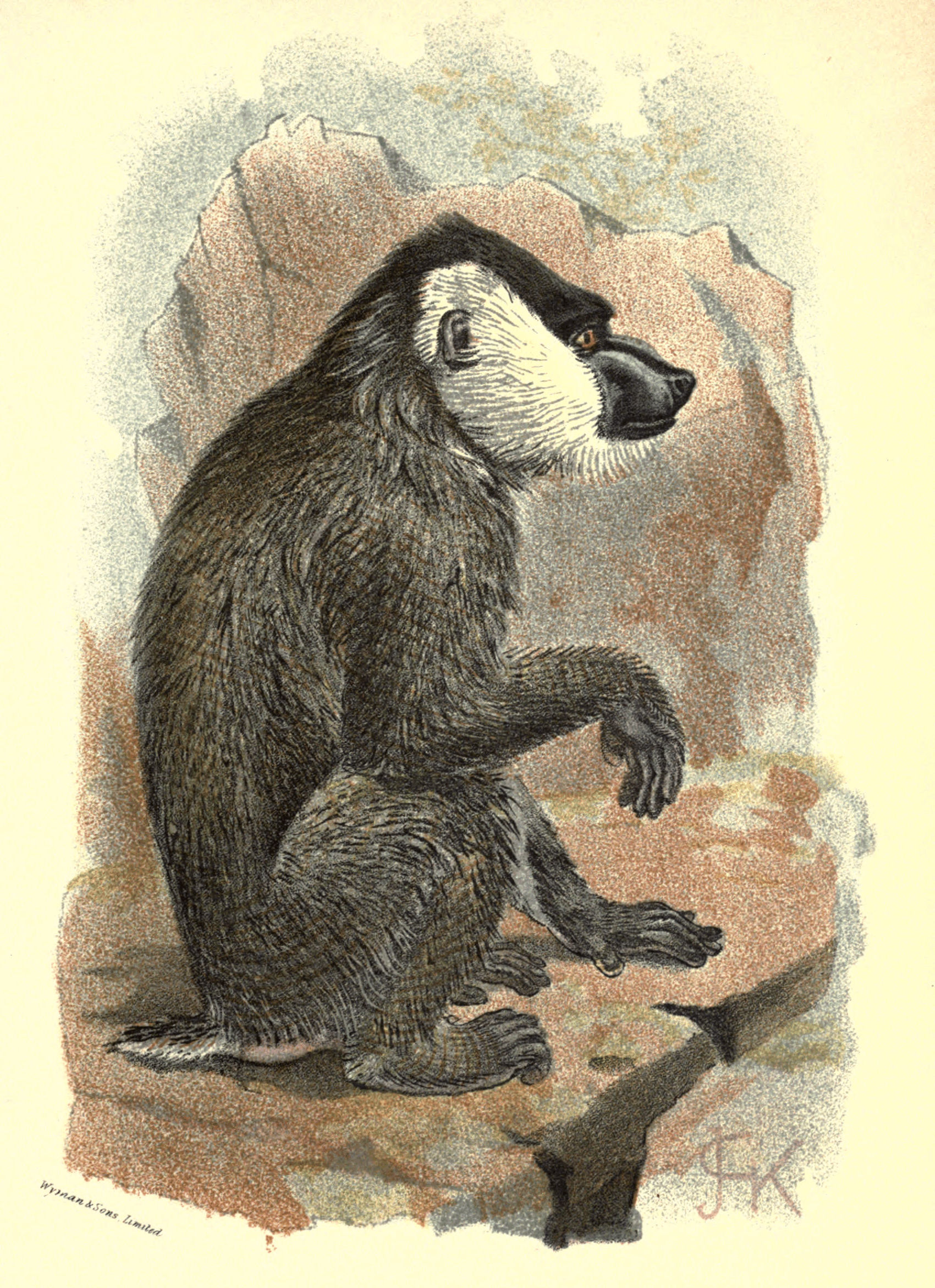
THE DRILL.
Characters.—Somewhat similar to C. maimon, but body less robust, the limbs more slender. Face-swellings with only two furrows; crest and mane less prominent; whiskers encroaching on the face less than in the Mandrill; beard slightly shorter; ears naked, pointed; tail very short, erect, covered with hair all round; the hair round the head, shoulders and sides of body, in a band below the chin, on the under surface of the body, and the outer surface of the limbs, long and fine; muzzle long and truncated, the nostrils placed at its extremity, and somewhat tubular; fingers and toes naked.
Face entirely black, without bright coloration; general colour of fur brown, approaching that of the Mandrill, but washed with greenish on the upper parts, and the shoulders darker. The hairs on the top of the head, on the back, and wherever the greenish colour appears, are grey at the base, alternating with black and yellow, thus producing the greenish coloration; a band from the throat to behind the ear greyish; the whole of the under surface and inner side of the limbs greyish-white; beard and whiskers greyish-white, washed with greenish; hands and feet reddish-purple; callosities bright scarlet.
Young Male.—Smaller; face-swellings less marked; fur and beard more washed with greenish; neck-band paler grey; whiskers paler; callosities not scarlet.
Female.—Like the young male, but the head shorter, and the callosities scarlet; the head and shoulders less haired; the grey neck-band absent; fur in general paler; the greenish hue less marked except on the head and limbs; the fur predominating on the lower part of the back and flanks.
Distribution.—The Drill is confined to West Africa.
Habits.—Little is known of the habits of the Drill. It has the reputation of being good-tempered when young, and of being, when old, ferocious, like the Mandrill.
III. THE DOGUERA BABOON. PAPIO DOGUERA.
Cynocephalus babouin, Rüpp., Neue Wirb. Säugeth., i., p. 7 (1835, in part).
Cynocephalus doguera, Pucher. et Schimp., Rev. et Mag. de Zool., 1856, p. 96, 1857, p. 57.
Cynocephalus porcarius, Fitz. et Heugl., Syst. Uebers., 1866, p. 6; var. Gray, Cat. Monkeys Brit. Mus., p. 64 (1870).
Papio doguera, Schl., Mus. Pays Bas, vii., p. 126 (1876).
Characters.—Face naked; tail moderately long, terminating in a tuft of hairs. General colour of fur olive-brown, or yellowish-olive, the hairs being ringed alternately with black and orange, or brownish-yellow, bars, for their outer third; body and outer surface of hind-limbs and tail olive-brown, the brown predominating; sides of head, under surface of body, and inner surface of limbs pale yellow; hands and feet dark brown or black—Length of body, 38 inches; of tail, 20 inches.
The canine teeth are very large, and the lower jaw very heavy. Distinguished from C. porcarius by its much lighter colour.
Distribution.—The interior of Abyssinia.
Habits.—This very rare Baboon, of which only a very few specimens are known, was brought by Schimper from Central Abyssinia. He states, according to Dr. Slack, that these animals are gregarious, as he met with them in troops of from one to two thousand individuals. They hunt their prey, which consists mainly of small Ruminants, in a manner similar to that of a pack of Hounds, following the quarry till it is exhausted by fatigue, and then capturing and devouring it. It is also stated that the Lion and the Leopard are unknown in the region inhabited by this Baboon. A glance at the animal under consideration would convince anyone that it is of a most ferocious disposition. Mr. Schimper also informs us that it wages continual war against the Gelada Baboon (Theropithecus gelada) which inhabits the same locality.
IV. THE CHACMA BABOON. PAPIO PORCARIUS.
Simia porcaria, Bodd., Naturf., xxii., p. 17, figs. 1, 2 (1787).
Cynocephalus porcarius (Le Chacma), F. Cuv., Hist. Nat. Mamm., p. 132, pl. 47 (? 1807); Gray, Cat. Monkeys Brit. Mus., p. 34 (1870).
Papio comatus, Geoffr., Ann. Mus., xix., p. 103 (1812).
Papio porcarius, Geoffr., Ann. Mus., xix., p. 102 (1812); Schl., Mus. Pays Bas, vii., p. 124 (1876).
Cynocephalus ursinus, Schinz, Synops. Mamm., i., p. 64 (1844).
Characters.—Face and ears naked; muzzle protruding, the nose extending beyond the upper lip; the hair of the body long and shaggy, lengthening on the shoulders and the neck, but not forming a conspicuous mane; whiskers small and directed backwards; tail slightly exceeding half the length of the body, elevated at its base, and then descending perpendicularly; callosities small; hands and feet naked. Sense of smell acute.
Skull flattened, the cranial portion smaller than the facial; ridges above and at the sides of the close-set orbits very large; nasal bones long and prominent; canine teeth very large and triangular.
General colour dark brown or nearly black, washed with green, especially on the forehead, the hairs being grey at the base, then ringed alternately with black and green; some of them, however, lighter. Head, arms, and legs black; face, hands, feet, and ears dark blue; a white ring encircling each eye; upper eyelids white; whiskers grey.
Female and Young Male.—Similar to the adult male in wanting a conspicuous mane; head rounder; nose less protuberant; cranial portion of skull less conspicuously disproportionate to the facial portion.
Distribution.—This species inhabits South Africa; and in the Cape Colony it is found in large troops.
Habits.—The Chacma, which is the largest of all the Baboons, lives, like the others, in troops, consisting of nearly a hundred individuals. They inhabit rocky places, and apparently prefer country broken into steep cliffs and rocky crags, very often in the neighbourhood of the sea. The Chacmas are very ferocious and dangerous, and in captivity, when fully adult, extremely jealous, but when young they are said to be playful and well-dispositioned. They are, moreover, very intelligent. Their sense of smell, especially for hidden water-springs in dry and arid districts, is said to be remarkable. "An animal," says Le Vaillant, in his "Travels in Africa," "that rendered me more effectual services; which, by its useful presence, suspended and even dissipated certain bitter and disagreeable reflections that occurred to my mind; which, by its simple and striking instinct, seemed to anticipate my efforts; and which comforted me in my languor—was an Ape, of that kind so common at the Cape, under the name of Cawiars. As it was extremely familiar, and attached itself to me in a particular manner, I made it my taster. When we found any fruit or roots unknown to my Hottentots, we never touched them until my dear Kees [the Chacma] had first tasted them; if it refused them, we judged them to be either disagreeable or dangerous, and threw them away." The food of the "Chacma," an Anglicised form of the Hottentot name for this Baboon, consists of Lizards, Scorpions, Centipedes, and all manner of insects; birds' eggs, gum, and honey are particularly relished by it. When these are difficult to find, it searches for the bulbous roots of certain liliaceous plants, of which it is very fond, and which it very ingeniously disinters. As Le Vaillant has recorded of the same individual to which we have just referred: "He laid hold of the tuft of leaves with his teeth, and pressing his four paws firmly against the earth, and drawing his head backwards, the root generally followed; when this method did not succeed, he seized the tuft as before, as close to the earth as he could, then throwing his heels over his head, the root always yielded to the jerk he gave it."
V. THE YELLOW BABOON. PAPIO BABUIN.
Le petit papion, Buffon, Hist. Nat. Mamm., xiv., pl. 14 (1766).
Papio cynocephalus, Geoffr., Ann. Mus., xix., p. 102 (1812); Schl., Mus. Pays Bas, vii., p. 127 (1876).
Cynocephalus babouin, Desm., Mamm., p. 68 (1820); (Le babouin), F. Cuvier, Mem. du Mus., iv., p. 419, pl. 19 (1818); id. Hist. Nat. Mamm., livr. iv. (1819); Is. Geoffr., Arch. Mus., ii., p. 579, pl. 34 (1841); Gray, Cat. Monkeys Brit. Mus., p. 35 (1870).
Simia cynocephala, Fischer, Synop. Mamm., p. 33 (1829).
Cynocephalus anubis, var. Wagner in Schreb., Säugeth., Suppl., v., p. 63 (1855).
Characters.—Adult Male.—Snout elongate, not surpassing the upper lip; nostrils large, round, separated by a longitudinal furrow above; tail shorter than the body, haired throughout its length; curved upwards at the root, and then descending straightly; no mane; hair of crown elongated, a large tuft directed backwards on each cheek, forming large whiskers.
General colour of fur brownish-yellow; ears nude, coloured like the face; face livid flesh-colour, deeper round the eyes; upper side of body uniform brownish-yellow, the hairs being ringed alternately with broader yellow and narrower black bars; sides of body somewhat darker; throat and under side paler yellow than above; whisker-tufts pale citron-yellow; hands and feet like the back in colour, their naked parts like the face.
Young Male.—Coloration of upper parts similar to that of the adult male, but paler underneath; the snout less protuberant.
Distribution.—This species inhabits Western Abyssinia, Nubia (Dongola), and the Soudan (Sennaar), at elevations of from 2,000 to 5,000 feet. It also occurs on the West Coast of Africa—having been brought from the Coanza river by the late Captain Cameron, R.N.; in East Africa Mr. H. H. Johnston has observed it on Mount Kilimanjaro; while from the remarks of Sir John Kirk given below it would seem to extend also as far south as the Zambesi (Tete).
Habits.—Very little is known of the habits of the Baboons in a state of nature; but it is probable that this species does not differ materially in its ways and manners of life from those of its near relations described in the preceding pages. Sir John Kirk says that in some parts of Africa, such as Tete, Batoko, and Rovuma it is considered to be a sacred animal by the natives, and is thus unmolested.
VI. THE ANUBIS BABOON. PAPIO ANUBIS.
Cynocephalus anubis, F. Cuvier et Geoffr., Hist. Nat. Mammif., vol. iii., livr. 50 (1825).
Cynocephalus anubis, Waterh., Mamm., Zool. Soc. Lond. (2), p. 8 (1838); Gray, Cat. Monkeys Brit. Mus., p. 34 (1870).
Cynocephalus olivaceus, Is. Geoffr., Cat. Méth. Primates, p. 34 (1851); id. Arch. Mus., v., p. 543, note (1848).
Papio anubis, Schl., Mus. Pays Bas, vii., p. 125 (1876).
Characters.—Snout very elongated; nape of the neck crested. Face black; general colour uniform olive-green; the hairs being grey at the base and ringed higher up with bars of black and yellow; arms and legs like the back; the naked hands and feet flesh-colour.
Distribution.—Interior of West Africa. Lagos, in the Bight of Benin, is the port from which this species is generally shipped to Europe.
Habits.—The Anubis Baboon is not a common species in captivity, as the natives are terribly afraid of its strength and ferocity. The animals wander about in companies, inhabiting chiefly the dry, rocky, mountainous regions in the interior of West Africa, feeding on the peculiar vegetation that they find there; digging up the roots of grasses, and gnawing with their strong jaws the roots and stems of an extraordinary short, woody, top-shaped plant, known as Welwitschia, which produces in its youth two leaves, and never more in its lifetime, though attaining to a great age. They feed also on the Scytonema, a moisture-storing plant, which grows only on rocks. Though affecting dry, rocky regions from choice, the Anubis Baboons often descend in large hordes to the cultivated country, and ravage the gardens of the natives.
Mr. Darwin, in describing the expression of pleasure, joy, and affection in Monkeys, observed that, when they were pleased, the form of the lips differed a little from that when they were angered. In the case of an Anubis Baboon which was first insulted and put into a furious rage by his keeper, who afterwards made friends with him, Mr. Darwin relates that, "as the reconciliation was effected, the Baboon rapidly moved up and down his jaws and lips, and looked pleased. When we laugh heartily, a similar movement or quiver may be observed more or less distinctly in our jaws; but with Man the muscles of the chest are more particularly acted on; whilst with this Baboon, and with some other Monkeys, it is the muscles of the jaws and lips which are spasmodically affected."
VII. THE THOTH BABOON. PAPIO THOTH.
Cynocephalus thoth, Ogilby, P. Z. S., 1843, p. 11; Frazer, Zool. Typica, pl. 5; Gray, Cat. Monkeys Brit. Mus., p. 35 (1870).
Cynocephalus babuin (nec Desm.), Rüpp., Neue Wirbelth. Säugeth., p. 7 (1835-1840).
? Papio hamadryas, Schl., Mus. Pays Bas, vii., p. 129, 1876, in part.
Characters.—Male.—Body massive, thick-set; face broad; cheekbones protuberant; the nostrils placed at the extremity of the truncated snout; nose as long as, but not exceeding, the upper lip. Hair of head and neck longer and thicker than on the rest of the body, but not forming a mantle-like mane as in C. hamadryas; the hair of the legs and outer portion of the thighs and of the toes long; whiskers not intruding far on the face, and directed backwards, less copious than in the Arabian Baboon; ears naked, pointed; soles and palms also naked; callosities large, hips naked. Tail nearly the length of the body, not tufted at the termination.
In colour somewhat similar to C. sphinx, and closely allied to C. babuin. Face livid flesh-colour, lighter on the ridge of the nose. General colour of fur on back, sides of body, and outer side of limbs olive-green; on the under side of the body and inner side of the limbs light yellowish-green; breast, throat, and under part of chin silvery-grey; whiskers silvery-grey; ears, palms of hands, and soles of feet dark brown; callosities flesh-coloured; the surrounding naked parts purple-brown.
Distribution.—Abyssinia.
Habits.—Little or nothing is known of this species. It was obtained in Abyssinia by Dr. Rüppell. A specimen was exhibited alive, however, in the Zoological Gardens of London in 1843.
VIII. THE EAST AFRICAN BABOON. PAPIO IBEANUS.
Papio thoth ibeanus, Oldfield Thomas, Ann. and Mag. Nat. Hist., xi., p. 46 (1893).
Distribution.—Lamu, East Africa.
Mr. Oldfield Thomas has described this sub-species, which has remarkably coarse and shaggy fur all over the body, longer than in the typical form, and of a blackish and dull tawny white, without any of its brighter yellow; the hairs on the crown of the head broadly ringed with black; the chin and throat whitish; hairs of the chest ringed with black and white; the belly black and dull fawn; the inner side of the fore-limbs like the chest, and of the hind-limbs clearer and less ringed fawn-colour. Length of the body, 33½ inches; of the tail 24 inches.
IX. THE GUINEA BABOON. PAPIO SPHINX.
Le papion, F. Cuvier, Mamm., vol. i., livr. 6 (♂); livr. 7 (♀), Hist. Nat. (1819).
Papio sphinx, Geoffr., Ann. Mus., xix., p. 103 (1812); Schl., Mus. Pays Bas, vii., p. 127 (1876).
Cynocephalus papio, Desmar., Mamm., p. 69 (1820).
Cynocephalus choras, Ogilby, P. Z. S., 1843, p. 12.
Papio rubescens, Temm., Esquisses Zool., p. 39 (1853); Schl., t. c. p. 28.
Cynocephalus sphinx, Gray, Cat. Monkeys, Brit. Mus., p. 35 (1870).
Characters.—Male.—Snout tapering, longer than the upper lip; face, ears, palms and soles of feet naked; whiskers bushy, directed backwards, nearly hiding the quadrangular ears; tail of the form usual in this genus, shorter than the body. Hair on back of the neck longer than on the body; facial ridges present, but not very prominent; hinder part of belly, inside of limbs, and chin, throat, and breast very scantily haired.
Face, ears, naked parts of hands and feet, black; upper eyelids white; fur of head, back, and limbs in general brownish-yellow—the hairs being ringed with alternate bars of black and light-brown; cheeks and whiskers fawn-coloured; throat and under side of body paler. Scrotum, callosities, and naked parts of buttocks bright flesh-coloured, but not so bright as in C. hamadryas. Length of body (in young male), 27 inches; of tail, 20 inches.
Female and Young Male.—Similar to adult males in coloration; but less thick-set, and with a shorter muzzle.
Distribution.—The Guinea Baboon inhabits West Africa from Senegal and the Niger to Central Africa. In East Africa, Mr. H. H. Johnston observed it in the inhabited region of Kilimanjaro.
Habits.—Little is known of the habits of this species; but it is improbable that it departs widely from those of the other members of the genus. In regard to the bright coloration of the callosities and posterior parts of this and other Baboons, Mr. Darwin remarks: "In the discussion on sexual selection in my 'Descent of Man,' no case interested and perplexed me so much as the highly-coloured hinder ends and adjoining parts of certain Monkeys. As these parts are more brightly coloured in one sex than the other, and as they become more brilliant during the season of love, I concluded that the colours had been gained as a sexual attraction.... I had, however, at that time no evidence of Monkeys exhibiting this part of their bodies during their courtship.... I have lately read [in an article by J. von Fischer, of Gotha, published in April, 1876] an account of the behaviour of a young male Mandrill when he first beheld himself in a looking-glass, and it is added, that after a time he turned round and presented his red hinder end to the glass. Accordingly I wrote to Herr J. von Fischer to ask what he supposed was the meaning of this strange action. He says that he was himself at first perplexed ... and was thus led carefully to observe several individuals of various other species of Monkeys, which he has long kept in his house. He finds that not only the Mandrill (C. mormon) but the Drill (C. leucophæus) and three other kinds of Baboons (C. hamadryas, C. sphinx, and C. babuin) ... turn this part of their bodies, which in all these species is more or less brightly coloured, to him when they are pleased, and to other persons as a sort of greeting.... From these facts von Fischer concludes that the Monkeys which behaved in this manner before a looking-glass ... acted as if their reflection were a new acquaintance.... It deserves especial attention that von Fischer has never seen any species purposely exhibit the hinder part of its body, if not at all coloured.... With respect to the origin of the habit, it seems to me probable that the bright colours, whether on the face or hinder end, or as in the Mandrill, on both, serve as a sexual ornament and attraction.... The fact that it is only the Monkeys (with those parts brightly coloured), which as far as at present known, act in this manner as a greeting towards other Monkeys, renders it doubtful whether the habit was first acquired from some independent cause, and that afterwards the parts in question were coloured as a sexual ornament; or whether the colouring and the habit of turning round were first acquired through variation and sexual selection, and that afterwards the habit was retained as a sign of pleasure, or as a greeting, through the principle of inherited association."
X. THE ARABIAN BABOON. PAPIO HAMADRYAS.
Simia hamadryas, Linn., Syst. Nat., i., p. 36 (1766).
Le tartarin, F. Cuvier and Geoffr., Mamm., vol. i., livr. 5 (1819).
Cynocephalus hamadryas, Fr. Cuvier, Hist. Nat. Mammif., p. 129, pl. 46 (♂).
Papio hamadryas, Geoffr., Ann. Mus., xix., p. 103 (1812); Schl., Mus. Pays Bas, vii., p. 129 (1876, in part).
Hamadryas ægyptiaca, Gray, Cat. Monkeys Brit. Mus., p. 34 (1870).
Characters.—Male.—Size of a large Pointer Dog; muzzle long; nose slightly longer than the upper lip; nostrils terminal, separated by a furrow above and in front; face naked, the ridges parallel to the nose, and far less prominent than in the Mandrill or Drill; eyes deep-set; brows overhanging; ears naked; a large mane, mantle-like, on the throat, neck, shoulders and middle of the back; whiskers long, directed backwards, almost concealing the ears; hair on the lower back, arms, thighs and legs short; callosities large, and the surrounding part of the buttocks nude; tail slightly shorter than the body, arched at the basal third, then descending perpendicularly to its termination, which is tufted; under surface of body and inner aspect of limbs thinly haired; fourth finger and second toe strongly clawed.
Face flesh-coloured, darker round the margins of the mouth, lighter round the eyes; snout, chin, eyebrows, ears, and naked parts of the hands and feet, dark flesh-colour; general colour of the fur over the body ashy-grey, lightly washed with greenish—the hairs being ringed with alternate bars of black and greyish-green; the head, the mane on neck and shoulders, and the front part of the body ashy-grey, washed with greenish; whiskers greyish-white; hind part of body paler than the fore; forearms and legs greyish-black or almost black; under side of body greyish-white; tip of tail darker; callosities and neighbouring nude parts bright scarlet. Length of body, 26 inches; of tail, 15 inches; height, when standing erect, 4 feet; when sitting, 2½ feet.
Females and Young Males.—Similar to adult males in coloration, but having no mane; the females of the same size as the males.
Both sexes possess laryngeal pouches or air-sacs, extending down the neck nearly to the arm-pits, and connecting with the windpipe by a single opening above the larynx.
Facial portion of skull proportionately larger than the cranial. Top of skull and forehead flattened; brain-case and front of cerebrum small and intruded on by the orbits; the latter directed forwards and outwards.
Distribution.—Arabia, from the plains up to 9,000 feet; Abyssinia, and the Soudan.
Habits.—The Arabian Baboon, or "Tartarin," as it is often called, is gregarious like its allies, occurring in troops of from two hundred and fifty to three hundred individuals. When full-grown, they are very bold and ferocious. They feed on fruits, berries, and the tubers of an edible grass; but their chief food consists of insects, and such small animals as they find under stones, or among the rocky cliffs and ravines, where they usually dwell, for they seem to avoid the wooded country.
They have a loud voice, uttered as a grunting bark. They are said to be extremely intelligent, "astonishingly clever fellows," as one traveller records:—having chiefs whom they obey implicitly, and possessing a regular system of tactics in war, with the posting of sentinels on pillaging expeditions. They have variously modulated cries, to warn, to indicate safety or false alarm, or to direct the general movements or conduct of the troop. "The old males," as Mr. Blanford narrates, "are always most conspicuous animals, all the fore part of their body being covered with long hair. They usually take the lead when the troop is moving; some of them also bringing up the rear; others placing themselves on high rocks or bushes and keeping a sharp look-out after enemies. A troop collected on a rocky crag presents a most singular appearance. I several times saw large numbers assembled around springs in the evening in the thirsty Shoho country.... On such occasions every jutting rock, every little stone more prominent than the rest, was occupied by a patriarch of the herd, with the gravity and watchfulness befitting his grizzled hair, waiting patiently until the last of his human rivals had slaked his thirst and that of his cattle. Around, the females were mainly occupied in taking care of the young, the smaller Monkeys amusing themselves by gambolling about." The Arabian Baboon climbs heavily, but when moving quickly on the ground has a regular steady gallop.
This is the Sacred Monkey of the ancient Egyptians, and its likeness is often found engraved on their various temples and monoliths. "The Cynocephalus Ape," as Sir Gardner Wilkinson writes, "which was particularly sacred to Thoth, held a conspicuous place among the sacred animals of Egypt, being worshipped as the type of the God of Letters, and of the Moon, which was one of the characters of Thoth.... Sometimes a Cynocephalus placed on a throne as a god, holds a sacred Ibis in his hand; and in the judgment-scenes of the dead it frequently occurs, seated on the summit of a balance, as the emblem of Thoth, who had an important office on that occasion, and registered the account of the actions of the deceased. The place where this animal was particularly sacred was Hermopolis, the city of Thoth. In the necropolis of the capital of Upper Egypt, a particular spot was set apart as the cemetery of the Sacred Apes."
XI. LANGHELD'S BABOON. PAPIO LANGHELDI.
Cynocephalus langheldi, Matschie, S. B. Ges. Nat. Freunde, Berlin, 1892, p. 233.
Characters.—Hair of back long and coarse; that of the hinder quarters shorter. Length of body, 29½ inches; of tail, 18 inches.
General colour, dirty olive-grey—the hairs brown at the base, then yellowish-grey, ringed further up with black and yellowish-grey and tipped with black; the long and coarse hair of the back lighter; chin greyish-white; the hind-limbs externally washed with brownish-yellow; the upper side of the hands and feet olive-yellow; tail brownish-grey; under side of body and inside of limbs silvery-grey.
The bright olive-grey of the upper side and the silver-grey under side distinguish this species from all others; it is most nearly related to C. babuin.
Distribution.—East Africa, from the Rovuma river to the Pangani, and extending to the Victoria Nyanza.
THE GELADA BABOONS. GENUS THEROPITHECUS.
Theropithecus, Is. Geoffr., Arch. Mus., ii., p. 576 (1841).
This genus has been established for the reception of two species which differ from the true Baboons (Cynocephalus) in having the nostrils placed on the side of the snout, instead of being terminal and opening, Dog-like, on the blunt face of the truncated nose.
I. THE GELADA BABOON. THEROPITHECUS GELADA.
Macacus gelada, Rüpp., Neue Wirbelth. Säugeth., p. 5, pl. 2 (1835); Schl., Mus. Pays Bas, vii., p. 107 (1876).
Theropithecus gelada, Is. Geoffr., Arch. Mus., ii., p. 576 (1841).
Theropithecus senex, Schimp. et Puch., Rev. et Mag. de Zool., 1857, p. 51.
Gelada rüppellii, Gray, Cat. Monkeys Brit. Mus., p. 33 (1870); Garrod, P. Z. S., 1879, p. 451.
Characters.—Male.—Body large and massive; head oblong; face produced, rounded, and nude below the superciliary ridge; nose long and depressed in its middle region, but elevated at the tip upon the deep upper lip; head crested, with long hair, rising from the superciliary ridge, and descending to a long and mantle-like mane on the back of the neck and shoulders, where the hair is longest, down to the loins behind, and as far as the elbow joints in front; whiskers very long, directed backwards over the ears, and downwards from the corners of the mouth; no beard; chin nude; a patch on the chest and one on the throat naked, separated from each other by a haired bar 1½ inches broad; tail long, round, erect for its basal third, then falling straight down as in other Baboons, and terminating in a long thick tuft.
Face, hands, feet and callosities deep black; nude chest-spaces florid; hair of whiskers, neck-portion of mane, sides, arms, and lower margins of the mantle-like mane dark sooty chocolate-brown; breast, chest, shoulders, fore-arms, hind quarters and tail (except the terminal tuft) black; tail-tuft brownish-black, with a few white hairs; abdomen paler brown than the hair generally, though still dark; hair bordering the nude chest-spaces iron-grey from the presence of numerous short grey and white hairs; nipples close together on the lower nude chest-space; nails of hands longer than those of the feet. Length of the body, 29 inches; of tail, 24¾ inches; to tip of terminal tuft, 32 inches.
Skull shorter than in Cynocephalus; canine teeth very large; posterior lower molars with a large fifth cusp; upper molars with a large front talon; cranial crests strongly developed; nasal bones high, narrow, separate, and not fused together.
The affinities of T. gelada are more with Cercopithecus than with Cynocephalus, and still less with Macacus.
Young Male.—Similar to the adult, but the mane shorter, and more curly; and the brown colour, wherever it occurs in the male, is lighter in colour.
Female.—Coloured like the young male, but smaller than the adult male, and with shorter hair, darker at the tips; hair longest between the shoulders; loins paler than in the male; nude chest and throat-spaces united into one, which is carunculated along its borders, and without white hairs along the margins; callosities carunculated.
Distribution.—Southern Abyssinia; in the provinces of Heremat and Godjan.
Habits.—The habits of the "Gelada," as it is named by the natives of its own country, are similar to those of the Baboons (Cynocephalus). They live in large companies, and when full-grown—the males especially—are very ferocious, pugnacious, and dangerous. It is a common habit of these animals to roll down stones from the rocky cliffs amid which they live, upon any approaching animal—the Arabian Baboon being an especial object of their animosity. Their food consists of all sorts of fruits, as well as grass, and the cultivated crops of the natives. They are chiefly found in barren rocky regions, ascending the mountains to an altitude of from 7,000 to 8,000 feet above the sea.
II. THE DUSKY GELADA. THEROPITHECUS OBSCURUS.
Theropithecus obscurus, Heuglin, Act. Acad. Leop., xxx., Nachtrag, p. 10 (1863); Schl., Mus. Pays Bas, vii., p. 107 (1876).
? Theropithecus senex, Schimper et Puch., Rev. Zool., 1857, p. 244.
Characters.—Nearly allied to T. gelada, but distinguished by its darker colour, the flesh-coloured ring round the eyes, and the two naked spots on the chest at the base of the neck, surrounded by white hairs, extending to the inner side of the arm.
Face naked, the chin thinly haired, the nose-pad situated behind the blunt and broad end of the muzzle; eyes small, set close together, deep sunk beneath the prominent overhanging frontal ridges; ears small; sides of the head entirely covered with woolly hair; mane long, soft, and thick. Length of body, 53 inches; tail, 26 inches.
Face black, but with a broad flesh-coloured ring round each eye; scanty hairs on the chin white; top of head and back dark brown; mane on fore-neck and shoulders, arms, and hind part of the hands pure black; sides of head and neck, rump, and tail dirty ochre; naked spots on breast dark flesh-coloured, more vivid in passion; breast and inner side of fore-arm, and middle of chest white; rest of under surface pale brown. Callosities bluish-grey.
Female and Young.—Almost uniform fulvous, but the mane less marked.
Distribution.—North-east Africa; on the eastern boundary of Abyssinia, near the sources of the Takazze river, on the confines of the Galla country. Dr. Blanford observed it also near Magdala.
Habits.—This large and "stately" Baboon, known to the natives as "Tokur-Sinjero" (or Black Baboon), lives in large troops in the high mountains of Abyssinia, at an altitude of from 6,000 to 10,000 feet. It is seldom seen among trees, but generally in open plains, or in inaccessible rocky cliffs, from which it hurls stones on anyone who dares to approach. During the night these Baboons hide together in holes in the rocks, whence, on the return of the morning sun, they emerge and sit warming themselves, before starting on their marauding expeditions in the cultivated fields, or in the vegetation which clothes the sides of the deep valleys, where they feed largely on the leaves of the trees. Their disposition is, among themselves, harmless. As a rule two to six year old males lead with grave strides a herd of twenty to thirty females and young, the latter now playing with each other, and scampering about the troop, now carried by their mothers, and sometimes pinched and boxed on the ears by them. As soon as, but not before, the leader has assured himself of any danger, he utters a gentle bark, to which the whole troop responds and retreats back into safety among the rocks. The old males then stand on their hind-feet barking and displaying to the intruder their long white teeth. On their marauding expeditions, or when in flight, they do not usually exhibit great haste, the whole troop generally going in single file with an old Sultan bringing up the rear. Often several troops mingle together during the day, but at nightfall each returns to its own headquarters.
Their cry is a sharp bark, but that of the old males is very hoarse. One of their great enemies is the Lämmergeier or Bearded Vulture.
These observations have been extracted from the account given of this species by von Heuglin, who discovered it during his Abyssinian expedition in 1853.
THE MALAYAN BABOONS. GENUS CYNOPITHECUS.
Cynopithecus, Is. Geoffr., in Belanger's Voyage, p. 66 (1834).
This genus has been constituted to include the single species described below; the characters of the genus being thus, perforce, the same as those of the species.
THE CELEBEAN BLACK BABOON. CYNOPITHECUS NIGER.
Cynocephalus niger, Desm., Mamm., p. 534 (1820).
Macacus niger, Bennett, Gard, and Menag. Zool. Soc., p. 189, with figure (1830); Schl., Mus. Pays Bas, vii., p. 119 (1876).
Cynopithecus niger, Is. Geoffr., in Bélanger's Voyage, p. 66 (1834); Lesson, Quadrum., p. 101 (1840); Gray, Cat. Monkeys Brit. Mus., p. 33 (1870).
Papio niger et P. nigrescens, Temm., Possess. Néerl. Ind., iii., p. 111 (1847).
Cynopithecus niger, vel nigrescens, Wagner in Schreb., Säugeth. Suppl., v., p. 61, tab. 6 (1855).
Cynopithecus nigrescens, Wallace, Malay Arch., i., p. 432 (1869).
Characters.—About the size of a Spaniel; head oblong; face very elongated, naked; neck, hands, and feet also naked; nose triangular, the sides erect, flattened behind nearly to the eyes, not extending to the end of the muzzle, but leaving a broad upper lip; nostrils, with a long and broad partition between them, directed downwards and outwards—a character seen in the genus Macacus, and distinguishing this genus from the true Baboons (Cynocephalus); cheek-swellings parallel to the nose, distinct, but not conspicuously large; supra-orbital ridges very conspicuous; cheek-pouches large; tail rudimentary, reduced to a fleshy tubercle, one inch long, and hardly visible. Length, 24 inches.
Fur long and woolly over the body; especially long on the top of the head, forming a crest; hair of the limbs shorter.
Face, neck, hands, and feet black; fur all over the body and limbs jet-black; callosities bright flesh-colour.
In the skull the maxillary bones are developed into strong lateral ridges corresponding in structure to those of the most typical Baboons.
Distribution.—This species is found far away from the habitat of the true Baboons, whose home is in the Ethiopian Region. The Black Baboon is an inhabitant of Celebes, one of the islands of the eastern portion of the Malay Archipelago. It is found, however, also in the neighbouring island of Batchian, further to the east—indeed the most easterly range of the Quadrumana—as well as in some of the Philippine Islands to the west. In both of these regions it is supposed to have been accidentally introduced by the Malays. In Batchian, Mr. Wallace remarks, "it seems so much out of place that it is difficult to imagine how it could have reached the island by any natural means of dispersal, and yet not have passed by the same means over the narrow strait to Gilolo—so that it seems more likely to have originated from some individuals which had escaped from confinement, these and similar animals being often kept as pets by the Malays and carried about in their praus." Analogous to the distribution of this animal in the Philippines and Celebes is that of a genus of Parrots—Prioniturus—with racquet-shaped tails. The species of the latter genus are divided between Celebes and its small adjacent islands and the Philippines and the small islands adjacent to that archipelago, and present a curious case of the restricted range of a well-marked group.
Habits.—This interesting animal, geographically so isolated, lives in the luxuriant forests in small companies, and feeds chiefly on the abundant fruits which these forests provide. In its disposition it appears to be more amiable and docile than the African Baboons. Some kinds of Monkeys, as Mr. Darwin observes, which have moveable ears, and fight with their teeth, draw back their ears when irritated just like Dogs, and then they have a very spiteful appearance.... Other kinds—and this is a great anomaly in comparison with most other animals—retract their ears, "and utter a slight jabbering noise when they are pleased by being caressed. I observed this in the Cynopithecus niger.... With the Cynopithecus the corners of the mouth are at the same time drawn backwards and upwards, so that the teeth are exposed. Hence this expression would never be recognised by a stranger as one of pleasure. The crest of long hairs on the forehead is depressed, and apparently the whole skin of the head is drawn backwards. The eyebrows are thus raised a little, and the eyes assume a staring appearance. The lower eyelids also become slightly wrinkled; but this wrinkling is not conspicuous, owing to the permanent transverse furrows on the face." When enraged, the Cynopithecus niger depresses the crest of hair on its forehead, and shows its teeth; "so that," as Mr. Darwin continues, "the movements of the features from anger are nearly the same as those from pleasure; and the two expressions can be distinguished only by those familiar with the animal." See the figures in Mr. Darwin's "Emotions in Man," &c., p. 136.
APPENDIX.
While this volume was passing through the press, a valuable paper by Messrs. Oldfield Thomas and Ernst Hartert has appeared in the Hon. Walter Rothschild's Journal "Novitates Zoologicæ." It deals with the Mammalia collected in the Natuna Islands by Mr. Alfred Everett, and the following additional notes must be recorded.
p. 20. TARSIUS TARSIUS.
Tarsius spectrum, Oldfield Thomas and Hartert, Nov. Zool., i., p. 655 (1894).
Mr. Everett says that on Banguran Island he could hear nothing of the existence of the Tarsier, but on Sirhassen Island the Malays described it to him unmistakably under the name of "Imbing."
p. 33. NYCTICEBUS TARDIGRADUS.
Mr. Everett procured specimens of the Javan Slow-Loris on the island of Banguran, where, he says, it is probably not rare, though not often captured; the native name is "Kukáng." The natives of Banguran did not appear to know the animal.
p. 100 et sequent. PROPITHECUS MAJORI.
Propithecus majori, Rothschild, Nov. Zool., i., p. 666, pi. xiv. (1894).
Adult.—Head and neck black. Face, snout, and ears naked, and of a blackish colour, encircled by a broad band of long white hairs, joining under the throat, slightly mixed with darker hairs. Rest of fur, including the tail, white on the upper surface; back and upper rump dark brown. The large white patch on and between the shoulders much grizzled with brown hairs. Under side of hind-limbs, to just below the knees, blackish-brown. Inside of hind-limbs down to the heel also brown, joining the colour of the upper surface, thus forming a continuous dark stripe along the legs. Inner and upper surface of arms, thumb, and two following fingers, deep blackish-brown; throat, chest, and greater part of abdomen, deep brown. Size perceptibly larger than that of Propithecus verreauxi, with the tail longer.
This species of Propithecus is nearest to the typical P. verreauxi of Grandidier, which is white, with the top of the head black, and the lower back and rump greyish-brown, but is no doubt an entirely different species. (Rothschild, l.c.)
Distribution.—Antimosy country, S.W. Madagascar.
END OF VOL. I.
PRESS OPINIONS.
"The 'Naturalist's Library' has all the signs of earning and keeping a wide popularity."—Scotsman.
"They are carefully compiled from the most authentic sources of information, and are embellished with cleverly-executed coloured plates."—Daily News.
"Admirable in every way, and should be highly popular."—Public Opinion.
"Really good handbooks, well arranged, concise, carefully printed, and handsomely illustrated with full-page coloured plates."—Science Gossip.
"Eminently readable, the information being given in an interesting manner."—Field.
"A most valuable feature of these volumes is the plates, which have been coloured from specimens in the British Museum, and are by far the finest that have ever appeared in any work at the price, or anything near it. Altogether the character and general get-up of 'Allen's Naturalist's Library' leave nothing to be desired. We trust these volumes, and those that may come after them, will be widely welcomed."—Westminster Gazette.
"Should prove most instructive to every student of natural history."—Rod and Gun.
"Abounds in interesting matter, and can be read through with pleasure."—Saturday Review.
"May be heartily recommended."—St. James's Budget.
LONDON: W. H. ALLEN & CO., Limited, 13, Waterloo Place, S.W.
TENTATIVE SCHEME OF VOLUMES.
The following list will give an outline of the General Scheme, but it may be varied if, in the opinion of the Editor and Publishers, an alteration would improve the Series.
MONKEYS, Vol. II. By Henry O. Forbes, F.L.S., &c.
MON,,KEYS Vol. II. ,,
CETACEA ,,
CATS By R. Lydekker, B.A., &c.
DOGS ,,
RUMINANTS ,,
BRITISH MAMMALS ,,
MARSUPIALS ,, Ready.
HORSES ,,
PACHYDERMS ,,
BRITISH BIRDS, Vol. I. By R. Bowdler Sharpe, LL.D. Ready.
BRITISH,,BIRDS,,,VIII. ,,
BRITISH,,BIRDS,,,VIII. ,,
BRITISH,,BIRDS,,,IIIV. ,,
SUN-BIRDS ,,
HUMMING-BIRDS ,,
BIRDS OF WEST AFRICA ,,
PARROTS By Henry O. Forbes, F.L.S., &c.
PIGEONS ,,
GAME BIRDS By W. R. Ogilvie Grant.
BUTTERFLIES (with special reference to British Species) By W. F. Kirby, F.L.S.

BUTTERFLIES, Vol. II. ,,
MOTHS (with special reference to British Species) ,,
BEETLES, CRICKETS, &c. ,,
BEES ,,
FISHES, Vol. I. By Professor R. H. Traquair, F.R.S.
FIS,,HES,,, IIII. ,,
FIS,,HES,,, IIII. ,,
London: W. H. ALLEN & CO., Limited, 13, Waterloo Place, S.W.
Notes.
[1]
ἄνθρωπος—Man.
[2]
ἕτερος, different, ὀδούς, a tooth.
[3]
ὁμός, the same, ὀδούς, a tooth.
[4]
διφυής, double, ὀδούς, a tooth.
[5]
N.B.—These descriptions of new species have been kindly supplied by Dr. Forsyth Major from his MSS., and I am much indebted to him for allowing them to be first published in the present work.
[6]
N.B.—The white feet should have been more pronounced in the plate.
[7]
Κατά, down; ῥὶς, ῥινός, nose.
[8]
πλατὺς, flat; ῥὶς, ῥινός, nose.
[9]
Vide anteà, p. 145.
[10]
"Red-footed Night-Monkey," on plate.
[11]
See the figures in Flower and Lydekker, Mammals, p. 711.
[12]
This curious custom, of women suckling animals, was also observed by the present writer in New Guinea, where the native women suckle puppies and young pigs.
[13]
Humboldt and Stedman both state that these Monkeys threw pieces of branches towards them.
[14]
κατα, down; ῥις, ῥινος, nose or nostril.