Front matter (continued 3)
Reading edition
The species to be noticed below are some of the more important of those which have been ascertained to belong to the present Sub-order.
No remains assignable with certainty to the families Chiromyidæ or Tarsiidæ, have as yet been discovered. The first form to be mentioned belongs to a family which has now no living representatives.
FAMILY MEGALADAPIDÆ.
This family has recently been established by Dr. Forsyth Major, for a fossil species represented by the greater portion of a large cranium and part of its lower jaw, found in a marsh at Amboulisatra, on the south-west coast of Madagascar. This species is the only representative of the single genus of the family.
GENUS MEGALADAPIS.
Megaladapis, Forsyth Major, Phil. Trans., vol. 185 B, p. 15 (1894).
The cranium, about 10 inches long, indicates an aged animal three or four times as long as the common Cat, which is an enormous size as compared with any living Lemur. Brain-case straight, narrow, short, low, and situated at a higher level than the facial region; an enormous lateral development of the region between the eyes; orbits small in diameter, communicating freely with the temporal fossa, protruding outwards and forwards, and surrounded by a thickened ring; facial region elongate and bent upward; palate convex downwards from front to back; ridges for attachment of the temporal muscles uniting in a great central crest; frontal bones constricted behind the orbits; maxillary bones behind the molar teeth greatly inflated by air-cavities; the two halves of the lower jaw ossified together. In the upper jaw the pre-molars have one outer and one inner cusp, and the molars one internal and two external cusps, the former being deeply separated from the hind outer cusp, and joined by a ridge to the front outer cusp. In the lower jaw, the posterior pre-molar has one outer cusp, a fore and hind inner cusp (each joined by a crescent to the outer cusp), and a central inner cusp; the three molars have two outer and three alternating inner cusps, and to the outer side a basal cingulum; the posterior molar has a strongly cusped heel.
Megaladapis madagascariensis, Forsyth Major, the only species of the genus, presents many marsupial and insectivorous characters and features which show some approach towards the South-American Howlers (Alouatta), a specialisation "not in the least," according to Dr. Major, "implying a near relationship, but probably only an adaptation to a corresponding function" implied in the "vocal organs of unusual size," which, he believes, Megaladapis to have possessed. Lemurine characters, however, predominate. In the shape of its molars it is related to Lepidolemur, and still more closely to Microcebus and Chirogale, while by the characters of its inter-orbital region it approaches to the Sifakas (Propithecus) and the extinct Adapis.
The small diameter of its orbits suggests, according to Dr. Major, that in habits this extinct giant Lemur was diurnal; and from the conformation of its lower jaw "there exists," continues the same distinguished investigator, "a strong assumption that, as in Alouatta, it was provided with vocal organs of unusual size."
The age of this Howling Lemur, estimated either geologically or by years, cannot be of very great antiquity. Its remains were found associated with those of the giant Moa-like bird, the Æpyornis, of Tortoises and Hippopotami, all now extinct, and of Crocodiles still living in the interior lakes of the island. Some of these animals were certainly contemporaneous with the now vanished Dodo and the large flightless Rail (Aphanapteryx), both of which were seen alive by Europeans little more than two centuries ago, and it is not improbable that Megaladapis may have been living in the Madagascar forests at the same period.
FAMILY LEMURIDÆ (anteà, p. 22).
In this family, and in its sub-family Lemurinæ (because of its affinities with Hapalemur), has to be included a large extinct species from Nossi Vey, in North-west Madagascar. Its fossil remains were recently described (P. Z. S., 1893, p. 532), but not named by Dr. Forsyth Major. They will prove, he believes, when more fully known, to be the type of a new genus. At present, however, owing to their incomplete state, it is not possible to describe the species fully. "The Lemuroid nature of the specimen is at once demonstrated by the great elevation and downward bending of the post-orbital processes ... showing that the osseous ring of the orbit was complete." Unusual for a Lemuroid is the very strong post-orbital constriction of the frontals, a character, however, seen in Adapis, an Eocene European form, and in Hapalemur. With the latter it agrees in the voluminous cranial and very short facial portion, and the "cuttingly sharp" inferior margin of its post-orbital process. Seen from the side, this fossil cranium is almost vertically truncated behind, as in the skull of Alouatta. The region between the eyes is vaulted by underlying air-chambers.
FAMILY ANAPTOMORPHIDÆ.
This family includes certain fossil forms of Lower Eocene age from the phosphatic deposits of Quercy in France, the Wasatch strata of Wyoming, and the Puerco beds in New Mexico. Their dental formula is the same as that of existing Lemurs, namely I2(2-1), C1(1-0), P(2-3)(2-3), M33. In some of the genera there is a tendency to develop, as Cope has pointed out, large cutting teeth in the position of incisors, "thus approaching the Aye-Aye." The posterior pre-molars are more simple than the anterior true molar, a character which indicates some relationship to the Mouse-Lemurs (Chirogale). The mastoidal or posterior portion of the ear-capsules, and the neighbouring squamosal region of the cranium are swollen, as among the Galagos.
GENUS MICROCHÆRUS.
Microchærus, Wood, Lond. Geol. Journ., i., p. 5 (1846).
Heterohyus, Gerv., Zool. et Pal. Fr., p. 202, pl. 35, fig. 14.
Necrolemur, Filhol, C. R., lxxxvii., p. 1112 (1873); id. Ann. Sc. Geol., viii., p. 55, pl. iv., figs. 213-217 (1877).
This genus is distinguished from all other Lemurs by "the angle of the mandible being produced into a large hook-like flange." (Flower and Lydekker.) The orbits are large, indicating a nocturnal animal; the inter-orbital space is wide, and distinguishes it from Loris. The dental formula is I21, C11, P33, M33. The canine teeth are not prominent; the anterior lower pre-molar is only slightly developed; a gap separates the anterior and the median upper pre-molars.
This genus is represented by five species. Microchærus antiquus (Filhol) is of very small size, and has many affinities with Galago, as exhibited in the well-preserved cranium that has been recovered from the Phosphorites of Central France. The two lower molars have only one root. M. erinaceus, Wood, from the Upper Eocene of Hampshire; M. edwardsi (Filhol), from Central France, a species larger than M. antiquus, presents dental characters similar to the Galagos and the Mouse-Lemurs; M. parvulus (Filhol), and M. zitteli (Schlosser), are both from the Quercy Phosphorites of France; while M. armatus is from the Eocene of Alsace, and M. (Cryptopithecus) siderolithicus from the Bonerg of Frohnstellen.
GENUS MIXODECTES.
Mixodectes, Cope, Proc. Amer. Phil. Soc., p. 447 (1883); id., Rep. U. S. Geol. Surv., iii., p. 240, pl. xxiv. f, figs. 1 and 2.
The members of this genus, founded on fragmentary mandibles from the Puerco (Lower Eocene) strata of New Mexico, have a large front tooth "issuing from the ramus at the symphysis like a rodent incisor, the second tooth being similar but smaller and posterior and external to the first." The genus is represented by two species, M. pungens, Cope, and M. crassiusculus, Cope.
GENUS CYNODONTOMYS.
Cynodontomys, Cope, Palæont. Bull., p. 151 (1882); id., Rep. U. S. Geol. Surv., iii., p. 243, pl. xxiv., fig. 2.
This genus contains but one species, founded on several lower jaws disinterred from the Wasatch beds in the Big-Horn Bad-lands, in Northern Wyoming. The lower incisors, or perhaps, canines, are very large and close to the line of union of the two halves of the jaw; the molars have three cusps in front and a heel behind. The dental characters of the genus "resemble considerably those of Anaptomorphus and Necrolemur [Microchærus] but the large size of the inferior canine or incisor tooth distinguishes it from both." (Cope.) C. latidens, Cope, is the only species.
GENUS OMOMYS.
Omomys, Leidy, Journ. Acad. Nat. Sci. Philad., vii., p. 408 (1869).
This genus was established for the first Mammalian fossil—a lower jaw—described from the Bridger-beds as O. carteri. The posterior lower molar has cusps in opposing pairs; pre-molars, three in number, the two anterior one-cusped, the posterior two-cusped. The chin was longer and less rounded than in Anaptomorphus.
GENUS ANAPTOMORPHUS.
Anaptomorphus, Cope, Proc. Amer. Phil. Soc., 1872, p. 554; id., Rep. U. S. Geol. Surv., iii., p. 245, pl. xxiv. e, fig. 1; xxv., fig. 10.
This genus was founded by Cope on an almost entire cranium discovered in the Bridger (Eocene) beds of the upper Valley of Green river, and on other remains from what is known as the Wasatch formation of the Big-Horn Basin in Wyoming Territory, in North America. The external upper incisor is small and set close to the small canine; the pre-molars have each a large external and a smaller internal cusp; the true molars are wide and have one internal and two external cusps. In the lower jaw the two anterior molars are four-cusped, with a transverse ridge between the anterior pair, and an oblique ridge between the hind inner, and the front outer, cusp; the posterior is three-cusped and has a heel. The orbits are enclosed, as in typical Lemurs. Not less typical characters are the position of the lachrymal foramen, external to the orbit, and the unossified halves of the lower jaw. "Its dental formula (I22, C11, P22, M33) agrees only with the Indrisinæ. But no known Lemuridæ possess anterior lobes and cusps on all the pre-molars, so that in this respect, as in the number of its teeth, this genus resembles the higher Monkeys, the Simiidæ and Hominidæ, more than any existing member of the family.... It has ... a number of resemblances to Tarsius, which is, perhaps, its nearest ally among the Lemurs, although that genus has three pre-molars.... There is no doubt but that the genus Anaptomorphus is the most Simian Lemur yet discovered...." (Cope.)
The species included in this genus are A. æmulus (Cope), which did not exceed the size of a Marmoset or a Red Squirrel, and had short erect incisors; A. homunculus (Cope), a species founded on a cranium without a lower jaw, with the orbits not so large as in Tarsius, and the skull wide behind the eyes. "The A. homunculus was nocturnal in its habits," according to Professor Cope, "and its food was like that of the smaller Lemurs of Madagascar and the Malayan islands. Its size is a little less than that of the Tarsius tarsius."
Two other insufficiently characterised genera, both considered to be primitive Lemuroids, are Plesiadapis, Gervais, containing the species P. remensis, P. gervaisi, P. tournesarti, and P. daubrei, from the Lower Eocene strata of Rheims, which have five-cusped lower molars, and enlarged upper and lower incisors; and Protoadapis, Lemoine, with one or two high front cusps, and a low heel to its three pre-molars; the anterior molars with two pairs of opposite cusps, the posterior molar with a fifth cusp on the hind border. P. crassicuspidens, Lemoine, and P. recticuspidens, Lemoine, are its two species.
FAMILY ADAPIDÆ.
The different species associated together under this family are abundantly known from the Upper Eocene of France, England, and North America. They are remarkable in having an extra pre-molar in both jaws, the dental formula being I22, C11, P44, M33.
GENUS ADAPIS.
Adapis, Cuvier, Ossem. Foss. (2) iii., p. 265 (1822); Flower, Ann. and Mag. N. H., xvii., (1876), p. 323.
Palæolemur, Delfort., Act. de la Soc. Linn. Bord., xxix., pp. 87-95, pl. 5 (1873); id. C. R., lxxvii., p. 64 (1873).
Aphelotherium, Gervais, Zool. et Pal. Franç. (1), ii., Exp. 34 (1848-52).
Cænopithecus, Rütim, Denksch. Schw. Ges. Nat., xix., p. 88 (1862).
Notharctus, Leidy, Geol. Surv. Mont., p. 364 (1871).
? Thinolestes, Marsh, Am. Jour. Sci., 1872 (2), p. 205.
? Telmalestes, Marsh, op. cit., p. 206.
"The general form of the cranium," to quote Sir W. Flower, "the large size and anterior direction of the orbits, the small and narrow muzzle ... show its affinity to the Lemurine animals, and especially to the African forms. The whole skull, however, is more depressed than in the slow Lemurs and Galagos; the orbits are smaller, the brain cavity relatively smaller and more constricted behind the orbits, and the muscular ridges more developed."... The lower jaw is deep and stout. The posterior upper pre-molar is very similar to a true molar. "The upper molar teeth are nearly equal in size, and have nearly square crowns, with four distinct cusps, one at each angle, rather obliquely placed"; the hind inner cusp of the posterior molar inconspicuous. The lower molars have two pairs of obliquely placed cusps, connected by transverse ridges, anterior and posterior, with an oblique ridge running forwards and inwards from the outer hind cusp. The hindmost lower pre-molar has an internal cusp; the lower incisors have upright spatulate crowns like those of true Apes.
Several species of this genus have been described. Adapis Parisiensis (with the synonyms of Aphelotherium duvernoyi, Gervais, and Palæolemur betillei, Delfortrie) is one of the best known, and its remains have been found in Upper Eocene strata at Egerkingen, in Switzerland, at Sainte Néboule de Béduer, and in the Paris Gypsum, in France, as well as in England. It "more nearly resembles the Indo-African Lemurs, and not those of the island of Madagascar, or of the extreme east, having no near relationship with the Tarsius, the Aye-Aye, or the Indris, and not much with the true Lemurs." (Flower.) From the Eocene of Switzerland comes A. lemuroides. Adapis magna (Filhol) is larger than the preceding species, has a larger face, and a greater constriction between the cerebral and facial regions of the skull. It has been found in the phosphatic deposits at Raynal, in France. Adapis angustidens (Filhol), from the Quercy Phosphates of France, is distinguished by the structure of its molars, and by the great size of its two anterior pre-molars. A. tenebrosus (Leidy) has a large lower canine. A. minor (Filhol) is an additional species.
GENUS TOMITHERIUM.
Tomitherium, Cope, Vert. Bridg. Eoc. Wyom., p. 2, 1872.
Limnotherium, Marsh, Am. Journ. Sci., 1871, ii., p. 43 (in part).
This genus, which is allied to Adapis, is characterised by having its lower incisors with cutting edges; the first and second lower pre-molars with one root; the third with one cusp and a posterior heel, and the fourth an interior lateral cusp in addition. The lower true molars have two anterior cusps (the inner being double) and two posterior. The thigh is long and the knee free from the body as in the Anthropoidea, the hand capable of turning freely upwards at the wrist; the hind-limbs longer than the fore-, and "the details of the lower jaw, which is co-ossified in the centre, and teeth similar to that of the lower Monkeys." The remains of the only known species, T. rostratum (Cope), which was about the size of the Capuchin Monkey (Cebus capucinus) of Brazil, were found in the Bridger (Eocene) beds in an isolated spot on Blacks' fork, Wyoming.
GENUS MENOTHERIUM.
Menotherium, Cope, Bull. U. S. Geol. Surv. Territ., 1874, i., p. 22.
Laopithecus, Marsh, Am. Journ. Sei., 1875, i., p. 240.
This genus was established on an under jaw from the Lower Miocene White-river beds of Nebraska. Its molars are successively larger from anterior to posterior; the two pairs of cusps are obliquely opposite, the hinder pair longer than the front pair, and presenting a strong cingulum. Its discovery was the first indication of Lemurs in the Miocene of the United States. M. robustum, Marsh, was as large as a Coati; and M. lemurinum (Cope) about the size of a domestic Cat.
GENUS PELYCODUS.
Pelycodus, Cope, Cat. Verteb. Eoc. New Mex., p. 13 (1875).
Tomitherium, Cope, Rep. U. S. Geol. Surv. W. of 100° mer., ii., p. 135 (in part).
Lemuravus, Marsh, Amer. Journ. Sci., 1875, i., p. 239.
This genus is characterised by the second pre-molar having always two roots; the anterior has one root and the third three; the posterior has one external and one internal cusp. Of the true molars, all have two external cusps; the anterior and median have two internal cusps and the posterior has only one; of the lower teeth the posterior pre-molar has an internal cusp and a heel; the next one has no internal cusp; the molars often have the fore inner cusps double; the posterior molar has a strong heel. This genus contains three species, all described by Cope (P. jarrovii, P. tutus, P. frugivorus), with the hind inner cusp of the upper molars distinct from the heel; and P. angulatus, in which that cusp is small and is on the heel. Their remains have been found in the Lower Eocene (Wasatch) beds of New Mexico. P. helveticus has been described from the Upper Eocene of Egerkingen.
GENUS MICROSYOPS.
Microsyops, Leidy, Proc. Acad. Nat. Sci., Philad., 1872, p. 20.
Limnotherium, Marsh, Amer. Journ. Sci., 1871, ii., p. 43 (in part).
This genus is easily distinguished, as Cope points out in his sumptuously illustrated "Vertebrata of the Tertiary Formations of the West," by the absence of the first (anterior) inferior pre-molar, and probably of the superior first pre-molar also. The canine tooth of the lower jaw is very large. The posterior pre-molar has an internal cusp, and the molars two front inner cusps. There are three species, distinguished chiefly by size, M. spierianus (Cope), very small; M. elegans (Marsh), the largest, with seven teeth succeeding the canine in the lower jaw; and M. scottianus (Cope); all from the Eocene of Wyoming.
GENUS HYOPSODUS.
Hyopsodus, Leidy, Proc. Acad. Nat. Sci., Philad., 1870, p. 109.
The present genus is recognised by the front inner cusp of the lower molars being single, and their heel presenting a cusp at its inner hind angle (except in H. acolytus). Of the upper pre-molars, the median and posterior have an internal cusp; and the molars have two outer and two inner cusps with two small intermediate tubercles. There are six species known, from the Wasatch and Bridger beds of Wyoming and New Mexico, of which H. acolytus is distinguished by having the heel of the anterior and median lower molars without an inner hind cusp. Professor Cope remarks that though the species of this genus are not numerous, individuals of some of them are exceedingly common in the Eocene beds of Wyoming. H. paulus and H. minusculus, Leidy, H. vicarius and H. powellianus, Cope, with H. jurensis, Rutimeyer, from the Upper Eocene of Egerkingen, are the best known species.
The genera Indrodon, Cope, from the Lower Eocene Puerco formation of New Mexico, with three cusped upper and four cusped lower molars; Opisthotomus, Apheliscus, and Sarcolemur, Cope, from the Wasatch of Wyoming; Hipposyus, Leidy; Bathrodon, Mesacodon, and Stenacodon, Marsh, from the Middle Eocene Bridger beds; are of doubtful affinities.
II. THE MONKEYS AND APES—SUB-ORDER ANTHROPOIDEA.
This Sub-order, though containing animals of much higher organisation than the Lemuroidea, embraces species presenting many different grades of intelligence, and ranging in size from the Pigmy Marmoset, not larger than a small Kitten, to the ponderous Gorilla and the genus Homo. In external characters the Monkeys and Apes have in general a shorter and less Dog-like nose than the Lemurs, thin lips and a more distinct face; while their eyes, situated on the face, are invariably directed forwards, and never outwards, or to the side. The opening of their nostrils is either outward (as in those inhabiting the New World), or downwards (as in the bulk of the Old World species). All of them are covered with hair; the tail may be long, short, or wanting. The proportions of the fore-limbs to the hind- vary much in the different groups. The great toe, as well as the thumb, is (except in a few species) fully opposable, so that in the majority of members of the Sub-order, the foot is as good a prehensile organ as the hand. From this circumstance comes the designation, Quadrumana, or "four-handed," so often applied to these animals. In a few species the thumb is rudimentary or absent, but the fore-finger, the absence of which characterised some of the Lemurs, is always present and well developed, and the corresponding digit in the foot (except in the Marmosets) has a flat nail instead of a claw. The mammæ of the Anthropoidea are always situated on the breast. If we examine the structures underlying the skin, we find that in the skull the orbits are entirely shut in by a bony wall, so that the finger cannot be passed into the temporal depression behind, as could be done in the Lemurine skull, and that the lachrymal foramen opens within the cavity for the eye. In the present Sub-order there is no toothless space in the mid-line of the upper jaw, the incisor teeth being set close together; but there is always a vacuity, except in Man, between the incisors and the canine tooth. The lower canine teeth do not resemble in form the incisors, nor do they protrude horizontally, as in the Lemurs. The two halves of the lower jaw are always co-ossified together, when the animal is full grown. The humerus, or arm-bone, never has an entepicondylar foramen on the inner side of its lower portion, and the bones of the fore-arm (the ulna and radius) are never ossified together, nor are those of the lower leg (the tibia and fibula); so that there is perfect freedom for every movement necessary for grasping and walking, or for rotating the hand or foot on the wrist and ankle.
With regard to the brain, the anthropoid cerebrum, or fore-brain, is greatly convoluted, and differs from that of the Lemurs by its proportionately larger size, the cerebellum, or hind-brain, being as a rule entirely covered by it.
The uterus and structures for the nutrition of the young prior to birth differ greatly in this Sub-order from the conditions existing in the Lemuroidea. The uterus is a simple and not a two-horned sac, and its inner layer, in which the fœtal and maternal structures intermingle during the growth of the embryo, is shed after the birth of the young, which is not the case in the Lemurs.
"The resemblance of Monkeys to Man," says Mr. Darwin, "is greatly caused by the relative position of the features of the face. The eyes are arched over; they are separated by a long nose, the end of which in some is very human. The mouth is not carried back, but occupies the same general position as in Man, and the forehead, so often wrinkled, is usually prominent and like that of a child. The likeness is increased by the fact that anger, sorrow, pleasure, and satisfaction, are displayed by the Monkey by nearly similar movements of the muscles and skin, chiefly above the eyebrows and round the mouth. Some few expressions are indeed almost the same, as in the weeping of certain kinds of Monkeys, and in the laughing noise made by others, during which the corners of the mouth are drawn backward and the eyelids wrinkled. In Man the nose is much more prominent than in most Monkeys; but we may trace the commencement of an aquiline curvature in the nose of the Hoolock Gibbon, and this in the Great-nosed Monkey (Nasalis larvatus) is carried to a ridiculous extreme."
In regard to the distribution of the Anthropoidea, excluding Man (Hominidæ), two families (the Hapalidæ and Cebidæ) are known only from the New World; and two others (the Cercopithecidæ and Simiidæ) are exclusively confined to the Old World. No fossil remains of Eastern Hemisphere forms have as yet been found in the Western, or vice versâ, a fact which indicates, doubtless, a separation of great antiquity between the two groups. The various species of these families are to be found chiefly in the warmer regions on both sides of the equator. In the New World some species range as far north as to 20° N. lat. in Mexico; and South, to 30° below the equator. In the Eastern Hemisphere, the Old World species predominate in the tropical and sub-tropical regions; but certain forms have spread as far north as Thibet and Japan, and others have made the high altitudes of the Himalaya Mountains their home; while to the southward they extend in Africa nearly to the Cape of Good Hope. No indigenous species have ever been found in New Guinea, Australia, New Zealand, or in the Pacific, or West Indian Islands.
The Apes of the Old World differ in many important characters from those of the New. Among the former, as already mentioned, the openings of the nostrils are directed downwards, as in Man; the nose is narrow, and the nostrils themselves are set close together, being separated from each other by a thin septum, or partition, of cartilage. On this account, they have received the name of Catarrhine Monkeys (Catarrhini).[7] The New World Monkeys, on the other hand, have the nose flat and the opening of their nostrils directed outwards, and the one nostril widely separated from the other by a broad cartilaginous septum, and they are therefore designated Platyrrhine Monkeys (Platyrrhini).[8]
The dental formula of the Old World forms is I22, C11, P22, M33, making a total of thirty-two teeth in all; but those of the Western Hemisphere differ in having invariably three pre-molars, and sometimes two molars, instead of three, so that they possess either thirty-two or thirty-six teeth altogether. There is always a gap, or diastema, in the series of the teeth in front of the upper and behind the lower canines; the latter teeth being taller than the rest. Many of the Catarrhine Apes have large cheek-pouches as well as bare patches, or callosities, often brightly coloured, on the part they apply to the ground when sitting. None of the Platyrrhine group have cheek-pouches or callosities, but in many of them the tail is marvellously prehensile, which is not the case in any of the Old World species. Again, in the Apes of the Eastern Hemisphere, the ear-capsules of the skull have an external bony channel (or meatus) for conveying the sound vibrations into the ear, which is absent in the American species.
As a rule the Platyrrhine Monkeys have the fore-limbs shorter than the hind-, and are more quadrupedal than those of the Old World. Their thumb is also more like a finger than the same digit in their Eastern brethren.
Of the New World Monkeys, the Hapalidæ, or Marmosets, have thirty-two teeth, and the Cebidæ, with several sub-families, have thirty-six teeth. The former include the Marmosets (Hapale) and the Tamarins (Midas). The latter comprise the Capuchins (Cebus), which may be taken as the representative genus of American Monkeys, the Woolly Monkeys (Lagothrix), the Spider-Monkeys (Ateles and the allied Eriodes), the Howlers (Mycetes), the Sakis (Pithecia and Brachyurus), the Night-Monkeys or Douroucolis (Nyctipithecus), and the Squirrel Monkeys or Saimiris (Chrysothrix), with the allied Callithrix.
"The extensive equatorial forests of the Amazon and Orinoco, and their tributaries, constitute par excellence the home of the American Monkeys, but the majority of the genera have a very extended range, appearing in one or more species throughout the greater portion of the tract covered by the entire family. This is more particularly the case with the Sapajous (Cebus), Spider-Monkeys, Howlers, and the species of Callithrix. The range of the species, on the other hand, is not unfrequently very sharply defined, as, for example, when a natural barrier, offering insurmountable obstacles to further migration, suddenly interposes itself. Examples of such limitation, as brought about by the dominant water-courses of the equatorial forests," are numerous. Mr. Wallace cites the case of certain species of Saki Monkey (Pithecia), found on either side of the Amazon river, whose range, either southward or northward, appears to be limited by that river. "The number of species of these American Apes found in, and north of, the Isthmus of Panama is ten, of which only one (Ateles vellerosus) extends into Mexico; Mycetes villosus, the Guatemalan Howler, or 'Mono,' has thus far been found only in Guatemala and Honduras. It is a little surprising that the range of only two of the species—the Black-faced Spider-Monkey (Ateles ater) and one of the Night-Apes (Nyctipithecus vociferans)—extends beyond Colombia, in South America."
"None of the South American Monkeys appear to pass west of the Andean chain of mountains south of Ecuador, and even north of the Peruvian boundary the number of such transgressional forms is very limited. Indeed, even among the wooded slopes, a habitation along the basal line of the mountain axis seems to be much preferred. The greatest altitude at which Monkeys were observed by Tschudi in Peru was 3,000 feet (Lagothrix humboldti); Ateles ater and Cebus robustus were found at 2,500 feet. On the other hand, Salvin and Godman state that in the district of Vera Paz, in Guatemala, the 'Mono' or Howler is most abundant at an elevation of 6,000 feet; and on the Volcano of Atitlan, in the same country, Mr. Salvin found troops of the Mexican Spider-Monkey (Ateles vellerosus) in the forest region of 7,000 feet elevation.
"The range of the Marmosets and Oustitis (Hapalidæ) is nearly co-extensive with that of the Monkeys proper." (Heilbrin.) The Pigmy and the Silky Marmoset range as far north as Mexico.
THE MARMOSETS AND TAMARINS. FAMILY HAPALIDÆ.
Of the New World, or Platyrrhine, Apes, the Marmosets come to be described first, as they have many characters which mark them out as the lowest of the Anthropoidea, and rank them nearer to the Lemuroidea than any of the others. They are specially characterised by having only thirty-two teeth, their dental formula being I22, C11, P33, M22. In the actual number of their teeth they agree with their Eastern relations, but with this difference, that in the latter the pre-molars are two, and the molars three, above and below on each side. Their flattened nose, with its wide partition between the nostrils, and their non-prehensile bushy tails, are also distinguishing characters. The face is nude, the ears large and sometimes fringed. Their hind-limbs are proportionately larger and longer than their fore-limbs, while the nails of their fingers and toes are not flattened as in the Old World Apes, but all form sharp curved claws, except on the much shortened great toe. The thumb is elongated and lies parallel, but quite unopposable to, nor indeed is it separable at will from, the rest of the digits. The fore-foot, consequently, "is a mere paw, and the term 'hand' is not applicable to it."... The plantar surface of the hind-foot "is very long, and the digits are very short. It follows from these facts that the term 'quadrumanous' is not applicable in any sense to the Marmosets." (Huxley.) These animals have no callosities over the ischial (or buttock) bones, and no cheek-pouches. In their smooth and rounded skull superciliary ridges are conspicuously absent; and the ear-capsules have, as has been already observed, no external bony canal for conducting sound vibrations to the inner ear. The hyoid bone resembles that of the Lemurs.
This family has been divided into two genera, distinguished from each other only by a variation in the relative length of their incisor and canine teeth, which is so slight as to render it doubtful whether these differences really warrant the generic separation of the two groups. As, however, the distinction has been maintained by nearly all writers upon these animals, the arrangement has been followed here, and the various species of the family will be described as true Marmosets (Hapale) and Tamarins (Midas). They are most numerous in the equatorial forests of South America.
THE MARMOSETS. GENUS HAPALE.
Hapale, Illiger, Prodr. Syst. Mamm., p. 71 (1811).
The members of this genus, which are often kept in captivity as pets, are very small animals, covered with thick and silky fur, and having bushy tails, equal to or even exceeding the length of their body. The head is round, the eyes large and watchful, the face short and nude, and often abundantly whiskered. The mouth is large; the ears also large and often fringed, and the neck sometimes clothed, with long hair. They are distinguished from the Tamarins (Midas) by having their upper incisor teeth long, narrow, and protruding outwards and forwards; the incisors of the lower jaw are also very long, and its canines small and shorter than the incisors, both being protrusive, as among the Lemurs. The cranial region of the smooth skull is conspicuously large in comparison with its facial portion, but the cerebrum shows a low type of organisation, and indicates a small degree of intelligence in its possessor; it is smooth and almost devoid of convolutions; the cerebrum, too, unlike that of the Lemuroidea, completely covers the cerebellum. The orbits are large, and almost completely walled in from the temporal depression behind. The stomach in form resembles that found in the higher groups, but its orifices for the entrance and exit of food are nearer to each other than in any of the other American Monkeys.
The female produces two or three young at a birth, instead of one, as is the general rule among the Anthropoidea. The species vary much in coloration, and some of them resemble the Lemurs in being ring-tailed.
The Marmosets are all gentle and playful in disposition, and are, on this account, very largely brought to Europe as pets; but they are very delicate, and rarely survive long in confinement after the advent of the Northern winter. They are arboreal, living in troops, and feeding on insects and fruit, and not disdaining flesh, especially of fishes, when they can obtain it. They emit a characteristic chirping noise.
I. THE COMMON MARMOSET. HAPALE JACCHUS.
Simia jacchus, Linn., Syst. Nat., i., p. 40 (1766).
Jacchus pencillatus, Geoffr. Ann. Mus., xix., p. 119 (1812); Spix, t. c. p. 34, pl. 26 (1823).
Jacchus leucocephalus, Geoffr., t. c. p. 119.
Jacchus vulgaris, Geoffr., t. c. p. 119; Gray, Cat. Monkeys Brit. Mus., p. 63 (1870, in part).
Hapale jacchus, Kuhl, Beitr., Zool., p. 46 (1820); Schleg., Mus. Pays Bas, vii., p. 271 (1876).
Hapale albicollis, Spix, Sim. et Vespert. Bras., p. 33, pl. 25 (1823); Geoffr., Cat. Méth. Primates, p. 59 (1851).
Characters.—Head small; eyes gentle; nose flat; face black, with a white spot in front; ears naked, with a tuft of long hairs on the front edge of its opening, either black, white, or grey; hair of the sides of the head elongated; back cross-banded with black and grey, the hair at the base dusky, reddish-brown in the middle, grey at the top. Tail banded with black or grey.
Several species have been described under the names of the White-necked Marmoset (H. albicollis, Spix), the Black-eared Marmoset (H. penicillata, Kuhl), and the White-headed Marmoset (H. leucocephala, Kuhl), but Dr. Gray considered these to be only varieties of the common species, which has sometimes the head and neck greyish-white, or the head, neck and ear-tufts black, or the head alone white.
Distribution.—Island of Marajo, at the mouth of the Amazon.
Habits.—The Common Marmoset is an inhabitant of the forests, feeding chiefly on fruits and insects. It is very susceptible to cold, and lives but a short time when removed from the tropics, unless extreme care be taken. Mr. Bates, the author of "The Naturalist on the River Amazons," states that when in Para, he counted in a short time thirteen different species of Monkey in semi-domestication in the city, either at the doors or windows of houses, or in the native canoes. Two of them he did not meet with afterwards in any other part of the country. One of these was the well-known Hapale jacchus, a little creature resembling a Kitten, banded with black and grey all over the body and tail, and having a fringe of long white hairs surrounding the ears. It was seated on the shoulder of a young mulatto girl as she was walking about the street, and he was told that it had been captured in the island of Marajo.
II. THE WHITE-SHOULDERED MARMOSET. HAPALE HUMERALIFER.
Hapale humeralifer, Geoffr., Ann. Mus., xix., p. 120 (1812); Bates, Nat. Amaz., ii., p. 55 (1863).
Characters.—Face partly naked, flesh-coloured; ears fringed with long white hairs. Fore-part of body white; hands grey; hind part black, with the rump and under side reddish-tawny; tail banded with grey and black; long white hair on the shoulders. Length about 8 inches, exclusive of the tail.
Distribution.—Mr. Bates says that this species seems to occur only in the dry woods bordering the Campos in the interior of Brazil.
Habits.—"One would mistake it," writes Mr. Bates in reference to this rare little Marmoset—the prettiest species of its family—"at first sight for a Kitten, from its small size, varied colours, and the softness of its fur. It was a most timid creature, screaming and biting when anyone attempted to handle it. It became familiar, however, with the people of the house, a few days after it came into their possession. When hungry or uneasy, it uttered a weak querulous cry, a shrill note which was sometimes prolonged so as to resemble the stridulation of a grasshopper."
III. THE WHITE-EARED MARMOSET. HAPALE AURITA.
Jacchus auritus, Geoffr., Ann. Mus., xix., p. 19 (1812).
Hapale aurita, Kuhl, Beitr. Zool., p. 48 (1820); Schl., Mus. Pays Bas, vii., p. 276 (1876).
Characters.—Larger than Hapale jacchus; ears naked, external, exposed, with a band of long hairs across the inner surface of the conch, forming a short grey tuft; tail ringed, blackish, the hair minutely punctulated with yellow or red; sides of the head, limbs, and hinder part of body blackish-brown; face more or less white; back blackish, without indication of cross-bands.
Distribution.—Brazil.
IV. THE WHITE-FOOTED MARMOSET. HAPALE LEUCOPUS.
Hapale leucopus, Günth., P. Z. S., 1876, p. 743, pl. lxxii.
Characters.—Hair of back and sides moderately long, silky, brownish-grey; nape and occiput darker; face and head covered with short sparse white hair; ears large, naked, and without tufts; throat greyish-brown; under side of body and inside of legs rusty-red; fore-arm, hands, and feet white—the hairs short, blackish or black, with white tips. Head and body, 11½ inches long; tail, 14½ inches. Dorsal and lumbar vertebræ together, 19.
Female.—Similar to the male, but with the hairs of the upper parts silver-tipped.
Distribution.—Medellin, in the province of Antioquia, United States of Colombia.
Habits.—Unknown.
V. THE GOLDEN MARMOSET. HAPALE CHRYSOLEUCA.
Hapale chrysoleucos, Wagner in Wiegm. Arch., 1842, i., p. 357; id. in Schreb. Säugeth., Suppl., v., p. 125 (1855); Sclater, P. Z. S., 1869, p. 594.
Mico sericeus, Gray, P. Z. S., 1868, p. 256, pl. xxiv.
Miocella chrysoleucos, Gray, Cat. Monkeys Brit. Mus., p. 131 (1870).
Miocella sericeus, Gray, Cat. Monkeys Brit. Mus. App., p. 131 (1870).
Hapale chrysoleuca, Schl., Mus. Pays Bas, vii., p. 227 (1876).
Characters.—Ears large, naked, exposed, margined with long white hairs. General colour white; limbs, under surface, and tail, uniform greyish-yellow, or reddish-brown in some varieties.
Distribution.—Forests of Brazil; vicinity of Borba, on the Rio Madeira.
VI. THE PIGMY MARMOSET. HAPALE PYGMÆA.
Jacchus pygmæus, Spix, Sim. et Vespert. Bras., pl. xxiv., fig. 2 (1823).
Hapale pygmæa, Wagner in Schreber, Säugeth., v., p. 126 (1855). Castelnau, Voy. Amér. Sud, pl. 5, figs. 1, 2; Schl., Mus. Pays Bas, vii., p. 277 (1876).
Cibuella pygmæa, Gray, Cat. Monkeys Brit. Mus., p. 64 (1870).
Characters.—Face with long brown whiskers, naturally brushed back over the ears; ears small, with a few scattered hairs over them, but no ear-tufts, sunk in the long fur of the head. General colour brownish-tawny; tail ringed with black. The young resemble the adults from their earliest days.
This is the most diminutive Monkey known, and measures only six inches in length.
Distribution.—Forests of Brazil, extending north into Mexico. Mr. Bates remarks in reference to this species: "I was surprised on my return to England to learn that the Pigmy Marmoset was found also in Mexico, no other Amazonian Monkey being known to wander far from the great river plain. Thus the smallest, and apparently the feeblest, species of the whole order is one which has by some means become the most widely dispersed."
Habits.—Little or nothing is known of the habits of this individual species, but there is very little doubt that they agree closely with those of the Common Marmoset.
VII. THE BLACK-TAILED MARMOSET. HAPALE MELANURA.
Simia argentata, Linn., Syst. Nat., p. 40 (1766), albino var.
Jacchus melanura, Geoffr., Ann. Mus., xix., p. 120 (1812); Gray, P. Z. S., 1865, p. 734.
Jacchus argentatus, Geoffr., t. c. p. 120.
Hapale melanura (nec Kuhl); Wagner in Schreb., Säugeth., i., p. 127, fig. 36 (1840), and Suppl. v., p. 15, fig. 13 (1855); Scl., P. Z. S., 1875, p. 419, pl. l.; Schl., Mus. Pays Bas, vii., p. 267 (1876).
Midas argentatus, Bates, Nat. Amaz., i., p. 162 (1863).
Mico melanurus, Gray, Cat. Monkeys Brit. Mus., p. 64 (1870).
Hapale argentata, Schl., Mus. Pays Bas, vii., p. 268 (1876).
Characters.—Face naked, flesh-coloured; ears naked, flesh-coloured, exposed; no ear-pencils, as in H. chrysoleuca; tail uniform black; head and fore-limbs pale brown; front of the body paler; front edges of the thighs, and a band across the loins, white. Length, 7 inches, without the tail. Some varieties have the body entirely covered with long, white, silky hairs.
Distribution.—Bolivia and Brazil. Mr. Bates says that the Black-tailed Marmoset is one of the rarest of the American Monkeys. He did not hear of its being found anywhere in Amazonia except near Cametá, on the River Tocantins.
Habits.—Little is known of the habits of this species, few naturalists having had the good fortune to observe it in its native state. Mr. Bates, however, once saw three individuals together, running along a branch, and looking like white Kittens. "I afterwards saw a pet animal," he says in his book, "of this species, and heard that there were many so kept, and that they were esteemed as choice treasures.... It was a most timid and sensitive thing. The woman who owned it carried it constantly in her bosom, and no money would induce her to part with her pet.... The nervous little creature would not permit strangers to touch it. If anyone attempted to do so, it shrank back, the whole body trembling with fear, and its teeth chattered, whilst it uttered its tremulous, frightened tones. The expression of its features was like that of its more robust brother, Midas ursulus; the eyes, which were black, were full of curiosity and mistrust, and it always kept them fixed on the person who attempted to advance towards it."
THE TAMARINS. GENUS MIDAS.
Midas, Geoffr., Ann. Mus., xix., p. 120 (1812).
This genus differs from the preceding only in the characters of some of the teeth. The canine teeth in the lower jaw are longer than their neighbouring incisors; but, as has been pointed out by Prof. St. George Mivart, it is a question whether this generic distinction can be maintained, as an intermediate condition exists in some forms.
For the convenience of description the species of this genus have been divided into two groups—(a) those with long hair on the head and neck, and (b) those with short hairs on the back of the head. The number of species in the latter group is greater than in the former; and they are further divided into those with, and those without, white lips.
I. THE SILKY TAMARIN. MIDAS ROSALIA.
Simia rosalia, Linn., Syst. Nat., i., p. 41, pl. i. (1766).
Midas rosalia, Geoffr., Ann. Mus., xix., p. 121 (1812).
Leontopithecus rosalia, Gray, Cat. Monkeys Brit. Mus., p. 65 (1870).
Hapale rosalia, Schl., Mus. Pays Bas, vii., p. 250 (1876).
Characters.—This is the first species of the long-whiskered and maned group; fur soft and silky; tail equal in length to the body, bushy at the tip; hair round the face and on the back of the neck very long, forming a conspicuous ruff. Face, hands, and feet purple; general colour of the hair golden yellow, more or less red, and glossy.
These animals are said to possess an air-sac in the throat, at the back of the trachea (or windpipe), as in Ateles. Length, 11 inches; tail, 12 inches.
Distribution.—The Silky Tamarin is found in the forests of South-eastern Brazil, in the coastal forests of New Granada, and as far north as the Isthmus of Panama.
Habits.—The "Marakina," as this exceedingly beautiful species is often called, lives in small troops, ascending to the slender branches at the tops of the highest trees in the forest. The species is very playful and intelligent.
Closely related to the Silky Tamarin, if indeed it is really distinct from it, is the Maned Tamarin (M. leoninus, of Humboldt), which inhabits the same region, and is only seven inches in length, exclusive of the tail. "It is named leoninus," remarks Mr. Bates, "on account of the long brown mane which depends from the neck, and which gives it very much the appearance of a diminutive Lion." In referring to their intelligence, the same writer continues, "Isidore Geoffroy St. Hilaire relates of a species of this genus, that it distinguished between different objects depicted on an engraving. M. Audouin showed it the portraits of a cat and a wasp; at these it became much terrified, whereas at the sight of a figure of a grasshopper or beetle it precipitated itself on the picture as if to seize the objects there represented."
Another species, the Golden-headed Tamarin (M. chrysomelas, of Kuhl), which is in general colour black, with the head, fore-arms, hands, and a line beneath the tail, golden-yellow, is, according to Dr. Gray, "very like a melanism of Leontopithecus (= Midas) rosalia; but the hands and feet, which are sometimes blackish in that species, are yellow—that is to say, not changed."
II. GEOFFROY'S TAMARIN. MIDAS GEOFFROYI.
Midas œdipus, var. Spix, Sim. et Vespert. Bras., p. 30, pl. 23 (1823).
Hapale geoffroyi, Pucher., Rev. Zool., 1845, p. 336; Schl., Mus. Pays Bas, vii., p. 258 (1876).
Midas geoffroyi, Is. Geoffr., Cat. Méth. Primates, p. 63 (1851); Sclater, P. Z. S., 1871, p. 478, pl. xxxviii.
Midas ursulus (nec Geoffr.), Rep. Council Zool. Soc., 1858, p. 16.
Œdipus geoffroyi, Gray, Cat. Monkeys Brit. Mus., p. 65 (1870).
(Plate XIII.)
Characters.—Face black; a patch on the top of the head white; back of neck and shoulders, lower part of back, and upper side of base of tail rusty-brown; ears, back, outer side of arms and thighs, and outer side of upper part of leg, brownish-grey; throat, under surface of body, outer and inner surface of fore-arms and legs, white; remainder of tail black.
Hair on the crown of the head short, forming a narrow oblong patch; that on the nape of the neck elongated.
Distribution.—At present only known from Panama.
Habits.—Unknown.
III. THE PINCHÉ MONKEY. MIDAS ŒDIPUS.
Simia œdipus, Linn., Syst. Nat., i., p. 41 (1766); Audeb. Singes, Fam. vi., Sect, ii., pl. iv fig. 2. (1727).
Midas œdipus, Geoffr., Ann. Mus., xix., p. 122 (1812).
Œdipus titi, Gray, Cat. Monkeys Brit. Mus., p. 65 (1870).
Hapale œdipus, Schl., Mus. Pays Bas, vii., p. 258 (1876).
Characters.—Face and sides of head nearly naked; top of head with large, erect, crest; hair of neck elongated; tail not ringed.
General colour greyish-brown; outside of limbs and base of tail, washed with rusty-red; crest, throat, and lower surface of body, fore-limbs and front edge of hind-limbs white; extremity of the tail black.
PLATE XIII.
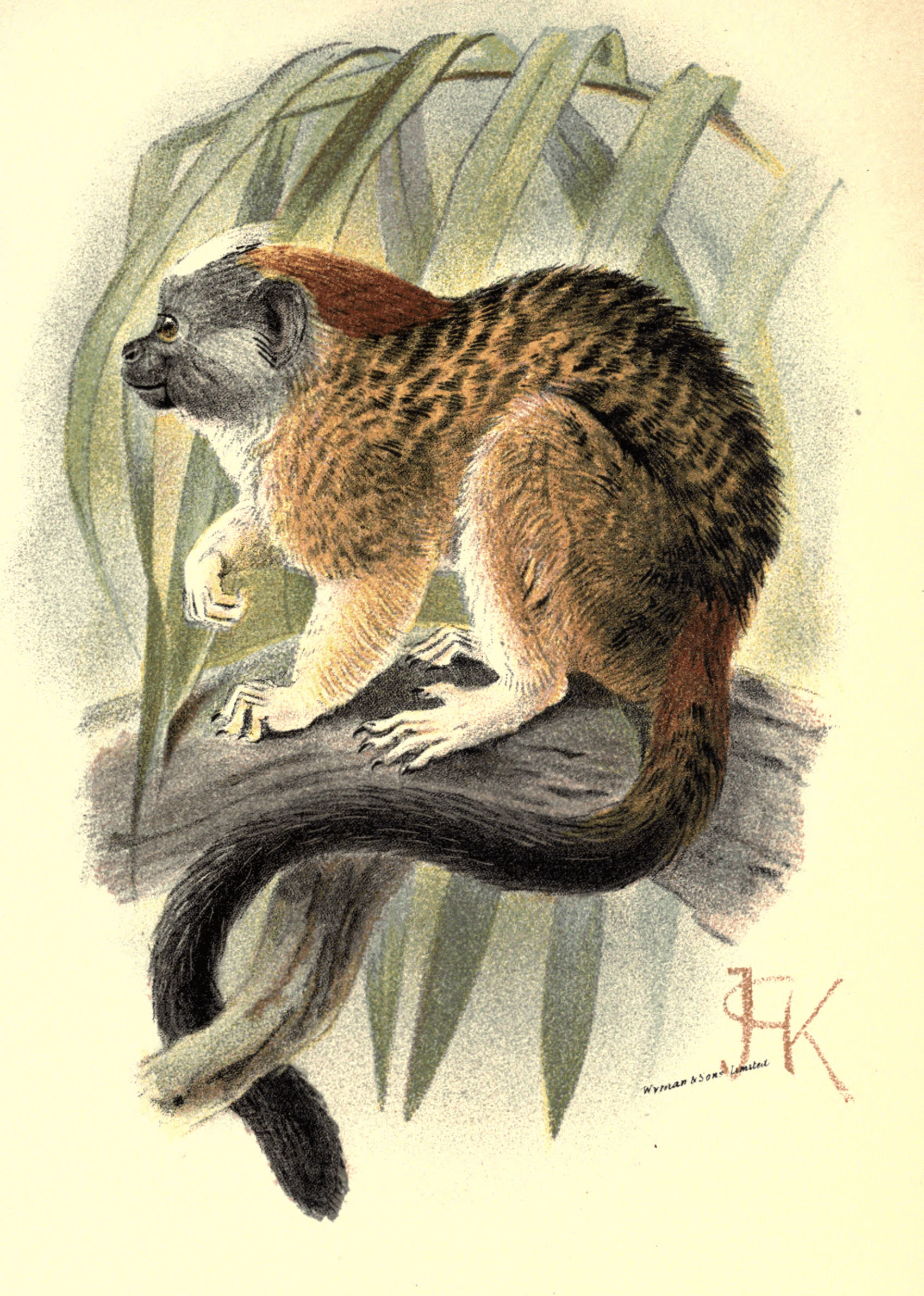
GEOFFROY'S TAMARIN.
Differs from the preceding species, M. geoffroyi, in having a crest.
Distribution.—The Pinché Monkey is found in the forests of New Granada, near the coast.
With the succeeding species we commence the description of the Tamarins which have no conspicuous mane on the back of the neck, and that section whose members have a patch of white hairs around the mouth, each looking at a short distance, as Mr. Bates remarks, "as though it held a ball of snow-white cotton in its teeth."
IV. THE WHITE-LIPPED TAMARIN. MIDAS LABIATUS.
Midas labiatus, Geoffr., Ann. Mus., xix., p. 121 (1812); Gray, Cat. Monkeys Brit. Mus., p. 66 (1870).
Jacchus labiatus, Desmarest, Mammalog., p. 95 (1820); Humb., Rec. d'Obs. Zool., Prod. sp. 44 (1811).
Hapale labiata, Wagner in Schreb., Säugeth., i., p. 246 (1840); Mus. Pays Bas, vii., p. 260 (1876, part).
Characters.—General colour black; under side reddish, the black terminating on the front of the chest in a straight line, the hinder part of the back washed with grey; the hinder part of the chest, belly, inside of the limbs, and the under side of the root of the tail, rust-colour; tip of nose and edges of upper and lower lips white.
Distribution.—The forests on the north side of the Amazon.
V. THE RED-BELLIED TAMARIN. MIDAS RUFIVENTER.
Midas rufiventer, Gray, Ann. and Mag. N. H., xii., p. 398 (1843); id. P. Z. S., 1865, p. 735; id. Cat. Monkeys Brit. Mus., p. 66 (1870).
Midas elegantulus, Slack, Proc. Acad. Nat. Sc. Philad., 1861, p. 463.
Hapale labiata (nec Geoffr.), Schl., Mus. Pays Bas, vii., p. 260 (part).
Characters.—Head, throat, fore-limbs, tail, and hands deep glossy black; hairs of back, sides, and posterior limbs black, broadly tipped with white, not regularly ringed; belly, breast and inner surface of limbs bright brick-red, separated by a distinct line from the black of the back and outer surface of the limbs. On the back of the head a small patch of the same colour as the back; on the top of the head a golden-yellow triangular patch. Lips and tip of the nose, white.
This species is distinguished from the White-lipped Tamarin (M. labiatus) by the spot on the crown and nape; and by the rufous of the under side extending forward nearer to the throat.
Distribution.—Banks of the Upper Amazon. Mr. Bates shot a specimen at Tunantins in 69° W. long., and 4° S. lat.
Habits.—Nothing is known of the habits of this species.
Closely allied to the Red-bellied Tamarin is the so-called Moustached Tamarin (Midas mystax, Spix), in which the head, shoulders, and tail are black; the body above brown, sometimes ringed with white, and the belly bright rust-coloured. It can be distinguished, as Dr. Slack points out, from M. rufiventer, by the want of the ashy tips to the hairs of the back and posterior limbs, and the triangular golden spot on the vertex. The hairs of this spot are golden throughout their entire length, in this respect resembling another closely related Upper Amazonian species, the so-called Bonneted Tamarin (M. pileatus, Is. Geoffr.), from which it can readily be distinguished by the black colour of the under surface. The back of the Bonneted Tamarin is also varied, black and grey, the limbs and tail are blackish, and the lips white.
VI. DEVILLE'S TAMARIN. MIDAS WEDDELLI.
Midas weddellii, Deville, Rev. et Mag. de Zool., 1849, p. 55.
Midas devillii, Is. Geoffr., Cat. Méth. Primates, p. 64 (1851); Castelnau, Expéd. Amér. Sud, Mamm., pl. vi., fig. 2 (1855); Gray, Cat. Monkeys Brit. Mus., p. 67 (1870).
Midas leucogenys, Gray, P. Z. S., 1865, p. 735; id. Cat. Monkeys Brit. Mus., p. 67 (1870).
Hapale devillei, Schl., Mus. Pays Bas, vii., p. 262 (1876).
Hapale weddelii, Schl., t. c. p. 262.
Characters.—Fur of back ringed with grey; that of the head, neck, and front of the fore- and hind-limbs, tail, hands, and feet black; loins, thighs, legs, and base of tail bright maroon.
Distribution.—Obtained by MM. Castelnau and Deville, at Sarayacu, in the Peruvian Amazons.
VII. THE BLACK-FRONTED TAMARIN. MIDAS NIGRIFRONS.
Midas nigrifrons, Geoffr., Cat. Méth. Primates, p. 64 (1851).
Midas flavifrons, var. c. Midas nigrifrons, Gray, Cat. Monkeys Brit. Mus., p. 67 (1870).
Hapale nigrifrons, Schl., Mus. Pays Bas, vii., p. 263 (1876).
Characters.—Differs from M. weddelli in having the fur washed with rufous, and the hairs finely ringed.
Distribution.—Unknown.
VIII. THE BROWN-HEADED TAMARIN. MIDAS FUSCICOLLIS.
Midas fuscicollis, Spix, Sim. et Vespert. Bras., p. 27, pl. 20 (1823).
Midas flavifrons, Is. Geoffr., Cat. Méth. Primates, p. 64 (1851); Castelnau, Expéd. Amér. Sud, Mamm., pl. vi., fig. 1 (1855); Gray, Cat. Monkeys, Brit. Mus., p. 67 (1870).
Midas devillii (nec Is. Geoffr.), Slack, Proc. Acad. Nat. Sc. Philad., 1861, p. 464.
Hapale fuscicollis, Schl., Mus. Pays Bas, vii., p. 264 (1876).
Hapale chrysomelas (nec Kuhl), Schl., t. c. p. 254.
Characters.—Pelage mostly black; head and face brown or reddish-brown, with some grey hairs; lips white, but the nose black; top of the head yellow, or yellowish-red; back yellow and black; hands and feet black; outside of the limbs and base of the tail reddish; under side of the body and inside of the limbs brownish-red.
The female differs in having the outside of the limbs and the underpart of the body blackish.
Distribution.—Brazil.
Habits.—Nothing is known of the individual habits of this species.
IX. THE YELLOW-TAILED TAMARIN. MIDAS CHRYSOPYGUS.
Hapale chrysopyga, Wagner, in Schreb. Säugeth., i., Simiæ, p. 249 (1840); Schl., Mus. Pays Bas, vii., p. 254 (1876).
Characters.—Similar to M. fuscicollis. Black, with the thighs, legs, and base of tail rusty-red.
Distribution.—Brazil, near Ypanéma, Province of St. Paulo.
X. THE BLACK AND RED TAMARIN. MIDAS NIGRICOLLIS.
Midas nigricollis, Spix, Sim. et Vespert. Bras., p. 28, pl. 21 (1823).
Midas rufoniger, I. Geoffr. et Deville, C. R., xxvii., p. 499 (1848); Is. Geoffr., Cat. Méth. Primates, p. 64 (1851); Castelnau, Expéd. Amér. Sud, pl. v., fig. 3 (1855); Gray, Cat. Monkeys Brit. Mus., p. 67 (1870).
Hapale nigricollis, Schl., Mus. Pays Bas, vii., p. 264 (1876).
Characters.—Differs from M. fuscicollis in having the back, loins, thighs, and legs bright reddish-chestnut. (Gray.) Mouth bordered with longish white hairs.
Distribution.—The Upper Amazon Region. (Bates.) The Black and Red Tamarin is considered by Mr. Bates to be a form or race of the same stock as M. ursulus, modified to suit the altered local conditions of its home, for in the Upper Amazon Region, as Mr. Wallace has pointed out, the seasons, as well as the nature of the country, differ very considerably.
Habits.—Mr. Bates states that in its habits the present species is similar to Midas ursulus. "One day," he says, "whilst walking along a forest pathway, I saw one of these lively little fellows miss his grasp as he was passing from one tree to another along with his troop. He fell head foremost from a height of at least fifty feet; but managed cleverly to alight on his legs on the pathway; quickly turning round, he gave me a good stare for a few minutes, and then bounded off gaily to climb another tree."
XI. ILLIGER'S TAMARIN. MIDAS ILLIGERI.
Hapale illigeri, Pucher., Rev. Zool., 1845, p. 336.
Midas illigeri, Geoffr., Cat. Méth. Primates, p. 65 (1851); Schl., Mus. Pays Bas, vii., p. 65 (1876).
Midas flavifrons, var. d. Gray, Cat. Monkeys Brit. Mus., p. 67 (1870).
Midas devillii (nec Geoffr.), Sclater, P. Z. S., 1871, p. 220, pl. xiii.
Characters.—Head black; back black, washed with grey; back of head, nape of neck, shoulders and humeral region black, washed with reddish-brown; under side and the outer and inner surface of both limbs red; tail at base and tip red, intermediate portion black.
The sexes hardly differ; the male being merely rather larger and darker, especially on the head and nape, where the hair is longer.
Distribution.—Mr. E. Bartlett says that this was the only Midas met with by him in Eastern Peru. It was plentiful everywhere in the Peruvian Amazons; and he obtained specimens both on the Huallaga and Ucayali rivers.
Habits.—This species is extremely delicate, and will not bear the least cold. "I have had them alive," writes Mr. Edward Bartlett, "for two or three weeks; but they appear to suffer from cold and die. They are kept, however, by the Indian women, who make pets of them and put them into the long hair on their heads. With this protection they are able to live for a long time. Having become tame, they frequently hop out and feed, or, having captured a spider or two, scamper back again, and hide under the luxuriant crop of their owners, who are generally unwilling to part with them."
With the succeeding species commences the group of Tamarins with no mane and without white lips.
XII. THE PIED TAMARIN. MIDAS BICOLOR.
Midas bicolor, Spix, Sim. et Vespert. Bras, p. 31, pl. 24, fig. 1 (1823).
Hapale bicolor, Wagner in Schreb., Säugeth., v., p. 135, pl. 12 (1855); Schl., Mus. Pays Bas, vii., p. 257 (1876).
Seniocebus bicolor, Gray, Cat. Monkeys, Brit. Mus., p. 68 (1870).
Characters.—Head naked in front of the ears in the adult; hind-part of the head covered with long white hairs; ears exposed, naked; tail not ringed, the upper side black; nose and lips black; neck, chest and arms white; face, body, and hind-limbs brown; under side of tail, inner side of limbs, and the abdomen ferruginous.
In the young animal, the face is rather hairy and the forehead naked. (Gray.)
Distribution.—The eastern bank of the Rio Negro, a northern tributary of the Amazon. Mr. Bates obtained a specimen at Barra, where it was rather common in the forest; and, he adds: "This place, a waterfall near Barra, which its citizens consider as the chief natural curiosity of their neighbourhood, is classic ground to the naturalist, from having been a favourite spot with the celebrated travellers Spix and Martius, during their stay at Barra in 1820. Von Martius was so much impressed by its magical beauty, that he commemorated the visit by making a sketch of the scenery, to serve as background in one of the plates of his great work on the Palms."
Habits.—Keeping together in small troops, running along the main boughs of the loftier trees, climbing perpendicular trunks, but never taking flying leaps.
XIII. LACÉPEDE'S TAMARIN. MIDAS MIDAS.
Simia midas, Linn., Syst. Nat., i., p. 42 (1766).
Simia lacepedii, Fischer, Bull. Soc. Mosc., 1806, p. 23.
Midas rufimanus, Geoffr., Ann. Mus., xix., p. 121 (1812).
Midas ursulus, var. Gray, Cat. Monkeys Brit. Mus., p. 68 (1870).
Hapale midas, Schl., Mus. Pays Bas, vii., p. 266 (1876).
Characters.—General colour black; hands and feet golden-yellow or bright rusty-red; ears short, haired. The young males resemble the adults.
Distribution.—Surinam.
XIV. THE NEGRO TAMARIN. MIDAS URSULUS.
Midas ursulus, Geoffr., Ann. Mus., xix., p. 121 (1812); Gray, Cat. Monkeys Brit. Mus., p. 68 (1870).
Midas tamarin, Slack, Proc. Acad. Nat. Sc. Philad., 1861, p. 464.
Hapale ursula, Schl., Mus. Pays Bas, vii., p. 265 (1876).
Characters.—Body long, slender, covered with soft thick fur; ears large, naked; the face haired. General colour black; nose and lips black; hinder part of the body rather mottled or banded with reddish-brown or greyish-white; the hands sometimes black and sometimes yellow. Length, 9 inches; tail, 15 inches.
Distribution.—Found on the Lower Amazon, near Para. Mr. Bates says it is not met with in the Upper Amazon Region, but in its stead a closely allied species (Midas nigricollis), presents itself.[9]
Habits.—"The Midas ursulus is never seen," writes Mr. Bates, "in large flocks; three or four is the greatest number observed together. It seems to be less afraid of the neighbourhood of Man than any other Monkey. I sometimes saw it in the woods which border the suburban streets, and once I espied two individuals in a thicket behind the English Consul's house at Nazareth. Its mode of progression along the main boughs of the lofty trees is like that of the Squirrels; it does not ascend to the slender branches, or take wonderful flying leaps like those Monkeys whose prehensile tails and flexible hands fit them for such headlong travelling. It confines itself to the larger boughs and trunks of trees, its long nails being of great assistance to the creature, enabling it to cling securely to the bark; and it is often seen passing rapidly round the perpendicular cylindrical trunks. It is a quick, restless, timid little creature, and has a great share of curiosity, for when a person passes by under the trees along which a flock is running, they always stop for a few moments to have a stare at the intruder." In Para, the Negro Tamarin "is often seen in a tame state in the houses of the inhabitants.... When first taken, or when kept tied up, it is very timid and irritable. It will not allow itself to be approached, but keeps retreating backwards when anyone attempts to coax it. It is always in a querulous humour, uttering a twittering, complaining noise; its dark, watchful eyes, expressive of distrust, are observant of every movement which takes place near it. When treated kindly, however, as it generally is in the houses of the natives, it becomes very tame and familiar.... It is generally fed on sweet fruits, such as the banana; but it is also fond of insects, especially soft-bodied spiders and grasshoppers, which it will snap up with eagerness when within reach. The expression of countenance in these small Monkeys is intelligent and pleasing. This is partly owing to the open facial angle, which is given as one of 60°, but the quick movements of the head, and the way they have of inclining it on one side, when their curiosity is excited, contribute very much to give them a knowing expression.... In mobility of expression of countenance, intelligence and general manners, these small Monkeys resemble the higher Apes far more than they do any rodent animal with which I am acquainted, notwithstanding their apparently low organisation in many points."
This description of the habits of the Negro Tamarin may be taken as representative of those of the various species of the genus, of whom only glimpses can be caught in their homes, which are the safe altitudes of the giants of the virgin forests of Brazil.
THE CAPUCHINS, HOWLERS, AND SPIDER-MONKEYS, &c. FAMILY CEBIDÆ.
This family embraces the typical Platyrrhine Monkeys, and to it belongs the great majority of the American species. As already pointed out (p. 127) their nose is flat, and the partition between the nostrils, which open sideways, is very broad, and separates them widely. They are essentially quadrupedal, and walk with the soles of both pairs of limbs flat to the ground. The Spider-Monkeys occasionally, however, assume an erect posture. "They all possess tails, and in some genera (e.g., Ateles) this organ becomes very flexible and muscular, and the under surface of its curled extremity is devoid of hair and highly sensitive. The tail thus modified is a powerful prehensile organ and serves for a fifth hand." (Huxley.) In these Monkeys there are no cheek-pouches, nor ischial callosities. Except in the Spider-Monkeys the hind-limbs are longer than the fore-; "while the thumb, even where it is best developed, is capable of but a partial opposition to the other fingers, bending almost in the same plane with the latter, so as to be more like a fifth finger." (Mivart.) Nevertheless, all its muscles, except the long flexor, are present. The great-toe is large and can be moved from and to the side of the other digits, but is not opposable to them.
The skull is smooth and has no muscular crests; the external bony tube to the ear is not ossified. The two extremes in its form are presented by the Howling Monkeys (Alouatta) and the Squirrel-Monkeys (Chrysothrix), as pointed out by Professor Huxley in his "Anatomy of Vertebrated Animals": "In the former the face is very large and prominent, with a low facial angle. The roof of the brain-case is depressed; the plane of the occipital foramen [for the passage of the spinal cord] is almost perpendicular" to the axis of the base of the skull. "In Chrysothrix, on the contrary, the face is relatively small, with a high facial angle; the brain-case is moderately arched;" and the plane of the occipital foramen is horizontal.
The dentition of the Cebidæ is very characteristic of the family. The dental formula is I22, C11, P33, M33 and the teeth thirty-six in all—a larger number than is found in any of the Old World forms, or in the species of the last family (the Hapalidæ); for they possess an extra pre-molar tooth above and below on each side. Their molar teeth are four-cusped; and in the upper molars of the Spider-Monkeys (Ateles) and of the Howlers (Alouatta) there is an oblique cusp, such as is found in the molars of the Lemuroidea, joining the hind inner to the front outer cusp. Among the Cebidæ the brain varies very much; the posterior lobes of the main brain (or cerebral hemispheres, which are almost always convoluted) are also almost always so large as to entirely cover over the cerebellum (or hind brain), a relation which does not exist between these two regions of the brain in the Lemuroidea. The cerebellum, however, in the Howlers is slightly uncovered. The absolute size of the brain never, in any Ape, approaches that of Man. None of the Cebidæ attain the size of even the medium-sized Old World Apes.
The Cebidæ are all arboreal, and strictly confined to the forest regions of Tropical America, from the southern part of Mexico to about the parallel of 30° S. lat. They are divided into four sub-families, namely: The Douroucolis, or Night-Monkeys (Nyctipithecinæ); the Saki Monkeys (Pitheciinæ); the Howlers (Mycetinæ); and the Capuchin Monkeys (Cebinæ).
THE NIGHT-MONKEYS. SUB-FAMILY NYCTIPITHECINÆ.
The Night-Monkeys are small and elegant animals covered with long hair, and having long bushy tails, which are not prehensile, although they can be curled round a branch of a tree. The caudal vertebræ in these creatures are consequently not flattened from above downward, as is the case in the prehensile-tailed groups, but rounded. Their lower incisor teeth are set vertically and their thumb is fairly well developed.
This sub-family contains three genera, the Squirrel-Monkeys (Chrysothrix); the Whaiapu-Sais, or Titis (Callithrix); and the typical Night-Monkeys, or Douroucolis (Nyctipithecus).
THE SQUIRREL-MONKEYS. GENUS CHRYSOTHRIX.
Chrysothrix, Kaup., Thierreich., i., p. 51 (1835).
The Saimiris, or Squirrel-Monkeys, are very beautiful and active little animals, characterised by their soft, close, and erect fur, and especially in having the head produced posteriorly. The face is relatively small and has a high facial angle. The eyes are large, directed forwards, and set very close together. The ears are large; and the nose has a very broad partition between its nostrils. The tail is long, round, and covered with short hair; but tufted at the extremity and non-prehensile.
As regards the skeleton, the skull is elongated, and the arched cranial portion prolonged backwards, the length of the base of the skull being shorter than the cerebral cavity. The facial portion of the skull is relatively smaller and the cranial larger even than in Man; this character being, however, common to all the smaller representatives of particular groups, and "obviously necessary to provide the requisite amount of brain-space." (Mivart.) The angle of the lower jaw is narrow behind. The bony partition between the nostrils is very thin and membranaceous; and that between the large orbits is also thin and imperfect. The lower incisor teeth are vertical, and in regular series with the canines, and the latter are well developed. No Primate has the teeth placed in one uninterrupted series except Man; but there is always a small interval between each upper canine and the adjacent incisor, and between each lower canine and the adjacent pre-molar.
The skeleton of the hand is one-fifth of the length of the spinal column. The wrist-bones are nine in number, the central—os centrale—being present as in the majority of Monkeys. In Chrysothrix and in Nyctipithecus also, the thumb is proportionately shorter than in any other genus, except among the Spider-Monkeys (Ateles), and the Old World Guerezas (Colobus). In the length of their foot the members of this genus approximate to the proportion existing in Man; and its length, compared with that of the hand, is greater in Chrysothrix than in any other group of Monkeys.
The cerebral hemispheres project beyond the hind brain (cerebellum) to a greater relative extent than in any other mammal, namely, to one-fifth of their total length. (Huxley.) The external surface of the cerebral hemispheres is almost as little convoluted as in the Marmosets and Tamarins, in which it is almost quite smooth, yet on the inner faces of the hemispheres the more important grooves (sulci) are present. The opening for the passage of the spinal cord lies nearly in the middle of the base of the skull, whereas in other genera it is situated closer to the hinder region.
The Squirrel-Monkeys are entirely arboreal, and found in most of the tropical regions from Costa Rica to Brazil and Bolivia, being among the commonest of the Anthropoids of the American forests. They are diurnal, and feed chiefly on insects; but they will also often attack and devour small birds.
I. THE SHORT-TAILED SQUIRREL-MONKEY. CHRYSOTHRIX USTA.
Saimiris usta, Is. Geoffr., Arch. Mus., iv., p. 15, pl. 1 (1844).
Saimiris ustus, Bartlett, P. Z. S., 1871, p. 219; Sclater, P. Z. S., 1872, p. 688, fig. of head.
Chrysothrix ustus, Gray, Cat. Monkeys Brit. Mus., p. 53 (1870).
Saimiri sciureus (nec L.), Schl., Mus. Pays Bas, vii., p. 242 (1876, pt.)
Characters.—Face white; head grizzled grey, minutely punctulated with black, the hairs grey with black tips; outer side of fore-arm grizzled grey, but in some species golden; back grizzled grey, washed with golden, the tips of the hairs black; tail short, thick and grey, but with the tip black.
Distribution.—The forests of Bolivia and Brazil. This is a common species, inhabiting the whole of the Peruvian Amazons, and may be met with on every stream. (E. Bartlett.)
Habits.—Arboreal and gregarious, moving about in large numbers through the forest, feeding on insects—chiefly orthoptera and spiders—small birds, and fruits.
II. THE BLACK-HEADED SQUIRREL-MONKEY. CHRYSOTHRIX ENTOMOPHAGA.
Callithrix entomophagus, d'Orb., Voy. Amér. Mér., iv., Mamm. pl. 4 (1836).
Callithrix boliviensis, d'Orb., Nouv. Ann. Mus., iii., p. 89 (1834).
Saimiris entomophagus, d'Orb., Voy. Amér. Mér., iv., Mamm., text, p. 10 (1847); Is. Geoffr., Cat. Méth. Primates, p. 38 (1851).
Saimiri entomophagus, Schl., Mus. Pays Bas, vii., p. 246 (1876).
Chrysothrix sciurea (nec L.), Frantz. in Wiegm. Arch. f. Nat., xxxix., p. 260 (1869).
Chrysothrix entomophagus, Wagn., Ann. Nat. Hist., xii., p. 42 (1843); Gray, Cat. Monkeys Brit. Mus., p. 53 (1870).
Characters.—Face grey, washed with yellow; ears haired; head black; hairs of back black, with long yellow tips, or yellow with black tips, producing a shade of brown washed with golden; outer side of upper part of arms and legs yellow, peppered with black; throat, under surface of body and inside of limbs yellowish-grey; tail long, black.
In some species the upper part of the head has a shade of yellow, caused by the colour of the lower half of the hairs showing through the black tips.
Distribution.—Bolivia; Veragua, Central America; and the warmer regions of Costa Rica, where it inhabits the humid forests.
III. THE COMMON SQUIRREL-MONKEY. CHRYSOTHRIX SCIUREA.
Simia sciurea, Linn., Syst. Nat., i., p. 43 (1766); Humb., Obs. Zool., p. 334 (var. cassiquiarensis).
Callithrix sciureus, Geoffr., Ann. Mus., xix., p. 113 (1812).
Saimiri sciureus, Cuv., Reg. An., p. 103, pl. 1 (1829); Schl., Mus. Pays Bas, vii., p. 242 (1876).
Chrysothrix lunulata, Geoffr., Arch. Mus., iv., p. 18 (1844).
Chrysothrix sciurea, Wagner in Schreb., Säugth. Suppl., v., p. 120, pl. 9, (1855); Gray, Cat. Monkeys Brit. Mus., p. 53 (1870); Sclater, P. Z. S., 1880, p. 395.
Chrysothrix nigrivittata, Wagn., Abh. bay. Ak. München, v., p. 461.
Characters.—Smaller than the two preceding species; face greyish-white; chin round and prominent; head blackish-grey; back grey, or grey washed with gold, the basal part of the hairs golden and the tips black; outer side of the fore-arm yellow; tail long, slender, grizzled grey, with the tip black. Length of the body, 10 inches; of the tail, 14 inches.
Certain females, examined by Dr. Sclater, had a distinct black line along the side of the crown above each ear and extending in front, down the side of the face, nearly to a level with the angle of the mouth; but Mr. Buckley says the Indians consider the black lines to be merely a sign of age.
Distribution.—This species has an extensive range, being found on both banks of the Amazon, Rio Negro, and on the Copataza river; also in Guiana, Surinam, and Colombia, near Bogotá.
Habits.—Like its congeners, the Common Squirrel-Monkey is arboreal, going about in large flocks. Their food consists of insects and fruits. Mr. Bates observes that the "pretty little Chrysothrix sciureus contents itself with devouring what fruit it can on the spot," thus differing from certain species of Cebus, which destroy more than they eat, and when about to return to the forest, carry away all they can in their hands or under their arms.
Mr. Darwin has remarked in his "Expression of the Emotions in Man and Animals," that "with Monkeys the expression of any painful emotion is not easily distinguished from that of anger." "Humboldt," he adds, "also asserts that the eyes of the Callithrix sciureus 'instantly fill with tears when it is seized with fear'; but when this pretty little Monkey in the Zoological Gardens was teased, so as to cry out loudly, this did not occur. I do not, however, wish to throw the least doubt on the accuracy of Humboldt's statement."
This species is a great favourite wherever it has been kept in captivity. It is very bright coloured, has a baby-like face, large and bright eyes, and most gentle manners. These Monkeys are very sensitive to cold, and when a sudden fall in the temperature takes place, they huddle close together, clasping each other with their arms, and embracing their neighbours and themselves with their long tails.
IV. THE RED-BACKED TITI. CHRYSOTHRIX ŒRSTEDI.
Saimaris sciurea ? (nec Linn.), Sclater, P. Z. S., 1856, p. 139.
Chrysothrix sciurea (nec Linn.), Scl., N. H. Rev., 1861, p. 510; Frantz. Arch. f. Naturg., xxxv. (1), p. 260.
Chrysothrix œrstedi, Reinh. Vidensk. Medd. Nat. For. Kjöbenh., p. 157, pl. iii. (1872); Alston, in Godm. et Salv., Biol. Centr. Am. Mamm., p. 16, pl. ii. (1879).
Saimiris entomophaga, Sclater, P. Z. S., 1872, p. 3 (nec d'Orb.).
Saimiri örstedii, Schl., Mus. Pays Bas, vii., p. 245 (1876).
Characters.—Differs from C. sciurea in having the top of the head black, the back and sides shining red, and the limbs olive.
Distribution.—Panama, Guatemala, Costa Rica, especially their hotter districts,—being particularly abundant in the Valley of Terraba and on the plain of Piris.
THE TITI MONKEYS. GENUS CALLITHRIX.
Callithrix, Geoffr., Ann. Mus., xix., p. 112 (1812).
This genus is intermediate between the Squirrel-Monkeys and the typical Night-Monkeys. In the Titis, sometimes known by the name also of Whaiapu-Sai Monkeys, the fur is soft, the head small, depressed, and not produced backward as in Chrysothrix; the tail is long and bushy; the eyes are small, and the orbits intermediate in size between those of the last and the next genus; the nasal partition is broad, and the ears large. The canine teeth are small, and the angle of the lower jaw expanded, somewhat as in the Howlers (Mycetes), though to a less extent.
The Titi Monkeys are diurnal animals, arboreal and gregarious, very lively in disposition, noisy and agile, living on fruit, insects, birds' eggs, and even small birds. They range all over South America, from Panama to the southern limits of the forest regions.
I. THE WHITE-COLLARED TITI. CALLITHRIX TORQUATA.
Cebus torquatus, Hoffm., Mag. Ges. Nat. Freund. Berlin, x., p. 86 (1807).
Simia lugens, Humb., Obs. Zool., i., p. 319 (1811).
Callithrix lugens, Geoffr., Ann. Mus., xix., p. 113 (1812).
Saguinus vidua, Lesson, Species Mamm. Bimanes et Quadrum., p. 165 (1840).
Callithrix torquatus, Geoffr., t. c. p. 114; Gray, Cat. Monkeys Brit. Mus., p. 55 (1870).
Callithrix torquata, Schleg., Mus. Pays Bas, vii., p. 235 (1876).
Characters.—Head round; face short; ears short, nearly naked; nose flat. Fur soft and woolly, intermixed with many long, stiff, dark reddish-brown hairs,—the hairs red at the base, and black at the tips; forehead black; crown of head dark brown; a narrow band round the face, white; a narrow collar round the neck, reddish-white; hands white; hair of feet red at the base, but black at the tips. Length of the body, about 12 inches.
Distribution.—Confined to the upper reaches of the Rio Negro, Brazil.
Habits.—This species, often known under the name of the Widow Monkey, is said to be very gentle in disposition. When approaching to capture insects or small birds, which form its prey, it becomes keen and excited, but at other times it appears to be dull and listless. They roam about in flocks of about half a dozen individuals, on the large branches of the great forest trees. They are noisy animals, and in the early morning they make the forest resound with their yelping cries.
II. THE RED TITI. CALLITHRIX CUPREA.
Callithrix cuprea, Spix, Sim. et Vesper. Bras., p. 23, pl. 17, (1823); Gray, Cat. Monkeys Brit. Mus., p. 54 (1870); Schleg., Mus. Pays Bas, vii., p. 236 (1876); Thomas, P. Z. S., 1880, p. 394.
Callithrix discolor, Is. Geoffr., C.R., xxvii., p. 498 (1848); id. Cat. Méth. Primates, p. 41 (1851); id. Arch. Mus., v., p. 551, pl. 28; Wagner in Schreb., Säugeth. Suppl., v., p. 114 (1855).
(Plate XIV.)
Characters.—Fur soft and woolly, mixed with numerous long stiff hairs; face black; back grizzly blackish-grey in colour; tail the same but darker; the basal part and tips of the hairs grey, with an intermediate band below the tips, black; tip of the tail sometimes white; the cheeks, throat, hands, feet, legs, and the under side of the body, dark reddish bay; the ears coppery-red.
PLATE XIV.
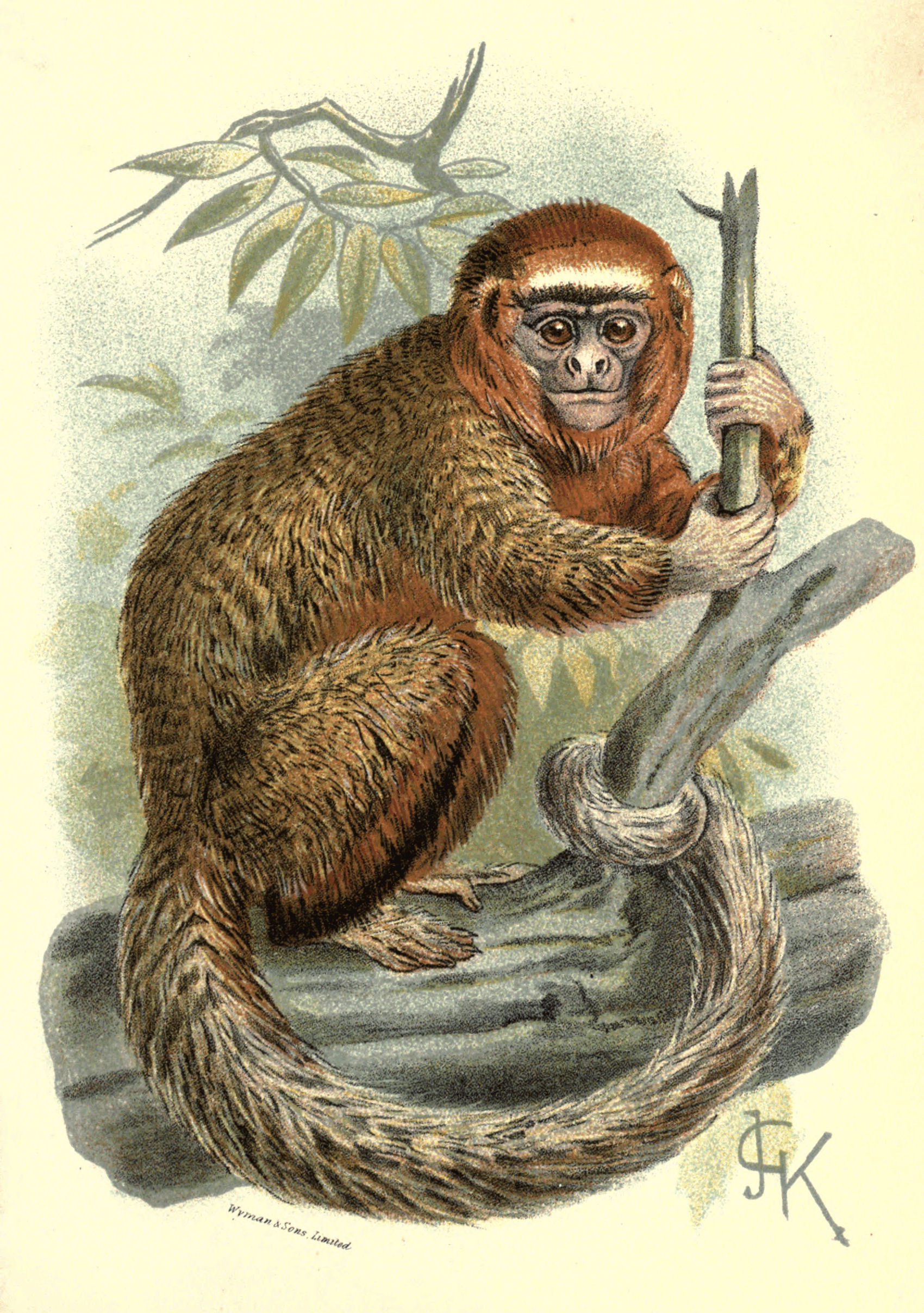
THE RED TITI.
Distribution.—This species is found throughout the whole of the Peruvian Amazons, though not in very large numbers—indeed, it is said to be rare. It has been recorded from Cashiboya on the Ucayali, and Santa Cruz on the Huallaga. Mr. O. Thomas mentions his having examined twelve specimens from the Copataza river, and one from Andoas in Ecuador. Of these he says: "The Andoas specimen, which is a male, differs from the rest in having the fur on the back of a dirty orange-grey colour, without annulations, instead of being of a bright annulated black and white. One of the others, a female, shows a tendency to this condition of the hair, which is, therefore, probably a seasonal change, as the Andoan specimen was shot in September, while the others were obtained between December and February."
III. THE WHITE-CHESTED TITI. CALLITHRIX AMICTA.
Simia amicta, Humboldt, Obs. Zool., i., p. 357 (1811).
Callithrix amicta, Spix, Sim. et Vespert. Bras., p. 19, pl. xiii. (1833).
Callithrix amictus, Geoffr., Ann. Mus., xix., p. 114 (1812); Gray, Cat. Monkeys Brit. Mus., p. 54 (1870).
Callithrix torquata, Schl., Mus. Pays Bas, vii., p. 235 (part, 1876).
Characters.—Agrees with the last species in the character of the fur; but the general colour is black, washed with rufous; the forehead is black; the chest has a pure white spot; the hands are white, but the feet black; the tail has the hairs entirely black throughout.
Distribution.—Guiana.
IV. THE REED TITI. CALLITHRIX CINERASCENS.
Callithrix cinerascens, Spix, Sim. et Vespert. Bras., p. 20, pl. 14 (1823).
Callithrix donacophilus, d'Orb., Voy. Amér. Sud, iv., p. 10, pl. 5 (1826); Gray, Cat. Monkeys Brit. Mus., p. 55 (1870).
Callithrix donacophila, Geoffr., Cat. Méth. Primates, p. 41 (1851); Schl., Mus. Pays Bas, vii., p. 240 (1876).
Characters.—Fur long and similar in character to that of C. torquata; chest and under side of body pale grey or dark reddish-grey; hands and feet grey; back of the same colour; tail mottled grey,—the hairs being grey, with black tips.
In some species the fur varies from dark grey washed with rufous, to almost white, the red wash, where it occurs, sometimes deepening, or almost vanishing.
Distribution.—Mr. Bates observed this species at Serra dos Parentins, in the Lower Amazon Region above the confluence of the Tapajos with the Amazon. It also extends to Bolivia and Peru.
V. THE ORABASSU TITI. CALLITHRIX MOLOCH.
Cebus moloch, Hoffman, Mag. Gesell. Berlin, x., p. 97 (1807).
Callithrix moloch, Geoffr., Arch. Museum, iv., p. 33, pl. 3(1844), id., Ann. Mus., xix., p. 114 (1812); Gray, Cat. Monkeys Brit. Mus., p. 55 (1870).
Characters.—Differs from the Reed Titi in having the cheeks, chest, and belly red. Hands and feet of the same colour as the back, grey.
The cerebral convolutions of this animal are, according to M. C. Dareste, exactly those of a "Maki," or Lemur.
Distribution.—Throughout Brazil.
VI. THE ORNATE TITI. CALLITHRIX ORNATA.
Callithrix discolor, Verreaux, M.S. (nec Geoffr.).
Callithrix ornata, Gray, Ann. and Mag. Nat. Hist., xvii., p. 57 (1866).
Callithrix ornatus, Gray, Cat. Monkeys Brit. Mus., p. 55 (1870).
Characters.—General colour black and grey, grizzled; forehead and ears white, instead of black as in C. caligata, or coppery-red as in C. cuprea; temples, cheeks, throat, under side of body, and inner side of legs, bright chestnut; hands and feet grey; tail black, with a grey tinge,—the hairs being grey, with a dark ring near the tip of each; hands and feet the colour of the back.
Distribution.—U. S. Colombia; vicinity of Bogotá.
Habits.—This species is arboreal, like the other members of its genus, and it is said to be nocturnal. It spends the day rolled up very much as many of the Lemurs do.
VII. THE MASKED TITI. CALLITHRIX PERSONATA.
Callithrix personatus, Geoffr., Ann. Mus., xix., p. 113 (1812); Spix, Sim. et Vespert. Bras., p. 18, pl. 12 (1823); Gray, Cat. Monkeys Brit. Mus., p. 56 (1870).
Callithrix brunnea, Wagner, Arch. f. Naturg., 1842, i., p. 357 (ex Natterer, MSS.).
Pithecia melanops, Vigors, Cat. Coll. Zool. Soc., p. 6.
Callithrix personata, Schl., Mus. Pays. Bas, vii., p. 231 (1876).
Characters.—Size larger than that of the other Titis. Style of fur the same as in the previous species, but longer, and the long stiff hairs more bristly; general colour black, mottled with grey rings on the hairs; back grizzled grey; entire head, hands, feet, and lower part of limbs, black; chest, under side of the body, and tail dark ashy-grey, the latter washed at the base, sometimes extensively, with rufous, and grey towards the tip below.
Female.—Body strongly washed with whitish-yellow, and the tail with rufous; forehead between the ears, black.
Distribution.—Upper Amazon. Of all the species of the genus, this ranges furthest to the south—to 14° S. lat.
VIII. THE BLACK-FRONTED TITI. CALLITHRIX NIGRIFRONS.
Callithrix nigrifrons, Spix, Sim. et Vespert. Bras., p. 21, pl. 15 (1823); Gray, Cat. Monkeys Brit. Mus., p. 56 (1870); Schl., Mus. Pays Bas, vii., p. 232 (1876).
Characters.—Nearly allied to the Masked Titi (C. personata), but distinguished by the nearly white back of the head and nape of the neck, and by the hairs at the base of the tail being entirely red.
Distribution.—Upper Amazonia.
IX. THE RED-BELLIED TITI. CALLITHRIX CASTANEIVENTRIS.
Callithrix castaneoventris, Gray, Ann. and Mag. N. H., xvii., p. 58 (1866); id., Cat. Monkeys Brit. Mus., p. 56 (1870).
Callithrix caligata, Wagner, Arch. f. Naturg., 1842, i., p. 454 (ex Natterer, MSS.); Schl., Mus. Pays Bas, vii., p. 237 (1876).
Characters.—Fur of the same nature as in C. cuprea, black, ringed with grey; face grizzled, whiskers, throat, chest, under side of the body, and inner surface of the limbs reddish-chestnut; outside of the limbs grizzled, washed with rufous; forehead, hands, feet and tail black; tip of the tail paler.
Distribution.—Paraguay and Brazil; Borba, Rio Madeira.
The two following species may be distinguished from those already described by having their soft woolly fur entirely free from the long bristly hairs, which were dispersed through the fur of the others.
X. THE BLACK-HANDED TITI. CALLITHRIX MELANOCHIR.
Callithrix melanochir, Neuwied, Beitr., ii., p. 114, et Abbild., iv.; Gray, Cat. Monkeys Brit. Mus., p. 57 (1870); Schl., Mus. Pays Bas, vii., p. 233 (1876).
Characters.—General colour red, but the crown of the head, the throat, and inner side of the limbs, mixed black and grey; the hands and feet black.
Distribution.—This species has been recorded from Bahia, on the east coast of Brazil.
XI. THE GREY TITI. CALLITHRIX GIGOT.
Callithrix gigot, Spix, Sim. et Vespert. Bras., p. 22, pl. 16 (1823); Schl., Mus. Pays Bas, vii., p. 234 (1876); Weldon, P. Z. S., 1884, p. 6.
Callithrix gigo, Gray, Cat. Monkeys Brit. Mus., p. 57 (1870).
Characters.—Hair about two inches long, soft and slightly woolly over the trunk; hair on the forehead shorter and more thickly set; that over the limbs short and loose. General colour of the back reddish-grey behind, more ashy over the forehead and limbs; the hair black at the base, cream-coloured further up, the tips ringed with chestnut and black. Muzzle and chin black, with a few short, strong, white hairs; a black line along the nose and round the eyes; the eyelids white; the eye-lashes and long eye-brows black; forehead thickly covered with loose grey hairs, slightly tipped with black; a faint ridge across the brow between the ears; the ears black, covered with soft black hairs, except for a small grey tuft at their hind outer angle. In front of the ears a light grey band over the cheeks, continued above on to the forehead, below to the chest; throat naked, light pink; under surface of the limbs pale grey; the hands and feet black; tail red, the hair bushy at its base. Length of the body, 14 inches; of the tail, 13½ inches. (Weldon.)
Cæcum with dilated end; liver more divided than in C. moloch; the two halves (rami) of the lower jaw enormously deep, resembling those of the Howlers (Mycetes).
Distribution.—Brazil; Bahia, and the country between the Parahyba and the mountains to the north of the Bay of Rio de Janeiro.
Habits.—This species is very rare, and nothing is known of its habits.
Professor Weldon writes, in his paper in the "Proceedings of the Zoological Society," referred to above: "Sir W. Flower has suggested to me that the enormous depth of the ramus of the mandibles in this Callithrix pointed to the existence of some arrangement resembling that of Mycetes. It was difficult to determine this point in a young female; but the swollen condition of the thyroid, together with the existence of a patch of ossification on each side, seem to show the possible existence of a howling apparatus in the male."
THE DOUROUCOLIS. GENUS NYCTIPITHECUS.
Nyctipithecus, Spix, Sim. et Vespert. Bras., p. 24 (1823).
The members of this genus, usually called "Douroucolis," are small animals, somewhat Lemurine in appearance, possessing a short, thick body, a rounded head produced behind, and a short, round face, encircled by a ruff of whitish fur. The muzzle is not prominent; the mouth and chin are small; the ears are very short, scarcely appearing above the hair of the head; the eyes are enormous and yellowish in colour, imparting to them the staring expression of nocturnal animals of prey. Their tail is bushy, moderately long and non-prehensile; and the nostrils are separated by a narrower partition than in the other genera of the sub-family. Their physiognomy reminds one of an Owl or Tiger-cat (Bates). They are covered with close, soft, woolly fur.
In the skull the orbits are enormously large and closely approximated, but yet separated by a complete bony wall; the nostrils, on the other hand, though separated in the living animal by a wide, fleshy partition, have only a thin plate of bone between them. The upper incisors are broad; the canines long; and the lower incisors project forwards, somewhat as in the Lemurs. The arm-bone has a perforation (the ent-epicondylar foramen) on its inner side above the articulation of the elbow joint, to give passage and protection to an important artery and nerve. The thumb is very short; the claws are small and weak. The dorsal and lumbar vertebræ together number twenty-two, the greatest number possessed by any American monkey. As in Chrysothrix, the external surface of the cerebral hemispheres is smooth and almost devoid of convolutions, but their inner faces exhibit several of the more important grooves seen in the higher Apes.
All the species are arboreal and nocturnal, hiding away in the daytime and roaming during the night, giving vent to loud howls, or Cat-like cries, as they move in quest of the insects, small birds, and fruits, which form their food. They range from Nicaragua to the Amazon and Eastern Peru, and are called "Devil monkeys" by the Indians. They are very delicate, and soon die in captivity.
I. THE THREE-BANDED DOUROUCOLI. NYCTIPITHECUS TRIVIRGATUS.
Aotus trivirgatus, Humboldt, Obs. Zool., p. 306, fig. 28 (1811).
Nyctipithecus trivirgatus, Gray, Ann. Nat. Hist., x., p. 256 (1842); id., Cat. Monkeys Brit. Mus., p. 58 (1870); Schl., Mus. Pays Bas, vii., p. 213 (1876).
Characters.—Fur short, grey and brown, with a silvery lustre; on the crown of the head three long black linear streaks, distinct from each other; frontal spot whitish; back greyish-brown with a dark dorsal band and a long chestnut patch; chest and lower surface of body rusty-red; throat, and inside of limbs, greyish-ashy; tail long, cylindrical, and with short, blackish-brown hair, more yellow on the under surface of the base. Length of the body, 12 inches; of the tail, 14 inches.
Distribution.—The type specimen was obtained by Humboldt on the banks of the Cassiquiare, near the head waters of the Rio Negro. Mr. Bates found it at Ega and at other places on the Upper Amazon region. It has been recorded also from Guiana; and from Chanchamayo in Peru, at 3,000 feet above the sea.
Habits.—The habits of the Three-banded Douroucoli are entirely nocturnal. They hide in small troops in a hole in the trunk of a tree from morning till twilight, hunting for food during the night. They have a singularly loud and far-reaching voice for such small animals.
II. THE LEMURINE DOUROUCOLI. NYCTIPITHECUS LEMURINUS.
Nyctipithecus lemurinus, Is. Geoffr., Arch. Mus., iv., p. 24, pl. 21 (1844); Gray, Cat. Monkeys Brit. Mus., p. 58 (1870).
Nyctipithecus felinus, Gray, List Mamm. Brit. Mus., p. 14 (1843); Schl., Mus. Pays Bas, vii., 214 (1876).
Characters.—Fur of body and head long; tail depressed, broad, with the hair bushy and spreading on the sides as in a Squirrel. Head presenting a dark frontal area with a round white spot over each eye.
Distribution.—The Lemurine Douroucolis are found in Colombia and in Upper Amazonia; at Macas, on the eastern side of the Andes; and on the upper branches of the main streams of the Amazon, as far as a congenial habitat is met with.
III. THE RED-FOOTED DOUROUCOLI.[10] NYCTIPITHECUS RUFIPES.
Nyctipithecus rufipes, Sclater, P. Z. S., 1872, p. 3, pl. 1.
Nyctipithecus vociferans, Spix, Sim. et Vespert. Bras., p. 25, pl. 19 (1823; part); Schl., Mus. Pays Bas, vii., p. 214 (1876; part).
(Plate XV.)
Characters.—Above grey, slightly washed on the back with rufous; under side reddish fulvous; three vertical black stripes on the head, similar to N. trivirgatus, but much less distinct, narrower, and showing a prominent triangular white patch over each eye; ears large and prominent, almost nude (perhaps the result of captivity). Hands and feet rufous; tail short-haired, cylindrical; the basal half rufous, the remainder reddish-black. Length of the body, 11 inches; and of the tail, 16 inches. The absence of the long chestnut patch on the back distinguishes N. rufipes from N. trivirgatus, and its paler colour and the indistinctness of its head-stripes, separate it from N. felinus.
Distribution.—Nicaragua; San Juan del Norte.
IV. AZARA'S DOUROUCOLI. NYCTIPITHECUS AZARÆ.
Simia azaræ, Humb., Obs. Zool., p. 359 (1811).
Pithecia miriquouina, Geoffr., Ann. Mus., xix., p. 117 (1812); Kuhl, Beitr., p. 43 (1820).
Nyctipithecus azaræ, Schl., Mus. Pays Bas, vii., p. 212 (1876).
Characters.—A large rhomboidal black patch between the two large superciliary spots, the two acute angles of which are prolonged, the one under the base of the nose, the other in the median line to the top of the head; the inner side of the limbs, the under side of the body, throat, and chin of a reddish-ochre colour.
Distribution.—The right bank of the River Paraguay, in the north-east of the Argentine Republic, but not in Paraguay proper.
V. THE FELINE DOUROUCOLI. NYCTIPITHECUS FELINUS.
Nyctipithecus felinus, Spix, Sim. et Vespert. Bras., p. 24, pl. 18 (1823); Is. Geoffr., Cat. Méth. Primates, p. 39 (1851); Gray, Ann. N. H., x., p. 256 (1842).
Nyctipithecus oseryi, Is. Geoffr. et Deville, C. R., xxvii., 1848, p. 498 (juv.); Geoffr., Cat. Méth. Primates, p. 39 (1851).
Nyctipithecus commersonii, Gray, Cat. Monkeys Brit. Mus., p. 58 (1870).
Nyctipithecus vociferans, Schl., Mus. Pays Bas, vii., p. 214 (1876; part).
Characters.—Closely related to the last species, but differs in having the three facial streaks irregular and combining together on the crown, the middle one broad and lozenge-shaped; the frontal spots short, and white. Fur longer and more woolly; neck, chest, under surface of body, inner sides of the limbs, and the base of the tail yellowish; tail round.
PLATE XV.
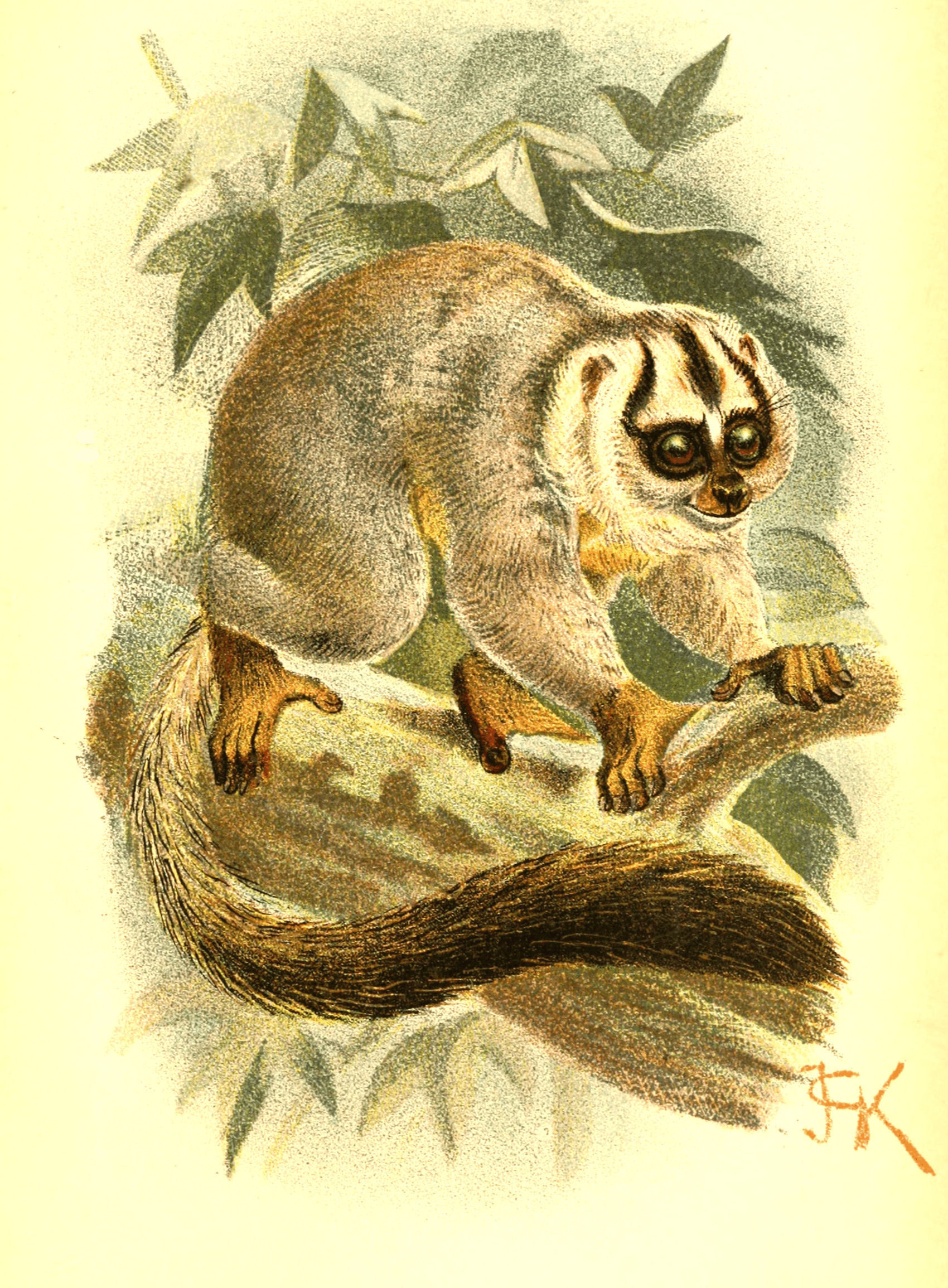
THE RED FOOTED NIGHT-MONKEY.
Distribution.—This species is rather rare, but it has been obtained at Ega and at Tabatinga on the Upper Amazons; on the Ucayali, and near Yurimaguas on the Huallaga River—in the warm and humid virgin forests—in fact, generally along the Peruvian Amazons.
In speaking of his collections made at Ega on the Upper Amazons, which he describes as a fine field for a Natural History collector, Mr. Bates gives an interesting account of the Night-Apes, called "Ei-á" by the Indians, observed by him during his various journeys. "Of these I found two species (Nyctipithecus trivirgatus and N. felinus) closely related to each other, but nevertheless quite distinct, as both inhabit the same forests, namely, those of the higher and drier lands, without mingling with each other or inter-crossing. They sleep all day long in hollow trees, and come forth to prey on insects and eat fruits only in the night. One cannot help being struck by this curious modification of the American type of Monkeys, for the Owl-faced Night-Apes have evidently sprung from the same stock as the rest of the Cebidæ, as they do not differ much in all essential points from the Whaiapu-Sais (Callithrix) and the Sai-miris (Chrysothrix). They have nails of the ordinary form on all their fingers, and semi-opposable thumbs; but the molar teeth (contrary to what is usual in the Cebidæ) are studded with sharp points, showing that their nocturnal food is principally insects.
"I kept a pet animal of N. trivirgatus for many months, a young one having been given to me by an Indian compadre as a present from my newly-baptized godson. These Monkeys, although sleeping by day, are aroused by the least noise, so that, when a person passes by a tree in which a number of them are concealed, he is startled by the sudden apparition of a group of little striped faces crowding a hole in a trunk. It was in this way that my compadre discovered the colony from which the one given to me was taken. I was obliged to keep my pet chained up; it, therefore, never became thoroughly familiar. I once saw, however, an individual of the other species (N. felinus) which was most amusingly tame. It was as lively and nimble as the Cebi, but not so mischievous, and far more confiding in its disposition, delighting to be caressed by all persons who came into the house. But its owner, the Municipal Judge of Ega, Dr. Carlos Mariana, had treated it for many weeks with the greatest kindness, allowing it to keep with him at night in his hammock, and to nestle in his bosom half the day as he lay reading. It was a great favourite with everyone, from the cleanliness of its habits and the prettiness of its features and ways. My own pet was kept in a box in which was placed a broad-mouthed glass jar; into this it would dive, head foremost, when anyone entered the room, turning round inside, and thrusting forth its inquisitive face an instant afterwards to stare at the intruder. It was very active at night, venting at frequent intervals a hoarse cry like the suppressed barking of a dog, and scampering about the room, to the length of its tether, after cockroaches and spiders. In climbing between the box and the wall it straddled the space, resting its hands on the palms and tips of the outstretched fingers with the knuckles bent at an acute angle, and thus mounted to the top with the greatest facility. Although seeming to prefer insects, it ate all kinds of fruit, but would not touch raw or cooked meat, and was very seldom thirsty. I was told by persons who had kept these Monkeys loose about the house, that they cleared the chambers of bats as well as insect vermin. When approached gently, my Ei-á allowed itself to be caressed; but when handled roughly it always took alarm, biting severely, striking with its little hands, and making a hissing noise like a Cat.