Front matter (continued 4)
Reading edition
"I have mentioned the near relationship of the Night-Apes to the Sai-miris (Chrysothrix), which are among the commonest of the ordinary Monkeys of the American forests. This near relationship is the more necessary to be borne in mind, as some Zoologists have drawn a comparison between them and the nocturnal Apes of the Lemur family, inhabiting Ceylon and Java, and it might be inferred that our American Ei-ás were related more closely to these Old World forms than they are to the rest of the New World Monkeys. The large nocturnal eyes and short ears of the Eastern Lemurs are simply resemblances of analogy, and merely show that a few species, belonging to utterly dissimilar families, have been made similar by being adapted to similar modes of life...."
THE SAKIS. SUB-FAMILY PITHECIINÆ.
The Sakis are characterised by having their lower incisor teeth inclined forward at their summits somewhat as among the Lemurs; and separated from the long canines by an interspace. The molar teeth are small; the tail, which in some is long, in others short, is non-prehensile. The nostrils are, as usual, far apart, and the thumb is well developed. The ears are large. Great differences in the character of the fur exist in the group: some species having long hair over the whole body, others on the chin and cheeks; some are well bearded, while others again are quite bald.
The Sakis are divided into two genera, a short-tailed group (Brachyurus), containing the Uakarí Monkeys, and a long-tailed section, the Sakis (Pithecia). Their various species are restricted to the great equatorial forests of South America.
THE UAKARÍ MONKEYS. GENUS BRACHYURUS.
Brachyurus, Spix, Sim. et Vespert. Bras., p. 11 (1823); W. A. Forbes, P. Z. S., 1880, p. 644.
Ouakaria, Gray, P. Z. S., 1849, p. 9.
The species of this genus are at once recognised by their short tail, being the only American Monkeys in which this organ is short. The fur is short and silky; the face short, and often brightly coloured. The mammæ are situated on the breast. In the skull the lower jaw is dilated behind, and certain bones, the parietal and the malar, are in contact with each other for a more or less considerable extent on the side walls of the skull. (Cf. W. A. Forbes, P. Z. S., 1880, p. 639, figs. 5 and 6.) In Old World Monkeys this contact never (except slightly in Hylobates) takes place. This is a useful mark for discriminating between the skulls of New and Old World Monkeys. (Forbes.) The shortness of the tail is due, not to a reduction in the number of the vertebræ, which may be 15 to 17, but in their size.
In the brain the cerebrum exhibits the more important grooves characterising the brain of the higher Apes (Simiidæ) well developed; the cerebellum (or hind brain) is also well developed. Thus in its general characters the brain of the Uakarís approaches most nearly to that of the genera Cebus and Pithecia (next to be described). By reason of its greater complication and development, it departs widely from that of the Titis (Callithrix) and the Squirrel-Monkeys (Chrysothrix).
A relationship to the Howlers (Mycetes), suggested by the external appearance of the Uakarís and the form of their lower jaw, is not borne out by their internal anatomy. The caudate lobe of the liver is very large. This character distinguishes the whole of the Cebidæ from the Old World families.
The Uakarís are arboreal Monkeys, very gentle and timid. The distribution of the various species is singularly restricted, each being confined to a small and particular district.
I. THE BLACK-HEADED UAKARÍ. BRACHYURUS MELANOCEPHALUS.
Simia melanocephala (Cacajao), Humboldt, Obs. Zool., p. 317, pl. xxix. (1811).
Pithecia melanocephala, Geoffr., Ann. Mus., xix., p. 117 (1812); Schl., Mus. Pays Bas, vii., p. 227 (1876).
Brachyurus ouakary, Spix, Sim. et Vespert. Bras., p. 12, pl. viii. (1823).
Ouakaria spixii, Gray, P. Z. S., 1849, p. 10, cum fig.
Ouakaria melanocephala, Gray, Cat. Monkeys Brit. Mus., p. 62 (1870).
Brachyurus melanocephalus, W. A. Forbes, P. Z. S., 1880, p. 645, pl. lxiii.
Characters.—Head and nude face-black; back, sides, thighs, upper surface of tail, and outer and inner sides of legs more or less chestnut-brown; shoulders, arms, hands, feet, and rest of tail, black. Ears large, naked, and similar in form to those in Man.
Distribution.—Confined, so far as at present known, to the forests traversed by the Rio Casiquiare, Rio Negro, and Rio Branco. This is the most northern form of the three species of the genus, and apparently the most widespread also (see map, p. 180). This is doubtless the "black-faced, grey-haired" species, neither white nor red, which Mr. Bates was assured took the place of B. calvus, at 180 miles northward from the mouth of the Japurá.
Habits.—Living in the high trees of the forest, feeding on fruits; and not differing in habits from those of the other species of the genus, which are referred to below.
II. THE RED UAKARÍ. BRACHYURUS RUBICUNDUS.
Brachyurus rubicundus, Is. Geoffr. and Dev., C. R., xxvii., p. 498 (1848); Is. Geoffr., Arch. Mus., v., p. 564, pl. 30 (1845); Castelnau, Expéd. Amér. Sud, Mamm., p. 19, pl. 4, fig. 2 (1855); W. A. Forbes, P. Z. S., 1880, p. 646, pls. lxi., lxii.
Ouakaria rubicunda, Gray, Cat. Monkeys Brit. Mus., p. 62 (1870).
Pithecia rubicunda, Schleg., Mus. Pays Bas, vii., p. 228 (1876).
Characters.—Face, chin, lips, forehead, and sides of face, bare (except for a few superciliary hairs, and scant representatives of moustache and beard), all bright vermilion red, deepening with emotion. Eyes brown; ears square in shape, without a lobule; hair on top of head short, silky, and grey; that on the side of the lower jaw and throat long and rich chestnut-red, running forward as far as the symphysis, and forming whiskers. Hair of upper surface of body entirely rich chestnut-red, more or less black-tipped and long, especially on the shoulders and limbs; hair of head, nape, and neck paler than on the rest of the body; tail, haired below at tip, rich chestnut-red; under surface of body rich chestnut-red, and less hairy. The fur in general colour and texture resembles that of the Orang, the red hair, continued on to the limbs and tail, being particularly long on the arms and shoulders (forming a sort of cape), and along the hind border of the thigh and leg. (W. A. Forbes). Between the thigh and the lower part of the leg there is a wide expansion of the skin behind the knee.
The thumb is in the same plane with the other digits and not opposable; digits with compressed and rather elongated nails; the nail of the thumb and the great-toe shorter and more "nail"-like; upper surface of the hands and feet haired, on to the fingers. The cæcum (6 inches) and intestines (22 inches) are absolutely and relatively longer than in any other New World Monkey.
Length of the body, 27-28 inches; of the tail, 6½
Distribution.—Forests on the north bank of the Amazons, opposite Olivença, not passing eastwards of Iça on the Iça river. The exact westward extension of this species still remains unknown. The young specimen seen at Fonteboa by Bates, and by him referred to this species, was more probably B. calvus, as we know from the account given by Geoffroy St. Hilaire and Castelnau, that the young of B. rubicundus resembles in coloration the adult, and is not paler.
Habits.—Gregarious and diurnal; living in the high trees, and feeding on fruits, probably exclusively, the length of its intestines seeming to indicate that it is more of a vegetarian than its allies.
III. THE BALD UAKARÍ. BRACHYURUS CALVUS.
Brachyurus calvus, Is. Geoffr., C. R., xxiv., p. 576 (1847); id., Arch. Mus., v., p. 560 (1845); Castelnau, Expéd. Amér. Sud, Mammif., p. 17, pl. 4, fig. 1 (1855); W. A. Forbes, P. Z. S., 1880, p. 646; Beddard, P. Z. S., 1887, p. 119, pl. xii.
Ouakaria calva, Gray, Cat. Monkeys Brit. Mus., p. 62 (1870).
Pithecia calva, Schl., Mus. Pays Bas, vii., p. 228 (1876).
Pithecia alba, Schl., t. c. p. 229.
(Plate XVI.)
Characters.—Fur very long, straight, and shining from neck to tail. Face scarlet; top of head nearly bald, greyish, passing into brown anteriorly and at the sides, with bushy sandy whiskers meeting below the chin; throat dark brown, mixed with numerous black hairs, the general tint being rich chestnut-brown; back whitish-grey, with black hairs mixed with white ones, which are in greater number. Under surface fulvous brown, darker on the breast, where brown hairs are numerous; the same brown tinge is visible on the arms, legs, the hinder region of the thighs, at the wrist, and ankle, and especially on the tail; eyes reddish-yellow. Length, 18 inches.
Some species are paler than the above description, being pale sandy-white, slightly rufous below and on the inside of the limbs.
Cæcum 10 inches long along its greater curvature, and not sacculated.
According to Mr. Beddard, B. calvus and B. rubicundus agree very closely in external and in internal characters, while B. melanocephalus differs more in external characters from the other two than they do from each other.
Distribution.—Opposite Fonteboa; banks of the Japurá river west of its mouth. This species appears to be confined to the triangle formed by the union of the Japurá river and the Amazon. It does not pass east of Ega, nor does it cross to the south of the Amazon, but keeps to the forests of the low lands to the north of that boundary and south of the Japurá.
PLATE XVI.
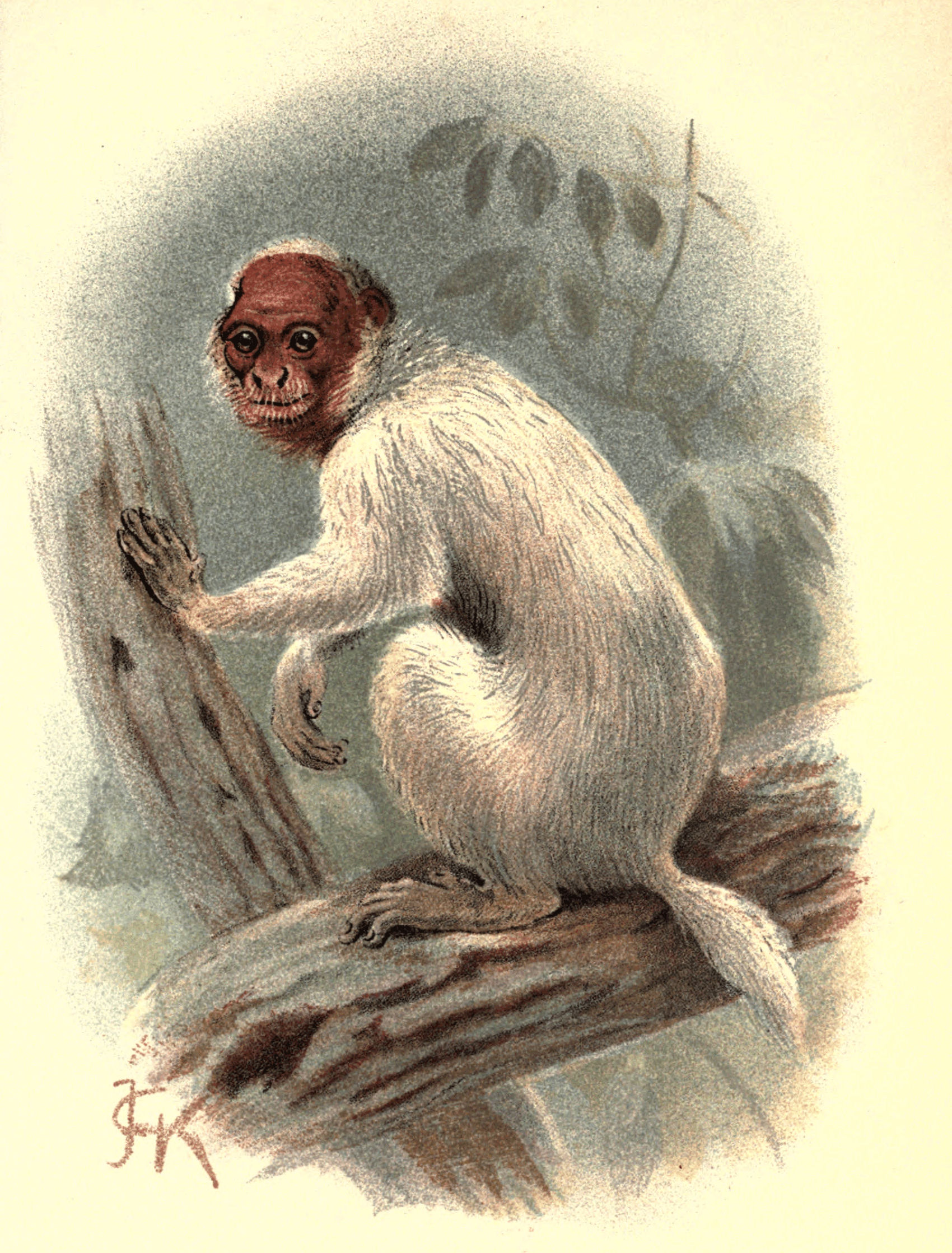
THE BALD UAKARI.
Habits.—"This scarlet-faced monkey," says Mr. Bates, "lives in forests, which are inundated during the greater part of the year, and is never known to descend to the ground; the shortness of its tail is, therefore, no sign of terrestrial habits, as it is in the Macaques and Baboons of the Old World.... It seems to be found in no other part of America than the banks of the Japurá near its mouth; and even there it is confined to the western side of the river. It lives in small troops amongst the crowns of the lofty trees, living on fruits of various kinds. Hunters say it is very nimble in its motions, but it is not much given to leaping, preferring to run up and down the larger boughs in travelling from tree to tree. The mother, as in other species of the Monkey order, carries her young on her back. Individuals are obtained alive by shooting them with the blow-pipe and arrows tipped with diluted Urari poison. They run a considerable distance after being pierced, and it requires an experienced hunter to track them. He is considered the most expert who can keep pace with a wounded one and catch it in his arms when it falls exhausted. A pinch of salt, the antidote to the poison, is then put in its mouth, and the creature revives.... Adult Uakarís, caught in the way just described, very rarely become tame. They are peevish and sulky, resisting all attempts to coax them, and biting anyone who ventures within reach. They have no particular cry, even when in their native woods; in captivity they are quite silent. In the course of a few days or weeks, if not carefully attended to, they fall into a listless condition, refuse food, and die.... The bright scarlet of its face is, in health, spread over the features up to the roots of the hair on the forehead and temples, and down to the neck, including the flabby cheeks, which hang down below the jaws. The animal, in this condition, looks at a short distance as though someone had laid a thick coat of red paint on its countenance.... After seeing much of the morose disposition of the Uakarí, I was not a little surprised one day, at a friend's house, to find an extremely lively and familiar individual of the species. It ran from an inner chamber straight towards me after I had sat down on a chair, climbed my legs and nestled in my lap, turning round and looking up with the usual Monkey's grin after it had made itself comfortable. It was a young animal, which had been taken when its mother was shot with a poisoned arrow; its teeth were incomplete, and the face was pale and mottled, the glowing scarlet hue not supervening in these animals before mature age; it had also a few long black hairs on the eyebrows and lips. The frisky little fellow had been reared in the house among the children, and allowed to run about freely...." This species is rare, even in the limited district which it inhabits. A Government official sent six of his most skilful Indians, who were absent hunting for three weeks before they obtained twelve specimens.
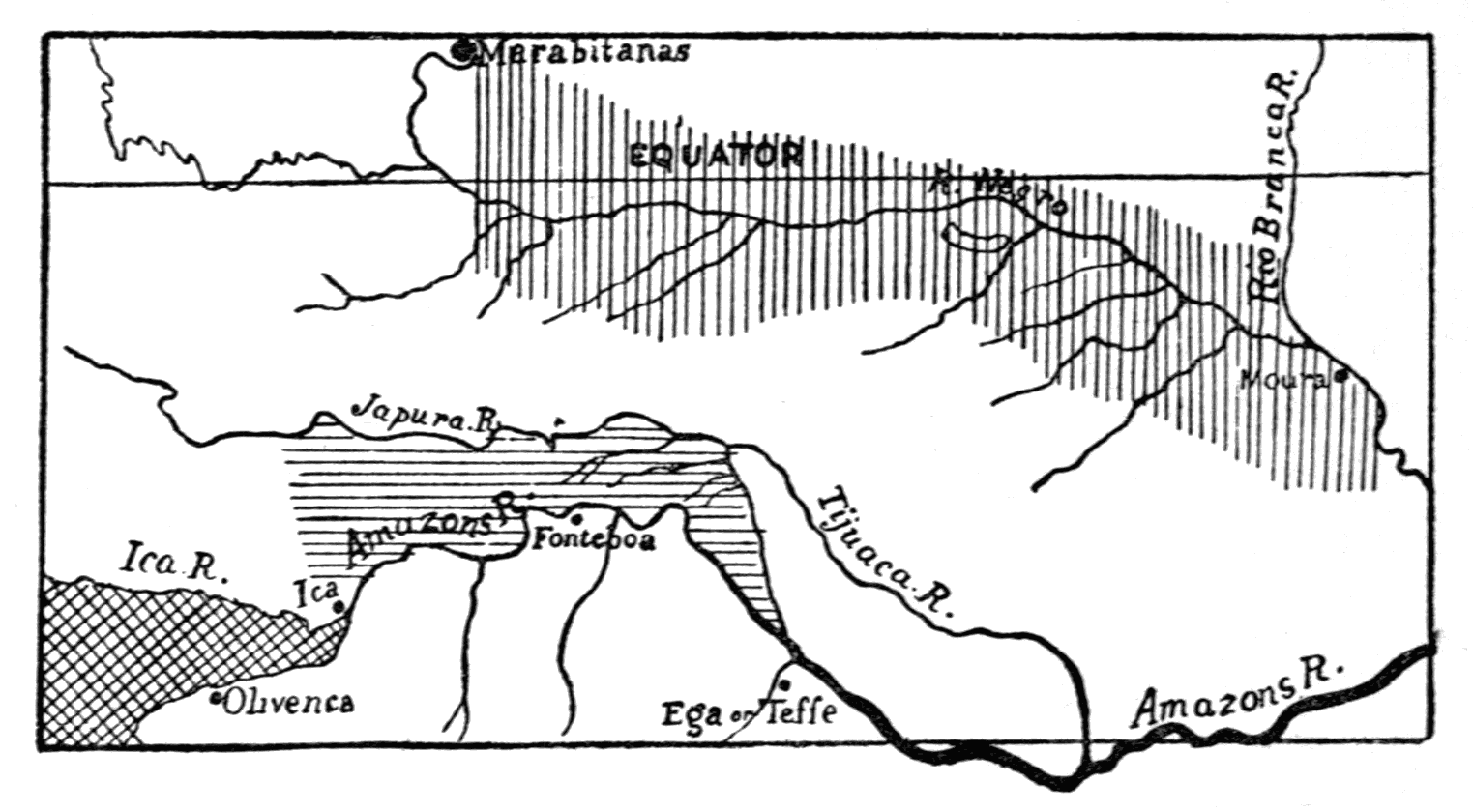
Fig. 8.
Map of part of the basin of the Amazons to show the distribution of the Uakarí Monkeys. (Forbes, P. Z. S., 1880, p. 647.)
Supposed area of ''B. melanocephalus'',

Of ''B. calvus'',

Of ''B. rubicundus'',

In reference to the singularly restricted range of these Uakarís, Mr. Wallace's observations in his paper "On the Monkeys of the Amazon," before the Zoological Society of London, are of great interest.
"During my residence," he says, "in the Amazon district, I took every opportunity of determining the limits of species, and I soon found that the Amazon, the Rio Negro, and the Madeira formed the limits beyond which certain species never passed. The native hunters are perfectly acquainted with this fact, and always cross over the river when they want to procure particular animals, which are found even on the river's bank on one side, but never by any chance on the other. On approaching the sources of the rivers, they cease to be a boundary, and most of the species are found on both sides of them. Thus several Guiana species come up to the Rio Negro and Amazon, but do not pass them; Brazilian species, on the contrary, reach but do not pass the Amazon to the north. Several Ecuador species from the east of the Andes reach down into the tongue of land between the Rio Negro and Upper Amazon, but pass neither of those rivers, and others from Peru are bounded on the north by the Upper Amazon, and on the east by the Madeira. Thus there are four districts whose boundaries on one side are determined by the rivers I have mentioned. In going up the Rio Negro, the difference on the two sides of the river is very remarkable.
"In the lower part of the river you will find on the north the Jacchus [Hapale] bicolor, and the Brachyurus couxui [Pithecia satanas], and on the south the red-whiskered Pithecia. Higher up you will find on the north the Ateles paniscus, and on the south a black Jacchus and the Lagothrix humboldtii."
THE SAKIS. GENUS PITHECIA.
Pithecia, Geoffr., Ann. Mus., xix., p. 115 (1812).
Chiropotes, Gray, Cat. Monkeys Brit. Mus., p. 60 (1870), in part.
The Sakis form the second section of the present Sub-family, and are characterised by their long, thick, and bushy non-prehensile tail. A thick beard conceals the large chin. Hair on the crown long, divided by a central line, and hanging over the head, half concealing the pleasing diminutive face, or confined to the head, cheeks, and chin. The ears are large. The upper and lower incisor teeth project forward, the upper inner pair being moderately large, the outer very small; canines strong and conical; first pre-molar smaller than the others, and one-cusped; molars with square crowns, grooved in the middle and slightly four-cusped.
In the brain the whole of the cerebellum and the olfactory lobes are covered by the cerebrum. In general form the latter resembles that of the species of Cebus. The frontal and occipital regions of the skull approximate in form to those in Man; the angle of the mandible is expanded, but less so than among the Howlers (Mycetes). The ribs are relatively broader in this genus than in any other of the American Monkeys.
I. THE HAIRY SAKI. PITHECIA MONACHUS.
Simia monachus, Humb. and Bonpl., Obs. Zool., p. 359 (1811).
Pithecia monachus, Geoffr., Ann. Mus., xix., p. 116 (1812); Flower, P. Z. S., 1862, p. 326, pl. xxxvii.; Gray, Cat. Monkeys Brit. Mus., p. 59 (1870).
Pithecia hirsuta, Spix, Sim. et Vespert. Bras., p. 14, pl. 9 (1823).
Pithecia inusta, Spix, t. c. p. 15, pl. x. (1823).
Pithecia irrorata, Gray, Voy. Sulphur, Zool., p. 14, pl. 3 (1844).
Pithecia albicans, Gray, P. Z. S., 1860, p. 231, pl. lxxxi.
Pithecia monacha, Schl., Mus. Pays Bas, vii., p. 220 (1876).
Characters.—Fur harsh, long and loose, with a hood of forwardly-directed hairs on the upper part of the head, neck, and shoulders. Face bare, long, and narrow; nose large and full; nostrils widely separated and lateral. Face dark purplish-brown, and black on the nose, paler round the eyes, and sparingly covered with short coarse whitish hairs; a yellowish-white patch on the cheeks, terminating in front in a distinct line from the inner corner of the eye to below the angle of the mouth; margin of upper lips white; ears large, round, naked, and of the same colour as the face; upper part and back of head, neck, shoulders, back, arms, thighs, and tail, black, washed with yellowish-white, becoming yellowish-brown on the hinder part of the body. Throat, breast, under side of body, and inside of thighs, pale yellowish-brown, sparingly haired. Tail 18 inches long, cylindrical, and bushy at the end; the hair long, coarse, curled, black, washed with pale yellowish-brown. Legs black; fore-arm black, washed with white; upper surface of hands, feet, and digits, white. Hands small, thumbs short, parallel to the other fingers; nails black, somewhat compressed, pointed, that of the thumb flatter; great-toe well developed, standing apart from the other toes, its nail flat and pointed; nails of the other toes long, curved, and compressed.
Distribution.—Mr. Bates states that the "Parauacú," as this Monkey is called by the natives of its own country, is found on the "terra firma" lands of the north shore of the Solimoens, or Upper Amazon, from Tunantins to Peru. It exists also on the south side of the river on the banks of the Teffé, but there under a changed form, which differs from its type in colours, as much as the red differs from the white Uakarí. This variety is Dr. Gray's Pithecia albicans.
Habits.—The Hairy Saki is a very timid and inoffensive animal, and is also, as Mr. Bates tells us in his well-known book, "very delicate, rarely living many weeks in captivity; but anyone who succeeds in keeping it alive for a month or two, gains by it a most affectionate pet. One of the specimens now in the British Museum was, when living, the property of a neighbour of mine at Ega. It became so tame in the course of a few weeks that it followed him about the streets like a dog. My friend was a tailor, and the little pet used to spend the greater part of the day seated on his shoulder whilst he was at work on his board. It showed, nevertheless, great dislike to strangers, and was not on good terms with any other member of my friend's household than himself.... The eager and passionate Cebi seem to take the lead of all the South American Monkeys in intelligence and docility, and the Coaita, one of the Spider-Monkeys (Ateles paniscus), has, perhaps, the most gentle and impressionable disposition; but the Parauacú, although a dull, cheerless animal, excels all in this quality of capability of attachment to individuals of our own species, nor is it wanting in intelligence."
II. THE WHITE-HEADED SAKI. PITHECIA PITHECIA.
Simia pithecia, Linn., Syst. Nat., i., p. 40 (1766).
Simia leucocephala, Audeb. Singes., Fam, vi., Sect, i., p. 9, fig. 2 (1797).
Pithecia adusta, Illig., Abh. Berl. Ak., 1804-1811, p. 107; Kuhl, Beitr. Zool., p. 44 (1820).
Pithecia nocturna, Illig., l. c.; Schl., Mus. Pays Bas, vii., p. 217 (1876; part).
Pithecia leucocephala, Geoffr., Ann. du Mus., xix., p. 117 (1812); Gray, Voy. Sulphur, Zool., p. 12, pl. 2; id., Cat. Monkeys Brit. Mus., p. 59 (1870; part); Scl., P. Z. S., 1871, p. 228.
Pithecia ochrocephala, Kuhl, Beitr. Zool., p. 44 (1820, = young).
Pithecia rufibarbata, Kuhl, t. c. p. 44 (1820).
Pithecia capillamentosa, Spix, Sim. et Vespert. Bras., p. 16, pl. 11 (1823).
Pithecia rufiventer, Geoffr., Cat. Méth. Primates, p. 55 (1851); Gray, Cat. Monkeys Brit. Mus., p. 60 (part, 1870); Wagner, Abhandl. Akad. Münch., v., pt. 2, p 436 (1848: = ♀).
Pithecia chrysocephala, Geoffr., Cat. Méth. Primates, p. 55 (1851).
Pithecia pogonias, Gray, Voy. Sulphur, p. 13, pl. 2 (1844).
Characters.—Male.—Hair black, very long over the body, and especially on the tail. Head with short hair, white, washed with yellow and divided by a central nude black streak; the white hair becoming yellow on the cheeks.
Female.—Greyish-black, washed with pale yellow, the hairs being tipped with the latter colour; moustache yellow; belly red.
Young Male.—Belly rufous brown.
Distribution.—Interior of Demerara, Kaicteur Falls; Rio Negro, and Rio Branco in Amazonia; Cayenne; Surinam.
III. THE BLACK SAKI. PITHECIA SATANAS.
Saki noir, F. Cuv., Hist. Nat. Mammif., pl. 78.
Simia satanas, Hoffm., Mag. Ges. Berl., x., p. 93 (1807); Humb., Obs. Zool., i., p. 314, pl. xxvii. (1811).
Pithecia satanas, Geoffr., Ann. Mus., xix., p. 115 (1812); Scl., P. Z. S., 1864, p. 712, pl. xli.; id., t. c. p. 138; Schl., Mus. Pays Bas, vii., p. 224 (1876).
Chiropotes cuxio, Lesson, Sp. Mamm. Bimanes et Quadrum., p. 179 (1840).
Chiropotes ater, Gray, Cat. Monkeys Brit. Mus., p. 61 (1870).
Chiropotes satanas, Gray, t. c. p. 61.
Characters.—Male.—Fur soft; tail bushy and as long as the body; crown with long black hair arranged on each side, divided by a central line. "The hair of the head sits on it like a cap, and looks as if it had been carefully brushed." (Bates.) Long whiskers on each side, and the chin with a moderate beard. Fur black and shining; back sometimes washed with grey or ashy-brown.
Female.—Similar to the male, but having a browner back.
Young.—Beard absent or rudimentary; hair of crown radiating from centre and projecting forwards.
The skull in this species is sometimes ossified into one piece.
Distribution.—Lower Amazonia; Para; British Guiana; the River Orinoco, towards the Rio Negro.
Habits.—Little is known of the habits of the Black Saki, which is also known under the names of "Cuxio" and "Mono Capuchino." It lives in the most retired parts of the forest, where the ground below it is not inundated by the river, and feeds on fruits.
It is said that this animal—unlike the next species—drinks freely, always bending down on its hands and putting its mouth to the surface of the water, heedless of wetting its beard and indifferent to the observation of onlookers. Sir Robert Porter says that he never saw it take up water in the hollow of its hand, and convey it to its mouth to drink. Its voice is a weak and chirping whistle, which becomes shrill and loud when the animal is angry.
A young male of this species, which died in the Zoological Society's Gardens in 1882, presented an abnormal condition. The peculiarity consisted, as Mr. W. A. Forbes, the late distinguished prosector to the Society, has pointed out in the "Proceedings," in the completely "webbed" condition of the third and fourth digits of the manus (hand) on each side, these two fingers being completely connected together, down to their tips, by a fold of nude skin, and with their nails closely apposed, though not connected along their contiguous margins. The other digits of the hands, as well as those of the feet, were quite normal, the webbing not extending beyond the middle of the first phalanx. Mr. Forbes remarks: "The case is interesting, partly as affording an excellent instance of an abnormal condition affecting homologous parts of opposite sides in an exactly similar way, and partly as showing that the lower Primates are subject, occasionally, to a condition of things which, as is well known, also occurs not at all rarely in Man."
IV. THE RED-BACKED SAKI. PITHECIA CHIROPOTES.
Simia chiropotes, Humb., Obs. Zool., i., p. 311 (1811).
Simia sagulata, Traill, Mem. Wern. Soc., iii., p. 167 (1821).
Brachyurus israelita, Spix, Bras., Sim. et Vespert., p. II, pl. 7 (1823).
Pithecia chiropotes, Geoffr., Ann. Mus., xix., p. 116 (1812); Scl., P. Z. S., 1871, p. 228; Schl., Mus. Pays Bas, vii., p. 223 (1876).
Brachyurus satanas, Gray, List Mamm. Brit. Mus., p. 13 (1843).
Chiropotes sagulata, Gray, Cat. Monkeys Brit. Mus., p. 60 (1870).
Characters.—Male.—Larger than P. satanas; black, with a reddish-chestnut patch on the back, with a coarse brownish beard, longer than in P. satanas; tail very thick, bushy.
Female.—Similar to the male, but without the beard.
Distribution.—Amazonia, Rio Negro, and Rio Branco; Upper Orinoco; British Guiana.
Habits.—This species is said to be solitary, or to go about only in pairs. It derives its scientific name from its habit of drinking by lifting the water to its head with its hands, instead of stooping down and applying its mouth to the water. It is difficult to tame, being fierce and ill-dispositioned.
V. THE WHITE-NOSED SAKI. PITHECIA ALBINASA.
Pithecia albinasa, Is. Geoffr. et Dev., C. R., xxvii., p. 498 (1848); id., Arch. Mus., v., p. 559 (1845); Gervais in Castelnau, Expéd. Am. Sud, ii., p. 16, fig. 2 (1855); Scl., P. Z. S., 1881, p. 258, pl. xxix.
Chiropotes albinasa, Gray, Cat. Monkeys Brit. Mus., p. 61 (1870).
(Plate XVII.)
PLATE XVII.
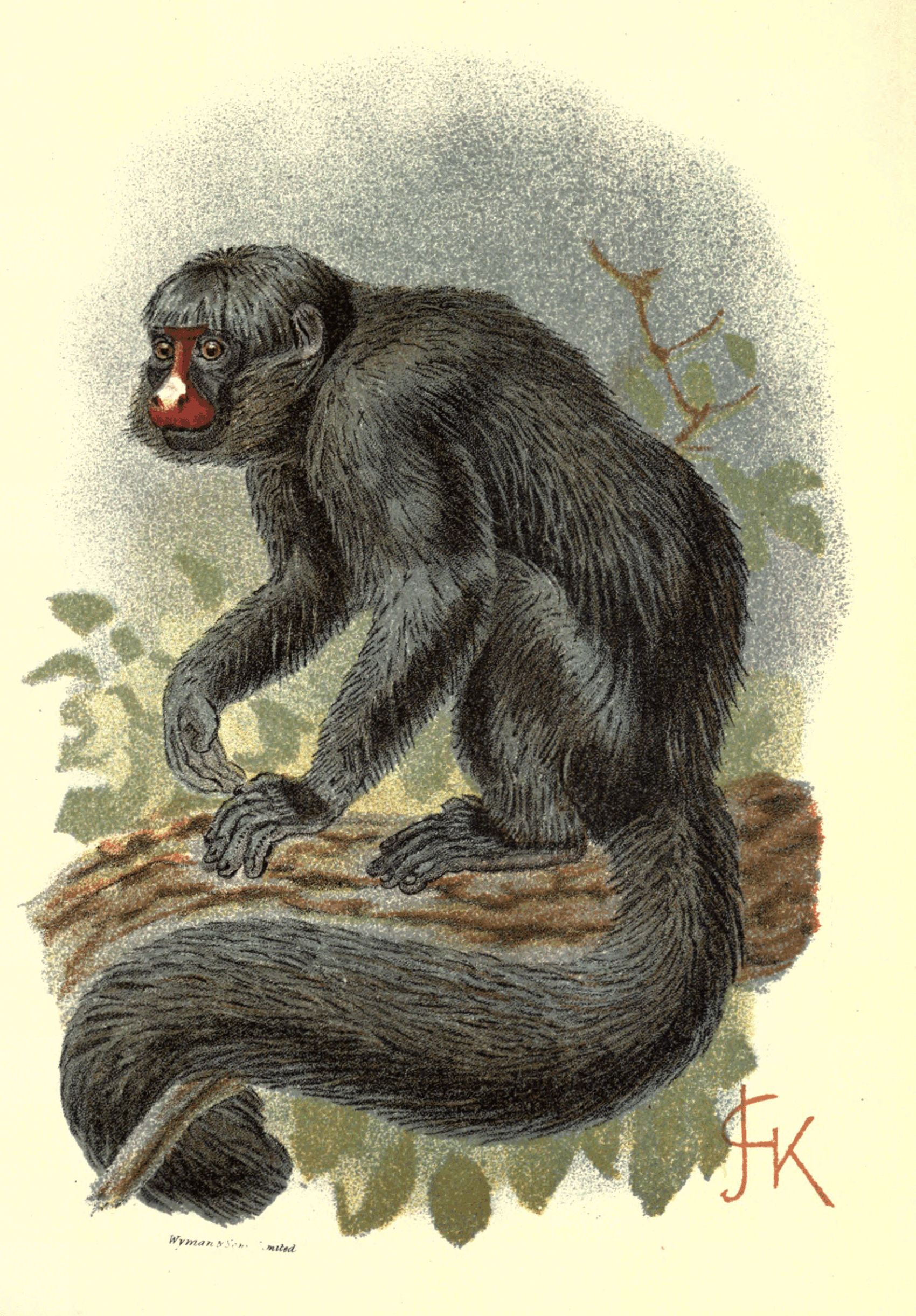
THE WHITE-NOSED SAKI.
Characters.—Uniformly, but rather sparingly, covered with black hairs. Face black, naked; nose broad and naked, and with a bright scarlet line down its bridge, broadening out on the latter and on the upper lip; tip of nose white, from the presence of a few white hairs.
Long hairs on the head falling to all sides; tail long and clothed to the tip with long hairs hanging down from its under side, slightly prehensile. Length of the body, 15 inches; of the tail, 18 inches.
Distribution.—Amazonia.
Habits.—The White-Nosed Saki, which might much more appropriately have been called the "Red-Nosed Saki," is very rare; its habits are quite unknown. The type specimen in the Paris Museum remained unique in Europe from 1848 till 1881, when a living specimen was brought to the Zoological Gardens in London.
THE HOWLERS. SUB-FAMILY MYCETINÆ.
This sub-family embraces only one genus, which is very distinct from all the others. The Howlers are the largest of the South American Apes, and are characterised by their thick unwieldy body, their pyramidal head, and small facial angle, owing to their long, somewhat Dog-faced muzzle. The angle of the lower jaw is very large and massive, and their chief characteristic is the conspicuous thickening of the throat, owing to the great enlargement of the hyoid bones—which are widely inflated and cavernous—to form the curious vocal organ which the males of these animals possess, and by which their voice can be so augmented as to be heard at a distance of several miles.[11] The skull is truncated behind in the male (less so in the female) for the reception of the vocal apparatus. Their incisor teeth are small and equal, the canines are prominent and have an oblique ridge across the crown from the outer front, to the inner hind, cusp, and the upper molars are large. The tail is powerful and prehensile, naked towards the tip, where it is tactile and very sensitive. The thumb is movable, the face is naked, and the chin bearded. Some have short, and some have long, fur over their bodies, but it is generally more plentiful about the head. In appearance they are the most unattractive and repulsive of the American Monkeys. Their intelligence is also of a very low order.
The roof of the brain-case is depressed; the plane of the opening for the passage of the spinal-cord from the brain is almost perpendicular to that of the base of the skull; the condyles for the articulation of the neck are situated as far back as possible. Sir William Flower, in his valuable monograph on the brain of Mycetes, has shown that the frontal lobes are small and the cerebral hemispheres only just cover the cerebellum. In regard to its grooves and convolutions, the main brain (cerebrum) of Mycetes can be distinguished from that of all other Monkeys. The whole organ is small as compared with the size of the animal; it wants the roundness and fulness of that of the Spider-Monkeys (Ateles) and of the Capuchins (Cebus). Its surface markings are comparatively few and simple, and depart remarkably from the ordinary type seen in the order. In the Old World Apes there is a striking similarity in the character of the surface markings of their cerebral hemispheres. There is a slight ascensive development from Cercopithecus towards Hylobates; and further complications overlying the same primitive type—such as large proportionate size, and complexity of convolutions—are observed in the Chimpanzee and Gorilla, leading up to the brain of Man. Among the New World genera there is a much greater divergence. Among the Capuchins (Cebus), and among them only, there is a precise repetition of the Old World type; but in the genus Mycetes we have modifications in which there is no parallel among the Catarrhine (or Old World) series. There is an absence in its brain of signs of serial elevation; and it exhibits a great dissimilarity to all, even the lowest of the Old World forms, and to those American Monkeys, which in brain-character closely resemble Old World Apes. It shows an affinity in some of its more striking characters to such low forms of New World Apes as Nyctipithecus. The low type of brain is in keeping, as Sir William Flower further observes, with their surly and untameable disposition, and with the observation that their intelligence is of a very different order from that of their neighbours, the Spider-Monkeys and Capuchins of higher cerebral organisation.
"When Howlers are seen in the forest," remarks Mr. Bates, "there are generally three or four of them mounted on the topmost branches of a tree. It does not appear that their harrowing roar is emitted from sudden alarm; at least, it was not so in captive individuals. It is probable, however, that the noise serves to intimidate their enemies." The muscular power employed in giving vent to their cavernous roar appears to be small. Their food consists chiefly of fruits and leaves.
In colour the Howlers vary very much. The young of both sexes often differ from their parents, and the females from the males, and there is also great individual variation.
The geographical distribution of some of the species is very restricted, several of them being confined to a special district of the Amazon, into which no other species intrudes. They are found, however, from Eastern Guatemala to Paraguay.
THE HOWLERS. GENUS ALOUATTA.
Alouatta, Lacép., Mém. Inst., iii., p. 490 (1801).
Mycetes, Illig., Prodr. Syst. Mamm., p. 70 (1811).
Stentor, Geoffr., Ann. Mus., xix., p. 107 (1812).
The characters of the genus Mycetes, which is the only one of the sub-family, are the same as those given above under the sub-family heading.
The genus contains six well-recognised species. According to Mr. Wallace the red and black species of the Amazon have females of the same colour as the males. Humboldt also remarks, speaking of the thousands of Arguatoes (M. seniculus) which he observed in the provinces of Cumana, Caracas, and in Guiana, that he never saw any change in the reddish-brown fur of the back and shoulders, either in isolated individuals or whole troops. Many of the species, however, do have the sexes of quite different colours.
The Howlers are semi-nocturnal in their habits, uttering their cries late in the evening and before sunrise, and also on the approach of rain. (Wallace.)
When a Mycetes is shot it always hangs to the tree, even if quite dead, and does not fall till the muscles of the feet and tail relax.
The species of this genus range through Central America, Colombia, and the Amazonian region, to Southern Brazil, Bolivia, and Paraguay.
PLATE XVIII.
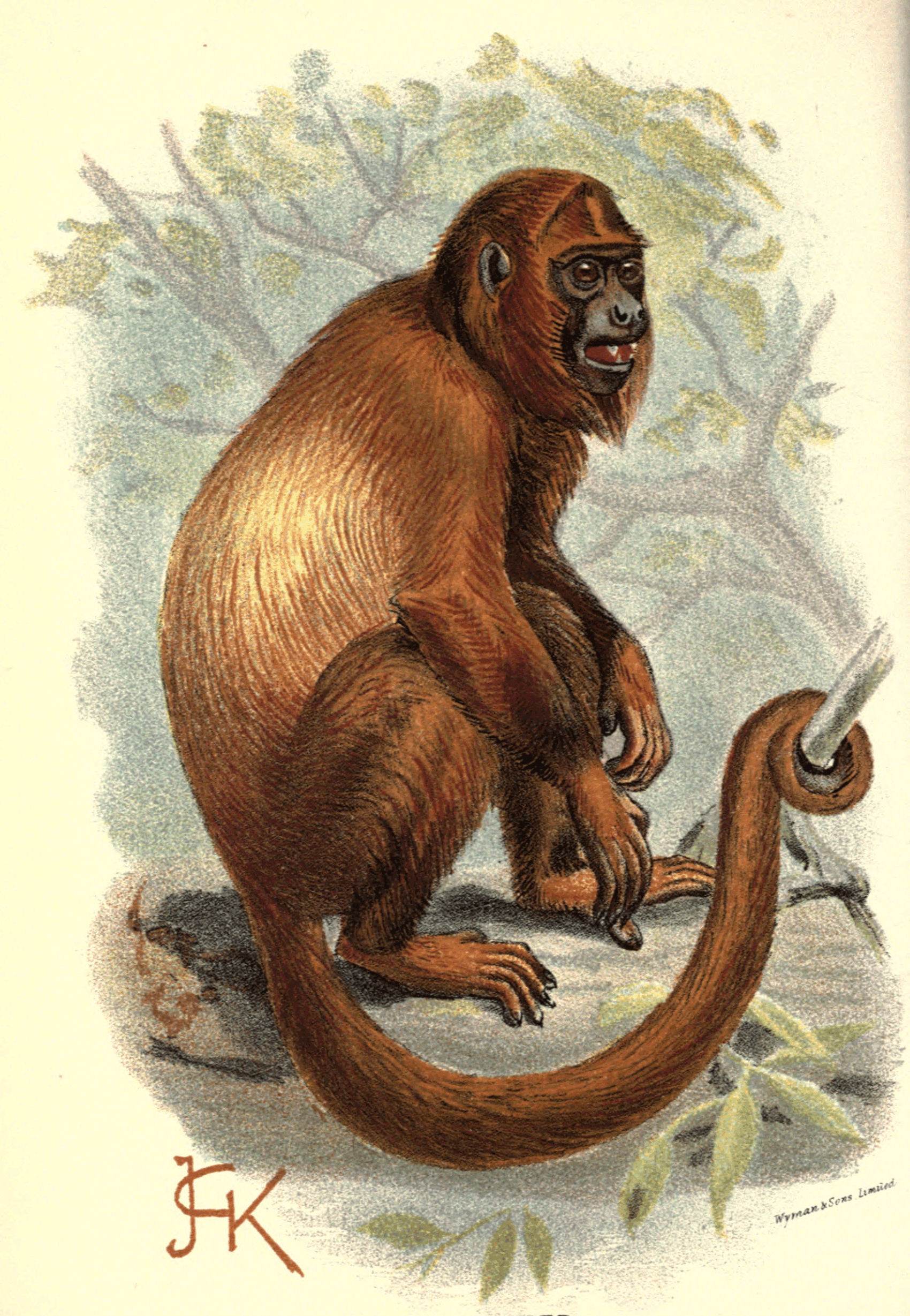
THE RED HOWLER.
I. THE RED HOWLER. ALOUATTA SENICULUS.
Simia seniculus, Linn., Syst. Nat., i., p. 37 (1766).
Alouatta seniculus, Lacép., Mém. de l'Inst., iii., p. 489 (1800).
Stentor ursina (nec fig.), Humb. and Bonpl., Obs. Zool., v., p. 354 (1811).
Mycetes seniculus, Illig., Prod. Syst. Mamm., p. 70 (1811); Geoffr., Cat. Méth. Primates, p. 52 (1851); Schl., Mus. Pays Bas, vii., p. 156 (1876); Gray, Cat. Monkeys Brit. Mus., p. 39 (1870, part.).
Stentor seniculus, Geoffr., Ann. Mus., xix., p. 108 (1812).
Mycetes stramineus, Spix, Sim. et Vespert., Bras., p. 45, pl. 31 (1823; nec Geoffr.).
Mycetes chrysurus, Geoffr., Mém. Mus., xvii., p. 66 (1829).
Mycetes auratus, Gray, Ann. N. H., xvi., p. 220 (1845); id. Cat. Monkeys Brit. Mus., p. 40 (1870).
Mycetes laniger, Gray, Ann. N. H., xvi, p. 219 (1845); id. Cat. Monkeys Brit. Mus., p. 40.
Aluatta senicula, Slack, Proc. Acad. Nat. Sci. Philad., 1862, p. 517.
(Plate XVIII.)
Characters.—Head, neck, limbs and tail, dark chestnut-brown; back and sides golden-yellow; beard in the full-grown male long, the hair golden-yellow at the root, otherwise chestnut-brown; face naked, black; chest naked, the abdomen sparsely covered with long brown hairs.
The hair of the body is soft. The tail varies in colour in individual specimens, being sometimes, at its termination, of the same colour as the back, and sometimes bright golden-yellow. The mammæ are occasionally situated in the axillæ (or arm-pits). Length of body, 19½ inches; tail, 20 inches.
Young.—Of the same colour as the parents, only a little darker, the hair hard and rigid.
Distribution.—Brazil; New Granada; Venezuela; Copataza river, Ecuador; Eastern Peru, along the Ucayali and Huallaga rivers.
Habits.—The Red Howlers always travel in large companies, keeping to the forests of the low lands and shores of the rivers. "We stopped," writes Humboldt, "to observe the Howling Monkeys, which, to the number of thirty or forty, crossed the road by passing in a long file from one tree to another upon the horizontal and intersecting branches." On another occasion the same celebrated naturalist records that "on approaching a group of trees, we perceived numerous bands of Arguatoes going as in a procession from one tree to another with extreme slowness. A male was followed by a great number of females, several of which carried their young on their shoulders. The uniformity with which the Arguatoes execute their movements is extremely striking. Whenever the branches of neighbouring trees do not touch, the male that leads the band suspends himself by the callous and prehensile part of his tail; and letting fall the rest of his body, swings himself till in one of his oscillations he reaches the neighbouring branch. The whole file performs the same action on the same spot. It is almost superfluous to add how dubious is the assertion that the Arguatoes and other Monkeys with prehensile tails form a sort of chain, in order to reach the opposite side of a river. We had opportunities, during five years, of observing thousands of these animals, and for this very reason we place no confidence in these stories."
"The Arguatoes are sometimes accused of abandoning their young, that they may be more free for flight when pursued by Indian hunters. It is said that mothers have been seen taking off their young from their shoulders and throwing them down to the foot of the tree. I am inclined to believe that a movement merely accidental has been mistaken for one that was premeditated. The Arguatoes, on account of their mournful aspect and their uniform howlings, are at once detested and calumniated by the Indians."
Mr. Wallace, in a paper "On the Monkeys of the Amazon," in the "Proceedings of the Zoological Society," says: "Humboldt observes that the tremendous noise which these Howlers make can only be accounted for by the great number of individuals that unite in its production. My own observations, and the unanimous testimony of the Indians, prove this not to be the case, one individual alone making the howling, which is certainly of a remarkable depth and volume and curiously modulated; but on closely remarking the suddenness with which it ceases and again commences, it is evident that it is produced by one animal, which is generally a full-grown male."
The flesh of this species is very good to eat, and furnishes the principal food of the inhabitants of the regions in which it abounds.
II. THE BLACK HOWLER. ALOUATTA NIGRA.
Stentor caraya, Humb. and Bonpl., Obs. Zool., i., p. 355 (1811 ex Azara).
Mycetes barbatus, Spix, Sim. et Vespert., Bras., p. 46, pls. 32, 33 (1811).
Stentor niger (male), S. stramineus (female), Geoffr., Ann. Mus., xix., p. 108 (1812; nec Spix).
Mycetes caraya, Less., Sp. Mamm. Bimanes et Quadrum., p. 122 (1840); Gray, Cat. Monkeys Brit. Mus., p. 41 (part).
Aluatta nigra, Slack, Proc. Acad. Nat. Sci. Philad., 1862, p. 518.
Mycetes niger, Thomas, P. Z. S., 1880, p. 394; Schl., Mus. Pays Bas, vii., p. 149 (1876).
Characters.—Male.—Hair rather long and entirely of a deep black; hair on the back of the head directed forward, meeting at right angles that of the forehead, which is directed backward, forming a well-marked semi-circular ridge. Length, 20 inches; tail, 17 inches.
Female and Young.—Pale straw-colour washed with black; the tips of the frontal ridge of hair black; at birth the young are entirely straw-colour.
Dr. Slack observes that, in the young, about the period of the second dentition, the hairs upon the mid-line of the back become black at their bases; soon after, the change takes place upon other parts of the body, the black gradually taking the place of the straw-colour, until the entire body in the adult male is of an intense black colour—the adult female having the coloration of the half-grown male.
Mr. Oldfield Thomas, who examined a specimen collected by Mr. Buckley, in Ecuador, points out that it agreed exactly with Humboldt's original description of the female of his Simia caraya, which he describes as having a black head and back, while the sides and belly are yellow. In all recent descriptions, however, the male is described as being nearly uniformly black, and the female uniformly yellow; so that Mr. Buckley's specimen appears to be just such an intermediate specimen as Humboldt described.
According to Prof. Schlegel, adult males sometimes have the black on the hands and feet mixed with yellow.
Distribution.—This is the species of Howler which ranges furthest to the south. It occurs most abundantly in Southern Brazil, Paraguay, and Bolivia, but Mr. Bates records his having obtained a specimen at Villa Nova, on the Upper Amazons, which had come from above Borba, on the Rio Madeira. He did not, however, meet with it on any other part of the Amazon region. Mr. Graham Kerr saw it in troops on the banks of the Pilcomayo river.
Habits.—Like nearly all the Howlers, the present species is of a sulky disposition, in captivity slinking away out of sight when approached. The members of this genus are the only Monkeys which the Indians have not succeeded in taming. They rarely survive their captivity many weeks.
III. THE YELLOW-HANDED HOWLER. ALOUATTA BEELZEBUL.
Simia beelzebul, Linn., Syst. Nat., i., p. 37 (1766).
Mycetes rufimanus, Kuhl, Beitr. Zool., p. 31 (1820).
Mycetes discolor, Spix, Sim. et Vespert., Bras., p. 48, pi. xxxiv. (1823).
? Colobus chrysurus, Gray, Ann. Nat. Hist., xvii., p. 77 (1866).
Mycetes beelzebul, Gray, Cat. Monkeys Brit. Mus., p. 41 (1870); Schl., Mus. Pays Bas, p. 150 (1876).
Characters.—Black, slightly washed with yellow on the under side of the body and inner side of the limbs; hairs of the body soft, brown at the roots, black at the tips; hands and feet variable, reddish-yellow or reddish-brown, or grey, or black. Upper surface and tip of the tail, spot in front of the ears, and on the knees, reddish-yellow. Length of the body, 17½ inches; tail, 18½ inches.
This species differs from the Black Howler (A. nigra) by the brown colour of the roots of the hair; and from the species next to be described—the Brown Howler (A. ursina)—by the length of the fur and the absence of the reddish-brown tips to the hairs.
Distribution.—Apparently confined to the Lower Amazon, in the vicinity of Para.
Habits.—The same as those of the species already described.
IV. THE BROWN HOWLER. ALOUATTA URSINA.
Stentor ursina, Humb. and Bonpl., Obs. Zool., i., pl. 30 (fig. nec descr.; 1811).
Stentor flavicauda, Id. t. c. p. 355 (1811).
Stentor ursinus, Geoffr., Ann. Mus., xix., p. 108 (1812).
Stentor fuscus, Geoffr., t. c. p. 108 (1812).
Mycetes fuscus, Kuhl, Beitr. Zool., p. 29 (1820); Spix, Sim. et Vespert., Bras., p. 43, pl. 30 (1823).
Mycetes bicolor, Gray, Ann. N. H., xvi., p. 214 (1845); id. Cat. Monkeys Brit. Mus., p. 40 (1870).
Mycetes ursinus, Is. Geoffr., Cat. Méth. Primates, p. 55 (part., 1851); Gray, Cat. Monkeys Brit. Mus., p. 39 (1870); Schl., Mus. Pays Bas, vii., p. 155 (1876).
Aluatta ursina, Slack, Proc. Acad. Nat. Sci. Philad., 1862, p. 517.
Mycetes flavicauda, Schl., t. c. p. 147 (part., 1876).
Characters.—General colour shining yellowish-red, or dark brownish-yellow; hairs rather rigid, black with yellowish tips; hairs of the shoulder ringed with black. When half-grown the limbs and tail are very dark brown, nearly black; tail shorter than the body, olive black, with two yellow lateral stripes. Length of the body, 23 inches; of the tail, 22 inches.
Young.—Black, with the tips of the hairs of the body yellowish-brown; base of the tail and the surrounding region reddish-brown.
This species is remarkable for great variation in colour. The young at first sight, as Dr. Slack has pointed out, appear to be of an intense black colour, but upon a closer examination, the hairs, more especially those of the back and sides of the head, are found to be tipped with reddish-brown. As the animal becomes older the black gradually vanishes, a yellowish-brown colour appearing in its place, until in the adult the only remains of the black are to be found in a few annulations in the hairs of the shoulders.
The skins are an article of commerce, for saddle cloths and saddle coverings.
Distribution.—The Rio Negro and Upper Amazonia. Mr. Bates remarks that this is the only species seen in this region.
V. THE GUATEMALAN HOWLER. ALOUATTA VILLOSA.
Mycetes villosus, Gray, Ann. Nat. Hist., xvi., p. 220 (1845); id. Cat. Monkeys Brit. Mus., p. 41 (1870); Sclater, P. Z. S., 1872, p. 5, figs, 1 and 2; Alston, in Godm. and Salvin, Biol. Centr. Amer. Mamm., pp. 3 and 5, pl. i.
Characters.—Differs from M. niger by its abundant, long, and soft hairs, which below, towards their bases, show a rufescent tinge, and by the frontal hairs being sometimes directed downwards at the base, instead of upwards; hair on cheeks under the ears, brownish.
Male.—Entirely black.
Female and Young.—Also quite black, like the adult male, instead of being pale yellow, like the corresponding age and sex of A. nigra, and having also the hair shorter and not so glossy.
Distribution.—This Howler is known only from the virgin forests of the eastern and north-eastern portions of Guatemala. Mr. Osbert Salvin has given the following account of this species. "The Mycetes of Guatemala is commonly known as the 'Mono.' It is abundant throughout the virgin forests of the eastern portion of the Republic, but is unknown on the forest-clad slopes which stretch towards the Pacific Ocean. In the former region it is found at various altitudes over a wide expanse of country. I have heard its cry on the shores of the lake of Yzabal; and all through the denser forests of the valley of the River Polochic it is very common, from the steep mountain road which lies between the upland village of Purulá and S. Miguel-Tucuru, and especially in the wilderness of uninhabited forest, which stretches from Teleman to the lake of Yzabal. In the unbroken forest-country which occupies the whole of the northern portion of Vera Paz, from Coban and Cahabon to the confines of Peten, it is also abundant; for seldom an hour passes but the discordant cry of the Mono strikes upon the ear of the traveller, as he threads the lonely path to Peten. The elevation of this district varies from 700 to 3,000 feet, and the Mycetes is found at all elevations. When travelling through the forest in 1862, I was dependent for the animal food, to supply my party of Indians, entirely upon my gun, and Monos contributed not a little to the larder. The Indians eat Monkey without demur, but the meat looks dark and untempting. For my own part I far preferred the delicate Tinamou or Curassow, a sufficient supply of which never failed for my own consumption. Perhaps there is no district in Vera Paz where Monos are more abundant than the mountains of Chilasco, a cold and damp region, elevated at least 6,000 feet above the sea, but where the forest-growth is of the densest description and trees of the largest size abound. It was here that the specimens were obtained that are now in the British Museum."
Habits.—These animals are found in small companies of five or six. They are usually met with on the upper branches of the highest trees, and when disturbed crawl sluggishly along the boughs. "The wonderful cry whence Mycetes gets its trivial name of Howling Monkey is certainly most striking; and I have sometimes endeavoured to ascertain how far this cry may be heard. It has taken me an hour or more to thread the forest undergrowth from the time the cry first struck my ear to when, guided by the cry alone, I stood under the tree where the animals were. It would certainly not be over estimating the distance to say two miles. When the sound came over the lake of Yzabal, unhindered by trees, a league would be more like the distance at which the Mono's cry may be heard." (O. Salvin.)
To this species, we believe, belongs the following description given by Captain Dampier: "The Monkeys that are in these parts are the ugliest I ever saw. They are much bigger than a Hare, and have great Tails about two Foot and a half long. The under side of their Tails is all bare, with a black hard Skin; but the upper side and all the Body is covered with coarse, long black staring Hair. These Creatures keep together, twenty or thirty in a company, and ramble over the Woods, leaping from Tree to Tree. If they meet with a single Person they will threaten to devour him. When I have been alone I have been afraid to shoot them, especially the first Time I met them. They were a great company, dancing from Tree to Tree over my Head; chattering and making a terrible Noise; and a great many grim Faces, and shewing antick Gestures. Some broke down dry Sticks and threw at me; ... at last one bigger than the rest came to a small Limb just over my Head; and leaping directly at me made me start back, but the Monkey caught hold of the Bough with the tip of his tail; and there continued swinging to and fro, and making mouths at me.... The Tails of these Monkeys are as good to them as one of their hands; and they will hold as fast by them.... The Females with their young ones are much troubled to leap after the Males; for they have commonly two: one she carries under one of her Arms, the other sits on her Back, and clasps her two Fore-Paws about her Neck. These Monkeys are the most sullen I ever met with, for all the Art we could use would never tame them.... These Monkeys are very rarely or (as some say) never on the Ground."
VI. THE MANTLED HOWLER. ALOUATTA PALLIATA.
Mycetes palliatus, Gray, P. Z. S., 1848, p. 138, pl. vi.; Frantz., Wiegm. Arch., xxxv., p. 254 (1869); Gray, Cat. Monkeys Brit. Mus., p. 40 (1870); Scl., P. Z. S., 1872, p. 7; Schl., Mus. Pays Bas, vii., p. 152 (1876); Alston, in Godm. and Salvin, Biol. Centr. Am. Mamm., p. 4 (1879).
Aluatta palliata, Slack, Proc. Acad. Nat. Sci. Philad., 1862, p. 519.
Characters.—Face naked; hair of forehead short, reflexed, forming a slight crest across the middle of the head; hairs of the back of the head rather longer; those of the cheeks few, short and grey; those of the fore neck lengthening into a short beard. General colour brownish-black; middle of back and upper part of sides, yellowish-brown; lower part of sides brownish-yellow, lengthened into a mantle; arms, legs, and tail black. Length, 19½ inches; tail, 20¾.
The late Mr. Alston, in describing the Mammals of Central America, in Messrs. Godman and Salvin's monumental work, "Biologia Centrali-Americana," observes that "this Howler presents considerable variety in the depth of the black or brown-black ground-colour, and in the extent of the fulvous tints of the flanks and loins. Dr. v. Frantzius states that the Howlers which he saw in Costa Rica were darker than is indicated by Dr. Gray's description; and in several of the Panama examples the light markings are much reduced, but in others they are quite as conspicuous as in the Nicaraguan types." Mr. Alston, therefore, agrees with Prof. Schlegel, that the variation does not depend on locality.
Distribution.—Shores and islands of the lake of Nicaragua; Costa Rica; Panama; Islet of Hicaron, at the southern extremity of Quibo Island, off the Coast of Veragua. South of the Isthmus of Panama, the Red Howler (A. senicula) replaces the Mantled Howler.
Habits.—The habits of the Mantled Howler do not differ widely from those of the species already described. It prefers the highest branches of the trees of the dense forests; and is harmless to the plantations of the natives. In disposition it is dull and melancholy, and is rarely kept in confinement. It is said, however, to reconcile itself to captivity more than some of the others referred to in previous pages. According to Dr. v. Frantzius, a tame male individual of this species was observed to howl whenever rain-clouds gathered, and also regularly at five o'clock every morning.
THE CAPUCHINS AND SPIDER-MONKEYS. SUB-FAMILY CEBINÆ.
We now come to describe the remaining Monkeys of the New World. The Cebinæ are characterised by having the incisors vertical, not procumbent; they have no inflated hyoid bone as in the foregoing Sub-family. The tail in all is long and prehensile, although in some species it is a less perfect grasping organ, being clothed with hair to the tip, instead of being there naked and highly sensitive. The thumb may be present or absent.
This Sub-family contains four genera: the Capuchins (Cebus); The Woolly Monkeys (Lagothrix); the Woolly Spider-Monkeys (Eriodes); and the Spider-Monkeys (Ateles). The species belonging to these genera are very numerous, and are found over the whole region from Mexico in the north, to Paraguay and Bolivia in the south, or from about 25° N. lat., to 30° S. lat.
THE CAPUCHINS. GENUS CEBUS.
Cebus, Erxleb., Syst. Regne Anim., p. 44 (1777).
This is the typical genus of the American Monkeys. They are distinguished by having a robust body, covered with woolly fur, with a rounded head and a face which, instead of having a protruding muzzle, is more erect and Man-like. They are the commonest Monkeys seen in captivity in our streets. Their tail is long and covered with hair to the tip, and, though prehensile, it is not the perfect substitute for an additional hand noticed in several other genera. Their limbs are only moderately long, and are less slender than in the Spider-Monkeys. The fore-limbs have a well-developed thumb, which, as compared with the length of the hand, is the most Man-like of all the Apes; in some species the nails of the digits are compressed laterally.
In the skull the cranial portion exceeds the facial. Professor Mivart observes that in this group the facial part is relatively smaller than in many of the higher Old-World Apes. The skull has no external bony canal (or meatus) to the ear; and its frontal bones possess large air-cavities. In the Capuchins the incisor teeth are erect, and are always shorter than the canines. The molars are four-cusped, and have, on their crowns, two transverse ridges and the oblique ridge, already described in the Lemuroidea, from the front inner cusp to the hind outer cusp. These animals have also one milk-molar tooth more than in Man.
The outer surface of the main brain (cerebrum) is almost as much convoluted as in the Old World Apes.
The Capuchins range from Costa Rica to Paraguay, and are represented by about eighteen species. They are very gentle and docile animals.
F. Cuvier observes in his "Histoire Naturelle des Mammiferes," that of all the Quadrumana—indeed, of all the Mammals—there are none so difficult to characterise as the Capuchins of America, whose colours vary almost with every individual. No two authors agree in the number of species the genus contains. Brisson recognised three, Linnæus four, Gmelin six, Buffon two, and George Cuvier supposed it possible that they all belonged to but one species. Two causes help to produce this diversity of opinion; one is, as remarked above, the natural disposition which these animals have to vary, and to become lighter or darker in colour according to circumstances, and the other is the extremely close relationship that exists between the different species of the genus. Observations, however, are not yet numerous enough, nor exact enough, to enable those who have only studied the species alive in Europe, or had skins, to decide with such imperfect data as to their sex, age, and habitat. Not until some naturalist has made a prolonged study of these animals in their native country, and watched their conduct and relations in the living state, can we hope to attain to any certain knowledge of how many species the genus contains; and of the differences between the old and young of both sexes at different periods from youth to age.
I. THE WHITE-THROATED CAPUCHIN. CEBUS HYPOLEUCUS.
Saï á gorge blanche, Buffon, Hist. Nat. Mamm., p. 64, pl. 15, fig. 9 (1767); Fr. Cuv., Hist. Nat. Mamm., livr. xvi.; Audeb., Hist. Nat. Singes, fam. v., sect. 2, pl. 5 (1797).
Simia hypoleuca, Humb., Obs. Zool., i., p. 337 (1811); Pucher., Rev. et Mag. de Zool. (2), 1857, p. 348.
Cebus hypoleucus, Geoffr., Ann. Mus., xix., p. 111 (1812); Gray, Cat. Monkeys Brit. Mus., p. 50 (1870); Schl., Mus. Pays Bas, vii., p. 190 (1876).
Cebus leucocephalus, Gray, P. Z. S., 1865, p. 827, fig. 4; Sclater, P. Z. S., 1872, p. 4; Alston in Godman and Salvin, Biol. Centr. Am. Mamm., p. 13 (1879).
Characters.—Hair very silky, smooth and stiff, and thicker above than below. Face and forehead nude, flesh-coloured; hands and feet nude, of a violet hue, as also the thinly-haired skin of the under side of the body. The tip of the tail for a short distance being naked, distinguishes this species from all others. Shoulders, arms, and sides of the head behind the ears pure white; chest and throat yellowish; rest of the body deep black.
Older individuals have the head longer than the younger ones, and the shoulders yellowish instead of white. Length of the body, 13½ inches; of the tail, 17 inches.
Distribution.—This species was discovered by Humboldt in the low lands of Colombia. From Colombia its range extends north to Nicaragua. It has been obtained in Veragua, in Panama, in Costa Rica, and in the north-east of the country between the Pacuar and Chirripo rivers, and also on the mountains of Candalaria.
Habits.—The White-throated Capuchin feeds partly on fruit, as Mr. Belt has narrated in his well-known "Naturalist in Nicaragua." He adds:—"It is incessantly on the look out for insects, examining the crevices in trees and withered leaves, seizing the largest beetles and munching them up with the greatest relish. It is also very fond of eggs and young birds, and must play havoc amongst the nestlings. Probably owing to its carnivorous habits, its flesh is not considered so good by Monkey-eaters as that of the fruit-eating Spider-Monkey; but I never myself tried either."
Mr. Salvin saw a troop of these Monkeys in company with several Spider-Monkeys by the margin of a watercourse in Nicaragua, and remarked that the actions of the latter were bolder and more active than those of the Capuchins, which were slower and more timid.
According to Cuvier, the cry of this animal in captivity is a continuous soft whistle until its wants are satisfied; if it wants nothing this whistle is intermittent, and very soft. When in terror, its cry is a veritable bark, broken by silent intervals.
It is extremely docile and very intelligent; the look in its eyes is remarkably penetrating, and it appears to read in the eyes of its observer what is passing within him, and to comprehend every motion and gesture.
When pleased it utters a reiterated shrill note, and draws back the corners of its mouth, producing a smile by contracting the same muscles as in the human face.
II. THE WHITE-CHEEKED CAPUCHIN. CEBUS LUNATUS.
Cebus lunatus (Sajou cornu), male; F. Cuv., Hist. Nat. Mamm., pl. 70 (nec Kuhl).
Cebus vellerosus, Is. Geoffr., Cat. Méth. Primates, p. 44 (1851, pt.).
Cebus leucogenys, Gray, P. Z. S., 1865, p. 824, pl. xlv.; id. Cat. Monkeys Brit. Mus., p. 48 (1870).
Cebus frontatus, Schl., Mus. Pays Bas, vii., p. 206 (1876).
Characters.—Fur soft, elongate, silky, with thick under-fur. Hair on front of head elongate and reflexed, forming across the brow a short crest, higher above each eye; hair on top of head lying flat; that on cheeks short and adpressed; base of nose large, and corrugated longitudinally; toes long; tail longer than in other species; under surface of body less haired.
General colour silky brown, almost black on the head and limbs, paler on the shoulders and arms; the whiskers forming a white, or sometimes pale yellow, band, bordering the cheeks from opposite the eyes to the chin. Face and hands naked, violet; skin below the hair of the same colour.
The hair of the body is longer in winter than in spring; but the crests, or "horns," and the white whiskers appear only when the animal is fully adult.
Distribution.—Brazil.
III. THE SLENDER CAPUCHIN. CEBUS FLAVUS.
Cebus barbatus, Geoffr., Ann. Mus., xix., p. 110 (1812); Schl,. Mus. Pays Bas, vii., p. 197 (1876).
Cebus albus, Geoffr., t. c. p. 112 (albino).
Cebus flavus, Geoffr., Ann. Mus., xix., p. 112 (1812); Kuhl, Beitr. Zool., p. 33 (1820); d'Orbig., Voy. Amér. Mérid., iv., Mamm., p. 1, pl. 3 (1847); Schl., Mus. Pays Bas, vii., p. 204 (1876).
Cebus gracilis, Spix, Sim. et Vespert., Bras., p. 8, pl. 5 (1823, young).
Cebus libidinosus, Spix, t. c. p. 5, pl. 2 (1823).
Cebus unicolor, Spix, t. c. p. 7, pl. 4 (1823).
Simia flavia, Schreb., Säugeth., pl. 31B (1840).
Cebus elegans, Is. Geoffr., C. R., xxxi., p. 875 (1850).
Caiarára branca, Bates, Nat. Amaz., ii., p. 100 (1863).
Cebus pallidus, Gray, Cat. Monkeys Brit. Mus., p. 49 (1870).
Characters.—Hairs of crown short and reflexed, forming a small short crest, separated by a median furrow on each side of the dark crown patch. Fur soft; the coronal patch on the back of the head small, black or brown; crest black.
General colour golden fulvous or greyish fulvous; limbs and tail dark brown; beard golden-red.
Varieties of this species are sometimes entirely fulvous, with the forehead white; others are entirely albino.
Distribution.—Bolivia.
IV. THE SMOOTH-HEADED CAPUCHIN. CEBUS MONACHUS.
Cebus monachus, F. Cuv., Hist. Nat. Mammif., livr. xix. (1820).
Le Saï a grosse tête, male, F. Cuvier, loc. cit.
Cebus xanthocephalus, Spix, Sim. et Vespert., Bras., p. 6, pl. 3 (1823); Gray, Cat. Monkeys Brit. Mus., p. 50 (1870).
Cebus cucullatus, Spix, t. c. p. 9, pl. 6 (1823).
Cebus olivaceus, Wagner in Schreb. Säugeth., Suppl., v., p, 87, pl. 8 (1855).
Cebus variegatus, Schl., Mus. Pays Bas, vii., p. 208 (1876).
(Plate XIX.)
Characters.—Fur soft and stiff. Head large and round covered with short recumbent hairs. Face naked, pale round the prominent eyes; muzzle sharp, and of the same colour as that which surrounds the eyes; forehead, temples, throat, chest, under surface of body, sides of jaws, and front of arms, pale orange-yellow; outer side of arms, pale orange, washed with white; fore-arms, rump, hind-limbs, and tail black; a mixture of black and brown, expanding irregularly into spots on the yellow, covering the back, shoulders, and sides of body; a spot on the crown, black; a superciliary ridge forming a band of whiskers extending down the cheeks, and meeting under the chin, also black. Hands naked, violet, almost black.
Varieties occur with the shoulders and loins pale yellow, instead of mixed black and brown, and the outside of the thighs and the base of the tail, reddish. In some specimens the pale yellow of the back gives place to a white ground.
Distribution.—Rio de Janeiro, Brazil; Paraguay (?); Guiana.
Habits.—Little is known of the habits of this species; but F. Cuvier, who had one under his care in the "Ménagerie Royale," in Paris, remarks that it had the confiding disposition characteristic of the Capuchins, although very timid. It exhibited a great desire to be caressed, was very affectionate and most intelligent. Its physiognomy, however, he says, was involuntarily repellent, being one that, among ourselves, would indicate a person steeped in ignorance and sensuality.
PLATE XIX.
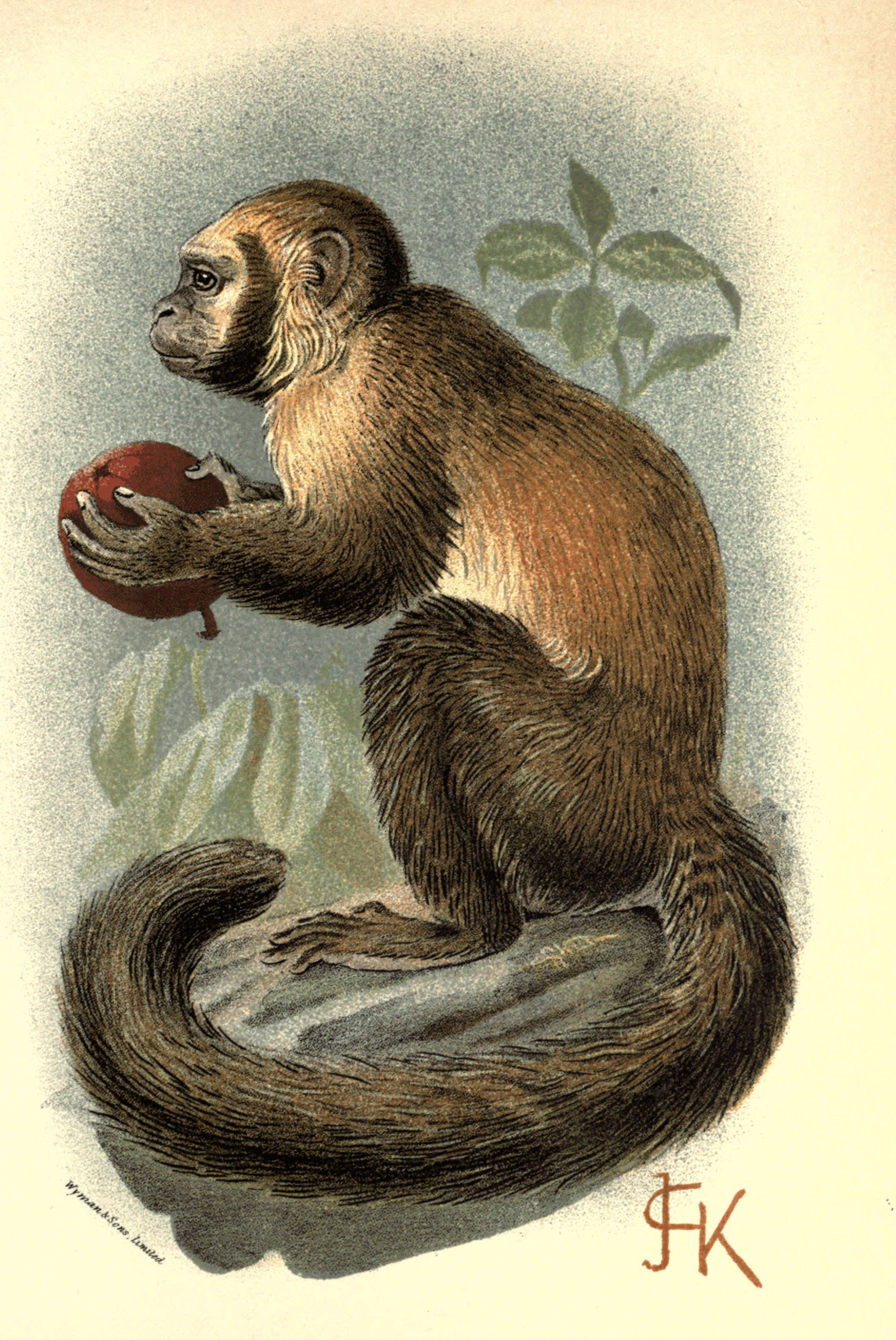
SMOOTH-HEADED CAPUCHIN.
V. THE BROWN CAPUCHIN. CEBUS FATUELLUS.
Simia trepida, Linn., Syst. Nat., i., p. 39 (1766).
Simia apella, Linn., Syst. Nat., i., p. 42 (1766).
Simia fatuellus, Linn., Syst. Nat., i., p. 42 (1766).
Cebus fatuellus, Geoffr., Ann. Mus., xix., p. 109 (1812).
Cebus apella, Geoffr., t. c. p. 109 (1812); Gray, Cat. Monkeys Brit. Mus., p. 48 (1870); Schl., Mus. Pays Bas, vii., p. 199 (1876).
Cebus macrocephalus, Spix, Sim. et Vespert., Bras., p. 3, pl. 1 (1823).
Characters.—Fur thick, harsh; hair of crown short, reflexed; on the sides of the crown a dark spot, elongated and elevated into two longer or shorter crests, according to the season and the age of the animal. General colour reddish-brown, darker on the hind-limbs, tail, and middle of the back; fore-arms, crown-spot, and whiskers, black; front of shoulders greyish or yellow; Face naked, purplish flesh-colour.
This species is subject to great individual variation. Its general colour is sometimes pale yellowish, with the whiskers yellow.
Distribution.—Brazil; Guiana, near the coast; on the mountains of the Upper Magdalena Valley; Tolima, U.S. Colombia, from 5,000 to 7,000 ft.
Habits.—This species, called "Mico Maizero" by the inhabitants of Tolima, lives as all the Cebi do, in considerable troops in the forests. When wild, it is restless and destructive, but in captivity it is docile and affectionate.
VI. THE VARIEGATED CAPUCHIN. CEBUS VARIEGATUS.
Cebus variegatus, Geoffr., Ann. Mus., xix., p. 111 (1812).
Characters.—Head round; muzzle protruding. Fur black, ringed with golden-yellow; under side of body rufous. Hairs of back brown at base, red higher up, black at the tips.
Distribution.—Brazil.
VII. THE TUFTED CAPUCHIN. CEBUS CIRRIFER.
Le Sajou negre, Buffon, Hist. Nat. Mamm. Suppl., p. 109, pl. 28.
Cebus cirrifer, Geoffr., Ann. Mus., xix., p. 110 (1812); Gray, Cat. Monkeys Brit. Mus., p. 49 (1870).
Cebus cucullatus, Spix, Sim. et Vespert., Bras., p. 9, pl. 6 (1823, juv.).
Macaco prego, Bates, Nat. Amazon., i., p. 323 (1863).
Cebus niger, Schl., Mus. Pays Bas, vii., p. 202 (1876).
Characters.—Head round; hairs of crown short and reversed, sometimes elongated into two retrorsal tufts. Fur short, close, and in general colour maroon, turning to black, darker on the under surface; face, chin, sides of forehead and a streak above the eyebrows, yellowish-white.
Distribution.—Lower Amazon region.
Habits.—Little is known of this Monkey beyond what Mr. Bates has told us, viz., that it is a great depredator of the fruit trees. "It is a most impudent thief; it destroys more than it eats by its random, hasty way of plucking and breaking the fruits, and when about to return to the forest, carries away all it can in its hands or under its arms."
VIII. THE CRESTED CAPUCHIN. CEBUS ROBUSTUS.
Cebus robustus, Kuhl, Beitr. Zool., p. 35 (1820, ex Neuwied MSS.); Is. Geoffr., Cat. Méth. Primates, p. 43 (1851); Gray, Cat. Monkeys Brit. Mus., p. 51 (1870).
Cebus frontatus, Kuhl, Beitr. Zool., p. 34 (1820); Schl., Mus. Pays Bas, vii., p. 206 (1876, part).
Cebus variegatus, Schl., Mus. Pays Bas, vii., p. 208 (1876, part).
Characters.—Crown with hairs elongated into a conical central crest. Fur bright red; crown bright red like the back, with a black spot.
Distribution.—Brazil.
IX. THE GRIZZLED CAPUCHIN. CEBUS ANNELLATUS.
Cebus annellatus, Gray, P. Z. S., 1865, p. 827, fig. 3; id. Cat. Monkeys Brit. Mus., p. 51.
Characters.—Hair of crown long and erect, forming a central conical crest. Fur brown, reddish-washed, especially on the thighs, the hairs with several pale rings; a streak on the sides of the neck bent down on the front of the shoulders, yellow; belly reddish; crown, temples, whiskers, outer and inner side of the limbs and tail, black; hair of face deep black; crown-spot broad, with a broad line to the forehead and another, on each side, to the whiskers.
Distribution.—Brazil.
X. THE WHITE-FRONTED CAPUCHIN. CEBUS ALBIFRONS.
Simia albifrons, Humb., Obs. Zool., p. 323 (1811).
Cebus chrysopes (Le Sajou à pieds dorés), Fr. Cuv., Hist. Nat. Mammif., pl. 51 (part.).
Cebus albifrons, Is. Geoffr., Ann. Mus., xix., p. 111 (1812); Gray, Cat. Monkeys Brit. Mus., p. 50 (1870); Schl., Mus. Pays Bas, vii., p. 195 (1876, part.)
Cebus leucocephalus, Gray, t. c. p. 50.
Cebus versicolor, Pucher., Rev. Zool., 1845, p. 335 (part).
Characters.—Head large in proportion to the body. Hair of crown short, reflexed, without crest or "horns." Tail with rather long hair. Face, forehead, throat, shoulders, and crest white. General colour of body light or reddish-brown; back and outer side of the limbs, brownish-red.
Distribution.—Generally distributed through the forests of the level country of the Upper Amazon.
Habits.—The Caiarara, as the Tupi Indians name this species, lives in troops in the forests and feeds on fruits. Mr. Bates, who kept one in captivity for a considerable period during his stay in the Upper Amazon region, describes it as "a most restless creature, but not playful like most of the American Monkeys; the restlessness of its disposition seeming to arise from great nervous irritability and discontent. The anxious, painful, and changeable expression of its countenance, and the want of purpose in its movements, betray this. Its actions are like those of a wayward child; it does not seem happy even when it has plenty of its favourite food, bananas; but will leave its own meal to snatch the morsels out of the hands of its companions. It differs in these mental traits from its nearest kindred, for another common Cebus, found in the same parts of the forest, the Prego Monkey (C. cirrifer), is a much quieter and better tempered animal.... The Caiarara [called Ouavapavi, by Humboldt] is always making some noise or other, often screwing up its mouth and uttering a succession of loud notes resembling a whistle." It is the most wonderful leaper of the whole tribe. Mr. Bates has also recorded:—"The troops consist of thirty or more individuals which travel in single file. When the foremost of the flock reaches the outermost branch of an unusually lofty tree he springs forth into the air without a moment's hesitation and alights on the dome of yielding foliage belonging to the neighbouring tree, maybe fifty feet beneath; all the rest following the example. They grasp, on falling, with hands and tail, right themselves in a moment, and then away they go along branch and bough to the next tree." Mr. Belt also mentions having kept a White-fronted Capuchin in captivity for a long time. Its actions, he tells us, were very human-like. "He had quite an extensive vocabulary of sounds, varying from a gruff bark to a shrill whistle; and we could tell by them, without seeing him, when it was he was hungry, eating, frightened, or menacing; doubtless one of his own species would have understood various minor shades of intonation and expression that we, not entering into his feelings and wants, passed over as unintelligible."
XI. THE WEEPER CAPUCHIN. CEBUS CAPUCINUS.
Simia capucina, Linn., Syst. Nat., i., p. 42 (1766).
Cebus capucinus, Geoffr., Ann. Mus., xix., p. 111 (1812); Gray, Cat. Monkeys Brit. Mus., p. 49 (1870); Schl., Mus. Pays Bas, vii., p. 19 (1876).
Cebus nigrovittatus, Wagner, Acad. Münch., v., p. 430 (1847, ex Natt. MSS.).
Cebus olivaceus, Schomb., Reis. Brit. Guiana, ii., p. 246, et iii., p. 770 (1848).
Cebus castaneus, Is. Geoffr., Cat. Méth. Primates, p. 46 (1851).
Cebus versicolor, Pucher., Rev. et Mag. Zool., 1857, p. 346 (part).
Characters.—Hairs of crown short, reflexed, but not elevated into a crest. Fur brown, washed with yellow; crown-spot dark brown, narrow, prolonged down the nose, and expanded backward on to the nape of the neck; sides of face, throat, chest, and front part of shoulders, greyish-yellow.
Distribution.—Widely distributed in the great forests from Paraguay to the United States of Colombia.
Habits.—This Capuchin wanders about among the high forest trees in small companies of from ten to a dozen, the larger number being females. It is very timid, and keeps well out of sight, so that it is difficult to watch its habits. Rengger, in his "Säugethiere von Paraguay," had more than once an excellent opportunity of observing these interesting Monkeys, and has given a capital account of them. He specially mentions the great affection the mother has for her offspring. "The mother's love," he says, "shows itself by the great care with which every old one handles her young, by laying them on the breast, by watching them, by searching their fur, and by the attacks they make on any intruder." In January the female gives birth to a single young one, and keeps it at her breast for the first week; later on she carries it partly on her back, partly under her arm. When sleeping the Weeping Çai curls itself up, covering its face with its arms and tail.
The leader of a troop shares his feelings with the others by various motions, and by giving utterance to certain noises, which are taken up by the others. Their feelings are also exhibited by a kind of laughing and crying. Rengger kept some of these Monkeys for several years in captivity in their own country, and says that, when happy, they uttered a peculiar tittering sound; they express agreeable sensations by drawing back the corners of the mouth without uttering any sound; this he supposed to be laughing, but, as Mr. Darwin remarks, it would be more appropriately called a smile. When crying, their eyes fill with tears, but never flow down the cheeks. When in pain or terror, the form of the mouth, as observed by Mr. Darwin at the Zoological Gardens in London, is quite different from that expressing pleasure or satisfaction; and high shrieks are uttered.
Specimens of this species have been kept in captivity in Europe for six and seven years.
XII. THE THICK-FURRED CAPUCHIN. CEBUS VELLEROSUS.
Cebus vellerosus, Is. Geoffr., Cat. Méth. Primates, p. 44 (1851, part.); Gray, Cat. Monkeys Brit. Mus., p. 49 (1870).
Cebus frontatus, Schl., Mus. Pays Bas, vii., p. 206 (1876, part.).
Characters.—Hairs of crown short; those on the side of the dark and narrow crown-spot, produced on the sides into two horns or crests. Fur thick and long, mingled with still longer glancing hairs; general colour blackish-brown; top of head, nape of neck, and whiskers black. (Gray.)
Distribution.—Brazil.
The following species has been described by Dr. Gray, but very little, if anything, is known of its habits or of the exact locality in which it lives.
XIII. THE PALE CAPUCHIN. CEBUS FLAVESCENS.
Cebus unicolor (nec Spix), Spix, Sim. et Vespert., Bras., p. 7 pl. 4 (1823, part).
Cebus gracilis (nec Spix), Gray, List Mamm. Brit. Mus., p. 12 (1843).
Cebus flavescens, Gray, P. Z. S., 1865, p. 827; id. Cat. Monkeys Brit. Mus., p. 51 (1870).
Characters.—Fur nearly uniform pale yellowish-fulvous; the cheeks, whiskers, and hair under the throat, greyish; the crown, nape, and middle part of the back rather darker; outside of the leg somewhat redder; hair on top of head and nape rather elongate, directed backward, but not forming a crest.
Distribution.—Brazil.
XIV. THE GOLDEN-HANDED CAPUCHIN. CEBUS CHRYSOPUS.
Cebus chrysopes, F. Cuvier, Hist. Nat. Mamm., pl. 51 (part.).
Cebus chrysopus, Fischer, Syn. Mamm., p. 51 (1829); Is. Geoffr., Cat. Méth. Primates, p. 47 (1851); Gray, Cat. Monkeys Brit. Mus., p. 51 (1870).
Cebus albifrons, Schl., Mus. Pays Bas, vii., p. 195 (1876, part.).
Characters.—Fur soft; hairs of crown of head radiating from a centre, directed forward in front, forming a transverse crest on the middle of the crown. Face, throat, chest, and front of shoulders, pale greyish-brown; back of head and eyebrows blackish. General colour of body pale sooty-brown, washed with golden; outer side of limbs golden-buff.
Distribution.—United States of Colombia.
XV. THE BONNETTED CAPUCHIN. CEBUS SUBCRISTATUS.
Cebus subcristatus, Gray, P. Z. S., 1865, p. 827; id. Cat. Monkeys Brit. Mus., p. 52 (1870).
? Cebus frontatus, Schl., Mus. Pays Bas, vii., p. 206 (1876, part.).
Characters.—Hair of crown elongate, divided by a central line diverging to the eyebrows, forming an erect transverse crest behind them. Fur blackish-brown; sides of face pale ashy; front of shoulders and of arms and outer side of legs, yellowish. Digits long and very slender.
Distribution.—Brazil.
XVI. THE CAPPED CAPUCHIN. CEBUS CAPILLATUS.
Cebus capillatus, Gray, P. Z. S., 1865, p. 827, fig. 1; id. Cat. Monkeys Brit. Mus., p. 52 (1870).
? Cebus frontatus, Schl., Mus. Pays Bas, viii, p. 206 (1876, part.)
Characters.—Hairs of head elongate, diverging in all directions; fur long, brown, slightly washed with yellow, more markedly on the thighs; sides of forehead paler; sides of neck, outer sides of shoulders and arms, fulvous; crown and nape of neck, blackish.
Distribution.—Brazil.
XVII. AZARA'S CAPUCHIN. CEBUS AZARÆ.
"Le Cay," Azara, Essais Hist. Nat. Quadr. Prov. Paraguay, ii., p. 230 (1801).
Cebus azaræ, Rengger, Naturg. Säugeth., Paraguay, p. 26 (1830).
Characters.—Top of head black, with a band of the same colour passing in front of the ears, and terminating on the lower jaw; forehead, temples, and face, white; ear-tufts white; chin, throat, and upper side of feet white; upper side of tail, anterior part of the fore-feet and ankles, dusky; rest of body brown, lighter on the sides, becoming yellowish on the rump, the lower part of the body, and the under side of the tail. Length of the body, 17 inches; of the tail, 19 inches.
Female.—Paler in colour above than the male; the dark colour of the tail and of the limbs more extended.
Distribution.—Paraguay.
Habits.—This rare Capuchin lives, as Azara relates, in the forests of Paraguay, and is met with both in single couples and in small troops. They are very lively little animals, ever in motion, swinging themselves from tree to tree by means of their tails, the mothers of the company generally carrying their single young one on their back. When once tamed they become very affectionate; when angry they can give vent to excruciating screams. Their ordinary voice resembles that of someone laughing with all their might, and crying Hu! hu! hu!
Only once has a specimen of this Capuchin been an inmate of the Zoological Gardens in London.
XVIII. SCHLEGEL'S CAPUCHIN. CEBUS FALLAX.
Cebus fallax, Schl., Mus. Pays Bas, vii., p. 210 (1876).
Characters.—In colour closely resembling C. fatuellus, but the hair is longer all over, silky, and of a dusky hue, especially on the hinder part of the body. The lumbar vertebræ are four in number, and there are also fourteen pairs of ribs.
Distribution.—Unknown.
THE WOOLLY MONKEYS. GENUS LAGOTHRIX.
Lagothrix, Geoffr., Ann. Mus., xix., p. 106 (1812).
The animals grouped under the genus Lagothrix are readily distinguished by having a heavy body, and a rounded head, with the muzzle much flattened, and the nostrils nearly circular, but not approximated. More conspicuous than any other external character is the woolliness of their under-fur.
The name Lagothrix was given by Humboldt to the first specimen he found, because of the similarity of its fur to that of the hare, and hence this name, from λαγώς, a hare, and θρίξ, τρῐχὸς, hair, was adopted for the new genus, which was afterwards established by Geoffroy St. Hilaire.
The hair of the crown is short and directed backwards; the tail is long and perfectly prehensile, being naked and sensitive for a considerable distance back from the tip. The limbs are moderately long, and the thumb and great-toe are well developed, the nails of the digits being compressed and pointed.
In regard to the skeleton, the skull of Lagothrix, as Dr. Slack points out, can be readily distinguished from that of the Capuchins by a broad, well-marked, articulation taking place between the pre-maxillary and the nasal bones at right angles to the suture between the latter, while in the Capuchins no true articulation takes place between these bones. The lower jaw is larger than in Cebus, approaching the size and form of Mycetes. The incisor teeth are small and unequal, the upper inner incisor being the largest; the canines are very large and grooved in front.
The Woolly Monkeys are slow in motion, gregarious, diurnal, and arboreal. The "Barrigudos," as they are called by the Portuguese colonists, live exclusively on fruits, and are larger and less active than the Capuchins. They are confined to the forests of the Ecuador district of the Upper Amazon Valley, and along the slopes of the Andes, north to Venezuela and south to Bolivia.
They are of a mild disposition, and, as Mr. Wallace remarks, they are the species "most frequently seen in confinement, and are great favourites, from their grave countenances, which resemble the human face more than those of any other Monkeys, their quiet manners, and the great affection and docility they exhibit."
I. HUMBOLDT'S WOOLLY MONKEY. LAGOTHRIX LAGOTHRIX.
Simia lagothrica, Humb. and Bonpl., Obs. Zool., i., p. 322 (1811).
Lagothrix cana, Id. tom. cit. i., p. 354 (1811).
Lagothrix lagotricha, Id. tom. cit. p. 354.
Lagothrix humboldtii, Geoffr., Ann. Mus., xix., p. 107 (1812); Scl., P. Z. S., 1863, p. 374, pl. xxxi.; Schl., Mus. Pays Bas, vii., p. 162 (1876, part.).
Lagothrix canus, Geoffr., Ann. Mus., xix., p. 107 (1812).
Gastrimargus olivaceus, Spix, Sim. et Vespert., Bras., p. 39, pl. 28 (1823).
Lagothrix tschudii, Pucher., Rev. et Mag. de Zool., 1857, p. 296.
Lagothrix geoffroyi, Pucher., t. c. p. 297.
Lagothrix cana, Schl., Mus. Pays Bas, vii., p. 162 (1876; part.).
Lagothrix olivaceus, Spix, ?; Bates, Nat. River Amazon, ii., p. 320 (1863).
(Plate XX.)
Characters.—Body large and heavy; face naked, black, and wrinkled; forehead low, the eyes projecting; a few scattered white hairs on lips. Hair of under surface hoary, and longer than that of the upper surface.
Adult Male.—General colour blackish, hoary-grey, the hairs being dark grey, tipped with black. Head, chest, hands, under surface of body, and tip of tail, black. Length of the body, from 19 or 20 inches to 27 inches in very large specimens; tail from 24 to 26 inches.
Young.—Hoary grey, darker on the belly and inner surface of the limbs; hands and top of head black.
PLATE XX.
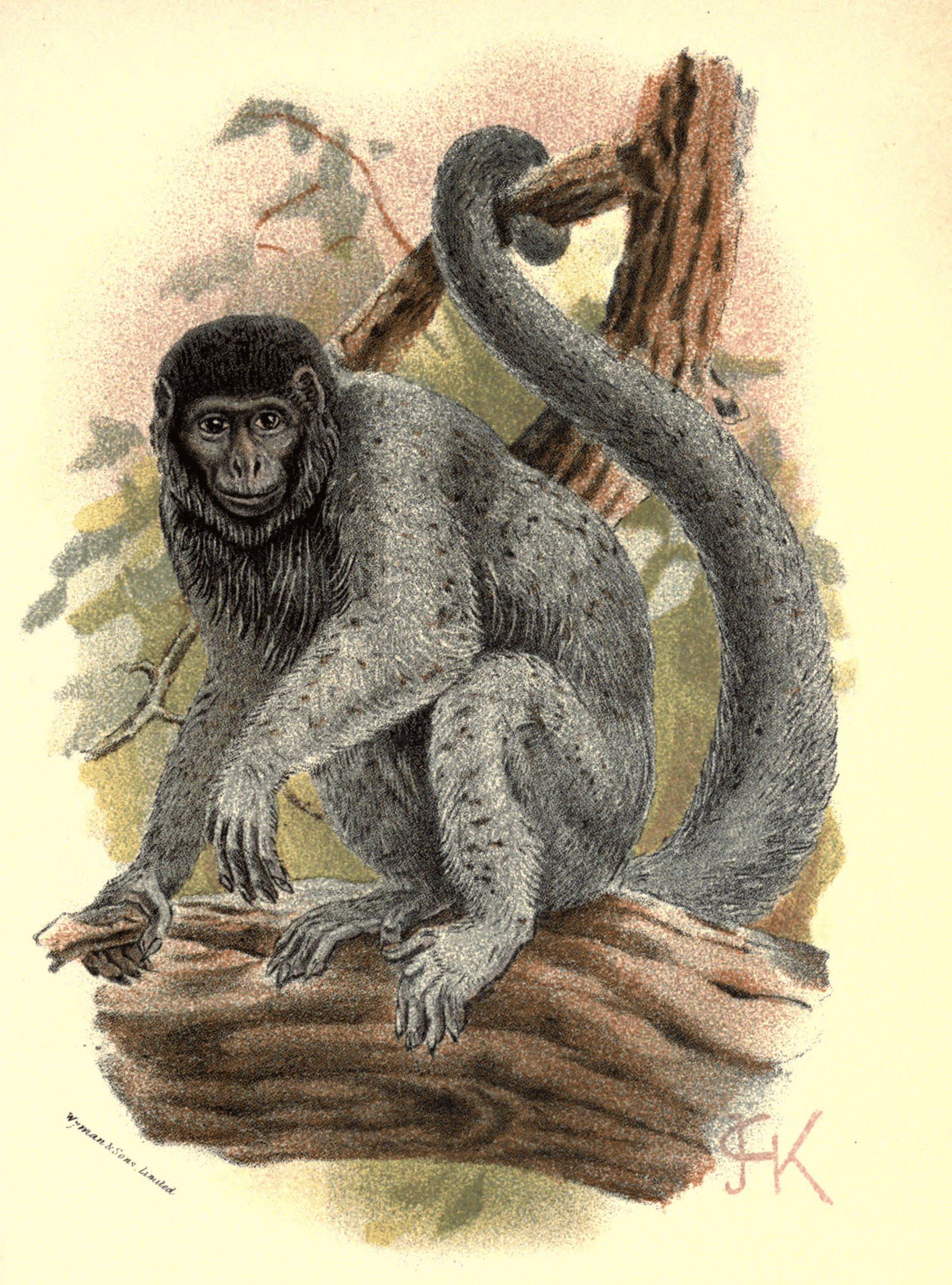
HUMBOLDT'S WOOLLY MONKEY.
Distribution.—This Monkey was discovered by Humboldt on the Guaviaré, a branch of the Orinoco river. It occurs in the Upper Magdalena Valley, Colombia, where it is known as the "Churuco" river. Its true habitat is the district south-west of the Rio Negro towards the Andes. It is unknown in the Lower Amazon Region.
Habits.—The "Caparro," as the Orinoco Indians named this species to Humboldt, or "Macaco barrigudo," as the Portuguese settlers call it, is entirely an arboreal animal, living exclusively on fruits, on which it is a most voracious feeder. The name of "big-bellied," which barrigudo means, is probably obtained from the effects of this habit. Its manners in captivity are grave, and its temper, according to Mr. Bates, is mild and confiding, like that of the Coaitas, or Spider-Monkeys. Owing to these traits, the Barrigudo is much sought after as a pet; but it is not hardy like the Coaitas, and seldom survives a passage down the river to Pará. Nevertheless, the Zoological Society has had a considerable number of these Monkeys in confinement during the past twenty years. Mr. Bates also states that it is much persecuted by the natives on account of the excellence of its flesh as food. "From information given me," he says, "by a collector of birds and mammals whom I employed, and who resided a long time among the Tacuna Indians, near Tabatinga, I calculated that one horde of this tribe, 200 in number, destroyed 1,200 of these Monkeys annually for food. The species is very numerous in the forests of the higher lands, but, owing to long persecution, it is now seldom seen in the neighbourhood of the larger villages."
II. THE BROWN LAGOTHRIX. LAGOTHRIX INFUMATUS.
Gastrimargus infumatus, Spix, Sim. et Vespert., Bras., p. 41, pl. 29 (1823).
Lagothrix poeppigii, Schinz, Synops. Mamm., i., p. 71 (1844); Pucher., Rev. et Mag de Zool., p. 299 (1857); Schl., Mus. Pays Bas, vii., p. 164 (1876).
Lagothrix geoffroyi, Schinz, Synops. Mamm., i., p. 72 (1844).
Lagothrix castelnaui, Is. Geoffr. et Deville, C.R., xxvii., p. 498 (1848); Casteln., Voy. Amér. Sud, Zool., p. 5, pl. 1.
Lagothrix infumatus, Gray, Cat. Monkeys Brit. Mus., p. 46 (1870); Scl., P. Z. S., 1871, p. 219 (Note).
Characters.—Large in size; face naked, black; general colour dark reddish-grey, the hairs being reddish-brown at the base, and tipped with grey or black; head, face and hind hands darker brown; chest, upper side of fore-arms, and under surface of body dark brown, or almost black; sides of body, base of the tail and perineal region brownish-red; hair of chest and under surface long and rather rigid.
Distribution.—The Brown Lagothrix, also called "Capparo" by Humboldt, is common in the forests of the low country over the whole of the Valley of the Peruvian Amazons. It has been recorded from the Valley of the Copataza river, and also from Macas, both in Cis-Andean Ecuador.
Habits.—These Monkeys go about in pairs, in troops of about twelve to fourteen, and frequent the great forest trees. They are often found in company with species of other genera, such as the Howlers. They are exclusively fruit-eaters, and are in great request as food; large numbers, consequently, are destroyed annually for this purpose.
THE WOOLLY SPIDER-MONKEYS. GENUS BRACHYTELES.
Brachyteles, Spix, Sim. et Vespert. Brazil, p. 36 (1823).
Eriodes, Is. Geoffr., Dict. Class., xv., p. 143 (1829).
The members of this genus resemble in general form the Spider-Monkeys, to be presently described, and they present also many resemblances to the foregoing species of the Woolly Monkeys. Their limbs are long and slender, and their body heavy, and covered with a woolly under-fur. Their head is rounder than in the Capuchins. The face is flat, and the facial angle large. The nose has the partition between the nostrils narrower than in the other species of the family, and the nostrils are themselves more approximated, circular in form, and directed more downward than outward, thus showing some approach to the position of the nostrils in the Old World Apes. Their fore-limbs are long and slender, and the thumb is often entirely absent (as in the Guerezas of Africa), or there may be a very rudimentary digit, which sometimes ends in a small nail. The nails of the digits are, as in Lagothrix, very compressed and sharp. The tail is longer than the body, naked on the under side, and sensitive at its termination, and therefore prehensile.
The skull is globular, and the pre-maxillary bones articulate with the nasal bones by a broad surface. The incisor teeth are equal in size; the canines are small, and of the same length as the incisors, and the molars, which are vertically higher than the canines, are thick and quadrangular. The lower jaw is dilated behind, somewhat less than in Lagothrix.
The Woolly Spider-Monkeys are very rare, and little is known of their habits. They are confined to the south-eastern coast forests of Brazil, that region to the south of Cape San Roque, whence, as far as Rio Grande do Sul, ever-verdant forests, as Mr. Wallace has described, clothe all the valleys and hills of the lowland region, stretching as far west as the higher mountain ranges parallel to the coast, and even up the valleys of the larger rivers a long way into the interior of the country.
THE BROWN WOOLLY SPIDER-MONKEY. BRACHYTELES ARACHNOIDES.
Ateles arachnoides, Geoffr., Ann. Mus., vii., p. 271 (1806); xiii., p. 90, pl. 9 (1809); xix., p. 106 (1812); Schl., Mus. Pays Bas, vii., p. 184 (1876, part.).
Ateles hypoxanthus, Desm., Mamm., p. 75 (1820); Neuwied, apud Kuhl, Beitr. Zool., p. 25 (1820); Schl., t. c. p. 185 (1876, part.).
Brachyteles macrotarsus, Spix, Sim. et Vespert., Bras., p. 36, pl. 17 (1823).
Eriodes hemidactylus and E. tuberifer, Geoffr., Mém. Mus., xvii., pp. 161, 163 (1828).
Eriodes arachnoides, Geoffr., Mém. Mus., t. c. p. 160 (1828).
Brachyteles arachnoides, Gray, Cat. Monkeys Brit. Mus., p. 45 (1870).
Characters.—Male.—Size small; face nude, flesh-coloured; general colour of body yellowish-brown, darker on the back of the head, with a few long black hairs on the forehead; hairs of head short and directed backward; buttocks, vent, base of tail and perineal region dark ferruginous-brown; the thumb wanting or rudimentary. Length of body, 22 inches; tail, 26 inches.
Female.—Ashy-brown, instead of yellowish-brown, in appearance.
Young.—In some young specimens the general colour is dark brown, with the sides of the face white.
Dr. Slack observes, in the "Proceedings of the Academy of Natural Sciences of Philadelphia" for 1862, in reference to this species: "I had long suspected that the three species of this genus described by Isidore Geoffroy St. Hilaire, were in reality one and the same; no specific characters are manifest in their coloration, or skulls, the supposed differences being based upon the development of the anterior thumbs, this member being absent in B. arachnoides, replaced by a small nailless tubercle in B. tuberifer, and surmounted by a nail in B. hemidactylus. In the "Magazin" of Messrs. Verreaux, in Paris, I found specimens having upon one hand the tubercle, and upon the other the nailed thumb, others with the tubercle on one hand, but absent upon the other. St. Hilaire himself, in his "Catalogue of the Primates," expresses a doubt as to whether B. arachnoides and B. hemidactylus are really distinct. In September and October, 1860, I was unable to find B. hemidactylus in the Paris Museum, all the Brachyteles being labelled Eriodes arachnoides."
Distribution.—Confined to the wooded region of the south-east of Brazil.
Habits.—Arboreal, diurnal, and (it is supposed) gregarious, frequenting the high forest trees, and subsisting on fruits.
THE SPIDER-MONKEYS. GENUS ATELES.
Ateles, Geoffr., Ann. Mus., vii., p. 262 (1806).
This is the fourth remaining genus of the Cebinæ, the last Sub-family of the Cebidæ. With the description of the Spider-Monkeys, therefore, we shall have passed in review all the species of the New World Platyrrhine section of the Anthropoidea. The species of this group derive their trivial name from their long and slender limbs; the name applied to them, however, in their native forests by the Indians of Brazil is "Coaita." They are characterised by their light and slender body, which is narrower across the loins than across the chest. The head is rounded, the forehead salient, and the muzzle somewhat projecting. Both pairs of limbs are much elongated, the hind-limbs being shorter, however, than the fore-, and the thumb of the fore-limb is sometimes very rudimentary, being only a nailless tubercle—or, in the majority of the species, entirely absent, rendering the hand a much less perfect organ for holding or picking up small objects, such as fruits, &c.; but its absence probably does not affect, if it does not even benefit, the hand as an organ for climbing and catching hold again after a long leap. The nails and other digits of both limbs are compressed, but much less so than in Brachyteles and Lagothrix. The tail is very long, generally exceeding the length of the body and head, and is nude on the under side, and very sensitive towards its termination. As a prehensile organ it has reached the summit of strength and perfection. "It even serves as a fifth hand, as detached objects, otherwise out of reach, can be grasped by it, and brought towards the hand or mouth." (Mivart.) The body is covered with long, rather coarse, generally black, hair, and has no woolly under-fur, as in Lagothrix and Brachyteles.
With regard to the skeleton of Ateles, the lumbar region of the vertebral column is short, and the dorsal segment attains a greater relative length than in any other Ape, being over nine-twentieths of the total length of the spine, without the tail. (Mivart.) The dorsal and lumbar vertebræ together number eighteen. In the tail there are twenty-three vertebræ, flattened on the under side, and exceptionally provided with bony processes, serving as points for the attachment of muscles for rendering it as efficient a prehensile organ as possible. The length of the whole arm and hand in Ateles, in proportion to that of the spine, is 174 to 100; but without the hand it is shorter than the spine, the hand itself being only slightly shorter than the latter. The proportion of the hind-limb to the spine is somewhat less, being 169 to 100. The thumb is reduced to a single metacarpal bone, to which, usually, a single minute nodular phalanx [finger-bone] is articulated, and is completely hidden beneath the integument. Although thus rudimentary and functionless, all its characteristic muscles, except one (the long-flexor) are present. (Huxley.) The upper incisors are unequal, the interior being the larger. There is a space (diastema) between the incisor and the canine teeth (as in all Anthropoidea, except Man); the canines are large and conical; the upper molars large, and their crowns four-cusped, with transverse ridges between the outer and inner front cusps and the outer and inner hind cusps, and also an oblique ridge crossing from the outer front cusp to the inner hind one. In the larynx of Ateles there is a single median air-sac opening from the back of the windpipe, but there is no such extension of the resonating apparatus as is seen in the Howlers (Alouatta). In its brain Ateles exhibits in some respects a higher type than in even the Old World Apes.
In regard to this group of Monkeys, the late Mr. H. W. Bates made the following interesting observations:—"In the Coaitas the tail reaches its highest perfection as a prehensile organ; and on this account it would perhaps be correct to consider the Coaitas as the extreme development of the American type of Apes. As far as we know from living and fossil species, the New World has progressed no further than the Coaita towards the production of a higher form of the Quadrumanous order. The tendency of Nature here has been, to all appearance, simply to perfect these organs, which adapt the species more and more completely to a purely arboreal life; and no nearer approach has been made towards the more advanced forms of Anthropoid Apes, which are the products of the Old World solely. The tail of the Coaita is endowed with a wonderful degree of flexibility. It is always in motion, coiling and uncoiling like the trunk of an Elephant, and grasping whatever comes within reach.... The flesh of the Coaitas is much esteemed by the natives in this part of the country [Obydos, on the Amazon].... One day I went on a Coaita hunt. When in the deepest part of a ravine we heard a rustling sound in the trees overhead, and Manoel [the guide] pointed out a Coaita to me. There was something human-like in its appearance [which is very characteristic of them], as the lean, dark, shaggy creature moved deliberately amongst the branches at a great height. I fired, but unfortunately only wounded it in the belly. It fell with a crash headlong about twenty or thirty feet, and then caught a bough with its tail, which grasped it instantaneously, and then the animal remained suspended in mid-air. Before I could re-load it recovered itself, and mounted nimbly to the topmost branches out of the reach of a fowling-piece, where we could perceive the poor thing, apparently probing the wound with its fingers. Coaitas are more frequently kept in a tame state than any other kind of Monkey. The Indians are very fond of them as pets, and the women often suckle them when young at their breasts.[12] They become attached to their masters, and will sometimes follow them on the ground to considerable distances.... The disposition of the Coaita is mild in the extreme; it has none of the painful, restless vivacity of its kindred, the Cebi, and no trace of the surly, untameable temper of its still nearer relatives, the Mycetes, or Howling-Monkeys. It is, however, an arrant thief, and shows considerable cunning in pilfering small articles of clothing, which it conceals in its sleeping place."
PLATE XXI.
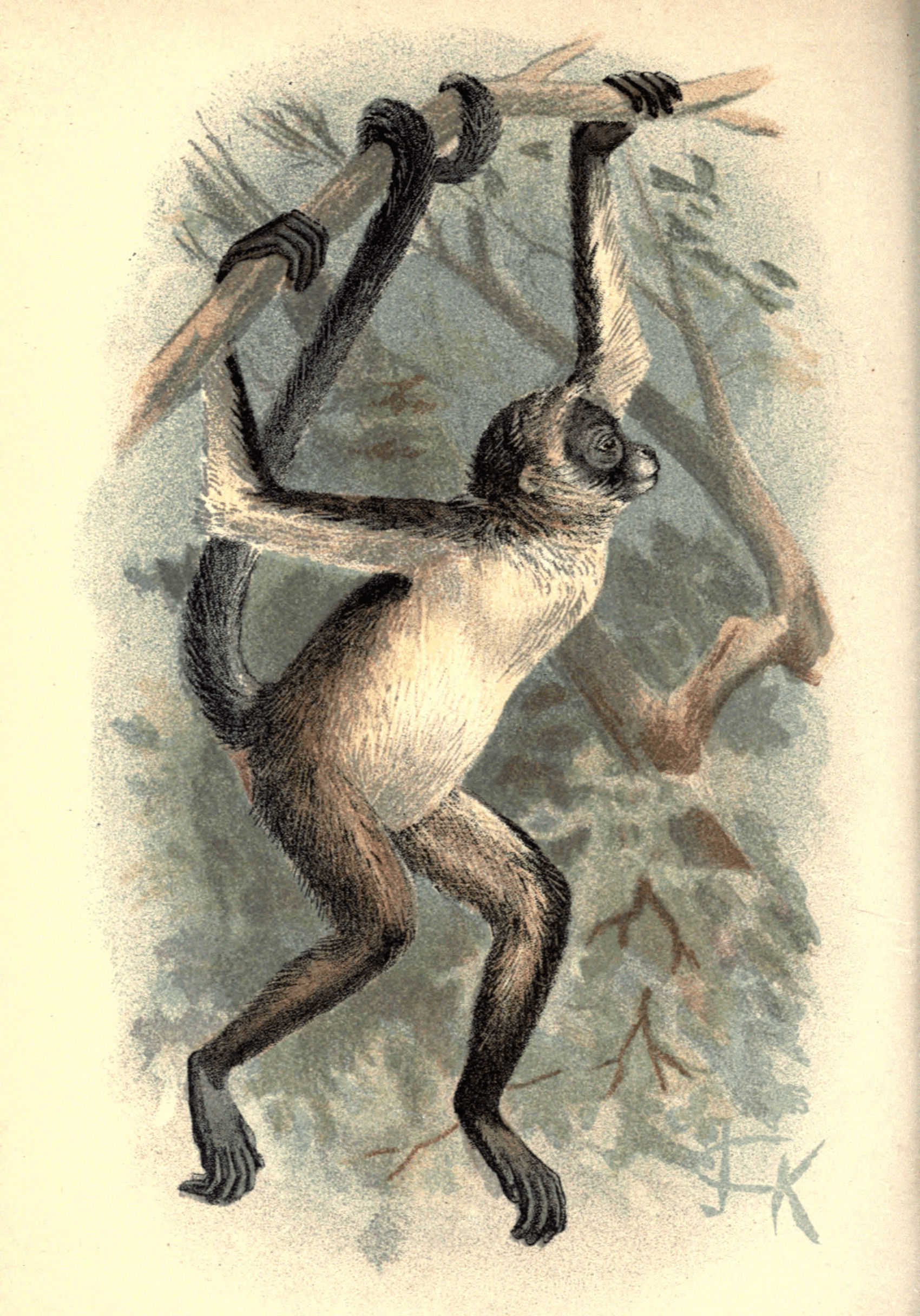
THE VARIEGATED SPIDER-MONKEY.
The Coaitas are like the rest of the Cebidæ, essentially quadrupedal, but they occasionally assume the erect posture. They are purely arboreal in habit, living in small companies in the very high trees of the forest.
Their geographical distribution is very wide. They extend over the whole area of the Cebidæ, i.e., over two of the sub-regions, the Brazilian and Mexican, of the Neotropical Region.
I. THE VARIEGATED SPIDER-MONKEY. ATELES VARIEGATUS.
Ateles marginatus (nec Geoffr.), Humb. Obs. Zool., pp. 340, 354 (1811).
Ateles variegatus, Wagner in Schreb., Säugeth., i., p. 313 (1840); id. Abhandl. Akad. Münch., v., p. 420 (1847); Sclater, P. Z. S., 1870, p. 668; 1871, pp. 39, 225; Gray, Ann. Nat. Hist. (4), vi. (1870), p. 472.
Sapajou geoffroyi (nec Kuhl), Slack, Proc. Acad. Nat. Sci. Philad., 1862, p. 511 [= ♂].
Ateles bartletti, Gray, P. Z. S., 1867, p. 992, pl. xlvii.
Ateles melanochir, var. Gray, Cat. Monkeys Brit. Mus., p. 43 (1870, in part).
Ateles chuva, Schl., Mus. Pays Bas, vii., p. 175 (1876).
(Plate XXI.)
Characters.—Male.—Fur of body abundant, long, and soft; hair of back and top of head long and directed forwards, and projecting over the forehead; beneath and behind the cheeks a band of longish hairs, directed forwards. Top of head, back, front aspect of the entire arms, and of the legs to the knees, hands, feet, and upper side of tail glossy blue-black; a band across the forehead rufous-yellow; the hairs directed upwardly, bordered by a narrower streak of deep black over the eyes; the under side of the fore-limbs, the posterior aspect of the thighs, and the entire leg, the buttocks, and the whole of the under side of the tail as far as the nude portion (which is black), rich orange-yellow; under surface of body paler. Face naked, black, and bordered by a broad white patch of whiskers, reaching from the temple nearly to the angle of the mouth. The black part of the limbs and legs near to the yellow colour, varied with more or fewer yellow hairs.