Front matter (continued 2)
Reading edition
Distribution.—This species is known from a single skin in the collection of the British Museum, which was obtained at Vohima, on the north-east coast of Madagascar.
III. THE HAIRY-EARED MOUSE-LEMUR. CHIROGALE TRICHOTIS.
Chirogaleus trichotis, Günther, P. Z. S., 1875, p. 78, pl. xv.
Chirogale trichotis, Forsyth Major, Nov. Zool., vol. i., p. 26 (1894).
PLATE V.
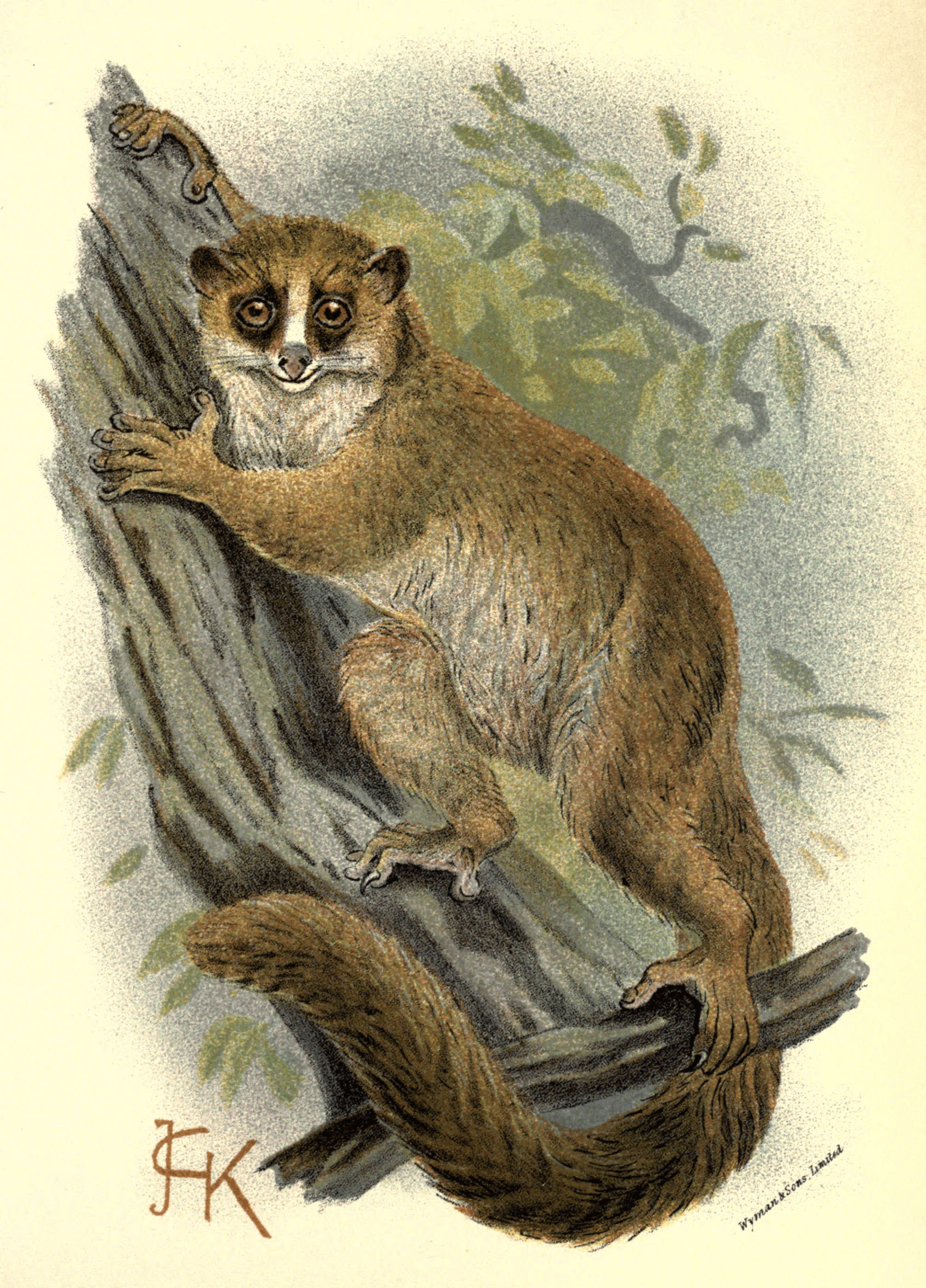
THE BLACK-EARED MOUSE-LEMUR.
Characters.—Brownish-grey above; lower parts grey with the hairs white-tipped; a spot in front of the eye black; the lips and a line down the nose, white. Hands and feet grey, the hairs white-tipped. Ears short, concealed in fur, with tufts of long hair on the lower part and on the space in front of the ears. Tail shorter than the body, its hair short except forwards, where it is longer.
Skull depressed and flattened; cranial portion short.
Distribution.—The only known specimen of this species is the type in the British Museum, obtained by Crossley during his journey from Tamatave to Mouroundava.
IV. CROSSLEY'S MOUSE-LEMUR. CHIROGALE CROSSLEYI.
Chirogaleus crossleyi, Grandid., Rev. et Mag. de Zool., xxii., p. 49 (1870).
Characters.—Smaller than C. melanotis (Major); tail short and very hairy. Head very large, rounded; ears small and haired. Hind-limbs longer than fore. Upper side, especially the head, rufous; under side greyish-white. Round the eyes a black ring; inner aspect of the ears dark brown, the upper border black. (Grandidier.)
Length, 8 inches; tail, 4¾ inches.
Distribution.—Crossley's Mouse-Lemur is known as yet only from the forests to the east of Antsianak, in Madagascar.
Habits.—The two species last described (Chirogale trichotis and C. crossleyi) are very closely related together. They are nocturnal animals, and very rare; consequently but little is known of their habits. It is, however, very improbable that they depart widely from those of the better known Mouse-Lemurs.
THE DWARF-LEMURS. GENUS MICROCEBUS.
Microcebus, Geoffr., Cours de l'Hist. Nat., Mamm., leçon vi., p. 24 (1828).
Under this genus are arranged five species of very small Lemurs, whose hind-limbs are longer than their fore-, though less so in proportion than is the case among the African Galagos. Their snout is also shorter; their eyes are large, approximated together, very prominent and very bright, and their ears are elongated. On the ventral surface are situated four mammæ, two on the breast and two on the abdomen.
Of their bony framework, the brain-case is high, broad, and more vaulted than that of either the Mouse-Lemurs or the species of the next genus, Opolemur. The facial region is also shorter. The mastoid portion of the ear-capsules (periotic bones) and the squamosal region is somewhat less inflated than in Galago. With regard to their dentition, the inner upper incisor is larger than its outer fellow. Between the upper canine and the anterior pre-molar of its own side there exists no gap, nor is there a space between the anterior and the median upper pre-molars. The molars have three-cusped crowns, but these cusps are very sharp, and are weaker than those in Galago; the intermediate cusp between the two main cusps to the front is wanting. The concavity also of the hinder margin (so marked in Galago) is here very slight, but the basal ring (cingulum) is swollen internally to form an inner hind cusp. The posterior upper molar is smaller than the anterior, and its inner hind cusp is rudimentary. The hind border of the bony palate extends to behind the last molar tooth, its posterior perforations being very large. The angle of the lower jaw is not produced downwards.
The foot in the Dwarf-Lemurs is long, on account of the elongation of two of its ankle-bones (the cuboid and the naviculare).
The species of this genus are confined to the island of Madagascar. They are entirely nocturnal, as their large eyes and inflated ear-capsules might suggest. They are chiefly arboreal and frugivorous.
I. SMALL DWARF-LEMUR. MICROCEBUS MINOR.
Microcebus murinus, Martin, P. Z. S., 1835, pp. 125.
Galago minor, Gray, Ann. and Mag. N. H., x., p. 255 (1842).
? Chirogalus gliroides, Grandid., C. R., 14 Dec., 1868.
Chirogaleus pusillus, Flower and Lydekker, Mammalia, p. 690 (1891 partim).
Microcebus minor, Forsyth Major, Nov. Zool., vol. i., p. 8 (1894), Taf. i., fig. 2; ii., figs. 5-7, 14, 15 (with full synonymy).
Characters.—Head rounded; muzzle short and pointed; eyes large and brilliant; ears large and naked; tail longer than body. Length of body, 5 inches; of tail, 6 inches.
Upper side, either for the most part Mouse-grey, washed with light rufous-brown, with the stripe down the back more or less distinct and somewhat darker; or with the rufous-brown colour preponderating. In grey specimens the upper side of the tail is washed with rufous, the under side being somewhat lighter. Cheeks, throat, breast, belly, and inner side of limbs almost pure white, here and there washed with grey. Between the eyes a white stripe; over the eyes in grey specimens a rusty-brown spot. Base of the hairs slate-grey; the tips silvery. (Forsyth Major.) Skull variable; the brain-case short and high, or long and depressed; the facial region short; posterior upper pre-molar less than the anterior molar. Length of intestine, 20 inches; cæcum blunt, 1¾ inches long; main arteries of fore- and hind-limbs not broken up into a rete mirabile of small parallel vessels.
Distribution.—This beautiful little animal, sometimes called the "Rat" of Madagascar, the smallest of all the Lemurs, is known from Ambulisatra on the south-west coast of Madagascar, and from Fort Dauphin on the south-east coast.
II. THE DORMOUSE DWARF-LEMUR. MICROCEBUS MYOXINUS.
Microcebus myoxinus, Peters, Reis, Mossamb. Zool., i., Säugeth., pp. 14-20, Taf. iii. and iv. (1852); Forsyth Major, Nov. Zool., vol. i., p. 11 (1894).
Characters.—Head Cat-like and round; muzzle pointed and broader than in M. minor. Ears large, one-third shorter than the head and short-haired; eyes large and round. Fourth digit of hand longest; second and fifth shortest. Tail longer than the body, its hair stronger and shorter than on the body, but longer at the tip and on the upper side than it is beneath. Two pairs of teats, one pair on the breast, and one pair on the abdomen.
Resembles M. minor, but is redder in colour. Back reddish-yellow, washed with ferruginous, brighter on the forehead and under the eyes; a dark brown spot on the upper and lower corners of the eyes; sides of body between the limbs, hands and wrists, feet and ankles, as well as the external margins of the limbs, and the whole under side, as well as a spot on the brow, a line down the centre of the nose, and the sides of the head and cheeks, pure white, washed with yellowish-brown. Tail golden-yellow, washed with ferruginous on the upper side, the entire distal third darker; rest of the under side of the tail paler. Naked part of ears flesh-colour. (Peters.) Hairs slate-grey at base, the tips ferruginous.
Mastoid portion of ear-capsules (periotic-bones) not so inflated as in M. minor; hind border of bony palate extending to the posterior border of the last molar, its posterior foramina being large; pre-maxillary bones very large and projecting beyond the incisor teeth; angle of lower jaw pointed and hooked. Upper inner incisors standing in front of the canines, and nearly twice the size of the outer; no gap between the canines and the anterior pre-molar; the pre-molars vertically sub-equal, and with one external cusp; molars with two external cusps, the hinder of the two united to the large inner front cusp by an oblique ridge, their inner side bounded by the cingulum; the posterior molar smaller than the two anterior. Anterior and median lower molars four-cusped; the posterior, the largest of the cheek-teeth, five-cusped.
Distribution.—The Dormouse Dwarf-Lemur inhabits the south-west coast of Madagascar; it has also been obtained at Bambotoka in St. Augustin's Bay on the west coast.
III. SMITH'S DWARF-LEMUR. MICROCEBUS SMITHI.
Microcebus pusillus, G. R. Waterh., Cat. Mamm. Mus. Zool. Soc., 2nd ed., p. 12 (1838).
Cheirogaleus smithii, J. E. Gray, Ann. Mag. Nat. Hist., 1842, p. 257.
Chirogaleus pusillus, Flower and Lydekker, Introd. Mamm., p. 690 (1891, pt.)
Microcebus smithii, Mivart, P. Z. S., 1864, p. 641; Forsyth Major, Nov. Zool., vol. 1., p. 12; Taf. ii., figs. 3, 4, 12, and 13 (1894) (with full synonymy).
(Plate VI.)
Characters.—Closely related to the foregoing; the fur in most specimens less woolly than in the other species; eyes large; snout longer and more pointed; ears shorter, less than half the length of the head; ankles proportionally shorter; fingers and toes longer; fur generally darker, the tail not markedly different from the back, very Rat-like in form; the dark marks in front of the eye extending to the tip of the nose, inside of the ears more ferruginous; size about that of a Rat. Muzzle longer and more pointed than in M. myoxinus; pre-maxillæ more produced in front, and nasals more produced above the nostrils; bony palate less prolonged backwards beyond the posterior molar, the hind perforations of the latter large; the line of union of the two halves of the lower jaw shorter than in M. myoxinus; upper incisors set anterior to the canines, and distant from the inner margin of the pre-maxillæ, the inner pair larger than the outer pair; the anterior upper pre-molar less vertically extended than the median one; median and posterior lower molars having the hind outer cusp lower and longer than the front outer cusp.
Distribution.—Smith's Dwarf-Lemur is known from Fort Dauphin, on the south-east coast, from Betsileo in the centre, and from the south coast of Madagascar.
PLATE VI.
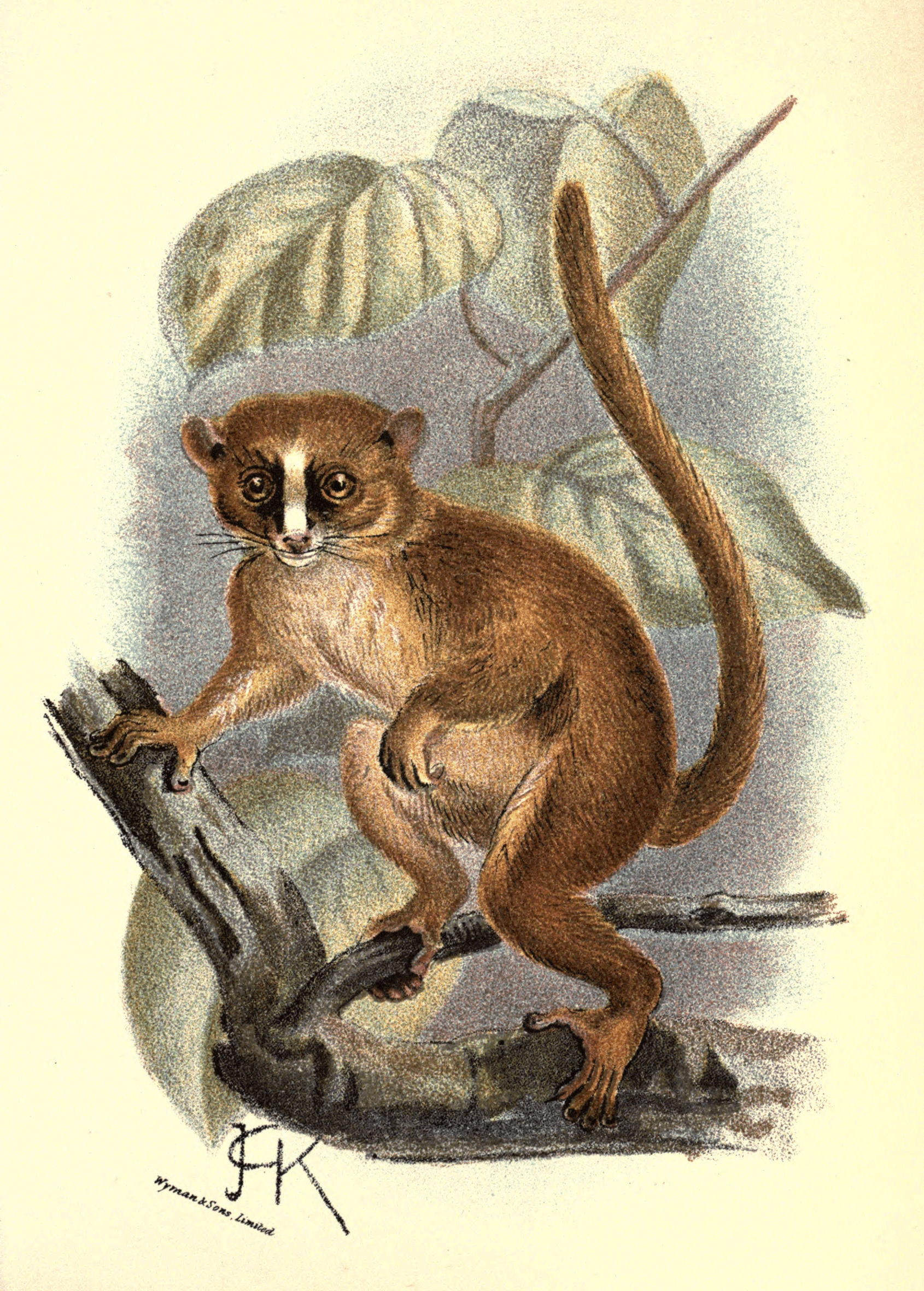
SMITH'S DWARF-LEMUR.
Habits.—Of the habits of both this and of the preceding species little is known, for they have rarely, if ever, been seen alive by Europeans. According to the Rev. G. A. Shaw, the present species lives in the belt of forest-land stretching from the eastern forest into the heart of Betsileo, a few miles north of Fianarantsoa, where they are tolerably abundant, frequenting the tops of the highest trees. Among these it moves about on all fours (its very stout limbs having beautifully perfect hands), using its tail as a balance by twisting it round a branch. The tail is, however, not truly prehensile, the animal only employing it to steady itself, or to hold on slightly by. This species, whose food consists chiefly of fruit and insects, builds a nest in a fork amid the smallest branches near the top of some very high tree, the female bringing forth two and sometimes three young at a birth.
IV. THE FORK-MARKED DWARF-LEMUR. MICROCEBUS FURCIFER.
Lemur furcifer, Blainv., Ostéogr. Mamm., 1841, p. 35, pl. vii.
Cheirogaleus furcifer, Isid. Geoffr., C. R., xxxi., p. 876 (1850); Mivart, P. Z. S., 1867, pp. 960-975 (skull and tarsus figured).
Lepilemur furcifer, Gray, P. Z. S., 1863, p. 145.
Phaner furcifer, J. E. Gray, Cat. Monkeys, Brit. Mus. App., pp. 132, 135 (1870).
Microcebus furcifer, Forsyth Major, Nov. Zool., vol. i., p. 16 (1894).
Characters.—Ears large and long; snout pointed; tail longer than the body, and equally haired; foot elongate. General colour reddish-grey. Unmistakably recognisable by the black dorsal streak bifurcating on the forehead into two branches, extending on the inner side of the ears and terminating over each eye.
Facial portion of skull longer than cranial; angle of lower jaw much produced backwards and downwards; hind margin of palate extending back to hinder margin of posterior molar; hind perforations of palate large; border of maxillary swollen in the canines and pre-molars. Upper anterior incisors much larger than the posterior, and both anterior to canines; anterior pre-molars canine-like, both vertically and proportionately longer than the median pre-molars of any other species of the family; median pre-molar compressed, with a fore and hind heel; the posterior pre-molar with a large internal talon. Molars comparatively small, but longer and narrower than in M. coquereli; anterior molar much larger than the posterior pre-molar, its hind inner cusp rudimentary; the posterior molar longer than the posterior pre-molar, and smaller than the other molars, its inner cusp wanting. Lower anterior pre-molar lance-shaped, vertically longer than the two posterior sub-equal grinders; molars sub-equal, much larger than the posterior pre-molar; posterior molar comparatively short, five-cusped.
Distribution.—Chiefly found on the west coast of Madagascar.
V. COQUEREL'S DWARF-LEMUR. MICROCEBUS COQUERELI.
Cheirogalus coquereli, Grandid., Rev. Mag. de Zool., xix., 1867, p. 85.
Microcebus coquereli, Mivart, P. Z. S., 1867, pp. 966-967; Forsyth Major, Nov. Zool., vol. i., p. 14 (1894; with full synonymy).
Mirza coquerelii, J. E. Gray, Cat. Monkeys, Brit. Mus. App., pp. 131, 135, 136 (1870); Schlegel, Mus. Pays Bas, vii., p. 321 (1876).
Characters.—Similar to M. furcifer, but slightly smaller; ears large, long, and almost naked; tail longer than the body; fur soft and woolly. Above dark grey, washed with rufous; tail, at base, of the same colour as the back; remainder of tail dark rufous; throat, breast, and under side of body yellowish-grey. Length of body, 8½ inches; tail, 13 inches; skull high and arched; outer and hinder portion of ear-capsules (periotic-bones) and squamosal swollen; frontal bone longer than in Opolemur and Chirogale; occiput less sloping from behind and above forwards and outwards. Upper median and posterior molars with one inner and two outer cusps, united by a curved ridge, cingulate all round, and with a small cusp or cingulum at the hind inner angle; posterior pre-molars smaller and shorter than the molars, with strong and vertically longer outer cusp, and a much more feeble inner cusp; posterior lower molar lengthened behind by a fifth cusp.
Distribution.—Coquerel's Dwarf-Lemur, or the "Sisiba," as the natives call it, is found round Passandava Bay, near Mouroundava, on the south-west coast of Madagascar.
Habits.—The Sisiba, like its congeners, is nocturnal and arboreal, constructing in the trees a nest of twigs. It feeds on fruits and leaves.
THE FAT-TAILED LEMURS. GENUS OPOLEMUR.
Opolemur, J. E. Gray, P. Z. S., 1872, p. 853.
The term Opolemur, by which this genus is designated, is not altogether appropriate, and is, indeed, even somewhat misleading. It was applied in the first instance to the typical species on account of the thickened base of its tail, which in the type-specimen was a very conspicuous character. The deposit of fat by which this thickening was caused was not then known to be merely transitory—a store of food collected at the base of the tail and on other parts of the body, to supply the needs of the animal during the arid and foodless season, when it retires into a state of torpidity. It is now known that other species of this sub-family (as we have seen above in the case of the Mouse-Lemurs), which are generically distinct from Opolemur, share this peculiarity.
The two species included in this genus are intermediate between the Mouse-Lemurs and the Dwarf-Lemurs, and are really more nearly related to the former than to the latter. The skull is flat and depressed as in Chirogale, and the brain-case small and almost vertical behind. The posterior foramina in the palate are small. In respect to their dentition, the cusps of the upper molars are blunter and shorter than in the Mouse-Lemurs, but less so than among the Dwarf-Lemurs; the hind inner cusps of the anterior and median molars are large, and the ridge from the inner cusp is less intimately joined to the two outer cusps than in the Dwarf-Lemurs.
I. SAMAT'S FAT-TAILED LEMUR. OPOLEMUR SAMATI.
Chirogalus samatii, Grandid., Rev. et Mag. de Zool., xx., p. 49 (1868).
Opolemur milii, Gray, P. Z. S., 1872, pp. 853-4, pl. lxx., fig. i. (in part).
Opolemur samati, Forsyth Major, Nov. Zool., vol. i., p. 18 (1894).
Characters.—Head, Cat-like; hair on body and tail very short, longer at tip of tail; tail very thick at base, from accumulation of fat, especially in the month of August. Length, 7½ inches; tail, 6½.
Fur above dark grey, washed with ferruginous, the tips of the hairs silvery-grey; tail faded rufous; a white spot on the forehead, becoming a line down the centre of the nose; a black circle round the eyes; ears slightly longer; tail shorter and thicker proportionately than in Chirogale milii; under surface and inner side of limbs fulvous.
Distribution.—This species, according to M. Grandidier, to whom all our knowledge of it is due, has been obtained on the River Tsidsibon, but is reported from other places on the west coast of Madagascar.
II. THOMAS' FAT-TAILED LEMUR. OPOLEMUR THOMASI.
Opolemur thomasi, Forsyth Major, Nov. Zool., vol. i., p. 20, Taf. i., fig. 1 Taf., ii., figs. 2 and 11 (1894).
Characters.—Nearly allied to O. samati. Head broad, flat; snout short; ears short. Above grey, with a wash of rusty brown, the tips of the hair glistening silvery-grey; top of head somewhat darker; under side of tail lighter; a white band between the eyes extending down to the nose-pad, which is naked; round the neck a white ring broken by a grey spot; ring round the eyes, and hair of ears, brownish-black; cheeks, lips, chin, throat, breast, belly, inner side of limbs, upper side of hands and feet, yellowish-white, and inclining to greyish-white, where it merges into the upper side. Length, 9¼ inches; tail, 8 inches.
Skull depressed; brain-case flat and short; facial portion blunt; inter-parietal bone broad and short. Posterior upper pre-molar broader than the median, and broader than the same tooth in O. samati, the median pre-molar lacking the inner cusp. Nasal bones sharply keeled in the mid-line.
Distribution.—Of this species only the three specimens, in the British Museum, are yet known. They were obtained near Fort Dauphin, on the south-east coast of Madagascar.
Habits.—Nothing is known of the habits of either of these two species of Opolemur.
THE TRUE LEMURS. SUB-FAMILY III. LEMURINÆ.
The third sub-family of the Lemuridæ contains the True Lemurs, which are characterised by the possession of a soft, thick, and woolly fur, the head rounded behind, with a specially elongated muzzle. They have small and oval ears, with the exterior aspect covered with long hair, but the inside naked, except round the margin. Their hind-limbs do not show so great a disproportionate length compared to that of the fore-limbs, as in the next sub-family, the Indrisinæ. The ankle-bones (tarsus) are only slightly elongated, and their toes are not united by a membrane. Their long and bushy tail is sometimes longer and sometimes shorter than the body. The females produce one or two, nearly naked, young at a birth, the mammæ being either two or four in number. The skull presents a central ridge on the frontal bone, and its facial portion is much elongated, the inter-orbital space being depressed and wider, and the orbits also directed somewhat outward and less straightforwardly than in several of the genera already noticed. The maxillary bones are generally much reduced, and the incisor teeth carried by them not unfrequently entirely aborted. The teeth in this Sub-family vary in number from 32 to 36, the dental formula being I(0-2)2, C11, P33, M33. The foot is slightly elongated by the lengthening of the naviculare bone of the ankle, the others being short. In the wrist (carpus) the central bone (centrale) may be present or absent; its absence, however, is a character which is met with otherwise only in Man, the Chimpanzees, and the Endrina and some other Lemurs, to be described later on. The cæcum is not markedly developed.
The external coloration of the species of this Sub-family is remarkably variable, the variation being chiefly in the upper portion of the hairs, as their base is generally slate-grey.
The sub-family Lemurinæ embraces four genera: the True Lemurs (Lemur), of which there are now eight recognised species; the Hattock (Mixocebus), with a solitary species; the Gentle-Lemurs (Hapalemur), containing two species, and the Sportive-Lemurs (Lepidolemur), with seven species. Some of the most elegantly coloured species in the Animal Kingdom belong to this group. They are gregarious, and most of them arboreal, though some are not so. They form rather an exception to the general rule among Lemurs, in not being nocturnal. They feed during the morning and evening, emitting loud cries as they move about, and during the heat of the day, they often lie stretched out in the sun; at night they rest with their long tails coiled about them. In their mode of progression they are more quadrupedal than most of the other Lemuroids; they jump, walk, or run on all fours. Their food consists of fruits, birds' eggs, birds and insects. Their infants are carried about close to, and concealed amid, the hair of their mother's breast; when older they cling to her back.
The True Lemurs are all inhabitants of Madagascar and of the adjacent Comoro Islands. They are unknown on the African continent.
THE TRUE LEMURS. GENUS LEMUR.
Prosimia, Brisson, Regn. Anim., p. 220 (1756).
Lemur, Linn., Syst. Nat., i., p. 44 (1766).
Varecia, Gray, P. Z. S., 1863, p. 135.
This genus contains the typical Lemurs, in their most restricted sense. They are characterised by having a very Fox-like head, and an elongate and tapering face, shelving on each side of the nose. A long fringe of hair surrounds their chin and cheeks. They have all large and tufted ears, and large eyes, with superciliary ridges rising higher than the forehead. Their tail is always half as long as the body at least. The fore-limbs are somewhat shorter than the hind-limbs, and both the wrist and ankles are haired. The ankle is not elongated, nor is the great toe as large as in the next family—the Indrisinæ. On the outside of the palm of the hand and under the base of the fingers are situated fleshy pads, giving them greater grasping power. The True Lemurs have only one pair of mammæ, which are situated on the breast.
In the skull the facial region is much elongated, its measurement from the anterior margin of the orbit forward being greater than the longitudinal diameter of the orbit, and the space between the eye-sockets is narrow and depressed. The bony palate is short, extending back only to the posterior end of the median molar. The posterior portion of the ear-capsules (the mastoidal and squamosal regions) is not inflated—a character which separates this genus from Galago. The pre-maxillary bones are large and protrude in front, if the skull be viewed from the side. The angle of the lower jaw is not produced downwards and backwards. In some species a large maxillary sinus projects into the anterior part of the orbit; in some also the foramen rotundum does not coalesce with the sphenoidal fissure (see page 11), but has a distinct opening. The teeth are of the normal number, namely thirty-six. In the upper jaw the incisors are small, sub-equal, and situated anteriorly to the canines and are not in contact with each other, or with the latter. The canines are very large, tusk-like, and set in an excavated notch on the jaw. All the pre-molars have one main cusp to the outside; the anterior pre-molar, however, has a supplementary minute front cusp, while the median has in addition one large interior cusp; both it and the posterior pre-molars are vertically taller than their anterior fellow. The molars have two inner cusps, and two main outer cusps with a supplementary minute fore cusp, as well as two cusps on the ridge joining the fore and hind outer cusps; the posterior molar—the smallest of the three—is, however, larger than the posterior pre-molar, and has only the front inner cusp and no supplementary external cusp. The lower jaw shows a gap between the canine and the anterior pre-molar. The anterior pre-molar, which is vertically taller than the rest, is edged and cutting, taking the place of a tusk; the anterior and median pre-molars are also separated by a small space; the latter, which is equal in vertical height to the posterior, has an inner cusp and a low cusped heel. The molars have two outer main cusps, of which the front one is more developed than the hind one, and two inner cusps, often with an intermediate cusp between them; the pair of fore and the pair of hind cusps are joined by transverse ridges, and the two outside cusps by a backwardly directed semicircular ridge; the posterior molar is four-cusped.
The dorsal and lumbar vertebræ together do not exceed twenty in number.
The hind portion of the cerebellum is large, which points to intellectual inferiority in the True Lemurs as compared with the Apes.
The species of this genus are all confined to the island of Madagascar and some of the smaller adjacent islands. They are gregarious, living in large companies in the forests, feeding on fruits, insects, and such small animals, birds, and lizards as they may capture. Like the Howlers of S. America and the Gibbons of the East Indies, they are very noisy. Their agility is wonderfully great, and is displayed chiefly in the evening. During the brighter hours of the day they sit somnolent, either alone with their heads buried between their arms, their tail coiled round the neck, or in twos or threes embracing each other with their arms. In walking they use their fore-limbs less as hands, and more as feet than do the members of the next family—the Indrisinæ—both when on the ground, as well as when climbing among the trees.
I. THE RUFFED LEMUR. LEMUR VARIUS.
Lemur macaco, var. Schreber, Säugeth., p. 142, pl. 40 B (1775).
Lemur macaco et L. ruber, Geoffr., Ann. Mus., xix., p. 159 (1812).
Lemur varius, Is. Geoffr., Cat. Méth. Primates, p. 71, no. 2 (1851); Schl., Mus. Pays. Bas., vii., p. 301 (1876); Milne-Edwards et Grandid., H. N. Madag., Mamm., Atlas, pls. 123-129 (1690).
(Plate VII.)
Characters.—Face and top of head black; a stripe over the eyes, ridge of nose and tip of nostrils, creamy-white; a patch on the shoulder, the inside of the fore-legs, the inner surface of body, a patch on the front of the thighs, the inner side of the limbs, and the feet, black; tail black, washed with white on the upper surface; rest of body creamy-white.
PLATE VII.
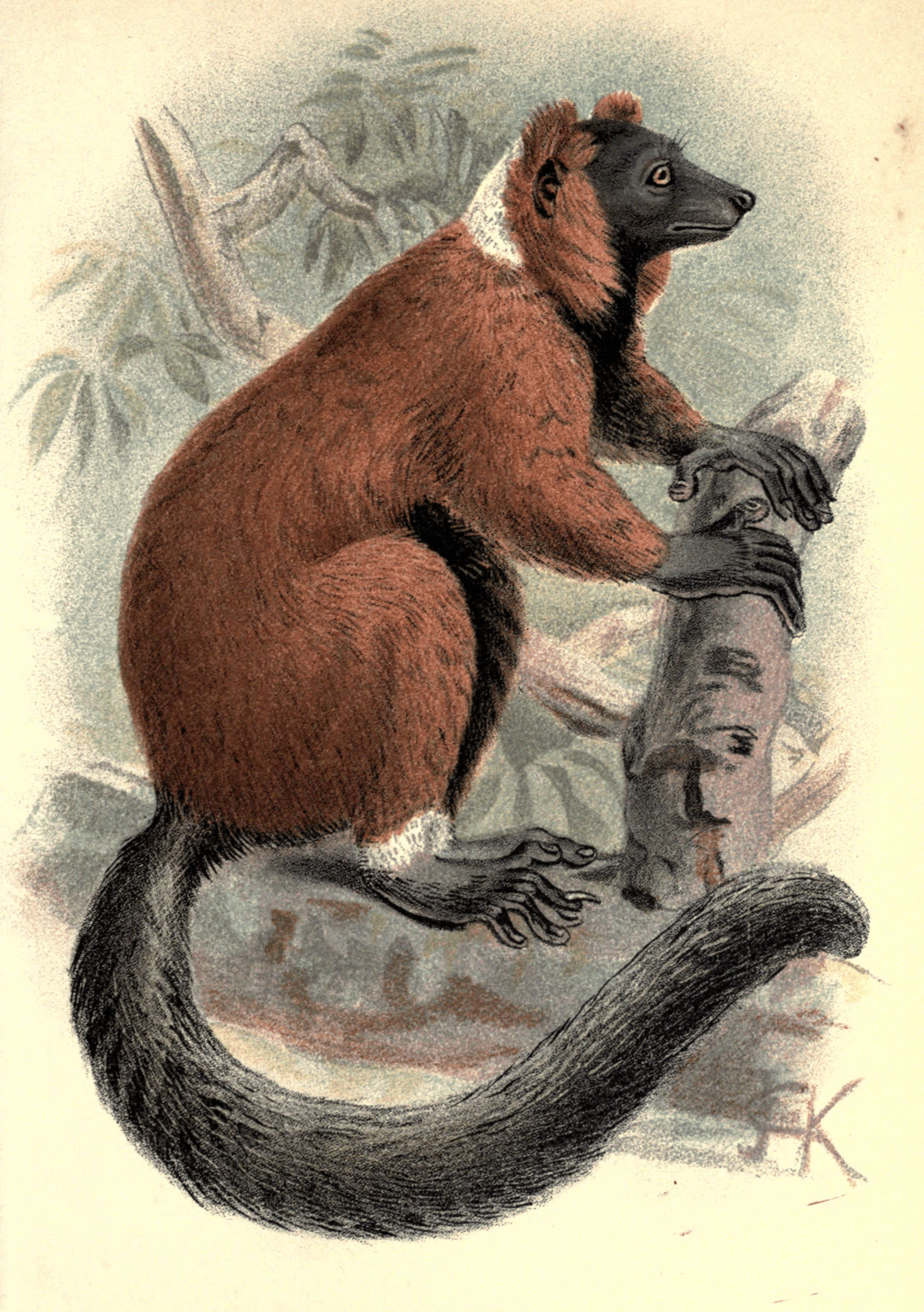
THE RED-RUFFED LEMUR.
The Ruffed or Variable Lemur derives its name from the remarkable variability of its external markings: so much is this the case, indeed, that not a few of them have been described as distinct species. This variability appears to be entirely individual, and is by no means constant. The Black-mantled variety has the back of the neck, the shoulders and interscapular region entirely black. Another form has the ears, the ruff, and a bar across the muzzle extending over and in front of the eyes, joining the ruff, pure white; the fore-arms, legs, a bar across the buttocks joining the thighs greyish-white; face, legs, and tail black; a ring encircling the body like a belt between the fore- and hind-limbs, yellowish-white; rest of body dark reddish-brown. A third variety has the ears, ruff, and outer side of the arms and legs pure white; the flanks rusty-red, the rest of the body black.
The Red-ruffed Lemur (L. ruber) is a very well-marked variety of the same species, and may easily be recognised by the ears, ruff and whole upper surface of body being dark rusty-red, with the outer surface of thighs and legs white; or, the ears, ruff and whole upper surface (except a white patch on the back of the neck) may be dark brown, with a white garter on each ankle; otherwise it may be entirely black. It is this variety which we have figured on Plate VII.
Distribution.—Throughout the north-east of Madagascar.
Habits.—The Ruffed Lemur, called by the natives "Varikossi," has a loud, harsh and powerful voice, which can be heard for a long distance.
II. THE BLACK LEMUR. LEMUR MACACO.
Lemur macaco, Linn., S. N., i., p. 44 (1766); Schl. Mus. Pays. Bas., vii., p. 302 (1876); Milne-Edwards et Grandid., H. N. Madag., Mamm., pls. 131, 132 (1890).
Lemur niger, Schreb., Säugeth., pl. 40 A (1775).
Lemur leucomystax, Bartlett, P. Z. S., 1862, p. 347, pl. xli. (female).
Varecia nigra, Gray, P. Z. S., 1863, p. 136.
Characters.—Ears tufted, with long hairs continuing down the side of the neck to the angle of the mouth.
Male.—Entirely black.
Female.—Formerly described as a distinct species, and known as the White-whiskered Lemur (L. leucomystax). Face and lips black, darkest on the nose, round the eyes and hinder part of the head; forehead blackish-grey; whiskers and ear-tufts white, almost concealing the ears. General colour of body rich ferruginous brown, darker on the middle of the back; arms, legs and neck reddish-yellow; tail whiter; throat, under side of body and inner side of limbs creamy-white.
There is a considerable amount of variation in this species. Some individuals have the lower back and base of tail white; the belly greyish-white, the feet brown, and the toes black. In others the black frontal spot is wanting, the back of the head being reddish-white; the basal half of the tail is dark orange-red, remainder of the body rich rusty-brown. On the fore-arm is a cluster of stiff hairs, which occurs in association with a large underlying sweat-gland, whose function is not yet understood.
Distribution.—The north-west coast of Madagascar.
Habits.—The special habits of this species of Lemur are unknown, but in all probability they agree with those of the group in general, as given under the heading of the genus. It is said to utter a coarse grunting call-note.
The young males are born black like the father, and the young females have the colour of the mother. Dr. Sclater has observed that in specimens in confinement in the Zoological Gardens, in London, the female carried her young one transversely across her belly, its long tail passing round her back and then round its own neck.
III. THE MONGOOSE LEMUR. LEMUR MONGOZ.
Lemur mongoz, Linn., S. N., p. 44, no. 2 (1766); Scl., P. Z. S., 1871, p. 231, figs, 1, 2; Schl., Mus. Pays. Bas., vii. p. 312 (1876); Milne-Edw. et Grandid., H. N. Madag., Mamm., pls. 133-153 (1890).
Lemur anjuanensis, Geoffr., Ann. Mus., xix., p. 161 (1812).
Prosimia melanocephala, Gray, P. Z. S., 1863, p. 137, pl. xviii.
Prosimia xanthomystax, Gray, P. Z. S., 1863, p. 138, pl. xvii.
Characters.—Fur woolly and thick; eyelashes long; some long bristles behind the angle of the mouth; face long; no ear-tufts and whiskers, but a sub-auricular patch of long hair; some long hairs on the digits; tail bushy.
Male.—Head, face, streak across the crown of head and down the forehead brownish-black; ears of the same colour, white-fringed; cheeks and a spot on the sides of the forehead iron-grey; sub-auricular cheek-patch white, slightly washed with rufous; rest of upper surface reddish-grey; tail darker; chest and under side rufous-grey.
Female.—Rufous-brown above; neck and shoulders white; throat white; frontal spot black; face whitish.
The colour of the fur in this species varies to an extraordinary degree, and before this fact was recognised, a number of supposed species, founded on the colour of the animals alone, were described. In course of time, however, as specimens were obtained in greater number, it became evident that the variation was only in the colour of the fur, and that there was none in their anatomical and osteological structure to warrant their being considered distinct species. They have, therefore, all been now classified by Professor Milne-Edwards and M. Grandidier in their great work on the Natural History of Madagascar, as so many varieties of one species, Lemur mongoz. Of these varieties, the most important are:—
THE RED-FOOTED LEMUR. LEMUR RUFIPES.
Male.—Face in front of a line above the eyes, dark reddish-brown; hands and feet bright rufous-brown; under side of body and inner side of limbs reddish-grey.
Female.—Wrist and ankles with adjacent part of limbs above brownish-red.
THE RED-FRONTED LEMUR. LEMUR RUFIFRONS.
Male.—Grizzly, washed with rufous; fore-arms, hands, feet, haunches, outer side of legs, and top of the head between the ears, rufous.
Female.—Grizzly brown; top of head grizzly black; patch over and round the eyes greyish-white.
THE GREY-HEADED LEMUR. LEMUR CINEREICEPS.
Face and frontal spot black; cheeks, sides, top of head, side of neck, and outside of ears grey; rest of body orange-red.
THE COLLARED LEMUR. LEMUR COLLARIS.
Male.—Head blackish-brown; cheeks, sides of throat, mark over eyes, and base of ears, yellowish-grey, washed with orange-red or rufous; a spot at the side of the nose, grey; chin, throat, and under side of the body, blackish-grey.
Female.—Centre of nose black; sides of nose, chin, cheeks, including the eyes, ears, sides of throat, iron-grey, slightly flushed at the lower side of the neck under the ears with reddish-orange. Specimens from the island of Mayotte (L. mayottensis, Schl.) differ from L. collaris in having a blackish spot over the root of the tail.
THE RUFOUS LEMUR. LEMUR RUFUS.
Has a yellowish-white frontal band and whiskers.
THE BLACK-FACED LEMUR. LEMUR NIGRIFRONS.
Has a brownish-black band over the forehead, including the eyes; muzzle, patch on top of head including the ears, the side of the head below the ears, sub-auricular tufts, throat and under surface, grey.
THE WHITE-FACED LEMUR. LEMUR ALBIFRONS.
Forehead, top of head, ears, throat, and chest white.
Pure albino varieties are also quite common.
Distribution.—The Mongoose Lemur with its numerous varieties is found throughout the island of Madagascar, in Mayotte, and in Anjuan or Johanna Island, one of the Comoro group.
Habits.—Gregarious and diurnal, feeding on fruits, insects, and small animals.
IV. SCLATER'S LEMUR. LEMUR NIGERRIMUS.
Lemur nigerrimus, Scl., P. Z. S., 1880, p. 451, figs. 1 and 2; Milne-Edw. et Grandid., H. N. Madag., Mamm., pls. 154, 155 (1890).
Lemur macaco (nec L.), Scl., P. Z. S., 1878, p. 1016.
Prosimia rufipes, Gray, Ann. N. H., 1871, p. 339 (female).
Characters.—Face covered with short hair; ears nude and without tufts; nose-pad and lower lips nude. Similar to L. macaco, but larger and more intensely black, with a raised crest of upstanding hair on the head, formed by the longer fur of the body terminating arcuately on the forehead. External ears pinkish flesh-colour. Eyes blue, turning to green. Length, 16 inches; tail, 20 inches.
Female.—(Prosimia rufipes of Gray) Brown; eyes brownish-yellow.
Distribution.—Cap d'Ambra, N. Madagascar.
Nothing is known of the habits of this species.
V. THE WHITE-HANDED LEMUR. LEMUR ALBIMANUS.
Le Maki aux pieds blancs, Audebert, H. N. Singes, p. 10, pl. 1 (1797: male).
Lemur albimanus, Is. Geoffr., Ann. Mus., xix., pp. 161-169 (1812); Milne-Edw. et Grandid., Hist. Nat. Madag., Mamm., Atlas, pls. 156, 157, 162-164, 165, figs, 1 and 2 (1890).
Lemur mongoz (nec L.), Schl., Mus. Pays. Bas., vii., p. 312 (1876, pt.).
Characters.—Nose sharp and Dog-like; eyes oblique; ears, except the central portion, haired.
Male.—Face, anterior to a line over the forehead, cheeks, snout (except a greyish wash on its sides and the upper lip) umber-brown; rest of head, neck, down to the middle of the back, and fore-limbs, grey; margins of ears, chin, and under surface of body white; rest of back and hind-limbs umber-brown; tail darker, except for a short distance at the base; upper surface of hands and feet grey. The nose varies in different species in the amount of grey colouring, and the forehead and face in depth of brown. Some specimens also have an arcuate black band over the forehead from one outer corner of the eye to the other.
Female.—Greyish-black; nose grey; rest of face washed with brick-red, deeper on the forehead, cheeks, ears, and sides of neck, fainter in tint on the upper back; lower back and tail darker, except at the base, where it is washed with reddish-yellow. Hands and feet greyish-white. The colour of the face varies much in different specimens, being deeper or lighter rufous. The arcuate band from the corners of the eyes over the forehead varies in breadth and depth of colour.
Distribution.—Madagascar; the precise locality unknown.
VI. THE CROWNED LEMUR. LEMUR CORONATUS.
Lemur coronatus, Gray, Ann. and Mag. N. Hist., x., p. 257 (1842); Schl., Mus. Pays. Bas., vii., p. 313 (1876); Milne-Edwards et Grandid., Hist. Nat. Madag., Mamm., Atlas, pls. 158-161, 165, 166.
Lemur chrysampyx, Scheurm. Mém. Cour. Acad. Brux., xxii., p. 6 (1848 = female).
Prosimia coronata, Gray, P. Z. S., 1863, p. 138.
Characters.—Tips of ears naked; tail a little more than the length of the body.
Male.—Face, nose, and region round the eyes greyish-white; cheeks and forehead rufous or yellowish-red; a conical spot in the centre of the head between the eyes, dark brown or black, intruding sometimes on the rufous of the forehead; ears white; inner side of limbs and under side of body greyish-white; tail rufous at base, the upper side blackish, and the under side lighter; rest of body sienna-grey.
Female.—Upper side entirely grey, washed with yellowish cream-colour on the middle and lower part of the back, and on the upper side of the tail; long black hairs present in the tail; the under side entirely silvery-grey; fur at base black, the tips grey or silvery; instead of the black spot on the forehead there is a golden yellow-hooped, or widely V-shaped, bar above the eyes, narrower in the centre over the nose.
Albino specimens are sometimes found, which are entirely white, except for the golden bar over the eyes.
VII. THE RED-BELLIED LEMUR. LEMUR RUBRIVENTER.
Lemur rubriventer, Is. Geoffr., C. R., xxxi., p. 876 (1850); Schl., Mus. Pays. Bas., vii., p. 311 (1876); Milne-Edw. & Grandid., Hist. Nat. Madag., Mamm., Atlas, ii., pls. 167-170 (1890).
Lemur flaviventer, Is. Geoffr., tom. cit., p. 876 (1850).
Characters.—Inner margins and outside of ears haired, the interior nude.
Male.—Face, a line down the forehead, and snout dark maroon-brown; a ring round the eyes cobalt-blue; rest of head and cheeks reddish-brown; upper side of body speckled reddish-brown, darker on the lower back; tail almost black, with long white hairs distributed throughout its length; feet rufous; under side of body pale.
Female.—Like the male, but having the cheeks whitish; a narrow ring round the eyes pale blue; upper surface umber-brown, washed with reddish-yellow; under side and inner sides of limbs yellowish; ruff reddish-chestnut.
Young.—Head entirely rufous; nose black.
Distribution.—Madagascar.
VIII. THE RING-TAILED LEMUR. LEMUR CATTA.
Lemur catta, Linn., S. N., i., p. 45, no. 4 (1766); Schl., Mus. Pays. Bas., vii., p. 314 (1876); Milne-Edw. et Grandid., Hist. Nat. Madag., Mamm., Atlas, pls. 171-172 (1890).
Characters.—Inside of ears naked; no ruff round the face; top of head greyish-black; face, rest of head, lower surface of body, and inner side of the limbs pearl-grey; upper surface sienna-grey. Tail pearl-grey, banded with from ten to twelve black rings, distinguishing it from all other Lemurs, which have the tail of one colour. Length of body and tail together, 40 inches.
On the fore-arm above the wrist-joint there is, in both sexes, a comb-like bony outgrowth (becoming in old males a prominent spur) continuous with the palm of the hand by means of a narrow strip of black, hairless skin; near it there is a cluster of long stiff hairs over an underlying sweat-gland, the function of which is still unknown.
Distribution.—This species inhabits chiefly the rocky and treeless regions of the south and south-western borders of the Betsileo province of Madagascar. It is, however, not entirely confined to these treeless districts, for it has been recorded as occurring in bands of some numbers in the neighbouring forest regions.
Habits.—The Ring-tailed Lemur—one of the handsomest species of the genus and the only one in which the tail is not uniformly coloured—is of gentle manners, active, and graceful. According to the notes of the Rev. G. A. Shaw, as recorded in a paper in the Zoological Society's "Proceedings," it lives among the rocks where a few stunted trees occur, and over this rocky ground it can easily travel, in places where it is impossible for the natives, although bare-footed, to follow it. The palms of its hands and feet are smooth and leather-like, enabling the animal to apply them firmly to the wet rocks. This Lemur feeds on bananas and wild figs. In the winter its chief sustenance consists of the prickly-pear, peeling off the spiny skin with its long upper canines. According to the same observer, this Lemur rarely drinks water; indeed, it is said that the species living in the west of Madagascar, including two kinds of White Lemur, subsist without water, while those on the east coast invariably drink water with their meals. When fighting, the Ring-tailed Lemur scratches vigorously and strikes out with its hands.
THE HATTOCKS. GENUS MIXOCEBUS.
Mixocebus, Peters, M. B. Akad. Berlin, 1874. p. 690.
This genus contains but one species, whose characters are therefore those of the genus also.
THE HATTOCK. MIXOCEBUS CANICEPS.
Mixocebus caniceps, Peters, M. B. Akad. Berlin, 1874, p. 690, pl. i., pl. ii. (Skull.)
Characters.—Snout sharp, with a naked nose-pad; eyes very large; ears very short, rounded, higher than broad, scarcely appearing beyond the fur, and sparsely covered with short hair; limbs long, the digits with unkeeled nails; tail as long as the body, or slightly longer; inter-maxillary bones more prominent than in the species of the next genus, and containing a small incisor tooth on each side; no inter-parietal bone; upper canine not vertically longer than the grinders; the upper pre-molar and molar series of teeth arranged to converge but slightly anteriorly, forming, as seen from the front, a somewhat convex line, differing in this from some species of Lepidolemur, in which these teeth are arranged in a nearly straight line.
Top of head grey, the base of the hairs Mouse-grey, with black or white tips; a triangular patch on the middle of the head, darker; band on the sides and middle of the nose dark brown, widening out on the forehead and over the eyes; a dark ring round the eyes, merging into the dark brown colour of the nose; front border of the ears, a patch behind the latter, the lips, chin, sides of cheek, and chest a creamy- or yellowish-white; throat grey; upper side of the body, outside of the limbs, and dorsal end of the tail, rufous-grey; back portion of the upper part of the thigh, the hinder part of the belly, and the greater part of the upper side of the tail yellowish-rufous; the upper side of hands dark brown, of the feet yellowish-grey; extremity of tail blackish-brown. Length of body, 12½ inches; tail, 13½ inches.
Distribution.—Confined to Madagascar.
Habits.—The habits of the Hattock, as the natives name this animal, are quite unknown.
THE GENTLE-LEMURS. GENUS HAPALEMUR.
Hapalemur, Is. Geoffr., Cat. Méth. Primates, p. 74 (1851).
This genus has been constituted for two species of a specialised type of Lemur, characterised by a globose head, a short muzzle, with a tapering nose and short hairy ears. The hind-limbs are longer than the fore-limbs, the feet short and broad, and the tail hairy and equal in length to the body. The female has four teats, two on the breast, or on the shoulder, and two on the abdomen.
In regard to their skeletal characters, the facial portion of the skull is short and narrow in front—the nasal bones being arched—and the brain-case rounded. The cranium presents no elevated frontal crests, as among the members of the next genus (Lepidolemur). The pre-maxillary bones are very small. The hind margin of the bony palate, which dilates posteriorly, does not extend behind the mid-line of the last molar. The squamosal region of the skull and the outer and posterior—the mastoidal—portion of the ear-capsules (periotic bones), is not inflated in the members of this genus. Their lower jaw is very characteristic, being massive in front and possessing a very long symphysis (or line of junction of its two halves), its angle being also very large, and produced downward, inward, and backward, even more than in the genus Indris. The naviculare bone of the ankle (tarsus) is relatively short, thus differing from the same region in Microcebus and in Galago; the carpus (or wrist) has no central (os centrale) bone.
In Hapalemur the teeth are of the normal Lemurine number, viz., 36; but the dentition as a whole is peculiar and characteristic. Each series of teeth is very uniform and equal, and those anterior to the molars are serrated. In the upper jaw the incisors are very small, sub-equal, and situated close together; the posterior tooth on each side being (when the skull is viewed from the side) internal to and touching the canines. The canines are small, and the gap between them and the anterior pre-molar is very small. The anterior pre-molar is slightly taller vertically than its median fellow, and stands close up to it without an interval; it has one main (and sometimes one rudimentary) outer cusp; the posterior pre-molar, which closely resembles a molar, and is often the largest tooth in the jaw, having one inner cusp united by ridges to its two outer cusps. The molar teeth are sub-equal to the hindmost pre-molar, and have one front inner and two outer cusps, without an oblique ridge between them, and also a well-developed cingulum, cusped externally. Of the lower teeth, the anterior and median pre-molars are set obliquely, the median having three outer and two inner cusps (the two inner being united to the two hind outer by ridges). The posterior pre-molar is quite molariform, and, with the molars, presents three outer and two (or three) inner cusps, of which the two inner are united by ridges to the outer hind cusps, while transverse ridges unite the main outer and inner cusps together. The molars are cingulate towards the outside.
PLATE VIII.
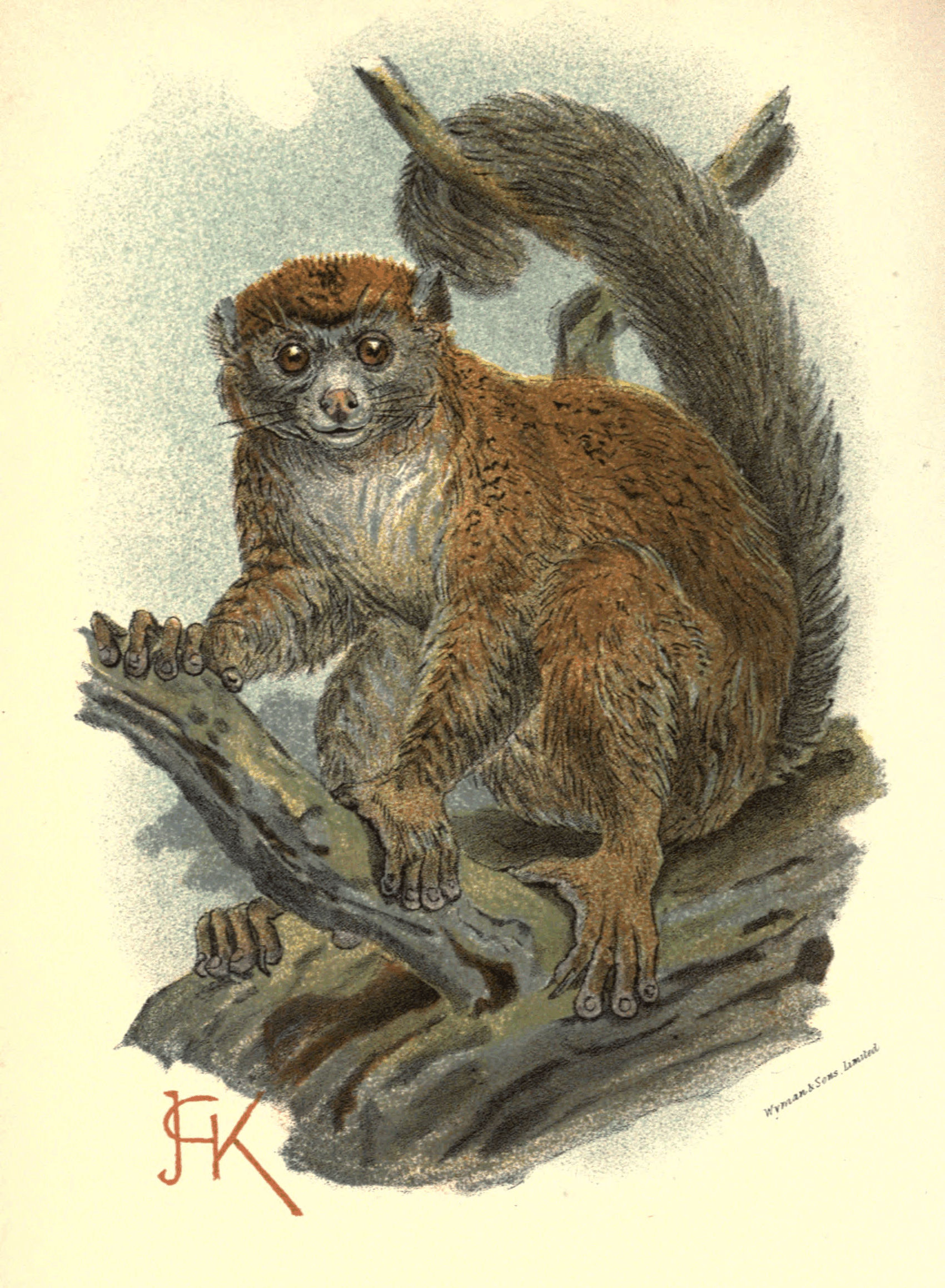
THE GREY GENTLE-LEMUR.
The brain is narrower and shallower than that of the genus Lemur, and presents no specially close resemblance to the same organ in the Indrisinæ or the Lorisinæ.
I. THE GREY GENTLE-LEMUR. HAPALEMUR GRISEUS.
Lemur griseus, Geoffr., Mém. sur les Makis. Mag. Enc., i., p. 48 (1796).
Hapalemur griseus, Is. Geoffr., Cat. Méth. Primates, p. 74 (1851); Mivart, P. Z. S., 1864, p. 613 (Skull); Schleg., Mus. P. B., vii., p. 361 (1876).
Hapalemur olivaceus, Is. Geoffr., Cat. Méth. Primates, p. 75 (1851); Schl., Mus. P. B., vii., p. 316 (1876).
Cheirogaleus griseus, Giebel., Säugeth., p. 1018 (1856); V. der Hoeven, Tijds. Natuurl. Gesch., p. 38, pl. i., fig. 1 (1844).
Hapalolemur griseus, Scl., P. Z. S., 1863, p. 161; Gray, P. Z. S., 1863, p. 828, pl. lii.
(Plate VIII.)
Characters.—Fur long and soft, not woolly; ears short, hairy, with long black vibrissæ between them; tail bushy, and as long as the body; general shade above greyish Mouse-colour, washed with rufous and speckled with black on the crown, back and external surface of limbs; shoulders and fore-limbs bluish-grey; cheeks, throat, breast, and inner side of limbs ochraceous white; under side of body whitish-yellow; tail and hands grey, washed with black. Body and tail equal, 15 inches in length.
Facial portion of skull short; brain-case rounded; lower jaw shorter and higher than in Lemurs generally; great toe large and broad; on the inner side of both arms close to the wrist occurs a rough patch (extending down to the bare skin of the palm) corresponding to a gland beneath, in the male, spine-like, while in the female hairy processes are present, together with a tuft of long hairs; external to this patch is a callous pad; mammæ opening on the shoulder; intestine large; cæcum small.
Young.—Reddish-yellow below.
Distribution.—The Grey Gentle-Lemur inhabits the eastern side of the Betsileo province of Madagascar.
Habits.—The "Bokombouli," as the natives name this animal, is the smallest of any of the True Lemurs. It is nocturnal, and lives, according to the Rev. G. A. Shaw, among the bamboos in the higher-level forests of the island. Its lower incisors are used as scrapers, and nearly all its teeth are serrated and very effective in cutting off the bamboo shoots, on which it feeds. To enable it to grasp smooth surfaces, such as the stems of the bamboo and other trees it frequents, it possesses a broad pad under each great toe.
II. THE BROAD-NOSED GENTLE-LEMUR. HAPALEMUR SIMUS.
Hapalemur (Prolemur) simus, J. E. Gray, Cat. Monkeys, Brit. Mus. App., p. 133 (1870); id. P. Z. S., 1870, p. 828, pl. lii., pp. 829, 830, figs. 1-4 (Skull).
Prolemur simus, J. E. Gray, P. Z. S., 1872, p. 851.
Hapalemur simus, Beddard, P. Z. S., 1884, p. 392; Jentink, Notes Leyd. Mus., vii., p. 33 (1885).
Characters.—Nose broad and truncated; ears short, covered with long hair on the outside and along the margin inside.
Very similar to H. griseus; head and upper back dark reddish-grey, faintly washed with rufous; sides of head, neck, and region round the eyes lighter; sides of nose and region between the eyes black; ears dirty grey; lower back, sides of body, and outer surface of limbs sooty-grey, with here and there a wash of rufous; the patch on the end of the rump and upper part of the base of the tail uniform pale yellowish rust-colour; remainder of tail sooty-grey; from the chin to the chest yellowish-grey; under side of body and inner side of arms pale sooty-grey.
No spines on the fore-arm above the wrist as in H. griseus. In the skull, the nose is broad, square, and truncated; the pre-maxillæ very small; the lower jaw weak and narrow in front.
Distribution.—Only known from Madagascar.
Habits.—The habits of the Broad-nosed Lemur are said to differ in no respect from those of the foregoing species.
THE SPORTIVE-LEMURS. GENUS LEPIDOLEMUR.
Lepilemur, Is. Geoffr., Cat. Méth. Primates, p. 75 (1851).
Lepidolemur, Peters, M. B. Akad. Berlin, 1874, p. 690 (1874).
This genus contains, according to Dr. Forsyth Major, as many as seven species. This excellent comparative anatomist has made a very careful revision of the group, and the present writer has gratefully to acknowledge from him many valuable notes incorporated under this section, as well as his kindness in supplying for publication the diagnoses of his new species.
Dr. Major divides these seven species into two series:—(A) a group of four larger species, and (B) a group of three smaller species.
The members of this genus are smaller than the True Lemurs of the genus Lemur. Their head is conical and short, their ears large, round, and membranaceous, and the tail is shorter than the body. In this latter character and in their shorter limbs they differ from Mixocebus. The fourth finger and toe are the longest digits of their respective extremities, the nails of all are keeled, and that of the great toe is very large and flat.
In the skull, the muzzle is longer than the longitudinal diameter of its orbit in the series of larger species (Section A); in the smaller species (Section B) the muzzle is shorter.
Their dentition presents several important characters. The series of upper molars and pre-molars form almost a straight line, both sides being almost parallel, or only slightly convergent towards the front. In the upper jaw the incisors are wanting; the canines are very large and grooved internally, and have a posterior heel. There is no gap between them and the anterior pre-molar, which last is vertically taller than the rest, and has one cusp to the outside, whereas the median and posterior have an inner cusp as well. The anterior and median molars have the inner hind cusp rudimentary, but the cingulum rises into a minute cusp, both at the fore and hind edge; the posterior molar is three-cusped. The whole of the cheek-teeth gradually broaden and decrease in vertical height from before backward as far as the median molar. In the lower jaw the anterior pre-molars are large, canine-like, and decumbent, and have a strong process on their anterior margin (resembling that in the corresponding tooth in Indris); the median and posterior pre-molars have one external cusp, and the latter tooth one interior cusp in addition. The anterior and median molars have a rudimentary fifth cusp, which is large in the posterior molar.
The pre-maxillæ are very much reduced, so that the teeth they usually carry are generally wanting. The bony palate is short, its hind margin extending back only to the middle of the median molar; its anterior foramina are small; and it differs from that of Microcebus and Chirogale in having its posterior perforations small. The angle of the lower jaw is produced downwards and backwards. The mastoid portion of the ear-capsules (periotic bones) as well as the squamosal are markedly enlarged and swollen, in this respect differing from the skulls of Lemur and Hapalemur. The ridges in the temporal bone unite into a frontal (sagittal) ridge, and the space between the orbits is depressed; a depression is also present on the cheek in front of the lachrymal foramen. The foot is slightly elongated by the lengthening of the naviculare bone of the ankle (tarsus), the thin bones of which are short. In the wrist (carpus) there is no os centrale or central bone, which is otherwise invariably present in the Primates, except in Man, the Chimpanzees, the Gentle-Lemurs, and the Endrina.
The Sportive-Lemurs are confined to Madagascar and are nocturnal and arboreal creatures, feeding on leaves and fruits.
In Group A (the larger species) are included: 1, The Weasel-like Lemur (L. mustelinus); 2, the Red-tailed Sportive-Lemur (L. ruficaudatus); 3, Edwards' Sportive-Lemur (L. edwardsi); and 4, the Small-toothed Sportive-Lemur (L. microdon). Group B (consisting of the smaller species) comprises: 1, The Round-headed Sportive-Lemur (L. globiceps); 2, Grandidier's Sportive-Lemur (L. grandidieri); and 3, the White-footed Sportive-Lemur (L. leucopus). With the exception of the two first-named species, all the others are here made known for the first time by Dr. Forsyth Major. Very little is recorded of the habits of these animals. They are so rare that at present the various species are known from a few skins or alcoholic specimens in European museums. They are said to be inhabitants only of the forest-country, nocturnal in their habits, sleeping coiled up in some retreat all day, but issuing forth at night, at which time they are very agile in their movements.
SECTION A. (SPECIES MAJORES.)
I. THE WEASEL-LIKE SPORTIVE-LEMUR. LEPIDOLEMUR MUSTELINUS.
Lepilemur mustelinus, Is. Geoffr., Cat. Méth. Primates, p. 76 (1851); Schl. et Pollen, Faun. Madag., Mammif., p. 10, pls. 4, 6, fig. 3; Schl., Mus. P. B., vii., p. 317 (1876).
Lepilemur dorsalis, Gray, Cat. Monkeys, Brit. Mus. App., p. 135 (1870).
Characters.—Fur soft and woolly; ears rounded, naked excepting at the base behind; muzzle elongated. Above, reddish-grey. Face and cheeks grey; throat white; under side of body and inner side of limbs, pale grey; tail short-haired, the posterior third dark brown. Length of body, 14 inches; and tail 10 inches.
Skull large and massive; the brain-case small and inflated; facial region long, differing in this character from L. ruficaudatus; orbits very large, thus differing from the three remaining species of the larger group (A); the process of the maxilla intervening between the nasal and lachrymal bones; molar teeth large.
Distribution.—This species occurs in the north-east of Madagascar, and, according to Grandidier, in the north-western corner of the island.
Habits.—The "Fitili-ki," as the natives have named this animal, is found in the forests in small companies. It is nocturnal in its habits, feeding on leaves and fruits.
II. THE RED-TAILED SPORTIVE-LEMUR. LEPIDOLEMUR RUFICAUDATUS.
Lepilemur ruficaudatus, Grandidier, Rev. et. Mag. de Zool., 1867, p. 256.
Lepilemur pallidicauda, Gray, P. Z. S., 1872, p. 850.
Lepilemur mustelinus (nec. Is. Geoffr.), Schl., Mus. P. B., vii., p. 317 (in part).
Characters.—Smaller than the last species; head much broader than it is long; snout short and conical; ears ovate, exposed, short-haired; tail long, thicker at the end, and covered with softer and longer hairs. Fur pale or reddish-grey; head dark brown; the shoulders and outer side of the arms grey, washed with brown; chin, breast, and inner side of limbs and under side of body whitish; upper side of the base of the tail rather dark brown, this colour extending further down in the tail of the female; rest of the tail uniform pale brownish or greyish-red.
Skull very broad compared with its length, more massive, and showing a shorter muzzle than in L. mustelinus; orbits smaller than in any of the other species in Group A.
Distribution.—South-western Madagascar.
III. MILNE-EDWARDS' SPORTIVE-LEMUR. LEPIDOLEMUR EDWARDSI.
Lepidolemur edwardsi, Forsyth Major.[5]
Characters.—"Similar to L. ruficaudatus; upper part of head grey; ears membranaceous, but encircled on the inner and posterior side by an incomplete belt of dark brown colour, which distinguishes the species from L. ruficaudatus; shoulders and outer side of the fore-limbs reddish-brown. Back greyish-brown, lighter on the outer side of the hind-limbs; an uninterrupted dark dorsal streak from the middle of the back to the centre of the forehead is very conspicuous between the shoulders. Breast, inner sides of the fore- and hind-limbs, and lower surface of the body greyish-white.
"The skull long and narrow; molars and pre-molars large, especially transversely; orbits small, yet larger than in L. ruficaudatus; the mastoidal portion of the ear-capsules and squamosal region of the skull conspicuously inflated. Bony palate more elongate than in L. mustelinus; par-occipital process present."
Distribution.—Betsako, north-west of Madagascar.
IV. THE SMALL-TOOTHED SPORTIVE-LEMUR. LEPIDOLEMUR MICRODON.
Lepidolemur microdon, Forsyth Major.
Characters.—"Somewhat similar to the Weasel-like Lemur (L. mustelinus) in coloration, but having the back and the outer portion of the shoulder and fore-limbs bright chestnut, passing into russet on the back (darker between the shoulders), on the outer parts of the hind-limbs and tail, as well as on the top of the head, where it is washed with greyish. A dark, dorsal stripe from the centre of the forehead to the middle of the back, where it is darkest. Breast and under surface of body yellowish-grey.
"Skull markedly distinguished from that of the other species by the small size of the molars; pre-molars not diminished in size; a depression at the base of the nasals; the bony palate more elongated than in L. mustelinus."
Distribution.—The eastern districts of the Betsileo province, Central Madagascar.
PLATE IX.
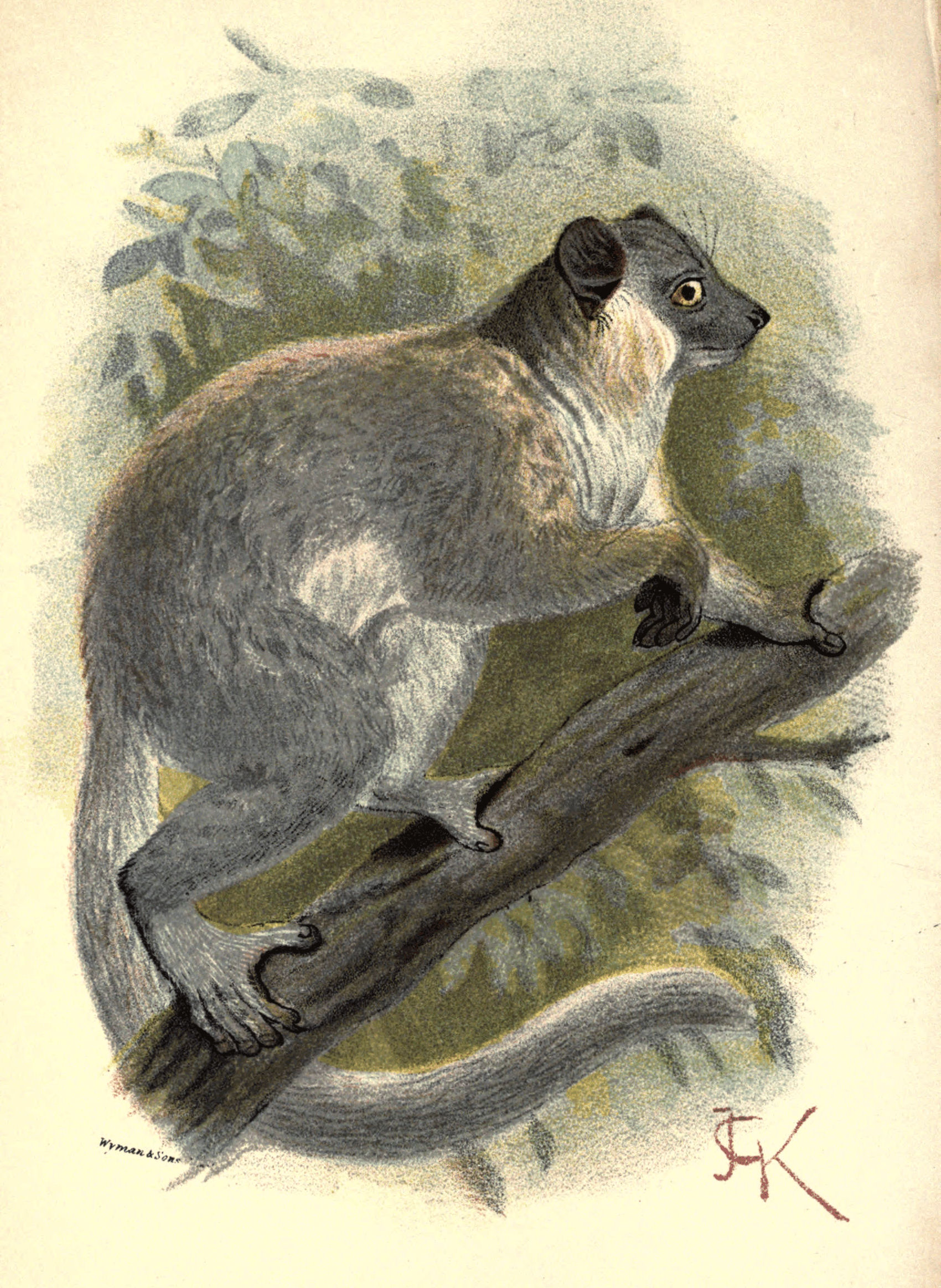
THE WHITE-FOOTED SPORTIVE-LEMUR.
SECTION B. (SPECIES MINORES.)
V. THE ROUND-HEADED SPORTIVE-LEMUR. LEPIDOLEMUR GLOBICEPS.
Lepidolemur globiceps, Forsyth Major.
Characters.—"The smallest of the Sportive-Lemurs. Similar to Lepidolemur ruficaudatus, but less rufous down the fore-limbs; the tail drab colour.
"Skull very characteristic; the brain-case broad, high, and globose, the facial region short; the premaxillæ more reduced than in any other species; the external auditory channel very large; the occipital region less vertical than in the species of Section A."
Distribution.—Ambulisatra, south-west Madagascar.
VI. GRANDIDIER'S SPORTIVE-LEMUR. LEPIDOLEMUR GRANDIDIERI.
Lepilemur mustelinus, Gray (nec Geoffr.), P. Z. S., 1863, p. 144.
Lepidolemur grandidieri, Forsyth Major.
Characters.—"General colour cinnamon; head greyish; an indistinct median dorsal streak from the forehead along the back; inner side of the limbs and under side of the body yellowish-grey.
"Skull remarkable for the large size of its orbits, and for the anterior convergence of its upper dental cheek-series being greater than in the other members of the group."
Distribution.—North-west Madagascar.
VII. WHITE-FOOTED SPORTIVE-LEMUR. LEPIDOLEMUR LEUCOPUS.
Lepidolemur leucopus, Forsyth Major, Ann. and Mag. Nat. Hist., xiii., p. 211 (1894).
(Plate IX.)
Characters.—Ears large, long, membranaceous; tail shorter than the body. Upper side Chinchilla-grey, with an indistinct median brownish stripe from the neck to the root of the tail. Top of head brownish-grey, with a darker median stripe; cheeks and chin whitish. Ears encircled by a broad ring of whitish hair. Neck, shoulders, and upper parts of the fore-arm pale rufous. Breast and belly greyish-white; inner surfaces of the hind-limbs and the heels pure white.[6] Tail greyish, with a rusty tinge. Length, 12 inches; tail, 10½ inches.
The skull is longer and broader than that of L. grandidieri; the mastoidal portion of the ear-capsules and the adjacent squamosal region very largely inflated; bony palate elongated; dental cheek-series short; molar teeth small and slender, distinguishing this species from L. grandidieri, their small size also separating it from L. globiceps.
Distribution.—This species is at present known only from Fort Dauphin in the south-east of Madagascar. [Type in British Museum.]
THE ENDRINAS. SUB-FAMILY INDRISINÆ.
This, the last sub-family of the Lemuridæ, is considered to contain the highest members of the whole Sub-order. They are distinguished by having their fur abundant, longer and woolly above, shorter beneath, with the hands and feet haired to the tips of the digits. Their head, set at right angles to the spinal column, is rounded, the face elongated and naked, with a deep furrow separating the nostrils. The eyes are large, and have a third eyelid, or nictitating membrane, to draw across the pupil during the day. The ears, which are naked inside and fringed on the outside, are moderately long and buried in the fur, but are less movable at will than is the case with the Galagos. Their fore-limbs are much shorter than the hind ones. The arms, which are united to the body by a parachute-like fold of integument, have long, narrow, and strong hands, of which the thumb is short, set far back, and but little opposable. The rest of the fingers, except the index, which is short, are long and slender, and terminate in a round disc. The feet are elongate, and the great toe, which is freely opposable to the other toes, is very large and broad, being, indeed, nearly as wide as the rest of the digits together; the remaining toes are united by a membrane as far as the second segment. The females have the mammæ situated on the breast.
In the skull the facial region is relatively small, and the cranial region relatively large. The external nostrils communicate with a cavity on the underlying bone; the pre-maxillary bones are deeply excavated in front, and the anterior perforations in the bony palate, behind the incisor teeth, are large. The lower jaw has its angle large, produced backwards, the line of union of its two halves being long, and its lateral movements very limited. In regard to their dentition, the number of the milk-teeth in the young individual is greater than that of the permanent set in the adult, the formula of the former being I22, C11, P23 [M33], while that of the latter is I22, C10, P22, M33, the lower canine and one lower pre-molar having disappeared. In the upper jaw the incisors are very small, the outer one standing behind the inner one, with a space between the former and the canine; the canines are long, curved behind, and set close up to the anterior pre-molar. The pre-molars are longer than they are broad, laterally compressed, and present to the outside one main triangular cusp with a small accessory cusp on each side, the posterior tooth of the series having a hind inner cusp. The anterior and median molars are four-cusped, of which the outer and inner pairs are separated by a longitudinal groove; to the outside they have one supernumerary cusp on each main cusp, and one between them. The median molar is the largest tooth of the jaw, and the posterior is small, triangular and three-cusped. Of the lower jaw, the outer pair of the long, and almost horizontally protruding incisors, is larger than the inner pair, and is separated by a space from the anterior pre-molar. Of the elongate laterally compressed pre-molars, the anterior is the larger, and is vertically taller than its fellows, being slightly depressed forward and curved behind; the posterior pre-molar has one cusp. The molars have four cusps, of which the inner ones alternate with the outer cusps.
The intestinal canal in the Indrisinæ is very long, the cæcum, or blind diverticulum at the junction of its two portions, being extremely long and large, occupying, indeed, a great part of the abdominal cavity. The main arteries of the fore- and hind-limbs do not break up into a rete mirabile, or series of small parallel vessels, as in many other Lemuroids.
In this group, while the sense of smell is very perfect, that of hearing is less acute than in the other Sub-families; and that of touch conspicuously blunt, both in the fingers and toes, which are chiefly climbing and not tactile and prehensile organs, as they are in the corresponding limbs of the Anthropoids. The female never produces more than one young at a birth.
The convolutions of the brain are few, but they are more complicated than in many of the South American Monkeys. In very young individuals the cerebellum is more covered by the cerebrum than it is in the adult.
The species of this Sub-family are confined to the island of Madagascar. Our knowledge of their general characters, anatomical structure and habits, is very complete, through the researches, both in the field, of M. Grandidier, and in the study, of Prof. Alphonse Milne-Edwards. These results are published in their magnificent "Histoire de Madagascar," to which the reader is referred for fuller information.
The Indrisinæ, on account of their superior organisation, and especially their relatively large brain, are considered to be the highest of all the Lemuroids. They are essentially arboreal. If they come to the ground they sit upright on their hind-legs, and progress by jumps, holding their arms above their heads. They are easily tamed, and become gentle in confinement; but they are not very intelligent. The Endrinas "never manifest in any very marked manner," so MM. Milne-Edwards and Grandidier tell us, "the passions that affect the Apes so vividly; their countenance, almost as immobile as that of an herbivorous or carnivorous animal, exhibits neither anger nor pleasure. In captivity they do not seek to be caressed; they appear neither to become attached to their master, nor to take interest in anything about them." Many of their actions, however, and the peculiar sounds they often utter, recall those of Monkeys.
Some of the species are diurnal and others nocturnal.
The Sub-family has been divided into three genera, Avahis with one species; Propithecus, with three species, and Indris with a single species. All its members are remarkable for the extraordinary amount of variation in the coloration of their fur.
THE AVAHI LEMURS. GENUS AVAHIS.
Avahi, Jourdan, C. R., Journal l'Inst., ii., no. 62, p. 231 (1834).
Avahis, Milne-Edwards and Grandid., Hist. Nat. Madag., Mamm., i., p. 320 (with full synonymy).
This genus is monotypic, containing but a single species, whose characters include necessarily those of the genus.
I. THE WOOLLY AVAHI. AVAHIS LANIGER.
Lemur laniger, Gm., Syst. Nat., i., p. 44, no. 10 (1788).
Microrhynchus laniger, Jourdan, Thèse inaug. Soc. Phys., Grenoble, 1834; Mivart, P. Z. S., 1866, p. 151, pi. xv.
Avahis laniger, Milne-Edwards and Grandid., Hist. Nat. Madag., Mamm., p. 325 (with full synonymy), Atlas, pls. 9, 10.
(Plate X.)
Characters.—Fur woolly; the head nearly round; the face short in proportion to the head; muzzle short, covered with hair; the nose and region of the chin hairy; nose-pad on lip large; nostrils opening into a cavity on the upper lip below the skin. Eyes large, the pupil vertical; ears small, concealed in fur. Tail a little longer than the body; body short, stumpy. Third, fourth and fifth fingers flattened; third and fourth toes united by a membrane as far as the first joint.
PLATE X.
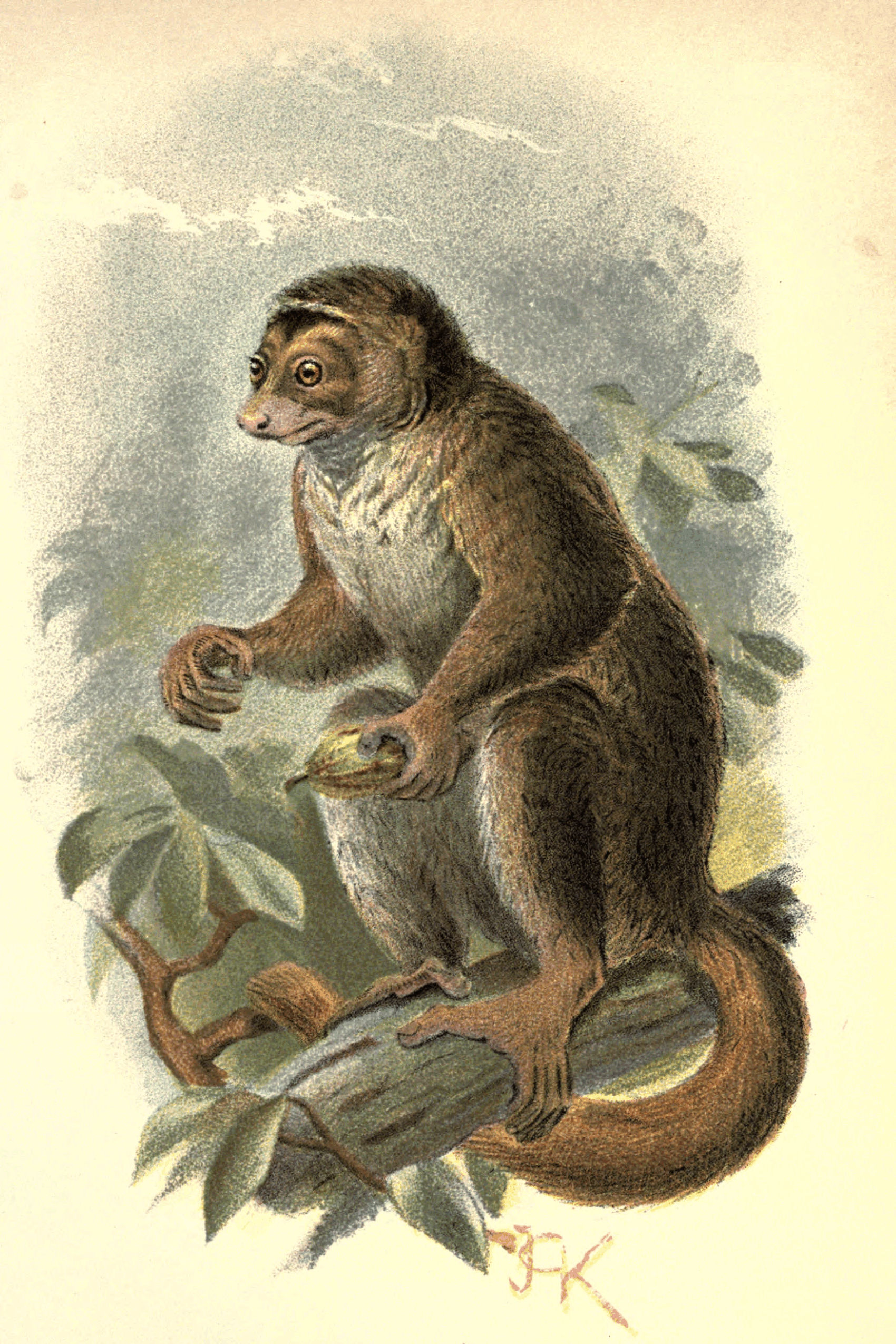
THE WOOLLY AVAHI.
Cranium more vaulted and the muzzle remarkably shorter than in the genera Indris and Propithecus; eye-sockets very large; the space between the eyes hollow. Temporal ridges not uniting into a single median ridge. Nasal bones projecting as far as the front end of the very small pre-maxillary bone. Lower jaw remarkably deep and broad behind; line of union of its two halves nearly half the length of the jaw, and in a straight line with the incisor teeth. Toothless space in front of upper jaw greater than in the other two genera. Dentition of the upper jaw: incisors small, the outer larger than the inner, set close to the canines and not at the inner edge of the toothless space; canines vertically short; pre-molars, with no inner cusp, but having a prominent outer cingulum (a character seen in no other species of Lemur); molars, four-cusped. Lower jaw: incisors larger than in the two other genera, and less horizontal, the inner ones more slender than the outer. Anterior and posterior molars, five-cusped. Hind margin of palate reaching to the middle of the median molar. Central bone of wrist wanting (of all Primates agreeing in this character only with Man, the Chimpanzees, the Gentle- and Sportive-Lemurs and the Endrina); fourth digit of the hands and feet longest. Tail long. The small intestine not spirally coiled upon itself, but folded many times transversely.
Hair long, woolly, dark Mouse-grey at base, reddish-brown in the middle, black at the tips. Face broad, entirely covered with short greyish-brown hairs; nose-pad alone nude. Ears concealed and covered by rufous hair; pupil of eye very contractile, very narrow and linear during the day; across the forehead and over the eyes a transverse lunulate whitish band, margined anteriorly by a black band. Back greyish-brown, the nape darker; a patch over the rump, and the base of the tail and buttocks white, washed with rufous; back and inner side of thighs and round the arms whitish; a narrow fringe on the lower margin of arms and legs ashy-grey, washed with rufous; fore-arm, hands and feet rusty-brown; tail bright dark red, deepest at its extremity. Under side and inner surface of limbs grey, washed with rufous. Length of body, 12½ inches; tail, 15¾ inches.
Of this species there are two forms, an eastern and a northern, the latter being always smaller in size, with the fur lighter and less rusty. In some varieties the upper surface is dark rusty-red all over, and the inner sides of the limbs pure white. Examples from the north-west coast are constantly smaller; the head rounder, and the facial hairs grey; no white band on the forehead; upper surface bright yellowish-brown; tail rusty-grey; under side of hind-limbs pure white, the under surface and inner side of the arms whitish. The variation in coloration is due to the middle part of the hairs, which in typical specimens is rusty-red, but is yellow in the above-mentioned form. Hands and feet grey.
Young.—Ashy-grey, slightly washed with red.
Distribution.—The Woolly Avahi seems to inhabit only the forests of the parallel ranges of the mountains which face the whole eastern coast of Madagascar; it extends round the bay of Passandava on the west coast, opposite to the northern termination of this eastern range of mountains.
Habits.—This species—the smallest of the Indrisinæ—being essentially nocturnal, is torpid during the day, and is the wildest and least docile of the family. The first specimen of the "Avahi," the name by which this animal is known among the Anatala tribe, was brought to Europe by Sonnerat, the French traveller, in 1781, and nearly half a century elapsed before a second one was obtained. Since then several specimens have been kept in captivity in the different zoological gardens of Europe.
THE SIFAKAS. GENUS PROPITHECUS.
Propithecus, Bennett, P. Z. S., 1832, p. 20; Milne-Edwards and Grandid., Hist. Nat. Madag., Mamm., i., p. 288 (with full synonymy).
The characters which distinguish this genus from Avahis and Indris are the following: The fur with which they are covered is more silky than woolly, and in general appearance is white, more or less washed with yellow, varying to red or black. The head is very slightly longer than it is broad, with a black and almost naked muzzle; the ears, half buried in the fur, are flatter and wider than in Indris, the inner surface being naked and black, and the outer haired. The nostrils are large and semilunar in shape. The tail is long. The index-finger is not united by a membrane to the others; their hands and feet are in a much less degree organs of prehension than in most of the other Lemurs.
The skull in proportionate length is intermediate between that of Avahis and Indris. Compared with Avahis it is less vaulted, its muzzle is longer, and the orbits are smaller. The space between the eyes is high, and not depressed, on account of the presence of a large air-cavity in the underlying bone. Their nasal bones do not reach as far forward in front as the level of the incisor teeth. In the dentition of the upper jaw, the incisors protrude somewhat in front, and are dilated laterally in a regular series—thus distinguishing the genus Propithecus from Lemur,—the inner incisors being larger than the outer ones, with their tips approximating. Between the canine and the anterior pre-molar there is a short gap. The anterior and median molars have the cusps of the crown alternate; the posterior has them opposite. In the lower jaw the incisors are shorter and stronger than in Avahis, and the molars are four-cusped.
The genus Propithecus contains three species; (1) The Diademed Sifaka (P. diadema), (2) Verreaux's Sifaka (P. verreauxi), both having numerous very marked varieties; and (3) the Crowned Sifaka (P. coronatus).
These species are found all round the coasts of Madagascar; as well in the luxuriant forests on the east side as in the arid deserts and the sparsely-wooded plains of the south-western and western coasts. Of the three species of the genus, one (P. diadema) is confined to the eastern and southern coasts, the other two (P. verreauxi and P. coronatus) are found only on the west coast. More or less distinctly coloured varieties or races of these three species occur, and it is very remarkable that each of them is rigorously restricted to localities distinct from that of the typical species.
I. THE DIADEMED SIFAKA. PROPITHECUS DIADEMA.
Propithecus diadema, Bennett, P. Z. S., 1832, p. 20; Milne-Edwards and Grandid., Hist. Nat. Madag., Mamm., p. 296 (with full synonymy), Atlas, pl. 1-3.
Characters.—Fur long, silky, the muzzle naked. Head shorter and rounder than in the other species of the genus; thumb slender, like the toes, set far back, free; great toe very strong, and in the same plane with the other digits; a marked depression exists in the skull behind the orbits. Body, 21 inches; tail, 19 inches in length.
Forehead crossed by a broad white bar; cheeks in front of the ears, and the under side of the chin, white or fulvous white; face black, with a few short black hairs. Back of head, neck, shoulders, sides of body, outer sides of arms, sometimes grey, but generally very dark brown, merging into dark grey on the lower back. Tail at its root washed with orange-yellow, paler in the middle, greyish-white at its extremity. Fore-arm, lower part of arm, sacral region, and external face of hind-limbs, bright orange-yellow. Hands black-haired to the ends of the fingers, but with long and yellow tufts of hair at the tips. Feet pale orange and haired to the nails. Chest dark brown. Under surface white, or white tinged with yellow, or dark brownish-grey. Internal face of the fore-limbs grey, from the intermixture of black hairs; that of the hind-limbs pale yellow.
Young.—Similar in colour to the adults, but lighter; the frontal band yellow, not white; limbs light yellow.
Varieties.—Several varieties of this species—the "Simpona" of the natives—have been described, of which the following deserve special notice:—
THE SILKY SIFAKA. PROPITHECUS SERICEUS.
Face black, with flesh-coloured spots; the body entirely white, faintly washed with yellow; the base of the tail washed with rust-red. It is of the same size as the type-form, and appears to be only an albino variety. Specimens showing every gradation in coloration between that of the type and the absolute albino are now well known. This form, however, is more or less restricted to the narrow belts of forest on the eastern side of the mountains in the north-east of Madagascar, between the rivers Lokoi and Bemarivo, a region conterminous with that inhabited by the typical species.
MILNE-EDWARDS' SIFAKA. PROPITHECUS EDWARDSI.
Differs from the true P. diadema in having the face slightly haired between the eyes and on the chin; a patch on each flank rufous-white or orange-yellow, separated by a reddish-black band; a spot at the root of the tail bright rusty-red, and all the rest of body black, washed slightly with rufous. The young are like the parents. This form is also of the same size as the type, but is a melanistic variety, for a series of specimens show every intermediate shade between that here described and the Black Sifaka (P. holomelas), which is of an entirely black colour, and inhabits, as has been shown by MM. Milne-Edwards and Grandidier, the same region as P. edwardsi.
Distribution.—The typical form of the species is confined to the extended region on the east coast of Madagascar lying between the Bay of Antongil on the north, and the River Masora in the south, in the forest-belts on the eastern aspect of the mountains, where rain falls abundantly and the whole region is covered with luxuriant vegetation. Its melanistic variety (P. edwardsi) extends south from the Masora as far as the Faraouny river, but it ranges to higher and colder altitudes on the mountains; while its albinistic variety (P. sericeus) lives in the somewhat warmer region to the north of Antongil Bay, each being, to south and north respectively, conterminous with the central habitat of the typical form.
II. VERREAUX'S SIFAKA. PROPITHECUS VERREAUXI.
Propithecus verreauxi, Grandid., Album de l'île de la Réunion, iv., pp. 153-162, pls. 1, 2 (1867); Milne-Edwards and Grandid., Hist. Nat. Madag., Mamm., i., p. 305 (with full synonymy), Atlas, pls. 4, 6, 8.
Characters.—Fur short and woolly; face entirely naked; head longer than broad; a well-marked swelling of the skull between the eyes; the upper incisors sub-equal. Smaller and more robust than P. diadema, the head longer, the hair on the limbs shorter, the tail longer.
Body yellowish-white; a spot on the top of the head dark brown, sometimes washed with rufous, separated from the face by a white frontal bar. Face black; eyes brownish-yellow; interior of ears black, and naked; a grey patch on the middle of the back; outer aspect of the fore-arms, and hind-legs, ashy-grey; rest of the body white. Hands and feet white. Tail yellowish-white. Length of body, 18 inches; of tail, 22 inches.
Young.—Entirely white, with a dark brown spot on the head; the under surface of the body washed with rufous.
Varieties.—Two well-marked varieties of this species are known, both of which were for many years considered to be distinct species. Continued exploration has, however, now resulted in the accumulation in various museums of a large amount of material from many localities, and this proves that the two forms really belong to but one species.
VON DER DECKEN'S SIFAKA. PROPITHECUS DECKENI.
Differs from the true P. verreauxi in having the face and ears black, and the body otherwise entirely grey, or white, washed more or less with yellow (sometimes rufous on the limbs); or of an ashy-grey colour on the loins, neck, and outer aspect of the limbs; the under side bright rufous; chest and inner sides of the limbs rusty-white, with a fulvous spot at the base of the tail. Specimens from the forests of the interior have a grey spot on the back of the neck expanding into a collar, which is absent in those from the coast. An albino variety comes, so far as is at present known, only from the wooded belts on the extensive plains between the rivers Manambolo and Manjaray, on the west coast.
COQUEREL'S SIFAKA. PROPITHECUS COQUERELI.
(Plate XI.)
Has the face naked and black, but the centre of the nose white; the ears showing as black points amid the white hair; head and back of neck white, slightly washed with yellow; outer side of arm and fore-arm dark maroon-red, the lower border fringed with long white hair; a maroon patch on the upper and outer surface of the thighs, lighter on the chest and central part of the belly. Loins dark rusty-grey; hands white; tail rusty-grey.
Distribution.—Verreaux's Sifaka, with its two varieties, is confined to the small thin woods on the sandy and almost rain-less plains along the western and southern coasts of Madagascar. The type-form is found, alone, and unassociated, in the extensive plains of Mesozoic geological formation—between the southern base of the eastern range of mountains and the River Tsidsubon, which flows into the sea on the west coast. Von der Decken's Sifaka inhabits the middle of the west coast, while Coquerel's Sifaka has its home further to the north. It occupies the area between the south side of Narendry Bay and the north side of Bembatoka Bay, the Betsiboka River being its extreme southern limit.
Though first observed by Flacourt, and described by him in 1661, Verreaux's Sifaka remained practically unknown from that time till re-discovered by M. Grandidier in 1867.
III. THE CROWNED SIFAKA. PROPITHECUS CORONATUS.
Propithecus coronatus, Milne-Edwards, Rev. Scient., 1871, p. 224; id. et Grandid., Hist. Nat. Madag., Mamm., i., p. 316 (with full synonymy), Atlas, pl. 7.
PLATE XI.
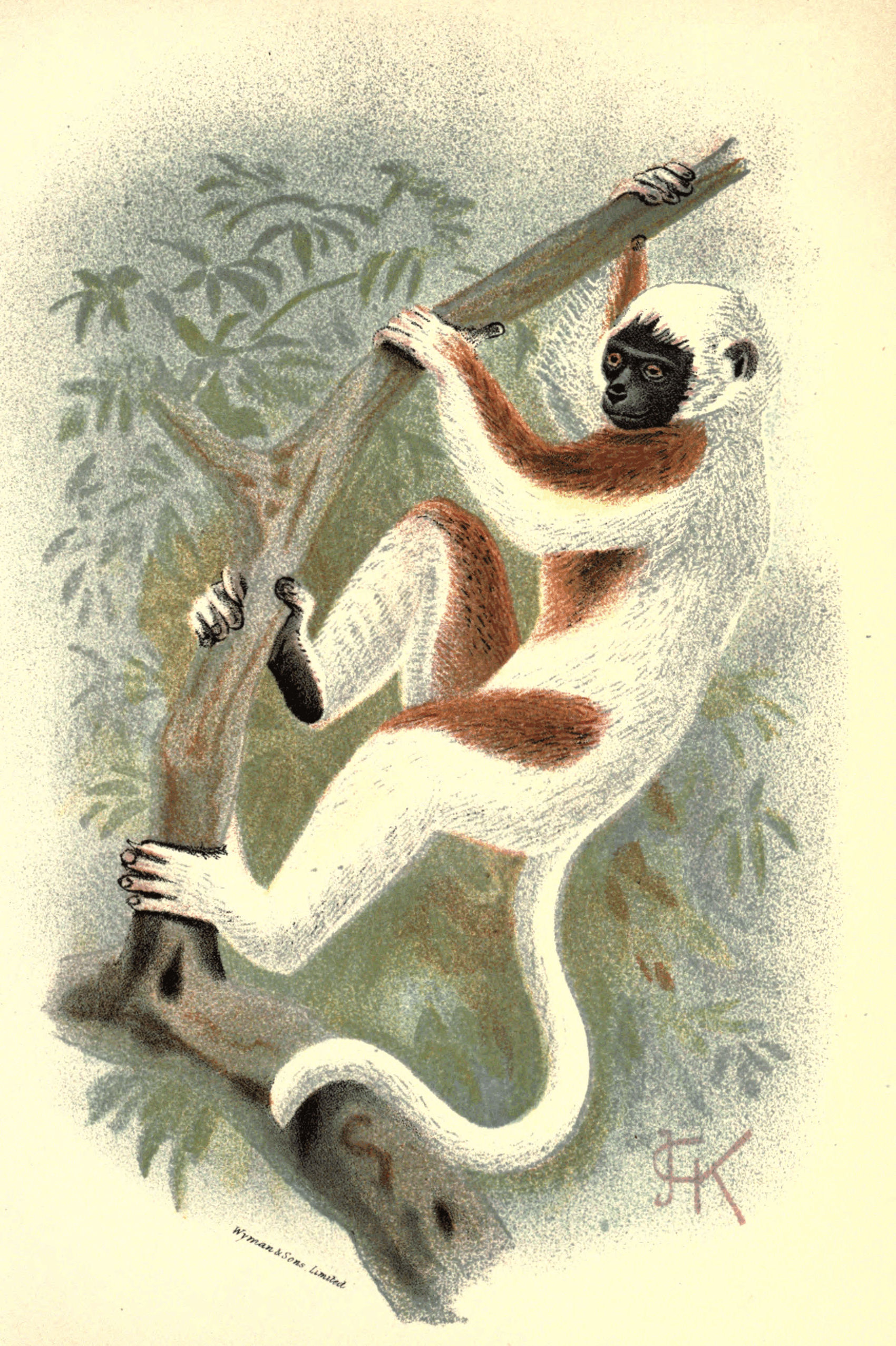
COQUEREL'S SIFAKA.
Characters.—Muzzle very broad and naked; nose-pad wide; inside of ears naked. Face, top of head, sides of neck, and throat, deep brownish-black; muzzle black; a band across the temples, and a streak down the nose, white. Ears black inside, fringed externally with white; neck and upper surface white, washed with rust-colour on the limbs and root of the tail. Tail, hands, and feet, pure white. Under side rich orange-red, darker across the chest; inside of limbs white, washed with rufous. Of the same size as P. verreauxi.
Cranium larger in all its parts than in other species. Nasal bones elongated beyond the incisor teeth; nose very flat, this being due to the large air-cavity (called false nose) in the jaw-bone below, connected with the nose. The length and breadth of the muzzle gives a peculiar expression to the face of P. coronatus.
This species, like the preceding, is subject to considerable variation.
The whole head is sometimes grey, washed with rufous; the upper surface and root of the tail white, flushed with rust-colour.
In examples living further in the interior than the habitat of the type (Bay of Bembatoka), the back is more rufous, the neck has a large grey or brown patch, and the chest is very dark brownish rust-colour. The abdomen and the inner sides of the limbs are bright red.
Distribution.—This species occurs on the north-west coast of Madagascar, between the Bay of Mozamba to the north and the River Manjaray on the south, ranging over the country to a considerable distance into the interior. The lighter-coloured specimens come from the more northern range of the species, while the more brightly-marked varieties have been obtained in the interior more to the south. It is curious, remarks M. Grandidier, to find races and species of the same genus so exactly restricted, that one has only to cross a river, not necessarily large, in order to obtain on one bank certain species of Propithecus, whereas those occurring on the opposite bank may be of a very distinct species or race. To what influence in their surroundings can all these variations be ascribed? One can understand that species inhabiting a wooded and humid country, or living among granitic mountains (as P. diadema does), would differ in size and fur from other members of the same genus which live in dry and arid plains (as in the case of P. verreauxi); but how can the great variations that occur in members of the same species living a few miles, and perhaps only a few metres, apart, be explained, when the external conditions are almost the same?
Habits.—The habits of the different species of Sifaka are very similar. They live in companies of six or eight, and are very gentle and inoffensive animals, wearing always a most melancholy expression, and, as a rule, being morose, inactive, and more silent than other Lemurs. They rarely live long in captivity. In their native state they are most alert in the morning and evening, as during the heat of the day they conceal themselves amid the foliage of the trees. When asleep or in repose, the head is dropped on the chest and buried between the arms, the tail rolled up on itself and disposed between the hind-legs. The Sifakas live exclusively on vegetable substances—leaves, fruits and flowers—their diet not being varied, as in the other groups, by small birds, eggs, or insects. Their life is almost entirely arboreal, for which the muscles of their hands and feet, as well as the parachute-like fold of skin between their arms and body, and their peculiarly hook-like fingers, are most fitted. The young one is carried about by its mother on her back, its hands grasping her arm-pits tightly. The Sifakas are held in great veneration or fear by the natives of Madagascar, and are never intentionally killed by them.
PLATE XII.
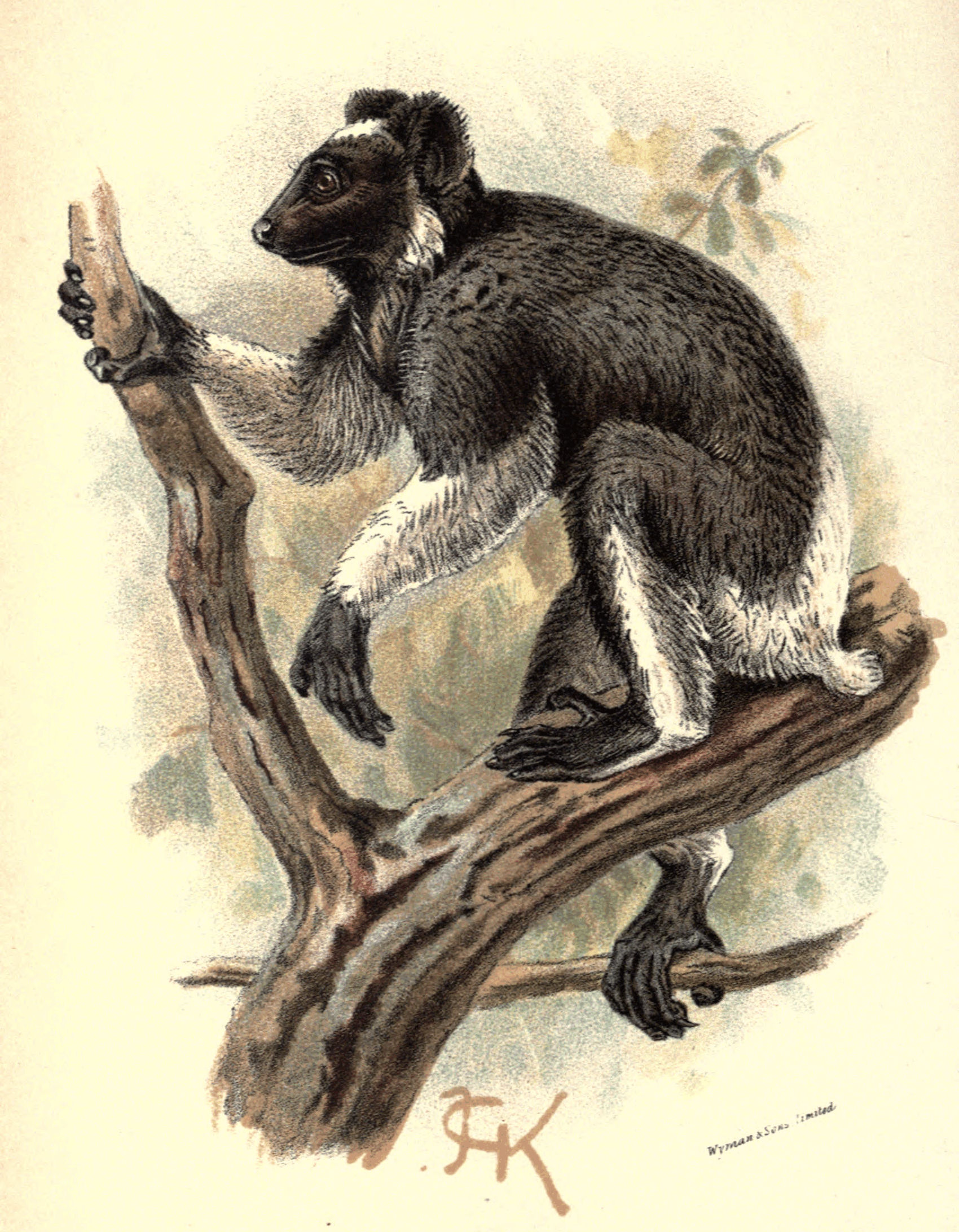
THE ENDRINA.
THE ENDRINAS. GENUS INDRIS.
Indris, Cuv. et Geoffr., Mag. Encycl., 2 ed. Ann. i., p. 46 (1796); Milne-Edwards and Grandid., Hist. Nat. Madag., Mamm., i., p. 330 (with full synonymy).
This genus is, like the first of the sub-family, monotypic, no second species having rewarded the many explorers of Madagascar in the long period that has elapsed since its solitary species was discovered. This species is known as
I. THE ENDRINA. INDRIS BREVICAUDATUS.
Indris brevicaudatus, Geoffr., Mag. Encycl., 2 ed. Ann., p. 46 (1796).
Indris variegatus, Gray, Ann. and Mag. N. H. (4), x., p., 474 (1872).
Indris brevicaudatus, Milne-Edwards and Grandid., Hist. Nat. Madag., Mamm., i., p. 336 (with full synonymy), Atlas, pls. xi.-xii.
(Plate XII.)
Characters.—The peculiar features of the species, as given below, are necessarily those of the genus also.
Fur long and woolly, extremely variable in its coloration. Head rounded, longer than it is broad; muzzle moderately long, covered with very short hairs; fingers and toes haired to the finger-tips; external ears rounded, exserted, and more developed than in Avahis or Propithecus, with long and tufted hair forming a fringe all round. Median nose-pad high and narrow; pupil of eye circular; body elongated; arms about one quarter of the length of the legs; hands very long, the four outer fingers united by a membrane as far as the first joint, and the toes to the centre of their middle segments; hands and feet haired to the tips. Tail rudimentary.
Skull longer and less vaulted; brain-case proportionately more compressed from side to side; the muzzle longer, and the orbit smaller, than in Avahis; floor of orbit higher than the bony margin of the jaw; inter-orbital space flat; nasal bones, though long, not extending in front as far as the end of the pre-maxillary bone; mandible elongated, narrower, and less deep than in Avahis. Bony palate short, posterior margin thickened, and with a foramen behind the posterior molar; line of union of the two halves of the lower jaw shorter than in Avahis; its angle very large. No central bone in the wrist (or carpus); hind-limb (with or without the foot), compared with the fore-limb (with or without the hand), longer than in any other of the Primates, except Galago. Upper teeth: Incisors, sub-equal, set close together and subject to variation in size; canine, vertically taller than, and not separated by a gap from, the pre-molar; pre-molars compressed, and having an inner cusp; anterior molars, four-cusped, with the supplementary cusps weak, and with no oblique ridge; anterior and median, with their outer and inner cusps opposite; posterior molar, which is the smallest grinder of the jaw—four-cusped, with transverse, but no oblique ridges. Lower teeth: Incisors, with marked longitudinal ridges to the outside (peculiar to this genus); pre-molars sub-equal; molars all four-cusped, and the posterior ones expanded behind.
Brain highly organised. A large laryngeal pouch (present also in the fœtus), but differing from that of the Apes, is placed between the gullet and windpipe, communicating with the latter by an orifice: main arteries of the fore- and hind-limbs not broken up into a rete mirabile of small parallel vessels, as in many species of Lemurs.
Face naked, sometimes blackish, generally dark grey; lips downy; head, neck, back, shoulders, arms, and hands, deep black; fore-arms faintly washed with rufous; a large patch, widening from the middle of the back downwards to the lower back, rump, and root of the tail pure white, washed with orange or red; a patch on each flank, pale, becoming rufous or greyish-white, separated from the rump-spot by black bands continuing down the outer side of the inner face of the thighs, and the front and inner sides of the legs; thighs ashy-grey, their upper two-thirds greyish, becoming black on the front, and ashy-grey on the hinder surface, of the leg. Feet black; tail stumpy, fawn-colour, brownish-grey at the tip; under side rusty brown; abdomen grey; heel rufous.
Many varieties of this species have been met with. Of these, some have the top of the head and between the eyes greyish-white, mixed here and there with black; jaws and throat, grey; ears, neck, back and upper part of arms, black; the fore-arms grey; the hands black; a patch on the lower back ashy-grey; flanks bright rufous; legs grey; band on front of the thighs black; heel bright rufous.
Other examples have a mark over each eyebrow, the fore-limbs nearly to the hands, the hinder part of the thighs, the legs from the knee to the ankle, and the whole under side iron-grey; the ankles and hind part of the heels white, yellow below. (Indris variegatus, Gray.)
All stages between the forms here described and complete albinos are known; so that the various differences observed prove them to be only individual variations of the same species.
Distribution.—The Endrina is confined to the woods looking eastward, on the two high ranges along the eastern coast, between the Bay of Antongil on the north and the River Masora on the south.
Habits.—The "Endrina," "Bàbakòto," or "Amboanala" (Dog of the Forest), as the natives variously name this species, has the same habits as the Sifakas. It is the largest of the Lemurs, and is diurnal. It derives its appellation of "Dog of the Forest" from the doleful, dog-like howls which it utters. In this habit it differs, therefore, from most of the other groups (except the True Lemurs), which are, as a rule, rather silent. Its powerful voice is due to the distensible resonator which it possesses in its laryngeal pouch, described above. Essentially diurnal, the Endrinas live in small companies, and feed only on vegetable diet. The hook-like fingers of their hands are better adapted for climbing than for prehension, and much of their food is, indeed, seized by the mouth. They are entirely arboreal, and move about the trees in an erect position, rarely coming to the ground. The "Bàbakòto" is held in great veneration by most of the native tribes.
M. Pollen gives several other particulars of these Lemurs, and of the curious notions of the Malagasy respecting them. Their native name is "Bàbakòto," literally "Father-child" (or "boy"), not "Indri," as stated by Sonnerat, who discovered the species. Indri, or Indry, is a Malagasy word meaning "lo!" or "behold!" and was probably mistaken by him and other Europeans for the vernacular name of the animal when the natives exclaimed, "Indry izy!" ("There he is!"). Dr. A. Vinson says that, in passing through the great Eastern forest, he was assailed for two days by the incessant clamour of these Lemurs, which seem to keep together in large companies, but are invisible in the dense foliage. The natives have a superstitious veneration for these animals, and consider them as sacred. They believe that their ancestors change after death into Bàbakòto, and that the trees where these animals live supply infallible remedies against otherwise incurable diseases. The people say that it is very dangerous to kill these Lemurs with spears, because if a spear is hurled against one of them it seizes the spear in its flight without being itself hurt, and in its turn stabs with certain aim those attacking it. They also relate that when the female has borne a young one, she takes the little creature in her arms and tosses it to her mate, who is seated on a neighbouring tree, and that he throws it back to the female. If the little one does not fall to the ground after being subjected to this exercise for a dozen times, the parents bring it up with the greatest care; but, if the contrary event happens, they abandon it, not even troubling to pick it up. In certain parts of Madagascar, says M. Pollen, the people employ the Bàbakòto in chasing birds, and they say that it renders as good service as a Dog. These animals, although principally fruit-eaters, do not disdain small birds, which they catch with much skill, in order to eat their brains.
This Lemuroid is probably the best known to travellers in Madagascar, at least by ear, as no one can travel along the most frequented route in the island, that from Tamatave to Antananarivo, without often hearing the cries of these animals as he passes through the great forest. They are not often seen, but their long drawn-out melancholy cries are frequently heard, a strange wailing sound, as if of people in distress, or children crying. Dr. Vinson says that the Bètànimèna tribe let these animals at liberty if they find them in captivity, and give them burial should they find them dead. They relate that a certain tribe, at war with its neighbours, took refuge in the forests; their enemies, in pursuing them, led by the sound of human voices, as they supposed, found before them a troop of Bàbakòto, at whose appearance they were struck with terror. They fled, persuaded that the fugitives had been changed into beasts. These, on the other hand, vowed eternal gratitude to the Lemurs who had saved them, and have ever since religiously refrained from injuring them in any way.
EXTINCT LEMUROIDEA.
On a former page (anteà, p. 13), attention was drawn to the interrupted distribution of the Lemurs, and to their present restricted range to the tropical and sub-tropical regions of Africa, of Madagascar, and of part of the mainland and of the islands of the Asiatic continent. In times geologically not very remote, they were inhabitants of both worlds.
The earliest appearance of the Primates in time is at the beginning of the Tertiary period. Lemuroids, some of them of a more or less primitive type, then lived in Europe in the Lower Eocene period. In the higher beds of the same epoch (to which the fresh-water deposits of the London clay of England, the Plastic clay of France, and the prolific Wasatch beds of Wyoming, Utah, and Colorado of America belong) undoubted Lemurs are represented by many genera, which in the Middle Eocene attained to a great development.
In the Upper Eocene of Europe many distinctively Lemuroid genera (Adapis, Microchærus, &c.) "formed," as Zittel remarks, "a very characteristic element of the fauna; they are connected with old Tertiary fore-runners, and combine features of the existing Lemurs and true Apes." The presence of these heat-loving animals in such northern latitudes undoubtedly indicates the existence there of a climate more genial at that epoch than now. In the corresponding period in North America remains have been less plentifully found; but for the most part the genera are representatives of those of the European beds.
In strata of Oligocene and older Miocene age no Lemuroid remains have come to light in Europe, and they are represented by only one or two doubtful forms in America. After that date they apparently vanished from the New World and from the northern portions of the Old.
Many of these extinct Lemuroids so combine the characters of the Insectivora and the Ungulata (or hoofed animals), with those of their own Sub-order, that it is often extremely difficult, even impossible, sometimes, to determine to which Order they really belong, owing to a blending of characters due to their common origin. The Upper Eocene forms present many affinities with the South American Capuchin Monkeys (Cebidæ). Dr. Forsyth Major is of opinion, however, that they are more highly, and not (as is generally believed) less specialised than those now living, which appear to have been the subject of retrogressive development.