Front matter (continued 5)
Reading edition
"There's no use, Sherrill," he said, flinging himself down upon the cushioned seat Jack had just vacated; "we can't have the theatricals unless you take the girl's part. It won't put you out any--smooth face and no scrub. You 've been it once, and it will be a dead failure if you aren't in it now."
"I don't see how I can," replied Jack, shortly, for this intrusion on his mood irritated him. "I told you, all of you, at the Club last year, that I would n't play after I was a Junior."
"Well, what if you did?" rejoined his chum, a little crossly. "You 're not so uncompromisingly steadfast in other things that you can't afford to change your mind in such a trifle as this."
"Come, don't be touchy," said Jack, good-humoredly. "Hit right out from the shoulder, old man, and tell me what you mean."
Dawns smiled, clasped his hands under his head, and raised his merry blue eyes to Jack, who was lighting up.
"They say over at the Club that you have thrown Maude Seaton over, but Grayson took up the Seaton cudgels and made the statement that she had thrown you over, and you won't take the girl's part in the play because she is coming on for it."
Jack hesitated. He hated to play at any comedy of love when his heart was throbbing with the genuine article. But, after all, it might be the best way to silence the Club's tongues as well as some others in Boston and New York.
"I 'll help you out this once, Dawns, but I tell you plainly I won't have anything more to do with the Club theatricals while I 'm in college," he replied, ignoring both of Dawns' statements, which omissions his chum noticed, and made his own thoughts: "Just like Sherrill. You can't get any hold of him to know what he really feels and thinks."
Jack played his part accordingly, repeating the success of the year before, and scoring new triumphs. He was glad when it was over, and he could go back to his room "dead tired," as he said to himself, but with the conviction that he had settled matters to his own satisfaction if not to that of one other.
The room was in such disorder! Evidently, Dawns had been having a little spree before Jack's late return, and the smoke had left the air heavy.
Jack dropped his paraphernalia in the middle of the floor--peeling himself as he stood yawning and thanking his lucky star that he was not born a woman to be handicapped by such things!--décolleté white satin waist, long-trained satin gown, necklace--Jack gave the string a twitch, for it had knotted, and the Roman pearls rolled into unreachable places all over the floor. Off flew one white satin slipper--number ten, broad at the toes!--with a fine "drop kick" hitting the ceiling and landing on the book-shelves; the other followed suit. White fan with chain, white elbow gloves, corsage bouquet--all dropped in a promiscuous heap. A general stampede loosened silk under-skirt and dainty muslin petticoat, lace-trimmed. A wrench,--corset-cover and corsets were torn from their moorings. Jack groaned--or something worse--at the flummery, and, leaving everything as it had dropped, rushed off into his bedroom, only to find that he had forgotten to take off the blonde wig and wash off the rouge.
At last, however, he was asleep, and slept the sleep of the justified.
He slept both soundly and late, but when he awoke the next morning his first thought was of the flowers for Mount Hunger and the appropriate sentiment. Accordingly, having reckoned the arrival of train, departure of stage, etc., to a minute, he selected the flowers, wrote the sentiment, not without forebodings of the usual kind, and despatched both to Mount Hunger with high hopes, notwithstanding prescient feelings. Then, metaphorically, he sat down to await an answer. He waited just two months, and during that time had turned emotionally black and blue more than once at the thought of his temerity in sending such a message.
Hazel had written him at once from North Carolina to tell him of March's illness, and on the same day she sent a penitent note to Rose, confessing her shame at her attempt at deception, and explaining that it was because she loved her cousin so dearly she could not bear to see his gift slighted.
When March was out of danger, Rose had written to Hazel a frank, loving letter, blaming herself for her want of self-control, and begging Hazel's forgiveness for her harsh words:
"It's all my old pride, Hazel dear," she wrote, "that I have to fight very often. It was most kind of Mr. Sherrill to remember me when he has so many, many other friends whom he has known longer, and I shall write and tell him so. Now that my heart is lighter on account of dear March, I can write more easily.
"We miss you so! when are you coming back to us? Chi looks perfectly disconsolate, and we all feel a great deal more than we care to say.
"I wish you were here to have the fun of the French evenings, three times a week. You speak it so beautifully, Mr. Ford says, and I thank you so much for all the help you gave me in teaching me. Mr. Ford speaks it very well, too, so Miss Alton says. We all meet at our house once a week on March's account, and then one evening in the week, Miss Alton and I (she 's lovely) go over to the Fords' for music. He has sent for some lovely songs for me--old English ones, and we're going to have a little celebration for March's birthday in May. How I wish you were to be here!
"March is lying on the settle, dreaming over that exquisite photograph of Cologne Cathedral you sent him; I've just asked him if he had any messages for you, and he smiled--oh, it's so good to see his dear smile again! You can't think how tall he's grown since his illness, and he's so thin--and said, 'I sent one to her this morning myself; she can't have two a day.' But you know March's ways.
"Now I must stop; Mr. Ford is coming over on horseback and I am riding Bob now. I wear an old riding-habit of Martie's--it fits fine! I have more to tell you, but will finish after I get back from the ride--there comes Mr. Ford--"
This letter Hazel duly forwarded to her cousin. "He 'll know by what she says in it that she really was pleased, for all she acted so queer," she said to herself as she enclosed it in one to Jack, in which she took special pains to inform him that he had never told her whether he had given those verses Rose sang to Miss Seaton.
"I told Rose I was sure they were for Miss Seaton, and Rose said she did n't mind copying them herself for you if you wished them. Do tell me if you gave them to her. I told Rose your valentine to her last year was a rose-heart. I hope you don't mind my telling, for, you know, Jack, all our family think you are engaged to her--"
Jack dropped Hazel's letter at this point and gave a decided groan.
"What luck!" he muttered. "It's all up with the whole thing now. No girl of any spirit would stand all that--and Hazel meddling so! thinking she is doing her level best to explain matters;--What an ass I was to send that flower-valentine to Maude--and she thinks I gave her those verses! and there 's this Ford skulking round and having it all his own way; he 's just the kind a girl would care for--those musical cranks are no end sentimental. Hang it all!"
Jack thrust his hands deep into his pockets, took several decided turns up and down the room, squared his shoulders, pursed his lips, cut his two classroom lectures, ordered up Little Shaver and rode out to the polo grounds, where, finding himself alone, he put the little fellow through his best paces, ignoring the fact that snow and ice wore on the pony's nerves--and had a game out to himself.
When just two months had passed, he received a note from Rose, his first, and it was accorded the reception due to first notes in particular. After this, Jack developed certain wiles of diplomacy, he had thus far, in his various experiences, held in abeyance. He wrote sympathetic notes to Mrs. Blossom; commissioned Chi to find him another polo pony--Morgan, if possible--among the Green Hills; sent March a set of illustrated books on architecture, and complained to Doctor Heath of a pain that racked his chest; at which the Doctor's eyes twinkled. He said he would examine him later, but he was convinced it was heart trouble, the symptoms were apt to mislead and confuse. He added gravely: "Too much hard polo riding, Jack; get away into the country--mountains if you can, and you 'll recuperate fast enough. I 'll make an examination in the fall."
Jack obeyed to the letter, and what a month of September that was!
There were glorious rides with Rose along the beautiful river valley and over the mountain roads. There were delightful evenings at the Fords', and silent, beatific walks with Rose homewards beneath the harvest moon. There were morning rambles with Rose up over the pastures and deep into the woodlands for late ferns and hooded gentians. There were adorable hours of doing nothing but adore, while Rose was busy about her work, setting the table for tea (Jack paid his board at the inn, but he lived at the Blossoms'), or laying the cloth for dinner, or on Saturday morning even making rolls for the tea to which the whole party at the inn were invited.
Chi was in his glory. Little Shaver came trotting regularly every day up through the woods'-road, and whinnied "Good-morning" first to Fleet, then to Chi. There were general coaching-parties to Woodstock and Brandon, in which Mrs. Blossom was guest, and a grand tea at the Fords' for all the guests, with a musicale for a finish, and an informal dance in the Blossoms' barn to which all the Lost Nation were invited.
They accepted, one and all. Captain Spillkins was in his element, so he said. He and Mrs. Fenlick danced a two-step in a manner to win the commendation of the entire assembly. Miss Elvira and Miss Melissa went through the square dance escorted by Jack and Uncle Jo. There were round dances and contra dances. Uncle Israel contributed an "1812" jig, and Mr. Clyde passed round the hat for his sole benefit. There were waltzes for those who could waltz, and polkas for those who could polka, and schottische and minuet. "There never was such a dance since before the Deluge!" declared Mrs. Fenlick, when Captain Spillkins escorted her to a seat on a sap-bucket; and then they all went at it again in a grand finale, the Virginia Reel--Chi and Hazel, Mr. Clyde and Aunt Tryphosa for head and foot couple; Maria-Ann with Jack; Alan Ford with Mrs. Fenlick; the Colonel with Mrs. Blossom whom he admired greatly; March and Miss Alton--such a double row of them!
Poor Reub sat in one of the empty stalls and watched the fun with slow, half-understanding smile, and Ruth Ford reclined in a rocking-chair in the corner, and with merry laughter and sparkling wit soothed the dull ache in her heart that the knowledge that she was henceforth to be a "Shut-out" from all that life had at first given her.
The next day after the dance there was a grand dinner given at the inn by the Newport party to all the Lost Nation; and, later on, private entertainments for Mr. and Mrs. Blossom and the Fords. At last, when the first maple leaves crimsoned and the frost silvered the mullein leaves in the pasture, Hazel, her father, Jack, and their friends bade good-bye to the Mountain and all its joys of acquaintance, and in some cases, friendship, and turned their faces, not without reluctance on the part of some of them, city-wards.
"Oh, mother! has n't it been too beautiful for anything?" exclaimed Rose, turning to her mother, as the last of the riding-party waved his cap in farewell to those on the porch. It was Jack.
"We have had a happy summer, Rose;--I think they have, too," her mother added, shading her eyes from the setting sun. "You 'll be very lonely here at home, dear, after all this gayety."
"Lonely! Why, Martie Blossom, how can you think of such a thing!" said Rose, still scanning the lower road for a last glimpse of the riders. "See, see, they are all waving their handkerchiefs!"
The whole Blossom family laid hold of what they could--napkins, towels, a table-cloth, and Chi seized his shirt, which he had hung on the line to dry, and waved frantically until the party was no longer to be seen.
"Lonesome! the idea," said Rose, turning to her mother. "Think of all the studying March and I have to do, and the French evenings, and the Fords, and Thanksgiving coming, and then Christmas, and then--
"Then," said Mrs. Blossom, interrupting her, "my Rose takes a little plunge into that whirlpool of gay life and fashion in New York."
"Yes," said Rose, with a happy smile that spoke volumes to her mother, "I do look forward to it, Martie dear; but the whirlpool shan't suck me under; I shall come home just your old-fashioned Rose-pose."
"I hope so, dear," said her mother, a little wistfully, and called the children in to supper.
Indeed, they found little opportunity to miss their friends in the ensuing months; for there came kindly letters, and friendly letters, and something very nearly resembling love-letters. The mail brought papers, books, and magazines. The express brought to Barton's River many a box of lovely flowers. At Christmas came more than one remembrance for them all, including Aunt Tryphosa and Maria-Ann, and four special invitations for Rose to visit in New York directly after the holidays. One was from Mr. Clyde--with an urgent request from Hazel to say "yes" by telegram and "relieve her misery," so she put it--; one from Mrs. Heath; one from Aunt Carrie, and a gushingly cordial one from Mrs. Fenlick! Each claimed her for a month. But Mrs. Blossom shook her head.
"No, no, dear, you would wear your welcome out. I shall need you at home by the last of February. I think you can accept only Mr. Clyde's and Mrs. Heath's. You can accept social courtesies from the other four of course."
"But, mother," Rose's face was the image of despair, "what shall I wear? Just hear what Hazel has planned--'lunches, dinners, theatre, concerts'--why! I can never go to all those things."
"I 've thought of that, too, Rose; but the little colt shan't go bare this time--it will take some courage, dear, to wear the same things over and over again, not to mention the puzzle of planning for it all."
"I 'm not 'Molly Stark' for nothing," laughed Rose, and the two women began to plan for what Chi called "Rose's campaign." The pretty white serge was lengthened and made over to appear more grown up, as Cherry put it; the dark blue wash silk--Hazel's gift that had never been made up--was fashioned into a "swell affair"--so March pronounced it; the old-fashioned blue lawn was cut over into a dainty full waist, and then Mrs. Blossom added her surprise--a delicate blue taffeta skirt to match the waist. Rose went into raptures over it, and sought the best bedroom regularly three times a day to feast her girl's eyes on the silken loveliness as it lay in state on the best bed. A new dark blue serge was to do duty for a street suit, with a plain felt hat. For best, there was a turban made of dark blue velvet to match the wash silk.
"And four pairs of gloves! Martie Blossom, you are an angel, to give me these that Hazel gave you a year ago last Christmas. Have you been keeping them for me all this time?"
Mrs. Blossom smiled assent, and was rewarded by a squeeze that interfered decidedly with her breathing apparatus.
The night before she left, Rose "costumed" for the benefit of the entire family, who were assembled in the long-room, together with Aunt Tryphosa and Maria-Ann, to see Rose in her finery.
"I 'll make it a climax," said Rose, laughing half-shamefacedly, as she slipped upstairs to change her street suit, which had brought forth admiring "Ohs" and "Ahs" from the children, and favorable criticism from their elders.
Down she came in her white serge; there were nods and smiles of approval.
Her reappearance in the wash silk and velvet turban was the signal, on March's part, for a burst of applause, and cries of admiration from Budd and Cherry.
"Grand transformation scene!" cried March, as Rose tripped down in the blue taffeta, looking like a very rose herself.
"Beats all!" murmured Chi, who had become nearly speechless with admiration, "what clothes 'll do for a good-lookin' woman; but for a ravin', tearin' beauty like our Rose--George Washin'ton! She 'll open those high-flyers' eyes."
"Cinderella--fifth act!" shouted March as, after a prolonged wait, he heard Rose on the stairs.
But was it Rose?
The beautiful India mull of her mother's had been transformed into a ball-dress. She had drawn on her long white gloves and tucked into the simple, ribbon belt three of Jack's Christmas roses.
Maria-Ann gasped, and that broke the, to Rose, somewhat embarrassing silence.
Marshalled by March, the whole family formed a procession, and Rose was reviewed:--back breadths, front breadths, flounces, waist, gloves; all were thoroughly inspected.
Chi touched the lower flounce of the half-train gingerly with one work-roughened forefinger, then, straightening himself suddenly, sighed heavily.
"What's the matter, Chi?" Rose laughed at the dubious expression on his face.
"You ain't Rose Blossom nor Molly Stark any longer. You 're just a regular Empress of Rooshy, 'n' you don't look like that girl I took along to sell berries down to Barton's last summer, 'n' I wish you--" he hesitated.
"What, Chi?" said Rose.
"I wish you was back again, old sunbonnet, old calico gown, patched shoes 'n' all--"
"Oh, Chi, no, you don't," said Rose, laughing merrily; "you forget, I shall probably see Miss Seaton down there in New York, and you wouldn't want me to appear a second time before her in that old rig."
"You 're right, Rose-pose," replied Chi, his expression brightening visibly. He drew close to her and whispered audibly:
"Just sail right in, Molly Stark, 'n' cut that sassy girl out right 'n' left. She never could hold a candle to you."
"Sh-sh, Chi!" said Mrs. Blossom, meaningly, but with a twinkle in her eye.
"I mean just what I say, Mis' Blossom. Folks can't come up here on this Mountain to sass us to our faces, 'n' she did;--I've stayed riled ever since, 'n' I hope she'll get sassed back in a way that 'll make her hair stand just a little more on end than it did, when she gave that mean, snickerin' giggle--"
"Chi, Chi," Mrs. Blossom interrupted him in an appeasing tone.
"You need n't Chi me, Mis' Blossom. These children are just as near to me as if they was my own, 'n' when they 're sassed, I 'm sassed too; 'n' my great-grandfather fought over at Ticonderogy, 'n' I ain't bound to take any more sass than he took--"
By this time the whole family were in fits of laughter over Chi's persistent use of so much "sass," and, at last, Chi himself joined in the laugh at his excessive heat:--
"Over nothin' but a wind-bag, after all," he concluded.
On the following morning, Mr. Blossom, Chi, March and Budd drove down to Barton's to see Rose off. The old apple-green pung had been fitted with two broad boards for seats, and covered with buffalo robes and horse blankets. There was just room in the tail for Rose's old-fashioned trunk and a small strapped box, which held two dozen of new-laid eggs, six small, round cheeses, and a wreath of ground hemlock and bitter-sweet--a neighborly gift from Aunt Tryphosa and Maria-Ann to Hazel and Mr. Clyde.
As the train moved away from the station, Chi watched it with brimming eyes.
"She'll never come back the same Rose-pose, livin' among all those high-flyers--never," he muttered to himself; but aloud he remarked, with forced cheerfulness, turning to Mr. Blossom while he dashed the blinding drops from his eyes with the back of his hand:
"Looks mighty like a thaw, Ben; kind of wets down, don't it?"
"Yes, Chi," said Mr. Blossom, busy with conquering his own heartache, "we 'd better be getting on home;" and the masculine contingent of the Blossom household climbed into the pung and took their way homeward in silence.
But what a reception that was for the transplanted Rose!
Mr. Clyde met her at the Grand Central Station, and Rose felt how welcome she was just by the hand-clasp, and his first words:
"We have you at last, Rose; I would n't let Hazel come because I thought the train might be late, and there's a cold rain falling. Martin, take this box--"
"Oh, no; I must carry that myself," laughed Rose, looking up at the liveried footman with something like awe. "I promised Aunt Tryphosa and Maria-Ann I would n't let any one take them till they were safe in the house; thank you," she bowed courteously to Martin, who confided to the coachman so soon as they were on the box: "Hi 'ave n't seen nothink so 'ansome since Hi 've bean in the States."
As the brougham whirled into the Avenue, and the electric lights shone full into the carriage, Rose could see the luxuriously upholstered interior, and a sudden thought of the old apple-green pung and the buffalo robes dimmed her eyes. But it was only for a moment; Mr. Clyde was telling her of Hazel's impatience, and how the coachman had had special orders from her to hurry up so soon as he should be on the Avenue, and he had hardly finished before the coachman drew rein, slackening his rapid pace as he turned a corner, Martin was opening the door, and Hazel's voice was calling from a wide house entrance flooded with soft light:
"Oh, Rose, my Rose! Is it really you, at last?"
"And this, I am sure, is Wilkins," said Rose, when finally Hazel set her arms free. "We 've heard so much of you, that I feel as if I had known you a long time." Rose held out her hand with such sincere cordiality that Wilkins' speech was suddenly reduced to pantomime, and he could only extend his other hand rather helplessly towards the box that Rose still carried. But Rose refused to yield it up.
"Here, Hazel, I promised Maria-Ann and Aunt Tryphosa I would n't give it into any hands but yours. Oh! be careful--they 're eggs!"
"Eggs!" repeated Hazel, laughing. "Here, Wilkins, unstrap it for me, quick--Oh, papa, look!" She held out the box to Mr. Clyde, and, somehow, John Curtis Clyde for a moment thought with Chi, that there was going to be a "thaw." Each egg was rolled in white cotton batting and wrapped in pink tissue paper. The six little cheeses were enclosed in tin-foil, and cheeses and eggs were embedded in the Christmas wreath. On a piece of pasteboard was written in unsteady characters:
To Mr. John Curtis Clyde of New York City, with the season's compliments.
MOUNT HUNGER, VERMONT, January 6th, 1898.
"And you 've had such lovely flowers come for you, five boxes of them, Rose, and piles of invitations. I 'm sure you 're engaged up to Ash Wednesday."
"Come, Chatterbox," said her father, smiling at her volubility, "Rose has just time to dress for dinner; you know Aunt Carrie and Uncle Jo are coming to-night."
"Oh, I forgot all about them; you 'll have to hurry, Rose. Wilkins, bring up the flowers. Come on," Hazel ran up the broad flight of stairs, carpeted with velvety crimson, to the first landing, from which, through a lofty arch in the hall, Rose caught a glimpse of softly lighted rooms, the walls enriched with engravings and etchings, with here and there a landscape or marine in watercolors. Rose drew a long breath. This, then, was what Chi meant when he said "Hazel was rich as Croesus."
"But, Hazel, my trunk has n't come," said Rose, as she followed her hostess into the spacious bedroom, which was separated from Hazel's only by a dressing-room.
"It 'll be here in a few minutes; papa has a special man, who always delivers them almost as soon as we get here."
Sure enough, the trunk came in time; and Rose, as she unpacked, finding evidences of the loving mother-care in every fold, cried within her heart, looking about at the exquisite appointments of her room and dressing-room:
"Martie, Martie, what would all this be without you!--Oh, I know now, what dear old Chi meant when he said Hazel was poor where we are rich--only a housekeeper to see to all Hazel's things--"
"Rose, what flowers are you going to wear?" called Hazel from her room.
"I have n't had time to look," Rose called back, surveying her white serge with great satisfaction in the pier-glass.
"Do look, then, and see who they 're from."
"Oh, Hazel, do come and see. How kind everybody has been! Here are cards from Mrs. Heath and Doctor Heath, and your Aunt Carrie, and Mr. Sherrill, and Mrs. Fenlick, and even that Mr. Grayson who was up at our house to tea a year ago!"
"They are lovely. Whose are you going to wear?"
"I 'll make up a bunch of one or two from each, that will show my appreciation of all their favors."
Hazel looked slightly crestfallen. "I hoped you 'd wear Jack's--they 're the loveliest with white--" she lifted the white lilacs--"and they 're so rare just now. I heard Aunt Carrie say that one of the girls had put off her wedding for six weeks, just because she couldn't have white lilacs for it."
"They 'll last with care three days surely, and I can wear them to-morrow evening," replied Rose, bending to inhale their delicate fragrance.
"So you can, for papa is going to give a dinner for you to-morrow night, and afterwards, he has promised to take you to a dance at Mrs. Pearsell's. I can't go, you know, for I 'm not grown up; but you can tell me all about it. We 're going to have lots of fun this week, for school does not begin for several days. Come."
Together they went down to the drawing-room, and Wilkins announced that dinner was served.
After it was over he sought Minna-Lu in her own domains, and gave vent to his long pent emotions.
"Minna-Lu," he whispered, mysteriously, "dere 's an out an' out angel ben hubberin' 'bout de table--"
"Fo' de Lawd!" Minna-Lu turned upon him fiercely, for she was superstitious to the very marrow. "Wa' fo' yo' come hyar, skeerin' de bref out a mah bones wif yo' sp'r'ts! Yo' go long home wha' yo' b'long."
But Wilkins was not to be repulsed in this manner. "Nebber see sech ha'r, an' jes' lillum-white--"
"Oh, go 'long! Lillum-white ha'r," interrupted Minna-Lu, with scathing sarcasm. "Huccome yo' know de angels hab lillum-white ha'r?"
"Huccome I know?--'Case I see de shine, jes' lake yo' see in de dror'n-room."
"De shine ob lillum-white ha'r in de dror'n-room! 'Pears lake yo' head struck ile--"
"Yo' hol' yo' tongue, Minna-Lu," retorted Wilkins, irritated at the continued evidence of disbelief on the part of his coadjutor. "Jes' yo' hide back ob de dumb-waitah to-morrah ebenin' when de dessert comes on, an' see fo' yo'se'f!" He departed in high dudgeon, and Minna-Lu gurgled long and low to herself, but, in her turn, was interrupted by the sound of tripping steps on the basement flight.
Minna-Lu hastily put her fat hands up to her turban to see if it were on straight, and smoothed her apron, muttering:
"Clar to goodness, ef it ain't jes' mah luck to hab little Missus come into dis yere hen-roost?" she rapidly surveyed her immaculate kitchen with anxious eye.
"Minna-Lu, this is my friend, Miss Rose; the one who did up those lovely preserves, and here are some new-laid eggs and some cheeses that Miss Maria-Ann Simmons--you know I told you all about her and the hens--has sent papa."
Minna-Lu gazed at Rose in open admiration. The faithful colored retainer had her thorny side and her blossom one.
Rose put out her hand, and Minna-Lu took it in both hers. "I 'se mighty glad yo' come, Miss Rose, dere ain't no strawberry-blossom nor no rose-blossom can hol' a can'le to yo' own honey se'f. Dese yere cheeses is prime." She examined one with the nose of a connoisseur. "Jes' fill de bill wif de salad-chips to-morrah." She stemmed her fists on her hips, and her mellow, contented gurgle caused Rose and Hazel to laugh, too.
"What is it, Minna-Lu?" said Hazel, reading the signs of the times.
"Dat Wilkins done tol' me to git back ob de dumb-waitah, to-morrah ebenin' to see Missy Rose, but I 'se gwine to ask rale straight to jes' see her 'fo' de comp'ny come."
"Of course you may. Come up to my room about seven, and we 'll be ready."
"Fo' sho'," said Minna-Lu, with beaming face.
"Good-night," said Rose, beaming, too, for she found the black faces and ways irresistibly amusing.
"De Lawd bress yo' lily face, Missy Rose."
When the two girls were alone, at last, in Hazel's room, there was no thought of bed for an hour. There were numberless questions on Hazel's part concerning all the dear Mount Hunger people, and speechless astonishment on Rose's at the number of invitations that were waiting for her. They chatted all the time they were undressing, calling back and forth to each other as one thing or another suggested itself. Finally, Hazel made her appearance in Rose's room. She went up to her, put her arms about her neck, and, looking up with eyes full of loving trust, said:
"Rose-pose, won't you come into my room and say 'Our Father' with me as Mother Blossom used to do on Mount Hunger? You can't think how I miss it."
"Why, Hazel darling, of course I will--then I shan't feel homesick missing that precious Martie."
She followed Hazel into her room, and after she was in bed, Rose knelt by her side, and together they said, "Our Father." Then Rose bent over to receive Hazel's loving kiss and whispered, "Oh, Rose, I 'm so happy to have you here," and whispered back, "And I 'm so happy to be with you, Hazel--good-night."
"Good-night."
Rose went back to her room. At last she was alone. She drew one of the easy-chairs up before the wood-fire that was dying down, put her bare feet on the warm fender, and, for a while, dreamed waking dreams. It was all so strange. The cathedral clock on the mantel chimed twelve. They were all asleep in the farmhouse on the Mountain--it was time for her to be. She rose, tiptoed softly into the dressing-room, took from the bowl the spray of white lilacs she had worn with the other flowers that evening, shook off the water, and drew the stem through a buttonhole in the yoke of her simple night-dress. She tiptoed back again into her room, looked up at the dainty, canopied bed, then laid herself down within it, and, almost immediately, fell asleep--with her hand resting on the white fragrance that lay upon her heart.
XXIII
BEHOLD HOW GREAT A MATTER A LITTLE FIRE KINDLETH
It was so delightful! The weeks were passing all too quickly, and the letters to Mount Hunger waxed eloquent in praise of everybody's kindness.
Jack had come on to lead a cotillion with Rose at Aunt Carrie's. It was a weighty affair--the selecting of the flowers for her. White violets they must be, and white violets were about as rare as white raspberries. Jack gave the florist his own address.
"I 'll see them, myself, before I send them up; for I won't trust anyone's eyes but my own," he said to himself as he hurried home to dress for dinner with a friend. "I wish I had n't promised Grayson to meet him at the Club before seven. I 'm afraid they won't come in time." He looked at his watch. "I 'm going to make them a test--and see what she 'll do. She 's so friendly and frank and all that, I can't find out even whether she 's beginning to care."
Jack's absorption in the theme was such that he put his latch-key in wrong-side up, and, in consequence, wrestled with the lock till he had worked himself into a fever of impatience; finally he touched the button before he discovered the trouble.
"Any packages come for me, Jason?" he inquired of the butler, whose dignified manner of locomotion had been rudely shaken by Jack's unceasing pressure on the electric-bell.
"Yes, Mr. John. Just taken a box up to the rooms."
Jack looked relieved, and sprang upstairs two steps at a time. He opened the box. There they were in all their exquisite freshness. "Like her," he thought, touching his lips to them; then, suddenly straightening himself, he felt the blood surge into his face.
"I like Dord's way of putting up his flowers, no tags, nor fol-de-rols. Jason," he said, as he ran down stairs again, "I shall be back in an hour; tell Thomas to have everything laid out--I 'm in a hurry. And have a messenger-boy here when I come back, and don't forget to order the carriage for quarter of eight, sharp."
"Yes, Mr. John."
"Messenger-boy come?" he inquired as Jason opened the door on his return.
"Yes, sir, waiting in the hall."
Jack raced up stairs. There was the precious box on his dressing-table. He hastily took a visiting card, and, writing on it the sentiment that was uppermost in his heart, slipped it into the envelope, gave it, together with the box, to the waiting boy, and bade him hand it to the man, Wilkins, with the request that it be sent up at once to the lady to whom it was addressed. Then he made ready for dinner.
An hour later, Rose was dressing for the dance, and Hazel was watching her, chatting volubly all the while.
"That's the loveliest dress, Rose, I heard Aunt Carrie say, you couldn't buy such, nowadays."
"It was Martie's wedding-dress. An uncle of her mother's, who was a sea-captain, brought it from India. But if I wear it many more times, it will be known throughout the length of New York. This is my sixth time."
"I should n't care if it were the hundredth; it's just lovely. Besides, Jack has n't seen it, you know."
Rose laughed. "Oh, yes, he has--on Martie; that night of the tea on the porch."
"Oh, well, that's different. What flowers are you going to wear?"
"I thought I wouldn't wear any, just for a change." Rose's face was veiled by the shining hair, which she was brushing, preparatory to coiling it high on her head; otherwise, Hazel would have seen the clear flush that warmed even the roots of the soft waves at the nape of her neck. Just then there was a knock. The maid opened the door, and Wilkins' voice was distinctly audible:--
"Jes' come fo' Miss Rose; dey wuz to come up right smart, so de boy say."
"Oh, more flowers. Who from?" cried Hazel, eagerly, while Wilkins strained his ears to catch the reply.
"From Mr. Sherrill," said Rose, opening the little envelope.
What she read on the card caused the blood to mount higher and higher, till temples and forehead flushed pink, then as suddenly to recede.
"May I open them, Rose, and won't you wear some if they 're from Jack?"
"Yes," said Rose, simply. The two girls leaned over the box as Hazel took off the wrapper--then the cover--then the inner tissue papers--then--
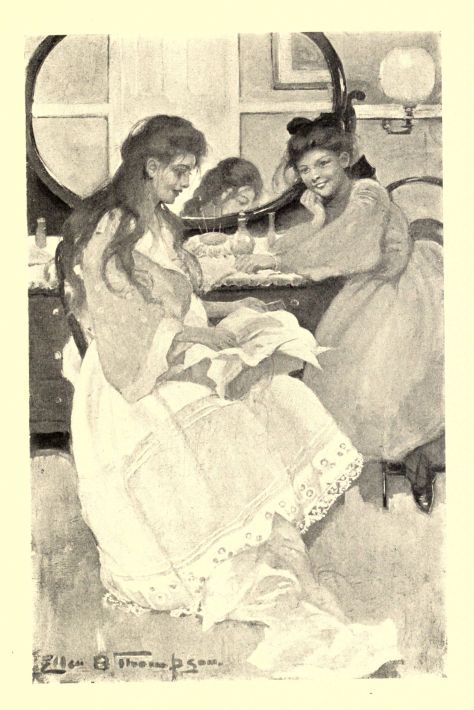
"The two girls leaned over the box as Hazel took off the wrapper"
Suddenly a shriek of laughter, followed by another, penetrated to Wilkins, who was lingering on the stairs; he came softly back again. Peal after peal of wild merriment issued from Rose's room. Within, Rose in her petticoat and bodice had flung herself on the bed in an ecstasy of mirth, and Hazel was rolling over on the rug as was the wont of Budd and Cherry in the old days on Mount Hunger. The maid looked from one to the other, and, no longer able to keep from joining in the merriment, although she did not know the cause, left the room, only to find Wilkins with perturbed face just outside the door.
"'Pears lake dere wor sumfin' queah 'bout dat ye re box--" he began; but the maid only shook with laughter and laid her finger on her lips, motioning him into the back hall.
"Did you ever?" cried Hazel, when she recovered her breath.
"No, I never," said Rose, wiping away the tears, for she had laughed till she cried. "Let's take another look."
They bent over the box, and took out its contents; then went off again into fits of seemingly inextinguishable laughter; for, neatly folded beneath the tissue paper, lay four sets of Jack's new light-weight, white silk pajamas, which he had purchased that afternoon, in order to take back to Cambridge with him. On the card, which Rose still held in her hand, was written, "Wear these for my sake."
"What will you say to him, Rose?" said Hazel, sitting up on the rug with her hands clasped about her knees.
"I don't know," said Rose, proceeding to dress. "I can't wear them, that's certain." And again the absurdity of the situation presented itself to her. "And I can't apologize for not wearing them. Neither can I take it for granted that he was going to send me flowers, and explain that he sent me these instead."
"How awfully careless," said Hazel, interrupting her; "he must have had something on his mind not to take the pains to look, even."
Rose flushed. "It will be best to let the matter drop, and say nothing about it," she replied in a cool, toploftical tone that amazed, as well as mystified, her little hostess.
"Why, Rose, I think Jack ought to know about it. I 'll tell him, if you don't want to."
"Thank you, Hazel, but I don't need your good offices in this matter."
Hazel rose from the rug, and going over to Rose, laid both hands on her shoulders and looked straight up into her eyes.
"Now, Rose Blossom, please don't speak to me in that way. You 're so queer! First you 're nice about Jack, and then you 're horrid; and when you 're that way, you are n't nice to me a bit--and I don't like it, and I don't blame Jack for not liking it either," she added emphatically. "I remember papa said a year ago that Jack was 'all heart' for a good many girls, old and young--but I can tell you what, he won't have any for you, if you whiff round so."
Hazel in her earnestness gave Rose a little shake. Rose smiled, and, bending her head, kissed her, saying, "F. and F. and you know, Hazel."
"Oh, I know all about 'forgiving and forgetting,' but I don't like it just the same. He's my cousin and the dearest fellow in the world, and I don't like to have him treated so."
"How about his treating me?" said Rose, pointing to the innocent box of underwear, "forgetting even to look; or not caring enough, to see if I had the right package?"
"Oh, that's different--perhaps the florist made a mistake."
"The florist!" Rose laughed merrily. "I never knew that gentlemen's underwear and roses grew on the same bush.--There 's Wilkins, and I 'm not ready."
"De coachman say it's a pow'f ul col' night, an' Miss Rose bettah take some mo' wraps."
"Thank you, Wilkins," Hazel flew into the dressing-room for a long fur cloak of her mother's which she had used to wear to the dancing-classes. She wrapped it about Rose, who stooped suddenly and kissed her again, whispering, "Hazel, you 've all spoiled me, that's what's the matter,--but I 'll be good to Jack, for your sake as well as for my own."
"Now you 're what Doctor Heath calls papa, the most splendid fellow in the world. There now--I won't crush your gown--" A kiss--"Good-night. You look like an angel!"
Mr. Clyde thought so, too, as he watched her coming downstairs. She slipped off the cloak as she stood beneath the soft, but brilliant hall lights. "Do I look all right?" she asked earnestly, for she had fallen into the habit, before going anywhere with him or Hazel, of asking for their criticism.
"I should say so--but where are the flowers? I miss them."
"I thought I wouldn't wear any to-night, just for a change."
"A woman's whim, Rose. But I can't say that you need them--Now, what's to pay?" he said to himself, as he helped her into the carriage. "I saw Jack at Dord's this afternoon, and, evidently, something was in the wind. I hope it has n't been taken out of his sails."
"Sumfin' mighty queah 'bout dat yere box," murmured Wilkins to himself, as he closed the door, "but Miss Rose doan' need no flow's. Nebber see sech h--Fo' de good Lawd! Wha' fo' yo' hyar? Yo' Minna-Lu,--skeerin' mah day-lights out o' mah, shoolin' 'roun' b'hin' dat por' chair,--jes' lake bug'lahs."
Minna-Lu gurgled. "Yo' jes' straight, Wilkins; nebber see sech ha'r. Huccome I 'se hyar? Jes' to see dat lillum-white angel--"
"Yo' go 'long, wha' yo' b'long," growled Wilkins, not yet having recovered from his fright. And Minna-Lu went, with the radiant vision still before her round, black eyes.
Jack felt a queer tightening about his lower jaw, and one heart-throb, apparently in his throat, as he entered Aunt Carrie's reception-room. Then, as with one glance he swept Rose from the crown of her head to the hem of her dress, a hot, rushing wave of indignant feeling mastered him--he knew he had staked his all (so a man at twenty-two is apt to think) and lost. He braced himself, mentally and physically. He was n't going to show the white-feather--not he.
But Rose--Rose was mystifying, captivating, cordial, merry, and altogether charming. She knocked out all Jack's calculations as to life, love, women, girls in general, and one girl in particular, at one fell swoop. He was brought, necessarily, into unstable equilibrium, so far as his feelings were concerned--his head he was obliged to keep level on account of the various figures. Several other heads were variously askew, and would have been turned, likewise, for good and all, had the wearer of her mother's India-mull wedding-dress been possessed of a fortune.
Rose developed social powers that evening that furnished food for conversation for Aunt Carrie and Mr. Clyde, who watched her with pride and pleasure. She was evidently enjoying herself thoroughly, and her enjoyment proved contagious.
"After all," said Jack as, between figures, he found opportunity for a whispered word or two; "this is n't half so fine a dance as the one in the barn, last September."
"Why, that's just what I was thinking, myself, that very minute!"
"You were?"
"Yes."
The brown eyes and the blue ones met with such evidence of a perfect understanding, that Jack failed to see Maude Seaton, who had approached him for the purpose of taking him out in the four-in-hand.
"Oh, I beg your pardon," said Jack, starting to his feet, "it's the 'four-in-hand.'"
"Yes, and I think you 'll have to be put into the traces again," she said, with a meaning smile.
"Not I," retorted Jack, merrily, "I kicked over them nearly a year ago."
"So I heard," replied Miss Seaton, sweetly; and Jack wondered what she meant.
When Jack found himself again beside Rose, he decided that, flowers or no flowers, he would ask for an explanation. But his first attempt was met with such a bewilderingly merry smile, and such confident assurance that explanations were not in order, that it proved a successful failure.
When, at last, in the early morning hours he was seated before the open fire in his bedroom, pulling away reflectively at his pipe, he had time to think it over. He came to the conclusion that it was trivial in him to have staked his all on her wearing those flowers, for she certainly--certainly had led him to think that she was anything but indifferent to him.
"That look now," mused Jack. "I don't believe that a girl like Rose Blossom would look that way if she didn't mean it--if she did n't care. No other girl could look that way." He reached for his watch on the dressing-case. "I shall get good two hours' sleep before that early train.--What's that?" He noticed for the first time, that on the bed lay a familiar-looking box in a brown paper wrapper. In a trice he had broken the string, whisked off the cover, scattered the tissue paper right and left.--There lay the violets, white, and sweet, and almost as fresh as when he gave them his virgin kiss nearly twelve hours before.
Jack sat down stupefied on the bed. What had he given her, anyway? He thought intensely for a full minute.
"Great Scott! the pajamas!" And then Jack Sherrill rolled over on the bed, ignoring the damage to dress suit and violets, and, burying his face in the pillow, gave vent to a smothered yell.
There was a merry exchange of notes between Cambridge and New York during the next two weeks, and Rose had promised to wear any flowers--and only his--he might send her for the ball at Mrs. Fenlick's the middle of February, and for which Jack was coming on. It would occur during the last week of Rose's visit, and Jack thought that possibly--possibly,--well, he could n't define just what "possibly;" but it proved to be an infinitely absorbing one, and Jack felt it was "now or never" with him.
Mrs. Heath had claimed Rose as her guest for the last three weeks, and the days were filled with pleasures. On the Saturday before the ball, and a week before Rose was to return to Mount Hunger, two seats in a box at the opera had been sent in to Mrs. Heath from a friend.
"Look at these, Rose!" Mrs. Heath exclaimed, showing her the note. "Just exactly what you were wishing to hear, and we thought we could not arrange it for next week. That opera has been changed for to-day's matinée, and now you can hear both Lohengrin and Siegfried."
Rose clapped her hands. "I 've just longed to hear Lohengrin; Mrs. Ford and her son have played so much of it to me. I think it's perfectly beautiful."
"I 'm so sorry I can't go, dear; but I made a positive engagement for this afternoon and it must not be broken. But I 'll send round for Cousin Anna May. She does n't care much for the opera, but she will chaperone you. She 's not much of a talker either, so you can enjoy the music in peace. People chatter so abominably there."
From the moment the orchestra sounded the first notes of that pathetic and thrillingly appealing fore-word of the overture, Rose was lost to the world about her. She was glad of the darkness, glad no one could see or notice her intense absorption in the opening scene. Even when the lights were turned on between the acts, and the subdued murmur in the house rose to a confusing babble, she was living in the story of Elsa and her lover Knight. Elderly Cousin Anna May, seeing this, let her alone, thinking to herself:--"One has to be young to be so enthusiastic over this wornout theme."
The curtain fell; the house was brilliant with lights; confusion of talk, confusion of merry chat and laughter were all about Rose; but she sat unheeding, wondering if the element of evil would be turned into a factor of good. Her heart was aching with the intensity of feeling for the two lovers. Suddenly, a few words behind her arrested her attention. She sat with her back to the speakers--two girls in the next box, who had annoyed her more than once by their ceaseless, whispering gabble.
"I told Maude I did n't believe it."
"What did she say?"
"She said it was gospel truth."
"Do tell me what it was, I won't tell."
"Sure?"
"Not a soul."
"Promise?"
"Why, of course. They say he 's got oceans of money."
"Piles--. He 's got his mother's fortune and will have his father's. Besides, his Uncle Gray is a bachelor, and so Jack will have that, too. Maude says he 's the best catch in New York."
"I heard Sam say he was in an awfully fast set in college; but Sam likes him awfully well. Have you seen him?"
"Oh, yes, lots. Maude let me see him one night before dinner at Newport. I used to see him playing polo at the grounds. I think he 's fascinating--just like Lohengrin."
"But what was it? Hurry up, do."
"You 'll never tell?"
"Never."
The voice was slightly lowered--confused with the munching of Huyler's; and Rose, with hypersensitive hearing, could distinguish only a word or two, or a detached sentence.
"I don't think that's so awful. Sam does that, too, and he 's just as nice a brother as I want."
"Oh, I don't know anything about that; but I know it's true, for Maude said so." In the increasing confusion of talk in the house, the voices were suddenly raised, and Rose caught every word.
"I 'll ask Sam--" began the other, dropping her opera glass and stooping to pick it up.
"If you do, Minna Grayson, I 'll never speak to you again."
"Oh, I forgot--" laughed the other. "Tell us some more, it's awfully exciting."
"I won't either," said the other, in a huffy tone. Evidently, they were school-girls in for the matinée.
"Oh, do; what did Maude say?"
"She said, 'No,'" chuckled the other triumphantly.
"But think of his money!'
"She said she did n't mind; she 's got money enough of her own, anyway, if she does skimp me on allowance ever since grandmamma died."
"I heard Sara say last Christmas when I was home for vacation, that he was perfectly devoted to that new girl the Clydes have taken up."
"Yes. Maude says it's one of his fads. She gives him six months more to get over it."
"Everybody says she is a perfect beauty. Sam says that Mrs. Fenlick says she is the most beautiful creature off of a canvas she has ever seen."
"Oh, Maude says Mrs. Fenlick raves over everything new. She, the girl, I mean, made a dead set at him a year ago when he happened to meet her up in the mountains. You know they had a riding-party last August. But now they say she seems to be setting her cap for Hazel's father--he has a million or two more than Jack, and she 's as poor as a church-mouse."
"I did n't know that,--poor?"
"Yes, awfully. Why, Maude says she's seen her selling berries for a living somewhere up in the mountains--oh, way back in them. People call them the Lost Nation, they 're so far back; and Maude says she wore patched shoes and an old calico dress--Sh!--Now we 're going to have that bridal march, is n't it dandy? It ought to be a part of the marriage ceremony, Maude says. I 'm so glad it's coming;--Tum, tum, ty tum--tum, tum, ty tum--here 's just one more candied violet--tum, tum, ty tum, tum, ty tum, ty ty tum, ty tum--Oh, look! Is n't Elsa just lovely--"
A burst of applause greeted the beautiful prima donna. Upon Rose's ears it fell like the thunder of a cataract, like the crash and roll of an avalanche. She stared at the exquisite scene before her with strained eyes. The music went on with all the troublous-sweet under-tones of love, and longing, and forever-parting. Not once did Rose stir until the curtain fell, then she turned to her companion:--
"Can we get out soon, Mrs. May? The air is a little close here."
"Certainly, my dear;" but to herself she said, "How intense she is. I 'm thankful I never was so strung up over music."
XXIV
"OLD PUT"
"Where 's Rose?" said the Doctor as he came in that Saturday evening, and heard no welcoming voice from the library or the stairs.
"She came home from the opera with a frightful headache and has gone to bed. She said she did n't want any dinner, but I have insisted upon her having some toast and tea," replied his wife.
"Humph!" growled the Doctor; "Our wild rose can't stand such hot-house atmosphere. When does the Fenlicks' ball come off?"
"Next Wednesday; it will be a superb affair. Rose showed me her card the other day, and if you will believe me, it's full, although Jack Sherrill gets the lion's share."
"How do you think things are coming on there, wifie?"
"Why, he's devoted to her whenever he can be; you know what Mrs. Pearsell told us about last summer, but--"
"But what?" said the Doctor, a little impatiently. "Generally, wifie, you can see prospective wedding-cake if two young people so much as look twice at each other."
Mrs. Heath laughed and nodded. "Yes, I know; but in just this case, I don't know. You can't tell anything by her--and I fear, hubbie, that Jack Sherrill is n't quite good enough for her."
"Not quite good enough for her!" The Doctor almost shouted in his earnestness. "Jack Sherrill not quite good enough for--"
"Sh--sh, dear!" His wife held up her hand in warning. "Someone might hear."
"Let 'em hear, then," growled the Doctor. "I say Rose is n't a bit too good for him.--Look here, wifie,--" he drew her towards him and down upon the arm of his easy-chair, "Jack's all right every time--do you understand? All right!"
"Ye-es," admitted his wife rather reluctantly. "I know he 's a great favorite of yours. But Mrs. Grayson says he 's in a very fast set at Harvard--
"Now look here, wifie, don't you let those women with their eternal hunger for gossip say anything to you about Jack. I tell you there is n't another fellow I know, who, placed as he is, can set up so many white stones to mark his short life's pathway as John Sherrill's only son. For heaven's sake, give him the credit for them. I know what I saw on Mount Hunger a year ago, and I know and believe what I see."
"Well, I only hope he won't flirt with her--" began Mrs. Heath. Her husband interrupted her:
"Flirt with her!" The Doctor chuckled. "I'll warrant Jack won't do any flirting with her--it 'll be the other way round sooner than that! Just say good-night to Rose for me when you go up stairs, and tell her if she is n't down bright and early Sunday morning, I 'll prescribe for her."
But there was no need for the Doctor's prescription; for Rose was down for breakfast, and although white cheeks and heavy eyes caused the Doctor to draw his eyebrows together in a straight line over the bridge of his nose, nothing was said of there being any need for a prescription. But after breakfast he drew her into the library and placed her in an easy-chair before the blazing fire.
"There now," he said in his own kindliest tones, "sit there and dream while wifie makes ready for church, and after that you shall go with me for an official drive. The air will do you good. I can't send such white roses"--he patted her cheek--"back to Mount Hunger; what would mother say?"
To his amazement Rose buried her face in both hands; a half-suppressed sob startled him.
"Why, Rose-pose! What's the matter, little girl? Headachey--nerves unstrung--too much opera? Here, come into the office where we shan't be disturbed, and tell me all about it."
But Rose shook her head, lifted it from her hands, and smiled through the welling tears.
"I 'm a perfect goose, but--but--I believe I 'm getting just a little bit homesick for Mount Hunger, and I 'm not going to stay for Mrs. Fenlick's ball. I know mother needs me at home--I can just feel it in her letters, and I know I want--I want her."
"Don't blame you a bit, Rose,--but is n't this rather sudden? Any previous attacks?"
"No--and I know it seems dreadfully ungrateful to you and dear Mrs. Heath to say so, and it is n't that--I 'd love to be with just you two; but it's this dreadful feeling comes over me, and I know I ought to go."
"And go you shall, Rose," said the Doctor, emphatically, but oh! so kindly and understandingly. "Go back to all the dear ones there--and when you come again, don't give us the tail-end of your visit, will you?"
"Indeed, I won't," answered Rose, earnestly, "and if it were only you and Mrs. Heath, I 'd love to stay, but--but--"
"No need to say anything more, Rose, wifie and I understand it perfectly--" ("I wish the dickens I did!" was his thought)--"Tell wifie when she comes down, and meanwhile I 'll send round for the brougham and we 'll take a little drive in the Park before office hours."
Rose patted his hand, and her silence spoke for her.
"Here 's a pretty kettle of fish!" said the Doctor to himself as he went to the telephone. "I wish I could get to the bottom of it."
And thus it came about that a cool, dignified note, not expressive of any particular regret, was mailed to Cambridge on Sunday afternoon, and a long letter to Mount Hunger telling them to be sure to meet her on Tuesday at Barton's, and filled with wildly enthusiastic expressions of delight in anticipation of the home-coming. And on Tuesday afternoon, as the train sped onwards, following the curves of the frozen Connecticut, and the snow-covered mountains on the Vermont side began to crowd its banks, Rose felt a lightening of the heart and an uplifting of spirits.
The bitterness and shame and shock she had experienced, in consequence of that one little bite of the fruit of the Tree of the Knowledge of Good and Evil, seemed to diminish with every mile that increased the distance between her and the frothing whirlpool of the great city's gayeties. All the way up, until the mountains loomed in sight, there had been hot, indignant protest in her thoughts. At first, indeed, it had been hatred.
"I hate it all--hate it, hate it!" she found herself saying over and over again after the good-byes had been said at the station, and Hazel and Mr. Clyde and Doctor Heath had supplied her with flowers and magazines for the long day's journey. It was all she could think or feel at the time; but soon the little pronoun changed, and the thought grew more bitter:
"I hate him! How could he--how dared he do as he did! Because I am poor, I suppose. Oh! I wish I could make him pay for it. I wish I could make him love me really and truly, and then just scorn him! But what a fool I am--as if he could love after what I heard--oh, why did I hear it! I wish I may never see his face again, and I wish I 'd stayed at home where I belong--I hate him!"--And so on "da capo" hour after hour, and the incessant chugetty-chug-chug of the express furnished the rhythmic, basal tone for the bitter motive.
It was long after lunch time, and the train of thought had not changed, when Rose's eye fell upon the dainty basket Martin had placed in the rack.
"This is a pretty state of mind to go home to Martie in!" she said to herself, rising and taking down the basket. "I have n't eaten a good meal since last Saturday at lunch, and I 'm--why, I believe I 'm hungry!"
She opened the basket, and loving evidence of Minna-Lu's admiration tempted her to pick a little here and there--a stuffed olive or two, a roast quail, a delicate celery sandwich, a quince tart, a bunch of Hamburg grapes. Soon Rose was feasting on all the good things, and her harsh thoughts began to soften. How kind they all were! And they truly loved her--and what had they not done for her comfort and pleasure! Rose, setting her pretty teeth deep into a third quince tart, looked out of the window and almost exclaimed aloud at the sight. The vanguard of the Green Mountains closed in the upper end of the river-valley along which they were speeding. It was home that was behind all that! The thought still further softened her.
What? Carry her bitterness and disappointed pride back into that dear, peaceful home? Not she! "They shall never know--never!" she said to herself--"I 'm not Molly Stark for nothing, and there are others in the world beside Jack Sherrill." And so she continued to speak cold comfort to herself for the next four hours until the brakeman called "Barton's River!"
There beyond the platform was the old apple-green pung!--and yes! father and March and Budd and dear old Chi anxiously scanning the coaches.
Home at last! and such a home-coming! How busy the tongues were for a week afterwards! How wildly gay was Rose, who kept them laughing over the many queer doings of the metropolis, over Wilkins and Minna-Lu and Martin and Mrs. Scott! And how lovingly she spoke of Hazel's charming hospitality and of Mr. Clyde's thoughtfulness for her pleasure, although, as she mentioned his name, a wave of color mounted to the roots of her hair at the ugly thought that would intrude. Chi listened with all his ears, enjoying it with the rest; but once upstairs in his room over the shed, he would sit down on the side of his bed to ponder a little the gay doings of his Rose-pose among the "high-flyers," and then turn in with a sigh and a muttered:
"'T ain't Rose-pose. I knew how 't would be.--There 's a screw loose somewhere; but she's handsome!--handsome as a picture, 'n' I 'd give a dollar to know if she 's cut that other one out."
"Valentines seem kind of scarce this year," he remarked rather grimly, a few days after her arrival, as late in the afternoon, he returned from Barton's with little mail and no boxes of flowers. "It's the sixteenth day of February, but it might be Fast Day for all that handful of mail would show for it!" He placed the package on Mrs. Blossom's work-table at which Rose was sitting busy with some sewing. They were alone in the room.
Rose laughed merrily. "Goodness, Chi! you want us to have more than our share. We had a perfect deluge last year when Hazel was here; you know it makes a difference without her. You said yourself that there was a good deal of bulk, but it was pretty light weight--don't you remember?"
Chi elevated one bushy eyebrow. "I ain't forgot; but I don't know about it's bein' any Deluge--it appeared to me it was a Shadrach, Meshach, 'n' Abednego kind of a business--" He gave the back log a kick that sent the sparks up the chimney in a grand pyrotechnic show. "Seems as if I could see those posies, now, a-shrivellin' in the fireplace. Never thought you treated those innocent things quite on the square, Rose-pose!"
Rose's head was bent low over her work. Chi went on, bracing himself to the self-imposed task of enlightening her:--
"I don't want to meddle, Rose, in anybody's business, but it ain't set well with me ever since--the way you treated those roses; 'n', after all, we 're both members of the Nobody's Business But Our Own Society, 'n' if anybody 's goin' to meddle, perhaps I 'm the one. I 've thought a good many times you would n't have been quite so harsh with 'em, if you had n't overlooked this in your flare-up--" He drew out of his breast pocket a card--Jack 's--with the verse on the back. "Read that, 'n' see if you ain't dropped a stitch somewhere that you can pick up in time." He handed her the card.
Rose looked up surprised, but with burning cheeks. She took the card, read the verse, turned it over on the name side, and rose from her chair. Every particle of color had left her face. She went over to the fireplace, and, bending, dropped the little piece of pasteboard upon the glowing back-log.
"The sentiment belongs with the roses, Chi; don't let's have any more Shadrach, Meshach, and Abednego business--I 'm tired of it." She spoke indifferently; then, resuming her seat, called out in a cheery voice:
"Martie, won't you come here a minute, and see if I have put on this gore right?"
"I 'll come, dear."
Chi, nonplussed, irritated, repulsed, set his teeth hard and abruptly left the room.
Outside in the shed he clenched his fist and shook it vigorously at the closed door of the long-room: "--By George Washin'ton!" he muttered, "I 'll make you pay up for that, Rose Blossom. You can't come any of your high-flyers' games on me-- Just you put that in your pipe and smoke it! Thunderation! what gets into women and girls, sometimes?" He seized the milk-pails from the shelf and hurried to the barn nearly running down Cherry in his wrathful excitement.
"Look out there, Cherry! You 're always getting round under foot!" he said, harshly, and stumbled on, regaining his balance, only to be met by Budd in the barn.
"Just clear out now, Budd! I ain't goin' to stand your foolin'. Let alone of that stanchion," he roared. "Always worryin' the cow if she looks once at you sideways. Get up, there--" His right boot helped the amazed cow forwards into the stall, and the milk drummed into the pail as if the poor creature were being milked by a dummy-engine with more pressure of steam on than it could well stand.
Budd flew into the woodshed and found Cherry still standing, in a half-dazed condition, where Chi had left her. They compared notes immediately to the detriment and defamation of Chi's character. Then they carried their budget of woe to their mother.
"Chi is worried, children; you must n't mind if he is a little cross now and then. He feels dreadfully about the prospect of this war, as we all do, and that's his way of showing it."
"Well, if he's going to be so cross at us, I wish he 'd clear out an' go to war!" retorted Budd, smarting under the unjust treatment.
"I 'm only afraid he will if we have one," said Mrs. Blossom, sadly. "But, oh, I hope and pray we may be spared that!"
But Budd continued to grumble, and Cherry to be suspiciously sniffy, until their father's return; and then at the supper table they listened greedily to all the talk of their elders, that had for its absorbing theme the prospective war.
As the spring days lengthened, and the sun drew northward, the tiny cloud on the country's peaceful horizon grew larger and darker, until it cast its shadow throughout the length and breadth of the land, and men's faces grew stern and troubled and women prayed for peace.
With the lengthening days Chi showed signs of increasing restlessness. "It ain't any use, Ben," he said, one soft evening in early May, as the family, with the exception of the younger children, sat on the porch discussing the latest news, "I 've got to go."
"Oh, Chi!" broke from Mrs. Blossom and Rose. They cried out as if hurt. Mr. Blossom grasped Chi's right hand, and March wrung the other.
"I can't stand it," he went on; "we 've been sassed enough as a nation, 'n' some of us have got to teach those foreigners we ain't goin' to turn the other cheek just coz we're slapped on one. When I wasn't higher than Budd, my great-grandfather--you remember him, Ben, lived the other side of the Mountain--put his father's old Revolution'ry musket (the one, you know, Rose-pose, as I 've used in the N.B.B.O.O.) into my hands, 'n' says: 'Don't you stand no sass, Malachi Graham, from no foreigners.--Just shoot away, 'n' holler, "Hands off" every time, 'n' they 'll learn their lesson easy and early, 'n' respect you in the end.' And I ain't forgot it."
"Chi," Mrs. Blossom's voice was tremulous, "you won't go till you 're asked, or needed, will you?"
"I ain't goin' to wait to be asked, Mis' Blossom; I 'd rather be on hand to be refused. That's my way. So I thought I 'd be gettin' down along this week--"
"This week!" Rose interrupted him with a cry and a half-sob. "Oh, Chi! dear old Chi! must you go? What if--what if--" Rose's voice broke, and Chi gulped down a big lump, but answered, cheerily:
"Well, Rose-pose, what if? Ain't I Old Put? 'n' ain't you Molly Stark? 'n' ain't Lady-bird Barbara Frietchie?--There, just read that--" he handed a letter to March, who gave it back to him, saying, in a husky voice, that it was too dark to read.
"Well, then we 'll adjourn into the house, 'n' light up.--There now," he said, as he lighted the lamp and set it on the table beside March, "here's your letter, Markis, read ahead."
March read with broken voice:
4 EAST --TH STREET, NEW YORK, May 5, 1898.
DEAR FRIEND CHI,--I never thought when I joined the N.B.B.O.O. Society, that I 'd have to be really brave about real war;--and now dear old Jack is going off to Cuba with Little Shaver and all those cow-boys,--and it's dreadful! Uncle John is about sick over it, for, you know, Jack is all he has. Papa is going to keep the house open all summer; he says there is no telling what may happen.
We have made no plans for the summer, for our hearts are so heavy on Jack's account--his last year in Harvard, too! He told me to tell you he would find out if there is a chance for you in the new cavalry regiment he has joined. He looked so pleased when I told him; he read your letter, and I told him how you wanted to go with him, and he said: "Dear old Chi, I'd like to have him for my bunkie"--and told me what it meant. He told me to tell you to be prepared for a telegram at any moment.
I must stop now; papa wants me to go out with him. Give my love to all, and tell Mother Blossom and Rose I will write them more particulars in a few days.
If you come to New York, you know a room will be ready for you in the home of your
Loving friend,
HAZEL CLYDE.
There was silence for a while in the room; then Mr. Blossom spoke:
"How are you going, Chi?"
"I 'm goin' to jog along down with Fleet, 'n' take it kind of easy--thought I 'd cross the Mountain, 'n' strike in on the old post-road; 'n' follow on down by old Ticonderogy,--I 've always wanted to see that,--then across to Saratogy 'n' Albany, 'n' foller the river. You can't go amiss of New York if you stick to that."
Again there was a prolonged silence. Chi hemmed, and moved uneasily on his chair, while he fumbled about in his trousers' pocket. He pulled out a piece of crumpled, yellow paper.
"S'pose I might just as well make a clean breast of it." He tried to laugh, but it was a failure. "Jack's telegram came along last night, 'n' I thought, maybe I 'd better be gettin' my duds together to-night, Mis' Blossom, as 't will be a mighty early start--before any of you are up," he added, hastily.
The two women broke down then, and Mr. Blossom and March followed Chi out to the barn.
The household, save for the younger children, was early astir--before sunrise. Mrs. Blossom had prepared a hearty breakfast, and Rose was rolling up a few pairs of her father's stockings to put in the netted saddle-bag which Chi was wont to use in hunting.
"Tell March to call Chi, Rose," said her mother. "His breakfast is ready, I hear him in the barn."
Rose ran out in the dawning light to find her father and March just coming towards the house.
"Why, where 's Chi?" she cried.
For answer, her father pointed to the woodlands. She looked just in time to see in the soft gray of the early morn the horse and rider rise to the three-railed fence that separated the pasture from the woodlands. He was following the trail he had indicated to Jack--"through the woods 'n' acre or two of brush, 'n' then some pretty steep sliding down the other side, 'n' a dozen rods or so of swimmin', 'n' a tough old clamber up the bank--"
Some ten days afterward, late on a warm afternoon in May, there rode into New York City by the way of the Bronx and Harlem, a middle-aged man on a bright bay horse. The animal's gait was a noticeable one, a long, loping gallop, that covered the ground in a manner that roused the admiration of the drivers on the speedway. The tall, loose-jointed body of the rider apparently loped along with the horse--their movements were identical. The saddle was an old-fashioned cavalry one of the early sixties. A netted saddle-bag and a rolled rubber coat were fastened to the crupper. A light-weight hunting rifle was slung on a strap over the man's shoulder. At the northern entrance to the Park he drew rein beside a mounted policeman.
"Can you tell me if I 'm on the right track to this house?"
He took a card from the pocket of his dusty blue flannel shirt and handed it to the policeman.
The city guardian nodded assent. "But you can't take that gun along with you; you 're inside city limits and liable to arrest."
"'Gainst the law, hey? Well, I 've come from a pretty law-abiding state, 'n' ain't goin' to get into rows with you fellers--" He laid a brown, knotty, work-roughened finger on the policeman's immaculate blue coat--"I 'd trust that color as far as I could see. Where shall I leave the rifle?"
The city guard unbent as the kindly voice yielded such undefiant obedience to his demand. "You can leave it with me now,--I 'm off my beat by seven, and live over east of this--" he handed back the card--"and I 'll leave it at the house if you 're going to be there."
"All right, that 'll suit me. Yes, I 'm goin' to put up there for a day or two, maybe."
"Off on a hunting trip?"
"You bet--goin' on a big, old, U.S.A. hunt for a lot of darned foreigners in Cuby."
The policeman held out his hand and grasped the stranger's. "You're one of them?"
"Yes, I come down to join a cavalry regiment. Jack Sherrill, he belongs, too. Great rider--can't be beat. Ever seen him round here on Little Shaver?"
The policeman smiled. "No, but I 'd like to see you again--"
"Maybe you will; but I 'd better be getting along before sundown,--'gainst the law to ride this horse a piece through those woods?" He pointed into the Park.
"Oh, no, that's all right. Keep along till you come to Seventieth Street, and inquire; and then turn into Fifth Avenue--east--and you're there."
"Much obliged. Like to show you a trail or two up in Vermont when you come that way. Get, Fleet." The animal set forward into a long, loping gallop.
The brilliant, light green of the May foliage was enhanced by the level rays of the setting sun, as the man turned his horse into Fifth Avenue and drew rein to a rapid walk. Many a one paused to look at him as he paced over the asphalt. He was looking up at the mansions of the Upper East Side. Soon he halted at the corner of a side street and gazed up at the first house, the end of which, with the conservatory, was on the Avenue, but the entrance on the side street. "That's the place," he spoke to himself,--"don't see a hitchin'-post handy, so I 'll just have to tie up to this electric light stand. Iron, by thunder!--Well, there ain't any risk so long as 't isn't lit, 'n' there ain't a tempest."
Leaving his horse firmly tied to the standard he stepped up on the low, broad stoop of "Number 4," and looked for the bell. Not finding any he knocked forcibly on the carved iron grill that protected the plate-glass doors.
The great doors flew open, and a face--"blacker 'n thunder"--as the man said to himself, scowled on the interloper.
"Wha' fo' yo' come hyar, yo'--" He got no further. A horny hand was extended, and a cheery voice, that broke into a laugh, spoke the assuaging words:
"Guess you 're Wilkins, ain't you? I 've heard Lady-bird tell 'bout you till I feel as if we 'd been pretty well acquainted goin' on nigh two year now."
By this time Wilkins' face was one broad beam. He slapped his free hand on his knee:
"Yo 's Mister Chi, for sho'--dere ain't no need yo' tellin'. Yo' jes' come straight in, Mister Chi; Marse John an' little Missy jes' gone fo' ah drive in de Park. Dey 'll be in any minute. Yo' room 's all ready, an' little Missy put de flow'rs in fresh dis yere mornin'--''Case,' she say, 'Wilkins, dere ain't no tellin' when Chi's comin'.'"
"Sho'," Chi interrupted him, brushing the back of his hand hastily across his eyes. "I can't come in now, Wilkins, coz I 've got to stay here 'n' watch my horse--I 'll sit here on the steps a spell 'n' cool off till Mr. Clyde gets home, 'n' he 'll help me see to puttin' up Fleet for the night. His legs are a little mite swollen near the hocks, 'n' I 'm goin' to rub him down myself."
"De coachman jes' tend to yo' hoss like 's ef 't wor yo'se'f, Mister Chi. I 'll jes' call up de stable bo', 'n' he 'll rub him down wif sp'r'ts, an' shine him up till he look jes' lake new mahog'ny. Jes' yo' come--dere dey come now!"
Chi was at the curbstone to welcome them.
"Chi! O Chi!" Hazel rose up in the trap at sight of the well-known figure, and Chi, laying his hand firmly on Martin's shoulder, put him aside as he sprang to open the door and let down the steps, reached up both arms, and took Hazel out as tenderly as on the night of her first arrival at the farmhouse on the Mountain. And then and there Hazel gave him a kiss, and Mr. Clyde grasped his hands in both his, and the wide hall doors that Wilkins had thrown open to their fullest extent closed upon the reunited friends.
"'E 's a 'ansome 'oss," Martin remarked to the coachman, as he mounted Fleet to take him to the stable; "Hi 'ave n't seen a 'ansomer since Hi 've bean in the States."
A few days after the hall doors were again flung wide, but not to their fullest extent, and Wilkins' face grew strangely tremulous when he heard Hazel and Mr. Clyde, Jack and Chi coming down the broad hall stairs. Martin was proudly leading Fleet and Little Shaver up and down in front of the house.
"Jack! O Jack! I can't bear to have you go--but I will be brave." Hazel smiled through the raining tears. She clung to him and kissed him. He put her aside, ran out to Little Shaver, and flung himself on before Chi had said good-bye.
"Take care of Jack, Chi," she whispered, patting his hand.
"I will, Barbara Frietchie." He pointed to the flag that, in the east wind blowing in from the Sound, was waving over the entrance, gripped Mr. Clyde's hand, then Wilkins', and, apparently, stepped into the saddle.
"Quick, quick, Wilkins! lower the flag, and let me have it." Wilkins sprang to obey. Hazel seized it, and rushed up stairs to the drawing-room, the windows of which overlooked the Avenue. One of them was open; she leaned out; and as Fleet and Little Shaver turned the corner, their riders, looking up, saw the young girl's figure in the opening. She was waving the symbol of their Country's life and their manhood's loyalty.
They halted, baring their heads for a moment--then without once looking back, galloped down the Avenue.
XXV
SAN JUAN
Notwithstanding it was a hot day in the first week of July, Mrs. Spillkins had decided to have a "quilting-bee." Having made up her mind, after consulting with Miss Melissa and Miss Elvira, she lost no time in summoning Uncle Israel from the barn, and making known her plans. Uncle Israel mildly objected.
"Kinder hot fer er quiltin'-bee, ain't it, Hannah?"
"'Tis pretty hot," Mrs. Spillkins admitted, wiping the perspiration from her face with her apron, "but we 'll have it to-morrow 'long 'bout four. You get the frames and rollers out, Israel, from the back garret, an' then I want you to go up to Mis' Blossom's an' ask 'em to come, an' get word to the other folks on the Mountain."
"I 'll go, Hannah, but I dunno 'bout Mis' Blossom 'n' Rose comin' ter er quiltin'-bee jest 'bout this time. They 're feelin' pretty low 'bout Chi off thar in Cuby; news hez come thet ther 's ben fightin'--"
"I know that, Israel; I 've thought of that, too; but, mebbe, it 'll do 'em good, just to change the scene a little. Anyway, you ask 'em."
"Jest ez ye say, Hannah."
The sun was setting when Uncle Israel made his appearance on the porch where the whole family was assembled with Alan Ford. They had but one topic for conversation.
Uncle Israel gave his invitation, and added: "Hannah thought ye 'd better come 'n' change the scene a leetle--she knowed ye 'd be kinder low-spereted 'bout now."
Mrs. Blossom held out her hand. "Thank you, Uncle Israel. Tell Mrs. Spillkins we will both come."
"Hannah wants your folks ter come, tew, Alan."
"Much obliged, Uncle Israel. I 'll tell mother and Ruth; I 'm sure they will enjoy it. Ruth said the other day she wished she might have a chance to see a quilting-bee while we are here. Shall I take your message over to Aunt Tryphosa?"
"Much obleeged, Alan. Thank ye, Rose,"--as Rose brought out the large arm-chair and placed it for him; "I 'll set a spell 'n' rest me."
It was a typical northern midsummer night. Across the valley the mountains loomed, softly luminous, against the pale green translucent stretch of open sky in the west. There were no clouds; but high above and around there swept a long trail of motionless mist, flame-colored over the mountain tops, but darkening, with the coming of the night, into gray towards the east. The stars were not yet out. The veeries were choiring antiphonally in the woodlands.
An hour afterwards Alan Ford rose to go, and Uncle Israel soon followed his example.
"I 'll go down the woods'-road a piece with you, Uncle Israel," said Rose.
As she came back up the Mountain a cool breath drew through the pines, and the spruces gave forth their resinous fragrance upon the dewless night. The stars were brilliant in the dark blue deeps.
A midsummer night among the mountains of New England! And far away in the sickening heat and wet, the fever-laden exhalations of the tropics rose into the nostrils of a man, who sat motionless in the rude field-hospital, hastily improvised on the slope of San Juan, watching, with his knees drawn up to his chin and his hands clasping them, for some faint tremor in the still face on the army blanket spread upon the ground.
The lantern cast its light full upon that still face. Suddenly the watcher bent forward; his keen eyes had detected a twitch of an eyelid--a flutter in the muscles of the throat. "Don't move him," the surgeon had said; "the least movement will cause the final hemorrhage."
There was a catch of the breath--the eyes opened, partly filmed.
"Jack!" The watcher spoke, bending lower; his ear over the other's lips.
"Chi--" it was a mere breath, but the man heard--"I'm--done for."
The watcher's hand, muscular, toil-hardened, sought the nerveless one that was lying on the other's breast, and closed upon it with a brooding pressure. There was silence for a few minutes. Then the horny hand felt a feeble stirring of the fingers beneath the hardened palm--they were fumbling weakly at a button.
The strong hand undid the button, gently--very gently, without apparent movement. There was a motion of the nerveless fingers towards the place. Another breath:--
"Give--love--"
A long silence fell.
Mrs. Spillkins heaved a sigh of satisfaction: "We 've done an awful sight of work," she said, surveying the five quilts "run" and "tacked" and "knotted" in even rows and mathematically true squares; "but it seems as if they did n't eat a mite of supper, an' that strawberry shortcake was enough to melt in your mouth."
"What'd I tell ye, Hannah? They're worretin' 'bout Chi," said Uncle Israel. "They've fit agin; Ben told me while he wuz waitin' with the team fer the womin-folks. He hed the mail, 'n' er telegram thet thet young feller, we see ridin' 'roun' here las' summer, wuz mortal wounded. He did n't want the womin-folks ter know it till he got 'em hum. They sot er sight by him."
Mrs. Spillkins threw up her hands: "Dear suz'y me!" she exclaimed in a distressed voice. "What 'll they do! I hope an' pray Malachi Graham ain't hurt none. I feel as if I ought to go right up there, an' see if there 's anything I can do."
"Better wait till the Cap'n comes hum, Hannah; he 'll hev the papers."
"I guess 't would be better," and Mrs. Spillkins proceeded to fold up her quilts and "clear up" the best room.
The hot July days warmed the breast of the Mountain. Over in the corn-patch the stalks had spindled and the swelling ears were ready to tassel. By word or look Rose had given no sign--and her mother wondered. The days wore on; the routine of daily work and life went on; but the younger children's voices were subdued when they spoke lovingly and longingly of Chi, and Rose sang no longer when she kneaded bread. They were days of suspense and heart misery for them all.
Two weeks had passed since that evening when Mr. Blossom had read to them the fatal despatch. No word had come from anyone save Hazel, who wrote that her father and Uncle John had started at once for Cuba, and that she hoped to be with the Blossoms the third week in July, for by that time they would know the whole truth.
They had been making ready Hazel's little bedroom, for she was expected in a few days. Rose was tacking up a white muslin curtain at the small window, when she heard her father call:
"Rose, come here a minute."
"Yes, father."
She went out on the porch with the hammer in her hand. "What is it, Popsey dear?--Why, father, what--oh what--!"
With shaking hand her father held out a letter to her. Rose looked once--it was from Chi!
"I wish mother were here, daughter--but she'll be back soon. Let me know how it is with them all--." Mr. Blossom could say no more, for Malachi Graham was as near to him as a brother, and he was agonizing for his child. He went off to the barn, leaving Rose standing on the porch, staring as if fascinated at the superscription of the letter:
To Miss Rose Blossom,
Mill Settlement, Barton's River, Vermont.
N.B.B.O.O.--To be opened by nobody but her.
Rose laid down the hammer mechanically, opened the envelope, and unfolded the piece of brown paper from out of which fluttered to the floor another and thicker slip, stained almost beyond recognition. With staring eyes and face as white as driven snow she read the few words scrawled in pencil on the brown slip:--
DEAR ROSE-POSE,--I ain't no wish to meddle with anybody's business--but I 'm just obeying orders. The last words I heard Jack Sherrill speak, was "Give--love," and he fumbled at his breast to get out this enclosed. I ain't read it--but it's his heart's blood that's on it. Give my love to all.
Yours forever,
CHI.
"His heart's blood!" For a moment the words conveyed no meaning. She picked up the iron-rusty brown slip from the floor; unfolded it; read--Barry Cornwall's love-song in her own handwriting!
"His heart's blood!" She pressed one hand hard upon her own heart, crushing with the other the dark-stained slip. Then, with one wild look around her as if searching for help, she ran down the steps, across the mowing, over into the pasture and up into the woodlands. Deep, deep into the heart of them she made her way, as her mother, Mary Blossom, had done before her; but now there was no kneeling, no prayer, no petition to take from her the intolerable pain.
She was young, and she loved as the young love. It was not God whom she wanted; it was "Jack! Jack! Jack!" She cast herself face down upon the ground, and moaned in her agony: "His heart's blood--his heart's blood." She pressed the stained paper to her lips, over and over again. Then she opened her blouse and baring her bosom, laid the love-song against it--"His heart's blood--his heart's blood!"
So her mother found her.
XXVI
MARIA-ANN'S CRUSADE
Of late Aunt Tryphosa had been growing suspicious of Maria-Ann, and the latter felt she was being watched; to use her own words, "it nettled her."
One afternoon, late in August, her grandmother, coming upon her rather suddenly in the pasture as she sat under the shade of a patriarchal butternut, ostensibly watching Dorcas, asked her sharply:
"What you doin', Maria-Ann?"
"'Tendin' to my own business," retorted Maria-Ann, with an unwonted snap in her voice, and hurriedly folded something out of sight beneath the Hearthstone Journal which lay upon her lap.
This was the signal of open revolt on the part of her granddaughter, and the like had occurred but once before in all the time of her up-bringing with Aunt Tryphosa. The old dame's lips drew to a thinner line than usual, as she fired the second shot into the hostile camp:
"You been cryin', Maria-Ann."
"What if I be?" demanded her granddaughter, with a flash of indignation from beneath her reddened eyelids. "S'pose I have a right to have feelin's same as other folks."
Suddenly Aunt Tryphosa swooped like a hen-hawk upon a small piece of bright scarlet flannel, that the breeze had caught away from the protecting folds of the Hearthstone Journal, and landed in the covert of sweet fern just at her feet.
"What's that?" She held up the glowing bit of color, dangling it before Maria-Ann's eyes.
Upon poor Maria-Ann's inflamed sense of injustice, it had much the same effect as a red rag waved before the eyes of an infuriated bull.
She sprang to her feet, snatched the bit of cloth from between her grandmother's thumb and fore-finger, and thrust it into her dress waist, crying out shrilly in her unwonted excitement:
"You let that be, Grandmarm Little! It's my cross and I 'm going on a crusade--so now!"
Aunt Tryphosa sat down rather suddenly in the middle of the sweet-fern patch. Was Maria-Ann going crazy? Her breath came short and sharp; she drew her thin lips still more tightly, and, although really alarmed, braced herself for the combat.
"What 'd you say you was goin' on, Maria-Ann?"
"I never knew you was growin' deef before, grandmarm; I said a crusade." She had raised her voice to a still higher pitch, as she stooped to gather up the Hearthstone Journal, the bits of red cloth, her scissors, and thimble which had fallen from her lap as she sprang to her feet.
"Is that the thing you read me about last winter in the Journal, with the soldiers with crosses on their backs on hosses startin' out for Jerusalem?" demanded the old dame, but in a strangely agitated voice.
"Yes," responded Maria-Ann, promptly, but with less acerbity of manner.
"And is that red rag you hid away a cross, Maria-Ann Simmons?" No words can do justice to the old dame's tone and its implied impiety of her granddaughter's conduct.
Maria-Ann was silent.
"Be you a Christian girl, or an idolater, Maria-Ann?"
Her grandmother's voice shook pitiably. Maria-Ann's conscience gave a twinge, when she heard it; but she felt the time was ripe, and she must put in the sickle.
"I hope I 'm a Christian, grandmarm, but I 'm an idolater, too,--" Aunt Tryphosa drew in her breath, as if hurt. "But, anyway, I guess I was an American 'fore I was a Christian, an' I jest idolize my Country--" Maria-Ann's eyes filled with tears--"an' I can't do anything for her, nor make sacrifices same as other women do who can send their husbands--," a sob, "an' lovers--," another sob, "an' nuss 'em, an' help on their Country's cause livin' 'way up here in an old back paster with an old cow--an' an old wo--Oh, grandmarm!" Maria-Ann broke down utterly, laid her head upon her knees, and sobbed unrestrainedly.
It was an unusual sight, and Aunt Tryphosa was troubled. She felt it necessary to beat a retreat in the face of such genuine grief, but she was determined that it should be a dignified one.
"I ain't never seen you give way so, Maria-Ann, and you 're thirty-one year old come next January. I 've done my best to bring you up right, an' now you 're old enough to know your own mind, I hope; so, if you want to leave me, you can go jest as soon as you can get ready. I come up for Dorcas, an' now I 'm goin' home." In spite of her effort her old voice trembled, but her pride sustained her nobly, and Maria-Ann was all unaware that the tears were rolling down the wrinkled furrows in the old cheeks as her grandmother drove Dorcas before her down the fern-scented pasture slope.