Front matter (continued 3)
Reading edition
"This is a kind of stockholders' meetin'," said Chi, as the piles were completed. "We 'll divide the proceeds accordin' the number of hens each set; coz I could n't keep run of so many chicks after they'd struck out for themselves."
He opened his book.
"Here 's some items you better hear, before you find any fault with the management:
"Mem. July. 15 chicks killed by hen-hawks.
"Mem. August. 21 chicks died of the pip.
"Mem. September. Skunks stole ten.
"Mem. October. 2 can't find.
"There 's a dead loss to all the stockholders, share 'n' share alike. Now for expenses:
"Mem. Corn for feed till October--7 bushels.
"Mem. November. Express, $5.50. Crates expressin'--$1.10. Now for the profits!" said Chi, with a ring of triumph in his voice. "Count up your piles."
How the cheeks flushed and the eyes grew dark with excitement as the counting proceeded: "One hundred--one hundred and thirty-two--one hundred and seventy-seven--two hundred!"
"Oh-ee!" cried Hazel, as March fairly thundered "Two hundred!" "There 's more, there 's more!"
"Go on, go on!" she cried again, almost beside herself with excitement.
"Two hundred and seven--TWO HUNDRED AND SEVENTEEN!!"
"Chi!" exclaimed Rose, almost breathless, "How did you make all that?" and thereupon, without waiting for his answer, she sprang up from her chair, and, to Chi's amazement, took his weather-worn face between her two hands, and popped a kiss upon his forehead.
Chi cleared his throat and attempted to make his explanation, but was interrupted by March, who got hold of his right hand and wrung it without speaking. Chi saw the boy turn a little white about the mouth and his gray eyes flash through tears; words were not needed.
Budd and Cherry did not realize all this meant to the elder brother and sister, but they did not wish to be outdone by the others in expressing their appreciation of Chi. So Budd thumped him unmercifully on the back, saying, "You 're a trump, Chi; tell us how you did it," in a most patronizing tone, and Cherry danced around the table, singing; "I love my Love with a big, big C!"
Hazel looked on, rejoicing in their joy, but wondering why such a little sum, less than her yearly allowance, should create all that happiness.
"But tell us how you did it, Chi," said Rose again.
"Well, I sold most of them for broilers, they bring a pretty good price; 'n' then I sold the feathers; 'n' you forget all those forty hens have been layin' the last two months, 'n' I sold the eggs. Then, too,--" a slow smile wrinkled Chi's eyes--"I was n't interfered with, 'n' that made a great difference in the business. How much have you got altogether?"
"Three hundred and twenty-seven dollars," said March.
"What you goin' to do with it? that's the next question. You can't let your money lay round in wooden boxes 'n' old stockin's. It ought to be bringing you in interest."
"I 'm going to give my share to Rose, to prepare for college with," said Hazel.
"Indeed, I sha'n't take your money, Hazel; you 've earned it fairly for yourself. I should be ashamed to accept it, but it's lovely of you to think of it-- Why, Hazel!" she cried, throwing her arm around her, for the tears were rolling down Hazel's cheeks, and her chest heaving with a bona fide sob.
But Hazel flung off the encircling arm and threw herself full length upon the settle in an abandonment of woe.
"I don't care anything about your old money," she sobbed. "I did n't want it for myself, and I 've worked so hard picking berries and all--and you said you 'd keep the by-law--and I 've been so happy working to help others, and I never would have believed it of you, Rose Blossom, that you 'd go back on your word--you promised--you promised to help others--a regular solemn pl-pledge, Chi says, and now--and the only way you could help me--was to let--to let me help y-ou-oo-oo!"
March and Rose looked at each other aghast at this unwonted outburst from Hazel, and Mrs. Blossom, hearing the wail, made her appearance from the bedroom.
"Why, Hazel dear, what is the matter?" she said.
"They 've spoiled all my good times," sobbed Hazel, refusing to be comforted even when Mrs. Blossom, sitting down by her, stroked her head and begged her to sit up and tell her all about it.
"Oh, mother!" cried Rose, holding back the tears as well as she could, "it's all my fault. It's my old pride that keeps coming up at every little thing, somehow, and I know it 'll be the death of me! March has it, too; and between us we have made it just horrid for Hazel."
"Why, Rose, what do you mean?" asked her mother, gravely.
"Things that we 've kept from you, Martie. Hazel wanted to give us the jars and the sugar, and we would n't let her; and she wanted to give me a blue wash silk like hers, because I said I wished I could afford one like it,--and I--and I was a little angry, and showed it; and March spoke up and said we would n't be patronized if we were poor--"
"Why, March Blossom!" was all his mother said.
"Yes," broke in Budd, ready to place himself on the side of righteousness, "an' Cherry told her that March called her 'a perfect guy,' an' that meant she was homely; an' that Chi said she was awful poor, an' we were a great deal richer than she was, an' that you would n't have had her here if you had n't pitied her--"
"Children!" Not one of them ever remembered to have heard their mother speak with such stern anger in her voice. "I 'm ashamed of you; you have disgraced your parents' name." Then she turned to Hazel, drew her up into her arms, and said, tenderly:
"Hazel, my dear little girl, why did n't you come to me with this trouble?"
"Because--because you were n't my mother, you were theirs; but, oh! I wish you were mine! I love you so--" Hazel flung both arms around Mrs. Blossom's neck and sobbed out,--"I 've wanted to call you Mother Blossom and hug and kiss you like the rest--but Cherry was so jealous--the first time I did it--that she--she stuck burrs in my bed and led me through the nettle-patch when we were raspberrying, because she knew I did n't know nettles; and Chi told me we 'd got to be brave if we joined the N.B.B.O.O., and I knew I ought to bear it--for I do love to be here--and I love them all, for most of the time they 're lovely to me;--and I don't think you 've been horrid, Rose, only you did hurt my feelings when you would n't let me give you the blue silk--and--and it is n't my fault if I am rich, and it is n't fair not to like me for it!"
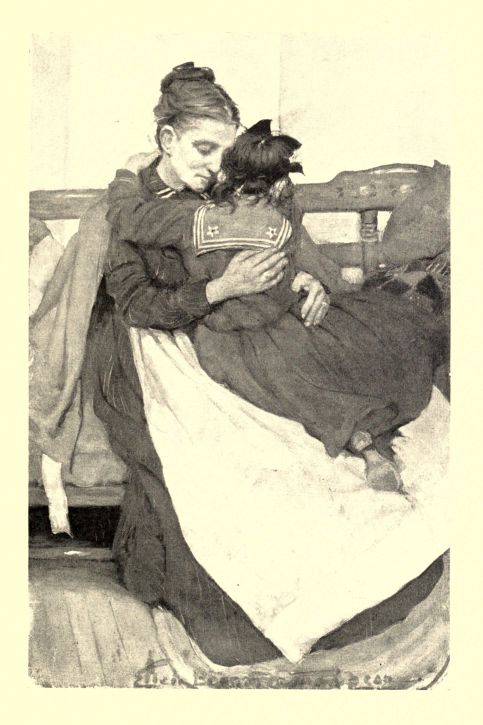
"Hazel flung both arms around Mrs. Blossom's neck"
"No more it ain't, Lady-bird," said Chi, who, after drawing the back of his hand across his eyes, was apparently the only dry-eyed one in the room. March had flung himself on the other end of the settle and buried his face deep among the patch-work cushions. Rose was sobbing outright with her head on her arms as she sat at the dining-room table.
Cherry, in her shame and misery--for she had come to love Hazel dearly without wholly conquering her jealousy--softly opened the pantry door and slipped inside where she sniffed to her heart's content. As for Budd, he stood over the wood-box, repiling its contents while the tears ran off his nose so fast that he saw all the sticks double through them.
"You may go to bed, children," said Mrs. Blossom, still holding Hazel in her arms. At this fiat, there was a general increase in the humidity of the atmosphere; and, knowing perfectly well when their mother spoke in that tone, that words, tears, or prayers would not avail, they, one and all,--for Cherry had been listening at the pantry door,--made a rush for the stairs and stumbled up, blinded by their tears.
Mrs. Blossom led Hazel still sobbing into her own little bedroom, and shut the door.
Chi, president of the vanished N.B.B.O.O. Society, was left alone. He gazed meditatively awhile at the little piles of money and the vacant chairs opposite each. Then he gathered them up carefully and placed them in orderly rows in the wooden box. His next move was to the shed door. As he opened it, a gust of wind extinguished the lamp on the table.
"Guess I 'll go to bed, too," said Chi to himself, coming back for the box, which the firelight showed plainly enough. "The barometer's dropped, 'n' it always makes me feel low in my mind."
He heaved a prodigious sigh and went out into the shed and up the back stairs. The wooden box he put under the head of the mattress; he barricaded the door and placed his rifle beside it against the wall. Then he turned in and drew the coverlet up over his head with another sigh, so long, so profound, that it mingled with the wind as it swept through the cracks of the shed beneath, and made a part of the dismality of the night.
Mrs. Blossom returned to the long-room, and, sitting down in her low rocker before the fire, waited. She knew her children.
Soon, it might have been within half an hour, she heard Rose call softly at the top of the stairs:--
"Martie."
"Yes, Rose."
"May I come?"
"Yes, dear."
"O Martie! may I, too?" wailed Cherry.
"Yes."
"I 'm coming, mother," said March, speaking in a low, determined voice through the knot-hole.
"Very well, March."
"Come along, Budd," said March, and Budd was only too glad to grip his brother's pajamas and follow after.
Down they came, tiptoeing in their bare feet, Rose heading the penitential procession. She knelt by her mother's side, and March and Budd and Cherry knelt, too.
Then, to their mother's, "Are you truly ready, children?" they answered heartily, "Yes, Martie."
Together they said in subdued but earnest tones, "Our Father;" together they prayed, "'Forgive us our trespasses as we forgive those who trespass against us'"--and after the heart-felt, "Amen," each received a kiss by way of absolution; and together, until the clock struck ten, they talked the whole matter over and resolved to fight their Apollyons daily and hourly, and, with God's grace, conquer them.
These were the rare hours, the memory of which held March Blossom in the way of right and honor when he went out to battle for himself in the world. These were the hours, the memory of which kept him in his college days unspotted from the world. It was such an hour that ripened Rose Blossom into a thinking, feeling woman, and made Budd into a knight of the Twentieth Century.
It was for such an hour that Jack Sherrill would have given his entire fortune.
XIII
A SOCIAL ADDITION
It was a chastened household that gathered about the breakfast table the next morning; and for a week afterwards, every one was so thoughtful and considerate of everybody else that Mrs. Blossom said, laughing, to her husband; "They 're so angelic, Ben, I 'm afraid they are all going to be ill. I declare, I miss their little naughtinesses."
Several things had been settled during the week and, apparently, to everyone's satisfaction. At a very serious-minded meeting of the N.B.B.O.O., it had been decided to keep the larger part of the money in order to start March on his career. Not without protest, however, on March's part. But he was overruled. Rose argued that if he were going to college, he must begin to prepare that very winter, and if their earnings were divided among the five, no one would reap any special benefit from them, least of all, March.
"I can wait well enough another year, perhaps two," she said; "and, meanwhile, we 'll be earning more. But you, March, ought to be in the academy at Barton's this very minute."
"I know it," said March, dejectedly; "but I do hate to take girls' money; somehow, it does not seem quite--quite manly."
"Better remember what your mother talked to you 'bout last Sunday, 'bout its bein' more of a blessin' to give than to get," said Chi, sententiously.
"I do remember, and there 's nobody in the world I 'd be more willing to take it from than from you, all of you, but--"
"Me, too?" interrupted Hazel, leaning nearer with great, eager, questioning eyes.
"Yes, you, too, Hazel," March replied gently, with such unwonted humility of spirit shining through his rare, sweet smile, that Hazel bounced up from her seat at the table, and, going behind March's chair, clasped both arms tightly around his neck, laid the dark, curly head down upon the top of his golden one, exclaiming delightedly:
"Oh, March, you are the dearest fellow in the world. I never thought you 'd give in so--and I love you for it! There now,"--with a big squeeze of the golden head--"you 've made me superfluously happy." Hazel took her seat, flushed rosy red in pleasurable anticipation of being allowed, at last, to give to those she loved, and wholly unmindful of her slip of the tongue.
"Now that's settled, I move that each of you keep three dollars of that money 'gainst the Wishin'-Tree business. Chris'mus 'll be here 'fore you can say 'Jack Robinson.'"
"Second the motion," said Budd and Cherry in the same breath.
It was a unanimous vote.
"There is just one thing I want to say," said March, who, in a bewilderment of happy emotions, had been unable to reply one word to Hazel, "and that is, that I want you to consider that you have lent it to me and let me have the pleasure of paying back, sometime, when I am a man."
"That's fair enough," said Chi. "I glory in your independence, Markis. That's the right kind to have. Put it to vote."
Again there was a unanimous vote of approval, for they all knew that to one of March's proud spirit it meant much to accept the money, from the girls especially; and they felt it would make him happier if he were to accept it as a loan.
"I can save a lot by not boarding down at Barton's, and by working for my board at the tavern, or in some family," said March, thoughtfully.
"No you don't," said Chi, emphatically. "'T ain't no way for a boy to be doin' chores before he goes to school in the mornin' 'n' tendin' horses after he gets out in the afternoon. If you 're goin' to try for college in two years, you 've got to buckle right down to it--'n' not waste time workin' for other folks that ain't your own. Here comes Mis' Blossom, we 'll ask her what she has to say about it."
"Why, Martie, where have you been all this afternoon? I saw you and father driving off in such a sly sort of way, I knew you did n't want us to know where you were going. Now, 'fess!" laughed Rose.
"'Fess, 'fess, Martie!" cried Budd and Cherry, hilariously breaking up the meeting. "We 've got you now!" And without more ado they anchored her to the settle, each linked to an arm, while Hazel took off her hood, March drew off her rubbers, and Rose unpinned her shawl.
Mrs. Blossom laughed. "No, you guess," she replied.
"Down to the Mill Settlement?"
"Wrong."
"Over to Aunt Tryphosa's?"
"No."
"Down to see the Spillkinses?"
"Wrong again."
"Over eastwards to the Morris farm," said Chi.
"Right," said Mrs. Blossom, smiling. "How did you know, Chi?"
"I didn't, just guessed it; coz I knew the new folks was goin' to move in this week."
"What new folks?" chorussed the children in surprise.
"An addition to the Lost Nation," replied their mother, "and a very charming one. Now there are five families on our Mountain."
"Who are they, Martie?"--"Are you going to ask them to Thanksgiving, too?"--"What's their name?"--"How many are there of them?"--"Any boys?" They were all talking together.
"One at a time, please," laughed Mrs. Blossom, putting her hands over her ears. "I never heard such mill-clappers!"
"Do hurry up, mother," said March, appealingly.
"A young man from New Haven has taken the lease of the farm for three years. He has his mother and sister with him. He was in the law school at Yale until last spring; then his father died, and his sister, a little older than you, Rose, was injured in some accident--I don't know what it was--and now she is very delicate. The doctor says if she can live in this mountain country for a few years, she may recover her health. The brother and mother are perfectly devoted to her. She calls herself a 'Shut-in'--"
"Then she can't come over for Thanksgiving dinner," said Rose, interrupting.
"Not this year, but I hope she may next."
"Did he give up college for his sister's sake?" asked March.
"He gave up the last year of his law course; they could not afford to travel so many years for the benefit of her health, so they came up here. I do pity them; it must be such a change. But, oh, March! how you will enjoy that house! They have been there only a week, yet it looks as if they had lived there always. They have such beautiful framed photographs of places they visited when they were in Europe with their father, and cases of books, and a grand piano--I don't see how they ever got it up the Mountain. The young man and his mother both play, and he plays the violin, too."
The children and Chi were listening open-eyed as Mrs. Blossom went on enthusiastically:--
"It's just like a fairy story, only it's all true. Just two weeks ago, when your father and I drove by there, that long, rambling house looked so bleak and bare and desolate--your father and I always call it the 'House of the Seven Gables,' for there are just seven--and the spruce woods behind it looked fairly black, and the wind drew through the pines by the south door with such an eerie sound, that I shivered. And to-day, what a change! All the shutters were open, and muslin curtains at the windows, and the sun was streaming into the four windows of the great south room that they have made their living-room. There was a roaring big fire in the hall fireplace, and plants--oh, Rose, you should see them! palms and rubber trees and sword ferns,--and lovely rugs, and--I can't begin to tell you about it; you must go and see for yourselves." Mrs. Blossom paused for breath, with a glad light in her eyes.
"It sounds too good to be true," said Rose, "and you look as if you had been to a real party, Martie."
"Well, I have, my dear. Just to see such people and such a house is a party for me."
"And you can keep having it, too, can't you, Martie? because they 're going to be neighbors," cried Cherry, every individual curl dancing and bobbing with excitement.
"Is the young man good-looking?" asked Hazel, earnestly.
"Very," replied Mrs. Blossom, smiling.
"As handsome as Jack?" said Hazel.
"Very different looking, Hazel; quiet and grave, but genial. Not so tall as Mr. Sherrill, I should say; talks but little, but what he says is well worth listening to--and when he smiled! I did n't hear him laugh, but I know he can enjoy fun. He has a fine saddle horse, Chi, and he wants you to come and give him some advice about selecting stock."
"'Fraid he 's too high-toned for me," said Chi, modestly; "but if I can help him anyway, I 'd like to. Seems a likely young man from all you say."
"He 's more than 'likely,' Chi," returned Mrs. Blossom, with a twinkle in her eye that only Chi caught.
"Speakin' of horses, Mis' Blossom, we 've decided to send March to the Academy at Barton's, 'n' if I let him have Fleet, he could come 'n' go, a matter of sixteen miles a day, without bein' from home nights. I don't approve of that for boys."
"No, indeed, neither his father nor I would think of such a thing for a moment. But how kind of you, Chi, to let March have Fleet."
"I want to help on the college education all I can; 'n' if our boy wants to go, he 's goin' to have the best to get him there so far as I 'm concerned."
"I don't know how to thank you, Chi," said March, "but I 'll treat Fleet like a lady and I 'll study like a--like a house on fire. I don't envy that other fellow his saddle horse if I can have Fleet. What's his name, mother? you haven't told us yet."
"Why, so I have n't--Ford, Alan Ford, and his sister's name is Ruth."
"When can we go over and see them, Martie?" said Rose.
"I thought two or three days after Thanksgiving, and then you can take a little neighborly thank-offering with you."
"What can we take?" queried Cherry.
"Oh, a mince pie or two, some raspberry preserves, a comb of last summer's honey, a pat of butter, a nice bunch of our white-plume celery, and, perhaps, Chi could find a brace of partridges."
"M-m--does n't that sound good-tasting!" said Cherry, patting her chest ecstatically.
"Who 's coming for Thanksgiving, Martie?" asked Budd.
"All the Lost Nation--the Spillkinses and Aunt Tryphosa and Maria-Ann, Lemuel and his wife and--who else? Guess."
"Why, that's all."
"Not this year, you forget your new teacher, Budd. She boards around, and it's the Mountain's year, so she is at Lemuel's now."
"Oh, good!" cried Budd enthusiastically. "She 's a daisy. I know you 'll like her, Hazel. All the fellows are awfully soft on her, though--bring her butternut candy, an' sharpen her pencils, an' black the stove, an' wash off the black-board; an' I saw Billy Nye sneak out the other day and wipe the mud off her rubbers with his paper lunch-bag! Catch me doing it, though," he added, his chest swelling rather pompously as he straightened himself and thrust his hands deep into the pockets of his knickerbockers.
"Why not?" his mother asked with an amused smile.
"Oh, coz," was Budd's rather sheepish reply, and thereupon he followed Chi out to the barn, whistling "Dixie" with might and main.
XIV
THE LOST NATION
The four families on Mount Hunger were known to the towns about as The Lost Nation. Two of them, the Blossoms and the Spillkinses, were, in reality, lumber-dealers rather than farmers. The third, Lemuel Wood, had a sheep farm, and Aunt Tryphosa Little with her granddaughter, Maria-Ann, was the fourth. The two women owned a spruce wood-lot and let it out to men who cut the bark. They cultivated a small garden-patch of corn, beans, and squash, kept a cow and a few hens, and eked out their scanty income with a day's work here and there in fine weather.
Every two weeks they did the washing and ironing for the Blossom family, as Mrs. Blossom's cares were too heavy for her, and she felt that not only could she afford it this year, but that in putting it out she was giving a little help to her poorer neighbors.
Chi or March took the huge basket of linen over on the wagon or sledge, and always left with it a neighborly gift--a peck of fine russets or greenings, a bunch of celery, a pound or two of salt pork, a bunch of delicious parsnips, or a dozen eggs when the old dame's hens were moulting. Aunt Tryphosa and Maria-Ann were not to be outdone in neighborly kindnesses, and, regularly, the willow basket, full to overflowing with snow-white clothes, was returned with something tucked away under the square covering of oil-cloth--a tiny bunch of sage or summer savory, an ironing-holder made of bits of bright calico or woollen rags, a little paper-bag of spruce gum, a pair of woollen wristers for Mr. Blossom or Chi, a new recipe for spring bitters with a sample of the herbs--sassafras, dockroot, thoroughwort, wintergreen, and dandelion--gathered by Aunt Tryphosa herself.
They had one cow which they regarded as the third member of their family. She had been named Dorcas, after Aunt Tryphosa's mother, and proved a model animal of her kind. She gave a more than ordinary amount of creamy milk; presented her mistress with a sturdy calf each year; never hooked or kicked; never, during the bitter winter weather, grew restless in her small shed which adjoined the woodshed, and never broke from pasture in the sweet-smelling summer-time.
Aunt Tryphosa and Maria-Ann vied with each other in petting her. They brushed her coat as regularly as they did up their own back hair. They gave her a weekly scrubbing as conscientiously as they took their Saturday bath. For cold nights Aunt Tryphosa had made for her a nightdress of red flannel (although she had never heard of "Cranford"), which she and Maria-Ann had planned to fit the cow-anatomy, and it had proved a great success.
For the midsummer fly-time they had contrived a wonderfully fashioned garment of coarse fish-netting, into which they had knotted a cotton fringe. They claimed, and rightly, that freedom from chill and irritation, incident upon zero weather and August dog-days, affected the milk most favorably, both in quantity and quality; and, as it all went to make delicious small cheeses, which sold at Barton's River for twenty-five cents apiece and were renowned throughout the county, people had ceased to laugh at the cow's appearance.
It had become one of Hazel's great treats to be permitted to go with March or Chi to the little house--not much more than a cabin--on the east side of the Mountain; and when she knew that the two were to be guests for Thanksgiving, but not for Christmas, she began to lay plans accordingly.
The Spillkinses were an aged set, not one was under seventy.
There were the Captain and his wife, who had celebrated their Golden Wedding, and his wife's two maiden sisters, Melissa and Elvira, of whom he always spoke as the "girls." They were funny old maidens of seventy one and two, who did up their hair in curl-papers, precisely as they did a half a century ago; wore black cotton mitts when they went to church, and white silk ones when they went out to tea; called each other "Lissy" and "Elly," and were still sensitive in regard to their ages.
In addition to these, the old, gray-shingled, vine-covered farmhouse on the lower mountain-road, sheltered the Captain's elder brother, Israel, who was just turned ninety-three, hale and hearty, and Israel's eldest son, Reuben, a youth of seventy, who in our North Country parlance "was not all there," but harmless, kindly, and generally helpful.
All these, together with Lemuel Wood and his wife, and the new teacher, were to be Thanksgiving guests, and wonderful preparations went on for days beforehand.
Such a sorting and paring and chopping of apples! Such a seeding of raisins, and whipping of eggs, and compounding of cakes! Such a tucking away of chickens beneath the flaky crust of the huge pie! Such a moulding of cranberry jelly, so deeply, darkly, richly red! Such a cracking of butternuts, and a melting of maple sugar! Such a stuffing of an eighteen-pound turkey, and such a trussing of thin-linked sausages! Such a making of goodly pies, pumpkin, mince, and apple! Such a quartering of small cheeses contributed by Aunt Tryphosa! Such an unbottling of sweet pickles, and unbarrelling of sweet cider;--and, on the final day, such a general boiling, and baking, and roasting, and basting, and mashing, and grinding, and seasoning, and whipping, and cutting, and kneading, and rolling, as can occur only once a year in an old-fashioned, New England farmhouse.
Hazel was in her glory. Arrayed in a checked gingham apron, which she had made herself, she beat eggs, whipped cream, helped Rose set the table, wiped the dishes and baking-pans, basted the noble Thanksgiving bird once, as a great privilege, although in so doing, she burned her fingers with the sputtering fat, scorched her apron, and parboiled her already flushed face with the escaping steam. But she was happy!
"Oh, papa!" she wrote the day after the party, "I never had such a good time in my life! If only you could see the things we made!--apple and lemon tarts, and mince and cranberry 'turnovers,' and doughnuts all twisted into a sort of French bow-knot such as Gabrielle used to make of her back hair, and a queer kind of cake they call 'marble,' all streaky with chocolate and white, and butternut candy made with maple sugar, and an Indian pudding, and little bits of nut-cakes with a small piece of currant jelly inside and all powdered sugar out; and--oh, I can't begin to tell you, for this is only a part of the dessert.
"I 'll try to paragraph this letter in the right places so you 'll understand about the party.
"All the Lost Nation was invited; Captain and Mrs. Spillkins, Miss Melissa and Miss Elvira, Uncle Israel and Poor Reub, Mr. Lemuel Wood and his wife, and Aunt Tryphosa and Maria-Ann, and-- Oh, I forgot Miss Alton. She 's awfully sweet; she is Budd and Cherry's teacher in the district school at the Mill Settlement. She's more like a city person than the others. I wish you 'd been here! for I can't tell it half as nice as it was; but I 'll do my best because you wrote you wanted me to tell you everything.
"We were already for the party at eleven o'clock--in the morning, I mean--(I can't remember the sign for forenoon). We don't have any lunch up here, as you know, but the dinner comes between 12 and 1, so everything was ready then. I got up at five o'clock! and worked hard till it was time to change my gown.
"It was awfully cold. Chi said the thermometer was shivering when he looked at it just after breakfast; he means by that, it's below zero--a good deal; and I couldn't help thinking how cosy and warm and deliciously smelly it would be for the Lost Nation when they came in out of the cold into the long-room and saw the table (it looked beautiful, with baskets of red apples, and nuts and raisins, and a big centre-piece of red geranium) just loaded with goodies.
"March had driven over for Aunt Tryphosa and Maria-Ann, and they arrived first--Mrs. Blossom says they always do. (I want you to go over and call on them when you are up here Christmas; it's just like a story in Hans Andersen; they keep a cow, Dorcas, who wears a kimono on very cold nights.)
"March helped Aunt Tryphosa out just as if she had been Queen Victoria. (I forgot to tell you she and Maria-Ann do our laundry work.) March is perfectly splendid about such things--and Maria-Ann sort of bounced out, although Chi held out his hand to help her. It's so funny to see them together! Aunt Tryphosa is so small and wrinkled and thin that, sometimes, Chi says he has known a good wind to knock her right over; and Maria-Ann is almost as tall as Chi, and stout and rosy-cheeked, with nice brown eyes that talk to you.
"And, oh, papa!--I'll tell you, but it's a confidence--I saw Aunt Tryphosa shiver hard when she came into the house, and I 'm afraid she did not have enough warm things on. I know her shawl was n't very thick, for I went into the bedroom afterwards and felt of it; and she had no furs at all! Think of that with the thermometer way down below zero, papa! I 'll tell you all about it when you come.
"Well, after Mrs. Blossom had given the old lady a cup of hot tea, she felt better and began to talk; and, honestly, papa, she never stopped talking all day long! March said he timed her. She lives away over on the east side of the Mountain away from everybody, and yet she knows everything that is going on, on the Mountain, and at the Mill Settlement, and at Barton's River, and that, as you know, is quite a large place.
"She told us all about the new neighbors in the seven-gabled-house; how they had their dinner at bed-time, and what 'help' they have, and whom they are going to have for hired man, and how they have music every night after dinner, and how the lights were n't put out in the north-east chamber till one o'clock. She even knew the pattern of lace on the underclothes that were hung out to dry! and Maria-Ann was trying to crochet some in imitation; I saw it myself.
"And she said that one of the chambers was all lined with books, and another just covered, floor and walls, with pictures--what can she mean, papa? and that down stairs off the living-room in what used to be old Mrs. Morris's milk-room, there were ropes, and weights, and pulleys, and a stretcher, and iron balls, and that every one said it did n't have the right look. But she said she meant to stand up for them, because the young man had come over to call just two or three days ago and said, as she was his nearest neighbor, they ought to become acquainted before winter set in; and he ordered a half a dozen cheeses and brought word from his mother that she would like them to come over and see her daughter, for she thought Maria-Ann might be able to do something for her. Now, what do you suppose it all means?
"Of course, it makes us all wild to go over there, and I hope we shall go soon.
"But, oh! if you could see the Spillkinses! I had to go off up stairs and bury my face in Rose's feather bed so I could laugh without being heard. They 're the funniest lot of people I ever saw. They all came over in a big wagon filled with straw, and before they came in sight, Chi said, 'They 're coming, I know by the cackle;' and, papa, that is just what it was.
"They are all awfully aged, but they act just like young people, and Mrs. Blossom says it's their young hearts that keep them so young.
"Uncle Israel, he's ninety-three, but he wears a dark brown wig and looks younger than his son, Poor Reub, who is seventy and has snow-white hair. Mrs. Spillkins wears what they call up here a 'false front;' it's just the color of Uncle Israel's, so she looks more like his sister. But her two sisters, Miss Melissa and Miss Elvira, are perfectly comical. They're just as small as Aunt Tryphosa, but they don't talk; only nod and smile and bow as if they were talking. They have little corkscrew curls, three on each temple, and they bob and shake when they nod and smile and sort of chirrup; it's the Captain and his wife and Uncle Israel who cackle so when they laugh. Poor Reuben does n't say much either, only he looks perfectly happy, and always sits by his father when he can get a chance. Chi was just lovely to him all the afternoon.
"Well, after Mr. Wood and his wife and the new teacher came, we all sat down to dinner, and Mr. Blossom said 'grace,' and all the Spillkinses said 'Amen,' which surprised us all very much.
"We don't have courses up here, because there is nobody to serve us; so everything is put on your plate at once, except, of course, dessert, and papa!--I would n't say it to any one but you, but I never saw any one eat so much as Aunt Tryphosa for all she is so small and thin. Mr. Blossom piled her plate up twice with turkey, and squash, and onion, and potato, and turnip, and then she helped herself to cranberry jelly and sweet pickles three times; and yet she managed to talk all the time; and the queer part of it was that she did n't cut herself once, they all eat with their knives--except, of course, our family and Miss Alton.
"Rose and Cherry and I removed the dinner plates, and that was all the waiting there was.
"We sat till half-past three at the table; then Uncle Israel said another 'grace'--'after-grace,' he called it,--and Mr. Blossom and Chi took the--the gentlemen part out to see the horses and cows, and all the rest went to work to clear off the table and do up the dishes. There were so many of us it did n't take long, and then we lighted the lamps, and all the--the ladies took out their knitting and began to work as fast as they could.
"Then in a little while all the--the gentlemen came in, and the ladies put up their work, and they all sat round the room and sang Auld Lang Syne. Rose led, and Miss Alton sang a lovely alto. It was lovely, and I longed to have you with me. Then Captain Spillkins said it was time to hitch up, and Chi said it was time to be going as it was very dark and cold. He drove Aunt Tryphosa and Maria-Ann home, and Mrs. Blossom filled a large basket with all sorts of goodies, and Mr. Blossom set it in behind in the apple-green cart without their knowing it; so now they can have a surprise party of their own and Thanksgiving for a whole week.
"There! This is the longest letter I ever wrote in all my life. I 've written it at different times during the day. I ate so much yesterday, that I don't feel very bright to-day, so you must excuse any mistakes, although I've used the dictionery as you wanted me to.
"Always your loving, and now your dreadfully sleepy
"DAUGHTER HAZEL.
"P.S. I think I shall feel better, if I tell you that we all had a very unhappy time two weeks ago. I had a really dreadful heartache, papa, and, for the first time, was homesick for you.
"You see, March and Rose are very proud of spirit, and I don't think they liked it in me because we are rich--but you and I understand each other, don't we? and know that being rich does n't mean anything to us, does it? and then, too, Chi says we 're poor because we have n't so much family to love as the Blossoms have, and that's true, too, is n't it?--and I think that kind of poorness ought to balance our riches, don't you? And--well, I can't explain how it all came about, but now they are willing to let me give them things when I want to, and that makes me very happy, and we are all a great deal happier than we were before, and I'm going to call Mrs. Blossom, 'Mother Blossom,' after this, she says she wants me to, and she takes me in her arms just as she does Rose and Cherry, and we talk things over together; so everything is all right now.
"Please send up my violin by express when you receive this. There is a very good-looking young man, the new neighbor at the seven-gabled-house, and he plays the violin, too, and his mother the piano. Love to Wilkins and Minna-Lu. I 'll send him a present from here--Oh, I forgot! don't forget to write Chi within a week sure, to inform you about the Wishing-Tree, and don't buy any presents for anybody till you hear from him. H.C."
When Mr. Clyde read this long letter at the breakfast table, his face was the despair of Wilkins, who hovered about, seeking, ineffectually, for an excuse to ask about Miss Hazel.
"Doan know what kin' er news Marse John get from little Missy," he told Minna-Lu, the cook; "but he laffed pow'ful part de time, an' den he grow pow'ful sober, an' de fust ting I know, de tears come splashin' onto de paper, an' he speak up rale sharp, 'Wha' fo' yo' hyar, Wilkins?' an' sayin' nuffin', I jes' makes tracks, case I see he wan's nobuddy see dem tears.-- Fo' Gawd, I 'se be glad when little Missy come home."
Mr. Clyde took this manuscript, as he called it, over to the Doctor.
"There, Dick, read that," was all he said.
After the Doctor had read it, he whisked out his handkerchief in a remarkably suspicious manner, and Mr. Clyde busied himself with a medical journal without reading one word, till the Doctor spoke:
"I say, Johnny, let's get up a theatre party of us two for the Old Homestead to-night; it's the nearest thing we can get to this of Hazel's."
"You always hit the right thing, Dick, I 'll call for you at eight."
XV
WISHING-TREE SECRETS
All-hallow-e'en had come.
The exercises about the tree had been carried out with great success--tom-toms, war-whoop, song and dance. After supper, the apples had been roasted, and the whole family "bobbed" for them in the wash-tub; father, mother, Chi, and even little May joining heartily in the fun. Then they had melted lead, sailed nutshells freighted with wishes, and finally "loved their Loves" with all the letters of the alphabet.
When all were off to bed and sound asleep, Chi took his lantern, and went up again to the old butternut tree in the corner of the pasture.
It was preparing to snow. A chill wind drew through the bare branches, and caused a wild commotion among the roosters' tail feathers that dangled from one of the lower ones.
Chi unlocked the little door, and from the hollow took out a handful of notes. He thrust them into the side pocket of his coat, relocked the door, and went back to his room over the shed. There, by the light of the lantern, he read them and rejoiced over them; re-read them and cried a little over them, nor was he ashamed of his tears; for in the precious missives, Rose and Hazel, March and Budd and Cherry, had shown, as in a mirror, the workings of their loving hearts.
All-hallo w-e'en.
MY DEAR MOTHER,--I have a great favor to ask of you and father. Will you hang up your stockings this year and let us children fill them instead of your filling ours? I don't want you to take one cent of the money you are earning by having Hazel here to buy me anything. I want every penny of it to go to pay off that mortgage you told us of--for I feel just as you do about it, and only wish I had known it last Hallow-e'en when I asked for the paints and brushes. It makes me sick just to think of all we asked for, and you not having any money to buy them with--and never telling us! Oh, mother!
Your devoted son,
MARCH BLOSSOM.
All-hallow-e'en.
MY DEAR POPSEY,--Me and Cherry want to help you and Martie pay off that morgige she told us about. March says it is a dreadfull thing that we must get rid of just as soon as we can. So Cherry and me are going to give you 2 dollars apeace out of our $3 we saved for ourselves out of the jam and the chickens as we voted in the N.B.B.O.O. That will make four dollars and March says it will be just 1/300 of what you owe and will help a great deal. I think the other $1 we have left will be enough to buy presents for the rest of the famly, don't you?
Your Son,
BUDD BLOSSOM.
P.S. I meant to say I don't expect anything this year 'cause last year I asked for a double-runner and a bat and a new cap with fir on the edges like the boys at Barton's and 20 cents to buy marbles with and I didn't get them 'cause you were sick and I 'm sorry I asked for so much to bother you when you were sick. B.B.
DEAR FRIEND CHI,--Do you think you can find out in some way what March and Budd would like for Christmas? And if you know anything special that Rose wants very specially, please let me know at your earliest convenience so I can send to New York for it. I should like to consult you about some gifts for Aunt Tryphosa and Maria-Ann, and if you could get a chance to take me down to the Barton's River shops all alone by myself, I should esteem it a great favor.
Your true friend,
HAZEL CLYDE.
All-hallow-e'en.
P. S. I 'm rather anxious about the note I put in the Wishing-Tree for papa.
All-hallow-e'en.
DARLING PATER NOSTER,--When I think of last year, my heart aches for you and my precious Martie. Oh, why did n't she tell us before! I never should have asked for that dress and the French grammar and dictionary and the cheap set of Dickens', if I had only known.
Do, Pater dear, let us know in the future if you are in trouble, and let us help share it. Would n't that make it easier for you?
Now a favor; I want you and Martie to play boy and girl again this year and hang up your stockings for a change; and please, please, father dear, don't give us anything this year--we don't want anything but you and Martie, and besides, we have money of our own! Chi calls us "bloated bond-holders," and says we have formed a "combine."
Your loving daughter,
ROSE BLOSSOM.
DEAREST COUSIN JACK,--I have n't answered your letter because I 've been having too good a time. This is only a Wishing-Tree note; I want you to do me a favor, please; find out what I can buy nice for papa with a dollar. I 've earned it myself (and a great deal more, Jack, you would be surprised if you knew how much the preserves and chickens came to) and want him to have a present out of it. Then, I would like to buy something for Doctor Heath, about fifty cents' worth, and another fifty cents' worth for Mrs. Heath. I want to give Aunt Carrie a little something, too, out of my own earnings; (I've all my two quarterly allowances besides,) I can afford fifty cents for her; and then I would like to remember Wilkins with a little gift out of my earnings for mamma's sake as well as my own, and then I shall have twenty-five cents left of the money I worked for. The rest we all voted to put aside for March to help him through college. He wants to be an architect, you know, and he draws beautifully. I shall be glad of your advice.
In haste, yours devotedly,
HAZEL.
All-hallow-e'en, MOUNT HUNGER.
DEAR CHI,--May wants a doll the kind she saw last summer down at Barton's River. I ve got only a doller to spend for all the famly, so will you plese ask the pris for me as I am afrade it will be to high. There is a big french one in the right hand window at Smith's store with a libel on it 7$, and I play it's mine when I am down there and you are buying horse-feed. I have named her Emilie Angelique. Rose spelt it for me.
Your loving CHERRY BOUNCE.
DEAR OLD CHI,--If you can find out what Hazel would like specially for Christmas, just let me know.
MARCH.
DEAR CHI,--Can you manage to get us all down to Barton's some Saturday to do some Christmas shopping?
Your ROSE-POSE.
All-hallow-e'en.
DEAREST PAPA,--Will you please ask Aunt Carrie to please help you buy these Christmas things? I enclose fifty dollars; (your check.)
A white serge dress pattern, like mine.
A book of lovely foreign photographs of buildings and pictures for March.
2 pairs of white kid gloves, number 6.
2 pairs of tan kid gloves, number 6-¼.
1 pair fur-lined gloves for March.
1 pair ditto for Mr. Blossom.
A year's subscription for the Woman's Hearthstone Journal for Maria-Ann.
A small shirt waist ironing-board for Aunt Tryphosa.
1 pair brown woolen gloves and one pair of those fleece-lined beaver gauntlet driving gloves like those of yours, for Chi.
1 blue Kardigan jacket for Chi.
The other things I think I can get at Barton's River.
Your devoted daughter,
HAZEL CLYDE.
"Well," said Chi, thoughtfully, as he finished reading them a second time, "I 've got more than one string to my bow this year. Beats all, how Chris'mus limbers up a man's feelin's! Guess 't was meant for all of us children of a lovin' Father." So saying, Chi knelt beside his bed, and, dropping his face in his hands, remained there motionless for a few minutes, while his loving, gentle, manly "soul was on its knees."
XVI
A CHRISTMAS PRELUDE
"It 's goin' to be an awful cold night, grandmarm," said Maria-Ann as she stepped to the door just after sunset on Christmas eve. The old dame followed her and looked out over her shoulder.
"I know 't is; my fingers stuck to the latch when I went out to see after Dorcas. While your gettin' supper, I 'm goin' to bundle up the rooster and the hens, or they 'll freeze their combs, sure's your name's Maria-Ann; looks kinder Chris'musy, don't it?"
"I was just thinkin' of that, grandmarm; just look at that star in the east!" She pointed to a shoulder of the Mountain, where a serene planet was ascending the dark blue heavens. "An' there 's been just enough snow to make all the spruces look like the Sunday School tree, all roped over with pop-corn. Do you remember that last one, grandmarm?"
"I ain't never forgot it, Maria-Ann; that's ten year ago, an' I sha'n't never see another?" She shivered, and drew back out of the keen air.
"Nor I," said Maria-Ann, shutting the door.
"I don't know why not," snapped Aunt Tryphosa, who always contradicted Maria-Ann when she could. "I guess we can have a Chris'mus tree same's other folks; we 've got trees enough."
"That's so," replied Maria-Ann, laughing. "Let's have one to-morrow, grandmarm. I don't see why we can't have a tree just as well as we can have wreaths--see what beauties I 've made! I 've saved the four handsomest for Mis' Blossom an' Mis' Ford."
"You do beat all, Maria-Ann, making wreaths with them greens and bitter-sweet; I wish you 'd hang 'em up to-night; 'twould make the room seem kinder Chris'musy."
"To be sure I will." And Maria-Ann bustled about, hanging the beautiful rounds of green and red in each of the kitchen windows, on the panes of which the frost was already sparkling; then, throwing her shawl over her head, she stepped out into the night and hung one on the outside of the narrow, weather-blackened door. Again within, she set the small, square kitchen table with two plates, two cups and saucers of brown and white crockery, the pewter spoons and horn-handled knives and forks that her grandmother had had when she was first married. Finally, she put on one of the pots of red geranium in the centre and stood back to admire the effect.
"Guess we 'll have a treat to-night, seein' it's night before Chris'mus--fried apples an' pork, an' some toast; an' I 'll cut a cheese to-night, I declare I will, even if grandmarm does scold; she 'll eat it fast enough if I don't say nothin' about it beforehand."
Maria-Ann had formed the habit of thinking aloud, for she had been much alone, and, as she said, "she was a good deal of company for herself."
"Oh, hum!" she sighed, as she cut the pork and sliced the apples, "a cup of tea would be about the right thing this cold night, but there ain't a mite in the house." Then she laughed: "What you talkin' 'bout luxuries for, Maria-Ann Simmons? You be thankful you 've got a livin'. I can make some good cambric-tea, and put a little spearmint in it; that 'll be warmin' as anything." She began to sing in a shrill soprano as she busied herself with the preparations for the supper, while the kettle sang, too, and the pork sizzled in the spider:
"'Must I be carried to the skies
On flowery beds of ease,
While others fought to win the prize
And sailed through bloody seas?'"
Meanwhile, Aunt Tryphosa, with her lantern in one hand and a bundle of red something in the other, had repaired to the hen-house which was partitioned off from the woodshed.
Had either one of them happened to look out down the Mountain-road just at this time, they would have seen a strange sight.
Along the white roadway, sparkling in the light of the rising moon, came six silent forms in Indian file. Two were harnessed to small loaded sledges. Sometimes, all six gesticulated wildly; at others, the two who brought up the rear of the file silently danced and capered back and forth across the narrow way. They drew near the house on the woodshed side; the first two freed themselves from the sledges, and left them under one of the unlighted windows. Then all six, attracted by the glimmer of the lantern shining from the one small aperture of the hen-house, stole up noiselessly and looked in.
What they saw proved too much for their risibles, and suppressed giggles and snickers and choking laughter nearly betrayed their presence to the old dame within.
On the low roost sat Aunt Tryphosa's noble Plymouth Rock rooster, and beside him, in an orderly row, her ten hens. Every hen had on her head a tiny flannel hood--some were red, some were white--the strings knotted firmly under their bills by Aunt Tryphosa's old fingers trembling with the cold.
She was just blanketing the rooster, who submitted with a meekness which proved undeniably that he was under petticoat government, for all the airs he gave himself with his wives. The funny, little, hooded heads twisting and turning, the "aks" and "oks" which accompanied Aunt Tryphosa in her labor of love, the wild stretching and flapping of wings, all furnished a scene never to be forgotten by the six pairs of laughing eyes that beheld it.
The moment the old dame took up her lantern, the spectators sped around the corner. Under the dark windows they noiselessly unloaded the wood-sleds, and silently carried bundles, baskets, and burlap-bags around to the front door.
At last they had fairly barricaded it, and the tallest of the party, after fastening a piece of paper in the Christmas wreath that Maria-Ann had hung up only a half-hour before, motioned to the others to step up to the kitchen window.
Just one glimpse they had through the thickening frost and the wreathing green: a glimpse of the kitchen table, the steaming apples, the pot of red geranium, the two cups of smoking spearmint tea, and of two heads--the one white, the other brown--bent low over folded, toil-worn hands in the reverent attitude for the evening "grace."
"For what we are now about to receive, may the Lord make us truly thankful," said Aunt Tryphosa, in a quavering voice.
"Amen," said Maria-Ann, heartily--"Land sakes, grandmarm! how you scairt me, looking up so sudden!" she exclaimed, almost in the same breath.
"Thought I heerd somethin'," said the old dame, holding her head in a listening attitude--"Hark!"
"I don't hear nothin', grandmarm. Now, just eat your apples while they 're hot. What did you think you heard?" she continued, dishing the apples.
"I thought I heerd it when I was out in the shed, too."
"I should n't wonder if 't was a deer. I saw one come into the clearing this afternoon, an' seein' 't was Christmas evening, I put a good bundle of hay out to the south door of the cow-shed."
"Guess 't was that, then," said Aunt Tryphosa. "You clear up, Maria-Ann, an' I 'll keep up a good fire, for I want to finish off them stockings for Ben Blossom an' Chi. I s'pose you 've got your things ready in case we see a team go by to-morrow?"
"Yes, they 're all ready," said her granddaughter, rather absently, and set about washing the few dishes.
When all was done, neatly and quickly as Maria-Ann so well knew how, she flung on her shawl, saying:
"I 'm goin' out a minute to see if the bundle of hay is gone, and besides, I want to look at the moon on the snow; it's the first time I 've seen it so this year." She opened the door--
"Oh, Luddy!" she screamed, as bundle, and basket, and bag toppled over into the room.
"Land sakes alive!" quavered Aunt Tryphosa, hurrying to the rescue. "Did n't I tell you I heerd somethin'? What be they?"
"Presents!" cried Maria-Ann, pulling, and hauling, and gathering up, and finally getting the door shut.
"Seems to me I see somethin' white catched onto the door 'fore you shut it," said Aunt Tryphosa. "Better look an' see." Again her granddaughter opened the door, and found the strip of paper on which was written;
"Merry Christmas! with best wishes of Benjamin and Mary Blossom and May, Malachi Graham and Rose Eleanor Blossom, March Blossom and Hazel Clyde, Benjamin Budd Blossom and Cherry Elizabeth Blossom of the N.B.B.O.O., and of John Curtis Clyde of New York; U.S.A.; N.A.; W.H."
"Oh, grandmarm! It's just like a romantic novel!" cried Maria-Ann, who was as full of sentiment as an egg is full of yolk. "It makes me feel kinder queer, comin' just now right after we was talkin' 'bout our tree. You open first, an' then we 'll take turns." Aunt Tryphosa, who was winking very hard behind her spectacles, was not loath to begin.
"Let's haul 'em up to the stove; it's so awful cold," she said, shivering.
"Why, you 've let the fire go down; that's the reason. Don't you remember you was goin' to put on the wood just as the things fell in?"
"So I was," said her grandmother, making good her forgetfulness; in a few minutes there was a roaring fire, and the room was filled with a genial warmth. Then they sat down to their delightful task, Maria-Ann kneeling on the square of rag carpet before the stove.
"My land!" cried Aunt Tryphosa, clapping her hands together as she opened the largest burlap bag; "if that boy ain't stuffed this two-bushel bag chock full of birch bark! Look a-here, Maria-Ann, you read this slip of paper for me; my specs get so dim come night-time."
The truth was, the tears were running down Aunt Tryphosa's wrinkled cheeks and filming her eyes to such an extent that she saw the birch bark through all the colors of the rainbow.
"'For Aunt Tryphosa from Budd Blossom to make her fires quick with cold mornings.' Did you ever?" said Maria-Ann, untying another large burlap bundle--"What's this? 'Made by Rose Blossom and Hazel Clyde to keep Aunt Tryphosa snug and warm o' nights when the mercury is below zero.' O grandmarm, look at this!"
Maria-Ann unrolled a coverlet made of silk patch-work (bright bits and pieces that Hazel had begged of Aunt Carrie and Mrs. Heath and others of her New York friends) lined with thin flannel and filled with feathers.
But Aunt Tryphosa was speechless for the first time in her life; and, seeing this, Maria-Ann took advantage of it to do a little talking on her own account.
"She don't seem like a city girl in her ways; she ain't a bit stuck up--Oh, what's this!" She poked, and fingered, and pinched, but failed to guess. Aunt Tryphosa grew impatient.
"Let me see, you 've done nothin' but feel," she said, reaching for the package, and Maria-Ann handed it over to her.
Again Mrs. Tryphosa Little was nearly dumb, as the miscellaneous contents of the queer, knobby parcel were brought to light.
"These are for you, Maria-Ann," she said in an awed voice, laying them on the kitchen table one after the other:--A copy of the Woman's Hearthstone Journal, with the receipt for a year's subscription pinned to it;--A small shirt waist ironing-board;--A pair of fleece-lined Arctics that buttoned half-way up Maria-Ann's sturdy legs when, an hour later, she tried them on;--Six paper-covered novels of the Chimney Corner Library including Lorna Doone (Hazel had discovered in her frequent visits, that Aunt Tryphosa's granddaughter at twenty-nine was as romantic as a girl of seventeen);--A box of preserved ginger;--Two pounds of Old Hyson Tea;--(upon which Maria-Ann bounced up from the floor, and without more ado made two cups, much to her grandmother's amazement);--Six pounds of lump sugar;---A dozen lemons;--A dozen oranges;--A white Liberty-silk scarf tucked into an envelope;--Six ounces of scarlet knitting-wool;--All for "Miss Maria-Ann Simmons, with Hazel Clyde's best wishes."
Then it was Maria-Ann Simmons's turn to break down and weep, at which Aunt Tryphosa fidgeted, for she had not seen her granddaughter cry since she was a little girl.
"Don't act like a fool, Maria-Ann," she said, crustily, to hide her own feelings; "take your things an' enjoy 'em. I 've seen tears enough for night before Chris'mus," she added, ignoring the fact that she had established a precedent.
"Well, I won't, grandmarm," said her granddaughter, laughing and crying at the same time; "but I 'm goin' to have that cup of tea first to kind of strengthen me 'fore I open the rest," she added decidedly. "Besides, I don't want to see everything at once; I want it to last."
"I don't mind if I have mine, too. Guess you may put in two lumps, seein' as we did n't have to pay for it," and the old dame sipped her Hyson with supreme satisfaction, as did likewise her granddaughter.
As the latter pushed back her chair from the table, her grandmother cautioned her:--"Look out! you 're settin' it on another bag!" But it was too late. To Aunt Tryphosa's amazement and Maria-Ann's horror, the bag suddenly flopped up and down on the floor, the motion being accompanied with such an unearthly, "A--ee--eetsch--ok--ak--ache--eetsch!" that the two women's faces grew pale, and they jumped as if they had been shot.
Then Maria-Ann, with her hand on her thumping heart, burst into a shrill laugh, and Aunt Tryphosa quavered a thin accompaniment. How they laughed! till again the tears rolled down their cheeks.
"Scairt of hens!" chuckled the old dame as she undid the strings of the bag--"at my time of life! Oh, my stars and garters, Maria-Ann! ain't they beauties?"
She drew out by the legs two snow-white Wyandotte pullets, and held them up admiringly. "They 're from March, I know; but just to think of this, Maria-Ann!" Again words and, curiously enough, eyes, too, failed her, and her granddaughter read the slip of paper tied around the leg of one of the hens:--"'One for Aunt Tryphosa, and one for Maria-Ann; have laid three times; last time day before yesterday; I hope they 'll lay two Christmas-morning eggs for your breakfast. March Blossom.'"
"I 'm goin' to put 'em on some hay in the clothes-basket, Maria-Ann, an' keep 'em right under my bed where it's good an' warm," said Aunt Tryphosa, decidedly. "They 're kinder quality folks and can't be turned in among common fowl. Besides, I ain't got another hood, an' if they should freeze their combs, I 'd never forgive myself."
"Well, I would, grandmarm," said Maria-Ann, still laughing, as she untied the last two bundles. "Laws!" she exclaimed, "Here 's New York style for you." She read the visiting card:
"To Mrs. Tryphosa Little, with the Season's compliments from John Curtis Clyde. 4 East ----th Street."
"Well, I 'm dumbfoundered," sighed Mrs. Tryphosa Little, and more she could not say as she took out of the large pasteboard box, a white silk neckerchief, a cap of black net and lace with a "chou" of purple satin lutestring, a black fur collar and a muff to match, in all of which she proceeded to array herself with the utmost despatch, forgetful of the two hens, which, after wandering aimlessly about the kitchen, had roosted finally on the back of her wooden rocking-chair, where they balanced themselves with some difficulty.
But suddenly, as she was thrusting her hands into the new muff, she paused, laid it down on the table, and said, rather querulously, "Help me off with these things, Maria-Ann; I 'm all tuckered out. I can stan' a day's washin' as well as anybody, if I am eighty-one come next June, but I can't stan' no such night 'fore Chris'mus as this, an' I 'm goin' to bed, an' take the hens."
"I would, grandmarm," said her granddaughter, gently, taking off the unwonted finery and kissing the wrinkled face. "You go to bed; I put the soap-stone in two hours ago, so it's nice an' warm. I 'll clear up, an' don't you mind me--here, let me take one of those hens."
"No, I can take care of hens anytime," snapped Aunt Tryphosa, for she was tired out with happiness, "but I can't stan' so many presents, an' I 'm too old to begin." She disappeared in the bed-room, the two Wyandotte hens hanging limply, heads downward, from each hand.
Maria-Ann picked up the paper and the wraps, and made all tidy again in the kitchen. She put her hand on the last bag that was so heavy she had not moved it from the door. "It's a bag of cracked corn--hen-feed," she said to herself, "an' it's from Chi, I know as well as if I'd been told."
Then she sat down in the rocker before the stove and put her feet in the oven to warm. She blew out the light and sat awhile in silence, thinking happy thoughts.
The fire crackled in the stove, and dancing lights, reflected from the open grate, played on the wall. The moon shone full upon the frosted window panes, and the Christmas wreaths were set in masses of encrusted brilliants. The kettle began to sing, and so did Maria-Ann--but softly, for fear of waking Aunt Tryphosa:
"'My soul, be on thy guard;
Ten thousand foes arise;
The hosts of sin are pressing hard
To draw thee from the skies.'"
XVII
HUNGER-FORD
Such a line of communication as was soon established between Mount Hunger and New York, Mount Hunger and Cambridge, the Lost Nation and Barton's River, Hunger-ford--the Fords' new name for the old Morris farm--and the Blossom homestead on the Mountain!
Uncle Sam's post, the Western Union Telegraph Company, the American Express, a line of freight, saddle horses, sleds, and the old apple-green cart on runners were all pressed into service; in all the United States of America there were no busier young people than those belonging to the Lost Nation.
They wrote notes to one another with an air of great mystery; they drove singly, in couples, or all together to Barton's River with Chi; they smuggled in bundles and express packages of all sorts and sizes; looked guilty if caught whispering together in the pantry; took many a sled-ride over to Hunger-ford, and audaciously remained there three hours at a time without giving Mrs. Blossom any good reason either for their going or remaining.
The acquaintance formed between the Blossoms and the Fords just after Thanksgiving, was fast ripening into friendship. March, usually shy with strangers, fairly adored the tall, quiet son with the wonderful smile, and expanded at once in his genial presence. With Ruth Ford he had much in common; and regularly once a week since Thanksgiving he had drawn and painted with her in her studio, the room that Aunt Tryphosa had so graphically described. His gift was far more in that direction than hers; and Ruth, recognizing it, encouraged him, spurred his ambition, and placed all her materials at his disposal.
Rose's sweet voice had proved a delight to them all, and Hazel's violin was being taught to play a gentle accompaniment to Alan Ford's, that sang, or wept, or rejoiced according to the player's mood.
"I am so thankful, Ben, that our Rose can have the advantage of such companions just at this time of her life," said Mrs. Blossom, on the afternoon before Christmas when the two eldest, with Hazel, had gone over to Hunger-ford with joyful secrets written all over their happy faces.
"So am I, Mary. When I see young men like Ford, I realize what I lost in being obliged to give up college on father's account," said Mr. Blossom, with a sigh.
"I do, too, Ben; and what I 've lost in opportunity when I see that gifted woman, Mrs. Ford. She has travelled extensively, she reads and speaks both German and French, she is a really wonderful musician, and keeps up with every interest of the day, besides being a splendid housekeeper and devoted to her children."
"Do you regret it, Mary?" said her husband, looking straight before him into the fire.
"Not with you, Ben," was Mary Blossom's answer. Taking her husband's face in both her hands and turning it towards her, she looked into his eyes, and received the smile and kiss that were always ready for her.
"If we did n't have all this when we were young people, Mary, we 'll hope that we may have it in our children," he said, earnestly.
Just then Chi came in, and gave a loud preliminary, "Hem!" for to him, Ben and Mary Blossom would always be lovers. "Guess 't is 'bout time to hitch up, if you 're goin' clear down to Barton's to meet the train, Ben; I 've got to go over eastwards with the children."
"All right, Chi, I 'd rather drive down to the station to-night; it's good sleighing and our Mountain is a fine sight by moonlight."
"Can't be beat," said Chi, emphatically. "S'pose you 'll be back by seven, sharp? I kind of want to time myself, on account of the s'prise."
"We 'll say seven, and I 'll make it earlier if I can. You 're off for Aunt Tryphosa's now?"
"Just finished loadin' up--There they are!" and in rushed the whole troop, hooded and mittened and jacketed and leggined, ready for their after-sunset raid.
"Good-bye, Martie!" screamed Cherry, wild with excitement, and made a dash for the door; then she turned back with another dash that nearly upset May, and, throwing her arms around her mother's neck, nearly squeezed the breath from her body. "O Mumpsey, Dumpsey, dear! I 'm having such an awfully good time; it's so much happier than last Christmas!"
"And, O Popsey, Dopsey, dear!" laughed Rose, mimicking her, but with a voice full of love, and both mittens caressing his face, "it's so good to have you well enough to celebrate this year!"
Hazel slipped her hand into Chi's, and whispered, "Oh, Chi, I wish I had a lot of brothers and sisters like Rose. Anyway, papa's coming to-night, so I 'll have one of my own," she added proudly.
"Guess we 'd better be gettin' along," said Chi, still holding Hazel's hand. "It's goin' to be a stinger, 'n' it's a mile 'n' a half over there."
"Come on all!" cried March; "we 'll be back before you are, father."
"We 'll see about that," laughed his father, as he caught the merry twinkle in his wife's eye.
But March was right by the margin of only a minute or two; for just as the merry crowd entered the house on their return from their errand of "goodwill," they heard Mr. Blossom drive the sleigh into the barn. In another moment Hazel had flung wide the door and was caught up into her father's arms.
In the midst of their cordial greetings there was a loud knock at the door. They all started at the sound, and Budd, who was nearest, opened it.
"Please, Budd, may I come in, too?" said a voice everyone recognized as the Doctor's.
Then the whole Blossom household lost their heads where they had lost their hearts the year before. Rose and Hazel and Cherry fairly smothered him with kisses; Budd wrung one hand, March gripped another; May clung to one leg, and the monster of a puppy contrived to get under foot, although he stood two feet ten.
Jack Sherrill, looking in at the window upon all this loving hominess, felt, somehow, physically and spiritually left out in the cold. "What a fool I was to come!" he said to himself. Nevertheless he carried out his part of the program by stepping up to the door and knocking. This time Mrs. Blossom opened it.
"Have you room for one more, Mrs. Blossom?" he said with an attempt at a smile, but looking sadly wistful, so wistful and lonely that Mary Blossom put out both hands without a word, and, somehow,--Jack, in thinking it over afterwards, never could tell how it happened so naturally--he was giving her a son's greeting, and receiving a mother's kiss in return.
In a moment Hazel's arms were around his neck;--"Oh, Jack, Jack! I 've got three of my own now; I 'm almost as rich as Rose!"
Rose, hearing her name, came forward with frank, cordial greeting, and May transferred her demonstrations of affection from the Doctor's trousers to Jack's; Cherry's curls bobbed and quivered with excitement when Jack claimed a kiss from "Little Sunbonnet," and received two hearty smacks in return; March took his travelling bag; Budd kept close beside him, and the puppy, who had been christened Tell, nosed his hand, and, sitting down on his haunches, pawed the air frantically until Jack shook hands with him, too.
By this time the wistful look had disappeared from Jack's eyes, and his handsome face was filled with such a glad light that the Doctor noticed it at once. He shook his head dubiously, with his eyebrows drawn together in a straight line over the bridge of his nose, and, from underneath, his keen eyes glanced from Jack to Rose and from Rose back again to Jack. Then his face cleared, and explanations were in order.
"Why, you see," the Doctor said to Mrs. Blossom, "my wife had to go South with her sister, and could not be at home for Christmas--the first we 've missed celebrating together since we were married--and when I found John was coming up to spend it with you, I couldn't resist giving myself this one good time. But Jack here has failed to give any satisfactory account of how or why he came to intrude his long person just at this festive time. I thought you were off at a Lenox house-party with the Seatons?" he said, quizzically.
Jack laughed good-naturedly. "I don't blame you for wondering at my being here; but I've been here before," he said, willing to pay back the Doctor in his own coin.
"The deuce you have!" exclaimed the Doctor. "I say, Johnny, are we growing old that these young people get ahead of us so easily?"
"I don't know how you feel, Dick, but I 'm as young as Jack to-night."
"That 's right, Papa Clyde," said Hazel, approvingly, softly patting her father on the head; "and, Jack, you 're a dear to come up here to see us, for you 've just as much right as the Doctor."
The Doctor pretended to grumble:--"Come to see you, indeed, you superior young woman--you indeed! As if there weren't any other girls in the world or on Mount Hunger but you and Rose--much you know about it."
"Well, I 'd like to know who you came to see, if not us?" laughed Hazel, sure of her ultimate triumph.
"Why, my dear Ruth Ford, to be sure."
"Ruth Ford!" they exclaimed in amazement.
"Why not Ruth Ford? You did n't suppose I would come away up here into the wilds of Vermont in the dead of winter, did you? just to see--" But Hazel laid her hand on his mouth.
"Stop teasing, do," she pleaded, "and tell us how you knew our Ruth."
"Our Ruth! Ye men of York, hear her!" said the Doctor, appealing to Mr. Clyde and Jack. "The next thing will be 'our Alan Ford,' I suppose. How will you like that, Jack?"
"I feel like saying 'confound him,' only it would n't be polite. You see, Doctor, I thought I had preëmpted the whole Mountain, and was prepared to make a conquest of Miss Maria-Ann Simmons even; but if Mr. Ford has stepped in"--Jack assumed a tragic air--"there is nothing left for me in honor, but to throw down the gauntlet and challenge him to single combat--hockey-sticks and hot lemonade--for her fair hand."
At the mention of Maria-Ann, Rose and Hazel, Budd and Cherry and March went off into fits of laughter. They laughed so immoderately that it proved infectious for their elders, and when Chi entered the room Budd cried out, "Oh, Chi, you tell about the--we can't--the rooster and the hoods, and--Oh my eye!--" Budd was apparently on the verge of convulsions.
"I stuffed snow into my mouth and made my teeth ache so as not to laugh out loud," said Cherry; at which there was another shout, and still another outburst at the table when Chi described the scene in the hen-house.
"Now, children," said Mrs. Blossom, after the somewhat hilarious evening meal was over, the table cleared, the dishes were wiped and put away, "we 're going to do just for this once as you want us to--hang up our stockings; but I want all of you to hang up yours, too. If you don't, I shall miss the sixes and sevens and eights so, that it will spoil my Christmas."
"We will, Martie," they assented, joyfully; for, as March said, it would not seem like night before Christmas if they did not hang up their stockings.
"Yes, and papa, and you," said Hazel, turning to the Doctor, "must hang up yours, and you, too, Jack."
"Why, of course," said Mrs. Blossom, "everybody is to hang up a stocking to-night, even Tell."
"Oh, Martie, how funny!" cried Cherry, "but he has n't a truly stocking."
"No, but one of Budd's will do for his huge paw--won't it, old fellow?" she said, patting his great head.
Then Budd must needs bring out a pair of his pedal coverings and try one brown woollen one on Tell, much to his majesty's surprise; for Tell was a most dignified youth of a dog, as became his nine months and his famous breed.
Early in the evening the stockings were hung up over the fireplace, all sizes and all colors:--May's little red one and Chi's coarse blue one; Mr. Clyde's of thick silk, and Budd's and Tell's of woollen; Hazel's of black cashmere beside Jack's striped Balbriggan. What an array!
Then Mrs. Blossom and May went off into the bedroom, and Mr. Blossom and his guests were forced to smoke their after-tea cigars in the guest bedroom upstairs, while the young people brought out their treasures and stuffed the grown-up stockings till they were painfully distorted.
"Don't they look lovely!" whispered Hazel, ecstatically to March, who begged Rose to get another of their mother's stockings, for the one proved insufficient for the fascinating little packages that were labelled for her.
"Let's go right to bed now," suggested Budd, "then mother 'll fill ours--Oh, I forgot," he added, ruefully, "we are n't going to have presents this year--"
"Why, yes, we are, too, Budd," said Rose, "we 're going to give one another out of our own money."
"Cracky! I forgot all about that--" Budd tore upstairs in the dark, and tore down again and into the bedroom, crying:--"Now all shut your eyes while I 'm going through!" which they did most conscientiously.
Soon they, too, were invited laughingly to retire, and by half-past ten the house was quiet.
"'TWAS THE NIGHT BEFORE CHRISTMAS, AND ALL THROUGH THE HOUSE,
NOT A CREATURE WAS STIRRING, NOT EVEN A MOUSE;"
Stretched out on the hearth-rug lay Tell snoring loudly,
And above from the mantel the stockings hung proudly;
When down from the stairway there came such a patter
Of stockingless feet--'t was no laughing matter!
As the good Doctor thought, for he sprang out of bed
To see if 't were real, or a dream iii its stead.
But no! with his eye at a crack of the door
He discovered the truth--'t was the Blossoms, all four,
With Hazel to aid them, tiptoeing about
Like a party of ghosts grown a little too stout.
They pinched and they fingered; they poked and they squeezed
Each plump Christmas stocking--then somebody sneezed!
Consternation and terror!! The tall clock struck one
As the ghosts disappeared on the double-quick run!
"'T WAS THE NIGHT BEFORE CHRISTMAS, AND ALL THROUGH THE HOUSE,
NOT A CREATURE WAS STIRRING, NOT EVEN A MOUSE;"
Without in the moonlight, the snow sparkled bright;
The Mountain stood wrapped in a mantle of white,
With a crown of dark firs on his noble old crest
And ermine and diamonds adorning his breast;
And the stars that above him swung true into line
Once shone o'er a manger in far Palestine.
What a Christmas morning that was!
Chi was up at five o'clock, building roaring fires, for it was ten degrees below zero.
With the first glint of the sun on the frosted panes the household was astir. At precisely seven the order was given to take down the thirteen stockings. But bless you! You 're not to think the stockings could hold all the gifts. In front of each wide jamb were piled the bundles and packages, three feet high!
Rose hesitated a moment when the children sat down on the rug with their stockings, as was their custom every Christmas morn; then she plumped down among them, saying, laughingly:
"I don't care if I am growing up, Martie--it's Christmas."
Upon which Jack, hugging his striped Balbriggan, sat down beside her.
Such "Ohs" and "Ahs"! Such thankings and squeezings! Such somersaults as were turned by March and Budd at the kitchen end of the long-room! Such rapturous gurgles from May! Such hand-shakes and kisses! Such silent bliss on the part of Chi, who, though suffering as if in a Turkish bath, had donned his new, blue woollen sweater, drawn on his gauntleted beaver gloves, and proceeded to investigate his stocking with the air of a man who has nothing more to wish for. And through all the chaotic happiness a sentence could be distinguished now and then.
"Chi, these corn-cob pipes are just what I shall want after Christmas when I give my Junior Smoker."
"Oh, Martie, it can't be for me!" as the lovely white serge dress, ready made and trimmed with lace, was held up to Rose's admiring eyes.
Budd was caressing with approving fingers a regular "base-ball-nine" bat and admiring the white leather balls.
"I say, it's a stunner, Mr. Sherrill; but how did you know I wanted it?"
Mr. Clyde, who was touched to his very heart's core by Hazel's gift of a dollar pair of suspenders which she had earned by her own labor, felt a small hand slipped into his, and found Cherry Bounce looking up at him with wide, adoring, brown eyes, which, for the first time, she had taken from her beautiful Émilie Angélique, whom she held pressed to her heart:--
"I want to whisper to you," she said, shyly. Mr. Clyde bent down to her;--"After I said my prayers to Martie, I asked God to give me Émilie Angélique--every night," she nodded--"but I only told Budd, so how did you know?"
March was lost to the world in his volume of foreign photographs, in his boxes of paints and brushes, and a whole set of drawing materials. He had not as yet thanked Hazel for them.
Everybody was happy and satisfied. Everybody said he or she had received just exactly the thing. Tell alone could not express his gratification in words. He had been given his woollen stocking, and nosed about till he had brought forth three fat dog-biscuit, a deliciously juicy-greasy beef bone, wrapped in white waxed paper and tied at one end with a blue ribbon, a fine nickelplated dog collar with a bell attached, and last, from the brown woollen toe, three lumps of sugar.
One by one he took the gifts and laid them down at Mrs. Blossom's feet; putting one huge paw firmly on the waxed-paper package, he waved the other wildly until she took it and spoke a loving word to him. Then, taking up his beloved bone, he retired with it to the farthest end of the long-room, under the kitchen sink, and licked it in peace and joy.
Jack and Chi in the joyful confusion had slipped from the room.
Soon there was a commotion in the woodshed, and the two made their appearance dragging after them a brand-new double-runner and a real Canadian toboggan, which Jack had ordered from Montreal for March.
Breakfast proved to be a short meal, for the whole family was wild to try the new toboggan with Jack to engineer it. Then it was up and down--down and up the steep mountain road; Jack and Doctor Heath, Mr. Clyde, Mr. Blossom and Chi, all on together--clinging for dear life, laughing, whooping, panting, hurrahing like boys let out from school, while March and Budd and Rose and Hazel and Cherry flew after them on the double-runner, the keen air biting rose-red cheeks, and bringing the stinging water to the eyes.
But what sport it was!
"Now, this is something like," panted Jack, drawing up the hill with Chi, his handsome face aglow with life and joy.
"By George Washin'ton! it's the nearest thing to shootin' Niagary that I ever come," puffed Chi.
"Didn't we take that water-bar neatly?" laughed Jack.
"'N inch higher, 'n' we 'd all been goners;--I had n't a minute to think of it, goin' to the rate of a mile a minute; but if I had--I 'd have dusted! Guess I 'll make it level before I try it with the children,--'n' I want you to know there 's no coward about me, but I 'm just speakin' six for myself this time."
So the morning sped. Even Mrs. Blossom and May were taken down once, and the Doctor stopped only because he wanted to make a morning call on his patient, Ruth Ford; for it was by his advice the family had come to live for three years in this mountain region.
The horn for the mid-day meal sounded down the Mountain before they had thought of finishing the exciting sport, and one and all brought such keen appetites to the Christmas dinner, that Mrs. Blossom declared laughingly that she would give them no supper, for they had eaten the pantry shelves bare.
Such roast goose and barberry jam! Such a noble plum-pudding set in the midst of Maria-Ann's best wreath, for she and Aunt Tryphosa had sent over their simple gifts by an early teamster. Such red Northern Spies and winter russet pears! And such mirth and shouts and jests and quips to accompany each course!
It was genuine New England Christmas cheer, and the healths were drunk in the wine of the apple amid great applause, especially Doctor Heath's:
"Health, peace, and long life to the Lost Nation--May its tribe increase!"
And how they laughed at Chi, when he proposed the health of the Prize Chicken (which, by the way, he had kept for the next season's mascot,) and recounted the episode in the barn.
What shouts greeted Budd, who, rising with great gravity, his mouth puckered into real, not mock, seriousness--and that was the comical part of it all--said earnestly:
"To my first wife!" and sat down rather red, but gratified not only by the prolonged applause, but by the enthusiasm with which they drank to this unexpected toast from his unsentimental self.
Directly after dinner Mr. Clyde declared that a seven-mile walk was an actual necessity for him in his present condition, and invited all who would to accompany him to call in state on Mrs. Tryphosa Little and Miss Maria-Ann Simmons. Only Doctor Heath and Jack went with him, for Mr. Blossom and Chi had matters to attend to at home, and Rose and Cherry and Hazel were needed to help Mrs. Blossom. Even March and Budd turned to and wiped dishes.
"I 'll set the table now, Martie," said Rose, "then there will be no confusion to-night--there are so many of us."
"No need for that to-night, children," replied Mrs. Blossom, with a merry smile. "'The last is the best of all the rest,' for we were all invited a week ago to take tea and spend Christmas evening at Hunger-ford."
"Oh, Martie!" A joyful shout went up from the six, that was followed by jigs and double-shuffles, pas-seuls and fancy steps, in which dish-towels were waved wildly, and tin pans were pounded instead of wiped.
When the din had somewhat subsided there were numberless questions asked; by the time they were all answered, and Rose and Hazel had donned their white serge dresses, the gentlemen had returned from their walk, and it was time to go.
"That's why Mrs. Ford had us learn all those songs," said Rose to Hazel. "Don't forget to take your violin."
A merrier Christmas party never set forth on a straw-ride. Mr. and Mrs. Blossom and May went over in the sleigh, but the rest piled into the apple-green pung, and when they came in sight of the seven-gabled-house, a rousing three times three, mingling with the sound of the sleigh-bells, greeted the pretty sight.
Every window was illumined, and adorned with a Christmas wreath. In the light of the rising moon, then at the full, the snow that covered the roof sparkled like frosted silver. The house, with its background of sharply sloping hill wooded with spruce and pine, its twinkling lights and the surrounding white expanse, looked like an illuminated Christmas card.
Within, the hall was festooned with ground hemlock and holly; a roaring fire of hickory logs furnished light and to spare. In the living-room and dining-room, Mr. Clyde and Jack Sherrill found, to their amazement, all the elegance and refinement of a city home combined with country simplicity. The tea-table shone with the service of silver and sparkled with the many-faceted crystal of glass and carafe. For decoration, the rich red of the holly berries gleamed among the dark green gloss of their leaves.
At first, the younger members of the Blossom family felt constrained and a little awed in such surroundings; for although they had been several times in the house, they had never taken tea there. But the Fords and the other city people soon put them at their ease, and, as Cherry declared afterwards, "It was like eating in a fairy story." There was a real pigeon pie at one end and a Virginia ham at the other, as well as cold, roast duck with gooseberry jam. There were sparkling jellies, and the whole family of tea-cakes--orange, cocoanut, sponge, and chocolate; and, oh, bliss!--strawberry ice-cream in a nest of spun cinnamon candy, followed by Malaga grapes and hot chocolate topped with a whip of cream.
After tea there was the surprise of a beautiful Christmas Tree in the library. Ruth Ford had occupied many a weary hour in making the decorations--roses and lilies fashioned from tissue paper to closely copy nature; gilded walnuts; painted paper butterflies; pink sugar hearts, and cornucopias of gilt and silver paper, in each of which was a bunch of real flowers--roses, violets, carnations, and daisies, ordered by Jack Sherrill from New York. On the topmost branch, there was a waxen Christ-child. The tree was lighted by dozens of tiny colored candles. When the door was opened from the living-room, and the children caught sight of the wonderful tree, they held their breath and whispered to one another.
But more lovely than the tree in the eyes of the older people were the radiant faces of the young people and the children. Rose, with clasped hands, stood gazing up at the Christ-child that crowned the glowing, glittering mass of dark green. She was wholly unconscious of the many pairs of eyes that rested upon her in love and admiration. There was nothing so beautiful in the whole room as the young girl standing there with earnest blue eyes, raised reverently to the little waxen figure. Her lips were parted in a half smile; a flush of excitement was on her cheeks; the white dress set off the exquisite fairness of her skin; the shining crown of golden-brown hair, that hung in a heavy braid to within a foot of the hem of her gown, caught the soft lights above her and formed almost a halo about the face.
Suddenly there was a burst of admiration from the children, and, under cover of it, Doctor Heath turned to Mr. Clyde, who was standing beside him:--
"By heavens, John! That girl is too beautiful; she will make some hearts ache before she is many years older, as well as your own Hazel--look at her now!"
The father's eyes rested lovingly, but thoughtfully, on the graceful little figure that was busy distributing the cornucopias with their fragrant contents. Yes, she, too, was beautiful, giving promise of still greater beauty. He turned to the Doctor and held out his hand:--
"Richard, I have to thank you for this transformation."
"No--not me," said the Doctor, earnestly, "but," pointing to Mrs. Blossom, "that woman there, John. Hazel needed the mother-love, just as much as Jack does at this moment."
Jack had turned away when the Doctor began to speak of Rose, and, joining her, said, "Won't you wear one of my roses just to-night, Miss Blossom?"
"Your roses! Why, did you give us all those lovely flowers?"
"Yes, I wanted to contribute my share, and flowers seemed the most appropriate offering just for to-night."
"They 're lovely," said Rose, caressing the exquisite petals of a La France beauty. "Of course I 'll wear one--" she tucked one into her belt; "but why--why!--has n't anyone else roses?" She looked about inquiringly.
"No,--the roses were for their namesake," said Jack, quietly.
Rose laughed merrily,--a pleased, girlish laugh. "Then won't the giver of the roses call their namesake, 'Rose'?--for the sake of the roses?" she added mischievously.
Now Jack Sherrill had seen many girls--silly girls, flirty girls, sensible girls, charming girls, smart girls, nice girls, and horrid girls, and flattered himself he knew every species of the genus, but just this once he was puzzled. If Rose Blossom had been an arrant flirt, she could not have answered him more effectively; yet Jack had decided that she had too earnest a nature to descend to flirting. Somehow, that word could never be applied to Rose Blossom--"My Rose," he said to himself, and knew with a kind of a shock when he said it, that he was very far gone. But in the next breath, he had to confess to himself that he had "been very far gone" many a time in his twenty-one years, so perhaps it did not signify.