Front matter (continued 2)
Reading edition
"I could flog that proud feller," muttered Chi to himself.
Hazel hesitated a moment, then put out her hand a little reluctantly. March caught the gesture and her look.
"Oh, you 're not obliged to," he said haughtily, and turned on his heel. But Hazel put her hand on his arm.
"I 'm afraid we are both breaking some of the by-laws, March. I do want to shake hands, but I was thinking just then that you did n't mean the apology--not really and truly; and if you did mean it, there was something else you needed to apologize for more than that!"
March flushed to the roots of his hair. Then his boy's honor came to the rescue.
"I do want to now, Hazel--and forgive and forget, won't you?" he said, with the winning smile he inherited from his father, but which he kept for rare occasions.
Hazel put her hand in his, and felt that this had been worth waiting for. She knew that at last March had taken her in.
Budd gripped with all his might, Cherry shook with two fingers, and Chi's great hand closed over hers as tenderly as a woman's would have done.
This was Hazel's initiation into the Nobody's Business But Our Own Society. It was the second meeting of the year.
"Now, March, I 'll make you chairman and ask you to state the business of this meetin', as you 've called it. Must be mighty important?"
"It is," replied March, gravely, all the fun dying out of his face. "You remember, all of you,--don't you?--what mother told us that night she said Hazel was coming?"
"Yes," chorussed the children.
"Well, I 've been thinking and thinking ever since how I could help--"
"So 've I, March," interrupted Rose.
"And I have, too," said Budd.
"What's all this mean?" said Chi, somewhat astonished, for he had not known why the meeting had been called.
"Why, you see, Chi, we never knew till then that the farm had been mortgaged on account of father's sickness, and that it had been so awful hard for mother all this year--"
Chi cleared his throat.
"--And we want to do something to help earn. If we could earn just our own clothes and books and enough to pay for our schooling, it would be something."
"Guess 't would," said Chi, clearing his throat again. "Kind of workin' out the third by-law, ain't you?"
"Trying to," answered March, with such sincerity in his voice that Chi's throat troubled him for full a minute. "And what I want to find out, without mother's knowing it, or father either, is how we can earn enough for those things. If anybody 's got anything to say, just speak up."
"What you goin' to do with those Wyandottes?"
"I knew you 'd ask that, Chi. I 'm going to raise a fine breed and sell the eggs at a dollar and a half for thirteen; but I can't get any chicken-money till next fall, and no egg-money till next spring, and I want to begin now."
"Hm--" said Chi, taking off his straw hat and slowly scratching his head. "Well," he said after a pause in which all were thinking and no one talking, "why don't all of you go to work raisin' chickens for next Thanksgivin'?"
"By cracky!" said Budd, "we could raise three or four hundred, an' fat 'em up, an' make a pile, easy as nothing."
"I don't know about it's bein' so easy; but children have the time to tend 'em, and I don't see why it won't work, seein' it's a good time of year."
"But where 'll we get the hens to set, Chi?" said March.
"Oh, there 's enough of 'em settin' round now on the bare boards," Chi replied.
"Can I raise some, too?" asked Hazel, rather timidly.
"Don't know what there is to hinder," said Chi, with a slow smile.
"And can I buy some hens for my very own?"
"Why, of course you can; just say the word, 'n' you 'n' I 'll go settin'-hen hunting within a day or so."
"Oh, what fun!" cried Hazel, clapping her hands. "But I want some that will sit and lay too, Chi; then I can sell the eggs."
There was a shout of laughter, at which Hazel felt hurt.
"There now, Lady-bird, we won't laugh at your city ways of lookin' at things any more. The hens ain't quite so accommodatin' as that, but we 'll get some good setters first, 'n' then see about the layin' afterwards."
"But, Chi, it will take such a lot of corn to fatten them. We don't want to ask father for anything."
"That's right, Rose. Be independent as long as you can; I thought of that, too. Now, there 's a whole acre on the south slope I ploughed this spring,--nice, hot land, just right for corn-raisin'; 'n' if you children 'll drop 'n' cover, I 'll help you with the hoein' 'n' cuttin' 'n' huskin'; 'n' you 'll have your corn for nothin'."
"Good for you, Chi; we 'll do it, won't we?" cried March.
"You bet," said Budd.
"I can pick berries," said Rose, "and we can always sell them at the Inn, or at Barton's River."
"Yes, and we can begin in June," said Cherry; "the pastures are just red with the wild strawberries, you know, Rose."
"It's an awful sight of work to pick 'em," said Budd, rather dubiously.
"Well, you can't get your money without workin', Budd; 'n' work don't mean 'take it easy.'"
"I 'm sure we can get twenty-five cents a quart for them right in the village. I 've heard folks say they make the best preserve you can get, and you can't buy them for love nor money," said Rose. "Mother makes beautiful ones."
"Was n't that what we had last Sunday night when the minister was here to tea?" asked Hazel.
"Yes," said Rose.
"I never tasted any strawberries like them at home, and the housekeeper buys lots of jams and jellies in the fall." Hazel thought hard for a minute. Suddenly she jumped to her feet, clapped her hands, and spun round and round like a top, crying out, "I have it! I have it!"
The N.B.B.O.O. Society was amazed to see the new member perform in this lively manner, for Hazel had been rather quiet during the first month. Now she caught up her skirts with a dainty tilt, and danced the Highland Fling just to let her spirits out through her feet. Up and down the floor of the loft she charged, hands over her head, hands swinging her skirts, light as a fairy, bending, swaying, and bowing, till, with a big "cheese," she sat down almost breathless by Chi. Was this Hazel? The members of the N.B.B.O.O. looked at one another in amazement, and March's eyes flashed again, as they had done once before during the afternoon.
"Now all listen to me," she said, as if, after a month of silence, she had found her tongue. "I 've an idea, and when I have one, papa says it's worth listening to,--which is n't often, I 'm sure. We 'll pick the strawberries, and get Mrs. Blossom to show Rose how to do them up; and I 'll write to papa and Doctor Heath's wife and to our housekeeper and Cousin Jack, and see if they don't want some of those delicious preserves that they can't get in the city. I 'll find out from Mrs. Scott--that's the housekeeper--how much she pays for a jar in New York, and then we 'll charge a little more for ours because the strawberries are a little rarer. Are n't there any other kinds of berries that grow around here?"
"Guess you 'd better stop 'n' take breath, Lady-bird; there 's a mighty lot of plannin' in all that. What 'd I tell you, Budd?" Chi asked again.
Budd looked at Hazel in boyish admiration, but said nothing.
"I think that's splendid, Hazel," said Rose, "if they'll only want them."
"I know they will; but are there any other berries?"
"Berries! I should think so; raspberries and blackberries by the bushel on the Mountain, and they say they 're the best anywhere round here," said March.
"Oh, dear!" sighed Cherry, "I wish we could go to work right now."
"Well, so you can," said Chi, "only you can't go berryin' just yet. You can begin to drop that corn this very afternoon: better be inside the ground pretty soon, with all those four hundred chickens waitin' to join the Thanksgivin' procession."
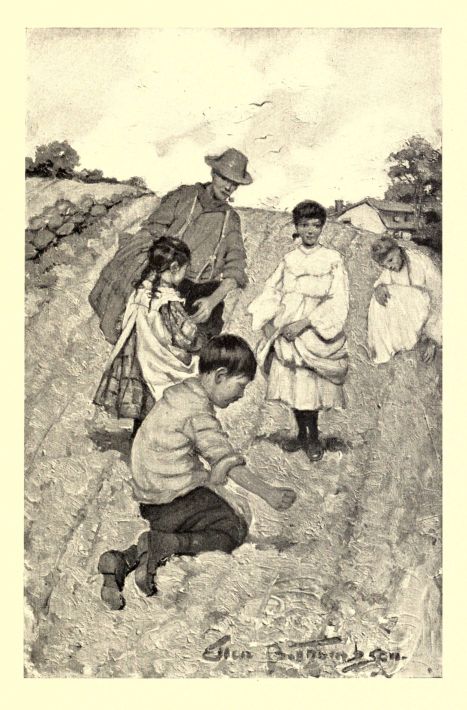
"'You can begin to drop that corn this very afternoon'"
"Oh, Chi, you 're making fun of us," laughed Rose.
"Don't you believe it, Rose-pose; never was more in earnest in my life. Come along, 'n' I 'll show you."
VIII
A LIVELY CORRESPONDENCE
It was a trial of patience to have to wait twenty-one days before the first of the "four hundred" could be expected to appear.
"You 'll have to be kind of careful 'bout steppin' round in the dark, Mis' Blossom, 'n' you, too, Ben," said Chi, "for you 'll find a settin' hen most anywheres nowadays."
Mrs. Blossom laughed. "Oh, Chi, what dear children they are, even if they aren't quite perfect."
"Can't be beat," replied Chi, earnestly. "Look at them now, will you?"
Mrs. Blossom stepped out on the porch, and looked over to the south slope and the corn-patch. "What if her father were to see her now!" She laughed again, both at her thoughts and the sight.
"'T would give him kind of a shock at first," Chi chuckled, "but he 'd get over it as soon as he 'd seen that face."
"It is wonderful how she has improved. I shouldn't be surprised if he came up here soon to see Hazel."
"Well, he 'll find somethin' worth lookin' at. See there, now!"
The girls had been making scarecrows to protect the young corn, stuffing old shirts and trousers with hay and straw, while March and Budd had been getting ready the cross-tree frames. In dropping and covering the corn that Saturday afternoon after the initiation, the girls had found their skirts and petticoats not only in the way as they bent over their work, but greatly soiled by contact with the soft, damp loam. So they had begged to wear overalls of blue denim like Chi's and the boys'. The request had been gladly granted. "It will save no end of washing," said Mrs. Blossom, and forthwith made up three pairs on the machine.
The girls found it great fun. They tucked in their petticoats and buttoned down their shoulder-straps with right good will. Then Mr. Blossom presented them with broad, coarse straw hats, such as he and Chi used, and with these on their heads they rushed off to the corn-patch. There now they were,--five good-looking boys with hands joined, dancing and capering around a scarecrow, that looked like a gentleman tramp gone entirely to seed, and singing at the top of their voices Budd's favorite, "I won't play in your back yard."
At that very hour, when the gentleman scarecrow of the corn-patch was looking amiably, although slightly squint-eyed, out from under his tattered straw hat (for March had drawn rude features on the white cloth bag stuffed with cotton-wool which served for a head, and on it Rose had sewed skeins of brown yarn to imitate hair) at the antics of the five pairs of blue overalls, Mr. Clyde, having finished his nine o'clock breakfast, asked for the mail.
"Yes, Marse John" (so Wilkins always called Mr. Clyde when they were alone), "'spect dere 's one from Miss Hazel by de feel an' de smell."
Mr. Clyde smiled. "How can you tell by the 'feel and the smell,' Wilkins?"
"Case it's bunchy lake in de middle, an' de vi'lets can't hide dere bref."
"Well, we 'll see," said Mr. Clyde, willing to indulge his faithful servant's childish curiosity. Wilkins busied himself quietly about the breakfast-room.
As Mr. Clyde opened the envelope, the crushed blue and white violets fell out. Suddenly he burst into such a hearty laugh that Wilkins had hard work to suppress a sympathetic chuckle.
"I shall have to carry this letter over to the Doctor, Wilkins," he said, still laughing. "I shall be in time to find him a few minutes alone before office hours." He rose from the table.
Wilkins followed him out to give his coat a last touch with the brush; he was fearful Mr. Clyde might leave without revealing anything of the contents of the letter from his beloved Miss Hazel.
"'Sense me, Marse John," he said in desperation, as Mr. Clyde went towards the front door, "but Miss Hazel ain't no wusser case yo' goin' to de Doctah's?"
"Oh, Wilkins, I forgot; you want to know how Miss Hazel is. She is doing finely; as happy as a bird, and sends her love to you in a postscript. I think I 'll run up and see her soon."
Wilkins ducked and beamed. "'Pears lake dis yere house ain't de same place wif de little missus gone."
"You 're right, Wilkins," said Mr. Clyde, earnestly. "I shall not open the Newport cottage this year; it would be too lonesome without her."
"Well, Dick," he said gayly, as he entered the Doctor's office, "I shall hold you responsible for some of the lives of the 'Four Hundred.' Here, read this letter."
MOUNT HUNGER, MILL SETTLEMENT, BARTON'S
RIVER, VERMONT, May 19, 1896.
DEAREST PAPA,--Good-morning! I am answering your long letter a little sooner than I expected to, because I want you to do something for me in a business way; that's the way March says it must be.
I don't know how to begin to tell you, but I 've joined the N.B.B.O.O. Society and one of the by-laws is that we must help others all we can and just as much as we can. I wish you'd been at the initiashun. (I don't know about that spelling, and I 'm in a hurry, or I 'd ask.) I had the hand of fellowship from a supposed corpse's hand first, and then I was branded on the arm. And afterwards they all took me in, and now we 're raising four hundred chickens to help others; I 'll tell you all about it when you come. Chi, that's the hired man, but he is really our friend, took me sitting-hen hunting day before yesterday, for I am to own some myself; and we drove all over the hills to the farmhouses and found and bought twelve, or rather Chi did, for I had to borrow the money of him, as I felt so bad when I kissed you good-bye that I forgot to tell you my quarterly allowance was all gone, and I know you won't like my borrowing of Chi, for you have said so many times never to owe anybody and I've always tried to pay for everything except when I had to borrow of Gabrielle, or Mrs. Scott, when I forgot my purse.
But truly the hens were in such an awful hurry to sit, that it did seem too bad to keep them waiting even three days till I could get some money from you; and then, too, we 've all of us, March and Rose and Budd and Cherry and me, bet on which hen would get the first chicken, and that chicken is going to be a prize chicken and especially fatted, and of course, if I waited for the money to come from you, I could n't stand a chance of coming out ahead in our four hundred chicken race, so I borrowed of Chi. The hens came to just $4 and eighty cents. I'll pay you back when I earn it, and don't you think it would have been a pity to lose the chance for the prize chicken just for that borrow?
Please send the money by return mail. I 've other letters to write, so please excuse my not paragraphing and so little punctuation, but I 've so much to do and this must go at once.
Your loving and devoted daughter,
HAZEL CLYDE.
P.S. The hens are sitting around everywhere. Give my love to Wilkins. H.C.
The Doctor shouted; then he stepped to the dining-room door and called, "Wifie, come here and bring that letter."
Mrs. Heath came in smiling, with a letter in her hand, which, after cordially greeting Mr. Clyde, she read to him,--an amazed and outwitted father.
MOUNT HUNGER, MILL SETTLEMENT, BARTON'S
RIVER, VERMONT, May 19, 1896.
MY DEAR MRS. HEATH,--Please thank my dear Doctor Heath for the note he sent me two weeks ago. I ought to write to him instead of to you, for I don't owe you a letter (your last one was so sweet I answered it right off), but he never allows his patients strawberry preserve and jam, so it would be no use to ask his help just now, as this is pure business, March says.
We are trying to help others, and the strawberries--wild ones--are as thick as spatter--going to be--all over the pastures, and we 're going to pick quarts and quarts, and Rose is going to preserve them, and then we 're going to sell them.
Do you think of anybody who would like some of this preserve? If you do, will you kindly let me know by return mail?
I can't tell just the price, and March says that is a great drawback in real business, and this is real--but it will not be more than $1 and twenty-five cents a quart. They will be fine for luncheon. I never tasted any half so good at home.
My dear love to the Doctor and a large share for yourself from
Your loving friend,
HAZEL CLYDE.
P.S. Rose says it is n't fair for people to order without knowing the quality, so we 've done up a little of Mrs. Blossom's in some Homeepatic (I don't know where that "h" ought to come in) pellet bottles, and will send you a half-dozen "for samples," March says, to send to any one to taste you think would like to order. H.C.
"The cure is working famously," said Doctor Heath, rubbing his hands in glee.
"Well," said Mr. Clyde, laughing, "I may as well make the best of it; but I can't help wondering whether the wholesale grocers in town have been asked to place orders with Mount Hunger, or the Washington Market dealers for prospective chickens! There 's your office-bell; I won't keep you longer, but if this 'special case' of yours should develop any new symptoms, just let me know."
"I 'll keep you informed," rejoined the Doctor. "Better run up there pretty soon, Johnny," he called after him.
"I think it's high time, Dick. Good-bye."
At that very moment, a symptom of another sort was developing in Z---- Hall, Number 9, at Harvard.
Jack Sherrill and his chum were discussing the last evening's Club theatricals. "I saw that pretty Maude Seaton in the third or fourth row, Jack; did she come on for that,--which, of course, means you?"
"Wish I might think so," said Jack, half in earnest, half in jest, pulling slowly at his corn-cob pipe.
"By Omar Khayyam, Jack! you don't mean to say you 're hit, at last!"
"Hit,--yes; but it's only a flesh-wound at present,--nothing dangerous about it."
"She 's got the style, though, and the pull. I know a half-dozen of the fellows got dropped on to-night's cotillion."
"Kept it for me," said Jack, quietly.
"No, really, though--" and his chum fell to thinking rather seriously for him.
Just then came the morning's mail,--notes, letters, special delivery stamps, all the social accessories a popular Harvard man knows so well. Jack looked over his carelessly,--invitations to dinner, to theatre parties, "private views," golf parties, etc. He pushed them aside, showing little interest. He, like his Cousin Hazel, was used to it.
The morning's mail was an old story, for Sherrill was worth a fortune in his own right, as several hundred mothers and daughters in New York and Boston and Philadelphia knew full well.
Moreover, if he had not had a penny in prospect, Jack Sherrill would have attracted by his own manly qualities and his exceptionally good looks. His riches, to which he had been born, had not as yet wholly spoiled him, but they cheated him of that ambition that makes the best of young manhood, and Life was out of tune at times--how and why, he did not know, and there was no one to tell him.
He had rather hoped for a note from Maude Seaton, thanking him, in her own charming way, for the flowers he had sent her on her arrival from New York the day before. True, she had worn some in her corsage, but, for all Jack knew, they might have been another man's; for Maude Seaton was never known to have less than four or five strings to her bow. It was just this uncertainty about her that attracted Jack.
"Hello! Here 's a letter for you by mistake in my pile," said his chum.
"Why, this is from my little Cousin Hazel, who is rusticating just now somewhere in the Green Mountains." Jack opened it hastily and read,--
MOUNT HUNGER, MILL SETTLEMENT, BARTON'S
RIVER, VERMONT, May 19, 1896.
DEAREST COUSIN JACK,--It is perfectly lovely up here, and I 've been inishiated into a Secret Society like your Dicky Club, and one of the by-laws is to help others all we can and wherever we can and as long as ever we can, and so I 've thought of that nice little spread you gave last year after the foot-ball game, and how nice the table looked and what good things you had, but I don't remember any strawberry jam or preserves, do you?
We 're hatching four hundred chickens to help others,--I mean we have set 40 sitting hens on 520 eggs, not all the 40 on the five hundred and twenty at once, you know; but, I mean, each one of the 40 hens are sitting on 13 eggs apiece, and March says we must expect to lose 120 eggs--I mean, chickens,--as the hens are very careless and sit sideways--I 've seen them myself--and so an extra egg is apt to get chilly, and the chickens can't stand any chilliness, March says. But Chi, that's my new friend, says some eggs have a double yolk, and maybe, there 'll be some twins to make up for the loss.
Anyway, we want 400 chickens to sell about Thanksgiving time, and, of course, we can't get any money till that time. So now I 've got back to your spread again and the preserves, and while we 're waiting for the chickens, we are going to make preserves--dee-licious ones! I mean we are going to pick them and Rose is going to preserve them. We 've decided to ask $1 and a quarter a quart for them; Rose--that's Rose Blossom--says it is dear, but if you could see my Rose-pose, as Chi calls her, you 'd think it cheap just to eat them if she made them. She 's perfectly lovely--prettier than any of the New York girls, and when she kneads bread and does up the dishes, she sings like a bird, something about love. I'll write it down for you, sometime. I 'm in love with her.
Please ask your college friends if they don't want some jam and wild strawberry preserves. If they do, March says they had better order soon, as I've written to New York to see about some other orders.
Yours devotedly,
HAZEL.
P.S. I 've sent you a sample of the strawberry preserve in a homeepahtic pellet bottle, to taste; Rose says it is n't fair to ask people to buy without their knowing what they buy. I saw that Miss Seaton just before I came away; she came to call on me and brought some flowers. She said I looked like you--which was an awful whopper because I had my head shaved, as you know; I asked her if she had heard from you, and she said she had. She is n't half as lovely as Rose-pose. H.C.
IX
THE PRIZE CHICKEN
There was wild excitement, as well as consternation, in the farmhouse on the Mountain.
On the next day but one after Hazel had sent her letters, Chi had brought up from the Mill Settlement a telegram which had come on the stage from Barton's. It was addressed to, "Hazel Clyde, Mill Settlement, Barton's River, Vermont," and ran thus:--
CAMBRIDGE, May 20, 1 P.M.
Hope to get in our order ahead of New York time. Seventeen dozen of each kind. Letter follows.
JACK.
"Seventeen dozen!" screamed Rose, on hearing the telegram.
"Seventeen dozen of each kind!" cried Budd.
"Oh, quick, March, do see what it comes to!" said Hazel.
Then such an arithmetical hubbub broke loose as had never been heard before on the Mountain.
"Seventeen times twelve," said Rose,--"let me see; seven times two are fourteen, one to carry--do keep still, March!" But March went on with:--
"Twelve times four are forty-eight--seventeen times forty-eight, hm--seven times eight are fifty-six, five to carry--Shut up, Budd; I can't hear myself think." But Budd gave no heed, and continued his computation.
"Four times seventeen are--four times seven are twenty-eight, two to carry; four times one are four and two are--I say, you 've put me all out!" shouted Budd, and, putting his fingers in his ears, he retired to a corner. Rose continued to mumble with her eyes shut to concentrate her mind upon her problem, threatening Cherry impatiently when she interrupted with her peculiar solution, which she had just thought out:--
"If one quart cost one dollar and twenty-five cents, twelve quarts will cost twelve times one dollar and twenty-five cents, which is, er--twelve times one are twelve; twelve times twenty-five! Oh, gracious, that's awful! What's twelve times twenty-five, March?"
"Shut up," growled March; "you 've put me all off the track."
"Me, too," said Rose, in an aggrieved tone.
Mrs. Blossom had been listening from the bedroom, and now came in, suppressing her desire to smile at the reddened and perplexed faces. "Here 's a pencil, March, suppose you figure it out on paper."
A sigh of relief was audible throughout the room, as March sat down to work out the result. "Eight hundred and sixteen quarts at one dollar twenty-five a quart," said March to himself; then, with a bound that shook the long-room, he shouted, "One thousand and twenty dollars!" and therewith broke forth into singing:--
"Glory, glory, halleluia!
Glory, glory, halleluia!
Glory, glory, halleluia,
For the N.B.B.O.O.!"
The rest joined in the singing with such goodwill that the noise brought in Chi from the barn. When he was told the reason for the rejoicing, he looked thoughtful, then sober, then troubled.
"What's the matter, Chi? Cheer up! You have n't got to pick them," said March.
"'T ain't that; but I hate to throw cold water on any such countin'-your-chickens-'fore-they 're-hatched business," said Chi.
"'T is n't chickens; it's preserves, Chi," laughed Rose.
"I know that, too," said Chi, gravely. "But suppose you do a little figuring on the hind-side of the blackboard."
"What do you mean, Chi?" asked Hazel.
"Well, I 'll figure, 'n' see what you think about it. Seventeen dozen times four, how much, March?"
"Eight hundred and sixteen."
"Hm! eight hundred and sixteen glass jars at twelve and a half cents apiece--let me see: eight into eight once; eight into one no times 'n' one over. There now, your jars 'll cost you just one hundred and two dollars."
There was a universal groan.
"'N' that ain't all. Sugar 's up to six cents a pound, 'n' to keep preserves as they ought to be kept takes about a pound to a quart. Hm, eight hundred 'n' sixteen pounds of sugar at six cents a pound--move up my point 'n' multiply by six--forty-eight dollars 'n' ninety-six cents; added to the other--"
"Oh, don't, Chi!" groaned one and all.
"It spoils everything," said Rose, actually ready to cry with disappointment.
"Well, Molly Stark, you 've got to look forwards and backwards before you promise to do things," said Chi, serenely; and Rose, hearing the Molly Stark, knew just what Chi meant.
She went straight up to him, and, laying both hands on his shoulders, looked up smiling into his face. "I 'll be brave, Chi; we 'll make it work somehow," she said gently; and Chi was not ashamed to take one of the little hands and rub it softly against his unshaven cheek.
"That's my Rose-pose," he said. "Now, don't let's cross the bridges till we get to them; let's wait till we hear from New York."
They had not long to wait. The next day's mail brought three letters,--from Mrs. Heath, Mr. Clyde, and Jack. Hazel could not read them fast enough to suit her audience. There was an order from Mrs. Heath for two dozen of each kind, and the assurance that she would ask her friends, but she would like her order filled first.
Mr. Clyde wrote that he was coming up very soon and would advance Hazel's quarterly allowance; at which Hazel cried, "Oh-ee!" and hugged first herself, then Mrs. Blossom, but said not a word. She wanted to surprise them with the glass jars and the sugar. Her father had enclosed five dollars with which to pay Chi, and he and Hazel were closeted for full a quarter of an hour in the pantry, discussing ways and means.
Jack wrote enthusiastically of the preserves and chickens, and, like Hazel, added a postscript as follows:
"Don't forget you said you would write down for me the song about Love that Miss Blossom sings when she is kneading bread. Miss Seaton is just now visiting in Boston. I 'm to play in a polo match out at the Longmeadow grounds next week, and she stays for that." This, likewise, Hazel kept to herself.
Meanwhile, the strawberry blossoms were starring the pastures, but only here and there a tiny green button showed itself. It was a discouraging outlook for the other Blossoms to wait five long weeks before they could begin to earn money; and the thought of the chickens, especially the prize chicken, proved a source of comfort as well as speculation.
As the twenty-first day after setting the hens drew near, the excitement of the race was felt to be increasing. Hazel had tied a narrow strip of blue flannel about the right leg of each of her twelve hens, that there might be no mistake; and the others had followed her example, March choosing yellow; Cherry, white; Rose, red; and Budd, green.
The barn was near the house, only a grass-plat with one big elm in the centre separated it from the end of the woodshed. As Chi said, the hens were sitting all around everywhere; on the nearly empty hay-mow there were some twenty-five, and the rest were in vacant stalls and feed-boxes.
It was a warm night in early June. Hazel was thinking over many things as she lay wakeful in her wee bedroom. To-morrow was the day; somebody would get the prize chicken. Hazel hoped she might be the winner. Then she recalled something Chi had said about hens being curious creatures, set in their ways, and never doing anything just as they were expected to do it, and that there was n't any time-table by which chickens could be hatched to the minute. What if one were to come out to-night! The more she thought, the more she longed to assure herself of the condition of things in the barn. She tossed and turned, but could not settle to sleep. At last she rose softly; the great clock in the long-room had just struck eleven. She looked out of her one window and into the face of a moon that for a moment blinded her.
Then she quietly put on her white bath-robe, and, taking her shoes in her hand, stepped noiselessly out into the kitchen.
There was not a sound in the house except the ticking of the clock. Softly she crept to the woodshed door and slipped out.
Chi, who had the ears of an Indian, heard the soft "crush, crush," of the bark and chips underneath his room. He rose noiselessly, drew on his trousers, and slipped his suspenders over his shoulders, took his rifle from the rack, and crept stealthily as an Apache down the stairs. Chi thought he was on the track of an enormous woodchuck that had baffled all his efforts to trap, shoot, and decoy him, as well as his attempts to smoke and drown him out. But nothing was moving in or about the shed. He stepped outside, puzzled as to the noise he had heard.
"By George Washin'ton!" he exclaimed under his breath, "what's up now?" for he had caught sight of a little figure in white fairly scooting over the grass-plat under the elm towards the barn. In a moment she disappeared in the opening, for on warm nights the great doors were not shut.
"Guess I 'd better get out of the way; 't would scare her to death to see a man 'n' a gun at this time of night. It's that prize chicken, I 'll bet." And Chi chuckled to himself. Then he tiptoed as far as the barn door, looked in cautiously, and, seeing no one, but hearing a creak overhead, he slipped into a stall and crouched behind a pile of grass he had cut that afternoon for the cattle.
He heard the feet go "pat, pat, pat," overhead. He knew by the sound that Hazel was examining the nests. Then another noise--Cherry's familiar giggle--fell upon his ear. He looked out cautiously from behind the grass. Sure enough; there were the twins, robed in sheets and barefooted. Snickering and giggling, they made for the ladder leading to the loft.
"The Old Harry 's to pay to-night," said Chi, grimly, to himself. "When those two get together on a spree, things generally hum! I 'd better stay where I 'm needed most."
Hazel, too, had caught the sound of the giggle and snicker, and recognized it at once.
"Goodness!" she thought, "if they should see me, 't would frighten Cherry into fits, she 's so nervous. I 'd better hide while they 're here. They 've come to see about that chicken, just as I have!" Hazel had all she could do to keep from laughing out loud. She lay down upon a large pile of hay and drew it all over her. "They can't see me now, and I can watch them," she thought, with a good deal of satisfaction.
Surely the proceedings were worth watching. The moonlight flooded the flooring of the loft, and every detail could be plainly seen.
"Nobody can hear us here if we do talk," said Budd. "You 'll have to hoist them up first, to see if there are any chickens, and be sure and look at the rag on the legs; when you come to a green one, it's mine, you know."
"Oh, Budd! I can't hoist them," said Cherry, in a distressed voice.
"They do act kinder queer," replied Budd, who was trying to lift a sleeping hen off her nest, to which she seemed glued. "I 'll tell you what's better than that; just put your ear down and listen, and if you hear a 'peep-peep,' it's a chicken."
Cherry, the obedient slave of Budd, crawled about over the flooring on her hands and knees, listening first at one nest, then at another, for the expected "peep-peep."
"I don't hear anything," said Cherry, in an aggrieved tone, "but the old hens guggling when I poke under them. Oh! but here 's a green rag sticking out, Budd."
"And a speckled hen?" said Budd, eagerly.
"Yes."
"Well, that's the one I 've been looking for; it's dark over here in this corner. Lemme see."
Budd put both hands under the hen and lifted her gently. "Ak--ok--ork--ach," gasped the hen, as Budd took her firmly around the throat; but she was too sleepy to care much what became of her, and so hung limp and silent.
"I 'll hold the hen, Cherry, and you take up those eggs one at a time and hold them to my ear."
"What for?" said Cherry.
"Now don't be a loony, but do as I tell you," said Budd, impatiently. Cherry did as she was bidden; Budd listened intently.
"By cracky! there 's one!" he exclaimed. "Here, help me set this hen back again, and keep that one out."
"What for?" queried Cherry, forgetting her former lesson.
"Oh, you ninny!--here, listen, will you?" Budd put the egg to her ear.
"Why, that's a chicken peeping inside. I can hear him," said Cherry, in an awed voice.
"Yes, and I 'm going to let him out," said Budd, triumphantly.
"But then you'll have the prize chicken, Budd," said Cherry, rather dubiously, for she had wanted it herself.
"Of course, you goosey, what do you suppose I came out here for?" demanded Budd.
"But, Budd, will it be fair?" said Cherry, timidly.
"Fair!" muttered Budd; "it's fair enough if it's out first. It's their own fault if they don't know enough to get ahead of us."
"Did you think it all out yourself, Budd?" queried Cherry, admiringly, watching Budd's proceeding with wide-open eyes.
"Yup," said Budd, shortly.
They were not far from Hazel's hiding-place, and, by raising her head a few inches, she could see the whole process.
First Budd listened intently at one end of the egg, then at the other. He drew out a large pin from his pajamas and began very carefully to pick the shell.
"Oh, gracious, Budd! what are you doing?" cried Cherry.
"What you see," said Budd, a little crossly, for his conscience was not wholly at ease.
He picked and picked, and finally made an opening. He examined it carefully.
"Oh, thunder!" he exclaimed under his breath, "I 've picked the wrong end."
"What do you mean?" persisted Cherry.
"I wanted to open the 'peep-peep' end first, so he could breathe," replied Budd, intent upon his work. Cherry watched breathlessly. At last the other end was opened, and Budd began to detach the shell from something which might have been a worm, a fish, a pollywog, or a baby white mouse, for all it looked like a chicken. It lay in Budd's hand.
"Oh, Budd, you 've killed it!" cried Cherry, beginning to sniff.
"Shut up, Cherry Blossom, or I'll leave you," threatened Budd. Just then the moon was obscured by a passing cloud, and the loft became suddenly dark and shadowy. Cherry screamed under her breath.
"Oh, Budd, don't leave me; I can't see you!"
There was a soft rapid stride over the flooring; and before Budd well knew what had happened, he was seized by the binding of his pajamas, lifted, and shaken with such vigor that his teeth struck together and he felt the jar in the top of his head.
As the form loomed so unexpectedly before her, Cherry screamed with fright.
"I 'll teach you to play a business trick like this on us, you mean sneaking little rascal!" roared March. "Do you think I did n't see you creeping out of the room along the side of my bed on all fours? You did n't dare to walk out like a man, and I might have known you were up to no good!" Another shake followed that for a moment dazed Budd. Then, as he felt the flooring beneath his feet, he turned in a towering passion of guilt and rage on March.
"You 're a darned sneak yourself," he howled rather than cried. "Take that for your trouble!" Raising his doubled fist, he aimed a quick, hard blow at March's stomach. But, somehow, before it struck, one strong hand--not March's--held his as in a vice, and another, stronger, hoisted him by the waist-band of his pajamas and held him, squirming and howling, suspended for a moment; then he felt himself tossed somewhere. He fell upon the hay under which Hazel had taken refuge, and landed upon her with almost force enough to knock the breath from her body. Cherry, meanwhile, had not ceased screaming under her breath, and, as Budd descended so unexpectedly upon Hazel, a great groan and a sharp wail came forth from the hay, to the mortal terror of all but Chi, who grew white at the thought of what might have happened to his Lady-bird, and, unintentionally, through him.
That awful groan proved too much for the children. Gathering themselves together in less time than it takes to tell it, they fled as well as they could in the dark,--down the ladder, out through the barn, over the grass-plat, into the house, and dove into bed, trembling in every limb.
"What on earth is the matter, children?" said Mrs. Blossom, appearing at the foot of the stairs. "Did one of you fall out of bed?"
Budd's head was under the bedclothes, his teeth chattering through fear; likewise Cherry. March assumed as firm a tone as he could.
"Budd had a sort of nightmare, mother, but he 's all right now." March felt sick at the deception.
"Well, settle down now and go to sleep; it's just twelve." And Mrs. Blossom went back into the bedroom where Mr. Blossom was still soundly sleeping.
Meanwhile, Chi was testing Hazel to see that no harm had been done.
"Oh, I 'm all right," said Hazel, rather breathlessly. "But it really knocked the breath out of my body." She laughed. "I never thought of your catching up Budd that way and plumping him down on top of me!"
"Guess my wits had gone wool-gatherin', when I never thought of your hidin' there," said Chi, recovering from his fright. "But that boy made me so pesky mad, tryin' to play such a game on all of us, that I kind of lost my temper 'n' did n't see straight. Well--" he heaved a sigh of relief, "he 's got his come-uppance!"
"Where do you suppose that poor little chicken is?"
"We 'll look him up; the moon 's comin' out again."
There, close by the nest, lay the queer something on the floor. "I 'll tuck it in right under the old hen's breast, 'n' then, if there 's any life in it, it 'll come to by mornin'." He examined it closely. "I 'll come out 'n' see. Come, we 'd better be gettin' in 'fore 't is dark again--"
He put the poor mite of a would-be chicken carefully under the old hen, where it was warm and downy, and as he did so, he caught sight of the rag hanging over the edge of the nest. He looked at it closely; then slapping his thigh, he burst into a roar of laughter.
"What is it, Chi?" said Hazel, laughing, too, at Chi's mirth.
"Look here, Lady-bird! you 've got the Prize Chicken, after all. That boy could n't tell green from blue in the moonlight, 'n' he 's hatched out one of yours. By George Washin'ton! that's a good one,--serves him right," he said, wiping the tears of mirth from his eyes.
The chicken lived, but never seemed to belong to any one in particular; and as Chi said solemnly the next morning, "The less said on this Mountain about prize chickens, the better it 'll be for us all."
X
AN UNEXPECTED MEETING
It was a busy summer in and about the farmhouse on Mount Hunger. What with tending the chickens--there were four hundred and two in all--and strawberry-picking and preserving, and in due season a repetition of the process with raspberries and blackberries, the days seemed hardly long enough to accomplish all the young people had planned.
Mr. Clyde came up for two days in June, and upon his return told Doctor Heath that he, too, felt as if he needed that kind of a cure.
Hazel was the picture of health and fast becoming what Chi had predicted, "an A Number 1" beauty. Her dark eyes sparkled with the joy of life; on her rounded cheeks there was the red of the rose; the skull-cap had been discarded, and a fine crop of soft, silky rings of dark brown hair had taken its place.
"Never, no, never, have I had such good times," she wrote to her Cousin Jack at Newport. "We eat on the porch, and make believe camp out in the woods, and we ride on Bess and Bob all over the Mountain. We've about finished the preserves and jams, and Rose has only burnt herself twice. The chickens, Chi says, are going to be prime ones; it 's awfully funny to see them come flying and hopping and running towards us the minute they see us--March says it's the 'Charge of the Light Brigade.'
"I wish you could be up here and have some of the fun,--but I 'm afraid you 're too old. I enclose the song Rose sings which you asked me for. I don't understand it, but it's perfectly beautiful when she sings it."
Hazel had asked Rose for the words of the song, telling her that her Cousin Jack at Harvard would like to have them. Rose looked surprised for a moment.
"What can he want of them?" she asked in a rather dignified manner; and Hazel, thinking she was giving the explanation the most reasonable as well as agreeable, replied:--
"I don't know for sure, but I think--you won't tell, will you, Rose?"
"Of course I won't. I don't even know your cousin, to begin with."
"I think he is going to be engaged, or is, to Miss Seaton of New York. All his friends think she is awfully pretty, and papa says she is fascinating. I think Jack wanted them to give to her."
"Oh," said Rose, in a cool voice with a circumflex inflection, then added in a decidedly toploftical tone, "I've no objection to his making use of them. I 'll copy them for you."
"Thank you, Rose," said Hazel, rather puzzled and a little hurt at Rose's new manner.
This conversation took place the first week in August, and the verses were duly forwarded to Jack, who read them over twice, and then, thrusting them into his breast-pocket, went over to the Casino, whistling softly to himself on the way. There, meeting his chum and some other friends, he proposed a riding-trip through the Green Mountain region for the latter part of August.
"The Colonel and his wife will go with us, I 'm sure, and any of the girls who can ride well will jump at the chance," said his chum. "It's a novelty after so much coaching."
"I 'll go over and see Miss Seaton about it," said Jack, and walked off singing to himself,--
"'--the stars above
Shine ever on Love'--"
His friend turned to the others. "That's a go; I 've never seen Sherrill so hard hit before." Then he fell to discussing the new plan with the rest.
Jack was wily enough, as he laid the plan before Maude Seaton, to attempt to kill two birds with one stone. He had had a desire, ever since the first letter of Hazel's, to see his little cousin in her new surroundings, and this desire was immeasurably strengthened by his curiosity to see a girl who sang Barry Cornwall's love-lyrics on Mount Hunger. Consequently, in planning the high-roads to be followed through the Green Mountains, he had not omitted to include Barton's River, as it boasted a good inn.
"Here 's Woodstock,--just here," he explained to pretty Maude Seaton, as they sat on the broad morning-porch of the palatial Newport cottage, with a map of Vermont on the table between them. "We can stop there a day or two, and make our next stop at Barton's River; I 've heard it's a beautiful place, with glorious mountain rides within easy distance. Suppose we arrange to stop three or four days there and take it all in? I 've been told it's the finest river-valley in New England."
"Oh, do let's! The whole thing is going to be delightful. I 'm so tired of coaching; I believe nobody enjoys it now, unless it's the one who holds the reins, and then all the others are bored. But with fine horses this will be no end of fun. We can send on our trunks ahead, can't we?"
"Oh, yes, that's easily arranged. By the way, what horse will you take? Remember," he said, looking her squarely in the eyes with a flattering concern, "it's a mountain country, and we can't afford to have anything happen to you."
"No danger for me," laughed Maude, meeting his look as squarely. "And I can't worry about you after seeing the polo game you played yesterday," she added with frank admiration.
"It was a good one, was n't it?" said Jack, his eyes kindling at the remembrance. "It was my mascot did the business--see?" He put his hand in his breast-pocket, expecting to draw forth a ribbon bow of Maude's that she had given him for "colors;" but, to his amazement, and to Miss Seaton's private chagrin, he drew forth only the slip of paper with Barry Cornwall's love-song in Rose Blossom's handwriting.
Where the dickens was that bow? Jack felt the absurdity of hunting in all his pockets for something he had intended should express one phase, at least, of his sentiments. He felt the blood mounting to the roots of his hair, and, laughing, put a bold face on it.
He held out the slip of paper. "It looks innocent, doesn't it?" he said mischievously, and enjoyed to the full Maude's look of discomfiture, which, only for a second, she could not help showing. "She 'll know now how a fellow feels when he has sent her flowers and sees her wearing another man's offering," he thought. He turned to the map again.
"Well, what horse will you ride?"
"I 'll take Old Jo; he 's safe, and splendid for fences. Of course you 'll take Little Shaver?"
"Yes, he and I don't part company very often. So it's settled, is it?" he asked, feeling cooler than he did.
"So far as I am concerned, it is; and I know the Colonel and Mrs. Fenlick will go; it's just the thing they like."
"Well, I 'll leave you to speak to the other girls, and I 'll go over and see Mrs. Fenlick. Good-bye." He held out his hand, but Miss Seaton chose to be looking down the avenue at that moment.
"Oh, there are the Graysons beckoning to me!" she exclaimed eagerly. "Excuse me, and good-bye--I must run down to see them." As she walked swiftly and gracefully over the lawn, she knew Jack Sherrill was watching her. "Yes, it's settled," she thought, as she hurried on; "and something else is settled, too, Mr. Sherrill! You 've been hanging fire long enough--and the idea of his forgetting that bow!"
The Graysons thought they had never seen Maude Seaton quite so pretty as she was that morning, when she stood chatting and laughing with all in general, and fascinating each in particular. The result was, the Graysons joined the riding-party in a body, and Sam Grayson vowed he would cut Jack Sherrill out if he had to fight for it.
It was a glorious first of September when the riding-party, ten in number, cantered up to the inn at Barton's River, and it was a merry group in fresh toilets that gathered after dinner and a rest of an hour or two in their rooms, on the long, narrow, vine-covered veranda of the inn. It had been a warm day, and the afternoon shadows were gratefully cooling.
"Will you look at that load coming down the street?" said Mrs. Fenlick. "I never saw anything so funny!"
The whole party burst out laughing, as the vehicle, an old apple-green cart, apparently filled with bobbing calico sunbonnets and straw hats, shackled and rattled up to the side door of the inn.
"I shall call them the Antediluvians," laughed Maude Seaton. "Do you know where they come from?" she said, speaking in at the open office-window to the boy.
"I guess they come to sell berries from a place the folks round here call 'The Lost Nation,'" he replied, grinning.
"'The Lost Nation!' Do you hear that?" said Sam Grayson. "Let's have a nearer view of the natives." They all went to the end of the veranda nearest the cart. Sam Grayson and Jack went out to investigate.
Two boys in faded blue overalls and almost brimless straw hats jumped down before the wagon stopped, and began lifting out six-quart pails of shining blackberries from beneath an old buffalo robe. Jack, with his hands in his pockets, sauntered up to the tail of the cart.
"Buy them all, do--do!" cried Miss Seaton, clapping her hands. "We need them to-morrow for our picnic; and pay a good price," she added, "for the sake of the looks. I wouldn't have missed it for anything?"
"How do you sell them?" said Jack to the tall boy who stood with his back to him, busied with the berries.
The boy turned at the sound of the pleasant voice, and lifted his brimless hat by the crown with an air a Harvard freshman might have envied. Jack, seeing it, was sorry he was bareheaded, for he hated to be outdone in such courtesy.
"Ten cents a quart, sir."
"What a handsome fellow!" whispered Mrs. Fenlick. "You rarely see such a face; and where did he get such manners?"
"How many quarts have--halloo, Little Sunbonnet! Look out!" said Jack, laughing, as he caught the owner of the yellow sunbonnet, who, perched on the side of the wagon, suddenly lost her balance because of Bess's uneasy movements in fly-time.
"Well, you are an armful," he laughed as he set her down and tried in vain to peer up under the drooping bonnet and discover a face.
"Whoa--ah, Bess!" shouted the driver, as Bess reared and snorted and shuddered and finally rid herself of the tormenting horse-fly. "All right, Cherry Bounce?" he said, turning at last when the horse was quieted.
But Cherry was dumb with embarrassment, and Jack answered for her.
"Little Sunbonnet's all safe, but what--" He got no further with that sentence. To the amazement of the group on the veranda and Jack's overwhelming astonishment, a wild, gleeful "Oh-ee!" issued from the depths of another sunbonnet in the cart, and the owner thereof precipitated herself recklessly over the side, and cast herself upon Jack's neck, hugging and "oh-eeing" with all her might.
"Why, Hazel! Hazel!" Except for that, Jack was dumb like Cherry, but not with embarrassment. Was this Hazel? Her sunbonnet had fallen off, and the dark blue gingham dress set off the wonderful richness of coloring that helped to make Hazel what she had become, "a perfect beauty."
"Oh, Jack, you old darling, why did n't you let us know you were coming? Chi, Chi!" Hazel was fairly wild with joy at seeing a dearly loved home-face. "This is my Cousin Jack we 've talked about. Jack, this is my friend, Chi."
Chi put out his horny brown hand, and Jack grasped it.
"Guess she 's givin' you away pretty smart, ain't she?" said Chi, with a twist of his mouth and a motion of his thumb backwards to the veranda.
"Well, rather," said Jack, laughing, for he felt that Chi's keen eyes had taken in the whole situation at a glance. "I meant to surprise her, but she has succeeded in surprising me." He stood with his arm about Hazel. "And these are your friends, Hazel?" he inquired; he felt he must make the best of it now.
"Oh, Jack, I 'm ashamed of myself; I 'm so glad to see you I 've forgotten my manners. Rose," she spoke up to the other sunbonnet that had kept its position straight towards the horse and never moved during this surprise party. Then Rose turned. "Rose, this is Cousin Jack."
The sunbonnet bowed stiffly, and Jack heard a low laugh behind him. It was Maude Seaton's. Rose heard it, too; so did Chi and March. It affected each in the same way. As Chi said afterwards, he "b'iled" when he heard it. Then Rose spoke:--
"I 'm very glad to see you, Mr. Sherrill, we 've heard so much of you." Her voice rang sweet and clear; every word was heard on the veranda. "And these berries are n't to be preserved; but evidently you are going to buy them just the same,--as well as your friends," she added, looking towards the veranda.
Jack bit his lip. "I should like to introduce all my friends to you," he said, without much enthusiasm, however. "I know this is March;" he turned pleasantly to him, but dared not offer his hand, for the look on the boy's face warned him that March had resented the laugh. "Will you come?" He held up his hand to Rose to help her down.
"Thank you." Rose sprang down, ignoring the proffered help.
She knew just how she looked, and her face burned at the thought. Her old green and white calico dress was shrunken and warped with many washings; her shoes were heavy and patched; fortunately her sunbonnet with its green calico cape was of a depth to hide her burning face. But that laugh had been like a challenge to her pride.
"Drive up to the front veranda, Chi," she commanded rather brusquely; and Chi, muttering to himself, "She's game, though; I would n't thought it of Rose-pose; but I glory in her spunk!" drew up to the front door in a truly rattling style.
Then Rose and Hazel were introduced to them all; but in vain did Maude Seaton try to get a look into her face. It was only a ceremony, and Rose felt it as such; nevertheless she said very pleasantly, "Hazel, wouldn't you like to invite your friends up to tea on the porch to-morrow? that is, if you are to be here?" she added, addressing Mrs. Fenlick.
"Oh, Rose, that would be lovely. Then they can see the chickens!" said Hazel. There was a general laugh.
"I fear it will be too much trouble, Miss Blossom," said Mrs. Fenlick, courteously, for she felt like apologizing for that laugh of Maude Seaton's; "there are so many of us."
"Oh, no, my mother will be glad to meet you," Rose replied with serene voice; "won't she, Chi?"
"Sure," said Chi, addressing the general assembly; "the more the merrier; 'n' if you come along about four, you 'll get a view you don't get round here, 'n' a wholesale piazzy to eat it on. How many do you count up?" Jack winced at the burst of merriment that followed the question.
"We'll line up, and you can count," said Sam Grayson, the fun getting the better of him. "Here, Miss Seaton, stand at the head."
"Miss Blossom, there are ten of us; are you going to retract your invitation?" said Mrs. Fenlick, shaking her head at Sam.
"Not if you wish to come," said Rose, pleasantly. "We will have tea at five. Come, Hazel, we must be going: there are the berries to sell--or shall we leave you here with your cousin till we come back?"
"No, I won't leave you even for Jack," said Hazel, earnestly; "besides, I 've never had the fun of selling berries."
"I 'm thinkin' you 've lost your fun, anyway," said Chi, "for Budd says the tavern-keeper has taken all; guess he 's goin' into the jam business, too."
"I 'll pick some more, then, to-morrow, and you 'll have to buy some of them, Jack," said Hazel, "for I 'm bound to sell some berries this summer."
"We 'll take all you can pick, Hazel," said Maude Seaton, sweetly. Then, as the cart rattled away with the three sunbonnets held rigid and erect, she turned to Mrs. Fenlick and the other girls: "What an idea that was of Doctor Heath's to put Hazel away up here in such a family--a girl in her position!"
"She seems to have thriven wonderfully on it," remarked Mrs. Fenlick; "she will be the prettiest of her set when they come out. I am delighted to have a chance to see Doctor Heath's mountain sanatorium."
"Oh, I 'm sure it will be amusing," replied Maude, dryly. Then she shook out her light draperies, pulled down her belt, and went down the road a bit to meet Jack and Sam Grayson, who had accompanied the cart for a few rods along the village street.
When they had turned back to the inn, the storm in the apple-green cart burst forth.
"Did you hear that girl laugh?" demanded March, with suppressed wrath in his voice.
"Just as plain as I hear that crow caw," said Chi.
"I can't bear her," said Hazel; "telling me she would buy my berries when I only meant Jack."
"Kinder sweet on him, ain't she?" asked Chi, carelessly.
"I should think so!" was Hazel's indignant answer. "I heard Aunt Carrie tell papa she was always sending him invitations to everything. But is n't Cousin Jack splendid, Rose?"
Rose's sunbonnet was still very rigid, and Chi knew that sign; so he spoke up promptly, knowing that she did not care to answer just then:--
"He 's about as handsome as they make 'em, Lady-bird; if he wears well, I sha'n't have nothin' against him."
Hazel felt rather depressed without knowing exactly why. March returned to the charge.
"Did you hear that laugh, Rose?"
"Yes, I did," said Rose, shortly. March looked at her in surprise, but Chi managed to give him a nudge, which March understood, and the subject was dropped on the homeward way.
That the berry-sellers were under a cloud was evident to Mrs. Blossom as soon as they drove up to the woodshed.
"Did you have good luck, children?" she called to them cheerily.
"We 've sold all our berries," said Budd.
"But March and Rose are cross, Martie," added Cherry.
"Tired 'n' hungry, too, Mis' Blossom," Chi hastened to say, trying to shield Hazel and the other two. "I wish you 'd just step out to the barn with a spoonful of your good lard. Bess has rubbed her shin a little mite, 'n' I want to grease it good to save the hair." Mrs. Blossom, reading his face, took the hint.
He made his confession in the barn.
"I don't know what we 've done, Mis' Blossom; but Rose has invited 'em all up here to-morrow to supper,--they 're regular high-flyers, girls 'n' fellers, 'n' the Colonel and his wife. There 's ten of 'em; 'n' it's a-goin' to make you an awful sight of work, but, by George Washin'ton! that pesky girl--Miss Seaver, or somethin' like it--riled me so, that I ain't got over it yet, 'n' I 'd backed up Rose if she 'd offered to take the whole of 'em to board for a week. I just b'iled when I heard her laugh, 'n' she can't hold a candle to our Rose; 'n' she's that sassy--although you can't put your finger on anything special--that you can't sass back; the worst kind every time; 'n' she 's set her cap for the straightest sort of chap--that's Hazel's cousin--there is goin', 'n', by George Washin'ton! I 'm afraid he 's fool enough to catch at that bait.
"There!" said Chi, stopping to draw breath, "I 've had my blow-out 'n' I feel better. Now, what are we goin' to do about it?"
"We 'll manage it, Chi," said Mrs. Blossom, smiling in spite of herself at Chi's wrath. "After all, the children have been carefully guarded in our home up here, and, sometimes, I think too much,--it won't hurt them to take a prick now and then. Besides, Chi," she added, laughing outright as she turned to go into the house, "the children did look perfectly ridiculous in those old berry-picking rigs. I laughed myself when I saw you drive off with them."
But she left Chi grumbling.
That night, after the children were in bed, and Mrs. Blossom was sure they were all asleep except Rose, she went upstairs a second time and spoke softly at the door:
"Rose."
"Yes, Martie; oh, you 're coming! I 'm so glad." And as Mrs. Blossom knelt by the bed, whispering, "Now tell me all about it," Rose threw one arm over her mother's shoulder and whispered her confession.
"They were n't rude to you, dear, were they?"
"No, Martie," whispered Rose, "it was n't that, but I just hated them far a minute,--Hazel's cousin and all."
"That is n't like you, Rose dear, to hate anyone without reason."
"Oh, Martie, I 'm ashamed to tell you--" the arm came close about her mother's neck, "I 'm too old to have such feelings, but I could n't bear them because I looked as I did. I was ashamed of my looks and the children's; and I was ashamed even of Chi--dear, old Chi!--" there was a smothered sob and an effort to go on. "And they were all dressed so beautifully, and Hazel's cousin had on a lovely white flannel suit, and I was just a little rude to him; but it was nothing but my dreadful pride! I did n't know I had it till to-day,--oh, dear!" The head went under the counterpane to smother the sound of the sobs.
"But, my dear little girl--" (When Rose cried, which was seldom, Mrs. Blossom called her daughter who was as tall as herself, "little girl," and nothing comforted Rose more than that.) So now, hearing the loving words, the head emerged from the bedclothes, and a tear-wet face was meekly held over the side of the bed for a kiss.
"But, my dear little girl," Mrs. Blossom went on after the interruption, "surely you were courteous and thoughtful of Hazel's happiness, at least, to ask them all up here to tea. You have n't that to regret."
There was a fresh burst, smothered quickly under the sheet. "Oh, Martie, that's the worst part of it! I did n't ask them for Hazel's sake, but just for myself, because I knew--I knew--" Rose smothered the rising sob; "that if they came, I could have on my one pretty dress, and they 'd see that I--that I--" Rose was unable to finish.
"Could look as well as they did?" said Mrs. Blossom, completing the sentence.
"Yes," sighed Rose, "and I feel like a perfect hypocrite towards every one of them;--and, oh, Martie! the truth is, I was ashamed of being poor and selling berries--" again the head went under the coverlet, and Mrs. Blossom caught only broken phrases:--
"I am so proud of--of you and Popsey--poor Chi made it worse--they laughed--March was mad, too,--and Miss Seaton 's so pretty--clothes--Hazel's cousin tried to be polite--Hazel--just her dear own self--but she 's rich--and Cherry f-fell into his arms--and I know--and I know--I know he wanted to be out of the whole thing--oh dear!"
Mrs. Blossom patted the bunch under the clothes whence came the smothered, broken sentences, and smiled while a tear rolled down her cheek. After all, this was real grief, and she wished she might have shielded her Rose from just this kind of contact with the world. But she was wise enough not to say so.
"Well, Rose dear, let's look on the other side now the invitation has been given. I, for my part, shall be glad to see what they are like. I know you looked queer in those old clothes, but, after all, would n't it have been just as queer to have been all dressed up selling berries?"
"Yes, I think it would, Martie," said Rose, emerging from her retreat. "I 'm not such a goose as not to realize we must have looked perfectly comical."
"Well, now comfort yourself with the thought, that to-morrow you need only look just as nice as you can in honor of our guests. I 'm sure I shall," said Mrs. Blossom, laughing softly. "I 'm not going to be outdone by all those 'high-flyers,' as dear, old Chi calls them. We 'll put on our prettiest--and there is n't much choice, you know, for we have just one apiece--and we 'll set the table with grandmother's old china out on the porch, and we 'll give them of our best, and queens, Rose-pose, can do no more. That's our duty; we'll let the others look out for theirs. Now, what will be nice for tea?"
"Not preserves, Martie, for Chi said--" Her mother interrupted her,--
"Never mind what Chi said now, dear, but plan for the tea. We shall have to work as hard as we can jump to-morrow forenoon to get ready. I 'm sorry father can't be at home."
"Could n't we have blackberries and those late garden raspberries Chi has been saving?" said Rose.
"Yes, those will look pretty and taste good; and then hot rolls, and fresh sponge and plum cake, and tea, and cold chicken moulded in its jelly, the way we tried it last month--"
"Oh, that will be lovely, Martie," whispered Rose, eagerly.
"And if Chi and March have the time," went on Mrs. Blossom, entering heart and soul into the hospitable plan, "I 'll ask them to go trout-fishing and bring us home two strings of the speckled beauties, and if those served hot don't make them respect old clothes--then nothing on earth will," concluded Mrs. Blossom, with mock solemnity.
"Oh, Martie Blossom, you're an angel!" cried Rose, softly, rising in bed and throwing both arms about her mother's neck--"there!"--a squeeze, "and there--" another squeeze and a kiss, "and now you won't have to complain of me to-morrow."
"That's mother's own daughter Rose," said Mrs. Blossom, smoothing the sheet under the round chin. "Now, good-night--sleep well, for I depend upon you to make those rolls to-morrow forenoon."
XI
JACK
Jack Sherrill had always had a particularly warm interest in his Cousin Hazel. He, too, was motherless. The fifteen-year-old lad had gone into one of the great preparatory schools with the terrible mother-want in his heart and life. Like Hazel, he, too, was an only child, and consequently without the guidance and help of an elder brother or sister. His father was all that a man, absorbed in large business interests, could be to the son whom he saw in vacation time only.
"You are born a gentleman, Jack," he had said to him when he was about to enter Harvard; "remember to conduct yourself as such. You 'll not find it an easy matter at times--I did n't--but you will find it pays; and--and remember your mother." Then Mr. Sherrill had wrung his boy's hand, and hurried away.
It was the only time in the three years since she had been lost to him, that his father had borne to mention the lad's mother to him. To Jack it was like a last will and testament, and he wrote it not only in his memory, but on his heart.
He had tried, yes, honestly, amid the manifold temptations of his life and his "set," to live up to a certain ideal of his own, but it had been slow work; and the last three months of his sophomore year had been far from satisfactory to himself.
He was thinking this over as he rode slowly up the steep road to Mount Hunger. He had come up that morning to call on Mrs. Blossom, for he knew that the social law of hospitality demanded that he should pay his respects to Rose Blossom's mother and Hazel's guardian before his friends should break bread in the house.
That tall girl in the sunbonnet was a disappointment--but then, he had been a fool to expect anything else just because she happened to sing one of Barry Cornwall's love-songs. He rode out of the leafy woods'-road, and came unexpectedly upon the farmhouse. Chi saw him from the barn, and came out to meet him.
"Is Mrs. Blossom at home?" asked Jack, lifting his cap.
Chi patted Little Shaver's neck, shining like polished mahogany. "Yes, she 's home, 'n' she 'll be glad to see you. You 'll find her right in the kitchen, 'n' I 'll tend to this little chap--what's his name?"
"Little Shaver, he 's my polo pony."
"George Washington! He knows a thing or two. He most winked at me," laughed Chi.
"Oh, he knows a stable when he sees it," said Jack, smiling; "but where 's the kitchen?"
"Right off the porch.--There 's Rose singing now; guess that 'll be as good a guide-post as you could have. Come along, Little Shaver,--a good name for you."
Jack went up on the porch, but stopped short at the open door. Rose was at the kitchen table, patting out the dough for the rolls. Her sleeves were turned up above the elbows, and the round, yet delicate, white arms and the pretty hands were working energetically with the rolling-pin. She was singing from pure lightheartedness, and she emphasized the rhythm by substantial thumps with the culinary utensil.
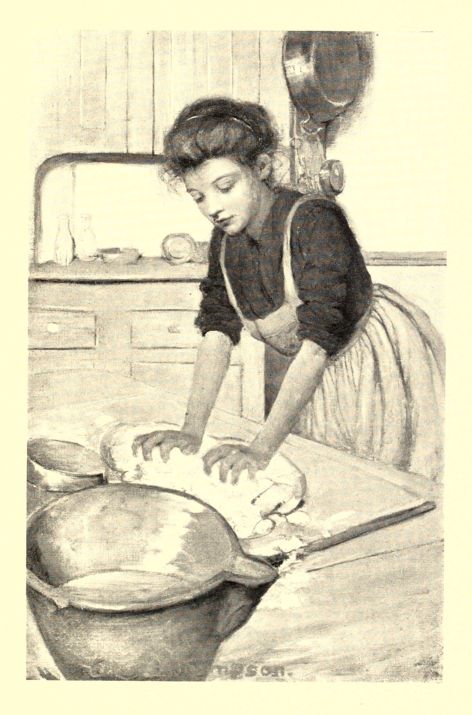
"Rose was at the kitchen table, patting out the dough for the rolls"
"'I told thee when love was hopeless; (thump)
But now he is wild and sings--(thump)
That the stars above (thump! thump!!)
Shine ever on Love--(thump--)'"
Jack knocked rather loudly, and Rose turned with a little "Oh!" and an attitude that made Jack long for a button-hole kodak.
"Come in, Mr. Sherrill," she said, cordially, but thinking to herself, "Caught again! well, I don't care."
"I hope I have n't come too early this morning to be received," said Jack, extending his hand.
"I can't shake, Mr. Sherrill," laughed Rose, "and if I stop to wash them, you won't have any rolls for tea."
"Do go on then," said Jack, eagerly, "only don't let me be a bother. I was afraid it might be too early and inconvenience you, but--"
"Not a bit," said Rose as she turned to the kneading-board again. "If you don't mind, I 'm sure I don't; only these rolls must be attended to."
"You 're very good to let me stay and watch the process," said Jack, humbly, deferentially taking his stand by the table. "I hope I shall not interfere so much with Mrs. Blossom; I forgot that--that--" Jack grew red and confused.
"That we did our own work?" Rose supplied the rest of his thought with such winning frankness, that Jack succumbed then and there to the delight of a novel experience.
"I 'll be out in a few minutes, Mr. Sherrill," called a cheery voice from the pantry behind him. Jack started,--then laughed.
"Am I interrupting you, too, Mrs. Blossom?" he said, addressing a crack in the pantry door.
"I don't mean to let you, or you will have no sponge cakes for tea; I 'm beating eggs and can't leave them or they 'll go down."
"Can't I help, Mrs. Blossom? I 've no end of unused muscle," said Jack, entering into the fun of the situation.
"No, thank you, I shall be but a few minutes. Rose dear, just feel the oven, will you?"
Jack began to think himself a nonentity in all this domesticity. "'Feel the oven,'" he said to himself. "Do girls do that often, I wonder." He watched Rose's every movement.
"Now, confess, Mr. Sherrill, have you ever seen anyone make biscuit before?" said Rose, cutting off a piece of dough, flouring it, patting it, cuddling it in both hands, folding it over with a little slap to hold a bit of butter, and tucking it into the large, shallow pan.
"No--" Jack drew a long breath, "I never have. You see I have always thought it a kind of drudgery, but this--" Jack sought for a word that should express his feelings in regard to the process as performed by Rose--"this is, why--it's poetry!" he exclaimed with a flashing smile that became his expressive face wonderfully, and caused Rose to fail absolutely in making a shapely poem of the next roll.
She laughed merrily. "There now, they 'll soon be done--in good shape too, if you don't compliment them too much."
"I 'll eat a dozen of them, I warn you now." Jack was waxing dangerous, for he was already possessed with an insane desire to become a piece of dough for the sake of having those pretty hands pat him into shape.
"Do you hear that, Martie?" cried Rose, flushing with pleasure.
"Yes. That's the best compliment you can pay them, Mr. Sherrill. I hope my cakes will fare as well," she said, coming from the pantry with extended hand.
It was strange! But when Jack Sherrill returned the cordial pressure of that same hand, small, shapely, but worn and hardened with toil, his eyes suddenly filled with tears. This, truly, was a home, with what makes the home--a mother in it.
Mrs. Blossom saw the tears, the struggle for composure, and, knowing from Hazel he was motherless, read his thought;--then all her sweet motherhood came to the surface.
"My dear boy," she said with quivering lip, "it is very thoughtful of you to come up and pioneer the way over the Mountain for all your city friends."
Jack found his voice. "Mrs. Fenlick wanted to come, too, Mrs. Blossom, but I managed to put it so she thought it would be better to wait until afternoon. They are all looking forward to it."
"I 'm sorry Hazel is n't here; she is out picking berries with the children. If Rose had n't so much to do, I 'd send her to hunt them up."
Jack protested. He had come to call on Mrs. Blossom and had detained them altogether too long.
"I don't want to go," he said laughingly, "but I know I ought. It seems almost an imposition for so many of us to come up here and put you to all this trouble. Why did you ask us, Miss Blossom?" At which question, Rose did not belie her name, for a sudden wave of color surged into her face, and she looked helplessly and appealingly at her mother.
"I 've put my foot into it now," was Jack's thought, as Mrs. Blossom responded quickly, "For more reasons than one, Mr. Sherrill."
They were out on the porch; Chi was bringing up Little Shaver.
"It will be a regular stampede this afternoon," said Jack, gayly, as he vaulted into the saddle. "Have you room enough for so many horses?" He turned to Chi.
"Plenty 'n' to spare, 'n' I 'm goin' to give 'em a piazzy tea of their own. Little Shaver knows all about it: I 've told him. I never saw but one horse before that could most talk, 'n' that's Fleet."
Little Shaver whinnied, and with a downward thrust and twist of his head tried to get it under Chi's arm.
"Did n't I tell you?" said Chi, delightedly.
"Can I get on to the main road by going over the Mountain?" Jack asked him.
"Yes, you can get over, if you ain't particular how you get," said Chi.
"No road?"
"Kind of a trail;--over the pasture 'n' through the woods, an acre or two of brush, 'n' then some pretty steep slidin' down the other side, 'n' a dozen rods of swimmin', 'n' a tough old clamber up the bank--'n' there you are on the river road as neat as a pin."
Jack laughed. "Just what Little Shaver glories in; I 'll try it, and much obliged to you, Mr.--" he hesitated.
"Call me, Chi."
"Chi," said Jack, in such a tone of good comradeship that it brought the horny hand up to his in a second's time.
Jack grasped it; "Good-bye till this afternoon." He spoke to Little Shaver, who ducked his head and fairly scuttled across the mowing, scrambled up the pasture, took the three-rail fence at the top in a sort of double bow-knot of a jump, and then disappeared in the woods, leaving the three gazing after him in admiration.
"That feller's got the right ring," said Chi, emphatically; "but if he had n't come up here this mornin', first thing, after that invite of Rose-pose's, I 'd have set him down alongside of that Miss Seaver--'n' a pretty low seat that would be!"
"I 'll put up some lunch, Chi, for you and March, and, if you can find him, you would do well to start now for the trout."
Mrs. Blossom turned to Rose. "Come, dear, we 've a hundred and one things to do to be ready in time. You may set the table on the porch, and we 'll all picnic for dinner to-day; I 've no time to get a regular one, and father is n't at home."
It was a perfect afternoon on that second of September. At a quarter of five Mrs. Blossom and Rose and Hazel were on the porch, looking down upon the lower road for the first glimpse of the party.
The table was set on the huge rough veranda that Mr. Blossom and Chi had built just off the kitchen long-room. Clematis and maiden-hair ferns, which abounded on the Mountain, were the decorations, and set off to good advantage Mrs. Blossom's mother's old-fashioned tea-set of delicate green and white china.
On one end was a large china bowl heaped with blackberries, on the other stood a common glass one filled with luscious, red raspberries. The sponge cakes gleamed, appetizingly golden, from plates covered with grape-vine leaves for doilies.
The chicken quivered in its own jelly on a platter wreathed with clematis. The delicious odor of fried trout floated out from the long-room, and the rolls were steaming hot in snow-white napkins.
"Oh, dear!" moaned Rose. "Everything will get cold, it's so late."
Just then there was a shout from the advance-guard of the twins, and the cavalcade came into view; Jack on Little Shaver, who, after his thirty-mile morning ride, was as fresh as a pastured colt--riding beside Maude Seaton on Old Jo.
There was a general dismounting, assisted by Chi; a gathering and looping up of riding habits; a bit of general brushing down among the men; then, with one accord they turned to the broad step of the porch.
Mrs. Fenlick, telling of it afterwards, said that, for a moment, she did nothing but look with all her eyes; for there on the porch step stood a woman still in the prime of life and beautiful. She was dressed in an India mull of the fashion of a quarter of a century ago, with a lace kerchief folded in a V about the open neck, and fastened with an old-fashioned brooch.
"At her side," said Mrs. Fenlick, "stood one of the loveliest girls off of canvas I have ever seen. She had on a gown of old-fashioned lawn--pale blue with a rose-bud border. She was tall and straight, and the skirt was a little skimpy, and so plain that had she designed it to set off the grace of her figure she could n't have succeeded better. And the face and head!" Mrs. Fenlick used to wax eloquent at this point--"were simply ideal. Hazel, of course, looked as handsome as a picture in her full, dark blue frock of wash silk trimmed with Irish lace, and with that rich color in her cheeks--but that girl's face was simply divine! Just imagine a complexion of pure white, and dark blue eyes--real violet color--black almost in her pretty excitement of welcoming us, and the loveliest golden brown hair just plaited and puffed a little at the temples, and a braid, that big--" Mrs. Fenlick generally put her two delicate wrists together at this point,--"that fell below her waist fully half a yard! I never saw such hair!"
Mrs. Fenlick used to pause for breath at this point, and then add, "Well, the whole thing was too lovely to be described. Of course, we ate--lots; for that ride and the air were enough to make a saint hungry in Lent, but I was only dimly conscious of ever so many good things I was eating, for that face fascinated me. And manners! Just as if those two women had had nothing to do all their lives but entertain royalty!
"I had sense enough, however, to notice that Jack Sherrill said very little and ate a great deal. I counted twelve rolls--of course they were small--for one thing; and I don't blame him,--I wanted more. Well, the whole thing was perfect--the valley and the great mountains were just in front of the porch, and everything harmonized. Even that lovely girl had a bunch of purple-blue pansies at her belt and a few in the bit of cotton lace at her throat; and the sunset and the mountains matched them--as if she had had the whole thing made to order."
Mrs. Fenlick always ended with, "I 've got one bone to pick with that dear Doctor Heath--a mountain sanatorium! I 'd be willing, almost, to get nervous prostration to be sent up there.
"But oh! you should have seen Maude Seaton!" And thereupon, Mrs. Fenlick would go off into a fit of laughter at the remembrance. "She was looking about for the 'rigid sunbonnet,' as she called it, of the day before, and did n't hear when Rose Blossom spoke to her; and when she did realize that the two were one and the same, her look was the kind 'Life' likes to get hold of, you know.
"As for Jack Sherrill," Mrs. Fenlick concluded in her most serious manner, "I have my own thoughts about some things." More than that she would not say, for fear it might get back to Maude Seaton's ears.
Jack, too, had his own thoughts about some things--and kept them to himself.
XII
RESULTS
It was the middle of November. A wild, cold wind was sweeping over the Mountain, and driving black clouds in quick succession across the tops of the woodlands. It howled around the farmhouse and, as now and again a more furious blast hurled itself against doors and windows, the children drew nearer together on the rug before the huge fireplace with a delightful sense of safety and cosiness.
A kettle of molasses was simmering on the stove, and Chi was wielding the corn-popper with truly professional skill before the open fire.
It was such fun to see the hurry, and scurry, and hustle, and rattle, and pop, and sudden white transformation of the heated kernels! A huge, wooden bowl received the contents of the popper, and March salted them. Oh, how good it smelt! And Rose was going to make molasses corn-balls to put aside for the next evening.
"It's just like having a party every night, there are so many of us," said Hazel, clapping her hands in delight.
"I should think you 'd miss some of your real parties, Hazel," said Rose, thoughtfully.
"Miss them! Not a bit; why, they are n't half so nice as this, and at home it's so lonesome when papa isn't there. Is n't it lovely to think he 's coming up Christmas? Even up here, you know, it would n't be quite Christmas for me without him. That makes me think, I must write him very soon about some things." Hazel looked mysterious.
"We hung up our stockings last year, but we did n't get what we wanted," said Cherry rather mournfully.
"Why not?" asked Hazel.
"Coz Popsey was so sick he could n't go out to the Wishing-Tree, and so he did n't know."
"What is the Wishing-Tree?" said Hazel, consumed with curiosity.
Cherry's mouth was full of corn, so Budd carried on the conversation between mouthfuls.
"I 'll show you to-morrow. It's a big butternut up in the corner of the pasture, an' there 's a little hollow in the trunk where the squirrels used to hide beech-nuts, but March has made a door to it with a hinge and put a little padlock on it--that's the key hanging up on the clock."
Hazel saw a tiny key suspended by a string from one of the pointed knobs that ornamented the tall clock.
"'N' nobody touches it till All-hallow-e'en," said Cherry, when the sound of her munching had somewhat diminished, although her articulation was by no means clear. "'N' then Chi goes up with us in the dark, 'n' we put in our wishes, 'n'--"
"Let me tell Hazel," said Budd. "You 've begun at the wrong end. You see, we write what we want for Christmas down on paper, an' seal it with beeswax, an' then don't tell anybody what we 've written; an' then Chi goes up there with us after dark, an' we 're all dressed up like Injuns--"
"Indians, Budd," corrected March.
"Well, Old Pertic'lar, Indians, then," said Budd, a little crossly, "an' then--
"Oh, you 've forgot the dish-pan and the little tub," Cherry's voice came muffled through the corn. "We take the dish-pan, Hazel, 'n' the little wash-tub, me 'n' Budd between us, 'n' beat on them with the iron spoon 'n' the dish-mop handle, 'n' play 'tom-toms'--"
"Yes, an' March gives an awful war-whoop--" Budd, in his earnestness, had risen and gone over to Chi's side, and now sat down by the big bowl, but, unfortunately, on the popper which Chi had just emptied. There was a smell of scorched wool, and, simultaneously, a wild, "Oh, gee-whiz!!" from Budd, who leaped as if shot, and stood ruefully rubbing the seat of his well-patched knicker-bockers, while the rest rolled over on the rug in their merriment.
"Oh, do go on, Budd!" cried Hazel, wiping the tears of mirth from her eyes. Cherry had laughed so hard that she was hiccoughing with outrageous rapidity; and March--forgetting May--chose that opportune moment to give forth a specimen of his best war-whoop, for the purpose, as he explained afterwards, of frightening her out of them.
By the time order had been restored, Cherry was able to take up the thread of the story;
"'N' we join hands--Chi 'n' all of us--'n' sing as loud as we can sing:
"'Intery, mintery, cutery corn,
Apple seed, apple thorn;
Wire, briar, limber lock,
Five geese in a flock--
Sit and sing by the spring;
You are OUT.'
Then we all give a great shout and grunt like In-di-ans--," said Cherry, emphatically, looking at March; and March nodded approval.
"How's that?" asked Hazel, who was listening with all her ears.
"A hánnah--a hánnah--a hánnah," grunted the children as well as they could, hampered by mouths full of corn. "An' then," went on Budd, "we drop the wishes into the hollow in the tree-trunk, an' Chi locks the door an' keeps it, an'--"
"'N' each of us ties two feathers from a rooster's tail to different colored strings, 'n' fastens them on to a branch of the tree, 'n' that brings us good luck; March calls it 'winging the wishes.' That's the way we get our presents."
"Oh, what fun!" cried Hazel. "May I do it this year?"
"Course," replied Budd, "but how will your father know anything about it?"
"I never thought of that," said Hazel, all her Christmas castles toppling over suddenly.
"We 'll fix it somehow, Lady-bird," said Chi, who, having finished his labors, had seated himself in a chair behind the children and provided himself with a private bowl of his own.
"But now, speakin' of roosters, I 'd like to know how you 're comin' out about chicken money. I sold the last lot but one down in Barton's to-day. There 's been a lot of express to pay, 'n' I thought I 'd better pay dividends to-night, 'n' get it off my mind, seein' it's most Wishin'-Tree time."
Rose took her little account book from her pocket. "We cleared one hundred and ten dollars on our preserves and jams after we 'd paid Hazel what we had borrowed for the jars and sugar, and paid for the express and boxes. I 'm awfully sorry we could n't fill all the orders, but we 'll try to next year. I 'll go and get the money. I like to look at it, knowing it means so much to us all."
She ran upstairs and came back with a little wooden box that Chi had made for her years ago. The children crowded about her. "There," said Rose, proudly, as she took out the money and smoothed it, one crisp bill after another, on her knees; "they 're all in ones, so it will seem as if we had more when we divide. Now we 've agreed to divide this equally, so that 'll make just twenty-two apiece."
"Let's play 'Hold-fast-all-I-give-you' in earnest," said Cherry, sitting down again on the rug and holding out her hands. "That 'll be twenty-two times round and make it seem a lot more."
"Good for you, Cherry," said March, approvingly, and they all followed her example. With a gravity befitting the occasion, the "truly-bruly" game, as Budd called it, went on to the supreme satisfaction of those interested as well as the enjoyment of father and mother and Chi; for to the two former the money-making had long been, of necessity, an open secret.
Chi, after watching them a little while, left the room. When he reappeared a few minutes later, he was greeted with a prolonged "Ah!" of satisfaction; for in one hand he held his old account-book, and in the other a long, dark blue woollen stocking which bulged fearfully from the toe halfway up the leg, where it was tied with a stout piece of leather whip-lash.
The whole business of disposing of the chickens had been intrusted to Chi, and the members of the N.B.B.O.O. Society had pledged themselves not to ask him any questions in regard to the sale of them until he should tell them of his own accord. This pledge they had kept, and now they were to have their rewards.
"If this is going to be a meeting of the N.B.B.O.O. Society, I move we ask those who aren't members to adjourn to the bedroom," said March, looking significantly at his mother and father. Mr. and Mrs. Blossom took the hint, and, without waiting for anyone to "second the motion," betook themselves, laughing, into the other room.
"Guess we 'll sit up to the table 'n' count it out," said Chi, "coz we don't want any of it to fly up chimney. We should never find it again in this gale."
He emptied the stocking of its contents--bills, pennies, and silver pieces of all denominations--upon the table, and the children drew up their chairs.
"Now we 'll sort," said Chi. "You take the bills, Rose, 'n' the rest take the other pieces, 'n' make little piles before you of a dollar each. Then we can reckon up easy. I 'll take the pennies and the nickels."
"I choose the ten-cent pieces," said Cherry, "an' you take the quarters, Budd." March and Hazel took the rest.