Front matter (continued 4)
Reading edition
Indeed, in the next minute, he was sure it did not signify, for, before he could gather his wits sufficiently to reply to her, Rose had slipped away to the other side of the room, where she was busying herself in fastening one of Jack's roses into the buttonhole of Alan Ford's Tuxedo. In consequence of which, Jack turned his batteries upon Ruth Ford with such effect, that she declared afterwards to her mother he was one of the most fascinating young men--for Ruth was twenty-one!--she had ever met.
Mrs. Ford and Hazel and Mr. Ford had done their best to persuade Chi to remain with them for the tree. Even Rose urged--but in vain. True, the girls had insisted upon his taking one look, then he had begged off, saying, as he patted Hazel's hand that lay on his arm:
"Not to-night, Lady-bird. I don't feel to home in there. I 'll sit out here and hear the music, then I can beat time with my foot if I want to." He remained in the hall, just outside the living-room door, enjoying all he heard.
First there was a lovely piano duet, an Hungarian waltz by Brahms, Mrs. Ford and the grave, quiet son playing with such a perfect understanding of each other, as well as of the music, that it proved a delight to all present. Then there was a carol by all the children, Rose leading, and Mrs. Ford playing the accompaniment:
"'Cheery old Winter! merry old Winter!
Laugh, while with yule-wreath thy temples are bound;
Drain the spiced bowl now, cheer thy old soul now,
"Christmas waes hael!" pledge the holy toast round.
Broach butt and barrel, with dance and with carol
Crown we old Winter of revels the king;
And when he is weary of living so merry,
He 'll lie down and die on the green lap of Spring.
Cheery old Winter! merry old Winter!
He 'll lie down and die on the green lap of Spring!'"
This won great applause, and a loud thumping could be heard in the hall. Jack went out to try his powers of persuasion with Chi, and found him sitting close to the door with one knee over the other and a La France rose (!) in his buttonhole.
"Come in, Chi, do."
"Ruther 'd sit here."
"Oh, come on."
"Nope."
Jack laughed at the decided tone. "Where did you get this?" he asked, touching the boutonniere.
"Rose-pose," answered Chi, laconically, but with a happy smile.
"Out of her bunch?"
"Nope--took it out of her belt," said Chi, with a curious twist of his mouth.
Jack went back crestfallen, and Chi smiled.
"I 'm afraid I cut him out, just for once; kind of rough on him, but 't won't hurt him any to have a change. He 's had his own way a little too much," said Chi to himself.
Again there was music, a Schubert serenade, with the two violins, and after that, the children begged Hazel to dance the Highland Fling as she did once in the barn. Hazel, nothing loath, borrowed a blue Liberty-silk scarf from Ruth Ford; the rugs being removed and Alan Ford tuning his violin, she made her curtsy, and, entering heart and body into the spirit of the thing, danced like thistle-down shod with joyousness.
It was a pretty sight! and Chi edged into the room, while the company made believe ignore him in order to induce him to remain there; but when the singing began, he slipped out again. Such singing! Everybody joined in it. They sang everything;--"Oh, where, tell me where, is your Highland laddie gone?";--"Star-spangled Banner";--"Marching Along";--"John Anderson, my Jo";--"Ye banks and braes o' Bonnie Doon";--"Twinkle, twinkle, little star";--"Annie Laurie";--"A grasshopper sat on a sweet-potato vine";--"Ben Bolt";--"Fair Harvard" and, finally, "Old Hundred."
It had been arranged that Mr. Blossom should take his wife and the younger children home in the pung; the rest were to walk. Chi, meanwhile, had driven home in the single sleigh.
On the walk home Jack tried what he had been apt to term--of course, to himself--his "confidential scheme" with Rose. He had tried it before with many another, and it had never failed to work. The thought of one of his roses in Alan Ford's buttonhole still rankled, and the best side of Jack's manhood was not on the surface when he entered upon the homeward walk.
"Miss Blossom,"--somehow Jack had not quite the courage to say "Rose," although he had been so frankly invited to--"I want to tell you why I came up here; it must have seemed almost an intrusion."
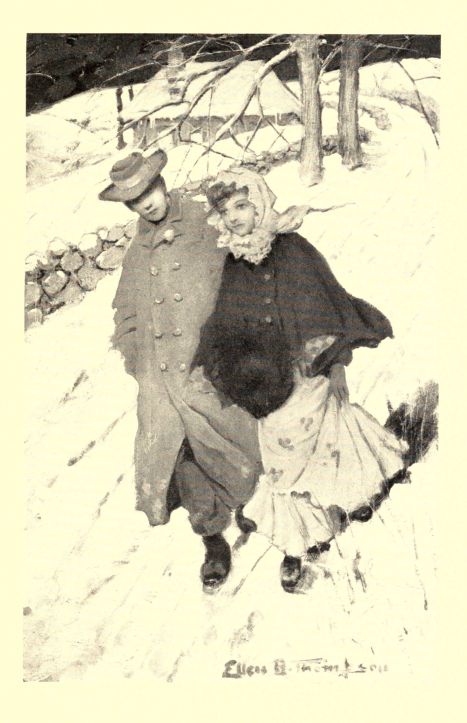
"'I want to tell you why I came up here'"
"Oh, no, indeed," said Rose, earnestly, "and I know why you came; Hazel told me."
"Oh, she did," said Jack, rather inanely, and a little uncertain as to his footing, figuratively speaking; for he had given her the chance to ask "Why?"--and she had n't taken it; in which she proved herself different from all those other girls of his acquaintance. To himself he thought, "Well, for all the cordial indifference, commend me to this girl."
"Yes, I 'm sure it would have seemed like anything but Christmas to you in New York with your father in Europe; you must miss him so."
Jack felt himself blush in the moonlight at the remembrance that he had seen his father but little in the last three years, and did not know what it was in reality to miss him. He never remembered to have missed anything or anybody but his mother, and that indefinite something in his life which he had not yet put himself earnestly to seek.
"I suppose you 'll be shocked, Miss Blossom, but I don't really miss my father. I 'm only awfully glad to see him when I get the chance--which is n't often. He 's such a busy man with railroads and syndicates and real estate interests. I wonder often how he can find time to write me even twice a month, which he has done regularly ever since--" he stopped abruptly.
"Since what?" asked Rose, innocently.
"Since my mother died," said Jack, in a hard, dry voice that served to cover his feeling.
"Yes," Rose nodded sympathetically, "Hazel told me." Then--for Rose's love for her own mother was something bordering on adoration--she said softly, under her breath, but with her whole heart in her voice; "Oh, I don't see how you could bear it--how you can live without her!"
"I don't," Jack replied with a break in his voice, "not really live, you know. I've always felt it, but never realized it until last night, when I stood out on the veranda and looked in at the window at you--all. Then I knew I 'd been hungry for that sort of thing for the last seven years--"
Now Rose's heart was swelling with pity for the loneliness of the tall, young fellow swinging along beside her, and at once her inner eyes were opened to see a, to her, startling fact. She turned suddenly towards him.
"Is that why you kissed Martie last night, and came up here to us?" she demanded rather breathlessly.
"Yes;" Jack had forgotten his scheme, and was in dead earnest now.
"Then," cried Rose, impulsively--but at the same time thinking, "I don't care if he is engaged to that Miss Seaton"--"I hope you 'll come to us whenever you feel like it; for," she added earnestly, "I 'm beginning to understand what Chi means when he talks about Hazel's being poor and our being rich, and--and I 'd love to share mine with you."
"You 're awfully good," said Jack, rather awkwardly for him; for, suddenly, in the presence of this young girl, as yet unspoiled by the world, he realized that Life was dependent upon something other than polo and club theatricals, railroad syndicates and Newport casinos, stocks and bonds and marketable real estate.
Jack was young, and the moonlight was transfiguring the face that, framed in a white, knitted hood, was turned towards him full of a frank, loving sympathy for him in his "poverty."---And, seeing it, Jack suddenly braced himself as if to meet some shock, thinking, as he strode along in silence, "Oh, I 'm gone!--for good and all this time."
Rose, a little surprised at the prolonged silence, welcomed the sound of sleigh-bells behind them.
"Why, that's Chi!" she exclaimed. "I thought he was at home long before this. I 'm sure he left long before we did. Where have you been, Chi?" she called so soon as the sleigh was within hailing distance.
"I 've been Chris'musin'," said Chi. "It ain't often you get just such a night on the Mountain as this, and I 've made the most of it. Can I give you a lift?"
"No, thank you, Chi, we 're almost home," said Rose.
"Well, then I 'd better be gettin' along--it's pretty near midnight--chk, Bob--" And Chi drove away down the Mountain, chuckling to himself:
"Ain't a-goin' to give myself away before no city chap that has cut me out as he has. George Washin'ton! When I peeked into the window 'n' saw Marier-Ann sittin' there in front of that kitchen table with all those presents on it, 'n' the little spruce set up so perky in the middle of 'em, 'n' she a-wearin' a great handful of those red, spice pinks in her bosom, 'n' her cheeks to match 'em, 'n' her eyes a-shinin'--I knew he 'd come it over me; he 'd made the first call, 'n' given her the first posies. Guess I won't crow over him after this." Chi undid his greatcoat, and bent his face until his nose rested upon Jack's rose:--
"It ain't touched yet, but it's a stinger; must be twenty below, now." Suddenly Chi gave a loud exclamation: "I must be a fool!--I 've broken one of the N.B.B.O.O. rules not to be afraid of anything, and did n't dare to give my posy to Marier-Ann!--Anyhow, she don't know I was goin' to give it to her, so I need n't feel so cheap about it--Go-long, Bob!"
XVIII
BUDD'S PROPOSAL
Before Mr. Clyde and Jack left the next day, Budd sought an opportunity to interview the latter on a subject, that, for a few weeks past, had been occupying many of his thoughts. The applause, with which his Christmas-day toast had been greeted, had encouraged him to seek an occasion for acquiring more definite knowledge on a subject which lay near his heart. It came when Jack was packing his dress-suit case in the guest chamber.
There was a knock on the half-opened door.
"Come in," said Jack, and Budd made his appearance.
"Halloo, Budd! What can I do for you? Any commissions in New York, or Boston?"
"Don't know what you mean by commissions," replied Budd, cautiously, thrusting both hands deep into the pockets of his knickerbockers, and spreading his sturdy legs to a wide V.
"Anything I can buy with that hen-and-jam money you helped to earn?--you did well, Budd, on that. I congratulate you."
"I have n't any of that money left. You see, we voted to give it to March to go to college with. But I 've got two quarters an' a dollar--Christmas presents, you know; an' that 'll do, won't it?" he asked rather anxiously.
"Well, that depends on what you buy," said Jack, with due seriousness.
"You 'll keep mum, Mr. Sherrill, if I tell you?" said Budd, inquiringly.
"Mum's the word, if you say so, Budd; out with it."
"Well, I want two things; one thing to make me feel grown up, an' I 've wanted it for a year."
"What's that, Budd?" asked Jack, immensely amused at Budd's swelling manhood--"A pair of long trousers?"
"No--" Budd hesitated for a moment, then went on in rather an aggrieved tone; "I hate to wear waists with buttons; it's just like a baby, an' a fellow can't feel grown up when he has to button everything on. I want to hitch things up the way March an' Chi do, an' I want you to buy me a shirt like that one you 're rolling up--only not flannel,--with a flap, you know, to tuck in."
"Oh, that's it, is it?" said Jack, endeavoring to keep his face and voice from betraying his inward amusement. "Well, I think you can get one for seventy-five cents--plain or striped?"
"I like those narrow blue striped ones like yours best," he replied, pointing to one of Jack's.
"Like mine it shall be, Budd; but you 'll want a pair of suspenders, or there 'll be too much hitching to be agreeable to you."
"March has an old pair, an' I 'm going to borrow them."
"That's an idea; now, what's the second thing?"
"A ring."
"A ring?" Jack looked amazed.
Budd nodded.
"For yourself?" Jack questioned further.
"No--for somebody else."
"Do you mean a finger ring?"
Budd nodded again emphatically.
"Engagement?" laughed Jack, at last, the fun getting the better of him.
Budd's mouth puckered into solemnity; "No--wedding."
Jack gave up the packing, and sat down, shaken with laughter, on the first convenient chair.
"Pardon me for laughing, Budd, but I can't help it. What do you want of a wedding ring? Is it for that 'first wife' of yours you toasted yesterday at dinner?"
Budd nodded again. "I don't see anything to laugh at," he said, with a reproachful glance. "You would n't if you was me."
"No, I don't think I should; you 're right there, Budd," he replied, sobering suddenly after his outburst of laughter. "When is the wedding to be?"
Budd looked thoughtful. "I have n't proposed yet," was his matter-of-fact answer.
"Well, why don't you?" Jack, sinner that he was, scented some fun at Budd's expense.
"I 'm going to when I know how," said Budd, humbly.
"Why don't you take lessons?" suggested Jack.
"I have."
"Of whom?"
"Chi."
Jack shouted. "What did Chi say?" he demanded when he had regained his breath.
"He said if he wanted to marry a girl, he 'd say what he wanted to--tell 'em he was fond of 'em."
"'Fond of them'--hm," repeated Jack, thoughtfully.
"What do you say?" questioned Budd, turning the tables rather suddenly on Jack.
"I don't say--never said," replied Jack, shortly.
"That's what Chi said. He said if I begun early I 'd find out how."
"You seem to be on the right road for it."
"Would you say 'fond of her'?" persisted Budd.
"Yes, I think I should," Jack replied with a peculiar smile; "but, of course, it would depend on the girl."
"Why, that's just what Chi said!"
"He did, did he!" Jack laughed; "Chi knows a thing or two."
"But I thought you 'd know more." Budd's face began to wear a puzzled look.
Just then Jack heard Rose's voice in the long-room asking where Mr. Sherrill was, and the sound brought home to him a realizing sense of the fact that there was but an hour before they left for the station, and every moment too precious to be wasted on Budd. Rising, and proceeding with his packing, he said with perfect seriousness:--
"Well, Budd, all I can say is, that if I were going to ask a girl to marry me, I should ask her if she thought enough of me to take me with all my imperfections and--"
"Where are you, Jack?" called Hazel, at the foot of the stairs; "Chi has to go an hour earlier than he said, and the sleigh is at the door."
In the hurry of Jack's good-byes and departure, the sentence was never finished, and the ring forgotten by him. But Budd remembered.
He was a sturdy little chap, broad of shoulder, strong of limb. His sandy red hair bristled straight up from his full forehead. His pale blue eyes, with thick reddish-brown lashes, were round and serious. His nose was a freckled pug, and his small mouth puckered, when he was very much in earnest, to the size of a buttonhole. From the time he had championed Hazel's coming to them, nearly a year ago, he had never wavered in his allegiance to her, and in his small-boy way showed her his entire devotion. Hazel had been so grateful to him for his whole-souled welcome of her, that she took pains to make his boy's heart happy in every way she could.
For Hazel, Budd was never in the way; never asked too many questions for her patience; never teased her beyond endurance. He found in her a ready listener, a good sympathizer, a capital playmate, and a loving girl-friend, who reproved him sometimes and, at others, praised him. What wonder that his ten-year-old heart had warmed towards her with its first boy-love? and that in his manly, practical way, he made of her an ideal?
"I love Hazel, and when I am big enough, I shall marry her," was what he said to himself whenever he stopped his play long enough to think about it at all. Naturally it seemed the wisest thing to tell her this when he should find the opportunity, and at the same time recall the fact.
Fortified by the testimony of Chi and Jack, he bided his time.
One Saturday afternoon in January, Rose said suddenly to Hazel: "I wish I could do some of the things that you do, Hazel." Hazel looked up from her book in surprise.
"What can I do that you can't do, Rose?"
"You dance so beautifully, and I 've always wanted to know how. I feel so awkward when I see you dance the Highland Fling."
"Is that all?" Hazel laughed a happy laugh. "I can teach you to dance as easy as anything, if you 'll let me."
"Let you!" Rose exclaimed, flushing with pleasure; "just you try me and see. But where can we practise?"
"Oh, out in the barn," cried Hazel. "It'll be lots of fun; of course, it's awfully cold, but the skipping about will keep us warm. I 'll tell you what--I 'll play on the violin, and you and March and Budd and Cherry can learn square dances first."
"What fun!" said Rose.
"What's the joke?" asked March, coming in at that moment with Budd and Cherry.
"We 're going to have a dance in the barn; Hazel's going to teach us. She says she can do it easy enough."
"Oh, bully!" Budd threw up his tam-o'-shanter, and Cherry, attempting to charge up and down the long-room as she had seen Hazel at the Fords', tripped on the rug and fell her length. When March had picked her up she rubbed her nose, which was growing decidedly pink, and sniffed a little, then asked suddenly:--
"Who 's going to be my partner? They always have partners in the story books."
"Sure enough," Rose laughed. "Whatever will we do, Hazel?"
"I never thought of that," said Hazel, ruefully. "Of course, it takes eight."
"Why can't we have chairs for partners?" said Cherry. "We can bow to them just as if they were alive, and make them move round, can't we?"
They all laughed at Cherry's inspiration.
"You 're a brick, Cherry Bounce?" said March, approvingly. "All choose your partners!" And, thereupon, he seized one of the kitchen chairs, and the rest followed his example. Hazel took her violin, and hooded and mittened and coated and mufflered, they trooped out to the barn, each lugging a wooden chair.
"Now I 'll give you the first four changes," said Hazel, illustrating, as well as she could in trying to be two couples at once, the first movements. "Form your square and get ready."
They obeyed with alacrity, and Hazel drew her bow across the strings.
"All curtsy to your partners!" she shouted, and the chair-partners received a bow, and, in turn, were made to thump the floor by being laid over on their backs, and righted suddenly.
"First couple forward and back!" shouted Hazel, and away went Rose dragging her chair after her to meet March and his chair--thumpity-thump--thumpity-thump.
They were in dead earnest, and the chairs were made to behave in a most human way.
All went well until they came to the Grand Right and Left; then there arose such a medley of shrieks of laughter, wild wails from the violin, thumps from sixteen chair-legs, and stampings from eight human ones as was never heard before. In a few minutes all was inextricable confusion, and the noise might have been best compared to a Medicine Dance among the Sioux Indians.
Upon this scene Mr. Blossom and Chi, on their return from the wood, looked with amazement.
"They seem to be havin' a regular pow-wow," Chi remarked dryly, as the exhausted dancers and musician sat down, panting for breath, on their wooden partners. "Rose-pose is about as young as any of 'em--but it beats all, how she's shootin' up into womanhood."
"She 's no longer my little Rosebud Blossom," said her father, rather sadly. "I dread the time when the birds begin to fly from the nest, and I see it coming with March and Rose."
Just then Rose caught sight of her father, and ran to him linking her arm in his. "We 've had such fun, father! We 're learning to dance; you must be my partner sometime, for Hazel's going to teach us the schottische next."
Rose never forgot the look of love her father gave her, nor the feel of his hand as he laid it on her hooded head: "Be my little Rose-pose, as long as you can, dear; you 're growing up too fast."
She recalled afterwards that this first dance in the barn marked the last time that she abandoned herself to the children's fun with a girl's careless heart.
The winter twilight was fast closing about the Mountain and the children just returning to the house, when Chi went out to milk. Leaving his lantern, stool, and pails in the first stall, he entered the third one to tie one of the cows to a shorter stanchion. Before he had finished he heard Budd's voice, and, looking over the partition, saw him standing with Hazel in the circle of light about the lantern. In another minute he began to feel like an eavesdropper.
"What did you want me to come here for, Budd?" said Hazel, dancing on the barn floor to warm her feet.
"I want to tell you something," said Budd, blowing on his cold fingers.
"Well, hurry up and tell; it's simply freezing here. Is it a secret?"
"Kinder," replied Budd, blowing harder; then, suddenly ceasing the bellows movement, he drew a step nearer to Hazel, and, putting the tips of his pudgy fingers together to make a triangle, he puckered his mouth solemnly and said, looking up at her with earnest eyes:--
"I 'm very fond of you."
Hazel laughed merrily. "Why, of course you are, you funny boy; you 've always been fond of me, have n't you? I 'm sure I 've always been fond of you. Is that what you kept me out here in the cold to say?"
"Not all;" Budd nodded seriously. "I 'm very fond of you, an'--an' if you 'll take me with all my perfections--I think that's the way it goes--if I have n't got the ring yet, it will be just the same, you know." He paused, and in the circle of light Chi could see the entire earnestness of his attitude.
"Goodness me, Budd! What do you mean about rings and things?"
"I want to marry you when I 'm big--an' I thought I 'd speak 'fore anyone else did to get ahead of 'em." Budd hastened to explain, as Hazel showed signs of impatience.
"Oh, is that all!" Hazel breathed a sigh of relief. "I thought something was the matter with you. Why, of course you 're fond of me, Budd; but I could n't marry you, for I 'm older than you, you know."
"I never thought of that," said Budd, beginning to blink rather suspiciously, "I thought--"
"Now, look here, Budd," said Hazel, in a business-like way; "I think everything of you, too, and I 'll tell you what you can be--"
"What?" interrupted Budd, eagerly, balancing himself on the tips of his toes.
"My knight!" said Hazel, triumphantly, "and wear my colors. I 'll give you a bow of crimson ribbon--I 'm Harvard, you know--and you must wear it till you die. And I have a white kid party glove I 'll give you, too, and that will mean I 'm your lady-love, and it will be just like the days of chivalry, you know we were reading about them the other day."
"And you won't mind about the ring?" queried Budd, rather wistfully.
"Not a bit--a glove is much nicer than a ring, and--"
"Moo--oo--oo--" came from the next stall.
"Oh, goodness gracious! How that made me jump. I 'm not going to stay out here another minute; so come along if you 're coming"--and the knight meekly followed his lady-love into the house.
XIX
A YEAR AND A DAY
"It seems queer to settle down the way we have, ever since Christmas. We had such fun up to that time." Hazel heaved a long sigh as she wrestled with her Latin and the Third Conjugation.
Rose looked up from her Cicero and smiled at the bored expression on Hazel's face. "I know, Latin is awfully dull at first, but when you can read it, you 'll like it. If only you could hear Cicero give this horrid Catiline--the old traitor--'Hail Columbia' as March says, you could n't help liking Latin. Then, too, if we had n't settled down, where would my French have been?"
But Hazel still pouted a little. "I wish papa had n't wanted me to study at all this winter--I don't see why, when Doctor Heath is always talking about its 'effect on my health--'"
She was interrupted by a merry laugh. Rose threw down her Cicero, caught away the grammar from Hazel, and, seizing her by the hand, drew her into the little bedroom. Then, taking her by the shoulders, she whirled her about until she faced the small looking-glass.
"There!" she exclaimed, still laughing, "look at that face before you talk about any 'effect on your health.'"
Hazel looked at the reflection in the mirror, and smiled in spite of herself. What a contrast to what she was a year ago! For to-morrow would be St. Valentine's day. There were real American Beauty roses on her cheeks; the dark eyes were full of sparkling life; the chestnut-brown hair fell in heavy curls upon her shoulders. She had grown tall, too, but rounded in the process, and the healthful, bodily exercise had given her grace of carriage--she was straight as an arrow, and as lithe as a willow wand.
"Perhaps I shall feel more interest when Miss Alton is here, for she is a regular teacher. When is she coming, Rose?"
"The very last of the month, when the spring term opens. It's our turn to have the district-school teacher board with us, and I 've never liked it before. But now I can't wait for Miss Alton to come. I think she 's lovely."
"She is n't half as lovely as you are, Rose," said Hazel, turning suddenly from the glass, in which she had been scrutinizing her reflection, and giving Rose an unexpected squeeze and a hearty kiss. "I think you are the most beautiful girl I have ever seen, I heard Doctor Heath say so; and--I told Jack so on Christmas night."
"I 'll warrant he did n't agree with you," said Rose, with a pleased smile. "You forget Miss Seaton."
"I know." Hazel shook her head dubiously. "He did n't say a word to me about you--I don't care if he did n't, Rose-pose, you 're worth all the Maude Seatons in the world, and I 'd give anything to have you for my real cousin instead of her, if only Jack--"
"I don't know what you are talking about, Hazel," said Rose, interrupting her shortly and sharply.
"And I don't know why you are speaking to me in that tone, Rose Blossom," retorted Hazel, both angry and hurt. "I 've said nothing I 'm ashamed of, and I shall say it whenever I choose and to whomever I please, so now." She flung out of the room, but not before Rose had laid a firm hand upon her shoulder.
"Hazel Clyde, if ever you speak of that again to anyone, I 'll break friendship with you, see if I don't."
"Break then," Hazel twitched her shoulder from under the detaining hand. "I 'll speak whenever I choose. I only said I thought you were the most beautiful girl I had ever seen, and I wished that you were going to be my real cousin, instead of Miss Seaton, and you need n't get mad just because Jack does n't happen to think as I do--"
"Hazel Clyde!" Rose stamped her foot, "don't you speak another word to me; I 'll not hear it." Rose stuffed both fingers into her ears, and beat an ignominious retreat to her own room, where she shut herself in, and was invisible until tea-time.
The family were late in sitting down to the table, for Mrs. Blossom wanted to wait for Chi, who had driven down to Barton's River to take Mr. Blossom to the train, and had arranged to bring March home with him.
It was seven already. "We won't wait any longer, children," said Mrs. Blossom. "Something must have detained Chi. Budd, you may say 'grace' to-night?" she added as she took her seat.
Budd looked up in amazement. "Why, Martie, Rose is here and you always--"
"That will do, Budd," said his mother, quietly, ignoring the flame that shot up to the roots of Rose's hair, and the cool look of indifference on Hazel's face. Budd folded his pudgy hands and repeated reverently the words he had heard father, or mother, or sister say ever since he could remember. Scarcely had he finished when Tell's deep note of welcome sounded somewhere from the road, and the sleigh-bells rang out on the still air.
"There they are!" cried Cherry. "May I go to meet them?"
"Yes--but put your cape over you, it's so chilly to-night."
In a minute Cherry was back again, every single curl bobbing with excitement.
"Oh, Martie! Chi's bringing in something all done up in the buffalo robe, and March won't tell me what it is."
She was followed by March, who walked up to his mother, put both arms about her and gave her a quiet kiss.
"There, little Mother Blossom, is my valentine for you," he said half-shyly, half-proudly, and placed in her hands his first term's report and a set of books.
"Oh, March, my dear boy!" said his mother, rising from the table and placing both hands on the broad, square shoulders of her six foot specimen of youth, "I 'm afraid I 'm getting too proud of you. Did you get the first Latin prize?"
"You bet I did, Martie." March's rare smile illumined his face. "There is n't another fellow at Barton's, who can boast of such a mother as I have, and I was n't going to let any second-class mothers read those books before you did. By Cicky!" (which was March's favorite name for the famous orator)--"But I 've worked like a Turk, and I 'm hungry as a Russian bear. Why, Rose, what's the matter with you? You look awfully glum, and Hazel, too. Here comes Chi; he's bringing something that will cheer you up. The truth is, mother, these girls miss me."
"Indeed, I do, March?" said Hazel, looking straight up into his eyes and showing the amazed lad tears trembling in her own.
"Guess there 'll be some breakin' of hearts, this year, Mis' Blossom." Chi's cheery voice was welcome to them all for some unknown reason. He came in loaded with huge pasteboard boxes.
"Your arms will break first, Chi," said Mrs. Blossom, hastening with March to relieve him.
"It ain't the heft of 'em, it's the bulk. Valentines are generally pretty light weight. Romancin' 'n' sentiment don't count for much, nowadays, though they take up considerable room." He deposited the last box on the settle. "'N' there's a whole parcel of things come by mail. I ain't looked at the superscribin's--you read 'em out, Rose-pose."
Rose read the addresses; there was more than one missive for each member of the family.
"Let's have supper, first, mother," said March, "then, after the table is cleared, we can sit round and guess who they 're from."
This proposition was welcomed by Budd and Cherry. Rose and Hazel gave a cordial assent, but there was a frigidity in the atmosphere which the outside temperature did not warrant. Chi and March were aware of this so soon as they entered the room, and Mrs. Blossom had known it the moment she saw the girls' faces at the table. She thought it not wise to interfere, but let matters straighten themselves in good time. She felt she could trust them both to see things in their right light, without the aid of her mental glasses.
"Now let's begin," said Chi, rubbing his hands in glee as, directly after supper, he piled the boxes on the table while March laid the envelopes in their proper places before each member of the family. "This top one says 'Miss Hazel Clyde.' Show us your valentine, Ladybird."
"They 're violets--from Jack, I know. He always sends them. What's yours, Rose?" She spoke rather indifferently.
"Oh, roses!" Rose was having the first look all to herself. "The loveliest things I have ever seen. Look, Martie!" Rose held up the mass of exquisite bloom, and the children oh'ed and ah'ed at the sight.
"They 're from Mr. Sherrill," said Rose, trying to speak in a most common-place tone, but, in her excitement, failing signally.
"They are lovely," Hazel remarked, shooting an indignant glance at Rose. "They're just like the ones he sent Miss Seaton last year, only they were formed into a great heart. Papa gave me one just like it; he got his idea from Jack."
Rose suddenly put down the flowers, in which she had buried her face to inhale their fragrance, as if something had stung her.
"Mr. Sherrill is very impartial with his favors," she said in a tone that increased the pervading chill of the domestic atmosphere.
"Why, Rose!" exclaimed Mrs. Blossom. "It is not like you to receive a favor so ungraciously; you 've never had flowers sent you before, and I 'm sure you would never have them again if the donor could witness your reception of them."
"I don't care for them again, thank you." Rose retorted with flaming cheeks; "I 'd give more for this of yours, Chi--" she opened a huge yellow envelope, and took from it a scarlet cardboard heart, with a small, white, artificial rose glued to the centre and a gilt paper arrow transfixing both rose and heart.
Chi hemmed rather awkwardly, thinking: "Beats the Dutch what's got into Rose-pose to-night. I ain't ever known her to treat a livin' soul so shabby as that in all her life. Beats all what gets into women 'n' girls, sometimes; when a feller thinks he's doin' 'em just the best turn he knows how, they up 'n' get mad with him, 'n' turn the cold shoulder, 'n' upset things generally." But aloud he said:
"I 'm glad it pleases you, Rose. Can't most always tell when it's goin' to please a girl or not. I suppose Jack, now, thought you 'd be tickled to get those posies just in the dead of winter. They don't grow round here on our bushes. What's in the other box?"
"Why!" Hazel exclaimed, laughing rather half-heartedly, "it's addressed to 'Miss Maria-Ann Simmons'--and just look, Mother Blossom! See what that dear old Jack has sent her! He's just too dear for anything." She added emphatically;--"I 'd like to give him a kiss for thinking of that poor girl all alone over there on the Mountain. I don't believe she ever had a valentine before. Look! Oh, look!"
She took out of the many layers of wadding a mass of yellow tulips, their closed golden cups shining in the lamp-light as if gilded by sunbeams.
"Sho!" was all Chi said, leaning nearer to examine the beautiful blossoms.
"You 'll take them over in the morning, early, won't you, Chi?" said Hazel, replacing them.
"First thing, Lady-bird; guess you 're right, Rose, about that young feller's bein' 'n all-round man with his favors. Don't seem to be much choice between you and Marier-Ann, 'n' that Miss Seaver. Kind of a toss-up, hey, Rose-pose?"
But Rose was too busy with another package to answer Chi. She grew wildly enthusiastic over the calla lilies that Alan Ford had sent her, and caressed their white envelopes, and praised their pure loveliness, until Hazel, growing jealous for poor Jack and his discarded gift, rose to put the neglected beauties in water, saying as she did so:
"I 'm sure, Rose, if Jack had known you cared so much for lilies, he would have sent you some Easter ones, they 're out now. I 'll tell him to next time."
"Hazel!" Rose burst forth indignantly, "do you mean to tell me you told Mr. Sherrill to send me these flowers for a valentine?"
Then Hazel, stung by the tone and the words, yielded to temptation--for it had been the last straw. "What if I did?" she said with irritating calm, "he 's my cousin. I suppose I can say what I choose to him."
Rose answered never a word; but, rising, took the La France roses from the pitcher in which Hazel had just placed them, and, going over to the fireplace, deliberately cast the mass of delicate pink bloom into the fire.
Mrs. Blossom looked both puzzled and shocked; this was wholly unlike Rose. What could it mean? The children were too awed by the proceeding to speak or exclaim. March looked gravely at Hazel, who burst into tears--it was such an insult to Jack!--and rushed into her bedroom and shut the door.
"I 'm going to bed; good-night, Martie," said Rose, quietly, after she had watched the last leaf shrivel in the flame, and, kissing her mother, she lighted her candle and went upstairs. Mrs. Blossom, following her with her eyes, felt that she had lost her "little Rose" in that hour.
March looked grave, complained of feeling tired, and said he would go to bed, too, as to-morrow was the last day of school and there were two more examinations to take. Budd and Cherry kissed their mother twice, bade her good-night in suppressed tones and crept upstairs. "It's just as if somebody was sick in the house," said Cherry, in an awed voice. Budd's was sepulchral:--
"It's just as if somebody was dead and all the flowers had come for the funeral."
Across the dining-room table, loaded with boxes and brilliant with valentines, Chi looked at Mrs. Blossom, and Mrs. Blossom looked at Chi. The whole affair was so incomprehensible, and the result so painfully disagreeable, that, for a while, they found no words with which to give expression to their feelings. Chi broke the silence:--
"Well! I wish I was one of those clairivoyants they tell about, 'n' could kind of see into the meanin' of this flare-up of Rose-pose's. Don't seem natural for Rose to go flyin' off at a tangent that way. What's she got against him, anyway? He 's about as likely as you 'll find. Beats me!" Chi leaned both elbows on the table, unmindful that he was crushing some of the flowers, sank his chin in the palms of his hands and thought hard for full a minute.
"I know Hazel and Rose have had some little trouble this afternoon--the first quarrel they have had--but Rose is too old to allow herself to lose her control in that way. I can't imagine what made her--" Mrs. Blossom broke off suddenly, for Chi had raised his head and sent such a look of intelligence across the table, handing her, as he did so, Jack Sherrill's card, which Rose in her confusion had neglected to read, that, in a flash, something of the truth was revealed to Mrs. Blossom.
She took the card. On the back was written, enclosed in quotation marks:--
"For I am thine
Whilst the stars shall shine,
To the last--to the last."
"O Chi!" was all Mary Blossom said; but the tears filled her eyes, and, reaching across the table, her hand was clasped in Chi's strong one.
"I wish Ben was to home," sighed Chi, so lugubriously that Mrs. Blossom laughed through her tears.
"Oh, it is n't so bad as that, Chi. Girls will be girls, and grow up, and hearts will ache even when we 're young. We won't make too much of it. I don't understand the ins and outs of it, but I do know Hazel has said her family thought he was engaged to Miss Seaton. I 'm sure I 've thought so all along, and it never occurred to me there could be any danger for Rose under the circumstances. The mere fact of his name being connected so closely with Miss Seaton's would be a safeguard. Then, too, I fear he is spoiled by women on account of his riches."
"I don't know about that Miss Seaver,--but if it's as you say, I kind of wish Rose could cut her out."
"Sh-sh, Chi!" said Mrs. Blossom, reprovingly.
"Well, I do," Chi retorted with some warmth. "She ain't fit to tie Rose's old berryin' shoes, 'n' I saw her lookin' at her feet that day we was sellin' berries down to Barton's to the tavern, 'n' snickerin' so mean like, 'n' Rose just showed her grit--'n' I wish she'd show it again 'n' cut her out. I do, by George Washin'ton!" Chi rose up in his wrath, lighted his lantern, and started for the shed. At the door he turned:--
"I wish Ben was to home," he said again. "There 's goin' to be the biggest kind of a snow-down before long, 'n' he 'll get blocked on the road, sure as blazes."
"He 'll be back in two days, at the most, Chi; I would n't worry."
"I ain't worryin'; I 'm just sayin' I wish he was to home," repeated Chi, doggedly, and shut the door.
Mrs. Blossom smiled. She knew Chi's crotchets. When there was any disturbance of the family peace, Chi was apt to be depressed, and sometimes despondent. She put away the flowers in the cold pantry, smiling as she tied up Maria-Ann's box:
"He is universal," she said to herself. "I know it irritated Rose to be classed with her and Miss Seaton; but things will work around right with time. I can trust to Rose's common-sense.--Not a prayer to-night!" she added thoughtfully. "Well, we 'll make it up to-morrow." She took up the prize books. "That dear March! What a manly fellow he is getting to be--and so handsome. I wonder--" here Mary Blossom checked herself, laughing softly. "Goodness! if Ben were here what a goose he would think me--a regular old Mother Goose--" And again she laughed as she put out the light.
XX
SNOW-BOUND
They were all on the porch the next morning to see March off. It was not so very cold, but there was a marked chill in the air and the sky was leaden.
"It's my last day, mother, then vacation for two weeks. Hooray!" He leaped into the saddle, and Fleet reared gently to show her approval.
"Don't you get out a little earlier to-day, March?" said his mother, looking up at the leaden sky. "I 'm afraid it's going to snow heavily. Promise me not to start from Barton's if the storm is a hard one; you can stay at the inn or at the principal's. I would rather you remained away from home two days, or over Sunday, than to have you attempt the Mountain in too severe a storm."
"I 'll be careful, mother."
"Better give your promise to your mother, March; she 'll feel better 'bout you 're not startin' out," said Chi.
"I promise, little Mother Blossom." He threw himself off the horse, and gave her another kiss; "I would n't go to-day except for the exams.--I can't miss them."
"Good luck, dear," said his mother, and her eyes followed the horse and rider down the Mountain.
"I 'll go over the first thing 'n' give them posies to Marier-Ann, 'n' then I 'll make tracks for home, 'n' get my snow-shed up before it begins to come down."
"Do you think we shall need it?"
"Sure 's fate," replied Chi, laconically, and went into the barn to harness Bess.
It was noon before Chi had set up his snow-shed, a long, low, wooden tunnel, which he had manufactured to connect the woodshed door with a side door of the barn. By means of this he was enabled, in unusually heavy storms, to communicate with the barn and attend to the stock without "shovelling out."
It was about three in the afternoon when the first flakes began to fall, or rather to "spit," as Chi expressed it, and the snow fell intermittently and lightly until four, when there was a sudden change of wind. It veered to the north-east, and blast after blast, charged with icy particles, hurled itself against the Mountain. Within half an hour it was almost as dark as at midnight, and the snow swept in drifting clouds over woodlands and pasture. When the wind ceased for a moment, white, soft avalanches descended upon farmhouse, barn, and mountain-road, until, by six o'clock, the road was impassable and the drifts at the back of the house a foot above the bedroom windows. Chi had made all snug for the night.
"This beats anything I ever saw, Mis' Blossom. I 'm mighty glad Ben ain't comin' home to-day, 'n' that March gave you the promise to stay at Barton's if it stormed hard."
"You don't think he would venture to start, do you, Chi?" asked Mrs. Blossom, trying not to appear anxious for the sake of the others.
"Bless you, no;" was Chi's hearty response. "March has got too level a head to risk himself 'n' Fleet in such a storm--it's a regular howler of a blizzard. If he did start," he added, "he 'd go in somewheres on the road--he couldn't get far."
After tea there was no settling down to the cosey evening pastimes or employments. If such a thing could be, the storm seemed to increase in severity. The wind struck the house at times with terrific force; the intermittent drift of snow and ice against the window panes startled the inmates of the long-room like the rattle of small shot. Chi had put out the fire in the fireplace before supper, for the wind drove flame and ashes out into the room.
Again and again Mrs. Blossom went to the windows--first one then another, and pressed her face close to the pane; but they were plastered so thick with snow that her efforts to see into the night were fruitless. Chi sat by the kitchen stove, which he had filled with wood. His boots rested on the fender, and, apparently, he was indifferent to the storm. But, in reality, not the creak of a beam, not the springing of a board, not an unwonted sound within or without the house escaped his notice.
In marked contrast to Chi's apparent apathy was Tell's restlessness. Since six o'clock he had shown signs of uneasiness. With strides, heavy and long, the huge beast paced up and down the long-room. Sometimes he followed Mrs. Blossom to the window, and, sitting down on his haunches beside her, rested his nose on the window sill and gazed at the whitened panes. At others he took his stand beside Chi and looked into his face, their eyes meeting on a level as the man sat and the dog stood. The dog looked as if he were questioning him dumbly.
As the evening wore on the dog's pace grew more rapid, more uneven; his tail waved in a jerky, excited manner. At last he lay down by the shed door, and, placing his nose on the threshold, gave vent to a long, low, half-stifled moan. At the sound Chi brought down his heels and the tipped chair-legs with a thump, and started to his feet. Mrs. Blossom turned to him with a white face, and Rose cried out:--
"Oh, Chi! What is the matter with Tell? He never acted this way before."
"Don't know," said Chi, shortly; "dumb beasts are curious creatures. Guess he don't like the storm. I 'll go out, Mis' Blossom, 'n' see if the stock 's all right. Kind of looks as if Tell was givin' us a warnin'."
"Oh, Chi, don't go through the tunnel now," cried Mrs. Blossom, all the pent-up anxiety finding expression in her voice.
Chi manufactured a laugh: "That's all safe, Mis' Blossom. I chained it and roped it down, both--it can't get away, 'n' the snow can't crush it. Don't you worry about me. I 'll be back inside of fifteen minutes." He took his lantern from the shelf over the sink:--"Get up, Tell." The dog rose, but, as Chi opened the door, he tried to push past him. Chi crowded him with his leg:--"No you don't, old feller! there ain't room only for just one of us to-night. Lay down!"
And Tell lay down, with his nose on his paws, and both nose and paws pressed close to the crack on the threshold. Another long crescendo moan, that, at the last, sounded like a sharp wail, filled the long-room, and Budd and Cherry clung to their mother in terror.
"You must go to bed, children," said Mrs. Blossom, her face white as the snow on the window panes, but with a voice of forced calm. "When you 're asleep, you won't hear all this trouble the storm is raising to-night."
"But I don't want to sleep upstairs alone without March, Martie," protested Budd, trying to be brave, but showing his fear.
"You can sleep in Hazel's room to-night, Budd, and Cherry can get into my bed and sleep with me."
The twins looked relieved. "Oh, that's different, Martie," said Budd, with a grateful look. Cherry begged for a little cotton wool to stuff in her ears:--"Then I can't hear Tell and this awful noise." A novel idea, which Budd at once adopted and put into practice. Their mother looked relieved when they were safely bestowed in their new quarters.
About ten minutes afterwards they heard Chi's steps in the shed. Then the door opened slowly, as he shoved Tell aside. When he entered the room Mrs. Blossom gave one look at his face.
"Oh, Chi, what has happened!" She cried out as if hurt.
Chi's face showed grayish white and drawn in the lamplight. His hand shook a little as he reached for a second lantern, turning his back on the three terrified faces.
"Horse stalled, that's all. Had a tough tussle to get him round, but he 's all right now." His voice sounded hoarse.
"Was it Bob or Bess?" asked Rose.
Chi, without answering, turned quickly to Tell, who was pressing him nearly off his feet, and at the same time, lashing his tail as if in fury.
"What ails you, anyway?" said Chi, roughly. "D' you want to get out?"
For answer the dog rushed to the front door that opened on the porch, rose on his hind legs, stemmed his powerful forepaws against the panels and, throwing back his massive head, sent forth from his deep throat a roar that seemed to shake the rafters.
"Mis' Blossom," Chi's voice shook and his hand trembled till the glass globe of the lantern tinkled in the wire frame, "I 'm goin' to let him out, 'n' I 'm goin' to follow on--there 's trouble somewhere on the Mountain, 'n' I 'm goin' to find out where 't is."
All three cried out, protesting, entreating, praying him to desist. But Chi shook his head.
"I tell you I 've got to go, Mary Blossom"--Chi had never called her that but once before, and Mrs. Blossom, recalling the time, felt her heart as lead within her--"you're brave,--brave as a woman can be; don't say nothin', but let me go. Have plenty of hot water 'n' flannels, 'n' some spirits ready 'gainst I come back--"
"Lady-bird, give me the dog collar with the bell you gave Tell last Chris'mus; 'n' Molly Stark, fill your mother's hot water-bag--'n' hurry up; 'n' Mis' Blossom, give me Ben's brandy flask, he didn't take it with him."
Chi, while issuing these orders, was strapping down his trousers over his long boots; then he poured out a brimming cup of hot water, and mixed with it some of the brandy from the flask. He put the collar on Tell, the bell ringing loud and clear with every movement. He opened the door; the dog bounded out into the night. Chi followed him, a coil of rope around his neck, a shovel over one shoulder with a lantern suspended from the handle, and in his hand a second lantern. The hot-water bag he had put beneath his sweater, and a leathern belt girded him.
So equipped he went out into the drifting snows and the night of storm. The terrified women were left alone.
"Mother, oh, mother!" cried Rose, wringing her hands, "I know it's something dreadful; Chi would never look that way."
Mary Blossom could not answer. Her silence was prayer. It was all of which she was capable at that time.
"I don't know what the matter was in the barn, mother," again cried Rose, in an agony of fear. "Chi did n't tell us all, I 'm sure. Let me go through the tunnel and find out, do, mother!"
"Oh, Rose, I can't--I can't!" Mrs. Blossom spoke under her breath.
"Please, mother. It 's all safe, and the wind has gone down a little since Chi went; let me go--I can't rest till I do. You can hold the light at the shed door end and I won't be gone but a minute or two. I 'll take the dark lantern with me--Oh, mother! do, do--!"
"Well, Rose, perhaps it's for the best. I 'll watch you through."
"May I watch, too?" asked Hazel, eagerly.
"No, dear, I want you to stay here in case the children should wake. Come, Rose."
They were gone but a few minutes; then Mrs. Blossom came in followed by her daughter. The girl's teeth were chattering; she looked blue and pinched.
"What did you find, Rose?" Her mother's voice was scarce above a whisper.
"I found Fleet!"
The two women sat down on the settle, holding each other close; and the wind rose again in its fury.
Wrapping a heavy shawl about her Hazel crept away upstairs to the back garret and the window overlooking the woods'-road, which formed the approach to the house. There was a little snow-drift beneath it where the flakes had sifted through; but the wind was felt less severely on that side of the house. She opened the window a few inches, propping it on a corn cob she had stepped upon; then, kneeling, she put her ear to the opening and strained her hearing in every lull of the storm.
At last--she knew not how long she had listened--she heard Tell's deep roar. It came muffled, but distinct. She scarce trusted her ears; but again she heard it, and, this time, in a dead silence, she caught the sound of the bell. Surely Tell was nearing the house. She ran downstairs.
"They 're coming!" she cried, hardly realizing what she said in her excitement. Mrs. Blossom and Rose leaped to their feet. They threw open the door.
"Chi! Chi!" they called out into the night. There was a joyous bark for answer---then a groan, and Chi staggered across the snow-laden porch and fell with his heavy burden on the threshold.
At midnight the wind went down, but the snow continued to fall. All the next day it fell steadily, but at sunset it ceased, and a young moon looked over the shoulder of Mount Hunger upon an unbroken white coverlet that, in some places, was drifted to the depth of twenty feet.
There was twilight in Aunt Tryphosa's little cabin "over eastwards," for the snow was piled to the eaves, and the tulips furnished their only sunshine for two days.
There was consternation at Hunger-ford, for the family were cut off from their neighbors and the outside world of letters and papers.
There were councils at Lemuel's and the Spillkinses'--for how could they gather their forces to break out the Mountain?
There were heavy hearts and reddened eyelids in the farmhouse, for March, rescued by Chi and revived by vigorous treatment, had succumbed to the exposure and chill, and lay unconscious in fever--and no help at hand.
Chi, spent to exhaustion, had rallied at midnight, but knew that it was beyond human powers to attempt to reach Barton's or even Lemuel Wood's, their next neighbor, through the drifts.
So they waited, helpless--one day, two days. On the second day the white expanse showed no tracks. Then March began to wander, and clutch his breast, where his mother had found the telegram, which his father had sent to him from Ogdensburg:--
"Heavy blizzard. Roads blocked. Tell mother at once. Don't worry."
Chi walked the house night and day in his misery of helplessness. At last, on the third day, looking eastwards he descried a black blotch on the white,--it was a four-ox team breaking out from the Fords'. Later in the day, when the men were within two hundred yards of the house, he saw another black spot on the lower road. It was the Mill Settlement road-team, with a full equipment of men and tools, to cut a way through the drifts.
Soon there was help and to spare. Alan Ford was riding down the narrow way between high walls of glittering white to Barton's for aid, and bringing back telegrams of anxious inquiry from Mr. Blossom and Mr. Clyde. On the fourth day, the blockade was raised, and the south-bound express to Barton's River brought Mr. Blossom from the north, and another train brought Mr. Clyde from the south. Two days after all the Lost Nation knew that March would live.
XXI
A LITTLE DAUGHTER OF THE RICH
It was days before March himself was aware of that fact.
Budd and Cherry were at the Fords'. May was with Aunt Tryphosa and Miss Alton at Lemuel Wood's. Maria-Ann had come over to help Mrs. Blossom with the work, and Chi had taken care of the stock. Rose and her mother watched and waited in the sick room, relieved on alternate nights by Mr. Blossom and Chi.
The great storm was a thing of the past. The sun shone in a deep blue heaven, and the white world of the Mountain showed daily life and movement. The teamsters were at work loading the sledges with logs, and the ponderous drags squeaked and grated as they slid down the crisping highway.
A crow cawed loudly on the first of March, and the hens came out to find a warm nook in the south-east corner of the barn-yard, where a heap of sodden straw was thawing.
All in the farmhouse were rejoicing, for March had spoken in his weakness--a few words, but clear, coherent, for the frost and fever, both, had left his brain. When he spoke the second time it was to ask for Chi; and Chi had tiptoed into the room in his stocking-feet and laid his hand on March's thin, white one, gulped down the tears and the rising sob that was choking him, and--spoke of the weather!
The next day March turned to his mother, who was sitting by the bed, brooding him with her great love, and asked suddenly, but in a clear and much stronger voice:
"Where 's Hazel?"
Mrs. Blossom hesitated for a moment, then spoke quietly:--"Hazel is at home with her father for a few weeks."
March turned his face to the wall and was silent for several hours.
When he was stronger Mrs. Blossom gave him the little note Hazel had left for him, and, with mother-tact, knowing March's reserve of nature, went out of the room while he read it. She saw no signs of it when she returned and asked no questions, but March's gray eyes spoke a language for which there was but one interpretation. With his rare smile, he held out his hand for his mother's, and clasped it closely.
Soon he was able to be up and about, and the children were again at home. Life in the farmhouse resumed its old course--but with a difference. Just what it was no one attempted to define. But each felt it in his own way. March was more gentle with Budd and Cherry, more often with his mother and Chi, more companionable for his father. Rose was quieter, but, if possible, more loving towards all. Budd was at times wholly disconsolate, and wasted sheets of his best Christmas note-paper in writing letters to Hazel which were never sent.
Chi went oftener to the small house "over eastwards," where he was sure of willing ears and sympathetic hearts when he unburdened himself in regard to his "Lady-bird."
"Fact is," he said to Maria-Ann, as she stood with her apron over her head watching him plough their garden plot (that was his annual neighborly offering), "she 's left a great hole in that house, 'n' there is n't one of us that don't know it 'n' feel it;--kind of empty like in your heart, you know, just as your stomach feels when you 've ploughed an acre of sidlin' ground, before breakfast--Get up, Bess, whoa--back!--you don't hear that laugh of hers in the barn, nor out in the field, nor up in the pasture; 'n' you don't see those great eyes lookin' up at you when you 're harnessin', nor peekin' round the corner of the stall to see if you 're most through milkin'. 'N' you don't hear a fiddle makin' it lively after supper, 'n' the children ain't danced once in the barn this spring." Chi sighed heavily.
"Don't Mr. Ford go over there pretty often?" queried Maria-Ann. "I see him gallopin' by two or three times a week."
"Well, what if you do?" Chi answered grumpily, much to Maria-Ann's surprise. "He can't fiddle the way Ladybird does, 'n' they all sit 'n' jabber some kind of lingo--French, they call it, but I call it, good, straight Canuck--'n' act as if they were at a party,--Rose, 'n' Miss Alton, 'n' the whole of 'em. 'T ain't much company for me. I get off to bed about dark. 'N' the worst of it is, when he isn't to our house, they're all to his--Come around!" Chi jerked the reins, to Bess's resentful surprise.
"They say he's payin' attention to Rose," ventured Maria-Ann, her eyes following the furrow, which was running not quite true.
"They 're a parcel of fools," growled Chi, eyeing the furrow with a dissatisfied air, "Rose need n't look Alan Ford's way for attention. She can have all she wants most anywheres.--Get up, Bess! what you backin' that way for!--'n' folks tongues can be measured by the furlong 'twixt here and Barton's."
"Well, there ain't any harm in Rose's havin' attention, Chi," said Maria-Ann with some spirit, and ready to stand up for her sex.
"Did n't say there was," retorted Chi, in mollified tones. "There ain't no more harm in Rose's havin' attention than in your havin' it."
"Me!" exclaimed Maria-Ann, pleasantly surprised out of her momentary resentment. "I ain't had any chance to have any."
"Ain't you?" said Chi, busying himself with the plough preparatory to leaving. "Well, that ain't any sign you won't have--Get along, Bess!--I 'll leave this plough here till to-morrow; I ain't drawn those last two furrers straight, 'n' I 've got too much pride to have any man see that--Malachi Graham, his mark.--No, sir-ee," said Chi, emphatically, "straight or starve is my motto every time, just you remember that, Marier-Ann Simmons."
"I will, Chi," laughed Maria-Ann, and went back to her washing, singing joyfully to her rubbing accompaniment:--
"Come, sinners all, repent in time,
The Judgment Day is dawning;
Sun, moon, and stars to earth incline,
The trumpet sounds a warning."
Meanwhile letters were coming to every member of the family from Hazel. As March regained his strength there came as special gifts to him, books and magazines, and from time to time a beautiful photograph of an old-world cathedral--Canterbury, or York; a stately castle like Warwick, or Heidelberg; a peasant's chalet, or an English cottage to gladden his artist soul and eye, and transform the walls of his room into dwelling-places for his ideals.
"Mother," he said rather wistfully to Mrs. Blossom, on the first May day as they sat together under the old Wishing-Tree, talking over the plans for his future, "how can I go to work to make it all come true?"
He held in his hand a large photograph of the interior of Cologne Cathedral, which Hazel had given him.
"There are many ways, dear, which are most unexpectedly opened at times. No boy with health and perseverance has much to fear."
"But, mother, father had both, and he was n't able to go through college. He told me all about it the other day, and how he had missed it all through his life."
"I know, March, father failed in attaining to that which was his great desire, but he succeeded so immeasurably in another direction, that I think, sometimes, it must have been all for the best."
"Why, mother, father is poor now--how do you mean he has succeeded?"
"My dear boy, you are only in your seventeenth year, and I don't know that I can make it plain to you because you are young; but when your father conquered every selfish tendency in him, put aside what he had striven so hard for and what was just within his reach, and turned about and did the duty that the time demanded of him;--when he took his dead father's place as provider for the family, and, by his own exertions, placed his mother and sisters beyond want, before he even allowed himself to tell me he loved me, he proved himself a successful man; for he developed, in such hard circumstances, such nobility of character, that he is rich in love and esteem,--and that, March, and only that, is true wealth."
"I see what you mean, mother, but it does n't help me to see how I 'm to get through college, and get the training I need in my profession." March uttered the last word with pride. "There is so much a man has to have for that. Look at that now," he continued, holding up the photograph; "I need all that, and that means Europe, and Europe means money and time, and where is it all to come from?"
His mother smiled at the despairing tone. "As for time, March, you are only in your seventeenth year. That means ten years before you can begin to work in your profession; and as for the means--" she hesitated--"I think it is time to tell you something I 've been keeping and rejoicing over these last two weeks." She drew a letter from her dress-waist and handed it to him. "Read this, dear, and tell me what you think of it." Wondering, March took it and read:--
HAWKING VALLEY, NORTH CAROLINA, April 15, 1897.
MY DEAR MRS. BLOSSOM,--Just a year ago to-day I sent my one child to you, trusting the judgment of my dear friend, Doctor Heath, in a matter which he felt concerned the future welfare of my daughter. My home has been very lonely without her. You, as a parent, can know something of what this separation has entailed.
It seemed wise to me, and I know you concurred in my opinion, to take her away from the conditions, in which she has thriven so wonderfully, while you were burdened, both in heart and hands, by such a critical illness as your son's. The result confirms the wisdom of my action, for March's convalescence has been slow and long; I am thankful to be assured it is sure. The burden of an extra member in your family at this time would, in the long run, prove too heavy for you.
I cannot tell you how I appreciate what you have done for Hazel. I have no words to express it. She returns to me full of life and joy, with no apparent unwillingness to take up her life again with me, which must seem dull to her in contrast to that which she had with you. Yet I know in her loyal little heart she belongs to you, is a part of your family henceforth--and I am glad to know it is so, for she needs, and will need, as a young girl, your motherly influence at all times.
I 'm not taking her away from you for good. Oh, no! That would be her loss as well as mine; but I am testing her a little. I have said I had no words with which adequately to express my gratitude. I am your debtor for my child's physical well-being--for much else which I do not find it easy to define. Will you allow me to make some compensation for your year of devotion? I do not care what form it take, providing you will permit me to try to discharge something of the debt--the whole can never be repaid. Will you not let me send that splendid son of yours through college? and give him two years of Europe afterwards? That future profession of his has always been of great interest to me. If the boy is too proud, as I suspect is the case, to accept the necessary amount other than as a loan, make it plain to him that I will even yield a point there--a pretty bad state of affairs for me as a debtor to find myself in. If he won't do this for me--won't Rose help me out by permitting me to aid her in cultivating that voice of hers? I know your magnanimity, and depend upon you to help me in this.
Hazel does not know I am writing to you, or she would send loving messages.
My kindest regards to Mr. Blossom, with hearty congratulations for March, and all sorts of neighborly remembrances for all others of the Lost Nation.
Sincerely your friend,
JOHN CURTIS CLYDE.
To Mrs. Benjamin Blossom.
"Oh, mother!"
A wave of crimson surged into March's pale face, and the sensitive nostrils quivered; then two big drops plashed down upon the letter which he handed to his mother.
"Oh, mother! if only I could--but I can't!"
He rolled over on the soft pasture turf, face downwards, his head resting on his arms.
"Why, March dear," said his mother, tenderly, "why can't you? I think it 's beautiful, so does father."
A sob shook the long, thin frame. His mother laid her hand on the back of the yellow head. "What is it, my dear boy? Can't you tell me?"
The head shook energetically beneath her hand, and muffled words issued from the grass.
"But, March, we thought it would please you to have such an opportunity. You have read what Mr. Clyde says--you can look upon it as a loan. I hope you won't have any false pride in this matter--"
"'Tis n't false, mother," came forth from the grass, "and I would like to accept his offer, if only it were n't just his."
"Why not his, March? Surely, Hazel has been like one of us--a real little sister--" Another vigorous wagging of the yellow head arrested his mother in the midst of her sentence.
"Hazel is n't my sister."
"Why, of course, you can't feel as near to her as to Rose, but then, you must see how dear she has become to us all--and Mr. Clyde has put it in such a way, that the most sensitive person could accept it without injury to any feeling of true pride. Take time and think it over, March. It has come upon you rather suddenly, and I have been thinking about it for two weeks."
"It's no use to think it over." Deep tragedy now made itself audible, as March rolled over and sat up, displaying eyes bright with excitement, flushed cheeks, and a generally determined air of having it out with himself.
"Well, I can't understand you, March."
"I wish you could."
His mother smiled in spite of the gravity of the situation. "Can't you tell me? or give me some clue to this mysterious determination of yours?"
March cast a despairing glance at his mother. "Mother, will you promise never to tell?"
"Not even your father, March?"
"No, father, nor any one--ever, mother."
"Very well; I promise, March, for I trust you."
"Oh, mother, have n't you seen?--don't you know, that I--that I love Hazel! And how can I take the money from her father, when I 'm going to try to make her love me and marry me sometime, when I get through studying, and--and--Oh, don't you see?"
And Mrs. Blossom did see--at last.
She spoke very gently, after a minute's silence, in which March's ears burned red to their tips, and his fingers were busy digging up a tiny strawberry-plant by the roots. "My son, I see, and I honor you for feeling as you do; but, March, have you thought of the difference between you and Hazel?"
"What difference, mother?"
Now Mary Blossom was not a worldly woman, neither was she a woman of the world--and she found it difficult to answer.
"You know how Hazel is placed in life, although you do not know with what luxury she is surrounded in her home. She has beauty, a large circle of friends, immense wealth. There will be many who will seek her hand in four years' time, for she has a wonderful charm of her own, for all who come close to her.--Is it worth while to attempt, even, to win this little daughter of the rich? You, a poor boy, with his way to make?"
"But, mother,"--there was strong protest in the voice--"she did n't have any beauty till she came up here to us--and if she was a rich girl, she was n't a healthy one till she lived up here, and I don't see the good of money and a lot of things, if you 're sick, and homely, too." March waxed eloquent in his desire to convince his mother of the justice of his cause. "And if she hadn't come up here she would n't have got well, and then she would n't have grown so beautiful--and she is beautiful, mother." (Mrs. Blossom nodded assent.) "And I don't see why I have n't just as much right to try to make her love me as any other fellow. You 've told us children, dozens of times, it's just character that counts, and not money, and if I try as hard as I can to keep straight and be a good man like father, I don't see why things would n't be all right in the end."
Mrs. Blossom was silenced,--"hoist with her own petard." "How can I destroy this lovely, young ideal? I dare not," was her thought. But aloud, she said:--"You 're right, March. Nothing but character counts. Make yourself worthy of this little love of yours. We 'll keep this in our own hearts, and when you are tempted to wrong-doing--and there are fearful temptations for every young man to meet, March,--temptations of which you can form no conception here in the shelter of your home--just remember this little talk of ours, and keep yourself unspotted by the world just by the thought of this dear girl whom you hope some day to win. There is nothing, March, that will keep a young man in the right way like his love for just 'the one girl in the world'--if only she be worthy of his love. And I think Hazel will be--even of you."
March flung his arms about her neck and kissed her heartily:
"Dear, little Mother Blossom, I 'll try, and even if I fail, just the thought of such a glorious-filorious mother that does n't laugh at a fellow--I was afraid you would, though,--will keep me straight enough. Why, Mother Blossom! I 'd be ashamed to look you in the eyes, if I did a down-right mean thing."
His mother laughed through her tears. "I wonder if many mothers get such a compliment? Come, dear, the dew is beginning to fall--it's been such a heavenly day, I had forgotten it is early spring. Do you feel chilly?"
"Not I," laughed March, and proceeded to relieve his feelings after his favorite method--by turning a double-back somersault down the pasture slope.
As Mrs. Blossom leaned over to kiss tired, sleepy Budd that night, she thought complacently to herself:--
"Well, thank fortune, here 's one who is heart-free," and laughed softly to herself. Chi had not told her of Budd's proposal.
"Wilkins, tell Miss Hazel to come down into the library when she is dressed for dinner."
"Yes, Marse Clyde." Wilkins sprang upstairs two steps at a time, and, knocking at Hazel's door, delivered his message.
"Tell papa I 'm going to dress early, for I 've some things to attend to about the table, Wilkins."
"Fo' sho', Miss Hazel," said Wilkins, with a broad smile of delighted surprise.
"And tell Mrs. Scott I 'll choose the service, if she will take out the linen, and I have ordered the flowers. Papa said I might."
Wilkins skipped downstairs, delivered his message to the amazed housekeeper, and then flew into the kitchen to impart his news to the cook, his confidante and co-worker for years in the Clyde household.
Minna-Lu was preparing a confection, and giving her whole soul to the making, when Wilkins made his appearance. She looked up grimly, the ebony of her countenance shining beneath the immaculate white of her turban:--
"Wa' fo' yo' hyar?"
Wilkins slapped both knees with the palms of his hands, and bent nearly double with noiseless laughter; then, straightening himself, approached Minna-Lu with boldness, despite the repelling wave of the cream-whip that she held suspended over the bowl, and confided to her the change of régime, to her edification and delight.
She put down the bowl and whip, stemmed her fists on her broad hips, and gurgled long and low. "'F little missus done take rale hol' er de reins, dere ain't no kin' er show fo' sech po' trash." She indicated with an upward movement of her thumb the upper regions where the housekeeper was supposed to be.
"When I wan's a missus, I wan's quality folks, an' little missus do take de cake. Nebber see sech er chile. Dem great, shinin' eyes, lookin' at yo' out o' all de do's, an' dat laff soun'in' jes' like de ol' mocker dat nebber knowed nuffin' 'bout bedtime--yo' recollecks?" Wilkins nodded emphatically, but was unprepared for Minna-Lu's next move:--
"Git out o' hyar, yo' good-fo'-nuffin' niggah. Huccome yo' stan'in' roun' wif yo' legs stiffer 'n de whites er dese yer eggs, an' yo' jaw goin' like de egg-beatah, an' de comp'ny comin' at rale sharp eight." Minna-Lu took up her bowl, and Wilkins beat a hasty retreat.
It was a warm first of May, and just about the hour when March and his mother were leaving the Wishing-Tree, that Hazel appeared in the dining-room. Wilkins gazed at her in a species of adoration. Her orders appeared to him revolutionary, but he obeyed them implicitly and unhesitatingly.
"Take off the candelabra, Wilkins, it is too warm to-night to have them on; besides, people don't have a nice time talking when they have to peek around them to get a glimpse of the people they 're talking to." Wilkins whisked off the candelabra as if they had been made of thistledown.
"Dat's so, fo' sho', Miss Hazel. I see de folks doan' talk when dey ain' comf'ble; but I nebber tink ob de can'les."
"When it's dark you can light all the sconces. I want you to use the pale green, Bohemian dinner set to-night; and I want just as little silver as possible."
Wilkins looked blank, and Hazel laughed. "Oh, we 'll make it up with some cut glass, I 'll manage it. I want the table to look cool and simple, just to-night."
Cool and simple. Wilkins failed to comprehend it, but such was his faith in "little Missy," that he carried out her orders to the letter, and the result was, according to Mrs. Fenlick, "a dream of beauty."
When she had made her preparations to her entire satisfaction, as well as Wilkins's, and the latter had called Minna-Lu from her culinary tug-of-war to witness "little Missy's" triumph, Hazel ran into the library.
Her father looked at her in amazement. Could this radiant, young girl be the same Hazel of a year ago? They had gone directly to North Carolina when Hazel had left Mount Hunger, and had been at home but two days. This little dinner was given to Mr. Clyde's intimate friends as an informal celebration and recognition of his daughter's return to the New York house.
Now, as she ran into the room and linked her arm in his, her father looked down upon her with such evident pride and love, that Hazel laughed joyfully, kid her cheek against his coat-sleeve and patted his hand.
"Do I look nice, Papa Clyde?"
"Nice! that's no word for it, Birdie." And thereupon he took her in his arms and gave her such a hug and a kiss, that the pretty dress must have suffered if it had not been made of the softest of white China-silk.
"Oh, my flowers! you 'll crush them!" she cried, shielding with both hands a bunch of flowers at her belt.
"Where did you get all this--this style, daughter mine? It's--why, you 're nothing but a little girl, but it's 'chic.'"
Hazel enjoyed her father's admiration to the full. She drew herself up, straight and tall, graceful and slender--her head was already above his shoulder--exclaiming:--
"Little girl! Well, your little girl designed this gown herself. I would n't have any fuss or frills about it; it's just plain and full and soft and clingy, and this sash of soft silk--is n't it a pretty, pale green?--feel--" She caught up a handful of the delicate fabric and crushed it in her hand, then smoothed it again, and it showed no wrinkles. "I 've put it on to match the dinner. I 've had it all my own way--Wilkins did just as I said--and it's all cool and green and springy. You 'll see."
"Where did you get these flowers?" Mr. Clyde touched the bunch of arbutus, that showed so delicately pink and white against the white of her dress and the green of her sash.
A wave of beautiful color shot up to the roots of the little crinkles of chestnut hair on her temples; she touched the blossoms caressingly. "I wrote March about this dinner-party, and how it was the first at which I had been hostess, and he wrote back and wanted to know what I was going to wear, and I told him--and this morning these lovely things came by mail all done up in cotton wool in a tin cracker-box, the kind Chi uses to put his worm-bait in, when he goes fishing. Are n't they lovely? And was n't March lovely to think of them, papa?"
"They are n't half as lovely as you are," said Mr. Clyde, earnestly, replying to half of her question only. "You are my unspoiled Hazel-blossom--" Then a sudden, intrusive thought caught and arrested his words. "Hazel Blossom," he repeated to himself, looking at her unconscious face as he uttered the last word, "Good heavens! Could such a thing be?"
"De Cun'le an' Mrs. Fenlick," announced Wilkins.
And when they were all seated at the table--the Colonel and Mrs. Fenlick, Doctor and Mrs. Heath, Aunt Carrie and Uncle Jo, the Masons and the Pearsells--with no candelabra to interfere with the merry speech and glances, with the light from the candles in the sconces shining softly on the exquisite napery, on the low bed of white tulips in the centre and the grace of the pale, green porcelain, with the tall Bohemian Romer-glasses before the plates--what wonder that Mrs. Fenlick pronounced it a "dream of beauty"?
When their guests had gone, Mr. Clyde turned to Hazel:--"I shall be glad to open the Newport cottage again, Birdie, with such a little hostess to help me entertain."
"The Newport house, papa!" Hazel exclaimed, a distinct note of disappointment sounding in her voice.
"Why not, dear? I thought of getting down there by the tenth; in fact, gave my orders to Mrs. Scott to begin packing to-morrow."
Hazel was evidently struggling with herself. She fingered the arbutus nervously; took them out of her belt; inhaled their fragrance. Then she looked up with a smile, although the corners of her mouth drooped and trembled a little:--
"Why, of course, why not, papa? It's so much pleasanter there in May, than when everybody is down for the summer."
Her father sat down in an easy-chair, put an arm around his daughter, and drew her down to a seat on the arm of the chair.
"Now, Hazel, I want you to tell me all about it. Don't you want to go?"
"Yes, if you 're there, papa, but--" she turned suddenly and her arm stole around his neck--"don't leave me there alone, papa, please don't."
"Leave you--I? Why what do you mean, dear?"
"Oh, it is so lonesome when you are away, papa, when you go off yachting with the Colonel--and the house is so big, and there 's nobody to talk to and say good-night to--and--and, oh, dear!" The tears began to come, but she struggled bravely for a few minutes.
"Why, little girl, you have never told me you were lonesome without me: indeed, you have never shown any sign of it, or of wanting me around much. I never thought--why, Hazel." Down went the curly head on his shoulder, and the sobs grew loud and frequent.
"There, there, Birdie," he said soothingly, stroking her head, "you 're all tired out; this party has been too much for you--"
An energetic, protesting head-shake was followed by broken sentences--"It was n't that--I 'm not tired--you don't know, papa--I didn't know--know I was lonesome, and that I was--I think I was homesick--dreadfully--but Barbara Frietchie, you know--I had to be brave--and, I have tried not to show it to make you feel unhappy--and I love you so! but, oh, dear! I miss them so dreadfully, and I hoped--I was a member of the N.B.--B.O.--O., Oh--dear me,--Society, and the by-law says--I mean March read it--Oh, papa!"
"Well, well, there, there, dear," said the somewhat mystified father, bending all his efforts to soothe this evidently perturbed spirit, "why did n't you tell me before?"
"Because I was Barbara Frietchie."
"Now, Hazel, sit up and look me in the face and tell me what you mean. I supposed I was holding Hazel Clyde in my arms and not old Barbara Frietchie. Please explain."
"I thought I wrote you, papa," Hazel could not help smiling through her tears, for it did strike her as rather funny about papa's holding the patriotic, old lady in his arms.
"Well, you did n't tell me that." So Hazel explained.
Mr. Clyde nodded approval. "Very good, I approve of the N.B.B.O.O. Society, and of the present Barbara Frietchie's heroism--but no more of it is called for. You see, I fully intended you should pay your friends--my friends--a visit this summer, but I thought it would be much better later in the season when Mrs. Blossom would be rested from the fatigue of March's illness--"
"Oh, papa!" A squeeze effectually impeded further utterance. "I don't care how soon we go to Newport, or anywhere--of course, if you are with me--as long as I can go to Mount Hunger sometime this summer. And, besides," she added eagerly, "we planned next winter's visit from Rose, didn't we?"
"I should rather think we did. We shall be very proud of our beautiful friend, Rose, and delighted to have our friends meet her, shan't we?" Another squeeze precluded, for the moment, articulate speech.
"Yes," Hazel cried, enthusiastically, "we 'll take her to concerts and operas--just think, papa, with that lovely voice she has never heard a concert!--and we 'll take her to the theatre and--"
"And," her father went on, growing enthusiastic himself at the prospect, for he was the soul of hospitality, "and we 'll give her a dainty dinner or two, and possibly a little dance--few and early, you know--"
"Oh--ee!" cried Hazel, forgetting her woe, "and Mrs. Heath will give a lunch-party for her, and, perhaps, Aunt Carrie a tea, and Mrs. Fenlick a reception--"
"Heavens!" interrupted her father, "you 'll kill her with kindness--that fresh, wild rose can't stand all that--"
"Oh, yes, she can, papa; she can stand that just as well as I stood going up there where everything was so different."
"True," said Mr. Clyde, thoughtfully, "it was different."
"Oh, it was, papa! I never had to go to bed alone. Mrs. Blossom always came to say good-night and to kiss me, and to--to--"
"To what?" asked her father.
"You won't mind if I tell you?" Hazel asked, half-shyly.
"Mind! I should say not; I should mind if you did n't tell me."
"--to say 'Our Father' with me, papa; you know no one ever said it with me before, and it's--it's such a comfy time to feel sorry and talk over what you 've done wrong; and it's that I miss so."
"I don't blame you, Birdie," said her father, quietly. "But now see how late it is!"--he pointed to the clock--"Eleven! This will never do for a débutante. Good-night, darling. Sweet dreams of Rose and the N.B.B.O.O. Society."
"Good-night, Papa Clyde; Doctor Heath says you are the most splendid fellow in the world--but I know you are the dearest father in the world; good-night, I 've had a lovely party."
She ran upstairs, but, in a moment, her father heard her tripping down again. Her head parted the portières. "I just came back to tell you, that this kind of a talk we 've had is just as good as the Mount Hunger bedtime-talks. I shan't be homesick any more." And away she ran.
Now John Curtis Clyde was a pew-owner--as had been his father and grandfather before him--in one of the Fifth Avenue churches, and duly made his appearance in that pew every Sunday morning. He entered, too, into the service with hearty voice, and made his responses without, the while, giving undue thought to the world. But when he had said "Our Father" with his little daughter by his side, he had supposed his duty performed to the extent of his needs--of another's, his child's, he gave no thought.
To-night, however, as he sat in the easy-chair where Hazel had left him, it began to dawn upon him slowly that his little daughter, during her fourteen years, might have had other needs, for which he had not provided, nor, perhaps, with all his riches was capable of providing.
The clock chimed twelve,--one,--two--; John Clyde, with a sigh, rose and went up to bed--a wiser and a better man.
XXII
ROSE
What a summer that was! Mr. Clyde sent Hazel up to the Blossoms for July and again for September, when he, the Colonel and Mrs. Fenlick, the Pearsells and the Masons, Aunt Carrie and Uncle Jo took possession of the entire inn at Barton's River, and for a month coached and rode throughout the "North Country," all in the cool September weather. Jack Sherrill joined them for the last three weeks, and, this time, Maude Seaton was not of the party.
"I just headed her off every time she made a dead set at any one of us for an invitation," said Mrs. Fenlick one day in confidence to her intimate, Mrs. Pearsell, as they sat on the vine-covered veranda of the inn, "but she proved a regular octopus. She got the Colonel in her toils one morning at the Casino, and I pretended to be faint--yes, I did--just to get his attention for a sufficient time to make a fuss, and get him alone in the carriage; then, of course, I settled it. Oh, dear! men are so guileless in spots!"--Mrs. Fenlick gave a weary sigh--"What I have n't been through with that girl! Anyway, she's been out two winters, now, and she has n't caught Jack Sherrill yet. I don't think there is much chance after the first season for a girl to make a really fine match, do you?" Then they fell to discussing the pros, and cons, of the question with evergreen interest.
Jack Sherrill, for one, had no thought of Miss Seaton. He had sent the valentine-flowers, and the sentiment from Barry Cornwall's love-song, with a strange kind of "kill or cure" feeling.
He had communed with himself, at twilight of one February day, as he lay at full length on the cushioned window-seat of his room from which he looked down upon the darkening, snow-covered campus and the anatomy of the elms showing black against it. His pipe had gone out, but he derived some satisfaction in pulling away at it mechanically, while he thought out the situation for himself.
"What's the use of a man's hanging fire when he knows?" he thought. "Now, I love her--love her." (Jack's hand stole into the breast of his jacket and crushed a bit of paper there; he smiled.) "Of course she does n't know, and won't know for a while, but it shan't be through any neglect of mine that she does n't; and when she knows--there 's the rub!--will she care for me, Jack Sherrill? I 've never done anything in my life to make a girl like that care for me.
"But there's one thing I 'd stake my life on--she would n't marry a man for his money. A man 's got to be loved for himself--not for what he can give a woman, or do for her, but just for himself, if it's going to be the real thing, and last. And what am I that a girl like that should love me--" Jack was growing very humble. He pulled himself together: "Anyhow, I'll send the flowers and the sentiment, I mean it; I don't care what she thinks!" Jack's courage rose as he began to feel something like defiance of Fate.
Just then his chum came in.