A Cruising VOYAGE Round the WORLD, Begun August 1. 1708. and Finished October 14. 1711. (continued 7)
Reading edition
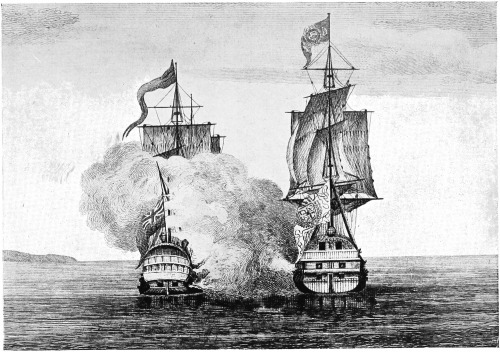
Engaging the bigger Manila Ship.
Enemy’s was a brave lofty new Ship, the Admiral of Manila, and this the first Voyage she had made; she was call’d the Bigonia, of about 900 Tuns, and could carry 60 Guns, about 40 of which were mounted, with as many Patereroes, all Brass; her Complement of Men on board, as we were inform’d, was above 450, besides Passengers. They added, that 150 of the Men on board this great Ship were Europeans, several of whom had been formerly Pirates, and having now got all their Wealth aboard, were resolved to defend it to the last. The Gunner, who had a good Post in Manila, was an expert Man, and had provided the Ship extraordinary well for Defence, which made them fight so desperately; they had filled up all between the Guns with Bales to secure the Men. She kept a Spanish Flag at her Main-top mast Head all the time she fought us; we shatter’d her Sails and Rigging very much, shot her Mizon-yard, kill’d two Men out of her Tops, which was all the Damage we could see we did ’em; tho’ we could not place less than 500 Shot (6 Pounders) in her Hull. These large Ships are built at Manila with excellent Timber, that will not splinter; they have very thick Sides, much stronger than we build in Europe. Whilst the Officers were aboard us, Capt. Courtney and others desir’d that what we had agreed upon might be put in Writing, and sign’d by as many as were present, to prevent false Reflections hereafter, which was done as follows.
At a Committee held on board the Duke, after we had engag’d the bigger Manila Ship, December 27. 1709.
WE having consider’d the Condition of all our 3 Ships, and that our Masts are much damnified in engaging the Manila Ship, do think it for the Interest of the whole to forbear any further Attempts upon her, having no Probability of taking her, but to do our endeavours to secure the Prize we have already took, which will be much more for the Honour and Interest of our selves and Country. This is our Opinion, in witness whereof we have set our Hands, the Day and Year above-written.
Woodes Rogers,Lan. Appleby,
Stephen Courtney, Charles Pope,
William Dampier,Henry Oliphant,
Edw. Cooke,Alex. Selkirk,
Rob. Frye,John Kingston,
Tho. Glendall,Nath. Scotch,
John Connely,John Piller.
John Bridge,
Thus ended our Attempt on the biggest Manila Ship, which I have heard related so many ways at home, that I thought it necessary to set down every particular Circumstance of it, as it stood in my Journal. Had we been together at first and boarded her, we might probably have taken this great Prize; but after the Enemy had fixed her Netting-deck and close Quarters, they valued us very little. I believe also we might have burnt her with one of our Ships, but that was objected against by all the Officers, because we had Goods of Value on board all our 3 Ships. The Enemy was the better provided for us, because they heard at Manila from our English Settlements in India, that there were 2 small Ships fitted from Bristol, that design’d to attempt them in the South Seas. This was told us by the Prisoners we took on board the other Ship.
When I proposed parting Companies at the Tres Marias, and to cruise for the Acapulco Ship from Manila with our Ship and Bark at one Station, and the Dutchess and Marquiss at another, we then expected but one Ship from Manila, and she not so well provided as the least Ship now was; tho’ as we have found it, we might probably have been better asunder, for then I make little question but we should have got some Recruit of Provisions, and consequently our Men had been stronger and better in heart to have boarded this great Ship at once, before they had been so well provided; but since Providence or Fate will have it as it is, we must be content.
Dec. 28. The Enemy lay braced to all the time the Council held, and run out 4 Guns of her lower Teer, expecting we would have the other Brush with her; but when we made sail, she fil’d and made away, W.N.W. and we betwixt the S.S.E. and the S. close upon a Wind. At 6 a Clock we sent the Pinnace with some Men into the Harbour to secure the Prize, not knowing what might happen before we could get in with our Ships. We unrigg’d the Main-top-gallant Mast, and got it down, securing our Main-mast with Runners and Tackles every way we could contrive, had little Wind all the Afternoon and Night, but this Morning a fresh Breeze sprung up at E.S.E. and soon after we saw nothing more of the great Ship.
At Anchor in Port Segura on California.
Jan. 1. After we arriv’d again at Port Segura, we dispatch’d the Prisoners away in the Bark, and likewise the Guiaquil Hostages: having got Security for the Money as aforesaid, we supplied them with Water and Provisions enough to carry ’em to Acapulco; and gave Capt. Pichberty and his chief Officers, with a Padre, their Clothes, Instruments, Books, &c. So that they parted very friendly, and acknowledged we had been very civil to ’em, of which they desired me to accept the following Testimony;
WE, whose Names are hereto subscrib’d, do acknowledge, that ever since we have been in the Hands of Capt. Woodes Rogers, and Capt. Stephen Courtney, Commanders of the Duke and Dutchess, two British private Men of War, we have been by them very civilly treated; and whatsoever we have transacted or done, had been voluntary, and by our Consent, and particularly in passing Bills, and Obligations, thro’ the Hands of Sir John Pichberty, for the Ransom of the Town of Guiaquil, and other valuable Considerations. Witness our Hands on the Coast of California.
Jan. 1. 1709.
Don John Pichberty,Manuel de Punta.
Don Antonio Guttera, Manuel Hemanes.
I wrote a Letter to my Owners, to acquaint ’em with our good Success, but could not be so full as I would, because I sent it by the Hand of an Enemy. We spent our Time till the 7th, in refitting, wooding, and watering; and were very glad to find as much Bread on board the Prize as we hop’d might, with what we had left of our old Store, make enough to subsist us in our next long Run. Capt. Courtney and his Officers, with those on board the Marquiss, are too willing to complement Capt. Dover with the chief Command of the Prize; which till now I thought he would not have accepted, his Posts already being above a Commander of any of our Prizes; but I and my Officers are against it; because we believe Capt. Frye or others, are fitter Persons to take Charge of her, which we insisted on; and Capts. Courtney and Cooke came to me, where they agreed to a Paper that was drawn up while we were all together, in such a Manner as I thought would have satisfied every one. Capt. Courtney carried this Agreement to Capt. Dover to sign it, not doubting but all would be content with what we had concluded; yet to our Surprize, they spent the Remainder of the Day, and instead of making Capt. Dover comply with it, undid all, and brought a Paper which impower’d him to be sole Commander, without the least Restraint, of not molesting those that should navigate the Ship, but to order every thing as he should think fit.
Jan. 9. We fetch’d our 3 wounded Men from on board the Dutchess; one of ’em was Tho. Young, a Welchman, who lost one of his Legs; the other, Tho. Evans, a Welchman, whose Face was miserably torn; the third, John Gold, wounded in the Thigh; and one died of his Wounds, viz. Emanuel Gonsalves, a Portuguese: So that out of ten that went, only 6 return’d safe. I sent a Letter to Capt. Courtney this Morning, to know what Measures were going forward; having heard nothing from him since the 7th Instant, and desired that there might be no loss of time, but that the Committee might meet once more, to try if they would make use of their unbyass’d Reason. They were than all aboard the Marquiss, where I heard they had, ever since our last Meeting, concerted how to frame a Protest against me, and my Officers of the Committee, which was immediately answer’d by a Protest from us, both which are as follows.
KNOW all Men, by these Presents, That We, the Commanders of the Ships Dutchess and Marquiss, and other Officers, being the major Part of a Committee appointed by the Owners, for the regulating the Affairs of the Ships Duke and Dutchess, private Men of War, till their Return to Great Britain, as more largely appears in their Orders and Instructions. Now, whereas we have lately taken a rich Prize bound from Manila to Acapulco, and the said Ship being safe at Anchor in a Bay near Cape St. Luke, on California, We held a general Committee on board the Duke the 6th Day of January 1709-10. for appointing a Commander and other Officers for the said Prize, call’d by the Spaniards, when in their Possession, Nostra Seniora del Incarnation de Singano, but now named by us The Batchelor Frigate, wherein it was carried by Majority of Votes for Capt. Thomas Dover, who came out second Captain of the Duke, and President of this Committee, and Owner of a very considerable Part of both Ships, Duke and Dutchess, to command the said Prize, we thinking him the most proper Person for the Interest of the Owners and Company; we likewise proposing to put two of the best of our Officers on board, to command under him, and manage the navigating Part of the said Ship during the Voyage, with other substantial Officers and Men, sufficient to work the Ship and take Care of her.
At Anchor in Port Segura.
Now whereas Capt. Woodes Rogers, Commander of the Duke, and several of his Officers, Members of this Committee, did refuse to sign to the Agreement of the said Committee (the Like never having been refus’d by any before, when carried by Majority of Voices) to acknowledge the said Capt. Thomas Dover Commander of the Ship Batchelor Frigate; we do hereby, in the behalf of the Owners of the Ships Duke and Dutchess, our selves and Company, Protest against the unadvis’d Proceedings and Practice of the said Capt. Woodes Rogers, and the rest of the Officers of the Committee, that refus’d to sign and agree to the same, it being directly contrary to the Owners Orders and Instructions, (Reference being had thereto) and the Union and Peace of the Ships Companies (by them likewise recommended). And whatever Damage may ensue, either by Loss of Time, Want of Provisions, or Men sufficient to manage the said Ship, or any Mutiny or Disagreement that may arise from hence between the Ships Companies, or any other Disaster whatsoever, &c. we do likewise Protest against, in the behalf of the Owners, ourselves, and Company, as aforesaid; expecting from the said Captain Woodes Rogers, and Officers of the Committee aforesaid, full Satisfaction and Reparation of all Losses and Damages whatsoever, that may happen to the said Ship during her Voyage to Great Britain.
In witness whereof, we the Commanders and Officers, being the major Part of the Committee, have set our Hands, this 9th Day of January, 1709-10. on board the Marquiss, at Anchor near Cape St. Luke, on California.
Sign’d by the Officers of the Dutchess and Marquiss.
Which Protest was answer’d by another from our Ship.
WE the chief Officers in behalf of ourselves and the rest of the Ship’s Company of the Duke, having taken a rich Spanish Prize, in Consortship with the Dutchess and Marquiss, call’d Nostra Seniora del Incarnacion de ingano, and did design to use the securest Methods to carry her to Great Britain, both for our Employers interest and our own Advantage. But being in a remote part of the World, we offer’d and desired our Consorts to put one or more able Officers in the principal charge of the aforesaid Prize, it being so valuable that a Retaliation for all our Risques and Hardships is in her Riches, which highly behoves us to be very careful in preserving. But against all our Ships Company’s Consent, (tho’ we are so nearly concern’d) our said Consorts Officers, Capt. Stephen Courtney, Capt. Edward Cooke, Capt. William Dampier, Mr. William Stretton, Mr. Charles Pope, Mr. John Connely, Mr. George Milbourne, Mr. Rob. Knowlman, and Mr. John Ballett, have sign’d an Instrument, and combin’d together, to put Capt. T. Dover in Command of the said Ship.
We therefore (being inclin’d to Peace and Quietness aboard and not to use any Violence to remove the said Captain Dover out of the aforesaid forc’d Command, although he is utterly uncapable of the Office) do hereby publickly Protest against the aforesaid Commander, and every one of those that have already, or shall hereafter combine to place him in. The Ship now being in safety, we declare against all Damages that may arise or accrue to the said Ship, or Cargo under his Command; and that the aforesaid Combiners, who have put the Care of the said Ship under an uncapable Command, we expect are accountable and liable to us for all Damages that may happen. This is our publick Protest. Witness our Hands, aboard the said Ship Duke, riding at Anchor in a Port of California, the 9th of January, 1709-10.
Sign’d by the Officers of the Duke.
’Twas our great Unhappiness, after taking a rich Prize, to have a Paper-War amongst our selves. I am sorry to trouble the Reader with these Disputes, which continued for two Days about a proper Commander for this Prize; because it highly concern’d us to take the utmost Precautions for her Safety, having a long Run through dangerous unknown Passages, into the East Indies, and most of the Recompence for our great Risques and Hardships lay in her Riches. I had always desired that Capt. Dover might be aboard her, for being a considerable Owner, we all agreed he was a very proper Person to take Care of her Cargo, and to have all the Freedom and Accommodation that could be made for him in that Ship, which was of such vast Consequence to us and our Employers, that in their Instructions to me, they strictly charged me to use the securest Methods to bring her safe home, in case we should be so fortunate as we now are, to take one of the Acapulco Ships: So that after the Protests were over on both sides, I desired they might assemble together, and finally determine what the Majority would agree on, that no Time might be lost. So all the Council met again on board the Batchelor, to endeavour an Accommodation. I being very weak, and in much Pain, was not able to stir, therefore sent my Opinion in Writing, as follows.
At Anchor in Port Segura.
MY Opinion is, That ’tis not for the Safety of the rich Spanish Prize, that Capt. Dover command her, because his Temper is so violent, that capable Men cannot well act under him, and himself is uncapable. Our Owners directed me to use the securest Method to bring the Ship home, if we should have the good Fortune to take her; and ’tis not so, if an ignorant Person have the Command: And tho’ it may be pretended that he’ll not command the sailing Part, there are other Parts necessary for a Commander; so that whosoever had the Charge of one, ought to act wholly in the rest, or else Confusion follows a mix’d Command, that would be very pernicious in this Case; and which it highly concerns us to beware of. I am content, and desire Capt. Dover may be aboard, and have Power to take Care of the Cargo, and all the Liberty and Freedom in her, he can in reason otherwise desire, and that none may have the like Power on board the Prize but himself. This is my Opinion. Jan. 9. 1709-10.
Woodes Rogers.
This Dispute is against my Desire already put in Print, from the publick Notes of the Voyage, otherwise I had left it wholly out of my Journal, as I had done several other of our Differences, being unwilling to trouble the Reader with the Contests that too often happen’d in the Government of our sailing Common-wealth.
After a long Debate, they voted Mr. Frye and Mr. Stretton, both to act in equal Posts, to take Charge of the navigating the Ship, tho’ under Capt. Dover, but they were to be no ways molested, hinder’d nor contradicted in their Business by him, whose Duty ’twas to see that nothing should be done contrary to the Interest of the Owners, and Ships Companies, in the Nature of an Agent, almost in the same Manner I proposed at first, only he had the Title of Chief Captain in that Ship, which was so small a Difference, where Titles are so common, that we all consented to it; and at the same time they chose Officers, agreeing that we should put 30 Men aboard her, the Dutchess 25, and the Marquiss 13, which with 36 Manila Indians, call’d Las-Carrs, and other Prisoners we have left, her Complement will be about 110 Men. The Majority keeping to their first Agreement I was obliged to come into it, according to my Instructions from our Owners; so that all our Differences about this Affair were at an end, and we drank to our safe Arrival in Great Britain.
The Council agreed as follows.
At a Council held on board the Batchelor Frigate, at Anchor in Port Segura, on California, Jan. 10. 1709/10.
IT is agreed, by the Majority of this Council, that Capt. Robert Frye and Capt. William Stretton, shall both act in equal Posts in the sole Navigating, Sailing and Ingaging, if Occasion should be, under Capt. Tho. Dover, on board the Batchelor Frigate, and that the said Capt. Tho. Dover shall not molest, hinder or contradict ’em in their Business; and we do appoint Alexander Selkirk Master, Joseph Smith chief Mate, Benj. Parsons second Mate, Charles May Surgeon, John Jones Carpenter, Rob. Hollinsby Boatswain, Rich. Beakhouse Gunner, Peirce Bray Cooper, James Stretton and Richard Hickman Midshipmen, Denis Reading Steward, and all other inferior Officers, as the Commanders shall think fit.
Sign’d by the Majority of our Council.
In the Morning we put 35 good Hands aboard her. The Dutchess and Marquiss put no more than their Share. Mean while Capts. Courtney and Cooke, and 2 or 3 more of the Committee came to me, where we sign’d a Paper for Capt. Dover and the two Commanders, recommending Peace and Tranquility amongst them. And that in case of Separation, the Place of Rendezvous was to be Guam, one of the Ladrones Islands, where we design’d to touch at, God willing, to get Provisions: Every thing being thus settled, and all in a Readiness to sail; before I proceed with the Relation of our Voyage from hence, I shall give an Account of California.
California described.
California Described.
IT is not yet certainly known whether it be an Island, or joins to the Continent, nor did either our Time or Circumstances allow us to attempt the Discovery. I heard from the Spaniards, that some of their Nation had sail’d as far up betwixt California and the Main, as Lat. 42 N. where meeting with Shoal Water, and abundance of Islands, they durst not venture any further: So that if this be true, in all Probability it joins to the Continent, a little further to the Northward; for Shoal Water and Islands is a general Sign of being near some main Land: but the Spaniards having more Territories in this Part of the World than they know how to manage, they are not curious of further Discoveries. The Manila Ships bound to Acapulco often make this Coast in the Latitude of 40 North, and I never heard of any that discover’d it farther to the Northward. Some old Draughts make it to join to the Land of Jesso, but all this being yet undetermin’d, I shall not take upon me to affirm whether it’s an Island, or joins to the Continent. The Dutch say, they formerly took a Spanish Vessel in those Seas, which had sail’d round California, and found it to be an Island; but this Account can’t be depended on, and I choose to believe it joins to the Continent. There is no certain Account of its Shape or Bigness, and having seen so little of it, I shall refer the Reader to our common Draughts for its Scituation. What I can say of it from my own Knowledge is, That the Land where we were is for the most part mountainous, barren and sandy, and had nothing but a few Shrubs and Bushes, which produce Fruit and Berries of several Sorts. Our Men who went in our Bark to view the Country about 15 Leagues to the Northward, say it was there cover’d with tall Trees. The Spaniards tell us of several good Harbours in this Country, but we found none of them near this Cape. We frequently saw Smoak in several Places, which makes us believe the Inhabitants are pretty numerous. The Bay where we rode had but very indifferent Anchoring Ground, in deep Water, and is the worst recruiting Place we met with since I came out. The Wind at this Time of the Year generally blowing over Land, makes it good Riding on the Starboard Side of the Bay, where you ride on a Bank that has from 10 to 25 Fathom Water; but the rest of that Bay is very deep, and near the Rocks on the Larboard-side going in there’s no Ground.
During the Time of our Stay the Air was serene, pleasant, and healthful, and we had no strong Gales of Wind, very little Rain, but great Dews fell by Night, when ’twas very cool.
The Natives we saw here were about 300, they had large Limbs, were straight, tall, and of a much blacker Complexion than any other People that I had seen in the South Seas. Their Hair long, black, and straight, which hung down to their Thighs. The Men stark naked, and the Women had a Covering of Leaves over their Privities, or little Clouts made of Silk Grass, or the Skins of Birds and Beasts. All of them that we saw were old, and miserably wrinkled. We suppose they were afraid to let any of their young ones come near us, but needed not; for besides the good Order we kept among our Men in that respect, if we may judge by what we saw, they could not be very tempting. The Language of the Natives was as unpleasant to us as their Aspect, for it was very harsh and broad, and they pronounc’d it so much in the Throat, as if their Words had been ready to choak them. I design’d to have brought two of ’em away with me, in order to have had some Account of the Country, when they had learn’d so much of our Language as to enable them to give it; but being short of Provisions, I durst not venture it. Some of them wear Pearl about their Arms and Necks, having first notch’d it round, and fasten’d it with a String of Silk Grass; for I suppose they knew not how to bore them. The Pearls were mix’d with little red Berries, Sticks, and Bits of Shells, which they look’d upon to be so fine an Ornament, that tho’ we had Glass Beads of several Colours, and other Toys, they would accept none of them. They coveted nothing we had but Knives, and other cutting Instruments, and were so honest, that they did not meddle with our Coopers or Carpenters Tools, so that whatever was left ashore at Night, we found it untouch’d in the Morning.
We saw nothing like European Furniture or Utensils among ’em. Their Huts were very low, and made of Branches of Trees and Reeds, but not sufficiently cover’d to keep out Rain. They had nothing like Gardens or Provisions about them. They subsisted chiefly on Fish while we were here, which with the Miserableness of their Huts, that seem’d only to be made for a time, made us conclude they had no fix’d Habitation here, whatever they may have elsewhere, and that this was their Fishing Season. We saw no Nets or Hooks, but wooden Instruments, with which they strike the Fish very dextrously, and dive to admiration. Some of our Sailors told me they saw one of ’em dive with his Instrument, and whilst he was under Water put up his Striker with a Fish on the Point of it, which was taken off by another that watch’d by him on a Bark Log. The Reader may believe of this what he pleases, but I give it the more credit, because I my self threw some rusty Knives overboard, on purpose to try those Divers, who seldom miss’d catching a Knife before it could sink about 3 or 4 Fathom, which I took to be an extraordinary Proof of their Agility.
California Described.
Instead of Bread they us’d a little black Seed, which they ground with Stones, and eat it by Handfuls; some of our Men thicken’d their Broth with it, and say it tastes somewhat like Coffee. They have some Roots that eat like Yams, a sort of Seeds that grow in Cods, and taste like green Pease, a Berry which resembles those of Ivy, and being dry’d at the Fire, eats like parch’d Pease. They have another like a large Currant, with a white tartish Pulp, a Stone and a Kernel; this sort of Fruit they seem to value much. They have also a Fruit which grows on the prickle Pear-tree, tastes like Gooseberries, and makes good Sawce. They have many other Seeds and Plants unknown to us, but I was not in a condition to view or describe them.
They seem to have a Season of Hunting by the Skins of Deer, &c. we saw among them: They paid a sort of Respect to one Man, whose Head was adorn’d with Feathers made up in the Form of a Cap; in other respects they seem’d to have all things in common; for when they exchang’d Fish with us for old Knives, of which we had plenty, they gave the Knives to any that stood next, and after they had enough, we could get no Fish from them. They appear’d to be very idle, and seem to look after no more than a present Subsistance. They stood and look’d upon our Men very attentively, while they cut Wood and fill’d Water; but did not care to lend us a Hand at either, or indeed to do any thing that requir’d hard Labour. Their Arms are Bows and Arrows, with which they can shoot Birds flying. Their Bows are about 7 Foot long, and of a tough pliant Wood unknown to us, with Strings of Silk Grass; their Arrows about 4 Foot and a half, made of Cane, and pointed with Fish Bones that they shape for the purpose. Most of their Knives and other cutting Instruments are made of Sharks Teeth. I saw 2 or 3 large Pearl in their Necklaces and Bracelets, and the Spaniards told me they had Store of them from the inner part of the Gulph of California, where they have Missionaries planted among them. Our Men told me they saw heavy shining Stones ashore, which look’d as if they came from some Mineral, but they did not inform me of this till we were at Sea, otherwise I would have brought some of ’em to have try’d what Mettal could be extracted out of ’em. The Spaniards likewise inform’d me, that the Country in general within on the main Land of Mexico, is pleasant and fruitful, and abounds with Cattle and Provisions of all sorts. The Natives grew very familiar with us, and came frequently aboard to view our Ships, which they mightily admir’d. We saw no Boats or Canoes among them, nor any other Sailing Craft, but Bark-Logs, which they steer’d with Paddles at each End. We gave one of the Natives a Shirt, but he soon tore it in pieces, and gave it to the rest of his Company to put the Seeds in which they us’d for Bread. We saw no Utensils for Cookery about them, nor do I suppose they have any; for they bury their Fish in a Heap of Sand, and make a Fire over it, till they think it fit for eating. There were all the Fishes usual in those Seas to be found in the Bay. The fresh Water here is good, and they have abundance of Samphire. They make a Fire in the middle of their Huts, which are very low and smoaky. We saw no extraordinary Birds here. I am told by our People that have been ashore, that they get Fire by rubbing two dry Sticks against each other, as customary among the wild Indians.
The Entrance into the Harbour may be known by four high Rocks, which look like the Needles at the Isle of Wight, as you come from the Westward; the two Westermost in form of Sugar-loves. The innermost has an Arch like a Bridge, through which the Sea makes its way. You must leave the outermost Rock about a Cable’s Length on the Larboard side, and steer into the deepest part of the Bay, being all bold, where you may anchor from 10 Fathom to 20 or 25 Fathom Water. Here you ride land-lockt from E. by N. back to the S. E. by S. yet it is but an ordinary Road, if the Wind should come strong out of the Sea, which it never did while we lay there.
Mexico describ’d
I Shall next give a brief Account of Mexico from the best Information and Authors. This Country lies betwixt Lat. 8. and 50 or 55 North, but it is little known or inhabited by the Spaniards to the Northward of 35. ’Tis divided into Old and New, and the former is also called New Spain, The Country in general includes all the West Side of Northern America, as far as ’tis known. ’Tis divided into the Audiences, or Jurisdictions of St. Domingo, Mexico properly so call’d, Guadalajara or New Gallicia, and Guatimala; and these again are subdivided into several Provinces, with which I shall not trouble the Reader, since that is the Business of a Geographer, and not of a Sailor. That part of it call’d New Spain is the best and most famous Part of all North America, and the Name is sometimes extended by the Spaniards to the whole.
Mexico Described.
The Air in general is mild, temperate and healthful, and the Soil so fertile, that in some places it produces 100 for one of Corn, and of Maiz 200; but the great Rains in Summer hinder their having good Oil and Wine. Their most remarkable Plant is that call’d Maguey, which abounds in this Country, and some of it we found in the Maria Islands; of the Juice the Spaniards and Natives make a small Wine, Vinegar, and Honey; and of the Leaves and other Parts they make Cordage, Thread, and Cloth for Sacks and Shirts. They have great and small Cattle, and Fowl in such plenty, that they frequently kill them only for the Skins and Feathers. They have also excellent Horses of the best Spanish Breed. There are few Gold Mines in this Country, but abundance of Silver, and tho’ not so rich as those of Peru, are much easier to be work’d, with less Expence of Money, and far less Danger of Mens Lives. Their other chief Commodities are Iron, Steel, Copper, but none of ’em much wrought, Hides, Wool, Cotton, Sugar, Silk, Cochineal, Scarlet-Dy, Feathers, Honey, Wax, Balm, Amber, Ambergrise, Salt, abundance of Medicinal Drugs, Cocoa, Cassia, Gold in the Sands of their Rivers, Figs, Oranges, Citrons, and other Fruit peculiar to the Climate, besides all those common in Europe; wild Beasts, and Fowl of all sorts, Chrystal, Turquoises, Emeralds, Marcasites, Bezoar Stones, and Pepper. This must be understood of Mexico in general; for all those Commodities are not in one Province, but some have one sort and some another. Nor is the Temper of the Climate every where the same, for those Places towards the South Sea are warm, but in and about the Mountains ’tis cold; and in some places they have continu’d Rains almost for 8 or 9 months in a Year, and are much infected with Serpents, Moskitto’s, and other Insects, especially near the Torrid Zone.
I shall not swell my Book with the fabulous Accounts of the Origin of the antient Mexicans, which are shocking to common Sense, nor pretend to give the Reader the History of their Kings, because ’tis not my Business; besides ’twould puzzle the ablest Critick to distinguish betwixt Truth and Falshood in those pretended Histories, preserv’d by fanciful Hieroglyphicks, which will bear what Sense any Author pleases to impose upon them. Therefore I shall only say in general, that the Spanish Authors who write of those Countrys say the Kings of Mexico were very potent, that they had 25 or 30 petty Kings their Tributaries, that their ordinary Guards did usually consist of 2 or 3000 Men, and that on occasion they could raise 2 or 300000; that their Palaces were magnificent, their Temples sumptuous, and their Worship barbarous, it being ordinary for them to sacrifice their Enemies, and sometimes their own Subjects. The Natives of Old Mexico say they are not of that Race of People, but that their Ancestors came from divers Nations, who inhabited the Northern parts of the Continent, and particularly that call’d New Mexico; and by the Account their Historians give of their Travels to settle here, ’twould seem those who compos’d the Story had heard something of the Travels of the Children of Israel in the Wilderness, and design’d to write something like it; and by calling their Leader Mexi, they would make his Name resemble that of Moses. ’Twas a long time before they united into one Monarchy; for Montezuma, who reign’d when Fernando Cortez invaded them, was only the 9th in their Catalogue. The Divisions among the Natives, and the Hatred which the Neighbouring Princes bore to their Kings, made the Conquest of Mexico much easier to the Spaniards than they expected; so that in the Bishoprick of Los Angeles, &c. there are many thousands of Indians exempted from extraordinary Taxes, because their Ancestors assisted the Spaniards in the Conquest of the Country.
Mexico Described.
The Natives of Mexico, properly so call’d, are the most civiliz’d, industrious and ingenious; they are noted for admirable Colours in their Paintings, tho’ their Figures are not proportionable; they draw ’em with the Feathers of their Cincons, a small Bird, which they say lives only upon Dew. They make use of certain Characters instead of the Letters of the Alphabet, by which they have preserv’d some Fragments of their History. The Spanish Governour of Mexico, our Author says, with much difficulty got it out of the Hands of the Natives, with an Explanation in their own Language, and had it translated into Spanish. The Ship in which ’twas sent to the Emperor Charles V. being taken by a French Ship, the Manuscript fell into the Hands of Andrew Thevet at Paris, from whose Heirs our Hackluyt, being then Almoner to the English Ambassador, purchas’d it. Sir Walter Raleigh got it translated into English, and the Learned Sir Henry Spelman prevail’d with Purchas to get the Figures engraven. They represent Princes and others in several Postures, and bring down their History from the Year 1324. to the Beginning or Middle of the 16th Century, or thereabouts. This History is divided into 3 Parts; the first contains little but an Account of the Names and Conquests of their Princes, with a Summary of their Vices and Virtues, so that it is not worth insisting upon. The second has an Account of the Tributes paid by the People, which were Proportions of the Product of the Country for Provisions, Clothes, Arms, warlike Habits and Ornaments, Paper and Houshold Furniture. The third gives an account of the Oeconomy, Customs and Discipline of the Mexicans, which because they are odd enough, I shall give a short Account of the most remarkable.
Four Days after a Child was born, the Midwife carried it to the Yard of the House, laid it upon Rushes, and after washing it, desir’d 3 Boys, who were there at a sort of Feast, to name it how they pleas’d. If it was a Boy, she put into its Hand the Tools belonging to its Father’s Imployment; and if a Soldier, his Arms. If ’twas a Girl, she put a Distaff or other Utensils of Women by it. If the Boy was design’d for the Church, they carried it to a Temple with Presents, when of a sufficient Age, and left it with the High Priest to be educated; and if design’d for War, they carried him to an Officer to teach him the Use of Arms. The Parents corrected them by Blows, or pricking them with Needles made of the Maguey Tree: The Father prick’d the Boys, if unlucky, all over their Body, and the Mother prick’d her Daughters only in the Fists. When Boys were pretty well grown, they ty’d ’em Hand and Foot, and laid ’em in muddy Water naked a whole Day, and then their Mothers took ’em out and clean’d ’em at Night. When a Maid was to be married, the Marriage-maker carried her on his Back to the Bridegroom’s House, 4 Women bearing Torches before her; the Bridegroom’s Friends receiv’d her in the Yard or Court, carried her to a Room, and set her down by him on a Mat, and ty’d the Skirts of their Garments together, offer’d Incense to their Idols, and had 4 old Men and Women to be Witnesses; after a Feast the Witnesses exhorted ’em to live well together, and so the Ceremony concluded.
The Priests train’d up their Novices in sweeping the Temples, carrying Branches, &c. to adorn them, to make Seats of Cane, to bring Needles or Thorns of Maguey to draw Blood for Sacrifices, and Shrubs to keep a perpetual Fire; and if they fail’d in their Duty, return’d to their Parents, or were catch’d with Women, they prick’d ’em with those Needles. One of the chief Priests went by Night to a Mountain, where he did Penance, carried Fire and Perfume to sacrifice to the Devil, and was always attended by a Novice; others of the Priests play’d on Musical Instruments by Night, and some of ’em observ’d the Stars, and told the Hours. The Novices arriv’d to the chief Dignities of the Priesthood by degrees, and some of ’em always attended the Armies to encourage the Men, and perform their Rites.
Those who train’d the Youth to War, punish’d their Scholars by throwing burning Coals on their Heads, pricking them with Sticks of Pine sharpen’d at one End, or by burning off their Hair. Their Kings rewarded the Soldiers according to the Number of Prisoners they took, with Military Habits of several Colours, or Posts in the Army, till they came to the highest. Their Chief Priests were also Men of Arms, and capable of all Military Preferments.
Their capital Punishments were Strangling or Stoning to Death. If a Caicque or petty Prince rebell’d, all his Subjects shar’d in his Punishment, except they found some Method to appease the King. They punish’d Drunkenness in young Men by Death, but allow’d it in old Men and old Women of 70. Highway-men and Adulterers they ston’d to Death. They had Assemblies for publick Affairs, wherein the Great Master of the Emperor or King’s Houshold exhorted the Youth to avoid Idleness, Gaming, Drunkenness, and other Vices.
This is the Sum of what that Hieroglyphical History says of the antient Mexicans.
As to the present Natives, most of ’em are subject to the Spaniards; but in some of the Mountains and Northern Parts they are not reduc’d; so that they frequently attack the Spaniards, when they meet with a favourable Opportunity.
Mexico Described.
In that call’d New Mexico some of the Natives are very barbarous, and much given to Arms, the Men wear nothing but Skins, and the Women scarce any other Covering than their Hair; they live for the most part on raw Flesh, and go together in Troops, changing their Habitation as the Season requires, or for the Conveniency of Pasturage. Their Oxen and Cows are large, with small Horns, their Hair almost like Wooll, long before, and short behind, with a Bunch on their Backs, great Beards like Goats, and their Fore Legs short; they are of an ugly Aspect, but very strong; they are the principal Riches of the Natives, their Flesh serves them for Diet, their Skins for Clothes and Coverings to their Huts, they make Thred of their Hair, Bow-strings of their Nerves, Utensils of their Bones, Trumpets of their Horns, keep their Drink in their Bladders, and use their Dung for Firing, because they are scarce of Wood. They have Sheep as large as our Asses, and Dogs so strong, that they make ’em carry their Baggage. This Country is inhabited by People of different Languages and Manners; some of them live in Cities, of which ’tis said there are several that contain from 30 to 50000 Inhabitants; others wander about in Herds like the Arabs or Tartars; but in short, this Country is so little known, and Travellers differ so much in their Accounts of it, that there’s not much to be depended upon.
I think it proper here to say something of the peopling of it. There are many Opinions about the peopling of America, but the most reasonable to me is, that it was peopled from Tartary by way of the North Pole, where they suppose it to join with some part of Asia. This I think very probable, because the Spaniards, who come yearly hither from Manila or Luconia, one of the Philipine Islands in the East Indies, are forced to keep in a high Latitude for the Benefit of Westerly Winds, and have often sounded, finding Ground in Lat. 42. N. in several Places of the Ocean betwixt the East Indies and America, which makes me conclude that there must be more Land, tho’ none of ’em, as I have heard of, ever saw any Continent till they fall in with California, in about 38 or 39°. N. Lat. I have often admir’d that no considerable Discoveries have yet been made in South Latitude from America to the East Indies: I never heard the South Ocean has been run over by above three or four Navigators, who varied little in their Runs from their Course, and by consequence could not discover much. I give this Hint to encourage our South Sea Company, or others, to go upon some Discovery that way, where for ought we know they may find a better Country than any yet discover’d, there being a vast Surface of the Sea from the Equinox to the South Pole, of at least 2000 Leagues in Longitude that has hitherto been little regarded, tho it be agreeable to Reason, that there must be a Body of Land about the South Pole, to counterpoise those vast Countries about the North Pole. This I suppose to be the Reason why our antient Geographers mention’d a Terra Australis Incognita, tho’ very little of it has been seen by any body. The Land near the North Pole in the South Sea, from California to Japan, is wholly unknown, altho’ the old Maps describe the Streights of Anian, and a large Continent, it is but imaginary; for the Dutch themselves, that now trade to Japan, say they do not yet know whether it be an Island, or joins to the Continent.
Gemelli[147] having been in this Country in 1697, who is the latest Traveller that has publish’d any thing about it, and his Accounts being in the main confirmed to me by our Spanish Prisoners, I shall give a brief Hint of what he says, especially of what relates to Trade and Provisions.
Their best Product is Gold and Silver, Pearl, Emeralds, and other precious Stones: He saw the Silver Mines of Pachma, 11 Leagues from the City of Mexico: One of ’em he says is 225 English Yards deep, the other 195: He adds, that in the Space of 6 Leagues there are about 1000 Mines, some laid aside, others still in use. There are many thousands of People imploy’d to dig ’em, from some the Metal and the Water is brought up by Engines, and from others the Metal is brought up on Mens Backs to the great Danger of their Lives, besides Numbers that are lost by the falling in of the Earth, and pestilential Damps: They go down to them by notch’d Poles, which being wet and slippery, the poor Indian Slaves many times fall, and break their Necks. Our Author says he was in danger of doing the like, when he went to see them. He adds, the Workmen inform’d him, that from one of the Veins, where near 1000 Men work’d per diem, they had in 10 Years Dug 40 Millions of Silver, that 2 Millions had been laid out in Timber-work to support it, and that it became so dangerous, as the Owner stop’d it up. I refer to him for the Manner of separating the Metal from the Oar. Every Discoverer of a Mine must pay the 5th of the Product to the King, who allows him only 60 Spanish Yards round from the Mouth, or all on one side, if he pleases. Gemelli says there’s 2 Millions of Marks, of 8 Ounces each, entred at Mexico in a Year from those Mines, besides what is stole, and 700000 Marks of it are coin’d annually into Pieces of Eight there, for which the King has a Ryal per Mark. There being Gold mix’d with the Silver, they make use of Aqua Fortis to separate them. The Officers of the Mint have very profitable Places, but I can’t insist upon their Sallaries.
’Tis needless to be particular in describing the Birds and Beasts of this Country; they having been so often done by others, I shall only say, they have enough for Provisions, Mexico Described. and many of both sorts unknown to us. ’Tis the like as to their Fruits and Plants, which serve them for Food and Physick; but I have not room to be particular.
Mexico is the Capital City of this vast rich Country, and lies in N. Lat. 19. 40. in the Middle of a Valley, which is 14 Spanish Leagues long, and 7 broad, encompass’d by a Ridge of Mountains. The City is surrounded by a Lake, and is square, with long, wide, and well pav’d Streets, cross one another. ’Tis 2 Leagues round, and the Diameter half a League. There are 5 Causeys or Banks through the Lake into the City, which vies with the best in Italy for noble Structures and beautiful Women, who prefer Europeans to their own Country-men; this occasions irreconcilable Prejudices betwixt them, so that an European can scarce pass the Streets without being insulted. The Inhabitants are about 100000, the major part Blacks, and Mulatto’s, because of the vast Number of Slaves carried thither. Europeans seldom marry there, because finding no way to get real Estates, they generally become Clergymen, which takes up most of those that come from Old Spain. There are 22 Nunneries and 29 Friaries of several Orders within the City, and all richer than they ought to be, says Gemelli. The Cathedral is exceeding rich, maintains 10 Canons, 5 dignify’d Priests, 6 Demi-Canons, 6 half Demi-Canons, 1 Chief Sacristain, 4 Curates, 12 Royal Chaplains, and 8 others chosen by the Chapter, besides many others nam’d by the King. The Revenue of the Cathedral is 300000 Pieces of Eight per Annum. The Climate here is uncertain, as through all the Country, being for most part both cold and hot at the same time, viz. cold in the Shade, and hot in the Sun, but is never excessive either way; yet the Inhabitants complain of the Cold in the Mornings, and of the Heat from March till July; from thence to September the Rains cool the Air, and from that time till March the Rains are but small. The Indians reckon those Nights cold, but the Europeans like the Climate well enough. Their Water is very cool. The neighbouring Country produces 3 Harvests per Ann. one in June, the 2d in October, and the 3d uncertain, as the Weather proves. Maiz or Indian Corn is their chief Grain, the earliest being sow’d in March, the latest in May. It yields a wonderful Increase, and other Provisions being plentiful, one may live well here for half a Piece of Eight per Day, and all the Year round there’s Fruit and Flowers in the Market. There’s no Brass Money here, and the least Piece of Silver is Three-pence; so that they buy Herbs and small Fruit with Cocoa Nuts, 60 or 70 of which, as the Time goes, are valu’d at 6d. I cannot insist on the particular Description of the Churches and Monasteries. The Archbishop has 11 Suffragans under him, whose Revenues in all amount to 5160000 Pieces of Eight. The Cathedral founded by Fernando Cortez, who conquer’d this Country, was not finished in 1697. ’tis carried on at the King’s Charge. They have admirable Conveyances to let the Water run out of the Lake by Canals, to prevent its overflowing the City, as sometimes it has done. The Expence of these Canals is so prodigious, that it seems incredible; the Curious may find it in Gemelli, as also an Account of the Royal Palace and other Structures. I say nothing of the fabulous Accounts which the Natives give of the Foundation of this City.
The present Habit generally wore by the Natives of this Country is a short Doublet and wide Breeches, a Cloak of several Colours on their Shoulders, which they cross under the Right Arm, and tye on the Left Shoulder by the 2 Ends in a great Knot: Some wear Sandals, the rest go bare footed and bare-legg’d, and all wear their Hair long, which they will by no means part with. The Women wear a fine white Cotton Cloth, and under it a thing like a Sack; they wear another upon their Backs, with which they cover their Heads when abroad or in Church. The Natives adorn their narrow Coats with Figures of Beasts, Birds and Feathers. Both Sexes are of a dark Colour, but endeavour to make themselves fair with pounded Herbs. They daub their Heads with thin Clay, to refresh them, and make their Hair black. The Mestizzo, Mullatto, and black Women, are most in Number, but not being allow’d to wear Veils, or the Spanish Habit, and despising the Indian Garb, they wear a thing like a Petticoat a-cross their Shoulders, or on their Heads, which makes ’em look like so many Devils. The Blacks and Mullattoes are very insolent, and so much increas’d, that if it ben’t prevented, they may at one time or other endanger the Country. The Indians of most Parts of Mexico are nothing so industrious as formerly, and the Spaniards say they are cowardly, cruel, Thieves, Cheats, and so beastly, that they use Women in common, without regard to the nearest Relations, lie on the bare Ground, and are nasty in their Way of living, which perhaps may proceed from the Slavery they are kept under, being worse treated than those
CAPTURE OF THE ACAPULCO GALLEON OFF THE COAST OF CALIFORNIA From a copper-plate engraving.
Mexico Described.
in the Mines. He adds that there’s scarce one fair dealing Man to be found among 100 Mullattoes.
Acapulco lies in Lat. 17. bating some few Minutes, he says it is rather like a poor Village of Fishermen, than fit to be the chief Mart of the South Sea, and Port for China. The Houses are mean, built of Wood, Mud and Straw, it is cover’d by high Mountains on the East side, and very subject to Distempers from November till the End of May, during which time they have no Rain, or very little. ’Tis as hot here in January, as in our Dog-days; they are much pester’d with Gnats and Earthquakes. He observes that it never rains in New Spain in a Morning. This Town is dirty, and ill furnish’d with Provisions, so that a Man can scarce live for a Piece of Eight per Day. Most of the Inhabitants are Blacks and Mullattoes, for the Spanish Merchants are gone as soon as their Business is over at the Fair, for Goods brought hither from China and Peru. It has nothing good but the Harbour, which is surrounded with High Mountains, and the Ships are moar’d to Trees that grow on the Shore. It has two Mouths, the small one at N.W. and the great at S.E. The Mouth is defended by 42 Brass Cannon. The Castellan, who is chief Magistrate during the Fair, has 20000 Pieces of 8, from the Duties paid in the Harbour, and the Comptroller and other Officers as much; the Curate has 14000 per Ann. tho’ the King allows him but 180, but he exacts terribly on Baptisms and Burials, so that he will scarce bury a rich Merchant under 1000. The Trade of this Place being for many Millions, every one, in his Profession gets a great deal in a short time; for a Black will scarce work for less than a Piece of 8 per diem, All the Dependance of the Inhabitants is on the Port, which also maintains the Hospitals, Monasteries and Missionaries.
During the Fair, this Town resembles a populous City, because of the great Concourse of Merchants from Peru and Mexico; then the miserable Huts, in which there was nothing before but a few nasty Mullattoes, are fill’d with gay Spaniards, and rich Merchants, and the very Porters do generally earn 3 Pieces of 8 per Diem, by loading and unloading of Goods, &c. but when this Trade is over, the Porters make a sort of a Funeral, carry one of their Number about upon a Bier, and pretend to bewail his Death, because their Harvest for Gain is then at an End, till the next Year.
I shall not here say any thing further of the Seaports of Mexico, because the Reader will find them in the Appendix, which gives a full Account of all the noted Harbours in the South Sea, but shall add, that the Trade of Mexico, on this Coast, is very little, compar’d with that of Peru, because those of the former have their Goods brought to their chief Ports in the N. Sea, directly from Europe; so that except when the two Ships come yearly from Manila to Acapulco, they have little Commerce in this Sea. I must here observe, that the Ships which come from Manila use to be much richer than our Prize; for she waited a long time for the Chinese Junks to bring Silk, which not arriving, she came away with a Cargo mix’d with abundance of coarse Goods. The Prisoners told me, that the Manila Ship did often return from Acapulco, with 10 Millions of Dollars, and that the Officers never clear’d less than from 20 to 30000 Dollars each in a Voyage; and the Captain, whom they call General, seldom got less than 150 or 200000 Pieces of 8; so that it would have been an extraordinary Prize, could we have met with them at the Time.
I think it proper to observe here, because it belongs to the Subject, that when we arrived at the Texel in Holland, there were two Spanish Ships there, bound for Cadiz, and on board of one of ’em a Sailor, who told us he was aboard the large Spanish Ship from Manila, when she arriv’d at Acapulco, very much disabled by the Engagement she had with us off of California; that ’twas the Gunner who made them engage us so resolutely at first, and forced them to continue the Fight by keeping in the Powder-Room himself, and having taken the Sacrament to blow up the Ship in case we had boarded and over-power’d her. I was the more apt to believe this Man had seen the Ship, and this Story might be true, because he related almost every Passage of the Fight, as I have given it before in my Journal.
Mexico Described.
I shall also take Notice here that Capt. Stradling, who was taken Prisoner in America, when his Ship stranded, and came off Prisoner in a French Ship, some Months after we left the South Seas, inform’d me, that the Corregidore of Guiaquil sent an Express to Lima, upon the first Notice of our being in those Parts, that they then apprehended us to be part of a Squadron of Men of War, and therefore lay still until they had certain Advice of our Strength, and in about 3 Weeks after we took the Town, they fitted out 3 Spanish Men of War, which was all their South Sea Strength, against us; the biggest carried not above 32 Guns, but they were join’d by 2 French Ships, one of 50, and the other of 36 Guns, and all well Mann’d. They stop’d at Payta, till Mr. Hatley and his 4 Men, who lost Company with us at the Gallapagos Islands, being in want of Provisions, and having had no Water for 14 Days, stood in for the Main, and landed near Cape Passao, almost under the Equinox, among a barbarous sort of People, who are a mix’d Breed of Negroes and Indians. They voluntarily surrendered themselves, being in a starving Condition, yet those Brutish People, instead of giving them Food, tied their Hands, then whipp’d them and hang’d them up, so that they must unavoidably have lost their Lives, had not a Padre, who liv’d in the Neighbourhood, came time enough by good Providence, to cut ’em down, and save them. There are several Letters from Mr. Hatley since, which signify that he is a Prisoner at Lima. Capt. Stradling likewise told me that the French Ship, which brought him to Europe, was the very Ship that we chas’d in sight of Falkland Island, before we passed Cape Horn. She had before attempted to sail round Cape Horn, to the South Sea; but it being the wrong Season, she met with bad Weather, and was forc’d to bear away to recruit at the River of La Plata, and there wait for a more proper Season to go round Terra del Fuego, into the South Sea. When we chas’d her, she had not above 100 healthful Men on board, so that had we been able to come up with her, she must certainly have been our Prize.
Capt. Stradling told me they ran their Ship on an Island, and afterwards surrendered Prisoners to the Spaniards, to save their Lives, she being ready to sink; so that the Report I formerly mention’d, that part of their Crew was drown’d in the Ship, proves a Mistake.
In Mexico, the Prisoners who are employ’d in cutting Logwood, have no way to escape the Cruelty of the Spaniards, but to turn Papists, and be baptized after their Manner; then they have the Liberty to chuse a Godfather, who is generally a Man of Note, and they serve him as Liverymen, &c. One Boyse, who fled to us at Guiaquil, was baptized thus by an Abbot, in the Cathedral of Mexico, had Salt put in his Mouth, and Oil poured upon his Head, and small parcells of Cotton, which rub’d it off, were distributed as precious Relicks among the Penitents, because taken off the Head of a converted Heretick, as they call them. The native Spaniards enjoy all the Posts in the Church and Monasteries, and admit no Indians, nor any mix’d Breed, to those Preferments; which they think a necessary Piece of Policy, that they may the better keep the Country in Subjection to Spain. Some of these Prisoners who are forced to be pretended Converts, do now and then make their Escape, tho’ it be dangerous to attempt it, for if taken they are generally confin’d to the Workhouses for Life. There are several Englishmen who were Prisoners in this Country, that, by Compliance, have obtain’d their Liberty, with the Loss of their Religion in exchange for Riches; particularly one Thomas Bull, who was born in Dover, and taken in Campeche; he is a Clock-maker, has been 18 Years there, is about 45 Years old, lives in the Province of Tabasco, and grown very rich. One Capt. James Thompson, born in the Isle of Wight, has been there about 20 Years, is about 50 Years old, grown rich, and commanded the Mullattoes who took Capt. Packe, at the Beginning of the War. The Person who told me this was a Comb-maker, and endeavour’d to escape from La Vera Crux, but was taken, and sent Prisoner to Mexico, where he came off to Peru, after he had his Liberty, by pretending he went to buy Ivory to make Combs; he gave me a long Account of his Ramble amongst the Indians, and says, he was at the Mouth of the River Missisippi, which falls into the Gulph of Mexico, but could not pass it: He adds, That the Indians, on the Bay of Pillachi, have murder’d several of the Padres, out of an Aversion to the Spaniards, but show a great Inclination to trade with the English. There are other Englishmen who now live near the Bay of Campeche, as I was inform’d; one of ’em is Tho. Falkner, he was born at the Hen and Chickens in Pall-mall, where his Friends kept an Alehouse. He is married to an Indian Woman. Such of them as won’t comply to turn Papists are kept in miserable Slavery, either in the Mines or Workhouses at Mexico, which City he says, is about as large as Bristol. Those that are put in Workhouses are chain’d and imploy’d in carding Wool, rasping Logwood, &c. They have more Manufactures of Woollen and Linnen in Mexico than in Peru. Abundance of raw Silk is brought from China, and of late Years worked up into rich Brocades equal to any made in Europe.
Mexico Described.
The Mullattoes and Indians, on light Occasions, are put into the Workhouses, and kept there, till they pay their Debts or Tribute; but no Spaniards, except for the worst of Crimes: There are many Englishmen, who were taken cutting Logwood in the Bay of Campeche, in several of these Workhouses, kept at hard Labour, and will end their Days in Slavery, unless their Liberty be demanded by her Majesty at the general Peace.
There’s abundance of Sheep in this Country, which yield excellent Wool, of which, I am inform’d, the English Prisoners have taught them to make Cloth, worth about 15s. a Yard in England, which there yields 8 Pieces of 8; They have also taught them to make Bays and other coarse Woollen.
At Chopa in Mexico, about Lat. 12. N. there’s a great River which sinks into the Earth at once, runs under the Mountains, and rises bigger about 15 Leagues from the Place where it sunk. ’Tis twice as large as the Thames. This River afterwards joins that of Tabasco, and falls into the North Sea, as most of the great Rivers of this vast Continent do, he told me, about this Place. There are high Mountains, with Plains on the Top, where the Air is very temperate, and all our European Fruits grow; whereas at the Bottom of these Mountains they have none but the Fruits of hot Climates, tho’ ’tis not above 5 Leagues asunder.
There are also Woods of Pines, &c. on those Mountains, among which there are Flocks of harmonious Birds, which sing together in an agreeable Consort, that resembles a fine Organ, so that Strangers are amaz’d to hear such Musick strike up of a sudden in the Woods. There’s also a strange Creature in those Woods, call’d by the Spaniards an Ounce, much of the Form and Size of a Woolf-dog; but it has Talons, and the Head is more like that of a Tyger: It kills Men and Beasts, which makes travelling through the Woods dangerous; ’tis said to eat nothing but the Heart of its Prey.
I had many more Relations from this Man, who had been 7 Years a Prisoner in this Country; but they being too tedious, I shall add nothing more concerning Mexico, but that the Worm is larger, and eats the Bottoms of the Ships more on its Sea-Coasts, than any other Place where we were. All the Coast from Guiaquil in Peru to the Northward, as far as the Latitude of 20 in Mexico, ’tis reckon’d unhealthful, but the contrary from Guiaquil to the Southward.
Peru Described.
I Shall not trouble the Reader with the History of its Conquest by the Spaniards, nor the fabulous Stories of its Incas or Princes, the Curious may find them in the Spanish Writers, and for the Natives, they are much the same as those I have described in other Parts.
PERU, properly so called, is about 1000 Leagues long, but the Breadth various, from 100 to 300 Leagues. The best known Part of it lies on the South Sea, and is divided into the 3 Audiences of Quito in the North, Lima in the Middle, and La Plata in the South. The Air of Quito is temperate enough, tho’ under the Line; the Soil is fruitful, abounds with Cattle and Corn, and they have Mines of Gold, Silver, Quick-silver and Copper; they have also Emeralds and Medicinal Drugs. The Audience of Lima is most noted, because of its Capital of the same Name, being the Residence of the Viceroy of Peru. This Country abounds with Mines of Gold, Silver, Quicksilver, Vermilion, and Salt. The Audience of La Plata I have already described in my Account of that River. I shall only add, that tho’ the Silver Mines of Potosi be much decay’d, yet some say the King of Spain has annually about 2 Millions of Crowns per Annum for his Fifth; and that those of La Plata and Porco, in the same Province, which were, upon discovery of the Mines of Potosi, less used, may probably be open’d again to advantage; now Goods are sold so cheap by the continual Supplies from France, that the Indians, who were imploy’d in the Manufactures, must again work at the Mines, their own coarse Goods being brought thither cheaper than they can make ’em.
Peru Described.
The Spanish Writers in general say, that for 500 Leagues in Length, from Tumbez to Chili, it never thunders, lightens nor rains, which agrees with the Informations that I had from our Prisoners, viz. that from Cape Blanco in S. Lat. 4. to Coquimbo, Lat. 30. it never rains, but the Want of this is supply’d by great Dews, so that they have as good Corn and Fruit, particularly Wheat, about Truxillo, as any in Europe. In the Vallies near the Sea the Climate is hot, but temper’d with Breezes from the Ocean and Mountains. In the Hilly part, far into the Country, ’tis Winter, and very rainy, when ’tis Summer in the Plains, though in the same Latitude. The Product, Beasts and Birds, being much the same with other Parts of the South Sea Coast, I shall not insist upon ’em.
They have their Cordage, Cotton, Cloth, Pitch and Tar from Chili and Rio Lezo in Mexico, and tho’ the Country abounds with Provision, ’tis always dear near the Mines, because there Husbandry is neglected. The Cordage they use is made of coarse Silk Grass, which is very tough, draws small when strain’d, but grows twice as big when slack’d.
Capt. Stradling told me he travel’d the great Road from Quito towards Cusco, in his way to Lima, which has Piles of Stone on each side for some hundreds of Miles. When he and his Men were brought Prisoners to Lima, the Spaniards put them in a close Dungeon, used them very barbarously, and threaten’d to send them to the Mines, because he attempted his Escape, and sail’d in a Canoe from Lima towards Panama, near 400 Leagues, intending to cross the Isthmus, and to get to Jamaica by some of our trading Sloops, but was taken and brought back to Lima. Before he came thence he saw several of the Spaniards, who had been our Prisoners, and said, they all own’d we had treated them very civilly, which has in part taken off the bad Impression they had conceiv’d of the English in those Parts; for not being used to War, they account all alike that come to cruize, because of the unheard of Cruelties and Debaucheries which were committed about 25 Years ago by the Buccaneers in those Parts, which their Priests did improve to give them an ill Idea of all those they think fit to call Hereticks, not considering that most of those Disorders were committed by French Buccaneers of their own Religion.
Having said so much of Peru in several Parts of my Journal, I need not enlarge upon it here; the Spaniards extend it from Panama to Coquimbo, which is about 800 Leagues, but the Breadth various. The Gold Mines are most of ’em in the North Parts, betwixt Panama and the Equinox.
Before the French traded hither round Cape Horne, there was a considerable Commerce from Panama to all the Ports of the South Sea, as I noted before; but now they have supplied the Country so much with European Goods, and so cheap, that this Trade is in a manner sunk; so that from hence forward there will be little sent over Land from Panama to the North Sea, but the King’s Revenue. The Spaniards have a great many Ships and small Vessels belonging to the several Ports of Peru, which are chiefly imploy’d in carrying Timber, Salt, Salt-fish, Wine, Brandy, Oil, and other Commodities, from one part of the Coast to another, without which they could not well subsist; for this Country is laid to be more populous and better inhabited than Mexico. They make Woollen Cloth here of several sorts; I have seen some made at Quito worth about 8s. per Yard, that is sold here for 5 Dollars. The Indians do likewise make a coarse sort of Cotton Cloth; but since the French furnish them better and cheaper, those Manufactures will come to nothing, and the People must betake themselves to digging of Mines, or what other Imployment they can get.
The Spanish Settlements in this Country, as well as in Mexico and Chili, are not so full of Indians as formerly; for many of ’em are gone to remote Parts, and live in Colonies by themselves, to avoid the Slavery and Taxes impos’d on them by the Spaniards, for they were oblig’d to pay from 8 to 14 Dollars per Ann. per Head to the King, which had it been duly collected and faithfully paid, would have amounted to the greatest Poll Tax in the World; but ’tis now lessen’d by the removal of so many Natives as abovemention’d, and the Impoverishment of the rest, who are sensible enough of their Oppression, but are so dispirited, that they can do nothing to assert their Liberty, and they are besides kept under by the Artifices of the Priests.
The Spaniards here are very profuse in their Clothing and Equipage, and affect to wear the most costly things that can be purchas’d; so that those who trade hither with such Commodities as they want, may be sure to have the greatest Share of their Wealth.
Chili describ’d.
Chili Described.
I come next to the Kingdom of Chili, which lies nearest to those who shall think fit to attempt a Trade from England into the South Sea. Father Ovalle, a Native of this Country, and Procurator for it at Rome, agrees with our Maps, that it lies farthest South of any part of America on that call’d the South or Pacifick Sea. He bounds it with Peru on the North, the Straits of Magellan on the South, Paraguay, Tucuman, and Patagonia on the East, and the South Sea on the West. He begins it at S. Latitude 25, and extends it to Lat. 59, which is near 500 Leagues. The Breadth of it varies, and the broadest Place from East to West he makes about 150 Leagues, tho’ Chili properly so call’d is not above 20 or 30 Leagues broad, from the Chain of Mountains named Cordillera to the South Sea; but when the King of Spain divided America into particular Governments, he added to Chili the vast Plains of Cuio, which are of an equal Length, and twice as broad as Chili it self. The Country in general Ovalle places in the 3d, 4th and 5th Climates; the longest Day in the 3d is 13 Hours, and in the 5th above 14.
The first European who took possession of it was Don Diego d’Almagro, a Spaniard, in 1535. He is said to march hither from Peru by Order of the King of Spain, with a Body of Spanish Troops and 15000 Indians and Blacks commanded by some Indian Princes, who had submitted to the Spaniards. I shall not trouble the Reader with the particular History of the Spanish Conquests till they reduced this Country, which they may find at large in Ovalle, Herrera, and others; but shall only say in general, that it was not totally in subjection to the Spaniards till the Year 1640, when the Inhabitants submitted to the Crown of Spain, on Condition that they should not be given in Property as Slaves. The Spaniards, who sufficiently experienc’d the Valour of this People, treat them with more Civility than they do the rest of the Americans, on purpose to keep them in Obedience, and for the most part they have submitted to the Church of Rome.
The Sansons say that Chili, in the Language of the Country, signifies Cold, which is so excessive in the Mountains call’d Sierra Nevada, a part of the Cordillera, that it freezes Men and Cattle to Death, and keeps their Corps from Putrefaction; so that Almagro lost a great many of his Men and Horses as he past those Mountains. But the Vallies toward the Sea are very healthful, the Climate temperate, and the Soil excellent and fruitful, tho’ with some difference, according as it lies nearer or further from the Equator; but the Coasts are subject to strong Gales of Wind.
The Country is divided into 3 Quarters, and those 3 into 13 Jurisdictions. The Quarter of Chili proper extends from the River Copiapo to that of Maule, and is hotter than Spain. The 2d Quarter call’d Imperial, reaches from the River Maule to that of Gallegos, and much resembles the Climate of Spain. The Proximity of the Mountains on one side, and of the Sea on the other, makes it colder than otherwise it would be; but it has Warmth enough to make it one of the best Countries in America. The Valley of Copiapo is so fruitful, that it frequently yields 300 for one single Measure, those of Guasco and Coquimbo fall very little short of it, and that of Chili proper is so excellent, that it gives Name to the whole Country by way of Eminence.
I come now to give a brief View of what Ovalle, a Native, says to it in general.
He tells us, that in Chili, properly so call’d, viz. the Country betwixt the Mountains and the Sea, the Soil and Climate exceed those of any part of Europe in Goodness, by the Confession of the Europeans themselves: He says it is like the best part of Europe in every thing, except the Opposition of the Seasons, it being Spring and Summer in the one, when it is Autumn and Winter in the other; but in the Vallies the Heat and Cold are not so excessive as in Europe, especially from Lat. 36, or thereabouts to Lat. 45, so that neither the Heat of the Day nor the Cold of the Night can be complain’d of, from whence it is that the Inhabitants make no difference between the Summer and Winter in their Bedding and Clothes. He adds, that they are not troubled here with Lightning, and seldom hear Thunder, except at a great distance. They have no Storms of Hail in the Spring, and seldom above 2 or 3 rainy Days together in the Winter, after which the Sky is serene without the least Cloud. The North Winds bring the Clouds and Rain, and the South Winds speedily make all clear. They have no poysonous or ravenous Creatures, except a small sort of Lions, which sometimes prey on their Flocks, but always fly from Men; nor are these Lions numerous, there being only a few of them in the Woods and Desarts. He observes as a peculiar Property of the Air of Chili, that no Bugs will live in it, tho’ they swarm in Cuio on the other side of the Mountains. From the whole he infers, that there is no Country in America so agreeable to European Constitutions as Chili, and Air and Provisions are so like their own, but rather better.
Chili Described.
The Spring begins about the Middle of our August, and lasts till the Middle of November; then the Summer holds to the Middle of February, the Autumn continues to the Middle of May, and the Winter from thence to the Middle of August. During this Season the Trees are depriv’d of their Leaves, and the Ground is cover’d with white Frosts, which are dissolved about 2 hours after the Sun rises. The Snow falls seldom in the Vallies, but in great Quantity in the Mountains, from whence it is melted in the Summer, and fructifies the Vallies and Plains with Rivulets. In the Spring the Fields are adorn’d with beautiful Flowers of all Colours and sorts, and of an admirable Scent, from whence they distil a fine Liquid called Angels Water, which makes a noble Perfume. The choicest Flowers and Plants that we cultivate grow wild there; they have Groves of Mustard Trees higher than a Man on Horseback, and the Birds build their Nests in them. They have many Physical Plants and Herbs, with which their Indian Physicians perform wonderful Cures, when the Patients are despair’d of by our European Doctors, but they are very shy of communicating those Secrets. Fruits and Seeds brought hither from Europe thrive very well, but those of Mexico and Peru don’t. They have all our sorts of Fruit in such abundance, that every one may take what they please; so that none is sold, except a sort of extraordinary large Strawberries, which they cultivate. They have Oats, Wheat and Maiz in such plenty, that they are seldom troubled with Want of Grain. Their Pastures are so rich, and their Cattle of all sorts so numerous, that they don’t value the Flesh, but salt the Tongues and Loins, and send ’em to Peru with the Hides and Tallow, which is a great Branch of their Trade. They have Store of noble and generous Wines, both white and red; their Vines are larger, and their Clusters of Grapes much bigger than any in Europe. They have also plenty of Olives, Groves of Cocoa Trees of several Leagues long. Almond-trees, and such Store of Silk grass, which they use instead of Hemp, that they furnish all the Coasts of the South Sea with Cordage for their Ships; they have also great Quantities of Annise and Cummin-seed, Salt, Flax, Wool, Leather, Timber, Pitch, Amber, &c. So that according to Ovalle, Merchants may trade from hence to other Parts in the South Sea, and especially to Lima, from 100 to 300 per Cent. Profit, of which I have also been informed by our Prisoners. Though they have abundance of Mulberry-trees, they breed no Silk-worms; so that the Ladies, who are extravagant in their Apparel, impoverish the Country by purchasing the richest Silks, tho’ they might easily have enough of their own. They have plenty of Bees, yet have their Wax from Europe, for want of Industry to improve their own, and they have Pepper and other Spice from the East Indies, tho’ they have a kind of Spice of their own, which might very well supply them. He adds, that the Herbage, Fishing, Hunting, Wood for Fuel and Timber, and Salt Mines, are here in common, so that every one may take what they please. They make little use of their Mines of Lead and Quicksilver; for Peru has enough of the latter to purify their Silver. Ovalle says the Gold Mines are so many, that from the Confines of Peru to the Straits of Magellan there is no part of the Country without ’em; but they are not so much follow’d as in Peru, and they don’t so much apply themselves to the Silver Mines, because those of Gold are wrought with less charge; their Silver is dug from hard Rocks, ground to Powder in their Mills, and then refin’d with Quicksilver, which is laborious as well as expensive; whereas they have no other trouble with the Gold than to wash the Earth from it; yet sometimes they follow the Veins of Gold through Rocks, when they have hopes that they will grow larger, as they frequently do, and one of these Veins is often enough to enrich the Discoverers. Gold is not dug here in such Plenty, since the War betwixt the Spaniards and Araucanos; but the Natives wait for the Winter Rains, which wash it down from the Mountains, into Rivers, Ponds, &c. when the Women go into the Water, feel out the Grains with their Toes, and make up as much as supplys their present Necessities, as our Author says, but to me this appears a very odd Way to get Gold. He tells us that he sent one of those Grains to Seville, where being touch’d, it was found to be 23 Carats fine, without any manner of Purification. Most of the Bells and great Guns us’d in Peru, are made of the Copper of this Country.
Chili Described.
He comes next to give an Account of the Chain of Mountains, named Cordillera, from his own Observation, and what he has read in Authors: He says they run from N. to S. from the Province of Quito to the Straits of Magellan, which is above a Thousand Leagues, and accounts them the highest Mountains in the World; they are generally 40 Leagues broad, and intermix’d with Abundance of habitable Valleys: These Mountains form 2 Ridges, the lowermost is cover’d with Woods and Groves, but the higher barren, because of the excessive Cold and Snow on them. The most remarkable Animals in these Mountains are, 1. that Species of Hogs which have their Navels on their Backs, call’d Pecarys, these go in great Herds, with each their Leader, and till he be kill’d, ’tis not safe for Hunters to attack them, but when he falls, they immediately disperse. 2. Wild Goats, whose Hair is as soft as Silk, and much us’d for fine Hats. 4. Their Sheep call’d Guanacos, shap’d like Camels, but of a far less Size, with Wool so fine that it is preferr’d to Silk for Softness and Colour. He adds, that the ancient Yncas, or Princes, cut two Roads through those Mountains, and if we may believe Herrera,[148] one of them was pav’d for 900 Leagues from Cusco to Chili, ’twas 25 Foot broad, and at every 4 Leagues, there was a noble Structure, and at each half League Couriers to relieve one another, in carrying Messages from the State. He says, there are still a sort of Inns on this Road, where Travellers find all Necessaries; but the Paths into the Mountains are so narrow, that a single Mule can scarce pass them. The Ascent begins at the very Shore of the Sea, but that which is properly call’d the Mountains, requires three or four Days Journey to the Top of them, where the Air is so very piercing and cold, that he found difficulty to breath, when he pass’d them, so that he and his fellow Travellers were obliged to breath quicker and stronger than ordinary and to apply their Handkerchiefs to their Mouths, to break the extreme Coldness of the Air. Herrera says, That those who pass them from Peru are troubled with Reachings and Vomitings. Ovalle adds, That there are Meteors upon those Mountains sometimes so high in the Air, that they resemble Stars, and at other times so low, that they frighten the Mules and buz about their Ears and Feet. He says, on the Top of those Mountains they can’t see the Country below for Clouds, tho’ the Sky over their Heads is clear and bright, and the Sun shines with admirable Beauty. When he pass’d the highest Part of that which is properly call’d the Cordillera, he found no Snow, tho’ in the beginning of Winter, whereas, in the lower Parts, ’twas so deep, that the Mules could scarce travel. He supposes the Reason why there was no Snow on the Top is, that it reaches above the middle Region of the Air. There are 16 Vulcanos in this Chain of Mountains, which sometimes break out with dreadful Effects, cleave the Rocks, and issue great Quantities of Fire, with a Noise resembling Thunder. I refer to our Author for the particular Names and Places of those Vulcanos. He doubts not but there are many rich Mines among those Mountains, tho’ the Natives industriously conceal them, and make it Death to discover them, which has defeated several Attempts of that Nature by the Spaniards. The Natives have no occasion for those Mines themselves, because they have Plenty of Provisions, which is all they desire, and they are afraid that such Discoveries will occasion the Spaniards to dispossess them, or to make them work in the Mines as Slaves. He concludes this Head with an Account that very rich Mines were discover’d at the Foot of those Mountains on the side of Cuio.
Those Mountains of the Cordillera are passable only in Summer, or in the Beginning of the Winter. There are frightful Precipices, and deep Rivers, at the sides of the narrow Passes, which frequently occasions the Loss of Mules and Travellers. The Streams run with such Violence, and so far below the Roads, that to look at them turns ones Head. The Ascents and Descents are so steep, that they are difficult to pass on Foot, but the Irksomeness of the Way is alleviated by the beautiful Cascades which the Water naturally forms as it falls from the Rocks and Mountains; and in some of the Valleys the Water springs up to a great Height, like Fountains made by Art, amongst odoriferous Plants and Flowers, which make an Agreeable Prospect. All these Streams and Springs are so very cool, that a Man can’t drink above 2 or 3 Sips at once, nor hold his Hand in them above a Minute. In some Places there are hot Springs, good against many Distempers, and leave a green Tincture in the Channels thro’ which they run. One of those Rivers, call’d Mendoca, has a natural Bridge of Rock over it, from the Vault of which there hangs several Pieces of Stone, resembling Salt, which congeal like Icecles, as the Water drops from the Rock, and are form’d into several Shapes and Colours. This Bridge is broad enough for 3 or 4 Carts to pass a-breast. There’s another Bridge near this, call’d the Yncas, laid over by Art, betwixt 2 Rocks, as some say, but our Author thinks it is the Work of Nature: It is so very high from the River, that he could not hear the Stream, which runs with great Rapidity, and though it be a large River, it appear’d like a Brook when he look’d down from the Bridge, which he could not do without being struck with Horror.
Chili Described.
Chili Described.
He comes next to describe the particular Rivers which run from these Mountains; but I shall only mention the chief of them; and tho’ most of them don’t run above 30 Leagues, yet some of them, towards their Mouths, are navigable by Ships of the greatest Burthen. The first is that which rises in the Confines of Peru, about S. Lat. 25. ’tis call’d the River of Salt, because ’tis so salt that it can’t be drank, and petrifies what’s thrown into it. 2. Copiapo, which rises in Lat. 26. runs 20 Leagues from E. to W. and forms a Bay and a Harbour, at its Entrance into the Sea. 3. Guasco rises in Lat. 28. and forms likewise a Bay and Harbour. 4. The River of Coquimbo, which rises in Lat. 30, forms a noble Bay and a Port, with beautiful Myrtles, and other Trees on the Bank, that make a noble and a pleasant Grove. 5. Aconcagua, a large deep River that rises about Lat. 33. runs thro’ several fruitful Valleys. 6. Maypo rises about Lat. 33 and a half. It is so rapid, that it admits no Bridge but one made of Cables; it enters the Sea with so much Force, that its Waters form a Circle, and are distinguished a great Way. It is brackish, noted for excellent Trouts, and the Sheep which feed on its Banks, afford Mutton of a curious Relish. There are several other Rivers which fall into it; the first is, that of St. Jago, alias Mapocho; ’tis divided into several Streams, to water the District of St. Jago, which sometimes it over-flows: Not far from the City it sinks under Ground, and rises again in a Grove, about 2 or 3 Leagues distant. 2. The River Poangue, its Water is extraordinary clear and sweet, and flowing thro’ Veins of Metal, very much helps Digestion. It runs for several Leagues under Ground, fructifies the Valley which lies over it, and produces excellent Corn and Melons. The Banks of this River are adorn’d with beautiful Trees. 3. The Rivers Decollina and Lampa, which unite together within 10 or 12 Leagues off their Rise, and form the noted Lake of Cudagues. It is so deep, that great Vessels may sail in it, is about 2 Leagues long, and its Banks cover’d with Trees that are verdant all the Year. It abounds with excellent Trouts and Smelts, which are a great Conveniency to the City of St. Jago. 7. Rapel is nothing inferior to Maypo, enters the Sea about Lat. 34. and a half, and receives several other rapid Streams. The adjacent Country has excellent Pastures for fattening of Cattle. 8. Delora rises in Lat. 34 three quarters, and is exactly like the former. 9. Maul, a great River, which rises in Lat. 35. and bounds the Jurisdiction of St. Jago. The Natives call all the Country betwixt those Rivers, Promocaes, i.e. a Place of Dancing and Delight, which our Author says is very just, for he never saw a more pleasant Country, nor one better furnish’d with Provisions of all sorts. The Spaniards have many noble Farms in these Parts. Near the Mouth of this River, there’s a Dock for building of Ships, and a Ferry belonging to the King for the Conveniency of Passengers. 10. Itata; ’tis 3 times as large and deep as the Maul, and enters the Sea about Lat. 36. In most Places they pass it on Rafts, and in some it is fordable. 11. Andalien, a River which runs slow, and enters the spacious and pleasant Bay of Conception, at Lat. 36 three quarters. There’s another small River, which runs through the middle of the City of Conception, a little above which it falls from a high Rock, and gives the Inhabitants an Opportunity to form all sorts of Water-works from it, among pleasant Groves of Lawrels, Myrtles, and other odoriferous Plants. 12. Biobio, a famous River, which enters the Sea, in Lat. 37. ’tis the largest in Chili, and is from 2 to 3 Mile broad at its Mouth. Our Author says its Waters run thro’ Veins of Gold, and Fields of Sarsaparilla, which make them very wholesom, and good against several Distempers. This River is the Boundary betwixt the Indians who are Friends to the Spaniards, and those who are their Enemies, and make frequent Incursions upon them. This obliges the Spaniards to keep many Garrisons in those Parts, but the Natives trust to their Mountains. This River swells so much in the Winter, that it becomes unpassable, and occasions a Cessation of Arms on both sides. These People, says Ovalle, have given the Spaniards more trouble than all the other Natives of America; so that they are forced to maintain 12 Forts, well provided with Men and Cannon, besides the City of Conception and Chillam, to over-aw the Natives. 13. Imperial, a pleasant River, which falls into the Sea, about Lat. 39. after having receiv’d many other Rivers, and among ’em two which run into the famous Lake of Buren, where the Indians have an impregnable Fortress. 24. Tolten, about 30 Miles from the River Imperial, is deep enough for great Ships, where it enters the Sea. 15. About 8 Leagues farther, the River Quenale enters the Sea, and is capable of small Barks. 16. Valdivia, so called from Pedro de Valdivia, one of the Conquerors and Governors of Chili, who built a Port and City, near the Mouth of it, where great Ships may come up about 3 Leagues from the Sea. This River opens to the North, and over-against the City lies the pleasant Island of Constantine, with two others; the River is navigable on both sides of the Island, but deepest on the South side. 17. Chilo, which rises from a Lake at the Foot of the Cordillera, where there are Baths good against the Leprosy and other Distempers. Our Author says so little of the Rivers on the East side of the Cordillera, that we pass them over.
Ovalle gives an Account of many remarkable Fountains, both hot and cold, good against most Distempers; but I shall not insist on them. He says, they have many Sea Lakes or Bays, which bring great Profit to the Owners, because their Fisheries are more certain than those of the Sea; and furnish most part of the Lenten Fair to the Inhabitants, and in the hot Season abundance of Salt.