A Cruising VOYAGE Round the WORLD, Begun August 1. 1708. and Finished October 14. 1711. (continued 2)
Reading edition
This is all I can affirm from my own Observation concerning this Country, which was discover’d first by the famous Americus Vespucius, Anno 1500. when he call’d it Santa Cruz; but the Portuguese afterwards nam’d it Brazile, from the red Wood of that name which grows here. It’s situate in the Torrid Zone, and extends from the Equinoctial to the Lat. of 28 South. The Extent from East to West is uncertain, therefore I can determine nothing concerning it. The Portuguese divide it into fourteen Districts or Captainships, six of which, being the Northern part, were subdu’d by the Dutch about the Year 1637. and a Peace concluded, allowing it to be call’d Dutch Brazile, which extended from North to South about 180 Leagues: And since it is not usual for the Dutch to lose their Settlements abroad, it mayn’t be amiss to give a brief Account how they were outed of this profitable Country. In 1643 the Face of the Dutch Affairs there began to alter for the worse, the Magazines of their West-India Company were exhausted by several Expeditions against Angola, &c. and receiving no Supplies from Holland as usual, the great Council at the Receife, their Capital in Brazile, was forc’d to make use of what was due to the Company, for paying the Garisons and Civil Officers, and by consequence to force their conquer’d Debtors the Portuguese to prompt Payment. This oblig’d the Debtors to borrow Mony at 3 or 4 per Cnt. per Month, which impoverished them so in a little time, that they were neither able to pay Principal nor Interest. The Portuguese immers’d themselves in Debt to the Company, because of their hopes that the Fleets coming from Portugal would quickly subdue the Dutch, and pay off all scores. Besides, there happen’d a great Mortality among the Portuguese Negroes, which they purchas’d from the Dutch at 300 Pieces of Eight per head. This compleated their Ruin; which, together with their Hatred to the Dutch on account of Religion, made them resolve on a general Revolt.
The Dutch at the same time were engag’d in a War with Spain at home, and Count Maurice,[100] who was Governour of Dutch Brazile, was recall’d just in the height of the Plot. The Dutch had several Discoveries of it, and an account of Portuguese Commissions, importing that this Revolt was undertaken for the Honour of God, the Propagation of the Roman Faith, the Service of the King, and common Liberty. They complain’d of this to the Portuguese Government in Brazile, who told them they would cultivate a good Correspondence with them, according to the Orders of the King their Master; and wrote so to the Dutch Council, yet still carry’d on the Conspiracy, till at last the Rebellion broke out. The Dutch renew’d their Complaints, but the Portuguese Government deny’d their having any hand in it, till in 1645 they openly invaded the Dutch, on pretence at first of appeasing the Revolts of the Portuguese in the Dutch Provinces, according to the Tenour of the Peace; but afterwards when they had got footing, they alledg’d the Dutch had murder’d many of the Portuguese in cool Blood; and then carry’d on the War till 1660, when the Dutch were forc’d to abandon Brazile in the following Conditions: That the Crown of Portugal should pay the States Eight hundred thousand Pounds in Mony or Goods, and that the Places taken on each side in the East-Indies should remain to the present Possessors; and that a free Trade should be allow’d the Dutch in Portugal, and at their Settlements in Africa and Brazile, without paying any more Custom than the Portuguese. But other Agreements have been since made between the two States, and the Portuguese remain in full possession of this fine Country, without allowing the Dutch to trade to it. This they fancy makes them sufficient amends for the Loss of their large Conquests in India, taken from them by the Dutch East-India Company; the Portuguese being now the least Traders thither, after enjoying the whole East-India Trade for above one hundred Years.
Account of Brazile.
Newhoff, who gave the best Account of Brazile at that time, assigns the following Causes for so easy a Reconquest of it by the Portuguese: 1. The Dutch took no care to have sufficient Colonies of their own Natives, nor to keep strong Garisons in the Country. 2. They left the Portuguese in possession of all their Sugar-Mills and Plantations, which hinder’d the Dutch from getting any considerable Footing in the open Country. 3. The Plantations and Sugar-Mills that fell into their hands by Forfeiture or otherwise, they sold at such excessive Rates, and laid such Taxes on the Product, that the Dutch did not care to purchase them. 4. The States of Holland, instead of reinforcing the Garisons of Brazile, according to Prince Maurice’s Advice, reduc’d them lower, notwithstanding all the Remonstrances of the Company to the contrary; for they were so intent upon their Conquests in the East-Indies, that they seem’d willing to be rid of Brazile, which is now a vast and populous Country, and employs a great number of large Ships yearly from Portugal, who carry home an immense Treasure of Gold, besides all other Commodities of that Country.
Whilst Prince Maurice was in Brazile, the Dutch fitted Ships thence for Chili, which arriv’d there: but wanted a sufficient Force to withstand the Spaniard, while they could be recruited, or gain an Interest amongst the Natives, which they might have easily done, could they have settled, because at that time the Spaniards had not conquer’d the Indians of Chili; so the Dutch being too weak, were forc’d to return without effecting any thing. I shall conclude this Head with a brief Account of the Natives of Brazile from Newhoff, whose Authority, as I have said already, I found upon Inquiry to be very good. They are divided into several Nations, and speak different Languages. They are generally of a middling Size, well-limb’d, and their Women not ill-featur’d. They are not born black, but become so by the Heat of the Sun. They have black Eyes, black curl’d Hair, and have their Noses made flat when young. They come soon to Maturity, yet generally live to a great Age, without much Sickness; and many Europeans live here to above a hundred Years old, which is ascrib’d to the Goodness of the Climate. The Portuguese cut off such multitudes of ’em, that they perfectly hate that Nation, but were civil enough to the Dutch because they treated them kindly. Such as live next the Europeans, wear Shirts of Linen or Callico, and the chief of ’em affect our Apparel; but those within Land go for the most part naked, covering their Privities slightly with Leaves or Grass fasten’d about them with a string, and the Men exceed the Women in Modesty. Their Hutts are built of Stakes, and cover’d with Palm-tree Leaves. Their Dishes and Cups are made of Calabasses, being the Shells of a sort of Pompions. Their chief Furniture is Hammocks of Cotton made like Network, and these they fasten to sticks, and use them for Beds; and when they travel, tie them to Trees. The Wives follow their Husbands to War and elsewhere, and carry their Luggage in a Basket, with a Child hung about them in a piece of Callico, a Parrot or an Ape in one hand, and leading a Dog by a string in the other; while the idle Lubber carries nothing but his Arms, which are Bows and Arrows, Darts or Wooden Clubs. They know nothing of Arithmetick, but count their Years by laying by a Chesnut in the Season. Those who inhabit the inland Parts know scarce any thing of Religion; yet they have a sort of Priests, or rather Conjurers, who pretend to foretel what’s to come. They have a Notion of a Supreme Being more excellent than the rest; some reckon this to be Thunder, and others Ursa Minor, or some Constellation. They fancy that after Death their Souls are transplanted into Devils, or enjoy all sorts of Pleasures in lovely Fields beyond the Mountains, if they have kill’d and eat many of their Enemies; but those that never did any thing of moment, they say are to be tormented by Devils. These People are much afraid of Apparitions and Spirits, and make Offerings to pacify ’em. Some of ’em are mightily addicted to Sorcery, to revenge themselves upon their Enemies; and they have others who pretend to cure those that are so bewitch’d. The Castilians converted some of ’em, but the Dutch Ministers were more successful, till they were hinder’d by the Revolt of the Portuguese. The Brazilian Women are very fruitful, have easy Labour, retire to the Woods where they bring forth alone, and return after washing themselves and their Child; the Husbands lying a bed the first 24 hours, and being treated as if they had endur’d the Pains.[101]
The Tapoyars, who inhabit the inland Country on the West, are the most barbarous of the Natives, taller and stronger than the rest, and indeed than most Europeans. They wear little Sticks thro their Cheeks and Under-Lips, are Maneaters, and use poison’d Darts and Arrows. They change their Habitations according to the Season, and live chiefly by Hunting and Fishing. Their Kings and Great Men are distinguish’d by the manner of shaving their Crowns, and their long Nails. Their Priests are Sorcerers, make them believe that the Devils appear to ’em in form of Insects, and perform their diabolical Worship in the night, when the Women make a dismal howling, which is their chief Devotion. They allow Polygamy, yet punish Adultery by Death; and when young Women are marriageable, but courted by no body, their Mothers carry ’em to their Princes, who deflower ’em; and this they reckon a great Honour. Some of these People were much civiliz’d by the Dutch, and very serviceable Account of the River Amazons. to them, but still kept under Subjection to their own Kings. For the extraordinary Animals, Plants, &c. of Brazile, I refer to Newhoff; being sensible that the Descriptions of such things are not my Province, but I thought it convenient to give this Hint for the Diversion of such Readers as may relish it better than a Mariner’s bare Journal.
The River of the Amazons being the Northern Boundary of Brazile, I shall describe it here.
According to most Geographers it rises in the Mountains of Peru, and is compos’d at first of two Rivers, one of which begins about Lat. 9. S. and the other about 15. The Sansons call the latter Xauxa or Maranhon, which communicates its Name to the other. ’Twas call’d Amazons, not because of any Nation of Virago’s, who as some fancy are govern’d by a Queen, and have no Commerce with our Sex; but at certain times, when they make an Appointment with the Males of neighbouring Nations, and if they prove with Child, keep the Daughters and send away the Sons, as the Greeks fabled of their Amazons. But the true Reason of the Name is, that the Spaniards, who first discover’d it, were told of such a terrible barbarous Nation of Women by some of the Natives, on purpose to frighten them, and that they did actually on several places of this River find their Women as fierce and warlike as the Men; it being their Custom to follow their Husbands, &c. to War, on purpose to animate them, and to share in their Fate, as we find was antiently practis’d by the Women of Gaul, Germany, and Britain.
But to return to the Course of the River. The Sansons[102] give us a Map of it from the Discoveries of Texeira, who sail’d up and down the same in 1637, 1638, and 1639. The River, he says, begins at the foot of a Chain of Mountains nam’d Cordelera, about 8 or 10 Ls. East of Quito in Peru. It runs first from West to East, turns afterwards South; and then after many Windings and Turnings holds its main Course East, till it falls into the Atlantick Sea. Its Fountains and Mouth are very near under the Equator, and the main of its Stream is in the 4th and 5th deg. of S. Lat. The Rivers which fall into it on the North side, rise about one or two deg. N. Lat. and those on the South side, some of them begin in 10, some in 15, and others in the 21 ft of S. Lat. Its Channel from Junta de los Reyos about 60 deg. from its Head, till it is join’d by the River Maranhon, is from one to two Leagues in breadth. From thence, say the Sansons, ’tis from 3 to 4, but grows larger as it advances towards the Atlantick, into which it falls by a Mouth from 50 to 60 Leagues broad, betwixt Cape Nort on the Coast of Guaiana, and Cape Zaparara on the Coast of Brazile. Its Depth from Junta de los Reyos to Maranhon is from 5 to 10 fathom, from thence to Rio Negro from 12 to 20, and from thence to the Sea from 30 to 50, and sometimes a great deal more. ’Tis always of a good depth near the Shore, and has no Sand-Banks till it come towards the Sea. Its running in a continu’d Descent from West to East, makes the sailing down it very easy; and the East Winds, which last most part of the day, are very commodious for those who sail up this River. From the Fountain to its Mouth ’tis 8 or 900 Leagues in a direct Line, but the Windings and Turnings make it about 1200. Some compute it at 1800, and others 1276; but then they derive its Source from the Lake Lauricocha near Guanuco in Peru about Lat. 10. Authors differ whether this River or La Plata be the greatest, which I shall not take upon me to determine. The Rivers which run into it on the right and left, have their Courses from 100 to 600 Leagues in length, and their Banks are well inhabited by multitudes of People of different Nations, not so barbarous as those of Brazile, nor so polite as the Natives of Peru. They live chiefly upon Fish, Fruit, Corn and Roots; are all Idolaters, but pay no great Respect to their Idols, nor perform any publick Worship to them, except when they go upon Expeditions.
Texeira[103] and his Fellow-Discoverers say, that most of those Countries enjoy a temperate Air, tho in the middle of the Torrid Zone. This is probably owing to the multitude of Rivers with which they are water’d, the East Winds which continue most of the day, the equal Length of the Days and Nights, the great numbers of Forests, and the annual Inundations of the Rivers, which fructify this Country, as that of the Nile does Egypt. Their Trees, Fields, and Flowers are verdant all the Year, and the Goodness of the Air prevents their being infested so much with Serpents and other dangerous Insects as Brazile and Peru. In the Forests they have Store of excellent Honey, accounted very medicinal. They have Balm good against all Wounds. Their Fruit, Corn, and Roots, are not only in greater plenty, but much Account of the River Amazons. better than any where else in America. They have vast number of Fish of all sorts in the Rivers and Lakes; and among others, Sea-Cows, which feed on the Banks, and Tortoises of a large Size and delicate Taste. Their Woods abound with Venison, and afford Materials for building the largest Ships. They have many Trees of five or six fathom round in the Trunk, and inexhaustible Stores of Ebony and Brazile Wood, Cocoa, Tobacco, Sugar-Canes, Cotton, a Scarlet Dye call’d Rocon, besides Gold and Silver in their Mines and the Sand of their Rivers.
The Nations who inhabit about this and the other Rivers that run into it, are reckon’d by Sanson and others 150, and their Villages so thick in many places, that most of ’em are within Call of one another. Among those People, the Homagues who live towards the Head of this great River, are mostly noted for their Manufactures of Cotton; the Corosipares for their Earthen Ware; the Surines who live betwixt Lat. 5 and 10. and Long. 314 and 316, for their Joyners Work; the Topinambes who live in a great Island of this River, about Lat. 4. and Longit. 320. for their Strength. Their Arms in general are Darts and Javelins, Bows and Arrows, with Targets of Cane or Fish-Skins. They make war upon one another to purchase Slaves for their Drudgery, but otherwise they treat them kindly enough.
Among the Rivers that fall into it on the North side, the Napo, Agaric, Putomaye, Jenupape, Coropatube, and others, have Gold in their Sands. Below Coropatube there are Mines of several sorts in the Mountains. In those of Yagnare there are Mines of Gold; in Picora there are Mines of Silver; on the River Paragoche there are precious Stones of several sorts; and Mines of Sulphur, &c. near other Rivers. Those of Putomaye and Caketa are large Rivers: the latter is divided into two Branches; one falls into the Amazons River, by the name of Rio Negro, which is the largest on the North side; and the other, call’d Rio Grande, falls into the Oronoko. The chief Rivers that fall into it on the South side, are Maranhon, Amarumaye, Tapy, Catua, Cusignate, Madere or Cayane, and many other large ones.
The Sansons add, that on this River, about 200 Leagues from the Sea, there is a Bosphorus or Strait of one mile broad; that the Tide comes up hither, so that it may serve as a Key to all the Trade of those Countries: But the Portuguese being already possess’d of Para on the side of Brazile, Corupa and Estero on the side of Guaiana, and Cogemina an Island at the mouth of it; they may, by fortifying the Island of the Sun, or some other place in its chief Outlet, be Masters of all the Trade.
William Davis[104] a Londoner, who liv’d in this Country some time, gives us this further Account of it, and of the Inhabitants about this River. They have Store of excellent Wild-Fowl in their Woods, and among others, Parrots as many as we have Pidgeons in England, and as good Meat. Their Rivers and Lakes abound with Fish, but such as catch them must be upon their guard against Crocodiles, Alligators, and Water-Serpents. The Country is subject to frequent and violent Storms of Rain, Thunder, and Lightning, which commonly hold 16 or 18 hours; and the Inhabitants are terribly pester’d with Muskettoes. There are abundance of petty Kings, who live upon their particular Rivers, on which they decide their Quarrels with Canoes, and the Conqueror eats up the Conquer’d; so that one King’s Belly proves another’s Sepulcher. The Regalia by which they are distinguish’d, is a Crown of Parrots Feathers, a Chain of Lion’s Teeth or Claws about their Necks or Middles, and a Wooden Sword in their hands. Both Sexes go quite naked, and wear their Hair long; but the Men pluck theirs off on the Crown. He says ’tis a question whether the Womens Hair or Breasts be longest. The Men thrust pieces of Cane thro the Foreskin of their Pudenda, their Ears and Under-Lips, and hang Glass-Beads at the Gristle of their Noses, which bob to and fro when they speak. They are thievish, and such good Archers, that they kill Fish in the water with their Arrows. They eat what they catch without Bread or Salt. They know not the Use of Mony, but barter one thing for another, and will give twenty Shillings worth of Provisions, &c. for a Glass-Bead or a Jews-Harp.
I come next to the Discovery of this River. When Gonsales Pizarro, Brother to Francis that conquer’d Peru, was Governour of the North Provinces of that Country, he came to a great River where he saw the Natives bring Gold in their Canoes to exchange with the Spaniards. This put him upon a compleat Discovery of that River from its Fountains to its Mouth. In order to this, he sent out Capt. Francisco de Orellana[105] in 1540. with a Pinnace and Men: Some say Account of the River Amazons. he went also himself, and sail’d down the River Xauxa or Maranhon 43 days, but wanting Provisions, commanded Orellana to go in quest of some down the River, and to return as soon as he could; but Orellana being carry’d down 200 Leagues thro a desert Country, the Stream was so rapid, that he found it impracticable to return, and therefore sail’d on till he came to that which is properly call’d the River of the Amazons. He had spent all his Provisions, and eat the very Leather on board; so that seven of his Men died of Want. In January that Year, after sailing 200 Leagues further, he came to a Town on the Bank of the River, where the People were afraid of him, but at last furnish’d him with Provisions; and here he built a large Brigantine. He set out again the 2d of Febr. and 30 Leagues further was almost cast away by the violent Stream of a River which run into that of the Amazons on the right side. He sail’d above 200 Leagues further, and was invited ashore in the Province of Aparia, where he discours’d several of their Caciques, who forewarn’d him of his Danger by the Amazons. He staid here 35 days, built a new Brigantine, and repair’d the other. He sail’d again in April thro a desert Country, where he liv’d upon Herbs and toasted Indian Wheat. On the 12th of May he arriv’d at the populous Country of Machiparo, where he was attack’d by many Canoes full of Natives arm’d with long Shields, Bows and Arrows; but fought his way thro them till he came to a Town where he took Provisions by Force, after two hours fight with some thousands of the Natives whom he put to flight, and had 18 of his Men wounded, but all recover’d. He put off again, and was pursu’d two days by 8000 Indians in 130 Canoes, till he was past the Frontiers of that Country. Then he landed at another Town 340 Leagues from Aparia, which being abandon’d by the Natives, he rested there three days, and took in Provisions. Two Leagues from hence he came to the mouth of a great River with three Islands, for which he call’d it Trinity River. The adjacent Country seem’d very fruitful, but so many Canoes came out to attack him, that he was forc’d to keep the middle of the Stream. Next day he came to a little Town, where he took Provisions again by force, and found abundance of curious earthen Ware finely painted, and several Idols of monstrous shapes and sizes. He also saw some Gold and Silver, and was told by the Inhabitants that there was abundance of both in the Country. He sail’d on 100 Leagues further, till he came to the Land of Pagnana, where the People were civil, and readily furnish’d him with what he wanted.
On Whitsunday he pass’d by a great Town divided into many Quarters, with a Canal from each to the River. Here he was attack’d by Canoes, but soon repuls’d them with his Fire-Arms. He afterwards landed, and took Provisions at several Towns. He met with the Mouth of a River, the Water as black as Ink, and the Stream so rapid, that for 20 Leagues it did not mix with that of the Amazons. He saw several small Towns in his Passage, enter’d one by force, which had a Wall of Timber, and took abundance of Fish there. He pursu’d his Voyage by many great Towns and well-inhabited Provinces, by which time the River was grown so wide, that they could not see the one side from the other. Here he took an Indian, by whose Information he suppos’d this to be the proper Country of the Amazons. He sail’d on by many other Towns, and landed at one, where he found none but Women. He took abundance of Fish there, and resolv’d to have staid for some time; but the Men coming home in the Evening, they attack’d him, so that he ship’d off, and continu’d his Voyage. He saw several great Towns with pav’d Roads between Rows of Fruit-Trees into the Country, and landed for Provisions. The Inhabitants oppos’d him; but their Leader being kill’d, they fled and left him at liberty to carry off Provisions. From hence he sail’d to an Island for Rest, and was inform’d by a Female he had taken Prisoner, that there were Men like themselves in that Country, and some white Women, whom he conceiv’d to be Spaniards: she told him they were entertain’d by a Cacique. After several days sail, he came to another great Town, near which the Indian told him those Whites did live. He kept on his Course, and after four days came to another Town, where the Natives were civil, furnish’d him with Provisions; and here he saw abundance of Cotton Cloth, and a Place of Worship hung with Weapons and two Mitres resembling those of a Bishop. He went to a Wood on the other side in order to rest, but was soon dislodg’d by the Natives. He saw several large Towns on both sides the River, but did not touch at them. Some days after they came to a Town where he got Provisions. After doubling a Point, he saw other large Towns, where the People stood ready on the Banks to oppose him. He offer’d ’em Toys in order to please them, but in vain. He continu’d his Voyage, and on the Banks saw several Bodies of People.
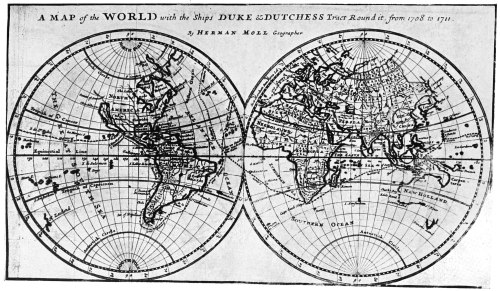
THE TRACK OF THE DUKE AND DUTCHESS ROUND THE WORLD Reproduction of the frontispiece to the first edition of Woodes Rogers’s book.
Account of the River Amazons.
He stood into them, and landing his Men, the Natives fought with great Resolution, ten or twelve being white Women of an extraordinary Size, with long Hair and all naked but their Pudenda, who seem’d to be their Commanders. They were arm’d with Bows and Arrows; and seven of ’em being kill’d, the rest fled. Orellana had several Men wounded; and finding that multitudes of the Natives were marching against him, he sail’d off, reckoning that he had now made 1400 Leagues during his Voyage, but still did not know how far he was from the Sea. He afterwards came to another Town, where he met with the like Opposition: several of his Men were wounded, and his Chaplain lost an Eye. Here he observ’d several Woods of Oak and Cork-Trees: He call’d this Province by the name of St. John’s, because he came to it on that Saint’s Day. He sail’d on till he met with some Islands, where he was attack’d by 200 Canoes with 30 or 40 Men in each, abundance of Drums, Trumpets, and Pipes, &c. but he kept them off with his Fire-Arms. These Islands appear’d to be high, fruitful, and pleasant, and the largest of ’em about 50 Leagues long; but he could take in no Provisions, because the Canoes continually pursu’d him.
When he came to the next Province, he perceiv’d many large Towns on the Larboard side of the River: Multitudes of Natives came in their Canoes to gaze on him, and his Indian Prisoner inform’d him that these Countries abounded with Gold and Silver. Orellana was here oblig’d to barricade his Boats to cover his Men, because one of ’em was kill’d by a poison’d Arrow. As he sail’d on, he came to inhabited Islands, and perfectly discern’d the Tide. Here he was attack’d by multitudes of Canoes, and lost some more Men by poison’d Arrows. There were many Towns on the Starboard side of the River, and he found other inhabited Islands, where he got Provisions, but was attack’d and beat off when he landed on the Continent, till he came near the mouth of the River, where the People readily furnish’d him. He sail’d 200 Leagues among the Islands, where he found the Tide strong, and at last in August that Year found a Passage to the Sea of about 50 Ls. wide, where the Tide rises five or six fathom, and the fresh Water runs 20 Leagues into the Sea; Esquire Harcourt,[106] in his Voyage to Guiana, says 30 Ls. and that the fresh Water there is very good. He was mightily distress’d for want of Rigging and Provisions till he came to the Island of Cubagua, from whence he went to Spain to give the King an Account of his Discovery. The Manuscripts taken by Capt. Withrington[107] say that Orellana was about a Year and half upon this River.
When he reported his Discoveries, the King of Spain sent him back with a Fleet and 600 Men to take possession of this River in 1544, some say 1549, but the Project came to nothing: for the Captain himself, after he had sail’d up 100 Ls. died with 57 of his Men by the Unhealthiness of the Air; and some of them sail’d 60 Ls. higher, where they were friendly entertain’d by the Natives, but being too few to pursue the Discovery, they return’d to the Island Margarita, where they found Orellana’s Lady, says Heerera, who told them that her Husband died of Grief for the Loss of so many of his Men by Sickness and the Attacks of the Indians. And thus they return’d re infecta: so that Orellana receiv’d no other Advantage for his Danger and Expence, but the Honour of the first Discovery, and having the River call’d by his name in some Authors. Ovalle says that he lost half his Men at the Canaries and Cape Verd, and his Fleet was reduc’d to two large Boats before he came back to the River; so that he was too weak to attempt a further Discovery.
The Manuscripts taken by Capt. Withrington say the second Person who attempted it was Leus de Melo a Portuguese, by order of his Sovereign King John III. to whom the Country from the mouth of this River to that of La Plata belong’d, according to the Partition agreed on betwixt the Portuguese and the Spaniards. He had ten Ships and 800 Men, but lost eight of his Ships at the mouth of the River; so that he went to the Island Margarita, from whence his Men were dispers’d all over the Indies. Two or three Captains from the Kingdom of New Granada attempted it afterwards by Land, but without Success.
In 1560. those of Peru try’d it another way. The Viceroy sent Pesdro de Orsua, a Native of Navarre, with 700 Men to the Head of this River, where he built Pinnaces and Canoes; and having furnish’d himself with Provisions, and taken 2000 Indians with many Horses on board, he imbark’d on the
Account of the River Amazons.
River Xauxa or Maranhon. He sail’d till he came to a plain Country, where he began to build a Town: but his Men not being us’d to such Labour, and fatigu’d by the hot and rainy Seasons, they murmur’d, tho they had Provisions enough, and a great prospect of finding Store of Gold. The Mutineers were headed by Lopez de Agira a Biscayner, who had been an old Mutineer in Peru; and being join’d by Ferdinand de Guzman a Spanish Soldier, and one Saldueno who was enamour’d on Orsua’s beautiful Lady, they murder’d him when asleep, with all his Friends and chief Officers. Then they proclaim’d Guzman their King, but 20 days after he was also murder’d by Lopez, who assum’d the Title to himself. Being a Fellow of mean Birth, he murder’d all the Gentlemen in company, lest any of them should rival him; and having form’d a Guard of Ruffians about him, he became so jealous of his new Dignity, and was so conscious of what he deserv’d, that when any of the Men talk’d together, he concluded they were plotting against him, and sent his Ruffians to murder them. Abundance of the rest and the Women falling sick, he barbarously left them to the mercy of the Natives, and sail’d to the Island Margarita with 230 Men. He was “well entertain’d by the Governour, who took him to be one of the King’s Officers; but this ungrateful Villain did speedily murder him and his Friends, ravag’d the Island, forc’d some Soldiers to go along with him, and pretended to conquer the Indies; but was defeated, taken and hang’d by the Governour of New Granada. The Wretch murder’d his own Daughter that she might not be insulted by his Enemies, and then attempted to murder himself, but was prevented. Thus concluded that fatal Expedition.
The Sansons say the next Attempt was by those of Cusco in 1566. but it came to nothing; for their Leaders fell out and fought with one another, which made the rest a Prey to the Natives: or that only Maldonado one of their Captains and two Priests escap’d to carry home the News.
Two of the Generals of Para and Governours of Maranhon were the next that renew’d the Attempt by the King’s Command, but met with so many cross Accidents that they could not effect it.
In 1606. two Jesuits set out from Quito, thinking to reduce the Country on this River by their Preaching: but one of them was kill’d by the Natives, and the other narrowly escap’d, says Ovalle.
The next Discovery was by Capt. John de Palacios. Authors differ as to the time; but most agree ’twas in 1635. He set out from Quito with a few arm’d Men and Franciscan Fryars, sail’d down the River till he came to Annete, where he was kill’d in 1636. and most of his Companions return’d, except two Monks and five or six Soldiers, who sail’d down in a little Vessel as far as Para the Capital of Brazile; where they acquainted Texeira the Portuguese Governour with their Discovery: who upon their Information sent 47 Canoes with 70 Spaniards and 1200 Indians to sail up the River under Texeira the Sailor. He set out in October 1637. and met with several Difficulties, which occasion’d many of the Indians to forsake him; but he went on, and sent a Captain with eight Canoes to make Discoveries before him. This Captain arriv’d June 24. 1638. at a Spanish Town built at the Conflux of the Rivers Huerari and Amazons, and dispatch’d a Canoe to acquaint Texeira with it. This encourag’d him to proceed till he came to the Mouth of the River Chevelus, where it falls into the Amazons, and there he left part of his Men under a Captain, and the rest at Junta de los Rios under another; while himself with a few went forward to Quito. The other Captain arriv’d there some time before, and both were well receiv’d by the Spaniards, to whom they reported their Discovery in September 1638. The Men he left behind were well entertain’d by the Natives at first, but quarrelling with them afterwards, suffer’d much for want of Provisions, and had little but what they took by force.
Upon the News of this Discovery, the Count de Chinchon Viceroy of Peru sent Orders from Lima to furnish Texeira with all Necessaries for his Return down the River, and appointed Father d’Acugna, Rector of the College of Cuenca, and another Jesuit, to attend him and carry the News to Spain. They set out in February 1639. and arriv’d at Para in December following; from whence d’Acugna went to Spain, and publish’d his Account of this River in 1640.
Account of the River Amazons.
The Sum of his Discovery, besides what has been mention’d already, is as follows. There’s a Tree on the Banks of this River call’d Andirova, from whence they draw an Oil that is a Specifick for curing Wounds. There’s plenty of Iron-Wood, so nam’d because of its Hardness, Red-Wood, Log-Wood, Brazile, and Cedars so large, that Acugna says he measur’d some that were 30 span round the Trunk. They have Timber enough to build Ships, make Cordage of the Barks of Trees, and Sails of Cotton, but want Iron. They make Hatchets of Tortoise-shells, or hard Stones ground to an Edg; and Chizzels, Planes, and Wimbles of the Teeth and Horns of wild Beasts. Their chief Directors are Sorcerers, who are the Managers of their hellish Worship, and teach them how to revenge themselves on their Enemies by Poison and other barbarous methods. Some of them keep the Bones of their deceas’d Relations in their Houses; and others burn them with all their Movables, and solemnize their Funerals first by mourning, and then by excessive drinking. Yet the Father says they are in general good-natur’d and courteous, and many times left their own Hutts to accommodate him and his Company. Some of these Nations, particularly the Omaguas, whose Country is 260 Leagues long, and the most populous on the River, are decently clad in Rayment of Cotton, and trade in it with their Neighbours. Some of the other Nations wear Plates of Gold at their Ears and Nostrils; and their Joiners are so expert, that they make Chairs and other Houshold Furniture in the shapes of several Animals with great Art.
The Jesuits of Quito in Peru have engrav’d a Map of this River, in which they give the following Account, viz. That ’tis the greatest in the known World: That tho it be call’d by the name of Amazons or Orellana, its true name is Maranhon: That it rises from the Lake Lauricocha, as we have mention’d already, runs 1800 Leagues, and falls into the North Sea by 84 Mouths: That near the City Borja it is pent up by a Strait call’d El-Pongo, not above 13 Fathom wide and 3 Ls. long; where the Stream is so rapid, that Boats run it in a quarter of an hour. The Truth of this must be submitted to the Judgment of the Reader, but it seems very improbable, since none of those who sail’d up and down this River describe it thus: besides, ’twere impossible to sail up against so rapid a Stream without a Tide, which the Sansons say comes up to this Strait; but they make it a mile broad, and by consequence not so rapid. The Jesuits add, that both Banks from the City Jaen in the Province of Bracamoros, where it begins to be navigable, down to the Sea, are cover’d with Woods of very tall Trees, among which there’s Timber of all colours, abundance of Sarsaparilla, and the Bark they call Cloves, which is us’d by Dyers and Cooks. In the neighbouring Woods there are many Tygers, wild Boars, and Buffaloes, &c. The Jesuits began their Mission upon this River in 1638. have their Capital at the City of St. Francis of Borja in the Province of Manos, 300 Leagues from Quito; and their Mission extends along three other Rivers as far as the Province of the Omaguas, whither they make sometimes long and dangerous Voyages in Canoes. They give an account of eight of their number that have been murder’d by the Barbarians, the last of them in 1707. Besides Borja and its Dependencies, they have 39 Towns founded mostly by their own Labour and Charge, but we shan’t insist on their Names. Their Converts they reckon at 26000, and the Missionaries about 18. They add, that they have contracted Amity with several numerous Nations, whose Conversion they hope for.
The Portuguese have some Towns at the Mouth of this River, and a Fort on Rio Negro; so that of late years they have traded much upon it, and, as several Spaniards inform’d me, during the last Peace they extended their Commerce as far as Quito and many other Places in Peru. I have insisted the longer on this River, because it is of so great Fame, and may be of mighty Advantage for Trade.
The River of La Plata being the South Boundary of Brazile, within the Limits of the South-Sea Company, and lying conveniently for opening a great Trade from the North-Sea with Peru, Chili, and other vast Countries; I shall give a Description of it here, from the best Authors.
The first European who discover’d it, seems to have been Juan Dias de Solis, who sailing from Spain in 1512. some say 1515. run along the Coast of Brazile till he came to this River, says Ovalle. With him agree the Manuscripts taken on some Spanish Priests in this River by Capt. Withrington, publish’d in Harris’s Collections[108]; where we are told, De Solis obtain’d the Government of this River, but was murder’d by the Natives with most of his Men in 1515. The next who came hither was Sebastian Cabot in 1526. but his Men being mutinous, he had not the desir’d Success, tho he sail’d 150, some say 200 Leagues up this River; and purchasing many Pieces of Gold and Silver Plate from the Natives, who call’d this River Parama, he call’d it the River of Plate, because he thought it to be the Product of the Country, which was afterwards found to be a Mistake. Yet upon his Report, in 1530. when he return’d, the Emperor Charles V. sent Don Peter Mendoza, one of his chief Grandees, with 2200 Men besides Mariners, to plant a Colony here in
Account of the River La Plata.
1535. and they had so great hopes of finding Mines of Gold and Silver, that above thirty Heirs of noble Families went on the Expedition; and sailing 50 Leagues up the River, where the Air was good, he founded a Town, which from thence was call’d Buenos-Ayres. They built a Fort, and enlarg’d the Town; but as they were carrying on their Work, the Natives attack’d them, and overpowering them with Numbers, kill’d 250, among whom were several of the chief Men. This oblig’d the Spaniards to keep within their Fort, where they suffer’d much by Famine. Mendoza return’d towards Spain, but died miserably, with many of his Companions, for want of Provisions by the way. His Deputy-Governour Oyola sail’d up into Paraguay, in quest of a Country said to abound with Gold and Silver; but was treacherously slain by the Natives, with all his Followers.
Irala who was his Deputy, and left at Buenos-Ayres, contracted a Friendship with some of the Natives call’d Guaranians. In 1538. he built Assumption in their Country, which is now the Metropolis of Paraguay, and left Buenos-Ayres for a time. Assumption lies on the Banks of the River Paraguay, in S. Lat. 25. 240 Leagues from the Sea, and 40 from the Mouth of the River Paraguay, where it falls into La Plata, These Rivers after they join continue their natural Colour for several miles, La Plata being clear, and Paraguay muddy. The latter is by much the most considerable River, and the adjacent Country abounds with Mines of Gold and Silver, and is navigable above 200 Leagues. The River Uruquay falls into Paraguay on the right side, and runs a Course of 300 Leagues, according to Sepp the Jesuit, who in his Voyage says ’tis as big as the Danube at Vienna. In short, as to this River La Plata, Authors are not agreed. Some of the Jesuits who are Missionaries in those Countries think it to be the same with that call’d Paraguay higher up in the Country, and that it has a Communication with the North-East Coast of Brazile by the River St. Meary, which rises out of the same Lake, and runs N E. as Paraguay or Plata runs S. and afterwards to the S E. when it falls into the Sea. Be that how it will, here are many Rivers which fall into the same Channel on both sides. But that which is commonly call’d La Plata, begins near the Town of that Name about S. Lat. 19. and after running N. a little way, takes its Course S E. till it join the River Paraguay. So that I chuse rather to trust to the Account given us by Mr. White our Linguist, who having dwelt long in that Country, told me this River derives its Name from the Town of La Plata, a sort of Metropolis to which there lies an Appeal from other Jurisdictions. He adds, that ’tis a pretty Town, has fourteen Churches with a Cathedral, and four Nunneries, and lies North-west from Buenos-Ayres about 500 Leagues, which requires commonly two months and a half’s Travel.
All are agreed that La Plata is very large at the Mouth, where some account it 50, and others 30 Leagues broad. The Mouth of it is dangerous because of Sands, and therefore requires Pilots. Knivet,[109] in his Description of the West-Indies, says, the best way to avoid those Sands is to keep near the North Shore till you come to a high Mountain white at top; and then to sail 4 Ls. South, to another small Hill on the North side, near which you must sail. This brings you into a fair Bay, where you must still keep along shore: and after passing the West Point of this Bay, you come to the River Maroer, and then there are no more Shoals between that and Buenos-Ayres.
La Plata runs into the Sea about S. Lat. 35. and sometimes overflows the Country for several miles, when the Natives put their Goods into Canoes, and float about till the Inundation assuages, and then they return to their Habitations. Ovalle gives the following Account of this River, viz. That it runs with such a mighty Stream into the Sea, as makes it fresh for a great way: That the Water of this River is very sweet, clears the Voice and Lungs, and is good against all Rheums and Defluxions: That the People who dwell about it have excellent Voices, and are all inclin’d to Musick: That it petrifies the Branches of Trees, and other things which fall into it; and that Vessels are naturally form’d of its Sand, which are of various Figures, look as if they were polish’d by Art, and keep Water very cool. It breeds great store of excellent Fish of divers sorts, and most beautiful Birds of all kinds are seen on its Banks. Sepp informs us, that this River and Uraguay abound so with Fish, that the Natives catch great numbers of them without any other Instrument than their Hands: one of the choicest, call’d the Kings-Fish, is small without Bones, and taken only in Winter. Our Author, says he never saw any European Fish in this latter, except one that the Spaniards call Bocado; and that the Fish are larger here than ours, of a dark or yellow colour, and well tasted; which he ascribes to the nature of
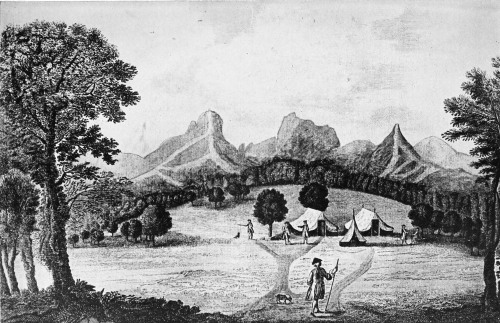
THE ISLANDS OF JUAN FERNANDEZ, WHERE ALEXANDER SELKIRK WAS FOUND
Account of the River La Plata.
the Water, that tho drunk in great quantities even after raw Fruit, helps Digestion, and never does any hurt. The Plains about this River are so large and even, without any Obstruction to the Sight, that the Sun seems to rise and set in them. Their way of travelling in those Plains is by high Carts cover’d with Hoops and Cows-Hides like our Waggons, with Conveniency for Travellers to sleep in the bottom; which is so much the better, because they travel most by night to avoid the Heat. They are drawn by Oxen, which are frequently so pinch’d by Drought, that when they come towards any Water, which they smell at a great distance, they run furiously to it, and drink up the very Mud which they raise with their Feet. This obliges Travellers to furnish themselves with Water and other Provisions for their Journy; there being no Water to be had, except by Rain: so that Travellers are frequently as much distress’d for want of Water as the Oxen, and can scarce get any that’s clear at the Watering-places, tho they send before-hand, because the Oxen run with so much haste to it that they make it all in a puddle: Ovalle says, that in this case Travellers are forc’d to stop their Noses and shut their Eyes when they drink it. The Journy thro these Plains is at least 14 or 20 days, without any place of shelter, or any Firing to dress their Victuals but the dry’d Dung of Cattle. Yet there are several Lakes and Ponds where Inns might be fix’d, but ’tis neglected because there’s no settled Trade that way.
It remains to give some account of the Towns upon the River Plata and on the Road to Potosi. 1. Buenos-Ayres lies upon the River 50 Leagues from the Sea, about Lat. 36. Our Linguist inform’d me that ’tis the Residence of a Spanish Governour, is defended by a Stone Fort mounted with 40 Guns, and is generally garison’d by 4 or 500 Men. The Harbour is pretty good, but troublesom in a N W. and W. Wind. The River is 7 Ls. broad there, and navigable by Ships 60 Ls. above the Town, but no further, because of a great Cataract. The Town has one Cathedral, and five other Churches: The Portuguese had a Settlement over against this Town, but were dislodg’d by the Spaniards at the beginning of this War; since which time the French drive a Guinea Trade hither for Negroes, who are sent over Land to Peru and Chili, and yield them vast Profit. The Trade from hence to Spain is in Hides and Tallow, Silver from Peru, and Gold and Silver from Chili. All European Goods yield a good Price here. They have plenty of Fruit-Trees about the Town of all kinds, both of the hot and cold Climates; and have store of Wheat and other European Grain, besides Indian Corn. Thousands of Cattel of all sorts run wild in the Neighbourhood, and they furnish Peru with 50000 Mules per ann. In short, this place lies very convenient for Commerce in Silver and Gold, and the other Commodities of Peru and Chili, which the French have now begun to engross. They sent three Ships to those parts and the South-Sea, under M. de Beauchesne Gouin[110] of St. Malo in 1698, of whose Progress I shall give a further account from a Copy of his Journal, as I go on with my Description of the Coasts. Their Winter here is in May, June, and July, when ’tis cold by night, but warm enough by day, the Frost never being violent, nor the Snow considerable in those parts.
Father Sepp,[111] who was here in 1691. tells us in his Voyage from Spain to Paraquaria or Paraguay, that Buenos-Ayres has only two Streets built crosswise; that there are four Convents, one of which belongs to the Jesuits; that their Houses and Churches are built of Clay, and not above one Story high; that the Jesuits have taught them of late to burn Lime, and make Tiles and Bricks, with which they now begin to build. The Castle is likewise of Clay, encompass’d with an earthen Wall and a deep Trench, and defended by 900 Spaniards; tho in case of necessity above 30000 Indian Horse might be arm’d out of the several Cantons, where they have been train’d by the Jesuits: But this boasting Account I can’t believe. They have in the Neighbourhood whole Woods of Peach, Almond, and Fig-Trees, which they propagate by putting the Kernels in the Ground: they grow so fast as to produce Fruit the first Year, and their Timber is us’d for Fewel. The adjacent Pastures are so fat and large, that many thousands of Beeves feed together; so that any one when he pleases goes into the Field, throws a Rope about their Horns, brings ’em home and kills ’em. They are very large, generally white, and being so numerous, are valu’d only for their Hides, Tallow, and Tongues; the rest being expos’d to the Birds and Beasts of Prey, which are very numerous, and frequently destroy the Calves. The Natives feed most on Beef half-raw without Bread or Salt, and in such quantities that they throw Account of the River La Plata. themselves naked into cold Water, that they may retain the natural Heat within their Entrails to help Digestion; and sometimes they lie down with their Stomachs in hot Sand: but their Gluttony in devouring so much raw Flesh fills them so with Worms, that they seldom live till 50 Years old. There are such numbers of Partridges here, and so tame, that they knock them down with sticks as they walk in the fields. The Missionaries, who are absolute Masters of the Natives in the neighbouring Cantons of Paraguay, &c. suffer none of ’em to come nearer Buenos-Ayres than two or three Leagues, on pretence that they would be corrupted by the ill Example of the Spaniards; and under that same pretence they won’t suffer the Spaniards to settle in their Missions, which extend above 200 Leagues up the River; nor do they allow Merchants who trade thither to stay above a few days; the true cause of which is, they are not willing that the Laity should be privy to the Wealth they heap up there, in a Country which abounds with Gold, nor be Witnesses to their splendid, or rather luxurious way of living. Sometimes Complaints of this Procedure of the Jesuits have been made to the Spanish Governours, but they find a way to bribe them to silence. This I was inform’d of by those who have been among them, and am confirm’d in it by Father Sepp: He does not dissemble that the Missionaries have a Despotical Power over the Natives, tho he gives it another Turn, and pretends that ’tis necessary in order to convert and force them to work. He says the Jesuits are Captains, teach them the Use of Arms, and how to draw up into Squadrons and Battallions; which he boasts they can do as well as the Europeans. The Jesuits obtain’d this Power, on the specious Pretence of reducing those Indians to the Obedience of the Spaniards, which they would not submit to till within these few Years. This Management is so much the more easily carry’d on, because the Ecclesiastical Government there is lodg’d in the hands of one Bishop only and three Canons; and the Missionaries being compos’d of all Nations, few of them have any natural Affection to the Spanish Government. This is the more to be observ’d, because the Jesuits being an intriguing Society, and generally in the French Interest, it would seem to be the Concern of the Allies to recover the Trade of those Countries from the House of Bourbon with all possible speed, left by making themselves Masters of the vast Treasures of Peru and Chili, they be enabled at last to compleat their Design of an Universal Monarchy. Father Sepp says, that Silver in 1691. was cheaper here than Iron; that for a Twopenny Knife one may have a Crown, for a Hat of two Shillings 10 or 12 Crowns, and for a Gun of ten or twelve Shillings 30 Crowns; that Provisions are so plenty here, that a fat Cow may be bought for the Value of 10 d. or 12 d. a good Ox for a few Needles, a stout Horse for about 2 s. that he has seen two given for a Knife not worth 6 d. and that he and his Company had 20 Horses for a few Trifles that did not cost them a Crown; being only a few Needles, Fish-Hooks, sorry Knives, Tobacco, and a little Bread. He mentions a Cataract in the River Uruquay, which he says Providence has plac’d here for the advantage of the poor Indians against the Avarice of the Spaniards; who not being able to go further with their Vessels, have been hitherto confin’d to Buenos-Ayres, and could not settle in those Cantons, tho very inviting, because of the vast Profit they might draw from them. This he reckons a great Happiness to the Natives, who being a simple People, would not only be soon infected with the Vices of the Spaniards, but enslav’d by ’em: for, says he, they make no difference betwixt Pagan and Christian Natives, but treat them promiscuously like Dogs. He adds, that this Province of Paraquaria or Paraguay exceeds in bigness Germany, France, Italy, and the Netherlands put together; (wherein I doubt he exceeds:) That they have no Cities, and are govern’d by 80 Colleges of Jesuits, in which there are no more than 160 Persons; and that these Colleges are from 100 to 600 Miles distant from one another. There’s one Plain of 200 Leagues long betwixt Buenos-Ayres and Corduba in Tucuman, without so much as a Tree or Cottage, and yet it contains the best Pastures in the World, fill’d with Cattel of all sorts which have no Owners.
Account of the River La Plata.
He describes the Natives thus: The Men are not quite so tall as Europeans, but have thick Legs and large Joints. Their Faces are round, flattish, and of an Olive Colour; and their Arms are Bows and Arrows. Some of the strongest have many Scars on their Bodies, occasion’d by Wounds which they gave themselves when young, that these Scars may be remaining Proofs of their Courage. Their Hair is black, long, and as strong as that of a Horse. The Women look more like Devils than rational Creatures, with their Hair loose over their Foreheads, and the rest twisted in Locks behind, which hang as low as their Hips. Their Faces are wrinkled, their Arms, Shoulders and Breasts naked; and their Ornaments are Fish-Bones made like Scales of Mother-of-Pearl about their Necks, Arms and Hands. The Wives of their Caciques or petty Princes wear a sort of Triple Crowns of Straw. The Caciques wear Doe-Skins hanging over their shoulders; the rest only a piece of a Skin wrap’d about their middle, and hanging down before to their knees. The Boys and Girls are quite naked. They have holes in their Ears and Chins, in which they put Fish-Bones, or a colour’d Feather tied by a thred, and Feathers of several colours fasten’d to a string round their Necks. They wrap their Infants as soon as born in a Tyger’s Skin, give them the Breast for a little while, and then half-raw Meat to suck. He says, the Men at the death of their nearest Relations cut off a Finger of their own left Hand; and if it be a handsom Daughter, they make a Feast and drink out of her Skull. They live in Straw Hutts without Roofs, and their Utensils are a few Sticks for Spits, and Pumpkins hollow’d out, in which they eat their Meats. Their Beds are the Hides of Oxen or Tygers, spread on the ground; but the Caciques, and those of Note, lie in a Net fasten’d to two Poles for Hammocks, at some distance from the ground, being a Security against wild Beasts and Serpents. Our Author says that he sent well-boil’d Meat to several of them when sick, which they receiv’d thankfully; but afterwards gave it to their Dogs, because they lik’d their own Cookery better.
It is now time to see how the Missionaries live among those Flocks over whom they assume the Pastoral Care. Father Sepp tells us, that he and other new Missionaries were welcom’d by some of them with 20 Musicians in a Train, abundance of Boats equip’d like Galleys lin’d with Firelocks, and having Drums, Trumpets, and Hautboys on board. The Missionaries brought ’em Sweatmeats, and all sort of Fruit; and the Indians diverted them by wrestling in the Water, and Salvoes of their Fire-Arms, &c. They conducted them thro a green Triumphal Arch to the Church, where the Women were so earnest at their Devotion, that not one of them cast an eye upon our Father and his Companions: so that here were a Militant and a Triumphant Church both together. When the Devotion was over, the chief of the Indians welcom’d the Father and the rest of the Missionaries, by a short but very pathetick Speech; and one of the Indian Women did the like with wonderful Elegancy, says the Jesuit, who it seems is not against Women speaking in the Church. That and the next day they spent in Mirth and Jollity, and in the Evening were diverted by four Dances; 1. By Boys, who danc’d with Pikes and Lances. 2. By a couple of Fencing-Masters. 3. By six Seamen. 4. By six Boys on horseback, who afterwards gave them a kind of Tournament, the place being illuminated by Ox-Horns fill’d with Suet, for they have no Oil nor Wax. On Whitsunday, which happen’d soon after, the Missionaries went to Church, and return’d Thanks for so many Converts; as certainly they had reason, since they are such merry ones.
These Cantons, he says, are 26, and have but one or two Missionaries apiece, tho they contain from 3000 to 6000 People each, and sometimes more; so that they must either have too much work, or perform it very slightly, especially if they be so ignorant as our Father says, that if they be neglected one day, they scarce know how to make the Sign of the Cross the next: And besides all the Pastoral Work, the Missionaries must act the part of Clerks, and clean the Church-Ornaments and Plate; for these poor Wretches are uncapable of doing it. To be short, says he, the Missionary must be Cook, Nurse, Doctor, Architect, Gardiner, Weaver, Smith, Painter, Baker, Potter, Tile-maker, and every thing else that is necessary in a Commonwealth. This he supposes will appear incredible (and he’s certainly in the right) but he says ’tis the naked Truth; the Natives being so stupid, that unless he plainly shew his Indian Cook how much Salt he must put in each Pot, he would put all into one, tho ever so much; and he must see them wash the Vessels, unless he would be poison’d: yet this Father, for all his other hard work, must look after his Garden, Orchard, and Vineyard, where he has all sorts of Flowers, Herbs, Roots and Fruits, and so many Vines as produce 500 large Casks of Wine in a Year, if not prevented by multitudes of Pismires, Wasps, Birds, or by the North Winds, which sometimes make Wine so dear, that a Cask yields 20 or 30 Crowns; and after all, ’tis not to be preserv’d from turning sour without a great mixture of Lime. The chief Distemper of the Natives is the Worms before-mention’d, the bloody Flux [dysentery] and spotted Fever, which frequently carry off great numbers. The Medicines which the Missionaries give against Worms, is a Vomit of Tabacco-Leaves; and after that, sour Lemon-Juice with those of Mint and Rue put into Milk.
Account of the River La Plata.
These Cantons or Towns, he says, are generally upon an Ascent near the Rivers Uruguay and Paraguay, and contain young and old from 6000 to 8000 Souls. Each Canton has a Church and a square Market-place near it, the rest being divided into Streets of Clay-Hutts cover’d with Straw, only of late they begin to use Tiles. They have no Windows, Chimneys, or different Apartments; and over the Fire-place they hang their Beds at night. Their Doors are Ox-Hides; and since all lie together in one Room, with their Dogs, Cats, &c. the Missionaries are entertain’d with very ungrateful Scents, besides Smoke, when they go to visit them. He says, in the main they are very patient under Distempers, and the Death of Relations; that they seek after no Riches but a present Maintenance; that their young Women are marriageable at 14, and the Men at 16, when the Missionaries take care to match them, otherwise they will pair themselves. There are no Disputes here about Dowries, Jointures, or Marriage-Settlements; the Agreement consists only in two Articles, viz. The Woman promises to fetch what Water the Husband wants from the River, and he engages to provide the Kitchin with Fewel. The Missionaries furnish them with Hutts, the Wedding-Clothes and Dinner. The Wedding-Suit is five yards of coarse woollen Stuff for each, the Dinner is a fat Cow, and the Bed some Ox-hides. He presents them also with a little Salt and a few Loaves, and then they treat their Parents. The Women court here, come to the Missionary, and tell him they have a mind to such a Man, if he will give his Consent; which if he do, the Match is made, and the Missionary is both Priest and Father.
How mean soever the Natives live, the Priests have enough of Splendor and Plenty. Their Churches and Steeples are lofty, have four or five Bells apiece, most of ’em a couple of Organs, Altars, and Pulpits richly gilt, Images well painted, plenty of Silver Candlesticks, Chalices, and other Church-Plate; and the Ornaments of the Priests and Altars are as rich as in Europe. They teach the Natives to sing and play on all Musical Instruments both for Devotion and War; so that according to the Jesuits they go now more merrily to Heaven than formerly they did to Hell, and the good Fathers divert themselves with Sets of Musicians on the Banks of the Rivers and in charming Islands. Nor can we wonder that they live so merrily, since they fare so well; for besides all sorts of delicious Fruits and Preserves, they have plenty of Fowl, Fish, and Venison of all sorts, as well as ordinary Butchers Meat; only the Tygers, which are very numerous, frequently put in for a share with them, invade their Flocks and their Followers: but if you’ll believe our Father, they never attack the Clergy, they have such a Respect for their Cloth, and are so civil to Europeans, that they’l charge the Indians in their Company, and let them go scot-free; and the Serpents, which likewise abound here, are charm’d by Ave Mary’s into the like Good-Manners. The Priests use Honey for their Sallets, for they have no Oil, so that they are very hard put to it. They had Silver in such plenty, says the Father, that old Shoes and Hats were much more valuable. And as if the Missionaries had not Work enough otherwise, Father Sepp tells us, the Natives when they kill their Cows bring ’em to the good Jesuits to allow each their share; and to be sure the Hides fall to the Missionaries, for he says the three Ships which brought him and his Companions from Spain, carry’d back 300000 Ox-Hides, which they had for nothing, and each Hide he says would yield ’em six Crowns at home. A good Horse-shoe he says is here worth six Horses, and the Bit of a Bridle worth three. An Ell of Linen is worth four or five Crowns; for they have no Hemp or Flax, but store of Cotton: and one Sheep, Lamb or Kid, is for the sake of the Wool worth three Oxen or Cows. Tho the Natives, he says, are so dull that they can’t do the most frivolous thing without direction, yet they are so good at Imitation, that if you give them Models, they will make any thing very well. Thus he says the Indian Women after ripping a piece of Bone-Lace with a Needle, will make one by the same pattern very exactly; and so the Men do Trumpets, Hautboys, Organs, or Watches; and copy Pictures, Printing and Writing to admiration.
Account of the River La Plata.
But they are so lazy that they must be forc’d to their work by blows, at the direction of the Missionaries, who tho they convert ’em themselves, make them cudgel one another. This they take very patiently, give no ill Language, but cry Jesu Maria! and thank the good Fathers into the bargain for taking such care of ’em; so that they have learnt Passive-Obedience to perfection. But to make them amends, our Author says the Missionaries teach their young ones to dance as well as to sing in the Church, when they are habited in rich Apparel: so that they are extremely taken with the Ornaments of our Religion, says he, which raises in them a high Esteem and Affection; and indeed ’twould be a wonder if it should not. The Missionaries do now take care to instruct both Sexes in all necessary Employments, Reading, Writing, &c. They have also taught ’em to make Images, especially of our Lady of Ottingen; and very good reason, for if we believe Sepp, she has done abundance of Miracles there. The Fathers wear Caps like a Bishop’s, and black Linen Cassocks when they go abroad; and instead of Canes use Crosses, which have a peculiar Virtue to knock Serpents o’ the head.
The Soil is so fruitful that it produces a hundred fold, tho sorrily manur’d. The Natives sow nothing but Turky Wheat, and scarce enough of that, they are so lazy: and are likewise such bad Husbands, that they would eat all at once, did not the Missionary force ’em to lay it up in his Barn, where he distributes it to ’em as they want, and so he does their Flesh. They have no Mills, but pround their Wheat in a Mortar, and make it into Cakes which they bake on Coals, or boil with their Meat. The Fathers have white Bread for themselves, which the Natives value so much, that they will give two or three Horses for a Loaf; and of these the Missionaries have good store, for they have always 40 or 50 Acres sow’d with Wheat for themselves: Land, Corn, Cattel, and every thing is theirs; so that they call all the People their Sons and Daughters, and perhaps there’s just cause enough to give many of ’em that Title. These Lords Proprietors assign every Family their number of Cows and Oxen to till their Ground, and to eat; tho one would think they might have enough for the taking, without asking any body’s leave: and yet our Father says he has been forc’d to chide his Parishioners for killing and eating their Oxen, and roasting them with their wooden Plows in the very Field while they were tilling the Ground; for which they pleaded in excuse that they and their Wives were hungry and weary: and yet there was no great reason for the latter, since their Plows, says our Author, don’t enter above three inches into the Ground. They need no Hay for their Cattel, since they go up to the knees in Grass all the year. This is the way of living in those Cantons, which the Missionaries call Reductions, because, if you’ll believe ’em, they have reduc’d them to Christianity by their Preaching, tho the Spaniards could never do it by their Arms.
Our Linguist told me that the Road from Buenos-Ayres to Chili is only passable in the Summer Months, when Commodities are purchas’d at that Town, and transported by Land to Chili.
On that Road about 100 Leagues N. W. from Buenos-Ayres lies the City of Cordoua, which is the See of a Bishop, has ten Churches, and an University. ’Twas founded in 1573. says F. Techo, by a Native of Cordoua in Old Spain, when there were 60000 Archers reckon’d in its Territory, about 8000 of whom continu’d in subjection, but the others revolted. ’Tis now the Metropolis of the Province, and the Jesuits have a Chappel in their College there, which for Riches and Beauty may vie with the best in Europe. The Natives of this Country were very barbarous, made use of Sorcery to satisfy their Revenge, and of Philtres of their own Blood to gratify their Lust. Both Sexes daub’d their Faces with strange Colours, and each Village was govern’d by a Sorcerer, who pretended to be their Physician. To shew their Courage, they would draw Arrows thro the Skins of their Bellies, and they fought Duels with sharp Stones, standing foot to foot, and holding down their Heads to receive the Blows from one another by turns. He that struck first was reckon’d the most fearful: It was accounted disgraceful to dress their Wounds, and the Conqueror was applauded by hideous Shouts from the Spectators. ’Twas a long time before the Missionaries could reform those barbarous Customs.
Another Town on this Road is Mendosa, where they make large quantities of Wine, Brandy, and Oil.
So much for that part of this vast Country which lies towards Chili and Brazile: I shall next come to that part which lies towards Peru, and particularly the Road to Potosi and the Mines.
Santa-Fe is the next Spanish Settlement of note to Buenos-Ayres, from which it lies 80 Leagues N W. at the mouth of a River which falls into La Plata. The Country betwixt this Town and Buenos-Ayres is fruitful, well inhabited by Spaniards and Indians, and produces Wheat from forty to an hundred fold, and abounds with Cattel. The Town is encompass’d with a River, and built of Brick. Our Prisoners and Linguist told us that there are Mines of Gold and Silver in the Neighbourhood, but the Spaniards don’t care to open them, because the Conveniency of sailing up the River might encourage Enemies to invade and take them from ’em. This Town was built by the Spaniards when they first settled, for the Defence of this River.
Account of the River La Plata.
St. Jago de l’Istero 200 Leagues N W. from Santa-Fe, is a pretty Town govern’d by a Corregidore, has three Churches, and lies on the River that runs down to Santa-Fe. Hither the Plate is brought from Potosi on Mules, because the Roads are bad; and from hence it is carry’d to Buenos-Ayres by Waggons. Next to this Town lies St. Miquel de Toloman 200 Leagues N W. Then Salta 150 Leagues. This Town contains six Churches. Then Ogui 50 Leagues further, which has five Churches.
Potosi is next, lies N. of the Tropick of Capricorn about S. Lat. 21. Long. 73. Our Linguist tells us the City is large, has ten Churches govern’d by an Arch-Priest. The Town stands at the bottom of that call’d the Silver Hill, which is round like a Sugar-Loaf. There are 1500 or 2000 Indians constantly at work in the Mines here; they have two Reals a day, and are paid every Sunday. The Mines are a hundred fathom deep, and the Silver is grown much scarcer of late. Provisions are scarce at this Town, and they have no Firing but Charcoal, which is brought from 30 to 50 Ls. distance. They have great Frosts and Snow here in May, June, and July. Knivet in his Remarks says, in his time they were well supply’d here with all things from the South-Sea, and that the Natives in the adjoining Country traffick’d in Gold and precious Stones; and hundreds of ’em ply’d upon the Road to carry Passengers from Town to Town in Nets fasten’d to Canes, and supported by two or more Men; which was the easiest way of travelling, and they desir’d no other Reward but a Fish-Hook and a few Glass-Beads. They have also Sheep of an extraordinary Size, with large Tails, upon which they carry’d Jars of Oil and Wine. He says the rich Oar when taken out of these Mines looks like Black Lead, then they grind it by certain Engines, and wash it thro fine Sieves into pav’d Cisterns. They make the Indians and other Slaves work quite naked in the Mines, that they mayn’t hide any thing.
The Curious who would know more of the Manners of the Natives, or the History and particular Product of this large Country, may find it in Gemelli,[112] Father Sepp, and Father Techo,[113] but this is enough for my purpose, to shew what a vast Field of Trade may be open’d here, and how dangerous it may prove to all Europe, if the House of Bourbon continue possess’d of that Trade.
Some being of Opinion that our South-Sea Company may possess themselves, by virtue of the late Act, of the River de la Plata, as far up that River and Country as they please, either in the Provinces of Paraguay or Tucuman; I shall give a further Description of those large Provinces, after taking notice that according to several of our Draughts Paraguay lies both on the E. and W. side of the River La Plata; according to others, entirely on the E. side, and Tucuman on the W. side. The Sansons make Paraguay 720 miles from S. to N. and 480, where broadest, from E. to W. and place it betwixt S. Lat. 14 & 24. Long. 315 & 325. but the Breadth is not equal. Father Techo says the River Paraguay, which gives name to the Country, is one of the greatest in America, receives several other large Rivers, runs 300 Leagues before it falls into the Parana, about 200 from the Sea is navigable, and together with the Parana forms the River La Plata. The word Paraguay in the Language of the Country signifies the Crown’d River, because the Inhabitants wear Crowns of Feathers of several beautiful Colours, which they have from the Birds that abound in that Country. I shall not insist upon the several Nations that inhabit it, among whom the Garanians are the chief, and submitted first to the Spaniards; but growing weary of the Slavery they subjected them to, revolted, and were with much difficulty subdu’d after their Leaders were cut off, about 1539. The chief Discovery of this Country is owing to Dominick Irala, who in the Reign of the Emperor Charles V. was sent by the Governour Alvar Nunez Cabeca de Vaca with 300 chosen Men, and went 250 Leagues up this River, to endeavour a Communication with Peru, but was oppos’d by some of the Natives, of whom 4000 were kill’d, and 3000 taken in a Battel. The Governour went afterwards on the Discovery himself, and sailing up the River, came to a delicious Island, which his Men call’d Paradise, and would have settled there, but he dissuaded them, and advancing to the Borders of Peru, found a large Town of 8000 Houses deserted by the Inhabitants, who were affrighted with the noise of the Spanish Fire-Arms. ’Tis said they found in this Town a great Market-place, with a wooden Tower in form of a Pyramid built in the middle, and a monstrous Serpent kept in it by which the Devil pronounc’d Oracles: this Serpent they kill’d with their Fire-Arms. But a Difference happening betwixt the Officers and Soldiers about dividing the Booty, they return’d to Assumption without pursuing the Discovery any further.
Account of the River La Plata.
This Province, till that of Tucuman was taken from it, contain’d all the Country betwixt Brazile and Peru. Our Author adds, that besides the Towns above-mention’d the Spaniards built here Corientes on the Conflux of the Paraguay and Parana, which is but a small Town, no way suiting the Dignity of those two Rivers: That 100 Leagues up the Parana, in the Province of Guirana, the Spaniards built two little Towns call’d Villarica and Guaira; that on the upper part of the Paraguay they built Xeres and another Villarica, to join Paraguay on that side to the further Provinces; and lastly, the City of Conception on the Marshes of the red River which falls into Parana, and was of great use to curb the fierce Nations in the Neighbourhood. He adds, that all these Towns were first planted by a Race of the noblest Families in Spain. He mentions an extraordinary Herb here call’d Paraguay by the name of the Country; it grows in marshy Grounds, and the Leaves being dry’d and powder’d, and mix’d with warm Water, the Spaniards and Natives drink it several times a day, which makes them vomit, and strengthens their Appetite. They look upon it as a sort of Catholicon, use it so much that they can’t live without it; and this Custom has so much overspread the neighbouring Provinces, that the Inhabitants will sell any thing to purchase it, tho the excessive Use of it occasions the same Distempers as the immoderate Use of Wine. They did so fatigue the Natives to gather and powder this Herb, that multitudes of ’em died; and this, with other slavish Employments, did much dis-people the Country. The Natives live mostly by Fishing, Hunting, and Shooting.
Account of the River La Plata.
Tucuman is 300 Leagues long, but varies much in breadth. ’Tis inhabited by four Nations: The furthest South have no fix’d Dwellings, live by Fishing and Hunting, and carry about Mats to serve them for Tents. The North People live in Marshes, and feed most on Fish. The Southern People are the tallest, but the Northern the fiercest; and many of them live in Caves, but those nearest Peru in Villages. They are all very slothful, and have store of Brass and Silver, but make little use of them. They have large Sheep which carry their Burdens, and their Wool is almost as fine as Silk. They have many Lions, not so large and fierce as those of Africa, but their Tygers are fiercer than those of other Countries. Their two chief Rivers are Dulce and Salado, so call’d from the sweet and salt Taste of their Waters. They have multitudes of Springs and Lakes, some of which have a petrifying quality. The Country was formerly very populous, but their Numbers are much decreas’d since the Spaniards planted among them. They easily subdu’d this Country, which was govern’d by abundance of petty Princes continually at war with one another. This Province was first discover’d in 1530. by one Cæsar a Soldier belonging to Sebastian Cabot, and three more, at the time when Pizarro took Atabalipa the Great Inga of Peru. In 1540. the Viceroy of Peru, Vaca de Castro, assign’d this Country to John Rojas as a Reward for his Services. He went thither with 200 Spaniards, but was kill’d on the Frontiers by a poison’d Arrow, and his Men under Francis Mendoza march’d thro to the River of Plate. Mendoza being kill’d as going up that River by Mutineers, John Nunez Prada was sent hither by the Viceroy Peter Gasca, subdu’d the Indians, built the Town of St. Michel on the Banks of the River Escava, and settled Fryars there. This Province was afterwards subjected to Chili; and Francis d’Acquire being sent thither with 200 Spaniards, destroy’d St. Michel, and built St. Jago, now the Metropolis of Tucuman, on the River Dulce, in S. Lat. 28. says Techo, but others place it on the River Salado. ’Tis the same Town I have already describ’d. In 1558. Tarita being made Governour of this Province, built the City of London near the Borders of Chili, about Lat. 29. calling it so out of compliment to Q. Mary of England, at that time marry’d to Philip II. of Spain. This Town serv’d to curb the Natives. Tarita did likewise rebuild St. Michel, and reduc’d the Country so much, that 80000 Indians who submitted to Spain were muster’d in the Territory of St. Jago. The Spaniards, as was usual in those days, fighting with one another about the Command of the Provinces, Tarita was drove out in 1561. by Castaneda; so that most of the Natives revolted, till 1563. that Francis d’Acquire reduc’d ’em again, and built Esteco above-mention’d. But the Spaniards contending afterwards with one another about the Government, many of their Settlements were destroy’d; so that in Techo’s time the chief Places remaining in this Country were St. Jago, Cordoua, St. Michel, Salta or Lerma, Xuxui or St. Salvador, Rioja, Esteco or Nuestra Señora de Talavera, London, and a few other small Garisons. He says that in this Country it does not rain in Winter, but in Summer they have thick Mists and Rains enough. The Jesuits are the chief Missionaries here, and settled in the principal Towns. He adds, that near the City Conception, which is ninety Leagues from St. Jago, the Natives were call’d Frontones, because they made the Fore-part of their Heads bald. Their Arms were a Club at their Girdle, Bows and Arrows, and Staves set with Jawbones of Fishes. They went naked, and painted their Bodies to make them look terrible. They were continually at War among themselves about the Limits of their Land, and they fix’d the Bodies of their slain Enemies in Rows to the Trunks of Trees, that others might be afraid of invading their Borders.
He adds, that the Country about St. Michael is well peopled, abounds with Woods, and all sorts of European and other Fruits, so that it was call’d The Land of Promise; but they are much infested with Tygers, which the Natives kill with great dexterity. Guaira a Province of Paraguay is very hot, because for the most part under the Tropick of Capricorn; is very fruitful, but subject to Fevers and other Diseases: yet when the Spaniards came hither in 1550, they are said to have found 300000 People in this Country, but they say there’s scarce a fifth part of that number now; and the Natives very miserable, having no Meat but the Flesh of wild Beasts nor Bread but what they make of the Root Mandiosa. There are Stones here which breed in an oval Stone-Case, about the bigness of a Man’s Head. Our Author says, they lie under ground, and when they come to maturity, break with a noise like Bombs, and scatter abundance of beautiful Stones of all colours; which at first the Spaniards took to be of great Value, but did not find ’em so. The other remarkable Product of this Country is a Flower call’d Granadillo, which the Jesuit says represents the Instrument of our Saviour’s Passion, and produces a Fruit as big as a common Egg, the Inside of which is very delicious. 2. A Fruit call’d Guembe, which is very sweet, but has yellow Kernels, which if chew’d, occasions a sharp Pain in the Jaws. 3. Dates, of which they make Wine and Pottage. 4. Wild Swine which have their Navel on their backs, and if not cut off immediately when the Beast is kill’d, corrupts the whole Carcase. 5. Abundance of wild Bees, several sorts of which yield store of Honey and Wax. 6. Snakes which dart from the Trees, and twist themselves about Men or Beasts, and soon kill ’em if they be not immediately cut in pieces. 7. Macaqua Birds, so call’d because of an Herb which they eat as an Antidote when hurt by Snakes, which lie and watch for them in the Marshes. They frequently fight those Snakes, for which Nature has provided them with sharp Beaks for a Weapon, and strong Wings to serve them as a Buckler. Our Author mentions the River Paranapan, which runs thro this Country, is almost as large as the Paraguay, and falls into the Parana. Its Banks on both sides are cover’d with tall Trees, especially Cedars, of so vast a Bulk that they make Canoes out of a single Trunk, which row with twenty Oars. The Jesuits built the Towns of Loretto and St Ignatius, and two more near the Conflux of this River and the Pyrapus, about 1610, and eleven more have since been built in that Province, where they have brought over many of the Inhabitants to their Religion. They kill’d many of the Spaniards at first, and then eat them. These Towns are plac’d by the Sansons about Lat. 22. and betwixt Long. 325, and 330.
Account of the River Oronoco.
Our Author not being distinct in describing the Provinces of Paraguay and Tucuman, but sometimes confounding one with the other, I shall only add a few things more relating to those Countries in general. He mentions a People call’d Guaicureans who live on the Banks of Paraguay near the City Assumption, maintain themselves by Fishing and Hunting, and eat all manner of Serpents and wild Beasts without hurt. They have Tents of Mats, which they remove at pleasure. They dawb one side of their Bodies with stinking Colours, scarify their Faces to make them look terrible, suffer no Hair to grow on their Bodies; and instead of a Beard fasten a Stone of a finger’s length to their Chin, and make their Deformity the Standard of their Valour. Their chief Delight is in Drunkenness and War; and to acquire the Title and Dignity of Soldiers, they must endure to have their Legs, Thighs, Tongues, &c. bored with an Arrow; and if they flinch in the least, are not allow’d that Quality: and therefore they inure their Children from their Youth to all sorts of Hardship, and to run Thorns and Briars into their Flesh by way of Pastime. They honour their Commanders so much, that when they spit they receive it into their hands, stand about them when they eat, and observe all their Motions. They chose to fight by night, because they knew nothing of Order, but made their Onsets like Beasts. They either kill’d or sold their Prisoners, if at Man’s Estate, and the young ones they bred in their own way. They lurk’d in Marshes and Woods by day, keeping Spies abroad; and thus they plagu’d the Spaniards for above a hundred years, till they were civiliz’d by some Missionaries. They would not allow their Women to paint with a Clay-colour till they had tasted human Flesh; and therefore when they kill’d Enemies, would divide them among the young Women, or give them the Corpse of their own Dead. They planted Trees over their Graves, adorn’d them with Ostrich Feathers, and met there at certain times, howling in a most barbarous manner, and performing many lewd and hellish Ceremonies. They worship Parrots as Gods, and have a sort of Bears call’d Ant-Bears: They have long Heads, Snouts much longer than those of Swine, and Tongues like Spears, which they thrust into the Ant-Hills, and lick up those Insects, which are as big as the top of one’s finger, and being toasted over the fire, are eat by the Natives and Spaniards too as a Dainty.
Father Techo mentions another People nam’d Calchaquins in this Country, whom he supposes to have been of Jewish Descent, because when the Spaniards came first here, they found that many of them had Jewish Names, and something of their Habit and Customs. Our Author draws a Parallel in several Instances; but this, as well as his Arguments to prove that St. Thomas the Apostle planted Christianity in this Country, will scarce obtain Credit among the Learned. I refer the Curious who would know more of those things to our Author, who brings down what he calls the History of this Country as low as 1645. which is the latest Account we have yet printed, except Father Sepp’s abovemention’d, which brings it to 1691. of which I have given the Substance already.
Before I go further, I shall give some account of the River Aranoca or Oronoco, which is the Northern Boundary of our South-Sea Company’s Limits. The Head of it, according to our Maps, is about N. Lat. 3. and in Long. 77. It runs Eastward about 840 miles, about 60 miles N. of the Equator, then runs N. about 420. and turning NE. about 120, falls into the Sea about N. Lat. 9. So that its whole Course is about 1370 miles, including Turnings and Windings; for it runs almost the whole Breadth of that part of America, since it rises within 160 miles of the South-Sea.
Mr. Sparrey,[114] who was left in the adjoining Country by Sir Walter Raleigh in 1595. gives the following Account of this River. He says it is also call’d Barequan, is a great River, and others call it Pariæ. It falls into the Sea by sixteen Mouths; but according to Sansons Map, what Sparrey calls Mouths are a number of Islands which lie near the Shore at the Entrance of the River, and the chief of those Mouths nam’d Capuri lies furthest South. They say it has 9 foot water at full Sea, and but 5 at Ebb: It flows but a small time, when it rises apace, and the Ebb continues 8 hours. There are several other ways of entring this River, for which I refer to Sparrey; as also for the other Rivers which fall into it on both sides. He attempted a Passage to Peru this way, but in vain. He says that in this Search he enter’d the great River Papemena, which is six Leagues broad, and came to a pleasant Island call’d Athul, where the Climate is temperate, the Island is well water’d, and abounds with Fish, Fowls, and other Animals for Food. It has many Woods that abound with delicate Fruit all the Year. There’s store of Cotton, Balsam, Brazile Wood, Lignum Vitæ, Cypress Trees, several Minerals and fine Stones, but for want of Skill he could not judg of the Value of ’em. This Island was not then inhabited, because of the Cannibals nam’d Caribbes in the Neighbourhood. He is of opinion, that Westward from Oronoco Gold might be found; but it was dangerous to go far into the Country, because the Natives were continually in Arms. He adds, that in the Country of Curae, part of the Province of Guiana, which lies on the S. and E. of Oronoco, there was plenty of Gold; but it was dangerous seeking for it in the Sands of the Rivers, because of Crocodiles. He talks also of Pearl or Topazes found here, but dubiously. At Camalaha South of Oronoco, he says, there was then a Fair for Women Slaves, where he bought 8 for a coarse red-hafted Knife, the eldest of whom was not above 18 years old. The Inhabitants, he says, are generally swarthy. We have few modern Accounts of this River, because it is not much frequented for Trade; and therefore I shall say no more of it, but return to my Journal.
Nothing remarkable happen’d till Decemb. 6. when we had close cloudy Weather, with Showers; Wind at E. by N. We saw a large Bird call’d Alcatros, who spread their Wings from eight to ten foot wide, and are much like a Gannet.
Dec. 7. Rainy Weather, with Thunder and Lightning, a brisk Gale from E by N. to N E. This day I remov’d one of the Boatswain’s Mates, and put Rob. Hollanby one of our best Sailors in his place.
From Grande towards Juan Fernandez.
Dec. 10. Yesterday I exchang’d Benjamin Long, one of the Boatswain’s Mates, with Tho. Hughes Boatswain’s Mate on board the Dutchess; he being mutinous there, they were willing to be rid of him.
Dec. 13. We had a strong Gale of Wind at S W. Yesterday in the Afternoon we reef’d our Main-Sail, which was the first time since we left England.